Sunday, May 24, 2020

Mini Reviews for May 18-24, 2020

Quarantine, Week 10: Are we even doing quarantine anymore?

Movies

Emma. (2020)
I'm very excited that Jane Austen adaptations now seem to be interested in reclaiming just how acerbic and funny Austen is. I have a few reservations about how Emma. maybe tries a little too hard on some of its comedic moments (it's kind of weird to see these choreographed bits of mini-slapstick like people's heads turning toward someone in perfect sync), but I'd much, much, much rather see a movie overreach in that department than to commit to the over-starched piety of, like, Masterpiece Theatre. And anyway, the cast is pretty much perfect (Mia Goth and Anya Taylor-Joy in particular, who are as attuned to Austen's sensibilities as I've ever seen screen actresses), and the costumes and sets are to die for. Would happily see Autumn de Wilde take on Austen's whole body of work. Grade: A-

The Case for Christ (2017)
I went into this ready to dunk on the ideas, since I assumed this was going to be the usual Pure Flix grandstanding; the single-minded obsession within Christian apologetics on proving factual and historical claims about the Bible (an obsession for which Lee Strobel is the poster child) is at best a red herring for the Christian faith (and usually animated by fringe methodology at that), as misguided and simplistic an engagement with faith as the atheist practice of attempting to tear the faith down with a mountain of nitpicks and rigidly literal readings of scripture. As a Christian, I find it deeply alienating to see the beautiful, profound richness of my experiences and beliefs reduced merely to a checklist of factual claims. But then this movie turned out to be something of a biopic of Strobel himself, and since I think it's pretty gauche to ridicule someone's sincere faith journey, I'm deciding to review The Case for Christ as a character study/biopic (though as anyone who has read Strobel's mega-best-selling book of the same name would expect, the traditional biopic stuff is occasionally interrupted by the usual apologetics didacticism). So anyway, on that metric, this still isn't good: underwritten, overwrought, thinly intellectualized. The whole dramatic exigency for the plot is (as in real life) that the then-atheist Strobel (played passionately by a generally pretty good Mike Vogel) feels alienated by his wife's conversion to Evangelical Christianity, and relative to other Pure Flix movies (a generous curve if there ever was one), Strobel's status as a skeptic is treated with some dignity and sophistication—you know, he doesn't get hit by a car and convert with his dying breath or anything like that. But the movie does so little to dramatize why his wife's conversion is such a crisis that most of the movie is sapped of urgency. At one point, Strobel tells his wife that he doesn't recognize her anymore now that she's a Christian, yet the wife (played respectably by Erika Christensen) is written so weakly that it was hard for me to understand what exactly has changed about her. The movie simply assures us, by Strobel's reaction, that she has changed, without allowing much room for demonstration, and a lot of what we see of this relationship operates on the same dynamic, where we basically just see one side of a conflict (Strobel's), which, without the other side to react against, feels more hypothetical than material. And that's before the movie completely invalidates the relative sensitivity it's given to Strobel's journey of skepticism by trotting out the patently ridiculous claim (delivered by an incongruous Faye Dunaway cameo??) that the reason why Strobel can't accept Christianity is that he hates his own father—even more ridiculous because, from what I remember, that claim is never made in Strobel's own book. I'll give the movie this: it's surprisingly more competent than usual for a movie proudly bearing that Pure Flix banner—gone is the brittle "I just learned how this camera thing works" cinematography of the God's Not Dead movies, as well as the TV-movie-style flatness of Little Women; The Case for Christ looks like an honest-to-god professional product, not infrequently capable of producing some pretty nice combinations of image and sound. What tension does emerge from Strobel's struggle with the Christian faith in this movie I credit to the cinematic style (and Vogel's performance, which, as I mentioned earlier, is quite good). But to call something "better than a normal Pure Flix movie" is damning with the faintest praise I can imagine, and this is still pretty much garbage. I do think it's kind of hilarious that the movie prominently features a subplot that shows Strobel not being a very good journalist (his faulty investigative work gets a man wrongfully convicted—this happened in real life, too!) and then has the legitimacy for the titular "case for Christ" lean heavily on Strobel's skills as a journalist. I guess a movie that already dunks on itself didn't need me to dunk on its ideas after all. Grade: C-

Dawson City: Frozen Time (2016)
Less overtly experimental than some of Morrison's other work, but that seems to bother me less than it does others. The images of recovered footage from the Dawson Film Find set to Alex Somer's music are unspeakably beautiful, and the first half of the movie, where we see the horrors and triumphs of trying to build a society from scratch on land stolen from indigenous people, is 100% my catnip. The second half of the movie is considerably less engaging, both because the story of Dawson City in the 20th century is less interesting to me and also because the archival footage used becomes a lot more prosaic. Nevertheless, there's a poignancy to the entire project that the movie never loses: watching the sweat of human endeavor pillaged by the robber baron Time, people's life work and livelihood unable to escape the ephemerality that faces all existence. It is legitimately depressing how short the memory of the American frontier is—most of the events of this movie occurred within the last 125 years and were scrupulously documented, and in the end, it's still all just rubble children are pulling out of the ground and setting on fire for fun in the 1970s. And that's saying nothing of the erasure of Native American life, an erasure even this movie feels a little complicit in. Grade: B+

Black Snake Moan (2006)
I remember Craig Brewer being a very hot commodity in the greater Memphis area when he first broke out into the (semi) mainstream, and even though neither of the movies I've seen of his are what I would call completely "good," I get it; there aren't a lot of movies about Memphis, and there are even fewer movies about the rural Midsouth directly surrounding Memphis, and both Hustle & Flow and Black Snake Moan have a real sense of local pride and attention to detail to them that reminds me of John Waters with Baltimore or Spike Lee with Brooklyn. As someone who spent a good chunk of his life in and around Memphis, I gotta say that it's inspiring. But man, what a weird, weird movie. When it works, it really works: Samuel L. Jackson playing the blues during a thunderstorm? The whole club scene where everybody is just losing themselves in the music? Transcendent. Probably better than any other movie on the subject that I've seen, this one understands the religious undercurrents of the blues, and at its best, the film becomes a kind of out-there ecstatic folk tale about the intersection of trauma and faith and music. But then you have the other 75% of the movie, in which Samuel L. chains Christina Ricci to a radiator to cure her of sex addiction, and like... I don't think that's how sex addiction works? And there are a thousand questionable moments that grow from that premise, particularly in the opening half hour establishing Ricci and Jackson's characters and the abundance of patriarchal and virgin/whore tropes in it. There are some moments of pure gold that I would love to bottle in isolation, but taken as a whole, oof. Grade: C

Hamburger Hill (1987)
I don't think I've seen an American war movie as fixated on tedium as this one is. The movie has exactly two types of scenes: 1. the boys sitting around some corner of the jungle in Vietnam squabbling and cracking wise (they're usually joking about hooking up with Vietnamese women, and sometimes they actually do just that), and 2. the boys trying to take the titular hill and one-by-one getting unceremoniously destroyed in the carnage. Neither mode is particularly engaging; the former is mundane and boilerplate "men at war" banter, while the latter is numbingly violent pandemonium. And they repeat, one after the other. They boys are bantering; the boys are being killed; the boys are bantering again; the boys are being killed. Over and over and over again: the relentless pointlessness of war (and particularly the Vietnam War) literalized by a directionless movie. It's not an art film or Slow Cinema—it's just a more-or-less mainstream American film set on a droning and endless loop, which honestly makes it one of the more philosophically coherent and structurally interesting anti-war movies I've seen, and the repetitive minimalism of Philip Glass's (criminally underused, imo) score is a perfect parallel to that structure. Unfortunately, though, the structure is the only thing that's interesting about it. I know this is The Point, but man, was I bored and unengaged in any of this. Grade: B-

Tampopo (タンポポ) (1985)
For a movie that consciously lampoons so many established movie genres (including most prominently the Hollywood Melodrama and Western), Tampopo isn't really like any movie I've ever seen, in that you have a main plot—a lady is helped by a scrappy band of outsiders to make amazing ramen—orbited by a bunch of wildly divergent and usually completely unrelated subplots and vignettes. It's like a dumpling in which the dough is a semi-parodic inspirational sports movie (complete with a training montage of ramen cooking!) and the filling is an anthology film. It's a weird combination that for the most part works; anything negative I have to say about the movie is mostly the stock criticism of any anthology film, which is that the various sections are kind of uneven, and a few flat-out don't work for me—e.g. the vignette where a guy gets a gangrenous tooth removed from his mouth and then enjoys an ice cream cone with a sweet li'l kid, as well as the last vignette with the recurring newlywed couple characters, where the husband's dying words are a recipe for making yam sausage out of the half-digested contents of a boar's intestines. On that note, I'm impressed by how unafraid this movie is to just dive right into some pretty gross territory, too, and swish it around confusingly with eroticism and sensuality, like when the same newlywed couple, in what appears to be a sex-game version of hot potato, pass a raw egg yoke between their mouths until it breaks (when one of them comes?), or the really, really nasty bit where a guy discovers that raw oysters taste better with human blood (I'll take his word for it) after he cuts his mouth on the oyster shell, so he just laps blood and oyster mucus out of this lady's hand. Humans are pretty much just sacks of fluid, and eating is just the process of making food squishy and slimy enough to slide down our throats into our bellies, where it all becomes more fluid in our fluid sacks; it's a real feat that this movie is able to be completely transparent about that reality while also unambiguously and successfully celebrating the sensual joy of food. Gonna have to pass on the egg foreplay, though. Grade: B+

Sunday, May 17, 2020

Mini Reviews for May 11-17, 2020

Quarantine, Week 9: I guess we technically aren't quarantined anymore. Fingers crossed, Tennessee.

Movies

Western Stars (2019)
It wouldn't be unfair to call this a vanity project: Bruce Springsteen (co)directing himself though footage of live performances of material from his most recent album, interspersed with Springsteen giving little homilies about the music over car-commercial cinematography. But Springsteen's earnestness remains irresistible to me (he's probably my favorite living musical artist), and the live arrangements do a fantastic job of highlighting just what a thoughtful and lovely collection of songs the album Western Stars is—probably Springsteen's most poetic work since Nebraska, and "Hello Sunshine" in particular would not be out-of-place ranked among his all-time best songs. Also, the decision to end the set with "Rhinestone Cowboy" reminds me a lot of Sufjan Stevens ending his Carrie & Lowell concerts with "Hotline Bling": a gesture that seems hair-brained on paper but makes a shocking amount of sense in practice. Grade: B

Capital in the Twenty-First Century (2019)
I have a lot of the same problems with Capital in the Twenty-First Century that I had with 13th when it first came out: namely, that its perpetual montage sacrifices depth for breadth and bends toward generalizations over specific information. In the years since, 13th has had a lot more legs with audiences than I would have guessed initially, though, and I'd hazard this is entirely due to DuVernay's masterful control over the images and editing of her film, which weaponize its cuts and imagery in service of a rich depth of cultural mythology and emotional weight that both recalls and rivals the triumphs of Eisenstein and Vertov a century prior. The same, I'm afraid, can't be said for Capital in the Twenty-First Century. Director Justin Pemberton has little of the formal mastery of DuVernay, and the movie struggles to leverage its parade of images efficiently enough to enrich its thesis about the history of wealth inequality and capital over the past four centuries of Western history—and in fact, Permberton is at a fundamental disadvantage here, since media and image are far less central to the story it's telling than they are to the history of race and incarceration that DuVernay is interested in. So you're left with a movie that feels kind of cheap and scattershot in its attempt to convey this grand historical narrative. What's worse, this historical narrative feels compromised significantly, either by time constraints (I get that this is trying to condense things for a general audience, but 400 years in 100 minutes is a tall task) or ideological ones (what on earth is Francis Fukuyama doing in a semi-critical history of capitalism and neoliberalism?). I'm not, like, super well-read in leftist theory and history, but it seems like academic malpractice to ignore entirely the influence that the Cold War and anti-colonial victories in the "third world" had on capitalism in the 20th and 21st centuries—the Civil Rights movement (and its backlash's role in dismantling America's social safety net) is less than a footnote here, and the only mention we get of the Soviet Union is in the opening minutes of the film describing the nation's collapse and the rise of capitalism as the main economic ideology in the world, opening minutes whose presence seems entirely to be predicated on assuring the audience that don't worry, this isn't a communist film. Which, like, okay, whatever. I would settle for now for a progressive tax system resembling that of post-war America, as this movie advocates. But come on, this movie acts like there's no other possible solution. I do think that, like 13th, this movie could possibly be useful as an introduction for people who are already sympathetic but not quite converted to its general stance, but man, is the overall package a lot thinner than 13th's. Does anyone know if the book is better? Grade: C

Final Destination (2000)
I kind of wish we could see a movie with this premise go just a bit more gonzo with it—like, if we're going to make Rube Goldberg machines to kill off the characters in a movie, let's go for it, you know? But accepting that it's never going to be more than just moderately energetic with its ideas, it's pretty entertaining. There's a fascinating tension in the movie where we're both rooting for Death to succeed in killing the characters in these (somewhat) ludicrous chain reactions while also rooting for the characters to escape, not because we care for their lives (these are some pretty indifferently composed characters—by design, probably) but because the act of out-maneuvering the death traps makes those death traps more interesting. That's honestly the effective (if not intentional) tension of most teen slasher movies, so kudos for the meta flourish of making it the actual text of this movie. Also kudos for having the movie tip its hand in its final shot: after a lot of hemming and hawing, this ends definitively as a comedy, which seems just about right for the devilishly playful grin hiding behind the po-faced suspense of a lot of the film. Grade: B

Popeye (1980)
What a completely wild experiment. You could describe a lot of movies as "a live-action cartoon," but very few of them are trying to be a specific cartoon. By golly, though, Popeye is, and it succeeds to a mind-boggling extent. This is probably as close as is humanly possible to recreating a Popeye cartoon in live action, and it's kind of a wonder to behold. Absolutely all of the great things about this movie come from that project: Robin Williams's performance as Popeye has a stunning amount of fidelity to the cartoon character, the practical effects bringing cartoon slapstick to life in the "real" world are tons of fun, and I don't think there's ever been an actor in the history of cinema as genetically and dispositionally perfect for a role as Shelley Duvall is for Olive Oyl. So for all that, I salute this movie. But the rest is kind of exhausting and terrible. The songs, written by Harry Nilsson, are dreadful—though that's maybe part of the joke, because they're exactly in the spirit of the songs in old cartoons. But there are other things that are certainly not a joke: the movie has exactly one trick (it's just like the cartoon!) and has little else to its plot; the pacing is terrible, which shouldn't be a surprise given that the old Popeye cartoons are like ten minutes long and this is pushing two hours; and as it turns out, making real people into actual cartoons is actually pretty grotesque. Can you imagine the out-of-body experience of horror that someone would suffer if they watched this having no knowledge of the cartoons? Nightmare stuff, my dudes. Grade: B-

The Beguiled (1971)
A lot more overtly trashy than Coppola's adaptation, and along with that, a lot funnier, too: the movie begins with Eastwood's Union defector meeting a twelve-year-old girl and declaring her "old enough for kissing" (he then kisses her), which perfectly sets the table for the intersection of horror, smut, and rank hilarity that is this movie's register. It's a fundamentally different movie from Coppola's while at the same time following the same plot almost beat-for-beat, which does a great job of showing just how malleable a text this is. The biggest difference here is the presence of the enslaved Hallie, a character I was ready to cringe at but who proves to be so vital of a force that I'm ready to join the people who claimed her absence as the biggest flaw in Coppola's film. Grade: A-

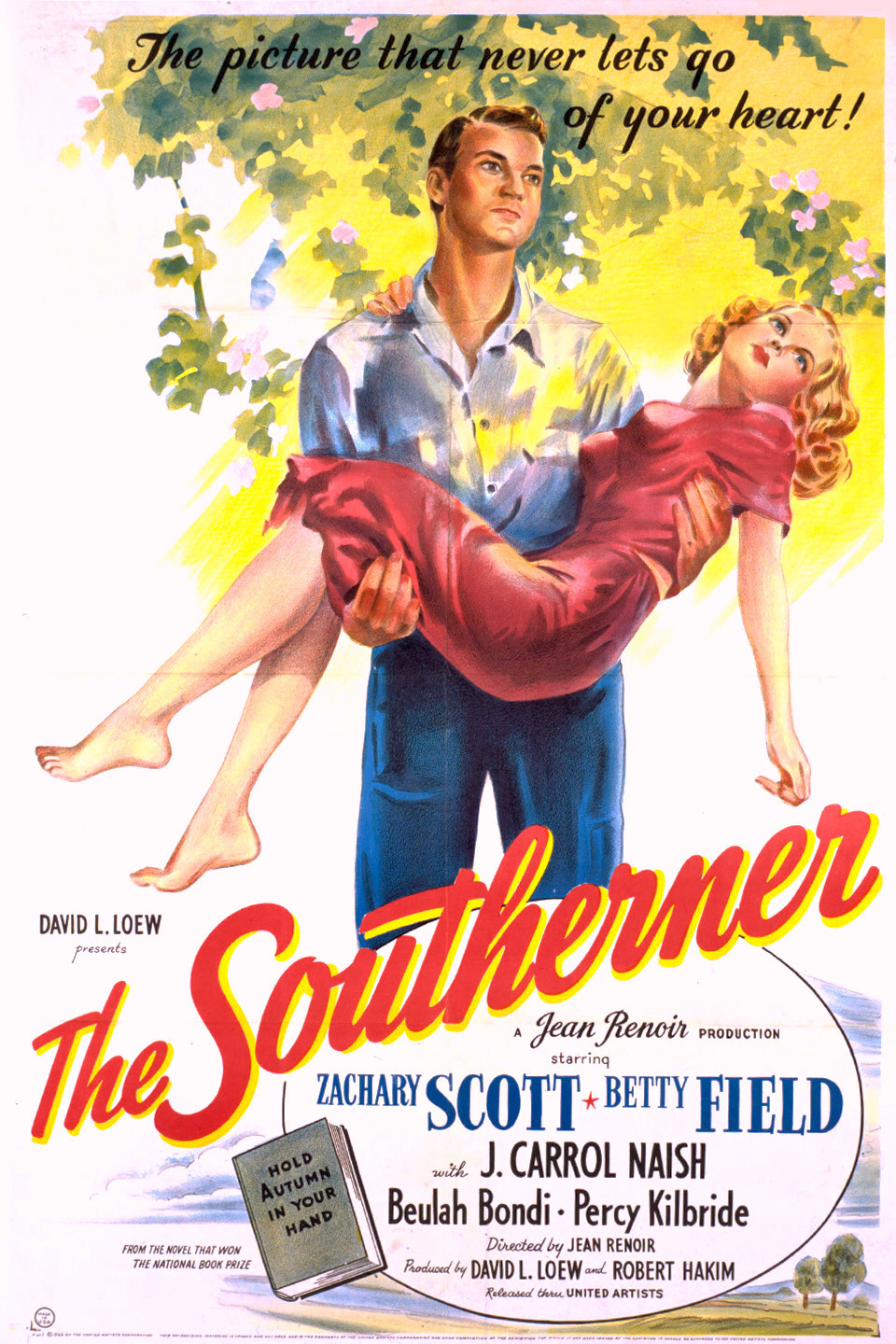
The Southerner (1945)
This film presents a really weird dynamic wherein the central family is given almost every reason imaginable to leave their sharecropping farm and go work in one of the modern factories in the city instead, up to and including the complete and total destruction of a whole year's crops and the implication that their children will likely die of malnutrition if they stay. But then they choose the farm anyway because of the sheer indominability of Americana spirit and, like, "freedom" (whatever that word means when you're sharecropping), and the movie frames this as optimism rather than self-destruction. I'm not a starving sharecropper during the Depression, so maybe this is just one of those "you had to have been there" moments, but it is very dissonant to me. The movie is good overall, though! It is a genuinely moving tale of hardship and human connection, directed beautifully by none other than Jean Renoir, and I could have probably watched the big wedding sequence for hours. And for as much as I raise my eyebrows at the (misplaced?) optimism, the movie is a lot more complex than I indicated earlier. There are times when it shows a fairly sharp picture of the functional dead-end "choice" offered to someone like the central family who doesn't own property: either be exploited on a sharecropping farm or be exploited in a factory—and once you do scrape together enough to own a piece of land (as the family's neighbor does here), you operate under a perception of scarcity, where you fight tooth-and-nail to keep anyone else from being able to do the same as you and encroach on your piece of the pie. The American Dream, baby! Grade: B

Television

Superstore, Season 5 (2019-2020)
It doesn't feel quite as vital as it did in previous seasons, but Superstore is still probably my favorite live-action sitcom on TV right now. The show has become a fine-tuned machine for joke delivery, having learned how to utilize every inch of its cast, and its plotting is refreshingly off-format from the traditional sitcom trajectory of will-they-won't they --> dating --> marriage --> kids. I mean, that happens, too, but also, for example, Jonah and Amy's relationship in which Amy has kids from a previous marriage and their conflicts have to do with the power dynamics of their respective jobs and where those jobs will take them feels a lot more genuine and in-touch with how people live now than your typical sitcom. Grade: B+


Music

U.S. Girls - Heavy Light (2020)
Not quite as riveting as their previous album, In a Poem Unlimited, but not without its moments. In particular, "4 American Dollars," the opener, is great, a post-disco banger with a populist rage. The rest of the songs are good, too, if not as strong. I'm not getting a lot out of the spoken-word transitional tracks, and I think the album kind of runs out of steam as it approaches the end. But this is still worth a listen if you've enjoyed Meghan Remy's past work. Grade: B

Sunday, May 10, 2020

Mini Reviews for May 4-10, 2020

Quarantine, Week 8: It's Mother's Day! An actual temporal landmark!

Movies

Becoming (2020)
Basically a puff piece, but I came for the Kamasi Washington score, and while it played less of a role than I would have liked, it was still good. Grade: B-


Pain and Glory (Dolor y gloria) (2019)
Exquisitely filmed—those colors!—and beautifully acted. The story only worked for me in fits, though, which I guess is kind of baked into a movie as fragmented as this one is: the remembered childhood material, the scene where Banderas's character talks to his old lover—and talk about sticking the landing, because the final scene is magnificent. But I had a hard time pulling this together into the stately emotional arc this is trying to be, re: an aging filmmaker coming to terms with his career and his own mortality. Maybe I'll just have to wait a few decades for it to sink in. Grade: B


Speed Racer (2008)
There was a span of about thirty minutes at the beginning of Speed Racer when I thought I might be watching the greatest movie of all time. Then there was still like 110 minutes left of the film, though, and the movie's runtime is absolutely the biggest liability here, letting the movie get tied up in all its gobbledygook wheels-within-wheels plotting, and giving its actors time to get tripped up on the arch cadence the movie requires of them (I'd say only about 30% of the movie's cast really hangs with the "live-action anime" thing this movie is going for, with Christina Ricci being far and away the most tuned in to it). But what emerges at the end of that bloated runtime isn't the greatest movie of all time, but it's still easily my favorite film from the Wachowskis, and probably the most visually dazzling blockbuster of the 21st century until Mad Max: Fury Road (and maybe more dazzling than that one, even). It's a movie about the pure love of a craft and the ingenious lengths scrappy outsiders have to go to snatch that craft away from the cynical influence of corporate interests, and it's not hard to extrapolate what this movie has to say about race car driving into a thesis on the Wachowskis' filmmaking ethos, especially from a movie so exuberantly, overwhelmingly crafted. This is a symphony of lights and edits that verges into the otherworldly in its pure embrace of color, shape, and movement, and at the climax of the movie, when we're basically just falling into a spinning tunnel of fluorescent bursts and red and white stripes, my head almost exploded from sheer sensory joy. Whoosh. Grade: A

Miracle Mile (1988)
Starts as a rom-com, ends as a nightmare, almost literally—I have nightmares about nuclear war all the time, and the final twenty-ish minutes of this movie are probably the most brutal evocation of what those nightmares feel like that I've ever seen committed to media: the twin sadness and despair of seeing human society tear itself apart in a panic as Lovecraftian violence rains from the sky. This is a weird movie, though, because in order to get to that place, it has to take a couple left turns that make the whole thing feel kind of duck-taped together. There's the aforementioned rom-com at the beginning, which is probably the thinnest section of the movie, which then shifts gears into a thriller in which our protagonist has to rally help within the titular Los Angeles neighborhood to escape the city, which finally melts into the straight-up terror of that final act. The juxtaposition of that second and third act is particularly sobering: not only is it deeply tragic to see the lovingly (if roughly) sketched cast of kooks from the middle of the movie dissolve into the mindless panicking masses of the climax, the whole arc argues that collective solidarity is fundamentally incompatible with violence on the scale of a nuclear attack, and as much as I'd like to think that that is incorrect, I don't know if I can really compellingly take that position. Grade: B+

León Morin, Priest (Léon Morin, prêtre) (1961)
A bisexual communist woman debates a hip, hot priest about Marxism, materialism, Christian salvation, and resistance to Nazi occupation during WWII. There's no way this movie wasn't going to be good, and it is good. Its central ideas (especially the tension between collective action and the individualistic ideas of salvation in Christianity) are some of the most potent of 20th century Western religious thought. But for a guy who was so influential on the French New Wave, director Jean-Pierre Melville's cinematic style is distinctly lacking the cool that was a staple of the New Wave, and while there is some tremendous light/shadow interplay, I gotta say that a good portion of this felt kind of stodgy, not helped by the fact that this movie's somewhat heavy-handed voiceover and start-stop pacing underlines thickly that this was adapted from a novel. But what's good is good, and I could watch forever the scenes between Barny and the priest, which luckily comprise a good portion of the film. Grade: B

Television

The Midnight Gospel, Season 1 (2020)
An intriguing concept: take a podcast and edit it into psychedelic animated odysseys that give a surreal narrative context to the podcast conversations. The animation is arranged by Pendleton Ward (i.e. the Adventure Time guy), and it is stunning, unpredictable and funny and unbelievably detailed—this is among the very best animation work ever done for television. On the other hand, the podcast being animated is The Duncan Trussell Family Hour, hosted by this series's co-creator and main voice actor, Duncan Trussell, and I found the conversations gleaned from the podcast to be sophomoric and self-satisfied in the worst ways. So I'm basically 98% here for the animation, with the major caveat that the last two episodes form a mini-masterpiece: the penultimate episode features an interview with a mortician, while the final episode is centered around an interview Trussell did with his own mother just weeks before she died of breast cancer, and I can guarantee that you've never seen nor heard anything like the hour created by these episodes—the most visionary, bracing, and bruisingly honest meditation on death I've ever seen in a television show. So come for that, if nothing else. I kind of hated a lot of the rest, but the animation carried me through. Grade: B

Fanny and Alexander (Fanny och Alexander) (1982)
This television miniseries (later recut into a much shorter [though still three hours long!] theatrical film) was apparently supposed to be the last thing Ingmar Bergman worked on before retiring, and that makes sense. It's at once the culmination of the filmmaker's entire body of work, from the warm group dynamics of Smiles of a Summer Night to the anguished anti-theodicy of his God trilogy to the tortured domestic hell of Scenes from a Marriage to even the use of the stage and stage magic as a figurative investigation of faith from The Magician, while at the same time feeling completely different from anything Bergman had done before: a lush, semiautobiographical coming-of-age epic in which the spirit world bursts from every piece of reality. It's funny (there are fart jokes!) and freaky and sad and, above all, ridiculously ambitious, an attempt to capture the entire spectrum of the human condition, not just from cradle to grave but also beyond the grave. It's also far plottier and immediate than Bergman is typically known for: as much as I've pontificated about the metaphysics of this work, Fanny and Alexander can more or less be experienced as a straightforward Gothic drama about a boy and his sister and their mother as they navigate the trials of their aging aristocratic family, and this series is twisty and conventionally exciting for long stretches in a way that you really can't say of, for example, The Seventh Seal or Cries and Whispers. The whole work stands with the very best that Bergman ever did. Magnificent. Grade: A

Books

Red, White & Royal Blue by Casey McQuiston (2019)
A romance between a fictional First Son of the United States and the Prince of Whales: this is really not my type of book for a lot of reasons, both political and aesthetic, but I was prepared to put that all aside and try to enjoy this as an escapist fantasy. But it's really hard to enjoy something as escapist when it insists on grounding itself within actual real-world (or real-world adjacent) politics with a kind of West-Wing-esque liberal dream, e.g. a left-center woman winning the presidency in 2016 and reelection in 2020, a controversy with a private email server not actually making a difference in the presidential election, etc. Like, can I just read a Tumblr-ish YA romance without the book constantly underlining how much worse the real world is? Can I enjoy the First Son and the Prince hooking up without jokes about Netanyahu and Mitch McConnell? And as long as we're inventing improbable political fantasies like Texas going blue in 2020 or a cool gay independent senator going undercover in a Republican presidential candidate's campaign in order to bring it down from the inside, why even bother with a depressingly realistic Democratic president? Couldn't we have just gone the whole nine yards and made the dream-world president a democratic socialist or something? Anyway, I tried. But on every other page, my concentration was shattered by some political thread my sick brain picked up on. The point of escapist fiction is to escape this hellish reality, and I just couldn't. I know, I know—my brain is broken, and I am incapable of experiencing fun. Grade: D+

Sunday, May 3, 2020

Mini Reviews for April 27 - May 3, 2020

Quarantine, Week 8: I need a haircut.

Movies

John Carter (2012)
I was really into this for the first ten minutes, when I thought it was going to be some kooky meta-pulp thing with stuff like Edgar Rice Burroughs appearing as a character. I was still into it, if lessly so, when it becomes a less kooky but still fun pulp western thing—Stanton feels at his most playful here, and there are some great laugh-out-loud moments built from the editing. Unfortunately, the stage of this movie I was least into, and the one that takes up the bulk of the runtime, is the actual premise of the movie, i.e. when John Carter actually goes to Mars, as the movie quickly devolves into some really tedious Martian sociopolitical action epic. The effects and world/creature design are excellent, which is a saving grace, but the movie loses almost all of its sense of fun. Which is too bad, because if the Mars material had had some Valerian-like invention, I would be proclaiming this an unjustly maligned gem. Instead, I'm stuck with a movie that I only like in pieces, and small pieces at that. Grade: B-

God's Own Country (2017)
On the one hand, the aesthetic of this movie is a snooze, basically the driest kind of cinematic realism you can imagine. On that same hand, this movie doesn't do a ton with its characters who aren't the protagonist—the Romanian love interest is basically just a magically perfect immigrant, and the rest of the cast is even less filled in than that. On the other hand, this movie does an affecting (if a little broad) job of rendering the cage of traditional masculinity, and the final scene is great. So I dunno, I guess I sort of liked the movie as a whole. Grade: B-


Harold & Kumar Go to White Castle (2004)
A thoroughly mixed bag with the usual noxious mix of homophobia and misogyny that was the default garnish to the mainstream American comedy in the 2000s. But I also laughed really hard at the "battle shits" part and at Kumar's daydream where he marries a bag of marijuana, and the scene in the police station is top-to-bottom great, so... what can you do, you know? Grade: B-


Trouble Every Day (2001)
There's a lot to process here. Which do I process first? The cannibalistic sex acts? The (needlessly?) opaque plotting? The fact that I kept confusing the housekeeper with the other female characters in the film? Anyway, I'm on the record as saying that I like Claire Denis when she's at her most brutal and miserable, and I remain on that record now, so I guess I reap what I sow. This feels like every bit the thematic antecedent to High Life in the sense of treating sex in its juicy, bodily materiality and suffering as a sort of embodied existentialism. Kind of wish this movie were set in space, too, though I guess I can't have everything. Grade: B


Sling Blade (1996)
This movie's relative chronological proximity to Forrest Gump doesn't do it any favors, as it highlights that Billy Bob Thorton's protagonist really isn't any less of a hollow symbol than that other emblem of spiritual purity by way of mental disability. Which is too bad, because otherwise, Sling Blade is a haunting, even chilling evocation of existentialism via the American South. I'm particularly impressed with (and surprised by) Thorton's direction here, which is as patient as I've seen in an American mainstream release: shots just linger in a way that reminds me of some intersection between Bergman and Ozu—I wouldn't say that Thorton has a remarkable eye for imagery, but he has a tremendous sense of tone and pace, which renders this philosophical fable with striking clarity. I wish it worked better on the character level, but otherwise, there are some real aces up this movie's sleeve. Grade: B

Tromeo & Juliet (1996)
I'm not super familiar with the Troma world (outside Surf Nazis Must Die, which I saw years ago and hated), but this was as much a delight as an abomination. It's supremely gross, and the incest angle and occasional transphobic flavors (including a very unfunny [what other kind is there?] Ace Ventura riff) are transgressive bridges too far for me. The softcore veneer over everything is also kind of a buzzkill for me, though I think that people who are saying that it's some wild innovation on Shakespeare are forgetting just how sexually lurid the original text of Romeo and Juliet is. But I adore the general ethos of this thing; I've been waiting my whole adult life for a Romeo and Juliet adaptation that treats the Bard's worst major play with the contempt that it deserves, and Tromeo and Juliet gets closest to that ideal. The movie has the bones of a very good farce, and for as much as a lot of the moment-by-moment jokes don't land, a lot of them do land, provided you're willing to go to the juvenile, continuously extra place the film's tone demands—there's just something so funny to me about arbitrarily renaming the character Paris "London" here; sue me. I also appreciate that the juvenile and extra elements are grounded in, like, an actual literacy of the original play—anyone can make a face cheek / butt cheek pun, but only someone who is reasonably familiar with the play can craft a joke as terrific and terrifically dumb as the moment when Romeo swoons, "See how she leans her cheek upon her hand," and the movie cuts to a shot of Juliet's hand resting on her bare posterior. Grade: B

Matewan (1987)
The best thing here is the gorgeously dusky cinematography. The movie's depiction of the 1920 coal miner strike in the town of the same name is otherwise told excitingly enough, and it ticks its ideological boxes: an intersectional coalition of workers united against some truly nasty coal barons. There are some basic foundational things that are pretty shaky, though; the cast is uniformly excellent (including a lil baby Will Oldham!), but the screenplay is pretty indecisive on how to employ them. The striking miners themselves are mostly anonymous outside their respective big scenes, none of the female characters are given much to do, and James Earl Jones comes swaggering in as just about the coolest part of the movie for the first half hour before more or less disappearing for the rest of the film. None of this stops the movie from being a rousing depiction of labor solidarity, but it could have been a lot more effective for me if the character work came together better. Grade: B

Television

Barry, Season 2 (2019)
This is a pretty messy season, and it loses a lot of the considered, Shakespearean arc of its first year. This isn't all bad: the freedom from that structure allows for some interesting arcs for, for example, Sally, who struggles with the intersection (or lack of intersection) of emotional honesty with acting success. At other times, though, the season is tonally all over the place, and while that was also true of the first season, this season struggles to tie it all together in the way that the first season did. I enjoy NoHo Hank as a screen presence, but his sort of cheery self-help-obsessed mob guy feels like forced shtick this time around, as disconnected from the main plots as he becomes. And with this season's ending, it's glaring how much the show is contorting itself to preserve its central cast, even when the plotting would seem to demand, for example, the death of Fuches. I'm complaining a lot because this is such a step down from the first season, but there are still a lot of engaging elements being juggled here: Henry Winkler's performance, the light satire of the aspiring acting community, a completely bonkers fifth episode that's nothing like anything the show has done before. But that juggling is a lot less elegant this time around. Grade: B

Brooklyn Nine-Nine, Season 7 (2020)
It's fine, just like every other season of Brooklyn Nine-Nine. The show is walking through the motions of an aging sitcom (characters getting pregnant!), but the remarkable thing about this show is that it seems incapable of showing age, and its quality has remained absolutely constant throughout its run. It began as a mildly funny workplace sitcom with a great cast and an iffy premise, and it remains precisely that—no more, no less. Grade: B


King of the Hill, Season 3 (1998-99)
The show dips its toe a little less frequently into issues commentary this time around, which is good, because that still feels as awkward a gesture as ever (and I'm not always sure whether it's a joke or serious—e.g. the episode "Love Hurts... and So Does Art," which resolves with Hank bringing in a sheriff to an art exhibit to enforce Texas's [fictional?] law against modern art). But on the whole, this season feels like a total maturation into King of the Hill as I remembered it, the sweet show about the light absurdities of its characters' small-town Texas psychologies, and even some things I didn't remember: there are full multi-episode arcs here, which are often very sweet (the best being Hank and Peggy's ongoing struggle with infertility, which culminates in a poignant finale). More so than most animated shows of its era, this season has a sense of continuity to it that caught me by surprise. The structure of this season is unexpectedly complex for the kind of series that it is, and everything and everyone just feels so much richer this time around, fully realizing the promise of those first two seasons. But it achieves this without ever losing touch with its core episodic structure, which you know I love. Very funny, very sweet television. Yup. Grade: A-

Music

Fiona Apple - Fetch the Bolt Cutters (2020)
If Fiona Apple is going to only release albums once a decade, they might as well keep being among the best of the decade. Fetch the Bolt Cutters is dazzling, a percussive, bewildering torrent of acid poetry. It's whimsical in the best ways (several dogs are credited as performers on the album) while also being a brutally serious engagement with the very texture of existence and what that existence means when overlapping with other people's existences. And the lyrics. Fetch the Bolt Cutters lacks the surrealism of The Idler Wheel's tumultuous words, but Fiona's no less considered of a wordsmith here; in fact, she's better than she ever has been in that regard. Simultaneously blunt and so razor-edged that they'll cut your fingers clean off without you even feeling the pressure of the blade if you aren't careful—I love these lyrics; I want to put them in a book; I want to put them on posters and paper my house walls with them. I would quote some of the standout lyrics, but every single word sung is its own universe. Anyway, this album is great. Believe the hype. Grade: A

Sunday, April 26, 2020

Mini Reviews for April 20-26, 2020

Quarantine, Week 7: Increasingly unsure of the days of the week.

Movies

The Turning (2020)
I lost interest in this pretty quickly when it became clear that the movie was going to do absolutely nothing with the rather exquisite set. Just watch The Innocents if you want to see a great film adaptation of Turn of the Screw. But then oh boy, did the last five minutes pull in my attention again: I don't think I've ever seen a mainstream film released by a major studio have such a flabbergastingly fumbled ending. Either the movie thinks that it can evoke the rich ambiguity of James's novel by throwing in a bunch of incomprehensible, out-of-context plot twists and edits, or else the production team just got tired of the whole project and just arbitrarily rolled the credits after splicing in all the remaining footage they had. Either way, it's incredibly, fascinatingly dumb, and I want to know the backstory. Grade: C-

Democrats (2014)
I feel extreme skepticism about a movie like this—a documentary by a Western filmmaker about political turmoil under an aging Marxist state in a post-colonial country. Having literally no knowledge of Zimbabwe's history or politics, I really don't know exactly how much of that skepticism is valid with regards to this movie's stance on the contentious creation of Zimbabwe's new constitution following its 2008 election, though there are a few things raising major red flags for me (esp. the uncritical way to which it gestures toward "international intervention" in Zimbabwe's politics from the West). So who knows how useful this documentary is at actually documenting the broader political realities of Zimbabwe. All that being said, as a generalized take on a very specific kind of political activity (in this case, the drafting of a national constitution), this movie is stupendous, almost entirely on the virtues of the access granted to its film team. I'm not sure if we've ever gotten this intimate of a cinematic document on the shaping of a nation's central laws: the camera crew of this documentary were somehow allowed to sit in the room as representatives from the ruling political party and the opposition party edit and collaborate and shout at each other over specific pieces of the constitutional drafts, along the way showing the push and pull between democratic/populist energy and the inertia of a political establishment. It's fascinating stuff, and I gladly would have watched a 4-hour Wiseman-style documentary with just the camera stuck in those negotiation rooms rather than the rather brisk 90 minutes that this movie is. Grade: B


Holy Smoke (1999)
I was not a huge fan of the setup—Indian cult? fake terminal illness?—but man oh man does this movie cook when it's just Harvey Keitel and Kate Winslet locking horns in a psychosexual battle of wills. As in her similarly dismissed In the Cut, Jane Campion takes this movie to some really fearless places that are deeply uncomfortable, and the results are some fascinating interrogations of power and human desire. But unlike In the Cut (and virtually every other Campion feature), this movie is actually very funny on top of all that. So as it turns out, this whole narrative of how Campion lost her way at the turn of the millennium and then found it again with Bright Star is just a bunch of noise, and honestly, Bright Star is maybe my second-least-favorite Campion feature after Portrait of a Lady. I wanna see more of this, Jane! Grade: B+

Meeting People Is Easy (1998)
Maybe this is less true now that Radiohead have become de-facto elder statesmen of rock and their whole ethos has more or less stabilized since the OK Computer-->Kid A-->Amnesiac cycle, but I definitely remember a long period of time when the music press, as much as they praised their albums, somewhat dismissed the individuals in the group as a bunch of antisocial grumps. Perhaps they are antisocial and grumpy, but golly, I'd be too if I had to endure interviewer after interviewer lob the most inane questions and comments at me. Questions like, I kid you not, "Is OK Computer rock music?", and comments like, "This seems like music for wrist-cutters." I've heard people say that Meeting People Is Easy isn't really a very good tour documentary, and it's true that its lo-fi, impressionistic, at-times inscrutably garbled style is at odds with giving us good concert footage (though fans will still be treated to more or less straightforward concert gems like early renditions of "Nude" and "Life in a Glasshouse"). But when it comes to rendering the subjective experience of the hell that is doing a world tour and a million interviews with skeptical, ham-fisted journalists, this movie rocks. The fatigue and disorientation Meeting People Is Easy evokes is compelling, and to give us the catharsis of seeing the cool spectacle of Radiohead bringing down the house with "Paranoid Android" or something would probably have been antithetical to that subjective effect. Grade: B

Dirty Harry (1971)
I was kind of thinking that the "fascist-lite" allegations against this movie were overblown, given that it was unfolding like a more-or-less conventional and honestly kind of dull "loose cannon"/urban apocalypse cop movie—yes, I realize this was basically the first, but just because you're the first to promote problematic mythology doesn't absolve you of the problematic mythology, especially if you're not going to be interesting about it. But then we get to the scene when Harry tells the DA of San Francisco that the 4th and 5th Amendments to the Constitution are "wrong," and I was like, "Ohhhh... I see what people are talking about..." Anyway, this movie picks up as it gets more outlandish near the end: e.g. Harry intentionally crashes a school bus full of kids in order to catch the Zodiac Killer. Don't worry; all the kids are okay. I would be interested in seeing a horror/dark-comedy remake in which all the ridiculously risky gambits Harry makes in this movie actually don't pay off, and Harry is just some deranged cop with stern-dad vibes who violated people's rights, shot a hostage, and killed a school bus's worth of children, because this is nuts. "Loose cannon" indeed. Grade: C

Guess Who's Coming to Dinner (1967)
Nobody told me that the opening 15 minutes are virtually identical to the opening of Get Out, though I'd been plenty warned that this movie is the epitome of "I would have voted for Obama a third time" cinema. It's also stagey and largely boring, full of impossible people (Spencer Tracy's character owns a major newspaper? Sidney Poitier's character is the assistant director of the World Health Organization??) walking through shallow, well-intentioned sanctimony. Most of what makes the parts that aren't boring interesting is a kind of cultural artifact perspective: for example, the movie's... interesting understanding of what late '60s rock and roll is. But the acting in this movie is also stellar and makes the film way more watchable than it would have been otherwise. No surprise given the presence of Poitier (who, per usual, does God's work of breathing real life into respectability politics' wet dream) and Tracy/Hepburn—but golly, Tracy and Hepburn are magnificent together here, and the best parts of the movie by far are the ones they share together, particularly the mid-movie drive where they get ice cream (a real shame Tracy wasn't alive for On Golden Pond, because their relationship here has a lot of the same energy and might have been able to save that movie from its own saccharine). The same, I'm afraid, can't be said for Hepburn's niece, Katharine Houghton, who is, both as written and acted, one of the most vapid screen presences I've seen in a while. Grade: C

She Wore a Yellow Ribbon (1949)
Somewhat difficult for me to swallow the lionizing of the U.S. Cavalry and General Custer specifically (Michael Bluth looks in bag labeled *Old Hollywood Western*: "I don't know what I expected"), even more difficult considering that the whole plotting with the cavalry mission against the Indians is right up there with the love triangle as the most tedious part of the movie. But Lord have mercy, this movie is probably the best use of Technicolor of the 1940s, and John Wayne gives a legitimately great performance and absolutely rocks that mustache. Some really great character acting from the guy who plays Sgt. Quincannon (Victor McLaglen), too. I kinda wish this whole movie was just a wistful hangout dramedy with Wayne and McLaglen's characters just futzing around the fort as they contemplate their upcoming retirement. The parts of the movie that are that are top-tier. Grade: B

I talked about this movie with some smart folks on the Cinematary podcast—if you're interested, you can listen here!

Television

Better Call Saul, Season 5 (2020)
With Jimmy McGill having fully transformed into Saul Goodman (thus completing the show's prequel arc), Better Call Saul could have easily just called it a day, giving itself over completely to place-setting for Breaking Bad. But that's not what Better Call Saul does, blessedly. Instead, as we watch Jimmy tumble into the craven abyss of his alter ego, we see him grasping frantically at those around him, and what Season 5 becomes is something of a battle for the soul of Kim Wexler. It has, in short, pivoted from the Greek tragedy of its first season to full-on Shakespearean tragedy now. In doing so, the show finds some of its most conventionally exciting plotting in a couple seasons, bolstered by some incredibly tense setpieces as well as some legitimately stomach-turning character work. Alongside a newfound purpose for Nacho (he gets his best arc in seasons) as well as a renewed relevance of Mike (who is much more organically integrated into the story than last season), Season 5 is Better Call Saul at the top of its game. Really great stuff. Grade: A

Books

Lemony Snicket: The Unauthorized Autobiography by Lemony Snicket (2002)
Basically a book-length indulgence in A Series of Unfortunate Events's postmodern affectations. Some of it is hilariously bewildering, most notably the introduction, in which there are four nested narrations and circular definitions; other parts are puzzles, where you have to piece together underlined words to get codes and morsels of information relevant to unraveling the intentionally opaque mysteries of the main series; other parts are just kind of inscrutable and odd, like the series of photos near the end with incomplete captions. There's not a lot of actual substance here once you get past the literary and linguistic games, and there's nothing as inspired as the best moments of the main series. But it is still pretty funny on a moment-by-moment basis, and I remain impressed and somewhat gobsmacked that Snicket/Handler was able to publish the equivalent of a Danielewski or Nabokov novel for kids. Madness. Grade: B

Christine by Stephen King (1983)
One of the weaker novels from Stephen King's golden era, if you ask me. It's overlong, misanthropic (and often specifically misogynist), and doesn't find a real emotional core in its characters until near the end. Plus, it does this irritating thing (that admittedly is also true of The Shining) where it's crystal clear exactly where this is going at least a hundred pages from the end, making the lead-up to the climax frustratingly slow rather than simmeringly intense. It's not without its charms, though: there's a great sense of geography here—it's the rare King book not set in Maine, but its Pennsylvania small-town setting is vividly evoked. Also, King's use of rock and roll car lyrics works really well to highlight the dually liberating and sinister undercurrents of that mythology, and as an avowed ally of public transit and a sworn enemy of personal vehicle ownership, I do get a kick out of the idea that car ownership is basically a Faustian deal with a demon. Still, that's not enough to buoy this book completely for me. Grade: C+

Sunday, April 19, 2020

Mini Reviews for April 13-19, 2020

Quarantine, Week 6: Hey, at least I did an interview! With a really good poet and friend! Read it here if you missed it.

Movies

Band of Robbers (2015)
Pretty dumb. Advertises itself as a modern-day-set adaptation of The Adventures of Tom Sawyer and Adventures of Huckleberry Finn—in reality, it's 97% Tom Sawyer, with the only part from Huckleberry Finn being that bit at the end of the book that hardly anybody likes where Tom impersonates Sid to try to save Jim (Jorge here). The movie somehow simultaneously treats its story less seriously but also less irreverently than Twain's original, and the whole thing has a major case of Early2010sitis, full of low-rent Wes Andersonisms and forced twee. Parts of this were amusing, but on the whole, it's a pretty shoddy effort. Do you want to see Tom Sawyer and Huckleberry Finn (and Joe Harper—hey, good to see that dude get a shout-out for once) drinking craft beer? Then by all means, hit this movie up before it leaves Netflix. Grade: C

The Devil's Rejects (2005)
A pointedly and unbelievably cruel movie, the hicksploitation of something like The Hills Have Eyes or (less this time around than in the original House of 1,000 Corpses) The Texas Chainsaw Massacre blown out to the grand scope of America itself, a pointedly and unbelievably cruel country if there ever was one. It's an interesting and often compelling decision of Zombie's to refuse mythologizing its central Bonnie-and-Clyde-esque clan, who spend the majority of the movie literally torturing the people they encounter. We Americans love the idea of our outlaws, but this movie makes hay out of the way that that that love is a fair-weather facade that drops the moment we're confronted with outlawism's brutal realities. I'm not sure Zombie or this movie really do much to recognize that, for example, the sexual violence perpetrated by its central family is as totemic as the psychotic cop's embodiment of the faux-respectable post-'70s American Establishment, and I'm hesitant to embrace sincerely the "the enemy of my enemy is my friend" logic that I've seen some people use when talking about the purportedly melancholy ending—or maybe the movie does recognize it, and the famous "Free Bird" finale is just a winking, ironic piece of nihilism showing one American demon brutalizing another. My relatively middle-of-the-road rating speaks to the fact that I'm not really that interested in the way the movie lingers lasciviously over this brutality, but the fact that I am thinking about it this much speaks volumes about how rich this movie can be at times. Also, God, please let me become that Groucho Marx enthusiast when I grow up. Grade: B

Joker (2019)
I liked it—just wanted to make that clear before I get into a list of complaints. I probably made a mistake by putting off seeing Joker for as long as I did, as almost every shot, it seems, I had already seen in some awards-season highlight reel. That said, it probably would have felt familiar anyway, since (as has been widely broadcast) this movie is basically conceived as the intersection of King of Comedy and Taxi Driver within an alternate DC universe. I don't know that Joker does much that those two movies don't already do other than to throw a coat of class warfare over the whole thing, a coat that begins well enough (the defunding of social services as a catalyst for social unrest and individual misery, for example) but kind of feels thin by the end, as the movie, for as much as its "You get what you deserve!" finale gestures toward a leftist rage, takes on a pretty dim view of the proletariat, presenting them as society's mindless id held in sway by a nihilistic icon (another example: the garbage collection strike is multiple times blamed for Gotham's filthy condition rather than whatever poor wages and working conditions these folks are presumably striking about). I did get a chuckle out of the Thomas Wayne / Mike Bloomberg parallels ("anti-rich sentiments!"), though speaking of that, what ultimately happens with the Wayne subplot feels merely like a DC genre obligation, which is disappointing for a movie loudly declaring itself as a work not beholden to the same rules as other superhero movies, and I would have liked to see something more unpredictable play out there; the same goes for the movie's setting in the early 1980s, which feels more like an impulse to appear within the same world as the Scorsese movies it's referencing than an artistically vital choice of its own—it's obviously futile to imagine versions of movies we never got, but I can think of a much more cutting iteration of Joker set in a gentrifying, post-Giuliani (or whatever the DC version of Giuliani is) Gotham, where the class issues are no less urgent but also significantly more papered over by the facade of the ruling class. But anyway, I did begin this review by saying I liked this movie, and I do; for as much as this movie's reach exceeds its grasp regarding all the above issues, it works tremendously as a character study. Joker understands the Joker as a human being more so than any other movie iteration of the character has, and the combination of Joaquin Phoenix's performance and the writing create a richly rendered person whose journey feels true. As much as I don't think the movie quite succeeds in scaling up the Arthur's personal issues to society-wide movements, I think it works great in the opposite direction, showing how broader social movements have personal effects on Arthur himself—it's been done before (again, Taxi Driver, King of Comedy), but Joker does a good job of showing how the Great Society's collapse manifests itself on the psychology of those already living on the margins, and his descent into destructive nihilism is entirely convincing, an effect that I don't think was necessarily a sure thing, even mimicking the movies it does. To end this scattered review on a different note: for as much as this movie's been talked to death in the discourse, I've not seen a ton of discussion about the score by Hildur Guðnadóttir, which is really solid and probably at least as worthy of acclaim as the Phoenix performance most people centered on. I don't know if I'd put it above Little Women's score (probably my pick of the Academy Award nominees), but there's definitely no shame in the Oscars picking this one. Grade: B

The Hills Have Eyes (1977)
Starts really good with some strong "A Good Man Is Hard to Find" vibes before basically settling into a pretty typical grindhouse/exploitation second half. The movie does such a good job of establishing the "normal" family as a thoroughly unlikable locus of white, middle-class, anti-rural entitlement that it's really hard for me to get invested in those same people defeating the mutant hillbillies (who have, moreover, clearly seen the butt-end of the U.S. government a la nuclear testing, eminent domain, etc.). Not really sure how to reconcile those two halves, but maybe that's part of the point, I dunno. Anyway, pieces of this are strong enough that I'm landing positive on the whole. Grade: B


God Told Me To (1976)
An utterly deranged police procedural turned sci-fi pulp turned ecstatic messianic dystopia. Starts as a relatively straightforward investigation of mass killings whose perpetrators claim to be directed by God, and then becomes something else entirely very quickly, something wild and unclassifiable, with shades of The Last Temptation of Christ and preemptive shades of David Lynch. It does not—I repeat, does not—hang together on a moment by moment basis, with scene transitions often feeling like they leave out narrative in between. And it has a, to be charitable, problematic posture toward its African-American characters. But I also can't think of a movie prior to this one that has a more innovative and cosmic-minded approach to the crime thriller format except maybe Kiss Me Deadly. Whacked-out, messy, weirdly compelling. Grade: A-

Season of the Witch (1972)
I started laughing when Donovan's "Season of the Witch" started playing at one point, because it's such a hilariously on-the-nose choice to have that song play in a movie of the same name at the precise moment when the main character is getting into witchcraft. This became less funny when I found out that the movie's original title was Hungry Wives and was marketed as a softcore film ("Caviar in the kitchen, nothing in the bedroom"), but then again, that's funny in its own way, because this movie barely has any nudity and is mostly concerned with suburban couples at dinner parties arguing about if anyone is going to hurry up and smoke some weed already—very sexy, ya know. So I get that this movie was kind of stuck between a rock and a hard place w/r/t the title, but then again, the fact that the movie stuck between the rock and the hard place is a snore to begin with couldn't have helped. Sorry, George A. Romero. You make good movies—just not this one. Grade: C

Images (1972)
In a world where Repulsion exists, I guess it's not surprising that this has a reputation as something of an also-ran. But it is really good (though admittedly, not Repulsion good), anchored by a deliriously off-brand John Williams score (Academy Award nominated), some really tremendous editing by Graeme Clifford, as well as a dynamite central performance by Susannah York, without any of which the movie wouldn't have worked at all. I'm not exactly sure how I feel about the story—there's a lot regarding coercive men as well as the collateral damage of York's character's self-destructive tendencies, but I'm not particularly interested in the whole "woman has crippling guilt over infidelity" angle, which is what this movie is going for probably 50% of the time. But the whole package is freaky and disorienting enough that I'm willing to put style over substance if I have to. Altman's reputation is kind of staked on his use of shaggy, improv-y ensemble pieces, but between this and 3 Women, I think there's ample evidence that he was at least as good at assembling meticulously planned cinematic work, too. Grade: B+

Television

Barry, Season 1 (2018)
I was skeptical of Barry at first; "aspiring actor moonlights as a hitman" sounds like an unintentional parody of the typical post-Breaking Bad "Peak TV" series, and the first couple episodes didn't really make me feel more confident, either, as they're basically the most obvious way to play out that premise. But then it gets good. It's not that Barry does something radically different from what its premise promises—this is exactly that story. But the seriousness and dramatic complexity with which the show ultimately bears out the balls set in motion by its first couple episodes lend Barry a terrific weight, and as the show makes abundantly clear by having its last several episodes revolve around a stage performance of Macbeth, what Barry is ultimately going for (and ultimately succeeds at being) is Shakespearean tragedy. The final two episodes are as breathtaking and bleak as Act V of Macbeth, and in fact, I can't really think of a TV show that's been as successful at this format since Breaking Bad itself. Grade: A-

Music

Paul Simon - Stranger to Stranger (2016)
Paul Simon has, alongside Randy Newman, unobtrusively remained one of the more vital Boomer legacy artists still making new material, and 2016's Stranger to Stranger is probably the best of his legacy period. A quiet, quietly powerful rumination on love, class, despair, and hope, Stranger to Stranger finds Simon with some of his cleanest melodies of recent years, as well as some of his sharpest lyrical turns. Early in the record, he sings that "most obits are mixed reviews," and he's sure to get one when the inevitable happens (criticisms of cultural appropriation will no less dog this album than his earlier efforts); but for the positive portions of the eulogies, I hope people remember this record. Grade: A-