Showing posts with label Jane Campion. Show all posts

Sunday, December 12, 2021

Mini Reviews for December 6 - 12, 2021

In addition to this stuff, I also rewatched The Prince of Egypt and chatted about it on this podcast, if you're interested!

Movies

Pig (2021)
A very sweet, low-key revenge thriller (what a combo of adjectives, huh?) about a man who just really loves his truffle-hunting pig, but what's haunting me about the movie is the mid-film scene inside a trendy Portland restaurant in which retired, off-the-grid ex-chef Nicolas Cage interrogates one of his former employees, who is now the chef at said restaurant, about abandoning his culinary ambitions in order to cave to the tastes of vapid gentrifiers. The rest of the movie is good, but that one scene in particular cuts deep. Grade: B+


The Power of the Dog (2021)
It's not as oblique and mysterious as Jane Campion's best (e.g. The Piano), but it's every bit as feral an interrogation of power and human sexuality. Besides, it's best not to look a gift horse in the mouth, because it might cause us to lose sight of the celebratory fact that at long last we have a new Jane Campion movie! And a really excellent one, too—a tensely written psycho-sexual western sturdily supported by a terrific batch of performances, none greater than Benedict Cumberbatch's seething, animalistic turn as a brooding bully turned sociopathic by his desperate clawing at the mustiest of masculine tropes for protection. I am hit-and-miss on Cumberbatch, so I'm extremely impressed here. He's so good that his character is still manacing even after calling a piano a "pinano" the whole movie. I wonder what it would have been like if this character had shown up in The Piano. Grade: A-

The Apostle (1997)
A great Robert Duvall performance (and several great supporting performances) in search of a great movie. But if the movie it found isn't great by any stretch of the imagination (it's meandering and overlong to a significant fault), it's at least a fascinating one for me nonetheless. The Baptist-inflected evangelicalism of suburban comfort that I grew up with is a far cry to the charismatic revival style of Christianity depicted here, so I don't know if I'm any less of an outsider viewing this as your garden-variety nonbeliever, but it's often riveting to see a completely unvarnished depiction of rural Pentecostalism, free from judgement or condescension. I grew up fairly skeptical of charismatic Christianity, both because of theological prejudices picked up from the churches I attended (and, it must be said, prejudices grounded in my own whiteness, since as this movie shows, charismatic traditions tend to be much more multi-racial than the white enclaves of the less spirit-filled evangelical traditions) and also because the most visible examples I had of these strains of Christianity were of megachurch pastors on TV who obviously were peddling something. But this movie does a pretty good job of showing just what is so meaningful about this sort of tradition, while also not sugar-coating the reality of it or trying to assimilate it to more mainstream tastes—I would say it's a "warts and all" depiction, but the movie seems completely uninterested in leveraging any judgement here that might identify warts at all, including of the iffy atonement theory and afterlife obsession that the churches in the film share with my own upbringing. It's not at all the approach I would have had given the subject matter, but I respect the commitment to the ethos. I wish the narrative of this movie had more going for it. The transformation Duvall's character goes through from ousted pastor to "apostle" is theoretically interesting, but the movie is just so episodic that it's hard to get into it as an arc; meanwhile, the movie seems a lot more impressed with the implications of the character's maniacal possibilities (the film's inciting incident is him more or less killing a man) juxtaposed with his ecstatic piety than feels earned; it kind of just presents these warring impulses in Duvall's character without comment, with little development or interplay (he more or less leaves behind his violent tendencies the moment he's re-baptized, except for the scene in which he beats up a racist dude), which leaves the irony of his character and the catharsis of his redemption arc as more of a conceptual dare than anything truly felt. Which is a shame. The concepts of forgiveness and redemption are some of the thorniest and least-convenient and frankly offensive in Christianity, ones that enrich the faith as much as they scandalize it, and this movie treats them with the same sociological neutrality as it does every other bit of faith here. Duvall's performance is clearly up to the task of that complexity, too, and any life his character has is entirely from the way that he plays the central figure as someone whose fanatical proselytizing and seething fury are drawn from the same ambiguous energy. But without more in the text itself (text which Duvall himself wrote!), that tremendous performance is left twisting in the wind. Too bad, because even with its shortcomings, this movie feels important, at least on a ecumenical level; 1997 is probably the latest moment when this story could be told without being forced into a period setting, and even in '97, it was clear that the totalizing force of the Hillsongs and the Purpose-Driven Churches and that whole white-middle-class homogeneous evangelical mainstream machine were sucking these kinds of regional faith traditions dry, in a mirror to the free trade and globalization at the same time destroying the economies of the communities in which these traditions lived—hell, Steven Curtis Chapman even makes an appearance on the soundtrack, an acknowledgement of the inevitable terminus of this Christian moment. But this movie just feels dry outside of its obviously valuable depiction of a particular milieu. I desperately wish it weren't the case. Grade: B

Repo Man (1984)
An utterly deranged movie. Starts unassumingly enough (punk sells out, starts repossessing cars) only to then stack bizarre detail upon bizarre detail until the sheer accumulation of it all turns it into something that's primal and intuitive while also being heady and complex. Or maybe it's just convoluted and this doesn't really add up to anything, and if that's the case, it only helps the movie's jaded cause of depicting the world as corrupt systems run by jerks on top of corrupt systems run by even bigger jerks... on top of aliens? I dunno. A wild time. Grade: A-


Television

King of the Hill, Season 5 (2000-2001)
I don't know how much there is to say about this show five seasons in. Bobby remains great, as are the episodes that focus on his adolescent trials, the episodes that unironically present Hank's worldview as noble are still pretty eye-roll-y, as are the episodes where the show tries to Say Something, but overall the show remains pretty consistently gently funny with the occasional hilarious gag/episode. At this point, the show seems like it was getting some clout, as it features some notable celebrity guest stars (Brendan Fraser, Snoop Dogg, Paul Giamatti) as well as some Texas royalty in the form of former Texas governor Ann Richards (a limp-wristed George W. Bush also makes an appearance as a character, though the read Dub apparently declined an invite to dub his own voice work); as with its Fox lineup mate The Simpsons, these guests tend to be hit-and-miss in terms of how well they fit into the universe of the series (the governor especially feels inorganic—not the least because she's not a great voice actor). But even so, these don't feel like seismic shifts for the series. It's basically what you'd expect from the series at its height, which is mostly a good thing in my book. Grade: B


Music

Sufjan Stevens & Angelo De Augustine - A Beginner's Mind (2021)
Sufjan Stevens and some dude named Angelo make a single-songwriter record inspired by a bunch of different movies, so obviously this is very specifically catered to my tastes. This is going to appeal to people who like Sufjan's earlier folk work like Seven Swans, and while I do wish this were a little more aesthetically ambitious, there's no denying the songcraft here. A few feel a little shoehorned into the broader film concept, but the range of influences is impressive (Hellraiser III?), and most of the songs here are extremely solid, clever, even emotionally resonant at times, no more so than in the opener, "Reach Out," easily my favorite track here (inspired by Wings of Desire, which I haven't seen). Grade: B+

Sunday, April 26, 2020

Mini Reviews for April 20-26, 2020

Quarantine, Week 7: Increasingly unsure of the days of the week.

Movies

The Turning (2020)
I lost interest in this pretty quickly when it became clear that the movie was going to do absolutely nothing with the rather exquisite set. Just watch The Innocents if you want to see a great film adaptation of Turn of the Screw. But then oh boy, did the last five minutes pull in my attention again: I don't think I've ever seen a mainstream film released by a major studio have such a flabbergastingly fumbled ending. Either the movie thinks that it can evoke the rich ambiguity of James's novel by throwing in a bunch of incomprehensible, out-of-context plot twists and edits, or else the production team just got tired of the whole project and just arbitrarily rolled the credits after splicing in all the remaining footage they had. Either way, it's incredibly, fascinatingly dumb, and I want to know the backstory. Grade: C-

Democrats (2014)
I feel extreme skepticism about a movie like this—a documentary by a Western filmmaker about political turmoil under an aging Marxist state in a post-colonial country. Having literally no knowledge of Zimbabwe's history or politics, I really don't know exactly how much of that skepticism is valid with regards to this movie's stance on the contentious creation of Zimbabwe's new constitution following its 2008 election, though there are a few things raising major red flags for me (esp. the uncritical way to which it gestures toward "international intervention" in Zimbabwe's politics from the West). So who knows how useful this documentary is at actually documenting the broader political realities of Zimbabwe. All that being said, as a generalized take on a very specific kind of political activity (in this case, the drafting of a national constitution), this movie is stupendous, almost entirely on the virtues of the access granted to its film team. I'm not sure if we've ever gotten this intimate of a cinematic document on the shaping of a nation's central laws: the camera crew of this documentary were somehow allowed to sit in the room as representatives from the ruling political party and the opposition party edit and collaborate and shout at each other over specific pieces of the constitutional drafts, along the way showing the push and pull between democratic/populist energy and the inertia of a political establishment. It's fascinating stuff, and I gladly would have watched a 4-hour Wiseman-style documentary with just the camera stuck in those negotiation rooms rather than the rather brisk 90 minutes that this movie is. Grade: B


Holy Smoke (1999)
I was not a huge fan of the setup—Indian cult? fake terminal illness?—but man oh man does this movie cook when it's just Harvey Keitel and Kate Winslet locking horns in a psychosexual battle of wills. As in her similarly dismissed In the Cut, Jane Campion takes this movie to some really fearless places that are deeply uncomfortable, and the results are some fascinating interrogations of power and human desire. But unlike In the Cut (and virtually every other Campion feature), this movie is actually very funny on top of all that. So as it turns out, this whole narrative of how Campion lost her way at the turn of the millennium and then found it again with Bright Star is just a bunch of noise, and honestly, Bright Star is maybe my second-least-favorite Campion feature after Portrait of a Lady. I wanna see more of this, Jane! Grade: B+

Meeting People Is Easy (1998)
Maybe this is less true now that Radiohead have become de-facto elder statesmen of rock and their whole ethos has more or less stabilized since the OK Computer-->Kid A-->Amnesiac cycle, but I definitely remember a long period of time when the music press, as much as they praised their albums, somewhat dismissed the individuals in the group as a bunch of antisocial grumps. Perhaps they are antisocial and grumpy, but golly, I'd be too if I had to endure interviewer after interviewer lob the most inane questions and comments at me. Questions like, I kid you not, "Is OK Computer rock music?", and comments like, "This seems like music for wrist-cutters." I've heard people say that Meeting People Is Easy isn't really a very good tour documentary, and it's true that its lo-fi, impressionistic, at-times inscrutably garbled style is at odds with giving us good concert footage (though fans will still be treated to more or less straightforward concert gems like early renditions of "Nude" and "Life in a Glasshouse"). But when it comes to rendering the subjective experience of the hell that is doing a world tour and a million interviews with skeptical, ham-fisted journalists, this movie rocks. The fatigue and disorientation Meeting People Is Easy evokes is compelling, and to give us the catharsis of seeing the cool spectacle of Radiohead bringing down the house with "Paranoid Android" or something would probably have been antithetical to that subjective effect. Grade: B

Dirty Harry (1971)
I was kind of thinking that the "fascist-lite" allegations against this movie were overblown, given that it was unfolding like a more-or-less conventional and honestly kind of dull "loose cannon"/urban apocalypse cop movie—yes, I realize this was basically the first, but just because you're the first to promote problematic mythology doesn't absolve you of the problematic mythology, especially if you're not going to be interesting about it. But then we get to the scene when Harry tells the DA of San Francisco that the 4th and 5th Amendments to the Constitution are "wrong," and I was like, "Ohhhh... I see what people are talking about..." Anyway, this movie picks up as it gets more outlandish near the end: e.g. Harry intentionally crashes a school bus full of kids in order to catch the Zodiac Killer. Don't worry; all the kids are okay. I would be interested in seeing a horror/dark-comedy remake in which all the ridiculously risky gambits Harry makes in this movie actually don't pay off, and Harry is just some deranged cop with stern-dad vibes who violated people's rights, shot a hostage, and killed a school bus's worth of children, because this is nuts. "Loose cannon" indeed. Grade: C

Guess Who's Coming to Dinner (1967)
Nobody told me that the opening 15 minutes are virtually identical to the opening of Get Out, though I'd been plenty warned that this movie is the epitome of "I would have voted for Obama a third time" cinema. It's also stagey and largely boring, full of impossible people (Spencer Tracy's character owns a major newspaper? Sidney Poitier's character is the assistant director of the World Health Organization??) walking through shallow, well-intentioned sanctimony. Most of what makes the parts that aren't boring interesting is a kind of cultural artifact perspective: for example, the movie's... interesting understanding of what late '60s rock and roll is. But the acting in this movie is also stellar and makes the film way more watchable than it would have been otherwise. No surprise given the presence of Poitier (who, per usual, does God's work of breathing real life into respectability politics' wet dream) and Tracy/Hepburn—but golly, Tracy and Hepburn are magnificent together here, and the best parts of the movie by far are the ones they share together, particularly the mid-movie drive where they get ice cream (a real shame Tracy wasn't alive for On Golden Pond, because their relationship here has a lot of the same energy and might have been able to save that movie from its own saccharine). The same, I'm afraid, can't be said for Hepburn's niece, Katharine Houghton, who is, both as written and acted, one of the most vapid screen presences I've seen in a while. Grade: C

She Wore a Yellow Ribbon (1949)
Somewhat difficult for me to swallow the lionizing of the U.S. Cavalry and General Custer specifically (Michael Bluth looks in bag labeled *Old Hollywood Western*: "I don't know what I expected"), even more difficult considering that the whole plotting with the cavalry mission against the Indians is right up there with the love triangle as the most tedious part of the movie. But Lord have mercy, this movie is probably the best use of Technicolor of the 1940s, and John Wayne gives a legitimately great performance and absolutely rocks that mustache. Some really great character acting from the guy who plays Sgt. Quincannon (Victor McLaglen), too. I kinda wish this whole movie was just a wistful hangout dramedy with Wayne and McLaglen's characters just futzing around the fort as they contemplate their upcoming retirement. The parts of the movie that are that are top-tier. Grade: B

I talked about this movie with some smart folks on the Cinematary podcast—if you're interested, you can listen here!

Television

Better Call Saul, Season 5 (2020)
With Jimmy McGill having fully transformed into Saul Goodman (thus completing the show's prequel arc), Better Call Saul could have easily just called it a day, giving itself over completely to place-setting for Breaking Bad. But that's not what Better Call Saul does, blessedly. Instead, as we watch Jimmy tumble into the craven abyss of his alter ego, we see him grasping frantically at those around him, and what Season 5 becomes is something of a battle for the soul of Kim Wexler. It has, in short, pivoted from the Greek tragedy of its first season to full-on Shakespearean tragedy now. In doing so, the show finds some of its most conventionally exciting plotting in a couple seasons, bolstered by some incredibly tense setpieces as well as some legitimately stomach-turning character work. Alongside a newfound purpose for Nacho (he gets his best arc in seasons) as well as a renewed relevance of Mike (who is much more organically integrated into the story than last season), Season 5 is Better Call Saul at the top of its game. Really great stuff. Grade: A

Books

Lemony Snicket: The Unauthorized Autobiography by Lemony Snicket (2002)
Basically a book-length indulgence in A Series of Unfortunate Events's postmodern affectations. Some of it is hilariously bewildering, most notably the introduction, in which there are four nested narrations and circular definitions; other parts are puzzles, where you have to piece together underlined words to get codes and morsels of information relevant to unraveling the intentionally opaque mysteries of the main series; other parts are just kind of inscrutable and odd, like the series of photos near the end with incomplete captions. There's not a lot of actual substance here once you get past the literary and linguistic games, and there's nothing as inspired as the best moments of the main series. But it is still pretty funny on a moment-by-moment basis, and I remain impressed and somewhat gobsmacked that Snicket/Handler was able to publish the equivalent of a Danielewski or Nabokov novel for kids. Madness. Grade: B

Christine by Stephen King (1983)
One of the weaker novels from Stephen King's golden era, if you ask me. It's overlong, misanthropic (and often specifically misogynist), and doesn't find a real emotional core in its characters until near the end. Plus, it does this irritating thing (that admittedly is also true of The Shining) where it's crystal clear exactly where this is going at least a hundred pages from the end, making the lead-up to the climax frustratingly slow rather than simmeringly intense. It's not without its charms, though: there's a great sense of geography here—it's the rare King book not set in Maine, but its Pennsylvania small-town setting is vividly evoked. Also, King's use of rock and roll car lyrics works really well to highlight the dually liberating and sinister undercurrents of that mythology, and as an avowed ally of public transit and a sworn enemy of personal vehicle ownership, I do get a kick out of the idea that car ownership is basically a Faustian deal with a demon. Still, that's not enough to buoy this book completely for me. Grade: C+

Sunday, January 6, 2019

Mini Reviews for December 31, 2018 - January 6, 2019

It's a new year, y'all. A new school semester is about to start (sad!). A new O'Malley is about to be born (happy!). And you can still catch up with my year-end lists (ambivalent!):
-My favorite music of 2018
-My favorite movies of 2018

Movies

Gemini (2018)
Lola Kirk is good as the lead, an amateur gumshoe investigating the murder of the celebrity she was assistant to, but I think that's more because I like Lola Kirk in general than anything to do with this movie in particular. A disappointingly listless neo-noir that gambles its paint-by-numbers plotting on a bafflingly open-ended resolution that makes no sense. Or maybe I'm just dumb. But regardless, I was bored. Also, I know that the neon-and-synths aesthetic is kind of the default for American indie right now, but it would be nice if movies like Gemini at least tried to make it fresh. Feels like a complete afterthought. Not a great outcome for my last movie of 2018. Grade: C


Drinking Buddies (2013)
I've never seen a Joe Swanberg movie before, but this is almost exactly what I've always imagined a Joe Swanberg movie to be: young-ish adults working at a brewery dealing with confusing, low-stakes emotional dramedy; also, hand-held camera; also, Foxygen. Anyway, it's good. A wonderfully prickly performance from Olivia Wilde, which is exactly the sort of thing you need to make this material work. Grade: B


Bright Star (2009)
Jane Camion's John Keats biopic/period romance is gorgeously constructed at every level—especially on the metrics of cinematography, lighting, score, and Abbie Cornish's kind of transcendent performance. Still, maybe it's just that I've never been hugely enthusiastic about Keats's poetry (or poetry of the Romantic Period in general), but I didn't feel a thing watching this movie, and when you're dealing with Romantic poetry, a stony heart is pretty much the death of the form. But for the look and texture of this film and for Cornish's performance, I'm glad to have dropped in. Grade: B


Revolutionary Road (2008)
Handsomely put together, and Roger Deakins's cinematography alongside Thomas Newman's score is frequently breathtaking. As with Sam Mendes's other "the suburbs suxxxx" film, American Beauty, Revolutionary Road's tendency to use its plot as a sledgehammer for a kind of solipsistic message is a liability; the chief irony of the suburbs, that a community design premised on the idea of escaping black people became a source of anguish and oppression for its own residents, is entirely lost on this movie in favor of a sort of vaguely aesthetic lifestyle critique ("the suburbs suck because we can't move to Paris!")—I've not read the Richard Yates novel this is based on, so maybe that was just baked into this story from the get-go. Anyway, the movie is much more effective when it focuses on the smaller-scale, more interior conflict between the movie's central husband and wife, which does a much more incisive job of showing the ways that the enforcement of nuclear-family norms disproportionately affect women than the movie as a whole does of showing the damage of the suburban system. In fact, I'd go so far as to say that this movie would actually be great if it fully committed to the Who's Afraid of Virginia Woolf?-style domestic drama that it so clearly wants to be about 30% of the time. DiCaprio and Winslet are already acting as if they're in an Albee play anyway. Grade: B-

In the Cut (2003)
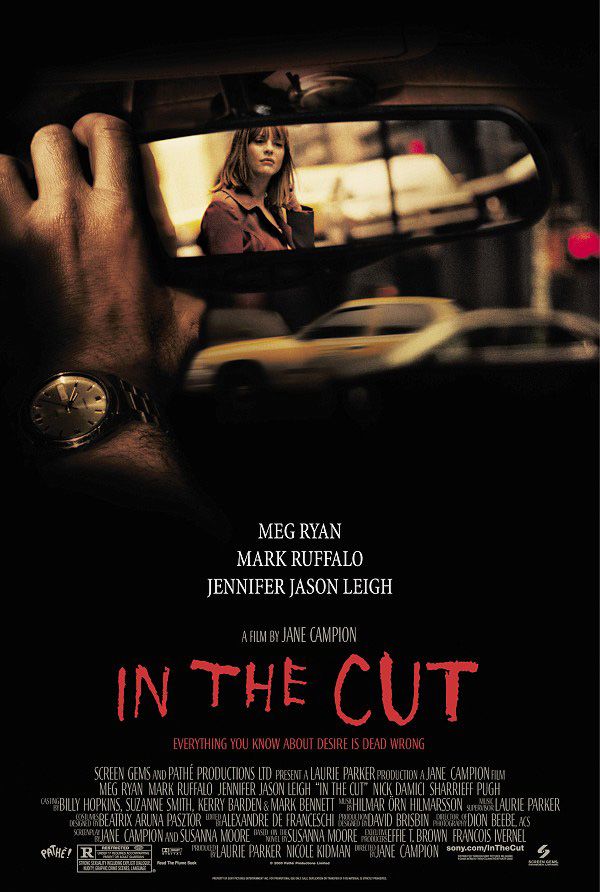
Significantly more interesting than its reputation as Campion's disaster would indicate. On a moment-by-moment basis, the screenplay is mostly gobbledygook ("No sense of cock!"), which I suspect was part of the film's negative reception. The rest, I think, probably has to do with the discomfort of having one of these purportedly Basic Instinct-style erotic thrillers focus so intently on female sexuality as dictated by the female gaze, rather than the typically phallocentric, male-pleasure-centric ideas of sexuality (and the villainizing of that which doesn't fit into that). Although the Basic Instinct angle is something of a feint, too, as this quickly evolves into a film more reminscent of the exercises in interiority and subjectivity that Polanski's Apartment Trilogy brought to the screen more than a purely lurid thriller of the '90s variety (though that Verhoeven-esque feeling of being unable to tell whether or not the movie's stiltedness is intentional artifice or just lousy acting remains). Anyway, this is a genuinely fascinating feature; seeing Campion work through the intersection of violence and sex makes it, more so than any other film in her career, a companion to her masterpiece, The Piano, and the cinematic style is exquisite. It's far from perfect, even putting aside the frankly rotten script, but it's not anywhere close to Campion's worst. I'd actually probably rather watch this again than Bright Star, to be honest. Grade: B

Bad Santa (2003)
It's a deceptively simple movie that manages a neat trick of becoming actually sentimental without ever giving up the dark, vulgarly tragicomic tone that defines the film, which saves it from the whiplash that sometimes plagues comedies that try to have serious emotional stakes. Billy Bob Thorton is also incredible here, plumbing some seriously impressive depths of self-loathing with his performance. So I understand why people like this movie as much as they do. But also, as much as I admire its sprightliness with project, this just isn't for me. Let me check my list twice for all this movie's naughtiness: 1) At the risk of sounding like someone who complains that Star Wars is set in outer space, the film just invests way too much energy into beat after beat of "golly, this Santa sure is bad!", which is both a cheap joke and a repetitive one after the film's first couple scenes. 2) Lauren Graham is criminally misused as this Santa-kink nympho—the movie gives her a half-hearted maternal turn in the movie's back half, which... am I supposed to be impressed by a single character straddling both sides of the Madonna/whore trope? 3) Then there are all the other non-Santa characters, who are sometimes mildly amusing (Bernie Mac's security chief—"HALF") but mostly just flat (Tony Cox as Santa's partner-in-crime elf, whose late-film turn may have worked better if he'd been better developed early on). 4) I'm also not a huge fan of all the casual homophobia and lovely 2003-ness here ("retarded" makes several appearances, as do a couple bits about the litigiousness of people of color/with disabilities). I suppose it's "period appropriate" (my gosh, 2003 is a "period" now), and the movie does have this sort of ironic distance where you're not exactly supposed to be in favor of all this. But I'm just not having fun with it. I realize that a large part of this movie's mode is to burrow so deeply into this darkly miserable comedic space that it comes around full circle and manages to be a sincere character piece, and it's moderately successful at that method, though I think the movie could commit a bit less to being a raunch comedy and a bit more to being a tragic character study if that's what it ultimately wants to become. But you'll forgive me for not really enjoying the trip through the misery, right? Grade: C+

Bubble Bath (Habfürdö) (1980)
A supremely strange animated rumination on domesticity and marriage. I can't claim to really know much about Hungarian animation, but this film's style, in which the character models and backgrounds are in constant motion, stretching and twisting and ballooning in concert with the emotional register of the characters (or, sometimes, seemingly just on a whim), feels pretty radical to me—like a proto-Bill Plympton but on a metric ton of acid. There are also songs. It's a lot: fascinating, confounding, inventive, good. Grade: B


Shanghai Express (1932)
Finds something of a midpoint between Grand Hotel and The Lady Vanishes while being neither as funny at Hitchcock's film nor as rich in pathos as Grand Hotel. It's diverting, and there are some moments ("Shanghai Lily" shrouded in darkness, looking up to God) that are exquisitely lit. But on a technical level, it's full of those kind of restless moments of silence you tend to see in early talkies where they clearly didn't know how to inhabit the sonic space they created, and on a screenwriting level, the central romance is doing precisely nothing for me. Grade: B-


Television

GLOW, Season 2 (2018)
Free from a lot of the setup and introductions that made the first season slow to start, GLOW's second season finds time to deepen the character relationships and make the plot beats a lot more poignant, and the results are wonderful. It's still not really a "message" show in the vein of its Netflix counterpart, Orange Is the New Black, but it does ground its pathos more in the unequal power structures of the showbiz industry, which gives the solidarity that the Gorgeous Women of Wrestling inevitably find a lot more weight. Moreover, this season does a much better job of sorting its characters into primary, secondary, and tertiary groups, which means we get a lot less of the kind of wheel-spinning dead air spent with characters who don't end up amounting to much of the course of the season. But that's not to say that the show is dismissive of any of its characters; with its second season, GLOW realizes its promise as a true ensemble show and, vitally, one of the warmest series on television at the moment. Grade: A-

Books

Motherhood by Sheila Heti (2018)
As much a philosophical dialogue as it is a novel, Motherhood is comprised almost entirely of conversations: ones the protagonist has with her friends, her husband, herself, and even the universe at large (via an I Ching-inspired coin flip system)—all centered on the idea of motherhood, something the childless protagonist, who is quickly aging out of her thirties, is mulling over with increased frequency these days. In the process, the book relentlessly interrogates the assumptions and pressures put on women, even in the 21st century, and while it doesn't always feel exactly new (a lot of this intersects stuff Virginia Woolf was writing about a century ago), it does always feel urgent. There's a part of me that wishes that the book was more explicitly in conversation with its philosophical antecedents (the novel is intensely solipsistic, which is both a feature and a bug), but as someone who is about to be a parent himself, I can't deny that regardless of how much it cites its sources, it was incisive enough to feel like commentary on my own life at times. Grade: B+

Three Men in a Boat (To Say Nothing of the Dog) by Jerome K. Jerome (1889)
A classic humorous travelogue of three men (and their dog)'s boating trip down the Thames. The humor feels a lot like a 19th-century Dave Barry, and as with Barry's work, a lot of this struck me as just mildly amusing—though sections of it are uproariously funny, such as an extended passage in which the narrator describes living in a house with a young couple, where it is frustratingly difficult not to walk in on them making out (and how maybe this was what it was like for the people of England when Henry VIII and Anne Boleyn first met). Honestly, the boating trip itself is pretty dull, but whenever the narrator goes on essay-like digressions like the above one or another highlight in which he muses about how the kitsch of one era becomes the valuable artifact of the next, it's great. Grade: B

The Grim Grotto by Lemony Snicket (2004)
The eleventh book in A Series of Unfortunate Events tones down some of the ethical and metafictional elements that had come to dominate the most recent entries in the series, and the book feels a little slight for it. Its setting inside the submarine named the Queequeg isn't nearly as inventive as past books either, lacking both the satirical bite of something like the high rise in The Ersatz Elevator and the delirious absurdity of The Miserable Mill (though as a whole, the novel is probably about on par with Mill as far as quality goes). The new characters (Captain Widdershins and his step-daughter, Fiona) don't make much of an impact, either, which is a problem for the book's back half and its reliance on these characters' actions for dramatic weight. On the other hand, the book also has some of the tensest setpieces in the series, which makes it a sprightly read despite its relative lack of shine compared to the other entries in the series. So it's kind of a mixed bag. Grade: B-

Music

Simon & Garfunkel - Wednesday Morning, 3 A.M. (1964)
The debut of the famed folk duo has some early highlights, like the original stripped-down version of "The Sound of Silence" and the deep-ish cut "Bleecker Street." But outside those few high marks, the album as a whole is pretty unremarkable, a forgettable collection of folk-revival covers and remade arrangements of traditional songs. "Silence" and "Bleecker" are both Paul Simon originals (as well as a couple others on here), and there's no question that Simon's songwriting is where this duo's strength lies, and the instant Simon & Garfunkel albums became good is the precise moment when they began structuring them around his compositions—i.e. not here. Grade: C+

Sunday, August 28, 2016

Mini-Reviews for August 22 - 28, 2016

Reviews. Read up.

Movies

Kubo and the Two Strings (2016)
There are good discussions to be had about the extent to which this movie appropriates Eastern culture to mostly Western ends, whether or not the characters are too trope-ish or one-joke, whether the plot is too video-game-ish (I'm far from the first to suggest that this may be the best Legend of Zelda movie we ever get). But when you get right down to it, one two things end up mattering to me in any gut-level way here, and both of them are towering and beautiful: the animation and the endingthe animation because this is hands-down the most intricate and gorgeous stop-motion that I've seen in my life, and the ending because it imbues the whole movie with such fantastic and thematically rich meaning about the nature of just what's going on in this movie that it snaps the preceding hour into sharp focus: a focus that turns the film into one of the most well-observed, provocative, and emotionally resonant commentaries on the power of storytelling in recent memory. I cried. Grade: A

High-Rise (2015)
This weird little dystopian satire involving an apartment building so self-contained that its increasingly Dionysian residents never need venture outside its walls proves something I already knew, which is that director Ben Wheatley makes technically fascinating movies that are a little hard to follow and a lot hard to love. This one's a little less aggressively off-putting than his last, the unapologetically surreal A Field in England, by virtue of having big-name stars (hey there, Mr. Hiddleston) and a satirical message so blunt (we live in a society that causes deep, dysfunctional class divides, y'all) that even when the plot gets a little hazy, there's always that frame to hang the scenes on. It's also his prettiest, most technically stunning movie to date: every single frame could be a groovy poster in your dorm. I'm not in love. But I liked it very much indeed. Grade: A-

Maggie's Plan (2015)
Throughout Maggie's Plan, Maggie (Greta Gerwig) has several plans, few of which are all that collected or grounded in much besides short-sighted impulse. I guess the same could be said about the movie as a whole, which flits through its oddly twisty (for this brand of indie dramedy) plot with as much breezy effervescence as Gerwig herself (who is typically fantastic). The result is a movie that is consistently entertaining all the way through without ever really cohering into anything that makes a lot of sense on a macro level. There's a sneaky sort of absurdity that's able to slip the phrase "ficto-critical anthropologist" alongside goofy sperm-donor hi-jinks and whatever on earth Julianne Moore is doing with that accent. Grade: B

Mind Game (マインド・ゲーム) (2004)
Imagine an animated movie that uses an early, metaphysical premise to eventually rope its protagonist into a slapstick middle half-hour set entirely in the belly of a whale, and you've only just begun to plumb the depths of unadulterated crazy that is Mind Game. Now imagine a movie animated in over a dozen styles that it rapidly switches between, often mid-scene: you're getting closer. The sensibilities of Mind Game are totally juvenile (the defining trait of the film's most prominent female character is that she has very large breasts, which have apparently kept her from realizing her childhood dream of being an Olympic swimmer [how could I make this stuff up?]), but those sensibilities, coupled with the completely gonzo animation, are piled up in such magnitude and intensity that the results toe the line between numbing and sublime. Grade: B+

Two Friends (1986)
Sort of like Memento, but with a friendship instead of murderous revenge. I'm being flippantJane Campion's debut feature (which aired on TV, her theatrical review still being three years away) is in turns sweet, poignant, and unapologetically harrowing in the emotional territory it mines. Maybe I'm just a softy, but the backwards-chronological sequencing of the sections makes this film's narrative of a friendship crumbling in reverse have the interesting and crushing effect of having each successively happier moment feel sadder and sadder. As it turns out, a friendship crumbling in reverse is even more painful than seeing one in the regular forward rush. Grade: B+


Music

Beyoncé - Lemonade (2016)
Lemonade is the sort of album we get every once in a while that seems to justify the pop music machine: an intensely collaborative, blockbuster record, the likes of which could never have been made without the piles of dollars and producers Columbia has at its disposal to throw behind its biggest stars, but one that nevertheless feels visionary and personal. This is every bit a commercial, big-label production while still being every bit Beyoncé's album: not just in the sense that she completely owns almost every minute of the record's 45 (I'm still on the fence about how well "Daddy Lessons" works) but also in that this is THE Beyoncé album, the one that's distilled the most potent parts of her identity into an adventurous, definitive statement. The album itself pales in comparison to the "visual album" feature film released alongside the music, and in fact, the record plays a lot like a soundtrack to the movie rather than a distinct work of its own, but as a soundtrack, it's killer. Grade: A-