Quarantine, Week 8: It's Mother's Day! An actual temporal landmark!
Movies
Becoming (2020)
Basically a puff piece, but I came for the Kamasi Washington score, and while it played less of a role than I would have liked, it was still good. Grade: B-
Pain and Glory (Dolor y gloria) (2019)
Exquisitely filmed—those colors!—and beautifully acted. The story only worked for me in fits, though, which I guess is kind of baked into a movie as fragmented as this one is: the remembered childhood material, the scene where Banderas's character talks to his old lover—and talk about sticking the landing, because the final scene is magnificent. But I had a hard time pulling this together into the stately emotional arc this is trying to be, re: an aging filmmaker coming to terms with his career and his own mortality. Maybe I'll just have to wait a few decades for it to sink in. Grade: B
Speed Racer (2008)
There was a span of about thirty minutes at the beginning of Speed Racer when I thought I might be watching the greatest movie of all time. Then there was still like 110 minutes left of the film, though, and the movie's runtime is absolutely the biggest liability here, letting the movie get tied up in all its gobbledygook wheels-within-wheels plotting, and giving its actors time to get tripped up on the arch cadence the movie requires of them (I'd say only about 30% of the movie's cast really hangs with the "live-action anime" thing this movie is going for, with Christina Ricci being far and away the most tuned in to it). But what emerges at the end of that bloated runtime isn't the greatest movie of all time, but it's still easily my favorite film from the Wachowskis, and probably the most visually dazzling blockbuster of the 21st century until Mad Max: Fury Road (and maybe more dazzling than that one, even). It's a movie about the pure love of a craft and the ingenious lengths scrappy outsiders have to go to snatch that craft away from the cynical influence of corporate interests, and it's not hard to extrapolate what this movie has to say about race car driving into a thesis on the Wachowskis' filmmaking ethos, especially from a movie so exuberantly, overwhelmingly crafted. This is a symphony of lights and edits that verges into the otherworldly in its pure embrace of color, shape, and movement, and at the climax of the movie, when we're basically just falling into a spinning tunnel of fluorescent bursts and red and white stripes, my head almost exploded from sheer sensory joy. Whoosh. Grade: A
Miracle Mile (1988)
Starts as a rom-com, ends as a nightmare, almost literally—I have nightmares about nuclear war all the time, and the final twenty-ish minutes of this movie are probably the most brutal evocation of what those nightmares feel like that I've ever seen committed to media: the twin sadness and despair of seeing human society tear itself apart in a panic as Lovecraftian violence rains from the sky. This is a weird movie, though, because in order to get to that place, it has to take a couple left turns that make the whole thing feel kind of duck-taped together. There's the aforementioned rom-com at the beginning, which is probably the thinnest section of the movie, which then shifts gears into a thriller in which our protagonist has to rally help within the titular Los Angeles neighborhood to escape the city, which finally melts into the straight-up terror of that final act. The juxtaposition of that second and third act is particularly sobering: not only is it deeply tragic to see the lovingly (if roughly) sketched cast of kooks from the middle of the movie dissolve into the mindless panicking masses of the climax, the whole arc argues that collective solidarity is fundamentally incompatible with violence on the scale of a nuclear attack, and as much as I'd like to think that that is incorrect, I don't know if I can really compellingly take that position. Grade: B+
León Morin, Priest (Léon Morin, prêtre) (1961)
A bisexual communist woman debates a hip, hot priest about Marxism, materialism, Christian salvation, and resistance to Nazi occupation during WWII. There's no way this movie wasn't going to be good, and it is good. Its central ideas (especially the tension between collective action and the individualistic ideas of salvation in Christianity) are some of the most potent of 20th century Western religious thought. But for a guy who was so influential on the French New Wave, director Jean-Pierre Melville's cinematic style is distinctly lacking the cool that was a staple of the New Wave, and while there is some tremendous light/shadow interplay, I gotta say that a good portion of this felt kind of stodgy, not helped by the fact that this movie's somewhat heavy-handed voiceover and start-stop pacing underlines thickly that this was adapted from a novel. But what's good is good, and I could watch forever the scenes between Barny and the priest, which luckily comprise a good portion of the film. Grade: B
Television
The Midnight Gospel, Season 1 (2020)
An intriguing concept: take a podcast and edit it into psychedelic animated odysseys that give a surreal narrative context to the podcast conversations. The animation is arranged by Pendleton Ward (i.e. the Adventure Time guy), and it is stunning, unpredictable and funny and unbelievably detailed—this is among the very best animation work ever done for television. On the other hand, the podcast being animated is The Duncan Trussell Family Hour, hosted by this series's co-creator and main voice actor, Duncan Trussell, and I found the conversations gleaned from the podcast to be sophomoric and self-satisfied in the worst ways. So I'm basically 98% here for the animation, with the major caveat that the last two episodes form a mini-masterpiece: the penultimate episode features an interview with a mortician, while the final episode is centered around an interview Trussell did with his own mother just weeks before she died of breast cancer, and I can guarantee that you've never seen nor heard anything like the hour created by these episodes—the most visionary, bracing, and bruisingly honest meditation on death I've ever seen in a television show. So come for that, if nothing else. I kind of hated a lot of the rest, but the animation carried me through. Grade: B
Fanny and Alexander (Fanny och Alexander) (1982)
This television miniseries (later recut into a much shorter [though still three hours long!] theatrical film) was apparently supposed to be the last thing Ingmar Bergman worked on before retiring, and that makes sense. It's at once the culmination of the filmmaker's entire body of work, from the warm group dynamics of Smiles of a Summer Night to the anguished anti-theodicy of his God trilogy to the tortured domestic hell of Scenes from a Marriage to even the use of the stage and stage magic as a figurative investigation of faith from The Magician, while at the same time feeling completely different from anything Bergman had done before: a lush, semiautobiographical coming-of-age epic in which the spirit world bursts from every piece of reality. It's funny (there are fart jokes!) and freaky and sad and, above all, ridiculously ambitious, an attempt to capture the entire spectrum of the human condition, not just from cradle to grave but also beyond the grave. It's also far plottier and immediate than Bergman is typically known for: as much as I've pontificated about the metaphysics of this work, Fanny and Alexander can more or less be experienced as a straightforward Gothic drama about a boy and his sister and their mother as they navigate the trials of their aging aristocratic family, and this series is twisty and conventionally exciting for long stretches in a way that you really can't say of, for example, The Seventh Seal or Cries and Whispers. The whole work stands with the very best that Bergman ever did. Magnificent. Grade: A
Books
Red, White & Royal Blue by Casey McQuiston (2019)
A romance between a fictional First Son of the United States and the Prince of Whales: this is really not my type of book for a lot of reasons, both political and aesthetic, but I was prepared to put that all aside and try to enjoy this as an escapist fantasy. But it's really hard to enjoy something as escapist when it insists on grounding itself within actual real-world (or real-world adjacent) politics with a kind of West-Wing-esque liberal dream, e.g. a left-center woman winning the presidency in 2016 and reelection in 2020, a controversy with a private email server not actually making a difference in the presidential election, etc. Like, can I just read a Tumblr-ish YA romance without the book constantly underlining how much worse the real world is? Can I enjoy the First Son and the Prince hooking up without jokes about Netanyahu and Mitch McConnell? And as long as we're inventing improbable political fantasies like Texas going blue in 2020 or a cool gay independent senator going undercover in a Republican
presidential candidate's campaign in order to bring it down from the
inside, why even bother with a depressingly realistic Democratic president? Couldn't we have just gone the whole nine yards and made the dream-world president a democratic socialist or something? Anyway, I tried. But on every other page, my concentration was shattered by some political thread my sick brain picked up on. The point of escapist fiction is to escape this hellish reality, and I just couldn't. I know, I know—my brain is broken, and I am incapable of experiencing fun. Grade: D+
At this point, nothing more than the musings of a restless English teacher on the pop culture he experiences.
Showing posts with label Ingmar Bergman. Show all posts
Sunday, May 10, 2020
Sunday, April 5, 2020
Mini Reviews for March 30 - April 5, 2020
Quarantine, Week 4: What year is it?
Movies
Bacurau (2019)
A lightly sci-fi western set in Brazil. A movie split in two between a "realistic" half and a "Hollywood" half. The first half of the movie is one of the best naturalistic social dramas I've seen in a while, depicting the culture of this village in rural Brazil with a vibrancy that's mesmerizing—in particular, a funeral procession is probably my favorite movie scene of the year so far. The second half of the movie, when it becomes much more self-consciously mannered, works considerably less well for me; while I can't claim to know much about the sociopolitical situation in Brazil besides very broad strokes re: Bolsonaro, etc., unless I'm missing some nuance (very possible), this movie's back half basically just boils down to a message about as nuanced as Ready or Not's assertion that rich people suck, only this time about Western colonialism. And as with Ready or Not, I've got to hand it to Bacurau that Western colonialism does suck. But I do wish the second half of the movie had been as lush as the first half. Still, don't let my reservations hold you back; it's a very solid, conceptually bold movie taken as a whole, one of the better new ones I've seen from this very, very weird cinematic year. Grade: B+
One Cut of the Dead (カメラを止めるな!) (2017)
A ridiculously charming zombie movie in three parts, the second and third of which I really don't want to spoil, because that's part of the fun. Just know that the first part is a single-take zombie short film that's both impressive and also endearingly sloppy in parts, reminiscent of the kind of low-budget zombie flick you might have gotten out of Italy or the American video market in the early '80s. As for the rest, like I said, I won't spoil the next two parts; but I will say that they get increasingly meta in increasingly delightful ways, up to a final thirty minutes that are a hilarious and deliriously sweet take on filmmaking itself—as evocative of my own memories making dumb little videos with my friends in high school as of the zombie tropes it's connected to. It's super fun, and the only thing that's knocking it down even a little bit for me is that the middle part leans a little too heavily on broadly comedic characterizations. Otherwise, this is great. Grade: A-
Newtown (2016)
I almost turned this off in the first five minutes because it was so upsetting—I almost never do that, but hearing 9-11 calls from the elementary school shooting in Newtown is a punishingly difficult gauntlet to throw down in your movie's opening minutes. The rest of this documentary isn't nearly so visceral, focusing as it does on the aftermath of the shooting and how the survivors deal with the grief and activism in its wake, but on a philosophical level, there's something just as upsetting about the way that our country collectively shrugged off any responsibility toward the victims of its own criminally negligent approach to gun violence; the burden of grief was laid entirely on the people of Newtown itself, just as the burden of safety in the aftermath of this (and any number of other school shootings) was laid entirely on the nation's individual schools. I have to sit in meetings at the school where I teach in which the cops come and tell us the most effective way to throw a textbook at a shooter to stop him; I would bet money that U.S. Senators don't have to do that same training. As a documentary, Newtown is content just to skim the surface of its own format and subject matter, but as a thinkpiece on the implications of probably the most capricious and incomprehensibly bleak tragedies of my lifetime to happen within the United States, it's urgent. Grade: B
Proud Citizen (2014)
Like Fort Maria, the other Thom Southerland-directed feature I've seen, Proud Citizen is a warm, loose movie centered around a Linklater-esque sense of time and an excellent Katerina Stoykova performance. This time, she's a Bulgarian playwright whose play has won second place in a contest, which earns her a trip to Lexington, Kentucky, to see her play performed by a local theater (the winning playwright got to go to NYC, which is kind of hilarious). There's a Lost in Translation-ish quality to this movie, wherein Stoykova feels alienated by a city and culture she's unfamiliar with, and in addition to the sweetness of this movie's well-observed moments, on a macro level Proud Citizen does a better job than any other movie I've seen of showing just how inherently inhospitable the modern American city is with its wide highways and underpopulated urban spaces. Down with urban sprawl, up with sensitive Bulgarian playwrights finding unlikely companionship with tour bus guides. Weird observation, though: from this movie, I learned that Lexington has the exact same trolley buses as Knoxville does, which gave me a disorienting moment where I was like, "Wait, are they filming in Knoxville?" Grade: B+
MacGruber (2010)
Even at just 90 minutes, this movie feels stretched thin. But the basic concept of turning the archetypal '80s action hero into basically what they always were (psychopaths) is a solid one, and there are some great jokes sprinkled in here and there—got a good chuckle out of MacGruber driving around bumping yacht rock from his car stereo and a genuinely gigantic chuckle out of the sex scene(s). Shooting from the hip here with this opinion, but those sex scenes are probably the best sex scenes in cinema history. Grade: B-
Donnie Brasco (1997)
The combination of Mike Newell's pedestrian direction and the strong Pacino performance comes this close to having this movie reach a kind of Sopranos-esque mob picture that finds organized crime trapped within the same mundane forces of late-20th-century modernity that make us all miserable: the scene where Pacino is trying to break open a parking meter feels deeply significant. But then again, Mike Newell's pedestrian direction is, well, pedestrian, and anything that isn't the relationship between Pacino and Depp feels thin and tropey (especially all the material between Depp and his character's wife, which... oh boy), and the whole thing becomes just mundane and dull instead of interestingly mundane. I wasn't expecting a ton out of this movie to begin with, but it barely made the minimum of what I was expecting. Grade: C+
The Magic Flute (Trollflöjten) (1975)
Legitimately love the idea of Bergman sitting down after making Cries and Whispers and Scenes from a Marriage—possibly his two most bracing explorations of human misery—and deciding to make this: as exuberantly joyful as those previous two are lacerating. It's just such a sweet movie; Sven Nykvist, who shot Cries and Whispers in all its brilliant hues, delivers some truly astonishing cinematography here, transforming the theater stage into a Méliès-esque fantasy, and the directorial surrogate of the enraptured little girl in the audience of the theater (Bergman apparently saw The Magic Flute performed as a child and loved it) is one of the most purely innocent gestures in all of Bergman's movies. The whole thing is also up there with Persona and The Passion of Anna as the most formally radical movie he ever made; Bergman is occasionally criticized (fairly at times) for bringing too much of his stage background to his movies, but the fantastical blending of the two mediums here makes hay out of the discontinuities between the two forms, giving this movie an otherworldly aura that feels like something on the level of Shakespeare's The Tempest. Based on this movie's reputation, I was expecting a curiosity, but I got a stone-cold classic. Really blown away by all this. Grade: A
Books
The Incendiaries by R. O. Kwon (2018)
In a way, The Incendiaries is another one of those stories that obsess over cults—it is, after all, about a couple of students at a fictitious East-Coast university who become drawn in to a cult lead by a man who claims to have found God in a North Korean gulag, and it ends with an FBI investigation and everything. But while it's definitely situated within that subgenre, The Incendiaries also reaches far beyond that whole scene entirely with its brutal yet empathetic interrogation of belief, becoming great literature in the process. Kwon's debut novel has this Gatsby-esque precision in which the short novel's plotting progresses in a way that's both masterfully efficient and also incisive to the point of blood-letting prose—evoking great swatches of the human experience through a sequence of experiences very specific to this set of characters. Kwon's prose is gorgeous and understands profoundly the way that loss and faith waltz together through a person's psyche; the novel's principal couple is made up of two deeply wounded people whose opposite trajectories (one having lost faith, the other gaining it) find them meeting in the middle for a few blessed moments of human connection before drifting toward the novel's inevitable tragedy. After Gilead, it's probably the best modern novel I've read about faith. I'm not making that Gatsy comparison lightly; like that book, it's a formally perfect and emotionally rich journey that should be held up as an example of what the medium of the novel is capable of. I'm beyond excited for what Kwon will do next. Grade: A
Music
Frances Quinlan - Likewise (2020)
In her solo venture, Hop Along's Frances Quinlan finds a playful, literate sound that's reminiscent of those mid-2000s ladies like Regina Spektor or Kate Nash, only replacing those artist's baroque tendencies with a kind of indie singer-songwriter sensibility. It's immanently catchy and listenable, and I've probably spent more time with this album than any other record released this year, even though it probably isn't even my favorite of the year so far. Good stuff. Grade: B+
Movies
Bacurau (2019)
A lightly sci-fi western set in Brazil. A movie split in two between a "realistic" half and a "Hollywood" half. The first half of the movie is one of the best naturalistic social dramas I've seen in a while, depicting the culture of this village in rural Brazil with a vibrancy that's mesmerizing—in particular, a funeral procession is probably my favorite movie scene of the year so far. The second half of the movie, when it becomes much more self-consciously mannered, works considerably less well for me; while I can't claim to know much about the sociopolitical situation in Brazil besides very broad strokes re: Bolsonaro, etc., unless I'm missing some nuance (very possible), this movie's back half basically just boils down to a message about as nuanced as Ready or Not's assertion that rich people suck, only this time about Western colonialism. And as with Ready or Not, I've got to hand it to Bacurau that Western colonialism does suck. But I do wish the second half of the movie had been as lush as the first half. Still, don't let my reservations hold you back; it's a very solid, conceptually bold movie taken as a whole, one of the better new ones I've seen from this very, very weird cinematic year. Grade: B+
One Cut of the Dead (カメラを止めるな!) (2017)
A ridiculously charming zombie movie in three parts, the second and third of which I really don't want to spoil, because that's part of the fun. Just know that the first part is a single-take zombie short film that's both impressive and also endearingly sloppy in parts, reminiscent of the kind of low-budget zombie flick you might have gotten out of Italy or the American video market in the early '80s. As for the rest, like I said, I won't spoil the next two parts; but I will say that they get increasingly meta in increasingly delightful ways, up to a final thirty minutes that are a hilarious and deliriously sweet take on filmmaking itself—as evocative of my own memories making dumb little videos with my friends in high school as of the zombie tropes it's connected to. It's super fun, and the only thing that's knocking it down even a little bit for me is that the middle part leans a little too heavily on broadly comedic characterizations. Otherwise, this is great. Grade: A-
Newtown (2016)
I almost turned this off in the first five minutes because it was so upsetting—I almost never do that, but hearing 9-11 calls from the elementary school shooting in Newtown is a punishingly difficult gauntlet to throw down in your movie's opening minutes. The rest of this documentary isn't nearly so visceral, focusing as it does on the aftermath of the shooting and how the survivors deal with the grief and activism in its wake, but on a philosophical level, there's something just as upsetting about the way that our country collectively shrugged off any responsibility toward the victims of its own criminally negligent approach to gun violence; the burden of grief was laid entirely on the people of Newtown itself, just as the burden of safety in the aftermath of this (and any number of other school shootings) was laid entirely on the nation's individual schools. I have to sit in meetings at the school where I teach in which the cops come and tell us the most effective way to throw a textbook at a shooter to stop him; I would bet money that U.S. Senators don't have to do that same training. As a documentary, Newtown is content just to skim the surface of its own format and subject matter, but as a thinkpiece on the implications of probably the most capricious and incomprehensibly bleak tragedies of my lifetime to happen within the United States, it's urgent. Grade: B
Proud Citizen (2014)
Like Fort Maria, the other Thom Southerland-directed feature I've seen, Proud Citizen is a warm, loose movie centered around a Linklater-esque sense of time and an excellent Katerina Stoykova performance. This time, she's a Bulgarian playwright whose play has won second place in a contest, which earns her a trip to Lexington, Kentucky, to see her play performed by a local theater (the winning playwright got to go to NYC, which is kind of hilarious). There's a Lost in Translation-ish quality to this movie, wherein Stoykova feels alienated by a city and culture she's unfamiliar with, and in addition to the sweetness of this movie's well-observed moments, on a macro level Proud Citizen does a better job than any other movie I've seen of showing just how inherently inhospitable the modern American city is with its wide highways and underpopulated urban spaces. Down with urban sprawl, up with sensitive Bulgarian playwrights finding unlikely companionship with tour bus guides. Weird observation, though: from this movie, I learned that Lexington has the exact same trolley buses as Knoxville does, which gave me a disorienting moment where I was like, "Wait, are they filming in Knoxville?" Grade: B+
MacGruber (2010)
Even at just 90 minutes, this movie feels stretched thin. But the basic concept of turning the archetypal '80s action hero into basically what they always were (psychopaths) is a solid one, and there are some great jokes sprinkled in here and there—got a good chuckle out of MacGruber driving around bumping yacht rock from his car stereo and a genuinely gigantic chuckle out of the sex scene(s). Shooting from the hip here with this opinion, but those sex scenes are probably the best sex scenes in cinema history. Grade: B-
Donnie Brasco (1997)
The combination of Mike Newell's pedestrian direction and the strong Pacino performance comes this close to having this movie reach a kind of Sopranos-esque mob picture that finds organized crime trapped within the same mundane forces of late-20th-century modernity that make us all miserable: the scene where Pacino is trying to break open a parking meter feels deeply significant. But then again, Mike Newell's pedestrian direction is, well, pedestrian, and anything that isn't the relationship between Pacino and Depp feels thin and tropey (especially all the material between Depp and his character's wife, which... oh boy), and the whole thing becomes just mundane and dull instead of interestingly mundane. I wasn't expecting a ton out of this movie to begin with, but it barely made the minimum of what I was expecting. Grade: C+
The Magic Flute (Trollflöjten) (1975)
Legitimately love the idea of Bergman sitting down after making Cries and Whispers and Scenes from a Marriage—possibly his two most bracing explorations of human misery—and deciding to make this: as exuberantly joyful as those previous two are lacerating. It's just such a sweet movie; Sven Nykvist, who shot Cries and Whispers in all its brilliant hues, delivers some truly astonishing cinematography here, transforming the theater stage into a Méliès-esque fantasy, and the directorial surrogate of the enraptured little girl in the audience of the theater (Bergman apparently saw The Magic Flute performed as a child and loved it) is one of the most purely innocent gestures in all of Bergman's movies. The whole thing is also up there with Persona and The Passion of Anna as the most formally radical movie he ever made; Bergman is occasionally criticized (fairly at times) for bringing too much of his stage background to his movies, but the fantastical blending of the two mediums here makes hay out of the discontinuities between the two forms, giving this movie an otherworldly aura that feels like something on the level of Shakespeare's The Tempest. Based on this movie's reputation, I was expecting a curiosity, but I got a stone-cold classic. Really blown away by all this. Grade: A
Books
The Incendiaries by R. O. Kwon (2018)
In a way, The Incendiaries is another one of those stories that obsess over cults—it is, after all, about a couple of students at a fictitious East-Coast university who become drawn in to a cult lead by a man who claims to have found God in a North Korean gulag, and it ends with an FBI investigation and everything. But while it's definitely situated within that subgenre, The Incendiaries also reaches far beyond that whole scene entirely with its brutal yet empathetic interrogation of belief, becoming great literature in the process. Kwon's debut novel has this Gatsby-esque precision in which the short novel's plotting progresses in a way that's both masterfully efficient and also incisive to the point of blood-letting prose—evoking great swatches of the human experience through a sequence of experiences very specific to this set of characters. Kwon's prose is gorgeous and understands profoundly the way that loss and faith waltz together through a person's psyche; the novel's principal couple is made up of two deeply wounded people whose opposite trajectories (one having lost faith, the other gaining it) find them meeting in the middle for a few blessed moments of human connection before drifting toward the novel's inevitable tragedy. After Gilead, it's probably the best modern novel I've read about faith. I'm not making that Gatsy comparison lightly; like that book, it's a formally perfect and emotionally rich journey that should be held up as an example of what the medium of the novel is capable of. I'm beyond excited for what Kwon will do next. Grade: A
Music
Frances Quinlan - Likewise (2020)
In her solo venture, Hop Along's Frances Quinlan finds a playful, literate sound that's reminiscent of those mid-2000s ladies like Regina Spektor or Kate Nash, only replacing those artist's baroque tendencies with a kind of indie singer-songwriter sensibility. It's immanently catchy and listenable, and I've probably spent more time with this album than any other record released this year, even though it probably isn't even my favorite of the year so far. Good stuff. Grade: B+
Sunday, August 11, 2019
Mini Reviews for August 5-11, 2019
Rvws.
Movies
Missing Link (2019)
Small and slight, but I feel like a healthy diversity of American animated output should make room for these sorts of low-stakes projects. Besides, it's charming, and the craft is exquisite (unsurprising of a Laika feature). Then again, I was saying the same thing about Pixar circa The Good Dinosaur, and now 2019 has the fourth Pixar prequel/sequel in four years, so I guess we'll see if this really is a harbinger for Laika's future. Grade: B
Charlie Says (2018)
I'm seemingly the only person on the planet who does not find the Manson family innately fascinating, despite the case intersecting a lot of my own personal interests ('60s counterculture, the Beatles, film history). I don't really know what it is, except that the idea of a misogynist, white-supremacist madman exploiting vulnerable women and misconstruing the White Album as an apocalyptic prophecy just feels too airy and unhinged to have the sort profound tragic arc of other countercultural movements grounded in actual social realities (Jonestown, the Black Panthers). On the one hand, it's nice that Charlie Says tries to freshen up some of the ossified framework of the Manson saga by grounding it in a very particular and sometimes-ignored perspective of the "Manson girls" themselves (specifically Leslie Van Houten); to the credit of this focus, the movie doesn't get lost in the Manson mythology or get star-struck by Manson's magnetic toxicity, like a lot of depictions of this story do. Director Mary Harron has a strong control of tone and gets some great performances out of everyone involved here without ever letting the charisma of the players overwhelm the larger context of the basic smallness and sadness that the whole Manson situation radiates. I also like the decision to focus part of the film on the de-radicalizing/de-brainwashing process the girls went through during their imprisonment after the murders. But on the other hand, it's kind of disappointing to me that Charlie Says deals most with the details I'm least interested in—the lurid and abusive environment Manson fostered at Spahn Ranch commune, leading up to the notorious murders themselves. What this movie brings new to the table is the most interesting piece of the whole thing to me: the conflict the graduate student visiting the girls in prison feels over the realization that helping the girls shake Manson's delusional ideology from their heads will cause them an enormous amount of suffering, since it will require them to confront their own actions in service of that ideology. The ways that putrid/nonsensical ideas like Manson's become their own shields against the consequences born from the application of those ideas—that's really thorny and compelling territory that's rarely explored in the context of the Manson family, but unfortunately, the movie doesn't give it nearly the obsessive scrutiny that it reserves for the Spahn Ranch flashbacks (which are less flashbacks than they are just 75 percent of the movie), and the prison scenes involving the girls' re-education are disappointingly programmatic: e.g. there's a flashback to Manson laying out his wildly racist delusions, followed by a prison scene where the girls repeat it to the graduate student educating them, followed by another scene where the graduate student brings in a black colleague, who basically just tells the girls, "Uh, that's racist"; lather-rinse-repeat for any number of ideas. There's no real wrestling with what it actually takes to de-program a true believer who believed enough to murder in cold blood, nor of the psychological toll of what it means to, in essence, lose one's faith and sense of moral justification at the same time; instead, it's just a handful of scenes featuring basic refutations of Manson's ideas. I get the impulse to spend more energy at the ranch, since on paper the ability of Manson to brainwash a whole bunch of people into believing his nonsense is one of the more incredulous parts of the whole story. But I dunno, maybe I've just spend too much time around fanatically religious people who believe some bonkers things, but that's never been the part that I had a hard time imagining. It makes total sense how a combination of affection, authority, cosmological vision, and abuse can create a completely dissociative, sheltered, nominally voluntary congregation. Escaping that, though, and coming to terms with what you've done in the name of belief—that's relatively unexplored territory. I know I'm kind of critiquing this movie for not being the movie I wanted it to be, which is bad form. But there's enough here of what I did want to make me pine for more. Grade: B-
Fast Color (2018)
Fast Color has arrived way too late: too late for either the dystopia boom of the early 2010s or the lo-fi indi sci-fi of the same period. I'm not sure if I would have liked it any better back then—genre context does nothing to help thin characters or tedious pacing—but it might at least have had a distinctness and novelty to its execution. As it is right now, it's just heavily evocative of Midnight Special, and in a diminishing way: a throwback of a throwback. Grade: C
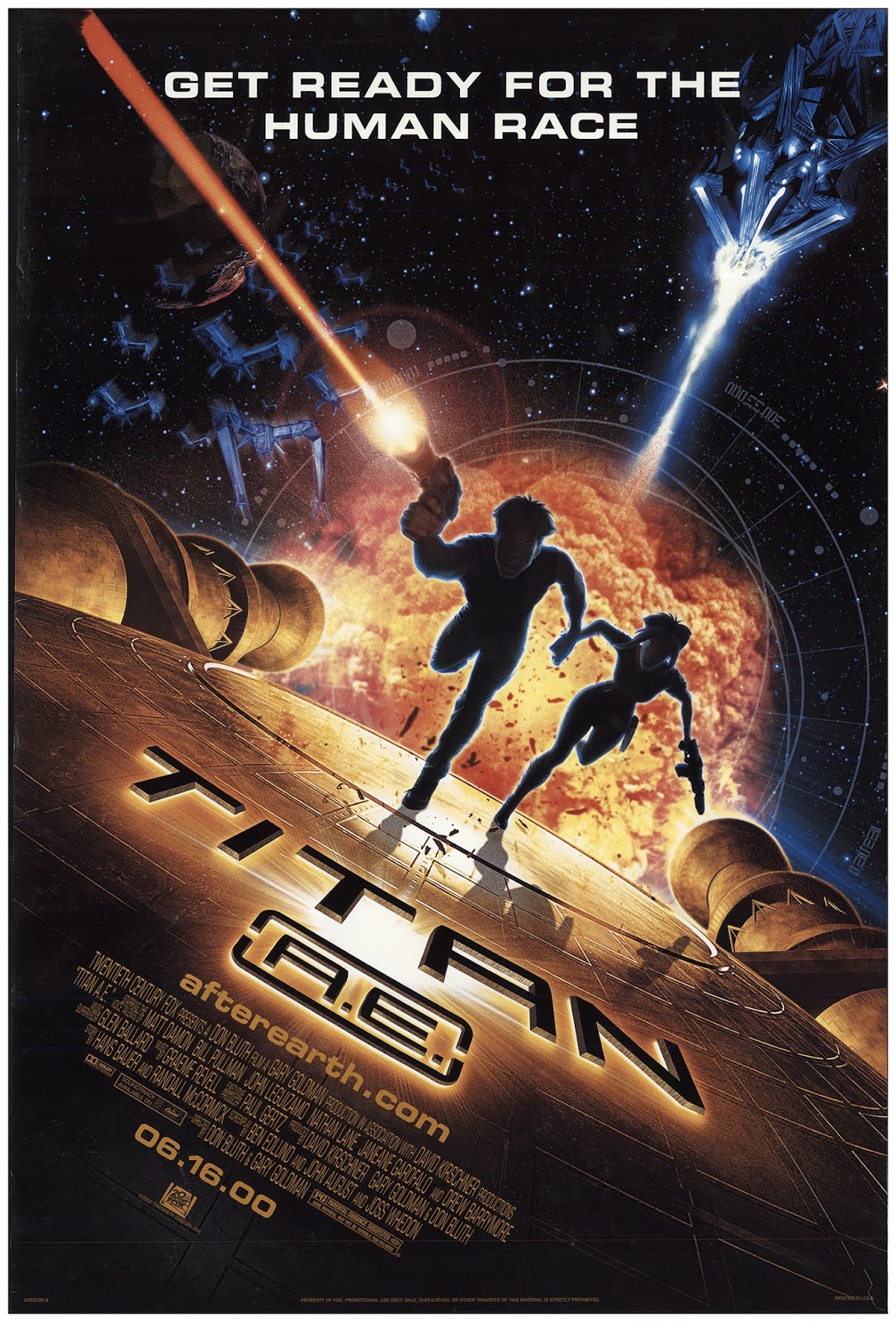
Titan A.E. (2000)
It's weird that Disney saw this movie and decided that they would still make Treasure Planet with both the butt-grunge soundtrack and cel-animation-over-flatly-textured-3D-polygon-backgrounds aesthetic—both huge liabilities in this movie. It doesn't help that this movie's screenplay is bland beyond belief. The bones of this movie are very weak. But the movie's saving graces are saving enough that they keep the movie upright: credit where credit is due, the visual design of this world is very cool, and the cel animation looks tremendous, if you can mentally isolate it from the PS2-level 3D it's interacting with. It's honestly a shame that the exact moment everyone else caught up with the technical possibilities of Renaissance-era Disney animation, they all decided to pivot to CG. Grade: C
Television
King of the Hill, Season 2 (1997-98)
There's a reactionary streak to this show that I'd forgotten about (or maybe it had worked its way out by the time I was watching it), and the episodes that lean into that are pretty cringey—the worst case being "Junkie Business," which involves a complete misunderstanding of the Americans with Disabilities Act. But at the same time, the show is still as sweet and warm as it would ever be, and by this second season, it has a firm grasp on the nuances of its increasingly sprawling cast. Episodes have arcs, but they allow time for bizarre little character moments that make these people feel humanly idiosyncratic even outside their stock characteristics; my favorite example of this is in the second episode, "Texas City Twister," which spends like thirty seconds developing a C plot in which Bobby tries to test out what he's heard about a tornado being able to fling an egg through a brick wall—it's such a small little arc that pays off in a hilarious anticlimax, but the fact that the show makes room for it in an otherwise high-stakes episode just gives the episode so much vitality. When adult animation (I hate that term) on television so often goes for absurd jokes and metacommentary, it's nice to see a show built off of warm, character-based humor, even if it occasionally dips its toe into some eye-roll-worthy politics. Grade: B
Scenes from a Marriage (Scener ur ett äktenskap) (1973)
I've never actually seen the film version of this, but I've had the TV miniseries that the movie was cut from on Blu-ray for ages, and given that behind The Seventh Seal and maybe Persona, this is one of Ingmar Bergman's most influential works on subsequent generations of filmmakers, I figured I needed to watch it. Big surprise, it's great. Each episode is built around one of six "scenes" (though they are occasionally 2-3 scenes apiece), and each of these scenes are constructed from lengthy and claustrophobic conversations; these conversations are allowed to stew for dozens and dozens of minutes at a time until they become almost abstract versions of themselves, the blank walls of the bedchamber becoming a void against which this couple has nothing but themselves, almost as if they are onstage, which was maybe Bergman's intention, given his background in theatre. Bergman's permissive hand allows these conversations to wind in bizarre, digressive shapes that veer from affectionate mundanities to searing arguments, giving these episodes a live-wire feel, as if both everything and nothing about this relationship is contained with every word spoken. The execution here is highly artificial to points that occasionally strain credulity—the way this couple is able to frame everything about their relationship coolly and logically is a superhuman feat of articulation in the face of life-shattering events, and the eventual moment when cooler heads cease to prevail later in the series feels like a similarly calculated and "written" moment—but the great paradox of this film is that from that artificiality pours a messy deluge of bleeding human emotions, right up until the final moments of the series contemplate mortality and existence itself. No matter what rigor with which you impose order onto life, it all becomes subject to our quivering humanity. Grade: A-
Movies
Missing Link (2019)
Small and slight, but I feel like a healthy diversity of American animated output should make room for these sorts of low-stakes projects. Besides, it's charming, and the craft is exquisite (unsurprising of a Laika feature). Then again, I was saying the same thing about Pixar circa The Good Dinosaur, and now 2019 has the fourth Pixar prequel/sequel in four years, so I guess we'll see if this really is a harbinger for Laika's future. Grade: B
Charlie Says (2018)
I'm seemingly the only person on the planet who does not find the Manson family innately fascinating, despite the case intersecting a lot of my own personal interests ('60s counterculture, the Beatles, film history). I don't really know what it is, except that the idea of a misogynist, white-supremacist madman exploiting vulnerable women and misconstruing the White Album as an apocalyptic prophecy just feels too airy and unhinged to have the sort profound tragic arc of other countercultural movements grounded in actual social realities (Jonestown, the Black Panthers). On the one hand, it's nice that Charlie Says tries to freshen up some of the ossified framework of the Manson saga by grounding it in a very particular and sometimes-ignored perspective of the "Manson girls" themselves (specifically Leslie Van Houten); to the credit of this focus, the movie doesn't get lost in the Manson mythology or get star-struck by Manson's magnetic toxicity, like a lot of depictions of this story do. Director Mary Harron has a strong control of tone and gets some great performances out of everyone involved here without ever letting the charisma of the players overwhelm the larger context of the basic smallness and sadness that the whole Manson situation radiates. I also like the decision to focus part of the film on the de-radicalizing/de-brainwashing process the girls went through during their imprisonment after the murders. But on the other hand, it's kind of disappointing to me that Charlie Says deals most with the details I'm least interested in—the lurid and abusive environment Manson fostered at Spahn Ranch commune, leading up to the notorious murders themselves. What this movie brings new to the table is the most interesting piece of the whole thing to me: the conflict the graduate student visiting the girls in prison feels over the realization that helping the girls shake Manson's delusional ideology from their heads will cause them an enormous amount of suffering, since it will require them to confront their own actions in service of that ideology. The ways that putrid/nonsensical ideas like Manson's become their own shields against the consequences born from the application of those ideas—that's really thorny and compelling territory that's rarely explored in the context of the Manson family, but unfortunately, the movie doesn't give it nearly the obsessive scrutiny that it reserves for the Spahn Ranch flashbacks (which are less flashbacks than they are just 75 percent of the movie), and the prison scenes involving the girls' re-education are disappointingly programmatic: e.g. there's a flashback to Manson laying out his wildly racist delusions, followed by a prison scene where the girls repeat it to the graduate student educating them, followed by another scene where the graduate student brings in a black colleague, who basically just tells the girls, "Uh, that's racist"; lather-rinse-repeat for any number of ideas. There's no real wrestling with what it actually takes to de-program a true believer who believed enough to murder in cold blood, nor of the psychological toll of what it means to, in essence, lose one's faith and sense of moral justification at the same time; instead, it's just a handful of scenes featuring basic refutations of Manson's ideas. I get the impulse to spend more energy at the ranch, since on paper the ability of Manson to brainwash a whole bunch of people into believing his nonsense is one of the more incredulous parts of the whole story. But I dunno, maybe I've just spend too much time around fanatically religious people who believe some bonkers things, but that's never been the part that I had a hard time imagining. It makes total sense how a combination of affection, authority, cosmological vision, and abuse can create a completely dissociative, sheltered, nominally voluntary congregation. Escaping that, though, and coming to terms with what you've done in the name of belief—that's relatively unexplored territory. I know I'm kind of critiquing this movie for not being the movie I wanted it to be, which is bad form. But there's enough here of what I did want to make me pine for more. Grade: B-
Fast Color (2018)
Fast Color has arrived way too late: too late for either the dystopia boom of the early 2010s or the lo-fi indi sci-fi of the same period. I'm not sure if I would have liked it any better back then—genre context does nothing to help thin characters or tedious pacing—but it might at least have had a distinctness and novelty to its execution. As it is right now, it's just heavily evocative of Midnight Special, and in a diminishing way: a throwback of a throwback. Grade: C
Titan A.E. (2000)
It's weird that Disney saw this movie and decided that they would still make Treasure Planet with both the butt-grunge soundtrack and cel-animation-over-flatly-textured-3D-polygon-backgrounds aesthetic—both huge liabilities in this movie. It doesn't help that this movie's screenplay is bland beyond belief. The bones of this movie are very weak. But the movie's saving graces are saving enough that they keep the movie upright: credit where credit is due, the visual design of this world is very cool, and the cel animation looks tremendous, if you can mentally isolate it from the PS2-level 3D it's interacting with. It's honestly a shame that the exact moment everyone else caught up with the technical possibilities of Renaissance-era Disney animation, they all decided to pivot to CG. Grade: C
Television
King of the Hill, Season 2 (1997-98)
There's a reactionary streak to this show that I'd forgotten about (or maybe it had worked its way out by the time I was watching it), and the episodes that lean into that are pretty cringey—the worst case being "Junkie Business," which involves a complete misunderstanding of the Americans with Disabilities Act. But at the same time, the show is still as sweet and warm as it would ever be, and by this second season, it has a firm grasp on the nuances of its increasingly sprawling cast. Episodes have arcs, but they allow time for bizarre little character moments that make these people feel humanly idiosyncratic even outside their stock characteristics; my favorite example of this is in the second episode, "Texas City Twister," which spends like thirty seconds developing a C plot in which Bobby tries to test out what he's heard about a tornado being able to fling an egg through a brick wall—it's such a small little arc that pays off in a hilarious anticlimax, but the fact that the show makes room for it in an otherwise high-stakes episode just gives the episode so much vitality. When adult animation (I hate that term) on television so often goes for absurd jokes and metacommentary, it's nice to see a show built off of warm, character-based humor, even if it occasionally dips its toe into some eye-roll-worthy politics. Grade: B
Scenes from a Marriage (Scener ur ett äktenskap) (1973)
I've never actually seen the film version of this, but I've had the TV miniseries that the movie was cut from on Blu-ray for ages, and given that behind The Seventh Seal and maybe Persona, this is one of Ingmar Bergman's most influential works on subsequent generations of filmmakers, I figured I needed to watch it. Big surprise, it's great. Each episode is built around one of six "scenes" (though they are occasionally 2-3 scenes apiece), and each of these scenes are constructed from lengthy and claustrophobic conversations; these conversations are allowed to stew for dozens and dozens of minutes at a time until they become almost abstract versions of themselves, the blank walls of the bedchamber becoming a void against which this couple has nothing but themselves, almost as if they are onstage, which was maybe Bergman's intention, given his background in theatre. Bergman's permissive hand allows these conversations to wind in bizarre, digressive shapes that veer from affectionate mundanities to searing arguments, giving these episodes a live-wire feel, as if both everything and nothing about this relationship is contained with every word spoken. The execution here is highly artificial to points that occasionally strain credulity—the way this couple is able to frame everything about their relationship coolly and logically is a superhuman feat of articulation in the face of life-shattering events, and the eventual moment when cooler heads cease to prevail later in the series feels like a similarly calculated and "written" moment—but the great paradox of this film is that from that artificiality pours a messy deluge of bleeding human emotions, right up until the final moments of the series contemplate mortality and existence itself. No matter what rigor with which you impose order onto life, it all becomes subject to our quivering humanity. Grade: A-
Subscribe to:
Posts (Atom)