Showing posts with label Brooklyn Nine-Nine. Show all posts

Sunday, November 7, 2021

Mini Reviews for November 1 - 7, 2021

I'm not ready for my horror movie month to be over because I'm still looking for good horror movies instead of the trash I've been watching.

Movies

Cabin Fever 2: Spring Fever (2009)
"Oh cool, the Cabin Fever sequel is directed by Ti West! Guess I better check that out!" I cannot stress this enough: do not fall for this bait! Beyond the fact that it's not really a Ti West movie in the proper sense, as West himself disowned the film and it was cut to shreds by producers apparently, it's just awful, awful stuff. Mean-spirited, putrid garbage going through the motions of a really ungainly, try-hard horror-comedy screenplay in such an unfinished state that it just kind of ends and has a cheap-looking animated montage wrap up the film's loose ends. I guess if you're a gorehound, you might find something to like in the truly disgusting body horror on display here, but mostly I found it sad and off-putting. Grade: D-


28 Days Later (2002)
It's a real blast from the past seeing this movie all these years later. As best I can tell, 28 Days Later jump-started that whole zombie craze where everyone of a certain temperament was reading The Zombie Survival Guide and playing Left 4 Dead and that eventually culminated in things like The Walking Dead making us all thoroughly sick of everything to do with zombies. But looking back at this movie, it's easy to see why that craze happened to begin with. It's a pretty striking movie, merging that early-DV cinematography all the cool directors were playing with at the turn of the millennium with some very propulsive and grimy plotting and a savvy approach to the lore. Plus, typical of Danny Boyle, the soundtrack is aces. More Brian Eno and Godspeed in zombie movies, please. I will admit to still being somewhat burned out on zombies, especially the grim-realism version presented in this film, so it's not like this was the hair-raising revelation for me that it must have been to people in 2002. But it's still a solid time. Grade: B+

28 Weeks Later (2007)
It has a lot of the cool stylistic flourishes of its predecessor sanded off: for example, there are no inspired needle drops (or any needle drops to speak of, electing to exclusively use an original score this time around), and most of the cinematographic experimentation is gone, being fully immersed in the era of chaotic shaky cam being merely a tic of mainstream action filmmaking rather than an attempt at finding something new at the margins of narrative film style. So I dunno, this definitely feels a lot more generic than 28 Days Later. But it's still got some cool sequences, and the rightful cynicism of American military occupation feels 100% in line with the themes of the first movie. It just doesn't quite have the verve that buoyed that original. Grade: B-

The Relic (1997)
I've had a pretty bad October in terms of the horror movies I've watched; a lot of that is my own fault for deciding to go through a series as dopey as Friday the 13th, but even besides that, I've seen a lot of bad movies over the past month. I'm tempted to say that I've now seen yet another bad movie, but to be honest, the lighting in this movie is so bad that I'm not sure if I can truly say that I've "seen" it. I'm only being mildly hyperbolic; this movie is nigh unwatchable. I'm hard-pressed to think of a mainstream American movie with this big of a technical blunder. It actually sounds like some good, dumb fun, so I wish I could have seen what was going on. Grade: C


Friday the 13th Part VII: The New Blood (1988)
On the rubric of Friday the 13th movies, this was pretty fun. People make fun of the telekinetic girl, but honestly, she was cool? She has a real character arc, which isn't something you can say for most Friday protagonists, and the final showdown between her and Jason is unironically good. The usual caveats apply—this is still largely formulaic and suffers from the usual laziness that plagues these movies. But it's got some good highlights, which is more than I can say for some of these movies! Grade: B-


Friday the 13th Part VIII: Jason Takes Manhattan (1989)
Criminally boring, given its premise. It's not just that, infamously, Jason doesn't arrive in Manhattan until the final 30 minutes; Jason murdering people on a cruise ship could be cool if: 1. the cruise ship didn't look like a rust-bucket second-hand trawler, and 2. there was actually any attention at all paid to the plotting/pacing. The interminable and nonsensically organized cruise ship sequence makes one long for the clean simplicity of the old "sex, then death" formula of the franchise's classic films—just something, anything to hang these random pile of incidents on so it can take a coherent structure. It gets a little better once Jason reaches Manhattan, but not much. There is one part where he has a really long boxing match with a guy, culminating in Jason punching his head clean off, a scene whose sheer length and repetitiousness has an offbeat "rake joke" feel to it that I found hilarious. Honestly, this movie's unapologetic absurdity has a lot more potential for humor than the more explicitly humorous films in the franchise, but it's completely squandered by the near-total incompetence in construction. I'm pretty tired of this series by now. I just want to get to the space one. Please, let the space one come soon so I can go free. Grade: D+


Television

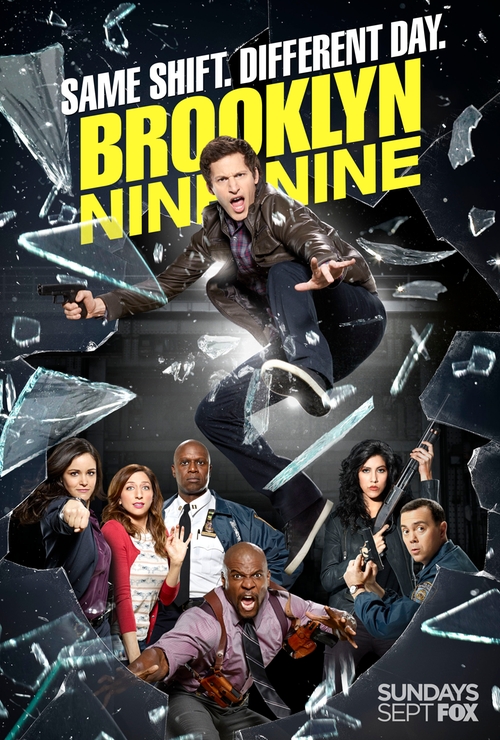
Brooklyn Nine-Nine, Season 8 (2021)
I really need to break this completionist habit of mine. I didn't get anything out of finishing the long-delayed final season of Brooklyn Nine-Nine, and in fact, doing so may have taken the shine off a show I was only ever moderately amused by. It's not that the final season is so much worse than the previous seasons; in many ways, it remains at about the same level of quality in terms of jokes (they're funny! but not extremely so) and character development (it's sweet, but never in a way that gets you too invested). But nonetheless, I found this final season irritating for long stretches because it indulges in my least-favorite of the show's occasional tics, where it feels compelled to try to make this goofy workplace sitcom/cop show into a show that acknowledges the Serious Issues surrounding policing today. Rosa quits her job and becomes an activist following the George Floyd protests; Amy and Holt create a "police reform" plan to fix the NYPD; there's an episode that wrings its hands about the effects of incarceration on people; there's an evil police union character who forms the antagonist for most of the season. There's a joke in the first episode of the season about how "woke" cops fall back on the same scripts of insisting they are "one of the good ones" when they are confronted about the systemic issues of their profession, and that joke would be a lot funnier if the show itself weren't so dead-set on unironically ensuring us that its central cast are "the good ones." It's honestly just embarrassing. Look, you decided to make your show about goofy, cuddly cops; if you aren't going to have the courage to go all the way with your critiques of policing (which would result in a far darker show than B99 has ever even pretended to be), then just have the self-awareness to accept that goofy, cuddly cops have no place in real-world commentary and let them be consequence-free goofy cops. Seriously, I'd rather a show that took place entirely in an alternate universe of utopian policing (which is what B99 is most of the time!) than this sort of nonsensically applied liberal piety. Anyways, that's just my own hangups. Otherwise, if you enjoyed the other seasons of the show, you're probably going to enjoy this one. Grade: C+


Books

The House on Mango Street by Sandra Cisneros (1984)
Lovely. A lot less story-driven than I was expecting it to be; it's mostly just a collection of vignettes about a young Mexican-American girl's relationships with her neighbors on the titular street in Chicago—closer in feeling to a book of poetry than a novel (or a short story collection). Cisneros's prose is great, using the simplicity and whimsy of its child's narration to depict some pretty complex things about the world she inhabits. Plus, it's just beautifully crafted on a sentence-by-sentence level in a way that a lot of literary fiction aspires to but often fails to achieve. Grade: B+

Sunday, May 3, 2020

Mini Reviews for April 27 - May 3, 2020

Quarantine, Week 8: I need a haircut.

Movies

John Carter (2012)
I was really into this for the first ten minutes, when I thought it was going to be some kooky meta-pulp thing with stuff like Edgar Rice Burroughs appearing as a character. I was still into it, if lessly so, when it becomes a less kooky but still fun pulp western thing—Stanton feels at his most playful here, and there are some great laugh-out-loud moments built from the editing. Unfortunately, the stage of this movie I was least into, and the one that takes up the bulk of the runtime, is the actual premise of the movie, i.e. when John Carter actually goes to Mars, as the movie quickly devolves into some really tedious Martian sociopolitical action epic. The effects and world/creature design are excellent, which is a saving grace, but the movie loses almost all of its sense of fun. Which is too bad, because if the Mars material had had some Valerian-like invention, I would be proclaiming this an unjustly maligned gem. Instead, I'm stuck with a movie that I only like in pieces, and small pieces at that. Grade: B-

God's Own Country (2017)
On the one hand, the aesthetic of this movie is a snooze, basically the driest kind of cinematic realism you can imagine. On that same hand, this movie doesn't do a ton with its characters who aren't the protagonist—the Romanian love interest is basically just a magically perfect immigrant, and the rest of the cast is even less filled in than that. On the other hand, this movie does an affecting (if a little broad) job of rendering the cage of traditional masculinity, and the final scene is great. So I dunno, I guess I sort of liked the movie as a whole. Grade: B-


Harold & Kumar Go to White Castle (2004)
A thoroughly mixed bag with the usual noxious mix of homophobia and misogyny that was the default garnish to the mainstream American comedy in the 2000s. But I also laughed really hard at the "battle shits" part and at Kumar's daydream where he marries a bag of marijuana, and the scene in the police station is top-to-bottom great, so... what can you do, you know? Grade: B-


Trouble Every Day (2001)
There's a lot to process here. Which do I process first? The cannibalistic sex acts? The (needlessly?) opaque plotting? The fact that I kept confusing the housekeeper with the other female characters in the film? Anyway, I'm on the record as saying that I like Claire Denis when she's at her most brutal and miserable, and I remain on that record now, so I guess I reap what I sow. This feels like every bit the thematic antecedent to High Life in the sense of treating sex in its juicy, bodily materiality and suffering as a sort of embodied existentialism. Kind of wish this movie were set in space, too, though I guess I can't have everything. Grade: B


Sling Blade (1996)
This movie's relative chronological proximity to Forrest Gump doesn't do it any favors, as it highlights that Billy Bob Thorton's protagonist really isn't any less of a hollow symbol than that other emblem of spiritual purity by way of mental disability. Which is too bad, because otherwise, Sling Blade is a haunting, even chilling evocation of existentialism via the American South. I'm particularly impressed with (and surprised by) Thorton's direction here, which is as patient as I've seen in an American mainstream release: shots just linger in a way that reminds me of some intersection between Bergman and Ozu—I wouldn't say that Thorton has a remarkable eye for imagery, but he has a tremendous sense of tone and pace, which renders this philosophical fable with striking clarity. I wish it worked better on the character level, but otherwise, there are some real aces up this movie's sleeve. Grade: B

Tromeo & Juliet (1996)
I'm not super familiar with the Troma world (outside Surf Nazis Must Die, which I saw years ago and hated), but this was as much a delight as an abomination. It's supremely gross, and the incest angle and occasional transphobic flavors (including a very unfunny [what other kind is there?] Ace Ventura riff) are transgressive bridges too far for me. The softcore veneer over everything is also kind of a buzzkill for me, though I think that people who are saying that it's some wild innovation on Shakespeare are forgetting just how sexually lurid the original text of Romeo and Juliet is. But I adore the general ethos of this thing; I've been waiting my whole adult life for a Romeo and Juliet adaptation that treats the Bard's worst major play with the contempt that it deserves, and Tromeo and Juliet gets closest to that ideal. The movie has the bones of a very good farce, and for as much as a lot of the moment-by-moment jokes don't land, a lot of them do land, provided you're willing to go to the juvenile, continuously extra place the film's tone demands—there's just something so funny to me about arbitrarily renaming the character Paris "London" here; sue me. I also appreciate that the juvenile and extra elements are grounded in, like, an actual literacy of the original play—anyone can make a face cheek / butt cheek pun, but only someone who is reasonably familiar with the play can craft a joke as terrific and terrifically dumb as the moment when Romeo swoons, "See how she leans her cheek upon her hand," and the movie cuts to a shot of Juliet's hand resting on her bare posterior. Grade: B

Matewan (1987)
The best thing here is the gorgeously dusky cinematography. The movie's depiction of the 1920 coal miner strike in the town of the same name is otherwise told excitingly enough, and it ticks its ideological boxes: an intersectional coalition of workers united against some truly nasty coal barons. There are some basic foundational things that are pretty shaky, though; the cast is uniformly excellent (including a lil baby Will Oldham!), but the screenplay is pretty indecisive on how to employ them. The striking miners themselves are mostly anonymous outside their respective big scenes, none of the female characters are given much to do, and James Earl Jones comes swaggering in as just about the coolest part of the movie for the first half hour before more or less disappearing for the rest of the film. None of this stops the movie from being a rousing depiction of labor solidarity, but it could have been a lot more effective for me if the character work came together better. Grade: B

Television

Barry, Season 2 (2019)
This is a pretty messy season, and it loses a lot of the considered, Shakespearean arc of its first year. This isn't all bad: the freedom from that structure allows for some interesting arcs for, for example, Sally, who struggles with the intersection (or lack of intersection) of emotional honesty with acting success. At other times, though, the season is tonally all over the place, and while that was also true of the first season, this season struggles to tie it all together in the way that the first season did. I enjoy NoHo Hank as a screen presence, but his sort of cheery self-help-obsessed mob guy feels like forced shtick this time around, as disconnected from the main plots as he becomes. And with this season's ending, it's glaring how much the show is contorting itself to preserve its central cast, even when the plotting would seem to demand, for example, the death of Fuches. I'm complaining a lot because this is such a step down from the first season, but there are still a lot of engaging elements being juggled here: Henry Winkler's performance, the light satire of the aspiring acting community, a completely bonkers fifth episode that's nothing like anything the show has done before. But that juggling is a lot less elegant this time around. Grade: B

Brooklyn Nine-Nine, Season 7 (2020)
It's fine, just like every other season of Brooklyn Nine-Nine. The show is walking through the motions of an aging sitcom (characters getting pregnant!), but the remarkable thing about this show is that it seems incapable of showing age, and its quality has remained absolutely constant throughout its run. It began as a mildly funny workplace sitcom with a great cast and an iffy premise, and it remains precisely that—no more, no less. Grade: B


King of the Hill, Season 3 (1998-99)
The show dips its toe a little less frequently into issues commentary this time around, which is good, because that still feels as awkward a gesture as ever (and I'm not always sure whether it's a joke or serious—e.g. the episode "Love Hurts... and So Does Art," which resolves with Hank bringing in a sheriff to an art exhibit to enforce Texas's [fictional?] law against modern art). But on the whole, this season feels like a total maturation into King of the Hill as I remembered it, the sweet show about the light absurdities of its characters' small-town Texas psychologies, and even some things I didn't remember: there are full multi-episode arcs here, which are often very sweet (the best being Hank and Peggy's ongoing struggle with infertility, which culminates in a poignant finale). More so than most animated shows of its era, this season has a sense of continuity to it that caught me by surprise. The structure of this season is unexpectedly complex for the kind of series that it is, and everything and everyone just feels so much richer this time around, fully realizing the promise of those first two seasons. But it achieves this without ever losing touch with its core episodic structure, which you know I love. Very funny, very sweet television. Yup. Grade: A-

Music

Fiona Apple - Fetch the Bolt Cutters (2020)
If Fiona Apple is going to only release albums once a decade, they might as well keep being among the best of the decade. Fetch the Bolt Cutters is dazzling, a percussive, bewildering torrent of acid poetry. It's whimsical in the best ways (several dogs are credited as performers on the album) while also being a brutally serious engagement with the very texture of existence and what that existence means when overlapping with other people's existences. And the lyrics. Fetch the Bolt Cutters lacks the surrealism of The Idler Wheel's tumultuous words, but Fiona's no less considered of a wordsmith here; in fact, she's better than she ever has been in that regard. Simultaneously blunt and so razor-edged that they'll cut your fingers clean off without you even feeling the pressure of the blade if you aren't careful—I love these lyrics; I want to put them in a book; I want to put them on posters and paper my house walls with them. I would quote some of the standout lyrics, but every single word sung is its own universe. Anyway, this album is great. Believe the hype. Grade: A

Sunday, June 2, 2019

Mini Reviews for May 27-June 2, 2019

HELLO! The randomly selected reader suggestion for this week is Zardoz! I'll keep the rest of the suggestions in the pool, and if you want to put in a suggestion for next week (or put in a second one), here's the link:

Just click here to submit a suggestion for next week's review post!

Movies

Zardoz (1974) Reader Suggestion!
I love the idea that John Boorman's immediate response after the success of Deliverance was to rush off and make this tripped-out sex odyssey, The Holy Mountain by way of (anachronistically) The Man Who Fell to Earth by way of H. G. Wells's The Time Machine. Truly one of the most singular and bizarre movies to come out of that bananas window between 2001: A Space Odyssey and Star Wars, when a lot of film sci-fi was stretching toward these sort of singular and bizarre statements already. Like a lot of that '70s sci-fi, Zardoz is a shaggy social satire bursting with ideas, striking imagery, and a ton of really off-beat costuming choices. Also like a lot of '70s sci-fi, it only barely hangs together on a plot level, and its reach exceeds its thematic grasp, especially toward its muddled conclusion. In some ways, its structure, where the first half is basically a character getting a tour of this weird future world and the second half is devoted to that character tearing that future world to shreds, feels more of a piece with Brave New World and other talkier socially conscious sci-fi novels of the mid-20th century than it does with '70s sci-fi cinema; in other ways, it bears exactly zero resemblance to anything, literary or cinematic. Not even the James Bond movies showed us this much sweaty Sean Connery skin. Thanks to whomever it was who recommended this movie to me, because that was something. Grade: B

Kaili Blues (路边野餐) (2015)
I was completely in the palm of this movie's hand for about the first hour, enough so that I was thinking about revising my rough "best of the decade" list I've started secretly compiling for the end of the year. Then the 40-minute single-take shot happened, and somehow, that jarred me out of the movie a bit. The shot takes what is initially one man's mystically infused personal quest and then blows it up into the story of the city of Kaili as a whole—which, normally that kind of "personal is a synecdoche of the communal" thing I would be a huge fan of, but there's just something about the way that that element of the movie interacts with those other elements that rubs me wrong, and the movie loses some of its unpredictable magic by tying the film down to what can be attained in a single shot. But make no mistake: this is still very good. It's got that Tarkovsky energy where every frame (that isn't part of the long take) vibrates with this spiritual potential energy that only bursts into something tangible once or twice during the film, but when it does, even subtly, it explodes. There was a shot early in the movie involving a projector and a train where I thought my head was going to melt it was so magical, and the movie ends on a similar effect. The whole thing is profound in this ineffable way that you so rarely get even in this kind of slow cinema, and I had a blast. Grade: A-

Would You Rather (2012)
A macabre, mean little thriller that violently riffs on the titular sleepover game. This gets commonly compared to Cheap Thrills (the reason I watched it, tbh), both being game-based metaphors for America's wealth divide released just a few months apart. Would You Rather has a much sharper political subtext, with the protagonist entering the game because of healthcare debt rather than just generic unemployment and with a much cleaner understanding of how the wealthy/powerful use the violence of the state to coerce the lower classes into a modern capitalistic game that they might otherwise rebel against (there's a butler literally holding everyone at gunpoint here, and it's revealed early on that he used to work for Mi6, so...). But also... Would You Rather just isn't as good as Cheap Thrills. Jeffrey Combs's sadistic gamemaster is about as compellingly watchable as David Koechner's parallel character in Cheap Thrills, but otherwise, the cast here is pretty cardboard and play barely sketched characters who are even less interesting than the performances, to say nothing about the even-less-engaging cinematic style. Plus, the lack of any sort of black-comic edge makes this movie just straight misery, and maybe I'm just a bourgeois loser for wanting my bleak class commentary to be just a tad bit more fun than this, but what can I say? Grade: B- 

The Beginning: Making "Episode I" (2001)
This is a remarkable making-of documentary on a number of counts, including the way it has virtually no interviews and instead presents a kind of fly-on-the-wall/Frederick Wiseman approach onset, giving us viewers a tremendous look at the moment-by-moment process of making The Phantom Menace. But more than anything, with the dramatic irony brought on by watching this in 2019, a deeply sad tragedy undergirds nearly every minute of this movie. Watching, for example, a young Jake Lloyd so genuinely excited to land a role for which he would be mercilessly harassed to such an extent that he would essentially renounce Star Wars forever; Ahmed Best throwing himself so completely and jovially into the physicality of Jar Jar Binks, a performance that would for all intents and purposes end his acting career; George Lucas himself working so dedicatedly to expand and challenge the Star Wars franchise, a vision for which he would receive so much hate that he would sell it off to Disney a mere decade later. This was Lucas's passion project, a bizarre little experimental film that just happened to have a budget of millions and an audience of billions, and regardless of how you feel about the final product of the prequels—I haven't watched them recently enough to have stronger feelings besides the notion that they don't deserve to be the whipping boy for the franchise—there's no denying just how singular the whole Lucas-led Star Wars series was: the most lucrative independent film project of all time, probably the most personal movie franchise to have ever made as much money as it did. In a lot of ways both technical and business-related, The Phantom Menace has proven itself to be one of the most important works of American mainstream filmmaking of the past twenty years, but perhaps the biggest one is how the fallout from this movie (alongside, much later, the Hobbit movies) made studios hit the brakes hard on this sort of blockbuster auteurism and eventually land at the bland competence of, for example, the Marvel Cinematic Universe. In Lucas's own words, Jar Jar is the key—a blessing in the specifics of how we rarely get characters this baldly terrible anymore, a curse in what it means that studios put up the bumpers so high that we can't get a character this baldly terrible again. To watch this documentary is to watch the movie industry change right before your eyes. Grade: A

The Adventures of Robin Hood (1938)
I'm sure this has been said before, but it just clicked with me while I was watching this movie just how important the late '30s were for establishing certain norms in American mainstream entertainment. Among this movie, The Wizard of Oz, and *sigh* Gone with the Wind, there is an enormous innovation in how Hollywood films approach spectacle—no longer the majestic tableau of the silent era or the hushed theatricality of the early sound era but a bombastic-yet-fleet style defined by kineticism and color and musical sweep and actor charisma. The Adventures of Robin Hood is incredibly watchable in a way that feels distinctly modern compared to some of its immediate peers. Errol Flynn is pitch-perfect as Robin, the swashbuckling action is impressively staged and tensely executed, and every bit of this movie is a joy to experience. I had no idea that Disney's Robin Hood movie was basically 80% cribbed from this movie, but it makes sense, given how well this whole package works; why reinvent the wheel? That said, as is the case with most Robin Hood stories, it is a huge deflation that all the simmering populist energy is ultimately in service of propping up a monarch more than it is about the protection of the poor and that the central injustice to be righted in these stories always lands on the wrong person being on the throne rather than the poor being oppressed. So all the bit with King Richard in the movie's climax feels pretty dull to me. On a related note, it's kind of amazing that the 2010s, with all its discourse about wealth inequality and populism, still hasn't managed to make a good Robin Hood movie. Be better, filmmakers. Grade: A-

Television

Brooklyn Nine-Nine, Season 6 (2019)
Still fun enough, I suppose, and the cast is, as always, extraordinarily engaging and winsome. But at this point, I'm mostly sticking with the show out of sunk cost. I've stuck with it this long; why not see it through to the end? I think I'm just tired of it; it's basically the same show it's ever been (the move to NBC doesn't seem to have made any huge creative changes to the show, although it feels just a tad sillier than it used to be—not sure if that would have happened at Fox anyway). But whereas something like Bob's Burgers is off-beat enough that even its recurring tropes don't wear thin, Brooklyn Nine-Nine is so conventionally a workplace sitcom that the longer some of its manners continue, the staler they feel because it's apparent that, aside from the amazing cast, we've been here before. Like I said, it's basically the same it's ever been, so this is more me than the show. But I'm wearing out on the Nine-Nine. Grade: B-

Music

Vampire Weekend - Father of the Bride (2019)
Vampire Weekend isn't aiming for new fans with their first new album in six years. If you hated the preppy cosmopolitanism and Paul Simonisms of their first three albums, you're not going to be swept off your feet by Father of the Bride; if you enjoyed the wry lyrical turns, sharp hooks, and subtle melancholy of their first run, you'll probably find something to like here. I'm mostly in the latter camp, though unfortunately, most of what I found to like were things I'd already found; the best material ("Harmony Hall," "This Life," "Sunflower") the band dropped as singles long before the album's release. It's not as if the songs beyond the pre-release material are bad, but it's disappointing that there isn't a "Hannah Hunt" hiding deep in the tracklist. I suppose some might attribute this to the departure of Rostam Batmanglij from the band prior to this album's recording, and without Batmanglij playing instruments or producing, there's definitely a looser feel to the music. The tight precision of the previous album's production has sometimes been traded for some intentionally messy choices, like including studio chatter or burying melodies in off-format mixing or making the album 18 tracks long (!) or just overall letting the band slow down and sound more jammy, in the style of Grateful Dead or some other '70s FM rock. I gotta say, it's telling that the best song by far here, "Harmony Hall," has a Batmanglij writing credit. It's not that these new styles don't yield good songs or even that these are that radical of changes (like I said, if you liked their previous material, you'll like this), but it's clear to me that the band's strengths lie more in the highly affected production and tight songwriting of their past than in their apparently whoolier future. But the band is hardly adrift without Rostam. As always, their lyrics are barbed in unexpected ways and slyly political. It's fascinating to see what may be the quintessential Obama-era indie band deal with a distinctly post-Obama world, definitively on the other side of the ambivalence of Modern Vampires of the City and into a much more studied weariness; "I know pain is as natural as the rain, I just thought it didn't rain in California," Ezra Koenig sings on "This Life," his duet with Danielle Haim that sums up pretty neatly the intersection of self-aware privilege and regretted idealism at this album's emotional core. There were probably more concise, more disciplined ways to get us to that emotion, but the fact that they made it to begin with is something. Grade: B+

Sunday, May 27, 2018

Mini-Reviews for May 21 - 27, 2018

Don't worry; I'll be starting that Disney retrospective soon. You can expect the first post sometime this week.

Movies


Wonder Woman (2017)
Wonder Woman is, as its thesis on humanity itself says, flawed. This is most notable in its depiction of World War I as a war with "good guys" and "bad guys," a claim the movie tries to undercut later on with discussions about the genocide of indigenous peoples and speeches about how the war is "all of our faults," but there's a lot of clumsiness in that walking back—it says all humans have the capacity for evil and violence and that war is a divine conspiracy for the suicide of the species (good theme, esp. for WWI), but it only actually depicts evil done by the Germans, and by golly, when it comes to film, especially one as visually driven as this, actions speak way louder than words. But what speaks even louder than its mismatched history and uneasy imperialism is Wonder Woman herself, cast and played perfectly by Gal Gadot and, prior to this year's Black Panther, given the most precise and uncluttered character arc any superhero has had since Star Lord in the original Guardians of the Galaxy; after the Jenga-stacked accumulation of the Marvel movies, this sort of clarity is a drink of cool water. And then there's director Patty Jenkins, who does tremendous work turning the Zack Snyder aesthetic into something genuinely iconic and exciting. The Marvel movies have a better grasp of how to create a successfully entertaining movie, but I find the DC project of playing up the otherworldliness and deity of their superheroes to be a much more thematically interesting approach to this material, and it has the potential to pay off richly. As much as the movie has some issues with the execution of its latter half (complaints that it devolves into yet another CG superhero climax are warranted), it's also one of the great blockbuster moments of last year to see this god-like woman look down on humanity and determine that, despite their capacity for evil, human beings are worthy of love and protection. This dialogue about humanity by people who are, by the movie's logic, definitely not human makes this movie's larger themes work on a mythological, even philosophical level, one where the Marvel movies, for all their structural integrity, usually crumble. Wonder Woman's thesis is hard-won and honest humanism in a narrative that acknowledges both the absurdity and necessity of humanism. As much as we can nitpick the specifics of the movie, that's powerful. Grade: B+


Wonder Wheel (2017)
It's an immense frustration to me that the most aesthetically engaging Woody Allen movie in a very long time (I would argue since Shadows and Fog, though there are a few other pit stops since that I'd contentedly settle upon) has the weakest Allen screenplay since Whatever Works, along with at least one bad performance (Justin Timberlake) and at least one iffy one (Kate Winslet). Such is the experience of watching a modern Woody Allen film, where there are frequently very good things among the frequently very bad things. The aesthetic I'll credit to cinematographer Vittorio Storaro, who uses the carnival lighting of the film's intentionally artificial—even music-box-like—Coney Island setting to make everything on screen positively glow with constantly shifting colors (to say nothing of the multiple long takes, all staged perfectly). The screenplay and the performances I've got to credit to Allen, though, since all their hoary tropes (a woman having an affair, you say? My oh my) and structural problems and stiltedness are as much of Allen mainstays as swing jazz. Also, I don't always find biological readings of movies to be compelling or helpful, but come on, there's no way that Allen isn't baiting us here with his story of a guy who is in a relationship with both a woman and her step-daughter. All that said, the movie looks soooo good that I'm tipping this over to a very slight net positive. Grade: C+


Middle of Nowhere (2012)
Unlike a lot of rising acclaimed directors, Ava DuVernay isn't much of a visual stylist, and her writing is, in its grand gestures, never a highlight either. Where her movies excel is at the micro level, the way a small edit creates tension between scenes, the way body language accumulates over a scene to build to great moments of intimacy and humanity. With this skill set, she can get amazing performances out of her actors, and here, Emayatzy Corinealdi and David Oyelowo shine. Also, Corinealdi's character rides the bus a lot and falls in love with a bus driver, so you know this has my number. Grade: B


Birth (2004)
Nicole Kidman's dazzling performance is the mirror image of Mia Farrow's in Rosemary's Baby, each raw and empathetic responses to a trauma that the world around them denies them the catharsis of processing. In Birth, Kidman's character has lost her husband suddenly, and ten years later, a ten-year-old boy comes and tells her that he is her husband, reborn; nobody (including possibly the film's audience) believes the boy but Kidman, who must relive their relationship's life and death through this boy—as depictions of grief and love and the unearthly madness of those emotions go, Birth's is both alien and breathtakingly human. If Kidman evokes Rosemary's Baby, then the film's otherworldly tone is Picnic at Hanging Rock, as we (along with Kidman's character) slip from drama to dream without ever releasing the tether of conscious reality. It's all rather stunning and makes me want to revisit my (lukewarm) feelings on director Jonathan Glazer's Under the Skin, which mines a lot of that same otherworldliness. Plus, if we aren't talking about Alexandre Desplat's score as one of the best of this century, then what are we even doing? Grade: A


8 Mile (2002)
There are two things that work in 8 Mile: 1. the on-location footage of urban/suburban Detroit, and 2. the lengthy rap battle that closes the film. And both of these things do more than work—they practically save the movie. The setting, full of its crumbling homes and cavernous, abandoned urban architecture, evokes a version of Detroit (and I emphasize "version," since I'm sure Detroit—as is the case with my home town of Memphis—doesn't always appreciate its public perception as Exhibit A in The Death of the Mid-Century American City) as something of a poetic squalor that absolutely makes the movie's action more interesting as it clambers over the brick and asphalt of this landscape. And the rap battle, the movie's climax and the only time we see Eminem do much rapping, hums with more live-wire energy than the rest of the movie combined. The rest of the movie, well... it's a pileup of underdog cliches, problematic archetypes (esp. the female characters), and boring drama—to say nothing of the uncomfortable racial component of having Eminem, a white dude, crashing into hip-hop against black antagonists. This is, to an extent, the story of Marshall Mathers himself, so I won't begrudge the movie too much for cribbing the autobiographical details. But given how popular and financially successful Eminem proved (and already had proven) to be relative to even some of the most successful black rappers, there's still something iffy about this guy's main opposition being black rappers. I don't quite know how to do this story without that dynamic, but I'm also not sure we needed much of this movie outside of silent shots of Detroit and that rap battle at the end, so. Grade: B-


Ghost World (2001)
This scratches the same itch as Juno and the better parts of Superbad for me, wherein we watch funny teens on the brink of adulthood using snark to mask the terror and loneliness of coming to grips with the parallel facts that 1. They are about to enter the adult world, and 2. The adult world sucks. Thora Birch, as Enid, plays perfectly that late-teen feeling of being being perpetually irritated by everything (a feeling I relate to deeply), as well as that similarly late-teen vulnerability in recognizing that identity—especially that identity you've cultivated as a high schooler—is both excitingly and scarily fluid (another feeling I relate to deeply). Hers is one of two wonderful performances this movie absolutely wouldn't work without, the other being Steve Buscemi's Seymour, a character that can be argued is just a nice version of a gross archetype (the older dude who falls for a teen, the older dude who thinks the modern world is terrible, the older dude who feels resentful that the women around him are shallow—take your pick; Juno drives this character type right into its dark subtext, to that movie's benefit, I think), but Buscemi's take on the guy is so perfectly pitched toward sadness and self-loathing that it works without him feeling like a sugarcoated MRA or something. Other parts of this movie feel either ill-considered (the weirdly broad convenience store hijinks) or underdeveloped (Scarlett Johansson's Rebecca—Johansson is totally not pulling her weight here, which is disappointing). But together, Birch and Buscemi make this movie a poignant exploration of friendship and loneliness that I fell in love with. Grade: A-

Television


Atlanta, Season 2: Robbin' Season (2018)
Although I enjoyed Atlanta's first season, I wasn't quite as enthusiastic as some of the show's more vocal supporters. Well, count me among the show's more vocal supporters now. Season 2 (or Robbin' Season, as it subtitles itself) is likely the best television we're going to get in 2018. Largely eschewing Season One's surrealism (though we do get a reference to the invisible car) for a more situational strangeness that's rooted in the Theatre of the Absurd, Robbin' Season proves to be a much more flexible and profound beast than it's older counterpart, wrenching hilarity out of terrifying existential labyrinths and horror out of piercing mundanity. In "Barbershop," Alfred (i.e. Paper Boi) is stuck in an episode-long haircut limbo as his barber drags him along for his shaggy-dog to-do list, and it's the funniest TV episode of 2018 to date; in "FUBU," a flashback to Earn's teens is one of the most painful and accurate depictions of high school I've ever seen on TV, and it's the most painful TV episode of 2018 to date; and in "Teddy Perkins," an episode best-approached with as little knowledge of it as possible, Atlanta looks the racism and abuse in show business and even evil itself squarely in the eye, and it's the best TV episode of 2018, period. Watching Robbin' Season recalls the excitement I felt watching Lost's fourth season or Mad Men's fifth, where I had no clue what to expect from week to week except the unfiltered pleasure of a show drunk on its own creativity and sure enough in its hand to pull off every idea it has masterfully. TV like this doesn't come around often, folks. Grade: A


Bob's Burgers, Season 8 (2017-18)
I mean, what can you say about Bob's Burgers anymore? It isn't really a show that innovates on itself, aside from the fun season premiere, "Brunchsquatch," which is animated in the style of some of the series's fan art. In general, though, it's a chronically unambitious show, content to tell small stories of the same variety it's always told, imbued with the same warmth for outsiders and weirdos as it's always had. Nowadays, we tend to value television that's dynamic, television that changes—Breaking Bad is beloved for, among other things, its relentless evolution of its own premise. But let's not forget that for the majority of TV's existence, formula and stasis have been the medium's default, and when a show has as much mastery of its formula as Bob's Burgers does, the dividends can be wonderful. Grade: B+


Brooklyn Nine-Nine, Season 5 (2017-18)
I continue to be gently entertained—rather than completely smitten—by this show, and it's increasingly reliant on the occasional Very Special Episode to address the various societal implications of the series, which I find kind of irritating. But the show's cast is still one of the best in the business, and on a week-to-week basis, it works as basic workplace sitcom comfort food well enough. Plus, the finale ends on a corker of a cliffhanger, which makes me glad that NBC rescued it from cancellation (sad face that the same can't be said of fellow Fox casualty, Last Man on Earth). Grade: B


Books


One Hundred Years of Solitude (Cien años de soledad) by Gabriel García Márquez (1967)
I read this not just because I've wanted to for years (which is true—and truth be told, I tried and failed to read it in high school) but also because I loved Isabel Allende's very García-Márquez-inspired The House of the Spirits so much that I wanted to follow-up. I dunno if this loses me literary cred or whatever, but I preferred House of the Spirits more—it's more emotionally accessible than García Márquez's distanced, often alien fable of Colombian history. Macondo, García Márquez's Colombia in miniature, is a town viewed under a microscope, not lived in, by his readers, and maybe I'm only feeling this way because I'm not Colombian, but also, I don't think it's too much of a stretch to say that we're not supposed to feel for these characters in the same way that we are Allende's. That's not to say this novel isn't also capable of fantastic heights, because it is, taken as a whole, great and at times tremendously powerful, often because of García Márquez's elevated, distancing approach. On the cover of my edition, there's a pull quote from William Kennedy of the New York Times that I've often rolled my eyes at, in which Kennedy compares the novel to the book of Genesis, but now, having read the novel, that's exactly the right comparison. The experience of the novel is very much like reading those early books of the Bible, where the supernatural piles on top of family genealogy which piles on top of history. We're left with a book that feels very much like it was written from the perspective of heaven looking down at Earth, and when the novel's apocalyptic ending—down to its soul-rending final sentence—splays across the last page, it lands like the fist of God itself. Grade: A-

Music


Janelle Monáe - Dirty Computer (2018)
Monáe pulls something of a St. Vincent by making this, her newest album, significantly more pop-centric and lyrically straightforward than her previous outings. There's a part of me that's disappointed in that, as one of the chief things I've loved in the past was her Bowie-like playing around with sci-fi personas and her record-crate-dive approach to genre. On Dirty Computer, the songs are most definitely about Janelle herself, and the music (while somewhat rooted in music history via its Prince inspirations [Prince himself was something of a mentor for Monáe before his passing]) sticks mostly to modern production and contemporary genres. Some of this works extremely well. Monáe gets to rap quite a bit, which is an enormous treat after her all-too-brief bars on her previous two albums, and several of the most modern-sounding tracks on the album—"Pynk," which sounds a lot like Charli XCX's work with PC Music, "Django Jane," which is basically a trap song, and "I Like That," which could have fit comfortably on Lemonade—are among the album's best. But then you've got songs like "Screwed" and "Crazy, Classic, Life," which focus on shout-along choruses, sloganeering, and Katy-Perry-sounding pop production in a way that sounds pretty thin to me. Monáe is clearly feeling liberated and happy at having shrugged off her android persona and come out as pansexual, and I think it's wonderful that she feels that way. The album's thematic through-line re: racial and sexual identity is a strong one, and I wouldn't want her to closet herself again in the interest of bringing back the weirdo sci-fi personas and stuff. But at the same time... I can't help but feel that her music was stronger (or at least more consistent) when it was committed more to being weird. I'd love to see her find a way to rediscover that part of her music without losing the personal touch and openness of the best songs here. Grade: B

Sunday, May 28, 2017

Mini-Reviews for May 22 - 28, 2017

Reviews, etc.

Movies


Pirates of the Caribbean: On Stranger Tides (2011)
It's a modern action blockbuster, so it's like at least thirty minutes too long, and the plotting is convoluted. But thank heavens that it has the good sense to jettison anything resembling the cumbersome mythology of the original two sequels and focus on the humor and swashbuckling action. It's a saving grace that makes the movie more enjoyable than it should be, and I liked it overall, if a bit tepidly. Grade: B-


Pirates of the Caribbean: Dead Men Tell No Tales (2017)
After the first (and still obviously best) Pirates of the Caribbean movie, there's been a bit of a trade-off, franchise-wise: the original two sequels that rounded out the trilogy had the madcap energy of gonzo director Gore Verbinski, but they also had a truly cumbersome plot deadened by everything to do with its convoluted maritime mythology and the lifeless romancing between Orlando Bloom and Keira Knightley. The fourth movie lacked Verbinski's weirdo charms but in exchange threw out the insipid mythologizing and instead offered a much lighter, more swashbuckling movie that hearkened back to the charms of the first. It was alright (see previous review). Now we have the fifth movie in the franchise, and shiver me timbers, the freaking mythology is back, and this time without Gore Verbinski in the director's chair. So what we're left with is something of the worst of both worlds: dour, byzantine, and shakily directed, not to mention dull. The movie can't even get Jack Sparrow right, which seems like the bare minimum we could expect of this franchise up to this point—gone is the winking irony and failing-upward luck, and in its place is something resembling emotional stakes and relentless backstorying (did you ever wonder where Jack got his compass? Well, fasten your seatbelt). Midway through the film, there's even a literal jumping-the-shark moment involving Sparrow; it's come three movies too late, of course, but it's never too late to listen. Grade: C


Paterson (2016)
By feelings toward Jim Jarmusch usually fall somewhere within the realm of disinterested admiration: I can see the craft of his films, but they never do a whole lot for me. Now enter Paterson, and that trend seems to have changed. Centering on a married bus driver (Adam Driver) who writes poetry in his spare time, it's possible that this film just intersects too many of my own personal passions in real life to avoid awakening some strong feelings in me. The movie is a quiet, well-observed rumination on the creation and role of art within the repetition ebbs and flows of a life, and I found it tremendously moving. Grade: A-


Hidden Figures (2016)
This kind of history-as-drama-with-overly-broad-emotional-beats film isn't really my cup of tea anymore, but there's no denying that this is a particularly well-acted one of that kind. And I'm all for movies about space, especially those that shed light on (or at least adapt a book that sheds light on) new angles to the same familiar Space Race moments. Grade: B


The Black Power Mixtape 1967-1975 (2011)
"Mixtape" is exactly the right word for this: a hodge-podge of footage (taken by Swedish journalists, which... okay, I guess) of prominent Black Power Movement events and leaders that, collectively, makes a collage of the era. It's an interesting experiment, particularly in the way it uses modern-day audio by those same leaders (esp. Angela Davis) to comment on the decades-old footage, and I can't deny that it's successful at crafting evocative sights and sounds. But there is something vaguely frustrating about the way the movie has little interest in going beyond those sights and sounds—if you know anything about Black Power at all, there's nothing particularly new or enlightening here, while if you're looking for a decent primer on the subject, there are far better resources for that sort of education than this film. But still, as collages go, you can do worse, too. Grade: B


Adventureland (2009)
Well, here's something of a time capsule—an indie dramedy from the days in which Kristen Stewart was still coasting on those Twilight/girl-next-door vibes rather than being an art-house trailblazer and Jesse Eisenberg, pre-Social Network, still hadn't figured out that he was way better at playing sociopaths than Michael Cera clones. It's also an indie dramedy about a sensitive, literate guy with hip music taste who just really, really wants to get laid, a plot that's its own sort of time capsule. I used to eat these sorts of movies for breakfast, and I won't deny the charms of a movie that features this much Lou Reed. But I've also become way more sensitive to the tropes of this kind of film, and while I appreciate the low-keyness of everything, there's also something solipsistic and dull about the way it frames dude-in-his-20s life as a lackadaisical movement between super goofy comedy and angsty pathos. The performances are decent, and the screenplay is warm, but, like... is this all there is? Grade: B-

Television

Anne with an E, Season 1 (2017)
In approaching this series, it's important for diehard fans of the original book series (and the superb 1985 TV miniseries) like myself to realize that Anne with an E (or simply Anne, as it was released in its original run in Canada) is much more of a reinterpretation and modernization of the original Anne story than it is a straight and faithful adaptation of Anne of Green Gables. This can be a little hard to swallow at times such as the second episode, where a wholly new plot digression alters the relationships among the principal three characters (Marilla, Matthew, and Anne) in a way that feels almost like a deliberate attempt to encourage hand-wringing among Green Gables purists; the same goes for the decidedly more mature content of this series (which includes semi-direct discussions of sexuality and abuse), which aims this show more at a teen audience than the traditional elementary-aged audience of the books. However, this looseness with the source material is also the key to this series's success, too. Any adaptation of a work that already has a successful and beloved adaptation in wide circulation has to contend with the completely reasonable question of why it even needs to exist in the first place, and the same goes doubly for Anne with an E in its opening hour, as it runs through familiar beats and verbatim lines from the book as if it were going through a fandom checklist. It's only when the series digresses in tone and content from the book that it becomes clear that Anne is doing something interesting and rather compelling with its source material: using the familiar, lackadaisical warmth of the novel as a stark counterpoint for the striking psychological realism it gives Anne. A subtext of the novel was the way that Anne's vivid imagination and flights of fancy were coping mechanisms for her impoverished and traumatic life as an orphan before coming to Green Gables, and that idea basically becomes the text of Anne; the cruelty she has experienced in her prior life is depicted unflinchingly here, and it stands in such vivid contrast to the sunny loquaciousness of Anne Shirley that it's not hard to see the heartbreaking desperation behind that cheer (an effect bolstered by a fantastic performance from Amybeth McNulty). The show uses this vantage point to inform all the various wrinkles of Anne's relationships with her new family and peers, from the ways that it causes her varying levels of trust and mistrust of the Cuthberts to how her extreme experiences at society's bottom rung have deteriorated her frame of reference for what is and isn't appropriate human behavior, something that manifests itself most potently in the ways that Anne struggles to make friends in the context of the post-Victorian propriety of the Prince Edward Island middle class. There are things about this series that don't work—the frequent discussion of gender politics and progressive values feels, at times, anachronistic and on-the-nose, and the introduction of a pair of villains in the series's final episode feels way off-base. But on the whole, Anne with an E is way more vital than I was expecting it to be, worthy of its source material even as it innovates on it. Grade: B+

Brooklyn Nine-Nine, Season 4 (2016-17)
Not a lot to say here: Brooklyn Nine-Nine has long been a pleasure, and this season represents no great change in that paradigm. The show's pursuit of consistency over ambition is less a liability (though it does continually keep this show short of greatness) than simply a commitment to classic sitcom craftsmanship, but that said, I'll be interested in seeing how the show restores its status quo after the cliffhanger in this season's finale. Grade: B


Books

Born to Run by Bruce Springsteen (2016)
As with most autobiographies, Bruce Springsteen's autobiography has dead zones that line up with the ebb and flow of the high points of interest in his life. Most exiting are what's expected—his rough-and-tumble childhood, early bar-band career, assembling of the E Street Band, relationship with his father, struggle with clinical depression, etc.; least exciting is his 1990s, i.e. the era of Human Touch, Lucky Town, and domestic stability. The depressing fact remains that as happy as I am that the Boss was so content in these years, it's just not that interesting to read about someone whose life is going very, very well. But even these dull spots are ameliorated by Springsteen's voice, which is about exactly as you'd expect it to be: thoughtful, down-to-earth, idiomatic, impassioned, charismatic. And when the autobiography is at its best (as it frequently is), the pages fly by. Overall, it's an engaging intersection of an artist's life with an artist's voice. Grade: B+

Music

Harriet Tubman - Araminta (2017)
Complex, nervy jazz-fusion for complex, nervy times. This is a political record in the style of old-school political jazz records from the '60s and '70s, more implicating politics and philosophy through dissonant rule-breaking than making any clear text within the album (though Wadada Leo Smith's contribution, "President Obama's Speech at the Selma Bridge" comes close). So what we're left with is a work that feels important in indefinable but grimily tangible ways that make for one of the year's best. Grade: A-

Sunday, May 1, 2016

Mini-Reviews for April 25 - May 1, 2016

Another week of reviews! I pretty much liked everything here, but feel free to disagree with me!

Movies

Sisters (2015)
A funnyoften very funnycomedy that's entirely hogtied once it realizes that it has to figure out an ending. But hey, if we judged the success of comedies on the rubric of plot, we'd be awful short on good comedies (I mean, even shorter than we are now). What's important here is this: I laughed. Tina Fey and Amy Poehler (but especially Tina Fey, who plays gloriously against type) are being their typical charming selves and having a great time doing it. It's not sophisticated or even all that internally consistent, but it's fun. Grade: B


Porco Rosso (紅の豚) (1992)
I like Miyazaki in swashbuckling mode, which is a mode I didn't realize he had. I'd like to see more of Swashbuckling Miyazaki. He needs more movies where people are inexplicably pigs (he's got at least two). Still, I won't lie: the best bits of the movie are the ones that are in regular-old Miyazaki mode, tender and wistful and slightly mysterious. Grade: A-


Eye in the Sky (2016)
Without a doubt the most upsetting 2016 movie I've seen so far and also possibly the first great 2016 movie I've seen (give or take Hail, Caesar!), Eye in the Sky is both not to be missed and not for the faint of heart. I'm really serious here: the bulk of the movie's plot revolves around the prospect of a little girl being blown up, so if you have any aversion whatsoever to seeing children in peril in movies, think long and hard about this one. I'm making it sound unpleasant because it is, but only in that way that any grim thriller is unpleasantthat is, in an absolutely necessary, profound way. It's a film about drone warfare, after all, which means that dives deep into the utter moral quagmire that is the War on Terror and the possibility that there truly is no such thing as "right and wrong" when it comes to that War. Postmodernism, it turns out, was not predicting society as a whole but specifically our modern military operations. Grade: A

Tabu (2012)
I don't hear a lot of people talking about it, but surely this Portuguese drama is one of the best films of the 2010s. Seriously, I'm blown away. It's stylish, moving, literary (it has all the hallmarks of a novel adaptation, but it's not, which is kind of charming), and at once classicist and modern. It's that combined old-fashionedness and cutting edge that makes this movie such a delight: in many ways, it's a revival of silent film and '40s melodrama, but with thoroughly modern technical twists. For example, especially in the film's jaw-dropping second half, the movie cuts out the dialogue audio altogether but keeps the ambient, environmental noise, to sublime effect: it appears as though we are in a silent movie but without the surrealism inherent in draining the world of sound completelythe actors seem merely lost in time, which is keeping right with the themes of memory and history in the plot itself. Beautiful. Grade: A

Big Trouble in Little China (1986)
It's a fun little action movie but not a great one: the fantasy feels a little thin and (though far be it from me to speak for a culture but still) possibly culturally insensitive. But Kurt Russell is a treasure in general, and specifically here, he's far an away the best part of the movie. The central gag of having him look and sound like an '80s action hero but giving him the grace and intelligence of one of the Three Stooges is hysterical. The rest of the movie isn't half so entertaining, but it's nothing game-breaking. Grade: B


Television

Brooklyn Nine-Nine, Season 3 (2015-16)
Fox's cop comedy continues to be one of the most consistent traditional sitcoms on TV. The inclusion of more cop-drama-esque storylines in the quarter of the season via ex-undercover-cop Adrian Pimento (Jason Mantzoukas, aka Parks and Rec's Dennis Feinstein) does a great job of shaking up what is, most weeks, a classic workplace comedy in spirit, and the final stretch of episodes is some of the best work the show has done. Elsewhere, the series consistency means that there's the occasional predictability and lull to the rhythms of the show, but when that's anchored by one of the funniest casts on TV right now, it's still lots of fun. Grade: B+


Unbreakable Kimmy Schmidt, Season 2 (2016)
The only thing better than a fantastic rookie season is the proof that the sophomore season is every bit capable of keeping pace. There's a lot of 30 Rock here, which is good, but it took 30 Rock at least twice as long (and several missteps more) to hit the glorious levels of absurdity that Kimmy achieves on an episode-by-episode basis. Perhaps even more impressive, though, is that in the thick of all the jokes about Cate Blanchette (is she talented, or just tall??) and roller coasters, the show manages to preserve the human core that makes it all so endearing. If anything, the series manages to plumb even greater emotional depths than before with its portrayal of the psychological fallout of Kimmy's trauma. It's hilarious, bizarre, and sweet, which is just the way I like it. Grade: A-

Books (Plays?)

Blood Wedding (Bodas de sangre) by Federico García Lorca (and Ted Hughes?) (1933 [1996?])
Sorry for all the parentheses and question marks. I'm frankly confused about Ted Hughes's involvement with my particular version of García Lorca's modernist play. The cover says, "in a version by Ted Hughes," which seems different from a simple translation, but the notes inside don't indicate what exactly makes it Ted Hughes's "version." Anyway, it's good, minimalist, politically charged drama with sharply human stakes. I enjoyed it, Ted Hughes or no. Grade: B+