Quarantine, Week 9: I guess we technically aren't quarantined anymore. Fingers crossed, Tennessee.
Movies
Western Stars (2019)
It wouldn't be unfair to call this a vanity project: Bruce Springsteen (co)directing himself though footage of live performances of material from his most recent album, interspersed with Springsteen giving little homilies about the music over car-commercial cinematography. But Springsteen's earnestness remains irresistible to me (he's probably my favorite living musical artist), and the live arrangements do a fantastic job of highlighting just what a thoughtful and lovely collection of songs the album Western Stars is—probably Springsteen's most poetic work since Nebraska, and "Hello Sunshine" in particular would not be out-of-place ranked among his all-time best songs. Also, the decision to end the set with "Rhinestone Cowboy" reminds me a lot of Sufjan Stevens ending his Carrie & Lowell concerts with "Hotline Bling": a gesture that seems hair-brained on paper but makes a shocking amount of sense in practice. Grade: B
Capital in the Twenty-First Century (2019)
I have a lot of the same problems with Capital in the Twenty-First Century that I had with 13th when it first came out: namely, that its perpetual montage sacrifices depth for breadth and bends toward generalizations over specific information. In the years since, 13th has had a lot more legs with audiences than I would have guessed initially, though, and I'd hazard this is entirely due to DuVernay's masterful control over the images and editing of her film, which weaponize its cuts and imagery in service of a rich depth of cultural mythology and emotional weight that both recalls and rivals the triumphs of Eisenstein and Vertov a century prior. The same, I'm afraid, can't be said for Capital in the Twenty-First Century. Director Justin Pemberton has little of the formal mastery of DuVernay, and the movie struggles to leverage its parade of images efficiently enough to enrich its thesis about the history of wealth inequality and capital over the past four centuries of Western history—and in fact, Permberton is at a fundamental disadvantage here, since media and image are far less central to the story it's telling than they are to the history of race and incarceration that DuVernay is interested in. So you're left with a movie that feels kind of cheap and scattershot in its attempt to convey this grand historical narrative. What's worse, this historical narrative feels compromised significantly, either by time constraints (I get that this is trying to condense things for a general audience, but 400 years in 100 minutes is a tall task) or ideological ones (what on earth is Francis Fukuyama doing in a semi-critical history of capitalism and neoliberalism?). I'm not, like, super well-read in leftist theory and history, but it seems like academic malpractice to ignore entirely the influence that the Cold War and anti-colonial victories in the "third world" had on capitalism in the 20th and 21st centuries—the Civil Rights movement (and its backlash's role in dismantling America's social safety net) is less than a footnote here, and the only mention we get of the Soviet Union is in the opening minutes of the film describing the nation's collapse and the rise of capitalism as the main economic ideology in the world, opening minutes whose presence seems entirely to be predicated on assuring the audience that don't worry, this isn't a communist film. Which, like, okay, whatever. I would settle for now for a progressive tax system resembling that of post-war America, as this movie advocates. But come on, this movie acts like there's no other possible solution. I do think that, like 13th, this movie could possibly be useful as an introduction for people who are already sympathetic but not quite converted to its general stance, but man, is the overall package a lot thinner than 13th's. Does anyone know if the book is better? Grade: C
Final Destination (2000)
I kind of wish we could see a movie with this premise go just a bit more gonzo with it—like, if we're going to make Rube Goldberg machines to kill off the characters in a movie, let's go for it, you know? But accepting that it's never going to be more than just moderately energetic with its ideas, it's pretty entertaining. There's a fascinating tension in the movie where we're both rooting for Death to succeed in killing the characters in these (somewhat) ludicrous chain reactions while also rooting for the characters to escape, not because we care for their lives (these are some pretty indifferently composed characters—by design, probably) but because the act of out-maneuvering the death traps makes those death traps more interesting. That's honestly the effective (if not intentional) tension of most teen slasher movies, so kudos for the meta flourish of making it the actual text of this movie. Also kudos for having the movie tip its hand in its final shot: after a lot of hemming and hawing, this ends definitively as a comedy, which seems just about right for the devilishly playful grin hiding behind the po-faced suspense of a lot of the film. Grade: B
Popeye (1980)
What a completely wild experiment. You could describe a lot of movies as "a live-action cartoon," but very few of them are trying to be a specific cartoon. By golly, though, Popeye is, and it succeeds to a mind-boggling extent. This is probably as close as is humanly possible to recreating a Popeye cartoon in live action, and it's kind of a wonder to behold. Absolutely all of the great things about this movie come from that project: Robin Williams's performance as Popeye has a stunning amount of fidelity to the cartoon character, the practical effects bringing cartoon slapstick to life in the "real" world are tons of fun, and I don't think there's ever been an actor in the history of cinema as genetically and dispositionally perfect for a role as Shelley Duvall is for Olive Oyl. So for all that, I salute this movie. But the rest is kind of exhausting and terrible. The songs, written by Harry Nilsson, are dreadful—though that's maybe part of the joke, because they're exactly in the spirit of the songs in old cartoons. But there are other things that are certainly not a joke: the movie has exactly one trick (it's just like the cartoon!) and has little else to its plot; the pacing is terrible, which shouldn't be a surprise given that the old Popeye cartoons are like ten minutes long and this is pushing two hours; and as it turns out, making real people into actual cartoons is actually pretty grotesque. Can you imagine the out-of-body experience of horror that someone would suffer if they watched this having no knowledge of the cartoons? Nightmare stuff, my dudes. Grade: B-
The Beguiled (1971)
A lot more overtly trashy than Coppola's adaptation, and along with that, a lot funnier, too: the movie begins with Eastwood's Union defector meeting a twelve-year-old girl and declaring her "old enough for kissing" (he then kisses her), which perfectly sets the table for the intersection of horror, smut, and rank hilarity that is this movie's register. It's a fundamentally different movie from Coppola's while at the same time following the same plot almost beat-for-beat, which does a great job of showing just how malleable a text this is. The biggest difference here is the presence of the enslaved Hallie, a character I was ready to cringe at but who proves to be so vital of a force that I'm ready to join the people who claimed her absence as the biggest flaw in Coppola's film. Grade: A-
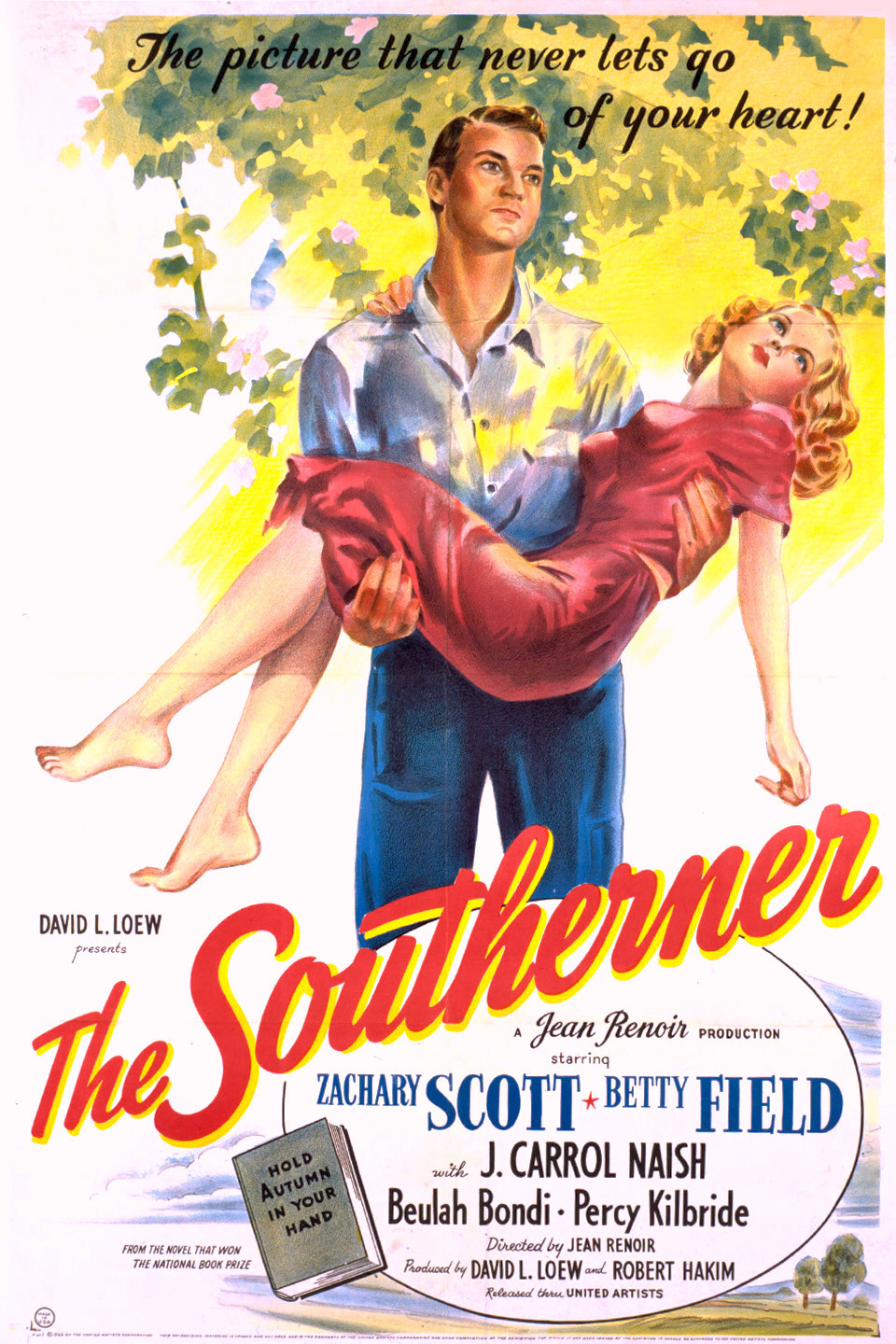
The Southerner (1945)
This film presents a really weird dynamic wherein the central family is given almost every reason imaginable to leave their sharecropping farm and go work in one of the modern factories in the city instead, up to and including the complete and total destruction of a whole year's crops and the implication that their children will likely die of malnutrition if they stay. But then they choose the farm anyway because of the sheer indominability of Americana spirit and, like, "freedom" (whatever that word means when you're sharecropping), and the movie frames this as optimism rather than self-destruction. I'm not a starving sharecropper during the Depression, so maybe this is just one of those "you had to have been there" moments, but it is very dissonant to me. The movie is good overall, though! It is a genuinely moving tale of hardship and human connection, directed beautifully by none other than Jean Renoir, and I could have probably watched the big wedding sequence for hours. And for as much as I raise my eyebrows at the (misplaced?) optimism, the movie is a lot more complex than I indicated earlier. There are times when it shows a fairly sharp picture of the functional dead-end "choice" offered to someone like the central family who doesn't own property: either be exploited on a sharecropping farm or be exploited in a factory—and once you do scrape together enough to own a piece of land (as the family's neighbor does here), you operate under a perception of scarcity, where you fight tooth-and-nail to keep anyone else from being able to do the same as you and encroach on your piece of the pie. The American Dream, baby! Grade: B
Television
Superstore, Season 5 (2019-2020)
It doesn't feel quite as vital as it did in previous seasons, but Superstore is still probably my favorite live-action sitcom on TV right now. The show has become a fine-tuned machine for joke delivery, having learned how to utilize every inch of its cast, and its plotting is refreshingly off-format from the traditional sitcom trajectory of will-they-won't they --> dating --> marriage --> kids. I mean, that happens, too, but also, for example, Jonah and Amy's relationship in which Amy has kids from a previous marriage and their conflicts have to do with the power dynamics of their respective jobs and where those jobs will take them feels a lot more genuine and in-touch with how people live now than your typical sitcom. Grade: B+
Music
U.S. Girls - Heavy Light (2020)
Not quite as riveting as their previous album, In a Poem Unlimited, but not without its moments. In particular, "4 American Dollars," the opener, is great, a post-disco banger with a populist rage. The rest of the songs are good, too, if not as strong. I'm not getting a lot out of the spoken-word transitional tracks, and I think the album kind of runs out of steam as it approaches the end. But this is still worth a listen if you've enjoyed Meghan Remy's past work. Grade: B
At this point, nothing more than the musings of a restless English teacher on the pop culture he experiences.
Showing posts with label Robert Altman. Show all posts
Sunday, May 17, 2020
Sunday, April 19, 2020
Mini Reviews for April 13-19, 2020
Quarantine, Week 6: Hey, at least I did an interview! With a really good poet and friend! Read it here if you missed it.
Movies
Band of Robbers (2015)
Pretty dumb. Advertises itself as a modern-day-set adaptation of The Adventures of Tom Sawyer and Adventures of Huckleberry Finn—in reality, it's 97% Tom Sawyer, with the only part from Huckleberry Finn being that bit at the end of the book that hardly anybody likes where Tom impersonates Sid to try to save Jim (Jorge here). The movie somehow simultaneously treats its story less seriously but also less irreverently than Twain's original, and the whole thing has a major case of Early2010sitis, full of low-rent Wes Andersonisms and forced twee. Parts of this were amusing, but on the whole, it's a pretty shoddy effort. Do you want to see Tom Sawyer and Huckleberry Finn (and Joe Harper—hey, good to see that dude get a shout-out for once) drinking craft beer? Then by all means, hit this movie up before it leaves Netflix. Grade: C
The Devil's Rejects (2005)
A pointedly and unbelievably cruel movie, the hicksploitation of something like The Hills Have Eyes or (less this time around than in the original House of 1,000 Corpses) The Texas Chainsaw Massacre blown out to the grand scope of America itself, a pointedly and unbelievably cruel country if there ever was one. It's an interesting and often compelling decision of Zombie's to refuse mythologizing its central Bonnie-and-Clyde-esque clan, who spend the majority of the movie literally torturing the people they encounter. We Americans love the idea of our outlaws, but this movie makes hay out of the way that that that love is a fair-weather facade that drops the moment we're confronted with outlawism's brutal realities. I'm not sure Zombie or this movie really do much to recognize that, for example, the sexual violence perpetrated by its central family is as totemic as the psychotic cop's embodiment of the faux-respectable post-'70s American Establishment, and I'm hesitant to embrace sincerely the "the enemy of my enemy is my friend" logic that I've seen some people use when talking about the purportedly melancholy ending—or maybe the movie does recognize it, and the famous "Free Bird" finale is just a winking, ironic piece of nihilism showing one American demon brutalizing another. My relatively middle-of-the-road rating speaks to the fact that I'm not really that interested in the way the movie lingers lasciviously over this brutality, but the fact that I am thinking about it this much speaks volumes about how rich this movie can be at times. Also, God, please let me become that Groucho Marx enthusiast when I grow up. Grade: B
Joker (2019)
I liked it—just wanted to make that clear before I get into a list of complaints. I probably made a mistake by putting off seeing Joker for as long as I did, as almost every shot, it seems, I had already seen in some awards-season highlight reel. That said, it probably would have felt familiar anyway, since (as has been widely broadcast) this movie is basically conceived as the intersection of King of Comedy and Taxi Driver within an alternate DC universe. I don't know that Joker does much that those two movies don't already do other than to throw a coat of class warfare over the whole thing, a coat that begins well enough (the defunding of social services as a catalyst for social unrest and individual misery, for example) but kind of feels thin by the end, as the movie, for as much as its "You get what you deserve!" finale gestures toward a leftist rage, takes on a pretty dim view of the proletariat, presenting them as society's mindless id held in sway by a nihilistic icon (another example: the garbage collection strike is multiple times blamed for Gotham's filthy condition rather than whatever poor wages and working conditions these folks are presumably striking about). I did get a chuckle out of the Thomas Wayne / Mike Bloomberg parallels ("anti-rich sentiments!"), though speaking of that, what ultimately happens with the Wayne subplot feels merely like a DC genre obligation, which is disappointing for a movie loudly declaring itself as a work not beholden to the same rules as other superhero movies, and I would have liked to see something more unpredictable play out there; the same goes for the movie's setting in the early 1980s, which feels more like an impulse to appear within the same world as the Scorsese movies it's referencing than an artistically vital choice of its own—it's obviously futile to imagine versions of movies we never got, but I can think of a much more cutting iteration of Joker set in a gentrifying, post-Giuliani (or whatever the DC version of Giuliani is) Gotham, where the class issues are no less urgent but also significantly more papered over by the facade of the ruling class. But anyway, I did begin this review by saying I liked this movie, and I do; for as much as this movie's reach exceeds its grasp regarding all the above issues, it works tremendously as a character study. Joker understands the Joker as a human being more so than any other movie iteration of the character has, and the combination of Joaquin Phoenix's performance and the writing create a richly rendered person whose journey feels true. As much as I don't think the movie quite succeeds in scaling up the Arthur's personal issues to society-wide movements, I think it works great in the opposite direction, showing how broader social movements have personal effects on Arthur himself—it's been done before (again, Taxi Driver, King of Comedy), but Joker does a good job of showing how the Great Society's collapse manifests itself on the psychology of those already living on the margins, and his descent into destructive nihilism is entirely convincing, an effect that I don't think was necessarily a sure thing, even mimicking the movies it does. To end this scattered review on a different note: for as much as this movie's been talked to death in the discourse, I've not seen a ton of discussion about the score by Hildur Guðnadóttir, which is really solid and probably at least as worthy of acclaim as the Phoenix performance most people centered on. I don't know if I'd put it above Little Women's score (probably my pick of the Academy Award nominees), but there's definitely no shame in the Oscars picking this one. Grade: B
The Hills Have Eyes (1977)
Starts really good with some strong "A Good Man Is Hard to Find" vibes before basically settling into a pretty typical grindhouse/exploitation second half. The movie does such a good job of establishing the "normal" family as a thoroughly unlikable locus of white, middle-class, anti-rural entitlement that it's really hard for me to get invested in those same people defeating the mutant hillbillies (who have, moreover, clearly seen the butt-end of the U.S. government a la nuclear testing, eminent domain, etc.). Not really sure how to reconcile those two halves, but maybe that's part of the point, I dunno. Anyway, pieces of this are strong enough that I'm landing positive on the whole. Grade: B
God Told Me To (1976)
An utterly deranged police procedural turned sci-fi pulp turned ecstatic messianic dystopia. Starts as a relatively straightforward investigation of mass killings whose perpetrators claim to be directed by God, and then becomes something else entirely very quickly, something wild and unclassifiable, with shades of The Last Temptation of Christ and preemptive shades of David Lynch. It does not—I repeat, does not—hang together on a moment by moment basis, with scene transitions often feeling like they leave out narrative in between. And it has a, to be charitable, problematic posture toward its African-American characters. But I also can't think of a movie prior to this one that has a more innovative and cosmic-minded approach to the crime thriller format except maybe Kiss Me Deadly. Whacked-out, messy, weirdly compelling. Grade: A-
Season of the Witch (1972)
I started laughing when Donovan's "Season of the Witch" started playing at one point, because it's such a hilariously on-the-nose choice to have that song play in a movie of the same name at the precise moment when the main character is getting into witchcraft. This became less funny when I found out that the movie's original title was Hungry Wives and was marketed as a softcore film ("Caviar in the kitchen, nothing in the bedroom"), but then again, that's funny in its own way, because this movie barely has any nudity and is mostly concerned with suburban couples at dinner parties arguing about if anyone is going to hurry up and smoke some weed already—very sexy, ya know. So I get that this movie was kind of stuck between a rock and a hard place w/r/t the title, but then again, the fact that the movie stuck between the rock and the hard place is a snore to begin with couldn't have helped. Sorry, George A. Romero. You make good movies—just not this one. Grade: C
Images (1972)
In a world where Repulsion exists, I guess it's not surprising that this has a reputation as something of an also-ran. But it is really good (though admittedly, not Repulsion good), anchored by a deliriously off-brand John Williams score (Academy Award nominated), some really tremendous editing by Graeme Clifford, as well as a dynamite central performance by Susannah York, without any of which the movie wouldn't have worked at all. I'm not exactly sure how I feel about the story—there's a lot regarding coercive men as well as the collateral damage of York's character's self-destructive tendencies, but I'm not particularly interested in the whole "woman has crippling guilt over infidelity" angle, which is what this movie is going for probably 50% of the time. But the whole package is freaky and disorienting enough that I'm willing to put style over substance if I have to. Altman's reputation is kind of staked on his use of shaggy, improv-y ensemble pieces, but between this and 3 Women, I think there's ample evidence that he was at least as good at assembling meticulously planned cinematic work, too. Grade: B+
Television
Barry, Season 1 (2018)
I was skeptical of Barry at first; "aspiring actor moonlights as a hitman" sounds like an unintentional parody of the typical post-Breaking Bad "Peak TV" series, and the first couple episodes didn't really make me feel more confident, either, as they're basically the most obvious way to play out that premise. But then it gets good. It's not that Barry does something radically different from what its premise promises—this is exactly that story. But the seriousness and dramatic complexity with which the show ultimately bears out the balls set in motion by its first couple episodes lend Barry a terrific weight, and as the show makes abundantly clear by having its last several episodes revolve around a stage performance of Macbeth, what Barry is ultimately going for (and ultimately succeeds at being) is Shakespearean tragedy. The final two episodes are as breathtaking and bleak as Act V of Macbeth, and in fact, I can't really think of a TV show that's been as successful at this format since Breaking Bad itself. Grade: A-
Music
Paul Simon - Stranger to Stranger (2016)
Paul Simon has, alongside Randy Newman, unobtrusively remained one of the more vital Boomer legacy artists still making new material, and 2016's Stranger to Stranger is probably the best of his legacy period. A quiet, quietly powerful rumination on love, class, despair, and hope, Stranger to Stranger finds Simon with some of his cleanest melodies of recent years, as well as some of his sharpest lyrical turns. Early in the record, he sings that "most obits are mixed reviews," and he's sure to get one when the inevitable happens (criticisms of cultural appropriation will no less dog this album than his earlier efforts); but for the positive portions of the eulogies, I hope people remember this record. Grade: A-
Movies
Band of Robbers (2015)
Pretty dumb. Advertises itself as a modern-day-set adaptation of The Adventures of Tom Sawyer and Adventures of Huckleberry Finn—in reality, it's 97% Tom Sawyer, with the only part from Huckleberry Finn being that bit at the end of the book that hardly anybody likes where Tom impersonates Sid to try to save Jim (Jorge here). The movie somehow simultaneously treats its story less seriously but also less irreverently than Twain's original, and the whole thing has a major case of Early2010sitis, full of low-rent Wes Andersonisms and forced twee. Parts of this were amusing, but on the whole, it's a pretty shoddy effort. Do you want to see Tom Sawyer and Huckleberry Finn (and Joe Harper—hey, good to see that dude get a shout-out for once) drinking craft beer? Then by all means, hit this movie up before it leaves Netflix. Grade: C
The Devil's Rejects (2005)
A pointedly and unbelievably cruel movie, the hicksploitation of something like The Hills Have Eyes or (less this time around than in the original House of 1,000 Corpses) The Texas Chainsaw Massacre blown out to the grand scope of America itself, a pointedly and unbelievably cruel country if there ever was one. It's an interesting and often compelling decision of Zombie's to refuse mythologizing its central Bonnie-and-Clyde-esque clan, who spend the majority of the movie literally torturing the people they encounter. We Americans love the idea of our outlaws, but this movie makes hay out of the way that that that love is a fair-weather facade that drops the moment we're confronted with outlawism's brutal realities. I'm not sure Zombie or this movie really do much to recognize that, for example, the sexual violence perpetrated by its central family is as totemic as the psychotic cop's embodiment of the faux-respectable post-'70s American Establishment, and I'm hesitant to embrace sincerely the "the enemy of my enemy is my friend" logic that I've seen some people use when talking about the purportedly melancholy ending—or maybe the movie does recognize it, and the famous "Free Bird" finale is just a winking, ironic piece of nihilism showing one American demon brutalizing another. My relatively middle-of-the-road rating speaks to the fact that I'm not really that interested in the way the movie lingers lasciviously over this brutality, but the fact that I am thinking about it this much speaks volumes about how rich this movie can be at times. Also, God, please let me become that Groucho Marx enthusiast when I grow up. Grade: B
Joker (2019)
I liked it—just wanted to make that clear before I get into a list of complaints. I probably made a mistake by putting off seeing Joker for as long as I did, as almost every shot, it seems, I had already seen in some awards-season highlight reel. That said, it probably would have felt familiar anyway, since (as has been widely broadcast) this movie is basically conceived as the intersection of King of Comedy and Taxi Driver within an alternate DC universe. I don't know that Joker does much that those two movies don't already do other than to throw a coat of class warfare over the whole thing, a coat that begins well enough (the defunding of social services as a catalyst for social unrest and individual misery, for example) but kind of feels thin by the end, as the movie, for as much as its "You get what you deserve!" finale gestures toward a leftist rage, takes on a pretty dim view of the proletariat, presenting them as society's mindless id held in sway by a nihilistic icon (another example: the garbage collection strike is multiple times blamed for Gotham's filthy condition rather than whatever poor wages and working conditions these folks are presumably striking about). I did get a chuckle out of the Thomas Wayne / Mike Bloomberg parallels ("anti-rich sentiments!"), though speaking of that, what ultimately happens with the Wayne subplot feels merely like a DC genre obligation, which is disappointing for a movie loudly declaring itself as a work not beholden to the same rules as other superhero movies, and I would have liked to see something more unpredictable play out there; the same goes for the movie's setting in the early 1980s, which feels more like an impulse to appear within the same world as the Scorsese movies it's referencing than an artistically vital choice of its own—it's obviously futile to imagine versions of movies we never got, but I can think of a much more cutting iteration of Joker set in a gentrifying, post-Giuliani (or whatever the DC version of Giuliani is) Gotham, where the class issues are no less urgent but also significantly more papered over by the facade of the ruling class. But anyway, I did begin this review by saying I liked this movie, and I do; for as much as this movie's reach exceeds its grasp regarding all the above issues, it works tremendously as a character study. Joker understands the Joker as a human being more so than any other movie iteration of the character has, and the combination of Joaquin Phoenix's performance and the writing create a richly rendered person whose journey feels true. As much as I don't think the movie quite succeeds in scaling up the Arthur's personal issues to society-wide movements, I think it works great in the opposite direction, showing how broader social movements have personal effects on Arthur himself—it's been done before (again, Taxi Driver, King of Comedy), but Joker does a good job of showing how the Great Society's collapse manifests itself on the psychology of those already living on the margins, and his descent into destructive nihilism is entirely convincing, an effect that I don't think was necessarily a sure thing, even mimicking the movies it does. To end this scattered review on a different note: for as much as this movie's been talked to death in the discourse, I've not seen a ton of discussion about the score by Hildur Guðnadóttir, which is really solid and probably at least as worthy of acclaim as the Phoenix performance most people centered on. I don't know if I'd put it above Little Women's score (probably my pick of the Academy Award nominees), but there's definitely no shame in the Oscars picking this one. Grade: B
The Hills Have Eyes (1977)
Starts really good with some strong "A Good Man Is Hard to Find" vibes before basically settling into a pretty typical grindhouse/exploitation second half. The movie does such a good job of establishing the "normal" family as a thoroughly unlikable locus of white, middle-class, anti-rural entitlement that it's really hard for me to get invested in those same people defeating the mutant hillbillies (who have, moreover, clearly seen the butt-end of the U.S. government a la nuclear testing, eminent domain, etc.). Not really sure how to reconcile those two halves, but maybe that's part of the point, I dunno. Anyway, pieces of this are strong enough that I'm landing positive on the whole. Grade: B
God Told Me To (1976)
An utterly deranged police procedural turned sci-fi pulp turned ecstatic messianic dystopia. Starts as a relatively straightforward investigation of mass killings whose perpetrators claim to be directed by God, and then becomes something else entirely very quickly, something wild and unclassifiable, with shades of The Last Temptation of Christ and preemptive shades of David Lynch. It does not—I repeat, does not—hang together on a moment by moment basis, with scene transitions often feeling like they leave out narrative in between. And it has a, to be charitable, problematic posture toward its African-American characters. But I also can't think of a movie prior to this one that has a more innovative and cosmic-minded approach to the crime thriller format except maybe Kiss Me Deadly. Whacked-out, messy, weirdly compelling. Grade: A-
Season of the Witch (1972)
I started laughing when Donovan's "Season of the Witch" started playing at one point, because it's such a hilariously on-the-nose choice to have that song play in a movie of the same name at the precise moment when the main character is getting into witchcraft. This became less funny when I found out that the movie's original title was Hungry Wives and was marketed as a softcore film ("Caviar in the kitchen, nothing in the bedroom"), but then again, that's funny in its own way, because this movie barely has any nudity and is mostly concerned with suburban couples at dinner parties arguing about if anyone is going to hurry up and smoke some weed already—very sexy, ya know. So I get that this movie was kind of stuck between a rock and a hard place w/r/t the title, but then again, the fact that the movie stuck between the rock and the hard place is a snore to begin with couldn't have helped. Sorry, George A. Romero. You make good movies—just not this one. Grade: C
Images (1972)
In a world where Repulsion exists, I guess it's not surprising that this has a reputation as something of an also-ran. But it is really good (though admittedly, not Repulsion good), anchored by a deliriously off-brand John Williams score (Academy Award nominated), some really tremendous editing by Graeme Clifford, as well as a dynamite central performance by Susannah York, without any of which the movie wouldn't have worked at all. I'm not exactly sure how I feel about the story—there's a lot regarding coercive men as well as the collateral damage of York's character's self-destructive tendencies, but I'm not particularly interested in the whole "woman has crippling guilt over infidelity" angle, which is what this movie is going for probably 50% of the time. But the whole package is freaky and disorienting enough that I'm willing to put style over substance if I have to. Altman's reputation is kind of staked on his use of shaggy, improv-y ensemble pieces, but between this and 3 Women, I think there's ample evidence that he was at least as good at assembling meticulously planned cinematic work, too. Grade: B+
Television
Barry, Season 1 (2018)
I was skeptical of Barry at first; "aspiring actor moonlights as a hitman" sounds like an unintentional parody of the typical post-Breaking Bad "Peak TV" series, and the first couple episodes didn't really make me feel more confident, either, as they're basically the most obvious way to play out that premise. But then it gets good. It's not that Barry does something radically different from what its premise promises—this is exactly that story. But the seriousness and dramatic complexity with which the show ultimately bears out the balls set in motion by its first couple episodes lend Barry a terrific weight, and as the show makes abundantly clear by having its last several episodes revolve around a stage performance of Macbeth, what Barry is ultimately going for (and ultimately succeeds at being) is Shakespearean tragedy. The final two episodes are as breathtaking and bleak as Act V of Macbeth, and in fact, I can't really think of a TV show that's been as successful at this format since Breaking Bad itself. Grade: A-
Music
Paul Simon - Stranger to Stranger (2016)
Paul Simon has, alongside Randy Newman, unobtrusively remained one of the more vital Boomer legacy artists still making new material, and 2016's Stranger to Stranger is probably the best of his legacy period. A quiet, quietly powerful rumination on love, class, despair, and hope, Stranger to Stranger finds Simon with some of his cleanest melodies of recent years, as well as some of his sharpest lyrical turns. Early in the record, he sings that "most obits are mixed reviews," and he's sure to get one when the inevitable happens (criticisms of cultural appropriation will no less dog this album than his earlier efforts); but for the positive portions of the eulogies, I hope people remember this record. Grade: A-
Sunday, January 5, 2020
Mini Reviews for December 30, 2019 - January 5, 2020
I've read a couple books and listened to some music, but I've also been traveling and thus didn't have a ton of time to write about them. I'll get to them later.
In the meantime, don't forget my pair of "Favorites of 2019" posts. You can find the movie one here and the music one here.
Movies
Cats (2019)
There was probably never going to be a good way to adapt the all-time-terrible Andrew Lloyd Webber Broadway smash Cats (and please, can this movie be the moment when everyone collectively wakes up and realizes that it was never good? That's right, not even "Memory"), but this is definitely one of the worse ways to even attempt to turn that musical into a movie, starting with the choice to superimpose actors faces over CG cat-human hybrid bodies but continuing on down the line to every single filmmaking choice including just the basic shot composition and blocking (which obscures 90% of the CG choreography 90% of the time). Still, I'd be lying if I joined in with the chorus of people calling this the worst movie of 2019—or even if I just said I didn't like it. The worst movies are either ideologically toxic or boring, and Cats is neither. Especially in this age of hyper-cautious movie studios, it's a rare treat to get a movie that goes so disastrously awry at every single turn as this one, and I had a terrific time with it. I can't quite rate it highly enough that I might trick someone into thinking that I recommend this movie on its own terms (half of the theater walked out before the film's halfway point, leaving just me and my friends to have a collective freak out), but, like, as a movie working against itself at every turn on its own sui generis rubric, this is great. Grade: C+
Gosford Park (2001)
I've not watched a ton of post-'70s Robert Altman movies, so my main associations with the man are primarily American, primarily counterculturally informed. So it was interesting to see a movie of his so far out of that milieu: i.e. one that takes place in the intensely buttoned-up, intensely stratified world of early 20th century Great Britain. The verdict is that it's about 70% shaggy Altman-esque ensemble observational drama, about 30% murder mystery that kind of pays off all the kind of aimless observational drama in the preceding hour-plus. The buildup to the murder feels far too long, but then again, once that plot jumps in, it racks the movie into crystal-clear focus on the ugliest, saddest implications of the class tensions that have been waltzing in front of the camera the whole time. I like that. Grade: B
The Wind Will Carry Us (باد ما را خواهد برد) (1999)
As always with Kiarostami and his movies, there's a lot to unpack with The Wind Will Carry Us. My initial takeaway is that this is basically like Kiarostami's take on the whole Hallmark original movie thing where the city slicker goes to the quaint small town and learns to renounce their city-slicking ways and appreciate the slow, personalized pace of the small-time life—in fact, Kiarostami finds the correct way to frame this story, which hinges on the tense interplay between the urban exploitation of rural "quaintness" and the interlocking systems of contemporary life that affect us all. It's a gorgeously shot, strikingly funny movie that's of course a lot more complicated than what I've described, more of a dense modern text of potent symbols and richly evocative scenes than anything like the moralizing narrative I've just framed it as, and I've barely scratched the surface of it myself. But this is a good one, for sure. Grade: A-
Kundun (1997)
I'm 100% here for the Philip Glass score and Thelma Shoomaker editing, but I'm maybe only 50% here for the Martin Scorsese direction and Melissa Mathison screenplay. The music is stunning throughout, and there are some edits here (especially in the final, highly impressionist final fifteen minutes or so) that are just jaw-dropping in their beauty. As for Scorsese/Mathison, Kundun is the first feature for both of them that is outside a Western, Christian milieu, and both the screenplay and the direction have a stuffiness about them that feels like the sort of careful reverence you might use when approaching a tradition you are not a part of. It's stuffy and robs the material of anything like the more incisive moments of either artist's typical work, and it kind of makes me wonder how suitable either one was for this project in the first place (ditto with the choice to have everybody speak in English—come on, Scorsese, even your bud Schrader had his "Asian" film in the regionally appropriate language!). For Scorsese in particular, his beatific stance toward the Dalai Lama is basically the opposite of the thorny complexity he affords his Christian protagonists and even Jesus Christ Himself, and while I completely understand why an outsider wouldn't want to imbue complexity onto a religious/political tradition not their own, it really makes some of Scorsese's work here feel like a noble failure. But that music! Those edits! Grade: B-
Enter the Dragon (1973)
The last new-to-me movie I watched in 2019 (though I did rewatch Frances Ha with my wife sometime later in the evening). Anyway, it's a lot of fun. I've never seen a Bruce Lee movie before, and this seemed like an alright introduction. It was basically a Bond movie, which means that it has the boring stretches and tedious archetypes that usually plague Bond movies, but Bruce Lee kicking and punching his way through the baddies is way more fun than, like, Sean Connery sleeping his way through a small army of women. Also, I like that Bruce Lee's character is just named Lee. Grade: B+
In the meantime, don't forget my pair of "Favorites of 2019" posts. You can find the movie one here and the music one here.
Movies
Cats (2019)
There was probably never going to be a good way to adapt the all-time-terrible Andrew Lloyd Webber Broadway smash Cats (and please, can this movie be the moment when everyone collectively wakes up and realizes that it was never good? That's right, not even "Memory"), but this is definitely one of the worse ways to even attempt to turn that musical into a movie, starting with the choice to superimpose actors faces over CG cat-human hybrid bodies but continuing on down the line to every single filmmaking choice including just the basic shot composition and blocking (which obscures 90% of the CG choreography 90% of the time). Still, I'd be lying if I joined in with the chorus of people calling this the worst movie of 2019—or even if I just said I didn't like it. The worst movies are either ideologically toxic or boring, and Cats is neither. Especially in this age of hyper-cautious movie studios, it's a rare treat to get a movie that goes so disastrously awry at every single turn as this one, and I had a terrific time with it. I can't quite rate it highly enough that I might trick someone into thinking that I recommend this movie on its own terms (half of the theater walked out before the film's halfway point, leaving just me and my friends to have a collective freak out), but, like, as a movie working against itself at every turn on its own sui generis rubric, this is great. Grade: C+
Gosford Park (2001)
I've not watched a ton of post-'70s Robert Altman movies, so my main associations with the man are primarily American, primarily counterculturally informed. So it was interesting to see a movie of his so far out of that milieu: i.e. one that takes place in the intensely buttoned-up, intensely stratified world of early 20th century Great Britain. The verdict is that it's about 70% shaggy Altman-esque ensemble observational drama, about 30% murder mystery that kind of pays off all the kind of aimless observational drama in the preceding hour-plus. The buildup to the murder feels far too long, but then again, once that plot jumps in, it racks the movie into crystal-clear focus on the ugliest, saddest implications of the class tensions that have been waltzing in front of the camera the whole time. I like that. Grade: B
The Wind Will Carry Us (باد ما را خواهد برد) (1999)
As always with Kiarostami and his movies, there's a lot to unpack with The Wind Will Carry Us. My initial takeaway is that this is basically like Kiarostami's take on the whole Hallmark original movie thing where the city slicker goes to the quaint small town and learns to renounce their city-slicking ways and appreciate the slow, personalized pace of the small-time life—in fact, Kiarostami finds the correct way to frame this story, which hinges on the tense interplay between the urban exploitation of rural "quaintness" and the interlocking systems of contemporary life that affect us all. It's a gorgeously shot, strikingly funny movie that's of course a lot more complicated than what I've described, more of a dense modern text of potent symbols and richly evocative scenes than anything like the moralizing narrative I've just framed it as, and I've barely scratched the surface of it myself. But this is a good one, for sure. Grade: A-
Kundun (1997)
I'm 100% here for the Philip Glass score and Thelma Shoomaker editing, but I'm maybe only 50% here for the Martin Scorsese direction and Melissa Mathison screenplay. The music is stunning throughout, and there are some edits here (especially in the final, highly impressionist final fifteen minutes or so) that are just jaw-dropping in their beauty. As for Scorsese/Mathison, Kundun is the first feature for both of them that is outside a Western, Christian milieu, and both the screenplay and the direction have a stuffiness about them that feels like the sort of careful reverence you might use when approaching a tradition you are not a part of. It's stuffy and robs the material of anything like the more incisive moments of either artist's typical work, and it kind of makes me wonder how suitable either one was for this project in the first place (ditto with the choice to have everybody speak in English—come on, Scorsese, even your bud Schrader had his "Asian" film in the regionally appropriate language!). For Scorsese in particular, his beatific stance toward the Dalai Lama is basically the opposite of the thorny complexity he affords his Christian protagonists and even Jesus Christ Himself, and while I completely understand why an outsider wouldn't want to imbue complexity onto a religious/political tradition not their own, it really makes some of Scorsese's work here feel like a noble failure. But that music! Those edits! Grade: B-
Enter the Dragon (1973)
The last new-to-me movie I watched in 2019 (though I did rewatch Frances Ha with my wife sometime later in the evening). Anyway, it's a lot of fun. I've never seen a Bruce Lee movie before, and this seemed like an alright introduction. It was basically a Bond movie, which means that it has the boring stretches and tedious archetypes that usually plague Bond movies, but Bruce Lee kicking and punching his way through the baddies is way more fun than, like, Sean Connery sleeping his way through a small army of women. Also, I like that Bruce Lee's character is just named Lee. Grade: B+
Sunday, February 12, 2017
Mini-Reviews for February 6 - 12, 2017
One-day work weeks are the best. It makes me feel better about the fact that this post has more negative reviews than I think any other post I've made so far.
Movies
Deadpool (2016)
Of all the myriad things I can be thankful for, I now realize near the top must be the merciful blessing that this movie did not come out during my high school years and thus subject me to months and even years of having to hear this film's smarmy, self-impressed vulgarisms repeated from the mouths of my peers. Rather, I merely have the choice to endure this film's 108 minutes of juvenilia once, which is quite enough. I'm not sure if it's an indictment of the modern superhero blockbuster that a movie with all the flaws of the genre's most pedestrian works can feel fresh to so many by merely slapping on some R-rated violence, profane dialogue, and the flimsiest of metacommentary, but it sure isn't a ringing endorsement for the health of the form. Grade: C
Manchester by the Sea (2016)
The crushing sadness of Manchester by the Sea's shaggy plot would be suffocating if it weren't for the film's idiosyncratic and often gut-busting sense of humor—it's not black humor specifically, at least not in the satirical sense that the term often connotes. Rather, the jokes here are the only joy that our characters can find in the spaces surrounding the death of a family member and a whole host of other experiences and memories I can only assume would be absolute hell to live with. I'm being a bit vague here because the movie seems to want the specifics of these characters' lives to read as surprising reveals within the film's tightly edited flashback structure, so for now, just know that while the tragedy here would be bleak by any sense of the word, the movie itself is not bleak. That's not to say it's uplifting either--this is just life that Manchester by the Sea depicts, with all its little moments of connection and pain. It no doubt helps that every actor here—even Matthew Broderick, in a somewhat ill-conceived tangent from the film's generally rough-around-the-edges, working-class sensibilities into Christianized suburbia—play human beings of such vigor and life that there's no way not to care for every person onscreen. Grade: A-
Loving (2016)
The better of Jeff Nichols's two 2016 films is also the more grounded—literally, as it turns out. Instead of Midnight Special's multi-dimensional-alien sci-fi, Loving gives us a tender and altogether moving portrait of the couple whose Supreme-Court-decided lawsuit ended all laws prohibiting marriage on racial grounds. A lesser (or at least a less poignant) movie may have focused obsessively on the injustices the Lovings face and the legal procedure that lead to eventual justice, and those things are there to a certain extent. But first and foremost, this is a movie about its two central characters and the ebb-and-flow textures of their life together. In short, it's a romance, and a darn good one at that. Grade: B+
Nuts! (2016)
A "mostly true" documentary tries to mix historical fiction and nonfiction into a folk concoction that's reminiscent of the fibs of its central huckster, John R. Brinkley, who claimed to have cured impotence by transplanting goat testicles into human males. It's a funny, outrageous bit of historical oddity, but the film's approach—a mix of talking heads and shoddy, frequently glib animation—lacks the precision needed to make its fictionalized nonfiction work like it should. In the hands of more skilled filmmakers, this might have been gold. Instead, it feels like a half-baked internet flash animation. Grade: C
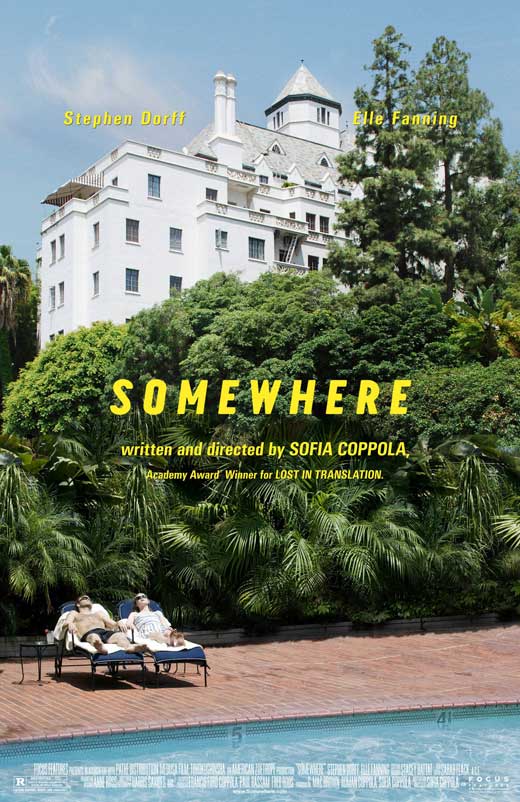
Somewhere (2010)
When Sofia Coppola is on her game, the results are often hypnotic, using music and images to imbue that space between mundane and just slightly alien with unexpected verve and beauty. When she's off... well, you get Somewhere, my least-favorite S. Coppola film that I've seen and something of a chunkily textured anti-character study. The feeling of deflation that the protagonist feels near the end of the movie when his daughter's visit ends rings true, but it's one of the only engagingly human moments in the film, the rest meandering through the irritations of minor celebrity and wealth with a stateliness that approaches staleness. Look to pretty much any other of Coppola's films for a more compelling take on these same themes. Grade: C+
Pink Floyd: The Wall (1982)
Often clumsy and flimsy in its live-action segments, The Wall falls far short of the pedigree of its namesake album. However, when it works—and, like the album, it works most brutally in its latter half—the film is absolutely aces, as compelling a portrayal of misery and psychological anguish as the album itself, and even more effective as a slice of the British counterculture and its fallout. And let's not forget the animation, which is always excellent and the best part of the film, despite clocking in at just over fifteen minutes collectively. What I would have given to have had this entire movie animated. Grade: B+
3 Women (1977)
As someone who's only seen the big three from Robert Altman (those being M*A*S*H, McCabe & Mrs. Miller, and Nashville), I found 3 Women to be pleasantly small turn from the guy's normal ensemble jigsaws. A psychological thriller very much in the vein of Bergman's Persona (if slightly less deconstructive) and what Roman Polanski was doing in the late '60s, it's a mesmerizing, head-scratching piece of filmmaking, made all the better by an all-time-great performance from already all-time-great performer Shelley Duvall. It's far too often that we forget that she pretty much batted 1.000 throughout most of the '70s and '80s. Grade: A-
Attack of the 50 Foot Woman (1958)
The title's a bit misleading, given that the giant woman doesn't attack until the last ten minutes of the movie (and isn't even giant for the majority of the preceding film). Also, characters repeatedly marvel at how the woman (and her male counterpart) must be "thirty feet tall." So that's strike two. Look, I'm probably not going to convince any haters that this is a good movie—there's plenty of ammunition there: titles aside, the special effects are startlingly bad, particularly the matte effects, and the dialogue is tepid. But I dunno, guys, I found this charming in all its raggedness, and from the way it's pretty much 80 percent domestic crime smut to the exaggeration of the "vengeful, wronged wife" trope to this level of sci-fi melodrama. Fans of second- (or third-) tier sci-fi from the era shouldn't miss it. Grade: B
Television
Crazy Ex-Girlfriend, Season 2 (2016-17)
While its shorter episode count makes Season 2 feel a little less complete than Season 1—character arcs feel rushed, plots feel underdeveloped—the second year of what's likely TV's best comedy right now is bolder, more complex, and more sure of itself than the first, which had a slightly rocky beginning. The end result is just tremendous TV, consistently hilarious, often hummable, and completely hitting its stride. Rachel Bloom's Rebecca Bunch is no less frantic and unwell—if anything, she's more so—which makes it all the more impressive that the series is able to find so much tenderness and compassion within a character who should, by all logic, be a whirlwind of irritating tropes. But as we all know, the situation is a lot more nuanced than that. Grade: A-
Crisis in Six Scenes (2016)
Woody Allen made it abundantly clear prior to the release of Crisis in Six Scenes that his undertaking a TV series was a colossal mistake. And now, having seen the finished product, I'm unfortunately compelled to agree with him. An aimless, horribly paced, unfunny six episodes of tired Allen tropes, Crisis is just over the length of his longest feature films (not coincidentally, among his worst), but the good material within amounts to little more than an hour's worth of watchable work—to say nothing of the horrible structural issues the show faces as Allen apparently has no idea of the concept of a distinct episode and instead sequences scene after scene until he hits twenty-plus minutes and cuts it off until the next episode, whether or not the drama requires it. I'll go to bat for the fifth episode, centered around a bungled crime that makes it reminiscent of the bumbling capers of Manhattan Murder Mystery or Scoop, and overall, Allen has fun with the lightly satirical depiction of 1960s counterculture, both with Miley Cyrus's anarcho-Marxist revolutionary and the escalating gag of the old-ladies book club who decides to read her literature. But there's very little here to recommend that isn't found in better form in any number of Woody Allen's cinematic work, and even then, it's encased in so much lard that it wouldn't be out of case in a frontier butcher shop. Skip it. Grade: C
Books
The Vegetarian by Han Kang (2016)
I was going to avoid referencing Kafka in describing this book (not the least because he's already mentioned in one of the critical blurbs on the book's back cover), but how else do you describe unsettling surrealism that at first feels satirical before turning heartbreaking? It's Kafkaesque, through and through: a woman decides to become a vegetarian after unsettling dreams (see??), and the book follows the escalating fallout on her husband, her father, her brother-in-law, her sister, and her own psychology. The gorgeous translation by Deborah Smith manages to evoke the strange proceedings with wit and kinetic energy that never loses track of either the central horror or underlying sadness that imbues the work with its magnetic power. Grade: A-
The Sculptor by Scott McCloud (2015)
Color me disappointed. A cursory glance through The Sculptor promised a strikingly illustrated fable about an artist's bargain with Death. What it ends up being is a bit of a one-dimensional mix of romance and struggling artist clichés that indulge in the worst of Manic Pixie Dream Girl and "nobody understands my work" artist tropes. David is an artist who's of course above irony and instead wants to make people feel something; Meg is a woman whose sole purpose seems to be to brighten his existence with her quirky lust for life and the inevitability of her eventual sleeping with him. Also, she's bipolar but won't take her medication because she wants to "feel everything." If you can't tell, that's the sound of my eyes rolling. It's not all bad: the story gets pretty good toward the end, and the fantasy elements (pretty much everything to do with death) are both cool and poignant. And those striking illustrations the book's initial pages promised me are totally there and totally great. It's just frustrating that those elements couldn't have concealed into a more consistently good package. Grade: B-
Movies
Deadpool (2016)
Of all the myriad things I can be thankful for, I now realize near the top must be the merciful blessing that this movie did not come out during my high school years and thus subject me to months and even years of having to hear this film's smarmy, self-impressed vulgarisms repeated from the mouths of my peers. Rather, I merely have the choice to endure this film's 108 minutes of juvenilia once, which is quite enough. I'm not sure if it's an indictment of the modern superhero blockbuster that a movie with all the flaws of the genre's most pedestrian works can feel fresh to so many by merely slapping on some R-rated violence, profane dialogue, and the flimsiest of metacommentary, but it sure isn't a ringing endorsement for the health of the form. Grade: C
Manchester by the Sea (2016)
The crushing sadness of Manchester by the Sea's shaggy plot would be suffocating if it weren't for the film's idiosyncratic and often gut-busting sense of humor—it's not black humor specifically, at least not in the satirical sense that the term often connotes. Rather, the jokes here are the only joy that our characters can find in the spaces surrounding the death of a family member and a whole host of other experiences and memories I can only assume would be absolute hell to live with. I'm being a bit vague here because the movie seems to want the specifics of these characters' lives to read as surprising reveals within the film's tightly edited flashback structure, so for now, just know that while the tragedy here would be bleak by any sense of the word, the movie itself is not bleak. That's not to say it's uplifting either--this is just life that Manchester by the Sea depicts, with all its little moments of connection and pain. It no doubt helps that every actor here—even Matthew Broderick, in a somewhat ill-conceived tangent from the film's generally rough-around-the-edges, working-class sensibilities into Christianized suburbia—play human beings of such vigor and life that there's no way not to care for every person onscreen. Grade: A-
Loving (2016)
The better of Jeff Nichols's two 2016 films is also the more grounded—literally, as it turns out. Instead of Midnight Special's multi-dimensional-alien sci-fi, Loving gives us a tender and altogether moving portrait of the couple whose Supreme-Court-decided lawsuit ended all laws prohibiting marriage on racial grounds. A lesser (or at least a less poignant) movie may have focused obsessively on the injustices the Lovings face and the legal procedure that lead to eventual justice, and those things are there to a certain extent. But first and foremost, this is a movie about its two central characters and the ebb-and-flow textures of their life together. In short, it's a romance, and a darn good one at that. Grade: B+
Nuts! (2016)
A "mostly true" documentary tries to mix historical fiction and nonfiction into a folk concoction that's reminiscent of the fibs of its central huckster, John R. Brinkley, who claimed to have cured impotence by transplanting goat testicles into human males. It's a funny, outrageous bit of historical oddity, but the film's approach—a mix of talking heads and shoddy, frequently glib animation—lacks the precision needed to make its fictionalized nonfiction work like it should. In the hands of more skilled filmmakers, this might have been gold. Instead, it feels like a half-baked internet flash animation. Grade: C
Somewhere (2010)
When Sofia Coppola is on her game, the results are often hypnotic, using music and images to imbue that space between mundane and just slightly alien with unexpected verve and beauty. When she's off... well, you get Somewhere, my least-favorite S. Coppola film that I've seen and something of a chunkily textured anti-character study. The feeling of deflation that the protagonist feels near the end of the movie when his daughter's visit ends rings true, but it's one of the only engagingly human moments in the film, the rest meandering through the irritations of minor celebrity and wealth with a stateliness that approaches staleness. Look to pretty much any other of Coppola's films for a more compelling take on these same themes. Grade: C+
Pink Floyd: The Wall (1982)
Often clumsy and flimsy in its live-action segments, The Wall falls far short of the pedigree of its namesake album. However, when it works—and, like the album, it works most brutally in its latter half—the film is absolutely aces, as compelling a portrayal of misery and psychological anguish as the album itself, and even more effective as a slice of the British counterculture and its fallout. And let's not forget the animation, which is always excellent and the best part of the film, despite clocking in at just over fifteen minutes collectively. What I would have given to have had this entire movie animated. Grade: B+
3 Women (1977)
As someone who's only seen the big three from Robert Altman (those being M*A*S*H, McCabe & Mrs. Miller, and Nashville), I found 3 Women to be pleasantly small turn from the guy's normal ensemble jigsaws. A psychological thriller very much in the vein of Bergman's Persona (if slightly less deconstructive) and what Roman Polanski was doing in the late '60s, it's a mesmerizing, head-scratching piece of filmmaking, made all the better by an all-time-great performance from already all-time-great performer Shelley Duvall. It's far too often that we forget that she pretty much batted 1.000 throughout most of the '70s and '80s. Grade: A-
Attack of the 50 Foot Woman (1958)
The title's a bit misleading, given that the giant woman doesn't attack until the last ten minutes of the movie (and isn't even giant for the majority of the preceding film). Also, characters repeatedly marvel at how the woman (and her male counterpart) must be "thirty feet tall." So that's strike two. Look, I'm probably not going to convince any haters that this is a good movie—there's plenty of ammunition there: titles aside, the special effects are startlingly bad, particularly the matte effects, and the dialogue is tepid. But I dunno, guys, I found this charming in all its raggedness, and from the way it's pretty much 80 percent domestic crime smut to the exaggeration of the "vengeful, wronged wife" trope to this level of sci-fi melodrama. Fans of second- (or third-) tier sci-fi from the era shouldn't miss it. Grade: B
Television
Crazy Ex-Girlfriend, Season 2 (2016-17)
While its shorter episode count makes Season 2 feel a little less complete than Season 1—character arcs feel rushed, plots feel underdeveloped—the second year of what's likely TV's best comedy right now is bolder, more complex, and more sure of itself than the first, which had a slightly rocky beginning. The end result is just tremendous TV, consistently hilarious, often hummable, and completely hitting its stride. Rachel Bloom's Rebecca Bunch is no less frantic and unwell—if anything, she's more so—which makes it all the more impressive that the series is able to find so much tenderness and compassion within a character who should, by all logic, be a whirlwind of irritating tropes. But as we all know, the situation is a lot more nuanced than that. Grade: A-
Crisis in Six Scenes (2016)
Woody Allen made it abundantly clear prior to the release of Crisis in Six Scenes that his undertaking a TV series was a colossal mistake. And now, having seen the finished product, I'm unfortunately compelled to agree with him. An aimless, horribly paced, unfunny six episodes of tired Allen tropes, Crisis is just over the length of his longest feature films (not coincidentally, among his worst), but the good material within amounts to little more than an hour's worth of watchable work—to say nothing of the horrible structural issues the show faces as Allen apparently has no idea of the concept of a distinct episode and instead sequences scene after scene until he hits twenty-plus minutes and cuts it off until the next episode, whether or not the drama requires it. I'll go to bat for the fifth episode, centered around a bungled crime that makes it reminiscent of the bumbling capers of Manhattan Murder Mystery or Scoop, and overall, Allen has fun with the lightly satirical depiction of 1960s counterculture, both with Miley Cyrus's anarcho-Marxist revolutionary and the escalating gag of the old-ladies book club who decides to read her literature. But there's very little here to recommend that isn't found in better form in any number of Woody Allen's cinematic work, and even then, it's encased in so much lard that it wouldn't be out of case in a frontier butcher shop. Skip it. Grade: C
Books
The Vegetarian by Han Kang (2016)
I was going to avoid referencing Kafka in describing this book (not the least because he's already mentioned in one of the critical blurbs on the book's back cover), but how else do you describe unsettling surrealism that at first feels satirical before turning heartbreaking? It's Kafkaesque, through and through: a woman decides to become a vegetarian after unsettling dreams (see??), and the book follows the escalating fallout on her husband, her father, her brother-in-law, her sister, and her own psychology. The gorgeous translation by Deborah Smith manages to evoke the strange proceedings with wit and kinetic energy that never loses track of either the central horror or underlying sadness that imbues the work with its magnetic power. Grade: A-
The Sculptor by Scott McCloud (2015)
Color me disappointed. A cursory glance through The Sculptor promised a strikingly illustrated fable about an artist's bargain with Death. What it ends up being is a bit of a one-dimensional mix of romance and struggling artist clichés that indulge in the worst of Manic Pixie Dream Girl and "nobody understands my work" artist tropes. David is an artist who's of course above irony and instead wants to make people feel something; Meg is a woman whose sole purpose seems to be to brighten his existence with her quirky lust for life and the inevitability of her eventual sleeping with him. Also, she's bipolar but won't take her medication because she wants to "feel everything." If you can't tell, that's the sound of my eyes rolling. It's not all bad: the story gets pretty good toward the end, and the fantasy elements (pretty much everything to do with death) are both cool and poignant. And those striking illustrations the book's initial pages promised me are totally there and totally great. It's just frustrating that those elements couldn't have concealed into a more consistently good package. Grade: B-
Labels:
book review,
Crazy Ex-Girlfriend,
Deadpool,
film,
Han Kang,
Jeff Nichols,
literature,
mini-reviews,
movie review,
Pink Floyd,
Robert Altman,
Scott McCloud,
Sofia Coppola,
television,
TV review,
Woody Allen
Friday, July 11, 2014
100 Years...100 Movies 58-60: The Gold Rush, Nashville, Duck Soup
Hello all! I'm working my way through AFI's 100 Years...100 Movies
list, giving thoughts, analyses, and generally scattered musings on each
one. For more details on the project, you can read the introductory
post here.
Our fun run of thematically grouped entries in this series has been broken. Oh well, nothing lasts forever, tempus fugit, blah blah blah.
58. The Gold Rush (1925, Charlie Chaplin)
First of all, sorry for the weird proportions of this movie's poster—turns out that studios in 1925 hadn't standardized the size of promotional material. Second of all, let's forget about the poster and focus on how completely amazing this movie is! If you know anything about Charlie Chaplin, chances are the bits you know are from The Gold Rush. The bear, the boot-eating, the teetering cabin, and like half a dozen (at least) other great sequences are all here. In fact, of all the Chaplin films I've seen, The Gold Rush might be the one most built on comic setpieces like those I just named (give or take Modern Times, which is just full of great setpieces), and whose success is most dependent on those moments rather than the connective tissue wrapping them together into a film. And boy, is it successful on that metric. Though it lacks the virtuosic timing of something like Modern Times and the soaring pathos of City Lights or The Kid, I'd argue that The Gold Rush is the most purely fun entry in Chaplin's filmography. It's less the sort of movie where the laughter sticks in your throat, which is definitely true of both Chaplin's more satirical and his more sentimental works, and it's more the kind that gives you permission to belt out the deepest, giddiest guffaws at any given moment during the action. This playfully inviting spirit—a sort of camaraderie with the viewer—gives the film much of Chaplin's typical warmth even though it lacks some of the more saccharine elements usually present in his work, and I'd probably rank it as my favorite of his. There's stiff competition, to be sure, but The Gold Rush is just that good.
59. *Nashville (1975, Robert Altman)
Well, this was unexpectedly devastating. I'd always heard Nashville described as either a comedy or a satire, sometimes both, and although I guess I should have known better than to expect a straightforward barrel of laughs from the director of M*A*S*H, I naively took those descriptions at face value. A barrel of laughs Nashville is not. That's not to say that it isn't funny (albeit usually funny in a sort of understated, observational way), and if we want to define a comedy as "a good time," then I suppose Nashville fits the bill, at least for about 95 percent of its duration. The film's characters are dim-witted and self-involved enough to be entertaining and often hilarious subjects to follow around; Altman and the actors (who actually wrote a lot of the movie's songs!) have also done a great job of capturing the feeling of live music, and the movie evokes a lively, if Looney-Tunesian, version of the old Nashville country scene that's a fun place to inhabit for 2.5-ish hours. But all those good times are really just window dressing for what is, at heart, an enormously cynical, bleak indictment of the state of America at its bicentennial. That dark heart wasn't clear to me until maybe fifteen minutes from the film's end, when the assassination attempt at the Parthenon concert pushes the violence and unrest percolating in the movie's subtext into the foreground. The truly damning moment is when the authorities shoo this violence to the periphery of the concert, and the audience all but ignores the events as new performers strike up a rousing, optimistic song, a giant American flag fluttering in the background. America isn't just ignorant about the problems that are ripping it apart; America doesn't care about the problems, so long as someone's there giving them a good time, telling them "don't worry." I mean, holy cow, that's just brutal. Once the ending hands you that thread, it's all too easy to pull at it until the fun of the whole movie unravels into the desperate state of the union address that it is at its core, a furious scream—"Wake up, America!" This is protest cinema at its most caustic, and it's also the kind of movie I wouldn't have been terribly receptive to even a couple years ago. But this is now, and at this specific moment in my life, even nearly forty years after its release, it hit me in the gut and made me want to cry. Does that mean I've gotten even more cynical than people told me I was a few years ago? Gosh. Hope not.
60. Duck Soup (1933, Leo McCarey)
And now for something completely different (thankfully—I don't want to bum y'all out). The thing about Marx brothers movies (and this is no original insight on my part) is that they pretty much live and die by their smallest distinct parts, e.g. the jokes. And I'm not just talking about the quality of the jokes either (though that's obviously important); no, the success of these movies is as much dependent on the quantity of jokes as it is on the quality. It's the theory of comic density: shove enough jokes into a short enough space of time, and the humor builds a sort of momentum wherein it becomes less important that each individual is funny and more important that the frenetic pace is maintained. In any scene (like, for instance, this one), the film rushes through so many jokes so quickly that it stops mattering that a good portion of them are howlingly unfunny because it takes only a few seconds to hit a hilarious one again. Moreover, the jokes spring forward with such relentless disregard for continuity or logic that the structure of the joke flow itself becomes a sort of joke; the separate jokes are funny enough, but what's really funny is the zigging and zagging of the script as it dashes from one moment of anarchy to the next. Look, I know I haven't talked very specifically about Duck Soup, but the thing is, there's not much distinguishing Duck Soup from the rest of the Marx brothers pack except that, of all their movies, its jokes probably have the highest funny-to-unfunny ratio. The Marx brothers' emphasis on individual jokes at the expense of pretty much everything else means that none of their films really work as distinct films so much as highlight reels. In Duck Soup specifically, I suppose that the political setting allows for a few unique bits of parody and satire, but no more so than, say, the opera at A Night at the Opera. The film has the same sort of bland-but-successful cinematography as all the other films, too, the primary strategy of which is to just set up a camera and let the Marxes just do their thing with as little editing and camera flair as possible. None of this is a criticism; Duck Soup is a hilarious, madcap film that's well worth the watch. I guess I just don't have that much else to say besides, "Yeah, it's hilarious."
We've hit the 60 percent mark in this project. Woot woot! I'll be posting the next entry sometime next week, but until then, don't be shy if you have something to say. Or not. That's cool, too. Until next time!
You can read the previous entry in this series, #s 55-57, here.
Update: The next post, #s 61-63, is up! You can read it here.
Our fun run of thematically grouped entries in this series has been broken. Oh well, nothing lasts forever, tempus fugit, blah blah blah.
58. The Gold Rush (1925, Charlie Chaplin)
First of all, sorry for the weird proportions of this movie's poster—turns out that studios in 1925 hadn't standardized the size of promotional material. Second of all, let's forget about the poster and focus on how completely amazing this movie is! If you know anything about Charlie Chaplin, chances are the bits you know are from The Gold Rush. The bear, the boot-eating, the teetering cabin, and like half a dozen (at least) other great sequences are all here. In fact, of all the Chaplin films I've seen, The Gold Rush might be the one most built on comic setpieces like those I just named (give or take Modern Times, which is just full of great setpieces), and whose success is most dependent on those moments rather than the connective tissue wrapping them together into a film. And boy, is it successful on that metric. Though it lacks the virtuosic timing of something like Modern Times and the soaring pathos of City Lights or The Kid, I'd argue that The Gold Rush is the most purely fun entry in Chaplin's filmography. It's less the sort of movie where the laughter sticks in your throat, which is definitely true of both Chaplin's more satirical and his more sentimental works, and it's more the kind that gives you permission to belt out the deepest, giddiest guffaws at any given moment during the action. This playfully inviting spirit—a sort of camaraderie with the viewer—gives the film much of Chaplin's typical warmth even though it lacks some of the more saccharine elements usually present in his work, and I'd probably rank it as my favorite of his. There's stiff competition, to be sure, but The Gold Rush is just that good.
59. *Nashville (1975, Robert Altman)
Well, this was unexpectedly devastating. I'd always heard Nashville described as either a comedy or a satire, sometimes both, and although I guess I should have known better than to expect a straightforward barrel of laughs from the director of M*A*S*H, I naively took those descriptions at face value. A barrel of laughs Nashville is not. That's not to say that it isn't funny (albeit usually funny in a sort of understated, observational way), and if we want to define a comedy as "a good time," then I suppose Nashville fits the bill, at least for about 95 percent of its duration. The film's characters are dim-witted and self-involved enough to be entertaining and often hilarious subjects to follow around; Altman and the actors (who actually wrote a lot of the movie's songs!) have also done a great job of capturing the feeling of live music, and the movie evokes a lively, if Looney-Tunesian, version of the old Nashville country scene that's a fun place to inhabit for 2.5-ish hours. But all those good times are really just window dressing for what is, at heart, an enormously cynical, bleak indictment of the state of America at its bicentennial. That dark heart wasn't clear to me until maybe fifteen minutes from the film's end, when the assassination attempt at the Parthenon concert pushes the violence and unrest percolating in the movie's subtext into the foreground. The truly damning moment is when the authorities shoo this violence to the periphery of the concert, and the audience all but ignores the events as new performers strike up a rousing, optimistic song, a giant American flag fluttering in the background. America isn't just ignorant about the problems that are ripping it apart; America doesn't care about the problems, so long as someone's there giving them a good time, telling them "don't worry." I mean, holy cow, that's just brutal. Once the ending hands you that thread, it's all too easy to pull at it until the fun of the whole movie unravels into the desperate state of the union address that it is at its core, a furious scream—"Wake up, America!" This is protest cinema at its most caustic, and it's also the kind of movie I wouldn't have been terribly receptive to even a couple years ago. But this is now, and at this specific moment in my life, even nearly forty years after its release, it hit me in the gut and made me want to cry. Does that mean I've gotten even more cynical than people told me I was a few years ago? Gosh. Hope not.
60. Duck Soup (1933, Leo McCarey)
And now for something completely different (thankfully—I don't want to bum y'all out). The thing about Marx brothers movies (and this is no original insight on my part) is that they pretty much live and die by their smallest distinct parts, e.g. the jokes. And I'm not just talking about the quality of the jokes either (though that's obviously important); no, the success of these movies is as much dependent on the quantity of jokes as it is on the quality. It's the theory of comic density: shove enough jokes into a short enough space of time, and the humor builds a sort of momentum wherein it becomes less important that each individual is funny and more important that the frenetic pace is maintained. In any scene (like, for instance, this one), the film rushes through so many jokes so quickly that it stops mattering that a good portion of them are howlingly unfunny because it takes only a few seconds to hit a hilarious one again. Moreover, the jokes spring forward with such relentless disregard for continuity or logic that the structure of the joke flow itself becomes a sort of joke; the separate jokes are funny enough, but what's really funny is the zigging and zagging of the script as it dashes from one moment of anarchy to the next. Look, I know I haven't talked very specifically about Duck Soup, but the thing is, there's not much distinguishing Duck Soup from the rest of the Marx brothers pack except that, of all their movies, its jokes probably have the highest funny-to-unfunny ratio. The Marx brothers' emphasis on individual jokes at the expense of pretty much everything else means that none of their films really work as distinct films so much as highlight reels. In Duck Soup specifically, I suppose that the political setting allows for a few unique bits of parody and satire, but no more so than, say, the opera at A Night at the Opera. The film has the same sort of bland-but-successful cinematography as all the other films, too, the primary strategy of which is to just set up a camera and let the Marxes just do their thing with as little editing and camera flair as possible. None of this is a criticism; Duck Soup is a hilarious, madcap film that's well worth the watch. I guess I just don't have that much else to say besides, "Yeah, it's hilarious."
We've hit the 60 percent mark in this project. Woot woot! I'll be posting the next entry sometime next week, but until then, don't be shy if you have something to say. Or not. That's cool, too. Until next time!
You can read the previous entry in this series, #s 55-57, here.
Update: The next post, #s 61-63, is up! You can read it here.
Tuesday, July 8, 2014
100 Years...100 Movies 52-54: Taxi Driver, The Deer Hunter, M*A*S*H
Hello all! I'm working my way through AFI's 100 Years...100 Movies
list, giving thoughts, analyses, and generally scattered musings on each
one. For more details on the project, you can read the introductory
post here.
Three very '70s movies up to bat this time. Enjoy the cynicism and auteurism.
52. Taxi Driver (1976, Martin Scorsese)
I have to tread cautiously here, because if I'm not careful, it's going to sound like I don't like Taxi Driver, and that would mean this blog would document me rejecting yet another of Scorsese's nearly undisputed masterworks (though I would like to say that I've warmed a little to Raging Bull since I first wrote about it). But I do. I might even go so far to say that I really like the film. It's a stupendously acted and directed movie, and for that it's probably worth seeing. It's also a movie that aims to stare deep into the dark, seedy heart of America and make a statement about why that heart kind of fails the rest of the body, so to speak, which is a purpose that usually endears me to a work of art. The thing is, though, for as much as I admire the intent and raw craft of Taxi Driver, I also have to admit that, for me at least, it's a hard movie to out-and-out love. On a visceral level, I've never been all that happy with how icy a film it is. If there's a humanity at the heart of Taxi Driver, I haven't found it, and golly, that's saying something for a movie that features not only a romance but a character's vigilante rage at child prostitution as major plot points. Everything about the cinematography and direction, as aesthetically interesting at they are, is just so darn removed from everything. On a more intellectual level, though, I also think the movie severely botches its ending and as a result compromises any critique of American society that the filmmakers intended to make. Travis Bickle is a monster, a racist, a fascist, someone who is not only aware of society's flaws but also fabricates several other nonexistent ones in his twisted mind. And that's a fascinating character to ground a film's perspective in, provided the movie is willing to interrogate just who this character is. The problem is that the ending does not interrogate Travis Bickle. What should be the cinematic equivalent of a biting and honest New York Times interview turns into a kind of Good Morning America featurette. I'm almost certain this was not the intent, but the effect of that climactic shootout when I see it play out on the screen is one of uncompromised heroism. It's a catharsis of Bickle's rage, and cinematographically, the film justifies that. This is his "real rain" to "wash all the scum off the street," and let's not forget that this scum includes not only pimps and child pornographers but also the black people Bickle stares down on the sidewalk throughout the film. I'm not saying the movie is complicit in Bickle's racism or militarism or whatever, but in its ending, the movie allows its viewers to be complicit in it if they choose. Call it Fight Club Syndrome, in which the cinematic depiction of something can often be so alluring that it undercuts whatever social point the filmmakers intend. That those newspaper headlines at the end are supposed to be ironic is not lost on me. The film just doesn't entirely earn that irony, though. At least, I don't think so, and as a result, I can't help but find Taxi Driver philosophically troubling once everything is said and done.
53. *The Deer Hunter (1978, Michael Cimino)
I have weird feelings about this movie, the bulk of which stem from my trying to reconcile two facts: first, that I found The Deer Hunter to be an indulgent, tedious slog, and second, that the film somehow manages to be sort of powerful anyway—at least, in parts. Good merciful heavens[1], is the bulk of The Deer Hunter tedious. I know I've been vocally opposed to long movies elsewhere on this blog, but I don't think there's a single movie on the rest of the AFI list that justifies its runtime less than The Deer Hunter. Scenes stumble on and on in meandering directions that do nothing to expand the scope of the movie, and yes, I realize that a big part of this movie's project is to capture with verisimilitude the ambling chaos of both everyday life and war scenarios, but come on, at least have a screenplay that's more than just intermittently interesting. It's not exclusively the script's problem, though; the editing throughout is slack, too. Case in point: in the funeral scene at the movie's end, we're treated to a wide-angle shot of all the main characters grieving at the graveside, followed by completely redundant closeup shots of each character sporting the exact same pose as in the wide shot. It only adds like thirty seconds to the movie, but these things add up. And yet I said up there at the beginning that this movie is powerful anyway. A good chunk of that power comes from the acting, which is stunning across the board and imbues even the more lethargic moments with life. There's sweetness to comradery in the film's opening third and weight to the tragedy of the final third that are totally not found in the screenplay itself, and I can only attribute it to the vibrancy with which these actors inhabit their characters. I'm even tempted to call Robert De Niro's role in this movie his career best, though there's still Raging Bull out there to contend with. Even if it isn't his absolute best, it's still immensely satisfying to see him play against type as a more sensitive kind of guy (though he does get his macho moments in there, too). The cinematography, too, has a great eye for images, and if nothing else, it's a beautiful film to look at. It's the darnedest thing, too: together with the acting, the visual beauty helps to give The Deer Hunter a depth in its handling of Vietnam and its aftermath that is pretty striking, despite my being restless the entire movie. There's a feeling of truth to everything that happens onscreen that feels big. So my question is: if a movie is a complete chore to watch but still manages to make striking statements, is it good? My second question: should that question even matter?
54. M*A*S*H (1970, Robert Altman)
M*A*S*H might be another one to chock up to the "you had to be there" class of movies, right alongside The Best Years of Our Lives. Mind you, I like this movie a great deal more than The Best Years of Our Lives, but it's still not one that I'd profess an undying love for or anything. And like that earlier film, it's a movie so rooted in not just a specific historical moment (this time, the experiences of army surgeons in the middle of a Korean War that looks a heck of a lot like Vietnam) but also a specific cinematic moment (when the film's rag-tag plotting and overlapping dialogue tracks were regarded as major innovations) that I can't help but feel that I missed a bus on this one by at least a couple decades [2]. That's not to say that I missed all the movie's buses, though, because there's still plenty here that I enjoy, despite not "being there." The juxtaposition of snark and wartime is still quite effective. As much as it's been imitated since, there's still a lot of power in the scenes of wise-cracking surgeons being playful in the face of ER intensity, especially when that intensity features war violence. And the film as a whole has a fun hangout vibe to it, with an endearing lack of pretension or heavy social commentary to "ground" the film in easily processed morals. It's entertaining simply to watch life unfold at the hospital, and for as much as I might complain about the relative slackness of the film's pacing (and I do complain about that, by the way), tightening the plot would have definitely sacrificed some of the comedic naturalism and easy-going attitude that I enjoy in the current version. Then again, it's also an astoundingly bitter movie, entirely cynical about the systems that dictate the lives of the characters at the hospital, so maybe I'm overemphasizing the hangoutness of M*A*S*H. It's a weird balance this film walks.
As always, let me know what you think. I of course welcome both dissenting and consenting opinions, so bring 'em on. Until next time!
You can go back to the previous post in the series, #s 49-51, here.
Update: The next post, #s 55-57, is up here.
1] Or, considering the director we're dealing with here, should I say, "Good merciful heaven's gate"?
2] Another bus I missed: I have only a passing familiarity with the TV series that this movie birthed, which means that I don't have all the "Hey look, it's the character who inspired that guy on the show!" moments that I assume the film is full of. Also, I've never seen another Robert Altman film (though that's going to change in a few posts), so maybe I'll gain a deeper appreciation for M*A*S*H once I've gotten a little further into his filmography. That being said, as I understand it, this film isn't generally regarded as one of his best by Altman enthusiasts, so maybe not.
Three very '70s movies up to bat this time. Enjoy the cynicism and auteurism.
52. Taxi Driver (1976, Martin Scorsese)
I have to tread cautiously here, because if I'm not careful, it's going to sound like I don't like Taxi Driver, and that would mean this blog would document me rejecting yet another of Scorsese's nearly undisputed masterworks (though I would like to say that I've warmed a little to Raging Bull since I first wrote about it). But I do. I might even go so far to say that I really like the film. It's a stupendously acted and directed movie, and for that it's probably worth seeing. It's also a movie that aims to stare deep into the dark, seedy heart of America and make a statement about why that heart kind of fails the rest of the body, so to speak, which is a purpose that usually endears me to a work of art. The thing is, though, for as much as I admire the intent and raw craft of Taxi Driver, I also have to admit that, for me at least, it's a hard movie to out-and-out love. On a visceral level, I've never been all that happy with how icy a film it is. If there's a humanity at the heart of Taxi Driver, I haven't found it, and golly, that's saying something for a movie that features not only a romance but a character's vigilante rage at child prostitution as major plot points. Everything about the cinematography and direction, as aesthetically interesting at they are, is just so darn removed from everything. On a more intellectual level, though, I also think the movie severely botches its ending and as a result compromises any critique of American society that the filmmakers intended to make. Travis Bickle is a monster, a racist, a fascist, someone who is not only aware of society's flaws but also fabricates several other nonexistent ones in his twisted mind. And that's a fascinating character to ground a film's perspective in, provided the movie is willing to interrogate just who this character is. The problem is that the ending does not interrogate Travis Bickle. What should be the cinematic equivalent of a biting and honest New York Times interview turns into a kind of Good Morning America featurette. I'm almost certain this was not the intent, but the effect of that climactic shootout when I see it play out on the screen is one of uncompromised heroism. It's a catharsis of Bickle's rage, and cinematographically, the film justifies that. This is his "real rain" to "wash all the scum off the street," and let's not forget that this scum includes not only pimps and child pornographers but also the black people Bickle stares down on the sidewalk throughout the film. I'm not saying the movie is complicit in Bickle's racism or militarism or whatever, but in its ending, the movie allows its viewers to be complicit in it if they choose. Call it Fight Club Syndrome, in which the cinematic depiction of something can often be so alluring that it undercuts whatever social point the filmmakers intend. That those newspaper headlines at the end are supposed to be ironic is not lost on me. The film just doesn't entirely earn that irony, though. At least, I don't think so, and as a result, I can't help but find Taxi Driver philosophically troubling once everything is said and done.
53. *The Deer Hunter (1978, Michael Cimino)
I have weird feelings about this movie, the bulk of which stem from my trying to reconcile two facts: first, that I found The Deer Hunter to be an indulgent, tedious slog, and second, that the film somehow manages to be sort of powerful anyway—at least, in parts. Good merciful heavens[1], is the bulk of The Deer Hunter tedious. I know I've been vocally opposed to long movies elsewhere on this blog, but I don't think there's a single movie on the rest of the AFI list that justifies its runtime less than The Deer Hunter. Scenes stumble on and on in meandering directions that do nothing to expand the scope of the movie, and yes, I realize that a big part of this movie's project is to capture with verisimilitude the ambling chaos of both everyday life and war scenarios, but come on, at least have a screenplay that's more than just intermittently interesting. It's not exclusively the script's problem, though; the editing throughout is slack, too. Case in point: in the funeral scene at the movie's end, we're treated to a wide-angle shot of all the main characters grieving at the graveside, followed by completely redundant closeup shots of each character sporting the exact same pose as in the wide shot. It only adds like thirty seconds to the movie, but these things add up. And yet I said up there at the beginning that this movie is powerful anyway. A good chunk of that power comes from the acting, which is stunning across the board and imbues even the more lethargic moments with life. There's sweetness to comradery in the film's opening third and weight to the tragedy of the final third that are totally not found in the screenplay itself, and I can only attribute it to the vibrancy with which these actors inhabit their characters. I'm even tempted to call Robert De Niro's role in this movie his career best, though there's still Raging Bull out there to contend with. Even if it isn't his absolute best, it's still immensely satisfying to see him play against type as a more sensitive kind of guy (though he does get his macho moments in there, too). The cinematography, too, has a great eye for images, and if nothing else, it's a beautiful film to look at. It's the darnedest thing, too: together with the acting, the visual beauty helps to give The Deer Hunter a depth in its handling of Vietnam and its aftermath that is pretty striking, despite my being restless the entire movie. There's a feeling of truth to everything that happens onscreen that feels big. So my question is: if a movie is a complete chore to watch but still manages to make striking statements, is it good? My second question: should that question even matter?
54. M*A*S*H (1970, Robert Altman)
M*A*S*H might be another one to chock up to the "you had to be there" class of movies, right alongside The Best Years of Our Lives. Mind you, I like this movie a great deal more than The Best Years of Our Lives, but it's still not one that I'd profess an undying love for or anything. And like that earlier film, it's a movie so rooted in not just a specific historical moment (this time, the experiences of army surgeons in the middle of a Korean War that looks a heck of a lot like Vietnam) but also a specific cinematic moment (when the film's rag-tag plotting and overlapping dialogue tracks were regarded as major innovations) that I can't help but feel that I missed a bus on this one by at least a couple decades [2]. That's not to say that I missed all the movie's buses, though, because there's still plenty here that I enjoy, despite not "being there." The juxtaposition of snark and wartime is still quite effective. As much as it's been imitated since, there's still a lot of power in the scenes of wise-cracking surgeons being playful in the face of ER intensity, especially when that intensity features war violence. And the film as a whole has a fun hangout vibe to it, with an endearing lack of pretension or heavy social commentary to "ground" the film in easily processed morals. It's entertaining simply to watch life unfold at the hospital, and for as much as I might complain about the relative slackness of the film's pacing (and I do complain about that, by the way), tightening the plot would have definitely sacrificed some of the comedic naturalism and easy-going attitude that I enjoy in the current version. Then again, it's also an astoundingly bitter movie, entirely cynical about the systems that dictate the lives of the characters at the hospital, so maybe I'm overemphasizing the hangoutness of M*A*S*H. It's a weird balance this film walks.
As always, let me know what you think. I of course welcome both dissenting and consenting opinions, so bring 'em on. Until next time!
You can go back to the previous post in the series, #s 49-51, here.
Update: The next post, #s 55-57, is up here.
1] Or, considering the director we're dealing with here, should I say, "Good merciful heaven's gate"?
2] Another bus I missed: I have only a passing familiarity with the TV series that this movie birthed, which means that I don't have all the "Hey look, it's the character who inspired that guy on the show!" moments that I assume the film is full of. Also, I've never seen another Robert Altman film (though that's going to change in a few posts), so maybe I'll gain a deeper appreciation for M*A*S*H once I've gotten a little further into his filmography. That being said, as I understand it, this film isn't generally regarded as one of his best by Altman enthusiasts, so maybe not.
Subscribe to:
Posts (Atom)