Showing posts with label Crazy Ex-Girlfriend. Show all posts

Sunday, April 28, 2019

Mini Reviews for April 22-28, 2019

Rervierws.

Movies

Her Smell (2019)
Her Smell hits almost all the beats of a traditional musician biopic (on paper, there's not a lot separating the plot of this movie from, say, Walk the Line), but what sets it truly apart as something special, not just among the stale annals of musician biopics but among 2019 cinema in general is just how much it lingers over the unexplored margins of these beats. In fact, Her Smell does almost nothing but linger; consisting of just five protracted scenes, the movie takes pieces that usually amount to just a few minutes of screentime (the pre-show green room, the recording booth, the rural "sobering up" cabin, etc.) and spends dozens of minutes allowing these scenes to spool out in haphazard and unpredictable ways that force us viewers to reckon with characters caught in the ligature of their lives—always in motion, always unsteady, always precarious. And hoo boy, is it a ride. Those who squirm at Alex Ross Perry's typical chamber misery beware: Her Smell has all the excruciatingly detailed human cruelty of Listen Up Philip with the unflinching, fevered style of Queen of Earth; I started the movie assuming I was watching these characters (especially Elizabeth Moss's Becky) at their lowest, only to be shown again and again just how much lower they could all go—rendered both exhilarating and oppressive by the cavernous space Perry gives these scenes. And yet... somehow this manages to be Perry's most hopeful movie thus far. It's a movie that shows the true work of recovery in the way that those hoary biopic tropes so rarely do, and by the end, there's something legitimately uplifting about the film. Exhausting at every turn, for sure, but that's the point, isn't it? It can't be easy. Grade: A-

High Life (2019)
In the same way that Interstellar and Tarkovsky's Solaris consciously evoked 2001: A Space Odyssey in order to revise it in significant ways, Claire Denis pointedly recalls both of those movies with High Life and comes out the other side with something that feels both bleeding-edge fresh and also in conversation with a pretty rich tradition of arthouse sci-fi. Via these austere space epics, there's a real, decades-long discourse being had about the nature of humanity's relationship with itself and the way that relationship refracts inward and fractures in key places within the context of 1. sexual encounters, 2. reproduction, and 3. eons of time. Whereas 2001 positions humanity as a mere mythological construct and both Tarkovsky and Nolan advance an essentialist view of human nature, one reflected at every turn (sometimes to ironic/hollow effect, particularly in Tarkovsky's work) by the physical universe, Denis answers the question of the human identity with an absurdly tactile response, that human beings are sacks of fluid tenuously held together by some vertebrae and social constructs. I'm being kind of academic here, so let me be clear: this idea is very, very scary and gross as rendered here—it's a film rife with rape (really: two rape scenes, and a sort of systematic rape/destroyed body autonomy throughout) and despair and spilled guts. It leans into the trappings of sci-fi horror a lot more than its most immediate cinematic precedents, perhaps because of the intrinsic terror of considering human life as a purely biological growth, and there are long sections of this movie that feel like a waking nightmare in the vein of David Lynch cross-pollinated with Alien. At the same time, the cross-cutting of this horror with the benign purity of the scenes of a father (Robert Pattinson) with his daughter gives us an existentialism-brand hope in the sense that it basically argues that life's meaning isn't solely mired in the visceral muck of our biology but also in what we build on top of that biology; to put it another way, it matters whether or not our bodies create a sex-fascist sperm cult, or a nurturing family. For all the despair of the movie, there's a cock-eyed, urgent optimism at work here, not nihilism. It's not going to be everyone's cup of tea, and it wasn't even always mine, but when it was mine, I loved it. Grade: B+

Spring Breakers (2012)
Basically takes the cultural meme of Spring Break and transforms it into this dreamy allegory for the predatory excesses of suburban, majority-white culture. There are a lot of gestures in a lot of interesting directions that I wish were explored more thoroughly, like the parallels between the traditional youth group experience and the ecstatic heights of Spring Break hedonism; there's also the whiff of "having cake and eating it, too" here regarding how the movie portrays both blackness and femininity that makes me uneasy at times—on the one hand pointedly showing the ways in which these folks are exploited and coerced into their ultimately self-destructive social roles by those with more cultural power, while on the other hand indulging in a pretty gazey camera that lingers salaciously over nude female bodies and "gangbanger" caricatured African Americans (this would maybe be a little easier to swallow except for my memories of the movie's ad campaign using these specific elements to sell the movie way back when this first came out). But you know, that hypocritical posture toward the marginalized people whose plight it explicates is something that's also true of The Great Gatsby, and that's one of my favorite novels of all time (and clearly a heavy influence on this movie), so what can I say. Besides, it's really hard to say no to a movie with THAT James Franco performance and THAT Britney Spears singalong. Grade: B+

Anvil! The Story of Anvil (2008)
As a documentary, it's haphazardly put together, and parts of this movie practically scream of the filmmakers having primed the pump in order to address the film's narrative. It also softballs its subject matter, not nearly digging deeply enough into the tragic, even self-destructive elements of Anvil's continued drive (or delusion, depending on who you're asking) toward heavy metal stardom. Also, I dunno, even for a movie that obviously baits a This Is Spinal Tap comparison, some of the stuff just feels too cute and... I dunno, setting off my baloney sensor? Like, they visit Stonehenge? Their drummer is named Robb Reiner? These are either the greatest coincidences in music-doc history, or there's something fishy afoot. But honestly, whatever; I'd be lying if I didn't find this (esp. the central figure of "Lips" Kudlow and his relentless Canada Nice) endearing to a surprising degree. For all the doc's faults and foibles, there's a beating human element that's irresistible. Grade B-

La Pointe Courte (1955)
Though it's nowhere near as effective as Cléo from 5 to 7, the first feature from Agnès Varda most people seem to talk about, it's at least as interesting as that film is as an expression of the mid-century European New Wave. This predates Wild Strawberries by two years; The 400 Blows by four; Breathless and La Dolce Vita by five—and yet, it seems to anticipate a lot of what feels so distinctive about those films, from the abstraction of classic film tropes to the intentional, modernist shot composition. Getting somewhere first isn't worth everything, but just sayin', Varda arrives at the famous "Persona shot" in 1955. And plus, as a film divorced from its context, it's pretty good! The mix of traditional narrative film with pseudo-documentary footage is something I'm told Varda gets much better at later in her career, but as is, it's a really interesting, often compelling how this movie juxtaposes the discursive, very movie-ish conversations of the foregrounded marriage-in-crisis plot with the documentary-ish footage of the working-class goings on of the fishing village in which that plot takes place. I dig it. Grade: B+

Television

Crazy Ex-Girlfriend, Season 4 (2018-19)
The end. It's a sad day for me and the twelve other people who watch this show. Not too sad—the show was clearly running out of gas, as evidenced by the relative dearth of songs this season as well as the increasingly spotting plotting for all the show's secondary characters. Even Rebecca's arc, one that centers on her efforts to create a stable, healthy life in the context of her mental health struggles, is hit-and-miss. But where else on TV would you even get a season-long plot about the work of creating stability within a mental-health context? Where else on TV would this have been told through song? Where else on TV would you have gotten this winning combination of snark and raunch and heart and soul? Whether or not Crazy Ex-Girlfriend should have continued (it probably shouldn't have, both because the creators said they were done and because the series was definitely running short on ideas by the end), the television landscape is much poorer without this show giving its burst of idiosyncrasy each week, and I'll miss it badly. We were lucky to get the four years we did. Grade: B-

Sunday, February 18, 2018

Mini-Reviews for February 12 - 18, 2018

Good morning and welcome to my world of reviews! Hope you like what you find!

Movies

Last Flag Flying (2017)
Not having seen/read The Last Detail, it's hard for me to pinpoint exactly what's Ponicsan's and what's Linklater's here. But it's an enormously generous film in the way that only Linklater films tend to be—so generous, in fact, that it finds room for compassion for none other than Saddam Hussein. This is a movie about the horrific cost of war: not just the deaths that result but the lies we tell ourselves about those deaths, lies that perpetuate the national myth that lures our young to their deaths to begin with. Last Flag Flying spits in the eye of the patriotic rhetoric of "heroes" and "patriotism" that American governments use to prevent people from questioning that cost, but what makes it ultimately as compelling as it becomes is the way that even the characters doing the spitting—a trio of bitter and shaken Vietnam veterans—can't escape the allure of the aesthetics of military prestige. As cynical as Linklater and Ponicsan are about the greater powers motivating and commanding the military, they are resolutely ambivalent on the profound meaning that veterans (or at least, these veterans) find in their military identity. It's all lies—the uniforms, the stories, the "character-building,"—and damaging lies at that, but to what extent should we condemn these lies when they clearly mean so much to those who actually experienced the truth of military service? The movie refuses to answer this question, and while I'm sure this ambiguity (some might say "mixed-messaging") won't work for some, it worked for me. This is narrative generosity in its most difficult form. Grade: B+

Better Watch Out (2016)
For a horror comedy, Better Watch Out is willing to get extremely sadistic, and unlike a few other reviewers, I count that as a plus—it's threading a pretty familiar needle here, but the extent of the ruthlessness in the film's villain remains the film's most reliable surprise, even when it's clear what the movie's game is (which, not to spoil too much, happens about half an hour in). I'm not sure if the way the movie juggles the staring-into-the-abyss nihilism of its villain with the winky appropriation of famous holiday movie beats (the movie has an extended homage to Home Alone, e.g., and on the non-holiday side, there's a conversation piece involving Adventure Time characters that's like the adolescent hell version of Reservoir Dogs's "Like a Virgin" bit) is entirely cohesive, but it works more often than not, even if the characters are either incoherent plot devices or staid archetypes. Fun and cringey times to be had by all, I'm sure. Grade: B

Empire of the Sun (1987)
I guess we can call this a "problem" film? The movie's first hour, as the Shanghai International Settlement is sacked and occupied by the Japanese and young Christian Bale's Jim is forced to live alone in the ruins of his spoiled, imperialist upbringing, promises a masterpiece. It's a miracle of visual storytelling, featuring some of the best imagery in any Spielberg film ever. The middle hour, however, drops the ball majorly; the plot slows way down for an interminable internment camp sequence that not only tones down that incredible imagery but also begins to lose Bale's character in a crowd of dull secondary ones—it's maybe thematically relevant, given the drudgery and dehumanization of the camp, but lord is it booooring. Thankfully, the final half hour recovers a bit, ending the movie on a strong and complicated note that foreshadows where Spielberg's dramatic output would go in the '90s and especially the 2000s. In fact, it's not hard to view this movie as ground zero for some of Spielberg's future endeavors—the Japanese occupation scenes feel like Spielberg's audition for Schindler's List, while a lot of the crowd scenes and the itinerant children with morally complicated adult companions feels like a test run of A.I. (dunno if Kubrick was watching this or not, but it sure feels like it). Both of those movies hang together a lot better than Empire does, which is maybe part of my disappointment here. But also, there's enough greatness in Empire that I feel like we don't really need to critique it solely in relation to other films. It's a big, complicated movie in a way that, to me, more often feels complicated in a flawed way than it does complicated in a rich or complex way, but I'll give Spielberg this: it's his first attempt at interrogating his own sentimentalism, and it does so brilliantly and in a way that he has never been able to recapture since, for as much as he's tried to replicate it—when Bale's character sees (perhaps supernaturally) the flash of the atomic bomb on Nagasaki, he assumes it's someone's spirit going to heaven, which is such a bitter, ironic inversion of E.T. and Close Encounters and every other "messianic bright light from the sky" moment in his filmography. In a way, the film as a whole is an attempt to stretch this feeling out to a full 2.5 hours (even, if I'm going to be really generous, using John Williams's cloying and frankly awful score as a counterpoint to the misery we see onscreen); it's not successful at all in doing so, but there are glimmers of the success that could have been. Grade: B

Watermelon Man (1970)
An outrageous satirical comedy from Melvin Van Peebles: racist white man wakes up as a black man one day, and the majority of the film is him trying to turn himself back white. It's a lot more grounded in traditional narrative cinema than Sweet Sweetback's Baadasssss Song, the only other Van Peebles I've seen—this is Van Peebles's only studio film, and it shows. But for a studio film, even one made in 1970, this movie is pretty strange. For example, Godfrey Cambridge, the lead, is in white face for the opening sequence of the movie before he "turns" black, and there are multiple points where the screen flashes strange colors or has these weird title cards, for no other reason except to be disorienting, in a way that anticipates Sweet Sweetback. It's also pretty unflinching about race—the (excellent) tagline is, "It won't happen to you, so you can laugh," which just feels like a gigantic middle finger to any white audience who might enjoy this movie. Grade: B+

Cléo from 5 to 7 (Cléo de 5 à 7) (1962)
My first Agnès Varda movie, and I LOVED it. It's not much else besides a woman waiting two hours for the results of a potentially fatal medical diagnosis and the ways all the people around her react to her dread, but why would you need more? The casual surrealism underpinned by some truly harrowing emotional ground, all bound up in this vigorous existential philosophy that's at once clear-eyed and serious without ever taking itself too seriously... this is extremely my thing. Also, how is Corinne Marchand not an international star? She's radiant and wonderful in this. Grade: A


Television

Crazy Ex-Girlfriend, Season 3 (2017-18)
Crazy Ex-Girlfriend's always had, to paraphrase its first season's theme song, a nuanced relationship with the "crazy" in its title, and Season 3 basically makes that relationship its thesis. The show's third year is very pointedly and single-mindedly about Rebecca Bunch's realization and acceptance that she has mental health concerns—this is signaled by nothing less than the conceptually clever (if musically weak) theme song for the season, which plays with the various and conflicting definitions of the word "crazy" in pop culture. That Crazy Ex-Girlfriend takes Rebecca's struggle seriously should be no surprise, but it's disarming and often harrowing just how seriously it takes it, giving the most clear-eyed look at the realities of mental illness I've ever seen in a TV series, bar none. At this point, we all know what Crazy Ex-Girlfriend's tricks are—bawdy comedy, piercing emotional insight, jaunty and parodic musical sequences—but the directions these tricks steer the show are consistently fresh. Last season's finale, with Rebecca swearing bloody vengeance on Josh, did nothing to prepare us for a season-long exploration of the personal and social implications of a mental health diagnosis, and I expect this season's finale (involving Rebecca going to jail [??]) to be entirely unrepresentative of where the show's fourth season will take us (there will be a fourth season, CW... right?). To be fair, this season could do a bit more with its increasingly crowded roster of secondary characters, and Paula in particular feels given short shrift. And while I'm at it, is it just me, or is this season less focused on the musical sequences than past seasons? Season 3 is the show's most inconsistent, but its highs are so high that despite that, it doesn't feel like much of a step down. Grade: A-

Books

Scott Pilgrim series by Bryan Lee O'Malley (2004-2010)
I didn't feel like reviewing all six volumes of this series one by one, so here's them all in lump sum. O'Malley's graphic-novel treatise on love, emotional baggage, and personal responsibility is a lot more fun than I just made it sound. In fact, it's great fun. Set in some surreal version of Toronto that's a confluence of mid-2000s twentysomethings' personal experiences and the culture they have internalized—especially video games, and the series tends to operates on video-game logic (Scott gets a 1-Up at one point and levels up at multiple points)—Scott Pilgrim is the sort of stylized, endlessly inventive narrative that the comics form was created to support (though to be fair, the Edgar Wright film adaptation of the series does a great job with it, too). At least as good is the characterization, which relies on slacker archetypes as its foundation but then builds each of its principals into full-bodied, complicated humans within that framework and, impressively, without losing any of that surreal, comedic voice until the final volume, which perhaps gets a little too video-gamey and high concept to make room for the small, well-observed character moments that made the first five volumes so rich. Best of all is the series's no-nonsense approach to its protagonist, Scott Pilgrim himself, and the way it's not shy about the uglier aspects of Scott's personality; I don't know if I've ever read a book that depicted the insidious ways in which meek passivity gets conflated with niceness and how that passivity can be just as douchey as some preening jock, but if I have, it's certainly never been as scathing as Scott Pilgrim is. Grade: A-

Music

Wilco - Sky Blue Sky (2007)
Back in 2007, some people saw this album as a disappointment, and I suppose after the art-rock freakout that was A Ghost Is Born, I can see how this might have felt like a step down at first blush. I certainly don't remember being very impressed the few times I listened to it back then. But guys, we were wrong. So wrong. So wrong, in fact, that we missed the part where Sky Blue Sky was one of Wilco's best, most mature releases. It lacks the noisy fireworks of Ghost (though Sky's songs are more deconstructive than they seem—they just unexpectedly bloom into pop-adjacent blossoms rather than scuzzy feedback; Nels Cline's guitar here is a lot more precise and clean than Tweedy's in the previous album, but it's no less exploratory [see the Cline showcase, "Impossible Germany"]), but in its place is a lyrical precision mixed with soul-music underpinnings that occupies an emotional and sonic space distinct from anything Wilco has done before or since. This is "dad rock" only in the sense that it captures the way that (I assume) it's a complicated and beautiful things to be a father. Grade: A

Sunday, February 12, 2017

Mini-Reviews for February 6 - 12, 2017

One-day work weeks are the best. It makes me feel better about the fact that this post has more negative reviews than I think any other post I've made so far.

Movies


Deadpool (2016)
Of all the myriad things I can be thankful for, I now realize near the top must be the merciful blessing that this movie did not come out during my high school years and thus subject me to months and even years of having to hear this film's smarmy, self-impressed vulgarisms repeated from the mouths of my peers. Rather, I merely have the choice to endure this film's 108 minutes of juvenilia once, which is quite enough. I'm not sure if it's an indictment of the modern superhero blockbuster that a movie with all the flaws of the genre's most pedestrian works can feel fresh to so many by merely slapping on some R-rated violence, profane dialogue, and the flimsiest of metacommentary, but it sure isn't a ringing endorsement for the health of the form. Grade: C


Manchester by the Sea (2016)
The crushing sadness of Manchester by the Sea's shaggy plot would be suffocating if it weren't for the film's idiosyncratic and often gut-busting sense of humor—it's not black humor specifically, at least not in the satirical sense that the term often connotes. Rather, the jokes here are the only joy that our characters can find in the spaces surrounding the death of a family member and a whole host of other experiences and memories I can only assume would be absolute hell to live with. I'm being a bit vague here because the movie seems to want the specifics of these characters' lives to read as surprising reveals within the film's tightly edited flashback structure, so for now, just know that while the tragedy here would be bleak by any sense of the word, the movie itself is not bleak. That's not to say it's uplifting either--this is just life that Manchester by the Sea depicts, with all its little moments of connection and pain. It no doubt helps that every actor here—even Matthew Broderick, in a somewhat ill-conceived tangent from the film's generally rough-around-the-edges, working-class sensibilities into Christianized suburbia—play human beings of such vigor and life that there's no way not to care for every person onscreen. Grade: A-


Loving (2016)
The better of Jeff Nichols's two 2016 films is also the more grounded—literally, as it turns out. Instead of Midnight Special's multi-dimensional-alien sci-fi, Loving gives us a tender and altogether moving portrait of the couple whose Supreme-Court-decided lawsuit ended all laws prohibiting marriage on racial grounds. A lesser (or at least a less poignant) movie may have focused obsessively on the injustices the Lovings face and the legal procedure that lead to eventual justice, and those things are there to a certain extent. But first and foremost, this is a movie about its two central characters and the ebb-and-flow textures of their life together. In short, it's a romance, and a darn good one at that. Grade: B+


Nuts! (2016)
A "mostly true" documentary tries to mix historical fiction and nonfiction into a folk concoction that's reminiscent of the fibs of its central huckster, John R. Brinkley, who claimed to have cured impotence by transplanting goat testicles into human males. It's a funny, outrageous bit of historical oddity, but the film's approach—a mix of talking heads and shoddy, frequently glib animation—lacks the precision needed to make its fictionalized nonfiction work like it should. In the hands of more skilled filmmakers, this might have been gold. Instead, it feels like a half-baked internet flash animation. Grade: C


Somewhere (2010)
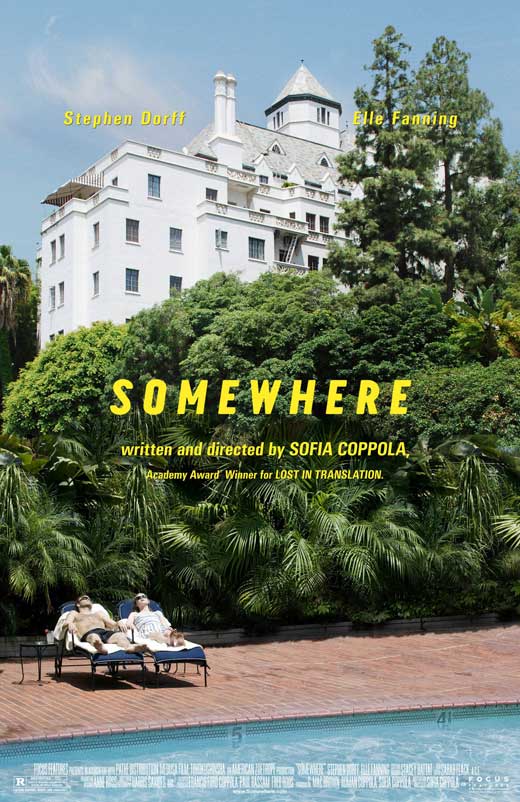
When Sofia Coppola is on her game, the results are often hypnotic, using music and images to imbue that space between mundane and just slightly alien with unexpected verve and beauty. When she's off... well, you get Somewhere, my least-favorite S. Coppola film that I've seen and something of a chunkily textured anti-character study. The feeling of deflation that the protagonist feels near the end of the movie when his daughter's visit ends rings true, but it's one of the only engagingly human moments in the film, the rest meandering through the irritations of minor celebrity and wealth with a stateliness that approaches staleness. Look to pretty much any other of Coppola's films for a more compelling take on these same themes. Grade: C+


Pink Floyd: The Wall (1982)
Often clumsy and flimsy in its live-action segments, The Wall falls far short of the pedigree of its namesake album. However, when it works—and, like the album, it works most brutally in its latter half—the film is absolutely aces, as compelling a portrayal of misery and psychological anguish as the album itself, and even more effective as a slice of the British counterculture and its fallout. And let's not forget the animation, which is always excellent and the best part of the film, despite clocking in at just over fifteen minutes collectively. What I would have given to have had this entire movie animated. Grade: B+


3 Women (1977)
As someone who's only seen the big three from Robert Altman (those being M*A*S*H, McCabe & Mrs. Miller, and Nashville), I found 3 Women to be pleasantly small turn from the guy's normal ensemble jigsaws. A psychological thriller very much in the vein of Bergman's Persona (if slightly less deconstructive) and what Roman Polanski was doing in the late '60s, it's a mesmerizing, head-scratching piece of filmmaking, made all the better by an all-time-great performance from already all-time-great performer Shelley Duvall. It's far too often that we forget that she pretty much batted 1.000 throughout most of the '70s and '80s. Grade: A-


Attack of the 50 Foot Woman (1958)
The title's a bit misleading, given that the giant woman doesn't attack until the last ten minutes of the movie (and isn't even giant for the majority of the preceding film). Also, characters repeatedly marvel at how the woman (and her male counterpart) must be "thirty feet tall." So that's strike two. Look, I'm probably not going to convince any haters that this is a good movie—there's plenty of ammunition there: titles aside, the special effects are startlingly bad, particularly the matte effects, and the dialogue is tepid. But I dunno, guys, I found this charming in all its raggedness, and from the way it's pretty much 80 percent domestic crime smut to the exaggeration of the "vengeful, wronged wife" trope to this level of sci-fi melodrama. Fans of second- (or third-) tier sci-fi from the era shouldn't miss it. Grade: B

Television


Crazy Ex-Girlfriend, Season 2 (2016-17)
While its shorter episode count makes Season 2 feel a little less complete than Season 1—character arcs feel rushed, plots feel underdeveloped—the second year of what's likely TV's best comedy right now is bolder, more complex, and more sure of itself than the first, which had a slightly rocky beginning. The end result is just tremendous TV, consistently hilarious, often hummable, and completely hitting its stride. Rachel Bloom's Rebecca Bunch is no less frantic and unwell—if anything, she's more so—which makes it all the more impressive that the series is able to find so much tenderness and compassion within a character who should, by all logic, be a whirlwind of irritating tropes. But as we all know, the situation is a lot more nuanced than that. Grade: A-


Crisis in Six Scenes (2016)
Woody Allen made it abundantly clear prior to the release of Crisis in Six Scenes that his undertaking a TV series was a colossal mistake. And now, having seen the finished product, I'm unfortunately compelled to agree with him. An aimless, horribly paced, unfunny six episodes of tired Allen tropes, Crisis is just over the length of his longest feature films (not coincidentally, among his worst), but the good material within amounts to little more than an hour's worth of watchable work—to say nothing of the horrible structural issues the show faces as Allen apparently has no idea of the concept of a distinct episode and instead sequences scene after scene until he hits twenty-plus minutes and cuts it off until the next episode, whether or not the drama requires it. I'll go to bat for the fifth episode, centered around a bungled crime that makes it reminiscent of the bumbling capers of Manhattan Murder Mystery or Scoop, and overall, Allen has fun with the lightly satirical depiction of 1960s counterculture, both with Miley Cyrus's anarcho-Marxist revolutionary and the escalating gag of the old-ladies book club who decides to read her literature. But there's very little here to recommend that isn't found in better form in any number of Woody Allen's cinematic work, and even then, it's encased in so much lard that it wouldn't be out of case in a frontier butcher shop. Skip it. Grade: C

Books


The Vegetarian by Han Kang (2016)
I was going to avoid referencing Kafka in describing this book (not the least because he's already mentioned in one of the critical blurbs on the book's back cover), but how else do you describe unsettling surrealism that at first feels satirical before turning heartbreaking? It's Kafkaesque, through and through: a woman decides to become a vegetarian after unsettling dreams (see??), and the book follows the escalating fallout on her husband, her father, her brother-in-law, her sister, and her own psychology. The gorgeous translation by Deborah Smith manages to evoke the strange proceedings with wit and kinetic energy that never loses track of either the central horror or underlying sadness that imbues the work with its magnetic power. Grade: A-


The Sculptor by Scott McCloud (2015)
Color me disappointed. A cursory glance through The Sculptor promised a strikingly illustrated fable about an artist's bargain with Death. What it ends up being is a bit of a one-dimensional mix of romance and struggling artist clichés that indulge in the worst of Manic Pixie Dream Girl and "nobody understands my work" artist tropes. David is an artist who's of course above irony and instead wants to make people feel something; Meg is a woman whose sole purpose seems to be to brighten his existence with her quirky lust for life and the inevitability of her eventual sleeping with him. Also, she's bipolar but won't take her medication because she wants to "feel everything." If you can't tell, that's the sound of my eyes rolling. It's not all bad: the story gets pretty good toward the end, and the fantasy elements (pretty much everything to do with death) are both cool and poignant. And those striking illustrations the book's initial pages promised me are totally there and totally great. It's just frustrating that those elements couldn't have concealed into a more consistently good package. Grade: B-

Sunday, April 24, 2016

Mini-Reviews for April 18 - 24, 2016

Hey! This week I actually have media besides movies!

Movies

Ed Wood (1994)
That Ed Wood is the best Tim Burton movie by such a wide margin (beating my other favorite, Big Fish, by a country mile) leads me to the uncomfortable idea that Burton is way better without the things that we normally associate with Good Burton: showily Expressionist scenery, Gothic fantasy, S&M, Danny Elfman. To be sure, the first couple of those tropes exist in Ed Wood, but they are pared waaaay down when compared to other Golden-Age-Burton output—it's by no means a subtle movie, but Ed Wood is perhaps the closest we've ever gotten to subtlety in this famously flamboyant director's filmography. So, maybe Burton is better when he's just a little less obviously himself than usual? It's a disheartening revelation in a movie that features such an unapologetic affection for the supposed worst director of all time; there's an easy possible version of this movie that depicts Ed Wood with all sorts of condescension: he's a fool, ignorant of his own shortcomings, filled with pretension and myopia. But Burton's version (and Depp's, who plays Wood with tenderness and empathy—rarely has Tim's favorite actor been so vital to the impact of Tim's film) says something different: that maybe it doesn't matter how good something is, just that it's done sincerely, with the kind of dorky passion that only a true outcast can muster. So maybe I've just missed the big fat point with my Burton critique? Grade: A

Fast, Cheap & Out of Control (1997)
This one snuck up on me. Leave it to Errol Morris, ever the docu-philosopher, to turn an ordinary documentary (well, "ordinary") about a robot scientist, a naked-mole-rat expert, a topiary trimmer, and a lion tamer into a treatise on consciousness and individuality. It's talking-head documentary-making taking to the abstract expressionist edge, and it's riveting. I had to take a walk afterward—it's not necessarily heavy viewing, but the ideas slowly envelope your mind like creeping vines until you can't shake them. Grade: A


Beau Travail (1999)
A loose, artsy adaptation of Melville's Billy Budd, apparently, which might mean more to me if I had read Billy Budd. As it is, we've got a movie that's hard-to-follow and kind of boring (in a meditative, considered way that's boring nonetheless) but also mercifully beautiful, albeit in that "handheld, accidentally beautiful" way that I don't particularly enjoy all that much. I demand for film compositions to be stable and intentional-looking, dang it! Grade: B-


Buffalo '66 (1998)
A great example of how style, not plot, is cinema's most valuable commodity. Because honestly, the plot here kind of sucks, particularly when it comes to Christina Ricci's woefully underdeveloped and possibly fetishized Layla, the kidnappee/love interest (I know, right?) for Vince Gallo's infinitely more interesting and alternatingly scary and hilarious Billy. But on a style level, we've got a nearly masterful combination of film grain, editing, music, lighting, and framing that pretty much single-handedly rescues the film from its male-centric tropes and turns it into one of the most distinctive-looking indies of the past couple decades. I mean, it's still not great, but it's hard to hate a movie with both Yes and King Crimson so skillfully deployed on its soundtrack. Grade: B+

Books

Reality Boy by A. S. King (2013)
Now that I'm teaching high school, I've decided to make a more diligent effort to keep up with YA lit outside the blockbuster Hunger Games/Harry Potter field, as most of my experience with that genre comes from at least a decade back (and most often begins and ends with Robert Cormier). This was my first stop on that journey. It's pretty good—A. S. King evokes a fantastic voice in her protagonist/narrator, and the basic premise, examining the psychological fallout of a child from one of those "Emergency Nanny"-type reality shows appeals a lot to my general loathing of that kind of show. The ending doesn't work at all: it stares right into the abyss so compellingly in its middle hundred pages that the sudden shift toward positivity and self-actualization at the conclusion feels under-cooked. But the journey there is funny, scary, and all kinds of readable. Grade: B

Television

Crazy Ex-Girlfriend, Season 1 (2015-2016)
Anyone paying attention to Rachel Bloom's fantastic video work prior to last fall (I wasn't) would have had no problem anticipating the Bloom-starring/co-created/co-written CW musical comedy, Crazy Ex-Girlfriend, as the sharp, gutsy, laugh-out-loud hilarious show it turned out to be, not to mention just how hummable the songs are. But I think what caught everyone off-guard was the depths of the emotional stakes here. Bloom deserves pretty much all the awards for imbuing what even the theme song acknowledges is a sexist term with wonderful, aching human life. It's sharp, laugh-out-loud, etc., yes, but it's also a moving, messy examination of what it means to be happy in modern life. Which is, like, amazing considering the really kooky premise of the show. The first few episodes are kind of duds, but once you get to the one with the "Sex With a Stranger" song and the Astaire-Rogers homage (that both of those can exist in the same series should give you an idea of just how wonderful this show is), it's pretty much gold through the end. If you're only going to catch up with one new show from the past TV season, make it this one. Grade: A-

Music

Black Mountain - IV (2016)
Black Mountain and their signature Pink Floyd/Black Sabbath revival sound with an album that is particularly Floydian and Sabbath-ish, in equal measures. The long, atmospheric passages and guitar solos (and heck, that cover art) is vintage Wish You Were Here, while the punchier, crunchier songs are straight Master of Reality. Plus, there's the gloriously unironic use of sci-fi imagery and proggy synths throughout, which, come on, we need more sci-fi songs these days. Like most revival-type albums, some of the stuff here ventures a little too close to pastiche at times, and the music can seem a little thinner than the legends it's trying to evoke. But when you get right down to it, this is either going to be your thing or not, and your love of Pink Floyd and Black Sabbath is pretty much going to determine that thingness. Grade: B+