Showing posts with label Woody Allen. Show all posts

Sunday, March 14, 2021

Mini Reviews for March 8 - 14, 2021

Don't forget that if you want to submit a question to my 400th post Q&A, you can do so here! If you don't know what I'm talking about, you can read my post about it here.

Movies

Ma Rainey's Black Bottom (2020)
The performances are great (Viola Davis and Chadwick Boseman, so duh), as is the writing itself (August Wilson, so duh). But boy, this is just completely baffling on a technical level. I guess aesthetic is subjective, but I have no idea who thought it was a good idea to take a play-to-film adaptation that imo ideally would have been full of long takes and long shots and instead make it consist almost entirely of erratically edited-together close ups. Maybe this is just some artsy vibe that I'm not keyed into, but as I experienced it, this movie is at war with its best elements, which is a shame given those elements. Grade: B-


Wild Mountain Thyme (2020)
I can't say there's much of my Irish heritage left beyond a residual disdain for British monarchs and some memories of my grandfather singing "Londonderry Air." I guess there was also that one time that my boss jokingly called me a "mick." But that's about it. I'm going to guess that John Patrick Shanley has about the same connection to Ireland as I do, because what in the world is this? It's like one of those "generic decades songs" from Bojack Horseman, only a movie and about Ireland: there are pub singalongs, green hills, salt-o'-the-earth musings about the countryside, really bad "tope o' thuh marnin" accents from a central cast who is almost exclusively not Irish (Christopher Walken???), a pivotal scene involving a pint of Guinness—like, come on, the only thing missing is flaming red hair and lots of children subsisting on potatoes. And then there's the writing, which contrives a romance so ludicrous and overcooked that it's almost surreal—given that this is the same dude who wrote and directed Joe Versus the Volcano, maybe I shouldn't rule out surreality as an intentional effect, but also, John Patrick Shanley did We're Back and Congo, too, so maybe he's just this chaotic neutral filmmaking presence that's impossible to trust. As it is, this is probably the most incredible mainstream cinema disaster since Cats, though unfortunately it does not even begin to approach that other movie's pileup of fevered-dream bad decisions. Mostly, this is just bad. Also, I was very disappointed to find out that Jon Hamm was not one of the actors in the cast doing a preposterous Irish accent. Grade: D-

A Rainy Day in New York (2019)
For a while there, I thought that people were intentionally under-rating late-period Woody Allen because of his insufferable public persona and what he ("allegedly," I guess) did to Dylan Farrow—which is fair, though not exactly how I engage with movies. And I still think that's probably the case for stuff like Irrational Man and Café Society. But at the same time, these last couple features have really seen Woody settling into exactly the things people have accused his late-period of being: a complacent parade of self-plagiarism, stale cultural references, phony bourgeois posturing, and dodgy sexual dynamics. It's not like these things haven't been present in pieces throughout most of Allen's career (or even all together in, e.g., Whatever Works). But Wonder Wheel and now A Rainy Day in New York represent a particularly somnolent turn from Allen, movies with almost no spark of life at all, embodying these tropes out of sheer laziness and retroactively flattening a filmography that, on par, is somewhat more complex than people tend to give it credit for these days. Which I guess makes it easier to dismiss Allen as a filmmaker, because at this point, he's just not good. It's contagious, too. The cast is wringing incredibly weak performances out of some of the most tepid writing of Allen's career (Timothée Chalamet in particular, whose character is named "Gatsby Welles," in case you wanted to know what level of unintentional self-parody Allen is working on here), and the whole film is a structureless blob that nobody involved seems to know what to do with except maybe Selena Gomez, who is at least fun to see onscreen (a surprise to me, I'll admit), and cinematographer Vittorio Storaro, Allen's only productive collaborator nowadays and whose work gives an artificial, soundstage-y quality to what I think are on-location shoots here, which is interesting. But unlike some of Allen's bad movies in the past, neither of those positive notes makes a good case for watching this movie despite the movie. If anyone's still on the Allen train, now might be the time to get off. Grade: C-

Dementia 13 (1963)
Francis Ford Coppola's first non-erotic feature film is basically a Psycho riff, only if Psycho made no sense on a plot level and was about a woman who was trying to commit inheritance fraud instead of embezzle money from an employer. This is basically proto-giallo in terms of how it values style over plot coherence, though this might have worked better if the style were just a little more developed and the plot made just a little more sense. But I guess you gotta start somewhere, right? Grade: B-


You're a Big Boy Now (1966)
Coppola's second "respectable" feature is a French-New-Wave-style screwball comedy about a recently adulted man (and virgin, the film is sure we understand) who is forced to live on his own for the first time. There's a kind of sweetness to the movie in the way that movies like Superbad can be sweet even at their raunchiest, where it finds bemused sympathy for a straight male interested in sex but flummoxed and befuddled at performing the patriarchal, chauvinist masculine scripts that our society says must be embodied in order to access sex. The film definitely wears out its welcome, though, as it becomes clear that it doesn't have enough jokes or enough subtle pathos to fill its 97 minutes, and a lot of what feels fun and zany at the beginning unfortunately just becomes grating by the end. Coppola's got a really interesting style here, though: a lot looser and less considered than what he would become known for (lots of rambling, urban long takes here), but also a lot slicker than his previous, almost shambling feature, Dementia 13. Progress, I suppose, though this movie isn't demonstrably more entertaining for it. Grade: B-

Sunday, June 3, 2018

Mini-Reviews for May 28 - June 3, 2018

Don't forget to read my Disney retrospective if you haven't already. So far, there's the first post (featuring Snow White, Pinocchio, and Fantasia) and the second post (Dumbo, Bambi, and Saludos Amigos).

Movies


Solo: A Star Wars Story (2018)
Solo is Disney's first major misstep in their curation of the Star Wars franchise, and it's a completely unforced error. They didn't have to make this movie. As the box office numbers show, few people are interested in a young Han movie—especially since, try as he might (and he does try), Alden Ehrenreich is not Harrison Ford, and if we're being honest, I think it's Harrison Ford that most of us love, not Han. I'll bet that even fewer people wanted a movie that's basically a SparkNotes version of A.C. Crispin's Han backstory trilogy from the old Expanded Universe novels (which I somehow remember with shocking clarity), certainly not one whose story is this lumpy nor whose emotional beats are this laden with doe-eyed sincerity nor whose special effects are this iffy—how is this one of the ten most expensive movies ever made?? The action setpieces at least have the decency to be a lot of fun, and I am absolutely here for Donald Glover's Lando (Glover is clearly having more fun than anyone else in front of or behind the camera). The alien design is also top-notch, and probably the most Lucas-esque thing in the whole Disney-Star-Wars franchise is the mid-movie gambling den where Han and Lando play sabacc with the Millennium Falcon at stake, populated with that same lovingly lurid marriage of rubber prosthetics and pulp sci-fi book covers that animated Mos Eisley Cantina and Jabba's palace. Still, to paraphrase our dearly beloved Harrison Solo, hokey casinos and hammy Donald Glovers are no match for a good movie on your screen, kid, and a good movie this is not. Grade: C


Munich (2005)
It's too long by at least half an hour (163 minutes? Really, Steven?), and that (and the accompanying slackness) is what separates this movie from the greats in Spielberg's filmography. But still, it remains a notable accomplishment, the first of Spielberg's mini-trend of using period pieces to comment on contemporary politics and the last of the most artistically sophisticated stretch of the man's career before he bent back around to his own cliches for a bit. Also, was there any other American movie in the period spanning 2001 to 2005 grappling so earnestly and rigorously with the moral thorns of the War on Terror as this one is? Grade: B+


Training Day (2001)
Basically the best-possible outcome of the intersection between Michael Bay and Paul Verhoeven. I hope that doesn't make it sound like I'm downplaying just how tight Antoine Fuqua's direction is, because it's very tight, finding the ideal gear for this sort of walking-the-line-between-gritty-and-bombastic mainstream filmmaking. Denzel is, of course, great here—I wouldn't have picked this for his lead-actor Academy Award performance (Malcolm X is right there, guys), but it's a high-wire performance that's justly iconic. Oh, and shout-out to Terry Crews for being given basically nothing to do but stand quietly and look intimidating and KNOCKING IT OUT OF THE PARK. Grade: B+


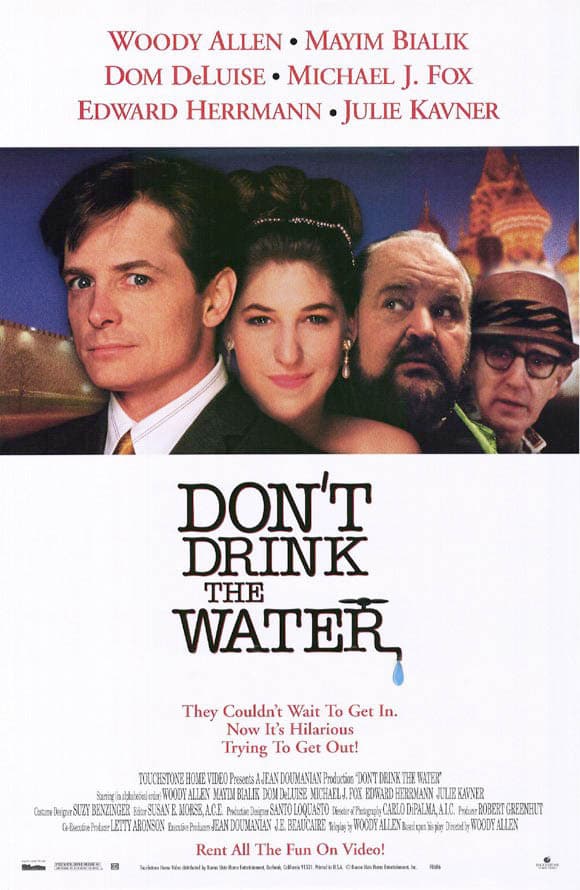
Don't Drink the Water (1994)
Woody Allen and Julie Kavner have great chemistry together as the leads (probably the last time a leading Woody Allen had good chemistry with his co-lead until Scoop, another movie involving an amateur magician—coincidence??). In fact, this is probably the best Kavner has ever been in a Woody Allen feature—though that's probably because she's usually underutilized. It certainly isn't because this movie is much good, because it isn't. For a movie that was once a play now on its second adaptation, it's haphazardly scripted and only intermittently amusing, to say nothing of the uncomfortable racial dynamics. Xenophobia/nonwhite cultural caricature (the movie ends with Allen's character sneaking off in a Middle-Eastern "harem"—dressed in drag in what I'm sure is not at all an authentic garb) is a rare flavor for Allen, and it's an unsavory one. Grade: C


Cat People (1982)
Paul Schrader's 1982 update of the 1942 classic is this weird mix of trash cinema and arthouse, and I gather that's kind of his thing. Unfortunately, it doesn't make any damn sense here. Cat People is an incomprehensible parade of nonsensical mysticism, male-gazey eroticism, and dull footage of the New Orleans zoo. The movie makes a litany of interesting and potentially rewarding decisions (setting the film in New Orleans, casting Malcolm McDowell, using that cinematography and that lighting), but it's at a complete loss as to how to put it all together. The result is a movie that's both bewilderingly bad and stultifyingly boring—a huge step down from the Tourneur original. At least the David Bowie main theme and Giorgio Moroder score are pretty good. Grade: C-


New York, New York (1977)
A great example of how a good movie is not just the accumulation of a lot of good ideas. New York, New York is made almost entirely out of good ideas: the lighting, the shot composition, the juxtaposition of New Hollywood grit with Old Hollywood musical artifice, the pairing of peak Liza Minnelli with peak Robert De Niro, the music, that nearly thirty-minute montage of Minnelli in out-of-context musical sequences belting out number after number—it's all good. But unfortunately, the movie is sunk by its lone bad idea, which is that all these elements should be crammed together indiscriminately into a movie nearly three hours in length. Grade: B-


Television


Dear White People, Volume 2 (2018)
As with its first season, Dear White People's second season's most impressive and distinctive achievement is how it manages to personify and dramatize with shocking fidelity the contemporary political discourse surrounding race and progressive politics, while at the same time making its characters characters and not merely symbols or mouthpieces for certain political archetypes. This season has the added bonus of including several conservative and alt-right voices as well, and the effect is something like watching a Twitter thread come to life—when the characters aren't actually on social themselves, which happens in several extended sequences. That may sound unappealing (I certainly find Twitter unappealing in real life), but in practice, Dear White People is (yet again) simultaneously one of the most vital depictions of the ways modern-day ideologies interact and a razor-sharp character-based dramedy. So you get episodes like "Chapter VIII," where the entire episode revolves, bottle-episode-style, around an argument between Sam and Gabe, and it's both a bracing character moment and a breathtaking examination of the conflicts between people of color's trauma and the role of white allies' "good intentions." It's not all great. The season as a whole isn't quite as cohesive or consistent as the show's first; lacking central organizing events like the blackface party or the gun being pulled on Reggie, Season 2 has the characters drift in disparate directions that don't always tie back together, leading to the underdevelopment of some of the season's threads (Tessa Thompson shows up, e.g., but her character is far too briefly examined to have her climactic moment have weight), and though I enjoy the historical scope of this season, an extended subplot involving Ivy League secret societies is something I found hard to take seriously, right up to the strange, baffling finale. But taken as a whole, Dear White People remains audacious and riveting. There's no show on right now doing stuff like this; it's electrifying. Grade: A-

Books


The Miserable Mill by Lemony Snicket (2000)
The narrative voice is as fun and morose as ever, and the details of this world are still surreal and great—my favorite this time around is that the mill workers only get chewing gum to eat at lunch. However, this book is suffocated under the series's increasingly rigid formula. The narrator seems more and more aware of this formula with each successive entry, but self-awareness and meta-commentary doesn't really make it any more interesting to read the same plot beats for the fourth time in a row. Grade: B-


The Austere Academy by Lemony Snicket (2000)
But now this is more like it. The Austere Academy isn't a complete break with the Series of Unfortunate Events formula, but it's enough to spice it up enough that I'm back onboard. The introduction of the Quagmire triplets as well as hints of a broader conspiracy/mystery (V.F.D.?) are relatively small additions, but they broaden the scope of the series in pleasantly evocative ways. Also, maybe it's just my profession talking, but the school-by-way-of-Kafka depiction of the titular academy is a highlight of my read-through of this series so far. There's something so very familiar about a school putting so much faith in an "advanced computer system" that ultimately fails spectacularly. Grade: B+


The Ersatz Elevator by Lemony Snicket (2001)
To say that The Ersatz Elevator is the best book in A Series of Unfortunate Events since Snicket kicked the whole thing off with The Bad Beginning isn't a statement meant to disparage the intervening four books (well, except maybe The Miserable Mill); it's more just me gushing about how big and alive and absolutely packed with ideas Elevator is. Everything the series does well is at its best in this book. The setting is hilarious, morbid, and surreal (this time, the Baudelaires are living with trendy rich people in a big-city high rise obsessed with what is "in" and what is "out"—ocean decorating becomes "in," so they spread sand and shells about their penthouse); Count Olaf's plan is arch and byzantine (involving an auction that is a front for child trafficking, basically?); Lemony Snicket's increasingly intrusive narrator is bone dry and Eeyore-ish (and he's apparently on death row?); the breadcrumbing of the series's mystery is tantalizing and effectively staged (a moment late in the novel involving a secret passage is thrilling in exactly the same way that text adventure games like Zork can be, and while I'm sure I'm the only person in the world excited by this, I'll take it); and for those playing Spot the Literary Reference with this series, there's an allusion to none other than Thomas Pynchon's The Crying of Lot 49, which seems as much of a statement of purpose for the series as we've ever gotten. This book is the series bursting into color. This book is great. Grade: A

Music


Sons of Kemet - Your Queen is a Reptile (2018)
One of the year's most fascinating and engrossing jazz records comes from Great Britain of all places. In the year of yet another royal wedding, it's cathartic and brash for Sons of Kemet to declare what they do in this album's title, and the music within is in the same spirit, each track's declaration of "My Queen" a triumphant and angry counterpoint to the title's dismissal of "Your Queen." "My Queen Is Angela Davis" one track says; "My Queen Is Harriet Tubman," says another, and yet another screams, "My Queen Is Albertina Sisulu"—each track a celebration of black women both well-known and obscure to white Western audiences (or at least to me), each track a winding groove set to the furious Afrobeat drive of the percussion and the fire of the occasional lyrics. I'm not sure if this is jazz's future or just one of its many, many historical and political tendrils that I'm only just now discovering, but it's definitely one of the definitive recordings of 2018. Grade: A-

Sunday, May 27, 2018

Mini-Reviews for May 21 - 27, 2018

Don't worry; I'll be starting that Disney retrospective soon. You can expect the first post sometime this week.

Movies


Wonder Woman (2017)
Wonder Woman is, as its thesis on humanity itself says, flawed. This is most notable in its depiction of World War I as a war with "good guys" and "bad guys," a claim the movie tries to undercut later on with discussions about the genocide of indigenous peoples and speeches about how the war is "all of our faults," but there's a lot of clumsiness in that walking back—it says all humans have the capacity for evil and violence and that war is a divine conspiracy for the suicide of the species (good theme, esp. for WWI), but it only actually depicts evil done by the Germans, and by golly, when it comes to film, especially one as visually driven as this, actions speak way louder than words. But what speaks even louder than its mismatched history and uneasy imperialism is Wonder Woman herself, cast and played perfectly by Gal Gadot and, prior to this year's Black Panther, given the most precise and uncluttered character arc any superhero has had since Star Lord in the original Guardians of the Galaxy; after the Jenga-stacked accumulation of the Marvel movies, this sort of clarity is a drink of cool water. And then there's director Patty Jenkins, who does tremendous work turning the Zack Snyder aesthetic into something genuinely iconic and exciting. The Marvel movies have a better grasp of how to create a successfully entertaining movie, but I find the DC project of playing up the otherworldliness and deity of their superheroes to be a much more thematically interesting approach to this material, and it has the potential to pay off richly. As much as the movie has some issues with the execution of its latter half (complaints that it devolves into yet another CG superhero climax are warranted), it's also one of the great blockbuster moments of last year to see this god-like woman look down on humanity and determine that, despite their capacity for evil, human beings are worthy of love and protection. This dialogue about humanity by people who are, by the movie's logic, definitely not human makes this movie's larger themes work on a mythological, even philosophical level, one where the Marvel movies, for all their structural integrity, usually crumble. Wonder Woman's thesis is hard-won and honest humanism in a narrative that acknowledges both the absurdity and necessity of humanism. As much as we can nitpick the specifics of the movie, that's powerful. Grade: B+


Wonder Wheel (2017)
It's an immense frustration to me that the most aesthetically engaging Woody Allen movie in a very long time (I would argue since Shadows and Fog, though there are a few other pit stops since that I'd contentedly settle upon) has the weakest Allen screenplay since Whatever Works, along with at least one bad performance (Justin Timberlake) and at least one iffy one (Kate Winslet). Such is the experience of watching a modern Woody Allen film, where there are frequently very good things among the frequently very bad things. The aesthetic I'll credit to cinematographer Vittorio Storaro, who uses the carnival lighting of the film's intentionally artificial—even music-box-like—Coney Island setting to make everything on screen positively glow with constantly shifting colors (to say nothing of the multiple long takes, all staged perfectly). The screenplay and the performances I've got to credit to Allen, though, since all their hoary tropes (a woman having an affair, you say? My oh my) and structural problems and stiltedness are as much of Allen mainstays as swing jazz. Also, I don't always find biological readings of movies to be compelling or helpful, but come on, there's no way that Allen isn't baiting us here with his story of a guy who is in a relationship with both a woman and her step-daughter. All that said, the movie looks soooo good that I'm tipping this over to a very slight net positive. Grade: C+


Middle of Nowhere (2012)
Unlike a lot of rising acclaimed directors, Ava DuVernay isn't much of a visual stylist, and her writing is, in its grand gestures, never a highlight either. Where her movies excel is at the micro level, the way a small edit creates tension between scenes, the way body language accumulates over a scene to build to great moments of intimacy and humanity. With this skill set, she can get amazing performances out of her actors, and here, Emayatzy Corinealdi and David Oyelowo shine. Also, Corinealdi's character rides the bus a lot and falls in love with a bus driver, so you know this has my number. Grade: B


Birth (2004)
Nicole Kidman's dazzling performance is the mirror image of Mia Farrow's in Rosemary's Baby, each raw and empathetic responses to a trauma that the world around them denies them the catharsis of processing. In Birth, Kidman's character has lost her husband suddenly, and ten years later, a ten-year-old boy comes and tells her that he is her husband, reborn; nobody (including possibly the film's audience) believes the boy but Kidman, who must relive their relationship's life and death through this boy—as depictions of grief and love and the unearthly madness of those emotions go, Birth's is both alien and breathtakingly human. If Kidman evokes Rosemary's Baby, then the film's otherworldly tone is Picnic at Hanging Rock, as we (along with Kidman's character) slip from drama to dream without ever releasing the tether of conscious reality. It's all rather stunning and makes me want to revisit my (lukewarm) feelings on director Jonathan Glazer's Under the Skin, which mines a lot of that same otherworldliness. Plus, if we aren't talking about Alexandre Desplat's score as one of the best of this century, then what are we even doing? Grade: A


8 Mile (2002)
There are two things that work in 8 Mile: 1. the on-location footage of urban/suburban Detroit, and 2. the lengthy rap battle that closes the film. And both of these things do more than work—they practically save the movie. The setting, full of its crumbling homes and cavernous, abandoned urban architecture, evokes a version of Detroit (and I emphasize "version," since I'm sure Detroit—as is the case with my home town of Memphis—doesn't always appreciate its public perception as Exhibit A in The Death of the Mid-Century American City) as something of a poetic squalor that absolutely makes the movie's action more interesting as it clambers over the brick and asphalt of this landscape. And the rap battle, the movie's climax and the only time we see Eminem do much rapping, hums with more live-wire energy than the rest of the movie combined. The rest of the movie, well... it's a pileup of underdog cliches, problematic archetypes (esp. the female characters), and boring drama—to say nothing of the uncomfortable racial component of having Eminem, a white dude, crashing into hip-hop against black antagonists. This is, to an extent, the story of Marshall Mathers himself, so I won't begrudge the movie too much for cribbing the autobiographical details. But given how popular and financially successful Eminem proved (and already had proven) to be relative to even some of the most successful black rappers, there's still something iffy about this guy's main opposition being black rappers. I don't quite know how to do this story without that dynamic, but I'm also not sure we needed much of this movie outside of silent shots of Detroit and that rap battle at the end, so. Grade: B-


Ghost World (2001)
This scratches the same itch as Juno and the better parts of Superbad for me, wherein we watch funny teens on the brink of adulthood using snark to mask the terror and loneliness of coming to grips with the parallel facts that 1. They are about to enter the adult world, and 2. The adult world sucks. Thora Birch, as Enid, plays perfectly that late-teen feeling of being being perpetually irritated by everything (a feeling I relate to deeply), as well as that similarly late-teen vulnerability in recognizing that identity—especially that identity you've cultivated as a high schooler—is both excitingly and scarily fluid (another feeling I relate to deeply). Hers is one of two wonderful performances this movie absolutely wouldn't work without, the other being Steve Buscemi's Seymour, a character that can be argued is just a nice version of a gross archetype (the older dude who falls for a teen, the older dude who thinks the modern world is terrible, the older dude who feels resentful that the women around him are shallow—take your pick; Juno drives this character type right into its dark subtext, to that movie's benefit, I think), but Buscemi's take on the guy is so perfectly pitched toward sadness and self-loathing that it works without him feeling like a sugarcoated MRA or something. Other parts of this movie feel either ill-considered (the weirdly broad convenience store hijinks) or underdeveloped (Scarlett Johansson's Rebecca—Johansson is totally not pulling her weight here, which is disappointing). But together, Birch and Buscemi make this movie a poignant exploration of friendship and loneliness that I fell in love with. Grade: A-

Television


Atlanta, Season 2: Robbin' Season (2018)
Although I enjoyed Atlanta's first season, I wasn't quite as enthusiastic as some of the show's more vocal supporters. Well, count me among the show's more vocal supporters now. Season 2 (or Robbin' Season, as it subtitles itself) is likely the best television we're going to get in 2018. Largely eschewing Season One's surrealism (though we do get a reference to the invisible car) for a more situational strangeness that's rooted in the Theatre of the Absurd, Robbin' Season proves to be a much more flexible and profound beast than it's older counterpart, wrenching hilarity out of terrifying existential labyrinths and horror out of piercing mundanity. In "Barbershop," Alfred (i.e. Paper Boi) is stuck in an episode-long haircut limbo as his barber drags him along for his shaggy-dog to-do list, and it's the funniest TV episode of 2018 to date; in "FUBU," a flashback to Earn's teens is one of the most painful and accurate depictions of high school I've ever seen on TV, and it's the most painful TV episode of 2018 to date; and in "Teddy Perkins," an episode best-approached with as little knowledge of it as possible, Atlanta looks the racism and abuse in show business and even evil itself squarely in the eye, and it's the best TV episode of 2018, period. Watching Robbin' Season recalls the excitement I felt watching Lost's fourth season or Mad Men's fifth, where I had no clue what to expect from week to week except the unfiltered pleasure of a show drunk on its own creativity and sure enough in its hand to pull off every idea it has masterfully. TV like this doesn't come around often, folks. Grade: A


Bob's Burgers, Season 8 (2017-18)
I mean, what can you say about Bob's Burgers anymore? It isn't really a show that innovates on itself, aside from the fun season premiere, "Brunchsquatch," which is animated in the style of some of the series's fan art. In general, though, it's a chronically unambitious show, content to tell small stories of the same variety it's always told, imbued with the same warmth for outsiders and weirdos as it's always had. Nowadays, we tend to value television that's dynamic, television that changes—Breaking Bad is beloved for, among other things, its relentless evolution of its own premise. But let's not forget that for the majority of TV's existence, formula and stasis have been the medium's default, and when a show has as much mastery of its formula as Bob's Burgers does, the dividends can be wonderful. Grade: B+


Brooklyn Nine-Nine, Season 5 (2017-18)
I continue to be gently entertained—rather than completely smitten—by this show, and it's increasingly reliant on the occasional Very Special Episode to address the various societal implications of the series, which I find kind of irritating. But the show's cast is still one of the best in the business, and on a week-to-week basis, it works as basic workplace sitcom comfort food well enough. Plus, the finale ends on a corker of a cliffhanger, which makes me glad that NBC rescued it from cancellation (sad face that the same can't be said of fellow Fox casualty, Last Man on Earth). Grade: B


Books


One Hundred Years of Solitude (Cien años de soledad) by Gabriel García Márquez (1967)
I read this not just because I've wanted to for years (which is true—and truth be told, I tried and failed to read it in high school) but also because I loved Isabel Allende's very García-Márquez-inspired The House of the Spirits so much that I wanted to follow-up. I dunno if this loses me literary cred or whatever, but I preferred House of the Spirits more—it's more emotionally accessible than García Márquez's distanced, often alien fable of Colombian history. Macondo, García Márquez's Colombia in miniature, is a town viewed under a microscope, not lived in, by his readers, and maybe I'm only feeling this way because I'm not Colombian, but also, I don't think it's too much of a stretch to say that we're not supposed to feel for these characters in the same way that we are Allende's. That's not to say this novel isn't also capable of fantastic heights, because it is, taken as a whole, great and at times tremendously powerful, often because of García Márquez's elevated, distancing approach. On the cover of my edition, there's a pull quote from William Kennedy of the New York Times that I've often rolled my eyes at, in which Kennedy compares the novel to the book of Genesis, but now, having read the novel, that's exactly the right comparison. The experience of the novel is very much like reading those early books of the Bible, where the supernatural piles on top of family genealogy which piles on top of history. We're left with a book that feels very much like it was written from the perspective of heaven looking down at Earth, and when the novel's apocalyptic ending—down to its soul-rending final sentence—splays across the last page, it lands like the fist of God itself. Grade: A-

Music


Janelle Monáe - Dirty Computer (2018)
Monáe pulls something of a St. Vincent by making this, her newest album, significantly more pop-centric and lyrically straightforward than her previous outings. There's a part of me that's disappointed in that, as one of the chief things I've loved in the past was her Bowie-like playing around with sci-fi personas and her record-crate-dive approach to genre. On Dirty Computer, the songs are most definitely about Janelle herself, and the music (while somewhat rooted in music history via its Prince inspirations [Prince himself was something of a mentor for Monáe before his passing]) sticks mostly to modern production and contemporary genres. Some of this works extremely well. Monáe gets to rap quite a bit, which is an enormous treat after her all-too-brief bars on her previous two albums, and several of the most modern-sounding tracks on the album—"Pynk," which sounds a lot like Charli XCX's work with PC Music, "Django Jane," which is basically a trap song, and "I Like That," which could have fit comfortably on Lemonade—are among the album's best. But then you've got songs like "Screwed" and "Crazy, Classic, Life," which focus on shout-along choruses, sloganeering, and Katy-Perry-sounding pop production in a way that sounds pretty thin to me. Monáe is clearly feeling liberated and happy at having shrugged off her android persona and come out as pansexual, and I think it's wonderful that she feels that way. The album's thematic through-line re: racial and sexual identity is a strong one, and I wouldn't want her to closet herself again in the interest of bringing back the weirdo sci-fi personas and stuff. But at the same time... I can't help but feel that her music was stronger (or at least more consistent) when it was committed more to being weird. I'd love to see her find a way to rediscover that part of her music without losing the personal touch and openness of the best songs here. Grade: B

Sunday, February 12, 2017

Mini-Reviews for February 6 - 12, 2017

One-day work weeks are the best. It makes me feel better about the fact that this post has more negative reviews than I think any other post I've made so far.

Movies


Deadpool (2016)
Of all the myriad things I can be thankful for, I now realize near the top must be the merciful blessing that this movie did not come out during my high school years and thus subject me to months and even years of having to hear this film's smarmy, self-impressed vulgarisms repeated from the mouths of my peers. Rather, I merely have the choice to endure this film's 108 minutes of juvenilia once, which is quite enough. I'm not sure if it's an indictment of the modern superhero blockbuster that a movie with all the flaws of the genre's most pedestrian works can feel fresh to so many by merely slapping on some R-rated violence, profane dialogue, and the flimsiest of metacommentary, but it sure isn't a ringing endorsement for the health of the form. Grade: C


Manchester by the Sea (2016)
The crushing sadness of Manchester by the Sea's shaggy plot would be suffocating if it weren't for the film's idiosyncratic and often gut-busting sense of humor—it's not black humor specifically, at least not in the satirical sense that the term often connotes. Rather, the jokes here are the only joy that our characters can find in the spaces surrounding the death of a family member and a whole host of other experiences and memories I can only assume would be absolute hell to live with. I'm being a bit vague here because the movie seems to want the specifics of these characters' lives to read as surprising reveals within the film's tightly edited flashback structure, so for now, just know that while the tragedy here would be bleak by any sense of the word, the movie itself is not bleak. That's not to say it's uplifting either--this is just life that Manchester by the Sea depicts, with all its little moments of connection and pain. It no doubt helps that every actor here—even Matthew Broderick, in a somewhat ill-conceived tangent from the film's generally rough-around-the-edges, working-class sensibilities into Christianized suburbia—play human beings of such vigor and life that there's no way not to care for every person onscreen. Grade: A-


Loving (2016)
The better of Jeff Nichols's two 2016 films is also the more grounded—literally, as it turns out. Instead of Midnight Special's multi-dimensional-alien sci-fi, Loving gives us a tender and altogether moving portrait of the couple whose Supreme-Court-decided lawsuit ended all laws prohibiting marriage on racial grounds. A lesser (or at least a less poignant) movie may have focused obsessively on the injustices the Lovings face and the legal procedure that lead to eventual justice, and those things are there to a certain extent. But first and foremost, this is a movie about its two central characters and the ebb-and-flow textures of their life together. In short, it's a romance, and a darn good one at that. Grade: B+


Nuts! (2016)
A "mostly true" documentary tries to mix historical fiction and nonfiction into a folk concoction that's reminiscent of the fibs of its central huckster, John R. Brinkley, who claimed to have cured impotence by transplanting goat testicles into human males. It's a funny, outrageous bit of historical oddity, but the film's approach—a mix of talking heads and shoddy, frequently glib animation—lacks the precision needed to make its fictionalized nonfiction work like it should. In the hands of more skilled filmmakers, this might have been gold. Instead, it feels like a half-baked internet flash animation. Grade: C


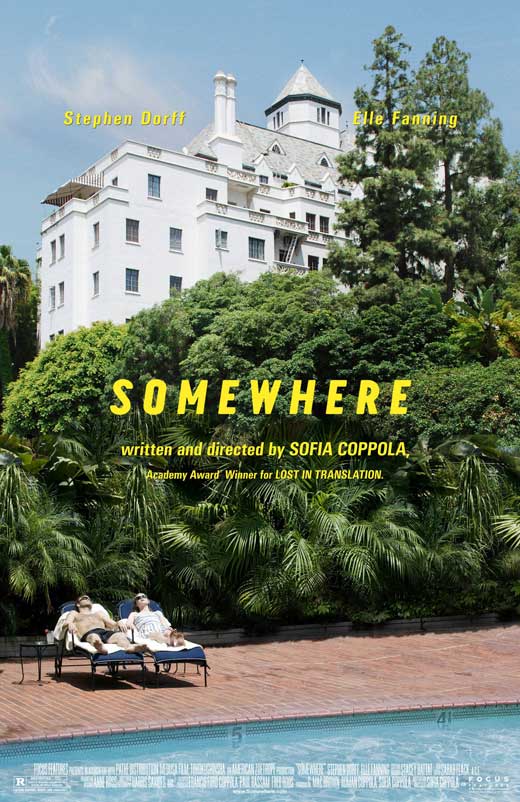
Somewhere (2010)
When Sofia Coppola is on her game, the results are often hypnotic, using music and images to imbue that space between mundane and just slightly alien with unexpected verve and beauty. When she's off... well, you get Somewhere, my least-favorite S. Coppola film that I've seen and something of a chunkily textured anti-character study. The feeling of deflation that the protagonist feels near the end of the movie when his daughter's visit ends rings true, but it's one of the only engagingly human moments in the film, the rest meandering through the irritations of minor celebrity and wealth with a stateliness that approaches staleness. Look to pretty much any other of Coppola's films for a more compelling take on these same themes. Grade: C+


Pink Floyd: The Wall (1982)
Often clumsy and flimsy in its live-action segments, The Wall falls far short of the pedigree of its namesake album. However, when it works—and, like the album, it works most brutally in its latter half—the film is absolutely aces, as compelling a portrayal of misery and psychological anguish as the album itself, and even more effective as a slice of the British counterculture and its fallout. And let's not forget the animation, which is always excellent and the best part of the film, despite clocking in at just over fifteen minutes collectively. What I would have given to have had this entire movie animated. Grade: B+


3 Women (1977)
As someone who's only seen the big three from Robert Altman (those being M*A*S*H, McCabe & Mrs. Miller, and Nashville), I found 3 Women to be pleasantly small turn from the guy's normal ensemble jigsaws. A psychological thriller very much in the vein of Bergman's Persona (if slightly less deconstructive) and what Roman Polanski was doing in the late '60s, it's a mesmerizing, head-scratching piece of filmmaking, made all the better by an all-time-great performance from already all-time-great performer Shelley Duvall. It's far too often that we forget that she pretty much batted 1.000 throughout most of the '70s and '80s. Grade: A-


Attack of the 50 Foot Woman (1958)
The title's a bit misleading, given that the giant woman doesn't attack until the last ten minutes of the movie (and isn't even giant for the majority of the preceding film). Also, characters repeatedly marvel at how the woman (and her male counterpart) must be "thirty feet tall." So that's strike two. Look, I'm probably not going to convince any haters that this is a good movie—there's plenty of ammunition there: titles aside, the special effects are startlingly bad, particularly the matte effects, and the dialogue is tepid. But I dunno, guys, I found this charming in all its raggedness, and from the way it's pretty much 80 percent domestic crime smut to the exaggeration of the "vengeful, wronged wife" trope to this level of sci-fi melodrama. Fans of second- (or third-) tier sci-fi from the era shouldn't miss it. Grade: B

Television


Crazy Ex-Girlfriend, Season 2 (2016-17)
While its shorter episode count makes Season 2 feel a little less complete than Season 1—character arcs feel rushed, plots feel underdeveloped—the second year of what's likely TV's best comedy right now is bolder, more complex, and more sure of itself than the first, which had a slightly rocky beginning. The end result is just tremendous TV, consistently hilarious, often hummable, and completely hitting its stride. Rachel Bloom's Rebecca Bunch is no less frantic and unwell—if anything, she's more so—which makes it all the more impressive that the series is able to find so much tenderness and compassion within a character who should, by all logic, be a whirlwind of irritating tropes. But as we all know, the situation is a lot more nuanced than that. Grade: A-


Crisis in Six Scenes (2016)
Woody Allen made it abundantly clear prior to the release of Crisis in Six Scenes that his undertaking a TV series was a colossal mistake. And now, having seen the finished product, I'm unfortunately compelled to agree with him. An aimless, horribly paced, unfunny six episodes of tired Allen tropes, Crisis is just over the length of his longest feature films (not coincidentally, among his worst), but the good material within amounts to little more than an hour's worth of watchable work—to say nothing of the horrible structural issues the show faces as Allen apparently has no idea of the concept of a distinct episode and instead sequences scene after scene until he hits twenty-plus minutes and cuts it off until the next episode, whether or not the drama requires it. I'll go to bat for the fifth episode, centered around a bungled crime that makes it reminiscent of the bumbling capers of Manhattan Murder Mystery or Scoop, and overall, Allen has fun with the lightly satirical depiction of 1960s counterculture, both with Miley Cyrus's anarcho-Marxist revolutionary and the escalating gag of the old-ladies book club who decides to read her literature. But there's very little here to recommend that isn't found in better form in any number of Woody Allen's cinematic work, and even then, it's encased in so much lard that it wouldn't be out of case in a frontier butcher shop. Skip it. Grade: C

Books


The Vegetarian by Han Kang (2016)
I was going to avoid referencing Kafka in describing this book (not the least because he's already mentioned in one of the critical blurbs on the book's back cover), but how else do you describe unsettling surrealism that at first feels satirical before turning heartbreaking? It's Kafkaesque, through and through: a woman decides to become a vegetarian after unsettling dreams (see??), and the book follows the escalating fallout on her husband, her father, her brother-in-law, her sister, and her own psychology. The gorgeous translation by Deborah Smith manages to evoke the strange proceedings with wit and kinetic energy that never loses track of either the central horror or underlying sadness that imbues the work with its magnetic power. Grade: A-


The Sculptor by Scott McCloud (2015)
Color me disappointed. A cursory glance through The Sculptor promised a strikingly illustrated fable about an artist's bargain with Death. What it ends up being is a bit of a one-dimensional mix of romance and struggling artist clichés that indulge in the worst of Manic Pixie Dream Girl and "nobody understands my work" artist tropes. David is an artist who's of course above irony and instead wants to make people feel something; Meg is a woman whose sole purpose seems to be to brighten his existence with her quirky lust for life and the inevitability of her eventual sleeping with him. Also, she's bipolar but won't take her medication because she wants to "feel everything." If you can't tell, that's the sound of my eyes rolling. It's not all bad: the story gets pretty good toward the end, and the fantasy elements (pretty much everything to do with death) are both cool and poignant. And those striking illustrations the book's initial pages promised me are totally there and totally great. It's just frustrating that those elements couldn't have concealed into a more consistently good package. Grade: B-

Sunday, July 31, 2016

Mini-Reviews for July 25 - July 31, 2016

Reviewing: all day, every day. Last one of these before school starts up again (heavy sigh). Let me know what you think of what's here.

Movies

Café Society (2016)
A melancholy romance that, if it weren't for the abundant morbidity in the rest of Woody Allen's career, would be rather startling in the lengths it goes to connect unrequited love with death. We see at least half a dozen onscreen deaths throughout the film, most played for laughs (Jesse Eisenberg's protagonist has an uncle in the mob, with predictable results ensuing), and at least a couple offscreen as well; the tone is light, but the themes weigh increasingly heavily on the movie's plot and style, culminating in a lengthy dissolve between two scenes in the film's final shot that's as aching an evocation of regret as Woody Allen has ever committed to film. "Live every day like it's your last, and one day you'll be right," one of the funnier lines in the movie goes, and that seems to be true of both life in general and time with lover in particular.  Make mistakes in your romances, and you've squandered the finite time you have before the end. I liked last year's Irrational Man a whole lot, but even so, my gut is that this is Allen's best film since Vicky Cristina Barcelona, or at the very least, Blue Jasmine. My wife says that Woody Allen has run out of stories to tell, and certainly, there are echoes of his past work hereSweet and Lowdown and shades of Bullets Over Broadway, for sure, and maybe a touch of Annie Hall's sense of the passage of time. And I'll say this: the first 15-20 minutes are the movie's weakest, which gives the initial impression that what we're about to see is a retread of Allen's greatest hits (one scene in particular involving a prostitute feels ripped from his mid-'90s output). Woody has his tropes, that's for sure; but when he's able to spin new, interesting, and frequently moving permutations of those tropes (as he does mightily in the back half of this one), you'll hear no complaints from me. Grade: A-

Sing Street (2016)
Almost all of my issues with this moviethe queasy way the romantic fantasy never quite integrates with the indie realism, the way the songs seems a bit out-of-time and more akin to 2016 impressions of what 1985 New Wave must have sounded like, the thinly cartoonish way most of the characters are established and then never given any more context (or really, much to do at all) beyond their first scenecan all be waved away with the simple admission that, "Dude, it's a musical. Of course those things happen." I might be more amenable to that position if I thought the songs were more than just pleasant. I mean, they're fine; they're well-crafted. But they aren't, like, memorable. I like the undercurrent of melancholy that informs most of the movie (especially the scenes between the protagonist and his older brother), but it never squarely lands upon something that definitively works dramatically. Musical or no, I really do need one or the other: timeless songs or workable drama. Or maybe I'm just a grump. Grade: B-

The Aviator (2004)
It's not Scorsese's finest hour, but it's far from his worst, either. Howard Hughes is such a fascinating and perfect Scorsese protagonistcharismatic, troubled, adventurous, recklessand our esteemed director's touch so nimble in painting him that it matters a lot less than it might have otherwise that this movie is about an hour too long or that the editing often commits that great Academy Awards fallacy of mistaking "most" for "best." I'm also not convinced Leo DiCaprio was the best man for the job here; the guy's certainly trying very hard to evoke Hughes's breezy recklessness, but, well, when you're trying to seem breezily reckless, it works a lot better when your effort to look so effortless isn't quite so visible. Grade: B


The French Minister (Quai d'Orsay) (2013)
I don't know a thing about French politics, so maybe a movie-length parody of French governmental figures was never going to be in my wheelhouse. Even so, I do think it's worth pointing out just how inconsistent the comedic tone is, a feeling no doubt bolstered by the fact that the editing only decides to get tight and interesting every once in a while. Grade: C+


Suspect Zero (2004)
It's really the worst kind of bad movie when the script requires the special stupidity of having Albuquerque be some podunk nowheresville, people from Dallas treat Frito pie as some mysterious foreign cuisine, and the CIA have a rogue, psychic agent, and still manages to be a bore. That's a real shame. Suspect Zero is so close to being entertainingly bad: the script is silly and portentous in equal measure, the cinematic style is almost mad-scientist in its impassioned attempts to artsy, the acting veers into the uncanny valley of not quite recognizably human behavior. We're just missing a level of intensity by a factor of two to make it actually fun. Grade: D+


Jonestown: The Life and Death of Peoples Temple (2006)
That the story of the Peoples Temple is upsetting is old hat at this point (see: any "lol don't drink the Kool-Aid" jokes), but for me specifically, there's something so viscerally horrendous about the entire thing that I doubt I'll ever shake it. The arc of Jim Jones and his followers is one of the few historical narratives that makes me truly despair: that revolution is a myth, that the premise of organized religion is fatally flawedthoughts that I don't believe 99% of the time, but that this specific narrative forces me to confront anyway, whether I'm prepared to bat them down or not. The genius of this documentary is that its mix of archival footage and actual Peoples Temple member interviews refuses to let this story become old hat. It's a full-throated howl at the realization that any attempt to untangle the chaotic beauty of the Peoples Temple from its unspeakable evil is doomed to fail, and the remaining survivors of Jonestown speak with such clean enthusiasm and life that it drives home with painful precision just how real this movement was to everyone involved and how apocalyptic its end proved to be. Grade: A

Books

Jazz by Toni Morrison (1992)
Toni Morrison's followup to the legendary Beloved maintains that novel's preoccupation with postbellum African-American history and heightened, magical vibes. It's not as good as Beloved, no, but that's an unfair standard to keep any literary work to, and Jazz has plenty to offer aside from its younger sibling status to one of American literature's recent(ish) masterpieces. Most notable is the novel's structure, which, true to the music of the title, follows characters into historical digressions and POV switches in a way that does often feel meandering but also frequently pays off by richly mirroring the "present-day" story of a man who has murdered his mistress. Typical of Morrison, the prose is absolutely pristine in a way that feels highly structured without sacrificing any of the spontaneity of the free-flowing jazz she's trying to evoke, and overall, the effect is pretty impressive. The very literary reality Morrison has constructed here does sometimes rob the story of stakes in favor of lyricismthe characters seem shockingly nonchalant and deliberate in their reactions to an uncontested murderer walking in their midstand a lot of these characters feel very bookishly human rather than realistically human, if that makes sense. But the marvel of Morrison's work here is that that artificiality somehow ends up making the book more approachable than it might have been otherwise, and the emotions are never anything but searing. Grade: B+

Music

St. Vincent - Actor (2009)
St. Vincent's second album lacks the melodic precision of her debut, Marry Me, or the guitar flamboyance of the albums to follow, and as such, it's probably my least favorite of hers. That's not to say it isn't goodit is, and with the mid-record streak of "Black Rainbow," "Laughing with a Mouthful of Blood," and "Marrow," it's even great. Elsewhere, the string arrangements are maybe just a little too thick, and the baroque pop just a tad too baroque, to let the album truly breathe. Grade: B


PJ Harvey - The Hope Six Demolition Project (2016)
I was excited enough to hear PJ Harvey's companion piece to 2011's career-best Let England Shake that I suppose a bit of disappointment is to be expected. A protest record dealing with poverty in Kosovo, Afghanistan, and Washington DC is bound to be less specific than Let England Shake's critique of Harvey's homeland, England, and that's one of the main issues. The album opener, "The Community of Hope," describing DC's Ward 7, is a good microcosm of what doesn't work here: the climactic chant of "They're gonna put a Wal-Mart here" is a generic, heavy-handed complaint that could apply to pretty much any aging American city (including my own city of Knoxville), while the comment that "the school looks like a shit-hole" has the unintended effect of seeming to lash out against the school itself rather than the bureaucratic and social dysfunction that has made it that way. The tone is off, and the observations are rote, and the music isn't quite good enough to forgive either of those flaws. It's not all bad, though. In fact, the final three songsand especially the climactic "The Wheel"—form a suite that ranks among the best work PJ Harvey has ever done. The rest of the album isn't quite there, but if only for those closing 15 minutes, the record's still worth at least a cursory listen. Grade: B