Showing posts with label Sofia Coppola. Show all posts

Sunday, July 10, 2022

Mini Reviews for July 4 - 10, 2022

In case you missed it, I published a post about Kate Bush's Hounds of Love as part of my series on progressive rock. You can read it here, if you're interested!


Movies

On the Rocks (2020)
Pleasant. Doesn't have the dreamy It factor of Sofia Coppola's best, but Bill Murray and Rashida Jones make a ridiculously charming father-daughter duo, and I enjoyed their low-key hijinks here a lot. Grade: B


The House of Mirth (2000)
Terence Davies does a great job of capturing the brutality of the Edith Wharton novel (my favorite of hers that I've read, for what it's worth), and Gillian Anderson specifically is 100% keyed into the very specific kind of detached, diorama-like spin Davies is putting on the material. Anderson is really, really terrific here, probably the technical best performance I've ever seen from her (I'm sorry, Scully!); the way that in the early goings she is able to let us understand the terrified insecurities of her character without letting slip one bit the mask of pretensions to high-brow society is masterful, multi-tiered acting—and when that mask does slip as she hits rock-bottom near the movie's end, it's some true fireworks. As for Davies, this isn't anywhere as ornate as his work in the '90s, but it's still beautiful, this time in a suffocating way that feels appropriate to the early-20th-century upper-crust-NYC setting. Overall just a very well-done costume drama. Grade: A-

The Color of Money (1986)
I was honestly a little bored whenever they weren't playing pool, and Tom Cruise is actively annoying here. But the pool sequences (especially those in the run-up to the finale, when Paul Newman's character is basically high on gambling—for a movie that goes out of its way to sneer at cocaine, this definitely has that "Marty remembers how good coke felt" feel) are electric. The very '80s atmosphere and Scorsese's occasional flashy new-wave touch make this feel ages removed from The Hustler, but about halfway through this, I realized that there are only 25 years separating this from The Hustler, while there are a full 36 years between Top Gun (which came out the same year as The Color of Money, by the way) and Top Gun: Maverick, which seems impossible to me because those movies feel way closer to one another than this and The Hustler. I don't know if that's just a testament to my screwed up perception of time and era proximity or if there's truly a much bigger shakeup in Hollywood ethos between the early '60s and the mid-'80s than between the mid-'80s and now. Grade: B-

Eat the Document (1972)
Just an hour of footage of Bob Dylan mumbling his way through his '66 tour, the clips strung together by what could generously be called experimental editing, intercut with concert footage of music that for the most part would be mercifully rescued and restored by the Bootleg Series Vol. 4. There are some really great kernels of scenes, almost none of which last long enough, but what's here is great (esp. the famous bit with John Lennon griping at Dylan for being too mopey). Warts and all, I found this kind of hypnotic and fun. Grade: B


Music

Arcade Fire - WE (2022)
This album was initially positioned as a return-to-form after the uneven Everything Now, ditching a lot of the disco/kitsch interests of that 2017 album for a sound more in-line with Neon Bible or The Suburbs. However, Arcade Fire ironically end up with basically the same two issues as they did with Everything Now on WE: occasionally embarrassing, obvious social commentary and an deeply uneven quality control throughout. Incredibly, the worst of these issues are clustered all on one track, the epic multi-part suite "End of the Empire," which plods along with boring observations about Society(TM) and the impending collapse of America until finally climaxing with the triumphant(?) declaration that "We unsubscribe, fuck season five." I say this as someone who is both deeply anxious about the collapse of America as well as generally an apologist for Arcade Fire's heart-on-sleeve brand of self-serious cringe: this is awful. Just truly, truly awful. At over nine minutes in length, "End of the Empire" takes up nearly a quarter of the whole album, and like the "Peter Pan" --> "Chemistry" --> "Infinite Content" --> "Infinite_Content" sequence on Everything Now, it forms a wretched centerpiece that nearly derails the whole record. I guess on the plus side, making it just one track means that you only have to press the skip button once this time? Anyway, the rest of the album is much better: occasionally great, even. "Age of Anxiety I" is an effectively nervy, groovy opener with a dancefloor pulse, "The Lightning I, II" is a terrific song in the classic Arcade Fire model, beginning with a folky mid-tempo melody that builds to a lose-your-mind ecstatic anthem of a climax, and "Unconditional I (Lookout Kid)" is Arcade Fire being corny is the right way. And that's more or less it; there's not a lot to the album, and if it weren't for the totemic black hole that is "End of the Empire," WE would be unremarkable, a solid but hardly earth-shattering release showcasing Arcade Fire returning to the safe territory of what they do best after a few records trying to push their sound forward. I'm hoping this doesn't signal the beginning of their "U2 in the 21st Century" phase, because they've not made nearly enough music to justify that sort of coda. Maybe I'm the problem, though, because I do really enjoy their back-to-basics tracks here. Grade: B

Saturday, December 30, 2017

Favorite Movies of 2017

Well, here we are again—another one of these lists. I'm not going to do one of those long preambles. As usual, this post is divided between my favorite movies (emphasis on "favorite," not "best," whatever that means) and other movies I thought were notable, either for good or ill. Also as usually, I admit that I (obviously) haven't seen every 2017 movie, and I resent that the elitist and outdated distribution schedules have kept some of my most-anticipated movies away from Knoxville (more importantly, The Post and Phantom Thread).

I hope y'all enjoy it. Please, disagree with me; share your own picks; discuss. I've said it before—I love discussing this list stuff.

Favorite Movies

1. The B-Side: Elsa Dorfman's Portrait Photography
It's all about death, when you get right down to it: our lives, our actions, our thoughts—whether or not we're conscious of it, they're all defined by that firm bookend. Warm and easy-going, The B-Side resembles that other Errol Morris masterpiece, Fast, Cheap & Out of Control, by allowing a mix of editing and unfettered obsession over a craft (here, Polaroid portraitry) to accumulate into a towering treatise. I haven't seen a ton of people love this movie as much as I did, but more so than anything else I saw this year, The B-Side is profound.

[Read original review here]


2. Good Time
A damning character portrait disguised as a feature-length chase sequence, Good Time is fun until it's devastating. It's the sort of movie where you'll spend most of the runtime with your hand over your agape mouth, your eyes dazzled by the gorgeous nocturnal cinematography, your ears ringing from the assaultive score. If you haven't already seen it, the most viscerally exciting movie of the year is well-worth your time.

[Read original review here]


3. The Shape of Water
In the running for Guillermo del Toro's best English-language film, The Shape of Water is by turns swooningly romantic and gory, baroque and grimy, nostalgic and mythic; it's a blender of all of del Toro's best preoccupations, from classic Hollywood to B-movie trash, and it's great. You'll believe a fish-man can dance.

[Read original review here]


4. A Ghost Story
David Lowrey's hypnotic, unpredictable art film about grief is something of a feature-length remake of the "I got a rock" refrain from It's the Great Pumpkin, Charlie Brown, right down to the sheet ghost. The magic of this movie is that it's also heartbreaking, and not in that gentle Charlie-Brown-style way—it's legitimately staring-into-the-void-style sublimity.

[Read original review here]


5. mother!
If Darren Aronofsky wanted to just make provocative, stylistically adventurous Bible movies for the rest of his career, that would be a-okay with me. Whatever you think of the theology here, the sheer daring of this movie's scope is in a league of its own.

[Read original review here]


6. The Beguiled
Sweatiest movie of the year, bar none. This is supposedly set in Virginia, but this is definitely Louisiana, and rarely has humidity been so palpably captured on film. It's Sofia Coppola's best in quite some time, and it's no accident that it's also a tight, mean little thriller, Coppola's usually dreamy atmospherics morphing into something as sinister and phantasmagoric as it is beautiful.

[Read original review here]


7. A Quiet Passion
An exquisite tribute to Emily Dickinson couched in Terence Davies's usual visual splendor—a particularly good match of subject with director, as Davies's understated formalism complements Dickinson's own poetic style wonderfully.

[Read original review here]


8. Logan
The only superhero movie in this superhero-stuffed year I'd call "great," and while we've had plenty of movies with politics on their minds, this, with its apocalyptic squalor, is one of the few that really captures my fears of where we seem to be heading.

[Read original review here]


9. A Cure for Wellness
Something something good taste something bad script something something. I don't care. This movie looks awesome, and it's the best gothic horror we've gotten at the movies since Crimson Peak. Plus, there's no topping the compositions and lighting of the visuals here.

[Read original review here]


10. Your Name
It has all the gorgeous detail of previous Makoto Shinkai features and, a first for me with his work, a story I really bought into. The final half hour or so of the film is some of the most cosmic, beautiful film imagery, animated or not, of the year.

[Read original review here]


Appendix: Miscellaneous Movies Also Worth Noting

Best Zeitgeist-Defining Movie: Get Out—This is the 2017 movie, and I don't see many good arguments to the contrary. It's far from my favorite, but Get Out is still really freaking good, hilarious and frightening in equal measure, bolstered by a diverse cinematic tradition alluded to heavily in Jordan Peele's dense and frequently brilliant screenplay. But this is more than a spot-the-allusion film; it's a film that uses movies like Night of the Living Dead and Invasion of the Body Snatchers to genuinely subversive ends, playing off our familiarity with the beats and images of these movies to shock us. Also, it's about race; more specifically, it's about predatory white people. Let's not pretend like that isn't the most 2017 plot in all of cinema.

Best Drama: The Salesman—And I mean "drama" in the sense that it resembles a play. Asghar Farhadi's The Salesman isn't play-like in the derogatory way that movie critics usually mean when they compare the two media; rather, I'd just like to call attention to and celebrate that way that, like always, Farhadi brings a tense efficiency to the screenplay that recalls the immediacy of the stage. Farhadi's movies are as tight as drums, and while there are some elements in The Salesman that makes it less tight than, say, The Past, it still makes a mighty sound when struck.

Best Coming of Age: Lady Bird—I haven't had a chance to formally review this one yet (it's likely the final 2017 movie I'm going to see in a theater), but I love me some coming-of-age cinema, and this one is very good. Willing to be honest about the specific ways in which high school students can be various shades of pretentious and careless in a way that recalls last year's masterful The Edge of Seventeen, it's a tremendously well-observed film that, for all its plot shagginess (and there is that, sometimes to its detriment), is so sharp and specific in its characterization of Lady Bird herself that she practically jumps off the screen to shake your hand.

Best Cinematography: Blade Runner 2049—I get the thematic and narrative critiques of this movie, but I won't hear anyone dissing Roger Deakins's astounding, beautiful, lay-me-down-to-rest-because-I-have-seen-the-face-of-God visual work. Some kudos probably goes to the production design, too, without which this probably wouldn't have been so stunning. But come on; it's also Deakins we're talking about here.

Best Cry: Coco—Pixar, y'all. "Remember meeeee..."

Best Action: John Wick: Chapter 2—It's like dudes in suits shooting each other in art galleries in highly choreographed ways. What's not to like about that?

Best "Not Quite the Best Action, but Hey Look! Tarkovsky!": Atomic Blonde—Don't get me wrong: the action in Atomic Blonde is very good. It just isn't John Wick: Chapter 2 good. Still, there's a fight scene in front of a projection of Andrei Tarkovsky's Stalker, so major points to this movie for making a cheap retro allusion that I am physically unable to resist. Take that, Ready Player One.

Best Action (Ape Division): War for the Planet of the Apes—Apes on horses! Apes with guns! Apes breaking out of concentration camps! Apes doing all sorts of things! All our movies should have more apes. (But all kidding aside, this really is a good movie)

Best Animation: The Boss Baby—Am I losing my mind? Pixar has the photorealism, Cartoon Saloon has the serious stylization, Illumination Entertainment has all the really crappy-looking stuff, but it's DreamWorks Animation—frikkin' DREAMWORKS—that's actually doing the animation I like best on an aesthetic level these days. This studio has finally done what I'd considered impossible and made CG animation as flexible and convincingly cartoonish as hand-drawn stuff, and for that, they have my sincere gratitude.

Animated Movie I'm Most Thankful For: The Breadwinner—This movie is flawed in significant ways, but, along with the DreamWorks output this year (?!?), it most pushes English-language animation in directions I wish the whole medium would all go: serious-minded, audience-trusting, culturally diverse, stylistically (not realistically) animated.

Best Opening Sequence: Valerian and the City of a Thousand Planets—The first five minutes of this movie, set perfectly to David Bowie's "Space Oddity," are the best five minutes (opening or not) of any movie this year. It's a warm throwback to the optimism of sci-fi's 1940s/50s golden era, only flipped to show interplanetary contact to be an intrinsic element of this future utopia, not its greatest threat. Any other year, it wouldn't be a particularly political statement, but with every inter-species handshake, it's impossible not to feel that cooperative multiculturalism is a necessary piece of humanity's future, and also to feel the chasm between that ideal and our contemporary political discourse.

Best Opening Sequence (Non-David-Bowie Division): Baby Driver—Edgar Wright's crime caper never really delivers on the promise of this scene as an action movie intricately choreographed to pop music, but for its opening scene (and honestly, the decidedly more pedestrian second scene), Baby Driver is the perfect realization of this premise. It's wonderful.

Best Use of "Take Me Home, Country Roads": Logan Lucky—This movie's a lot of fun all around, but it's only a great movie in one moment, and that's at a children's beauty pageant, of all reprehensible things. People sing this song; it's moving.

Best Use of the Word "Poop": Captain Underpants: The First Epic Movie—There's a lot of poop-centric stuff in this movie. It's great.

Worst Use of a True Story: Same Kind of Different as Me—Pure Flix strikes again! This time, they've skimmed over all the legitimately interesting stuff about the kind of amazing true story that informs the plot and instead left us with the most boring, cookie-cutter inspirational trash ever. Hurray!

Most Misunderstood: The Glass Castle—Critics saw a toothless weepy in a tremendously difficult, thorny film about what it means to feel love for a genuinely abusive person. This is not a movie of easily-arrived-at adages; it's a film that languishes on messy, complicated, intentionally problematic questions and doesn't suggest anything cheap about its film-ending catharsis.

Best Quote: The Big Sick—"This is why I don't want to go online, 'cause it's never good. You go online, they hated Forrest Gump." Terry (a great Ray Romano) gets it.

Best Use of Social Media: Personal Shopper—Briefly, the quiet psychological thrills of Personal Shopper get cranked up to sheer horror-movie levels, and it's all thanks to a clever playing off of what we know about texting and social media engagement.

Best Use of Outer Space: Guardians of the Galaxy Vol. 2—There's a lot about these Marvel movies that's getting stale, but I'll give them this: as long as they are making colorful, goofy, imaginatively designed space-opera visuals (see also: Thor: Ragnarok), I'll probably still watch them.

Best Shower: Alien: Covenant—You'll know it when you see it.

Best Kiss: Alien: Covenant—Again, you'll know it when you see it.

Best "Well, We're Going to Be Making These Movies Until Human Extinction, So We Might As Well Make It Interesting": Star Wars: The Last Jedi—This actually probably belongs again to Alien: Covenant again, but I'm not confident that they'll be making Alien movies for that much longer. Star Wars, though... Star Wars is forever. The Last Jedi is likely the most experimental that we're going to see Star Wars get for a while (though judging by some of the fan outrage, they need to get a lot more so—just rip that band-aide off, Kennedy), and even this isn't too dramatic of a departure (I can't be the only one who wanted Rey to join Kylo like he asked). However, it's by far the most interesting engagement with the series mythology since the prequels, and this is the first time since Lucas was at the helm that the Star Wars universe felt like a living, breathing place full of species and planets we haven't seen before. It's enjoyable.

"Good Try, I Guess" Award: Song to Song—Does Terrence Malick actually know what rock music is, or did he just read the Wikipedia page? QUESTIONS TO PONDER.

Worst Application of Corporate Synergy: Beauty and the Beast—We did not need this movie, and we certainly didn't need it to be as bad as it was. Disney's been pretty good at making questionable (and nakedly money-grubbing) decisions at least blandly enjoyable this decade, but NOPE. Not this one.

Best Slow, Monarchical Death: The Death of Louis XIV—The title says it all, and let me repeat: it is sloooooow. But it's also beautifully costumed, and there's something about the languorous, meticulous way that we watch the Sun King pass from this life that feels so profoundly conscious of the realities of death in a way that reminds me of Stan Brakhage's The Act of Seeing with One's Own Eyes.

Best Non-2017 Movie I Saw For the First Time in 2017: Ordet—A dialogue between realist modernity and old-time supernatural religiosity that feels like a genuine expression of both worldviews and, more impressively, a genuine fusion of both. It's a majestic film, one of the best-ever about faith, right up there with Tarkovsky's Nostalghia and Bergman's Winter Light though considerably more optimistic than either of those, and without a doubt the most fully I've been moved by a motion picture this year.

Sunday, July 23, 2017

Mini-Reviews for July 17 - 23, 2017

No F-grade movie yet. Keep those recommendations coming.

Movies


The Beguiled (2017)
There's no surer formula for earning my love than a movie devoted to rendering traditional b-picture sensibilities to classical-Hollywood formal rigor. It's not really news to call a Sofia Coppola film beautiful, but good golly, The Beguiled is her most gorgeous-looking movie yet—Philippe Le Sourd's cinematography makes use of natural lighting in a way that frames these Civil-War-era characters in painterly tableau, and the brilliant, Gothic set makes the plantation home setting look like nothing less than a mausoleum that reflects the Confederate society these women struggle to preserve. But don't mistake that stately technical virtuosity for stasis; this movie moves. It's a thriller above all else, and as such, it's the meanest and leanest you're likely to see this year. Grade: A-


Free Fire (2016)
As writer/director Ben Wheatley creeps closer and closer to mainstream filmmaking, it's becoming clear that he's much better at the experimentalish genre features that defined the early years of his career (e.g. Kill List) than he is at the language of traditional narrative. Last year's High-Rise was a nice hybrid of formal experiments and narrative, but with Free Fire, the result is technically confused and narratively slack. The idea is solid enough: a Reservoir-Dogs-esque crime comedy with a heavy dose of nihilism as the gunfire becomes so confused that all the characters (and audience members, too) lose track of who's on whose side. So in a sense, it's thematically relevant to have the camera blocking, editing, and action choreography make it difficult to spatially follow what's going on. But there's a line between thematic relevance and technical improficiency, and while I couldn't tell you exactly where that line is, Free Fire definitely crosses it. It's not terrible, but it's hard not to imagine just how much more enjoyable it could have been in the hands of someone with a more precise control of the language of traditional action narratives. Grade: C+


All Cheerleaders Die (2013)
It's a stupid horror comedy that's neither scary nor funny. Worse still, it even misses its ostensibly subversive target. The movie tries to satirize the objectification of women but doesn't seem to be sufficiently self-aware about that to avoid framing the female cast in a very male-gazy way with the camera. I suppose this is the risk of having two dudes make a feminist horror subversion. Grade: C


Mediterraneo (1991)
Roger Ebert reportedly walked out of this movie (one of the few movies of which he's ever done so, apparently), and frankly, I don't get it. It's no masterpiece or anything, but Mediterraneo is a pleasant-enough film with a POV you really don't see too often: that of a group of Axis soldiers. A bunch of Italian soldiers during WWII are stationed at a Greek island and essentially forgotten about by their army at large, so they spend years on this island, eventually growing to make the island their home among the Greek natives. This is all played as gentle comedy, and while there's nothing to write home about, it's funny and sweet enough that you won't regret its 90 minutes. Grade: B


Magical Mystery Tour (1967)
This film has a reputation of being a bit of a disaster, and while I can't quite say it's not, there's an extreme negativity to that word that doesn't really convey the soft pleasures of the movie. Written by, directed by, and starring all four Beatles, this is clearly the product of people who don't know what they're doing, from the nonsensical plotting to the uncertain camerawork. And the stretches between the songs are, for the most part, dull. But even in those stretches, we have some fun, from the occasionally inspired surrealist comedy (I like the gibberish-talking cops) to the actually pretty cool editing (done by Roy Benson, not the Fab Four). And let's not forget the songs themselves, whose whimsical proto-music-video visuals continue to mesmerize, not to mention that these are songs from some of pop music's foremost geniuses at the heights of their artistic powers. The whole package isn't good, no, but let's not throw out the baby with the bath water. Grade: C+

Television

Don't Trust the B---- in Apartment 23, Season 2 (2012-13)
The second (and final) season of this short-lived sitcom is significantly nicer than its first (very few people die or get pushed in front of cars!), and a lot of this season is a tonal and stylistic experiment. The series never quite figured out just what it was supposed to be—though it's fair to say that a broadcast-network sitcom was not it—but it's never not funny and the cast is never not great, especially Ritter and Van Der Beek. It's a shame the show wasn't given a third year to figure it out more. Grade: B


Books

A Monster Calls by Patrick Ness (2011)
Much like its movie adaptation, A Monster Calls is a bona fide weepy. In the vein of Bridge to Terabithia and Where the Red Fern Grows, this novel exists in large part to help children to realize and cope with the fact that life can be a miserable place full of suffering, but lordy, it's beautiful at doing so. The spare, precise prose evokes exactly as much of its story as it needs to, and the monster device powerfully teeters right on the edge of being too precious without ever actually becoming so. This is all marvelously complemented by Jim Kay's grungy, ink-blotted illustrations, which sketch out the novel's more emotive passages with just the right amount of texture. Worthy of the legacy of the aforementioned classic novels, to be sure. Grade: A-

Sunday, February 12, 2017

Mini-Reviews for February 6 - 12, 2017

One-day work weeks are the best. It makes me feel better about the fact that this post has more negative reviews than I think any other post I've made so far.

Movies


Deadpool (2016)
Of all the myriad things I can be thankful for, I now realize near the top must be the merciful blessing that this movie did not come out during my high school years and thus subject me to months and even years of having to hear this film's smarmy, self-impressed vulgarisms repeated from the mouths of my peers. Rather, I merely have the choice to endure this film's 108 minutes of juvenilia once, which is quite enough. I'm not sure if it's an indictment of the modern superhero blockbuster that a movie with all the flaws of the genre's most pedestrian works can feel fresh to so many by merely slapping on some R-rated violence, profane dialogue, and the flimsiest of metacommentary, but it sure isn't a ringing endorsement for the health of the form. Grade: C


Manchester by the Sea (2016)
The crushing sadness of Manchester by the Sea's shaggy plot would be suffocating if it weren't for the film's idiosyncratic and often gut-busting sense of humor—it's not black humor specifically, at least not in the satirical sense that the term often connotes. Rather, the jokes here are the only joy that our characters can find in the spaces surrounding the death of a family member and a whole host of other experiences and memories I can only assume would be absolute hell to live with. I'm being a bit vague here because the movie seems to want the specifics of these characters' lives to read as surprising reveals within the film's tightly edited flashback structure, so for now, just know that while the tragedy here would be bleak by any sense of the word, the movie itself is not bleak. That's not to say it's uplifting either--this is just life that Manchester by the Sea depicts, with all its little moments of connection and pain. It no doubt helps that every actor here—even Matthew Broderick, in a somewhat ill-conceived tangent from the film's generally rough-around-the-edges, working-class sensibilities into Christianized suburbia—play human beings of such vigor and life that there's no way not to care for every person onscreen. Grade: A-


Loving (2016)
The better of Jeff Nichols's two 2016 films is also the more grounded—literally, as it turns out. Instead of Midnight Special's multi-dimensional-alien sci-fi, Loving gives us a tender and altogether moving portrait of the couple whose Supreme-Court-decided lawsuit ended all laws prohibiting marriage on racial grounds. A lesser (or at least a less poignant) movie may have focused obsessively on the injustices the Lovings face and the legal procedure that lead to eventual justice, and those things are there to a certain extent. But first and foremost, this is a movie about its two central characters and the ebb-and-flow textures of their life together. In short, it's a romance, and a darn good one at that. Grade: B+


Nuts! (2016)
A "mostly true" documentary tries to mix historical fiction and nonfiction into a folk concoction that's reminiscent of the fibs of its central huckster, John R. Brinkley, who claimed to have cured impotence by transplanting goat testicles into human males. It's a funny, outrageous bit of historical oddity, but the film's approach—a mix of talking heads and shoddy, frequently glib animation—lacks the precision needed to make its fictionalized nonfiction work like it should. In the hands of more skilled filmmakers, this might have been gold. Instead, it feels like a half-baked internet flash animation. Grade: C


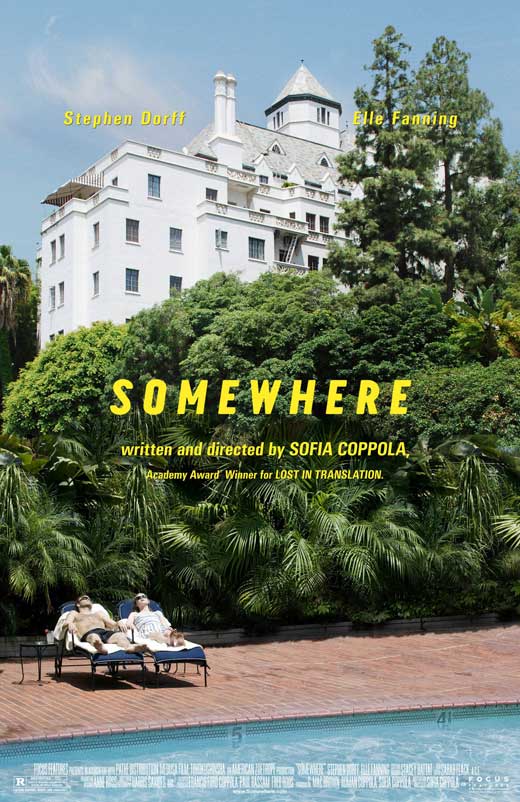
Somewhere (2010)
When Sofia Coppola is on her game, the results are often hypnotic, using music and images to imbue that space between mundane and just slightly alien with unexpected verve and beauty. When she's off... well, you get Somewhere, my least-favorite S. Coppola film that I've seen and something of a chunkily textured anti-character study. The feeling of deflation that the protagonist feels near the end of the movie when his daughter's visit ends rings true, but it's one of the only engagingly human moments in the film, the rest meandering through the irritations of minor celebrity and wealth with a stateliness that approaches staleness. Look to pretty much any other of Coppola's films for a more compelling take on these same themes. Grade: C+


Pink Floyd: The Wall (1982)
Often clumsy and flimsy in its live-action segments, The Wall falls far short of the pedigree of its namesake album. However, when it works—and, like the album, it works most brutally in its latter half—the film is absolutely aces, as compelling a portrayal of misery and psychological anguish as the album itself, and even more effective as a slice of the British counterculture and its fallout. And let's not forget the animation, which is always excellent and the best part of the film, despite clocking in at just over fifteen minutes collectively. What I would have given to have had this entire movie animated. Grade: B+


3 Women (1977)
As someone who's only seen the big three from Robert Altman (those being M*A*S*H, McCabe & Mrs. Miller, and Nashville), I found 3 Women to be pleasantly small turn from the guy's normal ensemble jigsaws. A psychological thriller very much in the vein of Bergman's Persona (if slightly less deconstructive) and what Roman Polanski was doing in the late '60s, it's a mesmerizing, head-scratching piece of filmmaking, made all the better by an all-time-great performance from already all-time-great performer Shelley Duvall. It's far too often that we forget that she pretty much batted 1.000 throughout most of the '70s and '80s. Grade: A-


Attack of the 50 Foot Woman (1958)
The title's a bit misleading, given that the giant woman doesn't attack until the last ten minutes of the movie (and isn't even giant for the majority of the preceding film). Also, characters repeatedly marvel at how the woman (and her male counterpart) must be "thirty feet tall." So that's strike two. Look, I'm probably not going to convince any haters that this is a good movie—there's plenty of ammunition there: titles aside, the special effects are startlingly bad, particularly the matte effects, and the dialogue is tepid. But I dunno, guys, I found this charming in all its raggedness, and from the way it's pretty much 80 percent domestic crime smut to the exaggeration of the "vengeful, wronged wife" trope to this level of sci-fi melodrama. Fans of second- (or third-) tier sci-fi from the era shouldn't miss it. Grade: B

Television


Crazy Ex-Girlfriend, Season 2 (2016-17)
While its shorter episode count makes Season 2 feel a little less complete than Season 1—character arcs feel rushed, plots feel underdeveloped—the second year of what's likely TV's best comedy right now is bolder, more complex, and more sure of itself than the first, which had a slightly rocky beginning. The end result is just tremendous TV, consistently hilarious, often hummable, and completely hitting its stride. Rachel Bloom's Rebecca Bunch is no less frantic and unwell—if anything, she's more so—which makes it all the more impressive that the series is able to find so much tenderness and compassion within a character who should, by all logic, be a whirlwind of irritating tropes. But as we all know, the situation is a lot more nuanced than that. Grade: A-


Crisis in Six Scenes (2016)
Woody Allen made it abundantly clear prior to the release of Crisis in Six Scenes that his undertaking a TV series was a colossal mistake. And now, having seen the finished product, I'm unfortunately compelled to agree with him. An aimless, horribly paced, unfunny six episodes of tired Allen tropes, Crisis is just over the length of his longest feature films (not coincidentally, among his worst), but the good material within amounts to little more than an hour's worth of watchable work—to say nothing of the horrible structural issues the show faces as Allen apparently has no idea of the concept of a distinct episode and instead sequences scene after scene until he hits twenty-plus minutes and cuts it off until the next episode, whether or not the drama requires it. I'll go to bat for the fifth episode, centered around a bungled crime that makes it reminiscent of the bumbling capers of Manhattan Murder Mystery or Scoop, and overall, Allen has fun with the lightly satirical depiction of 1960s counterculture, both with Miley Cyrus's anarcho-Marxist revolutionary and the escalating gag of the old-ladies book club who decides to read her literature. But there's very little here to recommend that isn't found in better form in any number of Woody Allen's cinematic work, and even then, it's encased in so much lard that it wouldn't be out of case in a frontier butcher shop. Skip it. Grade: C

Books


The Vegetarian by Han Kang (2016)
I was going to avoid referencing Kafka in describing this book (not the least because he's already mentioned in one of the critical blurbs on the book's back cover), but how else do you describe unsettling surrealism that at first feels satirical before turning heartbreaking? It's Kafkaesque, through and through: a woman decides to become a vegetarian after unsettling dreams (see??), and the book follows the escalating fallout on her husband, her father, her brother-in-law, her sister, and her own psychology. The gorgeous translation by Deborah Smith manages to evoke the strange proceedings with wit and kinetic energy that never loses track of either the central horror or underlying sadness that imbues the work with its magnetic power. Grade: A-


The Sculptor by Scott McCloud (2015)
Color me disappointed. A cursory glance through The Sculptor promised a strikingly illustrated fable about an artist's bargain with Death. What it ends up being is a bit of a one-dimensional mix of romance and struggling artist clichés that indulge in the worst of Manic Pixie Dream Girl and "nobody understands my work" artist tropes. David is an artist who's of course above irony and instead wants to make people feel something; Meg is a woman whose sole purpose seems to be to brighten his existence with her quirky lust for life and the inevitability of her eventual sleeping with him. Also, she's bipolar but won't take her medication because she wants to "feel everything." If you can't tell, that's the sound of my eyes rolling. It's not all bad: the story gets pretty good toward the end, and the fantasy elements (pretty much everything to do with death) are both cool and poignant. And those striking illustrations the book's initial pages promised me are totally there and totally great. It's just frustrating that those elements couldn't have concealed into a more consistently good package. Grade: B-