One-day work weeks are the best. It makes me feel better about the fact that this post has more negative reviews than I think any other post I've made so far.
Movies
Deadpool (2016)
Of all the myriad things I can be thankful for, I now realize near the top must be the merciful blessing that this movie did not come out during my high school years and thus subject me to months and even years of having to hear this film's smarmy, self-impressed vulgarisms repeated from the mouths of my peers. Rather, I merely have the choice to endure this film's 108 minutes of juvenilia once, which is quite enough. I'm not sure if it's an indictment of the modern superhero blockbuster that a movie with all the flaws of the genre's most pedestrian works can feel fresh to so many by merely slapping on some R-rated violence, profane dialogue, and the flimsiest of metacommentary, but it sure isn't a ringing endorsement for the health of the form. Grade: C
Manchester by the Sea (2016)
The crushing sadness of Manchester by the Sea's shaggy plot would be suffocating if it weren't for the film's idiosyncratic and often gut-busting sense of humor—it's not black humor specifically, at least not in the satirical sense that the term often connotes. Rather, the jokes here are the only joy that our characters can find in the spaces surrounding the death of a family member and a whole host of other experiences and memories I can only assume would be absolute hell to live with. I'm being a bit vague here because the movie seems to want the specifics of these characters' lives to read as surprising reveals within the film's tightly edited flashback structure, so for now, just know that while the tragedy here would be bleak by any sense of the word, the movie itself is not bleak. That's not to say it's uplifting either--this is just life that Manchester by the Sea depicts, with all its little moments of connection and pain. It no doubt helps that every actor here—even Matthew Broderick, in a somewhat ill-conceived tangent from the film's generally rough-around-the-edges, working-class sensibilities into Christianized suburbia—play human beings of such vigor and life that there's no way not to care for every person onscreen. Grade: A-
Loving (2016)
The better of Jeff Nichols's two 2016 films is also the more grounded—literally, as it turns out. Instead of Midnight Special's multi-dimensional-alien sci-fi, Loving gives us a tender and altogether moving portrait of the couple whose Supreme-Court-decided lawsuit ended all laws prohibiting marriage on racial grounds. A lesser (or at least a less poignant) movie may have focused obsessively on the injustices the Lovings face and the legal procedure that lead to eventual justice, and those things are there to a certain extent. But first and foremost, this is a movie about its two central characters and the ebb-and-flow textures of their life together. In short, it's a romance, and a darn good one at that. Grade: B+
Nuts! (2016)
A "mostly true" documentary tries to mix historical fiction and nonfiction into a folk concoction that's reminiscent of the fibs of its central huckster, John R. Brinkley, who claimed to have cured impotence by transplanting goat testicles into human males. It's a funny, outrageous bit of historical oddity, but the film's approach—a mix of talking heads and shoddy, frequently glib animation—lacks the precision needed to make its fictionalized nonfiction work like it should. In the hands of more skilled filmmakers, this might have been gold. Instead, it feels like a half-baked internet flash animation. Grade: C
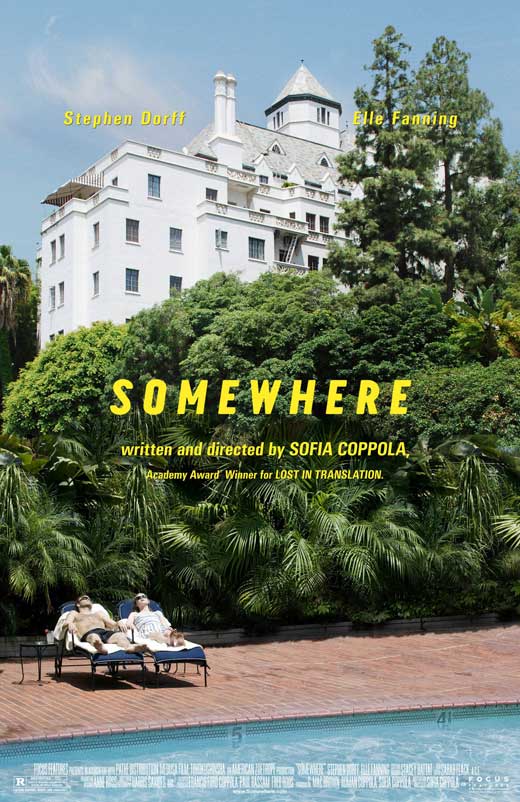
Somewhere (2010)
When Sofia Coppola is on her game, the results are often hypnotic, using music and images to imbue that space between mundane and just slightly alien with unexpected verve and beauty. When she's off... well, you get Somewhere, my least-favorite S. Coppola film that I've seen and something of a chunkily textured anti-character study. The feeling of deflation that the protagonist feels near the end of the movie when his daughter's visit ends rings true, but it's one of the only engagingly human moments in the film, the rest meandering through the irritations of minor celebrity and wealth with a stateliness that approaches staleness. Look to pretty much any other of Coppola's films for a more compelling take on these same themes. Grade: C+
Pink Floyd: The Wall (1982)
Often clumsy and flimsy in its live-action segments, The Wall falls far short of the pedigree of its namesake album. However, when it works—and, like the album, it works most brutally in its latter half—the film is absolutely aces, as compelling a portrayal of misery and psychological anguish as the album itself, and even more effective as a slice of the British counterculture and its fallout. And let's not forget the animation, which is always excellent and the best part of the film, despite clocking in at just over fifteen minutes collectively. What I would have given to have had this entire movie animated. Grade: B+
3 Women (1977)
As someone who's only seen the big three from Robert Altman (those being M*A*S*H, McCabe & Mrs. Miller, and Nashville), I found 3 Women to be pleasantly small turn from the guy's normal ensemble jigsaws. A psychological thriller very much in the vein of Bergman's Persona (if slightly less deconstructive) and what Roman Polanski was doing in the late '60s, it's a mesmerizing, head-scratching piece of filmmaking, made all the better by an all-time-great performance from already all-time-great performer Shelley Duvall. It's far too often that we forget that she pretty much batted 1.000 throughout most of the '70s and '80s. Grade: A-
Attack of the 50 Foot Woman (1958)
The title's a bit misleading, given that the giant woman doesn't attack until the last ten minutes of the movie (and isn't even giant for the majority of the preceding film). Also, characters repeatedly marvel at how the woman (and her male counterpart) must be "thirty feet tall." So that's strike two. Look, I'm probably not going to convince any haters that this is a good movie—there's plenty of ammunition there: titles aside, the special effects are startlingly bad, particularly the matte effects, and the dialogue is tepid. But I dunno, guys, I found this charming in all its raggedness, and from the way it's pretty much 80 percent domestic crime smut to the exaggeration of the "vengeful, wronged wife" trope to this level of sci-fi melodrama. Fans of second- (or third-) tier sci-fi from the era shouldn't miss it. Grade: B
Television
Crazy Ex-Girlfriend, Season 2 (2016-17)
While its shorter episode count makes Season 2 feel a little less complete than Season 1—character arcs feel rushed, plots feel underdeveloped—the second year of what's likely TV's best comedy right now is bolder, more complex, and more sure of itself than the first, which had a slightly rocky beginning. The end result is just tremendous TV, consistently hilarious, often hummable, and completely hitting its stride. Rachel Bloom's Rebecca Bunch is no less frantic and unwell—if anything, she's more so—which makes it all the more impressive that the series is able to find so much tenderness and compassion within a character who should, by all logic, be a whirlwind of irritating tropes. But as we all know, the situation is a lot more nuanced than that. Grade: A-
Crisis in Six Scenes (2016)
Woody Allen made it abundantly clear prior to the release of Crisis in Six Scenes that his undertaking a TV series was a colossal mistake. And now, having seen the finished product, I'm unfortunately compelled to agree with him. An aimless, horribly paced, unfunny six episodes of tired Allen tropes, Crisis is just over the length of his longest feature films (not coincidentally, among his worst), but the good material within amounts to little more than an hour's worth of watchable work—to say nothing of the horrible structural issues the show faces as Allen apparently has no idea of the concept of a distinct episode and instead sequences scene after scene until he hits twenty-plus minutes and cuts it off until the next episode, whether or not the drama requires it. I'll go to bat for the fifth episode, centered around a bungled crime that makes it reminiscent of the bumbling capers of Manhattan Murder Mystery or Scoop, and overall, Allen has fun with the lightly satirical depiction of 1960s counterculture, both with Miley Cyrus's anarcho-Marxist revolutionary and the escalating gag of the old-ladies book club who decides to read her literature. But there's very little here to recommend that isn't found in better form in any number of Woody Allen's cinematic work, and even then, it's encased in so much lard that it wouldn't be out of case in a frontier butcher shop. Skip it. Grade: C
Books
The Vegetarian by Han Kang (2016)
I was going to avoid referencing Kafka in describing this book (not the least because he's already mentioned in one of the critical blurbs on the book's back cover), but how else do you describe unsettling surrealism that at first feels satirical before turning heartbreaking? It's Kafkaesque, through and through: a woman decides to become a vegetarian after unsettling dreams (see??), and the book follows the escalating fallout on her husband, her father, her brother-in-law, her sister, and her own psychology. The gorgeous translation by Deborah Smith manages to evoke the strange proceedings with wit and kinetic energy that never loses track of either the central horror or underlying sadness that imbues the work with its magnetic power. Grade: A-
The Sculptor by Scott McCloud (2015)
Color me disappointed. A cursory glance through The Sculptor promised a strikingly illustrated fable about an artist's bargain with Death. What it ends up being is a bit of a one-dimensional mix of romance and struggling artist clichés that indulge in the worst of Manic Pixie Dream Girl and "nobody understands my work" artist tropes. David is an artist who's of course above irony and instead wants to make people feel something; Meg is a woman whose sole purpose seems to be to brighten his existence with her quirky lust for life and the inevitability of her eventual sleeping with him. Also, she's bipolar but won't take her medication because she wants to "feel everything." If you can't tell, that's the sound of my eyes rolling. It's not all bad: the story gets pretty good toward the end, and the fantasy elements (pretty much everything to do with death) are both cool and poignant. And those striking illustrations the book's initial pages promised me are totally there and totally great. It's just frustrating that those elements couldn't have concealed into a more consistently good package. Grade: B-
At this point, nothing more than the musings of a restless English teacher on the pop culture he experiences.
Showing posts with label Jeff Nichols. Show all posts
Sunday, February 12, 2017
Mini-Reviews for February 6 - 12, 2017
Labels:
book review,
Crazy Ex-Girlfriend,
Deadpool,
film,
Han Kang,
Jeff Nichols,
literature,
mini-reviews,
movie review,
Pink Floyd,
Robert Altman,
Scott McCloud,
Sofia Coppola,
television,
TV review,
Woody Allen
Sunday, August 21, 2016
Mini-Reviews for August 15 - 21, 2016
More reviews. They're getting longer, too; I'm sorry for the lack of discipline. Anyway, let me know what you think about these movies/books/shows/albums in the comments!
Movies
Spectre (2015)
The action—particularly the Mexico City sequence involving Day-of-the-Dead imagery, an epic tracking shot, and a fistfight in a helicopter doing barrel rolls (yes, every bit as amazing as that sounds)—is some of the best the Bond series has ever formed, which, I mean, thank goodness, because the rest of the movie sure doesn't have much to offer. Spectre is overlong, convoluted, illogical, and hampered by, of all things, relentless series continuity (something that should be at the absolute bottom of any checklist of Bond essentials). And I don't believe for one minute that Léa Seydoux's Dr. Swann is somehow Bond's soulmate, especially, especially in a movie that so tirelessly reminds us that a woman named Vesper Lynd once existed. That action is so good, though. Let's stay positive here. Grade: B-
Midnight Special (2016)
I wasn't prepared for the extent to which this movie is basically E.T. except with a psychic boy whose eyes glow in place of a psychic alien whose finger glows. Of course, being written and directed by Jeff Nichols and not Steven Spielberg (and Melissa Mathison), the film is a bit more elliptical and oblique than E.T. ever was, which is both to its benefit—there's an otherworldliness to Midnight Special that's entrancing—and its detriment—the specific and painful emotional beats that make E.T. on of the great American pictures are largely gone in favor of indie-esque stammers and withheld confessions. That said, the movie is still one of the sharper sci-fi pieces you're likely to see this year, and well-worth your time, great American film or not. Grade: B+
Flirting With Disaster (1996)
Very funny and also very good at achieving something pretty rare in American comedy, which is the ability to have its characters experience growth without having to stop the laughs to do so. Look, I like comedies that turn suddenly and unrepentantly sentimental, and that goes for everything from The Apartment to Superbad. And I like movies that don't really care about characterization at all, at least not to the extent that they're willing to take them seriously enough to develop them beyond joke delivery machines: I'm talking our Dr. Strangloves and Airplane!s. But there's something entirely satisfying and impressive about Flirting with Disaster, which sends multiple characters through complete and compelling arcs without actually halting the funny. Grade: A-
The Rules of the Game (La Règle du jeu) (1939)
A blistering critique of the 1930s French upper class that posits, to amusing effect, that the rich are only interested three things: killing animals, sleeping with others' significant others, and killing those who sleep with their own significant others. That this critique is anything more than a gentle "silly rich people" slap on the wrist isn't clear for most of the film's duration, but when it finally does pull the rug out on the silliness to reveal the utter moral decay beneath, it's startling. I might feel a bit more invested in this movie if I were at all connected to '30s French society and privy to its social nuances (a lot of this satire rings only in theory for me), and I'll be honest that I'm not quite sure what all the "greatest movie of all time" hubbub is about with this one. Still, it's fun and vicious in equal measure and definitely not time I regret spending. Grade: A-
Television
Deadwood, Season 3 (2006)
Prior to seeing the third (and final) season, I'd been mulling over the idea that Deadwood is the only of HBO's trio of great early-2000s drama series (alongside The Sopranos and The Wire) that could be reasonably said to have optimism programmed into its DNA. This is, after all, a show about how a group of criminals, cheaters, and liars managed to slowly but surely purge their baser instincts and form a functional society out of the wilderness and lawlessness of the American West. But alas, that optimism doesn't carry over into Season 3. The difference is, tellingly, the arrival of Big Business (in the form of cutthroat mogul and real-life evil dude George Hearst), which compromises the idealism that informed even the rougher of this show's characters, up to an unintentionally final episode that presents a thoroughly depressing future for the integrity of Deadwood's (and America's, because this is that kind of show) principles. There's an argument to be made that this is altogether too heavy-handed and blunt, and I'd be open to that if the show weren't still so consistently well-written: as always, it's the florid, winding dialogue that shines brightest here. Plus, it's kind of hard to call this too heavy-handed, when the speech is so arcane that it's often a challenge just to keep up with the plot, much less ruminate on its implications. Grade: A-
Books
But What If We're Wrong: Thinking About the Present As If It Were the Past by Chuck Klosterman (2016)
I'm only familiar with Klosterman's writing through the handful of pieces I've read of his on the internet, so who's to say if this is a potential critique of most of his work, but here: the biggest strength of Klosterman's speculative nonfiction book is also its biggest liability, that Klosterman seems way more interested in making his book "interesting" than with actual, sound methodology for crafting his ideas. Part of this is baked into the premise: imagining contemporary culture's legacy on the distant future, specifically through thinking through what assumptions we as a culture hold today that will seem ludicrous hundreds of years from now in the same way that Aristotle's theory of gravity (the rock "wants" to be closer to the earth) seems preposterous now. Of course, as Klosterman stressed throughout, the very nature of these sorts of assumptions is that it's nearly impossible for any culture to recognize from the inside, and the progression of human thought has not always moved forward according to the logic of previous ages. This idea that what seems logical now might not be what's logical in the long term frees up Klosterman to make some truly out-there speculation. At its best, it makes for some fascinating discussion that ignores pat, consensus answers, such as when his lengthy chapter on what rock musician/group will come to represent the genre in a thousand years ignores the low-hanging, obvious answer of "The Beatles" until the very end, instead musing on the potential role of Journey and Bob Dylan as avatars of rock to the thirtieth century. At its worst, Klosterman's thoughts come off as dilettante-ish and baseless, as is the case in his chapter on the progress of science that basically finds several dozen pages worth of ways to say that nobody knows if we're reaching the limits of human knowledge. The result in total is that But What If We're Wrong is endlessly readable, provocative, and consistently fascinating without actually meaning all that much in the end. It's the equivalent of listening to a very smart person ramble on a hodge-podge of subjects: Klosterman's a world-class rambler, but it's hard to shake the feeling that he's just kind of making this up as he goes along. Grade: B
Music
Margo Price - Midwest Farmer's Daughter (2016)
When I tell people that I don't like radio country, this is the alternative that I'm looking for: witty, colloquial, personal, heartbroken. The album makes the mistake of leading with its best song by a mile, the world-weary and small-time tragic "Hands of Time," but that's not to say that Price and her endearing mix of cynicism and melancholy sweetness don't consistently deliver great work throughout the album. The only real dud is "Tennessee Song," a bluesy stomper that, despite the home-state pride I deeply appreciate, is the sole moment that verges into the generic. The rest is good stuff, full of personality and sincerity that's likely to win over even country skeptics. Grade: B+
Movies
Spectre (2015)
The action—particularly the Mexico City sequence involving Day-of-the-Dead imagery, an epic tracking shot, and a fistfight in a helicopter doing barrel rolls (yes, every bit as amazing as that sounds)—is some of the best the Bond series has ever formed, which, I mean, thank goodness, because the rest of the movie sure doesn't have much to offer. Spectre is overlong, convoluted, illogical, and hampered by, of all things, relentless series continuity (something that should be at the absolute bottom of any checklist of Bond essentials). And I don't believe for one minute that Léa Seydoux's Dr. Swann is somehow Bond's soulmate, especially, especially in a movie that so tirelessly reminds us that a woman named Vesper Lynd once existed. That action is so good, though. Let's stay positive here. Grade: B-
Midnight Special (2016)
I wasn't prepared for the extent to which this movie is basically E.T. except with a psychic boy whose eyes glow in place of a psychic alien whose finger glows. Of course, being written and directed by Jeff Nichols and not Steven Spielberg (and Melissa Mathison), the film is a bit more elliptical and oblique than E.T. ever was, which is both to its benefit—there's an otherworldliness to Midnight Special that's entrancing—and its detriment—the specific and painful emotional beats that make E.T. on of the great American pictures are largely gone in favor of indie-esque stammers and withheld confessions. That said, the movie is still one of the sharper sci-fi pieces you're likely to see this year, and well-worth your time, great American film or not. Grade: B+
Flirting With Disaster (1996)
Very funny and also very good at achieving something pretty rare in American comedy, which is the ability to have its characters experience growth without having to stop the laughs to do so. Look, I like comedies that turn suddenly and unrepentantly sentimental, and that goes for everything from The Apartment to Superbad. And I like movies that don't really care about characterization at all, at least not to the extent that they're willing to take them seriously enough to develop them beyond joke delivery machines: I'm talking our Dr. Strangloves and Airplane!s. But there's something entirely satisfying and impressive about Flirting with Disaster, which sends multiple characters through complete and compelling arcs without actually halting the funny. Grade: A-
The Rules of the Game (La Règle du jeu) (1939)
A blistering critique of the 1930s French upper class that posits, to amusing effect, that the rich are only interested three things: killing animals, sleeping with others' significant others, and killing those who sleep with their own significant others. That this critique is anything more than a gentle "silly rich people" slap on the wrist isn't clear for most of the film's duration, but when it finally does pull the rug out on the silliness to reveal the utter moral decay beneath, it's startling. I might feel a bit more invested in this movie if I were at all connected to '30s French society and privy to its social nuances (a lot of this satire rings only in theory for me), and I'll be honest that I'm not quite sure what all the "greatest movie of all time" hubbub is about with this one. Still, it's fun and vicious in equal measure and definitely not time I regret spending. Grade: A-
Television
Deadwood, Season 3 (2006)
Prior to seeing the third (and final) season, I'd been mulling over the idea that Deadwood is the only of HBO's trio of great early-2000s drama series (alongside The Sopranos and The Wire) that could be reasonably said to have optimism programmed into its DNA. This is, after all, a show about how a group of criminals, cheaters, and liars managed to slowly but surely purge their baser instincts and form a functional society out of the wilderness and lawlessness of the American West. But alas, that optimism doesn't carry over into Season 3. The difference is, tellingly, the arrival of Big Business (in the form of cutthroat mogul and real-life evil dude George Hearst), which compromises the idealism that informed even the rougher of this show's characters, up to an unintentionally final episode that presents a thoroughly depressing future for the integrity of Deadwood's (and America's, because this is that kind of show) principles. There's an argument to be made that this is altogether too heavy-handed and blunt, and I'd be open to that if the show weren't still so consistently well-written: as always, it's the florid, winding dialogue that shines brightest here. Plus, it's kind of hard to call this too heavy-handed, when the speech is so arcane that it's often a challenge just to keep up with the plot, much less ruminate on its implications. Grade: A-
Books
But What If We're Wrong: Thinking About the Present As If It Were the Past by Chuck Klosterman (2016)
I'm only familiar with Klosterman's writing through the handful of pieces I've read of his on the internet, so who's to say if this is a potential critique of most of his work, but here: the biggest strength of Klosterman's speculative nonfiction book is also its biggest liability, that Klosterman seems way more interested in making his book "interesting" than with actual, sound methodology for crafting his ideas. Part of this is baked into the premise: imagining contemporary culture's legacy on the distant future, specifically through thinking through what assumptions we as a culture hold today that will seem ludicrous hundreds of years from now in the same way that Aristotle's theory of gravity (the rock "wants" to be closer to the earth) seems preposterous now. Of course, as Klosterman stressed throughout, the very nature of these sorts of assumptions is that it's nearly impossible for any culture to recognize from the inside, and the progression of human thought has not always moved forward according to the logic of previous ages. This idea that what seems logical now might not be what's logical in the long term frees up Klosterman to make some truly out-there speculation. At its best, it makes for some fascinating discussion that ignores pat, consensus answers, such as when his lengthy chapter on what rock musician/group will come to represent the genre in a thousand years ignores the low-hanging, obvious answer of "The Beatles" until the very end, instead musing on the potential role of Journey and Bob Dylan as avatars of rock to the thirtieth century. At its worst, Klosterman's thoughts come off as dilettante-ish and baseless, as is the case in his chapter on the progress of science that basically finds several dozen pages worth of ways to say that nobody knows if we're reaching the limits of human knowledge. The result in total is that But What If We're Wrong is endlessly readable, provocative, and consistently fascinating without actually meaning all that much in the end. It's the equivalent of listening to a very smart person ramble on a hodge-podge of subjects: Klosterman's a world-class rambler, but it's hard to shake the feeling that he's just kind of making this up as he goes along. Grade: B
Music
Margo Price - Midwest Farmer's Daughter (2016)
When I tell people that I don't like radio country, this is the alternative that I'm looking for: witty, colloquial, personal, heartbroken. The album makes the mistake of leading with its best song by a mile, the world-weary and small-time tragic "Hands of Time," but that's not to say that Price and her endearing mix of cynicism and melancholy sweetness don't consistently deliver great work throughout the album. The only real dud is "Tennessee Song," a bluesy stomper that, despite the home-state pride I deeply appreciate, is the sole moment that verges into the generic. The rest is good stuff, full of personality and sincerity that's likely to win over even country skeptics. Grade: B+
Subscribe to:
Posts (Atom)


