Quarantine, Week 9: I guess we technically aren't quarantined anymore. Fingers crossed, Tennessee.
Movies
Western Stars (2019)
It wouldn't be unfair to call this a vanity project: Bruce Springsteen (co)directing himself though footage of live performances of material from his most recent album, interspersed with Springsteen giving little homilies about the music over car-commercial cinematography. But Springsteen's earnestness remains irresistible to me (he's probably my favorite living musical artist), and the live arrangements do a fantastic job of highlighting just what a thoughtful and lovely collection of songs the album Western Stars is—probably Springsteen's most poetic work since Nebraska, and "Hello Sunshine" in particular would not be out-of-place ranked among his all-time best songs. Also, the decision to end the set with "Rhinestone Cowboy" reminds me a lot of Sufjan Stevens ending his Carrie & Lowell concerts with "Hotline Bling": a gesture that seems hair-brained on paper but makes a shocking amount of sense in practice. Grade: B
Capital in the Twenty-First Century (2019)
I have a lot of the same problems with Capital in the Twenty-First Century that I had with 13th when it first came out: namely, that its perpetual montage sacrifices depth for breadth and bends toward generalizations over specific information. In the years since, 13th has had a lot more legs with audiences than I would have guessed initially, though, and I'd hazard this is entirely due to DuVernay's masterful control over the images and editing of her film, which weaponize its cuts and imagery in service of a rich depth of cultural mythology and emotional weight that both recalls and rivals the triumphs of Eisenstein and Vertov a century prior. The same, I'm afraid, can't be said for Capital in the Twenty-First Century. Director Justin Pemberton has little of the formal mastery of DuVernay, and the movie struggles to leverage its parade of images efficiently enough to enrich its thesis about the history of wealth inequality and capital over the past four centuries of Western history—and in fact, Permberton is at a fundamental disadvantage here, since media and image are far less central to the story it's telling than they are to the history of race and incarceration that DuVernay is interested in. So you're left with a movie that feels kind of cheap and scattershot in its attempt to convey this grand historical narrative. What's worse, this historical narrative feels compromised significantly, either by time constraints (I get that this is trying to condense things for a general audience, but 400 years in 100 minutes is a tall task) or ideological ones (what on earth is Francis Fukuyama doing in a semi-critical history of capitalism and neoliberalism?). I'm not, like, super well-read in leftist theory and history, but it seems like academic malpractice to ignore entirely the influence that the Cold War and anti-colonial victories in the "third world" had on capitalism in the 20th and 21st centuries—the Civil Rights movement (and its backlash's role in dismantling America's social safety net) is less than a footnote here, and the only mention we get of the Soviet Union is in the opening minutes of the film describing the nation's collapse and the rise of capitalism as the main economic ideology in the world, opening minutes whose presence seems entirely to be predicated on assuring the audience that don't worry, this isn't a communist film. Which, like, okay, whatever. I would settle for now for a progressive tax system resembling that of post-war America, as this movie advocates. But come on, this movie acts like there's no other possible solution. I do think that, like 13th, this movie could possibly be useful as an introduction for people who are already sympathetic but not quite converted to its general stance, but man, is the overall package a lot thinner than 13th's. Does anyone know if the book is better? Grade: C
Final Destination (2000)
I kind of wish we could see a movie with this premise go just a bit more gonzo with it—like, if we're going to make Rube Goldberg machines to kill off the characters in a movie, let's go for it, you know? But accepting that it's never going to be more than just moderately energetic with its ideas, it's pretty entertaining. There's a fascinating tension in the movie where we're both rooting for Death to succeed in killing the characters in these (somewhat) ludicrous chain reactions while also rooting for the characters to escape, not because we care for their lives (these are some pretty indifferently composed characters—by design, probably) but because the act of out-maneuvering the death traps makes those death traps more interesting. That's honestly the effective (if not intentional) tension of most teen slasher movies, so kudos for the meta flourish of making it the actual text of this movie. Also kudos for having the movie tip its hand in its final shot: after a lot of hemming and hawing, this ends definitively as a comedy, which seems just about right for the devilishly playful grin hiding behind the po-faced suspense of a lot of the film. Grade: B
Popeye (1980)
What a completely wild experiment. You could describe a lot of movies as "a live-action cartoon," but very few of them are trying to be a specific cartoon. By golly, though, Popeye is, and it succeeds to a mind-boggling extent. This is probably as close as is humanly possible to recreating a Popeye cartoon in live action, and it's kind of a wonder to behold. Absolutely all of the great things about this movie come from that project: Robin Williams's performance as Popeye has a stunning amount of fidelity to the cartoon character, the practical effects bringing cartoon slapstick to life in the "real" world are tons of fun, and I don't think there's ever been an actor in the history of cinema as genetically and dispositionally perfect for a role as Shelley Duvall is for Olive Oyl. So for all that, I salute this movie. But the rest is kind of exhausting and terrible. The songs, written by Harry Nilsson, are dreadful—though that's maybe part of the joke, because they're exactly in the spirit of the songs in old cartoons. But there are other things that are certainly not a joke: the movie has exactly one trick (it's just like the cartoon!) and has little else to its plot; the pacing is terrible, which shouldn't be a surprise given that the old Popeye cartoons are like ten minutes long and this is pushing two hours; and as it turns out, making real people into actual cartoons is actually pretty grotesque. Can you imagine the out-of-body experience of horror that someone would suffer if they watched this having no knowledge of the cartoons? Nightmare stuff, my dudes. Grade: B-
The Beguiled (1971)
A lot more overtly trashy than Coppola's adaptation, and along with that, a lot funnier, too: the movie begins with Eastwood's Union defector meeting a twelve-year-old girl and declaring her "old enough for kissing" (he then kisses her), which perfectly sets the table for the intersection of horror, smut, and rank hilarity that is this movie's register. It's a fundamentally different movie from Coppola's while at the same time following the same plot almost beat-for-beat, which does a great job of showing just how malleable a text this is. The biggest difference here is the presence of the enslaved Hallie, a character I was ready to cringe at but who proves to be so vital of a force that I'm ready to join the people who claimed her absence as the biggest flaw in Coppola's film. Grade: A-
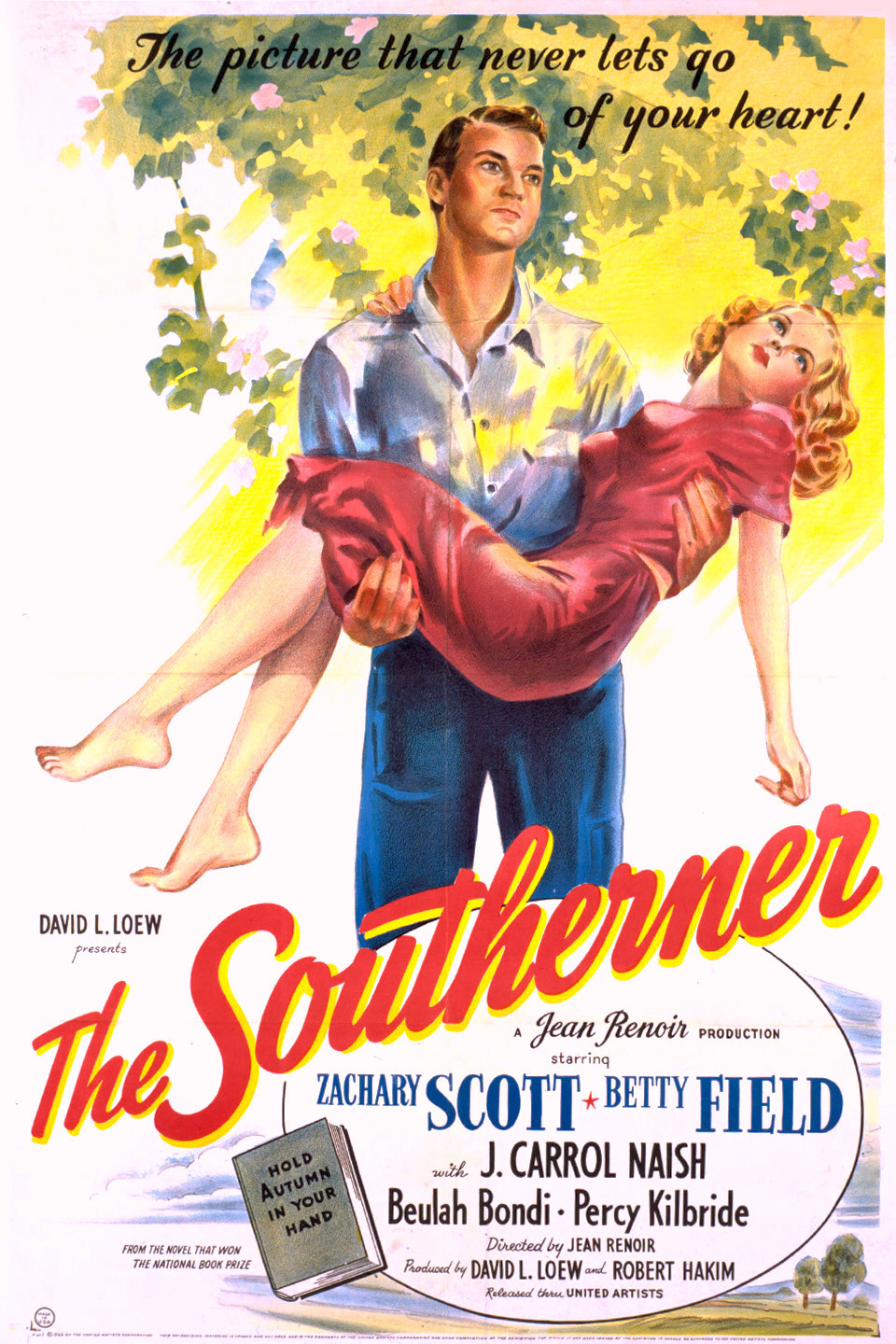
The Southerner (1945)
This film presents a really weird dynamic wherein the central family is given almost every reason imaginable to leave their sharecropping farm and go work in one of the modern factories in the city instead, up to and including the complete and total destruction of a whole year's crops and the implication that their children will likely die of malnutrition if they stay. But then they choose the farm anyway because of the sheer indominability of Americana spirit and, like, "freedom" (whatever that word means when you're sharecropping), and the movie frames this as optimism rather than self-destruction. I'm not a starving sharecropper during the Depression, so maybe this is just one of those "you had to have been there" moments, but it is very dissonant to me. The movie is good overall, though! It is a genuinely moving tale of hardship and human connection, directed beautifully by none other than Jean Renoir, and I could have probably watched the big wedding sequence for hours. And for as much as I raise my eyebrows at the (misplaced?) optimism, the movie is a lot more complex than I indicated earlier. There are times when it shows a fairly sharp picture of the functional dead-end "choice" offered to someone like the central family who doesn't own property: either be exploited on a sharecropping farm or be exploited in a factory—and once you do scrape together enough to own a piece of land (as the family's neighbor does here), you operate under a perception of scarcity, where you fight tooth-and-nail to keep anyone else from being able to do the same as you and encroach on your piece of the pie. The American Dream, baby! Grade: B
Television
Superstore, Season 5 (2019-2020)
It doesn't feel quite as vital as it did in previous seasons, but Superstore is still probably my favorite live-action sitcom on TV right now. The show has become a fine-tuned machine for joke delivery, having learned how to utilize every inch of its cast, and its plotting is refreshingly off-format from the traditional sitcom trajectory of will-they-won't they --> dating --> marriage --> kids. I mean, that happens, too, but also, for example, Jonah and Amy's relationship in which Amy has kids from a previous marriage and their conflicts have to do with the power dynamics of their respective jobs and where those jobs will take them feels a lot more genuine and in-touch with how people live now than your typical sitcom. Grade: B+
Music
U.S. Girls - Heavy Light (2020)
Not quite as riveting as their previous album, In a Poem Unlimited, but not without its moments. In particular, "4 American Dollars," the opener, is great, a post-disco banger with a populist rage. The rest of the songs are good, too, if not as strong. I'm not getting a lot out of the spoken-word transitional tracks, and I think the album kind of runs out of steam as it approaches the end. But this is still worth a listen if you've enjoyed Meghan Remy's past work. Grade: B
At this point, nothing more than the musings of a restless English teacher on the pop culture he experiences.
Showing posts with label Jean Renoir. Show all posts
Sunday, May 17, 2020
Sunday, August 21, 2016
Mini-Reviews for August 15 - 21, 2016
More reviews. They're getting longer, too; I'm sorry for the lack of discipline. Anyway, let me know what you think about these movies/books/shows/albums in the comments!
Movies
Spectre (2015)
The action—particularly the Mexico City sequence involving Day-of-the-Dead imagery, an epic tracking shot, and a fistfight in a helicopter doing barrel rolls (yes, every bit as amazing as that sounds)—is some of the best the Bond series has ever formed, which, I mean, thank goodness, because the rest of the movie sure doesn't have much to offer. Spectre is overlong, convoluted, illogical, and hampered by, of all things, relentless series continuity (something that should be at the absolute bottom of any checklist of Bond essentials). And I don't believe for one minute that Léa Seydoux's Dr. Swann is somehow Bond's soulmate, especially, especially in a movie that so tirelessly reminds us that a woman named Vesper Lynd once existed. That action is so good, though. Let's stay positive here. Grade: B-
Midnight Special (2016)
I wasn't prepared for the extent to which this movie is basically E.T. except with a psychic boy whose eyes glow in place of a psychic alien whose finger glows. Of course, being written and directed by Jeff Nichols and not Steven Spielberg (and Melissa Mathison), the film is a bit more elliptical and oblique than E.T. ever was, which is both to its benefit—there's an otherworldliness to Midnight Special that's entrancing—and its detriment—the specific and painful emotional beats that make E.T. on of the great American pictures are largely gone in favor of indie-esque stammers and withheld confessions. That said, the movie is still one of the sharper sci-fi pieces you're likely to see this year, and well-worth your time, great American film or not. Grade: B+
Flirting With Disaster (1996)
Very funny and also very good at achieving something pretty rare in American comedy, which is the ability to have its characters experience growth without having to stop the laughs to do so. Look, I like comedies that turn suddenly and unrepentantly sentimental, and that goes for everything from The Apartment to Superbad. And I like movies that don't really care about characterization at all, at least not to the extent that they're willing to take them seriously enough to develop them beyond joke delivery machines: I'm talking our Dr. Strangloves and Airplane!s. But there's something entirely satisfying and impressive about Flirting with Disaster, which sends multiple characters through complete and compelling arcs without actually halting the funny. Grade: A-
The Rules of the Game (La Règle du jeu) (1939)
A blistering critique of the 1930s French upper class that posits, to amusing effect, that the rich are only interested three things: killing animals, sleeping with others' significant others, and killing those who sleep with their own significant others. That this critique is anything more than a gentle "silly rich people" slap on the wrist isn't clear for most of the film's duration, but when it finally does pull the rug out on the silliness to reveal the utter moral decay beneath, it's startling. I might feel a bit more invested in this movie if I were at all connected to '30s French society and privy to its social nuances (a lot of this satire rings only in theory for me), and I'll be honest that I'm not quite sure what all the "greatest movie of all time" hubbub is about with this one. Still, it's fun and vicious in equal measure and definitely not time I regret spending. Grade: A-
Television
Deadwood, Season 3 (2006)
Prior to seeing the third (and final) season, I'd been mulling over the idea that Deadwood is the only of HBO's trio of great early-2000s drama series (alongside The Sopranos and The Wire) that could be reasonably said to have optimism programmed into its DNA. This is, after all, a show about how a group of criminals, cheaters, and liars managed to slowly but surely purge their baser instincts and form a functional society out of the wilderness and lawlessness of the American West. But alas, that optimism doesn't carry over into Season 3. The difference is, tellingly, the arrival of Big Business (in the form of cutthroat mogul and real-life evil dude George Hearst), which compromises the idealism that informed even the rougher of this show's characters, up to an unintentionally final episode that presents a thoroughly depressing future for the integrity of Deadwood's (and America's, because this is that kind of show) principles. There's an argument to be made that this is altogether too heavy-handed and blunt, and I'd be open to that if the show weren't still so consistently well-written: as always, it's the florid, winding dialogue that shines brightest here. Plus, it's kind of hard to call this too heavy-handed, when the speech is so arcane that it's often a challenge just to keep up with the plot, much less ruminate on its implications. Grade: A-
Books
But What If We're Wrong: Thinking About the Present As If It Were the Past by Chuck Klosterman (2016)
I'm only familiar with Klosterman's writing through the handful of pieces I've read of his on the internet, so who's to say if this is a potential critique of most of his work, but here: the biggest strength of Klosterman's speculative nonfiction book is also its biggest liability, that Klosterman seems way more interested in making his book "interesting" than with actual, sound methodology for crafting his ideas. Part of this is baked into the premise: imagining contemporary culture's legacy on the distant future, specifically through thinking through what assumptions we as a culture hold today that will seem ludicrous hundreds of years from now in the same way that Aristotle's theory of gravity (the rock "wants" to be closer to the earth) seems preposterous now. Of course, as Klosterman stressed throughout, the very nature of these sorts of assumptions is that it's nearly impossible for any culture to recognize from the inside, and the progression of human thought has not always moved forward according to the logic of previous ages. This idea that what seems logical now might not be what's logical in the long term frees up Klosterman to make some truly out-there speculation. At its best, it makes for some fascinating discussion that ignores pat, consensus answers, such as when his lengthy chapter on what rock musician/group will come to represent the genre in a thousand years ignores the low-hanging, obvious answer of "The Beatles" until the very end, instead musing on the potential role of Journey and Bob Dylan as avatars of rock to the thirtieth century. At its worst, Klosterman's thoughts come off as dilettante-ish and baseless, as is the case in his chapter on the progress of science that basically finds several dozen pages worth of ways to say that nobody knows if we're reaching the limits of human knowledge. The result in total is that But What If We're Wrong is endlessly readable, provocative, and consistently fascinating without actually meaning all that much in the end. It's the equivalent of listening to a very smart person ramble on a hodge-podge of subjects: Klosterman's a world-class rambler, but it's hard to shake the feeling that he's just kind of making this up as he goes along. Grade: B
Music
Margo Price - Midwest Farmer's Daughter (2016)
When I tell people that I don't like radio country, this is the alternative that I'm looking for: witty, colloquial, personal, heartbroken. The album makes the mistake of leading with its best song by a mile, the world-weary and small-time tragic "Hands of Time," but that's not to say that Price and her endearing mix of cynicism and melancholy sweetness don't consistently deliver great work throughout the album. The only real dud is "Tennessee Song," a bluesy stomper that, despite the home-state pride I deeply appreciate, is the sole moment that verges into the generic. The rest is good stuff, full of personality and sincerity that's likely to win over even country skeptics. Grade: B+
Movies
Spectre (2015)
The action—particularly the Mexico City sequence involving Day-of-the-Dead imagery, an epic tracking shot, and a fistfight in a helicopter doing barrel rolls (yes, every bit as amazing as that sounds)—is some of the best the Bond series has ever formed, which, I mean, thank goodness, because the rest of the movie sure doesn't have much to offer. Spectre is overlong, convoluted, illogical, and hampered by, of all things, relentless series continuity (something that should be at the absolute bottom of any checklist of Bond essentials). And I don't believe for one minute that Léa Seydoux's Dr. Swann is somehow Bond's soulmate, especially, especially in a movie that so tirelessly reminds us that a woman named Vesper Lynd once existed. That action is so good, though. Let's stay positive here. Grade: B-
Midnight Special (2016)
I wasn't prepared for the extent to which this movie is basically E.T. except with a psychic boy whose eyes glow in place of a psychic alien whose finger glows. Of course, being written and directed by Jeff Nichols and not Steven Spielberg (and Melissa Mathison), the film is a bit more elliptical and oblique than E.T. ever was, which is both to its benefit—there's an otherworldliness to Midnight Special that's entrancing—and its detriment—the specific and painful emotional beats that make E.T. on of the great American pictures are largely gone in favor of indie-esque stammers and withheld confessions. That said, the movie is still one of the sharper sci-fi pieces you're likely to see this year, and well-worth your time, great American film or not. Grade: B+
Flirting With Disaster (1996)
Very funny and also very good at achieving something pretty rare in American comedy, which is the ability to have its characters experience growth without having to stop the laughs to do so. Look, I like comedies that turn suddenly and unrepentantly sentimental, and that goes for everything from The Apartment to Superbad. And I like movies that don't really care about characterization at all, at least not to the extent that they're willing to take them seriously enough to develop them beyond joke delivery machines: I'm talking our Dr. Strangloves and Airplane!s. But there's something entirely satisfying and impressive about Flirting with Disaster, which sends multiple characters through complete and compelling arcs without actually halting the funny. Grade: A-
The Rules of the Game (La Règle du jeu) (1939)
A blistering critique of the 1930s French upper class that posits, to amusing effect, that the rich are only interested three things: killing animals, sleeping with others' significant others, and killing those who sleep with their own significant others. That this critique is anything more than a gentle "silly rich people" slap on the wrist isn't clear for most of the film's duration, but when it finally does pull the rug out on the silliness to reveal the utter moral decay beneath, it's startling. I might feel a bit more invested in this movie if I were at all connected to '30s French society and privy to its social nuances (a lot of this satire rings only in theory for me), and I'll be honest that I'm not quite sure what all the "greatest movie of all time" hubbub is about with this one. Still, it's fun and vicious in equal measure and definitely not time I regret spending. Grade: A-
Television
Deadwood, Season 3 (2006)
Prior to seeing the third (and final) season, I'd been mulling over the idea that Deadwood is the only of HBO's trio of great early-2000s drama series (alongside The Sopranos and The Wire) that could be reasonably said to have optimism programmed into its DNA. This is, after all, a show about how a group of criminals, cheaters, and liars managed to slowly but surely purge their baser instincts and form a functional society out of the wilderness and lawlessness of the American West. But alas, that optimism doesn't carry over into Season 3. The difference is, tellingly, the arrival of Big Business (in the form of cutthroat mogul and real-life evil dude George Hearst), which compromises the idealism that informed even the rougher of this show's characters, up to an unintentionally final episode that presents a thoroughly depressing future for the integrity of Deadwood's (and America's, because this is that kind of show) principles. There's an argument to be made that this is altogether too heavy-handed and blunt, and I'd be open to that if the show weren't still so consistently well-written: as always, it's the florid, winding dialogue that shines brightest here. Plus, it's kind of hard to call this too heavy-handed, when the speech is so arcane that it's often a challenge just to keep up with the plot, much less ruminate on its implications. Grade: A-
Books
But What If We're Wrong: Thinking About the Present As If It Were the Past by Chuck Klosterman (2016)
I'm only familiar with Klosterman's writing through the handful of pieces I've read of his on the internet, so who's to say if this is a potential critique of most of his work, but here: the biggest strength of Klosterman's speculative nonfiction book is also its biggest liability, that Klosterman seems way more interested in making his book "interesting" than with actual, sound methodology for crafting his ideas. Part of this is baked into the premise: imagining contemporary culture's legacy on the distant future, specifically through thinking through what assumptions we as a culture hold today that will seem ludicrous hundreds of years from now in the same way that Aristotle's theory of gravity (the rock "wants" to be closer to the earth) seems preposterous now. Of course, as Klosterman stressed throughout, the very nature of these sorts of assumptions is that it's nearly impossible for any culture to recognize from the inside, and the progression of human thought has not always moved forward according to the logic of previous ages. This idea that what seems logical now might not be what's logical in the long term frees up Klosterman to make some truly out-there speculation. At its best, it makes for some fascinating discussion that ignores pat, consensus answers, such as when his lengthy chapter on what rock musician/group will come to represent the genre in a thousand years ignores the low-hanging, obvious answer of "The Beatles" until the very end, instead musing on the potential role of Journey and Bob Dylan as avatars of rock to the thirtieth century. At its worst, Klosterman's thoughts come off as dilettante-ish and baseless, as is the case in his chapter on the progress of science that basically finds several dozen pages worth of ways to say that nobody knows if we're reaching the limits of human knowledge. The result in total is that But What If We're Wrong is endlessly readable, provocative, and consistently fascinating without actually meaning all that much in the end. It's the equivalent of listening to a very smart person ramble on a hodge-podge of subjects: Klosterman's a world-class rambler, but it's hard to shake the feeling that he's just kind of making this up as he goes along. Grade: B
Music
Margo Price - Midwest Farmer's Daughter (2016)
When I tell people that I don't like radio country, this is the alternative that I'm looking for: witty, colloquial, personal, heartbroken. The album makes the mistake of leading with its best song by a mile, the world-weary and small-time tragic "Hands of Time," but that's not to say that Price and her endearing mix of cynicism and melancholy sweetness don't consistently deliver great work throughout the album. The only real dud is "Tennessee Song," a bluesy stomper that, despite the home-state pride I deeply appreciate, is the sole moment that verges into the generic. The rest is good stuff, full of personality and sincerity that's likely to win over even country skeptics. Grade: B+
Subscribe to:
Posts (Atom)


