How is August already over?
Movies
First Cow (2020)
Before we're plunged into early-19th-century Oregon Territory, First Cow opens on a single scene set in the present day, in which Alia Shawkat comes across two skeletons, and it's not apparent until two hours later, at the movie's end, just how quietly great that tiny scene is. This is basically how a lot of First Cow works: a movie filled with moments whose greatness didn't occur to me until much later, when a stray line of dialogue or a seemingly superfluous shot of foliage clicked some thematic piece into place that elevated some previously errant moment. Which isn't to say that First Cow is a puzzle movie or even all that difficult to understand; in a way that is much more forthright than director/co-writer Kelly Reichardt usually opts for in her films, First Cow is very straightforwardly a familiar kind of American story (with of course a familiar American tragedy climaxing it): two sensitive guys in the frontier trying to live out their dream of selling enough delicious cakes to start their own hotel. It's as wholesome and sweet as I imagine those cakes are. But thinking back on this movie a few hours later, what I'm most drawn to in retrospect are the moments like Shawkat's inscrutable facial expression that ends that opening modern-day frame, or the oddly compelling interpreter in the brief interlude where we see a wealthy European discussing the beaver hat business with a native leader, or the part where the cowherd misses out on getting an oily cake and apparently holds a grudge the whole film. It's not even a particularly shaggy movie, but the loose threads that are there are just fascinating to tug and tug. Grade: A-
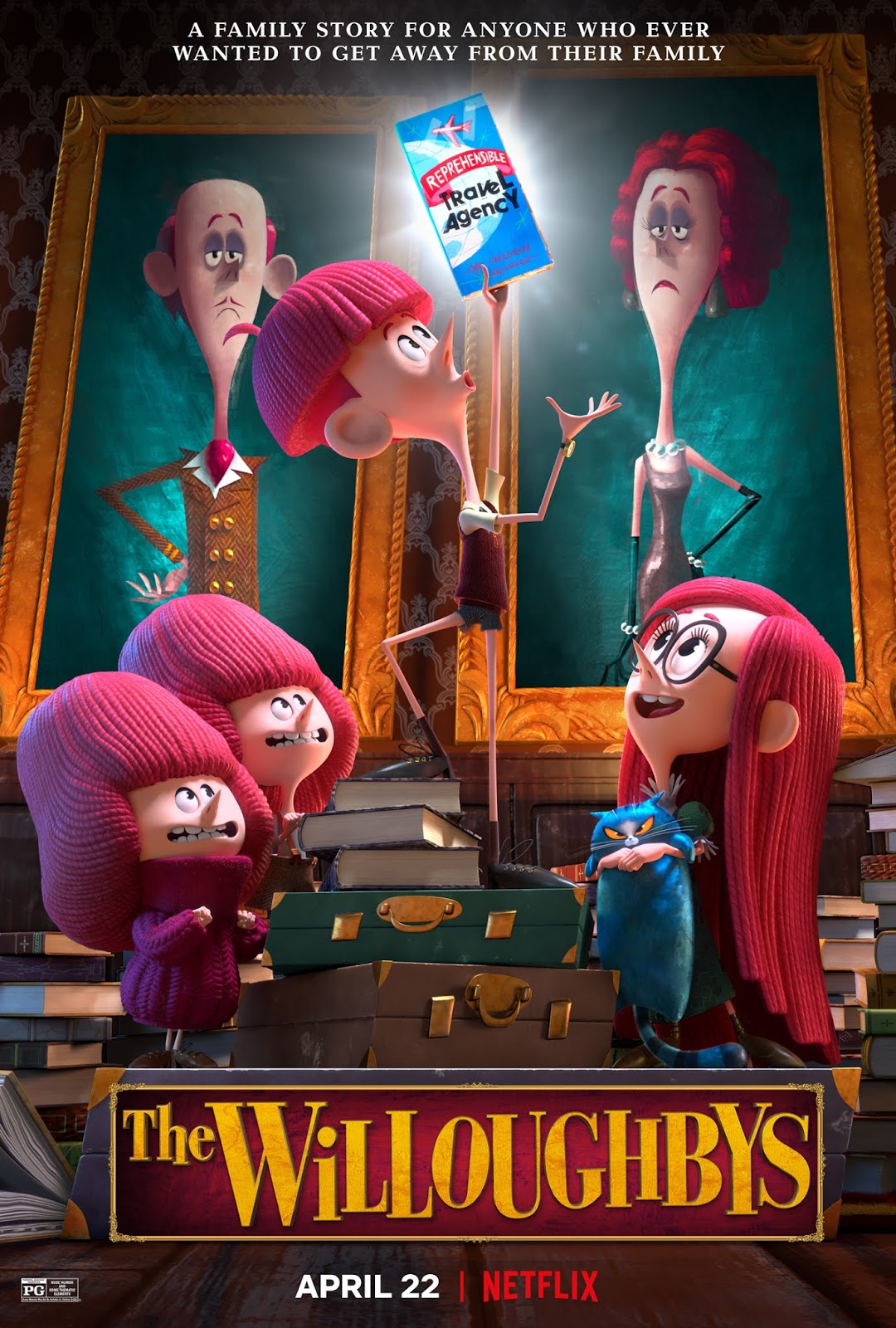
The Willoughbys (2020)
The plot feels like a bunch of alt-lite kids media stitched together: a little bit of A Series of Unfortunate Events, a little bit of Henry Selick, a lot of Roald Dahl (I've not read the Lois Lowry book this is based on, but I have a hard time imagining the Lowry of The Giver and Number the Stars also producing something this whimsical and demented). This movie is so highly caffeinated that it has a very hard time ever sticking to one plot, which is a huge detriment to a film that includes a gem of a plot involving the central children attempting to "orphan themselves," and for a lot of the movie I wanted to shake the screenplay by the collar and yell at it to just settle down, for Pete's sake. I'm pretty much in love with the animation style, though, which is probably the best example I've seen of the recent trend of twisting CG animation into looking like something spun out of arts-and-crafts—this one even goes the extra mile to make its framerate look like stop-motion animation. I'd be willing to make peace with this whole "photorealistic rendering" thing if what was being photorealistically rendered weren't the characters themselves but the material the characters are made out of. The promise of CG anything is the ability to conjure the impossible, and I'd honestly kind of love it if CG were used to conjure impossible stop-motion films like this one. Grade: B-
The Grudge (2004)
Like a lot of these Japanese-to-American remakes go, this is a sort of slick and sleepy version of the more homespun original. The original isn't really that much more propulsive, but it's at least got an uncannier feel—maybe I'm just not as inured to Japanese makeup and effects as I am to Hollywood ones, but there's something kind of rote to the scares here. I will give major props to this one for sticking with a virtually dialogue-free finale, the only part of this movie that feels better than the original, and I'm glad that Takashi Shimizu (who directed both) got to have a second go-round with a bigger budget. Grade: B-
Mouse Hunt (1997)
I don't know how I didn't know that Gore Verbinski's directorial debut was this little flick: an utterly deranged and caustic anti-capitalist film. The naked contempt this movie has for the two leads is a sight to behold, such that these guys are the villains of their own stories in whose grotesque punishment we viewers are supposed to delight. You know how the bad guys in '90s kids movies always suffer a ton of physical humiliation and pain and usually end up stepping in or being covered in poop at some point? Imagine those guys being the protagonists of the film—only they're also factory owners with bourgeois tastes and more interest in flipping a mansion than in little inconveniences like paying their workers. The '90s were a weird time for children's entertainment. Grade: B+
Blue Collar (1978)
I can't shake the feeling that this movie (and maybe Paul Schrader's career in general?) has some unresolved gender issues that it persistently neglects to work out—at least some other Schrader films have interesting female characters, which this one does not. But otherwise, this movie is white-hot. A bleak little parable about how those in power divide the working class against itself, culminating in one of the most shocking sequences of scenes to end a movie I've seen in a while. The three principal leads are all putting in really good work, too; of course Harvey Keitel and Yaphet Kotto bring their somewhat natural gravitas, but Richard Pryor especially is a real treat here, somehow doing basically his familiar comedic persona but also making that persona capable of some incredible dramatic intensity and desperation that I've never seen from his standup. Grade: B+
The Battle of Algiers (La battaglia di Algeri) (1966)
Maybe because I don't know a ton about the whole French/Algerian history, I got a little lost following the moment-by-moment details of the plot, but as a whole, this is a pretty striking piece of work and maybe the most effective rendering of the escalating cycle of violence during revolutions that I've seen in a movie. It shows compellingly how each side rushes to increasingly brutal tactics in response to the other side's violence. Crucially, it never let's you forget who started this whole thing; you don't open your movie with a scene of a French officer ruthlessly torturing an Algerian rebel (is Zero Dark Thirty recreating this in its opening scene?) and expect your audience to come away thinking that there were some good points made on both sides of the rebellion. Good. French colonialism kind of sucks. Grade: B+
Television
Steven Universe, Season 2 (2015-2016)
I know the production cycles of these Cartoon Network shows don't really position them to being watched in "seasons," but that said, I'm not sure where Season 2 really ends and Season 3 begins, since Hulu and Wikipedia put different episodes in different seasons. Oh well. Whatever the boundaries of the season, it's still a good time. This season is much more focused on the mythology and big-picture plot than the first season was, which means we get a lot less Beach City hijinks and standalone episodes. In fact, most of the latter half of the season is one continuous serialized arc. The arc is awesome, and the mythology is pretty impressive in that even as it gets bigger and deeper, it still remains rooted in the central psychological and emotional tensions that ground the show in a very real space, even as it becomes cosmos-spanning large: tensions about identities and bodies and gender and coming of age in a world in which adults lack the ability (either by absence or by incompatibility) to understand what that coming of age means and the urgency of compassion even in that space of incompatibility and absence. So it's good. Often really good. But at the time time, I do also miss the more balanced focus on small-scale stories, too, that I saw in the first season. Maybe I'm the only one who thinks this, since a lot of people seem to get extremely excited when TV shows go into hyper-serialized mode, but I don't think TV series are always necessarily better when they work hard to link all of their episodes into a larger narrative, and I think it would be cool to see more of the standalone episodes come back in the future (those who have already watched this show already know if I'll be disappointed or not, but I guess I'll be surprised as I pretend to watch this show as if it's still airing). But oh well. Like I said, this season is still good! Grade: B+
Music
Beyoncé - 4 (2011)
In my head, this was the first "modern" Beyoncé album, kicking off the more expansive, ambitious period of Beyoncé the Important Artist that we're currently living in. And the context of this album is certainly backs that, with an increased autonomy for Beyoncé in the crafting of the record after sacking her dad as her manager. Listening to this album front-to-back for the first time since 2011, though, I think I had that wrong as far as the actual album goes; 4 has a lot of the same issues that I Am...Sasha Fierce has, namely the indiscriminate track sequencing and an occasional over-reliance on some broad anthemic songwriting. Apparently Beyoncé presented 72 songs to her label, and I have a hard time imagining that none of those were more interesting than "I Care" (sonically, "Halo, Pt. 2"?) or "Start Over." But there are some delirious highs on this album, too, and on the whole, despite a little bit of diversification of sounds and production, 4 actually feels more like the crowning sendoff of Beyoncé's pop era before the inauguration of her Important Artist era. "1+1" is a great old-school slow-burn showcase for Beyoncé's overpowering ability to just belt melodies, and the Frank-Ocean-penned "I Miss You" is a pulsing R&B highlight with probably my favorite production on the record. But of course, the real peak is the one-two punch of now-wedding-reception staple "Love on Top," the best pop-soul song in Beyoncé's whole career, and the wild, densely hooky "Countdown," a top-five Beyoncé song for me and completely unlike anything she has done before or since. This would be a better album than Sasha Fierce even if its only two good songs were "Love on Top" and "Countdown." Grade: B
At this point, nothing more than the musings of a restless English teacher on the pop culture he experiences.
Showing posts with label Gore Verbinski. Show all posts
Sunday, August 30, 2020
Sunday, June 28, 2020
Mini Reviews for June 22-28, 2020
Blah blah.
Movies
(T)ERROR (2015)
As definitive a document of the simultaneously Kafkaesque and Orwellian horror of the post-9/11 surveillance state as CITIZENFOUR (though to be fair, there's not a lot in this documentary that couldn't also be found in the COINTELPRO days). I'm a little surprised that this didn't have the huge media splash of CITIZENFOUR, given the scale of the horror and the depth of the access the filmmakers get, except that I guess the international heist-ish scope of Snowden's story is just a lot more mass-audience ready than a sad, scary gaze into the mundane and even pathetic interplay between FBI informant and FBI target. Still, the access here is stunning: we see an active FBI case unfold from both the side of the informant (an ex-Black Panther) and the side of the target (basically a random Muslim dude in Pittsburgh with some academic interest in militias). This is probably the most intimate look I've ever seen at the U.S. intelligence state's ground-level methods, and it is, frankly, terrifying. There is a very real sense that American counterterrorism is based on nothing more than a never-ending cycle of manipulating vulnerable people into entrapping other vulnerable people, who then have few choices besides joining this cycle—the informant, for example, was initially approached to become an informant to avoid jail time for his involvement with a radical group, and despite the fact that being an informant has in a very real way destroyed his life, he continues to do so because the FBI pays him, and he needs the money. Pair all this with news like this from just down the road from where I live, and it's really hard not to get paranoid. Grade: A-
Redline (レドライン) (2009)
It's basically an R-rated, animated Speed Racer (2008), and like that movie, the style of this thing is completely wild. These stretchy hand-drawn characters (the whole movie is apparently hand-drawn, though I'd bet money that computers did the inking) whip through their sci-fi world with an abandon so reckless that it nearly breaks the cinematic form. The two racing sequences that bookend this movie are jaw-dropping sensory onslaughts, and I was having a great time as long as we were on the racetrack. Unfortunately, any time there isn't a race going on, this movie is kind of awful. The fifty-ish minutes between the two races are completely dull, fleshing out a narrative that is basically nonexistent during the races into some uninteresting archetypal beats and populating the movie with a convoluted but somehow still flat array of characters and noir-ish plots. This movie's relationship with its female characters is pretty bad, too, and there's like an entire scene where the love interest appears topless for no reason. So there's that, too. But those race sequences... golly, those races. Grade: B
The Ring (2002)
Solidly entertaining, though a little goofier at times than it probably needed to be. I prefer the Japanese one for reasons I can't exactly articulate at the moment except that it strikes me as a cleaner execution than this one. That said, I love how, for all its reputation as a horror movie, the story both versions tell is much more just a Gothic mystery, and kudos to Gore Verbinski's direction for being extremely keyed into that wavelength. Grade: B
Taken for a Ride (1996)
I'm of two minds with this one. On the one hand, the ascendancy of the automobile and highway systems is one of the most vile, destructive things to happen to the American city organism over the past century, and the second half of this movie gives an effective overview of those effects, from the cutting of public transit budgets to the destruction of neighborhoods for highway development. On the other hand, this movie is somewhat misleading in presenting the dismantling of the Los Angeles streetcar system as representative of how the country's mass transit got so terrible, and its nostalgia for the old streetcar systems completely ignores how those were usually private enterprises prone to their own abuses and often run by the very same people who built city suburbs—a ton of trolley lines were simply amenities built by developers, and since these developers were interested in real estate, not transit, they had a real incentive to encourage people to take automobiles instead of the streetcars once it became clear that that was the direction the larger corporate lobbies were leaning. On yet another hand, despite some really solid archival footage, this movie is an extremely 101 take on the history of public transit/car transit in America, and I was really hoping for something a little more detailed—maybe if the movie had just focused on either the Los Angeles streetcar system or the effects of highways on cities, instead of smashing those two topics together into two ungainly halves of a pretty short movie. So for anyone who's counting, that's two minds and three hands I have about this movie, which I think means that I think about urbanism too much and about metaphors too little. But anyway, I hate cars and motor companies, and this movie is great agitprop against those entities, so I'm trending more positively on this one than I should. Grade: B-
Pat Garrett & Billy the Kid (1973)
I don't think I've ever seen a cops-and-outlaws movie be so sad about the cops winning. Sad not just that Pat Garrett gets Billy the Kid, but that the cops win on a societal level: that the cops side with land-owners who abuse immigrants and native people; that the "taming" of the American West means the concentration of power that forms a true underclass as sure as it forms a ruling class. This all requires some dubious American mythology to work as existing within a real historical moment, but taken as a kind of parable, it's a pretty effective little tale about a man whose choice to become law enforcement has caused his soul to rot. A really elegiac bummer with (duh) some contemporary resonance both in '73 (I imagine this is how it felt for Peckinpah to watch the cops win the 1960s) as well as in good ol' 2020 A.D. That said, you've got the typical marginalized/objectified roles for women in a Peckinpah flick, which I'm never a fan of—there's only so many times you can show abused women as shorthand for "gee, masculine scripts sure are violent" before it comes off as a cheap crutch. And even though he's the whole reason that I watched this movie to begin with, I gotta admit that Bob Dylan is pretty distracting here. There isn't a single moment when he's onscreen when I wasn't thinking, "Wow, it's really Bob Dylan," and the fact that his character is super cagey about his real name ("Alias") doesn't help. Someone really needs to isolate the audio of him reading the general store inventory and set it to a sick beat, though. Grade: B+
The Discreet Charm of the Bourgeoisie (Le Charme discret de la bourgeoisie) (1972)
A relentless, dryly hilarious satire in which Buñuel justly heaps burning scorn on the titular social class for an hour and forty minutes. SPOILERS—There isn't much charm to the bourgeoisie at all. The central conceit that these clueless rich folks are forever in search of a dinner party but never actually eating is great, but my favorite part is how these people somehow still keep getting invited to dinner parties at all—and who invites them is telling (and damning). Major props to the part where the army sergeant declares war on radicals and then, with his next breath, cordially invites the bourgeoisie to dinner the following week, which feels like Buñuel inventing and then completely torching that Kendall Jenner Pepsi ad—this one moment is probably the most withering takedown of the whole "we could solve systemic social problems if we could just sit down and get to know each other" ethos that I've ever seen. Grade: A-
Hellzapoppin' (1941)
I honestly did not know they made movies like this in the 1940s. The closest contemporaries operating anywhere near this wheelhouse are the Marx Brothers with their vaudevillian anarchy and animators like Chuck Jones and Tex Avery, whose irreverent chaos and rubbery physics somewhat approximate what happens here. But more than anything, this movie feels like a forerunner to the absurd, sarcastic meta-humor of much later film comedy like Mel Brooks, Zucker-Abrams-Zucker and early Robert Zemeckis, though even at their giddiest (Blazing Saddles, Airplane!, and I Wanna Hold Your Hand/1941), those movies are still too beholden to plot to really be quite in the same wheelhouse as Hellzapoppin', whose already tenuous rom-com/musical revue structure is gleefully torn to pieces by its actors, who seem to actively resent the plot they are in. Gremlins 2 is probably the closest I've seen a mainstream studio feature come to this level of delighted self-destruction. It has to be seen to be believed, and maybe even then, you won't believe it. Grade: A
Books
Maus by Art Spiegelman (1980-1991)
The visceral impact of this graphic novel's innovations is mostly lost on me, reading it now almost twenty years after its final volume's publication and having already read a lot of comics that take its approach (most notably Persepolis). That said, this is extremely well-done, and I don't have any substantial critiques other than the anachronistic one that it feels overly familiar because of its influence. The one part that legitimately surprised me, though, was the frame narrative, where Spiegelman captures with admirable frankness the frustrating, often sad process of trying to interview his father to get the Holocaust survival narrative that makes of the bulk of this novel; his father (who died while Spiegelman was finishing the series—another surprising wrinkle) is obstinate and antagonistic and even bigoted himself, all of these characteristics having complicated roots in his survival and the ripple effects it had on his psyche and his family. I can't imagine how difficult it must have been for Spiegelman to wrestle with this, especially in the context of a Holocaust story, and the book, messy and complex, never really tries to reconcile all the threads of his father into a neat thesis; it's all the better for it. Grade: B+
Music
Frédéric D. Oberland & Irena Z. Tomažin - ARBA, DÂK ARBA (2020)
I bought this album entirely on the virtue of its cover art, and I wasn't disappointed. An intoxicating slurry of ambient drone and modern classical—when the vocal chants start up in the back half of the record, I get chills. This probably won't be for everybody, but if you're at all into the genres I named earlier, this is definitely worth a listen. Grade: A-
Movies
(T)ERROR (2015)
As definitive a document of the simultaneously Kafkaesque and Orwellian horror of the post-9/11 surveillance state as CITIZENFOUR (though to be fair, there's not a lot in this documentary that couldn't also be found in the COINTELPRO days). I'm a little surprised that this didn't have the huge media splash of CITIZENFOUR, given the scale of the horror and the depth of the access the filmmakers get, except that I guess the international heist-ish scope of Snowden's story is just a lot more mass-audience ready than a sad, scary gaze into the mundane and even pathetic interplay between FBI informant and FBI target. Still, the access here is stunning: we see an active FBI case unfold from both the side of the informant (an ex-Black Panther) and the side of the target (basically a random Muslim dude in Pittsburgh with some academic interest in militias). This is probably the most intimate look I've ever seen at the U.S. intelligence state's ground-level methods, and it is, frankly, terrifying. There is a very real sense that American counterterrorism is based on nothing more than a never-ending cycle of manipulating vulnerable people into entrapping other vulnerable people, who then have few choices besides joining this cycle—the informant, for example, was initially approached to become an informant to avoid jail time for his involvement with a radical group, and despite the fact that being an informant has in a very real way destroyed his life, he continues to do so because the FBI pays him, and he needs the money. Pair all this with news like this from just down the road from where I live, and it's really hard not to get paranoid. Grade: A-
Redline (レドライン) (2009)
It's basically an R-rated, animated Speed Racer (2008), and like that movie, the style of this thing is completely wild. These stretchy hand-drawn characters (the whole movie is apparently hand-drawn, though I'd bet money that computers did the inking) whip through their sci-fi world with an abandon so reckless that it nearly breaks the cinematic form. The two racing sequences that bookend this movie are jaw-dropping sensory onslaughts, and I was having a great time as long as we were on the racetrack. Unfortunately, any time there isn't a race going on, this movie is kind of awful. The fifty-ish minutes between the two races are completely dull, fleshing out a narrative that is basically nonexistent during the races into some uninteresting archetypal beats and populating the movie with a convoluted but somehow still flat array of characters and noir-ish plots. This movie's relationship with its female characters is pretty bad, too, and there's like an entire scene where the love interest appears topless for no reason. So there's that, too. But those race sequences... golly, those races. Grade: B
The Ring (2002)
Solidly entertaining, though a little goofier at times than it probably needed to be. I prefer the Japanese one for reasons I can't exactly articulate at the moment except that it strikes me as a cleaner execution than this one. That said, I love how, for all its reputation as a horror movie, the story both versions tell is much more just a Gothic mystery, and kudos to Gore Verbinski's direction for being extremely keyed into that wavelength. Grade: B
Taken for a Ride (1996)
I'm of two minds with this one. On the one hand, the ascendancy of the automobile and highway systems is one of the most vile, destructive things to happen to the American city organism over the past century, and the second half of this movie gives an effective overview of those effects, from the cutting of public transit budgets to the destruction of neighborhoods for highway development. On the other hand, this movie is somewhat misleading in presenting the dismantling of the Los Angeles streetcar system as representative of how the country's mass transit got so terrible, and its nostalgia for the old streetcar systems completely ignores how those were usually private enterprises prone to their own abuses and often run by the very same people who built city suburbs—a ton of trolley lines were simply amenities built by developers, and since these developers were interested in real estate, not transit, they had a real incentive to encourage people to take automobiles instead of the streetcars once it became clear that that was the direction the larger corporate lobbies were leaning. On yet another hand, despite some really solid archival footage, this movie is an extremely 101 take on the history of public transit/car transit in America, and I was really hoping for something a little more detailed—maybe if the movie had just focused on either the Los Angeles streetcar system or the effects of highways on cities, instead of smashing those two topics together into two ungainly halves of a pretty short movie. So for anyone who's counting, that's two minds and three hands I have about this movie, which I think means that I think about urbanism too much and about metaphors too little. But anyway, I hate cars and motor companies, and this movie is great agitprop against those entities, so I'm trending more positively on this one than I should. Grade: B-
Pat Garrett & Billy the Kid (1973)
I don't think I've ever seen a cops-and-outlaws movie be so sad about the cops winning. Sad not just that Pat Garrett gets Billy the Kid, but that the cops win on a societal level: that the cops side with land-owners who abuse immigrants and native people; that the "taming" of the American West means the concentration of power that forms a true underclass as sure as it forms a ruling class. This all requires some dubious American mythology to work as existing within a real historical moment, but taken as a kind of parable, it's a pretty effective little tale about a man whose choice to become law enforcement has caused his soul to rot. A really elegiac bummer with (duh) some contemporary resonance both in '73 (I imagine this is how it felt for Peckinpah to watch the cops win the 1960s) as well as in good ol' 2020 A.D. That said, you've got the typical marginalized/objectified roles for women in a Peckinpah flick, which I'm never a fan of—there's only so many times you can show abused women as shorthand for "gee, masculine scripts sure are violent" before it comes off as a cheap crutch. And even though he's the whole reason that I watched this movie to begin with, I gotta admit that Bob Dylan is pretty distracting here. There isn't a single moment when he's onscreen when I wasn't thinking, "Wow, it's really Bob Dylan," and the fact that his character is super cagey about his real name ("Alias") doesn't help. Someone really needs to isolate the audio of him reading the general store inventory and set it to a sick beat, though. Grade: B+
The Discreet Charm of the Bourgeoisie (Le Charme discret de la bourgeoisie) (1972)
A relentless, dryly hilarious satire in which Buñuel justly heaps burning scorn on the titular social class for an hour and forty minutes. SPOILERS—There isn't much charm to the bourgeoisie at all. The central conceit that these clueless rich folks are forever in search of a dinner party but never actually eating is great, but my favorite part is how these people somehow still keep getting invited to dinner parties at all—and who invites them is telling (and damning). Major props to the part where the army sergeant declares war on radicals and then, with his next breath, cordially invites the bourgeoisie to dinner the following week, which feels like Buñuel inventing and then completely torching that Kendall Jenner Pepsi ad—this one moment is probably the most withering takedown of the whole "we could solve systemic social problems if we could just sit down and get to know each other" ethos that I've ever seen. Grade: A-
Hellzapoppin' (1941)
I honestly did not know they made movies like this in the 1940s. The closest contemporaries operating anywhere near this wheelhouse are the Marx Brothers with their vaudevillian anarchy and animators like Chuck Jones and Tex Avery, whose irreverent chaos and rubbery physics somewhat approximate what happens here. But more than anything, this movie feels like a forerunner to the absurd, sarcastic meta-humor of much later film comedy like Mel Brooks, Zucker-Abrams-Zucker and early Robert Zemeckis, though even at their giddiest (Blazing Saddles, Airplane!, and I Wanna Hold Your Hand/1941), those movies are still too beholden to plot to really be quite in the same wheelhouse as Hellzapoppin', whose already tenuous rom-com/musical revue structure is gleefully torn to pieces by its actors, who seem to actively resent the plot they are in. Gremlins 2 is probably the closest I've seen a mainstream studio feature come to this level of delighted self-destruction. It has to be seen to be believed, and maybe even then, you won't believe it. Grade: A
Books
Maus by Art Spiegelman (1980-1991)
The visceral impact of this graphic novel's innovations is mostly lost on me, reading it now almost twenty years after its final volume's publication and having already read a lot of comics that take its approach (most notably Persepolis). That said, this is extremely well-done, and I don't have any substantial critiques other than the anachronistic one that it feels overly familiar because of its influence. The one part that legitimately surprised me, though, was the frame narrative, where Spiegelman captures with admirable frankness the frustrating, often sad process of trying to interview his father to get the Holocaust survival narrative that makes of the bulk of this novel; his father (who died while Spiegelman was finishing the series—another surprising wrinkle) is obstinate and antagonistic and even bigoted himself, all of these characteristics having complicated roots in his survival and the ripple effects it had on his psyche and his family. I can't imagine how difficult it must have been for Spiegelman to wrestle with this, especially in the context of a Holocaust story, and the book, messy and complex, never really tries to reconcile all the threads of his father into a neat thesis; it's all the better for it. Grade: B+
Music
Frédéric D. Oberland & Irena Z. Tomažin - ARBA, DÂK ARBA (2020)
I bought this album entirely on the virtue of its cover art, and I wasn't disappointed. An intoxicating slurry of ambient drone and modern classical—when the vocal chants start up in the back half of the record, I get chills. This probably won't be for everybody, but if you're at all into the genres I named earlier, this is definitely worth a listen. Grade: A-
Labels:
album review,
Art Spiegelman,
book review,
film,
Frédéric D. Oberland,
Gore Verbinski,
Irena Z. Tomažin,
literature,
Luis Buñuel,
mini-reviews,
movie review,
music,
Sam Peckinpah
Saturday, December 30, 2017
Favorite Movies of 2017
Well, here we are again—another one of these lists. I'm not going to do one of those long preambles. As usual, this post is divided between my favorite movies (emphasis on "favorite," not "best," whatever that means) and other movies I thought were notable, either for good or ill. Also as usually, I admit that I (obviously) haven't seen every 2017 movie, and I resent that the elitist and outdated distribution schedules have kept some of my most-anticipated movies away from Knoxville (more importantly, The Post and Phantom Thread).
I hope y'all enjoy it. Please, disagree with me; share your own picks; discuss. I've said it before—I love discussing this list stuff.
Favorite Movies
1. The B-Side: Elsa Dorfman's Portrait Photography
It's all about death, when you get right down to it: our lives, our actions, our thoughts—whether or not we're conscious of it, they're all defined by that firm bookend. Warm and easy-going, The B-Side resembles that other Errol Morris masterpiece, Fast, Cheap & Out of Control, by allowing a mix of editing and unfettered obsession over a craft (here, Polaroid portraitry) to accumulate into a towering treatise. I haven't seen a ton of people love this movie as much as I did, but more so than anything else I saw this year, The B-Side is profound.
[Read original review here]
2. Good Time
A damning character portrait disguised as a feature-length chase sequence, Good Time is fun until it's devastating. It's the sort of movie where you'll spend most of the runtime with your hand over your agape mouth, your eyes dazzled by the gorgeous nocturnal cinematography, your ears ringing from the assaultive score. If you haven't already seen it, the most viscerally exciting movie of the year is well-worth your time.
[Read original review here]
3. The Shape of Water
In the running for Guillermo del Toro's best English-language film, The Shape of Water is by turns swooningly romantic and gory, baroque and grimy, nostalgic and mythic; it's a blender of all of del Toro's best preoccupations, from classic Hollywood to B-movie trash, and it's great. You'll believe a fish-man can dance.
[Read original review here]
4. A Ghost Story
David Lowrey's hypnotic, unpredictable art film about grief is something of a feature-length remake of the "I got a rock" refrain from It's the Great Pumpkin, Charlie Brown, right down to the sheet ghost. The magic of this movie is that it's also heartbreaking, and not in that gentle Charlie-Brown-style way—it's legitimately staring-into-the-void-style sublimity.
[Read original review here]
5. mother!
If Darren Aronofsky wanted to just make provocative, stylistically adventurous Bible movies for the rest of his career, that would be a-okay with me. Whatever you think of the theology here, the sheer daring of this movie's scope is in a league of its own.
[Read original review here]
6. The Beguiled
Sweatiest movie of the year, bar none. This is supposedly set in Virginia, but this is definitely Louisiana, and rarely has humidity been so palpably captured on film. It's Sofia Coppola's best in quite some time, and it's no accident that it's also a tight, mean little thriller, Coppola's usually dreamy atmospherics morphing into something as sinister and phantasmagoric as it is beautiful.
[Read original review here]
7. A Quiet Passion
An exquisite tribute to Emily Dickinson couched in Terence Davies's usual visual splendor—a particularly good match of subject with director, as Davies's understated formalism complements Dickinson's own poetic style wonderfully.
[Read original review here]
8. Logan
The only superhero movie in this superhero-stuffed year I'd call "great," and while we've had plenty of movies with politics on their minds, this, with its apocalyptic squalor, is one of the few that really captures my fears of where we seem to be heading.
[Read original review here]
9. A Cure for Wellness
Something something good taste something bad script something something. I don't care. This movie looks awesome, and it's the best gothic horror we've gotten at the movies since Crimson Peak. Plus, there's no topping the compositions and lighting of the visuals here.
[Read original review here]
10. Your Name
It has all the gorgeous detail of previous Makoto Shinkai features and, a first for me with his work, a story I really bought into. The final half hour or so of the film is some of the most cosmic, beautiful film imagery, animated or not, of the year.
[Read original review here]
Appendix: Miscellaneous Movies Also Worth Noting
Best Zeitgeist-Defining Movie: Get Out—This is the 2017 movie, and I don't see many good arguments to the contrary. It's far from my favorite, but Get Out is still really freaking good, hilarious and frightening in equal measure, bolstered by a diverse cinematic tradition alluded to heavily in Jordan Peele's dense and frequently brilliant screenplay. But this is more than a spot-the-allusion film; it's a film that uses movies like Night of the Living Dead and Invasion of the Body Snatchers to genuinely subversive ends, playing off our familiarity with the beats and images of these movies to shock us. Also, it's about race; more specifically, it's about predatory white people. Let's not pretend like that isn't the most 2017 plot in all of cinema.
I hope y'all enjoy it. Please, disagree with me; share your own picks; discuss. I've said it before—I love discussing this list stuff.
Favorite Movies
1. The B-Side: Elsa Dorfman's Portrait Photography
It's all about death, when you get right down to it: our lives, our actions, our thoughts—whether or not we're conscious of it, they're all defined by that firm bookend. Warm and easy-going, The B-Side resembles that other Errol Morris masterpiece, Fast, Cheap & Out of Control, by allowing a mix of editing and unfettered obsession over a craft (here, Polaroid portraitry) to accumulate into a towering treatise. I haven't seen a ton of people love this movie as much as I did, but more so than anything else I saw this year, The B-Side is profound.
[Read original review here]
2. Good Time
A damning character portrait disguised as a feature-length chase sequence, Good Time is fun until it's devastating. It's the sort of movie where you'll spend most of the runtime with your hand over your agape mouth, your eyes dazzled by the gorgeous nocturnal cinematography, your ears ringing from the assaultive score. If you haven't already seen it, the most viscerally exciting movie of the year is well-worth your time.
[Read original review here]
3. The Shape of Water
In the running for Guillermo del Toro's best English-language film, The Shape of Water is by turns swooningly romantic and gory, baroque and grimy, nostalgic and mythic; it's a blender of all of del Toro's best preoccupations, from classic Hollywood to B-movie trash, and it's great. You'll believe a fish-man can dance.
[Read original review here]
4. A Ghost Story
David Lowrey's hypnotic, unpredictable art film about grief is something of a feature-length remake of the "I got a rock" refrain from It's the Great Pumpkin, Charlie Brown, right down to the sheet ghost. The magic of this movie is that it's also heartbreaking, and not in that gentle Charlie-Brown-style way—it's legitimately staring-into-the-void-style sublimity.
[Read original review here]
5. mother!
If Darren Aronofsky wanted to just make provocative, stylistically adventurous Bible movies for the rest of his career, that would be a-okay with me. Whatever you think of the theology here, the sheer daring of this movie's scope is in a league of its own.
[Read original review here]
6. The Beguiled
Sweatiest movie of the year, bar none. This is supposedly set in Virginia, but this is definitely Louisiana, and rarely has humidity been so palpably captured on film. It's Sofia Coppola's best in quite some time, and it's no accident that it's also a tight, mean little thriller, Coppola's usually dreamy atmospherics morphing into something as sinister and phantasmagoric as it is beautiful.
[Read original review here]
7. A Quiet Passion
An exquisite tribute to Emily Dickinson couched in Terence Davies's usual visual splendor—a particularly good match of subject with director, as Davies's understated formalism complements Dickinson's own poetic style wonderfully.
[Read original review here]
8. Logan
The only superhero movie in this superhero-stuffed year I'd call "great," and while we've had plenty of movies with politics on their minds, this, with its apocalyptic squalor, is one of the few that really captures my fears of where we seem to be heading.
[Read original review here]
9. A Cure for Wellness
Something something good taste something bad script something something. I don't care. This movie looks awesome, and it's the best gothic horror we've gotten at the movies since Crimson Peak. Plus, there's no topping the compositions and lighting of the visuals here.
[Read original review here]
10. Your Name
It has all the gorgeous detail of previous Makoto Shinkai features and, a first for me with his work, a story I really bought into. The final half hour or so of the film is some of the most cosmic, beautiful film imagery, animated or not, of the year.
[Read original review here]
Appendix: Miscellaneous Movies Also Worth Noting
Best Zeitgeist-Defining Movie: Get Out—This is the 2017 movie, and I don't see many good arguments to the contrary. It's far from my favorite, but Get Out is still really freaking good, hilarious and frightening in equal measure, bolstered by a diverse cinematic tradition alluded to heavily in Jordan Peele's dense and frequently brilliant screenplay. But this is more than a spot-the-allusion film; it's a film that uses movies like Night of the Living Dead and Invasion of the Body Snatchers to genuinely subversive ends, playing off our familiarity with the beats and images of these movies to shock us. Also, it's about race; more specifically, it's about predatory white people. Let's not pretend like that isn't the most 2017 plot in all of cinema.
Best Drama: The Salesman—And I mean "drama" in the sense that it resembles a play. Asghar Farhadi's The Salesman isn't play-like in the derogatory way that movie critics usually mean when they compare the two media; rather, I'd just like to call attention to and celebrate that way that, like always, Farhadi brings a tense efficiency to the screenplay that recalls the immediacy of the stage. Farhadi's movies are as tight as drums, and while there are some elements in The Salesman that makes it less tight than, say, The Past, it still makes a mighty sound when struck.
Best Coming of Age: Lady Bird—I haven't had a chance to formally review this one yet (it's likely the final 2017 movie I'm going to see in a theater), but I love me some coming-of-age cinema, and this one is very good. Willing to be honest about the specific ways in which high school students can be various shades of pretentious and careless in a way that recalls last year's masterful The Edge of Seventeen, it's a tremendously well-observed film that, for all its plot shagginess (and there is that, sometimes to its detriment), is so sharp and specific in its characterization of Lady Bird herself that she practically jumps off the screen to shake your hand.
Best Cinematography: Blade Runner 2049—I get the thematic and narrative critiques of this movie, but I won't hear anyone dissing Roger Deakins's astounding, beautiful, lay-me-down-to-rest-because-I-have-seen-the-face-of-God visual work. Some kudos probably goes to the production design, too, without which this probably wouldn't have been so stunning. But come on; it's also Deakins we're talking about here.
Best Cry: Coco—Pixar, y'all. "Remember meeeee..."
Best Action: John Wick: Chapter 2—It's like dudes in suits shooting each other in art galleries in highly choreographed ways. What's not to like about that?
Best "Not Quite the Best Action, but Hey Look! Tarkovsky!": Atomic Blonde—Don't get me wrong: the action in Atomic Blonde is very good. It just isn't John Wick: Chapter 2 good. Still, there's a fight scene in front of a projection of Andrei Tarkovsky's Stalker, so major points to this movie for making a cheap retro allusion that I am physically unable to resist. Take that, Ready Player One.
Best Action (Ape Division): War for the Planet of the Apes—Apes on horses! Apes with guns! Apes breaking out of concentration camps! Apes doing all sorts of things! All our movies should have more apes. (But all kidding aside, this really is a good movie)
Best Animation: The Boss Baby—Am I losing my mind? Pixar has the photorealism, Cartoon Saloon has the serious stylization, Illumination Entertainment has all the really crappy-looking stuff, but it's DreamWorks Animation—frikkin' DREAMWORKS—that's actually doing the animation I like best on an aesthetic level these days. This studio has finally done what I'd considered impossible and made CG animation as flexible and convincingly cartoonish as hand-drawn stuff, and for that, they have my sincere gratitude.
Animated Movie I'm Most Thankful For: The Breadwinner—This movie is flawed in significant ways, but, along with the DreamWorks output this year (?!?), it most pushes English-language animation in directions I wish the whole medium would all go: serious-minded, audience-trusting, culturally diverse, stylistically (not realistically) animated.
Best Opening Sequence: Valerian and the City of a Thousand Planets—The first five minutes of this movie, set perfectly to David Bowie's "Space Oddity," are the best five minutes (opening or not) of any movie this year. It's a warm throwback to the optimism of sci-fi's 1940s/50s golden era, only flipped to show interplanetary contact to be an intrinsic element of this future utopia, not its greatest threat. Any other year, it wouldn't be a particularly political statement, but with every inter-species handshake, it's impossible not to feel that cooperative multiculturalism is a necessary piece of humanity's future, and also to feel the chasm between that ideal and our contemporary political discourse.
Best Opening Sequence (Non-David-Bowie Division): Baby Driver—Edgar Wright's crime caper never really delivers on the promise of this scene as an action movie intricately choreographed to pop music, but for its opening scene (and honestly, the decidedly more pedestrian second scene), Baby Driver is the perfect realization of this premise. It's wonderful.
Best Use of "Take Me Home, Country Roads": Logan Lucky—This movie's a lot of fun all around, but it's only a great movie in one moment, and that's at a children's beauty pageant, of all reprehensible things. People sing this song; it's moving.
Best Use of the Word "Poop": Captain Underpants: The First Epic Movie—There's a lot of poop-centric stuff in this movie. It's great.
Worst Use of a True Story: Same Kind of Different as Me—Pure Flix strikes again! This time, they've skimmed over all the legitimately interesting stuff about the kind of amazing true story that informs the plot and instead left us with the most boring, cookie-cutter inspirational trash ever. Hurray!
Most Misunderstood: The Glass Castle—Critics saw a toothless weepy in a tremendously difficult, thorny film about what it means to feel love for a genuinely abusive person. This is not a movie of easily-arrived-at adages; it's a film that languishes on messy, complicated, intentionally problematic questions and doesn't suggest anything cheap about its film-ending catharsis.
Best Quote: The Big Sick—"This is why I don't want to go online, 'cause it's never good. You go online, they hated Forrest Gump." Terry (a great Ray Romano) gets it.
Best Use of Social Media: Personal Shopper—Briefly, the quiet psychological thrills of Personal Shopper get cranked up to sheer horror-movie levels, and it's all thanks to a clever playing off of what we know about texting and social media engagement.
Best Use of Outer Space: Guardians of the Galaxy Vol. 2—There's a lot about these Marvel movies that's getting stale, but I'll give them this: as long as they are making colorful, goofy, imaginatively designed space-opera visuals (see also: Thor: Ragnarok), I'll probably still watch them.
Best Shower: Alien: Covenant—You'll know it when you see it.
Best Kiss: Alien: Covenant—Again, you'll know it when you see it.
Best "Well, We're Going to Be Making These Movies Until Human Extinction, So We Might As Well Make It Interesting": Star Wars: The Last Jedi—This actually probably belongs again to Alien: Covenant again, but I'm not confident that they'll be making Alien movies for that much longer. Star Wars, though... Star Wars is forever. The Last Jedi is likely the most experimental that we're going to see Star Wars get for a while (though judging by some of the fan outrage, they need to get a lot more so—just rip that band-aide off, Kennedy), and even this isn't too dramatic of a departure (I can't be the only one who wanted Rey to join Kylo like he asked). However, it's by far the most interesting engagement with the series mythology since the prequels, and this is the first time since Lucas was at the helm that the Star Wars universe felt like a living, breathing place full of species and planets we haven't seen before. It's enjoyable.
"Good Try, I Guess" Award: Song to Song—Does Terrence Malick actually know what rock music is, or did he just read the Wikipedia page? QUESTIONS TO PONDER.
Worst Application of Corporate Synergy: Beauty and the Beast—We did not need this movie, and we certainly didn't need it to be as bad as it was. Disney's been pretty good at making questionable (and nakedly money-grubbing) decisions at least blandly enjoyable this decade, but NOPE. Not this one.
Best Slow, Monarchical Death: The Death of Louis XIV—The title says it all, and let me repeat: it is sloooooow. But it's also beautifully costumed, and there's something about the languorous, meticulous way that we watch the Sun King pass from this life that feels so profoundly conscious of the realities of death in a way that reminds me of Stan Brakhage's The Act of Seeing with One's Own Eyes.
Subscribe to:
Posts (Atom)


