Showing posts with label Kelly Reichardt. Show all posts

Sunday, August 30, 2020

Mini Reviews for August 24-30, 2020

How is August already over?

Movies

First Cow (2020)
Before we're plunged into early-19th-century Oregon Territory, First Cow opens on a single scene set in the present day, in which Alia Shawkat comes across two skeletons, and it's not apparent until two hours later, at the movie's end, just how quietly great that tiny scene is. This is basically how a lot of First Cow works: a movie filled with moments whose greatness didn't occur to me until much later, when a stray line of dialogue or a seemingly superfluous shot of foliage clicked some thematic piece into place that elevated some previously errant moment. Which isn't to say that First Cow is a puzzle movie or even all that difficult to understand; in a way that is much more forthright than director/co-writer Kelly Reichardt usually opts for in her films, First Cow is very straightforwardly a familiar kind of American story (with of course a familiar American tragedy climaxing it): two sensitive guys in the frontier trying to live out their dream of selling enough delicious cakes to start their own hotel. It's as wholesome and sweet as I imagine those cakes are. But thinking back on this movie a few hours later, what I'm most drawn to in retrospect are the moments like Shawkat's inscrutable facial expression that ends that opening modern-day frame, or the oddly compelling interpreter in the brief interlude where we see a wealthy European discussing the beaver hat business with a native leader, or the part where the cowherd misses out on getting an oily cake and apparently holds a grudge the whole film. It's not even a particularly shaggy movie, but the loose threads that are there are just fascinating to tug and tug. Grade: A-
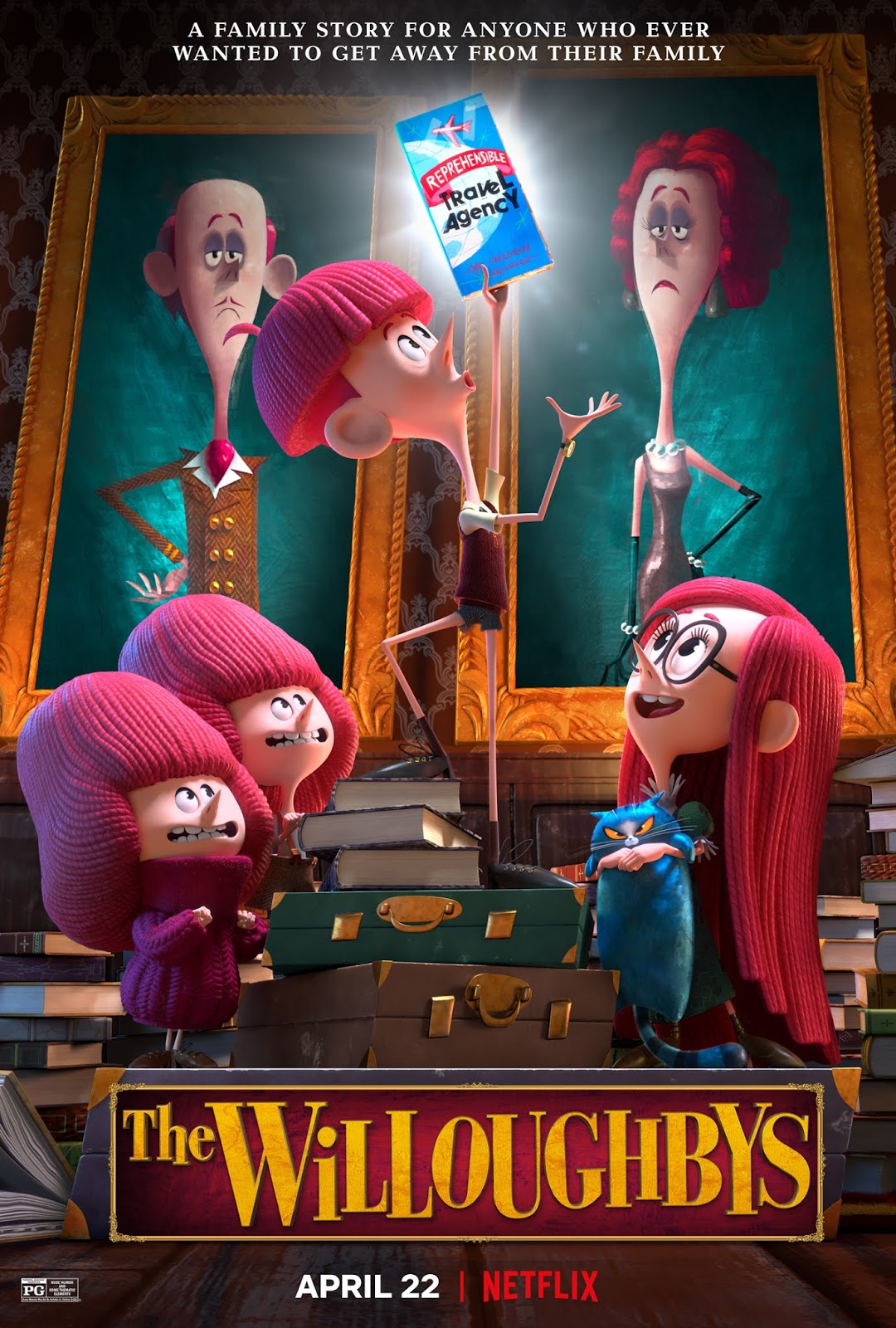
The Willoughbys (2020)
The plot feels like a bunch of alt-lite kids media stitched together: a little bit of A Series of Unfortunate Events, a little bit of Henry Selick, a lot of Roald Dahl (I've not read the Lois Lowry book this is based on, but I have a hard time imagining the Lowry of The Giver and Number the Stars also producing something this whimsical and demented). This movie is so highly caffeinated that it has a very hard time ever sticking to one plot, which is a huge detriment to a film that includes a gem of a plot involving the central children attempting to "orphan themselves," and for a lot of the movie I wanted to shake the screenplay by the collar and yell at it to just settle down, for Pete's sake. I'm pretty much in love with the animation style, though, which is probably the best example I've seen of the recent trend of twisting CG animation into looking like something spun out of arts-and-crafts—this one even goes the extra mile to make its framerate look like stop-motion animation. I'd be willing to make peace with this whole "photorealistic rendering" thing if what was being photorealistically rendered weren't the characters themselves but the material the characters are made out of. The promise of CG anything is the ability to conjure the impossible, and I'd honestly kind of love it if CG were used to conjure impossible stop-motion films like this one. Grade: B-

The Grudge (2004)
Like a lot of these Japanese-to-American remakes go, this is a sort of slick and sleepy version of the more homespun original. The original isn't really that much more propulsive, but it's at least got an uncannier feel—maybe I'm just not as inured to Japanese makeup and effects as I am to Hollywood ones, but there's something kind of rote to the scares here. I will give major props to this one for sticking with a virtually dialogue-free finale, the only part of this movie that feels better than the original, and I'm glad that Takashi Shimizu (who directed both) got to have a second go-round with a bigger budget. Grade: B-


Mouse Hunt (1997)
I don't know how I didn't know that Gore Verbinski's directorial debut was this little flick: an utterly deranged and caustic anti-capitalist film. The naked contempt this movie has for the two leads is a sight to behold, such that these guys are the villains of their own stories in whose grotesque punishment we viewers are supposed to delight. You know how the bad guys in '90s kids movies always suffer a ton of physical humiliation and pain and usually end up stepping in or being covered in poop at some point? Imagine those guys being the protagonists of the film—only they're also factory owners with bourgeois tastes and more interest in flipping a mansion than in little inconveniences like paying their workers. The '90s were a weird time for children's entertainment. Grade: B+

Blue Collar (1978)
I can't shake the feeling that this movie (and maybe Paul Schrader's career in general?) has some unresolved gender issues that it persistently neglects to work out—at least some other Schrader films have interesting female characters, which this one does not. But otherwise, this movie is white-hot. A bleak little parable about how those in power divide the working class against itself, culminating in one of the most shocking sequences of scenes to end a movie I've seen in a while. The three principal leads are all putting in really good work, too; of course Harvey Keitel and Yaphet Kotto bring their somewhat natural gravitas, but Richard Pryor especially is a real treat here, somehow doing basically his familiar comedic persona but also making that persona capable of some incredible dramatic intensity and desperation that I've never seen from his standup. Grade: B+

The Battle of Algiers (La battaglia di Algeri) (1966)
Maybe because I don't know a ton about the whole French/Algerian history, I got a little lost following the moment-by-moment details of the plot, but as a whole, this is a pretty striking piece of work and maybe the most effective rendering of the escalating cycle of violence during revolutions that I've seen in a movie. It shows compellingly how each side rushes to increasingly brutal tactics in response to the other side's violence. Crucially, it never let's you forget who started this whole thing; you don't open your movie with a scene of a French officer ruthlessly torturing an Algerian rebel (is Zero Dark Thirty recreating this in its opening scene?) and expect your audience to come away thinking that there were some good points made on both sides of the rebellion. Good. French colonialism kind of sucks. Grade: B+

Television

Steven Universe, Season 2 (2015-2016)
I know the production cycles of these Cartoon Network shows don't really position them to being watched in "seasons," but that said, I'm not sure where Season 2 really ends and Season 3 begins, since Hulu and Wikipedia put different episodes in different seasons. Oh well. Whatever the boundaries of the season, it's still a good time. This season is much more focused on the mythology and big-picture plot than the first season was, which means we get a lot less Beach City hijinks and standalone episodes. In fact, most of the latter half of the season is one continuous serialized arc. The arc is awesome, and the mythology is pretty impressive in that even as it gets bigger and deeper, it still remains rooted in the central psychological and emotional tensions that ground the show in a very real space, even as it becomes cosmos-spanning large: tensions about identities and bodies and gender and coming of age in a world in which adults lack the ability (either by absence or by incompatibility) to understand what that coming of age means and the urgency of compassion even in that space of incompatibility and absence. So it's good. Often really good. But at the time time, I do also miss the more balanced focus on small-scale stories, too, that I saw in the first season. Maybe I'm the only one who thinks this, since a lot of people seem to get extremely excited when TV shows go into hyper-serialized mode, but I don't think TV series are always necessarily better when they work hard to link all of their episodes into a larger narrative, and I think it would be cool to see more of the standalone episodes come back in the future (those who have already watched this show already know if I'll be disappointed or not, but I guess I'll be surprised as I pretend to watch this show as if it's still airing). But oh well. Like I said, this season is still good! Grade: B+

Music

Beyoncé - 4 (2011)
In my head, this was the first "modern" Beyoncé album, kicking off the more expansive, ambitious period of Beyoncé the Important Artist that we're currently living in. And the context of this album is certainly backs that, with an increased autonomy for Beyoncé in the crafting of the record after sacking her dad as her manager. Listening to this album front-to-back for the first time since 2011, though, I think I had that wrong as far as the actual album goes; 4 has a lot of the same issues that I Am...Sasha Fierce has, namely the indiscriminate track sequencing and an occasional over-reliance on some broad anthemic songwriting. Apparently Beyoncé presented 72 songs to her label, and I have a hard time imagining that none of those were more interesting than "I Care" (sonically, "Halo, Pt. 2"?) or "Start Over." But there are some delirious highs on this album, too, and on the whole, despite a little bit of diversification of sounds and production, 4 actually feels more like the crowning sendoff of Beyoncé's pop era before the inauguration of her Important Artist era. "1+1" is a great old-school slow-burn showcase for Beyoncé's overpowering ability to just belt melodies, and the Frank-Ocean-penned "I Miss You" is a pulsing R&B highlight with probably my favorite production on the record. But of course, the real peak is the one-two punch of now-wedding-reception staple "Love on Top," the best pop-soul song in Beyoncé's whole career, and the wild, densely hooky "Countdown," a top-five Beyoncé song for me and completely unlike anything she has done before or since. This would be a better album than Sasha Fierce even if its only two good songs were "Love on Top" and "Countdown." Grade: B

Sunday, July 5, 2020

Mini Reviews for June 29 - July 5, 2020

I guess Kanye West is really running for president.

Movies

Richard Jewell (2019)
The sad story of a man's almost puppy-dog-like love for American institutions that betray him at every turn. Olivia Wilde's character is a mistake—both for having her depict a real journalist who apparently didn't act this way in real life (I would have liked to see her as a fictional composite of a lot of different journalists, tbh) and also for basically embodying some sexist stereotypes about femme fatales and stuff. But otherwise, this is mostly super solid, and Paul Walter Hauser in the lead gives one of the best performances of 2019. Grade: B


Pope Francis: A Man of His Word (2018)
Admitting that this movie probably isn't for me, a lifelong Protestant, there's some surprisingly thin and hagiographic documentary work from Wenders here, though I guess he probably couldn't have gotten this much access to Pope Francis if he didn't go full Vatican-PR mode. Even so, while it's not surprising that the pope wouldn't be particularly excited about feminism or that he'd give strong moral condemnations but little systemic reform to the sexual abuse in the church, it's extremely frustrating that the documentary doesn't interrogate any of this more. One of the major reasons I am not Catholic is that I just cannot get behind the institutional hierarchy of having a pope or a single worldwide church leader like this, but on the other hand, I can't think of a single high-profile Protestant leader who speaks with as much frankness and passion about economic and environmental injustice as Pope Francis does, and they aren't particularly eager to embrace feminism or systematically address abuse either, so maybe I'm just closed-minded. Anyway, the PR might have worked a little here, because the parts of the movie that don't softball important issues I found pretty moving. The pope's words about wealth and the environment are potent coming from a leader of this stature, and even as just a symbolic gesture, the image of a pope (a South-American one at that) blessing those suffering in countries ravaged by centuries of colonialism and capitalism is undeniably powerful—it didn't occur to me until I was watching this that for a pope to take seriously the call of his position means shouldering and ministering to suffering on a global level, and I feel like a documentary that leaned more into the intensity of that idea would have been actually great. There's also something sad about it all, too, knowing the world in contrast to these ideals. Seeing the pope embrace Evo Morales and then go to the United States Congress to urge for the end of weapons trade is retrospectively heartbreaking; I guess even an endorsement from the pope himself can't protect a leftist, indigenous leader from a right-wing coup. Grade: C+

Mohawk (2017)
It's a bad sign when I know already that I will probably forget all about this movie within the month. There is absolutely nothing notable about this except for its indigenous protagonist (though even then, we spend more time with the American villains) and its setting within the War of 1812. We should have more (and more memorable) movies set in the War of 1812, because all I ever learned about that war in school was that that was how "The Star-Spangled Banner" was written. Educate me, cinema! Grade: C-


Blue Valentine (2010)
A good chunk of this, especially the flashbacks to when Gosling and Williams are falling in love, is pretty much peak Millennial Sundance Studio "Indie" (it's a Weinstein Co. production, but it just as easily could have been Fox Searchlight or whatever): the Grizzly Bear score, the use of recognizable Hollywood stars in an otherwise low-budget affect, the prominence of a mix CD, a cute little dance to old-timey music; Ryan Gosling plays a ukulele—in Brooklyn. I mean, wow. It lacks the Wes Anderson mannerisms, but that had kind of run its course by 2010 anyway. None of this is a putdown of the movie, by the way. It's really good and a lot more honest and complex than a lot of these kind of movies tended to be. It's genuinely moving, too, and ranks a little behind Before Midnight and A Separation (but not that far behind them) as one of the definitive marriage-dissolution films of the 2010s (it's way ahead of Marriage Story in that pantheon, btw). If I'd seen this in 2010, it probably would have been my second-favorite movie of that year behind The Social Network, and even though I'm far less into this aesthetic than I was in 2010, I was still blown away by some of the scenes here—the "drunken night in the hotel" sequence is frightening and heartbreaking in impressively equal measures. But at the same time, I also felt kind of outside myself watching this movie because I kept thinking about how of-its-time some of the specifics of this movie are and how weird it is that movies that came out when I was an adult now feel "of their time," with that "time" being "not now"—a weirdly thematically relevant dissonance to feel watching a movie in-part about the passage of time, now that I think about it. There are also some fascinating pieces that show Blue Valentine as an ever-so-slightly transitional work in the spectrum of American indie of its moment: the straight-blue hues of the central hotel room anticipate how monochrome and neon lighting would become the most important aesthetic signifiers of mainstream American indie filmmaking (and eventually some pockets of just straight American mainstream), and the "present-day" parts of this movie definitely feel like a definitive pivot away from the youth-obsessed indie 2000s and toward the "aging Millennial hipsters" 2010s in the same way that like LCD Soundsystem's last album and The National hit big (This Is Happening and High Violet were both 2010, too!). Gosling is definitely rocking that 'stache a few years ahead of time. I dunno. I know this is a lot of musing about cultural stuff that preoccupied a relatively small segment of the population of the United States. I'm having something of a Big Chill moment with this movie. Apologies. Grade: A-

Old Joy (2006)
Probably my favorite Kelly Reichardt movie, which is saying something for a filmography that includes Meek's Cutoff and Wendy & Lucy, two of the best American films of the past two decades. Well, now I know that she's directed three of the best American films of the past two decades. The central relationship between two friends who reunite for a camping trip after not having seen each other in years is so absolutely perfectly well-observed that I want to cry just thinking about it, and I don't think I've ever seen a movie grapple so compassionately with the ways in which male friends inevitably bump against the isolation at the edges of masculine behavioral scripts—and when the two of them finally push past it into the beautiful liminal space beyond for just a few minutes before they have to return to their lives, it's breathtaking and beautiful in a way that I have trouble describing. It's also Reichardt's most meditative movie, with long passages consisting of nothing but shots of nature intercut with other shots of nature with the rhythm of slow intakes of breath. The film is bookended by lengthy sequences in which a character listens to political talk radio during a drive through a city, which is not a terribly unrepresentative distillation of a certain slice of my own life; the roughly 70 minutes in between those bookends, though, are a transcendental voyage into a deeply peaceful, spiritually profound, and (by virtue of its contrast with the alienation and anxiety of real life) ultimately sad space of camaraderie and intimacy. Exactly the movie I needed. Grade: A

But I'm a Cheerleader (1999)
It's very successful as a camp satire of gender roles/heteronormativity, a success mostly thanks to the tremendous sets/costumes inside the gay conversion center, their garish baby pinks and blues as if a gender-reveal party became sentient and built a commune. The central relationship between Lyonne and DuVall is very cute, too, which is nice: this movie was apparently compared to the work of John Waters when it came out, and I can see that in some of the broad skewering of oppressive hetero-normie life, but what I've seen of Waters's work never quite manages to pivot from seething satire into pure sweetness as handily as this movie does. The same goes for the film's serious undercurrents about the harm of conversion camps; it probably could have gone a little harder into the actual existential threat that these places pose to queer youth (the lifelong trauma and even suicide that comes from these places, god), but it does still manage to incorporate some truly horrific stuff, like parents abandoning their children because the children are gay, within its generally comedic/easygoing tone, which is impressive. That said, there are parts of this movie that are too broad for me, particularly its use of stereotypes to fill out its cast; it's making a point about how people aspire (or are forced to aspire) to social scripts and stuff, and at least a few of the secondary characters get complicated by the film (I really appreciate that at least one person inside the conversion camp is straight but told they are gay because they don't scan as traditionally female). But the movie doesn't have time to do that for everyone, and a lot of the rest of the cast just kind of has to sit on these pretty thin tropes. The "intervention" scene where Lyonne's character is revealed to be gay in a series of escalating lesbian stereotypes is hilarious, though (the Melissa Etheridge poster...), so what do I know. Grade: B+

Books

Long Day's Journey into Night by Eugene O'Neill (1956)
O'Neill's autobiographical, posthumously published final work is very much mid-century theater of the kind that Arthur Miller and the like were making, and at first, this struck me as just a particularly aimless and miserable iteration of that: a son has a terminal illness, a mother has a morphine addiction, a father grapples with the artistic impotence of his career—and they spend the whole play drinking and fighting about all of that. But the moments of piercing, profound clarity in the play's more intimate stretches, when the drunken sniping halts and the characters talk sincerely one-on-one, are so beautiful that they become heartbreaking for how fleeting they are; this is especially true of a late conversation between Edmund (the terminally ill son) and his father, where Edmund articulates basically that: life is a confused and miserable muddle where we wander about in a fog until we stumble upon shining instances of meaning that soon get lost in the haze. Dialogues like this snap the play into focus for me and make it a largely compelling exploration of the spiritual and epistemic alienation of modernity. In the end, this was pretty moving. Grade: A-

Music

Enya - Watermark (1988)
I've never really given Enya a shot. Her reputation is mostly as a New Age artist, but this album kind of rocks. The New Age textures are here, but I'm also getting a lot of Kate Bush, too, which is very cool (and notably, Kate Bush integrates a lot of ambient/New Age sounds into her later work anyway). Very good stuff. I'm sorry to have slept on this artist for so long. Grade: A-

Sunday, March 15, 2020

Mini Reviews for March 9-15, 2020

Quarantine, Week 1: Rations running low. Ran out of milk and Kelly Reichardt DVDs today.

Movies

Wild Nights with Emily (2018)
The cinematic style itself is a little shaky, and this movie made me realize that it's kind of strange that the "letter is read by actor talking directly at the camera" technique has becomes something of a cliché for 18th/19th century period pieces trying to court modern sensibilities. But the screenplay and acting are both really tight, and the revisionist historical angle is enlightening—as an English teacher who has taught Dickinson poems in the past, I am embarrassed to admit that I didn't know half the things I discovered in my post-movie Wikipedia dive. Grade: B


Sacro GRA (2013)
Kind of like a Wiseman film if Wiseman were just a tad more interested in people than institutions. As cross-section of the people living along the biggest highway in Italy, it's a pretty interesting study of contrasts, from dudes bathing in literally golden tubs to people essentially living on the streets, and director Gianfranco Rosi gets some really evocative shots both of people living their lives (often filmed through their apartment windows) and of the highway itself. Gotta say, though, I dunno that it really justifies all of its 90 minutes, and I was restless by the end. Would have loved to spend a little more time with the guy making recordings of grubs than with some of the more anonymous folks here. Grade: B-


*Corpus Callosum (2002)
A playful, fun avant-garde feature that's basically just 90 minutes of goofing around with early digital film and digital effects. It feels historically significant that this came out the same year of Attack of the Clones (another landmark in digital cinema), and it makes me wonder what kind of movies George Lucas would have been making in 2002 if Star Wars hadn't ever taken off. Grade: B 

I talked about this movie (and Wavelength) on the Cinematary podcast, if you're interested in hearing about that. You can listen here.


River of Grass (1994)
It's pretty jarring to think of this movie's Badlands-by-way-of-'90s-indie in the context of Kelly Reichardt's broader career, to which it bears little resemblance. But I think if you can put that aside, it's a solid, occasionally lovely picture. I don't know if it's any more than the sum of its influences (a little bit of Breathless, a little bit Drugstore Cowboy, a lot of bit the aforementioned Badlands), but you could say the same of a lot of auspicious, slightly off-format '90s indie debuts: Hard Eight, Bottle Rocket, etc. There's something about the grimy, pre-Pulp Fiction American indie aesthetic that I just can't get enough of, and River of Grass delivers that in spades while also being Reichardt's funniest feature (the last scene is one of the great moments of black comedy in the '90s, on par with "You shot Marvin in the face"). Plus, it has that really awesome jazz score. Grade: B

Police Story (警察故事) (1985)
There are exactly three parts in this movie where I was more entertained than by any other action movie I've watched in recent memory: the opening sequence in the shanty town, the mid-film bit where Chan has to answer all the phones in the police station at once, and (of course) the legendary mall fight at the film's finale. The rest I thought was mostly tedious (with some pretty iffy gender politics to boot). But those three scenes are A+ territory, and Jackie Chan is a freaking Movie Star, so this shook out pretty great on average for me. Grade: B+


Wavelength (1967)
Really hate to be the guy who doesn't like the greatest avant-garde movie of all time, but I didn't like the greatest avant-garde movie of all time. I didn't get a thing out of it, and while I kind of appreciate some of the choices here (the "Strawberry Fields" part is neat, though for me that's likely just because I enjoy the song; some of the color tints are cool; I like where this ultimately ends up re: letting the waves go out of focus; also, that random dude who drops dead in front of the camera is Hollis Frampton??), I mostly just wish I didn't feel like the sound design had actually damaged my hearing. Was thinking I was going to be a Michael Snow head after digging *Corpus Callosum, so color me disappointed. Grade: C


Television

The Show About the Show, Season 2 (2019)
The first season of The Show About the Show was one of the great gems of the "Peak TV" era, a gonzo, hilarious experiment in self-reflexivity with a legitimate edge to it. I suppose it was only natural that a show as recursive as this one would eventually fold into itself and become not about the show itself but the people who make the show, and that's exactly what happens in this season, which essentially becomes a video diary of how Caveh Zahedi's commitment to the show has more or less destroyed his life. The show still has that same live-wire energy and compellingly playful unpredictability as its first season, but it's also excruciating and legitimately uncomfortable to see Caveh just dive into suffering with the abandon he does here. As this season shows, the central conceit of having real-life people recreate the ways in which they have interacted with the show creates a feedback loop that can end in nothing but chaos—interactions that, under normal circumstances, may have been tense but ultimately have dissipated with time become scabs that the show's recreations pick at and pick at until they become infected and even gangrenous. Added to this is the fact that the show now seems much less self-reflexive of its own limitations than it was in its first season; we are stuck in Caveh's point of view as he narrates his own memories, and while the first season did some work to explore the unreliability of this POV, the second season allows for no windows out of this solipsistic, at times genuinely sociopathic perspective, which renders central figures like Caveh's wife sort of incomprehensible as real people, either because Caveh chooses to portray them in fractured, illogical ways or because he doesn't understand these people himself. It's kind of horrific and monstrously sad. The first season was fun; this one is just kind of miserable, and while it's no less fascinating than its first season, I can't get too enthusiastic about this one. Grade: B

Music

Grimes - Miss Anthropocene (2020)
There's a somewhat muddled concept to Miss Anthropocene that you can explore if you want, but I'll be honest that I really just like the sound of this album. It sounds like what I imagine Visions-era Grimes would sound like if she had the Art Angels-era budget, and the result is a beguiling collection of songs, from the ambitious production of something like the opener, "So Heavy I Fell Through the Earth," to the hazy space-pop of "Delete Forever" or "Violence." It's a really solid record, and sure, it lacks some of the punch of Art Angels, but what doesn't? Grade: B+

Sunday, September 2, 2018

Mini Reviews for August 27 - September 2, 2018

It's that time of the month: when all the Netflix movies start expiring from streaming and I watch a random hodgepodge of stuff. Enjoy.

Movies


To All the Boys I've Loved Before (2018)
I want the rom-com to come back, but I guess part of having the rom-com come back is coming to grips with the fact that I will not like a good chunk of them. I get why people enjoy this: it's light and sweet and wholesome, and the importance of its Asian-American protagonist cannot be overstated as a representational milestone within the genre. And it's absolutely no fun to trash on this kind of movie, but... I dunno, I need more than milquetoast sweetness and a genial cast to help me enjoy this. The restlessness I got watching To All the Boys is the same restlessness I get whenever someone shows me a beloved Disney Channel Original Movie, with all apologies to the many fine people who enjoy those, too. This movie's two biggest liabilities—having a strong screenplay and having interesting visuals—are things that the DC movies (and, if we're being honest, the lion's share of the last major rom-com wave—and I'm totally including the Apatow films in that, too) were never really interested in, which is fine but also means that what I want to see in a movie and what this movie wants me to enjoy will be incompatible. Also, I felt mildly attacked by the film's insistence that staying at home on a Saturday night to read and/or watch movies is the height of desperate loneliness. Some people just like doing that, movie! There are dozens of us! Grade: C


White God (Fehér isten) (2014)
This has to be a joke, right? White God is basically agitprop, but with dogs instead of the working class—fetch, stay, heel... comrade. Or if I flip it around, it's sort of like the Hungarian New Wave version of those '90s family movies where an estranged parent has to learn to love their child, and there are cute animals involved who foil the villains in the end—didn't I see this same thing in Air Bud: Golden Receiver, just with less handheld camera and fewer pretensions of realism? Anyway, it's a bonkers concept that I can get behind, but one that doesn't really kick into gear until the final thirty minutes; up until then, it's just some really generic European austerity cinema. The dog footage is impressive (I'm not sure if a dog trainer or a sharp editor is responsible for the cohesive way the film builds its canine personalities, but whoever it is deserves a prize), but the rest of the movie is a real drag. Grade: C


Wendy and Lucy (2008)
There's the famous line in "Born to Run"—"the highway's jammed with broken heroes on a last-chance power drive"—but you've actually got to go back to the album's first song, "Thunder Road," to find out what happened to those heroes: "They haunt this dusty beach road in the skeleton frames of burned-out Chevrolets." The automobile has never been about the automobile: it's about the false promises of freedom and autonomy in the modern American landscape, the lie of the American Dream. In the movie, Wendy (a name that actually makes a frequent appearance on Born to Run, if I'm going to fully commit to this analogy) doesn't have a Chevrolet; it's an Accord, the supposedly responsible car to own. But even that's a trap, a deceptive hope ("I'm just passing through") that distracts from the fact that the world, for all its small moments of kindness—and there are several in Wendy and Lucy, and they are beautiful—the world is structured in such a way that society's operating principle is swift punishment, not grace. It's fitting, if crushing, that Wendy sheds the pretenses of individualistic Americana throughout the movie—her car and her dog—and in the end adopts the older, collectivist Americana of the train, a collectivism built on the back of exploitation and coercion—but what other choice does she have? It's also fitting that her final action in the film is an acknowledgement that she will never live up to what the billboards promise or the car commercials dream. One broken engine, and the entirety of America's systematic cul-de-sacs is laid bare—that's the brilliance of what director/co-writer Kelly Reichardt does here. Grade: A


Casino (1995)
Watching Scorsese's post-Goodfellas "wall-to-wall music and lifestyle porn juxtaposed with toxic masculinity" movies (this and The Wolf of Wall Street) and feeling like they are just fine, nothing great, and significantly flawed makes me kind of wonder about my belief that Goodfellas is one of the greatest American films—like... what if it just got there first? Still, if I can battle through the haze of nostalgia, I do think a crucial difference between Goodfellas and Casino is not just that Goodfellas was first but that it has a much stronger moral point of view. Part of it might be the dueling voiceover narrations, which, I think, ground the movie much less firmly in an unreliable perspective than Goodfellas's does, but moreover, there's some magical tipping point where the glamorous excess of the rich and reprehensible protagonists of this film begins to crowd out the implicit critique of toxic masculinity and the just-slightly-legal world of the casino itself, and Casino jumps right over that point and tumbles into this weird space where it's clear that these dudes are "bad," but there's nothing that really makes you feel viscerally that they are. It also doesn't help that the person most affected by the protagonists is Sharon Stone's character, which, while Stone gives this performance 110%, is nonetheless a sort of harpy stereotype and moreover also a reprehensible character whose reprehensibility is, in the movie's logic, portrayed as at least as much of a problem as the mob bosses's terribleness. But I'm waxing long about this movie's flaws when, in fact, I think it's pretty alright, so here's this: the soundtrack is absolutely baller (though I could maybe do without Scorsese dropping "Gimme Shelter" in the exact same place in each of his movies), and the movie's cinematic energy would be impressive in a movie half Casino's length and is downright miraculous over this film's three hours, to say nothing of that magnificent shot from the POV of a straw as cocaine is snorted through it. And on a thematic level, as problematic as some of its mechanics are, it's fascinating to view this movie as the middle piece of an arc beginning with Goodfellas and culminating with The Wolf of Wall Street, wherein Scorsese draws increasing equivalency between legal behavior our whole society is complicit in and the despicable organized crime our society purports to fight. Grade: B


Destiny (Der müde Tod) (1921)
A really lovely little fable that takes some of the best of German Expressionism and gives it the ruddy phantasmagoria of something like The Canterbury Tales. I guess it kind of comes with the territory of European silent film, but there is a lot of brown and yellow face, as well as some pretty bad racial caricatures here (and some things I assume are racial caricature, like some of the Chinese characters having grotesquely long fingernails—is this a thing? I'm not super-informed about Chinese history and culture). But the film also gives great dignity and humanity to a lot of its non-white characters, too, and each of the film's vignettes is a carefully (if archetypally) composed to confront the pathos of human mortality head-on. And that imagery, y'all! It's Fritz Lang in the director's chair, so no surprises here, but the mix of Gothic, almost metal imagery (Death's room of candles that hold human souls, for example) with precise tableau of seriously impressive set design (kind of like Intolerance, but on a budget and more carefully composed) is perfect for the film's narrative(s). In fact, I don't think it would be too much of a stretch to say that the imagery carries the movie, given how broad the film's narrative archetypes are. Grade: B+

Music


Sufjan Stevens - Seven Swans (2004)
The vibe I get from the Sufjan fanbase (and critics) is that Seven Swans is sort of the lesser release—almost a side project—that Sufjan occupied himself with between the Michigan and Illinois state projects. And I'm not exactly going to buck that consensus; at only 47 minute, it's certainly less sprawling than Michigan, and the song structures are a lot more conventional, free from the minimalist repetitions and the lengthy, multi-part epics of the likes of "Oh God, Where Are You Now?" But Seven Swans has a lot more to offer than just a signpost between larger records. It is, for one, a lot more surprising in its use of instrumentation than Michigan, which is an album whose stylistic proclivities are all pretty much laid out after its first few tracks; Seven Swans, on the other hand, has the chants at the beginning of "All the Trees of the Field Will Clap Their Hands" and the classic-rock electric guitar on "Sister" and and the organ on "We Won't Need Legs to Stand" all sorts of other one-off musical flourishes that are without precedent or posterity on the album. If Michigan is the structurally experimental album, then Seven Swans is (more mildly so, given the sedate folk-rock proclivities) the instrumentally experimental one. It is, moreover, a more literary and therefore a more mystical album than Michigan. Whereas the previous album is very much about spiritual malaise and nuanced expressions of interiority, Seven Swans is much more comfortable connecting those interior feelings to larger streams of human experience, using lyrical personas to navigate a host of songs based around either literary ("A Good Man Is Hard to Find") or biblical ("Seven Swans," "The Transfiguration"). On Michigan, the world is one where the holy is seen through meditations on the smallest details; the world of Seven Swans is one where the spiritual is practically bursting the seams of the physical world as it explodes into our vision. I like this idea a lot, though I think ultimately I'm always going to find Michigan's more meditative approach to be more interesting. But Seven Swans is no small potatoes. Grade: B+