It's that time of the month: when all the Netflix movies start expiring from streaming and I watch a random hodgepodge of stuff. Enjoy.
Movies
To All the Boys I've Loved Before (2018)
I want the rom-com to come back, but I guess part of having the rom-com come back is coming to grips with the fact that I will not like a good chunk of them. I get why people enjoy this: it's light and sweet and wholesome, and the importance of its Asian-American protagonist cannot be overstated as a representational milestone within the genre. And it's absolutely no fun to trash on this kind of movie, but... I dunno, I need more than milquetoast sweetness and a genial cast to help me enjoy this. The restlessness I got watching To All the Boys is the same restlessness I get whenever someone shows me a beloved Disney Channel Original Movie, with all apologies to the many fine people who enjoy those, too. This movie's two biggest liabilities—having a strong screenplay and having interesting visuals—are things that the DC movies (and, if we're being honest, the lion's share of the last major rom-com wave—and I'm totally including the Apatow films in that, too) were never really interested in, which is fine but also means that what I want to see in a movie and what this movie wants me to enjoy will be incompatible. Also, I felt mildly attacked by the film's insistence that staying at home on a Saturday night to read and/or watch movies is the height of desperate loneliness. Some people just like doing that, movie! There are dozens of us! Grade: C
White God (Fehér isten) (2014)
This has to be a joke, right? White God is basically agitprop, but with dogs instead of the working class—fetch, stay, heel... comrade. Or if I flip it around, it's sort of like the Hungarian New Wave version of those '90s family movies where an estranged parent has to learn to love their child, and there are cute animals involved who foil the villains in the end—didn't I see this same thing in Air Bud: Golden Receiver, just with less handheld camera and fewer pretensions of realism? Anyway, it's a bonkers concept that I can get behind, but one that doesn't really kick into gear until the final thirty minutes; up until then, it's just some really generic European austerity cinema. The dog footage is impressive (I'm not sure if a dog trainer or a sharp editor is responsible for the cohesive way the film builds its canine personalities, but whoever it is deserves a prize), but the rest of the movie is a real drag. Grade: C
Wendy and Lucy (2008)
There's the famous line in "Born to Run"—"the highway's jammed with broken heroes on a last-chance power drive"—but you've actually got to go back to the album's first song, "Thunder Road," to find out what happened to those heroes: "They haunt this dusty beach road in the skeleton frames of burned-out Chevrolets." The automobile has never been about the automobile: it's about the false promises of freedom and autonomy in the modern American landscape, the lie of the American Dream. In the movie, Wendy (a name that actually makes a frequent appearance on Born to Run, if I'm going to fully commit to this analogy) doesn't have a Chevrolet; it's an Accord, the supposedly responsible car to own. But even that's a trap, a deceptive hope ("I'm just passing through") that distracts from the fact that the world, for all its small moments of kindness—and there are several in Wendy and Lucy, and they are beautiful—the world is structured in such a way that society's operating principle is swift punishment, not grace. It's fitting, if crushing, that Wendy sheds the pretenses of individualistic Americana throughout the movie—her car and her dog—and in the end adopts the older, collectivist Americana of the train, a collectivism built on the back of exploitation and coercion—but what other choice does she have? It's also fitting that her final action in the film is an acknowledgement that she will never live up to what the billboards promise or the car commercials dream. One broken engine, and the entirety of America's systematic cul-de-sacs is laid bare—that's the brilliance of what director/co-writer Kelly Reichardt does here. Grade: A
Casino (1995)
Watching Scorsese's post-Goodfellas "wall-to-wall music and lifestyle porn juxtaposed with toxic masculinity" movies (this and The Wolf of Wall Street) and feeling like they are just fine, nothing great, and significantly flawed makes me kind of wonder about my belief that Goodfellas is one of the greatest American films—like... what if it just got there first? Still, if I can battle through the haze of nostalgia, I do think a crucial difference between Goodfellas and Casino is not just that Goodfellas was first but that it has a much stronger moral point of view. Part of it might be the dueling voiceover narrations, which, I think, ground the movie much less firmly in an unreliable perspective than Goodfellas's does, but moreover, there's some magical tipping point where the glamorous excess of the rich and reprehensible protagonists of this film begins to crowd out the implicit critique of toxic masculinity and the just-slightly-legal world of the casino itself, and Casino jumps right over that point and tumbles into this weird space where it's clear that these dudes are "bad," but there's nothing that really makes you feel viscerally that they are. It also doesn't help that the person most affected by the protagonists is Sharon Stone's character, which, while Stone gives this performance 110%, is nonetheless a sort of harpy stereotype and moreover also a reprehensible character whose reprehensibility is, in the movie's logic, portrayed as at least as much of a problem as the mob bosses's terribleness. But I'm waxing long about this movie's flaws when, in fact, I think it's pretty alright, so here's this: the soundtrack is absolutely baller (though I could maybe do without Scorsese dropping "Gimme Shelter" in the exact same place in each of his movies), and the movie's cinematic energy would be impressive in a movie half Casino's length and is downright miraculous over this film's three hours, to say nothing of that magnificent shot from the POV of a straw as cocaine is snorted through it. And on a thematic level, as problematic as some of its mechanics are, it's fascinating to view this movie as the middle piece of an arc beginning with Goodfellas and culminating with The Wolf of Wall Street, wherein Scorsese draws increasing equivalency between legal behavior our whole society is complicit in and the despicable organized crime our society purports to fight. Grade: B
Destiny (Der müde Tod) (1921)
A really lovely little fable that takes some of the best of German Expressionism and gives it the ruddy phantasmagoria of something like The Canterbury Tales. I guess it kind of comes with the territory of European silent film, but there is a lot of brown and yellow face, as well as some pretty bad racial caricatures here (and some things I assume are racial caricature, like some of the Chinese characters having grotesquely long fingernails—is this a thing? I'm not super-informed about Chinese history and culture). But the film also gives great dignity and humanity to a lot of its non-white characters, too, and each of the film's vignettes is a carefully (if archetypally) composed to confront the pathos of human mortality head-on. And that imagery, y'all! It's Fritz Lang in the director's chair, so no surprises here, but the mix of Gothic, almost metal imagery (Death's room of candles that hold human souls, for example) with precise tableau of seriously impressive set design (kind of like Intolerance, but on a budget and more carefully composed) is perfect for the film's narrative(s). In fact, I don't think it would be too much of a stretch to say that the imagery carries the movie, given how broad the film's narrative archetypes are. Grade: B+
Music
Sufjan Stevens - Seven Swans (2004)
The vibe I get from the Sufjan fanbase (and critics) is that Seven Swans is sort of the lesser release—almost a side project—that Sufjan occupied himself with between the Michigan and Illinois state projects. And I'm not exactly going to buck that consensus; at only 47 minute, it's certainly less sprawling than Michigan, and the song structures are a lot more conventional, free from the minimalist repetitions and the lengthy, multi-part epics of the likes of "Oh God, Where Are You Now?" But Seven Swans has a lot more to offer than just a signpost between larger records. It is, for one, a lot more surprising in its use of instrumentation than Michigan, which is an album whose stylistic proclivities are all pretty much laid out after its first few tracks; Seven Swans, on the other hand, has the chants at the beginning of "All the Trees of the Field Will Clap Their Hands" and the classic-rock electric guitar on "Sister" and and the organ on "We Won't Need Legs to Stand" all sorts of other one-off musical flourishes that are without precedent or posterity on the album. If Michigan is the structurally experimental album, then Seven Swans is (more mildly so, given the sedate folk-rock proclivities) the instrumentally experimental one. It is, moreover, a more literary and therefore a more mystical album than Michigan. Whereas the previous album is very much about spiritual malaise and nuanced expressions of interiority, Seven Swans is much more comfortable connecting those interior feelings to larger streams of human experience, using lyrical personas to navigate a host of songs based around either literary ("A Good Man Is Hard to Find") or biblical ("Seven Swans," "The Transfiguration"). On Michigan, the world is one where the holy is seen through meditations on the smallest details; the world of Seven Swans is one where the spiritual is practically bursting the seams of the physical world as it explodes into our vision. I like this idea a lot, though I think ultimately I'm always going to find Michigan's more meditative approach to be more interesting. But Seven Swans is no small potatoes. Grade: B+
At this point, nothing more than the musings of a restless English teacher on the pop culture he experiences.
Showing posts with label Fritz Lang. Show all posts
Sunday, September 2, 2018
Sunday, May 20, 2018
Mini-Reviews for May 14 - 20, 2018
Sorry for the late post! It's been a tremendously busy week.
Movies
Zombeavers (2014)
About what you'd expect from the title, with the added wrinkle of being slightly socially conscious by having a half-baked metaphor based on the "beaver=vagina" thing, which... *sigh*. I was hoping for a doofy, so-bad-it's-good kind of thing (and that's clearly what the movie is going for). But there's just something about its vaguely conscious pretensions and how thoroughly the movie reveals that it doesn't understand its own subtext (there's an extended scene whose point is literally that a character is making a big deal about another character being topless, and this seems less about body image/modesty culture commentary and more about "hey look, titties"—why yes, the movie is written and directed by a bunch of dudes, why do you ask?) that's deeply irritating, and ultimately, I found it all to be craven and lazy rather than fun. No abundance of hilariously bad beaver puppetry and over-the-top gore can remedy it. Grade: C-
Pariah (2011)
After loving Mudbound, I thought I'd go back to Dee Rees's 2011 breakthrough. The cinematography is very nice in that hazy, neon, handheld way that's been American indie's bread and butter for the past decade or so (though perhaps that decade of neon-bathed digital has softened the impact of this movie's look), and the story, while drawing on a familiar trope (the coming out story), succeeds by transporting tropes into an environment I've never seen them play out in, urban African-American culture. Some of this feels a little too on-the-nose, and it feels like the movie is spread just a tad bit thin by focusing on as many characters as it does, a feeling Mudbound miraculously avoided. But in general, it's a well-observed and engaging piece of cinema that fits in nicely with the sensitive, naturalist (as opposed to twee) indies of recent years. Grade: B
Cruel Intentions (1999)
It's basically the opposite of a screwball comedy, wherein instead of talking around sex in humorous ways, these guys just dive head-first into it by frankly talking about orgasms and oral sex and stuff [*Pete Rose sliding into home image*], only with that same glibness that makes screwball feel so fleet. The movie is attuned to and making fun of social nuances/manners in a way that feels at home with its 18th-century source material, and it's also dealing in this almost-parodic teen melodrama mode that fits in well with the late-'90s spate of teen movies and TV, the combination of the two making for some interesting moods in the film. So I like all that. But at the same time, I also don't think the movie really works as a whole, and I'm going to call it a failure of both directing and acting. Sarah Michelle Gellar is really the only one in this cast who understand the viciously tongue-in-cheek, arch tone that this material necessitates, and she gets all the best moments, too; the rest of the cast seems to have wandered in from something like Dawson's Creek and are various shades of listless and tone-deaf (though I guess Selma Blair deserves something for her strange, grating performance). And this is all staged in really contradictory and dull ways by the director, who I'm not going to say has misunderstood the material so much as he seems to lack the craft necessary to make the material pop; this is some shockingly generic filmmaking for a story that involves a wager staked on lowkey incest, and ten points from Gryffindor for those terrible music cues ("Bittersweet Symphony," what are you doing?). There's also the whole late-'90s sexual ethic that seems to buy into the myth that someone can be harassed (and basically raped, to be honest) into enjoying sex, which like... yikes. There's enough smart/high-camp stuff going on here that it didn't really ruin my time with it, but I don't blame anyone for checking out because of that. Either way, it's a complicated, compromised movie that easily could have been way better. But also, it's not like we've gotten a better version of this specific type of movie since, though I welcome modern filmmakers to try. Grade: B-
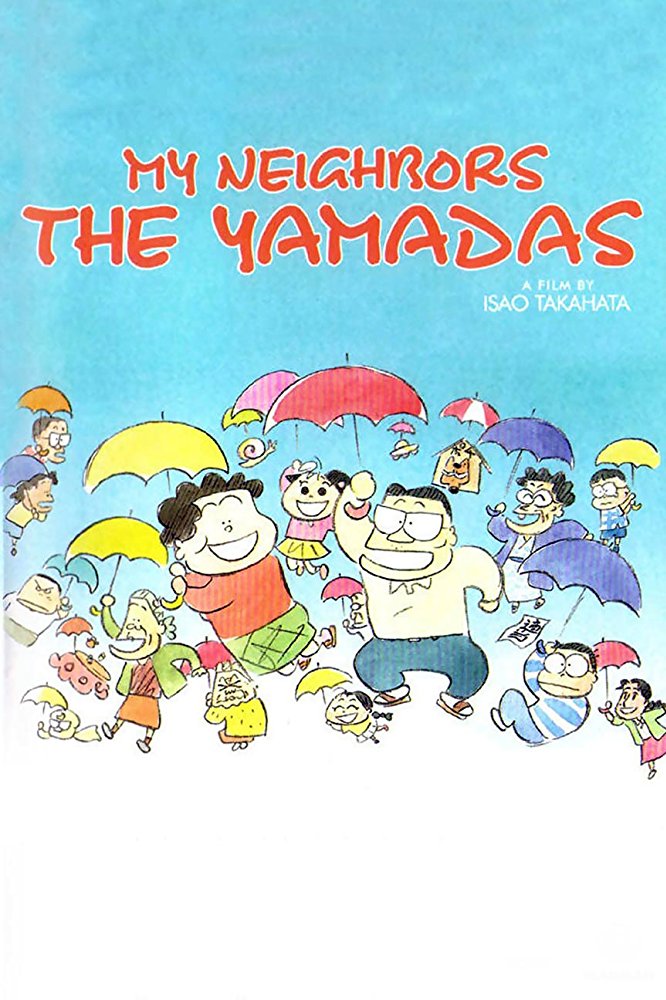
My Neighbors the Yamadas (ホーホケキョとなりの山田くん) (1999)
The two things that make My Neighbors the Yamadas so distinctive within Studio Ghibli's catalog—the sketchy, hyper-cartoonish aesthetic and the almost entirely vignette-based structure of its plot—also make it something of a drag at times. There are times when the art style works extremely well, especially when it blends the line between objective and subjective reality (a character flies into the air, the world itself melts away into a fantasy), and there are just as many times when the plot's vignettes create these heartbreaking little ellipses and slice-of-life pinpricks. But almost as often, the movie is directionless and inconsequential, and I strongly felt the 100-minute runtime. It's an interesting experiment that I'm glad exists, but I probably won't be returning to this any time soon. Grade: B-
Metropolis (1927)
Surprising absolutely nobody, one of the most popular and enduring movies of all time is great. Fritz Lang's vision of the future by way of the Weimar Republic is awe-inspiring and transporting and exactly the sort of thing I watch movies for. I can nitpick: the movie never quite bests its jaw-dropping opening hour (honestly, the 2.5-hour length of the "Complete" cut I watched was about fifteen minutes north of ideal), and I guess I wanted the movie to be just a tad more agitprop-ish and a tad less "we need a messiah to make the capitalists and the labor get along"—viva the robot revolution, is what I'm saying, or maybe that's just the Janelle Monáe fan inside me. But fixating on these bits would be unrepresentative of just how successful this movie was at achieving in me the greatest ambition of all popcorn cinema: I was enthralled. Grade: A
Movies
Zombeavers (2014)
About what you'd expect from the title, with the added wrinkle of being slightly socially conscious by having a half-baked metaphor based on the "beaver=vagina" thing, which... *sigh*. I was hoping for a doofy, so-bad-it's-good kind of thing (and that's clearly what the movie is going for). But there's just something about its vaguely conscious pretensions and how thoroughly the movie reveals that it doesn't understand its own subtext (there's an extended scene whose point is literally that a character is making a big deal about another character being topless, and this seems less about body image/modesty culture commentary and more about "hey look, titties"—why yes, the movie is written and directed by a bunch of dudes, why do you ask?) that's deeply irritating, and ultimately, I found it all to be craven and lazy rather than fun. No abundance of hilariously bad beaver puppetry and over-the-top gore can remedy it. Grade: C-
Pariah (2011)
After loving Mudbound, I thought I'd go back to Dee Rees's 2011 breakthrough. The cinematography is very nice in that hazy, neon, handheld way that's been American indie's bread and butter for the past decade or so (though perhaps that decade of neon-bathed digital has softened the impact of this movie's look), and the story, while drawing on a familiar trope (the coming out story), succeeds by transporting tropes into an environment I've never seen them play out in, urban African-American culture. Some of this feels a little too on-the-nose, and it feels like the movie is spread just a tad bit thin by focusing on as many characters as it does, a feeling Mudbound miraculously avoided. But in general, it's a well-observed and engaging piece of cinema that fits in nicely with the sensitive, naturalist (as opposed to twee) indies of recent years. Grade: B
Cruel Intentions (1999)
It's basically the opposite of a screwball comedy, wherein instead of talking around sex in humorous ways, these guys just dive head-first into it by frankly talking about orgasms and oral sex and stuff [*Pete Rose sliding into home image*], only with that same glibness that makes screwball feel so fleet. The movie is attuned to and making fun of social nuances/manners in a way that feels at home with its 18th-century source material, and it's also dealing in this almost-parodic teen melodrama mode that fits in well with the late-'90s spate of teen movies and TV, the combination of the two making for some interesting moods in the film. So I like all that. But at the same time, I also don't think the movie really works as a whole, and I'm going to call it a failure of both directing and acting. Sarah Michelle Gellar is really the only one in this cast who understand the viciously tongue-in-cheek, arch tone that this material necessitates, and she gets all the best moments, too; the rest of the cast seems to have wandered in from something like Dawson's Creek and are various shades of listless and tone-deaf (though I guess Selma Blair deserves something for her strange, grating performance). And this is all staged in really contradictory and dull ways by the director, who I'm not going to say has misunderstood the material so much as he seems to lack the craft necessary to make the material pop; this is some shockingly generic filmmaking for a story that involves a wager staked on lowkey incest, and ten points from Gryffindor for those terrible music cues ("Bittersweet Symphony," what are you doing?). There's also the whole late-'90s sexual ethic that seems to buy into the myth that someone can be harassed (and basically raped, to be honest) into enjoying sex, which like... yikes. There's enough smart/high-camp stuff going on here that it didn't really ruin my time with it, but I don't blame anyone for checking out because of that. Either way, it's a complicated, compromised movie that easily could have been way better. But also, it's not like we've gotten a better version of this specific type of movie since, though I welcome modern filmmakers to try. Grade: B-
My Neighbors the Yamadas (ホーホケキョとなりの山田くん) (1999)
The two things that make My Neighbors the Yamadas so distinctive within Studio Ghibli's catalog—the sketchy, hyper-cartoonish aesthetic and the almost entirely vignette-based structure of its plot—also make it something of a drag at times. There are times when the art style works extremely well, especially when it blends the line between objective and subjective reality (a character flies into the air, the world itself melts away into a fantasy), and there are just as many times when the plot's vignettes create these heartbreaking little ellipses and slice-of-life pinpricks. But almost as often, the movie is directionless and inconsequential, and I strongly felt the 100-minute runtime. It's an interesting experiment that I'm glad exists, but I probably won't be returning to this any time soon. Grade: B-
Metropolis (1927)
Surprising absolutely nobody, one of the most popular and enduring movies of all time is great. Fritz Lang's vision of the future by way of the Weimar Republic is awe-inspiring and transporting and exactly the sort of thing I watch movies for. I can nitpick: the movie never quite bests its jaw-dropping opening hour (honestly, the 2.5-hour length of the "Complete" cut I watched was about fifteen minutes north of ideal), and I guess I wanted the movie to be just a tad more agitprop-ish and a tad less "we need a messiah to make the capitalists and the labor get along"—viva the robot revolution, is what I'm saying, or maybe that's just the Janelle Monáe fan inside me. But fixating on these bits would be unrepresentative of just how successful this movie was at achieving in me the greatest ambition of all popcorn cinema: I was enthralled. Grade: A
Subscribe to:
Posts (Atom)