A quick note: I know it says "albums" there in the title, but what I'm actually ranking is what Wikipedia calls the band's "core catalog"—that means none of the U.S. albums (sorry, Yesterday and Today fans). It also means that I'm including one release on this list that's not technically an album (Magical Mystery Tour) but not including compilations like the two Past Masters releases or remixes like Let It Be...Naked, since they came out later.
I also tried really hard to relisten to this music with fresh ears when I was making this list, if it's even possible to hear this music fresh. It may have worked; albums that in my head I had ranked as among my favorites actually didn't hold up as well, and a few other albums that I'd not quite held as fondly shot up to near the top.
Anyway, as always, let me know what you think. This ranking is almost certainly wrong, so be sure to tell me the right one.

This one's position at the very bottom is a no-brainer for most Beatles fans and even The Beatles themselves, who released it basically as a contractual obligation. It's technically the band's 10th studio album, but it's barely an album. Half of it is an orchestral re-recording of the score George Martin wrote for the movie of the same title, a movie which the actual Beatles had almost nothing to do with outside of a short vocal cameo at the end. It's not a terrible score in the context of the movie itself, but it's a snooze here. The other half of the record includes the material The Beatles actually wrote, but of those six songs, two had already appeared on previous Beatles projects ("Yellow Submarine" and "All You Need Is Love"), while the remaining four include the single worst song in the Beatles canon ("All Together Now"), a very good Sgt.-Pepper-style psychedelic song ("It's All Too Much"), a perfectly passable Sgt.-Pepper-style psychedelic song ("Only a Northern Song"), and a moderately interesting blues rocker ("Hey Bulldog"). It's not completely unlistenable, but it's the only Beatles album that I think is anything less than "good." And lord, do I hate "All Together Now."

Even The Beatles couldn't avoid the dreaded sophomore slump. With the Beatles, their second LP, contains the worst tendencies of their early career—vanilla covers of iconic songs by Black artists, the fill-in-the-blank dopey adolescent innocence—without a compelling display of that era's best qualities. Alongside Yellow Submarine, it's the rare Beatles album with no iconic tracks, which makes this an album that doesn't have much of an identity within the broader sweep of The Beatles' career: The Beatles without the mythology, as if we're getting a peek into an alternate version of Please Please Me for a parallel universe in which The Beatles never became famous. None of this is to say that the album isn't still a fun listen; it is, and the Lennon-McCartney originals (plus one George Harrison song!) are generally good. It just never rises beyond its station, and I can't imagine why anyone would want to listen to The Beatles' takes on "Please Mr. Postman" and "Roll Over Beethoven" when the original versions exist.

This is apparently the first album The Beatles made after they discovered Bob Dylan and weed, and you can kind of tell if you squint really hard: songs like "No Reply" and "I'm a Loser" are a tad more structurally and melodically ambitious than most of their early work, and they have a darkness and introspection uncharacteristic of their early music, too. "Eight Days a Week" is of course the one song from the album that everyone is pretty much guaranteed to know, but there are some other great Beatles songs lurking around the corners of this record (I've already named two of them) that people don't give quite as much attention. And then the covers: there are a lot of them. Not really to worry, though: the "Kansas City / Hey-Hey-Hey-Hey!" medley that ends Side One tries a little too hard, but the rest are good, especially "Rock and Roll Music," which is the best product of the early Beatles' Chuck Berry fixation, and the climactic take on Carl Perkins's "Everybody's Trying to Be My Baby," which is a ton of fun and a great way to end the record. Still, given the context of the songwriting tours de force sandwiching this album in Beatles history (A Hard Day's Night and Help!), it's hard not to feel like an album so reliant on covers is a comparatively minor, placeholder work—one most bands would kill to achieve, though, I'm sure.

I actually think For Sale is a more consistent record than Rubber Soul, and while I understand the instrumental reasons why a lot of people consider this The Beatles' first mature work, I don't really share that feeling. Yes, the boys expand their instrumental ambition tremendously here, including sitars, tambourines, maracas, a harmonium, and a host of other instruments that would not have found a place on the straightforward rock and soul of their early work, and the lyrics are intriguingly oblique in unexpected ways. But as a complete object, this really doesn't feel like a huge departure for the band—maybe it's just knowing that Revolver and Sgt. Pepper were both on the horizon, but to me, a lot of the album sounds full of tentative half measures of experimentation before they truly let go, and the songwriting suffers as a result: the lighthearted stuff like "Drive My Car" and "What Goes On" seem to me like they'd have been better suited by the straightforward approach of their earlier albums, and of the serious tracks, you have at least a few that feel more reigned in than they ought to be (I'm thinking especially of "Nowhere Man"). And then there's "Run For Your Life," which is something of a different category, being just a loathsome song in general: stuck halfway between an awkward Elvis homage and some of the ugliest lyrics that John Lennon wrote prior to his solo career (when he sings about being "cruel to [his] woman" on Sgt. Pepper, it's hard not to imagine songs like this and wonder how autobiographical they are). It's not that these songs are bad (except for "Run For Your Life," of course); I mean, we're still dealing primarily with Lennon-McCartney tunes. They just don't feel as fully realized as they could have been. But I've put it before For Sale based entirely on the merits of two songs that stand as gleaming beacons of what the rest of Rubber Soul could have been: "Norwegian Wood (This Bird Has Flown)" and "In My Life." The former is the one track that truly leans into Rubber Soul's reputation as a folk album, being basically an English folk tune (accentuated with some psychedelic effects) that tells a bizarre black comedy tale about a failed affair, and it's both traditional and modern, beautiful and hilariously base, all in equal measure in a way that 100% anticipates the psychedelic and eventually postmodern directions The Beatles would soon go. The latter song, "In My Life," isn't nearly so musically and instrumentally complicated (though it does have a harpsichord-sounding piano solo), but it makes up for that by being simply the best Beatles song of all time; Lennon's lyrics form an unbelievably profound rumination on memory and love whose sophistication was never again matched either within the band's remaining output nor in any of the individual members' post-Beatles efforts, and the music, though simply rendered, is every bit as piercing and poignant and sweet as it needs to be to keep up with the lyrics. I have some mixed feelings about a lot of Rubber Soul, but "Norwegian Wood" and "In My Life" really put a finger on the scales in this album's favor.
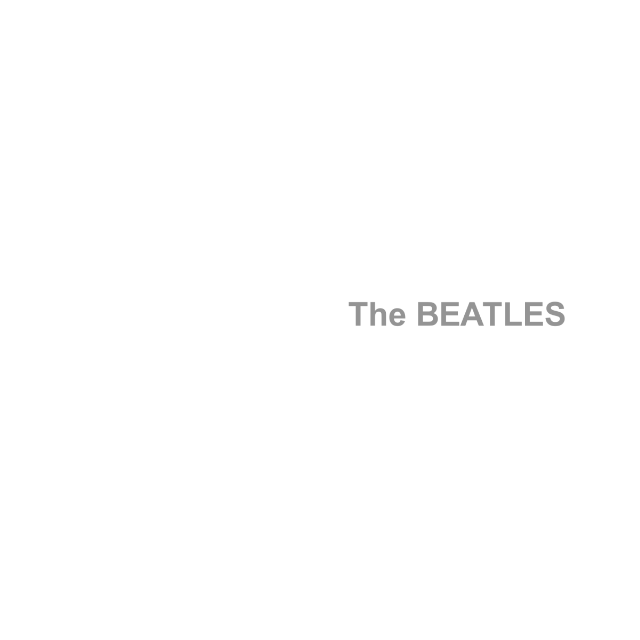
There are stretches of "The White Album" where I think that I'm listening to the greatest Beatles album ever—e.g. the opening "Back in the U.S.S.R." / "Dear Prudence" suite or the run of tracks that starts at "While My Guitar Gently Weeps" and then goes all the way through "Blackbird." Then again, there are other parts of the record that feel like they must be part of the worst Beatles album ever; "Piggies" through "Why Don't We Do It in the Road" is pretty weak, as is "Birthday" through "Everybody's Got Something to Hide Except for Me and My Monkey" (all the more so for the supposedly brash opening for the second LP). So I really don't know how I feel about the album as a whole, as sprawling and diverse as it is, which is realize is 100% The Point of an exercise like The Beatles. But like... what are you supposed to do with a record where part of The Point is that parts of the album are much worse than other parts? I certainly don't know. But it's an endlessly fascinating document, as wonderful as it is frustrating, and even though the album itself spawned a mini-genre of indulgent double LPs that make a virtue of messiness and stylistic diversity, there still really isn't anything quite like The Beatles in the rock canon. It's also sneakily a concept album, something I don't think people talk about very much—fittingly, an album named The Beatles is basically entirely about The Beatles, in terms of their mythology ("Glass Onion"), their intersection with the whole teeming corpus of mass media ("Revolution 9," i.e. a wild sound collage that forms a soup of 20th century media and then links it to a single Beatles studio session), or even just the current album ("Savoy Truffle"), and the songs that don't deal with this are mostly about the musical DNA that formed The Beatles in the first place, making smirking, ironic simulacra of the individual genres that birthed the band: for example, the blues ("Yer Blues"), surf rock ("Back in the U.S.S.R."), socially conscious folk ("Blackbird"), mid-century chamber music ("Good Night"), and doo-wop (the last and longest section of "Happiness Is a Warm Gun"). It's basically an out-of-body experience for the group, the moment The Beatles briefly stepped out of their role as one of the primary cultural products of the era and examined that role from an alternatingly bemused and bitter distance—without a doubt, the most conceptually complex of any of The Beatles' albums, which is funny because Sgt. Pepper gets all the noise about being a concept album. This sort of self-reflexivity and focus on pastiche/reproduction makes The Beatles a fundamentally postmodern record, honestly, probably the most widely distributed work of postmodernism ever—which is an analysis I was feeling pretty clever for having made myself until I saw that the first paragraph of the album's Wikipedia article says the same thing. Just when you think you've got a fresh take on The Beatles...

Sometimes a band just get it right the first time. There is nothing especially profound or complicated about Please Please Me, the debut record from a little Liverpool band rock band named The Beatles; it's just all executed to near-perfection. Bookended by two of the best songs the band would ever record, "I Saw Her Standing There" and "Twist and Shout" (the latter the being single best cover song The Beatles would ever do and the only one in which the band feels at-home in their own identity rather than play-acting as one of their heroes), the album finds an extremely winning groove of mixing soul/R&B covers (basically presenting themselves as a gender-flipped girl group) with original songs by the now-famous Lennon-McCartney songwriting team. A lot of British bands went to this formula, including The Beatles themselves at various times over the couple of years following this album, but I don't think it was ever improved upon. To get better, The Beatles would have to find a new formula, which they would soon enough.

This release is the reason that I hemmed and hawed about this list being all of their "core catalog," not just their albums. This is technically a double-EP, the first EP being songs from the Magical Mystery Tour film and the second being a collection of the non-album singles the band released in 1967. This used to be one of my favorite Beatles releases, though as I revisited it for this list, it struck me that the film-related material is definitely the weak link here, relatively, compared to the second EP, which is comprised basically front-to-back of some of the best songs The Beatles ever did (I know some people hate the hippy drippiness of "All You Need Is Love," which I understand, but I love the song anyway), but even then, "Flying" and "Blue Jay Way" are the only songs on the first EP that feel at risk of ever becoming less than good, while "I Am the Walrus" is one of the band's great freakouts. And of course, that second EP is nigh unimpeachable; "Strawberry Fields Forever" is an easy top-5 Beatles song for me, and the rest aren't far behind. Whether it's an album or not, it's still one of the definitive documents of the band's psychedelic era.

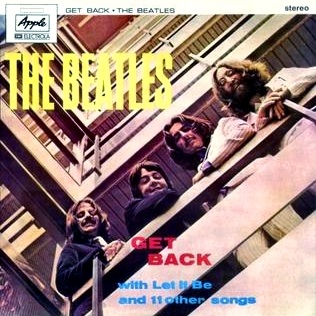
There are a lot of people who dislike this album, cobbled together as it was from the band's last, rankled studio sessions, but I have an enormous soft spot in my heart for it. The idea for the record (originally titled Get Back) was that the band would strip back all the studio trickery that had defined their recent output and delivery a back-to-basics release—the original album art was even a riff on the cover of Please Please Me. Obviously, this didn't quite work out, and the band basically disintegrated in the process of making the record (what parts of it hadn't already disintegrated during the acrimonious White Album sessions). While that's maybe a tragedy in the context of the Beatles mythos, it's actually a grace note for the version of the album that we did end up getting; the shagginess of the recordings here make Let It Be the loosest, warmest album in the band's history, a roots-rock record full of studio chatter and dead ends and jokes ("I hope we've passed the audition") and weird larks (e.g. the John Lennon falsetto at the end of "Dig It" that introduces "Let It Be"). It helps that the songwriting is generally tremendous and, fitting of the roots-rock milieu, unlike most of the group's previous work, even outside the uncharacteristic looseness: the gospel hymn of "Let It Be," the '50s-rock throwback "One After 909," the molasses soul of "Dig a Pony," the skiffle of the "Maggie Mae" fragment, the chugging revival tent blues of "I've Got a Feeling"—those are all great songs and weird, interesting, hairy directions to take The Beatles as they staggered through their last days as a group. Sure, "The Long and Winding Road" sucks, even the stripped-down, non-Phil-Spector version, but as I see it, that is literally the only bruise on this otherwise great set.

People talk about Rubber Soul being the turning point for The Beatles, but I present Help! instead (released just a few months before Rubber Soul, too). Songs like "The Night Before," "You've Got to Hide Your Love Away," "I've Just Seen a Face," and of course "Yesterday" (just a perfect gem of a song, that one) show the Lennon-McCartney songwriting stretching itself into new (to The Beatles) genres like folk, which is exactly what Rubber Soul does, too, albeit a bit more enthusiastically. But unlike Rubber Soul, literally all of the songs on this album are Great (except "Act Naturally," I guess, but that's basically just a goof anyway), and none of them have that half-measure feel in their embrace of new sounds; this is still very much an early Beatles record, which helps the new genres pop in ways that they rarely do on Rubber Soul. Other than comparing it favorably to Rubber Soul, I don't really have anything too clever to say about the album, though; it just slaps, front to back.

From here on out, it's basically just unqualified masterpieces, and any given one of these could be my favorite Beatles album, depending on how the wind blows or on which side of the bed I get up. Abbey Road feels like an album for people who wish that The White Album were more concise, less ironic, and less experimental, and though I don't think I want the last of those, I'm not complaining about the concessions to the first two. Abbey Road is a tight 47 minutes, using every bit of that time to cram in as much songwriting inspiration as possible into the record, up to and including only giving us a minute or so of a song's essential nugget before rushing on to the next, in the case of the famous medley that takes up the majority of Side Two. It's not as wild or groundbreaking as the albums leading up to this one (in fact, unless you count the medley as an innovation, there's nothing in here that couldn't have appeared on their previous records, which is the only post-1965 record of theirs that that's true of), but golly is it a rush of pure joy to the head. It's also achingly sincere, maybe the most sincere Beatles album of them all, full of sunny melodies paired with equally sunny lyrics—lyrics that often risk self-parody as they reach higher and higher for emotionally forthright meaning (I mean... "And in the end, the love you take is equal to the love you make"?) but somehow skate by unscathed on the euphoria of the music. Even genre riffs like "Oh! Darling" sound like they mean it, a far cry from the barely contained smirking of The White Album. There was a large part of my life when this was my favorite Beatles album, full-stop; since then, I've lost a little patience for "Octopus's Garden," and I now think the medley trips up just a tad as it transitions into the final movement with "Golden Slumbers" / "Carry That Weight" / "The End"—hence the #4 spot. But those minuscule blemishes are the only things I can bring against the record, and when the "You Never Give Me Your Money" reprise hits during "Carry That Weight," none of those blemishes matter one little bit.

Obviously from this ranking, I think there are other Beatles albums that are more exquisitely put together as complete album experiences, but if I'm looking at records on a song-by-song basis, this is simply the best collection of songs in the band's history. Not to slander the fine talents of George Harrison and Ringo Starr (whose songwriting, particularly the former's, wouldn't really flower until the late years of the band), but it's no accident that this coincides with its being the only Beatles album to be comprised entirely of Lennon-McCartney songwriting. A Hard Day's Night represents basically the perfection of that Beatlemania-era Lennon-McCartney partnership, the moment when John and Paul first managed to truly cease mimicking their idols and actually become their equals. Each song is a sparkling gem of melodic and lyrical craft around which the entire band thrives, and lest it sound like I'm marginalizing Ringo and George's contributions, let me be clear that this album works as well as it does because of the synthesis of the entire group. This album shows a harmony among all of the members' ambitions unparalleled anywhere else in the band's catalog, and it's a fleeting moment of collective optimism before these personalities and musical ideas would begin to sour in relation to one another; the record simply would not be the same without, for example, Ringo's resounding snare-drum smack opening "Any Time at All" or George's twisty guitar chords building tension over Ringo's drum fills in "Tell Me Why." The Lennon-McCartney songwriting is the impeccable backbone, but it's the whole band that gives the meat. Without a doubt the platonic ideal of the pre-psychedelia Beatles as well as the group's most perfect record, if not their flat-out best.

I mean, I don't know what else I can say about this album that hasn't already been said ad nauseum. #1 and #2 on this list are gigantic clichés as far as ranking The Beatles goes, and I went into my re-listen of the band's discography defiant and prepared to skirt this trope. But I just couldn't. I couldn't. The following are the all-time great songs on Revolver, all-time great in the context of the history of rock music, not just The Beatles: "Eleanor Rigby," "I'm Only Sleeping," "She Said She Said," "Good Day Sunshine," "And Your Bird Can Sing," "For No One," "I Want to Tell You," "Got to Get You into My Life." The songs I haven't listed are "merely" great in the context of The Beatles, except for "Yellow Submarine," which is a song I would have put in the above list when I was a six-year-old, and "Tomorrow Never Knows," which is not just great but among the greatest musical compositions of the 20th century (alongside a couple other Beatles songs, tbh). Like, let's just talk about "Tomorrow Never Knows" for a second. There are less than four years separating the releases of the Beatles' debut single ("Love Me Do") and the song "Tomorrow Never Knows" in the U.K., and it's only about three years between their debut single in the United States ("Please Please Me") and "Tomorrow Never Knows" (only about two years between their Ed Sullivan debut and "TNK"). Imaging being a freshman in high school who became a Beatles nut after watching Ed Sullivan; by the time you had finished your junior year, your favorite band had gone from doing mostly girl-group covers and Chuck Berry mimicry to the bleeding edge of avant-garde rock without losing one ounce of the immediacy or songwriting sheen. Just mind-boggling. And if that weren't enough, I already have a huge soft spot for Revolver, because it was the first Beatles album I ever bought on my own (Wal-Mart in Collierville, TN, what's up!).

I really, truly tried to make this list end more surprisingly, but here we are. There's a lot of hyperbole surrounding this album (it's neither the first album-oriented rock LP, nor the first concept album), but my revisiting the music of The Beatles has confirmed for me that at least one thing often said about Sgt. Pepper that isn't hyperbole: it's the best Beatles album. And I mean album. This is the quintessential "the whole is greater than the sum of its parts" record; I've already listed Beatles records that have more consistently great individual songs (definitely #2 and #3 on this list, I'd say, and maybe #4 and #5, too, depending on how I'm feeling about "Being for the Benefit of Mr. Kite!"), but when listened to front-to-back, all the songs have a collective power that far eclipses their individual merits. It's not even that the record is all that clever; it quickly exhausts its supposed "concept" of having The Beatles play-act as a fake band, only to then, like a marathon runner who has a van pick him up at mile 5 and then drop him off at mile 25, lazily act like they kept it up the whole time by finishing out the album with a return to the concept. Rather, I'm talking about how the sounds and sequencing of this album make its 39 minutes and 36 seconds feel like a journey like no other in The Beatles' catalog. Songs crossfade from one to the next in arresting blends, they bounce off each other in striking contrasts: the hypnotic George Harrison groove "Within You Without You" is punctuated by Paul McCartney and his bouncy clarinets on "When I'm Sixty-Four"; "Fixing a Hole" feels like a psychedelic mirror inversion of "Getting Better" when the two play one after the other, the vocal harmonies around the high notes echoing each other—the album is a prismatic accumulation of dozens of such moments until the whole record shimmers against itself in this transcendent effect. It doesn't hurt that it ends with "A Day in the Life," the only Beatles song that is a serious contender for unseating "In My Life" as the band's best; the most exciting single moment in all of Beatles music is the second orchestral glissando that ends with the emphatic, cosmic final piano chord rung simultaneously by John, Paul, Ringo, and roadie Mal Evans, and as that sustained sound fades into the largest emptiness in recorded rock history, you feel the album just twinkle out of existence in the most sublime way possible. Like, I dunno, maybe sometimes the consensus is right.