Showing posts with label Orange Is the New Black. Show all posts

Sunday, February 23, 2020

Mini Reviews for February 17-23, 2020

I finished a book this week, so I guess you could say I'm an intellectual now.

Movies

Gretel & Hansel (2020)
Very much an Oz Perkins horror movie, meaning that it's a little stilted, a little opaque, a little off-beat, and a lot spooky. Perkins is making a pretty good résumé (if not reputation—go see these movies, people!) for himself of movies that are just left-of-center enough to be interesting, undergirded by a strong visual eye and a refreshing recognition of mood as the primary building block of horror, not scares. As with most of these movies, there are things that don't work: in this case, I think the synth-core/Stranger-Things-y score is a mistake, an odd choice for a movie whose setting's sole concession to the 20th century is a delightfully incongruous playground slide. But on the whole, this is a really solid late-winter release with some awesomely thick atmosphere and tremendous set design. Also, Alice Krige is quite good. Grade: B+

Frankie (2019)
I've enjoyed Ira Sachs's other movies (Love Is Strange a lot, Little Men somewhat), and Frankie does has a little of that infectious wistfulness that I love. But it's a movie with too many protagonists when, in fact, there should be exactly two—Marisa Tomei and Isabelle Huppert—and that spreads out the emotional resonance perilously thin over some unnecessarily convoluted dramatic geography. I just want Huppert and Tomei walking around the Portuguese countryside together! Beautiful final shot, though. Grade: C


Tomboy (2011)
I remember being four or five and wanting to wear a dress to preschool, and my parents wouldn't let me, and I was a little upset about that. There have been a few moments like that in my life. I don't think I'm nonbinary or anything, and I certainly wouldn't want to equate my mild experiences with the much more severe ones the main character experiences here. But I say all this to explain why the beautiful liberty the protagonist of Tomboy experiences in the movie's early stages resonated with me. Sciamma renders with an artful matter-of-factness the unobstructed self-ness of simply being able to exist within the gendered space you feel you belong, and it's gloriously free. This is of course only a temporary freedom within a society so thoroughly bent around an obsession with matching genitalia with gender, which is the completely obvious but no less heartbreaking tragedy at the core of this movie. Gender normativity freaking suck. Cisgendered normativity is a cancer. Burn it down. Grade: B+

Yellow Submarine (1968)
I was significantly undersold how strange this movie is. There's a major character who is a giant glove with an eyeball on its thumb and a big, toothy mouth between its fingers; there are doppelganger Beatles we're told are the real Beatles who meet the real Beatles we're told are the doppelganger Beatles; there's a creature with a vacuum cleaner for a nose who sucks up the whole movie before sucking up itself; there is a sea full of holes in the animation. A lot of people might say that a movie that structures its plot entirely around the prospect of creating cool images to animate is wagging the dog, but no sir, not me; this is delightful, a movie completely drunk on the boundless possibilities of animation, so intoxicated by its own aesthetic that it literally cares about nothing else except the discography of The Beatles. The only other movie I can think of that's so in love with the pure texture and geometry and whimsical play of animation is The Thief and the Cobbler, and Yellow Submarine is considerably less compromised than that movie ended up being. An animation fan's dream. I guess The Beatles are pretty good, too. Grade: B+

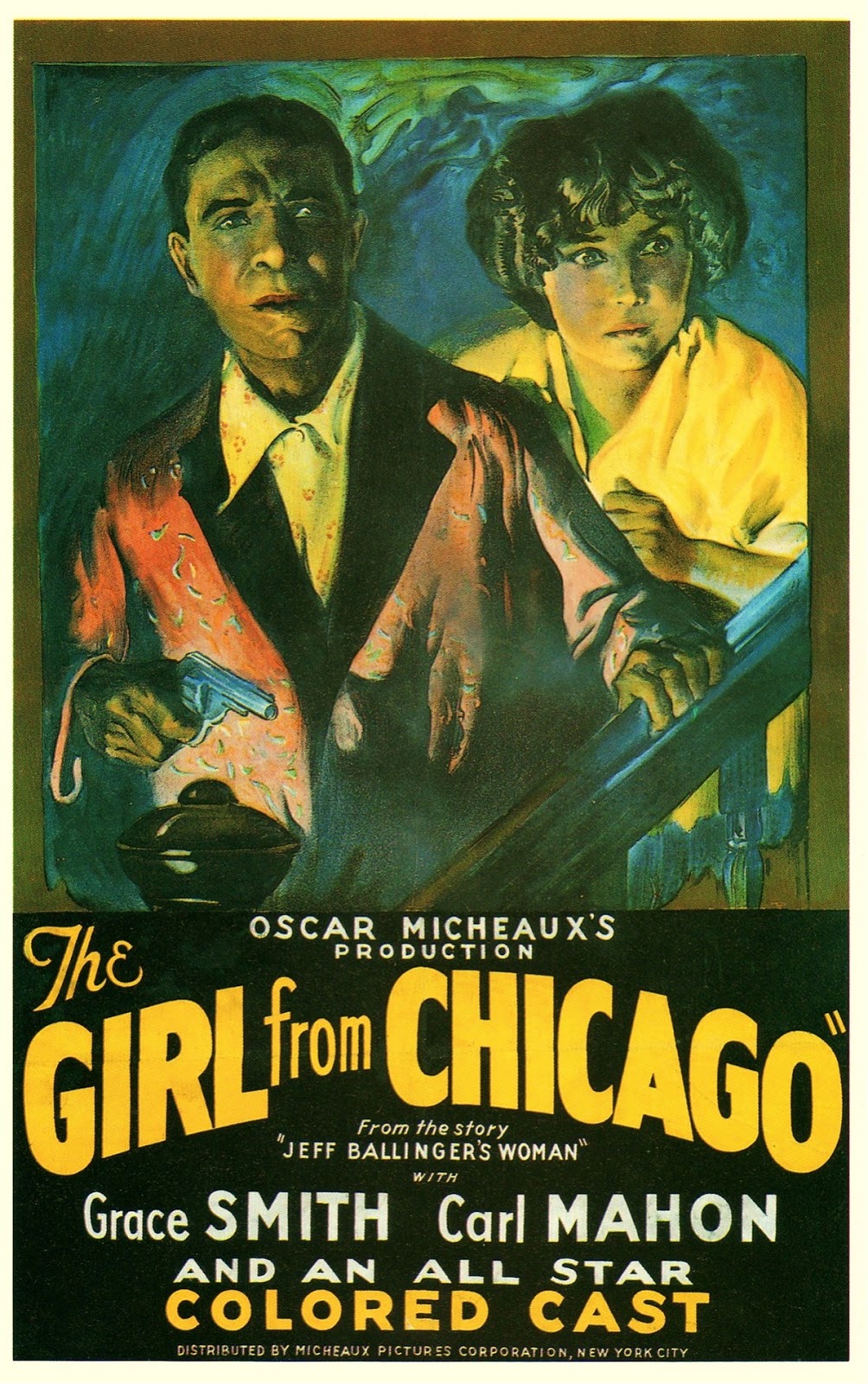
The Girl from Chicago (1932)
I had a really difficult time following this movie—partly because it's a fairly complicated plot created with some very threadbare early-sound equipment and sensibilities (Micheaux never really acclimated to sound cinema, and it's punishingly obvious here), partly because I was so bored that I couldn't keep my mind from wandering. But the musical sequences were fun! Grade: C-


Television

Orange Is the New Black, Season 7 (2019)
It's not that the seventh and final season of Orange Is the New Black doesn't have good moments. It does, and it's overall a much stronger season than the abysmal sixth season. But the scars left by that sixth season remain, and much as the writers try to add ripped-from-the-headlines plots (Litchfield becomes an ICE detainment facility) and return the show to a pre-Season-Six status quo (Badison gets shipped off to another prison, e.g.), Orange never really rights itself. Part of this is because most of these characters are too far gone—there's only so much backpedaling you can do, and it's not enough to make these characters interesting again after all the stupid storylines and wasted time in the past year. Another part of it is that the show's creative team, either through apathy or befuddlement at how to tie all the show's many, many threads together, has all but abandoned any semblance of dramatic coherence: new characters are introduced willy-nilly before being sidelined again for the main cast; flashbacks (long a liability in this show) are thrown in inconsistently and for the thinnest reasons; storylines flare up for an episode or two before being more or less ignored; episodes themselves become structureless blobs of one scene ambling after another until the runtime is up and they can do the credits needle-drop. All of these problems have been issues to some degree since the show began, but they become especially apparent now that the show has to work double-time to clean up its sloppy storytelling into some semblance of a finale. And speaking of the finale: it is, like many series finales, something of a curtain call for all its characters, and this means bringing back a lot of the characters we lost at the end of Season 5 when the cast was halved, and I can think of no greater indictment of how the show managed its last two seasons than the feeling of warmth I felt seeing all these old characters, followed by the feeling of deep frustration that I was watching freakin' Daya do whatever she was doing these past two years instead of spending time with these old friends. Orange Is the New Black skated through its inconsistent storytelling for years by the skin of its teeth and the strength of its character bench, and the parts of this season that work function on the same kind of character-above-all magic: Doggett's arc, Ramos's ICE experience, the chicken farm, Nichols's growth, etc. But these are relatively few and far between moments, and with the diminishing effectiveness of these characters, it becomes pretty clear how thin this show could be. Probably the worst case for a finale: I was glad to see this show go. Grade: C+

Books

The Secret Commonwealth by Philip Pullman (2019)
The second book in Pullman's companion trilogy to His Dark Materials is not only a huge improvement to the first one, La Belle Sauvage, but also retroactively helps some of the creative decisions in that book make sense. After Book One, I was left wondering why this story was being told, and The Secret Commonwealth answers that question thoroughly by pulling this trilogy into focus: Pullman's thesis here is centered on the limits of reason as a guiding principle for a worldview and the ways that reason-obsessed skeptics sometimes excise compassion, beauty, and other intangible but vital human qualities from their experiences. A not inconsequential subplot involves Lyra (this book takes place several years after the end of The Amber Spyglass) becoming infatuated with the ideas of a trendy Ayn-Rand-ish philosopher, and it's not hard to map this plot metaphorically onto our world in the same way that readers did the alternate-history Magisterium and Authority onto our real-world ideas about church authority and God in His Dark Materials. The titular "Secret Commonwealth" (i.e. the world of the spirits) serves as a counterpoint to the obsessively "rational" perspective that tempts our characters, and in this light, it becomes absolutely clear what exactly Pullman was up to in La Belle Sauvage, contrasting the relatively realist espionage with a blown-out fantasy finale full of fairies and magic that serves as a kind of foundational event for The Secret Commonwealth. More than just ideas, though, this book is just a rip-roaring adventure story, probably the closest thing to the scope and tone of The Golden Compass we've gotten; here again, Lyra must travel into an unknown world in search of a dear companion: this time she must journey east to find her own daemon, Pan. But it's a much darker and more complex journey than that told in The Golden Compass, much more interested in politics and in particular colonialism than Lyra's earlier trip into the relatively untouched North was, which makes sense. I do wonder if Pullman leans a little bit too hard into Orientalist tropes when describing places like Syria, but he at least goes out of his way to explain that these regions are as war-torn and corrupt as they are because of the influence of Western commerce and religion. But with that aside, it's a completely thrilling ride in the tradition of the best of His Dark Materials, balancing a sharp fantasy imagination with a deep interest in Big Ideas, and I was legitimately sad when I reached the last page. I've read that Pullman hasn't even started the third book, which makes me inordinately sad, because I have to know what happens next. I can't remember the last time I've felt like this about a series. Grade: A

Music

Don Cherry - Brown Rice (1975)
Most of the time, the "fusion" in jazz fusion is with rock or R&B, and it's not like Don Cherry's music is free of those influences. But what's so mesmerizing and compelling about Brown Rice (and, it bears mentioning, the rest of his '70s output) is that rock and R&B are just drops in the bucket of influences that form a kind of pan-Eurasian folk music with its mix of not just North American and British musical forms but also Indian and African and Near-Eastern. It's an album that pivots from ambient chants and hypnotic grooves to molten free-jazz solos—a truly adventurous listening experience that transportive and deeply spiritual. I've been obsessed for the past few weeks. Grade: A

Sunday, October 14, 2018

Mini Reviews for October 8 - 14, 2018

RIP Fall Break.

Movies


First Man (2018)
Damien Chazelle's last two features have been, to one degree or another, about the cost of success—what must a person give up to realize a great dream? First Man inflates this theme to a national scale, bludgeoning us with just what the United States had to sacrifice to put a man on the moon. We're treated to endless conversations of nervous NASA eggheads fearing government suits cutting the costly space program and sweating congressmen blustering about the billions of dollars the space race is costing the taxpayers and protesters (including Kurt Vonnegut!) shouting all the more pressing needs the Apollo program's funding could pay for—and not anything slight either, but things like a social safety net and food for the hungry. We're even shown human beings dying in the process of getting a man to the moon. And as such, for about 90% of its runtime, First Man is profoundly ambivalent on whether or not this national ambition is justified. This ambivalence is mirrored by Ryan Gosling's inscrutable, stoic (some might say empty) performance as Mr. "One Giant Leap For Mankind" himself, Neil Armstrong—who, it must be noted, has his own personal "cost of greatness" plot in the way his distance (both emotional and spatial) takes a toll on his wife, played by an excellent Claire Foy breathing way more life into this thankless "wife of a famous historical figure" role than the archetype usually receives. First Man is, to my knowledge, the only movie about the United States space program that really grapples with the ethical quandaries, to say nothing of the urgency of its interrogation, and the movie is worth seeing on those grounds alone. But then we get the moon landing itself, a sequence whose breathtaking beauty and bold silence and stark lighting and unshakable ethereality so firmly puts to bed the idea that it somehow wasn't worth it all in the end to get here that it's impossible not to feel deep in your gut that Chazelle's ambivalence was just theatrics and that he knew the answer all along—a decidedly less interesting ethical debate than originally presented. But there's no denying that the moon landing is magical, both as a real-life historical achievement and presented here as a cinematic showstopper, and Chazelle's direction captures really well that heady feeling of being so overwhelmed by the sheer magnitude of something that all other concerns, however urgent in theory, fall away. And maybe I'm not giving the film enough credit for its ethical wrestling; in the afterglow of the moon landing, it's easy to forget that the movie's final scene is a profoundly irresolute one, as Foy's Janet Shearon welcomes her husband back to Earth not with a smile but with tense silence, a wall of glass separating one from the other—greatness from the human cost. Grade: B+


Little Women (2018)
So my wife and I were going to see Crazy Rich Asians, but circumstances conspired against us, and we found ourselves in a screening of this movie instead: a movie that neither I nor my wife knew anything about. It's extremely rare for us to go into a movie as blindly as we did this one, which is its own kind of thrill, I'll admit; I wasn't even sure it was an adaptation of Louisa May Alcott's novel. It turns out that it is, in fact, an adaptation (though one set in the modern day), and it's, uh, not a good movie in any conventional sense: the cinematography is flat and overlit, the editing is dysfunctional, the screenplay is trite, and the acting is generally pretty wooden—to say nothing of the usual pitfalls of adapting Little Women (if even Gillian Armstrong's 1994 classic couldn't find anything constructive to do with Beth and Professor Bhaer, then certainly it's unfair to expect anything more of this version, but nonetheless, Beth and Bhaer are still drips). But anyway, it was still pretty novel to watch an opening credits roll and to have zero idea of what I was about to see; I recommend that experience. And even setting aside our viewing context, to this specific movie's credit, it stumbles upon two minor strokes of genius. Firstly, making the March girls homeschooled is perfect, and as someone who was homeschooled for a number of years, I am pleased to report that the movie gets exactly right the kind of free-range, unself-conscious creative energy that often animates large homeschooled families—there's an organic warmth to the way the family scenes unfold that feels unforced in a way that's super rare in movies and even rarer in movies that depict homeschooling, and I dug that. Secondly, there's Sarah Davenport's prickly and antagonistic performance as Jo March, which is an incredibly effective counterpoint to the often-saccharine mechanisms of Alcott's plot. Having Jo be a selfish dick who just prattles on about her various high fantasy writing projects is a fantastic modernization of Alcott's character and, moreover, an even more specific depiction of a certain corner of the homeschooled world (not that yours truly was ever such as nerd as to prattle on about high fantasy writing projects, oh no, I would *never* do such a thing, definitely not, nope). Now, to be clear, neither of these pieces salvage the movie as a whole, which remains incompetent on both cinematic and writing metrics. But among the mediocrity, there's a curious spark of life that a lot of other movies lack. If a movie's going to be bad, it can at least be this kind of bad: an honest and personal kind. Grade: C


Did You Wonder Who Fired the Gun? (2017)
Creative nonfiction is only just now, in the past decade or so, gaining real traction as a distinct literary form, so it's only fitting that film would still be finding its footing regarding the genre. Did You Wonder Who Fired the Gun? definitely skews along those lines, as much Southern Gothic literature and personal essay as it is a traditional documentary (reminiscent of last year's I Am Not Your Negro, which is actually based on an essay); documentarian Travis Wilkerson apparently envisioned this first as a performance, not a film, and it shows—I'm not sure if his self-serious, Batman narration would have worked on a stage either, but it sure isn't helped by the necessary filmic adaptation into voiceover. Yet for as much forced weight as the narration brings, there are also moments of absolutely arresting lyricism. In the film's best moments, wordless and starkly black-and-white footage of rural Alabama is set to garbled, wax-cylinder blues loops, and Wilkerson's investigation of the legacy of his great-grandfather (who killed a black man in cold blood and never faced legal consequences) becomes a ghost story. It's terrifying, and in the darkest corners of of the footage you can the specters of the past—the erasure of a black man, the unrepentant id of a white man; what persist are perverse, horrific inverses of each other: the void of the black man's legacy and the unmistakable, crowding largeness of the white man's. Those are just moments in a 90-minute film, but it makes the whole thing worth watching. Elsewhere, the movie isn't nearly so successful, especially as it increasingly relies on narration over pretty simple double exposures. Near the beginning of the movie, Wilkerson states that this movie is "radical," which is sort of pretentious anyway (how radical is it if you have to tell us it is?) but also set me up for a more formally adventurous movie—I could have done with something a bit more disruptive, or else just the pure horror of the B&W footage. Surely there's a great movie to be made out of this film's conception of creative nonfiction, but unfortunately, this movie isn't it—though it's certainly earnestly trying to be. Grade: B-


Into the Abyss (2011)
I keep accidentally watching these documentaries that double as horror movies, which I guess is appropriate, given the month and all. But jeepers creepers, this was rough. For some reason, the stories that resonate most against capital punishment with me are the ones that should argue least for mercy; In Cold Blood's account of Hickock and Smith—brutal murderers, both—thrashing for nearly twenty minutes in their nooses before finally dying shook me to the core when I read it in high school, and now, here's Werner Herzog's own In Cold Blood, which chronicles the crime and execution of a man who has committed similarly brutal murders. As in Capote's work, the first half of the film is dedicated to outlining all the grisly details of the murders committed, and make no mistake, they are horrifying. But there's something also deeply horrifying about watching the man guilty of these murders talk on camera just days before his execution—to see his eyes glisten, to hear his voice intone, to see his body move so full of life. Later in the film, we're shown a transcript and timeline of the man's lethal injection, and it's as frightening as the account of the murders—not that the injustice of an unprovoked murder and a state execution are the same, but just that the mere premise of the cessation of a human life (even one that has committed such vile actions) has an inherent terror. Herzog has said that this isn't a movie intended to take a stance on the issue of capital punishment, and in a way, he's right; it is, as Herzog himself says, "a gaze into the abyss of the human soul," not a polemic. But to gaze into a human soul, knowing that it will be (and already has been, by the time we see this documentary) annihilated—that's a horror that transcends the law. Each human life we encounter: that's the most terrifying of ghost stories. Grade: A-


Jennifer's Body (2009)
I think I may be the only person left on the planet who still really digs Diablo Cody's intensely affected faux-hip dialogue, but God help me, I love it. Honest to blog, I'm ready for her to make a full-on screwball comedy. Anyway, that's neither here nor there, because Jennifer's Body is not really the best showcase for that Cody touch—I mean, the dialogue is still enjoyable (sample: "They went all Benihana on my ass with that knife"), if not perhaps as laugh-out-loud funny as Cody can sometimes be, though I did get a hearty chuckle out of Adam Brody's speech about how the late-2000s indie-rock boom left the market so over-saturated that "Satan is our only hope"; however, the surrounding movie has some pretty severe structural and thematic issues. The film's treatment of the indie-emo music circuit as home to some heinous sexual predation is eerily prescient of all the Warped-Tour/Brand New/Pinegrove stuff that's come out in recent years ("prescient" or just "paying attention to women's experiences"?), and I was excited to see that explored in the rest of the movie. But the film kind of loses the centrality of that thread by positioning Megan Fox's Jennifer as the primary threat. It's like a vampire story in which the main threat isn't Dracula but the women he attacks, and unlike, say, Teeth, this movie doesn't really seem to be trying to say anything about how the whole "female danger" archetype is a direct response to male oppression; it's just a spooky story about a demonic woman, and not even that spooky either. Also, Amanda Seyfried is at a mental institution or something. I dunno. This is all on top of some rather tepid cinematic style. I had a good time with this movie, but it was not the uproarious good time that "Diablo Cody wrote a horror-comedy" promised. Grade: B-


Paranormal Activity (2007)
On paper, Paranormal Activity represents a lot of why I love horror movies: the grassroots advertising, the ingeniously shoestring productions, the way the relatively low-budget productions allow for completely unknown creators, actors, and intellectual properties to reach wide audiences to an extent that's practically unheard of in all other modern movie genres, how the tireless hunt for novelty in scares leads to some shockingly experimental filmmaking making its way to multiplexes and hundred-million-dollar box-office grosses. I mean, Paranormal Activity is practically a mumblecore movie when it isn't a straight-up slow-cinema exercise, letting shots of nothing but sleeping bodies linger for long periods with no payoff but a door slowly creaking from side to side or a shadow flickering across the wall—perhaps the film's real ghost is the specter of Andrei Tarkovsky?That a major studio release got people to raptly watch static footage of a dark bedroom for like two or three minutes at a time is charming and gives me hope for mainstream American cinema. So I love all that in theory, and there are some really great moments in here (a sequence involving powder on the floor is a standout, and some of the jump scares are exquisite, given how patient they are). But y'all, I gotta admit, the moments that aren't great are really kind of tedious—both scenes with with the psychic are dull exposition dumps, and while I know that empathy isn't the only metric by which we can measure a horror movie's effectiveness, I really did not care one bit about the central couple, neither on a traditionally empathetic level nor on the horror-movie, schadenfreude-ish level of being interested in watching annoying people being terrorized. Thank goodness the good parts are so good, because the rest is like 75% of the movie. Grade: B-


Jacob's Ladder (1990)
For a movie that's essentially a feature-length Twilight Zone episode, there's a lot going on. The Twilight Zone's biggest asset was its ability to hone in, to the exclusion of all other distractions, on one particular concept or idea (most successfully, over the span of a thirty-minute episode—let's not talk of that season of hour-long eps). Perversely, Jacob's Ladder takes the opposite approach; there are extended stylistic digressions, nested hallucinations, subplots, and all sorts of other inefficient stuff that The Twilight Zone would never have bothered with (or when it did, it usually resulted in a tedious mess). And yet, when at its end, Jacob's Ladder reveals that the movie really only has one thing on its mind, and that one thing is a central idea so simple that it could have been told (and essentially was told in at least one Twilight Zone episode I can think of) easily over one quarter of the film's runtime, it somehow miraculously feels less like a pulled thread unraveling a sweater than it does a single string drawing all the movie's divergent pieces into a coherent whole. It's not really a mind-blower or anything (familiarity with The Twilight Zone and one particularly famous American short story you might have read in high school makes it pretty easy to guess where this is going by the movie's halfway point), and the movie is, at times, a bit too cute in seeding its final reveal. But overall, it's a tightly executed bit of storytelling that, moreover, never loses the human element of its story to the thematic and structural games it's playing—both chilling and poignant in its depiction of the American military machine and its remorseless devouring of human life. Grade: B+


The Stepfather (1987)
There's a certain salt-of-the-earth earnestness about Terry O'Quinn that makes him perfect for those roles that allow him to tip wholesome archetypes over into the unhinged implications of following those archetypes to their most intense convictions. His survival-man/man-of-faith deconstruction as Lost's John Locke is an all-time-great example of this, but The Stepfather, the 1987 slasher by way of Night of the Hunter, rivals the perversity of that deconstruction (if not with the nuance). The Stepfather is strewn with the scenery of typical patriarchal fatherhood, from the lumber and tool-stocked basement to the entrepreneurial breadwinner spirit of O'Quinn's titular character to a very knowing "Father knows best" line delivery form O'Quinn himself—not to implicate any one of these signifiers specifically but merely to imply the dark current in taking patriarchal norms to their fullest conclusions. The movie, honestly, could stand to give its female characters a little more to do, and the film overall would be much-improved if it granted even a fraction of the thoughtfulness it devotes toward the development of O'Quinn's stepfather character. But as a confrontation of masculine archetypes, The Stepfather is as sharp as they come. Grade: A-

Television


Better Call Saul, Season 4 (2018)
With Chuck gone from the cast and Vince Gilligan mostly gone from the writers' room, it was unclear just what direction Better Call Saul was going to take this season. And to be fair, what we ended up getting isn't exactly a new direction. But it is an intensification of the thematic push that's been the show's centerpiece since episode one: that in the face of an intensely arbitrary and unfair universe, individuals sell off bits of their soul in exchange for success until, inevitably, there's nothing left. This is, of course, true of Jimmy, whose embrace of opportunistic hucksterism is taking him closer and closer to the hollow man hiding behind salesman masks that we know from Breaking Bad, but this also goes for Mike, too, whose increased complicity with Gus (this season goes hard on the Breaking Bad prequelness, sometimes in ways that are a little too cute, I'll admit) forces him to forego his principles in a slow-motion trainwreck that feels downright biblical—but when has anything in this whole Gilligan world felt anything but? And then there's Kim—dear Kim, whose Achilles's heel, it's becoming clearer and clearer, is her affection for Jimmy, culminating in the season's absolutely crushing final minutes. There's a slow, methodical intentionality about each piece of this season that makes the moments where it all snaps into place all the more tragic; whereas Breaking Bad got, with each successive season, more reckless and breakneck in its pacing, Better Call Saul has never been slower, relying increasingly on extremely lengthy takes of characters in abandoned spaces working out problems whose solutions we are not yet privy to, or lengthy conversations that end with subtle shifts whose effects aren't apparent for episodes at a time. It's all very meticulous and rewards patience—but more so than any previous season, it makes that patience a prerequisite to viewing the show. Moreover, it makes the season's inefficiencies stand out starkly; I love Nacho, but it's clear this season that the show doesn't really know what to do with him anymore. But on the whole, this is another very good season from one of television's best. Grade: B+


American Vandal, Season 2 (2018)
I was a little worried that, with this season's focus on poop-centric crimes perpetrated by a mysterious "Turd Burglar" (including a mass-pooping incident appropriately named "The Brownout"), American Vandal would be leaning a little too easily into scatological humor. And it's not as if the season doesn't revel in the hilarity of its own premise; "Poop is funny," one character remarks at one point, and like... it is. So while there's never anything quite as sublime as S1's investigation of "ball hairs" and dick-drawing technique (I honestly could have done with a bit more of that kind of straight-faced forensics with these poop crimes), S2 does manage to milk the humor of its premise without tipping it over into lazy jokes. More importantly, as with S1, this premise is really a Trojan Horse for a shockingly astute investigation of teen social dynamics, following through on last season's treatise on identity and social expectations by broadening its umbrella to cover class, race, and especially the ways in which people project identity over social media. It never quite obtains that deep soulfulness or bracing tragedy that undergirded S1's finale, nor is it nearly as self-interrogative about the series's methodology—Sam and Peter have traveled to a school out of state to cover this case, and as such, their biases are much less entangled in the filmmaking than they were last season, when they were documenting their own friends; this unfortunately has the effect of making them much less interesting as characters, and the show misses several opportunities to question their involvement with the case, especially in the game-changing finale. But even if it doesn't quite measure up to the first season, Season 2 is in no way a disappointment; this is still one of the smartest TV series out there, and its depiction of contemporary teen behavior is unparalleled. Grade: A-


Orange Is the New Black, Season 6 (2018)
Orange Is the New Black has always been a messy show. If you've been following my review of the series, you'll know that I've had deep issues with each season. Offsetting that, though, has been that each season has also had great pieces, too, from the deeply complicated depiction of the prison riot last season to the moving treatment of faith in Season 3 to the generosity of the show's empathy throughout the series. But let it be known that Season 6, in the year of our Lord 2018, is when I finally ran out of patience with OITNB's flaws; let it also be known that this loss of patience is not without reason, for Season 6 is where the show also seems to have run completely out of ideas. The shakeup at the end of last season, sending some characters to max while having others leave the show completely, now seems less like a bold narrative decision than an act of desperation. The new characters are grating and boring repetitions of what the show has already given us much more effectively in the past: Badison's alpha-dog posturing, Barb and Carol's evil nemesis masterminding, etc. And the old cast we do stick with (the ones in max) are so aggressively Flanderized that little of the nuance or respect given to them in the show's finest hours remains: Luschek is in a love triangle with two prisoners; Alaida is working for a vitamin-supplement pyramid scheme; Morello is... still pregnant, I guess; Alex and Piper, where (even in the best seasons) good storylines go to die, are planning a prison wedding. Only Taystee is given anything interesting to do, as she has become the legal scapegoat for last season's riot, and even that spins its wheels from time to time. It's all so tedious and pointless, made even worse by the per-usual flabby episodic structure and runtimes that plagues most Netflix shows—geez, did we really need a 1.5-hour finale? Did the individual episodes really need to be an hour-plus apiece? Here's hoping the seventh season is the last, because I don't know how much more of this I can take. Grade: C-

Books


A Corner of White by Jaclyn Moriarty (2013)
Finally a YA novel without the tired first-person sardonic narration. Jaclyn Moriarty writes A Corner of White in a wonderfully removed third-person that's like a bath of cool water on a hot day. There's a lot more to enjoy than just a relief from my personal hangups with YA tropes, though. Set alternatingly in our "real" world and a parallel universe in which there are magic fairies and hostile colors attacking villages and realms with funny dialects and pumpkin pyramids, the novel's kitchen-sink invention hearkens back to an older era of YA fantasy less preoccupied with explaining every last detail of the fantasy mechanics or creating a flatly coherent universe, when writers like Diana Wynne Jones were interested in the unbridled embrace of fun ideas and the characters' sincere interactions with those ideas. I found myself connecting more with the real world protagonist here, Madeleine, whose interest in Isaac Newton and a parking meter that leaves her cryptic letters felt more immediate than the more heavily fantasized trappings of the alternate Kingdom of Cello, where a boy named Elliot searches for his missing father and a pair of cops try to solve mysteries in a cock-eyed, hilarious way that seems to indicate that they just jumped out of an episode of Twin Peaks. It's all enjoyable, though, and each of the characters feels both precise and interesting while at the same time managing emotional arcs that feel genuine and human, even if the resolutions of their various mysteries do seem a little tossed-off and haphazard at times. I'll definitely be seeking out the other two books in this trilogy. Grade: B+

Sunday, April 22, 2018

Mini-Reviews for April 16 - 22, 2018

Hey, again! Don't forget to vote in the summer project poll! PLEEEEAAAASSEEE!

Movies


The Cloverfield Paradox (2018)
Undercooked and overwrought, The Cloverfield Paradox takes about five ideas—all of them with potential but none of them really great either—and crams them together into the most uneven and structurally disastrous studio movie I've seen in a long time. There's a little Alien here, a little of Event Horizon there, a pinch of Evil Dead 2 (probably my favorite segment of the movie, involving Chris O'Dowd's arm, and it plays as accidental [?] comedy), and then out of nowhere a bit of Solaris. It's all very nutty and strange that all these parts are thrown into the same pot together, but also the execution of these individual parts are staid enough that the whole thing feels boringly and tediously nutty/strange rather than intriguingly or endearingly so. Grade: C-


Molly's Game (2017)
Aaron Sorkin's directorial debut is a solid caper/crime picture, but not nearly as solid as I thought it was going to be before the ending completely wets the bed—in particular, an entirely unearned late-film scene involving our protagonist's father that's condescendingly paternal in the way that only our man Sorkin can do. Elsewhere, the movie is filled with pleasanter Sorkinisms like elaborate sentences and florid verbal sparring, and Jessica Chastain is incredible as the lead. Sorkin the writer still hasn't figured out writing female characters (the fact that the titular Molly only really has agency in relation to the men she interacts with goes from being an intriguing bit of possible social commentary about women in traditionally male spaces to an embarrassing window into the screenplay's own narrowly masculine worldview), but Chastain plays her part so excellently that she practically carries the movie on her own, giving Molly a vibrant interior life that's completely outside the text of the script. Chastain's herculean feat of acting here is the real commentary on women in traditionally male spaces, let me tell you. Grade: B


Thelma (2017)
It's the sort of convergence of arthouse and pulp and religion that I normally find fascinating, and this movie is fascinating, even if it doesn't quite come together. I can't decide if paring itself down to make its metaphor cleaner (something about the effects of sexual awakening and repression in a conservative Christian environment) or if the movie should have gone even more for broke with its shaggy, chilling supernatural cul-de-sacs. Either way, the movie doesn't quite work, but it's never not riveting. Grade: B+


Kahlil Gibran's The Prophet (2014)
The frame story is pretty lame, and I'll admit to being somewhat cold on Gibran's poetry itself. But the animated sections set to the poetry (each animated by a different artist) are breathtaking, maybe some of the best segments of animation of this decade, and that's enough to make me like this movie. Still, I'd rather this had been a collection of animated shorts rather than something that tried to tell a cohesive narrative. Grade: B


The Headless Woman (La mujer sin cabeza) (2008)
Lucrecia Martel's puzzling, puzzle-like arthouse opus that I watched in preparation for a local screening of her new film, Zama, next week. It's very much in the tradition of some of Ingmar Bergman's more esoteric stuff, where there's lots of striking imagery and potent symbolism that's hard to get your head around all in one go, and it's interesting to see that in a modern context. I wasn't really getting much out of it when I was watching it (though the cinematography is very much my jam), but in the day since, it's grown on me quite a bit—a frequently striking, lightly but sharply satirical portrait of subjectivity and bourgeois insularity. Grade: B+


Field of Dreams (1989)
To my complete surprise, this movie feels very much like the ancestor to my old nemesis, the contemporary faith-based film. It's all there: the main character has a supernaturally inspired mission, flimsy conflict with people deluded by the corruption of contemporary culture, a sidelined supportive wife figure, dopey comedy, broad sentimentality, etc. Only this time, the corrupt culture is the '80s, not the modern bogeyman of secular humanism, and the religion in question involves the mythology of baseball, not Jesus. Also, there's this weird memeification of '60s radicalism that feels kind of admirable in the context of the post-Reagan '80s but also kind of nostalgic and pandering, but no matter, it also gives us the best use of long-suffering-wife Amy Madigan (and the highest comedic moment, though maybe I just like seeing people trying to censor books called "Nazi cows"). Actually—forgive me—this feels like the missing link between Close Encounters of the Third Kind and the faith-based films I hate, pulling the teeth from Spielberg's deconstructive pursuit of the otherworldly in an attempt to make it huggable and distinctly worldly, on its way to the thoroughly wonderless faith-based genre that wouldn't even know true transcendence if it punched it in the mouth. Also, unlike virtually any modern faith-based movie, Field of Dreams is pretty okay. Not great; just okay. Grade: B-

Television


The X-Files, Season 11 (2018)
On an episode-by-episode basis (which is what any reasonable person should be evaluating The X-Files on in these meager revival days), Season 11 has a much higher batting average than the disheartening Season 10. To absolutely nobody's surprise, the Darin Morgan episode ("The Lost Art of Forehead Sweat") is, again, by far the best in show, a hilarious hour that says more about the show's history than all of the damnable mythology episodes put together. And then there are fun outings like "Rm9sbG93ZXJz," a nearly dialogue-less episode that puts Mulder and Scully into a Modern Times-esque fight against smart devices, and "Familiar," a slightly tropey but still chilly riff on killer clowns. But when I say damnable mythology episodes, I mean damnable. The book-ending "My Struggle" episodes are some of the worst gobbledygook tripe that the show's serialization has churned out (and given the track record of the mythology for the later seasons, that's saving a lot), saved only by the way they turn into unintentional parody—the line "I impregnated her! With science!" is uttered without irony, and it's kind of sublime. And even when we aren't dealing with the "My Struggle" struggle, the season's primary mytharc involves Mulder and Scully's mutant child, William, and please, Chris Carter, listen to me when I say that I have never cared about William! Not in Season 9 when he was a boring baby and certainly not in Season 11 when he's a moody teenager! Worst of all is what this does to Scully—long the heart of the show, this season bizarrely reduces her (as it always must, apparently, when William is involved) into a one-note maternal stereotype. I don't know why I even care about character fidelity at this point in the series, but it's a betrayal of the Scully I loved. Thankfully, the non-mytharc eps are pretty neat. Grade: B-


Orange Is the New Black, Season 5 (2017)
This season begins on track to become Orange Is the New Black's best, as the aftermath of S4's ending escalates into a full-on prisoner revolt that upends the show's status quo in a major way. It's fascinating to watch these characters we know adjust to the new, radical normal, and the factions that form give some of the fresher character development we've gotten in quite a while (though the flashback structure continues to be a major liability). On the plottier side of the season, the central device of the prisoner protest leads to a riveting exploration of the power dynamics of revolution and the logistics of affecting true social change through radical politics (to say nothing about the way it allows the actors to stretch their wings a bit—Danielle Brooks in particular is great). However, in typical OItNB fashion, the season struggles to juggle all these balls, and in particular its tonal control as the plots veer recklessly from comedy to high drama (to serial killer pastiche?) makes for a seriously slack middle third of the season that has a hard time giving a consistent gravitas (or sensitivity) to the number of violent and sexual hierarchies raised by the season's plots. By the time the inevitable tragedy of the season's finale hits, Season 5 has become yet another OItNB season compromised by its deep flaws. What we get is one of the more interesting iterations on this, and props to the show for trying something this new. But it's hard not to wish for the masterpiece that could have been. Grade: B

Books


The Bad Beginning by Lemony Snicket (1999)
I'm almost twenty years late, but I'm finally getting on that Series of Unfortunate Events train. And it's pretty great. Playful and drolly hilarious in ways that I wasn't expecting, I can't help but compare this to Harry Potter, that other late-'90s-debuting series of influential children's books. Both series begin with relatively unambitious first entries that bank most of their success on authorial voice and the reappropriation of children's lit tropes into genre-lit tropes. But whereas Rowling's voice is cozy and her plotting and archetypes very hearts-on-sleeves, Snicket's is prickly and sardonic, despairing and ironic and, even twenty years later, singular within the world of children's lit for the way it embraces metafiction and authorial distance and other modernist devices. Which isn't to say that The Bad Beginning is devoid of emotion—there's a deep well of empathy for the Baudelaire siblings and the ways that the adult world (even the so-called "good guys") care very little for them. But the way that the book backs into this emotional resonance by way of ironic distance is somewhat stunning. Grade: A-


The Reptile Room by Lemony Snicket (1999)
There's not a lot to say about this book that I didn't already bring up for the Bad Beginning, and that's mostly because this is, in a lot of ways, a retread. The characters are all in their same basic forms, the plot advances in basically the same way, and the resolution is similarly despairing. And that's fine—the goal here seems to be the refining of a formula rather than the breaking of new ground, and it's fun to see some of the formulaic elements of the series plotting and voice being toyed with (for instance, the narrator's habit of defining words continues to find new ways to make that device fresh and surprising). It's slightly more sophisticated than The Bad Beginning, but it's also nowhere near as thrilling as the debut, which, to further my Harry Potter comparison, you can basically say about The Chamber of Secrets in relation to The Sorcerer's Stone. Grade: B+


The Wide Window by Lemony Snicket (2000)
I'm told the series eventually breaks its formula, which is good—The Wide Window is by far the least interesting of the first three Series of Unfortunate Events books, the book that feels most negatively affected by its formulaic elements. By this time, there's this nagging awareness that these characters are all basically one-note and that the tropes of despair and, well, unfortunate events might be something of a narrative crutch than a bold thematic choice on the agency of children in the world. It's still enjoyable—the characters may be one-note, but the series is at least consistently introducing a few new one-noters per book, and the timid Aunt Josephine (whose fate is impressively grisly, not just for a children's book but for anyone's book) is another fine addition in that regard), and Snicket's narrative voice still hasn't gotten old. But I'm hoping to see something new out of this series pretty soon, or else this is going to be a long 13-book journey. Grade: B

Sunday, January 21, 2018

Mini-Reviews for January 15 - 21, 2018

Lots of snow days today means lots of reading, watching, etc. Woot woot!

Movies

The Post (2017)
A companion piece, of sorts, to Lincoln. If every 4-5 years Spielberg has to drop in and create a tightly scripted historical film stealthily (or not so stealthily, in The Post's case) about the state of the current executive branch, I'm cool with that as long as they're this good—good enough, even, that I'm willing to forgive how both of these movies have ended on final scenes that are entirely too cutesy. I'm also a sucker for movies about journalists doing journalist things, and honestly, I could watch a whole movie that was just shots of the Washington Post typesetting process and people with leather patches on the elbows of their tweed jackets shuffling through paper archives. Luckily for everyone who doesn't have my particular journalistic fetishes, The Post is all that plus electrifying plotting and dynamite actors chewing through some crackerjack dialogue. Grade: A-

Happy Death Day (2017)
"Groundhog Day, but a slasher" is a premise so easy and appealing that it's a wonder that it's taken this long to materialize (and apparently it's not been as long as it seems—this movie has been in production since 2007). Nevertheless, here we are, and the resulting film is consistently entertaining, though certainly not great—the characters, for starters, never really break out of the stock-character mold they're introduced in, and with the exception of one third-act twist that's incredibly fun and subverts the usual trajectory of these Groundhog Day movies perfectly, the movie isn't really doing a ton of new or interesting things with its format. Still, the script is entertaining enough throughout and the acting winsome enough that these quibbles are easy to dismiss in favor of just enjoying a moderately engaging variation on the familiar. Grade: B

Mary and the Witch's Flower (メアリと魔女の花) (2017)
A good—if a bit generic—fantasy coming-of-age from Ghibli-alum Hiromasa Yonebayashi. Imagine Harry Potter, but if McGonagall was Dr. Eggman from Sonic. There are some gorgeous and inventive character designs in the woefully brief magical Endor College tour, and overall, the movie is nicely animated in exactly the way you would assume a film from ex-Ghibli-ers to be. There are some narrative problems—most notably, the way the movie has essentially two first acts and no second act, though I'm not sure which first act I'd cut to add a second, since they're both rather lovely—that make the movie feel slight and a little underdeveloped even within its pretty standard genre fare, but none of them are fatal, and the things that are nice about this movie are quite nice. Grade: B

Basic Instinct (1992)
Gender-flipping Psycho seems like a lateral movie, as far as LGBT sensitivity goes, and I'm honestly not sure of the point of it, thematically, though it does lead to some clever moments. Cleverer still is the way that the movie finds Psycho by way of Vertigo, and I won't lie that I find this kind of experimentation—not just genre experimentation but experimentation with the narrative forms of specific genre hallmarks—pretty fun. The movie might go over much better if Basic Instinct had anything better than a monumentally dumb screenplay, but, well, it's monumentally dumb. As it is, Sharon Stone (in a deliriously hammy villain performance), Michael Douglas (in a perfectly nasty noir-protagonist turn), and score composer Jerry Goldsmith are doing a lot of heavy lifting here, and I'd ultimately guess your enjoyment of this comes down to how you feel about Paul Verhoeven's trademark "This doesn't exactly feel like satire, but that's the only possible explanation for some of these directorial choices" approach. I like Starship Troopers, so that puts me in the positive camp. Grade: B

Duel (1971)
Gotta love a movie that knows exactly what it is—in this case, a movie about a killer truck—and leans way into that. Some really fantastic shot compositions and lighting, too. Be the best you you can be. Grade: A


The Bellboy (1960)
I don't know what I was expecting from my first Jerry Lewis feature, but a 70-minute series of barely related and often surreal sketches is not it. In a brief prologue, the supposed "executive producer" at Paramount Pictures assures us, the audience, that The Bellboy is a movie with "no story and no plot," and the film makes very good on that promise. At one point, Jerry Lewis plays himself, harangued by a crowd of sychophants—he has about two scenes, and then we never see him again. At another point, the protagonist, Stanley (the titular bellboy, also played by Lewis), takes a flash photograph at night, and the flash literally turns the nighttime into day, despite only being 3:30 in the morning. In another scene, Stanley finds himself in the middle of a marital spat and gets beaten by both husband and wife. Elsewhere, Stanley flies a plane. And so on. These bits are tied together only by the tenuous connection that they all take place at or around the same Miami Beach hotel and mostly involve Stanley, and many of them seem to be inspired by the goofy wordplay, physical humor, and flights of fancy of Lewis's vaudeville-performing childhood. The result is something like the intersection of Charlie Chaplin, the Three Stooges, and the dream sequence in Sherlock Jr., though of the three of those, the overall sensibilities lean heavily in the Curly-Larry-Moe direction. It's all very silly, and as with anything as relentlessly episodic as this is, there's a lot of dead air. However, most of the bits are less than a minute long, so it generally skates by on the same principles that float Aaron Sorkin dialogue, moving fast enough that the bad patches are quickly replaced by the good ones before they linger too long in your mind. And beyond that, I don't think I can stress enough just how strange this movie is willing to get, often without any sort of explanation. There's a kitchen-sink approach to the comedy here that makes room for everything from musical interludes to meta humor, and the final package is endearingly bewildering. I can't say if this is representative of Jerry Lewis's output in general (his reputation suggests not), but I'm interested to see more. Grade: B

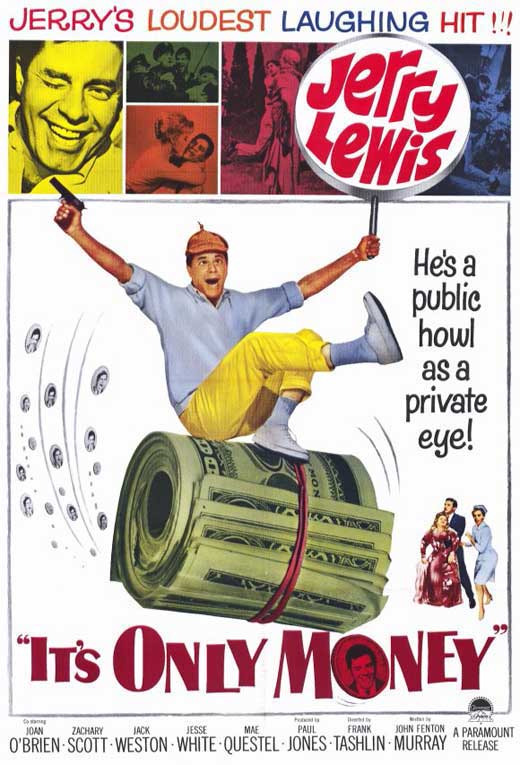
It's Only Money (1962)
Eh, okay. Lacking the go-for-broke absurdity of The Bellboy, all this Jerry-Lewis-starring feature is left with is Lewis's physicality, and that wasn't nearly my favorite thing about The Bellboy, though Lewis is admirably committed to it. I might be a little more admiring of it if Lewis wasn't so shouty and rapid-fire moron here, but I guess that's sort of his thing in his non-Bellboy performances. Honestly, the funnier part of the movie to me is the Ladykillers-style plot involving some no-gooders repeatedly failing in their attempts to murder Lewis's character. The escalating ridiculousness of it is fun, though the movie doesn't ever commit to it enough to make it actually Ladykillers-level enjoyable. Grade: C+


Television

Orange Is the New Black, Season 4 (2016)
Finally a season of Orange Is the New Black without any glaring flaws. Oh, there are little ones, to be sure, most notably in the way it still insists on keeping one foot in sitcom mode when dealing with non-major characters (something that manifests itself most troublingly in the way it depicts the new crop of white supremacist characters, which, with the bitter aftertaste of 2017 still on my tongue, feels far too glib and divorced from the reality of the actual white supremacists who have been running amok in this country). But this sitcomminess isn't nearly the problem it was in previous seasons, and most of the rest of the recurring OitNB issues have been relegated to the periphery (Alex and Piper), gotten rid of entirely (Daya and Bennett—THANK YOU LORD), or incorporated as vital thematic units of the season arc (the racial stereotyping, which the show turns cleverly on its head by ratcheting up the racial tensions—and even intra-racial tensions—within the Litchfield environment and making them a function of the prison context and not the show's storytelling). In lieu of these usual stumbling blocks, we're left instead with the series's most structurally ambitious and thematically cohesive year yet, a deftly (and okay, occasionally clumsily—this is still OitNB, after all) woven narrative about corruption and innocence and idealism and privilege. It's the first season of the show that actually seems to be trying to say something about Society in general, and while after the previous seasons, I would have said that this is a show not nearly well-equipped enough to handle that sort of scope, Season 4 manages it commendably (the aforementioned hiccups aside), building a complex tragedy that argues as well as any TV series has since The Wire that The System is both an unstoppable force and an accumulation of individual actions and prejudices by autonomous people. Grade: A-

Books

The Idiot by Elif Batuman (2017)
A discursive and directionless novel about a Harvard freshman feels directionless and alienated by academic pretensions and undergraduate socializing. It's basically a comedy, but a very dry one, and while there's a ton to like here (the motif of our protagonist, Selin, nodding along as she listens to some self-impressed academic blather on about his pet theory while she internally feels deeply confused or gets distracted by errant thoughts feels deeply accurate to me and is never not hilarious), I do kind of wonder if the novel could have had a bit more direction—or at least something to grab onto among all the detached and wry observations. I kind of feel like a stick-in-the-mud here; maybe I'm getting old. It's an easy novel to walk through, but for all its humor and stylistic precision, it's a hard novel to get any closer to than arm's length. Grade: B-

Music

Margo Price - All American Made (2017)
My favorite new country artist doesn't write anything as immediately Great as "Hands of Time" on her sophomore release, but All American Made, a less showy album than Price's debut by most accounts, finds Margo Price and frequent co-writer Jeremy Ivey pushing their songcraft in exciting new directions this time around. The soul inflections of "Do Right By Me," the tempo shifts and structural strangeness of "Cocaine Cowboys," and pop-country string-based production of "A Little Pain" are all welcome additions to Price's retro vibes. The album stumbles a few times, most significantly on the mariachi-tinged "Pay Gap," which melds a questionable musical idea with bland social commentary, but all is forgiven when we get to the mournful and masterful closing title track, a stealth contender for Price's best song yet and easily one of last year's best songs, period. Grade: B+

Sunday, July 16, 2017

Mini-Reviews for July 10 - 16, 2017

Still looking for that Grade F movie. The movies I watch remain stubbornly in the D-A range. Suggestions welcome.

Movies


Okja (2017)
The premise here seems to be to fuse an E.T.-esque girl-and-her-sentient-pet sentimentality with the gonzo capitalist satire of Bong Joon-Ho's previous feature, Snowpiercer. The result is a bizarre, tonally rambunctious piece that doesn't ever find a good way to cohere its halves. But through the magic of Bong Joon-Ho, it somehow works anyway. The relationship between the girl and her genetically modified pig is tender (meat pun unintended... or is it? mwahaha), and the commentary on the horrors of capitalism on the food industry is appropriately grotesque. Plus, Tilda Swinton plays twins, which, as anyone who saw Hail, Caesar! can tell you, is reason enough to see this. Grade: B+


Life (2017)
There's nothing especially new about this mash-up of Alien and Gravity, but considering that both those movies are excellent in their own rights, Life ends up being a fun, tight little thriller in the vein of both. Couple with that a legitimately chilling ending, and you've got a solid piece of sci-fi. Grade: B


A Quiet Passion (2017)
At a certain point here, I'm going to have to stop talking about the biopic as a genre in crisis, because A Quiet Passion marks the latest in an encouraging trend of films that have spun new and exciting things from the husk of that awards-glomming film type. But whereas movies like Neruda have found fresh things to say through postmodern hijinks and deliberate ahistoricity, A Quiet Passion, a biopic of the life of Emily Dickinson, finds its voice in the more traditional realm of pristine formal beauty (no surprise coming from writer/director Terence Davies). There are times when the film gets a little too cutesy with its habit of reading Dickinson poetry in voiceover (I'm unconvinced that we needed to be read "Because I Could Not Stop For Death" over footage of Dickinson's funeral), but on the whole, it is a gorgeous exploration of the figure behind those poetic verses. Grade: A-


Slack Bay (Ma Loute) (2016)
For that rarefied subset of folks who found Dumont's Li'l Quinquin not nearly absurd enough, here comes Slack Bay. There's grotesque acting, spontaneous levitation, a consistent motif of characters tripping and falling, casual cannibalism (a mother asks her children if they would like more foot, as she waves, yes, a human foot in the air), and Juliette Binoche in a kamikaze performance as this cross between upper-class fuddy-duddy and amateur opera singer. It's very weird and only sometimes funny, but through it all, a plot involving the romance between a trans adolescent and one of the cannibals (what am I even writing here?) actually reveals an acutely human emotional undercurrent to the film. Not everyone's cup of tea, to be sure, but it's somebody's, and that somebody may just be me. Grade: B+


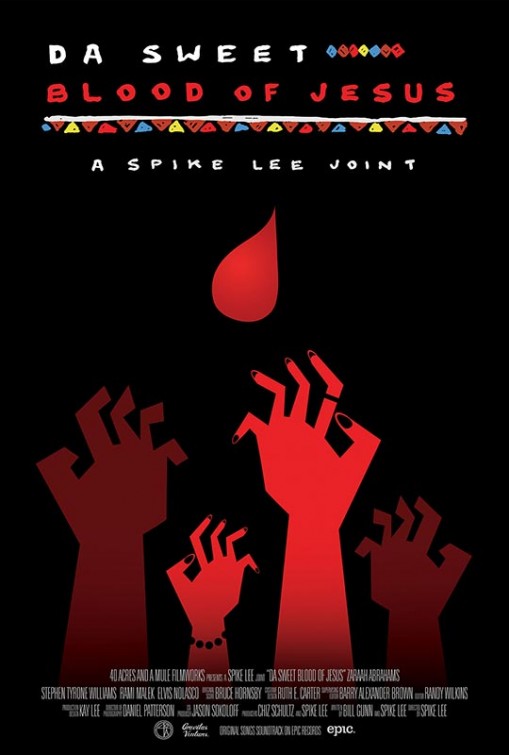
Da Sweet Blood of Jesus (2014)
Now, to be fair, I haven't seen the original Ganja and Hess, of which Spike Lee's Kickstarter-funded Da Sweet Blood. And also to be fair, this film is full of the typical Spike Lee technical excellence and thematic ambition, colliding Christianity with African heritage, horror, and eroticism to craft an evocative, lush aesthetic that makes for a more minute-by-minute engaging experience than the dire script and overlong runtime should allow. But good golly, is this film clumsy by pretty much every other metric. The thematic ambition is admirable, as I said, but it's as if Spike doesn't trust the ramifications of his own story. The film is full of moments like the one where two archaeologists discuss an ancient nation that fed off human blood, and one character actually states something to the effect of, "But America is the true blood-feeding nation because of slavery" (I'm only barely paraphrasing here), and, I mean, yes, that's true, and subtlety is overrated, I agree, but sweet merciful heavens, we don't need a two-by-four to the face when there's already a flashing billboard! This is to say nothing of the tepid characterizations that fail to enliven any of this beyond the level of merely "huh, interesting." Spike had the opportunity to create something singularly great here, and it's disappointing to see him fall so far from the mark. Grade: C+


Monsieur Verdoux (1947)
This film has a reputation as the sole notable instance in which Charlie Chaplin played a villain, though that's not quite right, not only because he also plays a villain in at least one of his early shorts but also because Monsieur Verdoux patently refuses to actually make Chaplin's character its villain. Oh, to be sure, he does some bad things, including but not limited to a sort of male black-widowing as he seduces, marries, and then murders wealthy elderly women. But the film can't seem to make up its mind whether or not this behavior is actually a problem, and, in fact, by the time we're openly asked to sympathize with this guy—he's been forced into this line of work in order to support his real wife and child, and after all, as Chaplin's climactic speech reminds us, his murdering of a few rich folks isn't nearly as heinous as the systematic brutality of America's ruling class. That sort of moralizing only really works through a broadly fable-like lens, one that the movie doesn't stick to with any consistency to speak of. But that doesn't stop the film from being one of the more thematically complex and fascinating works in Chaplin's oeuvre, despite its lack of structural integrity. Grade: B+

Television


Orange Is the New Black, Season 3 (2015)
The show's third year has its same crop of recurring issues (can Alex and Piper go away, pleeeease? See also: Daya and Bennett, though to a lesser extent) as well as a few new ones (Ruby Rose's character is likely the worst character the show will ever see, not just for Rose's wooden acting but for the nakedly [heh] contrived role as a catalyst to Alex/Piper drama). This is all compounded against the show's larger structural issue of year-to-year being basically a dozen plots pinging around in search of a season. But Season 3 also has some of the very best material I've seen in the show yet, from the way it finally figures out what to do with Doggett (whose pairing with Boo, of all people, is one of the most unexpected and resonant relationships in the series) to Black Cindy's quest for the Jewish faith to Caputo's struggle against Litchfield's new corporate overlords. Caputo especially shines here, and his spotlight episode, "We Can Be Heroes," is one of the best, most thematically cohesive hours the show has ever produced, interrogating the mix of self-gratification, hero complex, and idealism that motivates the guy. In fact, the guards in general (minus Bennett—get outta here, dude) all shine, and with the pressures put on them by the corporate buyout of the prison, their storylines are at least as compelling (arguably more so) than any of the inmates'. It's far from a perfect season of television, but for a show as scattershot as this one, thankfully there are more hits than misses. Grade: B

Books


Scythe by Neal Shusterman (2016)
In the future, an AI has been charged with governing the earth, and under its powerful leadership, the earth's population flourishes. In order to prevent overpopulation, a group of human beings, called Scythes, are appointed to kill (or "glean") a certain quota of humans every year. Our teen protagonists are Scythe apprentices. If this sounds like the typical YA dystopia with its belaboredly-symbolic-to-the-point-of-absurd premise, you're on the right track, but Shusterman fills out this world with enough detail and wrinkle that it's way more interesting than your typical post-Hunger-Games piece: excerpts from Scythe journals at the beginning of each chapter tug at the philosophical boundaries of the world, a bizarre religious cult worshiping musical tones runs mysteriously throughout the novel's background, human beings (capable of being revived through future technology) jump off buildings to "splat" as a sort of twisted pastime. For all its heavy-handed symbolism, the novel has a strong worldbuilding at its foundation, and honestly, if the plot didn't deflate itself so drastically in its last 75-ish pages, I would probably be saying something similar about the book as a whole. Grade: B