Showing posts with label Lemony Snicket. Show all posts

Sunday, April 26, 2020

Mini Reviews for April 20-26, 2020

Quarantine, Week 7: Increasingly unsure of the days of the week.

Movies

The Turning (2020)
I lost interest in this pretty quickly when it became clear that the movie was going to do absolutely nothing with the rather exquisite set. Just watch The Innocents if you want to see a great film adaptation of Turn of the Screw. But then oh boy, did the last five minutes pull in my attention again: I don't think I've ever seen a mainstream film released by a major studio have such a flabbergastingly fumbled ending. Either the movie thinks that it can evoke the rich ambiguity of James's novel by throwing in a bunch of incomprehensible, out-of-context plot twists and edits, or else the production team just got tired of the whole project and just arbitrarily rolled the credits after splicing in all the remaining footage they had. Either way, it's incredibly, fascinatingly dumb, and I want to know the backstory. Grade: C-

Democrats (2014)
I feel extreme skepticism about a movie like this—a documentary by a Western filmmaker about political turmoil under an aging Marxist state in a post-colonial country. Having literally no knowledge of Zimbabwe's history or politics, I really don't know exactly how much of that skepticism is valid with regards to this movie's stance on the contentious creation of Zimbabwe's new constitution following its 2008 election, though there are a few things raising major red flags for me (esp. the uncritical way to which it gestures toward "international intervention" in Zimbabwe's politics from the West). So who knows how useful this documentary is at actually documenting the broader political realities of Zimbabwe. All that being said, as a generalized take on a very specific kind of political activity (in this case, the drafting of a national constitution), this movie is stupendous, almost entirely on the virtues of the access granted to its film team. I'm not sure if we've ever gotten this intimate of a cinematic document on the shaping of a nation's central laws: the camera crew of this documentary were somehow allowed to sit in the room as representatives from the ruling political party and the opposition party edit and collaborate and shout at each other over specific pieces of the constitutional drafts, along the way showing the push and pull between democratic/populist energy and the inertia of a political establishment. It's fascinating stuff, and I gladly would have watched a 4-hour Wiseman-style documentary with just the camera stuck in those negotiation rooms rather than the rather brisk 90 minutes that this movie is. Grade: B


Holy Smoke (1999)
I was not a huge fan of the setup—Indian cult? fake terminal illness?—but man oh man does this movie cook when it's just Harvey Keitel and Kate Winslet locking horns in a psychosexual battle of wills. As in her similarly dismissed In the Cut, Jane Campion takes this movie to some really fearless places that are deeply uncomfortable, and the results are some fascinating interrogations of power and human desire. But unlike In the Cut (and virtually every other Campion feature), this movie is actually very funny on top of all that. So as it turns out, this whole narrative of how Campion lost her way at the turn of the millennium and then found it again with Bright Star is just a bunch of noise, and honestly, Bright Star is maybe my second-least-favorite Campion feature after Portrait of a Lady. I wanna see more of this, Jane! Grade: B+

Meeting People Is Easy (1998)
Maybe this is less true now that Radiohead have become de-facto elder statesmen of rock and their whole ethos has more or less stabilized since the OK Computer-->Kid A-->Amnesiac cycle, but I definitely remember a long period of time when the music press, as much as they praised their albums, somewhat dismissed the individuals in the group as a bunch of antisocial grumps. Perhaps they are antisocial and grumpy, but golly, I'd be too if I had to endure interviewer after interviewer lob the most inane questions and comments at me. Questions like, I kid you not, "Is OK Computer rock music?", and comments like, "This seems like music for wrist-cutters." I've heard people say that Meeting People Is Easy isn't really a very good tour documentary, and it's true that its lo-fi, impressionistic, at-times inscrutably garbled style is at odds with giving us good concert footage (though fans will still be treated to more or less straightforward concert gems like early renditions of "Nude" and "Life in a Glasshouse"). But when it comes to rendering the subjective experience of the hell that is doing a world tour and a million interviews with skeptical, ham-fisted journalists, this movie rocks. The fatigue and disorientation Meeting People Is Easy evokes is compelling, and to give us the catharsis of seeing the cool spectacle of Radiohead bringing down the house with "Paranoid Android" or something would probably have been antithetical to that subjective effect. Grade: B

Dirty Harry (1971)
I was kind of thinking that the "fascist-lite" allegations against this movie were overblown, given that it was unfolding like a more-or-less conventional and honestly kind of dull "loose cannon"/urban apocalypse cop movie—yes, I realize this was basically the first, but just because you're the first to promote problematic mythology doesn't absolve you of the problematic mythology, especially if you're not going to be interesting about it. But then we get to the scene when Harry tells the DA of San Francisco that the 4th and 5th Amendments to the Constitution are "wrong," and I was like, "Ohhhh... I see what people are talking about..." Anyway, this movie picks up as it gets more outlandish near the end: e.g. Harry intentionally crashes a school bus full of kids in order to catch the Zodiac Killer. Don't worry; all the kids are okay. I would be interested in seeing a horror/dark-comedy remake in which all the ridiculously risky gambits Harry makes in this movie actually don't pay off, and Harry is just some deranged cop with stern-dad vibes who violated people's rights, shot a hostage, and killed a school bus's worth of children, because this is nuts. "Loose cannon" indeed. Grade: C

Guess Who's Coming to Dinner (1967)
Nobody told me that the opening 15 minutes are virtually identical to the opening of Get Out, though I'd been plenty warned that this movie is the epitome of "I would have voted for Obama a third time" cinema. It's also stagey and largely boring, full of impossible people (Spencer Tracy's character owns a major newspaper? Sidney Poitier's character is the assistant director of the World Health Organization??) walking through shallow, well-intentioned sanctimony. Most of what makes the parts that aren't boring interesting is a kind of cultural artifact perspective: for example, the movie's... interesting understanding of what late '60s rock and roll is. But the acting in this movie is also stellar and makes the film way more watchable than it would have been otherwise. No surprise given the presence of Poitier (who, per usual, does God's work of breathing real life into respectability politics' wet dream) and Tracy/Hepburn—but golly, Tracy and Hepburn are magnificent together here, and the best parts of the movie by far are the ones they share together, particularly the mid-movie drive where they get ice cream (a real shame Tracy wasn't alive for On Golden Pond, because their relationship here has a lot of the same energy and might have been able to save that movie from its own saccharine). The same, I'm afraid, can't be said for Hepburn's niece, Katharine Houghton, who is, both as written and acted, one of the most vapid screen presences I've seen in a while. Grade: C

She Wore a Yellow Ribbon (1949)
Somewhat difficult for me to swallow the lionizing of the U.S. Cavalry and General Custer specifically (Michael Bluth looks in bag labeled *Old Hollywood Western*: "I don't know what I expected"), even more difficult considering that the whole plotting with the cavalry mission against the Indians is right up there with the love triangle as the most tedious part of the movie. But Lord have mercy, this movie is probably the best use of Technicolor of the 1940s, and John Wayne gives a legitimately great performance and absolutely rocks that mustache. Some really great character acting from the guy who plays Sgt. Quincannon (Victor McLaglen), too. I kinda wish this whole movie was just a wistful hangout dramedy with Wayne and McLaglen's characters just futzing around the fort as they contemplate their upcoming retirement. The parts of the movie that are that are top-tier. Grade: B

I talked about this movie with some smart folks on the Cinematary podcast—if you're interested, you can listen here!

Television

Better Call Saul, Season 5 (2020)
With Jimmy McGill having fully transformed into Saul Goodman (thus completing the show's prequel arc), Better Call Saul could have easily just called it a day, giving itself over completely to place-setting for Breaking Bad. But that's not what Better Call Saul does, blessedly. Instead, as we watch Jimmy tumble into the craven abyss of his alter ego, we see him grasping frantically at those around him, and what Season 5 becomes is something of a battle for the soul of Kim Wexler. It has, in short, pivoted from the Greek tragedy of its first season to full-on Shakespearean tragedy now. In doing so, the show finds some of its most conventionally exciting plotting in a couple seasons, bolstered by some incredibly tense setpieces as well as some legitimately stomach-turning character work. Alongside a newfound purpose for Nacho (he gets his best arc in seasons) as well as a renewed relevance of Mike (who is much more organically integrated into the story than last season), Season 5 is Better Call Saul at the top of its game. Really great stuff. Grade: A

Books

Lemony Snicket: The Unauthorized Autobiography by Lemony Snicket (2002)
Basically a book-length indulgence in A Series of Unfortunate Events's postmodern affectations. Some of it is hilariously bewildering, most notably the introduction, in which there are four nested narrations and circular definitions; other parts are puzzles, where you have to piece together underlined words to get codes and morsels of information relevant to unraveling the intentionally opaque mysteries of the main series; other parts are just kind of inscrutable and odd, like the series of photos near the end with incomplete captions. There's not a lot of actual substance here once you get past the literary and linguistic games, and there's nothing as inspired as the best moments of the main series. But it is still pretty funny on a moment-by-moment basis, and I remain impressed and somewhat gobsmacked that Snicket/Handler was able to publish the equivalent of a Danielewski or Nabokov novel for kids. Madness. Grade: B

Christine by Stephen King (1983)
One of the weaker novels from Stephen King's golden era, if you ask me. It's overlong, misanthropic (and often specifically misogynist), and doesn't find a real emotional core in its characters until near the end. Plus, it does this irritating thing (that admittedly is also true of The Shining) where it's crystal clear exactly where this is going at least a hundred pages from the end, making the lead-up to the climax frustratingly slow rather than simmeringly intense. It's not without its charms, though: there's a great sense of geography here—it's the rare King book not set in Maine, but its Pennsylvania small-town setting is vividly evoked. Also, King's use of rock and roll car lyrics works really well to highlight the dually liberating and sinister undercurrents of that mythology, and as an avowed ally of public transit and a sworn enemy of personal vehicle ownership, I do get a kick out of the idea that car ownership is basically a Faustian deal with a demon. Still, that's not enough to buoy this book completely for me. Grade: C+

Sunday, February 10, 2019

Mini Reviews for January 21-February 10, 2019

I'm back, baby!

Movies


The Hate U Give (2018)
A mixed-to-positive bag. This adaptation imports some of my least-favorite elements from the original book, from the pointless boyfriend character to the pedestrian style (though it's a better-directed movie than the book is written), while leaving out some of the best elements of the novel—the vibrant sense of place in the book's Garden Heights neighborhood is almost completely gone here, alongside the rich, multi-generational, intra-community response to tragedy evoked by the novel. But on the other hand, the film version wisely streamlines the novel's lumpy storytelling, often to great effect, and even if Amandla Stenberg can't ever make the (awful, tedious, expository) voiceover work, the acting is across-the-board excellent, which gives these characters a lot more life than they had in their novel versions. And for as much as the movie flubs the climax in its seriously ill-advised "hate we give" moment (unique to the film), it generally retains the novel's fearless intersection with incendiary political realities, rendered grippingly here. The whole is far from perfect, but there are some sublime pieces. Grade: B


Never Goin' Back (2018)
I spent most of my high school years scowling at movies like this; there's a LOT of shared DNA between the stoner comedies of the '90s and 2000s and Never Goin' Back, from the, well, the smoking to the pointedly gross scatological humor to the easy-going chemistry between the leads. Nowadays, I've come around to a lot of those old comedies anyway, but even so, it's a wonder how much good gender-flipping the formula does—most notably, by replacing the often bro-y demeanor that is the necessary[citation needed] evil of the male-led iteration of the genre with an almost literally riotous, completely endearing us-against-the-world fury carried to perfection by Maia Mitchell and Camila Morrone in the leading roles. It's hilarious and oddly moving, and I never got tired of the basic gag wherein these girls keep stumbling into a for-real bro-stoner plot, only to express extreme irritation at finding themselves there. So say we all. Grade: B+


The Sisters Brothers (2018)
I've seen a lot of people using the term "black comedy" for this movie, but I think that's selling short just how heavily the specter of death hangs over this movie. In what's probably more accurately described as a slightly more banter-y, slightly more deadly take on The Treasure of the Sierra Madre, The Sisters Brothers is both a lament and a critique of human enterprise—not nihilistic, exactly, but definitely convinced that the worst human impulses are also the strongest. On paper, I love this, and there are definitely things I love (particularly the casting—John C. Reilly and Joaquin Phoenix are a peanut-butter-and-chocolate combo of co-leads). But also, there's something that feels a little slack here; nothing has quite the punch it needs to tip the movie over into greatness. It may be a scripting problem, honestly, or perhaps also a pacing one. Whatever the case, it's good—just not amazing. Grade: B


Curse of the Man Who Sees UFOs (2016)
What initially presents itself as a bemused depiction of eccentric UFO chaser Christo Roppolo eventually turns into a more serious chronicle of Roppolo's personal tragedies (of which he has several). The UFO footage (real videos that Roppolo has taken, complete with his own ecstatic, often-profane commentary) is great, and Roppolo has just the right shades of unself-conscious oddity and pathos to make his mere presence onscreen consistently engaging. It's an affectionate portrayal of the guy, which is good, since this could easily slide into mockery of Roppolo; that said, filmmaker Justin Gaar seems to have mistaken affection for depth, and the movie as a whole is a bit surface-level in its engagement with Roppolo, despite being constructed out of what looks to have been some really engaging interviews. The movie is fun, but you wonder how much better it could have been if it had dug just a little deeper. Grade: B-


Karl Marx City (2016)
Petra Epperlein's investigation into her father's suicide doubles as a memoir of her childhood in East Germany and triples as a survey of East Germany in general. Watching her sort through literally miles of indexed records from the former state is awe-inspiring and terrifying; that sort of imagery, of which this movie is full to the brim, does a really great job arguing for the mid-century surveillance state as both apotheosis and nadir of modernity before digitization papered it all over with the veneer of ethics. Grade: B+


The Transfiguration (2016)
"Let the Right One In but in a NYC housing project" is the pithy way of describing this movie, but honestly, it's about all you need to know about it. Also, it's a nice touch to have a modern-day adolescent vampire obsessed with ranking vampire movies by how realistic they are, as if he were pre-gaming for the YouTube algorithm. Grade: B


Adore (2013)
Kind of reads like someone watched the end of Alex Ross Perry's The Color Wheel movie and thought they could do that sort of twist one better. But you'd think that a movie about best friends having sex with each other's kids would be a little less... boring. Grade: C-


Black Dynamite (2009)
Props to a parody so committed to recreating the lo-fi charms of blaxspoilation that it was filmed over less than three weeks on 16mm. The format here feels of a piece with Walk Hard in the sense that it's looking at a very specific genre and twisting the tropes just enough to the left to register as hilarious, though Black Dynamite is considerably more of an affectionate homage of blaxploitation than Walk Hard is of the musician biopic—to wit, Black Dynamite actually likes its parody target, and as such, this is less about making the genre the butt of the joke than it is about celebrating the genre to excess. It's tremendous fun, although I do wish this movie hadn't had quite so much affection for the sexism of the '70s alongside all the zooms and "jive talk." Grade: B


The Wrestler (2008)
Lacking the sometimes irritating cinematic theatrics of his early work like Requiem for a Dream and the balls-to-the-wall theological anguish of Aronofsky's mature period (that's what I'm calling Noah and mother!, deal with it), The Wrestler finds our ol' boy Darren somewhere in the middle, a gritty, naturalistic companion piece to 2010's nightmarish Black Swan. Like Black Swan, the plot beats here are somewhat obvious in their working through the tortured, self-destructive dedication of a craftsman bent on excellence, but unlike Black Swan, The Wrestler actually finds a beating heart within its inevitable arc. Maybe Aronofsky is just closer to the masculine dysfunction of this film as opposed to the svelte femininity of the other film (which he seemingly can't help but fetishize). No matter; I definitely felt something here, however standard the tragic hero structure is, and the film's final fifteen-ish minutes are powerful. My favorite Aronofsky mode is still when he's basically doing Midrash in cinematic form, but if I can't have that, then The Wrestler isn't a bad alternative. Grade: B+


Beowulf (2007)
I'm kind of gobsmacked by how much I liked this. Most of the negative reviews I see of this movie are grounded in pretty shallow critiques along the lines of "That's not how Beowulf goes!" And, I mean, that's technically correct—this is not how Beowulf goes. But these aren't just idle changes; the specific points at which this movie differs from the original epic are rich in a way that indicates they have been made by people with a deep understanding of the original, such that they know exactly which parts to tweak to completely transform the narrative. For example, the often-excised digressive sections of the original Anglo-Saxon poem are the ones where, in song, the Danes tell the mythological histories of their society, but rather than mythical digressions, what takes their place in this movie (following the fight with Grendel's mother, traditionally where "Hrothgar's sermon" occurs) is a reading of the actual text of the Beowulf poem (in Old English!) by the men of Herot. However ahistorical this is (what are Danes doing speaking Anglo-Saxon?), what it's done is position Beowulf the Epic Poem as mythology within the film, with the film itself occupying a similarly role in revising and mythologizing the stoic yet absurdly out-sized masculinity of both contemporary action films and masculine heroes without history. The whole movie becomes something of a meta-text for our sanctimonious posture toward our own literary heroes. And what are these heroes, as laid bare in this movie? Freakin' toxic males about whom we tell lies to make ourselves feel better for venerating them. I know it feels very "woke in 2019" to say that this movie is about toxic masculinity, but if not that, then at the very least this movie is about the myths about masculinity that our societies tell that end up propping up reprehensible, society-destroying behavior generation after generation. And look, maybe you don't care about yet another movie about bad dudes being bad, which is fair. And further in your defense, I will say this: 2007 gave us two PG-13 animated movies that include lengthy actions sequences hinged on a naked guy running through landscape that hides his junk in increasingly absurd ways, and what a world we live in that the one that actually had the guts to show the penis in the end was The Simpsons Movie. Grade: B+


Lady in the Water (2006)
Finds M. Night Shyamalan in full mad-scientist mode. At once an elaborate piece of dark fantasy, a treatise on the nature of narrative fiction, a testy refutation of The Village's critics, a social allegory, and also a commentary on the Iraq War (?!?), Lady in the Water can't be accused of being understuffed. I'm not sure if it would be a better movie if it were doing less, but lordy, is it doing too much. The oddly convoluted mythology of the fantasy makes an ill fit with some of the more straightforwardly metaphorical moments, and when the movie turns toward a sort of cock-eyed autobiography for Shyamalan, it feels vindictive and petty and self-aggrandizing. But then again, critics were wrong about The Village, which makes Shyamalan's self-mythologizing technically correct in a way that kind of makes all the self-aggrandizing feel somewhat badass, too. The movie's a complete mess, but it's kind of endearingly so, and regardless, it remains one of the foremost examples in recent memory of truly weird cinema somehow Trojan-horsing itself into a mainstream studio release. Grade: B-


All About My Mother (Todo sobre mi madre) (1999)
A lot soapier than I was expecting my first Almodóvar to be, which isn't necessarily bad, although the dramatic beats have that kind of muted impact of those in soaps, too. It has a really stellar score and great acting all around and above all some truly tremendous cinematography/lighting/set design/location scouting, so the movie looks and sounds fantastic front-to-back. But still, I had a hard time connecting to this lumpily structured, winding film, which I think I'm going to have to lay on the writing—there's a thrilling way to be off-format as far as act-structures go, and then there's this, which merely feels mushy and directionless and cloaks its fraught emotional territory in a vague conflictual haze. I enjoy the warmth of the portrayal of the trans community here, but even with that, I've seen some of the modern trans community critiquing the way it frames trans folks through the experiences of a cis woman, which I understand. So yeah. Good pieces, frustrating whole. Grade: B-


Sólo Con Tu Pareja (1991)
A very middling (if raucous) sex comedy is elevated somewhat by some great cinematography from Emmanuel Lubezki. It's amazing how mature the aesthetic dimensions of the Cuarón/Lubezki partnership are at this early a stage in their careers—this is the theatrical debut for both, and even here, it's a fruitful collaboration. So this movie looks great. The rest... ehhh, well, first of all, it's not very funny, outside of one sequence that's basically the adult version of the old "Oh no! I've invited two different girls to the same dance!" plot. And second of all, the idea—esp. in 1991, very much within the peak years of the AIDS epidemic—of using a fake AIDS scare as a tool for teaching some rando dirtbag straight dude a lesson about being a slightly better rando dirtbag straight dude: that scans as majorly iffy for me. Grade: C


The Godfather: Part III (1990)
It's not all that uncommon for a second sequel to be thematically redundant; the Toy Story movies didn't have a single new thematic idea after the first one. So that the third Godfather film isn't really saying anything new isn't an inherent evil, and in fact, the movie does accentuate the religious subtexts of the previous two movies in interesting ways (though again, it's hardly revolutionary in the context of the franchise), which alone makes the movie undeserving of the hate it gets in some circles; that and that the film is sumptuous to an extreme degree, no surprise from a F. F. Coppola production, esp. at this stage of his career—this is essentially the same iteration of Coppola who made Bram Stoker's Dracula two years later, if that gives you an idea of the visual richness here. Still, there's not really a compelling reason for this movie to exist, and certainly not three hours of it; unlike Toy Story, this movie's thematic remixing of its predecessors doesn't result in anything dramatically urgent. Like, in theory I dig the way that this movie links crime and religion and corporate capitalism in a much more explicit way that in the '70s Godfather films, in much the same way that the third Toy Story makes the mortal implications of the series literal. But also, I kind of have a hard time caring beyond that theory; interesting theory, but it's all head and no heart, you know? Grade: B


Cape Fear (1962)
It's fine and good and has a really, really great climax. But the whole time, I couldn't stop thinking how much I wanted to rewatch that episode of The Simpsons where Sideshow Bob is Robert Mitchum's character. It doesn't help that the movie is, in a lot of ways, a less-interesting remake of Night of the Hunter. Grade: B


Bluebeard's Eighth Wife (1938)
A very fun screwball adaptation of a play adapting a very not fun fairy tale. Claudette Colbert is great, per usual, and Gary Cooper is surprisingly good as her co-lead—a far cry from the "strong, silent type" of his reputation. You really can't go wrong with a Billy Wilder screenplay (co-written with frequent collaborator Charles Brackett) directed by Ernst Lubitsch, and while some of the character work gets a little inconsistent at times, the whole is just so airy and hilarious that I'll forgive a few out-of-character moments. Grade: B+


A Story of Floating Weeds (浮草物語) (1934)
My first silent Ozu ever and my first Ozu at all in several years. This is definitely the work of the master of Tokyo Story. Even if that master isn't quite at the top of his game yet (the character of Otaka, for example, feels too one-note both to make her woman-scorned role interesting and to carry the pivot toward nuance in the film's final minutes), it's still got that same heady combination of a simple story dealing with some anguishedly complex emotions—emotions made even more complex by the misogynist violence of the protagonist near the film's climax. We're supposed to feel for this man's situation while also feeling the depth of his destructive impulses while also understanding the social forces that guide him toward resorting to violence while also recognizing the internalized classism he wrestles with daily while also completely understanding the reactions of everyone around him. Like I said, complex emotions. Maybe more complex than is strictly responsible. Maybe more complex than I'm quite up to handling at this particular moment. But also, isn't that what happens when something is truly complex? Grade: B+

Floating Weeds (浮草) (1959)
I'm not sure this story is better served by giving it more space to be naturalistic (and have random comic relief from the stage players?), but it's also much, much more consciously gorgeous in that classic Ozu way—my word, the colors. One of the bit characters says it best: "The sky is so blue; it's sad." So between this one and the 1934 original, I'd say it's six of one, a half dozen of the other. Grade: B+


Television


The Good Place, Season 3 (2018-19)
The third season of The Good Place is by-far its least consistent. In previous seasons, the show's constant shape-shifting has been thrilling; this season marks the first time that the show shifts into shapes that don't completely work. The early goings of the season, in which our cast get a chance to continue their Earthly lives, has some interesting things to say about the show's central inquiry into "What does it mean to be a good person?", but that doesn't stop the majority of these episodes from feeling rudderless at times—simultaneously underdeveloped and not engaging enough to sustain more development. But on the plus side, the show's restlessness in format means it never settles down long enough for the weaker pieces of the season to truly curdle, and along the way, we're treated to some of the very best episodes the series has done yet: the metaphysical "Jeremy Bearimy," the please-give-D'Arcy-Carden-an-Emmy grandeur of "Janet(s)," the deeply wistfulness season finale. For as shaky as some of the individual pieces are, taken as a whole, this season gives the show's emotional core a resonance it's not previously had, and that new resonance lends the show's philosophical and ethical questions a new weight alongside the usual jokiness evoked by past seasons' dalliances with philosophy. That a network comedy would arrive at a particularly meaningful invocation of "no ethical consumption under capitalism" has me thrown completely on my backside. God bless this show. Grade: B+

SpongeBob SquarePants, Season 2 (2000-2003)
It dials back some of the gleeful whimsy of the first season in favor of something more akin to dadaism ("NOSFERATU??"); this mixes with an often more straightforwardly satirical bent, of, for example, language ("Sailor Mouth"), standup comedy ("Squirrel Jokes"), and factory farming ("Jellyfish Hunter"), and the result is some of the show's best and most iconic episodes. This second season is just a tremendous season of television, and it's nice that, for once, an object of such intense millennial nostalgia is actually good. Grade: A


Books


Inspired by Rachel Held Evans (2018)
Rachel Held Evans takes a break from the memoir-ish mode of her previous books to create a work about the big kahuna of all books: the Bible. She seems to be at about the same place I am regarding the Bible, which is to have moved on from the literal, legalistic lens of her upbringing toward a more diverse, open-handed approach to Biblical interpretation, which is cool; I like where I'm at right now. However, as is often true of the whole post-Evangelical crowd once they get past the telling of their own deconstruction/reconstruction stories, Inspired finds Held Evans basically realizing that a key part of moving forward toward a more inclusive faith is the inclusion of more voices. So Inspired is mostly a survey of a lot of different interpretive lenses for the Bible: here's liberation theology! Here's historical criticism! etc. Which is good; those are important ideas to know and use. But also, if these are important ideas, it begs the question of why I'm reading what Rachel Held Evans has to say about these things rather than just going straight to the source and picking up any of the many, many books used as references for Inspired. There's value in an accessible 101 orientation to the broader world of biblical interpretation, which is what Inspired is. I definitely heard from voices I hadn't heard from before, and I got stuff out of this book. But also, if the post-Evangelical movement is going to be worth my time going forward, it's going to have to figure out its place within this broader world rather than just observing it all as if it were a buffet set before it. Honestly, my gut tells me that the post-Evangelical movement's place is in critically engaging with the Evangelicalism of its past, and while I realize that's an exhausting prospect, it's probably the most critical. All of which is to say, this is not Rachel Held Evans's best work, although it's hardly a waste of time either. Grade: B


Wonder by R. J. Palacio (2012)
I guess I thought this was going to be a sentimental message novel. What it actually is is a pretty bracing depiction of the hardships of self-actualization in the early stages of middle school. This is (rightly) focused most on August, the central character whose facial disfigurement throws into relief all the prejudices of the early-adolescent social sphere, but one of the biggest surprises of the novel for me was the extent to which the novel grants a voice to the satellite secondary characters, who also struggle to navigate the nuances of their social strata—either due to their own tangled selfishness or the inconsideration of others. While I did kind of look askance at the extent to which this book resolves each and every conflict in the seeming happiest way possible, its journey there is a lot more honest and mature than most YA books intended for a supposedly more "mature" audience. Grade: A-


The Penultimate Peril by Lemony Snicket (2005)
For its... uh, penultimate entry, the series returns to the social satire of its best books after the lackluster Grim Grotto, and the results are excellent. Being a kind of big reunion novel (the setting this time is a hotel, and the guests are a veritable who's who of the series' characters), there's no particular strata of society that the book puts through its funhouse mirror; rather, this novel positions its hotel as the intersection of all the various settings of the series's past, and as such, the plot becomes something of a culminating satire, an examination of how all these various worlds interact with one another. This feeds right into the book's primary philosophical idea and its most concerted and honest wrestling with the series's ethical questions yet: that the sheer complexity and accumulation of narratives and information in the modern world makes it impossible to gather enough knowledge to make truly informed ethical evaluations—especially compared to the curated, artificially pared down world presented to children. It's a fascinating and sophisticated development for a series that leaned into deceptive simplicity for its early books, and more so than the periodic birthdays that crop up in the series's plots, this development best signals the Baudelaire's growth from childhood into adolescence. The book's climax involves the novel's entire cast trying to run a courtroom while all wearing blindfolds, and really, I can't think of a better evocation of the human condition in all of children's literature. Grade: A


The End by Lemony Snicket (2006)
In one of the more audacious literary allusions in the series, The Penultimate Peril is explicitly centered around a quote from Richard Wright's Native Son: "Who knows when some slight shock, disturbing the delicate balance between social order and thirsty aspiration, shall send the skyscrapers in our cities toppling?" That book answers the question definitively, culminating in the crumbling of the series's plurality of societies in the book's final chapters. The fire that ends the book is, for all intents and purposes, the end of the world as defined by the previous 11 books, so it's unsurprising—though no less audacious—that the final book in this series is about the creation of a new world: physically, socially, and even morally. It only makes sense; each book up to the penultimate one has been, in some form or another, about the dysfunctional orderliness and incomprehensible complexity of modern society, so it's incredibly satisfying that the series would end by examining the cosmic fabric by which social order is created in the first place. What's got me completely gobsmacked is just how intricate and rich this final book's approach to that idea is. Washing up on an island along with the rubble of their past adventures, the Baudelaires end their story with a group of humans trying to build a new society quite literally out of the broken pieces of the past, and on top of that is the way that this new society takes the fragments of all the linguistic tics of the series to try to build a new moral framework by which they can understand Count Olaf, Kit Snicket, and all the other characters who wash up from the series's past. It is supremely complex, bending the series in on itself to build this final novel out of the flotsam of the previous books and in the end arriving at something that's almost literally biblical in its scope (Edenic imagery litters the book): a novel about the entire sweep of human history, realized with beautiful simplicity in the microcosm of the Baudelaire family. If the penultimate book focused on that Richard Wright quote, then this final book could just as easily organized itself around another famous literary excerpt: Faulkner's claim that "the past is never dead; it's not even past." Each generation, The End argues, must build their world from the artifacts left by previous generations—artifacts whose context is increasingly lost to time and yet who inevitably drag that mysterious, obscure context with them into the future. We are both compelled to make our world better and doomed to repeat the errors of the whole series of unfortunate events of human history, and somehow, both of the betterment of the world and the cyclical inevitability of the past's traumas coexist in each new iteration of our universe. The world is both new and the same. Frankly, folks, The End is the best novel I've read in years and a flat-out masterpiece—something I would have never have guessed I would have said about any piece of this series when I started it last year. I'm shocked how good this whole series is but even more shocked that it ended with one of the great novels of the 21st century. Bravo. Grade: A+

Sunday, January 6, 2019

Mini Reviews for December 31, 2018 - January 6, 2019

It's a new year, y'all. A new school semester is about to start (sad!). A new O'Malley is about to be born (happy!). And you can still catch up with my year-end lists (ambivalent!):
-My favorite music of 2018
-My favorite movies of 2018

Movies

Gemini (2018)
Lola Kirk is good as the lead, an amateur gumshoe investigating the murder of the celebrity she was assistant to, but I think that's more because I like Lola Kirk in general than anything to do with this movie in particular. A disappointingly listless neo-noir that gambles its paint-by-numbers plotting on a bafflingly open-ended resolution that makes no sense. Or maybe I'm just dumb. But regardless, I was bored. Also, I know that the neon-and-synths aesthetic is kind of the default for American indie right now, but it would be nice if movies like Gemini at least tried to make it fresh. Feels like a complete afterthought. Not a great outcome for my last movie of 2018. Grade: C


Drinking Buddies (2013)
I've never seen a Joe Swanberg movie before, but this is almost exactly what I've always imagined a Joe Swanberg movie to be: young-ish adults working at a brewery dealing with confusing, low-stakes emotional dramedy; also, hand-held camera; also, Foxygen. Anyway, it's good. A wonderfully prickly performance from Olivia Wilde, which is exactly the sort of thing you need to make this material work. Grade: B


Bright Star (2009)
Jane Camion's John Keats biopic/period romance is gorgeously constructed at every level—especially on the metrics of cinematography, lighting, score, and Abbie Cornish's kind of transcendent performance. Still, maybe it's just that I've never been hugely enthusiastic about Keats's poetry (or poetry of the Romantic Period in general), but I didn't feel a thing watching this movie, and when you're dealing with Romantic poetry, a stony heart is pretty much the death of the form. But for the look and texture of this film and for Cornish's performance, I'm glad to have dropped in. Grade: B


Revolutionary Road (2008)
Handsomely put together, and Roger Deakins's cinematography alongside Thomas Newman's score is frequently breathtaking. As with Sam Mendes's other "the suburbs suxxxx" film, American Beauty, Revolutionary Road's tendency to use its plot as a sledgehammer for a kind of solipsistic message is a liability; the chief irony of the suburbs, that a community design premised on the idea of escaping black people became a source of anguish and oppression for its own residents, is entirely lost on this movie in favor of a sort of vaguely aesthetic lifestyle critique ("the suburbs suck because we can't move to Paris!")—I've not read the Richard Yates novel this is based on, so maybe that was just baked into this story from the get-go. Anyway, the movie is much more effective when it focuses on the smaller-scale, more interior conflict between the movie's central husband and wife, which does a much more incisive job of showing the ways that the enforcement of nuclear-family norms disproportionately affect women than the movie as a whole does of showing the damage of the suburban system. In fact, I'd go so far as to say that this movie would actually be great if it fully committed to the Who's Afraid of Virginia Woolf?-style domestic drama that it so clearly wants to be about 30% of the time. DiCaprio and Winslet are already acting as if they're in an Albee play anyway. Grade: B-

In the Cut (2003)
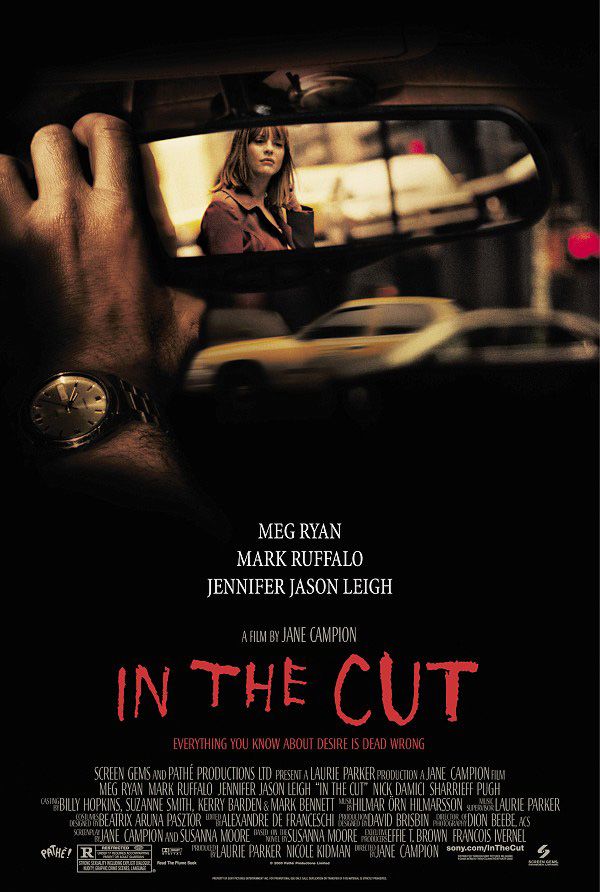
Significantly more interesting than its reputation as Campion's disaster would indicate. On a moment-by-moment basis, the screenplay is mostly gobbledygook ("No sense of cock!"), which I suspect was part of the film's negative reception. The rest, I think, probably has to do with the discomfort of having one of these purportedly Basic Instinct-style erotic thrillers focus so intently on female sexuality as dictated by the female gaze, rather than the typically phallocentric, male-pleasure-centric ideas of sexuality (and the villainizing of that which doesn't fit into that). Although the Basic Instinct angle is something of a feint, too, as this quickly evolves into a film more reminscent of the exercises in interiority and subjectivity that Polanski's Apartment Trilogy brought to the screen more than a purely lurid thriller of the '90s variety (though that Verhoeven-esque feeling of being unable to tell whether or not the movie's stiltedness is intentional artifice or just lousy acting remains). Anyway, this is a genuinely fascinating feature; seeing Campion work through the intersection of violence and sex makes it, more so than any other film in her career, a companion to her masterpiece, The Piano, and the cinematic style is exquisite. It's far from perfect, even putting aside the frankly rotten script, but it's not anywhere close to Campion's worst. I'd actually probably rather watch this again than Bright Star, to be honest. Grade: B

Bad Santa (2003)
It's a deceptively simple movie that manages a neat trick of becoming actually sentimental without ever giving up the dark, vulgarly tragicomic tone that defines the film, which saves it from the whiplash that sometimes plagues comedies that try to have serious emotional stakes. Billy Bob Thorton is also incredible here, plumbing some seriously impressive depths of self-loathing with his performance. So I understand why people like this movie as much as they do. But also, as much as I admire its sprightliness with project, this just isn't for me. Let me check my list twice for all this movie's naughtiness: 1) At the risk of sounding like someone who complains that Star Wars is set in outer space, the film just invests way too much energy into beat after beat of "golly, this Santa sure is bad!", which is both a cheap joke and a repetitive one after the film's first couple scenes. 2) Lauren Graham is criminally misused as this Santa-kink nympho—the movie gives her a half-hearted maternal turn in the movie's back half, which... am I supposed to be impressed by a single character straddling both sides of the Madonna/whore trope? 3) Then there are all the other non-Santa characters, who are sometimes mildly amusing (Bernie Mac's security chief—"HALF") but mostly just flat (Tony Cox as Santa's partner-in-crime elf, whose late-film turn may have worked better if he'd been better developed early on). 4) I'm also not a huge fan of all the casual homophobia and lovely 2003-ness here ("retarded" makes several appearances, as do a couple bits about the litigiousness of people of color/with disabilities). I suppose it's "period appropriate" (my gosh, 2003 is a "period" now), and the movie does have this sort of ironic distance where you're not exactly supposed to be in favor of all this. But I'm just not having fun with it. I realize that a large part of this movie's mode is to burrow so deeply into this darkly miserable comedic space that it comes around full circle and manages to be a sincere character piece, and it's moderately successful at that method, though I think the movie could commit a bit less to being a raunch comedy and a bit more to being a tragic character study if that's what it ultimately wants to become. But you'll forgive me for not really enjoying the trip through the misery, right? Grade: C+

Bubble Bath (Habfürdö) (1980)
A supremely strange animated rumination on domesticity and marriage. I can't claim to really know much about Hungarian animation, but this film's style, in which the character models and backgrounds are in constant motion, stretching and twisting and ballooning in concert with the emotional register of the characters (or, sometimes, seemingly just on a whim), feels pretty radical to me—like a proto-Bill Plympton but on a metric ton of acid. There are also songs. It's a lot: fascinating, confounding, inventive, good. Grade: B


Shanghai Express (1932)
Finds something of a midpoint between Grand Hotel and The Lady Vanishes while being neither as funny at Hitchcock's film nor as rich in pathos as Grand Hotel. It's diverting, and there are some moments ("Shanghai Lily" shrouded in darkness, looking up to God) that are exquisitely lit. But on a technical level, it's full of those kind of restless moments of silence you tend to see in early talkies where they clearly didn't know how to inhabit the sonic space they created, and on a screenwriting level, the central romance is doing precisely nothing for me. Grade: B-


Television

GLOW, Season 2 (2018)
Free from a lot of the setup and introductions that made the first season slow to start, GLOW's second season finds time to deepen the character relationships and make the plot beats a lot more poignant, and the results are wonderful. It's still not really a "message" show in the vein of its Netflix counterpart, Orange Is the New Black, but it does ground its pathos more in the unequal power structures of the showbiz industry, which gives the solidarity that the Gorgeous Women of Wrestling inevitably find a lot more weight. Moreover, this season does a much better job of sorting its characters into primary, secondary, and tertiary groups, which means we get a lot less of the kind of wheel-spinning dead air spent with characters who don't end up amounting to much of the course of the season. But that's not to say that the show is dismissive of any of its characters; with its second season, GLOW realizes its promise as a true ensemble show and, vitally, one of the warmest series on television at the moment. Grade: A-

Books

Motherhood by Sheila Heti (2018)
As much a philosophical dialogue as it is a novel, Motherhood is comprised almost entirely of conversations: ones the protagonist has with her friends, her husband, herself, and even the universe at large (via an I Ching-inspired coin flip system)—all centered on the idea of motherhood, something the childless protagonist, who is quickly aging out of her thirties, is mulling over with increased frequency these days. In the process, the book relentlessly interrogates the assumptions and pressures put on women, even in the 21st century, and while it doesn't always feel exactly new (a lot of this intersects stuff Virginia Woolf was writing about a century ago), it does always feel urgent. There's a part of me that wishes that the book was more explicitly in conversation with its philosophical antecedents (the novel is intensely solipsistic, which is both a feature and a bug), but as someone who is about to be a parent himself, I can't deny that regardless of how much it cites its sources, it was incisive enough to feel like commentary on my own life at times. Grade: B+

Three Men in a Boat (To Say Nothing of the Dog) by Jerome K. Jerome (1889)
A classic humorous travelogue of three men (and their dog)'s boating trip down the Thames. The humor feels a lot like a 19th-century Dave Barry, and as with Barry's work, a lot of this struck me as just mildly amusing—though sections of it are uproariously funny, such as an extended passage in which the narrator describes living in a house with a young couple, where it is frustratingly difficult not to walk in on them making out (and how maybe this was what it was like for the people of England when Henry VIII and Anne Boleyn first met). Honestly, the boating trip itself is pretty dull, but whenever the narrator goes on essay-like digressions like the above one or another highlight in which he muses about how the kitsch of one era becomes the valuable artifact of the next, it's great. Grade: B

The Grim Grotto by Lemony Snicket (2004)
The eleventh book in A Series of Unfortunate Events tones down some of the ethical and metafictional elements that had come to dominate the most recent entries in the series, and the book feels a little slight for it. Its setting inside the submarine named the Queequeg isn't nearly as inventive as past books either, lacking both the satirical bite of something like the high rise in The Ersatz Elevator and the delirious absurdity of The Miserable Mill (though as a whole, the novel is probably about on par with Mill as far as quality goes). The new characters (Captain Widdershins and his step-daughter, Fiona) don't make much of an impact, either, which is a problem for the book's back half and its reliance on these characters' actions for dramatic weight. On the other hand, the book also has some of the tensest setpieces in the series, which makes it a sprightly read despite its relative lack of shine compared to the other entries in the series. So it's kind of a mixed bag. Grade: B-

Music

Simon & Garfunkel - Wednesday Morning, 3 A.M. (1964)
The debut of the famed folk duo has some early highlights, like the original stripped-down version of "The Sound of Silence" and the deep-ish cut "Bleecker Street." But outside those few high marks, the album as a whole is pretty unremarkable, a forgettable collection of folk-revival covers and remade arrangements of traditional songs. "Silence" and "Bleecker" are both Paul Simon originals (as well as a couple others on here), and there's no question that Simon's songwriting is where this duo's strength lies, and the instant Simon & Garfunkel albums became good is the precise moment when they began structuring them around his compositions—i.e. not here. Grade: C+

Sunday, December 23, 2018

Mini Reviews for December 17-23, 2018

2018 catch-up time.

Movies

Mandy (2018)
I'm far from the first to observe that there is a prog half of this film and a metal half, and given that I have a whole section of my blog devoted to progressive rock, there's no surprise which half of this movie I prefer. That said, there's definitely a version of the movie's second half that I would enjoy very much: maybe it's all just for the memes, as some people have insinuated, but a movie in which Nicolas Cage gives a performance of loony Face/Off-style intensity while going on a cartoonishly violent rampage to kill lizard-people cultists sounds like a good time and a half to me. But here, being only half the movie, it feels somewhat cut off at the knees, and besides, juxtaposed with the far trippier, wilder first half of the movie, it feels like a disappointingly ordinary way to finish a film that opens with a bravura credits sequence set to King Crimson's "Starless." In fact, juxtaposed with director Panos Cosmatos's previous feature, Beyond the Black Rainbow, which remains one of the great cinematic sensory experiences of the 2010s, even the first half of the movie feels disappointingly ordinary. I dunno, maybe the secret to Black Rainbow was that it was impossible to track the plot; even when Mandy is going full Yes album, it's never that difficult to follow, and it just becomes clear that there's not a lot going on beyond the diluted psychedelia. Inspired in spots but unsatisfying overall. Grade: B-

Roma (2018)
As with most of Alfonso Cuarón's output, there's a sort of nagging feeling that this dude is just showing off with all the precisely choreographed long takes and immaculately blocked cinematography (this time filmed and edited not by his longtime collaborator Emmanuel Lubezki but by Cuarón himself—all the more reason to think he's simply flexing here). And the schematic screenplay, which somewhat contrivedly has grand character confessions and shocking revelations intersect at exactly the moments of highest cinematic sheen, bears this out. But honestly, I don't care one bit how artificial it feels when the results are this gorgeous. It's without a doubt the most visually stunning film I've seen all year, as well as the most pristinely constructed. And as much as the underwritten touches might undercut some of the character development, the cinematic style lifts it right back up again; those long takes tracking through crowded streets and violent tableaus become a sort of characterization of their own, crafting a grandly tragic emotional landscape nearly whole cloth from the film style alone, and as much as I can intellectually pick apart some of the decisions on paper, I didn't have much trouble getting swept up either. Grade: B+

The Green Fog (2018)
That something which, on paper, seems to amount to nothing more than an impressively-but-pointlessly difficult and theoretical archival project (recreating Hitchcock's Vertigo by stitching together footage from other films) actually adds up to a functional movie is sort of miraculous on its own. That it's not only one of the best movies of the year but also one of the funniest and also one of the most beautiful is nothing short of impossible. But here we are, with this amazing little impossible movie somehow existing and being great, having slipped in from another dimension or something. AND TO BOOT, it's got probably the best use of Michael Douglas in a decade, possibly in his whole career. Grade: A


Fahrenheit 11/9 (2018)
I don't know why Michael Moore didn't just make a full movie about the Flint water crisis, since that's far and away the best part of this scattered, shambling movie. Moore's populist fury for what has been done to his hometown remains his most compelling characteristic, and the 30 minutes that the film devotes to the whole sordid disaster is borderline great and alone probably justifies Moore's sharp turn toward actual agitprop in this film. However, the rest of the movie is this whirlwind of what feels like a survey of Daily Beast headlines from the past 2-3 years, unified under the really vague umbrellas of "Donald Trump" and "activism." Full of Moore's typical bluster and stuntery (hey, you lip-synced Adolf Hitler footage with audio of a Trump speech, you sure owned the MAGA crowd, don't know how they'll recover from that one), it's this heap of a film that just kind of flops around under its own many-tentacled weight, and it just plain doesn't work. It's viscerally upsetting because watching footage of the Stoneman Douglas shooting or Trump's threats toward protesters is viscerally upsetting just by virtue of those events having occurred at all. But as a coherent take on the modern American political landscape or even as the call to revolution that the finale so dearly wants to be, this is just ineffectual thunder. Grade: C

Food, Inc. (2008)
Normally, I would damn with faint praise by lumping this in with the rest of that tedious activistcore wave of documentaries from the mid-2000s. And... it's not like this isn't that (though it has good taste lacking in every other activist docs, in that it forgoes the obligatory ironic animated sequence). But this film's argumentation against industrial farming is particularly ruthless and cleared-eyed—impressively so. It also yields two legitimately great documentary moments. One involves a beef farmer cutting a hole in the side of a living cow and excitedly showing the camera how he can reach his hand into one of the cow's stomachs like it's the greatest thing since the microchip. The enthusiasm is infectious, both figuratively and literally (being part of a whole segment involving E. coli in meat). Errol Morris would be proud. The other, much more in-tune with the doc's overall rhetorical aims and almost without a doubt the most pointed and effective use of the film's take-no-prisoners posture, is when footage of immigrants being shoved into vans by immigration officials after raids of meat-packing plants plays over audio of an impassioned interview which tells us relentlessly that this is the real cost of our holiday hams and turkeys. It's the film's most bracing deployment of pathos, or at least it is for me eight months after a mass-scale version of that footage occurring just a county over from my house. Grade: B

Beverly Hills Cop (1984)
I mean, this is certifiably pro-cop in this really icky "ends justifying the means" way, to say nothing of the '80s trademark homophobia on display in a few key scenes (apparently the only thing more villainous than a vaguely Russian drug dealer is a vaguely Russian drug dealer who might be gay). But Eddie Murphy is extremely good in this movie—so good that he does a decent job of papering over some of the more objectionable qualities of his character. This is maybe the best Murphy performance that I've seen, and while that's not exactly saying much, given that I've seen only a handful of pre-Shrek Murphy roles, it is pretty stunning what he's doing here. Grade: C+


Vanishing Point (1971)
I'm of two minds regarding this film. Well, of many minds, actually. The film is complete and utter worship of the automobile, which my train-loving spirit objects to strongly, to say nothing of the mythologizing of the Ruggedly Individual American Male, which just sort of bores me. But also, as something of a 20th century folk tale, with all the kaleidoscopic cul-de-sacs and slippery meanings that come with the genre—I mean, is it a lionizing of the Ruggedly Individual American Male, what with that self-destructive ending and all? It's not as simple as it seems. But also, it falls handily into the fallacy of reducing the counterculture to a mere quest for Freedom, Maaaaan, wherein anti-authority sentiments are an end to themselves, which is the same kind of thinking that landed the movement at Altamont and later Ronald Reagan. So screw that. But also... maybe this movie is aware of that? But not enough to avoid casting its almost arbitrarily defiant (and of course white—they're always white, the salvific figures of these counterculture movies) protagonist as some sort of larger-than-life hero of the people? But also, the car goes vroom, and the rock music kicks, and the cinematography is brilliant. I dunno, man, I gotta lotta feelings here, and most of the time, I was feeling like I was having a good time. Grade: B

Television

Joe Pera Talks with You, Season 1 (2018)
I don't even know where this came from. Seemingly out of the clear blue sky (or, more likely, the cold, overcast sky of Michigan's Upper Peninsula) appears this beautiful little Adult Swim gem, featuring none of the aggressive weirdness that's characterized the Adult Swim brand, instead going for a quiet, contemplative wholesomeness that feels more in-line with, like, Mr. Roger's Neighborhood or The Joy of Painting—only infused with an idiosyncratic philosophic impulse and a deep well of melancholy that makes every one of its 11-minute episodes feel like something of a soft-spoken treatise on the human experience. I barely know how to describe it; what I'm saying here barely conveys the wonderfulness of Joe Pera Talks with You. When people talk about "Peak TV," they're usually referring to the explosion of ambitious content on streaming services, but honestly, this is the Peak TV I'm here for: these graceful little pockets of brilliance in the odd corners of the television landscape, both a piece of television tradition and curiously apart from it. Seriously, go watch this, folks. Grade: A

Books

The Slippery Slope by Lemony Snicket (2003)
The tenth book in A Series of Unfortunate Events is something of a transitional book. Being set on a relatively nondescript mountainside for its entirety, the novel lacks the inventiveness and little satirical microcosm societies that the best books in the series often develop; it's also something of an info-dump as far as the ongoing mysteries in the series go, which feels uncharacteristically inelegant for these books. But it's still that same wonderful wit as the other books, and Snicket's metafiction is both funny and interesting in the ways it's developed here. The payoff to all the ethical questions of the previous few books feels earned, too. Grade: B


Music

Noname - Room 25 (2018)
Chicago rapper's sophomore effort (or debut, if we're counting 2016's Telefone as a mixtape instead of an album, which... is confusing, but okay) is jazzy in production and quietly profound in its exploration of both the personal and the social. But let's take a moment just to appreciate how uproariously funny Room 25 is: "My pussy teaches 9th-grade English/My pussy wrote a thesis on colonialism" is maybe the funniest lyric in any music anywhere this year. Grade: A-