Showing posts with label Dear White People. Show all posts

Sunday, January 9, 2022

Mini Reviews for January 3 - 9, 2022

Hey, I got HBO! I'm cool now.

Movies

Malignant (2021)
A deranged, no-holds-barred throw-down against any sense of "respectability" that horror as a genre has tried to gain for itself in the past decade. James Wan goes absolutely bonkers with his camera, whipping that thing around in wild, virtuosic spins, and everything else in the movie follows suit. The plot kind of resembles one of those toothpick-and-marchmallow towers you had to build in middle school science class, where the facts at how ludicrously this thing is assembled and how shakily it reaches its heights aren't problems but the entire premise of the appeal, and if you aren't going to cackle gleefully as the movie pulls rug after rug out from under you, you're not going to like this movie. I was on-board as soon as it starts getting silly after its admittedly tepid warm-up half hour, though, so I had a great time. Really wish I could have caught this in a theater. Grade: A-


No Sudden Move (2021)
A quirk in my phone plan got me HBO Max*, so now I finally get to check out Soderbergh's two movies he did for them (and that HBO probably wouldn't have put out on physical media for years). This one's good! A really, really terrific film noir screenplay from Ed Solomon, who wrote things like the Super Mario Bros. movie, the Bill & Ted movies, etc.—surprise of the century that he has a movie this grimy and menacing and tightly written in him. It's no surprise that this material attracted Soderbergh; he's been directing crime thrillers about the perils of capitalism since I was in elementary school, so it probably would have been more of a shock if it hadn't turned out good. People don't seem to like the fish-eye lens used throughout, but I thought it looked cool. Grade: A-

*Also, I've been out of the HBO ecosystem for most of my life, so I'm open to suggestions on what series to watch. Assume I've already seen the big ones like The Sopranos, because I have!

Cry Macho (2021)
Too cute by half and doesn't have anything real to say about the US-Mexico border, despite that figuring prominently into the plot. But it is nice to see Clint palling around rural Mexico and making friends, and this movie has its low-key charms as long as it sticks to that. Grade: B-


Let Them All Talk (2020)
Second HBO Soderbergh I've seen! This one is also very good. It's basically a distillation of Soderbergh's proclivity with talented ensembles, and almost nothing else. Allegedly, most of the scenes in this movie were improvised, and you can kind of tell because of all the stammering, but also, it's an incredible exhibition of just how magnetic a great actor can be with a character given the right framing. Dialogue wanders with inventively circuity around the characters' relational dynamics, but always lands exactly where it needs to to advance to the next scene or plot beat; I've seen a lot of people compare it to jazz, and that sounds exactly right to me, capturing that same live-wire energy and virtuosity that can make a jazz performance so riveting. It's a spacious, generous movie, but also a tight one in its own way, and I was never bored. This is pretty near top-tier Soderbergh for me, though given that almost all his movies are hovering in the B+/A- range for me, it's not a super high ceiling to clear. Grade: A-

S He (女他) (2018)
An incredibly inventive stop-motion film using shoes and other found objects as stand-ins for oppression under the modern state; given its cycle of revolution-->oppressive new normal, I don't know that it would be accurate to classify it as anti-capitalist, as I've seen some people do—maybe anti-industrial and anti-hierarchical, but it seems to be going broader than a specific political system. Whatever; it's still cool. I wish I could be as over-the-moon about this as some people are, but I think the version I watched (tried both Amazon and Tubi) is broken. I can't be sure that this isn't intentional, given the already experimental nature of this thing, but it looked like the film's frames got slightly jumbled in the conversion to whatever file these streaming services are using, and as a result, the whole thing has this jittery, almost strobe-like look that was kind of hard to watch. Would love to know if other people had this experience and if this is the intended effect. If it is, then I don't like that effect.

EDIT: Okay, I rewatched this on Plex (never heard of that streaming service? Me neither!) and confirmed that the Amazon and Tubi versions were broken. Plex is the way to go! Seeing this with a lot more clarity now. On the one hand, I'm even more in awe of the technical prowess on display here; truly jaw-dropping craft, so much so that I'm bumping this up from what I had originally rated it. On the other hand, now being able to follow the story a lot better, I think I am going to have to change my take and agree with the consensus that this is anti-capitalist—though of a kind of Animal Farm variety that's ultimately not so much concerned with the theory of deconstructing capitalism as much as it is with the ways that the oppressions and hierarchies present within capitalism can manifest themselves in other systems, too, so long as they are reliant on the same kind of industrialism that subjugates bodies and the planet. So far so good, except that this movie frames it in gendered terms, which is kind of cool for the way that it shows the limitations of the "more female CEOs" line of thinking and how the enforcement of gender roles is a way of upholding modes of production but also feels pretty iffy in the ways that it evokes trans identity (especially given the English title and tagline). I genuinely don't know what to do with this movie's relationship with transness, and the film is opaque enough that I couldn't say for sure that it's transphobic, but I can't say for sure that it isn't transphobic either. For that reason, I'm hedging my bets by not rating this even higher, but know that this is absolutely amazing in most other aspects—heavily reminiscent of The Wolf House and 1986's The Pied Piper in terms of its grotesque, mind-melting animation, so if you were at all into those movies, SEEK IT OUT (but on Plex, though). Grade: B

The Adventures of Mark Twain (1985)
It's more or less a Twain anthology, and the decision to focus on Twain's later, less-read works like The Mysterious Stranger (which provides the film's lone top-to-bottom great segment) is extremely cool. But given that, it's pretty disappointing how aggressively dopey the execution of so much of it is. This is a fairly niche reference, but the writing and voice acting (esp. for the vapid children—character from The Adventures of Tom Sawyer for some reason) reminded me of those episodes of Adventures in Odyssey where the kids would jump in the Imagination Station to live through some edges-sanded-off depiction of American history or The Bible or whatever, and while it's impossible to turn Twain (and especially his unrelentingly cynical late career) into something as leadenly wholesome and whitewashed as Focus on the Family's radio-drama versions of beloved white Christian myths, there's an aw-shucks folksiness to this movie's relationship with Twain that overlaps a little bit with that, mixed with those "Read" library posters and an anachronistic dash of The Pagemaster. Even so, the general thematic arc of the film is kind of wild in its obsession with mortality (if I'm still on my Odyssey analogy, it's basically "The Mortal Coil" with a secular-humanist gloss—why do I remember so much about Adventures in Odyssey?), and the claymation yields some genuinely incredible imagery, especially near the end with the Halley's Comet sequence. It's kind of sad that outside of the extreme polish of Aardman, clay-based stop-motion has basically gone extinct, because in its heyday, the medium's capacity for rough-edged phantasmagoric worlds was something special. Grade: C+

The Wiz (1978)
The pacing and some of the creative decisions early on (why is Munchkinland so dimly lit?) make it pretty clear why short-sighted audiences and critics didn't respond well to this upon release. But holy cow, this movie is magnificent for long stretches, including the entire last 45 minutes. Michael Jackson is a revelation to me as the Scarecrow, the colors, set design, and choreography are jaw-dropping, and the cinematography does the thing that a lot of '70s musicals did, where it mixes scuzzy '70s grime with the aesthetic maximalism of the musical genre's 1950s heyday. I wasn't initially sold on Diana Ross as Dorothy, but good lord does she sell it by the end, especially in the final song, "Home." It's incredible that in a movie as ostentatious in its style makes its most ostentatious stylistic flourish in its final minutes with that one-take medium close-up of Ross decontextualized from any scenery, just absolutely belting "Home" at the top of her lungs as tears pour down her face—maximalist minimalism of the highest order. This is kind of a tangent, but I'd also be shocked if the "Home" sequence wasn't a direct inspiration for the "Fools Who Dream" sequence in La La Land, and I'm also shocked that for as much as The Discourse surrounding La La Land involved people excavating its influences and pointing and sneering at how La La Land was allegedly a weaker/less pure pastiche of its predecessors (unfair, but whatever), nobody mentioned The Wiz and how much "Home" and Ross completely and totally eclipse anything "The Fools Who Dream" and Stone are capable of. Not sure if it's fair to say that The Wiz needs to be reclaimed, given as I understand it that it was never really lost on the black audiences it was made for. But it certainly surprised me. Grade: A-


Television

Dear White People, Volume 4 (2021)
Conceptually, one of the most baffling final seasons of a show I've ever seen. There are a couple of things here that defy explanation. Firstly, the season is given a framing device where the characters are sitting around sometime in the future (I think it's supposed to be the late 2020s/early 2030s, though I don't remember it ever being clarified) reminiscing about the events of Volume 4 as we see them unfold—I suppose we get to see where these characters ended up in their careers, but none of that proves to be particularly illuminating, and anyway, the framing mostly is an outlet for tired jokes about Zoom and "oh no, the pandemic never ended." The second and far harder bizarre creative decision to swallow is that as the characters flash back to the events of the season, they remember them as a '90s R&B jukebox musical, complete with reality-breaking choreography. And, like..... what?? Dear White People has always been a stylistically arch series, but having characters suddenly break into song (and not just any song but distractingly famous songs) is such a radical break from the show's normal that I have to ask: why? We get a few clever recontextualizations of lyrics, some nice dances, but that's about it. It's an extremely tall request for an audience to go along with the series blowing up its format like this, and in return, there's no immediate thematic payoff or urgency to it, much less a suitable explanation. I do kind of admire the sheer audacity of the concept, but the concept itself is just never justified enough to warrant the dissonance of its inclusion. People joke about Community's "gas leak year," but this genuinely feels like the writers were in a chemical-induced fugue state. I might be more charitable about this stuff if the season didn't also feel like a major step down in terms of writing. There's a thematic throughline about the tensions between working within the system vs. tearing the system down, and the season does a reasonable job of showing why someone would choose the former despite believing in the latter. However, the moment-to-moment dialogue and character development feels strained and thin, diluted by the musical sequences and the constant flashing back and forth between the framing device. Plus, the catalyst for this tension is a new character named Iesha Vital, a freshman activist who attacks the cast (especially Sam) from the left. It's not a theoretically bad catalyst, and like most of the characters on the show, Iesha is premised on a contemporary political archetype. But Iesha never feels like she's given the life and messy humanity that the rest of the show's cast is afforded, and on a political level, the show seems unduly skeptical of her political motivations. In fact, the series makes the questionable decision to have her be somewhat disingenuous in her critiques of the older cast, being propelled by what the series explicitly labels as "immaturity" and emotional confusion. In the past, Dear White People has done a great job having imperfect people in ideological dialogue with one another, and oftentimes the show uses interpersonal psychology to inform its characters' politics. But Iesha's characterization feels strikingly slim on generosity, and even at the end of the season, when she's made more sympathetic, she's still a fairly flat character. I dunno, it's just a weird look for a show that's usually so sharp in terms of evoking current extremely online political discourse that it fails to believably render this dynamic. Just another miscalculation in a season full of them. An exceptionally disappointing end to what has perennially been one of Netflix's freshest shows. Grade: C


Books

Appleseed by Matt Bell (2021)
Wildly ambitious climate change fiction (a real genre now, it seems). The novel tells three parallel stories: one of a mythical faun and his human brother in late-1700s Ohio, another of ecologically collapsing late-21st century when the world's resources are owned by a tech giant run by a Jeff Bezos/Elon Musk analog, and the third thousands of years in the future as a 3D-printed cyborg searches for the last remnants of human civilization—all three tales riffing on Johnny Appleseed, the Orpheus myth, and biblical echoes to form an arc of North America under human industrialism. It's clear that Bell knows exactly what he's doing; the novel's plausibility is extremely stressful (as are all clear-eyed looks at the titanic realities and frightening possibilities of climate change), and its mythological preoccupations are inventive and often profound. I was sure that a novel with so many threads and sweeping ideas would spin out of control by the end, finishing on an unsatisfactorily tangled attempt to tie everything together, but astoundingly, Bell lands this incredible machine with the most elegant series of pages in the entire novel as he dovetails all three stories in the book's finale. The novel isn't perfect (it has a habit of over-explaining itself in the late-21st century story), but it's compelling nonetheless, not to mention impressive: a fully realized treatise on the fatal incompatibility of our planet's health with humanity's compulsion to subjugate, which reads not like a treatise but like a myth. Grade: A-

Sunday, September 15, 2019

Mini Reviews for September 9-15, 2019

Not a great week at the movies, gotta say.

Movies

Dumbo (2019)
Even putting aside my substantial philosophical/aesthetic opposition to the idea of these "live-action" Disney remakes, it's clear this is a huge miscalculation. I watched this pretty much because Burton doing Dumbo feels like one of those peanut-butter-and-chocolate pairings, and while late-period Burton and archvillain-period Disney are far from the ideal context for this union, there are some signs of life in the production design in general and a satirical riff on Walt Disney and Disneyland specifically (which ultimately proves toothless because duh, this is itself a Disney movie, but there's at least a hint of bitterness in it, which is fun within the rubric of this movie). But oh man, the narrative. What a mess. Disney has made PR hay out of the fact that they virtuously cut the notorious bit with "Jim Crow," but in their eagerness to do so, they've also left a pretty significant gap in the story's plot. This movie's solution is to make Dumbo not about Dumbo at all but rather about the two human children who teach Dumbo to fly in lieu of the crows, and also about their father who, as is contractually mandated of all fathers in live-action Disney films, is emotionally distant and just can't relate to his kids. And it doesn't work at all. It's not just that the human drama isn't engaging (though it isn't); it's also that recentering this story on human beings who are sympathetic and nice fundamentally misses one of the pillars of what makes this story tick in the first place, which is the depiction of the circus as a rotten, awful place for animals that exists only because of human beings' propensity for cruelty and mean-spirited amusement. Instead, the movie totally softballs this message by making it maddeningly ambivalent, where there are the Good Humans who understand the animals and the Bad Humans who want to exploit them. To call this movie's revision of the original's cynicism about human nature "both-sides-ism" would overstate the political ramifications of this issue, but it's definitely that for the world of Disney remakes. I'm not saying this movie needed an animal minstrel show at its climax, but it needed some animals in general, and it needed them to be real characters (if not speak). I'm as big a fan of humanism as the next guy, but interposing that ideology into a story that is, in many respects, Disney's parallel treatise alongside Bambi on the ways that humankind is irredeemably abusive toward animals... well, re-centering it on human daddy issues feels a little gauche, to say the least. Grade: C-

Shoot the Moon Right Between the Eyes (2018)
An unlikely (and often ungainly) mix of James Joyce, John Prine, and Brechtian techniques: "Two Gallants" turned into a Prine jukebox musical with deliberate moments of theatrical/cinematic artifice. It's (despite that Brechtian stuff) very sweet and, for stretches, pretty great, although the whole package didn't quite work for me. There's just too much stuff going on here, and the mix of irony and melodrama never quite gels—particularly the framing device where the movie is all part of a radio show, which is a meta bridge too far for me (a shame that this part specifically doesn't work for me, since the guy who voices the DJ is a friend of mine—it's not your fault, Nathan!). Also, I know that Sonny Carl Davis has a long and illustrious career, but all I can think of when I see him now are those anti-Ted Cruz ads that Linklater directed. Which actually works well for this movie. Grade: B-

Last Men in Aleppo (De sidste mænd i Aleppo) (2017)
It is deeply upsetting on a visceral level to watch living and dead children pulled from rubble, which is precisely what this documentary hinges on. I honestly don't know what really this documentary has to offer in the face of that—it feels pedantic to comment too much on this movie's structural issues or its unimpressively journalistic cinematic style, as if it's the job of a movie like this to entertain or wow me. I clearly responded to the visuals more strongly than I would have to an article covering the same material, which speaks to its value as cinema, though. Grade: B+


Helter Skelter (1976)
A friend of mine loaned this to me after we talked about Once Upon a Time in Hollywood, and I guess it's not his fault that I think that the mystique of the Manson Family is kind of dull, but man, three hours of made-for-TV (in every pejorative that implies) cinema specifically about the Manson Family really didn't do it for me. It doesn't help just how lurid this thing is. I know that's the whole point of a movie like this (made slap-dash from the book of the same title), but there's something pretty skeevy and uninteresting about just how procedurally this movie lingers over the details of the sex and murder perpetrated by the family at Manson's behest, with everyone involved (including the victims of the murders) feeling like wooden props by which we get access to this wild story. The whole thing oversells the grossness of the Manson endeavor while somehow not taking his motivating ideology seriously enough, which is a weird tension. Believe me, I still have some reservations about Once Upon a Time in Hollywood and particularly its ending, but it's movies like this that really throw into relief just how lovely it is that Tarantino's movie lets Sharon Tate exist as a human being apart from her status as a casualty of a cult massacre. Grade: C-

Television

Dear White People, Volume 3 (2019)
It would be overstating the case to say that the third season of Netflix's incendiary Dear White People is its first major misstep, but it is undeniably a step down from the previous two seasons. Part of this seems by design; there's a lot of this season (especially early on) devoted to meta jokes about Netflix shows in their third seasons becoming tired. On a deeper level, this is, in a lot of ways, a season about exhaustion and aimlessness. These characters are burned out: by their financial insecurities, by the relentless push for excellence, by the power hierarchies of Winchester, by the oppressive awfulness of the world around them. So they have become adrift. Sam has quit her radio show; Troy has quit Pastiche; Lionel is exploring the new (to him) world of the university's LGBT community; Gabe faces seemingly insurmountable obstacles on his thesis. It's a completely understandable development for the show. Dear White People was forged in the crucible of America's mid-to-late 2010s political and identity turmoil, and though that turmoil persists, a palpable feeling of exhaustion has set in among progressives—we're tired of marching, of writing representatives, of being outraged: tired of doing the things we're supposed to do in the face of a situation that only seems to become more dire by the day. So it only makes sense for the show to reflect this. The problem is that it never quite finds a way to make all its variations on this idea cohere. Dear White People is as attuned to the nuances of The Discourse among progressives and of the political climate in general (a subplot about the unionizing of teaching assistants feels very much an outgrowth of the labor fights of the past couple years), but unlike the blackface party of Volume 1 or the alt-right social media mystery of Season 2, none of the plots form a central structure for this third volume to hand its assorted pieces on. A plot involving sexual assault allegations feels like an attempt to provide a backbone for the season, but it's too late-breaking to make it work as that. It may be thematically appropriate for a season about aimlessness to itself lack structure, but as a viewing experience, there's definitely something missing. None of this is to say that this season is unwatchable or even just bad; it is still good, sharp-tongued television. But for a series with as sterling a pedigree as Dear White People, it's just a tad disappointing not to have it quite live up to its predecessors. Grade: B

Music

Flying Lotus - Flamagra (2019)
With a track list nearly as long as the White Album's and a title like a Final Fantasy spell and a cast of collaborators like the invite list for a Hollywood wrap party (George Clinton? Denzel Curry? DAVID LYNCH???), Flamagra is certainly one of the more bizarre and sprawling releases of Flying Lotus's career. It careens from genre to genre, R&B melding into fusion melding into electronica melding into neo-soul melding into unclassifiable sonic experiments. It doesn't cohere in the slightest, nor does it ever try to. Instead, it is basically the musical version of its own cover art: a baffling hodge-podge. Any one moment is fascinating (my favorite is the strange, scary David Lynch collab, "Fire Is Coming"), but good luck making sense of any of this from a bird's-eye view. Grade: B

Sunday, June 3, 2018

Mini-Reviews for May 28 - June 3, 2018

Don't forget to read my Disney retrospective if you haven't already. So far, there's the first post (featuring Snow White, Pinocchio, and Fantasia) and the second post (Dumbo, Bambi, and Saludos Amigos).

Movies


Solo: A Star Wars Story (2018)
Solo is Disney's first major misstep in their curation of the Star Wars franchise, and it's a completely unforced error. They didn't have to make this movie. As the box office numbers show, few people are interested in a young Han movie—especially since, try as he might (and he does try), Alden Ehrenreich is not Harrison Ford, and if we're being honest, I think it's Harrison Ford that most of us love, not Han. I'll bet that even fewer people wanted a movie that's basically a SparkNotes version of A.C. Crispin's Han backstory trilogy from the old Expanded Universe novels (which I somehow remember with shocking clarity), certainly not one whose story is this lumpy nor whose emotional beats are this laden with doe-eyed sincerity nor whose special effects are this iffy—how is this one of the ten most expensive movies ever made?? The action setpieces at least have the decency to be a lot of fun, and I am absolutely here for Donald Glover's Lando (Glover is clearly having more fun than anyone else in front of or behind the camera). The alien design is also top-notch, and probably the most Lucas-esque thing in the whole Disney-Star-Wars franchise is the mid-movie gambling den where Han and Lando play sabacc with the Millennium Falcon at stake, populated with that same lovingly lurid marriage of rubber prosthetics and pulp sci-fi book covers that animated Mos Eisley Cantina and Jabba's palace. Still, to paraphrase our dearly beloved Harrison Solo, hokey casinos and hammy Donald Glovers are no match for a good movie on your screen, kid, and a good movie this is not. Grade: C


Munich (2005)
It's too long by at least half an hour (163 minutes? Really, Steven?), and that (and the accompanying slackness) is what separates this movie from the greats in Spielberg's filmography. But still, it remains a notable accomplishment, the first of Spielberg's mini-trend of using period pieces to comment on contemporary politics and the last of the most artistically sophisticated stretch of the man's career before he bent back around to his own cliches for a bit. Also, was there any other American movie in the period spanning 2001 to 2005 grappling so earnestly and rigorously with the moral thorns of the War on Terror as this one is? Grade: B+


Training Day (2001)
Basically the best-possible outcome of the intersection between Michael Bay and Paul Verhoeven. I hope that doesn't make it sound like I'm downplaying just how tight Antoine Fuqua's direction is, because it's very tight, finding the ideal gear for this sort of walking-the-line-between-gritty-and-bombastic mainstream filmmaking. Denzel is, of course, great here—I wouldn't have picked this for his lead-actor Academy Award performance (Malcolm X is right there, guys), but it's a high-wire performance that's justly iconic. Oh, and shout-out to Terry Crews for being given basically nothing to do but stand quietly and look intimidating and KNOCKING IT OUT OF THE PARK. Grade: B+


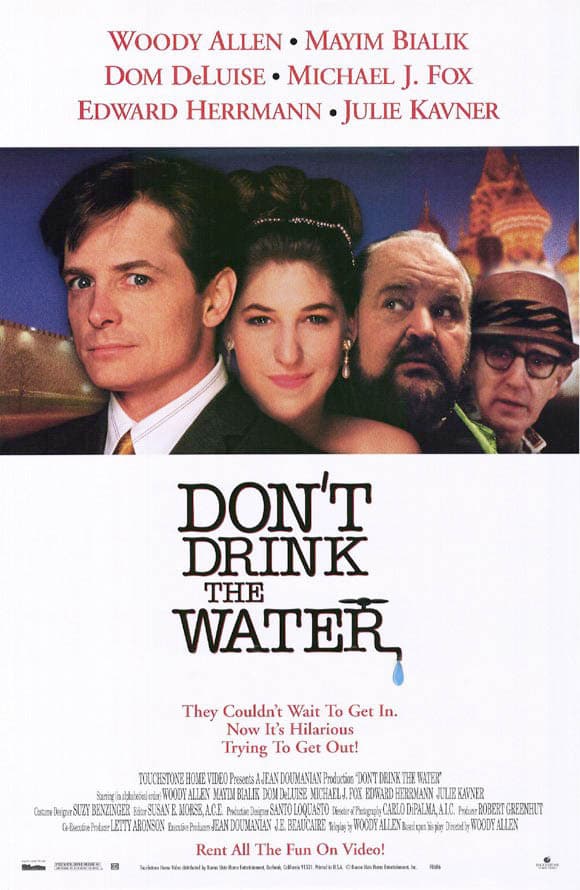
Don't Drink the Water (1994)
Woody Allen and Julie Kavner have great chemistry together as the leads (probably the last time a leading Woody Allen had good chemistry with his co-lead until Scoop, another movie involving an amateur magician—coincidence??). In fact, this is probably the best Kavner has ever been in a Woody Allen feature—though that's probably because she's usually underutilized. It certainly isn't because this movie is much good, because it isn't. For a movie that was once a play now on its second adaptation, it's haphazardly scripted and only intermittently amusing, to say nothing of the uncomfortable racial dynamics. Xenophobia/nonwhite cultural caricature (the movie ends with Allen's character sneaking off in a Middle-Eastern "harem"—dressed in drag in what I'm sure is not at all an authentic garb) is a rare flavor for Allen, and it's an unsavory one. Grade: C


Cat People (1982)
Paul Schrader's 1982 update of the 1942 classic is this weird mix of trash cinema and arthouse, and I gather that's kind of his thing. Unfortunately, it doesn't make any damn sense here. Cat People is an incomprehensible parade of nonsensical mysticism, male-gazey eroticism, and dull footage of the New Orleans zoo. The movie makes a litany of interesting and potentially rewarding decisions (setting the film in New Orleans, casting Malcolm McDowell, using that cinematography and that lighting), but it's at a complete loss as to how to put it all together. The result is a movie that's both bewilderingly bad and stultifyingly boring—a huge step down from the Tourneur original. At least the David Bowie main theme and Giorgio Moroder score are pretty good. Grade: C-


New York, New York (1977)
A great example of how a good movie is not just the accumulation of a lot of good ideas. New York, New York is made almost entirely out of good ideas: the lighting, the shot composition, the juxtaposition of New Hollywood grit with Old Hollywood musical artifice, the pairing of peak Liza Minnelli with peak Robert De Niro, the music, that nearly thirty-minute montage of Minnelli in out-of-context musical sequences belting out number after number—it's all good. But unfortunately, the movie is sunk by its lone bad idea, which is that all these elements should be crammed together indiscriminately into a movie nearly three hours in length. Grade: B-


Television


Dear White People, Volume 2 (2018)
As with its first season, Dear White People's second season's most impressive and distinctive achievement is how it manages to personify and dramatize with shocking fidelity the contemporary political discourse surrounding race and progressive politics, while at the same time making its characters characters and not merely symbols or mouthpieces for certain political archetypes. This season has the added bonus of including several conservative and alt-right voices as well, and the effect is something like watching a Twitter thread come to life—when the characters aren't actually on social themselves, which happens in several extended sequences. That may sound unappealing (I certainly find Twitter unappealing in real life), but in practice, Dear White People is (yet again) simultaneously one of the most vital depictions of the ways modern-day ideologies interact and a razor-sharp character-based dramedy. So you get episodes like "Chapter VIII," where the entire episode revolves, bottle-episode-style, around an argument between Sam and Gabe, and it's both a bracing character moment and a breathtaking examination of the conflicts between people of color's trauma and the role of white allies' "good intentions." It's not all great. The season as a whole isn't quite as cohesive or consistent as the show's first; lacking central organizing events like the blackface party or the gun being pulled on Reggie, Season 2 has the characters drift in disparate directions that don't always tie back together, leading to the underdevelopment of some of the season's threads (Tessa Thompson shows up, e.g., but her character is far too briefly examined to have her climactic moment have weight), and though I enjoy the historical scope of this season, an extended subplot involving Ivy League secret societies is something I found hard to take seriously, right up to the strange, baffling finale. But taken as a whole, Dear White People remains audacious and riveting. There's no show on right now doing stuff like this; it's electrifying. Grade: A-

Books


The Miserable Mill by Lemony Snicket (2000)
The narrative voice is as fun and morose as ever, and the details of this world are still surreal and great—my favorite this time around is that the mill workers only get chewing gum to eat at lunch. However, this book is suffocated under the series's increasingly rigid formula. The narrator seems more and more aware of this formula with each successive entry, but self-awareness and meta-commentary doesn't really make it any more interesting to read the same plot beats for the fourth time in a row. Grade: B-


The Austere Academy by Lemony Snicket (2000)
But now this is more like it. The Austere Academy isn't a complete break with the Series of Unfortunate Events formula, but it's enough to spice it up enough that I'm back onboard. The introduction of the Quagmire triplets as well as hints of a broader conspiracy/mystery (V.F.D.?) are relatively small additions, but they broaden the scope of the series in pleasantly evocative ways. Also, maybe it's just my profession talking, but the school-by-way-of-Kafka depiction of the titular academy is a highlight of my read-through of this series so far. There's something so very familiar about a school putting so much faith in an "advanced computer system" that ultimately fails spectacularly. Grade: B+


The Ersatz Elevator by Lemony Snicket (2001)
To say that The Ersatz Elevator is the best book in A Series of Unfortunate Events since Snicket kicked the whole thing off with The Bad Beginning isn't a statement meant to disparage the intervening four books (well, except maybe The Miserable Mill); it's more just me gushing about how big and alive and absolutely packed with ideas Elevator is. Everything the series does well is at its best in this book. The setting is hilarious, morbid, and surreal (this time, the Baudelaires are living with trendy rich people in a big-city high rise obsessed with what is "in" and what is "out"—ocean decorating becomes "in," so they spread sand and shells about their penthouse); Count Olaf's plan is arch and byzantine (involving an auction that is a front for child trafficking, basically?); Lemony Snicket's increasingly intrusive narrator is bone dry and Eeyore-ish (and he's apparently on death row?); the breadcrumbing of the series's mystery is tantalizing and effectively staged (a moment late in the novel involving a secret passage is thrilling in exactly the same way that text adventure games like Zork can be, and while I'm sure I'm the only person in the world excited by this, I'll take it); and for those playing Spot the Literary Reference with this series, there's an allusion to none other than Thomas Pynchon's The Crying of Lot 49, which seems as much of a statement of purpose for the series as we've ever gotten. This book is the series bursting into color. This book is great. Grade: A

Music


Sons of Kemet - Your Queen is a Reptile (2018)
One of the year's most fascinating and engrossing jazz records comes from Great Britain of all places. In the year of yet another royal wedding, it's cathartic and brash for Sons of Kemet to declare what they do in this album's title, and the music within is in the same spirit, each track's declaration of "My Queen" a triumphant and angry counterpoint to the title's dismissal of "Your Queen." "My Queen Is Angela Davis" one track says; "My Queen Is Harriet Tubman," says another, and yet another screams, "My Queen Is Albertina Sisulu"—each track a celebration of black women both well-known and obscure to white Western audiences (or at least to me), each track a winding groove set to the furious Afrobeat drive of the percussion and the fire of the occasional lyrics. I'm not sure if this is jazz's future or just one of its many, many historical and political tendrils that I'm only just now discovering, but it's definitely one of the definitive recordings of 2018. Grade: A-

Sunday, July 2, 2017

Mini-Reviews for June 26 - July 2, 2017

I watched a lot of movies this week, and most of them were kind of not great. Oh well.

Movies


Cars 3 (2017)
While the biggest question surrounding any entry in this series beyond the 2006 original remains, "Why?" (a close second to "What are they grilling at the Bar and Grill?"), Cars 3 at least returns to the warm Americana that ultimately made the first one endearing. In fact, the logically iffy globe-trotting of Cars 2 has been banished almost entirely to the realm of weird fevered dream, apparently, and Mater has mercifully been relegated to the small supporting role he deserves. In his place is Cruz Ramirez, the Adonis Creed to the aging Lightning McQueen's Rocky, if you will, and it works well enough, particularly in the film's rather graceful conclusion. It also bears mentioning that Cars 3 is the best-looking of the Cars films, all of which are technical marvels. It's gorgeous, actually, right down to the intricate lighting and surface textures that look practically photorealistic. It's still Cars, so you're not in for Pixar's best. But you could do a lot worse with children's animation this year. Grade: B


Neruda (2016)
One half of this movie involves Pablo Neruda, in typical biopic trappings, on the lam as he avoids his political enemies. The other half, cross-cut with the first, involves a po-faced film-noir-ish plot in which a mustachioed Gael García Bernal plays what basically amounts to a Chilean-fascist version of Inspector Clouseau hunting down Neruda. Topping it all off is the fact that Bernal's character is entirely fictitious and seems aware of this fact. It's glorious and weird and complex in a way I'm still parsing out, and I loved it. Suck it, standard biopics. Grade: A


Daddy Day Care (2003)
Isn't it funny how dads sometimes approach childcare differently from moms? Ha... Grade: C


Chocolat (2000)
This 2000 Best-Picture nominee (how??) is first a parable about inflexible morality and religious asceticism (unsuccessfully, I might add, as the film doesn't seem to understand anything about religion beyond "it tells you what to do, and that's bad"—there are so many things to criticize about religion, but it just seems silly and shallow to critique a system of morality for having the hallmarks of a system of morality). Then it's a more successful parable about tribalism and the fear of the other (hey there, younger, sexier Johnny Depp), and then it's back to being that first parable again. It's ineffective as a story, ineffective as social commentary, and uninteresting as anything other than chocolate porn (which is the one thing the film truly excels at—the chocolate looks scrumptious). Juliette Binoche is radiant, though, so I guess there's that, too. Grade: C


Escape from New York (1981)
Beat-for-beat, this is about as archetypally '80s action as it gets, and with good reason, since with Escape from New York John Carpenter and Kurt Russell helped invent some of the most robust of that genre's tropes (later to send them up viciously just a few years later in Big Trouble in Little China). And as the OG to that archetype, it's basically perfection, if a bit retroactively rusty in its tropes. It also has a guy who's the self-appointed Duke of New York who drives around in a Cadillac with two chandeliers on the hood, but honestly, that's just gravy. Grade: A-


Hello, Dolly! (1969)
There's a moment about midway through the interminable Hello, Dolly! that feels representative of the whole: a sequence involving the title song (with Louis Armstrong, thank goodness—for a moment there, I was worried that this movie would omit the major player in the best version of that song) lasts for what must be ten minutes, runs its course, and the players begin to walk off the set. But without warning, Louis Armstrong, bless him, jumps back in and shouts, "Let's hear that again!" and the poor musical number limps along for another two-to-three minutes. Such is the movie: overlong, tired, gratuitous... and did I mention overlong? There are exactly three highlights: the women's dresses (which are gloriously over-the-top), Barbara Streisand, and Walter Matthau, and even those last two, theoretical love interests, spend so little time together at the hands of this movie's dysfunctional structure that there's no time for romantic chemistry. Plus, Matthau is Streisand's senior by over twenty years, which... yeah, no. The American musical has two dark ages: we're just now emerging from the most recent one, but Hello, Dolly! remains one of the most insipid artifacts from the technicolor, widescreen, every-musical-is-over-2.5-hours era that marked the bleakest days of the 1960s. No thanks. Grade: C

Television


Dear White People, Volume 1 (2017)
Despite its title and prerelease reputation, Dear White People doesn't so much address white people as it does agonize over the best way to take action against people in power—of whom a large majority are white, of course, but more than anything, this show is about dialogues, not railing monologues. We get a few of those (as we did in the flawed-but-fascinating 2014 film on which this series expands and improves exponentially), especially with the college radio show one of the characters hosts, which she begins each time with a bitter, sardonic "Dear white people..." But as memorable as those monologues are, it doesn't take long to see that show-creator Justin Simien and his host of talented collaborators (most notably Moonlight writer-director Barry Jenkins, who directs a pivotal episode midway through the season) are playing a much more complicated and nuanced game than Aaron-Sorkin-ish theatrics that isolated clips of those monologues might imply. This is a show in which a lot of characters have a lot of opinions about what should be done with the very real problems in their society, but nobody seems to have the right answer or to agree. So in that light, the dramatic tension of the show isn't as much couched in the railing at the racist machine (although there is that) as it is figuring out how to coexist and collaborate with other activists. The series is set on a fictionalized ivy-league campus, and as such, it's probably the best depiction of contemporary campus politics as I've ever seen. But it also quite handily manages to be universal enough that it becomes a story that wrestles with just what it means to be an American progressive in the 2010s (and especially in the past year), and it does that brilliantly. This is the best Netflix series I've seen since BoJack Horseman, not to mention the TV series with the firmest grasp on the national discourse right now. Required viewing. Grade: A


Silicon Valley, Season 4 (2017)
This is what we might call a slump year for one of current television's best comedies. The plotting is ramshackle and questionable, and the formerly reliable minute-to-minute funniness stumbles a bit here and there. That's not to say it's bad, or anything: there are some absolute comedy gems here, from cat-eyes Gilfoyle to CEO Dinesh to pretty much everything Jared does (line of the year, from anything, is the way Zach Woods practically roars, "You reckless child!"), and the character moments this season are particularly nice. This season presents the most intriguing thematic thread for this show's future, which is the slow transition of Richard from nervous, humble idealist to morally compromised tech insider. We'll see where the show goes with this; I'm not sure how optimistic I am about the series's adjustment to a TJ-Miller-less horizon (he gets a very funny Jian-Yang sendoff, at least, followed by a weirdly thoughtless epilogue), but I'm at least intrigued by the plotting, which is something I couldn't have said of the show after even its best seasons. Grade: B