RIP winter break.
Movies
Star Wars: The Rise of Skywalker (2019)
I dunno if I have a ton more to say than everyone has already hashed out ad nauseum, but this was super bad. Simultaneously overlong and rushed, too fan-servicey and not validating enough of the fan commitment to the franchise, mind-numbingly illogical and yet somehow too obsessed with explaining the connection between everything—and above all, just flabbergastingly, stupifyingly dumb, especially in regards to its characters. This sequel trilogy has been far from perfect, but one thing I liked from the get-go is the ways in which its core cast consists of characters who are uneasy with the archetypes that the mythic tropes of the franchise have given them, which, at some of the trilogy's better moments (Finn's abandonment of the First Order in The Force Awakens, Kilo Ren's disillusionment with the Jedi/Sith binary and Rey's discovery that her parents are "nobodies" in The Last Jedi), has given the trilogy the feeling of these people not just doing the whole Joseph Campbell "Refusal of the Call" thing but full-on fighting the meta-authority of the oppressive mandates of their own franchise—a delicious and cosmic (if inconsistently implemented) idea that's super interesting. But Rise of Skywalker throws all that out; Rey just becomes Luke 2.0, Kilo just becomes Vader 2.0, etc., and we're treated to a very dull and undercooked retread of some of Return of the Jedi's more iconic structures without the benefit of the weight that a trilogy of well-crafted characters would lend those structures. I do think people are a little bit over-stating the extent to which this movie "undoes" The Last Jedi (though there are inarguably a few tweaks, most notably the capriciously diminished role of Kelly Marie Trans—Keri Russell's masked newcomer, whom we know and care nothing about, gets exponentially more screentime, for example, and I'm crying foul). Because of the proxy war against toxic fans that most of these movies are forced to be weapons in, people don't seem to remember (or like to bring up) that The Last Jedi itself walks back a good deal of its subversiveness in its final act, and Rey's embrace of the musty mythic hero archetype at the end of that movie probably laid a lot more ground work for the dull pileup of lazy character beats in The Rise of Skywalker than people would like to admit. Still, surely there was a way to leverage the somewhat conventional landing of The Last Jedi into a more interesting movie than this. Even reliable staples of excellence within the Star Wars franchise like creature design and the John Williams score are asleep at the wheel here, and this is probably the ugliest, most visually anonymous of the numbered Star Wars episodes (though I still think Solo takes the cake for the franchise overall). I can't say that I'm disappointed, both because I waited long enough before seeing this that I basically had heard a bunch of the fan grumbling beforehand and also because I've been only tepidly a Star Wars fan since the prequels shook me out in middle school. But at least the prequels were full of good ideas (albeit muddled with dodgy execution). The Rise of Skywalker is just bad ideas executed badly. Grade: C-
The Farewell (2019)
Some of this meandered in a way I didn't entirely think was productive—e.g. the running thread about the Guggenheim Fellowship—but the cast is uniformly excellent, and the "wedding" scene is one of the best movie scenes of 2019. Also, while it's definitely more of the "point-and-shoot" style of modern American indie films than some wildly formally inventive movie a la Gaspar Noé or Bi Gan, Lulu Wang's direction is still way more full of ideas than its "heartwarming family indie" milieu necessitates: not just the showy scenes like the pivoting camera at the circular wedding table moment or the slow-motion sequences but also small touches like the stark and subtly striking ways that the characters are blocked so close to the camera in several scenes. Good stuff. Grade: B+
35 Up (1991)
It's a little hard to review these movies individually, both because it's more about the decades-spanning scope of the project than any one entry and also because it's been a long time since I've seen the last installment (not quite the seven years that people watching this series in real time had, but not too far off either). So I don't really know if 35 Up is any better or worse than 28 Up—though it definitely feels less game-changing, mostly because the ways that the subjects have grown isn't quite so stark as in 28 Up. But these individuals have also grown into increasingly more intense versions of themselves, usually skewing toward either more self-reflexivity or more resolute acceptance of the increased stasis of their circumstances, and both make for some fascinating, soulful interviews. As with 28 Up, Neil is the one who sticks out most here, given his physically/mentally dire straights and philosophically minded answers to the film's questions. Really good to see the guy doing a bit better than he was in the last movie, although it's still heartbreaking to hear him talk with such frankness about his realistic prospects as an economically unstable man with mental illness in the early '90s. Grade: B+
Once Upon a Time in America (1984)
First things first: this movie is, like, stunningly similar to The Irishman, right? An aging filmmaker of Italian heritage makes a ridiculously long, deliberately slow movie in which an aging Robert De Niro reflects back with some regret over his life in organized crime and the way it has had repercussions on his relationships with the women in his life and also on a close male friend (who is also deeply connected with the Teamsters' union)? Just wanted to throw that out there since I haven't seen a ton of people make the connection. At any rate, unlike The Irishman, Once Upon a Time in America unfortunately finds none of its major talents (except maybe De Niro, who is stellar here) consistently at the heights of their abilities. Ennio Morricone, for example, gives a score that is uncharacteristically drippy for long stretches, and Sergio Leone himself drains his direction of virtually all of the giddiness of his westerns in the interest of delivery a Stately and Important Movie that nonetheless wallows in some of his worst impulses as a director, such as his pretty callous attitude toward his female characters—the movie undeniably paints it as a Bad Thing that, for example, one of our main characters rapes not one but two women (in scenes of punishing length, no less, practically wallowing in the ugliness and pain), but resolutely frames these rapes in terms of how bad they are for the rapist (he loses his girlfriend! oh no!), barely giving a passing glance at the psychological toll on the women. At the same time, not having these talents consistently at the heights of their abilities doesn't mean that they can't be inconsistently at the heights of their powers, and there are definitely stretches of Once Upon a Time in America where it achieves with stunning success the towering grandeur of its vision: a movie in which intimate personal drama and widescreen historical sweep intersect to form a dazzling work reminiscent of that old era of classic Hollywood epics like Doctor Zhivago. Morricone's score may turn to syrup more often than not, but it is also capable of moments of sublimely classical beauty; Leone's direction may have none of the zip of something like The Good, the Bad and the Ugly, but it preserves what is probably Leone's signature directorial flourish, which is the willingness to pull and stretch a dialogue-free scene to such excruciating lengths that it becomes a nearly abstract collage of long takes, repeated sounds, and potent silences. There are definitely scenes here—none of them with much dialogue—that rank among the best that Leone ever did, and that's enough to gesture tantalizingly at the great cinematic statement on American history and masculinity a la The Godfather Part II that Once Upon a Time in America could have been. Instead, we got this deeply flawed opus that's as ugly and imperfect as it is beautiful—I mean, I guess "THAT'S AMERICA, kids," and maybe it's just my tragic internalizing of American myth that makes me want this to be less compromised than the country it claims to embody. But hey, I'm American, too, so lemme keep reachin' for that dream, baby. Grade: B
Books
The Encyclopedia of Early Earth by Isabel Greenberg (2013)
This isn't an encyclopedia, don't worry. It's actually a graphic novel about storytelling and myth and folklore, and I thought it was great! In the tradition of ancient epic poetry, it follows around a hero on a quest (in this case, a boy looking for his other half—it's a little complicated) that frequently takes breaks to digress into the deep past and the mythologized sociopolitical history of the lands the hero travels through. These digressions themselves are infused with echoes of the mythology from our real world, with echoes of Genesis and The Odyssey and all sorts of other ancient stories. The result is a book that has the texture of Tolkien in the sense that its own lore feels real and profound, having found just the right balance of original material and established folkloric flavors to scan as "authentically" mythic. Some of the end feels rushed—I would have happily read another 100 pages, and that's probably what the book needed—but overall, it's very cool and very fun. Grade: A-
Music
DARK THOUGHTS - MUST BE NICE (2019)
There's nothing particularly special about DARK THOUGHTS (either here nor in 2018's AT WORK), but they do this whole Ramones-y raggedy pop-punk thing pretty well, and at only 19 minutes, they know exactly how long to hang around before they wear out their welcome. The closer (and title track) is retroactively one of my favorite songs of 2019, too. Grade: B
At this point, nothing more than the musings of a restless English teacher on the pop culture he experiences.
Showing posts with label Star Wars. Show all posts
Sunday, January 12, 2020
Sunday, June 2, 2019
Mini Reviews for May 27-June 2, 2019
HELLO! The randomly selected reader suggestion for this week is Zardoz! I'll keep the rest of the suggestions in the pool, and if you want to put in a suggestion for next week (or put in a second one), here's the link:
Just click here to submit a suggestion for next week's review post!
Movies
Zardoz (1974) Reader Suggestion!
I love the idea that John Boorman's immediate response after the success of Deliverance was to rush off and make this tripped-out sex odyssey, The Holy Mountain by way of (anachronistically) The Man Who Fell to Earth by way of H. G. Wells's The Time Machine. Truly one of the most singular and bizarre movies to come out of that bananas window between 2001: A Space Odyssey and Star Wars, when a lot of film sci-fi was stretching toward these sort of singular and bizarre statements already. Like a lot of that '70s sci-fi, Zardoz is a shaggy social satire bursting with ideas, striking imagery, and a ton of really off-beat costuming choices. Also like a lot of '70s sci-fi, it only barely hangs together on a plot level, and its reach exceeds its thematic grasp, especially toward its muddled conclusion. In some ways, its structure, where the first half is basically a character getting a tour of this weird future world and the second half is devoted to that character tearing that future world to shreds, feels more of a piece with Brave New World and other talkier socially conscious sci-fi novels of the mid-20th century than it does with '70s sci-fi cinema; in other ways, it bears exactly zero resemblance to anything, literary or cinematic. Not even the James Bond movies showed us this much sweaty Sean Connery skin. Thanks to whomever it was who recommended this movie to me, because that was something. Grade: B
Kaili Blues (路边野餐) (2015)
I was completely in the palm of this movie's hand for about the first hour, enough so that I was thinking about revising my rough "best of the decade" list I've started secretly compiling for the end of the year. Then the 40-minute single-take shot happened, and somehow, that jarred me out of the movie a bit. The shot takes what is initially one man's mystically infused personal quest and then blows it up into the story of the city of Kaili as a whole—which, normally that kind of "personal is a synecdoche of the communal" thing I would be a huge fan of, but there's just something about the way that that element of the movie interacts with those other elements that rubs me wrong, and the movie loses some of its unpredictable magic by tying the film down to what can be attained in a single shot. But make no mistake: this is still very good. It's got that Tarkovsky energy where every frame (that isn't part of the long take) vibrates with this spiritual potential energy that only bursts into something tangible once or twice during the film, but when it does, even subtly, it explodes. There was a shot early in the movie involving a projector and a train where I thought my head was going to melt it was so magical, and the movie ends on a similar effect. The whole thing is profound in this ineffable way that you so rarely get even in this kind of slow cinema, and I had a blast. Grade: A-
Would You Rather (2012)
A macabre, mean little thriller that violently riffs on the titular sleepover game. This gets commonly compared to Cheap Thrills (the reason I watched it, tbh), both being game-based metaphors for America's wealth divide released just a few months apart. Would You Rather has a much sharper political subtext, with the protagonist entering the game because of healthcare debt rather than just generic unemployment and with a much cleaner understanding of how the wealthy/powerful use the violence of the state to coerce the lower classes into a modern capitalistic game that they might otherwise rebel against (there's a butler literally holding everyone at gunpoint here, and it's revealed early on that he used to work for Mi6, so...). But also... Would You Rather just isn't as good as Cheap Thrills. Jeffrey Combs's sadistic gamemaster is about as compellingly watchable as David Koechner's parallel character in Cheap Thrills, but otherwise, the cast here is pretty cardboard and play barely sketched characters who are even less interesting than the performances, to say nothing about the even-less-engaging cinematic style. Plus, the lack of any sort of black-comic edge makes this movie just straight misery, and maybe I'm just a bourgeois loser for wanting my bleak class commentary to be just a tad bit more fun than this, but what can I say? Grade: B-
The Beginning: Making "Episode I" (2001)
This is a remarkable making-of documentary on a number of counts, including the way it has virtually no interviews and instead presents a kind of fly-on-the-wall/Frederick Wiseman approach onset, giving us viewers a tremendous look at the moment-by-moment process of making The Phantom Menace. But more than anything, with the dramatic irony brought on by watching this in 2019, a deeply sad tragedy undergirds nearly every minute of this movie. Watching, for example, a young Jake Lloyd so genuinely excited to land a role for which he would be mercilessly harassed to such an extent that he would essentially renounce Star Wars forever; Ahmed Best throwing himself so completely and jovially into the physicality of Jar Jar Binks, a performance that would for all intents and purposes end his acting career; George Lucas himself working so dedicatedly to expand and challenge the Star Wars franchise, a vision for which he would receive so much hate that he would sell it off to Disney a mere decade later. This was Lucas's passion project, a bizarre little experimental film that just happened to have a budget of millions and an audience of billions, and regardless of how you feel about the final product of the prequels—I haven't watched them recently enough to have stronger feelings besides the notion that they don't deserve to be the whipping boy for the franchise—there's no denying just how singular the whole Lucas-led Star Wars series was: the most lucrative independent film project of all time, probably the most personal movie franchise to have ever made as much money as it did. In a lot of ways both technical and business-related, The Phantom Menace has proven itself to be one of the most important works of American mainstream filmmaking of the past twenty years, but perhaps the biggest one is how the fallout from this movie (alongside, much later, the Hobbit movies) made studios hit the brakes hard on this sort of blockbuster auteurism and eventually land at the bland competence of, for example, the Marvel Cinematic Universe. In Lucas's own words, Jar Jar is the key—a blessing in the specifics of how we rarely get characters this baldly terrible anymore, a curse in what it means that studios put up the bumpers so high that we can't get a character this baldly terrible again. To watch this documentary is to watch the movie industry change right before your eyes. Grade: A
The Adventures of Robin Hood (1938)
I'm sure this has been said before, but it just clicked with me while I was watching this movie just how important the late '30s were for establishing certain norms in American mainstream entertainment. Among this movie, The Wizard of Oz, and *sigh* Gone with the Wind, there is an enormous innovation in how Hollywood films approach spectacle—no longer the majestic tableau of the silent era or the hushed theatricality of the early sound era but a bombastic-yet-fleet style defined by kineticism and color and musical sweep and actor charisma. The Adventures of Robin Hood is incredibly watchable in a way that feels distinctly modern compared to some of its immediate peers. Errol Flynn is pitch-perfect as Robin, the swashbuckling action is impressively staged and tensely executed, and every bit of this movie is a joy to experience. I had no idea that Disney's Robin Hood movie was basically 80% cribbed from this movie, but it makes sense, given how well this whole package works; why reinvent the wheel? That said, as is the case with most Robin Hood stories, it is a huge deflation that all the simmering populist energy is ultimately in service of propping up a monarch more than it is about the protection of the poor and that the central injustice to be righted in these stories always lands on the wrong person being on the throne rather than the poor being oppressed. So all the bit with King Richard in the movie's climax feels pretty dull to me. On a related note, it's kind of amazing that the 2010s, with all its discourse about wealth inequality and populism, still hasn't managed to make a good Robin Hood movie. Be better, filmmakers. Grade: A-
Television
Brooklyn Nine-Nine, Season 6 (2019)
Still fun enough, I suppose, and the cast is, as always, extraordinarily engaging and winsome. But at this point, I'm mostly sticking with the show out of sunk cost. I've stuck with it this long; why not see it through to the end? I think I'm just tired of it; it's basically the same show it's ever been (the move to NBC doesn't seem to have made any huge creative changes to the show, although it feels just a tad sillier than it used to be—not sure if that would have happened at Fox anyway). But whereas something like Bob's Burgers is off-beat enough that even its recurring tropes don't wear thin, Brooklyn Nine-Nine is so conventionally a workplace sitcom that the longer some of its manners continue, the staler they feel because it's apparent that, aside from the amazing cast, we've been here before. Like I said, it's basically the same it's ever been, so this is more me than the show. But I'm wearing out on the Nine-Nine. Grade: B-
Music
Vampire Weekend - Father of the Bride (2019)
Vampire Weekend isn't aiming for new fans with their first new album in six years. If you hated the preppy cosmopolitanism and Paul Simonisms of their first three albums, you're not going to be swept off your feet by Father of the Bride; if you enjoyed the wry lyrical turns, sharp hooks, and subtle melancholy of their first run, you'll probably find something to like here. I'm mostly in the latter camp, though unfortunately, most of what I found to like were things I'd already found; the best material ("Harmony Hall," "This Life," "Sunflower") the band dropped as singles long before the album's release. It's not as if the songs beyond the pre-release material are bad, but it's disappointing that there isn't a "Hannah Hunt" hiding deep in the tracklist. I suppose some might attribute this to the departure of Rostam Batmanglij from the band prior to this album's recording, and without Batmanglij playing instruments or producing, there's definitely a looser feel to the music. The tight precision of the previous album's production has sometimes been traded for some intentionally messy choices, like including studio chatter or burying melodies in off-format mixing or making the album 18 tracks long (!) or just overall letting the band slow down and sound more jammy, in the style of Grateful Dead or some other '70s FM rock. I gotta say, it's telling that the best song by far here, "Harmony Hall," has a Batmanglij writing credit. It's not that these new styles don't yield good songs or even that these are that radical of changes (like I said, if you liked their previous material, you'll like this), but it's clear to me that the band's strengths lie more in the highly affected production and tight songwriting of their past than in their apparently whoolier future. But the band is hardly adrift without Rostam. As always, their lyrics are barbed in unexpected ways and slyly political. It's fascinating to see what may be the quintessential Obama-era indie band deal with a distinctly post-Obama world, definitively on the other side of the ambivalence of Modern Vampires of the City and into a much more studied weariness; "I know pain is as natural as the rain, I just thought it didn't rain in California," Ezra Koenig sings on "This Life," his duet with Danielle Haim that sums up pretty neatly the intersection of self-aware privilege and regretted idealism at this album's emotional core. There were probably more concise, more disciplined ways to get us to that emotion, but the fact that they made it to begin with is something. Grade: B+
Just click here to submit a suggestion for next week's review post!
Movies
Zardoz (1974) Reader Suggestion!
I love the idea that John Boorman's immediate response after the success of Deliverance was to rush off and make this tripped-out sex odyssey, The Holy Mountain by way of (anachronistically) The Man Who Fell to Earth by way of H. G. Wells's The Time Machine. Truly one of the most singular and bizarre movies to come out of that bananas window between 2001: A Space Odyssey and Star Wars, when a lot of film sci-fi was stretching toward these sort of singular and bizarre statements already. Like a lot of that '70s sci-fi, Zardoz is a shaggy social satire bursting with ideas, striking imagery, and a ton of really off-beat costuming choices. Also like a lot of '70s sci-fi, it only barely hangs together on a plot level, and its reach exceeds its thematic grasp, especially toward its muddled conclusion. In some ways, its structure, where the first half is basically a character getting a tour of this weird future world and the second half is devoted to that character tearing that future world to shreds, feels more of a piece with Brave New World and other talkier socially conscious sci-fi novels of the mid-20th century than it does with '70s sci-fi cinema; in other ways, it bears exactly zero resemblance to anything, literary or cinematic. Not even the James Bond movies showed us this much sweaty Sean Connery skin. Thanks to whomever it was who recommended this movie to me, because that was something. Grade: B
Kaili Blues (路边野餐) (2015)
I was completely in the palm of this movie's hand for about the first hour, enough so that I was thinking about revising my rough "best of the decade" list I've started secretly compiling for the end of the year. Then the 40-minute single-take shot happened, and somehow, that jarred me out of the movie a bit. The shot takes what is initially one man's mystically infused personal quest and then blows it up into the story of the city of Kaili as a whole—which, normally that kind of "personal is a synecdoche of the communal" thing I would be a huge fan of, but there's just something about the way that that element of the movie interacts with those other elements that rubs me wrong, and the movie loses some of its unpredictable magic by tying the film down to what can be attained in a single shot. But make no mistake: this is still very good. It's got that Tarkovsky energy where every frame (that isn't part of the long take) vibrates with this spiritual potential energy that only bursts into something tangible once or twice during the film, but when it does, even subtly, it explodes. There was a shot early in the movie involving a projector and a train where I thought my head was going to melt it was so magical, and the movie ends on a similar effect. The whole thing is profound in this ineffable way that you so rarely get even in this kind of slow cinema, and I had a blast. Grade: A-
Would You Rather (2012)
A macabre, mean little thriller that violently riffs on the titular sleepover game. This gets commonly compared to Cheap Thrills (the reason I watched it, tbh), both being game-based metaphors for America's wealth divide released just a few months apart. Would You Rather has a much sharper political subtext, with the protagonist entering the game because of healthcare debt rather than just generic unemployment and with a much cleaner understanding of how the wealthy/powerful use the violence of the state to coerce the lower classes into a modern capitalistic game that they might otherwise rebel against (there's a butler literally holding everyone at gunpoint here, and it's revealed early on that he used to work for Mi6, so...). But also... Would You Rather just isn't as good as Cheap Thrills. Jeffrey Combs's sadistic gamemaster is about as compellingly watchable as David Koechner's parallel character in Cheap Thrills, but otherwise, the cast here is pretty cardboard and play barely sketched characters who are even less interesting than the performances, to say nothing about the even-less-engaging cinematic style. Plus, the lack of any sort of black-comic edge makes this movie just straight misery, and maybe I'm just a bourgeois loser for wanting my bleak class commentary to be just a tad bit more fun than this, but what can I say? Grade: B-
The Beginning: Making "Episode I" (2001)
This is a remarkable making-of documentary on a number of counts, including the way it has virtually no interviews and instead presents a kind of fly-on-the-wall/Frederick Wiseman approach onset, giving us viewers a tremendous look at the moment-by-moment process of making The Phantom Menace. But more than anything, with the dramatic irony brought on by watching this in 2019, a deeply sad tragedy undergirds nearly every minute of this movie. Watching, for example, a young Jake Lloyd so genuinely excited to land a role for which he would be mercilessly harassed to such an extent that he would essentially renounce Star Wars forever; Ahmed Best throwing himself so completely and jovially into the physicality of Jar Jar Binks, a performance that would for all intents and purposes end his acting career; George Lucas himself working so dedicatedly to expand and challenge the Star Wars franchise, a vision for which he would receive so much hate that he would sell it off to Disney a mere decade later. This was Lucas's passion project, a bizarre little experimental film that just happened to have a budget of millions and an audience of billions, and regardless of how you feel about the final product of the prequels—I haven't watched them recently enough to have stronger feelings besides the notion that they don't deserve to be the whipping boy for the franchise—there's no denying just how singular the whole Lucas-led Star Wars series was: the most lucrative independent film project of all time, probably the most personal movie franchise to have ever made as much money as it did. In a lot of ways both technical and business-related, The Phantom Menace has proven itself to be one of the most important works of American mainstream filmmaking of the past twenty years, but perhaps the biggest one is how the fallout from this movie (alongside, much later, the Hobbit movies) made studios hit the brakes hard on this sort of blockbuster auteurism and eventually land at the bland competence of, for example, the Marvel Cinematic Universe. In Lucas's own words, Jar Jar is the key—a blessing in the specifics of how we rarely get characters this baldly terrible anymore, a curse in what it means that studios put up the bumpers so high that we can't get a character this baldly terrible again. To watch this documentary is to watch the movie industry change right before your eyes. Grade: A
The Adventures of Robin Hood (1938)
I'm sure this has been said before, but it just clicked with me while I was watching this movie just how important the late '30s were for establishing certain norms in American mainstream entertainment. Among this movie, The Wizard of Oz, and *sigh* Gone with the Wind, there is an enormous innovation in how Hollywood films approach spectacle—no longer the majestic tableau of the silent era or the hushed theatricality of the early sound era but a bombastic-yet-fleet style defined by kineticism and color and musical sweep and actor charisma. The Adventures of Robin Hood is incredibly watchable in a way that feels distinctly modern compared to some of its immediate peers. Errol Flynn is pitch-perfect as Robin, the swashbuckling action is impressively staged and tensely executed, and every bit of this movie is a joy to experience. I had no idea that Disney's Robin Hood movie was basically 80% cribbed from this movie, but it makes sense, given how well this whole package works; why reinvent the wheel? That said, as is the case with most Robin Hood stories, it is a huge deflation that all the simmering populist energy is ultimately in service of propping up a monarch more than it is about the protection of the poor and that the central injustice to be righted in these stories always lands on the wrong person being on the throne rather than the poor being oppressed. So all the bit with King Richard in the movie's climax feels pretty dull to me. On a related note, it's kind of amazing that the 2010s, with all its discourse about wealth inequality and populism, still hasn't managed to make a good Robin Hood movie. Be better, filmmakers. Grade: A-
Television
Brooklyn Nine-Nine, Season 6 (2019)
Still fun enough, I suppose, and the cast is, as always, extraordinarily engaging and winsome. But at this point, I'm mostly sticking with the show out of sunk cost. I've stuck with it this long; why not see it through to the end? I think I'm just tired of it; it's basically the same show it's ever been (the move to NBC doesn't seem to have made any huge creative changes to the show, although it feels just a tad sillier than it used to be—not sure if that would have happened at Fox anyway). But whereas something like Bob's Burgers is off-beat enough that even its recurring tropes don't wear thin, Brooklyn Nine-Nine is so conventionally a workplace sitcom that the longer some of its manners continue, the staler they feel because it's apparent that, aside from the amazing cast, we've been here before. Like I said, it's basically the same it's ever been, so this is more me than the show. But I'm wearing out on the Nine-Nine. Grade: B-
Music
Vampire Weekend - Father of the Bride (2019)
Vampire Weekend isn't aiming for new fans with their first new album in six years. If you hated the preppy cosmopolitanism and Paul Simonisms of their first three albums, you're not going to be swept off your feet by Father of the Bride; if you enjoyed the wry lyrical turns, sharp hooks, and subtle melancholy of their first run, you'll probably find something to like here. I'm mostly in the latter camp, though unfortunately, most of what I found to like were things I'd already found; the best material ("Harmony Hall," "This Life," "Sunflower") the band dropped as singles long before the album's release. It's not as if the songs beyond the pre-release material are bad, but it's disappointing that there isn't a "Hannah Hunt" hiding deep in the tracklist. I suppose some might attribute this to the departure of Rostam Batmanglij from the band prior to this album's recording, and without Batmanglij playing instruments or producing, there's definitely a looser feel to the music. The tight precision of the previous album's production has sometimes been traded for some intentionally messy choices, like including studio chatter or burying melodies in off-format mixing or making the album 18 tracks long (!) or just overall letting the band slow down and sound more jammy, in the style of Grateful Dead or some other '70s FM rock. I gotta say, it's telling that the best song by far here, "Harmony Hall," has a Batmanglij writing credit. It's not that these new styles don't yield good songs or even that these are that radical of changes (like I said, if you liked their previous material, you'll like this), but it's clear to me that the band's strengths lie more in the highly affected production and tight songwriting of their past than in their apparently whoolier future. But the band is hardly adrift without Rostam. As always, their lyrics are barbed in unexpected ways and slyly political. It's fascinating to see what may be the quintessential Obama-era indie band deal with a distinctly post-Obama world, definitively on the other side of the ambivalence of Modern Vampires of the City and into a much more studied weariness; "I know pain is as natural as the rain, I just thought it didn't rain in California," Ezra Koenig sings on "This Life," his duet with Danielle Haim that sums up pretty neatly the intersection of self-aware privilege and regretted idealism at this album's emotional core. There were probably more concise, more disciplined ways to get us to that emotion, but the fact that they made it to begin with is something. Grade: B+
Sunday, June 3, 2018
Mini-Reviews for May 28 - June 3, 2018
Don't forget to read my Disney retrospective if you haven't already. So far, there's the first post (featuring Snow White, Pinocchio, and Fantasia) and the second post (Dumbo, Bambi, and Saludos Amigos).
Movies
Solo: A Star Wars Story (2018)
Solo is Disney's first major misstep in their curation of the Star Wars franchise, and it's a completely unforced error. They didn't have to make this movie. As the box office numbers show, few people are interested in a young Han movie—especially since, try as he might (and he does try), Alden Ehrenreich is not Harrison Ford, and if we're being honest, I think it's Harrison Ford that most of us love, not Han. I'll bet that even fewer people wanted a movie that's basically a SparkNotes version of A.C. Crispin's Han backstory trilogy from the old Expanded Universe novels (which I somehow remember with shocking clarity), certainly not one whose story is this lumpy nor whose emotional beats are this laden with doe-eyed sincerity nor whose special effects are this iffy—how is this one of the ten most expensive movies ever made?? The action setpieces at least have the decency to be a lot of fun, and I am absolutely here for Donald Glover's Lando (Glover is clearly having more fun than anyone else in front of or behind the camera). The alien design is also top-notch, and probably the most Lucas-esque thing in the whole Disney-Star-Wars franchise is the mid-movie gambling den where Han and Lando play sabacc with the Millennium Falcon at stake, populated with that same lovingly lurid marriage of rubber prosthetics and pulp sci-fi book covers that animated Mos Eisley Cantina and Jabba's palace. Still, to paraphrase our dearly beloved Harrison Solo, hokey casinos and hammy Donald Glovers are no match for a good movie on your screen, kid, and a good movie this is not. Grade: C
Munich (2005)
It's too long by at least half an hour (163 minutes? Really, Steven?), and that (and the accompanying slackness) is what separates this movie from the greats in Spielberg's filmography. But still, it remains a notable accomplishment, the first of Spielberg's mini-trend of using period pieces to comment on contemporary politics and the last of the most artistically sophisticated stretch of the man's career before he bent back around to his own cliches for a bit. Also, was there any other American movie in the period spanning 2001 to 2005 grappling so earnestly and rigorously with the moral thorns of the War on Terror as this one is? Grade: B+
Training Day (2001)
Basically the best-possible outcome of the intersection between Michael Bay and Paul Verhoeven. I hope that doesn't make it sound like I'm downplaying just how tight Antoine Fuqua's direction is, because it's very tight, finding the ideal gear for this sort of walking-the-line-between-gritty-and-bombastic mainstream filmmaking. Denzel is, of course, great here—I wouldn't have picked this for his lead-actor Academy Award performance (Malcolm X is right there, guys), but it's a high-wire performance that's justly iconic. Oh, and shout-out to Terry Crews for being given basically nothing to do but stand quietly and look intimidating and KNOCKING IT OUT OF THE PARK. Grade: B+
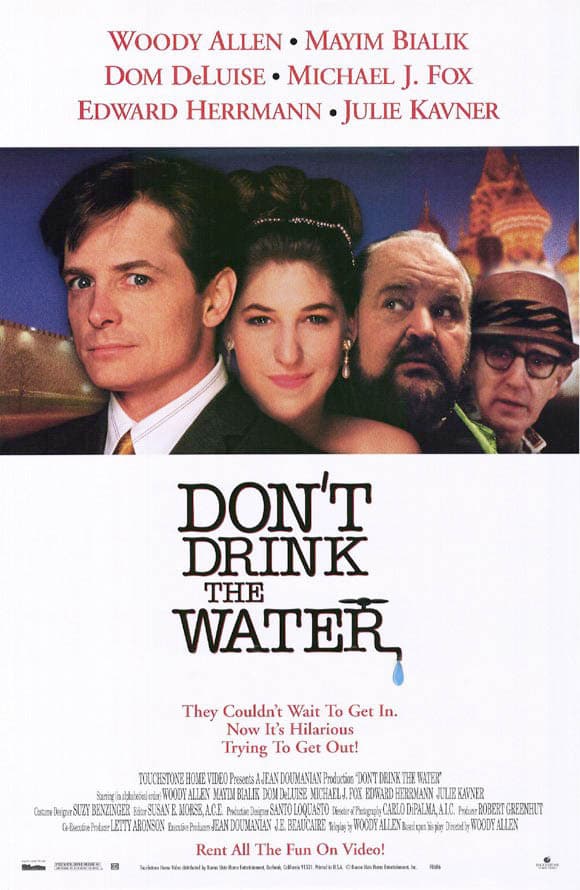
Don't Drink the Water (1994)
Woody Allen and Julie Kavner have great chemistry together as the leads (probably the last time a leading Woody Allen had good chemistry with his co-lead until Scoop, another movie involving an amateur magician—coincidence??). In fact, this is probably the best Kavner has ever been in a Woody Allen feature—though that's probably because she's usually underutilized. It certainly isn't because this movie is much good, because it isn't. For a movie that was once a play now on its second adaptation, it's haphazardly scripted and only intermittently amusing, to say nothing of the uncomfortable racial dynamics. Xenophobia/nonwhite cultural caricature (the movie ends with Allen's character sneaking off in a Middle-Eastern "harem"—dressed in drag in what I'm sure is not at all an authentic garb) is a rare flavor for Allen, and it's an unsavory one. Grade: C
Cat People (1982)
Paul Schrader's 1982 update of the 1942 classic is this weird mix of trash cinema and arthouse, and I gather that's kind of his thing. Unfortunately, it doesn't make any damn sense here. Cat People is an incomprehensible parade of nonsensical mysticism, male-gazey eroticism, and dull footage of the New Orleans zoo. The movie makes a litany of interesting and potentially rewarding decisions (setting the film in New Orleans, casting Malcolm McDowell, using that cinematography and that lighting), but it's at a complete loss as to how to put it all together. The result is a movie that's both bewilderingly bad and stultifyingly boring—a huge step down from the Tourneur original. At least the David Bowie main theme and Giorgio Moroder score are pretty good. Grade: C-
New York, New York (1977)
A great example of how a good movie is not just the accumulation of a lot of good ideas. New York, New York is made almost entirely out of good ideas: the lighting, the shot composition, the juxtaposition of New Hollywood grit with Old Hollywood musical artifice, the pairing of peak Liza Minnelli with peak Robert De Niro, the music, that nearly thirty-minute montage of Minnelli in out-of-context musical sequences belting out number after number—it's all good. But unfortunately, the movie is sunk by its lone bad idea, which is that all these elements should be crammed together indiscriminately into a movie nearly three hours in length. Grade: B-
Television
Dear White People, Volume 2 (2018)
As with its first season, Dear White People's second season's most impressive and distinctive achievement is how it manages to personify and dramatize with shocking fidelity the contemporary political discourse surrounding race and progressive politics, while at the same time making its characters characters and not merely symbols or mouthpieces for certain political archetypes. This season has the added bonus of including several conservative and alt-right voices as well, and the effect is something like watching a Twitter thread come to life—when the characters aren't actually on social themselves, which happens in several extended sequences. That may sound unappealing (I certainly find Twitter unappealing in real life), but in practice, Dear White People is (yet again) simultaneously one of the most vital depictions of the ways modern-day ideologies interact and a razor-sharp character-based dramedy. So you get episodes like "Chapter VIII," where the entire episode revolves, bottle-episode-style, around an argument between Sam and Gabe, and it's both a bracing character moment and a breathtaking examination of the conflicts between people of color's trauma and the role of white allies' "good intentions." It's not all great. The season as a whole isn't quite as cohesive or consistent as the show's first; lacking central organizing events like the blackface party or the gun being pulled on Reggie, Season 2 has the characters drift in disparate directions that don't always tie back together, leading to the underdevelopment of some of the season's threads (Tessa Thompson shows up, e.g., but her character is far too briefly examined to have her climactic moment have weight), and though I enjoy the historical scope of this season, an extended subplot involving Ivy League secret societies is something I found hard to take seriously, right up to the strange, baffling finale. But taken as a whole, Dear White People remains audacious and riveting. There's no show on right now doing stuff like this; it's electrifying. Grade: A-
Books
The Miserable Mill by Lemony Snicket (2000)
The narrative voice is as fun and morose as ever, and the details of this world are still surreal and great—my favorite this time around is that the mill workers only get chewing gum to eat at lunch. However, this book is suffocated under the series's increasingly rigid formula. The narrator seems more and more aware of this formula with each successive entry, but self-awareness and meta-commentary doesn't really make it any more interesting to read the same plot beats for the fourth time in a row. Grade: B-
The Austere Academy by Lemony Snicket (2000)
But now this is more like it. The Austere Academy isn't a complete break with the Series of Unfortunate Events formula, but it's enough to spice it up enough that I'm back onboard. The introduction of the Quagmire triplets as well as hints of a broader conspiracy/mystery (V.F.D.?) are relatively small additions, but they broaden the scope of the series in pleasantly evocative ways. Also, maybe it's just my profession talking, but the school-by-way-of-Kafka depiction of the titular academy is a highlight of my read-through of this series so far. There's something so very familiar about a school putting so much faith in an "advanced computer system" that ultimately fails spectacularly. Grade: B+
The Ersatz Elevator by Lemony Snicket (2001)
To say that The Ersatz Elevator is the best book in A Series of Unfortunate Events since Snicket kicked the whole thing off with The Bad Beginning isn't a statement meant to disparage the intervening four books (well, except maybe The Miserable Mill); it's more just me gushing about how big and alive and absolutely packed with ideas Elevator is. Everything the series does well is at its best in this book. The setting is hilarious, morbid, and surreal (this time, the Baudelaires are living with trendy rich people in a big-city high rise obsessed with what is "in" and what is "out"—ocean decorating becomes "in," so they spread sand and shells about their penthouse); Count Olaf's plan is arch and byzantine (involving an auction that is a front for child trafficking, basically?); Lemony Snicket's increasingly intrusive narrator is bone dry and Eeyore-ish (and he's apparently on death row?); the breadcrumbing of the series's mystery is tantalizing and effectively staged (a moment late in the novel involving a secret passage is thrilling in exactly the same way that text adventure games like Zork can be, and while I'm sure I'm the only person in the world excited by this, I'll take it); and for those playing Spot the Literary Reference with this series, there's an allusion to none other than Thomas Pynchon's The Crying of Lot 49, which seems as much of a statement of purpose for the series as we've ever gotten. This book is the series bursting into color. This book is great. Grade: A
Music
Sons of Kemet - Your Queen is a Reptile (2018)
One of the year's most fascinating and engrossing jazz records comes from Great Britain of all places. In the year of yet another royal wedding, it's cathartic and brash for Sons of Kemet to declare what they do in this album's title, and the music within is in the same spirit, each track's declaration of "My Queen" a triumphant and angry counterpoint to the title's dismissal of "Your Queen." "My Queen Is Angela Davis" one track says; "My Queen Is Harriet Tubman," says another, and yet another screams, "My Queen Is Albertina Sisulu"—each track a celebration of black women both well-known and obscure to white Western audiences (or at least to me), each track a winding groove set to the furious Afrobeat drive of the percussion and the fire of the occasional lyrics. I'm not sure if this is jazz's future or just one of its many, many historical and political tendrils that I'm only just now discovering, but it's definitely one of the definitive recordings of 2018. Grade: A-
Movies
Solo: A Star Wars Story (2018)
Solo is Disney's first major misstep in their curation of the Star Wars franchise, and it's a completely unforced error. They didn't have to make this movie. As the box office numbers show, few people are interested in a young Han movie—especially since, try as he might (and he does try), Alden Ehrenreich is not Harrison Ford, and if we're being honest, I think it's Harrison Ford that most of us love, not Han. I'll bet that even fewer people wanted a movie that's basically a SparkNotes version of A.C. Crispin's Han backstory trilogy from the old Expanded Universe novels (which I somehow remember with shocking clarity), certainly not one whose story is this lumpy nor whose emotional beats are this laden with doe-eyed sincerity nor whose special effects are this iffy—how is this one of the ten most expensive movies ever made?? The action setpieces at least have the decency to be a lot of fun, and I am absolutely here for Donald Glover's Lando (Glover is clearly having more fun than anyone else in front of or behind the camera). The alien design is also top-notch, and probably the most Lucas-esque thing in the whole Disney-Star-Wars franchise is the mid-movie gambling den where Han and Lando play sabacc with the Millennium Falcon at stake, populated with that same lovingly lurid marriage of rubber prosthetics and pulp sci-fi book covers that animated Mos Eisley Cantina and Jabba's palace. Still, to paraphrase our dearly beloved Harrison Solo, hokey casinos and hammy Donald Glovers are no match for a good movie on your screen, kid, and a good movie this is not. Grade: C
Munich (2005)
It's too long by at least half an hour (163 minutes? Really, Steven?), and that (and the accompanying slackness) is what separates this movie from the greats in Spielberg's filmography. But still, it remains a notable accomplishment, the first of Spielberg's mini-trend of using period pieces to comment on contemporary politics and the last of the most artistically sophisticated stretch of the man's career before he bent back around to his own cliches for a bit. Also, was there any other American movie in the period spanning 2001 to 2005 grappling so earnestly and rigorously with the moral thorns of the War on Terror as this one is? Grade: B+
Training Day (2001)
Basically the best-possible outcome of the intersection between Michael Bay and Paul Verhoeven. I hope that doesn't make it sound like I'm downplaying just how tight Antoine Fuqua's direction is, because it's very tight, finding the ideal gear for this sort of walking-the-line-between-gritty-and-bombastic mainstream filmmaking. Denzel is, of course, great here—I wouldn't have picked this for his lead-actor Academy Award performance (Malcolm X is right there, guys), but it's a high-wire performance that's justly iconic. Oh, and shout-out to Terry Crews for being given basically nothing to do but stand quietly and look intimidating and KNOCKING IT OUT OF THE PARK. Grade: B+
Don't Drink the Water (1994)
Woody Allen and Julie Kavner have great chemistry together as the leads (probably the last time a leading Woody Allen had good chemistry with his co-lead until Scoop, another movie involving an amateur magician—coincidence??). In fact, this is probably the best Kavner has ever been in a Woody Allen feature—though that's probably because she's usually underutilized. It certainly isn't because this movie is much good, because it isn't. For a movie that was once a play now on its second adaptation, it's haphazardly scripted and only intermittently amusing, to say nothing of the uncomfortable racial dynamics. Xenophobia/nonwhite cultural caricature (the movie ends with Allen's character sneaking off in a Middle-Eastern "harem"—dressed in drag in what I'm sure is not at all an authentic garb) is a rare flavor for Allen, and it's an unsavory one. Grade: C
Cat People (1982)
Paul Schrader's 1982 update of the 1942 classic is this weird mix of trash cinema and arthouse, and I gather that's kind of his thing. Unfortunately, it doesn't make any damn sense here. Cat People is an incomprehensible parade of nonsensical mysticism, male-gazey eroticism, and dull footage of the New Orleans zoo. The movie makes a litany of interesting and potentially rewarding decisions (setting the film in New Orleans, casting Malcolm McDowell, using that cinematography and that lighting), but it's at a complete loss as to how to put it all together. The result is a movie that's both bewilderingly bad and stultifyingly boring—a huge step down from the Tourneur original. At least the David Bowie main theme and Giorgio Moroder score are pretty good. Grade: C-
New York, New York (1977)
A great example of how a good movie is not just the accumulation of a lot of good ideas. New York, New York is made almost entirely out of good ideas: the lighting, the shot composition, the juxtaposition of New Hollywood grit with Old Hollywood musical artifice, the pairing of peak Liza Minnelli with peak Robert De Niro, the music, that nearly thirty-minute montage of Minnelli in out-of-context musical sequences belting out number after number—it's all good. But unfortunately, the movie is sunk by its lone bad idea, which is that all these elements should be crammed together indiscriminately into a movie nearly three hours in length. Grade: B-
Television
Dear White People, Volume 2 (2018)
As with its first season, Dear White People's second season's most impressive and distinctive achievement is how it manages to personify and dramatize with shocking fidelity the contemporary political discourse surrounding race and progressive politics, while at the same time making its characters characters and not merely symbols or mouthpieces for certain political archetypes. This season has the added bonus of including several conservative and alt-right voices as well, and the effect is something like watching a Twitter thread come to life—when the characters aren't actually on social themselves, which happens in several extended sequences. That may sound unappealing (I certainly find Twitter unappealing in real life), but in practice, Dear White People is (yet again) simultaneously one of the most vital depictions of the ways modern-day ideologies interact and a razor-sharp character-based dramedy. So you get episodes like "Chapter VIII," where the entire episode revolves, bottle-episode-style, around an argument between Sam and Gabe, and it's both a bracing character moment and a breathtaking examination of the conflicts between people of color's trauma and the role of white allies' "good intentions." It's not all great. The season as a whole isn't quite as cohesive or consistent as the show's first; lacking central organizing events like the blackface party or the gun being pulled on Reggie, Season 2 has the characters drift in disparate directions that don't always tie back together, leading to the underdevelopment of some of the season's threads (Tessa Thompson shows up, e.g., but her character is far too briefly examined to have her climactic moment have weight), and though I enjoy the historical scope of this season, an extended subplot involving Ivy League secret societies is something I found hard to take seriously, right up to the strange, baffling finale. But taken as a whole, Dear White People remains audacious and riveting. There's no show on right now doing stuff like this; it's electrifying. Grade: A-
Books
The Miserable Mill by Lemony Snicket (2000)
The narrative voice is as fun and morose as ever, and the details of this world are still surreal and great—my favorite this time around is that the mill workers only get chewing gum to eat at lunch. However, this book is suffocated under the series's increasingly rigid formula. The narrator seems more and more aware of this formula with each successive entry, but self-awareness and meta-commentary doesn't really make it any more interesting to read the same plot beats for the fourth time in a row. Grade: B-
The Austere Academy by Lemony Snicket (2000)
But now this is more like it. The Austere Academy isn't a complete break with the Series of Unfortunate Events formula, but it's enough to spice it up enough that I'm back onboard. The introduction of the Quagmire triplets as well as hints of a broader conspiracy/mystery (V.F.D.?) are relatively small additions, but they broaden the scope of the series in pleasantly evocative ways. Also, maybe it's just my profession talking, but the school-by-way-of-Kafka depiction of the titular academy is a highlight of my read-through of this series so far. There's something so very familiar about a school putting so much faith in an "advanced computer system" that ultimately fails spectacularly. Grade: B+
The Ersatz Elevator by Lemony Snicket (2001)
To say that The Ersatz Elevator is the best book in A Series of Unfortunate Events since Snicket kicked the whole thing off with The Bad Beginning isn't a statement meant to disparage the intervening four books (well, except maybe The Miserable Mill); it's more just me gushing about how big and alive and absolutely packed with ideas Elevator is. Everything the series does well is at its best in this book. The setting is hilarious, morbid, and surreal (this time, the Baudelaires are living with trendy rich people in a big-city high rise obsessed with what is "in" and what is "out"—ocean decorating becomes "in," so they spread sand and shells about their penthouse); Count Olaf's plan is arch and byzantine (involving an auction that is a front for child trafficking, basically?); Lemony Snicket's increasingly intrusive narrator is bone dry and Eeyore-ish (and he's apparently on death row?); the breadcrumbing of the series's mystery is tantalizing and effectively staged (a moment late in the novel involving a secret passage is thrilling in exactly the same way that text adventure games like Zork can be, and while I'm sure I'm the only person in the world excited by this, I'll take it); and for those playing Spot the Literary Reference with this series, there's an allusion to none other than Thomas Pynchon's The Crying of Lot 49, which seems as much of a statement of purpose for the series as we've ever gotten. This book is the series bursting into color. This book is great. Grade: A
Music
Sons of Kemet - Your Queen is a Reptile (2018)
One of the year's most fascinating and engrossing jazz records comes from Great Britain of all places. In the year of yet another royal wedding, it's cathartic and brash for Sons of Kemet to declare what they do in this album's title, and the music within is in the same spirit, each track's declaration of "My Queen" a triumphant and angry counterpoint to the title's dismissal of "Your Queen." "My Queen Is Angela Davis" one track says; "My Queen Is Harriet Tubman," says another, and yet another screams, "My Queen Is Albertina Sisulu"—each track a celebration of black women both well-known and obscure to white Western audiences (or at least to me), each track a winding groove set to the furious Afrobeat drive of the percussion and the fire of the occasional lyrics. I'm not sure if this is jazz's future or just one of its many, many historical and political tendrils that I'm only just now discovering, but it's definitely one of the definitive recordings of 2018. Grade: A-
Sunday, December 17, 2017
Mini-Reviews for December 11 - 17, 2017
I'm not really sorry my Star Wars review is so long, but I suppose it deserves an admittance that calling such a review "mini" is sort of laughable. So laugh away.
Movies
Star Wars: The Last Jedi (2017)
Let's get this over with: The Last Jedi has the worst John Williams Star Wars score by a comfortable margin, and it's the first Star Wars movie that, despite some very nice imagery late in the film, doesn't strive for visual grandeur. The extent to which these two things will hamper your enjoyment of the film is entirely dependent on how much you value those things in Star Wars, and unfortunately for The Last Jedi, score and visual grandeur are two of the things I want most out of Star Wars, which makes their relative weaknesses two of three things that keep me from crowing with the rest of y'all that this is the first great Star Wars movie since the original trilogy. The third thing that keeps it from greatness is, I think, a bit less personally subjective and a bit more critically substantive, and that's the way that The Last Jedi glibly punts all its thorny philosophical questions in its finale. And oh boy, are there thorny philosophical questions—The Last Jedi wants to be a ruthless interrogation of several of the key philosophical frameworks of Star Wars, including the value of individual heroism and the necessity of the Jedi to defeat darkness. The fact that the movie is asking these questions in the first place and actually walks them right up to the brink of something truly radical within the franchise is a testament to how smartly writer/director Rian Johnson is engaging with this intellectual property, and the fact that he doesn't actually jump off that ledge is either a crippling moment of trepidation on Johnson's part or an exhibition of the exact length of the leash Kathleen Kennedy is keeping him on—I can't decide which. Regardless, there's no question that the movie, twisty and emotionally potent, is the most narratively engaging Star Wars movie since the original trilogy (which is, I suspect, what a lot of people mean when they call a movie "great" anyway), and it's the most seriously any Star Wars property has taken the franchise mythology since Lucas was in charge—i.e. engaging the series ideas as ideas and not sacred texts to emulate. It's also the least-seriously any Star Wars movie has taken the franchise since Lucas was in charge, by which I mean that there is very little reverence for the form that Star Wars has taken up to this point (which is why my above critiques of visuals and score strike me as possibly a missing of the point on my part); it has absolutely no fear of yanking the film into genres heretofore never explored in the franchise (there's a brief casino heist, e.g.), nor is it too timid to engage with the elements of slapstick and B-movie goofiness that people often like to forget has been a staple of the series since 1977. I mean, there's an honest-to-goodness allusion to "Hardware Wars," the 1978 parodic short film that Lucas considered his favorite Star Wars send-up. The tone of The Last Jedi is all over the place in the best way possible, and it's the life blood of this movie (and shout-out to Domhnall Gleeson, who is legitimately great in bringing the sort of Laurel-and-Hardy comedy to his role as villain that the Star Wars villainy has always teetered on the edge of). In this regard, The Last Jedi feels a lot like—God help me—the prequel films, which (intentionally or not) are on a narrative level a pretty dedicated repudiation of the Hero's Journey and Jedi mythos and on a tonal level a grab bag of silly aliens, operatic character types, and genre experimentation. This isn't a bad thing, and you know what? The prequels aren't really that bad either, at least not on the hysterical level that an overly incensed nerd culture has made them out to be. I bet Rian Johnson would have put midi-chlorians in this movie if Disney had let him. Grade: B+
John Wick: Chapter 2 (2017)
I.e. "Collateral Damage? What's That?": The Movie. Honestly, for a film that knows how to make its killing so tactile and viscerally impactful, it cares shockingly little about human life outside of that of John Wick and his antagonist, Santino D'Antonio, whose lives seem to hold nearly cosmic importance within the increasingly byzantine world of this franchise. "The man, the myth," one character greets our hero, and he's basically right; John Wick has essentially become Achilles (or is it Macbeth?) and the world around him some sort of Olympian stage made entirely of penthouse suites and art galleries, upon which he battles other limber deific actors as he lumbers through the motions of some grand drama (or perhaps tragedy). In that sense, the heightened levels of myth-making position Chapter 2 much better to comment on its own violence than its more grounded predecessor, as the narrative's own grandiose aims excuse us from caring about anyone but our principal players, in the same way that only pesky humanists care about the way Hamlet sends Rosencrantz and Guildenstern gleefully to their deaths. But I'm sort of getting ahead of myself—who cares about all this moral philosophizing when the movie looks so freaking COOL? If the whole cinematic tradition of hall-of-mirrors finales was merely a decades-long breadcrumb trail to get us to John Wick: Chapter 2's climax, I'd say that sounds about right. Grade: A-
Columbus (2017)
Surely I'm not the first person to have gotten Lost in Translation vibes from Columbus, right? Ennui and low-key heartbreak set against an often alien-seeming geography? No matter—it's the sort of achingly beautiful work of film that deserves to be discussed on its own terms. From the exquisite framing of Columbus, Indiana's distinctive modern architecture to the warm but slightly prickly companionship that forms between our two protagonists through their small, intimate conversations, this is a movie that invites us to let its textures wash over us, small pieces making a small story with large feelings. Some of the plot feels a little by-the-numbers, but it's never not sincere in them, and there are moments of transcendence, too—e.g. when a character is asked to explain not the academic but the emotional reasons that make her love a particular edifice, and we're suddenly transported with the camera to the building's interior, watching her mouth through the glass as it emits words we'll never hear, the film's ambient score swelling for the first time. Grade: B+
On the Beach Alone at Night (밤의 해변에서 혼자) (2017)
To make what is probably a problematic comparison, this feels like Hong Sang-soo's Deconstructing Harry—a fragmented film that takes the director's tropes and cuts them into vignettes in the service of something that's halfway between penance and apologia for his sexual misdeeds (though admirably, Hong foregrounds the woman involved [Kim Min-hee, who absolutely owns this movie] and the effects of his behavior on her, as opposed to Allen's male-centric POV). Also as with Harry, there's a pretty sizable gap between the great success of individual scenes and the kind of shaky effect of the film's whole. The absolute best moments of the movie are a pair of long, liquor-fueled dinner-table conversations in the film's back half, live-wire sequences that play to the very best of Hong's abilities; the less pointed and kind of draggy connective tissue that ties these scenes (and a few other conversational setpieces) together works much less well, and I'm just not sure what to do with the flights of surreal metatextuality a la the repeated sleep/theater imagery (is this all a dream? just film fantasy?) and the recurring appearance of a mysterious man who really needs to know the time and can clean windows like nobody's business. It's an interesting experiment, one that feels decidedly less schematic than last year's Right Now, Wrong Then (the other Hong film I've seen) but also much less warm and approachable. Grade: B-
Che (2008)
Sort of American Indie's response to Spike Lee's Malcolm X, in the sense that it's an epic biopic of a controversial, martyred radial leader. Che has little of the sensuality of Lee's ecstatic humanism, Soderbergh instead opting for a vérité digital cinematography that, for all its you-are-there POVing, has a sort of chilly distance to it that rarely tries to dramatize the experience of Che's passion in the same way that we all become Malcolm. There's beauty in that starkness, though, particularly in Part One, which juxtaposes the grainy b&w of Guevara's UN visit with the broad political sweep of his Fidel-collaborating actions in Cuba. Part Two, a beat-for-beat breakdown of his fatal involvement in Bolivian guerrilla warfare, is much more formally straightforward and not nearly as interesting to me; still, the slow dismemberment of the Bolivian revolution is compellingly meticulous and thrilling in parts, so I can't complain too much. Taken as a whole, this is a pretty striking accomplishment. Grade: B+
Music
King Gizzard & the Lizard Wizard - Polygondwanaland (2017)
The fourth (!) of five (!!!) albums released by King Gizzard, and though they've all been good, Polygondwanaland is my favorite. It's possible that I'm just cheap—Polygondwanaland (how many times do I have to type that name?) was released online for free, and hey, I like free things. But more than that, (here we go again) Polygondwanaland seems particularly curated to my specific interests. It's not that King Gizzard & the Lizard Wizard with their psych-rock silliness are ever too far afield of my interests. But the way that this album doubles down on the proggy legacy of psychedelia delights me in a way that I imagine not all modern listeners can relate to, and with the cover looking like a trippy screenshot from Ultima Underworld, I'm basically in heaven here. I do wish the band would reach a little beyond the same psych-prog palette that's existed for over 40 years now—look, y'all are already weird, but can we get freaky weird?—but that's a minor gripe, considering how good the Gizzard boys are at what they do. Grade: A-
Sunday, March 12, 2017
Mini-Reviews for March 6 - 12, 2017
I'm posting this early because I'm going out of town this week. Spring break and east-coast snow, here I come!
Movies
Logan (2017)
I'm as surprised as anyone that the first superhero movie to get this close to greatness since Guardians of the Galaxy is one from Fox's X-Men franchise, a series that, despite its admirable ludicrousness, I've always been tepid toward outside of the few-and-far-between highlights (i.e. X2 and sorta First Class). It probably helps that Logan wants basically nothing to do with its X-Men peers, having set its story a decade into the future and, in what is likely as much out of spite for its franchise as dystopian despair, killed off pretty much every single recognizable mutant outside of its title character and a doddering, senile Charles Xavier (who, in one of the movie's more sadistic touches, is strongly implied to have accidentally caused a good portion of those X-Men deaths). It also helps that this is the first X-Men film where the central metaphor works; whereas the "X-Men as [insert marginalized group]" subtexts in past films have felt flimsy at best, Logan's positioning of mutants (really, children of mutants, since, you know, the original ones are all dead) as immigrants feels absolutely inspired. Scratch that: not just inspired; it's downright subversive, inverting the traditional American immigration narrative by having mutants fleeing north to Canada in response to the hostility of the American social climate of 2029. This is, I think, the first American film that feels post-2016 in the way that movies in the early 2000s felt post-9/11 and in the mid-'70s felt post-Watergate—there's a militarized border wall between Mexico and the USA; water is contaminated; eminent domain is resisted; social infrastructure is fragmented beyond repair; there's the unshakable feeling that the good guys, well-intentioned as they may have been, played a role in making the world this way. It's heavy and grim and ponderous and everything I hope superheroes don't overwhelmingly become. But as a deconstructive one-off, Logan feels vital. Grade: A-
Kate Plays Christine (2016)
It's understandably a difficult task to embody anyone in the way that acting asks an actor to, but Kate Plays Christine shows a decidedly more difficult task still. This documentary follows actress Kate Lyn Sheil as she prepares for the central role in a film adaptation of the life of Christine Chubbuck, a news reporter who committed suicide on live television in 1974 (something that—and the documentary backs me up here—seems to have been a vital influence on the film Network). An intriguing subject for a doc, for sure, and if the way it goes about documenting it—a disorienting mix of traditional fly-on-the-wall documentary film, talking heads, excerpts from the finished film (a cheapie, from the looks of it), and what seem to be dramatic and somewhat hyperreal reenactments of Sheil's experiences playing Christine—is a bit too mannered to be as compelling as the movie wants it to be, it's still an interesting look into the mechanics and ethics of acting. Grade: B
Oasis: Supersonic (2016)
This fairly dense, comprehensive documentary of the Britpop titans Oasis during their golden '90s years, stretching from the band's inception through the release of their megasuccess sophomore album (What's the Story) Morning Glory?, has plenty of great footage from concerts and behind the scenes, making it a rewarding document of, as is pointed out in the film, one of the last pre-internet, pre-cultural diaspora rock and roll monoliths. That relial on you-are-there footage also does a fantastic job of both capturing what made this group the towering force of rock and roll songwriting and performance that it was and also showing the exact factors (namely, sibling rivalry, inconceivable ego, and an unholy amount of drugs) that inevitably led to their collapse years down the line. And it does all this without so much mentioning traditional whipping boy Be Here Now, which is sort of a feat unto itself. Plus, if nothing else, this doc features plenty of interview footage of the incomparable Liam Gallagher, the most consistently entertaining musician in interview for nearly thirty years running. Grade: B+
Boy (2010)
Writer/director Taika Waititi has quite a résumé as pretty much the sole non-Wes-Anderson master currently working in the quirk dramedy idiom, a genre I'd be quick to call dead (or at least hibernating) if it weren't for those two. Boy is far and away his best, too, which is not to say anything negative about the immense fun of What We Do in the Shadows and Hunt for the Wilderpeople but rather just to stress just how freaking GREAT Boy is. That it sports Waititi's tremendous facility with gentle mockery and hilariously failed precociousness is no surprise; what's a bit more unexpected is just how emotionally raw the film is willing to get—a precipitous dip toward deep domestic pain in the film's third quarter feels as well-observed and human as any of the comedy here, and what's better is that the film still manages a happy ending without undoing or cheapening any of that pain. A lovely coming-of-age film not to be missed. Grade: A
Star Wars: The Clone Wars (2008)
I've softened on the Star Wars prequels over time; there's something to be said for the purity of Lucas's artistic vision on display, and for every "I don't like sand," there's an arresting image or fantastic creature design or inventive piece of worldbuilding. But this hot garbage—the quickie 2008 animated disaster that somehow made it to a wide theatrical release—I can't imagine ever warming to. Devoid of all but the barest thread of characterization and plot and completely lacking in any wonder or artistry, The Clone Wars is a gigantic bore, giving scarcely more than a cursory glance at any of the litany of interesting threads to pick up in Lucas's universe (look, I know people complain about the focus on the politics in the prequels, but this is what those prequels would be without the political angle, and let me tell you: it's dire). The cruel joke, too, is that although the monotone dialogue and mechanical, overly smooth animation gives the impression of watching a film at 1.25 speed, there's still 100 minutes of the thing here. Reportedly, the television series that spun off this movie is pretty good (and given the richness of the Old Republic world depicted in the prequels, I can believe it), and preparing to watch the show was my initial reason for watching this. But now I'm rethinking everything. Grade: D
The Game (1997)
Typical of at least half of director David Fincher's output (but even more so here), The Game is an immaculate, meticulously designed, beautifully constructed rendering of an altogether ridiculous and absurd premise. In brief: a rich dude pays lots of money to play a game that might not be a game, and thus gives him a heck of a head trip and thrusts him out the other side a marginally better person. I'm a big fan of Fincher's more serious-minded work (namely Zodiac and The Social Network), but works of gonzo pulp like this and the more recent Gone Girl suggest that Fincher's direction is more at ease in this weird, Hitchcockian element, hoisted into the space between smut and art by sheer force of formal elegance. Grade: B
Knife in the Water (Nóż w wodzie) (1962)
Roman Polanski, it seems, is one of those lucky magicians who arrives to this world with a full bag of tricks—his directorial debut, the tense Knife in the Water, is every bit the kind of film we'd come to expect from the acclaimed (and infamous) director down the line: tight compositions, patient and foreboding cinematography, paranoia, etc. The film all these flourishes are in service of isn't really much to write home about, a Bergman-esque chamber drama on a boat that's just a bit too familiar to be anything great, but it's solid and engrossing enough. Grade: B+
Books
Every Day by David Levithan (2012)
Every day, the protagonist wakes up inhabiting a different body. For much of the novel, the rules of this inhabitation are left vague, and that's fine, the book being more interested in telling a sort of high-concept fantasy romance than being any treatise on identity or body autonomy ethics (just what exactly is it okay to do when you're inhabiting another person's body for a day?), although both subjects are touched on. It's only after a late-book twist wants to make the mechanics and ethics of body inhabitation a major plot point—and in fact rushes the book toward an underexplained ending—that that vagueness becomes a liability and overtakes what is otherwise a fine romance between the protagonist and the girl whom s/he must, of course, confront as a different person each day. There are apparently sequels/companions to this book. Perhaps they could make this ending more satisfying. But as it is on its own, Every Day is a breezy but flawed read. Grade: B-
Music
Bruce Springsteen - Nebraska (1982)
This being me, of course I find Bruce Springsteen's most despairing album also one of his most accomplished. Rarely have the Boss's narratives felt more alive or more tragic, and rarely have his protagonists been more down on their luck. It all culminates in the closer "Reason to Believe," one of Bruce's most deliciously ambivalent tracks, where it's unclear whether or not it's foolish to hope—perfect in its ambiguity. Because even among the most hopeful of us all, who really knows? Grade: A
Movies
Logan (2017)
I'm as surprised as anyone that the first superhero movie to get this close to greatness since Guardians of the Galaxy is one from Fox's X-Men franchise, a series that, despite its admirable ludicrousness, I've always been tepid toward outside of the few-and-far-between highlights (i.e. X2 and sorta First Class). It probably helps that Logan wants basically nothing to do with its X-Men peers, having set its story a decade into the future and, in what is likely as much out of spite for its franchise as dystopian despair, killed off pretty much every single recognizable mutant outside of its title character and a doddering, senile Charles Xavier (who, in one of the movie's more sadistic touches, is strongly implied to have accidentally caused a good portion of those X-Men deaths). It also helps that this is the first X-Men film where the central metaphor works; whereas the "X-Men as [insert marginalized group]" subtexts in past films have felt flimsy at best, Logan's positioning of mutants (really, children of mutants, since, you know, the original ones are all dead) as immigrants feels absolutely inspired. Scratch that: not just inspired; it's downright subversive, inverting the traditional American immigration narrative by having mutants fleeing north to Canada in response to the hostility of the American social climate of 2029. This is, I think, the first American film that feels post-2016 in the way that movies in the early 2000s felt post-9/11 and in the mid-'70s felt post-Watergate—there's a militarized border wall between Mexico and the USA; water is contaminated; eminent domain is resisted; social infrastructure is fragmented beyond repair; there's the unshakable feeling that the good guys, well-intentioned as they may have been, played a role in making the world this way. It's heavy and grim and ponderous and everything I hope superheroes don't overwhelmingly become. But as a deconstructive one-off, Logan feels vital. Grade: A-
Kate Plays Christine (2016)
It's understandably a difficult task to embody anyone in the way that acting asks an actor to, but Kate Plays Christine shows a decidedly more difficult task still. This documentary follows actress Kate Lyn Sheil as she prepares for the central role in a film adaptation of the life of Christine Chubbuck, a news reporter who committed suicide on live television in 1974 (something that—and the documentary backs me up here—seems to have been a vital influence on the film Network). An intriguing subject for a doc, for sure, and if the way it goes about documenting it—a disorienting mix of traditional fly-on-the-wall documentary film, talking heads, excerpts from the finished film (a cheapie, from the looks of it), and what seem to be dramatic and somewhat hyperreal reenactments of Sheil's experiences playing Christine—is a bit too mannered to be as compelling as the movie wants it to be, it's still an interesting look into the mechanics and ethics of acting. Grade: B
Oasis: Supersonic (2016)
This fairly dense, comprehensive documentary of the Britpop titans Oasis during their golden '90s years, stretching from the band's inception through the release of their megasuccess sophomore album (What's the Story) Morning Glory?, has plenty of great footage from concerts and behind the scenes, making it a rewarding document of, as is pointed out in the film, one of the last pre-internet, pre-cultural diaspora rock and roll monoliths. That relial on you-are-there footage also does a fantastic job of both capturing what made this group the towering force of rock and roll songwriting and performance that it was and also showing the exact factors (namely, sibling rivalry, inconceivable ego, and an unholy amount of drugs) that inevitably led to their collapse years down the line. And it does all this without so much mentioning traditional whipping boy Be Here Now, which is sort of a feat unto itself. Plus, if nothing else, this doc features plenty of interview footage of the incomparable Liam Gallagher, the most consistently entertaining musician in interview for nearly thirty years running. Grade: B+
Boy (2010)
Writer/director Taika Waititi has quite a résumé as pretty much the sole non-Wes-Anderson master currently working in the quirk dramedy idiom, a genre I'd be quick to call dead (or at least hibernating) if it weren't for those two. Boy is far and away his best, too, which is not to say anything negative about the immense fun of What We Do in the Shadows and Hunt for the Wilderpeople but rather just to stress just how freaking GREAT Boy is. That it sports Waititi's tremendous facility with gentle mockery and hilariously failed precociousness is no surprise; what's a bit more unexpected is just how emotionally raw the film is willing to get—a precipitous dip toward deep domestic pain in the film's third quarter feels as well-observed and human as any of the comedy here, and what's better is that the film still manages a happy ending without undoing or cheapening any of that pain. A lovely coming-of-age film not to be missed. Grade: A
Star Wars: The Clone Wars (2008)
I've softened on the Star Wars prequels over time; there's something to be said for the purity of Lucas's artistic vision on display, and for every "I don't like sand," there's an arresting image or fantastic creature design or inventive piece of worldbuilding. But this hot garbage—the quickie 2008 animated disaster that somehow made it to a wide theatrical release—I can't imagine ever warming to. Devoid of all but the barest thread of characterization and plot and completely lacking in any wonder or artistry, The Clone Wars is a gigantic bore, giving scarcely more than a cursory glance at any of the litany of interesting threads to pick up in Lucas's universe (look, I know people complain about the focus on the politics in the prequels, but this is what those prequels would be without the political angle, and let me tell you: it's dire). The cruel joke, too, is that although the monotone dialogue and mechanical, overly smooth animation gives the impression of watching a film at 1.25 speed, there's still 100 minutes of the thing here. Reportedly, the television series that spun off this movie is pretty good (and given the richness of the Old Republic world depicted in the prequels, I can believe it), and preparing to watch the show was my initial reason for watching this. But now I'm rethinking everything. Grade: D
The Game (1997)
Typical of at least half of director David Fincher's output (but even more so here), The Game is an immaculate, meticulously designed, beautifully constructed rendering of an altogether ridiculous and absurd premise. In brief: a rich dude pays lots of money to play a game that might not be a game, and thus gives him a heck of a head trip and thrusts him out the other side a marginally better person. I'm a big fan of Fincher's more serious-minded work (namely Zodiac and The Social Network), but works of gonzo pulp like this and the more recent Gone Girl suggest that Fincher's direction is more at ease in this weird, Hitchcockian element, hoisted into the space between smut and art by sheer force of formal elegance. Grade: B
Knife in the Water (Nóż w wodzie) (1962)
Roman Polanski, it seems, is one of those lucky magicians who arrives to this world with a full bag of tricks—his directorial debut, the tense Knife in the Water, is every bit the kind of film we'd come to expect from the acclaimed (and infamous) director down the line: tight compositions, patient and foreboding cinematography, paranoia, etc. The film all these flourishes are in service of isn't really much to write home about, a Bergman-esque chamber drama on a boat that's just a bit too familiar to be anything great, but it's solid and engrossing enough. Grade: B+
Books
Every Day by David Levithan (2012)
Every day, the protagonist wakes up inhabiting a different body. For much of the novel, the rules of this inhabitation are left vague, and that's fine, the book being more interested in telling a sort of high-concept fantasy romance than being any treatise on identity or body autonomy ethics (just what exactly is it okay to do when you're inhabiting another person's body for a day?), although both subjects are touched on. It's only after a late-book twist wants to make the mechanics and ethics of body inhabitation a major plot point—and in fact rushes the book toward an underexplained ending—that that vagueness becomes a liability and overtakes what is otherwise a fine romance between the protagonist and the girl whom s/he must, of course, confront as a different person each day. There are apparently sequels/companions to this book. Perhaps they could make this ending more satisfying. But as it is on its own, Every Day is a breezy but flawed read. Grade: B-
Music
Bruce Springsteen - Nebraska (1982)
This being me, of course I find Bruce Springsteen's most despairing album also one of his most accomplished. Rarely have the Boss's narratives felt more alive or more tragic, and rarely have his protagonists been more down on their luck. It all culminates in the closer "Reason to Believe," one of Bruce's most deliciously ambivalent tracks, where it's unclear whether or not it's foolish to hope—perfect in its ambiguity. Because even among the most hopeful of us all, who really knows? Grade: A
Monday, January 9, 2017
Mini-Reviews for December 26, 2016 - January 9, 2017
Happy 2017! So, it's been a long time, I know. With all the end-of-year happiness (including my lists for music and movies—check 'em out!), I didn't have a chance to keep up with reviews. But here are some now! Without further ado, I present the first reviews post of 2017, mega edition.
Rogue One (2016)
As many, many people have pointed out before me, the beginning of this movie is rough. Really rough. As I watched the action scoot among five different planets and Lord knows how many different characters within five minutes, I had the sinking feeling that I was not going to like this scattered, confusing mess of a film. And indeed, up through the end of the section involving Forest Whitaker's Saw Gerrera (I didn't time, but reportedly 45-60 min. into the movie), I was getting that numb feeling I got by the end of The Force Awakens, that the film was mistaking quips for wit, emotive acting for clear character motivation, and action sequences for stakes. But then. Oh but then. The rest of the movie happened, and ladies and gentlemen, the hour-plus of movie remaining after that shaky beginning is the best Star Wars cinema we've gotten since the legendary tri-part climax of Return of the Jedi. Honestly, comparisons between Jedi and Rogue One are instructive, as both movies putter around on a desert planet with grizzled bottom-feeders before kicking into high, high gear with an epic battle that occupies a vegetated ground level, a tech-y fortress level, and a dogfight-esque space level simultaneously. In both cases, the results are breathtaking, exhilarating action spectacles. For as much flak as The Force Awakens caught for cribbing A New Hope's style and structure, Rogue One adopts much of the same in relation to Episode VI. The difference is that where Force Awakens uses those structural parallels to try to borrow the mythic vibes from its predecessor, Rogue One, with the exception of Donnie Yen's Guardian of the Whills (which, if I'm not mistaken, is an allusion to an early draft of Lucas's original Star Wars storyline—surely the most surprising and obscure of the film's many, many original trilogy easter eggs), largely jettisons the heavy mythology that informs Jedi's plot in favor of a boots-on-the-ground militaristic approach. People online have been batting around the idea that Rogue One is the movie to finally put the "War" in Star Wars, and that's obviously false to anyone who has watched any of the original trilogy or the Clone Wars TV series. But I will go to bat for the idea that this is the Star Wars movie that spends the most energy presenting the intergalactic violence as the endeavors of large military entities rather than the shuffling about of the same cast of half-dozen distantly related characters. Whatever the case, the emphasis on military action and maneuvers means that it doesn't matter if the characters never quite recover from the film's crumbling first section (and, honestly, they don't—these characters are either painted in such broad strokes or presented so opaquely that none of them ever really land) because this isn't a movie about characters so much as big action setpieces involving large numbers of combatants and vehicles, and as that, it's great. Rogue One has some of the best action of 21st century blockbuster history, and it has the good sense to put the very best stuff as close to the end as possible. I started the movie a bit frustrated; I ended it elated and feeling, for the first time since I don't even know when that I was excited for the future of the Star Wars universe. Grade: A-
Don't Breathe (2016)
A mean, nasty little horror thriller that smartly reverses the home-invasion formula so that we follow the band of invaders rather than the invadee. Good thing, too, because the more we learn about the blind man who lives in the house our teen protagonists break into, the nastier and less effective the film becomes. Apparently the best way to make us care about burglars is to make the guy they are robbing from even worse than a bunch of kids willing to rob a blind man. Don't Breathe is at its best when it sticks to the tactile terror of the robbers having to avoid detection in the house, grounded by fantastic lighting and sound design. Grade: B+
Blair Witch (2016)
The original Blair Witch Project movie is one of THE great American horror films and, with its often incomprehensible camerawork and half-improvised scripting, probably the nearest mainstream horror has ever gotten to the pure avant-garde, if only (as is likely) accidentally so. It's made only greater by the delicious ambiguity that imbues every frame up until the terrifying heights of ambiguity in its ending. Blair Witch, the second sequel to the '99 feature, tries to capture this ambiguity as well, but either due to a lack of commitment or the fact that this movie seems so much more self-consciously constructed compared to the meticulously evoked haphazardness of the original, its open-endedness ends up feeling so much smaller. Giving the kids multiple cameras was a mistake, as was having characters give bits of explanation in the protracted (and somewhat familiar) finale. What we're left with feels a lot closer to a conventional teen horror flick, where we wait with equal parts fear and bloodlust for these vaguely irritating youngsters are picked off one by one. It's a decent iteration of that kind of movie, and the climax does some neat things with camera perspective and the series mythology. But I can't help wanting something a bit more special. Grade: B
Pet (2016)
It's grisly, grimly funny, and has a lot of pulp fun with subverting the bondage/prisoner tropes within its premise (local, stalker-ish lonely dude imprisons the girl he's been obsessing over). But it's also tremendously nasty in temperament and not all that exciting, filmmaking-wise. Plus, once it tips its hand mid-movie to the kind of game its playing, there's not all that many places the film can go that don't feel predictable. As a B-movie thriller (and a chance to see Dominic Monaghan finally get more work [and try on an American accent, no less!]), it's fine, if unremarkable. Grade: B-
Krisha (2015)
On the rubric of "unfun movies about the effects of substance abuse on familial relationships," Krisha gets good marks—it's fantastically acted and stylishly shot. But it's still an unfun movie about the effects of substance abuse on familial relationships, which also makes it kind of a miserable watch. Miserable because it's craft is impeccable, not because the movie is any sort of failure. But miserable all the same, and while I'll acknowledge its power, I'll not rush to see it again. Grade: B
The Hunt (Jagten) (2012)
Considering that its premise—a man falsely accused of sexual assault at the kindergarten where he works—is a personal nightmare of mine, it should be no surprise that I found this movie white-knuckle terrifying. It's probably for the best, though, that the movie is less concerned with the central injustice/misunderstanding than it is with larger ramifications within the small Danish community in which it occurs. This is a movie about mass hysteria and the ways that misinformation spreads and won't let go. In the end, that's the ultimate horror here: the frailty of the truth. Grade: B+
Contact (1997)
The movie's opening shot—a breathtaking, intergalactic zoom out from Earth—is awesome. But it's all downhill from there. Look, I'm a sucker for first-contact movie; you had me in the bag here by your premise alone, Contact! The thing is that it's not just a first-contact movie—it's a science-vs.-religion movie, it's a father-daughter movie, it's a Matthew-McConaughey-is-charmingly-sexy movie, and all of those things are varying degrees of tiresome in execution here, made all the worse by a typical Robert Zemeckis bloated runtime. In fact, for very long stretches of this already very long 2.5 hours, Contact is way more interested in being all those tiresome things than it is at being a first-contact movie. There are good things here beyond the opening shot, but the whole package is just kind of bleh. Not to mention the ending, which is the most jerked around I've felt by a movie in a long while. Grade: C+
Genocide (1982)
I suppose what one gets out of this movie depends on one's knowledge of the Holocaust, since informing seems to be the main purpose here. But given I took a couple high school history courses, there's nothing here that's all that informative to me—in fact, with its short runtime, colorful and dynamic imagery, urgent tone, and breakneck pace, this documentary seems tailor-made for the high school classroom alongside units about Anne Frank and WWII. And there's value in that; the film is solidly (if bluntly) put together, and I'd imagine it would be a good primer on one of the defining events of the 20th century, were someone to need one. But I didn't. So this one isn't for me. Grade: C
The Long Way Home (1997)
A comparison between this movie and 1982's Genocide is instructive—both assume that its audience is in need of being informed of major, world-shaping 20th-century events surrounding the Holocaust, but The Long Way Home, dealing with the post-WWII struggles faced by Europeans Jews leading to the formation of Israel, is the only one of the two that's actually right in that assumption. At least, for me. As I said in my Genocide review, the need to be informed about something will obviously differ wildly from viewer to viewer, and that's no less true here. Either way, we're still dealing with an info-doc, one that I found often fascinating but one that's still chock full of talking heads, archival footage, and other dusty Ken Burns-lite tropes. There's nothing about this form of the movie that's going to wow you. But if you're as ignorant as I am, the content might. Grade: B+
Mother (1996)
Its premise is maybe a little toward the wrong side of sitcommy, and its ending is perhaps a bit too neat and epiphanic. But in between, there is a wealth of well-observed moments, including what is likely the single most accurate depiction of how elderly mothers react to their children being vegetarian (my wife has stories... so many stories). The ability to see yourself or people you know in a movie is not and should not be the ultimate goal of cinema at large. But golly, when this sort of comedic observationalism lands, it's as savory as they come. Grade: B+
Modern Romance (1981)
It's bit too meandery to have the lithe efficiency that characterizes the best comedies (a subplot involving the editing of a sci-fi film feels like an excuse to pad the runtime out to a clean 90 minutes). But Modern Romance has it where it really counts. The film realizes that many of the tropes that govern the romantic comedy are, if looked at from the right angle, less sweeping displays of deep love and more evidence of a pathological way of viewing yourself in relation to others. In fact, Modern Romance revels in turning the rom-com to just such an angle, giving us a hysterical yet often excruciating series of events in which Albert Brooks goes through all the typical rom-com romantic gestures of love and grief, only with the awareness that in reality, these actions are painfully wrong-headed. The modern cringe-comedy ethic has many roots, and I'm sure Albert Brooks is nowhere near the main of that lineage. But the final scene stings with such an agonizing display of human beings stumbling into wrong decision after wrong decision that it's hard not to feel the precedent for something akin to the UK version of The Office. An acerbic, cynical delight, if such words can be strung together like that. Grade: A-
Design for Living (1933)
A spirited and hilarious first half gives way to a much more pedestrian second half. In the annals of screwball comedy (and even more specifically Ernst Lubitsch-directed screwball comedy), this one's no great shakes, but it's intermittently delightful and never really dull. Miriam Hopkins is beyond charming as well, and the fact that this movie has a genuine affection for leftist bohemians (as opposed to the often feigned affection that movies like to adopt) makes this one a pretty good time. Grade: B+
Movies
Rogue One (2016)
As many, many people have pointed out before me, the beginning of this movie is rough. Really rough. As I watched the action scoot among five different planets and Lord knows how many different characters within five minutes, I had the sinking feeling that I was not going to like this scattered, confusing mess of a film. And indeed, up through the end of the section involving Forest Whitaker's Saw Gerrera (I didn't time, but reportedly 45-60 min. into the movie), I was getting that numb feeling I got by the end of The Force Awakens, that the film was mistaking quips for wit, emotive acting for clear character motivation, and action sequences for stakes. But then. Oh but then. The rest of the movie happened, and ladies and gentlemen, the hour-plus of movie remaining after that shaky beginning is the best Star Wars cinema we've gotten since the legendary tri-part climax of Return of the Jedi. Honestly, comparisons between Jedi and Rogue One are instructive, as both movies putter around on a desert planet with grizzled bottom-feeders before kicking into high, high gear with an epic battle that occupies a vegetated ground level, a tech-y fortress level, and a dogfight-esque space level simultaneously. In both cases, the results are breathtaking, exhilarating action spectacles. For as much flak as The Force Awakens caught for cribbing A New Hope's style and structure, Rogue One adopts much of the same in relation to Episode VI. The difference is that where Force Awakens uses those structural parallels to try to borrow the mythic vibes from its predecessor, Rogue One, with the exception of Donnie Yen's Guardian of the Whills (which, if I'm not mistaken, is an allusion to an early draft of Lucas's original Star Wars storyline—surely the most surprising and obscure of the film's many, many original trilogy easter eggs), largely jettisons the heavy mythology that informs Jedi's plot in favor of a boots-on-the-ground militaristic approach. People online have been batting around the idea that Rogue One is the movie to finally put the "War" in Star Wars, and that's obviously false to anyone who has watched any of the original trilogy or the Clone Wars TV series. But I will go to bat for the idea that this is the Star Wars movie that spends the most energy presenting the intergalactic violence as the endeavors of large military entities rather than the shuffling about of the same cast of half-dozen distantly related characters. Whatever the case, the emphasis on military action and maneuvers means that it doesn't matter if the characters never quite recover from the film's crumbling first section (and, honestly, they don't—these characters are either painted in such broad strokes or presented so opaquely that none of them ever really land) because this isn't a movie about characters so much as big action setpieces involving large numbers of combatants and vehicles, and as that, it's great. Rogue One has some of the best action of 21st century blockbuster history, and it has the good sense to put the very best stuff as close to the end as possible. I started the movie a bit frustrated; I ended it elated and feeling, for the first time since I don't even know when that I was excited for the future of the Star Wars universe. Grade: A-
Don't Breathe (2016)
A mean, nasty little horror thriller that smartly reverses the home-invasion formula so that we follow the band of invaders rather than the invadee. Good thing, too, because the more we learn about the blind man who lives in the house our teen protagonists break into, the nastier and less effective the film becomes. Apparently the best way to make us care about burglars is to make the guy they are robbing from even worse than a bunch of kids willing to rob a blind man. Don't Breathe is at its best when it sticks to the tactile terror of the robbers having to avoid detection in the house, grounded by fantastic lighting and sound design. Grade: B+
Blair Witch (2016)
The original Blair Witch Project movie is one of THE great American horror films and, with its often incomprehensible camerawork and half-improvised scripting, probably the nearest mainstream horror has ever gotten to the pure avant-garde, if only (as is likely) accidentally so. It's made only greater by the delicious ambiguity that imbues every frame up until the terrifying heights of ambiguity in its ending. Blair Witch, the second sequel to the '99 feature, tries to capture this ambiguity as well, but either due to a lack of commitment or the fact that this movie seems so much more self-consciously constructed compared to the meticulously evoked haphazardness of the original, its open-endedness ends up feeling so much smaller. Giving the kids multiple cameras was a mistake, as was having characters give bits of explanation in the protracted (and somewhat familiar) finale. What we're left with feels a lot closer to a conventional teen horror flick, where we wait with equal parts fear and bloodlust for these vaguely irritating youngsters are picked off one by one. It's a decent iteration of that kind of movie, and the climax does some neat things with camera perspective and the series mythology. But I can't help wanting something a bit more special. Grade: B
Pet (2016)
It's grisly, grimly funny, and has a lot of pulp fun with subverting the bondage/prisoner tropes within its premise (local, stalker-ish lonely dude imprisons the girl he's been obsessing over). But it's also tremendously nasty in temperament and not all that exciting, filmmaking-wise. Plus, once it tips its hand mid-movie to the kind of game its playing, there's not all that many places the film can go that don't feel predictable. As a B-movie thriller (and a chance to see Dominic Monaghan finally get more work [and try on an American accent, no less!]), it's fine, if unremarkable. Grade: B-
Krisha (2015)
On the rubric of "unfun movies about the effects of substance abuse on familial relationships," Krisha gets good marks—it's fantastically acted and stylishly shot. But it's still an unfun movie about the effects of substance abuse on familial relationships, which also makes it kind of a miserable watch. Miserable because it's craft is impeccable, not because the movie is any sort of failure. But miserable all the same, and while I'll acknowledge its power, I'll not rush to see it again. Grade: B
The Hunt (Jagten) (2012)
Considering that its premise—a man falsely accused of sexual assault at the kindergarten where he works—is a personal nightmare of mine, it should be no surprise that I found this movie white-knuckle terrifying. It's probably for the best, though, that the movie is less concerned with the central injustice/misunderstanding than it is with larger ramifications within the small Danish community in which it occurs. This is a movie about mass hysteria and the ways that misinformation spreads and won't let go. In the end, that's the ultimate horror here: the frailty of the truth. Grade: B+
Contact (1997)
The movie's opening shot—a breathtaking, intergalactic zoom out from Earth—is awesome. But it's all downhill from there. Look, I'm a sucker for first-contact movie; you had me in the bag here by your premise alone, Contact! The thing is that it's not just a first-contact movie—it's a science-vs.-religion movie, it's a father-daughter movie, it's a Matthew-McConaughey-is-charmingly-sexy movie, and all of those things are varying degrees of tiresome in execution here, made all the worse by a typical Robert Zemeckis bloated runtime. In fact, for very long stretches of this already very long 2.5 hours, Contact is way more interested in being all those tiresome things than it is at being a first-contact movie. There are good things here beyond the opening shot, but the whole package is just kind of bleh. Not to mention the ending, which is the most jerked around I've felt by a movie in a long while. Grade: C+
Genocide (1982)
I suppose what one gets out of this movie depends on one's knowledge of the Holocaust, since informing seems to be the main purpose here. But given I took a couple high school history courses, there's nothing here that's all that informative to me—in fact, with its short runtime, colorful and dynamic imagery, urgent tone, and breakneck pace, this documentary seems tailor-made for the high school classroom alongside units about Anne Frank and WWII. And there's value in that; the film is solidly (if bluntly) put together, and I'd imagine it would be a good primer on one of the defining events of the 20th century, were someone to need one. But I didn't. So this one isn't for me. Grade: C
The Long Way Home (1997)
A comparison between this movie and 1982's Genocide is instructive—both assume that its audience is in need of being informed of major, world-shaping 20th-century events surrounding the Holocaust, but The Long Way Home, dealing with the post-WWII struggles faced by Europeans Jews leading to the formation of Israel, is the only one of the two that's actually right in that assumption. At least, for me. As I said in my Genocide review, the need to be informed about something will obviously differ wildly from viewer to viewer, and that's no less true here. Either way, we're still dealing with an info-doc, one that I found often fascinating but one that's still chock full of talking heads, archival footage, and other dusty Ken Burns-lite tropes. There's nothing about this form of the movie that's going to wow you. But if you're as ignorant as I am, the content might. Grade: B+
Mother (1996)
Its premise is maybe a little toward the wrong side of sitcommy, and its ending is perhaps a bit too neat and epiphanic. But in between, there is a wealth of well-observed moments, including what is likely the single most accurate depiction of how elderly mothers react to their children being vegetarian (my wife has stories... so many stories). The ability to see yourself or people you know in a movie is not and should not be the ultimate goal of cinema at large. But golly, when this sort of comedic observationalism lands, it's as savory as they come. Grade: B+
Modern Romance (1981)
It's bit too meandery to have the lithe efficiency that characterizes the best comedies (a subplot involving the editing of a sci-fi film feels like an excuse to pad the runtime out to a clean 90 minutes). But Modern Romance has it where it really counts. The film realizes that many of the tropes that govern the romantic comedy are, if looked at from the right angle, less sweeping displays of deep love and more evidence of a pathological way of viewing yourself in relation to others. In fact, Modern Romance revels in turning the rom-com to just such an angle, giving us a hysterical yet often excruciating series of events in which Albert Brooks goes through all the typical rom-com romantic gestures of love and grief, only with the awareness that in reality, these actions are painfully wrong-headed. The modern cringe-comedy ethic has many roots, and I'm sure Albert Brooks is nowhere near the main of that lineage. But the final scene stings with such an agonizing display of human beings stumbling into wrong decision after wrong decision that it's hard not to feel the precedent for something akin to the UK version of The Office. An acerbic, cynical delight, if such words can be strung together like that. Grade: A-
Design for Living (1933)
A spirited and hilarious first half gives way to a much more pedestrian second half. In the annals of screwball comedy (and even more specifically Ernst Lubitsch-directed screwball comedy), this one's no great shakes, but it's intermittently delightful and never really dull. Miriam Hopkins is beyond charming as well, and the fact that this movie has a genuine affection for leftist bohemians (as opposed to the often feigned affection that movies like to adopt) makes this one a pretty good time. Grade: B+
Television
Black Mirror, Series 3 (2016)
What people sometimes forget about The Twilight Zone, surely the gold standard for the sci-fi anthology show, is that every third or fourth episode was pretty forgettable, if not downright terrible. We remember "Time Enough at Last" and "Eye of the Beholder," but there was also that one about the murderous slot machine. My point is that Black Mirror, a frequently great sci-fi anthology show that's nonetheless inferior to TZ, comes pretty close to putting all its eggs in one basket by having seasons as brief as it does. Season 3 does a little better by actually doubling the show's episode count with its 6-episode season, and that pays off—weaker episodes like the premier Bryce Dallas Howard-starring "Nosedive" feel less like a waste than, say, "The Waldo Moment" from S2, and "Playtest," "Shut Up and Dance," and especially "San Junipero" all three rank among the show's best. Not bad. Grade: B
Orange Is the New Black, Season 1 (2013)
At this early stage in the series, Orange Is the New Black's biggest issue is that its main characters are its least interesting. I care little about Piper and even less about her enemy-cum-lover Alex (who is, let's be honest, little more than a plot catalyst in this season, poignant flashback notwithstanding), and whenever the show focuses on these two, I'm checking out. The rest of the cast is varying levels of poignantly charming, though—at least, those that the show gives any attention (for a show with such a strong reputation for being "woke," it's odd that the series's second-biggest problem is its frequent trafficking in racial stereotypes, something that affects the Hispanic members of the cast most, who rarely rise above their tropes). Really, the sprawling cast is a blessing and a curse here, giving it a rich scope while also occasionally feeling a mile wide and an inch deep. It's a messy, imprecise season but one with considerable strengths, both comedic and dramatic and always toward interesting social commentary. Grade: B+
Books
The Crying of Lot 49 by Thomas Pynchon (1965)
I'm no Pynchon scholar, having only read Inherent Vice prior to this one (and been appropriately bewildered by it), but even on an intellectual level, it's a relief to know that this, his shortest novel, is a mere 150 pages of dense postmodern narrative relative to his normal 500-800. Even better is that the plot is actually coherent and, best of all, super punny. You've got to appreciate a satire of 1960s California culture that makes room for the silly wordplay of characters named Mucho Maas and Dr. Hilarius, not to mention the many parodic depictions of mid-'60s rock and roll—"I Want to Kiss Your Feet," by Sick Dik and the Volkswagens, maybe be the best of the lot, but there's much more. All of which is to say: yes, this is postmodern literature at its most postmodern, but this one has the good sense that most of the best postmodern works do, which is to at least have fun with the existential terror. Grade: B+
I'm Thinking of Ending Things by Iain Reid (2016)
A really effective, semi-surreal page-turner kind of falls apart into tiresome solipsism in its final few pages, which is a huge disappointment. Somehow, Reid manages to find the most boring solution to each of the novel's many mysteries. But oh well. It's quite a ride getting there. Grade: B-
Music
Solange - A Seat at the Table (2016)
The first of many 2016 albums I've been wanting to catch up with since my Best of 2016 music post. And it's good! Especially in its slow-burn-to-soaring anthems "Cranes in the Sky" and "Don't Touch My Hair," Solange shows a fantastic interplay between controlled, contemporary R&B atmospherics and pure pop bliss. It's a subdued and meditative record that knows just the right moments to burst free into unrestrained melody, and that's great. The interlude tracks/skits are less interesting, focusing on well-trodden talking points in modern-day race dynamics, but taken as a whole with the actual songs, A Seat at the Table is an immensely beguiling celebration of black identity. Grade: B+
Books
The Crying of Lot 49 by Thomas Pynchon (1965)
I'm no Pynchon scholar, having only read Inherent Vice prior to this one (and been appropriately bewildered by it), but even on an intellectual level, it's a relief to know that this, his shortest novel, is a mere 150 pages of dense postmodern narrative relative to his normal 500-800. Even better is that the plot is actually coherent and, best of all, super punny. You've got to appreciate a satire of 1960s California culture that makes room for the silly wordplay of characters named Mucho Maas and Dr. Hilarius, not to mention the many parodic depictions of mid-'60s rock and roll—"I Want to Kiss Your Feet," by Sick Dik and the Volkswagens, maybe be the best of the lot, but there's much more. All of which is to say: yes, this is postmodern literature at its most postmodern, but this one has the good sense that most of the best postmodern works do, which is to at least have fun with the existential terror. Grade: B+
I'm Thinking of Ending Things by Iain Reid (2016)
A really effective, semi-surreal page-turner kind of falls apart into tiresome solipsism in its final few pages, which is a huge disappointment. Somehow, Reid manages to find the most boring solution to each of the novel's many mysteries. But oh well. It's quite a ride getting there. Grade: B-
Music
Solange - A Seat at the Table (2016)
The first of many 2016 albums I've been wanting to catch up with since my Best of 2016 music post. And it's good! Especially in its slow-burn-to-soaring anthems "Cranes in the Sky" and "Don't Touch My Hair," Solange shows a fantastic interplay between controlled, contemporary R&B atmospherics and pure pop bliss. It's a subdued and meditative record that knows just the right moments to burst free into unrestrained melody, and that's great. The interlude tracks/skits are less interesting, focusing on well-trodden talking points in modern-day race dynamics, but taken as a whole with the actual songs, A Seat at the Table is an immensely beguiling celebration of black identity. Grade: B+
Labels:
Albert Brooks,
album review,
Black Mirror,
book review,
film,
Iain Reid,
literature,
mini-reviews,
movie review,
music,
Orange Is the New Black,
Solange,
Star Wars,
television,
Thomas Pynchon,
TV review
Subscribe to:
Posts (Atom)