You know.
Movies
Shirley (2020)
Objectively not nearly as out there as the other Josephine Decker movie I've seen (Madeline's Madeline), but if you grade on a curve that considers that this is ostensibly a Shirley Jackson biopic, then they're just about equals. A very mean, squalid little movie, wherein Elizabeth Moss and Michael Stuhlbarg play an awful, venomous couple who ruin people's lives with bitter pleasure, and these people just happen to be Shirley Jackson and her husband. It's really uncomfortable while (impressively) remaining really entertaining, too. Grade: B+
Lingua Franca (2020)
Soderbergh levels of herculean auteurist involvement from writer/director/producer(!)/editor(!!)/star(!!!) Isabel Sandoval. I do wish it pushed just a little past the lo-fi indie aesthetic, but the narrative itself is very affecting and distinctly lived-in and well-observed. I guess that's what happens when you let trans women and immigrants tell their own stories. Grade: B
David Byrne's American Utopia (2020)
Really interesting choreography and stage setup that I wish I could have seen live. I miss live music. That said, Spike Lee's direction makes the most of having this be rewarding as a film in a way that would have been inaccessible to a normal concert-goer—the overhead shots of the stage are fantastic, for example. Also, I got a lot of joy out of the Spike Lee dolly shot happening for the mobile light fixture instead of an actor. Grade: B
Leap! (2016)
Full disclosure: I watched this movie 100% because of Carly Rae Jespsen's involvement in it. I'm too proud to admit that this was a mistake, but I probably could have saved myself some time by just pulling up "Cut to the Feeling" on YouTube for the 100th time instead. Grade: D+
Youth Without Youth (2007)
I was pretty skeptical about Twixt when I saw it a few years ago, but holy cow is Youth Without Youth tempting me to become one of the late-career-Francis-Ford-Coppola-enthusiast people. Exceptionally strong weird fiction vibes on this one, told extravagantly and opaquely—delightfully indulgent of its pulpy "dude wants to discover the first human language" plot while also being cosmic and inscrutable. The whole movie just kind of keeps folding in on itself until it becomes something impossibly large for the space that contains it. Feels of a piece with Jonathan Glazer's Birth, I think. Grade: A
Raise the Red Lantern (大红灯笼高高挂) (1991)
A great little parable about how systems built on competition breed suffering: in this case, among among the concubines in a palace. I dig the ambient, slow-cinema textures, and some of the editing is very good, but above all, this is a stunning visual experience, even with my having to view it on the notoriously awful Razor Digital Entertainment DVD with the bad transfer and worse subtitles (the word "groovy" makes an appearance in dialogue set in early 20th century China, which I admit is kind of charming). Grade: B+
Black Christmas (1974)
1974, huh? Wild to see a proto-slasher that's so close to the actual fully-formed slashers from a few years later. Only this one is much better than most. In fact, I'm sure I'll immediately regret saying this, but right now I'm feeling like this movie is as good as the original Halloween; both share that feeling of an urban legend come to life, and while Halloween has better music (duh), I think Black Christmas is eerier—the ending especially is one of the more skin-crawling ellipses I've seen in a horror movie. On a separate note entirely, it's a shame that more slashers don't take place at Christmas, because the juxtaposition of caroling and killing yields some majorly good results. It's also a movie about abortion, and, after my post on Never Rarely Sometimes Always, I feel the need to comment that this is like no other abortion movie I've seen. Overall, this is just a really fascinating, complex movie that's a blast all the way through. Grade: A-
At this point, nothing more than the musings of a restless English teacher on the pop culture he experiences.
Sunday, September 13, 2020
Sunday, September 6, 2020
Mini Reviews for August 31 - September 6, 2020
I wrote a more in-depth review of I'm Thinking of Ending Things for Cinematary.com, which you can read here if you're interested!
Movies
I'm Thinking of Ending Things (2020)
I thought the novel's ending was a bit too literal and let the air out of the sails a bit, so it's a really great feeling when this movie walks right up to the place where the novel tips its hand and then aggressively jukes left in a way that smudges the specifics of the plot in all the right ways. Like all Kaufman, it's a document of loneliness and self-loathing and existential dread filtered through an unreliable psychology rendered as unreliable cinematic style, and like all Kaufman since Synecdoche, New York, it's intent on condensing the entire breadth of a human life into an improbably small narrative space, which is a project I really, really dig. New for Kaufman, though, is that the arc of the film is an (ultimately unsuccessful) attempt for that psychology to break out of its prison of myopia and truly understand another person, which makes it a lot sadder than it has any right to be. It's definitely a lot sadder than I would have ever expected of more or less a feature-length homage to Oklahoma! I have more thoughts, but I'll save them for a forthcoming review for Cinematary.com. Grade: A
Never Rarely Sometimes Always (2020)
There are so few movies that involve abortion that any time one actually comes along, there seems to be an unspoken assumption that it has to explain every facet of the issue within the text of the film or else risk missing yet another opportunity to explicate the subject. Never Rarely Sometimes Always is maybe the most thorough plot-as-explanation-of-the-abortion-process movie I've seen, to the point where it sometimes feels like it's supposed to represent a kind of universal ur-narrative: a teen with an unsupportive family who may or may not have been coerced into having the sex that got her pregnant goes first to a crisis pregnancy center, then tries to induce an abortion herself because she can't get one locally, then has to cross state lines to get to a clinic that will actually let her get an abortion, has to deal with the fact that she is running out of money but must somehow find lodging in the city because the procedure takes more than one day, etc. There are even a couple very long scenes where employees at the various clinics read out the rules and regulations of getting abortions and go through the required health questionnaires. It's incredibly detailed, and the minor miracle about this movie is that it somehow still feels like a movie. The film has an incredible ability to have its meticulous documenting of procedure also double as stealth characterization, like in the scenes where all the rules are explained and questions are asked, where the protagonist's reactions and answers flesh out her character with an impressive amount of nuance, even at times heartbreaking so. I wish the movie's style didn't feel so resolutely and generically "indie," which I found naggingly uninteresting, but as a feat of screenwriting and acting (the two leads are fantastic, especially Sydney Flanigan as Autumn), it's riveting. Grade: B+
Tito and the Birds (Tito e os Pássaros) (2018)
Absolutely in love with the aesthetic of this movie: dynamic (computer-enhanced?) oil-painted landscapes backgrounding digitally animated characters. It is an endlessly arresting and fascinating blending of the tactile and the pixelated. The rest of the movie is fine, a political allegory about how people like Bolsonaro capitalize on fear—there's an actual pandemic of fear that results in some unnerving bodily mutilations. But I honestly was a little distracted by how incredible the animation looks to get very invested in the story. Grade: B
Bulworth (1998)
Warren Beatty writes/produces/directs/stars in a movie about a milquetoast neoliberal California Democrat who has a psychological breakdown that turns him into basically a socialist whose campaign strategy becomes laying bare the ways in which the Democratic party is an organization that pretends to fight the exploitative capitalist political ecosystem of the USA while it contributes to and feeds off that same system—and he does this by basically acting like a white suburban middle-schooler discovering rap for the first time? Kind of in awe that this movie exists, and it's extremely cathartic to watch in the year of Democratic presidential nominee Joe "You Ain't Black" Biden. If the activists are right and people really can pressure Biden into pivoting to the left, I think we probably need to brace ourselves for the rapping. By the end, Beatty probably gets high on his own supply—for a movie this cynical, I can't believe it's not cynical enough to understand that a guy who "goes Bulworth" would eventually 100% exploit his cred with the Black community. And it's a major misstep that the film gives Beatty's character's romantic entanglement with Halle Berry's character even a smidge of sincerity. But hooooo boy, at the early and middle stages, there are some moments where this movie is just *chef's kiss* Grade: B+
Jerry Maguire (1996)
Cameron Crowe movies have such weird energy. These ungainly plots fueled by endless, almost expressionist runs of semi-related incidents in which characters speak from their mouths what sounds like their actual interior monologues in these weird lay-poetry grasps at street-smart profundity are squeezed into the mold of mainstream Hollywood crowdpleasers. The line that separates a good Cameron Crowe movie from a bad one is so fine and so reliant on the mysteriously unreliable alchemy of Crowe's ludicrous tics and tropes that I'm not sure I can really parse why Jerry Maguire works and something like We Bought a Zoo doesn't work, but man, one sure does and the other sure doesn't. Is it Tom Cruise? Talk about weird energy—Tom Cruise, who plays literally every scene in this movie (literally every scene in any of his movies) with the same intensity that he brings to, like, War of the Worlds. It is legitimately unnerving to see him play the role of a sympathetic romantic lead. This whole thing would work a whole lot better if the movie treated its two major supporting roles (Cuba Gooding Jr. and Renée Zellweger, both very good here) as actual co-leads instead of obvious accessories to Cruise's character's arc—an arc that in the hands of Cruise's performance kind of feels as if Patrick Bateman decided to hang up the ax and pursue sincere domestic bliss. Also, Tom Cruise very loudly shouts, "I love black people!!!" in one of the iconic scenes (I had no idea how packed this movie is with iconic scenes), which uncomfortably highlights the racial subtext of Cuba being an accessory to Cruise; no such moment for the movie's (somewhat less troubling) gender subtext, though we do get a literal highlight reel of women talking about how good Cruise's character is in bed, and it's somehow a big emotional turning point in the film. Like I said, very weird energy here. Compellingly weird, more often than not. Grade: B
Music
Blur - 13 (1999)
I'm not super familiar with Blur's broader body of work (I've always been more of an Oasis guy), so I'm sure this album's stylistic departure doesn't hit me like it would have the fans. But this music is pretty far out for a Britpop band. People talk about Radiohead deconstructing Britpop in the late '90s, but honestly, this albums extended noise passages and electronic jams feels way more openly deconstructive of the genre than OK Computer was. The album's structure is interesting in that it begins with its most conventional tracks (the all-time classic "Tender," the single "Coffee & TV"), after which it slowly lowers its listeners into more and more experimental tracks until we're up to our necks in the space electronica of a late-album track like "Caramel," giving the record the feel of a voyage into increasingly uncharted waters. It also feels like the necessary transition between Blur's '90s days and what Gorillaz would be doing in their first couple albums—it isn't hard to imagine some of those electronic sounds deep in the album being turned into beats for a Gorillaz track. But voyage or transition, Britpop or not, this is some good stuff. Grade: A-
Sunday, August 30, 2020
Mini Reviews for August 24-30, 2020
How is August already over?
Movies
First Cow (2020)
Before we're plunged into early-19th-century Oregon Territory, First Cow opens on a single scene set in the present day, in which Alia Shawkat comes across two skeletons, and it's not apparent until two hours later, at the movie's end, just how quietly great that tiny scene is. This is basically how a lot of First Cow works: a movie filled with moments whose greatness didn't occur to me until much later, when a stray line of dialogue or a seemingly superfluous shot of foliage clicked some thematic piece into place that elevated some previously errant moment. Which isn't to say that First Cow is a puzzle movie or even all that difficult to understand; in a way that is much more forthright than director/co-writer Kelly Reichardt usually opts for in her films, First Cow is very straightforwardly a familiar kind of American story (with of course a familiar American tragedy climaxing it): two sensitive guys in the frontier trying to live out their dream of selling enough delicious cakes to start their own hotel. It's as wholesome and sweet as I imagine those cakes are. But thinking back on this movie a few hours later, what I'm most drawn to in retrospect are the moments like Shawkat's inscrutable facial expression that ends that opening modern-day frame, or the oddly compelling interpreter in the brief interlude where we see a wealthy European discussing the beaver hat business with a native leader, or the part where the cowherd misses out on getting an oily cake and apparently holds a grudge the whole film. It's not even a particularly shaggy movie, but the loose threads that are there are just fascinating to tug and tug. Grade: A-
The Willoughbys (2020)
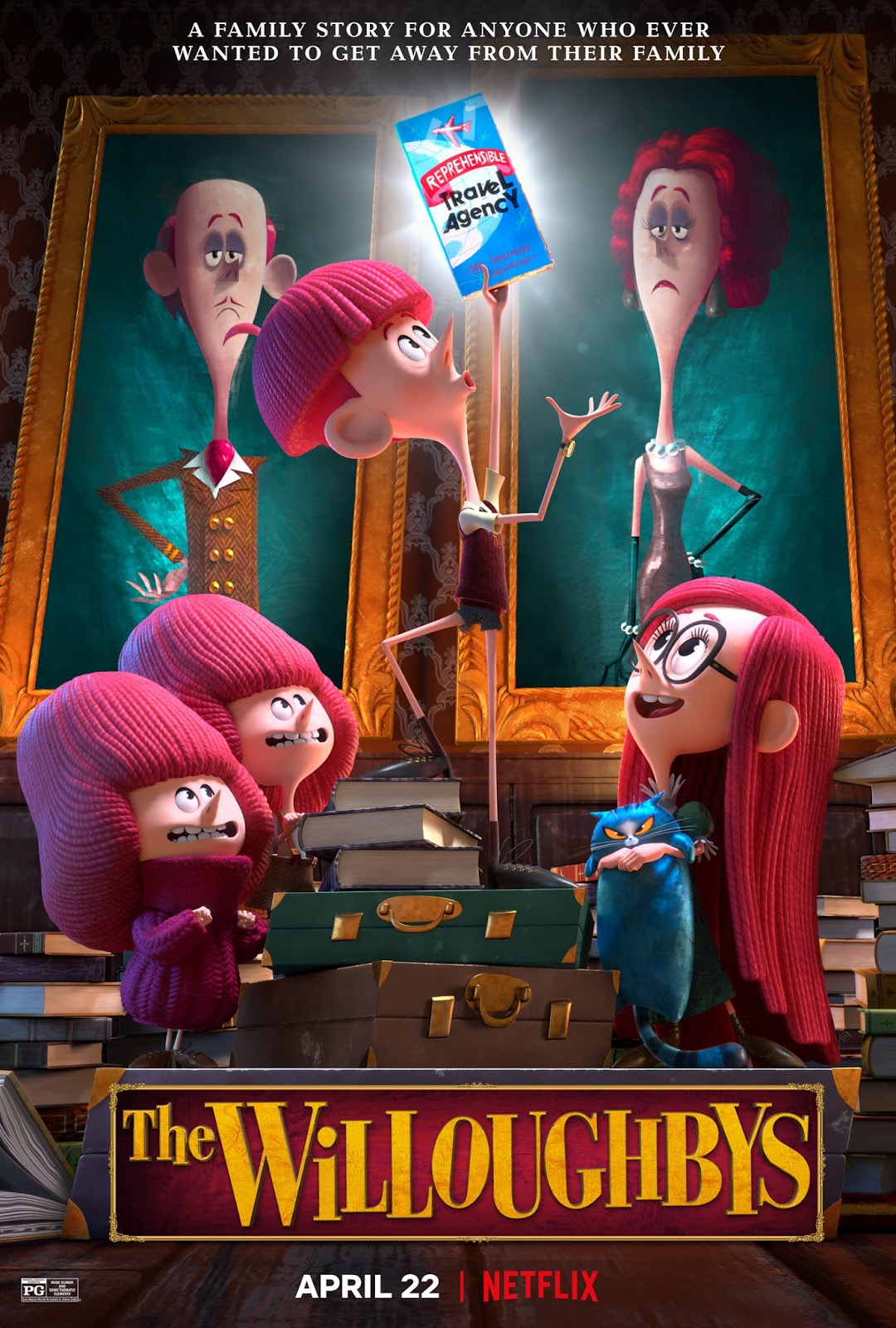
The plot feels like a bunch of alt-lite kids media stitched together: a little bit of A Series of Unfortunate Events, a little bit of Henry Selick, a lot of Roald Dahl (I've not read the Lois Lowry book this is based on, but I have a hard time imagining the Lowry of The Giver and Number the Stars also producing something this whimsical and demented). This movie is so highly caffeinated that it has a very hard time ever sticking to one plot, which is a huge detriment to a film that includes a gem of a plot involving the central children attempting to "orphan themselves," and for a lot of the movie I wanted to shake the screenplay by the collar and yell at it to just settle down, for Pete's sake. I'm pretty much in love with the animation style, though, which is probably the best example I've seen of the recent trend of twisting CG animation into looking like something spun out of arts-and-crafts—this one even goes the extra mile to make its framerate look like stop-motion animation. I'd be willing to make peace with this whole "photorealistic rendering" thing if what was being photorealistically rendered weren't the characters themselves but the material the characters are made out of. The promise of CG anything is the ability to conjure the impossible, and I'd honestly kind of love it if CG were used to conjure impossible stop-motion films like this one. Grade: B-
The Grudge (2004)
Like a lot of these Japanese-to-American remakes go, this is a sort of slick and sleepy version of the more homespun original. The original isn't really that much more propulsive, but it's at least got an uncannier feel—maybe I'm just not as inured to Japanese makeup and effects as I am to Hollywood ones, but there's something kind of rote to the scares here. I will give major props to this one for sticking with a virtually dialogue-free finale, the only part of this movie that feels better than the original, and I'm glad that Takashi Shimizu (who directed both) got to have a second go-round with a bigger budget. Grade: B-
Mouse Hunt (1997)
I don't know how I didn't know that Gore Verbinski's directorial debut was this little flick: an utterly deranged and caustic anti-capitalist film. The naked contempt this movie has for the two leads is a sight to behold, such that these guys are the villains of their own stories in whose grotesque punishment we viewers are supposed to delight. You know how the bad guys in '90s kids movies always suffer a ton of physical humiliation and pain and usually end up stepping in or being covered in poop at some point? Imagine those guys being the protagonists of the film—only they're also factory owners with bourgeois tastes and more interest in flipping a mansion than in little inconveniences like paying their workers. The '90s were a weird time for children's entertainment. Grade: B+
Blue Collar (1978)
I can't shake the feeling that this movie (and maybe Paul Schrader's career in general?) has some unresolved gender issues that it persistently neglects to work out—at least some other Schrader films have interesting female characters, which this one does not. But otherwise, this movie is white-hot. A bleak little parable about how those in power divide the working class against itself, culminating in one of the most shocking sequences of scenes to end a movie I've seen in a while. The three principal leads are all putting in really good work, too; of course Harvey Keitel and Yaphet Kotto bring their somewhat natural gravitas, but Richard Pryor especially is a real treat here, somehow doing basically his familiar comedic persona but also making that persona capable of some incredible dramatic intensity and desperation that I've never seen from his standup. Grade: B+
The Battle of Algiers (La battaglia di Algeri) (1966)
Maybe because I don't know a ton about the whole French/Algerian history, I got a little lost following the moment-by-moment details of the plot, but as a whole, this is a pretty striking piece of work and maybe the most effective rendering of the escalating cycle of violence during revolutions that I've seen in a movie. It shows compellingly how each side rushes to increasingly brutal tactics in response to the other side's violence. Crucially, it never let's you forget who started this whole thing; you don't open your movie with a scene of a French officer ruthlessly torturing an Algerian rebel (is Zero Dark Thirty recreating this in its opening scene?) and expect your audience to come away thinking that there were some good points made on both sides of the rebellion. Good. French colonialism kind of sucks. Grade: B+
Television
Steven Universe, Season 2 (2015-2016)
I know the production cycles of these Cartoon Network shows don't really position them to being watched in "seasons," but that said, I'm not sure where Season 2 really ends and Season 3 begins, since Hulu and Wikipedia put different episodes in different seasons. Oh well. Whatever the boundaries of the season, it's still a good time. This season is much more focused on the mythology and big-picture plot than the first season was, which means we get a lot less Beach City hijinks and standalone episodes. In fact, most of the latter half of the season is one continuous serialized arc. The arc is awesome, and the mythology is pretty impressive in that even as it gets bigger and deeper, it still remains rooted in the central psychological and emotional tensions that ground the show in a very real space, even as it becomes cosmos-spanning large: tensions about identities and bodies and gender and coming of age in a world in which adults lack the ability (either by absence or by incompatibility) to understand what that coming of age means and the urgency of compassion even in that space of incompatibility and absence. So it's good. Often really good. But at the time time, I do also miss the more balanced focus on small-scale stories, too, that I saw in the first season. Maybe I'm the only one who thinks this, since a lot of people seem to get extremely excited when TV shows go into hyper-serialized mode, but I don't think TV series are always necessarily better when they work hard to link all of their episodes into a larger narrative, and I think it would be cool to see more of the standalone episodes come back in the future (those who have already watched this show already know if I'll be disappointed or not, but I guess I'll be surprised as I pretend to watch this show as if it's still airing). But oh well. Like I said, this season is still good! Grade: B+
Music
Beyoncé - 4 (2011)
In my head, this was the first "modern" Beyoncé album, kicking off the more expansive, ambitious period of Beyoncé the Important Artist that we're currently living in. And the context of this album is certainly backs that, with an increased autonomy for Beyoncé in the crafting of the record after sacking her dad as her manager. Listening to this album front-to-back for the first time since 2011, though, I think I had that wrong as far as the actual album goes; 4 has a lot of the same issues that I Am...Sasha Fierce has, namely the indiscriminate track sequencing and an occasional over-reliance on some broad anthemic songwriting. Apparently Beyoncé presented 72 songs to her label, and I have a hard time imagining that none of those were more interesting than "I Care" (sonically, "Halo, Pt. 2"?) or "Start Over." But there are some delirious highs on this album, too, and on the whole, despite a little bit of diversification of sounds and production, 4 actually feels more like the crowning sendoff of Beyoncé's pop era before the inauguration of her Important Artist era. "1+1" is a great old-school slow-burn showcase for Beyoncé's overpowering ability to just belt melodies, and the Frank-Ocean-penned "I Miss You" is a pulsing R&B highlight with probably my favorite production on the record. But of course, the real peak is the one-two punch of now-wedding-reception staple "Love on Top," the best pop-soul song in Beyoncé's whole career, and the wild, densely hooky "Countdown," a top-five Beyoncé song for me and completely unlike anything she has done before or since. This would be a better album than Sasha Fierce even if its only two good songs were "Love on Top" and "Countdown." Grade: B
Sunday, August 23, 2020
Mini Reviews for August 17-23, 2020
Last blog post of quarantine. Students come to school tomorrow.
Movies
A Shaun the Sheep Movie: Farmageddon (2020)
Mostly pretty disappointed with this. The first Shaun the Sheep Movie is just this perfectly realized gem, one of the best animated movies of the past decade, but this is merely fine. While it's still basically charming by virtue of it being Aardman Animations doing their Aardman thing, Farmageddon strays from the clockwork slapstick of its predecessor and makes a gigantic crutch out of allusions to other alien sci-fi movies, most heavily E.T., whose beats Farmageddon follows shockingly closely, including a final scene that is nearly a shot-for-shot remake of E.T.'s final scene. There are some fun sequences here, and I love the recurring "flying disc cuts through things and lands in the dog's mouth" motif. But this feels pretty empty for the most part. Plus, the UFO subject matter kind of let Aardman fudge their animation by including visible computer effects alongside the stop-motion, which makes this a lot less warm-looking and homespun than their past work. I was pretty lukewarm on Early Man, too, so I hope this isn't me losing touch with Aardman, which has been my lodestone in animation fandom since I was in like kindergarten. Grade: B-
Vivarium (2019)
Starts as with an intriguing premise (a suburban housing development has no exit!) with great satirical or sci-fi possibilities. Ends up going down the satirical and sci-fi routes simultaneously, yet somehow without yielding anything but a few kind of cool images and a few moments of creeping dread. I've never read a J. G. Ballard novel, but this feels like a failed attempt at a J. G. Ballard tribute. Grade: C
Zack and Miri Make a Porno (2008)
It's been a while since I did my old "I don't know why this is on my Netflix queue, but it's expiring soon, so I guess I should watch it" thing, so here we are. I basically knew nothing about this movie besides what the title told me (it's not inaccurate!), but within a minute of the movie's beginning, both a hockey stick and a hockey jersey had made an appearance, and I was like, "Wait a minute...", and sure enough, there it was: Written and Directed (and Edited??) by Kevin Smith. So it's not like I had particularly high expectations. This is mostly pretty bad, but incredibly, Seth Rogen and Elizabeth Banks have mad-great onscreen chemistry, which caught me completely off-guard and saved this movie from an even lower score. It's too bad that both of them have drifted into the autopilot mediocre-movie career phase that they're in now, because there's a legit spark of star power on display here (and honestly in a lot of their early-ish work), and it sort of feels like we lost whatever alternate universe could have been if they'd actually gone on to do stuff that lives up to the promise of their work in turd-level movies like this one. Grade: C-
Thirty-Two Short Films About Glenn Gould (1993)
I know basically nothing about Glenn Gould outside of his "Goldberg Variations" recordings, and maybe that's key for approaching a biopic of somebody? Being entirely outside of the sphere of references that a biopic would pander to, so you're able to process the movie as a movie? It also helps if the movie is a structural tour-de-force. The short-film anthology format just keeps giving and giving here, making room for animated excursions, fragmentary interviews, mini-symphony scenes like when Gould walks into the diner and orders, little poignant asides like Gould asking the stage manager about his retirement plans. It feels like a movie that has cut out everything but the absolute best parts and has laid them out side-by-side without the usual impediment of narrative cohesion. I could see myself easily becoming even more positive on this movie in repeat viewings. Grade: A-
The Flowers of St. Francis (Francesco, giullare di Dio) (1950)
A collection of parable-like vignettes about Saint Francis of Assisi and his immediate followers. Maybe the most sincere movie about Christian belief and practice that I've ever seen—almost maybe the funniest, too. Somehow, a 5-minute scene consisting of nothing but a leper walking by and Saint Francis just breaking down in anguished tears coexists with a 5-minute sequence of pure slapstick involving a Franciscan being harassed by a feudal tyrant and his goons (and somehow, said tyrant is trapped in a suit of armor suspended just a few inches off the ground). The whole project is so seemingly simple, but it just gets wilder and wilder the more I think about it, and in the end, there's something achingly tactile and real about the way this film frames the faith on display here—a true embodiment of the idea that a lot of modern Christians seem to have lost sight of: that at the end of the Bible, heaven is manifested on earth rather than the other way around. A really weird and really moving film. Grade: A-
Music
NEPTUNIAN MAXIMALISM - Éons (2020)
Two hours and three song suites about radical environmental mysticism as told by music that sounds like On the Corner era Miles Davis collaborating with Sunn O))). This is either very your thing or very, very not your thing. It is definitely my thing. Hands-down one of my favorite records of the year. Grade: A
Sunday, August 16, 2020
Mini Reviews for August 10-16, 2020
Just reviewin', ya know?
Movies
The Assistant (2020)
I'm usually an aesthetic maximalist with film, but The Assistant is one of the most thematically resonant uses of filmmaking minimalism I've seen recently: a film about a mundane setting (the nondescript, visually drab office of some entertainment production company) hiding untold depths of cruelty as told through a pointedly mundane filmmaking aesthetic yielding depths of insight. I legitimately don't think this story could have been told as well with even the slightest bit more visual panache, because that would be a betrayal of the fundamental corporate tedium that props up the insane abuses of power. There's this recurring motif in the movie, where following the titular assistant being verbal harangued by her very Weinstein-esque boss, she is forced to write a boilerplate apology email for whatever extremely minor faux pas triggered the harassment, and that's exactly it—volcanic evil dressed in boring office decorum. Grade: A-
Driveways (2020)
An exceptionally poignant film of well-observed humanity. Its premise (old man befriends friendless kid next door) feels insufferably twee, but the movie itself is much more quiet and warm than that. There are pieces of this movie that are a little too low-key to completely work, but other parts are entirely effective. The whole birthday party sequence alone had me near tears because it's just such a perfect encapsulation of a particular type of loneliness and embarrassment, succeeded by probably the sweetest scene I've seen in a movie this year. Feels like the movie Up would have been if Mr. Fredricksen had been out of balloons. Grade: B+
Wine Country (2019)
It's hard to fault a movie like this for being exactly what it sets out to be: Amy Poehler, Maya Rudolph, Rachel Dratch, and co. just having a good time in the Napa Valley while they riff about middle age. I just didn't find it particularly funny. That said, the film walks a fascinatingly fine line between these characters being sympathetic and these characters being just the absolute worst kind of people—probably no better exemplified than by the scene in which they all crash a young person's art show and complain loudly about millennials, which is an inscrutable intersection of legitimately crotchety and slyly self-satiric. I'm also a little disappointed that nobody ever got to take molly or try Jason Schwartzman's paella, though, both of which are heavily foreshadowed. Grade: C
That Thing You Do! (1996)
I don't think I've ever seen an entire movie carried by a 2-minute pop song until now. That Thing You Do! has almost nothing going for it: a pretty dopey screenplay that manages to zig-zag around interesting conflicts instead of actually engaging them, a cast of characters that are likeable enough but mostly forgettable and broad archetypes (Tom Everett Scott's jazz-head drummer is the only thing approximating an engaging character here), a largely toothless early attempt at Tom Hanks playing the type of prickly streetwise presence that he'd perfect in something like Catch Me If You Can but here is stumbling out the gate. But the movie has exactly two things in its favor, and those two things mean the world. First, it has probably THE greatest fictional-band pop song of all time (the titular song), and second, it has the good sense to get out of the way of this song when it needs to. Everything good in this movie happens in conjunction with the song "That Thing You Do," and the gamble this movie makes is that if it plays the song enough times, it will elevate itself into being an enjoyable movie. Incredibly, that's exactly what happens. The song plays probably a dozen times over about 100 minutes, and the tune just gets better every go-round. Unbelievable. Grade: B
Candyman (1992)
A delicious stew of ideas (systemic racism, housing projects, sexism in academia, misguided white saviorism, and urban legends all intersect each other) served up with some really terrific, gross gore and giallo-esque style-over-coherence storytelling—plus bee horror, i.e. one of the scariest horrors known to humankind. It's the kind of movie where professors give literal lectures about the film's themes, but amazingly, those lectures don't diminish the movie one bit; in fact, they improve it, because of how interesting these ideas are in conversation with one another. The more I think about this movie, the more it just keeps opening up. Grade: A-
Sorcerer (1977)
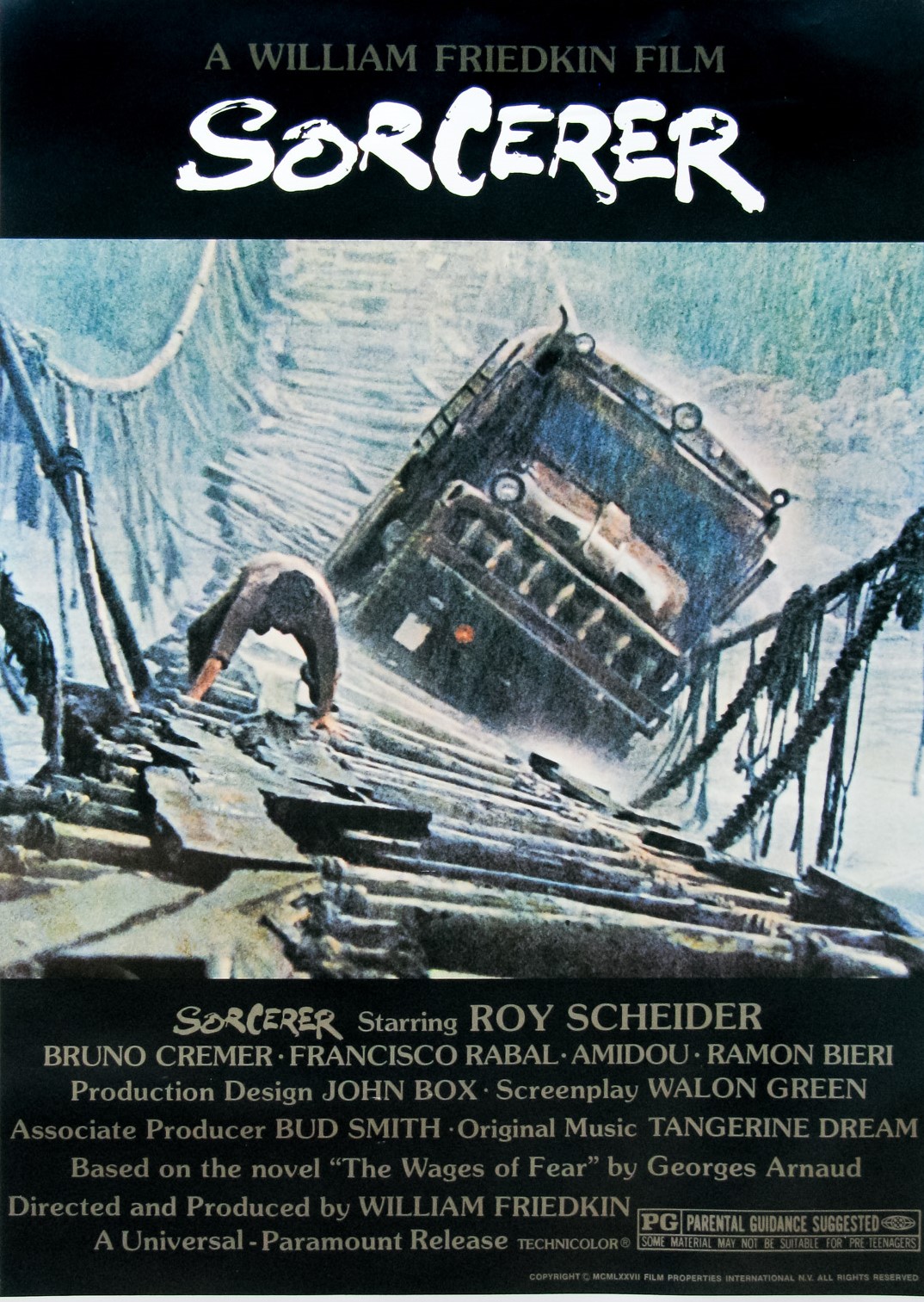
One of the grimiest movies of all time. You can practically feel the mud and motor oil. Like any human being with a beating heart, I more or less hyperventilated during the bridge scene. On a more holistic note, I know this is basically a remake of The Wages of Fear, but the whole time I was watching this movie, I couldn't stop thinking about how a year prior to Sorcerer's release, the Little House on the Prairie TV show had done its own episode with the same plot about transporting nitroglycerine in a vehicle over unsteady terrain—I'd kind of like to imagine that Friedkin was doing a gritty Little House remake instead (hey, this one's at least a little more honest than the show about the white people's relationship with indigenous people). Grade: A-
Books
The Prime of Miss Jean Brodie by Muriel Spark (1961)
On the one hand, it's a comic novel about a misfit teacher with an outsized personality at a girls school in Scotland, and as that, it's very funny. Spark is a terrifically efficient writer who can turn a phrase on a dime and a scene in just a paragraph, and she makes this story just pop with hilarity. But by the same turn, it's also a deconstruction of that Dead Poets Society trope of the misfit teacher with an outsized personality (was this a trope in 1961?), turning it into a fable about the rise of fascism in Europe that gives the humor a striking, heart-in-the-throat edge. I loved it—a nearly perfect novel. Grade: A
Music
Taylor Swift - folklore (2020)
A lot of the press surrounding folklore has focused on the idea that this is Taylor Swift's "indie" album, and there admittedly is a generally pan-indie sound here that feels like the line of best fit from the indie cohort that was cresting around 2007-2009: a little bit of Seven Swans-era Sufjan here, a little bit of Death Cab for Cutie there—not to mention the presence of Bon Iver's Justin Vernon on the song "exile" (doing a rare non-falsetto vocal, I might add, which is wonderful) and The National's Aaron Dessner credited as co-writer and producer on more than half the tracks. But less commented on is how folklore is a different kind of throwback, one to the kind of music Taylor Swift herself was making during that same era as those indie touchstones were breaking into the mainstream. In a lot of ways, this album feels like a revival of Taylor Swift the Songwriter that blossomed on Fearless and Speak Now. She's never not been a songwriter's songwriter on any of her records, but the pop idiom that she's embraced since Red has been increasingly persona-driven and self-referential and universal—its own pleasure, to be sure, but with folklore, Taylor Swift as storyteller and Taylor Swift as chronicler of personal detail return in full force, but with the twist that she's looking at her own life and especially the character-driven teen narratives later in folklore from the perspective of a thirtysomething instead of as a teen herself. To put it another way, she never sounds like anything but an adult on the record and specifically like the adult version of the public and artistic face of the Taylor Swift seen on a record like Fearless (unlike her other recent albums, which often seemed to be interested in progressing the concept of "Taylor Swift" into a new kind of person: for instance, 1989 and reputation represent evolution rather than simple growth). It lacks the diaristic intimacy of her early work, but the aged point of view turns familiar Swiftian tropes into thornier and more elliptical shapes, a kind of large-scale deployment of the teenagerdom-as-hindsight premise of something like "Fifteen." This album's "betty," for example, feels both like a song that Taylor might have written for Speak Now (that key change in the final chorus) but also unmistakably colored by the fact that Taylor Swift is writing as someone twice the age of the song's protagonist. It's incredibly satisfying, rewarding attention to Taylor Swift lore and meta-narrative without ever getting lost in the weeds that might obscure just how pristine and craftsman-like these songs are just as songs. Like most Taylor Swift albums, folklore could probably have been a stronger whole if it had shed a few tracks, particularly in the back half (to name one, I'd happily give up "hoax" so the album could end on the much better closer, "peace"). But this is some good, comfy music anyway, so on the other hand, it feels kind of appropriate that it would be billowy. Grade: A-
Sunday, August 9, 2020
Mini Reviews for August 3-9, 2020
Reviewin'.
Movies
Slay the Dragon (2020)
Gerrymandering and the modern Republican Party are both awful, and I'm glad there's a whole film dedicated to those two unshakable facts. But that said, this movie includes a brief clip of the Last Week Tonight episode about gerrymandering, which made me realize that the whole movie kind of feels like that John Oliver segment stretched to feature length, with very little to show for the extra length. These kinds of activist documentaries are never going to engage me formally, but I'd at least like to think they aim to be more informative than a half-hour HBO clip. On the plus side, though, this movie is entirely free of Oliver's extremely forced jokes, so maybe this would have actually been my preferred method of getting this information if I'd seen it before the Last Week Tonight episode. Grade: C+
Junun (2015)
Honestly, it's just nice to spend an hour watching Johnny Greenwood jam with his pals from India (plus one pal from Israel) while Paul Thomas Anderson does basically the equivalent on the filmmaking side. I don't have any deep thoughts. This was just pleasant, and I enjoyed it. Grade: B+
Matinee (1993)
A delightful, mostly frothy salute to William Castle (literally everything with a very Castle-esque John Goodman is a great time) that also somehow manages to argue by the end that movies acclimate people to the horrors of nuclear proliferation and the military industrial complex? Some seriously wild thematic turns, especially in the penultimate shot of the film, where a cutesy coming-of-age moment occurs in the context of a military base with literal armed helicopters and jets flying overhead. Having grown up partly on an air force base, I can testify first-hand to the astounding degree to which living within walking distance of industrial death machines can be normalized, and in conjunction with that, there's really something to Goodman's final monologue about how films help people accept almost certain annihilation at the hands of the kinds of people who populate Dr. Strangelove—if not the b-movie schlock peddled by William Castle then certainly the likes of your average U.S.-military-affiliated action blockbuster like Independence Day or whatever. Wild thematic turns, I say. Mad. Grade: B+
La Chinoise (1967)
A bunch of college kids get into Maoism and try to start a revolution. Basically a feature-length exploration of the limitations of bourgeois folks to instigate radical change—the revolution in this movie fails, in part, because these kids' backgrounds (their parents are all like bankers and stuff) give them no organic class solidarity with the people they actually need to link up with to start a movement (and, as a side note, it's probably worth pointing out that arguably Godard runs into this problem himself with his writing and direction, given the somewhat iffy way that, for example, a Black character is briefly tokenized by the film). It's a strikingly clear-eyed film, too. College activism can be so inspiring and important, but I also don't think I've ever seen a more apt deconstruction of that kind of activism, either, and what this movie depicts is uncomfortably close to the ways in which I've seen mini-movements surrounding people like those in this film (including myself) fail. I mean, I haven't seen botched assassination attempts, but the basic group dynamics and ultimate collapse ring extremely true—a bunch of college-educated white people failing to realize systemic change because they are busy yelling at each other about theorists and whether or not Johnny Guitar is problematic hits very close to home for me and likely does for a lot of people on the internet, I'd guess. Grade: A-
Sunday, August 2, 2020
Mini Reviews for July 27 - August 2, 2020
Plague school begins tomorrow. Hurray.
Movies
Black Is King (2020)
More so than Beyoncé's other visual album, Lemonade, Black Is King feels like a collection of music videos stitched together rather than a cohesive narrative. Maybe I'm missing some of the symbolism here because of my relative unfamiliarity with the Afrocentric imagery compared to the Americana of Lemonade, but there doesn't seem to be nearly as much going on in Black Is King, despite being substantially busier visually. That said, this film is very cool-looking, the themes on black identity, while not especially complex (at least not to this white guy), are clear and strong above the noise, and the music more or less slaps, so these complaints are mostly just petty comparisons, which isn't exactly fair to Black Is King. Also not fair: the fact that it's all stitched together by voiceover from the live-action Lion King remake, which is a very goofy feature to appease the Disney corporate overlords, though kudos to Beyoncé and co. for smuggling this weird, wild piece of work onto Disney+ under the auspices of a Lion King tie-in. Grade: B
She Dies Tomorrow (2020)
Imagine a world in which existential anxiety and a certainty of your imminent death were contagious: so of course this movie is both crushingly bleak and entirely appropriate. The film layers some impressively stressful lighting and editing over a basically mumblecore aesthetic, and the whole thing teeters right on the edge of being a complete freakout untethered by reality, though it never truly succumbs, staying just barely grounded in a tangible world—maybe the strongest (albeit still tenuous) note of optimism this otherwise desolate movie offers. Grade: B
Yes, God, Yes (2020)
A sincere and sweet though not particularly insightful exploration of female sexuality and Christianity. Its observations on conservative Christian ethics are well-trodden, especially how those ethics disproportionately shuffle responsibility onto women and girls while also denying those same women and girls pleasure, and its method of critiquing those beliefs falls a little too heavily on the "they're all hypocrites" trope—speaking from experience with these groups, I found that there are a lot of people who actually aren't hypocrites and are completely committed to these ethics (though of course there are plenty of craven liars, too), and for me at least, it would have been more interesting if the movie had had to critique those ideas in terms of the scarily intense integrity that animated some of the leaders I came across, rather than leaning back on the assumption that those who outwardly care most are those who cheat most. But as a gentle character piece, the movie works very well. Natalia Dyer is a minor miracle as the lead—the screenplay gives her maybe 200 words total to speak in the movie, as she mostly just observes and reacts to the world around her rather than participating directly, which means that the majority of her character's interior life has to be communicated via body language and reaction shots, so the fact that she is an intricately realized character is entirely a testament to the understated physicality of Dyer's performance and the incredible amount of information she is able to communicate with subtle facial expressions. This movie needed exactly this performance to work, so I'm glad it found it. Grade: B-
Doctor Sleep (2019)
Points for having some really interesting ideas re: cycles of trauma, addiction, etc., especially when they are manifested through Rebecca Ferguson's terrific villain. More points for director Mike Flanagan going 110% with interesting visuals. Lots of points deducted for the actual screenplay (and I suppose probably the source novel—I haven't read it) being filled with really uninteresting, tedious cul-de-sacs; I would have happily seen the movie do away with all of the young Danny flashback material, for example. So I don't now how many points are left, but this is basically where I land. A great movie being eaten alive by a bad one. Grade: C+
Tokyo Drifter (東京流れ者) (1966)
Genuinely unsure what happened in this movie beyond a lot of cool colors and hilarious posturing (the central drifter sings his own theme song??), but it's always fun to run across one of the certified Tarantino lodestones. Grade: B
P.S. I talked about this movie with some folks on the Cinematary podcast, if you're interested.
Forbidden Planet (1956)
As a vibe, this movie is peerless: the painted backdrops of the alien geography, the dream-like flourishes of animation as special effects, and especially that electronic score create a seriously indelible aesthetic experience that feels genuinely otherworldly. As a story, though, this is kind of awful. Like, whose job was it to pay attention to the pacing of this movie? Structurally, this is a complete disaster, puttering around for a full hour with boring meatheads exploring the titular planet in the most meathead way possible (one of the men actually asks if the robot is a boy or a girl, like he's in kindergarten or something) while trying to seduce the lone female cast member, only to then introduce some seriously heady concepts in the last thirty minutes that probably needed to have been teased out more over the preceding hour to avoid being the exposition-dump gobbledygook that it is. It is super disappointing the extent to which the story harshes the aesthetic vibe. Grade: B-
Television
Angel, Season 4 (2002-2003)
This season has some truly baffling plot developments in the early goings (Connor and Cordelia hook up? Cordelia has amnesia? Cordelia is in a coma? Most of these developments involve Cordelia) that eventually give way to a very cool sustained serialized arc that lasts pretty much for the last half of the season, and if that arc doesn't quite make up for some of the dumb character moments early on (though it certainly tries to explain them away), it at least ends the season on a legitimately complex, exciting run with some big ideas on its mind: ideas about religion and cults and whether or not the collective happiness of the whole group gained via religion are worth the casualties of religion's procedures. None of this really makes up for what the show does (or doesn't do) with Cordelia, which, even after the big-picture arc at the end, still feels like a betrayal of the character. But at least it gives us something interesting next to this betrayal. A deeply imperfect season, albeit with some of the highest highs the show has ever delivered. Grade: B
Books
No Name in the Street by James Baldwin (1972)
A somewhat scattered memoir of James Baldwin's experiences within the era of the Civil Rights Movement. Sections of the book are piercing and clear, such as when Baldwin talks about his experiences as a Black American in France compared to the experiences of Algerians or the passages describing Baldwin's reaction to the assassination of Martin Luther King, Jr. Other pieces don't hold my interest as well—I'm not terribly invested in Baldwin's interactions with Hollywood, for example. But even those sections are animated by Baldwin's fiery narrative voice, and being as sharp and as fervent as he is, he's able to mine fascinating essayic asides from everything he talks about; it's not uncommon for his observations and ideas to practically climb out of the page as they take a life of their own. Baldwin is such an uncompromising thinker who, at this point in his career, had little to gain from anything but complete candor and ruthless truth-telling about America's perennially insufficient reform of race relations and the white supremacy beneath it that Baldwin thrives on exposing. The book's biggest liability is the apparent difficulty Baldwin sometimes has in transitioning from one idea to another; it's often accomplished through inorganic lurches in the writing, suggesting an essay collection with the various essays simply jammed end-to-end without breaks. But between those transitions, the book can be luminous. Grade: A-
Music
Bob Dylan - Rough and Rowdy Ways (2020)
There's something so beautiful about the fact that Bob Dylan, at the twilight of his life, continues to plug on, making music like Rough and Rowdy Ways: defiantly unmodern, even square, but richly textured nonetheless. For Dylan, life post-Nobel Prize seems to go at about the same speed as it had been in the long late period of his career which has been in full swing since 1997's Time Out of Mind, a period now having occupied almost half of his time as a public figure. Musically, the quiet, traditional instrumentation of Rough and Rowdy Ways isn't that dissimilar from what you might here on Dylan's recent, divisive run of American songbook records, though lyrically, it's a somber throwback to Time Out of Mind; whereas Tempest, Dylan's last album of original material, was at least as death-obsessed as Rough and Rowdy Ways, it did so through crazed narrators and lurid tales of revenge, but this new album brings Dylan's late career full circle by sharing with Time Out of Mind self-reflexivity on Dylan's own mortality. Death personified haunts the record on songs like "Black Rider," and Death implicitly lurks at the corners of other songs like "Crossing the Rubicon," in which Dylan growls, "In this world so badly bent / I cannot redeem the time / so idly spent," half in anger, half in remorse. And then there's the clear masterwork of the album, "Murder Most Foul," a song whose 17 minutes are set apart on its own disc and whose lyrics are some of the most apocalyptic, mournful words Dylan has ever written—lyrics that take what might otherwise be Boomer kitsch (a 2020 song about JFK's assassination) and turns it into a postmodern dance macabre that finds a parade of 20th-century cultural flotsam marching into the abyss alongside the president whose death basically inaugurated Dylan's career. It's the morbid, often beautiful old-man inversion of Dylan's allusion-heavy electric period: soft piano backing over a gravelly collage of the collective mythology of mass media. If Bob Dylan never wrote another song, it would be the perfect ending to his career, and even if he does write more, "Murder Most Foul" will still linger as a eulogy long after this moment in his career has passed. For all those reasons, Rough and Rowdy Ways is as personal a record as we're likely to get these days from the notoriously cagey songwriter, and if it doesn't quite fit among Dylan's all-time best records (like a lot of late-period Dylan, his passion for individual songs seems to wane at times, and some of the instrumentation is a bit staid), it at least can proudly join the large repository of very good records bobbing just below the classics. Grade: B+
Subscribe to:
Posts (Atom)