Showing posts with label Steven Universe. Show all posts

Sunday, July 17, 2022

Mini Reviews for July 11 - 17, 2022

I'm out of town next week, so I'm not sure if I'll be posting here. But we'll see.

Movies

Good Luck to You, Leo Grande (2022)
A really lovely little film about a woman trying to overcome sexual shame and internalized misogyny late in life. It's generous and spacious in terms of how its screenplay allows its four scenes to play out over 20-30 minutes apiece and how it lets Emma Thompson's character meander through conversations that eventually poke at some deep wells of pain. Thompson's obviously got a killer résumé, but this honestly might be one of my favorite roles of hers; she so winsome and funny while also subtly wielding the barbs of a patriarchal, anti-sex society that she is trying to slough off but also reflexively prodding at herself and others. She's great. It's not a perfect movie—the attempts to flesh out "Leo Grande" into a character rather than simply a device feel a little thin, and the visual style of the filmmaking is fairly flat. But I was surprised by how moving I found the movie by the end. Grade: B+

Fire Island (2022)
A reasonably fun update of Pride and Prejudice into a gay milieu that I know literally nothing about (Duckduckgo tells me that "Fire Island" is a real place, but I couldn't have even told you that until a minute ago), so I'm probably not really the right person to be writing about this. With that caveat, I do like that it's class-conscious in exactly the right way for a Jane Austen adaptation, which isn't a given in these sorts of things: here we have people who are all fundamentally materially comfortable but in meaningfully different strata of comfort and antagonism toward each other's relative power within that comfort, and the queer gloss fits surprisingly well over Austen's heterosexual gender binaries. I couldn't ever get over how annoying the voiceover is, though, and the guy playing the Mr. Darcy character is a huge swing-and-a-miss within a cast who is otherwise pretty solid, unfortunately. Grade: B-

Steven Universe: The Movie (2019)
I'm a little confused why this exists—it adds basically nothing to the story that was pretty satisfyingly capped off at the end of the last season, and it also doesn't really evoke the comfortable rhythms of the show, since there's almost no interaction with the townsfolk and the gems are all reset to factory setting soon after the film begins. But it's a pleasant, gentle-hearted hour and a half (hard to imagine a Steven Universe property not being) with some great character animation (esp. the villain), and as a musical, it's actually pretty great. The show always flirted with a musical format, but this is one of the few times it fully committed, and the only time it committed to a feature-length musical, and it's delightful as that. I can't remember where, but I saw someone lamenting that the Bob's Burgers movie didn't go full musical, and judging by how much the music elevates what's otherwise a kinda meh story, I am retroactively sad about that, too. Grade: B

Zabriskie Point (1970)
It's bookended by two great scenes: first, a live-wire meeting between white and black student activists and last, a slow-motion sequence of a bunch of signifiers of American capitalist consumerism being blown up, set to Pink Floyd's "Careful with that Axe, Eugene." In between, the movie's a kind of boring series of scenes of a boring white couple meandering around the desert, and while there's a theoretically interesting throughline between the black activists in the first scene accusing the white activists of being merely fair-weather activists with radical chic and the remainder of the movie in which these two more or less bear out that characterization by abandoning class/race struggle and embracing a bunch of empty hippie utopianism, it's just not that interesting to watch. That said, this movie's reputation as one of the worst of all time is ludicrous. I truly can't understand the embrace of something like Easy Rider and the rejection of something like this. Grade: C+

Elevator to the Gallows (Ascenseur pour l'échafaud) (1958)
A whole lot of fun and a lot more darkly comic than I was expecting. It feels like a proto-Coen-Brothers film more than anything else: a dude creates this meticulous plot to murder his boss and then things just slowly start spiraling out of control after he makes one stupid mistake that involves him getting stuck in an elevator. I don't think I was expecting the title of the movie to be quite so literal. The Miles Davis music is great, too. I'm curious if there's an earlier film noir with the whole "pensive jazz score over moody b&w cinematography" thing that's become a cliché for parodying the genre, or if this is the inception of that trope. Grade: A-


All Quiet on the Western Front (1930)
An absolutely devastating anti-war film that's seldom been matched in the near-century since in American film—maybe the only parallel is that other WWI-set masterpiece, Paths of Glory. Like Paths, All Quiet uses surgical precision to cut through the lie that allegiance to a nation-state has value; Paths is much more interested in the bureaucratic labyrinths that protect the privileged and the powerful from caring about the brutality that these systems inflict upon those on the front lines, whereas All Quiet basically is entirely from the perspective of that meager class who gets ground through the grist mill of the state's vanguard. That final double-exposure shot of the soldiers looking back over their shoulders as they are superimposed on a cemetery made me so sad. Patriotism: what a sham. Grade: A

Sunday, July 18, 2021

Mini Reviews for July 12 - 18, 2021

Still working on a new way to email out my blog posts. Please stand by.

Movies

Alois Nebel (2011)
One of the things that I love about Czech animation is how fleshy and tactile it tends to be, so "Waltz with Bashir, but Czech" was probably never going to be my thing. The Flash/digital rotoscoping has none of the thematic resonance that it does in Waltz either. I was hoping that the hallucinogenic journey through personal and political history a la Tarkovsky's Mirror was going to win me over, and maybe it would have if that history meant more to me. But I definitely don't know enough about the political climate surrounding the Velvet Revolution to have anything coherent to say about the film's politics or its resonance, which I felt mostly locked out of. Grade: C


Waiting for Guffman (1996)
Just a good time and not a lot more: funny but not uproariously so, filled with colorful characters worthy of equal parts affection and mockery but not so much so that the movie teeters into either sentimentality or cruelty. This might have hit harder if I'd ever been involved in community theater, but as it is, it was a perfectly fun, frictionless 80 minutes to spend. Grade: B


Faust (Lekce Faust) (1994)
Probably the most a Jan Švankmajer has ever felt like a Terry Gilliam movie, which I realize is a little backwards to say, given that the former influenced the latter and not the other way around. But the specific way in which this movie has a single man (Dr. Faust, natch) trapped in a world whose otherworldly, absurd machinations (depicted via grotesque-yet-whimsical stop-motion special effects) inspire paranoia as well as a collapse in subjectivity between the camera and the character... I mean, it feels very Gilliam-esque. It's also extremely, extremely cool and tactile and gross in the way that only Švankmajer films can be, so guess who still has the edge, Terry? Grade: A-

Invention for Destruction (Vynález zkázy) (1958)
The story, a kind of greatest-hits medley of Jules Verne, is pleasantly nostalgic for me after having inhaled a bunch of Jules Verne as an early reader; the visual design of the film, basically woodcut-style illustrations come to life, is equally pleasantly nostalgic, given that these were the types of illustrations usually in the Verne library books I got. Outside of the nostalgia factor, the story is kind of meandering and forgettable, but the visuals legitimately rule. It's an intoxicating mix of stop-motion animation, optical illusions, elaborate studio sets, and double-exposure. Just super cool, and the vibes are incomparable. Grade: B+


Death Takes a Holiday (1934)
Pings wildly between spooky allegory and upper-crust melodrama, and the fact that this movie can't commit to just one dooms it to this ungainly, haphazardly paced story that is not nearly as engaging as a story literally about Death taking a vacation in a human villa should be. I definitely prefer the spooky parts; the first 10-15 minutes are surprisingly moody and kind of despondent in a compelling way, and I think there could have been a genuinely great movie about a bunch of rich people coming to terms with their own mortality and the empty artifice of their social structures. I also could have gotten into a feature-length version of the very brief section of the movie that turns into an outright comedy, wherein there's this montage of all manner of disasters in which everyone involved implausibly survives because Death is, you know, on holiday (wasn't this a Family Guy episode?), but unfortunately, that wasn't in the cards. Grade: C

Television

Steven Universe, Season 5 (2017-2019)
I've been halfway griping all along that Steven Universe prioritizes its ongoing story over pursuing interesting, standalone episodes, and now I'm going to make sort of the opposite criticism of its final season: it doesn't develop its main story nearly enough. Perhaps the world that Steven Universe had developed had just grown way too big for the show to wrap up in 32 episodes, but despite the fact that almost every episode here is devoted to advancing the main arc of the series, the results feel pretty rushed, as secondary characters are looped into the arc and then spun out into irrelevance. Lars, for example, becomes centrally important for like five episodes, during which his character transforms radically, but then we barely see him for the rest of the season, leaving his arc feeling rushed and unsatisfying (especially as it relates to Sadie). It's almost worse with Connie, who is present for most of the season but just doesn't get a lot of interesting material besides simply being present. I suppose the writers had to make some tough decisions on what to prioritize given the space they had to wrap this thing up, because an the other hand, all of the gem mythology is really well-developed, complex, and interesting this season—way more so than I found the previous explorations of it to be. The queer metaphors of course have always been there, but this season finds some really rich veins of dramatic tension within those metaphors, while at the same time making all of the gem-centric arcs bigger and more spectacular, until they all come together in an often breathtaking finale. That finale really is something—a lot of TV shows go big on their last episode, and I usually find that kind of flattening and deafening, but Steven Universe's finale is both epic in scale and spectacle (aided by some truly incredibly animation, some of it guest-animated by industry legend James Baxter) without losing the resonant emotional and queer subtext of the broader gems arc. Of course, this comes at the expense of basically sidelining or muting every single character that isn't explicitly tied to the gem storyline. Reflecting back over my complaints about serialization in the past few seasons, I think the frustrating I've actually been grasping at is that the show never truly found a way to reconcile its more whimsical, episodic Beach City environment with the galaxy-spanning epic of the gems, and this final season bears that out in a starker way than any of the previous seasons. But at least we got some great moments. I'm curious to see where the movie and the wrap-up miniseries takes it from here. Grade: B

Sunday, January 31, 2021

Mini Reviews for January 25 - 31, 2021

RIP SOPHIE

Movies

Mangrove (2020)
I guess the people who said that this is just the prestige version of one of those movies you'd watch in social studies class are right. But I also found this pretty rousing—Steve McQueen movies tend to feel pretty considered, Mangrove included, so this movie doesn't really capture the thrilling liveliness of collective action, but it definitely captures the heart of it. And once the film transitions to the courtroom, it's basically all great, since the closed-off environments of a court of law play very, very well to McQueen's strengths as a director. Also, I don't know what social studies classes you were in, but none of mine had any interest in (or sympathy for) radical politics. Grade: B+


Lovers Rock (2020)
I'm not good at dancing, and I don't like dancing (these two are probably related), and I don't ever have very much fun at the kind of party this movie depicts, i.e. the kind where the whole point is to lose yourself in dance and song and not to have the boring, discursive conversations I'd rather be having. So it's a sheer testament to the filmmaking magic on display here that I watched this movie, where pretty much the entire thing is one such party, and spent the whole runtime wanting very badly to be there—not dancing, of course, but just soaking up the energy in the room, watching the liberation of the dance floor. The whole movie is electrifying and communicates better than most movies I've seen the sheer joy of being completely embodied in a moment shared by an entire community. Also, to whatever degree these Small Axe works are a series (television or otherwise), the best argument in favor of that is how this plays in immediate succession to Mangrove and the way it so thoroughly shows what Mangrove spends so long telling: the vital importance of these third spaces, especially within marginalized communities. I'd imagine you'd be completely fine watching either in isolation of the other, but there really is something to be said about the accumulation of meaning when viewing them in sequence. Grade: A-

Kajillionaire (2020)
The only other Miranda July work I'm familiar with, Me and You and Everyone We Know (this blog's second post ever! don't read it—it's terrible!), I like well enough, but this caught me completely off-guard. As with that other film, Kajillionaire is basically about finding love and connection in the context of a modern world that makes the traditional expressions of human connection either embarrassing or difficult, and this movie is also very much in Miranda July Mode, where everything is kind of just slightly off-kilter, like the dialogue and character version of a Dutch Angle, which could be theoretically alienating and apparently is for some viewers, based on reviews I'm seeing. But I dunno, I ended up finding this really moving, and I personally connected pretty strongly with the way that Evan Rachel Woods's character (Old Dolio) has to basically reprogram herself after an upbringing with parents who have given her this completely skewed, transactional view of the world (it's a family of grifters, more or less, who are constantly scamming, perhaps out of a paranoia that the world's end at the hands of an earthquake are imminent) in order to begin to form connections with people in the Real World. My parents are actually great and love and care about me and were (still are) always very open about that, but the idea that you can grow up within a community (conservative/evangelical Christianity for me) with a fundamentally warped understanding of the world that affects your ability to make real connections with people—that resonated. There's a specificity to July's vision that I don't want to take away from (it's female, it's queer, it's very Los Angeles), but evangelicalism, how I've been trying to shake it out of my brain for the past 10-12 years, is what I ended up thinking about here, and July's ethos is open-handed and compassionate enough that I can't imagine she'd be too alienated by that train of thought. Love each other, folks. Grade: A

Miss Juneteenth (2020)
Definitely feels like an indie movie that in some ways seems to the movie's detriment: the at-times shaky screenplay and the somewhat stiff performances (outside of Nicole Beharie, who is fantastic) make this movie a little rough around the edges. But as a quiet story about one generation unintentionally passing the toxicity of their upbringing onto the next, this movie works when it counts, and the relationship between the mother, who won the pageant when she was a teen, and her daughter, who is unenthusiastic about the pageant, is wonderfully realized—especially with Beharie as the mother, who, again, does great work. Also, this movie has a really terrific evocation of a very particular milieu, i.e. a black Texas community. The only other example of this I can think of is the last couple seasons of Friday Night Lights, and even that's filtered through a pretty white perspective. Nice to see a depiction that doesn't come from a place of difference. Grade: B

FernGully: The Last Rainforest (1992)
I mistakenly believed this was a Don Bluth feature, which means that I was expecting a mostly mediocre film with some signs of life in the animation. It is not a Don Bluth feature, and it is not mediocre. It is a truly dreadful, utterly uninspired film with animation that only rises above direct-to-VHS levels when it is focused on the Tim-Curry-voiced villain (the villain animation is actually quite good, as is Curry's extremely Curry-esque performance—possibly the only two good things about this movie). The movie substitutes dreary musical numbers in place of character development, the environmental mythology is paper-thin, the big sexy heart-throb human is a mullet-sporting bro named Zak, and Robin Williams honest-to-glob RAPS. Also, for a movie basically conceived as a delivery system for environmental messages, its environmentalism is pretty dopey in the way that a lot of '90s environmentalism aimed toward children tended to be—maybe I am just a callous monster, but "Pollution/industry makes the cute animals sad" is the flimsiest possible rationale for environmental justice I can imagine, and this movie shows absolutely zero interest in interrogating the reasons why industry happens. I'm not saying this has to go full anti-capitalist, but at least a Lorax-level acknowledgement of the role that the ideologies serving at the altar of Production and Expansion have in the destruction of the world would have been nice. Instead, all we got are some dumb dudes who think it's fun to chop things up. Really talking about the issues here, FernGully. Did not enjoy. Will not be checking out its actually direct-to-VHS sequel. Grade: D

Fritz the Cat (1972)
Unbearably juvenile. Probably the most juvenile feature that I've seen from Bakshi, which is saying something. Setting a precedent is setting a precedent, but in the wake of decades of much more impressive adult animation, I don't know why I'm supposed to be impressed by animals having a threesome in a bathtub. The movie has sketches of interesting themes, like the opening when some white girls are being performatively woke toward a black character and end up being incredibly patronizing, or the sequence when Fritz briefly becomes a radical leftist but then ducks out of town when his revolutionary rhetoric results in police violence against his (mostly black) followers—the film seems to halfheartedly be interesting in satirizing the way that white kids from middle-class backgrounds try on the aesthetics of revolution without actually investing in any of the work done by true leftists (usually people of color). But just as often, it also seems to be lampooning leftism as a whole, resulting in this mealy-mouthed centrism that's being provocative without being brave enough to truly take a political stance of consequence—I'd like to think if Bakshi was smart enough to recognize the shallow, fashionable radicalism among white kids he would be smart enough to see the parallel in the shallow, fashionable centrism of the edgelord postures in this movie, but apparently not. Anyway, per usual with Bakshi, this film is also super misogynist, and I'm not super inclined to be charitable to even what good politics are here since they're awash with the same bare contempt for women that animates a lot of Bakshi films (though not usually as strongly as it does here). And speaking of animation, there are some moments of visual inspiration, like the shot of the crow snapping his fingers to Bo Diddley, but this is by far the most stylistically tidy Bakshi movie I've seen, which means that it lacks the usually really interesting way that Bakshi turns his tiny budgets into go-for-broke transgressive mixing of media and styles. This one looks like any old '70s cartoon, just with more sex. I've been wanting to see this movie for a while because I have a weird fascination with Bakshi. But this was pretty much garbage. Grade: D+


Television

Steven Universe, Season 4 (2016-2017)
I still miss the focus on Beach City, but the way that the show continues to expand its mythology is at least consistently engaging. A lot of shows start to feel thinner as they get bigger, but Steven Universe does a good job of enriching itself as it grows. This season is focused most on exploring the series's villains and their underlying ideology of hierarchy and supremacy, and through that. The show plays around with some ethical dilemmas (Steven feels guilt about having been unable to turn a gem before it shattered, for example, and there's a little bit of angst about how Rose Quartz may have committed war crimes), but it never really truly commits to ambiguity, and at its heart, the show remains a story about a group of fundamentally good people changing the world through compassion and fighting those who won't change, which is good (and often very good), though probably not the most interesting version of itself it could have been. Grade: B+


Books

Luster by Raven Leilani (2020)
Given the crowdedness of the field, there's a real uphill climb for a debut novel about a young artist in the publishing industry who has sexual misadventures while learning stuff about herself and her own maladaptive tendencies. But Leilani's debut works by sheer verve of voice. This book is compulsively readable, a real page-turner by the standards of literary fiction, solely because Leilani's prose just shimmers and moves. The content of the book itself I am relatively indifferent to, though there are a few interesting dynamics re: the young black protagonist hooking up with an older white man who has recently adopted a black girl. The books energy flags quite a bit toward the middle and end, which is sort of appropriate thematically, as it represents a period in which the protagonist herself stagnates and becomes directionless. But after the salvo of the opening 100-ish pages, it's hard not to feel that the book is coasting somewhat. That said, Leilani's prose remains electric throughout, and the book is never not engaging, even when it slows down. I guess this isn't a glowing recommendation, but I enjoyed my time with the novel, so... Grade: B

Sunday, November 1, 2020

Mini Reviews for October 26 - November 1, 2020

 Spooky season has ended. Alas. In case you missed it, I'll link here to the post I made earlier this week, which is a new entry in my prog series!

Movies

Wolfwalkers (2020)
Easily my favorite movie of the year so far and probably my favorite Cartoon Saloon feature now (sorry, Secret of Kells, you're still great!). If nothing else, this is just a tremendous aesthetic leap forward for Tomm Moore and his studio; previous Cartoon Saloon features have had to make virtues out of the limitations of the noticeably digital animation tools the animators had to work with, creating films that are geometric and smooth and dependent on crisp, clean lines at the edges of characters, and while those movies all do great work with that look, Wolfwalkers finds the Saloon with a much larger budget and hence a much more dynamic set of techniques at their disposal. The result is something that maintains the basic geometry of their earlier work while also finding ways to make the animation miles more textured and dynamic. It's just stunning, gorgeous work, the best-looking 2020 movie I've seen, animated or live-action, and what's even better is that it's in service of a terrific anti-imperialist tale that maps a variation of werewolf mythology onto the English occupation of Ireland and the intertwined birth of capitalism and English Protestantism, all bound up in an intense and often achingly sweet coming-of-age/coming-out story surrounding the friendship of an English girl with a "wolfwalker" girl. The movie is practically bursting with incredible narrative turns illuminated by breathtaking aesthetic flourishes, but my favorite is the visual motif of having the wolves' character models preserve the pencil-sketch lines around their edges, giving the wolves a noticeably freer visual palette compared to the English and occupied Irish in the town. The more I think about this movie, the more I like it, and I'm really tempted to pull the trigger on that A+. I can't imagine anything else this year captivating me like this. Grade: A

Ponyo (崖の上のポニョ) (2008)
I remember when this first came out hearing a lot of people dismiss it as "just a kids' movie," and 1. Good kids' movies are really hard to do, and Ponyo is a very good kids' movie; 2. It's also a pretty complex movie with a lot of different thematic angles to its environmental/apocalyptic themes, so it's not as if by being a kids' movie, this shows Miyazaki soft-balling any of his usual preoccupations; 3. It looks incredible, a colorful and surprisingly rich transition of Miyazaki from his usual ornateness into something that resembles the cartoonish fluidity of, like, Masaaki Yuasa. So yeah, I feel like those people I heard really made the wrong call on this one. Grade: A-


Ghostwatch (1992)
An extremely early found-footage example in the style of Orson Welles's infamous War of the Worlds radio program (this one was actually broadcast on the BBC!). It's a little aimless and goofy for the first hour or so, but that only makes it all the scarier when the real deal starts happening, revealing a close attention to pacing and structure all along. And the final fifteen minutes or so are VERY scary—if not on the scale of, say, the ending of Blair Witch Project then definitely just a few clicks below that. Grade: A-


Angel's Egg (天使のたまご) (1985)
This feels like the closest thing I've ever seen to an animated Tarkovsky movie: a meditative, oblique, spiritual movie involving two characters walking through a landscape of ruins and biblical allusions. The mid-film monologue recounting the revised version of the Noah's Ark story feels like it could have come right out of Stalker or something. The film's an incredible experience. The film is co-created by Yoshitaka Amano, whom I'm sure a lot of people know through his artwork for the Final Fantasy games, and as much as those games can be great, they're often busy and over-explained in ways that openly contradict what makes this movie so powerful, and I wish that Amano would have more of a chance to work in this mode, because his world clearly thrives on the slow, deliberate pace here. To wrap back around to Tarkovsky, my one wish for this movie is that it were even slower; a late-film shot of a campfire lasts for nearly a minute, and it's one of the best parts of the movie. Imagine a movie filled with shots like that. Even so, this is great. Grade: A

Soylent Green (1973)
The ending is so famous that I don't feel like I really need to warn people that this review spoils it. I'm actually kind of curious why it's such a famous twist, considering that it's not any more surprising than an average Twilight Zone twist, though I suppose that years of allusions to "It's people!" made me kind of primed to look for clues. What I'm surprised isn't as famous is the scene where riot-control cops scoop of crowds of people into big tanks, presumably to turn them into soylent. It's by-far the most haunting thing in the movie, and it's kind of wild that a movie would be that openly anti-cop—like, the cops in this movie are literally there to protect the state's process of turning political dissidents into crunchy food tablets. Hm. Makes ya think. Other than that, though, I actually think this movie is just kind of okay? It's way more of a neo-noir detective thing than I was expecting, kind of like Blade Runner without the philosophy and stunning production design (which is just run-of-the-mill '70s grime here), and not a particularly interesting central mystery either, though Heston gives 110% in his performance, as he was wont to do in these '60s/'70s dystopian films. It's a movie with striking moments but also long sections of drag. Grade: B-

Television

Steven Universe, Season 3 (2016)
My issues with Season 2 basically continue unabated in Season 3, mainly that some of the mythology overrides some of my favorite elements of the show's wonderful Beach City setting. I said this in my review of Season 2 also, but I really enjoy the small-scale Beach City storytelling that the first season balanced so well with the big, dramatic stuff. That balance is all out-of-wack here, most notably for the way that the first 20% of the show take place in a barn outside of Beach City, an arc that I didn't actually enjoy that much, especially because they focus so heavily on Peridot, a character whose thematic/dramatic purpose is clear (to show a character basically deprogramming after having been trained to follow a cold, abusive authority) but whose presence I never actually enjoy. The later arc-heavy episodes that end the season are much stronger, but they're often stronger not because they advance the contemporaneous plot but because they deal with the central characters' pasts with one another—this season deals a lot with, for example, the dynamics of Amethyst's being so much younger than the other Crystal Gems, and it's rich character work with that vein of melancholy that Steven Universe does so well. The same goes for the more standalone episodes in the middle of the season when the characters have returned to Beach City. Increasingly, the show is drawing from the past to inform the present as the denizens of the city mingle with one another, from the relatively inconsequential ("Restaurant Wars," which has two restaurateurs rekindling an old conflict) to the more serious (everything to do with the ongoing relationship between Lars and Sadie). In fact, my favorite episode of the season, the musical episode "Mr. Greg," is purely about characters dealing with the past, as Pearl and Greg come to grips with their complicated relationship with each other in the context of their past relationships with Rose Quartz; it's funny and fleet and sad and moving—Steven Universe at its very best. Grade: B+

Music

Neil Cicierega - Mouth Dreams (2020)
Internet savant and spicy meme lord Neil Cicierega returns with another of his "Mouth" mixtapes. These mixtapes are some of my favorite things on the internet, so it's a little disappointing that Mouth Dreams is uncharacteristically hit-and-miss for Cicierega. There are some truly great songs on here in the classically devilish Cicierega mode: songs such as "Just a Baby" (which mashes up Hoobastank's "The Reason" with Justin Bieber's "Baby" with Johnny Cash's "Folsom Prison Blues" in a way that makes Cash's opening line "When I was just a baby" not just a flashback but the entire premise of the song), "Fredhammer" (miraculously turning Limp Bizkit's noxious "Nookie" into a certified bop by the addition of a beat made from a sample of Peter Gabriel's "Sledgehammer"), and "10,000 Spoons" (Alanis Morissette's "Ironic" set to the Knight Rider theme). Elsewhere on the album, Cicierega is legitimately pushing himself into new territory, finding interesting textures and sounds seemingly as an end to themselves without the usual jokiness undergirding his work, and these are often rewarding: "Aammoorree," for example, or "Cannibals." But outside of these high points are some serious low ones, sometimes as Cicierega wrings far too much time out of an iffy or overwrought idea ("My Mouth," a mashup of Green Day with Aerosmith, is pretty weak, and it's far from the only such weaksauce mashup here), other times as Cicierega tries to expand his palate and it just plain doesn't work (the Beethoven's 5th with Britney Spears "Brithoven," for instance). More so than any of the other "Mouth" tapes, Mouth Dreams is something of a slog to get through, and its best moments are best in isolation rather than what they are in the context of the record: oases in the middle of a desert. The highs are certainly high, though, and I'm glad I have them, even if I'll probably not listen to the whole record all the way through that much. Grade: B-

Sunday, August 30, 2020

Mini Reviews for August 24-30, 2020

How is August already over?

Movies

First Cow (2020)
Before we're plunged into early-19th-century Oregon Territory, First Cow opens on a single scene set in the present day, in which Alia Shawkat comes across two skeletons, and it's not apparent until two hours later, at the movie's end, just how quietly great that tiny scene is. This is basically how a lot of First Cow works: a movie filled with moments whose greatness didn't occur to me until much later, when a stray line of dialogue or a seemingly superfluous shot of foliage clicked some thematic piece into place that elevated some previously errant moment. Which isn't to say that First Cow is a puzzle movie or even all that difficult to understand; in a way that is much more forthright than director/co-writer Kelly Reichardt usually opts for in her films, First Cow is very straightforwardly a familiar kind of American story (with of course a familiar American tragedy climaxing it): two sensitive guys in the frontier trying to live out their dream of selling enough delicious cakes to start their own hotel. It's as wholesome and sweet as I imagine those cakes are. But thinking back on this movie a few hours later, what I'm most drawn to in retrospect are the moments like Shawkat's inscrutable facial expression that ends that opening modern-day frame, or the oddly compelling interpreter in the brief interlude where we see a wealthy European discussing the beaver hat business with a native leader, or the part where the cowherd misses out on getting an oily cake and apparently holds a grudge the whole film. It's not even a particularly shaggy movie, but the loose threads that are there are just fascinating to tug and tug. Grade: A-

The Willoughbys (2020)
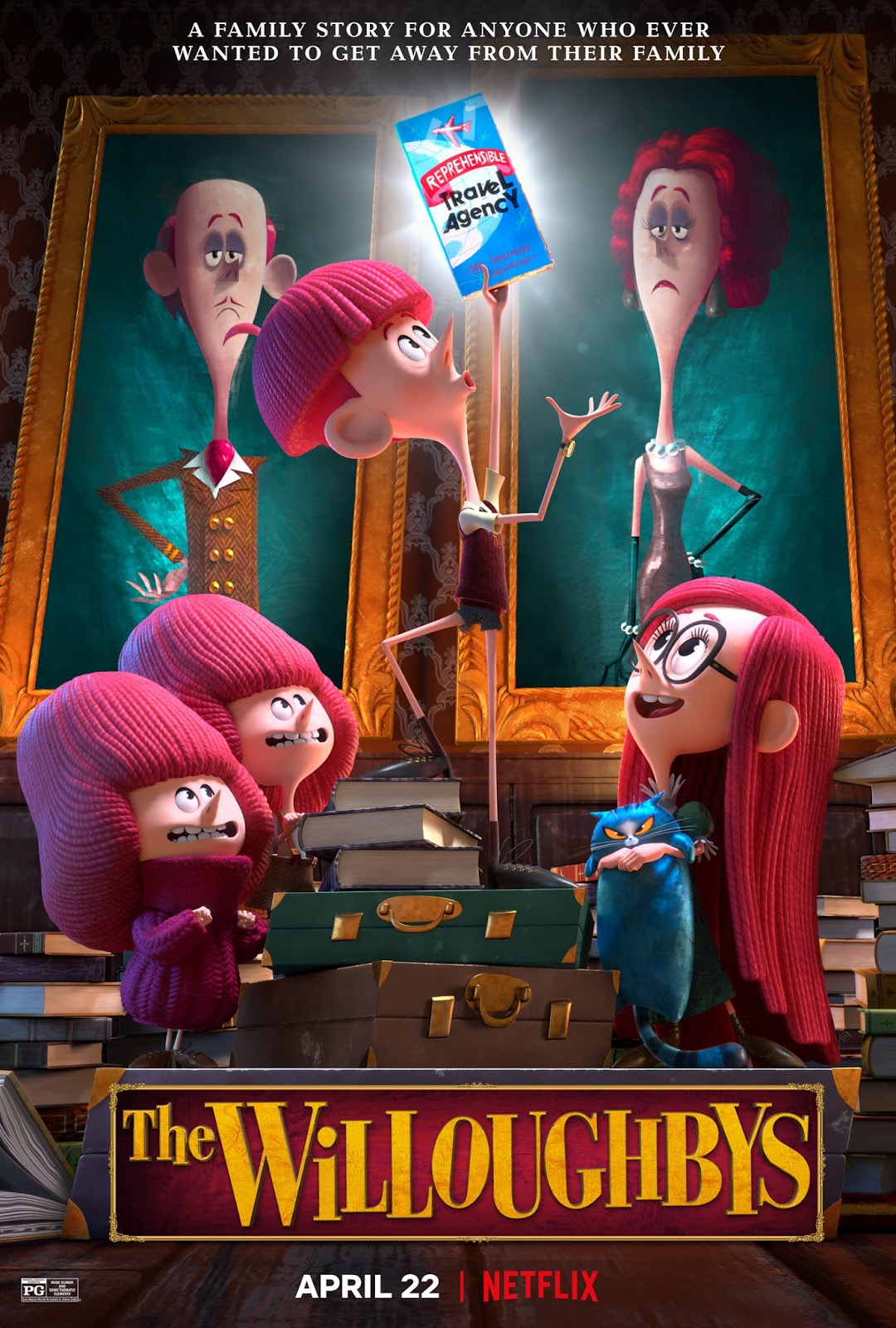
The plot feels like a bunch of alt-lite kids media stitched together: a little bit of A Series of Unfortunate Events, a little bit of Henry Selick, a lot of Roald Dahl (I've not read the Lois Lowry book this is based on, but I have a hard time imagining the Lowry of The Giver and Number the Stars also producing something this whimsical and demented). This movie is so highly caffeinated that it has a very hard time ever sticking to one plot, which is a huge detriment to a film that includes a gem of a plot involving the central children attempting to "orphan themselves," and for a lot of the movie I wanted to shake the screenplay by the collar and yell at it to just settle down, for Pete's sake. I'm pretty much in love with the animation style, though, which is probably the best example I've seen of the recent trend of twisting CG animation into looking like something spun out of arts-and-crafts—this one even goes the extra mile to make its framerate look like stop-motion animation. I'd be willing to make peace with this whole "photorealistic rendering" thing if what was being photorealistically rendered weren't the characters themselves but the material the characters are made out of. The promise of CG anything is the ability to conjure the impossible, and I'd honestly kind of love it if CG were used to conjure impossible stop-motion films like this one. Grade: B-

The Grudge (2004)
Like a lot of these Japanese-to-American remakes go, this is a sort of slick and sleepy version of the more homespun original. The original isn't really that much more propulsive, but it's at least got an uncannier feel—maybe I'm just not as inured to Japanese makeup and effects as I am to Hollywood ones, but there's something kind of rote to the scares here. I will give major props to this one for sticking with a virtually dialogue-free finale, the only part of this movie that feels better than the original, and I'm glad that Takashi Shimizu (who directed both) got to have a second go-round with a bigger budget. Grade: B-


Mouse Hunt (1997)
I don't know how I didn't know that Gore Verbinski's directorial debut was this little flick: an utterly deranged and caustic anti-capitalist film. The naked contempt this movie has for the two leads is a sight to behold, such that these guys are the villains of their own stories in whose grotesque punishment we viewers are supposed to delight. You know how the bad guys in '90s kids movies always suffer a ton of physical humiliation and pain and usually end up stepping in or being covered in poop at some point? Imagine those guys being the protagonists of the film—only they're also factory owners with bourgeois tastes and more interest in flipping a mansion than in little inconveniences like paying their workers. The '90s were a weird time for children's entertainment. Grade: B+

Blue Collar (1978)
I can't shake the feeling that this movie (and maybe Paul Schrader's career in general?) has some unresolved gender issues that it persistently neglects to work out—at least some other Schrader films have interesting female characters, which this one does not. But otherwise, this movie is white-hot. A bleak little parable about how those in power divide the working class against itself, culminating in one of the most shocking sequences of scenes to end a movie I've seen in a while. The three principal leads are all putting in really good work, too; of course Harvey Keitel and Yaphet Kotto bring their somewhat natural gravitas, but Richard Pryor especially is a real treat here, somehow doing basically his familiar comedic persona but also making that persona capable of some incredible dramatic intensity and desperation that I've never seen from his standup. Grade: B+
The Battle of Algiers (La battaglia di Algeri) (1966)
Maybe because I don't know a ton about the whole French/Algerian history, I got a little lost following the moment-by-moment details of the plot, but as a whole, this is a pretty striking piece of work and maybe the most effective rendering of the escalating cycle of violence during revolutions that I've seen in a movie. It shows compellingly how each side rushes to increasingly brutal tactics in response to the other side's violence. Crucially, it never let's you forget who started this whole thing; you don't open your movie with a scene of a French officer ruthlessly torturing an Algerian rebel (is Zero Dark Thirty recreating this in its opening scene?) and expect your audience to come away thinking that there were some good points made on both sides of the rebellion. Good. French colonialism kind of sucks. Grade: B+

Television

Steven Universe, Season 2 (2015-2016)
I know the production cycles of these Cartoon Network shows don't really position them to being watched in "seasons," but that said, I'm not sure where Season 2 really ends and Season 3 begins, since Hulu and Wikipedia put different episodes in different seasons. Oh well. Whatever the boundaries of the season, it's still a good time. This season is much more focused on the mythology and big-picture plot than the first season was, which means we get a lot less Beach City hijinks and standalone episodes. In fact, most of the latter half of the season is one continuous serialized arc. The arc is awesome, and the mythology is pretty impressive in that even as it gets bigger and deeper, it still remains rooted in the central psychological and emotional tensions that ground the show in a very real space, even as it becomes cosmos-spanning large: tensions about identities and bodies and gender and coming of age in a world in which adults lack the ability (either by absence or by incompatibility) to understand what that coming of age means and the urgency of compassion even in that space of incompatibility and absence. So it's good. Often really good. But at the time time, I do also miss the more balanced focus on small-scale stories, too, that I saw in the first season. Maybe I'm the only one who thinks this, since a lot of people seem to get extremely excited when TV shows go into hyper-serialized mode, but I don't think TV series are always necessarily better when they work hard to link all of their episodes into a larger narrative, and I think it would be cool to see more of the standalone episodes come back in the future (those who have already watched this show already know if I'll be disappointed or not, but I guess I'll be surprised as I pretend to watch this show as if it's still airing). But oh well. Like I said, this season is still good! Grade: B+

Music

Beyoncé - 4 (2011)
In my head, this was the first "modern" Beyoncé album, kicking off the more expansive, ambitious period of Beyoncé the Important Artist that we're currently living in. And the context of this album is certainly backs that, with an increased autonomy for Beyoncé in the crafting of the record after sacking her dad as her manager. Listening to this album front-to-back for the first time since 2011, though, I think I had that wrong as far as the actual album goes; 4 has a lot of the same issues that I Am...Sasha Fierce has, namely the indiscriminate track sequencing and an occasional over-reliance on some broad anthemic songwriting. Apparently Beyoncé presented 72 songs to her label, and I have a hard time imagining that none of those were more interesting than "I Care" (sonically, "Halo, Pt. 2"?) or "Start Over." But there are some delirious highs on this album, too, and on the whole, despite a little bit of diversification of sounds and production, 4 actually feels more like the crowning sendoff of Beyoncé's pop era before the inauguration of her Important Artist era. "1+1" is a great old-school slow-burn showcase for Beyoncé's overpowering ability to just belt melodies, and the Frank-Ocean-penned "I Miss You" is a pulsing R&B highlight with probably my favorite production on the record. But of course, the real peak is the one-two punch of now-wedding-reception staple "Love on Top," the best pop-soul song in Beyoncé's whole career, and the wild, densely hooky "Countdown," a top-five Beyoncé song for me and completely unlike anything she has done before or since. This would be a better album than Sasha Fierce even if its only two good songs were "Love on Top" and "Countdown." Grade: B

Sunday, June 14, 2020

Mini Reviews for June 8-14, 2020

There are a few things in this post that I would have reviewed last week if I'd had time.

Movies

Da 5 Bloods (2020)
More so than any Vietnam War movie I've seen, Da 5 Bloods goes beyond the psyche-scarring, generational consequences of fighting in an unjust, unjustified war, instead becoming about the psyche-scarring, generational consequences of how imperialism forces its victims to fight one another rather than their oppressors. Out of the mouth of none other than Hanoi Hannah (one of several gigantic middle fingers this movie gives to the mainstream, U.S.-government-approved narrative of the war), Spike Lee broadcasts his electric thesis: that at the very same moment that the United States was crushing the civil rights uprisings of black Americans on its home turf, it was also drafting those same black Americans to crush a Vietnamese uprising that was closely tied to liberation from their French oppressors; this is a fracturing of identity and global solidarity that takes the work of decades to mend, if at all, and the trauma of imperialism (both of the classical European variety represented by the French colonizers and of the modern military-industrial kind represented by the United States armed forces) reverberates through the Vietnamese and the African-American in ways that take the damage inflicted upon them by their oppressors and iterate that damage upon each other. It's an extraordinarily complex piece of filmmaking, even for Spike Lee, and it's filled to the brim with brilliant touches that feed recursively into that thesis, like the way that the camera frames the Western capitalism towering over the modern Vietnamese cities, or the use of "Ride of the Valkyries," Apocalypse Now-style, as the American soldiers take a tourist boat down a river. It's also incredibly uneven in sections, as Spike Lee movies tend to be. The first hour in particular has a lot of material that could easily be cut, I think; maybe this is a hot take, but I actually don't think we need any of the flashbacks to the battle scenes—like, besides the (admittedly cool) aspect-ratio change, what do they add that the present-day meat of the movie doesn't already tackle? But even at its shakiest, Spike maintains a furious focus on his central cause, and by the time we get to the final stage of the film (which begins about fifty minutes from the end) and its thematic threads begin to pull tight, the movie has become flat-out great, at times almost entirely on the back of Delroy Lindo's incendiary performance as a self-loathing Trump supporter—instantly one of Spike Lee's best characters out of a career full of great ones and one whose totemic inferno without a doubt deserves to be ranked beside Brando in Apocalypse Now and Vincent D'Onofrio in Full Metal Jacket as the definitive cinematic portraits of the self-destructive rot that the American military complex in Vietnam wrought on individuals. In this one character rests the most compelling embodiment of the film's ideas about the cyclical violence of imperialism among the oppressed, and a long, almost stream-of-consciousness sequence in which Lindo directly addresses the camera may in fact be the movie's most vital approach to its thesis. Compared to Spike's re-emergence back into the mainstream with BlacKkKlansman, Da 5 Bloods is maybe less conventionally "good," and I don't think it ever arrives at anything as visually arresting as Alec Baldwin in front of the projector or as structurally stunning as the Birth of a Nation cross-cutting. But as an object of cinematic derring-do, it's miles more ambitious, and as a thematic work (and particularly as those themes intersect Lindo's character), it's way knottier and more intricate than BlacKkKlansman could ever hope to be, and ultimately more challenging, too. Appointment viewing, to be sure. Grade: A-

A Hidden Life (2019)
Alongside a few Evangelical films, this is probably the definitive cinematic statement on how following Jesus is an inherently political gesture. The difference is that the politics of those Evangelical films always ultimately manifest themselves as self-defense: protection of the institution of Christianity (or at least their version of it). Though all three God's Not Dead movies focus on different aspects of it (respectively: freedom of thought, freedom of speech, and freedom of assembly), they all hinge on the idea that Christian counter-cultural resistance is about defending the presence of a Christian institution that is """under attack""" in our modern world—even the duty to save souls is always framed in terms of who shows up to the church service or the Newsboys concert (the third God's Not Dead movie is more complicated than this, but for the purposes of this review, oh well). Persecution is, under this framing of the Christian life, to be on the front lines of defending Christianity, and the sad irony of it all is the fundamental idolatry of it: they are followers of Christianity rather than followers of Christ, something Martin Scorsese's film (and Shūsaku Endō's novel) Silence thoroughly explore and ultimately burn to the ground. Contrast that with what Terrence Malick shows of Franz Jägerstätter's resistance in A Hidden Life. Jägerstätter takes a stand not for his Christianity but because of it, and the suffering he undergoes is not the result of people attacking his beliefs or an institution to which he belongs (what Evangelicalism would have you think persecution is) but the result of the political implications of actions he has committed because of his Christian beliefs: namely, that he refuses to fight for an army in service of Nazism. I can see how some people might ding this movie as being a slightly artsier version of the inspirational suffering fetishism that Christians have indulged in for centuries, at least, a la Foxe's Book of Martyrs. Silence is, after all, a much more complex look at Christian persecution, especially compared to the moral certitude of, you know, resisting Nazi Germany. But I can't just dismiss A Hidden Life as that, because in addition to that beatific depiction of persecution, it also functions as the greatest positive declaration of what the Christian life is that the film arts have seen in a very long time. As one character states early in the movie, "Christ's life is a demand," and the movie spends the better part of its three hours exploring just what that demand is. Neighbors and city leaders are seduced by white supremacist nationalism and spread its lies in the commons as the solution to affliction, jackbooted soldiers march through the city demanding patronage, fascist leaders obligate fealty. The bells of the church are melted into bullets, but the echoes of their peals ring across this film, a reminder of what the institution that Evangelical films defend has wrought: complicity in fascism, racism, brutality, subjugation. Jägerstätter's Christian life is one that follows Christ's: refuses complicity, refuses fascism's blathering leader, stands on behalf of the immigrant and the marginalized, stands against oppression. This is a vital part of Malick's declaration of the Christian life, but that declaration is not complete until the final moments of the film, when, echoing the words of John the Revelator describing the New Jerusalem descending to Earth at the Bible's end, Jägerstätter's wife Franziska finishes the film's vision with our great collective hope in Christ: "A time will come when we will know what all this is for, and there will be no mysteries. We will know why we live. We'll come together. We'll plant orchards, fields. We'll build the land back up." This hope is God's Kingdom, our work here on Earth, the two sides of a Christian life: resistance and renewal. Any alternative is idolatry. Grade: A

Ford v Ferrari (2019)
Cars are bad, but this movie is good, for the most part. It's kind of funny that a movie about the difficulty of being a craftsman within the soul-sucking machinations of a gigantic corporation ended up being more of a Ford itself than a Ferrari—which, while I don't know anything about cars (except that they are bad), this movie leads me to believe is a distinction based on vision and artistry (Ferrari) vs. dependability and profitability (Ford). This is like the definition of dependability: the kind of movie that nobody is probably going to say is their favorite but that they will reliably catch an hour of on cable from time to time and enjoy themselves solidly. It's way, way, way too long (2.5 hours? REALLY?? I was restless by the end, for sure), and Caitriona Balfe, who plays Mollie, Christian Bale's character's wife, is given a wildly uneven version of the already uneven trope of the Great Man's Nagging Wife. But generally, this is a pretty good time. Now someone needs to make the Ferrari version of this movie. Or maybe a movie about trains. Grade: B

Allegro non troppo (1976)
It's kind of surprising that there aren't more Fantasia knock-offs; syncing classical music (or music of any kind—still waiting for that progressive rock Fantasia, world) to wordless animated shorts is a very cool idea, and as this movie explicitly says in its opening minutes, it's an animator's dream to be given a blank canvas of the kind that the Fantasia model permits. The movie says this with its tongue unmistakably in its cheek, but I'm serious about it; anything-goes animation coupled with evocative orchestral music is a format with limitless possibilities, and it's a sad fact that the format is not quite commercial enough to get more iterations off the ground. Which is why, I think, that Allegro non troppo positions itself as a parody of Fantasia rather than a child of Fantasia, as that's probably the more marketable angle. And in fairness, it works extremely well as a parody—a satire, even, lobbing relentless scorn at the  sanctimony and labor abuses of Walt Disney, and bravo, I say, especially in this era of the entertainment-industry-gobbling tentacled empire of Disney. From this position of scorn, the movie not only includes but revels in crude punchlines and sexual humor to which stuffy Walt would never have dared "stoop," and the movie is better for it, a light and absurd bit of animated acid (in both the psychedelic and caustic senses) that has the devilish, anti-establishment sensibilities of Looney Tunes or Ralph Bakshi. But at the same time as it's a pretty good skewering of Fantasia, Allegro non troppo is also a great example of the form itself, and for as much as its anarchic personality makes it seem like this is all just a nihilistic farce, there is a real care to the animation that makes its individual sequences stunning, particularly the show-stopping sequence set to Ravel's Boléro, in which life evolves from the sludge at the bottom of a littered bottle of Coke—it's an honest-to-goodness masterpiece, and even if the other shorts were trash, this one piece justifies the existence of the entire endeavor. Luckily, the other shorts are pretty great for the most part, with the exception of the opening sequence, which involves an unfunny and uninteresting parade of sexual imagery as an aging satyr tries to get his groove back. That one's not too good. But on the whole, this is some serious stuff, as irreverent as it can be. Grade: A-

Jeanne Dielman, 23, Quai du Commerce 1080 Bruxelles (1975)
For a 3.5-hour movie that is 95% still shots of a woman doing chores in her own house, Jeanne Dielman is surprisingly riveting. Even before its somewhat infamous turn in its final minutes, it is legitimately fascinating to watch in great detail our protagonist go about her routines, in the same way that Frederick Wiseman's fly-on-the-wall chroniclings of lengthy bureaucratic meetings fascinating: give any procedure enough context and its inherent drama reveals itself. Mundane human life isn't usually boring to those involved in it because those involved tend to have a deep sense of what is at stake in those habits; movies have a hard time capturing these stakes because their necessarily hedged perspective lacks the infinite continuity of a subjectively lived life. Jeanne Dielman (and the work of Frederick Wiseman, for that matter) fixes this somewhat by giving as much immediate context as possible, letting these actions exist within long (for a movie) stretches of time inside lengthy, unedited takes. The more we see of a life, the more interesting it becomes because the importance of these details is magnified by the amount of time we spend with them, and by the accumulation of these details' significance, the gendered and economic dimensions of her life become more immediately lived by the viewer than they would be in a more conventionally edited movie, where the hyper-condensed information of a life necessitates a heavy hand and bold shapes to communicate the same information. That's not to say this movie isn't boring for large stretches; oh lordy, it can be a snooze. But as in so much slow cinema, that boredom is itself a feature of the text by which the movie builds its stakes, and paradoxically, it would be less exciting if it were less boring. Weird, wild stasis. Grade: A-

The Black Cat (1934)
This is waaay plottier than I was expecting from an early-sound feature adapted from a pretty brief Poe short story. You got train rides, you got satanic cults, you got mad scientists, Lugosi and Karloff playing chess over a guy's life, Lugosi and Karloff going fisticuffs, Russian conspiracies—all in an hour and change. A wild, wild movie that probably could have slowed down a tad and played up the atmosphere a hair more (and maybe done a little more with its female characters than make them swoon and die). But some very cool stuff on the whole, no doubt. Grade: B+

I was part of a conversation discussing this movie on the Cinematary podcast, if you're interested in listening.


7th Heaven (1927)
I was really tracking with this movie for its front half, when it's this somewhat kooky fantasy with exaggerated urban landscapes ("I work in the sewers but live in the stars!") that morphs into a slightly less kooky romantic comedy. It completely lost me when it became a WWI melodrama in the back half. The beginning is super good, though, and I don't think I could ever completely lose goodwill for a movie that includes the scene where the protagonist explains that he's an atheist because God owes him 10 francs. Grade: B-


Body and Soul (1925)
In one sense, this movie is fatally compromised by the censor's mandated changes. A story about a literal criminal uses religion to manipulate, exploit, and even assault his congregants that ends with a completely haphazard "but it was all a dream!" twist masking-taped onto the end is a failure at a fundamental level to achieve its goal of criticizing religion. On a meta level, though, this is a gut-punch—the censor's insistence that the very real abuse at the hands of the church is "just a dream" is documentary evidence of the gaslighting that so often happens to suppress allegations of abuse, particularly in church communities. I would have really liked to have seen the unedited version of this movie, but there's something compelling about the fact of this version's existence. Grade: B

Television

Rick and Morty, Season 4 (2019-2020)
There are some standout episodes in this season that indicate there's still plenty of gas in the tank for Rick and Morty: my favorites are "Rattlestar Ricklactica," a hilarious recreation of the first Terminator movie with a race of sentient snakes, and "The Vat of Acid Episode," in which Morty gets a re-do button for life. The show remains unparalleled at creating wildly clever (sometimes even parable-like) sci-fi yarns that double as joke machines. But there is a higher rate of weaker episodes this season than in previous seasons (neither "Chidrick of Mort" nor "Never Ricking Morty" did much for me), and on a more holistic level, the series seems to have run out of ideas for its characters as far as their humanity goes; we're not quite at the point of Flanderization, but for a show that seemed for a while at least nominally interested in delivering character insights and development, this season is curiously free of them. The characters just kind of live in the same stasis as they were left in at the end of Season 3, and any sincere moments they're given don't do much to expand beyond things we already know about them. Or even when there are a few new things, there's just nothing surprising or interesting about any of that. This is especially true of Rick. The show knows one emotional beat for Rick by heart: that his drive toward incredible material and scientific success doubles as both an attempt at connection with his friends and family and a method by which he drives those family and friends away, a destructive contradiction that leaves Rick miserable and bitter. And Season 4 plays this beat over and over again, occasionally to great effect (the end of "The Old Man and the Seat" is maybe the definitive image of this central conflict in Rick) but increasingly to diminishing returns. There are only so many times I can see Rick do something abusive or alienating that he feels bad about as the end credits roll and still be invested in that character trait. I had my complaints with the blunt and overly diagnostic approach to Rick's character in Season 3, but at least that was pushing the character in new directions. I don't see a lot of new direction here, and while I can see how some people may still find those familiar directions engaging (or find the stasis of a character like Rick to be a compelling depiction of how he is stuck in the same psychological cycles), for me it makes the show's character beats feel increasingly like afterthoughts to the main attraction of the wild, irreverent sci-fi adventures. I guess there's a version of the show just settling into a sci-fi adventure comedy that I would enjoy, but under the current version of the show, it kind of feels like if it's not going to engage critically with its characters, especially Rick, then it's just using the (increasingly rote) character moments as justification for its incredibly mean sense of humor. That humor can be funny, but the less it becomes tethered to characters who are developed, the less I'm interested in it. Grade: B-

Steven Universe, Season 1 (2013-2015)
A complete joy. It's very much the child of Adventure Time in the sense that it uses the 11-minute-episode Cartoon Network setup to create a kind of low-stakes sense of absurdity and pre-adolescent happy-go-luckiness within a warm world whose possibilities and format are flexible enough to pivot between serious mythological arcs and standalone bits. It also feels very much post-Adventure Time in the way that it immediately jumps into a fully formed environment (it took the Land of Ooo a couple seasons to really fill out, but this show's Beach City feels fully realized from the jump) and foregrounds the melancholy from the get-go: Steven Universe trades Adventure Time's dadaism for a much more direct engagement with the emotional lives of its characters, who are all dealing indirectly and directly with the loss of Steven's mother, Rose, particularly Steven, who must navigate his life, his family, and his own body without the guidance that his mother would have given him—a potent metaphor for puberty, for queerness, for general childhood heartbreak, but also on a literal level a potent storytelling device. The child's point of view gives the show's stories a beautiful poignancy and a vulnerability that television doesn't always allow in itself. It's also just a really fun time. I'm looking forward to watching the rest of the series. Grade: A-

Books

House of Leaves by Mark Z. Danielewski (2000)
A horror story wrapped in layers of meta-narrative wrapped in a formalist exercise—Lovecraft by way of Borges by way of the language poets. Danielewski is impressively committed to the central bit here (it's basically the novel equivalent of a found-footage film, taking the form of an academic text [complete with footnoted citations!] analyzing a possibly fictional home movie turned Hollywood movie, and there's an argument to be made that this goes up its own rear end in terms of its stylistic flourishes—though some moments are very funny and lack any real pretension of high art, like a sequence in which a lot of famous people (Stanley Kubrick, Jacques Derrida, etc.) are interviewed about what they thought of the home movie in question. But at the core of this novel is both a kind of sweetness paired with a deep sadness, both of which kind of transcend the formalist and pastiche games of the immediate aesthetic of the novel. The core horror story of the house that is (much) bigger on the inside than it is on the outside is more or less the story of a family desperately trying to hold itself together as their own traumas and neuroses tear it apart, and it ends on a note of real love, while the meta stories (i.e. the people compiling the academic analyses) present people plunging into the abyss as encroaching mental illness and obsession isolates and maybe even ultimately kills them. There's both an optimism and a tragedy to this story that feels hard-won. I don't know how much each individual moment works (after a while, the joke about the meticulous literature review and withdrawn tone of academic writing wears thin, and I don't exactly know what to do with the formatting games later in the novel), but this book at least has heart. Grade: B+