Another week of reviews! Enjoy! Comment! Argue! Love!
Movies
Krampus (2015)
If you like the funny, kind of sadistic, creepy-but-not-quite-actually-scary vibe that sold things like Gremlins, Fright Night, and the opening half hour of Cabin in the Woods, then Krampus will be a blast. I like the aforementioned movies, so I had a blast with Krampus. The creature design is fantastic and, by the looks of it, about 80% practical, which is always neat, and the atmosphere rides the delicious edge between lush and camp. The human beings are mostly rather hate-able, which makes it go down pretty easy (dare I say: enjoyably?) when they start getting devoured by evil gingerbread men and the like, but as unlikable as they get, the screenwriting is sharp enough that it's still fun spending time with them before they start dropping off. Grade: B+
Hush (2016)
A tight, tense home-invasion thriller that's likely to be duking it out with The Witch at the end of 2016 for the best horror movie of the year. The obvious comparison is Halloween, albeit without the iconic score, but this is a lot more than the sum of its influences. For starters, Hush is way more interested in its protagonist than the John Carpenter classic ever is, and it's to its benefit: Maddie, who has lived without speech and hearing since her teens, is an enormously winsome, engaging heroine, and rooting for her (rather than waiting for her demise, as many horror movies ask us to) is one of this movie's distinct joys. Another is just how stripped down the whole thing is. This is a very small movie, obsessed with details, sounds, minute spaces, and it's all the better for it. Horror fans: see it. It's great. Grade: A-
Project Nim (2011)
I can imagine this movie being captial-G Great in the hands of someone like Werner Herzog, who could spin the balls-to-the-wall weirdness of the central facts (a woman mentions that a chimpanzee shows sexual desire for her, and she seemed surprisingly okay with that except for the fact that she considered the monkey "like a son") into something profound. As it is, with director James Marsh, whose work I've never found more than just moderately engaging, we're left with an absolutely fascinating story—a '70s experiment tries to raise a chimp as if it were human—wrapped in an overall uninteresting package. The events of the story are so engaging that it's still good, but would that this doc had been something more than just generic talking heads and TV-special-esque reenactments. Grade: B+
Macbeth (2015)
Shakespeare gets the Nicolas Winding Refn treatment, only this one is directed by some guy named Justin Kurzel. But seriously, this is pretty much Only God Forgives with Shakespearean dialogue and great acting (Marion Cotillard's surprisingly vulnerable Lady Macbeth is the best). So you've got lots of slow-mo, lots of violence, lots of attention to color, only this time, it makes some kind of sense, which is more than I can say of the cool, empty Only God. It's not all roses—I say "kind of sense" because the emphasis on visuals does slim down what was already a lean, mean play; it's Shakespeare with a lot of the connective tissue trimmed off, which does put a lot more burden on the actors and our own brains to stitch everything together. Also, (spoilers! [?]) Macbeth doesn't lose his head! What the heck, movie? Grade: B
Attack the Block (2011)
It's like The Goonies, if The Goonies was actually good (and startlingly violent, and set in inner-city London, and more than happy to kill off its kids—not all, thank goodness, but some). The cast is entirely charming (a pre-Force Awakens John Boyega helms up the lead), and its a testament to chemistry between cast and screenplay that the movie opens with the main cast mugging a woman (Jodie Whittaker, who's great here, too) and not only manages to make us root for them not five minutes later but also convincingly sells a budding camaraderie between the boys and Whittaker's character in the middle act of the film. A great little creature feature. Grade: A-
Television
Deadwood, Season 1 (2004)
Finally embarking on this big one. Among the ranks of the innovative HBO dramas of the early 2000s, Deadwood has the same transitional growing pains that early seasons of The Sopranos had, where the tension between the newfound freedoms of serialization clash up against the episodic conventions of classically structured TV, leading to a few digressions (such as one involving a brother-sister criminal duo starring, of all people, Kristen Bell) that are entertaining but narratively slight. This isn't exactly a liability all the time; Deadwood is the least plotty of those early HBO dramas (certainly less so than The Wire, and even less than the notoriously plot-ambivalent Sopranos), and if anything, the show is less about what happens in Deadwood than who happens. The chief pleasure of the show so far is just spending time with this wonderful, grimy, profane set of characters as they rub up against each other and converse. And my goodness, the conversation—the show has a reputation as "Shakespeare with swearing," but even that doesn't quite capture the glorious feeling of just letting the colorful, elliptical poetry of the dialogue wash over you. Grade: A-
Music
Radiohead - A Moon Shaped Pool (2016)
I may be alone in ranking this album just slightly below The King of Limbs, the rock legends' divisive 2011 record—there's nothing quite so transcendent as the sequence of songs from "Lotus Flower" through the record's end. But TKoL comparisons are probably misguided; the Radiohead release that A Moon Shaped Pool most resembles is In Rainbows, primarily because 1) a significant portion of its tracks are long-awaited studio recordings of songs that have been floating around the band's live shows for more than a decade, and 2) it's much more a collection of songs than a unified album (as opposed to the hyper-sequenced, thematically linked OK Computer or even Amnesiac). Neither of those are bad things, especially when the songwriting and production is as tight as it is here. The emphasis on Jonny Greenwood string orchestrations is a particularly effective touch, and songs like "Burn the Witch" and "Tinker Tailor Soldier Sailor Rich Man Poor Man Beggar Man Thief" come alive under his lush, idiosyncratic direction. And even though Radiohead is at the point in its career where it doesn't need to make an innovative statement with each album, A Moon Shaped Pool has its share of surprises: the cascading piano and marching strings of "The Numbers" are something legitimately new for Radiohead, as is the classical-tinged guitar in "Desert Island Disk." Overall, it's a solid, intermittently great entry from a band that, even nearly 30 years into its career, still manages to be one of the most vital, interesting music acts out there. Grade: A-
At this point, nothing more than the musings of a restless English teacher on the pop culture he experiences.
Sunday, June 26, 2016
Sunday, June 19, 2016
Mini-Reviews for June 13 - June 19, 2016
Another week of reviews! Don't forget to tell me how wrong I am in the comments!
Movies
Captain America: Civil War (2016)
As is increasingly becoming the case with Marvel movies, Civil War is so overstuffed with plot and characters that there's only room for clumsily broad strokes in painting character beats that really deserve a much finer point and way more breathing room. The central conflict between Captain American and Iron Man doesn't ever reach the emotional heights that it should, mostly because the movie doesn't take time to make their argument about anything more than archetypal ideologies, and the lack of development in the supposedly central relationship between Cap and Bucky has never been more detrimental than here. Either of these issues could have been easily fixed if they'd been granted a bit more screen time, but the film also has to make room for Ant Man, Hawkeye, Black Widow, Roadie, Peggy Carter's niece, the Scarlet Witch, the good AI from Age of Ultron, and the two newcomers, Black Panther and Spider-Man. Black Panther fares very well, actually, but Spider-Man, bless his adorable heart, really doesn't belong in this movie, despite the fact that only based on his maybe fifteen total minutes of screen time, I'm ready to declare him the best cinematic Spidey we've ever had. It's not all bad; it's not even mostly bad. It's actually quite good in stretches, particularly a mid-movie fight scene that's probably the best action sequence in the entire Marvel Cinematic Universe. The movie just falls into that unfortunate space where its flaws are just visible enough to make make "pretty good" not nearly good enough. Grade: B
The Lobster (2016)
Even by the standards of black comedy, The Lobster is pretty cruel (though by the standards of Dogtooth, the other movie I'm familiar with from our esteemed director/co-writer, Yorgos Lanthimos, it's positively sunny), so the laughs tend to stick in the throat. By the standards of satirical absurdity, it's pretty average for the eastern-European theater of WTF-ery, although it's still great fun: you check into a hotel for 45 days, and if you haven't found your soul mate by the end, you are turned into an animal of your choosing. It's such a relatively contained premise that it's pleasantly surprising to see just how much the movie keeps unfolding this twisted fantasy world, and by the end, you get that rare, coveted feeling of having been taken on a long journey. Grade: A-
21 Jump Street (2012)
There are a handful of golden jokes in this movie (a recurring explosion-centered joke is particularly hysterical) padded out by a whole lot of mildly funny ones. Jonah Hill and Channing Tatum are having such a blast, though, that it's contagious, and in the end, how good a joke is doesn't quite matter as much as their very winning enthusiasm to throw themselves into anything the screenplay puts in front of them. Grade: B
The Act of Killing (2012)
I'm comfortable calling The Act of Killing the best documentary of all time. It's a bold, searing gaze into the human condition that left me actually shaking. The premise is fascinating, albeit chiling (let the agents of the Indonesian genocide of Communists in the '60s tell their own stories), but nothing about its abstract concept is adequate preparation for the visceral impact of hearing these men glibly and unapologetically recount the vivid details of the scores of atrocities they've committed. Its final moments—in which one of those genocidal agents literally gags over the memories of his actions—rank among the most powerful moments I've ever seen in a movie. This is titanic, thundering, unforgettable cinema. Grade: A+
Music
The Mars Volta - De-Loused in the Comatorium (2003)
Compared to their later work, The Mars Volta on their debut, De-Loused, is spare, punchy, and nearer to the post-hardcore genre than the proggy bona fides from their followup (the incomparable Frances the Mute) would indicate. I stress that this is compared to their later work. Compared to most other bands, The Mars Volta, even here, at their most restrained, remains a cacophonous act of rock maximalism that throws ideas like "spare" and "punchy" right out the window along with their punk cred. For some, this music will be numbing. For others, it's going to be exciting. I'll let you be the judge on where I fall (hint: Frances the Mute is my jam). Grade: B+
Movies
Captain America: Civil War (2016)
As is increasingly becoming the case with Marvel movies, Civil War is so overstuffed with plot and characters that there's only room for clumsily broad strokes in painting character beats that really deserve a much finer point and way more breathing room. The central conflict between Captain American and Iron Man doesn't ever reach the emotional heights that it should, mostly because the movie doesn't take time to make their argument about anything more than archetypal ideologies, and the lack of development in the supposedly central relationship between Cap and Bucky has never been more detrimental than here. Either of these issues could have been easily fixed if they'd been granted a bit more screen time, but the film also has to make room for Ant Man, Hawkeye, Black Widow, Roadie, Peggy Carter's niece, the Scarlet Witch, the good AI from Age of Ultron, and the two newcomers, Black Panther and Spider-Man. Black Panther fares very well, actually, but Spider-Man, bless his adorable heart, really doesn't belong in this movie, despite the fact that only based on his maybe fifteen total minutes of screen time, I'm ready to declare him the best cinematic Spidey we've ever had. It's not all bad; it's not even mostly bad. It's actually quite good in stretches, particularly a mid-movie fight scene that's probably the best action sequence in the entire Marvel Cinematic Universe. The movie just falls into that unfortunate space where its flaws are just visible enough to make make "pretty good" not nearly good enough. Grade: B
The Lobster (2016)
Even by the standards of black comedy, The Lobster is pretty cruel (though by the standards of Dogtooth, the other movie I'm familiar with from our esteemed director/co-writer, Yorgos Lanthimos, it's positively sunny), so the laughs tend to stick in the throat. By the standards of satirical absurdity, it's pretty average for the eastern-European theater of WTF-ery, although it's still great fun: you check into a hotel for 45 days, and if you haven't found your soul mate by the end, you are turned into an animal of your choosing. It's such a relatively contained premise that it's pleasantly surprising to see just how much the movie keeps unfolding this twisted fantasy world, and by the end, you get that rare, coveted feeling of having been taken on a long journey. Grade: A-
21 Jump Street (2012)
There are a handful of golden jokes in this movie (a recurring explosion-centered joke is particularly hysterical) padded out by a whole lot of mildly funny ones. Jonah Hill and Channing Tatum are having such a blast, though, that it's contagious, and in the end, how good a joke is doesn't quite matter as much as their very winning enthusiasm to throw themselves into anything the screenplay puts in front of them. Grade: B
The Act of Killing (2012)
I'm comfortable calling The Act of Killing the best documentary of all time. It's a bold, searing gaze into the human condition that left me actually shaking. The premise is fascinating, albeit chiling (let the agents of the Indonesian genocide of Communists in the '60s tell their own stories), but nothing about its abstract concept is adequate preparation for the visceral impact of hearing these men glibly and unapologetically recount the vivid details of the scores of atrocities they've committed. Its final moments—in which one of those genocidal agents literally gags over the memories of his actions—rank among the most powerful moments I've ever seen in a movie. This is titanic, thundering, unforgettable cinema. Grade: A+
Music
The Mars Volta - De-Loused in the Comatorium (2003)
Compared to their later work, The Mars Volta on their debut, De-Loused, is spare, punchy, and nearer to the post-hardcore genre than the proggy bona fides from their followup (the incomparable Frances the Mute) would indicate. I stress that this is compared to their later work. Compared to most other bands, The Mars Volta, even here, at their most restrained, remains a cacophonous act of rock maximalism that throws ideas like "spare" and "punchy" right out the window along with their punk cred. For some, this music will be numbing. For others, it's going to be exciting. I'll let you be the judge on where I fall (hint: Frances the Mute is my jam). Grade: B+
Sunday, June 12, 2016
Mini-Reviews for May 23 - June 12, 2016 (aka "Sorry for more delay!")
So, I've been in the middle of a move, which means that I haven't had a whole lot of time to blog. Again, sorry! I promise (I think...) that I won't have to make this feature a once-a-fortnight thing. Anyway, here's a super-sized post to make up for the missed week. Enjoy!
Movies
Bridesmaids (2011)
This movie is funny—at times, very funny. Jon Hamm's louse of a friend-with-benefits is hysterical; Rose Byrne's shade-throwing villainy is pitch-perfect; Kristen Wiig's gentler, tragicomic turn is the best she's ever been, before or since this movie. But damn it all, this movie falls for that same post-Apatow horror of being over two hours long, and that just really topples the whole thing. There is nothing about this movie that justifies its runtime, and in fact, there are several moments that actively argue against its long cut: I'm thinking specifically of the rehearsal dinner toast scene, which pivots distressingly quickly from funny to "why haven't they cut to the next scene yet?" Funny is funny; it's true. But given the option between one slice of cake and ten, it's generally better to play it safe. Grade: B
The New World (2005)
The New World, Terrence Malick's second post-hiatus movie after The Thin Red Line, has several things going for it over its immediate predecessor: First, it's uncommonly beautiful, visually speaking, even by the already high Malick metric. It's hard to call this a career best from a cinematographer as legendary as Emmanuel Lubezki, so I won't, but his fantastic work in The New World is definitely up there. Second, (and this gets a huge "Praise the Lord" from me), Malick's trademark interior monologues/voiceovers are grounded in the concrete events that the characters experience, a merciful change from the meandering, half-poetic philosophizing that bloats lesser Malick like The Thin Red Line and the later To the Wonder. The result is that The New World is Malick's plottiest film since probably Days of Heaven, which gives these characters an immediacy that even superior Malick features have lacked. Plot isn't a necessary feature of any movie, of course, but nonnarrative film can be a tough beast to tackle, so it's a nice surprise to go in expecting a bull and to get a delicious dairy cow instead (don't read too much into that analogy). That said, this movie still meanders, and even as artfully done as it is here, did we really need another John Smith/Pocahontas story onscreen? Mileage may vary, naturally (and it has, with the critics being mostly split between lukewarm and ecstatic reviews back in '05), but my mileage runs pretty low on this kind of story these days. Grade: B
The Thief and the Cobbler (1993)
Speaking strictly of the animation, this is one of the smartest, funniest, most creative animated movies of all time: the way the action plays around with the geometry of the backgrounds and forced perspectives, creating spaces where there seems to only be generic patterns, is wonderful in a way that's difficult to describe without just linking to clips of the movie itself, and the fact that this was all hand-drawn is seriously, seriously impressive. Speaking of everything else besides the animation, though, this movie is a train wreck. Cobbled (ha) together from over twenty years' worth of fragments, the movie is clearly unfinished, and in an attempt to stitch everything together into something that vaguely (and ultimately unsuccessfully) resembles a completed whole, we're subjected to awful narration and heinous celebrity voice acting that litters the story with irritating, sub-Dreamworks anachronism and pop cultural references. Never has the chasm between technical craft and narrative execution been so wide or so disastrous. But man, that animation is something to behold. Grade: A-
Mulholland Drive (2001)
It's as great as its sterling reputation suggests—a nightmarish thriller about the nature of reality and filmmaking with just enough metaphysics thrown in to make that sort of investigation more interesting than the Vertigo/Persona pastiche that the plot synopsis suggests. I do wonder if maybe all the discussion about it being incomprehensibly mysterious is a tiny bit overblown, though. Surely there are opaque edges here and there, as there are with most of David Lynch's work, but the central plot seems straightforward enough: the first 2/3 are a dream that the main character wakes up from in the last 1/3. Although maybe my confidence in that interpretation is misplaced, and I just haven't got far enough down the rabbit hole... erm, blue box. Grade: A
Anomalisa (2015)
Probably worth watching for the animation alone, which ranks among the most technically impressive and thematically resonant uses of stop-motion ever. If it weren't for that (and maybe even still), Anomalisa isn't quite the heavyweight that Synecdoche, New York was, nor is it the brain-bender of Being John Malkovich nor the well of pathos of Eternal Sunshine—what I'm saying is that among the major works of screenwriter (and co-director here) Charlie Kaufman, this ranks as relatively slight, although that doesn't keep it from being both tender and terrifying by turns in that typically Kaufman-type way. Probably the single most enduring touch to the movie (besides having Tom Noonan voice nearly every character) is the way the stop-motion models have seams left deliberately visible, which has the tremendous effect of making these character all seem as brittle as their psyches. This is not a happy movie—in fact, it shares quite a lot with late-period Mad Men, where Don Draper was at his most both narcissistic and fearfully aware of the catastrophic effects of that narcissism. But it's a striking, intimate, even frightening one that's not bound to leave your mind soon. Grade: B+
The Revenant (2015)
Oh, it's exquisitely made, for sure. The "we're only going to shoot with natural light, and oh yeah, in the actual wilderness, maaan" actually pays off with a nearly nonstop parade of gorgeous imagery that almost justifies the conceit of a ra-ra, fist-pumping, pulp remake of The New World. Almost. It would help if the whole thing weren't so criminally boring or if every scene between the admittedly impressive action set pieces weren't another redundant iteration of either DiCaprio doing hardcore wilderness survival stuff or Hardy making his way back to civilization looking villainous. Grade: C
Godzilla (2014)
The structure is lumpy, perhaps even broken: there's nothing inherently wrong with focusing on the human drama in a Godzilla story, but there is something wrong with focusing on drama that's so inert and tepid. But once you get to the creature-feature back half of the movie, all that doesn't matter. The design, direction, and mood surrounding the monster battles are so captivating that you're likely to forget all about the boring character drama (and maybe even who the characters are to begin with). I can't think of another recent blockbuster that's managed to achieve a sense of just how titanic its monsters are and just how insignificant its humans are in comparison. Godzilla is the most artfully directed, atmospherically immersive blockbuster of its size in years, so lumps and all, it's worth your time. Grade: B+
Television
Bob's Burgers, Season 6 (2015-16)
If you aren't watching Bob's Burgers yet, well, why not? You're missing out on some of the most potent combination of silly, sweet, and gleeful anarchy to hit Fox's animated programming since the heydays of Futurama and The Simpsons, although the best point of comparison is probably the gentle realism of King of the Hill (given that Bob's Burgers has a far longer absurdist streak than Hank's adventures ever did). If you're already watching it, well, congratulations! We got another great season! I suppose if you're keeping count, the hit-to-miss ratio is just slightly smaller than in the past, which might be either a statistical blip or a sign of the show's age. But whatever minuscule dip in quality we've seen is only noticeable if you're looking hard. This show is still a weekly delight for me. Grade: A-
SpongeBob SquarePants, Season 1 (1999-2000)
I've seen it before; you've probably seen it before, too, if you're anywhere near my age. Just in case you had any doubts: yes, it holds up. Gloriously. A big part of what's so incredible here is how much it takes advantage of the fact that children have few fully formed ideas about what constitutes "weird" and "normal." A sponge lives in a pineapple at the bottom of the Bikini Atoll? Well, okay! It's occasionally narrated by an anonymous French-accented voiceover? Sure! The show plumbs some sublimely surreal depths, sometimes to hilarious effect, sometimes to nightmarish effect, often to both, as in the series-best contender, "Rock Bottom." Beautiful stuff. Grade: A
Books
To the Lighthouse by Virginia Woolf (1927)
In the ranks of Virginia Woolf novels, it's slightly Mrs Dalloway's inferior, largely due to the lengthy opening section, "The Window," which occupies nearly half of the novel and is saddled with the unglamorous task of setting the table for the final two sections, both of which are sublime. "Time Passes," the second section, is a particularly moving passage that delivers just what its title implies, reversing the languorous pace of "The Window" by fast-forwarding through the lives of each of its characters until gut-punching consequence after gut-punching consequence hits the reader in succession as the characters hurtle toward the end of time. "The Window" is almost surely too long and too lyrical, but I'll forgive it since it allows for that wonderful, heartbreaking middle. Grade: A-
The Absolutely True Diary of a Part-Time Indian by Sherman Alexie (2007)
Almost any contemporary YA novel owes at least a little to Catcher in the Rye, but Sherman Alexie's breakout novel is one of the few that I've come across that seems to understand just how important the relative aimless and episodic plotting was to the oblique pathos and wounded voice in Salinger's work. Modern YA is plotty, which sometimes has the effect of turning its world into mechanical structures with "trauma" on the front end and "self-actualization" on the back. There are few mechanics in The Absolutely True Diary, at least not ones as angular and squeaky as those in, say, a John Green novel. Thankfully, Alexie allows his protagonist lyrical moments; he lets the characterization breathe. It's wonderful. The last few moments of the book are some of the best YA pages I've read in ages. Grade: A
Music
Chance the Rapper - Coloring Book (2016)
Chance the Rapper has long been modern hip-hop's resident cornball, which is both an asset when he's releasing work like last year's exquisite "Sunday Candy" or this tape's "Finish Line" and a liability when it leads him to incongruously silly lines promising to "give Satan a swirly" (actual quote from Coloring Book). Coloring Book is a tad more consistent than previous Chance the Rapper releases—it lacks the immediacy of a clear masterwork in the vein of "Sunday Candy" or "Pusha Man," but it also doesn't get nearly as silly as some of his least successful work from last year's Donnie Trumpet collaboration, Surf—although those looking for a fulfillment of Acid Rap's scrappy promise are probably going to be disappointed. It's a slick, gorgeously produced mixtape that focuses way more intently on Chance's Christianity than his drug-related neuroses (unlike with Kanye, that Kirk Franklin collaboration actually means something here—Coloring Book is the first secularly released album I've heard that trades in on CCM influences [seriously, there's a very prominent Chris Tomlin allusion], which is kind of cool, but it's also CCM, which... urg). The music is idiosyncratic, personal, and sincere, and even if it's not always successful, there's a lot of value in those qualities. Grade: B
Grimes - Art Angels (2015)
I really haven't much listened to Grimes before this, so I have no stake in the battle of whether or not this is her sellout record. What I do think is that it's this lovely, trash-can-punch mix of '90s Euro-dance, noise, and K-pop that's every bit as infectious and strange a confection as I could want from 2010s pop music. The album has a few duds (I love Janelle Monáe passionately, but her guest track, "Venus Fly" is pretty thin), but on the whole, this is probably the best possible product of poptimism. Grade: A-
TEEN - Love Yes (2016)
Love Yes fills a very St. Vincent-shaped hole in my heart. I haven't heard any of the band's other albums, but man, if TEEN is going to tread the St. Vincent territory, they might as well do it in this much style. I do miss Annie's guitar theatrics, though, which makes TEEN a slightly less interesting inhabitant of the St. Vincent world. Grade: B
Suede - Suede (1993)
If Oasis were the Beatles of the Britpop era, then Suede was the David Bowie, albeit a considerably narrower version of Bowie than Bowie himself ever allowed, and without the sense of humor to boot. Comparisons aside, though, these are stupendously crafted songs, and if there was one thing that mattered about Britpop, it wasn't all the allusions to British Invasion rockers; it was each band's proficiency with razor-sharp songwriting precision. Suede's got that in spades (suedes?). Grade: B+
Movies
Bridesmaids (2011)
This movie is funny—at times, very funny. Jon Hamm's louse of a friend-with-benefits is hysterical; Rose Byrne's shade-throwing villainy is pitch-perfect; Kristen Wiig's gentler, tragicomic turn is the best she's ever been, before or since this movie. But damn it all, this movie falls for that same post-Apatow horror of being over two hours long, and that just really topples the whole thing. There is nothing about this movie that justifies its runtime, and in fact, there are several moments that actively argue against its long cut: I'm thinking specifically of the rehearsal dinner toast scene, which pivots distressingly quickly from funny to "why haven't they cut to the next scene yet?" Funny is funny; it's true. But given the option between one slice of cake and ten, it's generally better to play it safe. Grade: B
The New World (2005)
The New World, Terrence Malick's second post-hiatus movie after The Thin Red Line, has several things going for it over its immediate predecessor: First, it's uncommonly beautiful, visually speaking, even by the already high Malick metric. It's hard to call this a career best from a cinematographer as legendary as Emmanuel Lubezki, so I won't, but his fantastic work in The New World is definitely up there. Second, (and this gets a huge "Praise the Lord" from me), Malick's trademark interior monologues/voiceovers are grounded in the concrete events that the characters experience, a merciful change from the meandering, half-poetic philosophizing that bloats lesser Malick like The Thin Red Line and the later To the Wonder. The result is that The New World is Malick's plottiest film since probably Days of Heaven, which gives these characters an immediacy that even superior Malick features have lacked. Plot isn't a necessary feature of any movie, of course, but nonnarrative film can be a tough beast to tackle, so it's a nice surprise to go in expecting a bull and to get a delicious dairy cow instead (don't read too much into that analogy). That said, this movie still meanders, and even as artfully done as it is here, did we really need another John Smith/Pocahontas story onscreen? Mileage may vary, naturally (and it has, with the critics being mostly split between lukewarm and ecstatic reviews back in '05), but my mileage runs pretty low on this kind of story these days. Grade: B
The Thief and the Cobbler (1993)
Speaking strictly of the animation, this is one of the smartest, funniest, most creative animated movies of all time: the way the action plays around with the geometry of the backgrounds and forced perspectives, creating spaces where there seems to only be generic patterns, is wonderful in a way that's difficult to describe without just linking to clips of the movie itself, and the fact that this was all hand-drawn is seriously, seriously impressive. Speaking of everything else besides the animation, though, this movie is a train wreck. Cobbled (ha) together from over twenty years' worth of fragments, the movie is clearly unfinished, and in an attempt to stitch everything together into something that vaguely (and ultimately unsuccessfully) resembles a completed whole, we're subjected to awful narration and heinous celebrity voice acting that litters the story with irritating, sub-Dreamworks anachronism and pop cultural references. Never has the chasm between technical craft and narrative execution been so wide or so disastrous. But man, that animation is something to behold. Grade: A-
Mulholland Drive (2001)
It's as great as its sterling reputation suggests—a nightmarish thriller about the nature of reality and filmmaking with just enough metaphysics thrown in to make that sort of investigation more interesting than the Vertigo/Persona pastiche that the plot synopsis suggests. I do wonder if maybe all the discussion about it being incomprehensibly mysterious is a tiny bit overblown, though. Surely there are opaque edges here and there, as there are with most of David Lynch's work, but the central plot seems straightforward enough: the first 2/3 are a dream that the main character wakes up from in the last 1/3. Although maybe my confidence in that interpretation is misplaced, and I just haven't got far enough down the rabbit hole... erm, blue box. Grade: A
Anomalisa (2015)
Probably worth watching for the animation alone, which ranks among the most technically impressive and thematically resonant uses of stop-motion ever. If it weren't for that (and maybe even still), Anomalisa isn't quite the heavyweight that Synecdoche, New York was, nor is it the brain-bender of Being John Malkovich nor the well of pathos of Eternal Sunshine—what I'm saying is that among the major works of screenwriter (and co-director here) Charlie Kaufman, this ranks as relatively slight, although that doesn't keep it from being both tender and terrifying by turns in that typically Kaufman-type way. Probably the single most enduring touch to the movie (besides having Tom Noonan voice nearly every character) is the way the stop-motion models have seams left deliberately visible, which has the tremendous effect of making these character all seem as brittle as their psyches. This is not a happy movie—in fact, it shares quite a lot with late-period Mad Men, where Don Draper was at his most both narcissistic and fearfully aware of the catastrophic effects of that narcissism. But it's a striking, intimate, even frightening one that's not bound to leave your mind soon. Grade: B+
The Revenant (2015)
Oh, it's exquisitely made, for sure. The "we're only going to shoot with natural light, and oh yeah, in the actual wilderness, maaan" actually pays off with a nearly nonstop parade of gorgeous imagery that almost justifies the conceit of a ra-ra, fist-pumping, pulp remake of The New World. Almost. It would help if the whole thing weren't so criminally boring or if every scene between the admittedly impressive action set pieces weren't another redundant iteration of either DiCaprio doing hardcore wilderness survival stuff or Hardy making his way back to civilization looking villainous. Grade: C
Godzilla (2014)
The structure is lumpy, perhaps even broken: there's nothing inherently wrong with focusing on the human drama in a Godzilla story, but there is something wrong with focusing on drama that's so inert and tepid. But once you get to the creature-feature back half of the movie, all that doesn't matter. The design, direction, and mood surrounding the monster battles are so captivating that you're likely to forget all about the boring character drama (and maybe even who the characters are to begin with). I can't think of another recent blockbuster that's managed to achieve a sense of just how titanic its monsters are and just how insignificant its humans are in comparison. Godzilla is the most artfully directed, atmospherically immersive blockbuster of its size in years, so lumps and all, it's worth your time. Grade: B+
Television
Bob's Burgers, Season 6 (2015-16)
If you aren't watching Bob's Burgers yet, well, why not? You're missing out on some of the most potent combination of silly, sweet, and gleeful anarchy to hit Fox's animated programming since the heydays of Futurama and The Simpsons, although the best point of comparison is probably the gentle realism of King of the Hill (given that Bob's Burgers has a far longer absurdist streak than Hank's adventures ever did). If you're already watching it, well, congratulations! We got another great season! I suppose if you're keeping count, the hit-to-miss ratio is just slightly smaller than in the past, which might be either a statistical blip or a sign of the show's age. But whatever minuscule dip in quality we've seen is only noticeable if you're looking hard. This show is still a weekly delight for me. Grade: A-
SpongeBob SquarePants, Season 1 (1999-2000)
I've seen it before; you've probably seen it before, too, if you're anywhere near my age. Just in case you had any doubts: yes, it holds up. Gloriously. A big part of what's so incredible here is how much it takes advantage of the fact that children have few fully formed ideas about what constitutes "weird" and "normal." A sponge lives in a pineapple at the bottom of the Bikini Atoll? Well, okay! It's occasionally narrated by an anonymous French-accented voiceover? Sure! The show plumbs some sublimely surreal depths, sometimes to hilarious effect, sometimes to nightmarish effect, often to both, as in the series-best contender, "Rock Bottom." Beautiful stuff. Grade: A
Books
To the Lighthouse by Virginia Woolf (1927)
In the ranks of Virginia Woolf novels, it's slightly Mrs Dalloway's inferior, largely due to the lengthy opening section, "The Window," which occupies nearly half of the novel and is saddled with the unglamorous task of setting the table for the final two sections, both of which are sublime. "Time Passes," the second section, is a particularly moving passage that delivers just what its title implies, reversing the languorous pace of "The Window" by fast-forwarding through the lives of each of its characters until gut-punching consequence after gut-punching consequence hits the reader in succession as the characters hurtle toward the end of time. "The Window" is almost surely too long and too lyrical, but I'll forgive it since it allows for that wonderful, heartbreaking middle. Grade: A-
The Absolutely True Diary of a Part-Time Indian by Sherman Alexie (2007)
Almost any contemporary YA novel owes at least a little to Catcher in the Rye, but Sherman Alexie's breakout novel is one of the few that I've come across that seems to understand just how important the relative aimless and episodic plotting was to the oblique pathos and wounded voice in Salinger's work. Modern YA is plotty, which sometimes has the effect of turning its world into mechanical structures with "trauma" on the front end and "self-actualization" on the back. There are few mechanics in The Absolutely True Diary, at least not ones as angular and squeaky as those in, say, a John Green novel. Thankfully, Alexie allows his protagonist lyrical moments; he lets the characterization breathe. It's wonderful. The last few moments of the book are some of the best YA pages I've read in ages. Grade: A
Music
Chance the Rapper - Coloring Book (2016)
Chance the Rapper has long been modern hip-hop's resident cornball, which is both an asset when he's releasing work like last year's exquisite "Sunday Candy" or this tape's "Finish Line" and a liability when it leads him to incongruously silly lines promising to "give Satan a swirly" (actual quote from Coloring Book). Coloring Book is a tad more consistent than previous Chance the Rapper releases—it lacks the immediacy of a clear masterwork in the vein of "Sunday Candy" or "Pusha Man," but it also doesn't get nearly as silly as some of his least successful work from last year's Donnie Trumpet collaboration, Surf—although those looking for a fulfillment of Acid Rap's scrappy promise are probably going to be disappointed. It's a slick, gorgeously produced mixtape that focuses way more intently on Chance's Christianity than his drug-related neuroses (unlike with Kanye, that Kirk Franklin collaboration actually means something here—Coloring Book is the first secularly released album I've heard that trades in on CCM influences [seriously, there's a very prominent Chris Tomlin allusion], which is kind of cool, but it's also CCM, which... urg). The music is idiosyncratic, personal, and sincere, and even if it's not always successful, there's a lot of value in those qualities. Grade: B
Grimes - Art Angels (2015)
I really haven't much listened to Grimes before this, so I have no stake in the battle of whether or not this is her sellout record. What I do think is that it's this lovely, trash-can-punch mix of '90s Euro-dance, noise, and K-pop that's every bit as infectious and strange a confection as I could want from 2010s pop music. The album has a few duds (I love Janelle Monáe passionately, but her guest track, "Venus Fly" is pretty thin), but on the whole, this is probably the best possible product of poptimism. Grade: A-
TEEN - Love Yes (2016)
Love Yes fills a very St. Vincent-shaped hole in my heart. I haven't heard any of the band's other albums, but man, if TEEN is going to tread the St. Vincent territory, they might as well do it in this much style. I do miss Annie's guitar theatrics, though, which makes TEEN a slightly less interesting inhabitant of the St. Vincent world. Grade: B
Suede - Suede (1993)
If Oasis were the Beatles of the Britpop era, then Suede was the David Bowie, albeit a considerably narrower version of Bowie than Bowie himself ever allowed, and without the sense of humor to boot. Comparisons aside, though, these are stupendously crafted songs, and if there was one thing that mattered about Britpop, it wasn't all the allusions to British Invasion rockers; it was each band's proficiency with razor-sharp songwriting precision. Suede's got that in spades (suedes?). Grade: B+
Labels:
album review,
Bob's Burgers,
book review,
Chance the Rapper,
David Lynch,
film,
Grimes,
literature,
mini-reviews,
movie review,
music,
Sherman Alexie,
SpongeBob SquarePants,
television,
TV review,
Virginia Woolf
Tuesday, May 24, 2016
Favorite Movies, 1-100
I'm sure nobody but boring bean-counters like me cares, but this post marks the 100th post by this blog! Woot woot! So in celebration of that milestone, I thought I'd do something fun. And because I'm a weird, boring bean-counter who likes quantifying art into meaningless lists, I make a list of my 100 favorite movies. Yay!
Actually, this turned out to be a lot harder than I thought it would be. Apparently, I have a lot of favorite movies. My apologies to the many, many movies left on the cutting-room floor. In order to avoid making this list even more difficult than it already was, I didn't really do any sort of ranking here; the movies are just listed alphabetically by title (with the release year and director[s] in parentheses off to the side).
Of course, I make no claims to any of these movies being the "best" or anything like that. I just happen to really dig them. My intention here is, if anyone's interested, to start a conversation where everyone shares their favorite movies. I'm seriously much more interested in hearing y'all's favorite movies than I am mine. So please! Share! Tell me how bad my taste is! Tell me what movies you would have picked instead! That's the whole point of list-making.
For those who are interested, numbers:
- The most represented letters of the alphabet are S and T, with 11 films each.
- The most represented director is Ingmar Bergman, with 4 films to his name.
- The most represented decade is, not surprisingly, given my age, 2000-2009, with 21 films.
The List
Aguirre, the Wrath of God (1972, Werner Herzog)
Airplane! (1980, Jim Abrahams and David & Jerry Zucker)
Aladdin (1992, Robert Clements and John Musker)
Alien (1979, Ridley Scott)
Annie Hall (1977, Woody Allen)
The Apartment (1960, Billy Wilder)
Babe (1995, Chris Noonan)
Barton Fink (1991, Joel & Ethan Coen)
Before Sunset (2004, Richard Linklater)
Being John Malkovich (1999, Spike Jonze)
Bill and Ted's Excellent Adventure (1989, Stephen Herek)
The Blair Witch Project (1999, Daniel Myrick and Eduardo Sánchez)
Cabin in the Woods (2012, Drew Goddard)
Casablanca (1942, Michael Curtiz)
Certified Copy (2010, Abbas Kiarostami)
The Circus (1928, Charles Chaplin)
Citizen Kane (1941, Orson Welles)
City of God (2002, Fernando Meirelles and Kátia Lund)
The Conversation (1974, Francis Ford Coppola)
Coraline (2009, Henry Selick)
Day of Wrath (1943, Carl Theodor Dreyer)
Days of Heaven (1978, Terrence Malick)
Do the Right Thing (1989, Spike Lee)
Donnie Darko (2001, Richard Kelly)
Dr. Strangelove or: How I Learned to Stop Worrying and Love the Bomb (1964, Stanley Kubrick)
The Emperor's New Groove (2000, Mark Dindal)
E.T. the Extra-Terrestrial (1982, Steven Spielberg)
Eternal Sunshine of the Spotless Mind (2004, Michel Gondry)
Evil Dead 2: Dead by Dawn (1987, Sam Raimi)
Eyes Wide Shut (1999, Stanley Kubrick)
Fantasia (1940, So many people)
Frankenstein (1931, James Whale)
The General (1926, Clyde Bruckman and Buster Keaton)
The Good, the Bad and the Ugly (1966, Sergio Leone)
Goodfellas (1990, Martin Scorsese)
Groundhog Day (1993, Harold Ramis)
His Girl Friday (1940, Howard Hawks)
The House of the Devil (2009, Ti West)
The Illusionist (2010, Sylvain Chomet)
Inglourious Basterds (2009, Quentin Tarantino)
The Iron Giant (1999, Brad Bird)
It's Such a Beautiful Day (2012, Don Hertzfeldt)
It's a Wonderful Life (1946, Frank Capra)
Juno (2007, Jason Reitman)
Kicking and Screaming (1995, Noah Baumbach)
The King of Comedy (1983, Martin Scorsese)
The Lord of the Rings (2001-2003, Peter Jackson)
M (1931, Fritz Lang)
The Magician (1958, Ingmar Bergman)
Magnolia (1999, Paul Thomas Anderson)
Make Way for Tomorrow (1937, Leo McCarey)
Man with a Movie Camera (1929, Dziga Vertov)
The Mirror (1975, Andrei Tarkovsky)
Mission Impossible: Ghost Protocol (2011, Brad Bird)
Monty Python's Life of Brian (1979, Terry Jones)
Modern Times (1936, Charles Chaplin)
Network (1976, Sidney Lumet)
The Night of the Hunter (1955, Charles Laughton)
O Brother, Where Art Thou? (2000, Joel & Ethan Coen)
Pan's Labyrinth (2006, Guillermo del Toro)
Paper Moon (1973, Peter Bogdanovich)
ParaNorman (2012, Sam Fell and Chris Butler)
Persona (1966, Ingmar Bergman)
The Piano (1993, Jane Campion)
Pinocchio (1940, A whole bunch of folks)
The Prestige (2006, Christopher Nolan)
Psycho (1960, Alfred Hitchcock)
Pulp Fiction (1994, Quentin Tarantino)
The Purple Rose of Cairo (1985, Woody Allen)
Radio Days (1987, Woody Allen)
Raiders of the Lost Ark (1981, Steven Spielberg)
Rear Window (1954, Alfred Hitchcock)
Repulsion (1965, Roman Polanski)
The Secret of Kells (2009, Tomm Moore and Nora Twomey)
A Separation (2011, Asghar Farhadi)
Sherlock Jr. (1924, Buster Keaton)
A Shot in the Dark (1964, Blake Edwards)
Sleeping Beauty (1959, A lot of folks)
The Social Network (2010, David Fincher)
Some Like It Hot (1959, Billy Wilder)
Spider-Man 2 (2004, Sam Raimi)
The Star Wars Trilogy (1977, 1980, 1983; George Lucas, Irvin Kershner, Richard Marquand [respectively])
Sunrise: A Song of Two Humans (1927, F. W. Murnau)
Sunset Boulevard (1950, Billy Wilder)
The Tale of the Princess Kaguya (2013, Isao Takahata)
Terminator 2: Judgement Day (1991, James Cameron)
The Texas Chainsaw Massacre (1974, Tobe Hooper)
There Will Be Blood (2007, Paul Thomas Anderson)
The Thing (1982, John Carpenter)
Through a Glass Darkly (1961, Ingmar Bergman)
Toy Story (1995, John Lasseter)
The Treasure of the Sierra Madre (1948, John Huston)
Trouble in Paradise (1932, Ernst Lubitsch)
25th Hour (2002, Spike Lee)
Twin Peaks: Fire Walk With Me (1992, David Lynch)
Up (2009, Peter Docter)
WALL-E (2008, Andrew Stanton)
When Harry Met Sally... (1989, Rob Reiner)
Winter Light (1963, Ingmar Bergman)
The Wizard of Oz (1939, Victor Fleming)
Sunday, May 22, 2016
Mini-Reviews for May 2 - May 22, 2016 (aka "Sorry for the delay!")
Due to a lot of end-of-semester craziness and some personal stuff, it's been two weeks since I've been able to write one of these review posts. I don't know if anyone hangs on these posts or waits up at night for them or anything, but if someone does, I'm sorry! Hopefully this extra-long post makes up for the delay.
Movies
Looney Tunes: Back in Action (2003)
The title leads you to believe that this is a Looney Tunes movie, and it's certainly anarchic and self-referential enough to earn that moniker. But what this movie really is is a salute to Warner Bros. history in general, which makes it way more fun than a Chuck-Jones-less Looney Tunes movie was ever going to be. It's sometimes trying too hard, and not all the jokes land. But it's got an Animaniacs-esque love of movie history, and it's hard to begrudge that. Grade: B+
Kiss Kiss Bang Bang (2005)
It's one of the funniest American movies of the past few decades. It's also got that irritating, show-stopping meta-commentary by Robert Downey Jr.'s character, which doesn't stop it from being one of the funniest American movies of recent years. But it is something extra that just kind of drives me up the wall—we get it, movies are artificial. The core of this movie is just aces, though; bonus points to Michelle Monaghan for breathing life into her wafer-thin girl friday. Grade: A-
The Descent (2005)
Why aren't more horror movies set in caves? Caves are terrifying! Especially when, as is the subtext in this movie, the cave leads to Hell itself. It's a spooky, unsettling undercurrent that's made all the more spooky and unsettling by the masterful control of lighting. The lighting really is the MVP here; if I had to guess, I'd say that a full 25 percent of the film is entirely dark, while a not inconsiderable fraction of the movie's remainder is composed of shots with only a corner of the frame lit. It's wonderfully effective and creates the neat effect of making the audience as blind as the unfortunate cavers who star in the film, but what sets the lighting into truly incredible territory is the scenes lit by the cavers' various flares and glowsticks, casting the cave walls in fire-red and sickly green monochrome. It's without question one of the best-directed horror movies of the new millennium, and were it not for the relatively forgettable cast of characters (my one strike against the movie), we'd be dealing with an all-time classic here. Grade: A-
American Ultra (2015)
This movie thinks it's a lot more entertaining than it is, obsessed with its own presumed cleverness and ironic juxtaposition of tones. There are actually two really fantastic performances in here, one from Jesse Eisenberg and the other from Kristen Stewart, and the ending credits are, improbably, cool. All of which makes it even more of a shame that the movie surrounding those bright spots is such a bore. Grade: C
Steve Jobs (2015)
The cracker-jack Sorkin dialogue and inventive, stage-like structure (each of the three "acts" center around a long scene that focuses on a single product launch in Jobs' career) make this one of the best biopics in years—probably since Spielberg's Lincoln. That is, until it completely and catastrophically flubs the landing on one of the most astoundingly ill-conceived endings I've ever seen in a movie. There's a moment (I won't spoil it, but you'll know it once the final ten minutes slap you in the face) when the movie jumps from being a razor-sharp study of the compromises of genius to a weirdly beatific, tender mushfest, and it's awful. That said, 95 percent of the best biopic in years is still 95 percent of the best biopic in years. Cut your losses, I suppose. Grade: B
The Nice Guys (2016)
This will likely be the funniest movie of 2016—funny enough that it pretty much doesn't matter that the trailer revealed most of the best jokes. Of course, if you've been paying attention to the career of Shane Black, this should come as no surprise; unfortunately for me, I haven't been paying attention to Shane Black until just earlier this week when I saw Kiss Kiss Bang Bang, so I'm in the kind of dopey-eyed position of being surprised that The Nice Guys is every bit as funny—nay, funnier—than its trailer promised. I can't overstate how much the winning cast plays a hand in this success: Ryan Gosling in particular displays a proficiency with timing and physical comedy that makes this probably my favorite performance of his career. There's a lot of Robert Downey Jr.'s Kiss Kiss Bang Bang performance in him here, which is good. In fact, there's a lot of Kiss Kiss Bang Bang in general here, which is mostly good but also comes with its own baggage: as in the earlier film, there's a troubling glibness surrounding the mistreatment of women, and the plot and writing in general hews closely enough to Black's wheelhouse that there's a definitely been-there-done-thatness to the whole movie that makes it just a tad less fresh than it might be in a vacuum. But still. This is great fun. Grade: A-
Television
Better Call Saul, Season 2 (2016)
It's a slight step down from the first season, if only because the debut's sickening feeling of discovery made the tragedy of Jimmy's world all the deeper, but a slight step down from one of the best seasons of television in recent years still makes for very, very good television. This season is all about teasing out more complex varieties of the same basic conflicts from the first season, though in more heightened situations—as Jimmy works his way up the legal-world ladder, he faces again and again those same questions: the tension between what's right and what's right for his career, the gulf between what people deserve and what people get, all of which culminates in a riveting, tense showdown between Jimmy and his brother that reveals, yet again, that the great tragedy of the show is Jimmy's love for his brother. Also (and slightly unrelated): Kim Wexler is probably my favorite character on TV right now. Grade: A-
Books
Please Ignore Vera Dietz by A. S. King (2010)
I liked Reality Boy, the other A. S. King I've read, alright, but Please Ignore Vera Dietz is head and shoulders above that novel. It's got the same stellar command of voice and humor that gave Reality Boy its readability, but the dysfunction is dialed down just a bit, which makes room for a bit more tender (though still not exactly cuddly) character interplay, especially between Vera and her father. There are also the surreal touches, like the from-the-grave narration of "the dead kid," which serve alternatingly as flashback devices and little tone poems, and it adds tons of texture to the story. A broken heart lives at the center of this book—torn apart by lost friendships and death—and it's genuinely moving to see it pieced back together. Grade: A-
The Girl Who Loved Tom Gordon by Stephen King (1999)
It's not absolutely top-notch Stephen King, but it does present King in a very readable mode. The '90s were a decade of experimentation for King, where he starts moving toward new storytelling structures and types, and while Tom Gordon isn't as experimental as something like Hearts in Atlantis, the wilderness survival genre is relatively fresh ground for King, and he tills it well, serving up something not unlike Hatchet crossed with Lovecraft. Not everything works: I'm not sure the narrative voice is sufficiently different from the average King protagonist to justify it being that of an 8-year-old. But as a whole package, it's good. Grade: B
Music
David Bowie - The Man Who Sold the World (1970)
I'd heard this album already, but it wasn't until I bought it that I really listened to it in-depth. The Man Who Sold the World finds Bowie at this fascinating crossroads in his career, stuck between his space-oddity progginess and his fun-house-mirror pop star sensibilities. There's at least one alternate universe where Bowie went on become the fifth member of Van der Graaf Generator, and arguably, the reason why Hunky Dory is so important is that it established that Bowie wouldn't do that. This is fantastic stuff, both as this sort of fascinating "what if" and also, with classics like "All the Madmen" and the title track, as the beginning of Bowie's golden years. Grade: A-
Vijay Iyer and Wadada Leo Smith - A Cosmic Rhythm With Each Stroke (2016)
I bought this album because I like Iyer (his 2015 record was one of my favorite of last year), but this is much more Wadada Smith's show. Iyer's piano lays down minimalist soundscapes for Wadada's trumpet to swoop and shriek over, and the results are spacious and thoughtful. A few songs are a little skeletal, which sometimes works for atmospherics but elsewhere just feels kind of underbaked. But on the whole, Cosmic Rhythm is an immersive, moody jazz record, the kind best played late at night. Grade: B+
Movies
Looney Tunes: Back in Action (2003)
The title leads you to believe that this is a Looney Tunes movie, and it's certainly anarchic and self-referential enough to earn that moniker. But what this movie really is is a salute to Warner Bros. history in general, which makes it way more fun than a Chuck-Jones-less Looney Tunes movie was ever going to be. It's sometimes trying too hard, and not all the jokes land. But it's got an Animaniacs-esque love of movie history, and it's hard to begrudge that. Grade: B+
Kiss Kiss Bang Bang (2005)
It's one of the funniest American movies of the past few decades. It's also got that irritating, show-stopping meta-commentary by Robert Downey Jr.'s character, which doesn't stop it from being one of the funniest American movies of recent years. But it is something extra that just kind of drives me up the wall—we get it, movies are artificial. The core of this movie is just aces, though; bonus points to Michelle Monaghan for breathing life into her wafer-thin girl friday. Grade: A-
The Descent (2005)
Why aren't more horror movies set in caves? Caves are terrifying! Especially when, as is the subtext in this movie, the cave leads to Hell itself. It's a spooky, unsettling undercurrent that's made all the more spooky and unsettling by the masterful control of lighting. The lighting really is the MVP here; if I had to guess, I'd say that a full 25 percent of the film is entirely dark, while a not inconsiderable fraction of the movie's remainder is composed of shots with only a corner of the frame lit. It's wonderfully effective and creates the neat effect of making the audience as blind as the unfortunate cavers who star in the film, but what sets the lighting into truly incredible territory is the scenes lit by the cavers' various flares and glowsticks, casting the cave walls in fire-red and sickly green monochrome. It's without question one of the best-directed horror movies of the new millennium, and were it not for the relatively forgettable cast of characters (my one strike against the movie), we'd be dealing with an all-time classic here. Grade: A-
American Ultra (2015)
This movie thinks it's a lot more entertaining than it is, obsessed with its own presumed cleverness and ironic juxtaposition of tones. There are actually two really fantastic performances in here, one from Jesse Eisenberg and the other from Kristen Stewart, and the ending credits are, improbably, cool. All of which makes it even more of a shame that the movie surrounding those bright spots is such a bore. Grade: C
Steve Jobs (2015)
The cracker-jack Sorkin dialogue and inventive, stage-like structure (each of the three "acts" center around a long scene that focuses on a single product launch in Jobs' career) make this one of the best biopics in years—probably since Spielberg's Lincoln. That is, until it completely and catastrophically flubs the landing on one of the most astoundingly ill-conceived endings I've ever seen in a movie. There's a moment (I won't spoil it, but you'll know it once the final ten minutes slap you in the face) when the movie jumps from being a razor-sharp study of the compromises of genius to a weirdly beatific, tender mushfest, and it's awful. That said, 95 percent of the best biopic in years is still 95 percent of the best biopic in years. Cut your losses, I suppose. Grade: B
The Nice Guys (2016)
This will likely be the funniest movie of 2016—funny enough that it pretty much doesn't matter that the trailer revealed most of the best jokes. Of course, if you've been paying attention to the career of Shane Black, this should come as no surprise; unfortunately for me, I haven't been paying attention to Shane Black until just earlier this week when I saw Kiss Kiss Bang Bang, so I'm in the kind of dopey-eyed position of being surprised that The Nice Guys is every bit as funny—nay, funnier—than its trailer promised. I can't overstate how much the winning cast plays a hand in this success: Ryan Gosling in particular displays a proficiency with timing and physical comedy that makes this probably my favorite performance of his career. There's a lot of Robert Downey Jr.'s Kiss Kiss Bang Bang performance in him here, which is good. In fact, there's a lot of Kiss Kiss Bang Bang in general here, which is mostly good but also comes with its own baggage: as in the earlier film, there's a troubling glibness surrounding the mistreatment of women, and the plot and writing in general hews closely enough to Black's wheelhouse that there's a definitely been-there-done-thatness to the whole movie that makes it just a tad less fresh than it might be in a vacuum. But still. This is great fun. Grade: A-
Television
Better Call Saul, Season 2 (2016)
It's a slight step down from the first season, if only because the debut's sickening feeling of discovery made the tragedy of Jimmy's world all the deeper, but a slight step down from one of the best seasons of television in recent years still makes for very, very good television. This season is all about teasing out more complex varieties of the same basic conflicts from the first season, though in more heightened situations—as Jimmy works his way up the legal-world ladder, he faces again and again those same questions: the tension between what's right and what's right for his career, the gulf between what people deserve and what people get, all of which culminates in a riveting, tense showdown between Jimmy and his brother that reveals, yet again, that the great tragedy of the show is Jimmy's love for his brother. Also (and slightly unrelated): Kim Wexler is probably my favorite character on TV right now. Grade: A-
Books
Please Ignore Vera Dietz by A. S. King (2010)
I liked Reality Boy, the other A. S. King I've read, alright, but Please Ignore Vera Dietz is head and shoulders above that novel. It's got the same stellar command of voice and humor that gave Reality Boy its readability, but the dysfunction is dialed down just a bit, which makes room for a bit more tender (though still not exactly cuddly) character interplay, especially between Vera and her father. There are also the surreal touches, like the from-the-grave narration of "the dead kid," which serve alternatingly as flashback devices and little tone poems, and it adds tons of texture to the story. A broken heart lives at the center of this book—torn apart by lost friendships and death—and it's genuinely moving to see it pieced back together. Grade: A-
The Girl Who Loved Tom Gordon by Stephen King (1999)
It's not absolutely top-notch Stephen King, but it does present King in a very readable mode. The '90s were a decade of experimentation for King, where he starts moving toward new storytelling structures and types, and while Tom Gordon isn't as experimental as something like Hearts in Atlantis, the wilderness survival genre is relatively fresh ground for King, and he tills it well, serving up something not unlike Hatchet crossed with Lovecraft. Not everything works: I'm not sure the narrative voice is sufficiently different from the average King protagonist to justify it being that of an 8-year-old. But as a whole package, it's good. Grade: B
Music
David Bowie - The Man Who Sold the World (1970)
I'd heard this album already, but it wasn't until I bought it that I really listened to it in-depth. The Man Who Sold the World finds Bowie at this fascinating crossroads in his career, stuck between his space-oddity progginess and his fun-house-mirror pop star sensibilities. There's at least one alternate universe where Bowie went on become the fifth member of Van der Graaf Generator, and arguably, the reason why Hunky Dory is so important is that it established that Bowie wouldn't do that. This is fantastic stuff, both as this sort of fascinating "what if" and also, with classics like "All the Madmen" and the title track, as the beginning of Bowie's golden years. Grade: A-
Vijay Iyer and Wadada Leo Smith - A Cosmic Rhythm With Each Stroke (2016)
I bought this album because I like Iyer (his 2015 record was one of my favorite of last year), but this is much more Wadada Smith's show. Iyer's piano lays down minimalist soundscapes for Wadada's trumpet to swoop and shriek over, and the results are spacious and thoughtful. A few songs are a little skeletal, which sometimes works for atmospherics but elsewhere just feels kind of underbaked. But on the whole, Cosmic Rhythm is an immersive, moody jazz record, the kind best played late at night. Grade: B+
Labels:
A. S. King,
album review,
Better Call Saul,
book review,
David Bowie,
film,
literature,
mini-reviews,
movie review,
music,
Shane Black,
Stephen King,
television,
The Descent,
TV review,
Vijay Iver,
Wadada Leo Smith
Sunday, May 1, 2016
Mini-Reviews for April 25 - May 1, 2016
Another week of reviews! I pretty much liked everything here, but feel free to disagree with me!
Movies
Sisters (2015)
A funny—often very funny—comedy that's entirely hogtied once it realizes that it has to figure out an ending. But hey, if we judged the success of comedies on the rubric of plot, we'd be awful short on good comedies (I mean, even shorter than we are now). What's important here is this: I laughed. Tina Fey and Amy Poehler (but especially Tina Fey, who plays gloriously against type) are being their typical charming selves and having a great time doing it. It's not sophisticated or even all that internally consistent, but it's fun. Grade: B
Porco Rosso (紅の豚) (1992)
I like Miyazaki in swashbuckling mode, which is a mode I didn't realize he had. I'd like to see more of Swashbuckling Miyazaki. He needs more movies where people are inexplicably pigs (he's got at least two). Still, I won't lie: the best bits of the movie are the ones that are in regular-old Miyazaki mode, tender and wistful and slightly mysterious. Grade: A-
Eye in the Sky (2016)
Without a doubt the most upsetting 2016 movie I've seen so far and also possibly the first great 2016 movie I've seen (give or take Hail, Caesar!), Eye in the Sky is both not to be missed and not for the faint of heart. I'm really serious here: the bulk of the movie's plot revolves around the prospect of a little girl being blown up, so if you have any aversion whatsoever to seeing children in peril in movies, think long and hard about this one. I'm making it sound unpleasant because it is, but only in that way that any grim thriller is unpleasant—that is, in an absolutely necessary, profound way. It's a film about drone warfare, after all, which means that dives deep into the utter moral quagmire that is the War on Terror and the possibility that there truly is no such thing as "right and wrong" when it comes to that War. Postmodernism, it turns out, was not predicting society as a whole but specifically our modern military operations. Grade: A
Tabu (2012)
I don't hear a lot of people talking about it, but surely this Portuguese drama is one of the best films of the 2010s. Seriously, I'm blown away. It's stylish, moving, literary (it has all the hallmarks of a novel adaptation, but it's not, which is kind of charming), and at once classicist and modern. It's that combined old-fashionedness and cutting edge that makes this movie such a delight: in many ways, it's a revival of silent film and '40s melodrama, but with thoroughly modern technical twists. For example, especially in the film's jaw-dropping second half, the movie cuts out the dialogue audio altogether but keeps the ambient, environmental noise, to sublime effect: it appears as though we are in a silent movie but without the surrealism inherent in draining the world of sound completely—the actors seem merely lost in time, which is keeping right with the themes of memory and history in the plot itself. Beautiful. Grade: A
Big Trouble in Little China (1986)
It's a fun little action movie but not a great one: the fantasy feels a little thin and (though far be it from me to speak for a culture but still) possibly culturally insensitive. But Kurt Russell is a treasure in general, and specifically here, he's far an away the best part of the movie. The central gag of having him look and sound like an '80s action hero but giving him the grace and intelligence of one of the Three Stooges is hysterical. The rest of the movie isn't half so entertaining, but it's nothing game-breaking. Grade: B
Television
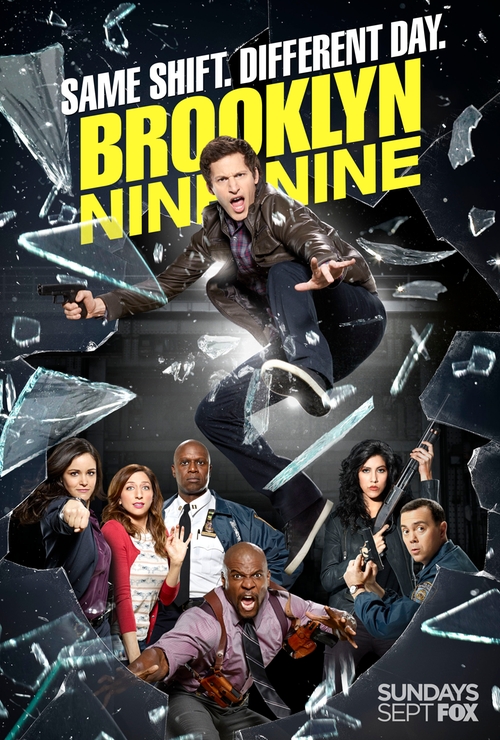
Brooklyn Nine-Nine, Season 3 (2015-16)
Fox's cop comedy continues to be one of the most consistent traditional sitcoms on TV. The inclusion of more cop-drama-esque storylines in the quarter of the season via ex-undercover-cop Adrian Pimento (Jason Mantzoukas, aka Parks and Rec's Dennis Feinstein) does a great job of shaking up what is, most weeks, a classic workplace comedy in spirit, and the final stretch of episodes is some of the best work the show has done. Elsewhere, the series consistency means that there's the occasional predictability and lull to the rhythms of the show, but when that's anchored by one of the funniest casts on TV right now, it's still lots of fun. Grade: B+
Unbreakable Kimmy Schmidt, Season 2 (2016)
The only thing better than a fantastic rookie season is the proof that the sophomore season is every bit capable of keeping pace. There's a lot of 30 Rock here, which is good, but it took 30 Rock at least twice as long (and several missteps more) to hit the glorious levels of absurdity that Kimmy achieves on an episode-by-episode basis. Perhaps even more impressive, though, is that in the thick of all the jokes about Cate Blanchette (is she talented, or just tall??) and roller coasters, the show manages to preserve the human core that makes it all so endearing. If anything, the series manages to plumb even greater emotional depths than before with its portrayal of the psychological fallout of Kimmy's trauma. It's hilarious, bizarre, and sweet, which is just the way I like it. Grade: A-
Books (Plays?)
Blood Wedding (Bodas de sangre) by Federico García Lorca (and Ted Hughes?) (1933 [1996?])
Sorry for all the parentheses and question marks. I'm frankly confused about Ted Hughes's involvement with my particular version of García Lorca's modernist play. The cover says, "in a version by Ted Hughes," which seems different from a simple translation, but the notes inside don't indicate what exactly makes it Ted Hughes's "version." Anyway, it's good, minimalist, politically charged drama with sharply human stakes. I enjoyed it, Ted Hughes or no. Grade: B+
Movies
Sisters (2015)
A funny—often very funny—comedy that's entirely hogtied once it realizes that it has to figure out an ending. But hey, if we judged the success of comedies on the rubric of plot, we'd be awful short on good comedies (I mean, even shorter than we are now). What's important here is this: I laughed. Tina Fey and Amy Poehler (but especially Tina Fey, who plays gloriously against type) are being their typical charming selves and having a great time doing it. It's not sophisticated or even all that internally consistent, but it's fun. Grade: B
Porco Rosso (紅の豚) (1992)
I like Miyazaki in swashbuckling mode, which is a mode I didn't realize he had. I'd like to see more of Swashbuckling Miyazaki. He needs more movies where people are inexplicably pigs (he's got at least two). Still, I won't lie: the best bits of the movie are the ones that are in regular-old Miyazaki mode, tender and wistful and slightly mysterious. Grade: A-
Eye in the Sky (2016)
Without a doubt the most upsetting 2016 movie I've seen so far and also possibly the first great 2016 movie I've seen (give or take Hail, Caesar!), Eye in the Sky is both not to be missed and not for the faint of heart. I'm really serious here: the bulk of the movie's plot revolves around the prospect of a little girl being blown up, so if you have any aversion whatsoever to seeing children in peril in movies, think long and hard about this one. I'm making it sound unpleasant because it is, but only in that way that any grim thriller is unpleasant—that is, in an absolutely necessary, profound way. It's a film about drone warfare, after all, which means that dives deep into the utter moral quagmire that is the War on Terror and the possibility that there truly is no such thing as "right and wrong" when it comes to that War. Postmodernism, it turns out, was not predicting society as a whole but specifically our modern military operations. Grade: A
Tabu (2012)
I don't hear a lot of people talking about it, but surely this Portuguese drama is one of the best films of the 2010s. Seriously, I'm blown away. It's stylish, moving, literary (it has all the hallmarks of a novel adaptation, but it's not, which is kind of charming), and at once classicist and modern. It's that combined old-fashionedness and cutting edge that makes this movie such a delight: in many ways, it's a revival of silent film and '40s melodrama, but with thoroughly modern technical twists. For example, especially in the film's jaw-dropping second half, the movie cuts out the dialogue audio altogether but keeps the ambient, environmental noise, to sublime effect: it appears as though we are in a silent movie but without the surrealism inherent in draining the world of sound completely—the actors seem merely lost in time, which is keeping right with the themes of memory and history in the plot itself. Beautiful. Grade: A
Big Trouble in Little China (1986)
It's a fun little action movie but not a great one: the fantasy feels a little thin and (though far be it from me to speak for a culture but still) possibly culturally insensitive. But Kurt Russell is a treasure in general, and specifically here, he's far an away the best part of the movie. The central gag of having him look and sound like an '80s action hero but giving him the grace and intelligence of one of the Three Stooges is hysterical. The rest of the movie isn't half so entertaining, but it's nothing game-breaking. Grade: B
Television
Brooklyn Nine-Nine, Season 3 (2015-16)
Fox's cop comedy continues to be one of the most consistent traditional sitcoms on TV. The inclusion of more cop-drama-esque storylines in the quarter of the season via ex-undercover-cop Adrian Pimento (Jason Mantzoukas, aka Parks and Rec's Dennis Feinstein) does a great job of shaking up what is, most weeks, a classic workplace comedy in spirit, and the final stretch of episodes is some of the best work the show has done. Elsewhere, the series consistency means that there's the occasional predictability and lull to the rhythms of the show, but when that's anchored by one of the funniest casts on TV right now, it's still lots of fun. Grade: B+
Unbreakable Kimmy Schmidt, Season 2 (2016)
The only thing better than a fantastic rookie season is the proof that the sophomore season is every bit capable of keeping pace. There's a lot of 30 Rock here, which is good, but it took 30 Rock at least twice as long (and several missteps more) to hit the glorious levels of absurdity that Kimmy achieves on an episode-by-episode basis. Perhaps even more impressive, though, is that in the thick of all the jokes about Cate Blanchette (is she talented, or just tall??) and roller coasters, the show manages to preserve the human core that makes it all so endearing. If anything, the series manages to plumb even greater emotional depths than before with its portrayal of the psychological fallout of Kimmy's trauma. It's hilarious, bizarre, and sweet, which is just the way I like it. Grade: A-
Books (Plays?)
Blood Wedding (Bodas de sangre) by Federico García Lorca (and Ted Hughes?) (1933 [1996?])
Sorry for all the parentheses and question marks. I'm frankly confused about Ted Hughes's involvement with my particular version of García Lorca's modernist play. The cover says, "in a version by Ted Hughes," which seems different from a simple translation, but the notes inside don't indicate what exactly makes it Ted Hughes's "version." Anyway, it's good, minimalist, politically charged drama with sharply human stakes. I enjoyed it, Ted Hughes or no. Grade: B+
Subscribe to:
Posts (Atom)