Showing posts with label Pablo Larraín. Show all posts

Sunday, February 27, 2022

Mini Reviews for February 21 - 27, 2022

Two more weeks until Spring Break.

Movies

Spencer (2021)
I don't know how much this Princess Diana biopic has going for it other than Kristen Stewart's performance as Diana and Jonny Greenwood's performance as one of the best composer of film scores of our time, but wow, both of them are knock-outs. Especially Greenwood's score. Easily the best film score of 2021. Grade: B


The Cotton Club: Encore (1984, released in 2017)
Watched the "Encore" director's cut (which Coppola found on an old Betamax, which... lol). No idea what the original movie was like, but this one is, like most Coppola pictures, an absolute marvel on a formal level, just flex after cinematic flex playing out onscreen for the entire 139 minutes. It's something of a backdoor musical, and a great one at that, with large portions of the film being set to some absolutely stunning dance sequences in the old Cotton Club—probably the best post-Jazz-Age media I've ever seen at depicting the raw magnetism of jazz as bringing-down-the-house party music, and I felt like hootin' and hollerin' along with the in-movie crowd when, for example, Cab Calloway shows up. The immense surface pleasures of all this kind of overwhelm what is ostensibly the movie's point, which is the contrast between the absolutely banging club atmosphere and the mechanisms of racism, abuse, exploitation, and outright violence that make the club possible in the first place. Coppola rarely met a bad screenplay he couldn't will into competence by sheer force of cinematic razzle-dazzle, and this one is certainly nowhere close to the worst screenplay in his filmography. But it's also not nearly good enough to pull off the downer thematic coup on that beautiful movie magic that it wants to. I would honestly have preferred a plotless movie that just had random characters hanging around the club, which is basically what this movie is for the first half hour at least. Grade: B
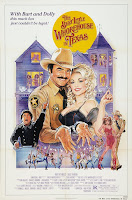
The Best Little Whorehouse in Texas (1982)
It's not hard to see this film as a political parable for the ways that the encroaching right-wing moral crusade across the United States in the early 1980s destroyed the measure of gender and sexual liberation won in the throes of the 1960s/1970s, particularly the queer liberation that was already marginalized even within second-wave feminism. It's not hard to see it because it's basically the explicit text of the film—though the heterosexual pleasures of the titular house are centered, there's a persistent vein of queer activity, from the high camp of the costumes and musical sequences like the nude all-male locker room dance, to the off-handed comment that lesbians were welcomed at the Chicken Ranch, to the casting of Jim Nabors as a knowing narrator. I've never seen the stage musical this is based on, so maybe this is just baked into the source material, but it's hard not to see the movie's attempts to twist a heterosexual exterior into a queer-affirming ethos as personally meaningful for co-writer and director Colin Higgins, an openly gay man who would die from AIDS six years after this film's debut. The film is deeply imperfect both as a political text and as a movie, but there's a strain of exhilarating freedom and also tragic loss working alongside the queer reading of the film that gives this a heft I was not expecting. Also, this is maybe the most I've ever enjoyed Burt Reynolds, which I attribute solely to the magic of Dolly Parton—the two have a certifiably electric onscreen chemistry that makes the sequences in which they're hanging out with each other (a not insignificant part of this probably too-long runtime) inordinately charming. Grade: B+

Coffy (1973)
As an exploitation film, juxtaposing erotic imagery with violence is part of the project, and I dunno how I feel about that, even if it's situated within a nominal empowerment narrative (an empowerment narrative that situates "empowerment" within a world animated by a fundamentally nihilist will to power, which is pretty interesting). Regardless, Pam Grier is incredible, as is Roy Ayers's score (from where I sit, every bit the equal of Isaac Hayes's more iconic work in Shaft), and overall, this is at least plotted fairly tightly and scripted fairly rigorously compared to other blaxsploitation films I've seen. I'm still waiting for a blaxploitation movie to really knock my socks off. This got close at times, though. Big bonus points for the scene where the dude is explaining that the world is so corrupt that you can't kill all of the bad guys, and Grier's just like "Why not?" More bonus points for Grier having the guts to field that absolutely terrible Jamaican accent. Grade: B+

Shaft (1971)
It remains astounding to me how many movies that were incredibly popular in the 1970s are basically just shaggily plotted and edited stories of characters meandering through textured environments as cool soundtracks play. Big portions of movie-going audiences were truly okay with just vibing at the movies, which is charming to me. Kind of wish we had more of that now. Maybe my brain has been poisoned by 21st century cinema, and maybe if I were back in the 1970s, I would have been a little more into this, but despite being charmed by the idea of people regarding this as an exciting action blockbuster, I just couldn't muster up much excitement myself for it as a whole. The Isaac Hayes soundtrack is extremely dope, and Richard Roundtree is justifiably iconic in the title role. But also, this movie feels awkwardly positioned between being more purely a neo-realist urban mood piece and a film noir, either of which could yield a very good movie if it committed to one but right now feels like half measures of both. If I'm going with foundational blaxploitation films from 1971, I would much rather watch the more politically and stylistically radical Sweet Sweetback's Baadasssss Song over this any day. Grade: C

Television

Nathan for You, Season 2 (2014)
Basically more of the same from Season 1, which is an unalloyed good in my mind. The schemes presented to the businesses get a little more elaborate in this season (perhaps most notably in the souvenir shop episode, where Nathan creates an entire film festival to justify the fake movie he's set up, as well as the "Dumb Starbucks" episode, which got national media attention as it unfolded), and Nathan as a character is a little more of a sad sack than he was before. But for the most part, this is taking everything that made the first season good and leaning into that. So of course it's still good. Grade: A-


Books

Stories of Your Life and Others by Ted Chiang (2002)
This story collection is of course most famous for "Story of Your Life," which won a whole bunch of awards and was eventually adapted into the movie Arrival. But the stories I connected to most were "Tower of Babylon," which is basically a story that assumes that ancient near-east cosmology is literally true, and "Hell Is the Absence of God," a story in which God, angels, heaven, and hell are all physically manifested in our material world. Chiang has a great knack for giving his stories one fairly simple idea and then burrowing deeper and deeper into the implications of that idea until you end up somewhere surprising. This of course makes him a good fit for sci-fi, but it's also great for these more religious stories. A lot of religious literature is either invested in doing apologia for a certain hermeneutic of scripture or making elaborate metaphors out of scripture, but Chiang's approach takes religious concepts at face value without a lot of the underlying assumptions that often go into purportedly literal readings of scripture, and the result is an often beautiful, often frightening defamiliarization of ideas that I grew up with. Fascinating stuff. Grade: A-

Sunday, February 2, 2020

Mini Reviews for January 27 - February 2, 2020

Had most of the week off of school. Praise be.

Also, if you like weird slacker prog, don't forget to check out my new Prog Progress post on Dün's Eros.

Movies

Miss Americana (2020)
Will write a more in-depth review for Cinematary in the next couple of days, but for now, I'll just say that this is a good—if unspectacular—documentary about all the various political and psychological tensions inherent in what it means to be Taylor Swift (and, more generally, any female celebrity). It's unabashedly in the pro-Taylor camp, and I imagine that people who aren't might accuse this movie of committing sins of omission; I myself would have liked for it to have been just a little thornier, too. But if the relatively unironic embrace of the Taylor brand is the price of having this close of access to Taylor herself, then I'd say it paid off. Grade: B

Edit: Here's the in-depth Cinematary review!

Taylor Swift: Reputation Stadium Tour (2018)
The music is good, of course (minus "End Game," an album highlight that loses a lot of its energy without that weird, compelling interplay between Swift, Sheeran, and Future). But the filmmaking made me want to pull my hair out. So much editing (did any single shot last longer than two seconds?), and that mixed with some astoundingly poor shot composition chops up the presumably impressive stage setup and dance choreography into a jumble of hard-to-contextualize imagery. I'm tilting slightly above the completely middle-of-the-road rating, though, because I want everyone to know that, two years later, the backlash is a lie: Reputation is one of Taylor Swift's best albums—good enough, even, to counteract filmmaking this aggravating. Grade: C+

Paint It Black (2016)
As it turns out, Amber Tamblyn is a really good writer/director—I guess all the hard work that went into the "suckumentary" in Sisterhood of the Traveling Pants really paid off, huh? Seriously, though, this is super solid: a taut indie that pivots effortlessly between warped psycho-drama and a tender exploration of grief, with a great eye for visuals/editing and a great ear for sound design. It's also the acting showcase that Alia Shawkat has deserved since forever. Grade: B+


No (2012)
The story and screenplay themselves have this kind of Argo-ish vibe that takes a real-life event (in this case, the advertising campaigns surrounding the 1988 vote to remove Pinochet) and spins a broad and bright yarn that alternates between humor and dead seriousness. It works well here, though it's nowhere near as deconstructive or bold as director Pablo Larraín's later features like Neruda, and I kind of missed that formal and thematic playfulness. The real draw here is Larraín's decision to film the whole movie on magnetic tape rather than celluloid. It's a choice that not only makes the movie's constructed scenes virtually indistinguishable from the archival footage Larraín often inserts (an effect that gives a striking power to scenes like the one where the police violently break up a "No" rally) but also gives the movie an uncommonly beautiful aesthetic as its rickety, slightly-color-separated video tape limitations collide with some world-class cinematography in breathtaking and unexpected ways. Grade: B+

Wuthering Heights (2011)
Andrea Arnold's arrestingly beautiful and relentlessly patient cinematic style reinterprets Brontë's heavily Gothic/Romantic novel through the lens of crushing Naturalism, which obscures some of the primal power of its plot. At the same time, the film also complicates a lot of the novel's ideas about class by also highlighting the novel's very sub-subtext about race (Heathcliff is explicitly black in this adaptation and the subject of some unambiguous racism), which does a lot to bring out a lot of the under-explored geometries of the plot's drama. I'm not sure if it completely works (environmental determinism by way of racial hate definitely fits within the broader philosophical context of Naturalism, but does it work within this specific plot? Still mulling it over), and there are a few unambiguously bad choices—e.g. the fact that there is no way in heaven or on earth that young Catherine as Shannon Beer could have grown into adult Catherine as Kaya Scodelario—that make the film not quite work anyway, even if you buy the intersection of its aesthetic and philosophy. But it's a striking movie whose risks demand consideration, and more classic literary adaptations could stand to be as daring as this one. Grade: B

Dil Se.. (दिल से..) (1998)
Really dug the musical sequences (especially the one on top of the train—y'all know I'm here for train musical sequences), and for a 2.5+ hour movie, this remains startlingly energetic throughout. I'm also very much interested in the romantic elements of this movie and how they intersect the ultimately deeply tragic ideas about the irreconcilability of moderate and radical politics—the shameless romance of the movie's early goings feels bitterly ironic and uneasily complicated by where this movie eventually goes, and that's really interesting. I'm honestly probably a little more positive on this movie than my rating indicates, but I'm hedging my bets with a kind of generically positive rating here because a lot of my positive feelings have to do with some hunches that I have about the way that the movie deconstructs Shah Rukh Khan's protagonist, hunches that I'm not entirely sure are correct, given my near total ignorance of contemporary Indian cinema and culture. Grade: B+

Anyway, if you'd like to hear me say a more in-depth version of the above or if you'd like to hear some other people say a few more interesting things, you can listen to Episode 284 of the Cinematary podcast, where a group of us talk about this movie!


9 to 5 (1980)
Ridiculously entertaining and far stranger than at least I had been told: the first half is basically what I was expecting, albeit much sharper—a workplace comedy surrounding entrenched misogyny and generally dehumanizing conditions at a large corporation. But then in the second half, the ladies steal a corpse from a hospital, and it's somehow not the wackiest thing that happens. Through all the hairpins turns, though, it never loses its wicked sense of humor nor its focus on the wage theft and exploitation inherent in a corporation, and given the sheer number of comedies whose thematic and comedic ideas just spin out of control by the end, I have mad respect for the screenplay and all-star leads who keep all this together. I know that it's unlikely that Dolly Parton has kept her political views secret for so long because she's a red-blooded communist, and yet... and yet... Grade: A-

Music

Pavement - Slanted and Enchanted (1992)
I'm confused by the discussion surrounding whether it is this album or Crooked Rain, Crooked Rain that is Pavement's best—Crooked Rain is clearly better than this album in every conceivable way, while Wowee Zowee is obviously superior to them both. Slanted feels very much like the low-budget EP before their real albums, which isn't a criticism, really, but they would go on to do much more complicated and interesting work. I do like how noisy and lo-fi the album is, even compared to Pavement's famously fuzzy aesthetic throughout the rest of their career, but time and again I find myself drifting toward the songs like "Here" that manage to lift their heads and melodies above the static, and then I just find myself wanting to go to Crooked Rain again. Still, it's not without its moments. Grade: B