Showing posts with label Child's Play. Show all posts

Sunday, December 4, 2022

Mini Reviews for November 28 - December 4, 2022

My wife and I finally released another episode of The Newbery Chronicles! It's on Louis Sachar's Holes, and you can listen to it here if you're interested.

ALSO: If you're one of the 10 people who subscribe to this via Letterdrop email, I'm going to have to discontinue that because Letterdrop eliminated their free tier. I might switch over to Substack, but I may just not email these out anymore. I dunno. If you have strong feelings about that, let me know.

Movies

The Fabelmans (2022)
As I watched this, my gut was telling me that this was enjoyable but slight, a handsomely filmed and extravagantly performed feature (Paul Dano and Michelle Williams are both incredible) whose most prominent characteristic is the cute allusions to Spielberg's own filmography, e.g. the scorpion box from Hook, the monkey from Raiders, etc. But then a late-film scene—for those who have seen it, the one in the school hallway with the jock upset at how he's portrayed in the skip day film—came and hit me like a freight train, surely one of the best scenes in any movie this year and one of the best scenes in Spielberg's career as a whole, and it cracked this movie wide open for me, and the more time I've spent rolling this movie over in my mind, the more it's opened up (to the point where I started this review with one grade in mind and ended it with another, higher one). I don't think there's been a Spielberg film since A.I. that places this much tension between its thorny ideas and the facade of Spielbergian classicism and sentimentalism, and that earlier film's ersatz family dynamics by way of semiotics is the core allusion that informs everything else in this movie; yes, the movie seems like a wistful semiautobiography about the magic of movies, and the movie works perfectly well when taken as that, but The Fabelmans, with that school hallway scene, tips its hand: "movie magic" is just another way of saying "control," and Spielberg, long accused of being a "manipulative" filmmaker, completely leans into this accusation, laying bare the manipulation baked into the very premise of filmmaking, which this movie pretty explicitly depicts as a person's attempt to recreate life in his own image. What we've been watching—what we watch with every movie, but especially with this movie—is a mere simulation that creates the illusion of authenticity by sleight of hand and trickery. There's a fun, whimsical element to this idea that runs through the film, most notably how the movie shows the ingenuity of its not-Spielberg protagonist as he makes home movies recreating his favorite moments at the cinema, but there's also a deeply sad, even disturbing undercurrent to this: the longer I've sat with this movie, the more the film's depiction of the parents' divorce and particularly the mother's side of things feels like the achingly bleak ending of A.I. when aliens grant the mechanical boy a day of bliss with an artificial mother before allowing him to die. Only in this film, Spielberg is cast as both sides of that scenario, both the boy desperate for the childhood he was denied and also the magic aliens comforting this boy with a constructed image, an automaton. The way I'm describing it sounds dire and depressing, but the incredible thing about the movie is its nuance in depicting it: there are moments in which the film's drive to show filmmaking as a form of control and coercion is profoundly unsettling, most notably the scene with Michelle Williams dancing in front of the car headlights (or a later scene in which a film-within-a-film quotes from the work of Leni Riefenstahl—a truly wild allusion for a Spielberg movie to make but also probably the purest possible example of the insidiousness of film's ability to subjugate reality), but elsewhere in the movie, the results are just delightful, which is kind of the ultimate wrinkle in the movie's thesis on film (described breathlessly by Paul Dano in the opening scene), which is that the illusion of film is able to create real movement in our reality because we are able to be tricked—movies are fake, but the tears, the joy, the anger we feel as we watch them: those are real. Which brings me back to that scene in the school hallway, where an anguished school bully has realized that the illusion of himself depicted in the skip day film will have tangible effects on his real life, and the ambivalence The Fabelmans has about this epiphany is profound: there's something maniacal or even devious about the protagonist's realization of the kind of control he has sought for the previous two hours, but there's also a gobsmacked wonder about it, too. The people who hate Spielberg films (and boy oh boy, do some people haaate them) seem more conscious of this duality in his work than most fans, but it's amusing and even gratifying to know that Spielberg (or at least, Spielberg working with Tony Kushner) understands the haters enough to give them a scene like this. He's also not above making the hater a raging antisemite in the film, which is the sort of self-aggrandizing "manipulative" thing that I'm sure will drive people nuts even more. But I dunno, to me, a lifelong Spielberg fanboy whose first real concept of the "art" of film came from realizing when I was ten years old that Raiders of the Lost Ark and E.T. were directed by the same person, there is something wonderful and magical about all of this, made even more so by Spielberg's alternating aggrandizement and villanizing of his own profession. Maybe I'm just one of the chumps who wants to be sold a magic trick, but I'm ultimately okay with that. I can't deny the reality of what this made me feel. Grade: A
Child's Play (2019)
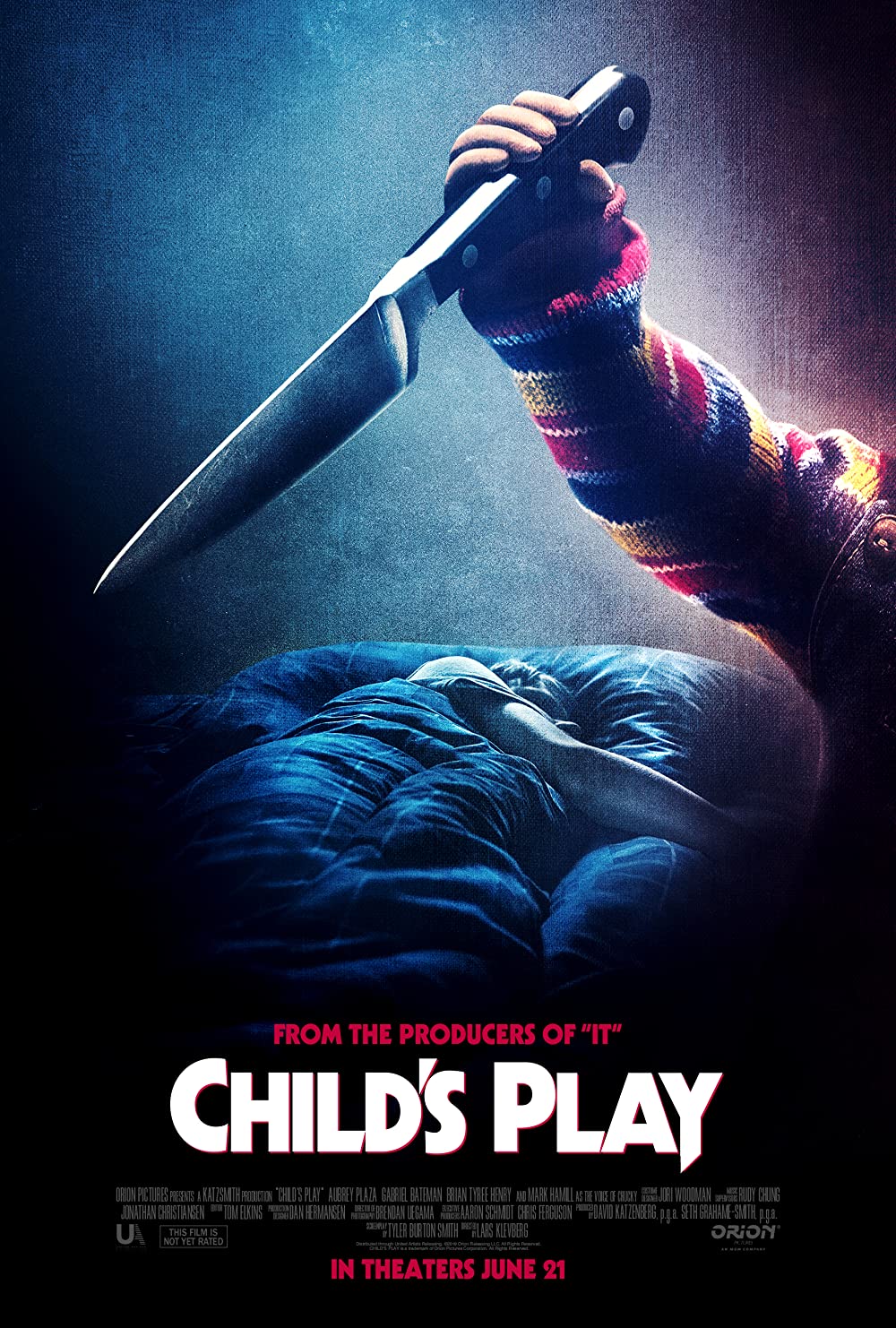
More of a reimaginging than a reboot, which is fine with me: if the original Child's Play is something of a response to the gross colonization of kids' imaginations by commercial advertising, then this is a pretty canny update of that concept for the fresh hell of surveillance and data collection that capitalism has brought to the act of play. It's also just a lot of silly, mean fun and does a great job of evoking the spirit of a Chucky movie (at least, the original three) without being overly familiar. Grade: B


Behind the Mask: The Rise of Leslie Vernon (2006)
As long as this stays true to its stated premise (a mockumentary about the killer in a slasher film), this is a great time. The mockumentary scenes show the killer, with the goofy enthusiasm of Michael Scott giving a tour of the Scranton branch, walking the documentary crew through his plan to manufacture the tropes of the slasher genre in his own prospective killing spree, and while by 2006, this was hardly ground-breaking commentary, it's fun and funny and charming to no end. Unfortunately, when the movie flips over to the actual movie that results from this plan, it turns out that following slasher tropes to a T doesn't result in a slasher that's notable in any way, and when the movie finally ends its mockumentary conceit entirely to permanently reside in the slasher mode (albeit in a transition that is pretty clever), Behind the Mask grinds to a halt. The good news is that this is a fairly small fraction of the movie, and the rest is so enjoyable that I'm willing to forgive the deflating ending. But still, it's too bad it has to end on its least-engaging note. Grade: B

The Call of Cthulhu (2005)
Pretty fun Lovecraft adaptation. The whole thing is a silent-film pastiche, and it does a better job evoking the feel of an old silent film than a lot of these silent-revival movies do, which is impressive given that this was basically a fan film by enthusiasts in the H. P. Lovecraft Historical Society. Also, the decision to make it a silent film is a good workaround to the obvious problems in adapting Lovecraft's cosmic horror for the screen, as the knowingly silly embrace of limitations actually makes it feel more otherworldly when Cthulhu finally shows up than it might have been otherwise (stop-motion Cthulhu is very cool, too). It's not perfect, and a lot of this feels a little too smooth—both in terms of the framerate as well as the costuming/props—to be completely credible as an expressionist film from the 1920s. But still, this is a lot better than it has any right to be. Grade: B


Shinbone Alley (1970)
It's not a good movie: it's haphazardly paced, its "spurned male lover" ethos is mean and dull, and the songs are terrible. That said, Shinbone Alley is an interesting historical document, not just for that way the its scratchy animation style so fully embodies the aesthetic preoccupations of what is probably the ugliest (not always in a bad way) era of American animation but also for the way it fits into the whole mini-trend of edgy animated animal movies. For example, this movie comes out a couple years before Fritz the Cat, but it's got some of the same bizarre predilections, i.e. the whole "animals, but make them hip and horny urbanites" thing. I mean, even Disney got in on this; 1970 is the same year that saw the release of The Aristocats, which, with its jazz cats and lecherous Thomas O'Malley and alcoholic geese, is definitely an iteration of the trend (albeit cleaned up for the Disney crowd), and while 1973's Robin Hood isn't quite the same, it's still got animals acting like people and being weirdly sexual at times. What was going on in the 1970s with animals and animators? Grade: C

Mildred Pierce (1945)
An incredibly bleak film about the world's abject refusal to allow the titular character to experience prolonged happiness. For as despairing as it ultimately is, the plot is a lot of fun (one turn near the end made me gasp so audibly that my wife called from the next room to check if I was okay), and Joan Crawford's performance is an all-timer—if the latent noir aesthetic were ratcheted up just a few clicks, the movie might be an all-timer, too. Grade: A-

Sunday, November 20, 2022

Mini Reviews for November 14 - 20, 2022

This week I was on the Cinematary podcast talking about the 1931 Ernst Lubitch film The Smiling Lieutenant. Here's the link if you're interested!


Movies

Barbarian (2022)
It spends a good portion of its first half pretending to be a much more serious movie than it is (the movie it pretends to be: a slow-burn thriller about two strangers accidentally booked at the same Airbnb), but after a particular point, it drops the mask so quickly that the abruptness in and of itself is hugely entertaining. It does this a couple more times, and by the end, Barbarian is thoroughly goofy, albeit of the grimy, ugly sort that characterizes the work of, say, Wes Craven. This isn't anywhere near as clever as a Craven movie, but that veneer of seriousness barely containing a mean-spirited glee at others' misfortunes definitely feels like it's in the same wheelhouse. I found this thoroughly entertaining, though by the end, as it's become clear that the film is kind of a one-trick pony in terms of how it doles out its reveals, there are diminishing returns to what it's attempting on a thematic level (some muddled ideas about gender and motherhood and morality). But it's a masterclass in executing that one trick, and I had a great time hootin' and hollerin' at the screen with my wife as we watched this. Grade: B+

The Banshees of Inisherin (2022)
Really, shockingly good. I don't hate Martin McDonagh, but it's been a while since he's done anything I particularly cared for, and this far surpasses the distant, pleasant memories I have of In Bruges. Moreover, this is the first McDonagh screenplay (I've never seen one of his stage plays) that doesn't feel like it's bending over backward trying to prove something with its cleverness; the screenplay here simply is clever in this understated yet confident way that bowled me over. If I'm not mistaken, there's some Irish political history metaphor going on with the plot that I am unequipped to unpack, but that's okay, because it's also just a very human story of pain and loss as two former friends drift apart. Whatever the allegory that's happening here, McDonagh does the very graceful and very difficult task of also making it not feel like an allegory, and the entire thing works just as well (perhaps better) if you assume that Colin Ferrell and Brendan Gleeson's characters are real, psychologically complex human beings instead of simply being analogs for the sides of the Irish Civil War or whatever is supposed to be going on there. Career-best work from Ferrell, too. He takes his "affable goofball with hidden complexity" thing and imbues it with a deep well of sadness and vulnerability that ends up pervading the entire film. I can imagine having a good, cathartic cry over this movie if it caught me in the right mood, and I mean that as a compliment. Grade: A-

My Father's Dragon (2022)
The first half of this movie, which is split pretty evenly between the social-realist(ish) beginning involving the struggle of a mother and her son to make it in a new city and the wildly inventive fantasy of the boy's flight from the city to a magic island, is terrific, utilizing a dream logic undergirded by a strong emotional core in a way reminiscent of the Where the Wild Things Are movie. The back half of the movie unfortunately falls apart as it fails to maintain the emotional clarity through the dream logic, and the climax hinges on an emotional epiphany that is almost completely unearned. Narratively, it's the weakest of the Cartoon Saloon features, and it's not even close. Visually, however, this is as stunning as any of the studio's other work, maintaining the rich texturedness of Wolfwalkers as well as the luminous use of color present throughout the studio's work. In the face of that, it's hard to feel grumpy about the film. Grade: B


Cult of Chucky (2017)
My least-favorite, I think, of the "...of Chucky" stage of this franchise, but Mancini continues to have a tight grasp of fundamental horror mechanics as well as the specific idioms that make his Chucky movies special—at this point, watching these characters and tropes return is something akin to watching a soap, and it's great fun just to see, for example, Jennifer Tilly show up again in some new, ridiculous role. Some great practical gore effects here, too. The psychiatric hospital setting isn't nearly as evocative or well-deployed as the old mansion in Curse, and the film relies just a little too much on movie-crazy-people-isms in fleshing out the secondary cast, and as a whole, the movie lacks the verve or the mad-scientist coherence that animates the best in the series. But I guess in the short span of time I've been watching the series, I've become a lifer with these movies, because I still had a good time and can't wait to hop into the TV series. A cult indeed. Grade: B


Dangerous Liaisons (1988)
If I wasn't already familiar with the source material, it would be unbelievable that a movie this smutty and this mean came out of the stuffy '80s costume drama world. The closest thing I can think of to this is The Favourite, which of course arrived from a much different milieu in cinema. But here's this movie, a brutally spiteful satire of 18th-century ruling class with only a few of the edges sanded off from the French novel on which it is based (I'm unfamiliar with Christopher Hampton's 1985 play that is the more direct source for this movie). This is probably the best I've ever seen Glenn Close and John Malkovich, two actors I'm not overly fond of, and the way they slowly reveal the utter despair that they cloak in the abject evil of their actions is kind of masterful. The film's pacing gets a little dicey by the end as the plot turns from being outrageous to being just bleak, and as with basically every other version of the story, I'm not sure how to feel about its treatment of sexual assault. But on the whole, this is pretty good. I want to live in the alternative universe in which all Masterpiece Theatre-ish productions are this cruel and sick. Grade: B+

Sunday, October 23, 2022

Mini Reviews for October 17 - 23, 2022

Nothing new to report up here. Here's an obligatory link to the podcast episode my wife and I released last week.

Movies

The House with a Clock in Its Walls (2018)
A perfectly serviceable (and no more than that) piece of family entertainment that is directed by Eli Roth for some reason. There are some fun, distinctive bits (I liked the evil pumpkins!), but I'm finding it hard to have much to say about a movie that is mostly pretty anonymous. Still, if you'd like to hear me try to say something about it, I was part of Episode 426 of the Cinematary podcast, which discussed it as part of the "Horror for Kids" series. Grade: B-


Freddy's Dead: The Final Nightmare (1991)
This movie opens with a hilarious premise that had me hoping for the best: it is ten years in the future, and Freddy has killed literally every teenager in Springfield except one, and he's out to get that one. Gold. The rest of the movie is really dull, though; a weird mix of unbearably try-hard goofy (Freddy trapping a dude in a video game and then killing him using an actual Nintendo Power Glove) and incongruously dark (the protagonists are all kids from a shelter for homeless or troubled teens, and they have some too-real, un-fun issues, e.g. one of them is suffering from PTSD after having been raped by her father repeatedly as a child). Nothing here is scary, and it's really hard to care about anything that happens, given how the movie can never decide how much contempt it wants to regard these characters with. And the effects aren't even that fun or inventive either. Definitely earns its reputation as the series low point. Grade: C

Wes Craven's New Nightmare (1994)
The only one of this franchise after the first one that's even remotely scary, and there's no way not to attribute this directly to the presence of Wes Craven again. I do miss some of the sillier, go-for-broke bonkers setpieces that animated a lot of the sequels, but the consummate professionalism and virtuosic control of tension on display here really can't be beat, especially after so many of the other sequels feeling cinematically complacent outside of the elaborate death scenes. The meta stuff obviously begs comparisons to Scream, and while the latter movie is certainly more clever, I've always found its commentary to be smug and vaguely irritating (despite film being solid overall); New Nightmare is a lot messier and probably not as good holistically, but it's also a lot more lovable—the regard the film has for Heather Langenkamp is genuinely sweet at times, which does a lot to endear the film to me. Anyway, I'm glad the Nightmare series got this little coda, because it would have been a bummer to end the series on a stinker like Freddy's Dead. Grade: B+

Child's Play 3 (1991)
A pretty big step down from the first two entries in this series. Andy goes to military school—pretty boring! I really liked the opening credits (we get to watch Chucky unmelt, which is very cool-looking), and Chucky himself remains a fun presence. But I just am so bored with Andy. Too bad Kyle didn't show up in this movie, because I liked her! On top of that, the movie is pretty tepidly staged—I guess military schools are by-design bland environments, and it feels like even the filmmakers realized they picked a bad setting because they set the climax in a random carnival that appears out of nowhere. Grade: C


Tetsuo: The Iron Man
(鉄男) (1989)
I had heard about the gnarly body horror in this movie, which is indeed gnarly (and if I were slowly turning into metal, I would probably rip up my flesh picking at the metal, too, so it's oddly relatable). But I don't think I was prepared for how stylistically out-there this is, which was a fun surprise. I was ready for a lo-fi gross-out, but the way the film has one foot in the avant-garde makes this a lot more engaging than it would have been for me otherwise. Also, terrific sound design—some just incredible squishy noises. Made my skin crawl. Grade: A-


Books

White Noise by Don DeLillo (1985)
As one of the seminal postmodern novels, I expected this to be a little more out-there than it was, and so reading this fairly dry, sardonic book grounded in middle-class alienation caused by the absurdities of postwar American consumerism required a little bit of a mental readjustment to get into. It still wasn't exactly my thing, but I had come around to it by the end. At first, the wry narration, which felt like DeLillo was smirking or rolling his eyes at every sentence, was a little grating to me, but eventually, I felt in on the joke, e.g. the "Hitler Studies" professor whose most pressing concern is whether or not the fact that he doesn't know German undermines his credibility to talk about the fascist leader. Everything is surface and self-presentation. By the end, the book finds a melancholy groove in the hollowness of everything the characters do, until that hollowness has become an abyss with the grave at its bottom. That's the good stuff. I'm curious how I will feel about this book if (when?) I read more Don DeLillo. Anyway, for now: Grade: B

Sunday, October 16, 2022

Mini Reviews for October 10 - 16, 2022

Horror movies! Also, if you're interested, my wife and I have a new podcast episode out, this time about Roll of Thunder, Hear My Cry.


Movies

Don't Worry Darling (2022)
Exactly the movie, no more, no less, you would imagine if I told you to picture the intersection of The Stepford Wives and the first act of The Matrix. There are very few—if any—surprises here if you have seen the right antecedent movies, and given that those antecedents are super popular, you probably have seen them. Obviously the problem with so openly aping such famous movies is that you're inviting comparison, and there's nothing about this movie that's better or even just more interesting than the movies it calls to mind. Nonetheless, it's not bad, assuming you aren't expecting it to be great. Olivia Wilde continues to be a director with an eye for striking imagery, even if she still doesn't let herself (isn't allowed?) to let that instinct fully flourish into something more striking; the production design, especially the costuming, is very good; Florence Pugh is, per usual, selling the crap out of her performance and probably carrying the whole movie in terms of acting, but the rest of the cast is no slouch either—I'm not sure what I was expecting out of Harry Styles, but he's good at playing a dude who is clean-cut and handsome enough to scan as vaguely menacing (though I do wonder what welcome chaos the originally planned Shia LaBeouf casting would have brought). It's just weird to see this level of prestige and budget brought to the kind of movie that probably would have gotten like $4 million and a late-January release like fifteen years ago. Grade: B-

Knock Knock (2015)
A "happily married" dude is coerced (maybe?) into sex with two strangers, who then spend the rest of the film refusing to leave his house, which they are intent on trashing. I wish I had written this review before watching the 1977 film it's based on, because I'm already forgetting how I felt about this without the '70s context. But anyway, I guess when I get to Death Game I'll talk about the rest, but what stands out as distinct about Eli Roth's remake is the absolutely sublime Keanu Reeves performance. Like the other Roth films I've seen, the film style of this movie feels premeditated and precise to an extreme degree, this time to a fault that undermines the chaos of the two female leads (this is my experience with the '70s one bleeding in already, sorry). But as a counterpoint, the technique of Keanu's acting here is really wacky in a way that is kinda surreal and unpredictable. Whether or not this is an intended effect I have no idea, but the feeling I got was that as Keanu's character has more and more of his "good guy dad" persona stripped from him by the physical and psychological humiliation he experiences, the further out of Keanu's acting range he goes, to the point where by the time he's giving the absolutely demented "free pizza" monologue, he's in some really dicey territory in terms of the actor's ability to even match what the movie is asking of him, which is bizarrely compelling in the context of a movie that is very much about taking a genteel presentation of masculinity and baiting it further and further outside of its self-satisfaction until it transforms into something feral and raw but also deeply silly and humiliating. I don't feel like it's a coincidence that this is the funniest movie I've seen from Roth, and more so than anything else of his I'm familiar with, this one has this really impish sensibility that is constantly tip-toeing around boundaries before bludgeoning those boundaries completely all at once, and that centerpiece Keanu performance feels key to that sensibility. This movie is a perfect encapsulation of one of the things people find so infuriating about Roth, i.e. the way it dances around big political topics (in this case, a bevvy of issues regarding gender, sex, age, and power) while defying clean, safe thematic readings outside of its obvious provocations—its '70s predecessor is a lot clearer in intention, and it's a fascinating effect that Roth is able to stay almost entirely faithful to the plot of the original while muddying the waters considerably in terms of what it actually means. There's at least a 50% chance that this movie really is as gross as it seems to want to bait us into thinking it is, but also, I thought it was very funny, so I dunno what to do with that. Grade: B

Death Game (1977)
A completely deranged movie on virtually every level. I'm not sure it's fair to Eli Roth to say that his remake is weaker for not having captured the pure chaotic spirit embodied by this film, because that clearly wasn't what he was after (maintaining the dirtbag ethos of grindhouse films while replacing their taped-together cheapness with a clean precision impossible in an earlier era seems to be a big part of Roth's thing, and godspeed to him on that quest, I suppose). But of the two films, this one is absolutely the superior one thanks to the ramshackle energy. Part of this seems like a happy accident of the era and the occasion of its production—as I understand it, this was stitched together from a reportedly unpleasant shoot in which nobody got along and which was plagued by money issues, and the result is a film that takes the typical amateurish messiness of exploitation films and, probably out of necessity, cranks it up to a ludicrous degree to the point of accidental psychedelia. Out of that haze come screaming the two central performances by Sondra Locke and Colleen Camp, and what proceeds from there is a bewildering kaleidoscope of extreme human behavior that feels almost otherworldly as it dementedly mixes camp with sadism. Even if Ana de Armas and Lorenza Izzo had had any interest and/or ability in recreating that tone in Roth's remake (as they are, their performances are merely serviceable, probably the biggest liability in the remake), I can't imagine that working well within Roth's smirking, detached mode, and what Camp and Locke achieve here feels like something that could only be achieved within the specific era of smut/fringe cinema that birthed this film. Both Roth's film and this original are playing with the idoms of porn from their respective eras, and while there's something to be said for the way Roth takes a porn premise and uses Keanu's goofy mannerisms to explore the shame and puritanical impulses of a modern masculinity that nonetheless is willing to indulge in erotic play, this movie's invocation of porn feels way more productive in the end, ironically because of the lack of Keanu (the one element of the remake that is unequivocally better than this version). Seymour Cassel's character here is such a nonentity, both as written and as performed, and in that relative emptiness, it's much clearer that this dude's self-satisfaction in his station in life is a character flaw, an icky dude who has won the game of life (probably at the expense of others) to such an extent that he has lost all understanding of the precarity that exists in most people's lives, and as such, the Bugs-Bunny-esque madness visited upon him by Camp and Locke has the feeling of an uprising, a kind of youth in revolt picture, a vestige of '60s counterculture cinema only with the perspective flipped, and the only way this gross man can interpret a youth revolt is through porn and the sexual pleasure it can bring to him. I saw a bunch of people comparing this to the Czech New Wave film Daisies, and before I watched it, I felt like that had to be a stretch, but I'm shocked to report that it's really not a stretch at all. We gotta get Eli Roth to watch some Věra Chytilová. Grade: A-

Hard Boiled (辣手神探) (1992)
I haven't seen a lot of John Woo movies, but I do know that I'm supposed to get swept up in the melodrama. That didn't happen to me here; the friendship (romance?) between the two cops was fun enough, but I mostly felt distant from the movie when guns weren't blazing, which is probably a Me Problem. When the guns are blazing, though, this is of course a blast, and once they get to the hospital, this movie is basically nonstop blazing guns. This John Woo guy knows how to film gunplay, huh? Grade: B+


Child's Play (1988)
This movie's a lot of fun and much more patient in doling out the camp than I was expecting. Honestly, though, as good as the doll effects are, the best part is when an unattended six-year-old kid is able to skip school by getting on a train that takes him from his bougie neighborhood to some bombed-out hive of villainy across town, which is really the kind of future us transit advocates dream about for American cities. Grade: B+


Child's Play 2 (1990)
About as much fun as the first one, even if it sweats just a little bit to try to reset with a new family at the beginning of the movie. The foster care angle pays off pretty well, though, if only for the addition of Kyle and her very sweet dynamic with Andy, and the movie in general does a great job of basically revisiting the most memorable beats of the original, including Andy almost taking the rap for Chucky's mayhem, without it ever feeling stale. The finale at the factory is pretty cool, too, and I like that it gives the kids the tools to dispatch of Chucky in some fun, inventive ways (multiple times, of course, since "He's dead—no wait, he's back again!" fakeouts seem to be a staple of this series). It makes sense that the series eventually juked into kookier territory, though, because I'm not sure how much more juice this formula has. Grade: B+


The Texas Chainsaw Massacre 2 (1986)
When everybody says that Rob Zombie based his career on The Texas Chainsaw Massacre, I guess I thought they meant the first one, but this one is definitely the germ of stuff like The House of 1,000 Corpses. Cranks up the waking nightmare element of the first movie until it wraps around to being overtly goofy but also still kinda scary. Weird, bonkers stuff that, aside from the central family, only feels of a piece with its predecessor by virtue of having this ineffable thisness about it that is hard to describe but nonetheless makes it feel weighty and sinewy in a way that is greater than the sum of its parts. Grade: A-