Sunday, September 25, 2016

Mini-Reviews for September 19 - September 25, 2016

Two reasons why this list is so short: 1) I didn't have a ton of time to read/watch/listen to things this week; 2) What time I did have, I mostly spent watching O.J.: Made In America (review forthcoming, but spoilers: it's phenomenal). As it is, though, I still got time to finish up one season and watch one movie. Enjoy!

Movies

The Fits (2016)
Enigmatic and oblique—I would say "to a fault," although there's no question that this movie would not be nearly so striking if it were more straightforward. As it is, this coming-of-age boxing/dance/experimental jazz exhibition is as mesmerizing as it is frustrating. Tone is something this movie absolutely lands, flirting with both horror and transcendental otherworldliness without committing entirely to either or abandoning completely its foothold in cinematic realism. It's all very interesting in a mysterious, minimalist way, and I'm not exactly sure what else I'm wanting here, but still, there's something missing in that enticing cocktail I've just described. Grade: B


Television

Adventure Time, Season 3 (2011-2012)
The two pleasures that set the third season of likely the best children's television since the debut of SpongeBob Squarepants apart from its other two similarly excellent seasons are these: 1) the feeling that the show is leveraging its off-the-cuff absurdity into world-building that manages to give the show an increasingly strong feeling of place that doesn't undercut the fundamental fun of that absurdity to begin with; and 2) the series's newfound penchant for exploring melancholy, enigmatic, and even spiritual content in its more adventurous episodes, best exemplified by the Firewolf/Snow Golem buddy comedy "Thank You" and the spook-romance/mystery "Ghost Princess," two of the show's best episodes ever. These are exciting expansions on the show's already vibrant palette, presenting the series yet again as one that's willing to push its borders without losing what's made it work to begin with. Outside of these expansions, Season 3 presents business as usual, and of course with Adventure Time, that usual business is excellent. Grade: A

Sunday, September 18, 2016

Mini-Reviews for September 12 - September 18, 2016

More reviews, mostly of movies, as always.

Also of note, though, is that I read Ta-Nehisi Coates's Between the World in Me, which is a book that practically begs discussion but is also so personal and live-wire that it feels like an ill-fit for a traditional blurb-with-grade book review. But if you want to talk about that one, too, please do!

Movies

Popstar: Never Stop Never Stopping (2016)
Popstar is a strange beast in that it's both a satiric mockumentary of a very Justin Bieber-like character and a showcase for a typical (and typically hilarious) batch of Lonely Island songs, resulting in the plot requiring this clueless rube to have risen to pop superstardom by performing accidentally hilarious Lonely Island song. Which doesn't quite make sense, even in this film's reality. The obvious forebear here is This Is Spinal Tap, a movie which manages the extremely difficult task of making the music both side-splittingly funny while also believably outgrown from these particular musicians in these specific circumstances. Popstar doesn't ever do this, and, to its credit, it never pretends to. The lack of a rigorous reality doesn't change the fact that the movie is, after all, very funny. Grade: B+

Lo and Behold: Reveries of the Connected World (2016)
In ten (heck, maybe even five) years' time, Lo and Behold, the newest Werner Herzog documentary, may look prophetic; there's also just as much chance that it'll look as goofy as some of the predictive sci-fi from the '50s does now. Herzog's making a gamble by making a movie full of people analyzing and prognosticating something as volatile and rapidly evolving as the internet. Even now, for someone as ignorant of cutting-edge technology as myself, it's hard to sort the kooks from the genuine experts among Herzog's colorful menagerie of interview subjects. Do we face a future of isolation within an augmented reality? Will a solar flare fling our internet-oriented society into an apocalyptic hellscape? I don't even know if its silly or prudent to contemplate these questions. Of course, Herzog has an out for the prospective silliness, though: as always, he's at least as much interested in talking to vibrant and off-beat personalities as he is the actual content of his films, and Lo and Behold certainly doesn't skimp on that angle, filled to the brim with excited and slightly unhinged talking heads that range from the comically gruff early-internet pioneers to the world's leading hacker. In fact, this large cast presents the film's largest flaw, which is that each of these people are so intriguing that I wish Herzog had maybe adopted a less panoramic ambition (the movie is divided into a handful of small, titled sections) and instead focused more in-depth on one of these people, Grizzly Man-style. As it is, the film is a whirlwind trip through some very interesting ideas that maybe don't get the depth they warrant. I, for one, would have watched a feature-length doc on the hacker alone. Still, as food-for-thought documentaries go, the one we got is pretty good. Grade: B+

House of D (2004)
Writer/director David Duchovny is a better writer than director, and he's not a great writer to begin with. So what you've got here is an inconsistently written film full of shots and directorial flourishes that try their hardest to imbue the film with cinematic personality but only manage to call attention to Duchovny's clumsy touch with a camera. But, as evidenced by the Duchovny-scripted X-Files episodes (particularly the baseball/E.T. fantasy, "The Unnatural," which feels in a weird way like this movie's precedent), the guy can also have a great ear for nostalgia and sentiment, which results in some absolutely lovely coming-of-age plotting and tender emotional beats, bolstered by a great performance by a young Anton Yelchin (R.I.P.). A lot of this movie doesn't work at all—the framing device starring Duchovny himself goes on for far too long and, at the end, dials back so hard some of the actual climax's emotions that it seems like the movie is ashamed of its own tragedy, and then we're treated to a scene of Robin Williams' mentally handicapped character explaining the movie's themes (urg...). But a lot of it does, and when it works, it works very well. Call it a draw. Grade: B-

American Psycho (2000)
It's a testament to the electricity of Christian Bale's performance that this movie doesn't become tedious. The satire is thuddingly obvious—those white-collar financial dudes sure are brutal, aren't they?—until the movie's final act, when it morphs into something different and almost poignant (again, still largely thanks to Bale's performance), and the plotting, even in the end, is straightforward and repetitive without always putting that repetition to analytical use. More than most other movies I can think of, American Psycho works by virtue of individually phenomenal scenes rather than any sort of greater whole. But those scenes are awesome. Do you like Huey Lewis & the News? Not really, but I love watching Christian Bale talk about them. Grade: B+

Walkabout (1971)
Two movies into his filmography, and I'm still not quite on director Nicolas Roeg's wavelength, in that many people seem to think his movies are the best things ever whereas I've just been merely coolly impressed. As with Don't Look Now (the other one I've seen), Walkabout teeters on the edge of full-on experimental film with tons of unconventional freeze-frames, cross-cutting, and symbolic imagery. This time, however, its relatively conventional story—girl and her brother must survive in the Australian wilderness—pulls it back from that precipice a few paces, and by the end of the movie, we're in comfortable enough filmmaking territory that Roeg sees fit to include a poem in voiceover over the film's final shots. An engaging, striking movie if not one to go straight to the record books. Grade: A-

Music

Joanna Newsom - Ys (2006)
This is only the second Newsom I've heard, the other being last year's superb Divers, with which it's a fascinating companion. That same lyrical density that, I'm assuming, stretches throughout Newsom's whole career highlights this whole record, but gone are Divers's melodic sensibilities and intricately arranged atmostpherics, replaced instead by labyrinthine, almost classical instrumentation, fronted by Newsom's mesmerizing harp, that winds these songs around themselves in fantastic mazes of narrative, both lyrical and musical. Oh yeah, and all the songs are over 7 minutes long—this record's pretty much got my name on it. Grade: A-

Sunday, September 11, 2016

Mini-Reviews for September 5 - September 11, 2016

Really solid batch of stuff this week. Good for me!

Movies

Louder Than Bombs (2015)
Boldly melodramatic, stylistically adventurous, emotionally perceptive, Louder Than Bombs is trying very hard to break your heart. I mean, it's about a family dealing with the untimely death of its matriarch; you don't plot that unless you're trying to craft a tale about searing grief. But unlike a lot of "family tragedy" indies, Louder Than Bombs succeeds mightily. There's not any one thing to credit for its success—this is more of a case of having all its immaculate ducks in a row. The story is quiet but multifaceted, unapologetically literary, its performances (Devin Druid in particular—this guy's going places) are fantastic without being particularly showy, its cinematic style is recognizably "serious indie" while still being weird and risk-taking enough to avoid the anonymity and boredom that plagues so many films with that aesthetic (and the best shot of the movie [and maybe the year] consists of nothing more than a character staring directly at the camera). This is master-class filmmaking with none of the tossed-off ease that a lot of master-classics ooze. This one lets you know that people worked hard to make it, and boy, did it pay off. Grade: A

How to Train Your Dragon 2 (2014)
There isn't so much anything wrong with the How to Train Your Dragon movies outside of the solidly mediocre voice cast (my general dislike of Jay Baruchel includes his voice, it seems) and some typically ugly DreamWorks character design (the model for Hiccup's mother is completely dysfunctional for conveying emotion). Those are relatively minor issues. These movies are fine. But whatever the case, I've just never gotten very excited about anything in this franchise, and that goes doubly for this second entry, which trades the endearing boy-and-his-dog story for more epic, less-resonant battle-centric territory. I like the sweetness embedded in the movie's relationships, be it Hiccup with his mother, his dragon, or his friends (and the brief but poignant scenes with his parents together are highlights of both films); I like the landscapes, which are cool-looking. But it's just not adding up to much for me. Maybe I need a pet or something for this all to come together like it has for everyone else. Grade: B-

American Mary (2012)
It's a structural mess, and the acting could stand to be several magnitudes better. But the extent to which it identifies with legitimate social outcasts is rare and rather special, subverting its own premise of body horror by positing extreme body modification as freedom from restrictive biology—the trans parallels are undeniable, as is the commentary about violent, oppressive social norms. The titular Mary's journey from initial disgust to eventual full-on embrace of grotesque cosmetic surgery is a fantastic arc, even if its done a bit too much in fits and starts to be entirely convincing. Grade: B


The Double Life of Véronique (Podwójne życie Weroniki) (1991)
Beautiful, frightening, and profound in equal measure, and—dare I say it—better than at least two-thirds of the Three Colours trilogy, Krzysztof Kieślowski's film is an art-film version of a Ripley's Believe It Or Not. As always, what shines is Kieślowski's use of light: some of movie history's most arresting images come out of darkness, but Kieślowski and his cinematographer here, Sławomir Idziak, never fail to remind us that the basic component of movie-making (and our world at large) is lightness. Grade: A


The Big City (Mahanagar) (1963)
This is probably the best possible way to break me into Indian cinema: a movie with big emotional beats, familiar themes (hey there, gender roles!), and a handsome but not overly busy style. This is a work of social realism that's got plenty to say about society and gives a vibrant and sharply observed cross-section of the mid-century Calcutta middle class but also doesn't skimp on the heart, right down to the surprisingly sweet final minutes. The Apu Trilogy is the heavyweight in director Satyajit Ray's career, and having not seen that, I obviously can't say how it compares. But The Big City is plenty good in its own right and quite the bar for Apu to clear. Grade: A-


Only Angels Have Wings (1939)
The plotting is maybe a bit too meandering and diffuse to be truly riveting in the traditional sense, and the middle sections of this movie verge on the barely interesting. But the cast is so winning, the screenplay so sharp in moment-to-moment dialogue flourishes, and its heart both so big and so bristled that it's hard not to love at least something here. Slow at times, yes, but also at times one of the most purely enjoyable of its era: the ending in particular is the sort of effortlessly tossed-off pathos and perfectly pitched final dialogue and acting flourishes that old Hollywood was master of and nostalgic directors like Woody Allen and Peter Bodganovich have been trying to replicate since. Grade: A-


Television

Seinfeld, Season 8 (1996-1997)
I'm one of these obnoxious people who thinks that Seinfeld loses its way a tad after Larry David left. The show becomes a little less controlled and a lot more zany, and not always in a funnier way—I'll go to bat for the crazy Mr. Peterman subplots and the Bizarro Jerry stuff, but Elaine getting on a plane that's hijacked by political extremists (try doing that one nowadays, guys) seems a bridge too far for this show's template. There's also this thing where we start getting a ton of episodes where the central comedic hook involves one or more of the cast acting like something they're not: Jerry and Kramer act like a testy married couple, Elaine acts like George, Jerry acts like a werewolf (?). These are all funny concepts, but I'm not kidding that at least one third of the episodes involve something like this. That said, the show is still very funny, even if it lacks the structural discipline of the Larry David years. These are, without a doubt, some of the show's best-known episodes, and often with good reason. "The Muffin Tops," "The Yada Yada," "The Abstinence"—these are all top-tier Seinfeld that gave birth to justifiably iconic memes and catchphrases. And even at the show's goofiest (maybe even because it gets so goofy), the show is pushing hard at the boundaries of the sitcom form: the camera swoops and dodges in more cinematic (albeit in intentionally amateur-looking) ways, and the locations and plots are increasingly more exotic, moving the form even further from its stage roots. By the late '90s, Seinfeld was at the height of its popularity, and it's always great to see a blockbuster show use its clout to be legitimately innovative. Grade: B+

Books


My Name Is Asher Lev by Chaim Potok (1972)
Chaim Potok's third novel and first book not related to his debut, high school required reading staple The Chosen (his second novel, The Promise, is a sequel to The Chosen), is ambitious and rife with potential pitfalls, plotting the childhood of Asher Lev, a fictitious painter whose life somewhat resembles Potok's (who was himself a painter). Luckily, Potok avoids these pitfalls gracefully, and the novel is much less a semi-autobiographical vanity project than it is a restrained, quietly heartbreaking rumination on the costs of become very good at a craft. As in The Chosen, Potok's affection for Hasidic Judaism and frustration with its limitations are highlights, and this time, the collision of Hasism with the modern art world makes for harrowing conflicts among the characters, culminating in a powerful and melancholy ending that I never thought this book would land. At times, Potok's prose is maybe a little too restrained, leaning a bit too hard into the spare formality that defines these characters' lives in a way that makes sections of the novel, especially in the early goings, a bit dry. But once the novel picks up speed in its latter pages, there's no stopping it. Grade: B+

Sunday, September 4, 2016

Mini-Reviews for August 29 - September 4, 2016

The new semester has hit me like a semi, but apparently I've still had time to squeeze in some pop culture. Thank goodness for long weekends, though.

Movies

A Nightmare on Elm Street 2: Freddy's Revenge (1985)
Far inferior to the original Nightmare but significantly better than its reputation as a lame-o, cash-in sequel. Freddy's Revenge lacks the nightmarish "are we awake or asleep" paranoia of the first as well as much of the Wes Craven-certified black humor, and the characters this time around are super boring. But there's a gore sensibility here that's paired really well with some dynamite practical effects (a late-film sequence involving Freddy emerging from some poor dude's body is a standout of both movies), and I'm a fan of the twist that it's not specifically Freddy but Freddy corrupting someone's dream persona that's the villain. Fun if not essential. Grade: B


Defending Your Life (1991)
This is sort of the cinematic distillation of "yeah, it's fine, I guess." The aggressively secular Judgement City has a few fun things to watch, particularly the sense of discovery early in the movie as Albert Brooks' character explores the purgatorial afterlife and all the weird conveniences that go with it: delicious food, convenient and theme-park-esque public transit. And I suppose the romance with Meryl Streep's character is cute enough. The movie falls into this peculiar space where there's not a whole lot "wrong" with it, but there's nothing all that exceptional either—the perks I just named are mildly pleasant at best. I've heard people talk highly of Albert Brooks's film output; maybe I'm just starting with the wrong movie. Grade: B-

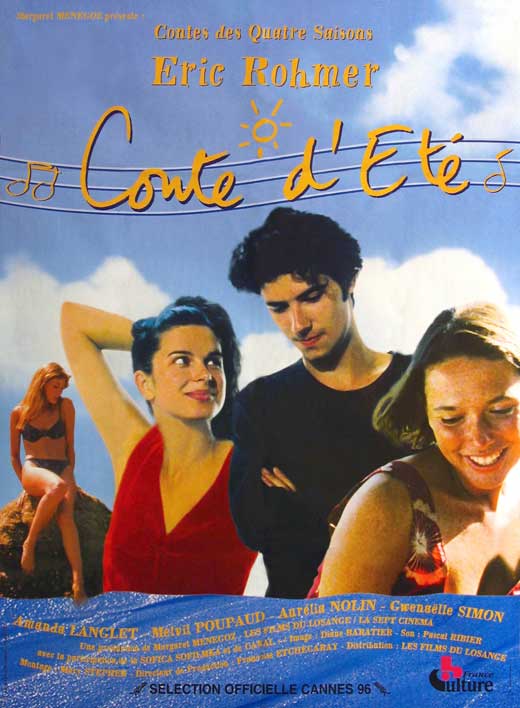
A Summer's Tale (Conte d'été) (1996)
A disaffected (and musically ambitious) young man feels disaffected and alone, and the only thing that can bring him out of his malaise is the presence of a woman to give his life meaning. But uh oh! There are three women in his life, all interested in him—WHICH ONE WILL HE CHOOSE?? Look, I realize I'm being a very bad sport here, but seriously, who cares? The protagonist is a total drip and kind of a douchebag in that sensitive-in-his-ennui way, and while I'm certain this is half the point (he's repeatedly called out by said women), that doesn't change the fact that his emotional journey has been so thoroughly played out in, like, half of all indie movies ever. I've just lost the patience for this sort of thing. Sorry. Grade: C

L'attesa (2015)
Focusing an a contrived scenario played deadly straight is sort of art film's bread-and-butter, and L'attesa (aka The Wait) is no exception: a grieving mother (Juliette Binoche) whose son has just left her (and likely died, though this is never completely confirmed) receives a surprise visit from her son's girlfriend whom she has, to this point, not known existed and must decide what to tell the girl about the whereabouts of her boyfriend. The parameters of the plot are all precisely minimalist and its edges hazy in just the right portions of ambiguity to give it the tease of artistry, and if Binoche weren't so fantastic here and the cinematography not so gorgeous and immaculately framed, I'd be tempted to call it just a bit too calibrated. Grade: B+

Music

Kendrick Lamar - untitled unmastered (2016)
When earlier this year Kendrick Lamar dropped this surprise compilations of purported leftovers from the To Pimp a Butterfly sessions, the expectation (at least from me) was that it would be somewhat of an odds-'n-sods B-sides collection. What we got, however, is very much the Amnesiac to TPaB's Kid A: the smaller, weirder sibling to last year's career-defining tour-de-force statement, more opaque, more textured and murky. To Pimp a Butterfly is Lamar's conversation with Tupac, and, following suit, untitled unmastered is every bit a conversation as well, although this time, Kendrick seems to be in conversation with himself. It's not just an album in first-person: it's one broadcasted from the echoing depths of Lamar's own psyche, and as such, it's a much more interior, oblique listen that trades concrete situations and social dialogue for impression and disorientation. If To Pimp a Butterfly was about the specifics of how Kendrick Lamar has dealt with fame, untitled unmastered is about showing what it feels like to have to have dealt with it: one's a thesis, the other's an experience. Both are brilliant. Grade: A-

Sunday, August 28, 2016

Mini-Reviews for August 22 - 28, 2016

Reviews. Read up.

Movies

Kubo and the Two Strings (2016)
There are good discussions to be had about the extent to which this movie appropriates Eastern culture to mostly Western ends, whether or not the characters are too trope-ish or one-joke, whether the plot is too video-game-ish (I'm far from the first to suggest that this may be the best Legend of Zelda movie we ever get). But when you get right down to it, one two things end up mattering to me in any gut-level way here, and both of them are towering and beautiful: the animation and the ending—the animation because this is hands-down the most intricate and gorgeous stop-motion that I've seen in my life, and the ending because it imbues the whole movie with such fantastic and thematically rich meaning about the nature of just what's going on in this movie that it snaps the preceding hour into sharp focus: a focus that turns the film into one of the most well-observed, provocative, and emotionally resonant commentaries on the power of storytelling in recent memory. I cried. Grade: A

High-Rise (2015)
This weird little dystopian satire involving an apartment building so self-contained that its increasingly Dionysian residents never need venture outside its walls proves something I already knew, which is that director Ben Wheatley makes technically fascinating movies that are a little hard to follow and a lot hard to love. This one's a little less aggressively off-putting than his last, the unapologetically surreal A Field in England, by virtue of having big-name stars (hey there, Mr. Hiddleston) and a satirical message so blunt (we live in a society that causes deep, dysfunctional class divides, y'all) that even when the plot gets a little hazy, there's always that frame to hang the scenes on. It's also his prettiest, most technically stunning movie to date: every single frame could be a groovy poster in your dorm. I'm not in love. But I liked it very much indeed. Grade: A-

Maggie's Plan (2015)
Throughout Maggie's Plan, Maggie (Greta Gerwig) has several plans, few of which are all that collected or grounded in much besides short-sighted impulse. I guess the same could be said about the movie as a whole, which flits through its oddly twisty (for this brand of indie dramedy) plot with as much breezy effervescence as Gerwig herself (who is typically fantastic). The result is a movie that is consistently entertaining all the way through without ever really cohering into anything that makes a lot of sense on a macro level. There's a sneaky sort of absurdity that's able to slip the phrase "ficto-critical anthropologist" alongside goofy sperm-donor hi-jinks and whatever on earth Julianne Moore is doing with that accent. Grade: B

Mind Game (マインド・ゲーム) (2004)
Imagine an animated movie that uses an early, metaphysical premise to eventually rope its protagonist into a slapstick middle half-hour set entirely in the belly of a whale, and you've only just begun to plumb the depths of unadulterated crazy that is Mind Game. Now imagine a movie animated in over a dozen styles that it rapidly switches between, often mid-scene: you're getting closer. The sensibilities of Mind Game are totally juvenile (the defining trait of the film's most prominent female character is that she has very large breasts, which have apparently kept her from realizing her childhood dream of being an Olympic swimmer [how could I make this stuff up?]), but those sensibilities, coupled with the completely gonzo animation, are piled up in such magnitude and intensity that the results toe the line between numbing and sublime. Grade: B+

Two Friends (1986)
Sort of like Memento, but with a friendship instead of murderous revenge. I'm being flippant—Jane Campion's debut feature (which aired on TV, her theatrical review still being three years away) is in turns sweet, poignant, and unapologetically harrowing in the emotional territory it mines. Maybe I'm just a softy, but the backwards-chronological sequencing of the sections makes this film's narrative of a friendship crumbling in reverse have the interesting and crushing effect of having each successively happier moment feel sadder and sadder. As it turns out, a friendship crumbling in reverse is even more painful than seeing one in the regular forward rush. Grade: B+


Music

Beyoncé - Lemonade (2016)
Lemonade is the sort of album we get every once in a while that seems to justify the pop music machine: an intensely collaborative, blockbuster record, the likes of which could never have been made without the piles of dollars and producers Columbia has at its disposal to throw behind its biggest stars, but one that nevertheless feels visionary and personal. This is every bit a commercial, big-label production while still being every bit Beyoncé's album: not just in the sense that she completely owns almost every minute of the record's 45 (I'm still on the fence about how well "Daddy Lessons" works) but also in that this is THE Beyoncé album, the one that's distilled the most potent parts of her identity into an adventurous, definitive statement. The album itself pales in comparison to the "visual album" feature film released alongside the music, and in fact, the record plays a lot like a soundtrack to the movie rather than a distinct work of its own, but as a soundtrack, it's killer. Grade: A-

Sunday, August 21, 2016

Mini-Reviews for August 15 - 21, 2016

More reviews. They're getting longer, too; I'm sorry for the lack of discipline. Anyway, let me know what you think about these movies/books/shows/albums in the comments!

Movies

Spectre (2015)
The action—particularly the Mexico City sequence involving Day-of-the-Dead imagery, an epic tracking shot, and a fistfight in a helicopter doing barrel rolls (yes, every bit as amazing as that sounds)—is some of the best the Bond series has ever formed, which, I mean, thank goodness, because the rest of the movie sure doesn't have much to offer. Spectre is overlong, convoluted, illogical, and hampered by, of all things, relentless series continuity (something that should be at the absolute bottom of any checklist of Bond essentials). And I don't believe for one minute that Léa Seydoux's Dr. Swann is somehow Bond's soulmate, especially, especially in a movie that so tirelessly reminds us that a woman named Vesper Lynd once existed. That action is so good, though. Let's stay positive here. Grade: B-

Midnight Special (2016)
I wasn't prepared for the extent to which this movie is basically E.T. except with a psychic boy whose eyes glow in place of a psychic alien whose finger glows. Of course, being written and directed by Jeff Nichols and not Steven Spielberg (and Melissa Mathison), the film is a bit more elliptical and oblique than E.T. ever was, which is both to its benefit—there's an otherworldliness to Midnight Special that's entrancing—and its detriment—the specific and painful emotional beats that make E.T. on of the great American pictures are largely gone in favor of indie-esque stammers and withheld confessions. That said, the movie is still one of the sharper sci-fi pieces you're likely to see this year, and well-worth your time, great American film or not. Grade: B+

Flirting With Disaster (1996)
Very funny and also very good at achieving something pretty rare in American comedy, which is the ability to have its characters experience growth without having to stop the laughs to do so. Look, I like comedies that turn suddenly and unrepentantly sentimental, and that goes for everything from The Apartment to Superbad. And I like movies that don't really care about characterization at all, at least not to the extent that they're willing to take them seriously enough to develop them beyond joke delivery machines: I'm talking our Dr. Strangloves and Airplane!s. But there's something entirely satisfying and impressive about Flirting with Disaster, which sends multiple characters through complete and compelling arcs without actually halting the funny. Grade: A-

The Rules of the Game (La Règle du jeu) (1939)
A blistering critique of the 1930s French upper class that posits, to amusing effect, that the rich are only interested three things: killing animals, sleeping with others' significant others, and killing those who sleep with their own significant others. That this critique is anything more than a gentle "silly rich people" slap on the wrist isn't clear for most of the film's duration, but when it finally does pull the rug out on the silliness to reveal the utter moral decay beneath, it's startling. I might feel a bit more invested in this movie if I were at all connected to '30s French society and privy to its social nuances (a lot of this satire rings only in theory for me), and I'll be honest that I'm not quite sure what all the "greatest movie of all time" hubbub is about with this one. Still, it's fun and vicious in equal measure and definitely not time I regret spending. Grade: A-

Television

Deadwood, Season 3 (2006)
Prior to seeing the third (and final) season, I'd been mulling over the idea that Deadwood is the only of HBO's trio of great early-2000s drama series (alongside The Sopranos and The Wire) that could be reasonably said to have optimism programmed into its DNA. This is, after all, a show about how a group of criminals, cheaters, and liars managed to slowly but surely purge their baser instincts and form a functional society out of the wilderness and lawlessness of the American West. But alas, that optimism doesn't carry over into Season 3. The difference is, tellingly, the arrival of Big Business (in the form of cutthroat mogul and real-life evil dude George Hearst), which compromises the idealism that informed even the rougher of this show's characters, up to an unintentionally final episode that presents a thoroughly depressing future for the integrity of Deadwood's (and America's, because this is that kind of show) principles. There's an argument to be made that this is altogether too heavy-handed and blunt, and I'd be open to that if the show weren't still so consistently well-written: as always, it's the florid, winding dialogue that shines brightest here. Plus, it's kind of hard to call this too heavy-handed, when the speech is so arcane that it's often a challenge just to keep up with the plot, much less ruminate on its implications. Grade: A-

Books

But What If We're Wrong: Thinking About the Present As If It Were the Past by Chuck Klosterman (2016)
I'm only familiar with Klosterman's writing through the handful of pieces I've read of his on the internet, so who's to say if this is a potential critique of most of his work, but here: the biggest strength of Klosterman's speculative nonfiction book is also its biggest liability, that Klosterman seems way more interested in making his book "interesting" than with actual, sound methodology for crafting his ideas. Part of this is baked into the premise: imagining contemporary culture's legacy on the distant future, specifically through thinking through what assumptions we as a culture hold today that will seem ludicrous hundreds of years from now in the same way that Aristotle's theory of gravity (the rock "wants" to be closer to the earth) seems preposterous now. Of course, as Klosterman stressed throughout, the very nature of these sorts of assumptions is that it's nearly impossible for any culture to recognize from the inside, and the progression of human thought has not always moved forward according to the logic of previous ages. This idea that what seems logical now might not be what's logical in the long term frees up Klosterman to make some truly out-there speculation. At its best, it makes for some fascinating discussion that ignores pat, consensus answers, such as when his lengthy chapter on what rock musician/group will come to represent the genre in a thousand years ignores the low-hanging, obvious answer of "The Beatles" until the very end, instead musing on the potential role of Journey and Bob Dylan as avatars of rock to the thirtieth century. At its worst, Klosterman's thoughts come off as dilettante-ish and baseless, as is the case in his chapter on the progress of science that basically finds several dozen pages worth of ways to say that nobody knows if we're reaching the limits of human knowledge. The result in total is that But What If We're Wrong is endlessly readable, provocative, and consistently fascinating without actually meaning all that much in the end. It's the equivalent of listening to a very smart person ramble on a hodge-podge of subjects: Klosterman's a world-class rambler, but it's hard to shake the feeling that he's just kind of making this up as he goes along. Grade: B

Music

Margo Price - Midwest Farmer's Daughter (2016)
When I tell people that I don't like radio country, this is the alternative that I'm looking for: witty, colloquial, personal, heartbroken. The album makes the mistake of leading with its best song by a mile, the world-weary and small-time tragic "Hands of Time," but that's not to say that Price and her endearing mix of cynicism and melancholy sweetness don't consistently deliver great work throughout the album. The only real dud is "Tennessee Song," a bluesy stomper that, despite the home-state pride I deeply appreciate, is the sole moment that verges into the generic. The rest is good stuff, full of personality and sincerity that's likely to win over even country skeptics. Grade: B+

Sunday, August 14, 2016

Mini-Reviews for August 8 - 14, 2016

Read on. Nothing to see up here.

Movies

Miles Ahead (2015)
In true jazz spirit, Miles Ahead takes the component parts of an existing genre—in this case, the biopic—and chops it up in order to spin something new from the pieces. This is, ostensibly, a Miles Davis biopic, and we're certainly treated to a lot of the familiar biopic tropes: copious recreation of Davis records (the film is scored gorgeously by Robert Glasper), through-the-ages snapshots of Davis career highlights, an ill-fated romance. But not only are these moments thread, stream-of-consciousness style, through a 1970s-set framing device that occupies the lion's share of the movie, it's a framing device that very obviously and intentionally is composed of things that never happened. The movie might feint toward providing an origin-story for some of Davis's seminal work, but for about 70% of its runtime, it's mainly concerned with some weird, alternate-universe version of Miles Davis running around with a gun trying to get his session tape for Agharta back from some low-level crooks. It's weird, it's funny, it's a cock-eyed commentary on the myth-making that comes with being a once-in-a-generation musician, and it's full of awesome music. Miles ahead of other biopics, that's for sure. Grade: A-

Cooley High (1975)
As the black answer to American Graffiti, the differences between Cooley High and Lucas's earlier film are stark: it's not just teenaged ennui and go-nowhere small town life on the line here; its the ability of these characters to navigate the balance between their own youthful indiscretions and the hostility of the real world. So when the meandering occasions of the story inevitably pull tight into a plot in the film's final fifteen-ish minutes, the results are dark and Greekly tragic, retribution for things the cast of American Graffiti would have merely gotten fun hi-jinks out of hitting these black, Chicago teens with disproportional force. The film is far from perfect: the comedic first half isn't nearly as effective as the dramedic-to-straight-drama of the film's latter stages, and the female characters are slight enough that it's hard to shake the feeling that the film at least identifies a little with the casual sexism of the male protagonists. But it's an immensely fascinating film nonetheless, and one that hides a magnificent emotional wallop around the corner. Grade: B+

Inside Man (2006)
A meat-and-potatoes thriller given just enough of director Spike Lee's idiosyncratic touch—characters addressing the camera, film stock changes, that part where Denzel Washington appears stationary as the rest of the world moves by—that you don't really care that it's only meat and potatoes you're eating. It's solidly written, convincingly acted, and fun to watch, even if by the end it's never really established itself as anything all that special. Grade: B


Proxy (2013)
This is trash, through and through: Proxy's plot involves obsession, perversion, a fully-explicit C-section of a still birth, a jealous and abusive lesbian lover, and not one but three gory deaths by shotgun. Please note that trash is not necessarily meant to denigrate here: cinema has a rich tradition of trash masterpieces. There's something undeniably transcendent about the sheer depths of old-fashioned, exploitation-style tastelessness that the film plumbs, and you know who you are if this is going to be your jam. For my part, I love a good, twisty, trashy thriller enough to appreciate those aspects here while not quite being gung-ho enough about the exploitation to ignore the painfully stiff acting, showy-for-showiness's sake cinematography, and troubling political subtext. Grade: B-

Television

Superstore, Season 1 (2015-16)
I didn't pick up many new shows during the last TV season, but I'm glad I finally caught up with this one. It's a charming, sharp sitcom, and even though, as a former Kroger employee, I'm maybe uniquely positioned to be captivated by its grocery-store setting (although it's more along the lines of Costco than a true grocery store), I'd also venture to claim that it's got something for everyone, too. The humor is both warm and absurd (the gently funny interactions between the main cast are punctuated by wordless, incongruous footage from around the store, such as a pantsless man in the bathroom) without ever becoming cloying or acidic. The pilot is weak, the only place where the show breaks toward unmitigated and unearned sentiment, but the rest of the season is breezily good, especially a fantastic late-season episode involving the cast spending the night in the store that seems to hint that this show has not just breezy goodness but actual greatness in it. Looking forward to the second season starting this week. Grade: B+

Music

Father John Misty - Fear Fun (2012)
Last year's I Love You, Honeybear is one of the great singer-songwriter albums in recent memory. Fear Fun, the 2012 debut of the Father John Misty persona (Josh Tillman actually has a slew of albums as "himself" before becoming this bearded, social media sage, none of which I have heard), is not. Lacking Honeybear's swooning idealism and romance that conflicted compellingly with Misty's innate irony, Fear Fun is merely ironic, which, especially after "Holy Shit" and "Bored in the USA," just doesn't seem like enough. That's not to say it's bad: Tillman's voice remains like honey, and the psych-country stylings of the music itself are great fun. It's also frequently hilarious, evoking Bob Dylan's sillier absurd moments (one song is even called "Misty's Nightmares 1 & 2," which has to be a direct allusion to the similarly weird and joking "Bob Dylan's Dream" series on Zimmerman's '60s albums); the best of the lot is "Tee Pees 1-12," which begins with the lines, "Well, you took me to the movies; you took me to the dance/You took me to your warehouse tied up in the back of your van." So I guess I can't complain too much, especially considering that this is Honeybear's predecessor. I guess I can forgive an artist some artistic growth. Grade: B