Hello, everyone!
As Tennessee shakes off the last drops of winter (it's actually been kind of nippy at night lately! I'm shocked, shocked!), the end of the school year approaches. And you know what that means: I'm going to have oodles and oodles of extra time on my hands for the next few months [1], which in turn means that I'm going to have to find some way to occupy a lot of that free time. And binge-watching Futurama again just ain't gonna cut it.
After all the fun that my AFI project last summer turned out to be, I want to do another multi-part project here to keep me busy this summer. Only this time, I want something that won't be quite as lengthy of an undertaking and also something that deals with a different medium than film. So here's what I'm thinking: I'm going to blog through C.S. Lewis's much-loved, poorly-adapted-into-film book series The Chronicles of Narnia. [Trumpet noise! Fanfare!]
Why Narnia? Why blog through these books? A few reasons, actually:
First: There was a period of about a decade in my life when I would not have hesitated to name The Chronicles of Narnia as my favorite books of all time. During that period, I read these books a lot. They were some of the first "chapter books" I owned—my parents gave me the box set one year, either at Christmas or my birthday (can't remember), and I just took off, first listening to my dad read them out loud to me and then reading them on my own once my reading skills acclimated. I was enthralled. Blogging through the series will give me a good opportunity to articulate what I love about it.
Second: Despite my young fanaticism for the books, I actually haven't read them since sometime in high school. I figure that it will be interesting and illuminating to revisit the series with adult eyes.
Third: Narnia gets used a lot as a theological bludgeon, an appropriation that Lewis sort of invited by including not-so-hidden parallels to Christian scripture and thought. But what often gets lost in all the theological brouhaha is the fact that these books are really, really lovely from a purely artistic standpoint. At least, I think they are—maybe I'll think differently about that now than I did as an eight-year-old. I'm interested in theology, yes, but I'm also interested in how these books are lovely works of art.
Putting these three points together, I guess what I'm trying to say is that my approach to this series is one of an adult cultural critic. You could think of this project as basically one of review: what about Narnia still holds up for 24-year-old me? What doesn't? I'm very much a layman, so don't expect me to dive too deeply down the theology well (though I of course won't shy away from it if its relevant to what I'm discussing). But what you can expect is commentary—well-reasoned or not, I make no guarantees—about what makes Narnia work as literature. Literature is beautiful; what is Narnia's beauty? I'm betting it doesn't just have to do with how Aslan is basically Jesus.
I'm still a little fuzzy on how exactly this is going to take shape, but my overall thought is that I'll write one post for each book—seven in total [2]. If you followed my 100 Years...100 Movies posts last summer, you can expect my Narnia posts to be a bit more in-depth than the reviews I did there, given that I'll be focusing on a single work each time instead of two or three different ones. The posts may be laser-sharp exegesis or just a collection of random thoughts I have; I suppose it will depend on the book itself and my mood in the given week. Also, since reading books (even books as short and breezy as the Narnia novels) takes longer than watching movies, this means that the posts will be less frequent than my AFI ones were last year. I'm going to try to do one at least once every week, though.
And that's about it. I'm about halfway through my reread of The Lion, the Witch and the Wardrobe right now (the Narnia Beautification Committee frowns upon your lion statue graffiti, Edmund), so it shouldn't be too long before I get to writing the first post, provided that end-of-semester grading, etc. doesn't dump all over my plans. I guess we'll see how the next few days go. Whenever it gets kicked off, though, I'm excited to revisit this series, and even if nobody else reads my posts, I'm sure I'll learn a lot and have a lot of fun trekking through this project.
Until next time!
Edit: Read the series now with the Table of Contents for Posts
1. The Lion, the Witch and the Wardrobe
2. Prince Caspian
3. The Voyage of the Dawn Treader
4. The Silver Chair
5. The Horse and His Boy
6. The Magician's Nephew
7. The Last Battle
1] Well, probably. There's this whole business of trying to get a job and start a career post-grad school, but you know. Details.
2] Also, for those who care, I'm reading through them in publication order (i.e. start with The Lion, the Witch and the Wardrobe). My box set and all modern editions of the series order the books in chronological order, and I've never read them in their originally published sequence. I've heard apologists for both orderings; it should be interesting to see how the two compare.
At this point, nothing more than the musings of a restless English teacher on the pop culture he experiences.
Thursday, April 23, 2015
Sunday, March 29, 2015
Ranking R.E.M.'s Albums
People sometimes ask me who my favorite band or musician is. Have you
ever tried to answer that question? It's a tough call. Sometimes I've
said Radiohead, other times David Bowie, and Miles Davis is becoming an
increasingly common thought of mine. But if I'm being totally honest and
not, you know, worried about making myself look smarter than I actually
am, I've got to say that R.E.M. is up there. Like, way up there.
Analogies are tricky, but I'm going to try to make one here: R.E.M. are the Beatles of alternative rock. It's not just because R.E.M. has roughly the same number of studio albums (depending on how you count all those US Beatles releases); it's the sheer breadth and quality of their catalog, the trailblazing trajectory of their career, the willingness to push simultaneously challenging and pop-oriented sounds. If nothing else, R.E.M. pretty much birthed the entire alternative rock genre in the early '80s alongside post-punk and new wave in much the same way that The Beatles helped to invent the British brand of the "white man" rock 'n' roll and R&B. This much is also for sure: R.E.M.'s streak of greatness, running (in my book) from 1983's Murmur through 1998's Up, is a feat of consistency almost without peer in rock history, with the closest analog being the career of the Fab Four themselves.
So, wherever R.E.M. ranks among my personal canon, there's no question in my mind that they are among the greats. In honor of that (and the fact that I just recently purchased the last album I needed to have the band's entire discography), I thought I'd rank all of R.E.M.'s studio albums from most-favorite to least-favorite. I've already blathered on for a while, so let's jump right into it. Enjoy!
15. Around the Sun
I realize that part of the secret to making a good list is the ability to make bold choices, ranking in ways that are surprising but well-reasoned. Well, folks, I just couldn't do it with this album. R.E.M.'s thirteenth studio album, per its reputation, truly is the rear end of their discography. The record's biggest sin is just that it's boring. Soooo boring. It's here that the emotional complexity and studio trickery that propped up the previous two post-Bill-Berry albums fall away entirely, and we're left with the form of a late-period R.E.M. album without any of the content. 56 somnolent minutes of it, no less. It's not all bad: "Leaving New York" is pretty, and "Wanderlust" gives a welcome flash of mid-album energy in what's otherwise an apathetic outing. But these highlights are fleeting and wouldn't even rank as highlights at any other point in R.E.M.'s career. Around the Sun is really no good, y'all. So let's move on.
14. Reveal
And now we have Reveal, which still isn't that good. But it's better! At the very least, though, it has some major cracks showing—like its immediate successor, Around the Sun, it's far too long (what was it with R.E.M. and these 50+ minute albums?), and it's sorely lacking the energy that invigorates better R.E.M. albums. But unlike Around the Sun, there's actually some good ideas, both musical and philosophical, within these twelve tracks, which does help keep the air in recordings a bit. The electronics are livelier and often lush, which gives even the more mundane moments (and there are plenty here—Reveal is no masterpiece) some spark. A motif of flight runs throughout the album, too, from the opening "The Lifting" (a plane is lifting off, get it?) through the flying beachball in the closing track, and while that's not the greatest theme to center a record around, it's not bad either, especially when it leads to the disaffection and melancholy of songs like "Disappear" and "Chorus and the Ring." In the face of how horribly human beings sometimes treat each other, even things as magical as flight or interplanetary bodies seem hollow. This idea comes to a head in the gorgeous "Imitation of Life," the album's high point and sole bona fide classic. The rest of Reveal runs the gamut between "meh" and "good enough," but "Imitation of Life" is really something else, proving that even on a minor work, R.E.M. can bring their A game out for a song or two.
13. Accelerate
I don't love Accelerate (obviously—look at that ranking), but it's miles ahead of both Around the Sun and Reveal, if only for two reasons: 1) It rocks, maybe harder than R.E.M. ever did elsewhere, and 2) It's only 35 minutes long. The first reason is mostly self-explanatory, though it's worth pointing out that while a lot of the band's '80s output was played with more vigor, Accelerate is the only of their albums to adopt a modern rock style of production, which gives it considerably more punch. The second reason may sound like I'm damning the album with faint praise, but I'm really not. Upon its release, Accelerate was heralded as a return to form for R.E.M., but something that people don't talk about enough is the pure pleasure of seeing this band (whose first six all clock in at robust 40-ish-minute runtimes) rediscover the art of self-editing. Coming right on the heels of Around the Sun, the album is still haunted by the specter of form-over-content; there's a song about Hurricane Katrina ("Houston") and another one about the exploitation of religious experience ("Supernatural Superserious"), but these have the feel of token nods to a few of the band's pet themes more than any real statement. Basically, this album doesn't have an "Imitation of Life," which is a shame. But what it does have is a sense of fun, almost as if Stipe and company (staunch leftists, all) are shaking off the malaise of the Bush era and roaring out of the gate for an election-year romp (this album came out early 2008). And fun is something that counts for a lot in my book.
12. Collapse Into Now
If Accelerate toys with the idea of R.E.M. as a band playing at its past identity with songs like "Houston" and "Supernatural Superserious," then Collapse Into Now takes that idea and blows it up into full-on concept album levels. On their fifteen and final record, R.E.M. is paying homage to itself, and wrapped up in its 41 minutes (thanks again for learning that a CD doesn't have to be a full hour, guys) are allusions—mostly musical—to the band's diverse history, especially its fat, mainstream radio years of the late '80s and early '90s: "All the Best" is straight out of Document; "Oh My Heart" wouldn't feel out of place among Automatic for the People's dark-night-of-the-soul tracks; "Blue" has the fuzzed-out guitars and ragged mourning of New Adventures in Hi-Fi (and also a Patti Smith guest vocal, not seen since that album's "E-Bow the Letter"); "Überlin" even has the almost-spoken-word "Hey!" hook from "Drive." The band never quite recaptures the greatness of those earlier moments, but we're in solidly "very good" territory here. Collapse Into Now is R.E.M. making their very own tribute album, and on those terms, it's a great success. If nothing else, it's a fitting sendoff to this dearly beloved band, one I'm glad we got.
11. Monster
There's a blog post out there that I can't find right now, but the gist of it is that the author points out how R.E.M.'s Monster is basically guaranteed to be taking up space in any used/bargain CD bin you come across. I've rummaged through a lot of used/bargain CD bins in my time, and that blog post is totally on the money! It's everywhere, and it usually costs no more than $5 (my copy came from Wal-Mart and ran me about $4). Monster is certainly not the R.E.M. album with the best reputation; bargain bin presence notwithstanding, there's a feeling of disappointment surrounding this album among fan circles, the original critical reviews, and even more recent retrospectives. And I guess that's understandable. It's no Automatic for the People, the blockbuster that this album had the misfortune of having to succeed in R.E.M.'s discography. Then again, it's not trying to be a sequel to Automatic for the People—an album that was itself a sort of sequel, the Empire Strikes Back to Out of Time's Star Wars, if you will. That Monster tried something different and isn't simply the Return of the Jedi of this period of R.E.M.'s career is admirable, and in fact (if I'm going to belabor this analogy), it's more like if Return of the Jedi had taken the Jabba's Palace segment and stretched that out into a feature film. From the sexuality of the lyrics to the fuzzy, warbling distortion that warps every track (even prettier balladry like "Strange Currencies"), Monster is a colorful, bizarre album unlike any other in the band's repertoire, and I love that. R.E.M. was never much for Bowie-like shifts in identity, but this album stands as their one experiment in that arena. Michael Stipe (and really, the band as a whole) is playing dress-up, trying on what it feels like to be a grunge band by way of Ziggy Stardust, and it's through that level of distance that the band somehow manages to craft some of its strangest, most intimate songs.
10. Green [1]
There are few albums in R.E.M.'s discography that are more significant than Green. I'm not talking about quality; I mean how much this album provides a road map for the rest of the band's artistic pursuits. Green is a transition album in almost every sense—their major-label debut, having moved from I.R.S. to Warner Bros., whom they would stay with the remainder of the band's existence; their commercial breakthrough, solidifying that the chart presence of Document's singles wasn't a fluke; and, most significantly, their biggest stylistic shift yet at the time, diversifying the college rock sounds of their first five albums by adding mandolin, strings, and accordion to the mix and adopting a decidedly poppier approach to songwriting. Without this album, there is no Out of Time or Automatic for the People, no R.E.M. as world-conquering stars, no Bill Berry leaving, no Up nor any of the somnolent work that followed. So yeah, this is a big 'un for the band, and like a lot of transition albums, it's got a frustrating mix of greatness and not-so-greatness. I am staunchly in the anti-"Stand" camp; it's one of the most inconsequential, irritating songs the group ever made, and I can't stand (ha...) it. I have similar, though less passionate, feelings about "The Wrong Child." But then you've got "Pop Song 89" and "Get Up," which are fantastic and the cream of all R.E.M.'s nakedly pop music. "Orange Crush" is also next-level, of course, and the lovely "Hairshirt" is another highlight, a quiet moment on an album full of loud statements. So I'm splitting the difference here and putting this right at the fringe of the band's top 10.
9. Up
Up is a depressing record for a number of reasons, both textual and meta, but here's the one that sticks in my craw the most as I do this writeup: it's the last R.E.M. album to come within spitting distance of greatness. In fact, scratch that: it is great, the last great R.E.M. album, though by most accounts, its greatness is a small miracle. Bill Berry, the band's longtime drummer, had just left the group, knocking a leg out from under R.E.M.'s equilibrium, and what with the concert fatigue afflicting the remaining members and the spiritual and existential despair present in the album's lyrics, it seems like c. 1998 was a dark time for our heroes. Wikipedia even informs me that the band "came close to breaking up while recording the album." Well, thank goodness they didn't, or we wouldn't have gotten this gem. Up is R.E.M.'s most personal album, eschewing the usual third-person commentary of their lyrics for first-person introspection, creating songs about frustration and alienation with a pathos that rivals Automatic for the People in emotional resonance. With songs like "Hope" and "The Apologist" and "Daysleeper," this is definitely a Doubt record, at once R.E.M.'s Achtung Baby and their Kid A[2], the tortured, weird sibling to the band's more commercial work. It's compelling, complicated stuff that makes the album's few moments of catharsis all the more resonant. "I've found a way to make you smile," Stipe sings on "At My Most Beautiful," the album's crown jewel of a song, the band's very own "Strawberry Fields Forever." Ain't that the truth.
8. Murmur
And now we're into full-blown classics from here on out. Any one of these top 8 albums I wouldn't hesitate to put among my personal top 100 albums, so it's a tough task for me to rank them. Still, I'm afraid I've got to give Murmur the boot, so to speak, and knock it down to the least of R.E.M.'s masterpieces. It's not that I don't like it—I do, very much, and it's a testament to how ridiculously great R.E.M. is that I'd put an album I like this much in the bottom 50% of their discography—but the album does suffer somewhat from its station as the first R.E.M. full-length. The performances here are slightly more mannered here than the band would develop in the following years, for one, and the bass has always struck me as somewhat awkwardly incorporated into the rest of the sound of the album. Honestly, it's probably the production, which is significantly thinner than even Reckoning, the band's 1984 follow-up. But let's not nitpick; Murmur is an astoundingly confident, accomplished work, both as a debut (one of the best in rock history) and as an album, period. It's got a fascinating tension between light and dark going on, where the melodies are bright and inviting (along with the chiming lead guitar) but seem kind of murky and mysterious by the same token. It's rare that music this outwardly effervescent and light can also feel dangerous, but R.E.M. does it somehow. Just look at the second track, "Pilgrimage," where the muttered, ominous verses break into the pop bliss of the chorus on the turn of a dime, and you'll see what I mean. And this is just the beginning.
7. Document [3]
R.E.M. have always been a political band on some level (you don't just name one of your albums Fables of the Reconstruction for a lark), but they really take it to the next level here. Released in 1987, right at the tail end of the Reagan years, Document is sort of R.E.M.'s state of the union address, and, being the lefties they are, the outlook isn't good. "Michael's nervous," Stipe sings here on "Strange," changing the lyrics from Wire's original version to ensure that we know: the world is ending, and R.E.M. isn't really feeling fine. And oh, it's deliciously vicious how they cope with it, comparing '80s America to McCarthy's senatorial tyranny on "Exhuming McCarthy" and proclaiming that "what we want and what we need have been confused" on the blistering opener, "Finest Worksong." Then there's "Welcome to the Occupation," the brutal critique of America's foreign policy: "Listen to the Congress where we propagate confusion, primitive and wild." On a personal note, this album played a pretty big role in the transformation of my own beliefs from thinking of the '80s as "that decade with all the bad hair" to "that decade with all the troubling legislation (and bad hair!)." It's a punk album in everything but musicianship, and even then, it's R.E.M.'s loudest collection of songs until Accelerate, twenty years later. Even if the politics don't match yours, there's still plenty to enjoy, from the bitter good riddance of "The One I Love" to the very early-'80s-R.E.M. "King of Birds" to, yes, "It's the End of the World As We Know It (And I Feel Fine)." Come for the message, stay for the music. Or the other way around, if you want.
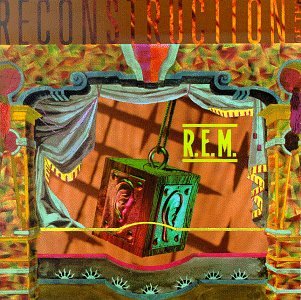
6. Fables of the Reconstruction [4]
This is the album that tends to get lost in the shuffle when R.E.M. conversations pop up. It's not groundbreaking, it's not an auspicious debut, it's not a new direction for the band, it's not a blockbuster; it's simply just another fantastic R.E.M. album in the sea of fantastic albums R.E.M. put out in the '80s. If R.E.M. is the Beatles of indie rock, then this is their For Sale—caught between milestones, its only claim to fame being that it's really great. If it sounds like I'm damning with faint praise, then allow me to redirect: Fables of the Reconstruction is also notable for being the last of R.E.M.'s murky, mysterious albums. Their subsequent records embraced a much cleaner, more arms-wide-open sound, but Fables of the Reconstruction is still very much in the spirit of Murmur, where each song has dark, ominous corners that refuse easy interpretation. For all the sweetness tied up in the Peter Buck's guitar and Michael Stipe's voice, this is a prickly album, as menacing as its title's allegation of institutionalized historical fiction. We're still a few years out from Document and R.E.M.'s most overtly political years, and on the whole, the band here is more interested in existential refraction and sonic haze than political statements, but there's something unmistakably conceptual about Fables, something that I find difficult to put my finger on, but it's there, somewhere, shifting in the brambles. The genius of the album isn't its clarity; it's the shifting, mirage-like qualities that defy fact. It's the fable.
5. Out of Time
After the success of Green, R.E.M. doubled down on the mandolins and mainstream sensibilities and came out with their definitive pop album, Out of Time. The songs are brightly produced, clearly enunciated, and melodic, and for some reason that has always eluded me, this makes for one of the most divisive records in the band's discography. Some people seriously hate this album, and in certain circles, it's a kind of shibboleth for R.E.M. fans. At the center of this vitriol is "Shiny Happy People," the jaunty, chamber-poppy bit that has many times been called (often by the members of R.E.M. themselves) one of the worst R.E.M. songs ever. Well, let's get this out in the open here: I love "Shiny Happy People." It's fun, it's catchy, and it has just the right undercurrent of melancholy (they are putting something/someone in the ground, after all) to ferment the tune into something richer than just simple fluff. The same goes for pretty much the whole album, which, if you hadn't already guessed from its ranking, I also love. It's a fleet record, full of some of R.E.M.'s nimblest, sweetest melodies, and its 45 minutes go down remarkably easy. But at the core of all this sweetness is a dark mass that gives the music an emotional texture that's much more complex than the shiny, happy instrumentation would indicate initially. The darkness only boils to the surface at two tracks—"Losing My Religion" (a serious contender for my favorite R.E.M. song) and "Country Feedback"—but they're both powerhouses that color the rest of the record. There's heartbreak here: "I need this," goes the refrain in "Country Feedback," and the sadness isn't just in the desperation of the words but also in the tension created with those smooth, bright studio sounds. It's not radio pandering (not with that opening "Radio Song"); it's the necessary ligature to keep the emotions from tearing everything else apart.
4. New Adventures in Hi-Fi
Okay, this is the last time I'm going to use the Beatles analogy: New Adventures in Hi-Fi is R.E.M.'s White Album. This is true for a lot of different reasons: it's sprawling (R.E.M.'s longest record, by quite a margin at the time of its release, though that margin shrunk quite a bit during the band's subsequent "hey, we can put a whole hour's worth of songs on a CD" era); it's stylistically diverse, including one-off experiments like the Mexican-folk "Zither" (surely the album's "Wild Honey Pie"); it's also an album that captures a band on the brink of fracture, with drummer Bill Berry preparing to leave soon after the record's completion (though this departure was on considerably better terms than the Beatles' breakup). But enough about the Beatles. New Adventures in Hi-Fi is a phenomenally mature album, both stylistically and lyrically, the kind of album that a band can only make when it's been around for a decade or two and its members are entering their late thirties. When Michael Stipe sings, "Twentieth century, go to sleep," on the radiant closer, "Electrolite," you can hear the years weighing on him. The same goes for Peter Buck's fuzzed-out guitar, which sounds like the rock star posturing of Monster grown older, more grisled. This album is the logical conclusion of everything the band had done up to this point, something no more apparent than in bracing centerpiece, "Leave," where the hurt of Out of Time and Automatic for the People has festered into a pulsing open wound. It's beautiful, bracing stuff and stands as an artistic height that R.E.M. would never reach again.
3. Reckoning
A lot of bands with a debut as fully formed as Murmur have a sophomore slump. R.E.M., on the other hand, has, I dunno, a sophomore... hump? peak? Whatever you call it, Reckoning is the sound of a scrappy young band improbably becoming even better than before, and it's marvelous. Part of my preference for Reckoning over Murmur is (at the expense of my indie cred) due to the hugely improved production values; it's not exactly a mainstream-pristine record (we'd have to wait until Document to have one of those), but it's like a sunny day compared to Murmur's murk and muddle. The result is a much richer sound that teases out melodies in a gently precise way, and it's rapturous. "(Don't Go Back To) Rockville" is the obvious, standout track here, and it's the one that's gotten the most attention over the years, but every single song here is a marvel, from the jaunting movement of "Harborcoat" to the delicate beauty of "Camera." The increased clarity brought on with the crisper production gives us, for the first time in R.E.M.'s career, actual tangible emotions to latch onto in these songs, too: "So. Central Rain" is R.E.M.'s first overtly sad song, and "Pretty Persuasion" practically spews vitriol in a way that anticipates the more acerbic moments on Document and Green. The crazy thing is that these first forays into what would eventually become tried-and-true tropes for the band are also the very best iterations of these styles. R.E.M. didn't need to practice; two albums into their career, they were already masters.
2. Lifes Rich Pageant [5]
There are a lot of things that can be said about Lifes Rich Pageant: its politics, its environmental themes, its commercial success. But focusing on any that runs the risk of eclipsing what's perhaps this album's greatest strength (something I've been guilty of on some of these other writeups), which is that the songs freakin' own. Lifes Rich Pageant is the great showcase of just how much of a songwriting powerhouse the men of R.E.M. were—especially in 1986, the height of what many consider their golden age. Its production, caught between the college-rock sounds of the first three albums and the radio-ready engineering of their next four, is the most optimal delivery system the band ever had for its sheer songwriting prowess, and it pays off wonderfully with a collection of some of the band's best songs. Robert Christgau calls the Rolling Stones' "Brown Sugar" "a rocker so compelling that it discourages exegesis"[6], and that pretty much describes my feelings about the twelve tracks on Lifes Rich Pageant. Take "Fall On Me," one of the album's many, many highlights. I can read the lyrics and think about its thesis about how commercialism destroys the environment, etc., but when the music starts, it sounds so glorious that I don't care at all what it says. This is true not just of the sweeter melodies like "Fall On Me" and "Cuyahoga" but also of the pricklier, deep-impact stuff like "These Days" and "Hyena," where R.E.M. really goes for broke on the rock 'n' roll. They've got smart, important things to say, but in a certain sense, who cares when they make music this awesome? It's not grandiose or conceptual, but song for song, on the level of pure craft, I'll stack this album up against any album in the rock canon. Plus, it takes its title from an Inspector Clouseau quote; that's a recipe for success if there ever was one.
1. Automatic for the People
Man, where to start with this album? How about personally: Automatic for the People is the first R.E.M. album that I ever owned (something that, I'm guessing, goes for many R.E.M. fans of a certain age); my brother had their greatest hits, and I'd heard quite a few of their songs on the radio, but this was the first CD of theirs that I ever got with my own money. When I first listened to it, I was alone, sitting at my parents' wobbly dining room table, my little circular CD player beside me, whirring. The house was empty. To this day, this is an album I find best experienced with nobody else around—preferably late at night, timed so that the final, gorgeous bars of "Find the River" fade at just the moment the evening is at its quietest. With other people (or even just in daylight), songs like "Nightswimming" and "Everybody Hurts" are easy to mock, friends and acquaintances filling up the spaces this album leaves intentionally blank, but alone, there's nothing to distract or buffer you from this album's quiet beauty. It's like the difference between a stage whisper and a real whisper, a secret passed between just two people. If I'm waxing pompous and insufferable about this one, know that it's because Automatic for the People is among my top 20—maybe even top 10—albums of all time. It's not a groundbreaking choice for #1 R.E.M. album (it's one of the band's best-selling records, and you won't find it in all that many bargain bins either), though it's hardly representative of what an R.E.M. album sounds like. The strings and organs recall some of the chamber poppiness on Green and especially Out of Time, and there's the requisite political number with "Ignoreland," but at most, these are just echoes of what R.E.M. had been up to this point and what they would become for the rest of their career. On Automatic for the People, the emotional depth are deeper, the tone is more mournful, the instrumentation is statelier, the left turns are weirder ("Star Me Kitten," anyone?). Gone is the college rock; not yet here are the guitar crunches of Monster and Hi-Fi nor the noodling electronics of the post-Berry era. Automatic for the People is just Automatic for the People. For all of R.E.M.'s masterpieces (and they are many), this is the one album of theirs that has grandeur, and in that sense, it's a sort of one-off for the band. But what a one-off it is.
And there you have it. Thanks for reading, everyone! Fellow R.E.M. fans out there, be sure to let me know your own favorite R.E.M. albums, songs, moments, anecdotes, complaints, thoughts, etc. I'd love to hear what everyone else has gotten out of this marvelous band.
Until next time!
1] For those of you out there who, like me, are fascinated by the quirks of owning physical media, I'd like to point out that the liner notes for the CD release of Green only have the lyrics to "World Leader Pretend." Also, the final song apparently has no title; on the disc, there's an "11." but no track title following, and the back of the CD doesn't even list an eleventh track. iTunes calls this song "Untitled," but Wikipedia says it's called "11." Mysterious. R.E.M.'s '80s releases are full of packaging weirdness like this, though for whatever reason, the trend doesn't continue into the '90s. Also also, my CD copy of this album is a used one, and the previous owner inscribed, in sharpie, the initials H.K.C. on the label side of the disc. H.K.C., whoever you are, thank you for selling your album so I could pick it up years later for $0.79.
2] Fun fact: Thom Yorke once said that Radiohead probably couldn't have made Kid A without the precedent of Up.
3] Packaging weirdness: on the back of my CD copy of Document are printed the words "Number 5 Document," right across from the track listing. I get it; Document is the fifth R.E.M. album. But why? No other R.E.M. album's packaging references its position in the band's discography. I mean, why not, I guess, but you've got to wonder what goes into these sorts of decisions.
4] More packaging weirdness: Fables of the Reconstruction is by far the most bizarre, as far as confounding packaging goes. Get this: the album basically has two covers, both of which are included in the CD edition, and which one is facing out seems to vary from retailer to retailer (those of you who have this on vinyl, let me know what that looks like). One cover is the one I included for the writeup above, while the other looks like this. If you look closely, you'll see that the first cover has the words "Fables of the" written across the top, while the second one has "Reconstruction of the" printed along the bottom. That means that when you put them together, they complete each others' phrases, creating a sort of snake-eating-its-tail situation where the phrases form an infinite loop. This, of course, plays right into the album's generally opacity and its central idea of reality being irrecoverably buried by fables and language, but it's still a little confounding. Also confounding: the spine of the CD copy I own bears not the album's title but "Reconstruction of the Fables." Additionally, the liner notes have a stylized track listing that includes "When I Was Young," an R.E.M. rarity that's only available in demo form, and that appears nowhere on this album. Why did R.E.M. do this? Was it a mistake? An artistic statement? Just trolling? Who knows, but it sure makes for some lengthy footnotes.
5] Even more packaging weirdness: Lifes Rich Pageant has maybe the best evidence for the argument that at least some of R.E.M.'s '80s packaging was just a mistake. Riddle me this: why would the band only include ten of the album's twelve songs on the track listing? And why are they in the wrong order?? Is it a printing error? Is it just to mess with the heads of bloggers writing about it 19 years later? Or is this all part of some elaborate message? Wake up, sheeple!!
6] An idea I think is complete BS for that particular song. No, Rob, it discourages exegesis because you just don't want to admit that actually reading the lyrics means you have to come to grips with the fact that it's a repellant celebration of racism and rape. At least with R.E.M., ignoring the words only means that you're tacitly agreeing to leftist political views.
Thursday, February 19, 2015
Goodbye, Parks and Recreation
Next Tuesday evening, NBC's little-watched but much-loved sitcom Parks and Recreation will air its final episode. And yeah, I get it. Seven season is way more than any of us had any right to hope for back in those dark, early years when it seemed like only three dozen people were watching. It's time to say goodbye. But the show's end still makes me sad. Sadder than I've felt at any other TV show's end. That's because Parks and Recreation is one of the few pieces of pop culture than I can say has really, truly, demonstrably changed my life.
In the final minutes before Conan O'Brien ended his brief stint as the Tonight Show host on January 22, 2010, the comedian gave one final monologue that, if history is fair, should be remembered as one of television's greatest moments. The whole speech is a marvel typical of Conan's warm, off-beat sensibilities, but its crux comes at the very end, when he speaks the following words: "Please do not be cynical. I hate cynicism. For the record, it's my least favorite quality, and it doesn't lead anywhere."
Parks and Recreation debuted more than nine months prior to Conan's last Tonight Show, but it may as well have been in direct conversation with that moment. By most accounts, Parks's first season is a mess, a sitcom stuck between meandering characterization and pale imitation of its older NBC sibling, The Office. But by January of 2010, the fledgling series was midway through its second season and on much firmer footing, having in the intervening ten-ish episodes figured out exactly what kind of show it was and remains today, up to its penultimate episodes. And that is a show that, like Conan (but unlike so many of its so-called "quality TV" peers), hates cynicism.
Take, for example, a moment the occurs in "Galentine's Day," a season-two episode that aired just a few weeks after Conan's NBC farewell. April, the Parks Department's resident millennial, pessimist, and hipster, attends a seniors' Valentine's Day dance with some of her also pessimist, also too-cool friends. The music is cheesy, the geriatrics are doddering, and her friends have a great time cracking jokes about not just the senior citizens but also Andy, April's crush who loves Dave Matthews Band. One suspects that a young Jim Halpert would have been right at home among April's pals. But April will have nothing of it, and she shouts, "Why does everything we do have to be cloaked in like fifteen layers of irony?" It might as well be a thesis statement for the show as a whole.
I know that there's a difference between cynicism and irony, but in the landscape of great TV comedy of the past twenty-ish years, the two come from remarkably similar places, whether its Seinfeld's cool remove from the solipsism of its characters' behavior or, more relevant to Parks, the acidic mockery often present within the mockumentary sitcoms that cropped up in the first few years of the new millennium. The Office is humanist at heart, showing tremendous sympathy for its characters in its most unguarded moments, but in practice, its comedy often hinges on giving the viewer a sharp feeling of superiority over most of its cast—man, isn't Dwight crazy? Man, isn't Andy preppy? At its most schadenfreude-inducing, The Office is funny not because what the characters are doing is funny but because they are inherently pathetic. Its comedy relies on a certain cynicism about humanity; we expect people to be flawed, so its funny when people are even more flawed than we initially imagined. That's what April rages against; that's what Parks and Recreation despises. There is very little superiority invoked by Parks and Rec. For all its jokes, for all its political satire, for all its warmth, Parks's most astounding artistic feat may just be that it manages to make liking people funny.
This is a show that's relentlessly optimistic, and I'm not just talking about how it believes that change is possible, or how it posits that small-town (and occasionally mid-sized city, depending on the narrative needs of the episode) Pawnee, Indiana, could somehow become not just the hub for a thriving tech startup but also the freaking National Parks headquarters. No, I'm talking about how it's optimistic about people. It really, truly believes that staunch libertarian Ron and political progressive Leslie can be best friends. It believes that Neutral-Milk-Hotel-loving April could hook up with Dave-Matthews-goof Andy and form a loving, stable marriage.
I'm not really saying anything new; TV critics have been discussing the miracle of Parks's sincerity and optimism for years. But for me, personally, watching this show as I transitioned from a late-teen to an early-twentysomething, those beliefs made more of an impact on me than all the biting, cynical wit of the most prestigious TV comedies combined. As a teenager, I had found a refuge in cynicism, in distancing myself from people because of the flaws that I expected in them. By the time college rolled around, it had become a default mode, something to fall back on whenever something bad happened. "Well, what did you expect? Things suck." It was the smart, cool thing to think. I mean, I wasn't quite at April-levels of cynicism, but the core was there. And Parks and Recreation's gently stubborn insistence that such thinking isn't the smartest or the coolest blew my mind.
Oftentimes, things do suck. I get that; I'm not that naive. The type of ironic/cynical comedy I discussed above has its merits; I like The Office, and I love Seinfeld, Arrested Development, and a whole slew of other shows that embrace a similarly cynical comedic philosophy (and anyway, this comedy of cynicism isn't the only thing these shows have to offer). But as far as revolutionary, as far as life-changing, I can't say any of those shows helped change my worldview. But Parks and Recreation did. The message that appreciating and connecting with people is often just as (if not more) important as acknowledging the suckage profoundly shook up the way I saw the world. Conan got to me first, but Parks wasn't far behind.
I don't want to overstate this; most catalysts in life don't work dramatically. Parks and Recreation impacted me in the way change normally happens—a nudge, a hair's breadth in a new direction. In true Parks and Rec fashion, it didn't work alone either, but in tandem with a variety of other factors in my life, some even more influential—changing theology, falling in love. But the fact remains that at least some part of me now, even if it is a small part, is different for having watched the show.
So thanks for that, Parks and Recreation.
Until next time.
Wednesday, December 31, 2014
Favorite Movies of 2014
Happy New Year's Eve, folks! Now that 2014 officially has a few scant hours left in its life, I think it's safe to say that I won't be seeing any more movies this year, which means it's safe to declare my favorites without fear that some later release will grab a spot in my heart (as was the case with my Favorite Music feature—that D'Angelo album, y'all).
Just a technical note: the movies I've considered are ones that have had theatrical releases in the United States during the past year. Several of the ones I discuss here have earlier release dates, either in festivals or foreign markets, but still qualify because of their theatrical release dates in the US of A.
It's also worth noting that (per usual) due to time, release schedules, and simple apathy, I have not seen every single movie released this year, so if it's not on this list, there's a big possibility that I just didn't see it. A few notable gaps in my viewing that readily spring to mind include Inherent Vice (which won't come to Knoxville until January—c'mon, distributors!), Selma, Dawn of the Planet of the Apes, Gone Girl, Big Hero 6, and Whiplash, and that's just the tip of the iceberg. Basically, it's been a great year for movies, so great that even with as many movies as I saw, it's been hard to keep up. So let's celebrate that.
Anyway, here are my favorites. Feel free to disagree; I'd love to hear what I missed!
Favorite Movies
1. The Grand Budapest Hotel
It's no secret that Wes Anderson movies can hold humanity at arms length, prizing affectation over pesky things like character motivation and recognizably human behavior. That's not at all true of his most recent feature, The Grand Budapest Hotel, which is Anderson's flat-out best since Rushmore. It's certainly the movie least constrained by the expectations of what a Wes Anderson movie should be since The Royal Tennanbaums, something it paradoxically achieves by making the movie even more Andersonian, with even the plot constructed like a fussbudget dollhouse. It's no small feat that a story this complicated also manages to throw enough dramatic heft to support poignant examination of nostalgia and storytelling, pet themes of Anderson's that feel more meaningful than ever here.
2. Bethlehem (בית לחם)
The best way to watch this movie is, I think, not to go in envisioning it a rich work of sociopolitical commentary on the relationship between Israel and Palestine (though it is that) but instead to see it as a heartbreaking picture of a relationship between two human beings, an agent and his star-crossed informant. First and foremost, this is a character drama in which, in a certain sense, the specifics of nationality are secondary. The movie isn't so much a political thesis as it is a mere empathic depiction, and with tweaking, the principal characters could be from any two states in conflict. The lesson here isn't "right vs. wrong" or "cops vs. robbers" or any such simple binaries that political lines imply; it's about human lives mattering and the sickening tragedy that arises when we're tempted to forget that.
3. Guardians of the Galaxy
I'm completely within the majority cultural sentiment here—I found Guardians of the Galaxy to be one of the funniest, warmest, and most winsome movies not just of 2014 but of the entire Marvel Cinematic Universe, a franchise that has had no shortage of good movies but has taken until this year to find a true emotional core. Guardians is great fun, but what makes it even greater than its similarly fun Marvel counterparts is the presence of real emotional stakes for its characters, something previously gestured toward only in the Captain America movies. It's not belabored, but with its light touch, it's also genuinely moving. Oh, and there's also tons of '70s music. And the glorious and long-overdue ascendance of Chris Pratt as a top-tier movie star. Sounds like a winning combination to me.
4. Ida
There's a very real way that Ida is as much of a genre tribute as Guardians of the Galaxy. Only instead of Guardians's two-hour love letter to the space opera and adventure serial, here we have Ida professing undying affection for the austere, punishing, and altogether miserable world of '60s and '70s European art cinema. Black and white cinematography? Check. Self-consciously portentous framings of shots? Definitely. Frequent, pregnant pauses in dialogue? For sure. Unsmiling characters who wrestle with weighty philosophical concepts like selfhood, art, and the existence of God? Oh, you better believe it! I'm making this movie sound terrible, I know, and admittedly, its appeal may only be compatible with a certain type of person. But I'm definitely of that type, and I found it a fantastic experience.
5. Noah
It shouldn't be surprising that the most profound religious ideas in this year's cinema came from a biblical epic. I mean, it's biblical, right? Still, the depressing reality is that movies directly adapted from the Bible tend to have all the profundity dignified out of them. What's in part so wonderful about Noah is how undignified it's willing to be. Noah is one strange movie that doesn't worry one bit about ruining its ethos with, for example, a detour into an experimental rendition of the Genesis creation story. This is the rare (perhaps sole) occasion of a Hollywood film approximating the terrifying power of the Old Testament, and it's bursting with ideas, the most compelling of which being that humanity is more important than fundamentalism but not so important as to trump God Himself. Great stuff.
6. Boyhood
As has been remarked before, "Boyhood" probably isn't the best title for Boyhood—"Parenthood" (already taken, I know) or particularly "Motherhood" might have suited it better, if only by virtue of its most interesting character. Poor Mason, protagonist though he may be, lingers a little too closely to blank slatehood for audience projections, and really, there's no more powerful line reading in any film on this list as Patricia Arquette's "I just thought there would be more." That moment resonates on several levels, but the most meta one is the way it functions as a duel commentary on both life and the nature of Linklater's newest masterpiece: they slip by without warning, without montage, only the flow of everyday mundanity marking time. It's a beautiful premise beautifully executed.
7. Interstellar
I've talked a lot with my friends about Interstellar: its themes, its special effects, it soundtrack, its acting, its leaps in logic and plot and characterization. I've usually entered those conversations with a comment like, "It's a flawed movie, but..." And you know, it is a flawed movie. BUT when all is said and done, Interstellar works in a big way for me. It's not just the effects, which are surely some of the best, most awe-inspiring space visuals we've seen this side of 2001; it's not just the surprisingly uncondescending treatment of astrophysics; it's not just the mastery of montage and cross-cutting, which recalls none other than Intolerance in its scope. No, it's McConaughey's Cooper watching twenty years in one fell swoop, his kids drifting away from him into adulthood. That, as they say, is all the feels. And feels work.
8. Particle Fever
And for a companion piece to Interstellar's feels, look no further than here. It's a cool quirk of this list that the two films that use complicated science as a platform to explore people ended up in adjacent spots. I'm a huge dork for quantum physics, particle physics, cosmology, and all that good stuff, but even if you aren't, don't worry; a large part of what makes Particle Fever such a great doc is how it's less about the science (though it's there) and more about the people who are enthusiastic enough about the science to test it out. With the physics that reaches us through textbooks, it's easy to forget that hardworking people hinge their entire life's work on these theories, and that there are real emotional stakes involved with even the most esoteric studies. Hopefully Particle Fever ensures we don't forget again.
9. The Immigrant
If this movie hadn't gotten in my Top 10, it surely would have won the "Greatest Difference in Quality Between Poster and Actual Film" award. What an ugly poster, but what a great movie. Around Oscar season, we see a lot of period films, and something that trips a lot of those pieces up is that their period trappings serve more as a projection of our modern society on history than history itself. It's only one of The Immigrant's many strengths that it avoids this trap. This is a movie set in early 20th-century New York, and with everything from the dialogue to its lush mis-en-scène, this movie immerses itself in that environment wholly. It's period done fantastically right. And that's to say nothing about the phenomenal cast or the gorgeous cinematography. Don't judge a film by its poster.
10. Grand Piano
I think the best way to describe this movie is to call it live-action Looney Tunes. Slapstick, zany action, and classical music combine with an energy here that suggests a darker take on the best of Bugs Bunny and company (in particular, "Rhapsody Rabbit"). Grand Piano is not a film to be taken straightly, despite its opening fifteen minutes of glowering Elijah Wood, a concert pianist sticken with a paralyzing case of stage fright, and by the time Wood's character is dodging bullets while simultaneously playing an "unplayable" piano piece, it's clear that neither reality nor sobriety are chief concerns. Before anything else, this movie is fun. Emotional stakes and insightful depictions of the human condition are great and all, but sometimes it's nice to see a film just kick back and have a good time.
Appendix: Miscellaneous Movies Also Worth Noting
Best Inheritor to Both Groundhog Day and City Lights: Edge of Tomorrow—This movie is so good that it's probably the best inheritor to several more movies, too. It definitely would have been #11 on the Favorites List up there, had the list gone on one entry more. Regardless, the Groundhog Day comparisons are hopefully obvious enough: dude relives one day of his life over and over (this time on a battle-strewn, alien-invaded Earth instead of Punxsutawney, PA). The Chaplin comparison is maybe more dubious, but that final scene and Cruise's smile in particular are totally right out of City Lights's legendary ending. And oh boy, is it perfect.
Best Movie, Animated Category: The Lego Movie—More accurately: the only animated movie I saw. Still, it's nice that even when Pixar takes the year off, American animation still has at least one honest-to-goodness great animated feature up its sleeve (the verdict is still out on The Boxtrolls and Big Hero 6 for me, since I regrettably haven't seen either). Everything is awesome indeed.
Best Movie, Agitprop Category: Snowpiercer—This film absolutely kicks butt, and it does so while wearing its politics in flashing neon lights on its bleeding sleeve. I don't mind it so much because there's a secret part of me that sometimes wants to be an angry anarcho-Marxist who blows up a train and stuff, though I do concede that it's heavy-handed as all get out.
Best Use of Enormous Eyeballs: Nightcrawler—I suppose it's worth mentioning that I haven't seen Big Eyes, the most obvious contender in this category. Still, I somehow doubt that that film, even with Chrisoph Waltz, will top the utterly riveting, utterly horrifying turn Jake Gyllenhaal makes as the gawky protagonist in this film. A lot of the credit should go to the lighting, which does a great job accentuating the already gaunt features (particularly those peepers, jeepers creepers!) on Gyllenhaal's character.
Movie I'm Least Likely to Forget: The Final Member—It's a documentary about, wait for it, two men competing to be the first human donation to the world's only penis museum. Believe it or not, it's actually kind of moving.
Most Regrettable Waste of Stellar Leads: The Amazing Spider-Man 2—Andrew Garfield and Emma Stone are so good reprising their roles as Peter Parker and Gwen Stacy (respectively, of course—although... there have been worse ideas...) that it's a shame that the movie feels the need to follow a half-baked plot that makes Gwen Stacy do her Gwen Stacy thing instead of just letting those two actors improvise the whole time. It would have been ten times the film, if only by the sheer charm of their chemistry alone.
Best Movie Overshadowed by Its Charismatic Younger Brother: Captain America: The Winter Soldier—Yeah, Guardians of the Galaxy gets all the Top-Ten love, but that's no negative reflection on Marvel's other cinematic outing this year. In a year that turned out to be hugely damaging to my personal trust in the American government, The Winter Soldier gave me catharsis by speaking to that exact distrust. It's not the most sophisticated investigation of our government ever, but when many films these days seem to go out of their way to avoid making a political point, The Winter Soldier feels essential.
The Kids Aren't Alright Award: Palo Alto—It's impressive how committed this film is to showing just how utterly terrifying and hopeless adolescence can feel. Most teen-oriented movies lean heavy on the self-actualization, which is fine, but man, Palo Alto is not interested at all in softening the teen nihilism with any kind of lesson or "coming-of-age." It's all the better for it, too.
Come for the Movie, Stay for the Music Award: Only Lovers Left Alive—I'm not in love with this movie as a whole (I've found that Jim Jarmusch films, this one included, tend to leave me cold), but the soundtrack is absolutely aces. All vampires should listen to drone metal.
The "I See What You Did There" Award: Locke—It's a cool technical achievement to have the entire movie take place in a car with a single character, so let's give a round of applause for that. You know what's also a cool achievement? Actually making your movie interesting instead of just a filmmaking exercise. Sorry, Locke.
The "I Don't See What You Did There" Award: Under the Skin—Look, I'm all for arthouse, and I'm even more for arthouse sci-fi, but I just do not get this movie. Points for weirdness and cool implosion effects, I guess, but other than that, I feel like the main feat here was aggressively keeping me at arm's length. Feel free to attack me for my thickheadedness.
Obligatory "Hey, Remember How Nicholas Cage Is a Good Actor?" Award: Joe—It's a bleak movie, which doesn't mean it's a bad one (it's quite good), but the only real source of joy here is that it showcases that rare beast of a measured Nick Cage performance. In the year of Left Behind, we needed that.
My Fair Lady Award for the Worst Ending to an Otherwise Enjoyable Movie: Magic in the Moonlight—File this under: Woody Allen loving his protagonists too much. There is nothing in the preceding 90 minutes that justifies Firth's character getting a happy ending. But there it is. The lesson is apparently that being a patronizing jerk will help you find love (a lesson unfortunately common in rom-com world).
Best Non-2014 Movie I Saw for the First Time in 2014: The General—I already wrote this one up for my AFI project (you can read the entry here—when everything was said and done, it was my favorite movie I saw for the first time through the project, though The Apartment came close), but other than what I already said there, I can now add that this movie introduced me to the wonderful world of Buster Keaton, the artist behind a veritable cornucopia of silent comedy masterpieces. I probably saw more Buster Keaton than any other filmmaker this year.
And that's it! Hope everyone has a wonderful new year! Don't forget to let me know what you think about this year's movies.
Until next year.
Subscribe to:
Posts (Atom)