Sunday, January 8, 2023

Mini Reviews for December 19, 2022 - January 8, 2023

Between the holidays and a bout of sickness, it's been hard to fit blogging in, so please take this super-sized post as penance for all the missed time!

P.S. My wife and I released another podcast episode, this time about The Tale of Despereaux, which you can listen to here. Enjoy!


Movies

Avatar: The Way of Water (2022)
I haven't seen the original Avatar since I watched it in 2010 on a dorm CRT TV during a floodwatch weekend interrupted by tornado sirens, so there's a pretty good chance I'm wrong about this, but The Way of Water feels superior to the first one. It's basically the same movie: broad, hokey, but achingly earnest anti-imperialist environmentalism filtered through some of the most stunning FX work of all time in the service of some very cool-looking prog-rock-album-cover production design. But as an iteration of that formula, this feels sturdier than my memories of the first, probably because it doesn't do the Pocahontas / Dances with Wolves thing of having the anti-imperialism hinge on a romance and also probably because James Cameron just has a way with water photography in a way that he doesn't with Roger Dean forests and also also probably because the limp context of contemporary Hollywood blockbusters in 2022 just makes it easier to appreciate this film's increasingly rare brand of impeccable technical craft mixed with sincere, archetypal storytelling. I was not entirely sold on this movie for probably the first half mostly because these Avatar movies stubbornly refuse to create interesting characters, and there's a lot of character melodrama in the opening salvo of the film. But once I got to the whaling sequence and felt myself getting palpably upset at the slaughter of the creatures (seriously, one of the most stomach-churning and brutal scenes in a big PG-13 Hollywood release in recent memory), it struck me at how impressive it was that this movie could get me to care about an ecosystem in the way I might care about a character, which is probably the more thematically important thing to do for this movie than to make me care about the actual characters. Anyway, once that scene hits, the rest of the movie is basically nonstop righteous-anger action, executed to perfection—weirdly parallel to the Top Gun sequel in that regard, though of course ideologically polar opposite. Also, I'm struggling to remember the last mainstream Hollywood release that explicitly had the U.S. military as its villain (maybe it was the last Avatar movie?), and as silly and hippy-ish as some of the screenplay's approach to race/imperialism/environmentalism can be, I gotta give it props for not softballing that part. Grade: A-


Glass Onion: A Knives Out Mystery (2022)
I liked this a little bit less than the first one—its structure is a little more ungainly (and the first already had a somewhat ungainly structure), and the knowingly obvious reveal of the killer (punctuated by the "It's so dumb it's brilliant," "No, it's just dumb" interchange) is only really satisfying on a meta level. But it's still a cracking good time because it has all the strengths of the first: the game cast, the pocket-watch-tight technical craft, the almost-camp deployment of mystery tropes, and of course the presence of the delicious, ludicrously fun Benoit Blanc. I wish I could have caught this in a theater (one week only? I truly don't understand this business model, Netflix), but instead, my wife and I watched it on Netflix and still had a ball. Speaking of the internet, though, I'm legitimately perplexed at how apoplectic some people are about the alleged "terminally online" qualities of the movie. Maybe I'm missing some of the nuances because I'm not on Twitter (though make no mistake: I spend too much time online nonetheless), but there's a long tradition in mystery stories of having characters who are broad caricatures of public figures or types, and the satirical easter-egg-ish allusions to contemporary political discourse and celebrities is another thing that doesn't strike me as particularly egregious—just wait until people find out about The Great Gatsby or Citizen Kane! Not saying this is anything on the level as those two, but just because time has obscured the references in them doesn't make them any less allusive. The only thing that felt a little forced to me was the "May 13, 2020" date, which feels less like lockdown commentary (the specter of COVID is hand-waved away with a magic spray mere minutes into the film) and more of a strained attempt to symbolically connect the film's ending with the 2020 BLM protests, since George Floyd's death is just a few days after this film takes place—I appreciate the intent behind the gesture, but also, it's kind of a wish-fulfillment treatment of the outcomes of that political moment, which have had a lot more "pretense for the state to crack down on left-wing organizing" consequences than this movie's ending allows for. But see, the very fact that I can write that sort of thing about this movie is evidence not that this movie is too glib with its politics but that I'm waaaay too extremely online myself. I say this with a note of dismay, since part of my project as a teacher has been to try to get people to understand contemporary resonances and themes in texts, but most people simply do not watch movies that way, even most people clued into politics and literary theory, like my wife. Yeah, sure, I think a lot of people are going to recognize that this movie is dunking on Elon Musk, especially post-Twitter-purchase, but beyond that broad level, I think we're way down the iceberg when it comes to the movie's allusions. I dunno, maybe the fact that I recognized the Lana Del Rey mesh mask thing here is more of an indictment of my spending too much time on the internet than it is of the film itself. Anyway, this is just a long way of saying, "It didn't bother me." This movie is fun! Grade: B+


Strange World (2022)
We're now elbows-deep into a bona fide Walt Disney Animation Studios dark age, so I guess it's time to trot out the daddy-issues sci-fi inspired by 19th-century European lit. This feels about on-par with Treasure Planet in that regard, both for its choice of source material (my childhood Jules Verne phase was basically concurrent with my childhood Treasure Island phase) and in terms of quality (which in both cases is decidedly mediocre). Strange World is mediocre in different but not especially productive ways from Treasure Planet: no Goo Goo Dolls this time around, nor does it have the horrendous CG "virtual sets" mixed with cel animation (Strange World's animation is quite nice as a whole, if a bit auto-pilot for WDAS CG animation at this point—I did love the creature designs and how palpably billowy everything was). But it's also much less enthusiastic in embracing the pulp swashbuckle of its inspiration, and for as much as the characters don't completely work in Treasure Planet, they at least aren't the hopelessly bland mush that comprises the cast of Strange World, who seem to have been conjured whole-cloth from either a mad libs or AI prompt: a son who wants to be different from his father? A father who... doesn't understand??? Gimme a break. A listless shrug of a movie that I hoped would be at least a little bit fun. I'm tempted to suspect that Disney astroturfed the (very dumb) culture war surrounding its racial diversity and gay representation just to give people a reason to care about this movie. Grade: C


Armageddon Time (2022)
A sharp piece of anti-nostalgia—I for one am glad to see the '80s being portrayed as a monumentally bleak time rather than whatever is going on with the seemingly endless '80s revival wave I've been experiencing for most of my adult life. In stretches, this equals its obvious "portrait of the artist as a young man" cinematic companion, The Fabelmans (a few of the family scenes, for example, as well as the scene where the mom chews out her kid for smoking weed), and there's an admirable impulse to make the protagonist just an absolute pain in the specific way that middle schoolers often are, but ultimately this is a lot more prosaic and thinner than Spielberg/Kushner's vision in that film. I don't really understand the distinction people are making between this being a product of white guilt (derogatory) instead of an interrogation of white privilege and the way it interacts with the Jewish assimilation the protagonist's family is aspiring to, and I would say that we need more movies that do the latter. As with everything else in the film, there are stretches where this part of the film is tremendous, but the main problem re: the racial dynamics is simply that Johnny, the black kid, is just not fleshed out whatsoever. There's a kind of logic to that, given the way that the film's point of view is intentionally limited to the white/Jewish half of the friendship, and that limitation could deploy an even more damning exploration of privilege, but if that's the route the film wants to take, it needs to be a little more clever at suggesting depth in Johnny just outside the frame. Instead, he's purely a thematic construct, which is ultimately unsatisfying, especially as that becomes the dramatic fulcrum in the film's climax. When this movie works, though, it really works, and I'd honestly love to see James Gray return to this well rather than going back to the stately period dramas he's been doing (outside of Ad Astra, which feels like an outlier in a few different ways). Grade: B+


White Noise (2022)
A rigidly literal-minded adaptation of a novel that definitely needed some creative liberties taken to be successfully brought to the screen. In general, I found it kind of dull, especially once I realized that Baumbach's screenplay was not interested in doing much beyond visualizing the novel. Kudos to Baumbach for trying something legitimately outside of his wheelhouse, even if it didn't really work—there's an admiral refusal to Baumbach-ize this material, which I appreciate. There are a few signs of life, though: the production design and costuming are terrific, and I dug the LCD Soundsystem dance party in the credits (one of the few places where the movie finds something new to do that nevertheless feels in the spirit of the book). Grade: C


Decision to Leave (헤어질 결심) (2022)
A fun little Vertigo riff, and I'm honestly having a hard time seeing it as anything other than that (there's even a green dress). Which is okay, because—hot take!—Vertigo rocks! That said, credit to Park Chan-wook for doing something genuinely new with depicting digital communication (e.g. SMS) onscreen. Grade: B+


Speak No Evil (Gæsterne) (2022)
For at least an hour of its runtime, this movie is a tense little satire about the discomfort people will undergo in the interest of maintaining a veneer of politeness. The film is great at teasing out its social nightmare scenario: a family agrees to spend the weekend with another family that they only barely know, and once the weekend begins, things immediately feel off but not starkly enough that they can articulate them in a way that would completely justify the impropriety of bailing before the weekend is up. The final thirty minutes of the film take a hard turn into the most absurd and upsetting conclusion possible from the preceding hour, and while I respect in theory the utter nastiness of the film's ending, in practice it just feels like a desperate play at being edgy and dark. Make no mistake: it is pitch dark in a viscerally unpleasant and impressively bleak way, but the extremity of it ruins the sublime tightrope that the film's first 2/3 has managed. For that first 2/3, though, it's one of the best movies of 2022. Grade: B


Watcher (2022)
I don't think I have much interesting to add to what people have already said, re: Maika Monroe being extremely good here, and re: this being basically Rear Window meets Polanski's apartment trilogy. I ended up kind of feeling the same way about it that I did Park Chan-wook's Decision to Leave in that I never really found a way to stop being distracted by this movie's being a riff on older movies and therefore felt a little distanced from it. Maybe I missed what's special about it. Really well-done for what it is, though. Grade: B


Resurrection (2022)
A well-done but not particularly notable psychological thriller—not notable, that is, except for Rebecca Hall's performance, which is an all-timer. She's been slowly building an incredibly impressive résumé of performances in this vein, in which her character's fraying understanding of objective reality begins to unmask a brutal, even feral internalized violence, and this is handily the best of the bunch. Grade: B


Flux Gourmet (2022)
I remain firmly fascinated with Peter Strickland's "thing," despite the fact that this and his previous film were both middling. It's got an incredible hook: a guy in a culinary arts commune is having gastrointestinal issues but has a deep fear of farting in front of others, so he painfully holds his gas in until he learns how to embrace his body and make it art. The resultant movie is intermittently inspired, especially when it focuses on the weirdo stuff that the commune is doing—some bizarre confluence of cooking, performance art, and noise show, which turns out to be super cinematic and visually/aurally interesting. But a lot of the rest of the movie just feels too buttoned-up and mannered to make full use of its setting and premise, and of all of the Strickland features I've watched, this feels the most stylistically inhibited, which is weird given that the whole point of the film is about being less inhibited. Whatever; I'll probably still watch whatever "kink turned textual art film" thing Strickland puts out next. Grade: B-


This Place Rules (2022)
Can't believe I wasted my last movie-watching opportunity of 2022 on this garbage. I haven't watched a ton of Andrew Callaghan's online work, but I've seen enough to know that he has a preternatural, almost Nathan-Fielder-esque ability for using his flat affect to draw incredible comments from the people he interviews, and that's on display here. There are a dozen fascinating documentaries to be made from the raw material captured here (the influencer street fight at the beginning, the heartbreaking QAnon family stuff, the surprisingly lucid Alex Jones interview, any number of the people-on-the-streets rants, etc. etc.), but in maybe one of the most egregious editing hack jobs of all time, this film realizes exactly none of those possibilities, creating instead a flimsy and specious narrative around "wow, people sure were crazy in 2020." Even worse, there's an attempt at political commentary that is so impoverished that it's insultingly obvious (you mean to say that social media and news media have a financial incentive to divide us along cultural and political lines??) when it's not borderline irresponsible, such as the handful of times that the film cuts between footage of left-wing protesters talking about abolition and footage of right-wing protesters talking about Joe Biden being a Chinese communist socialist child molester as if these are equivalent displays of unhinged political fringes. And then after all that, Callaghan didn't even get to attend January 6?? It's not his fault he got COVID, but maybe it would have been a good idea to rethink the whole conceit of "here's how the build-up to Jan. 6 looked from the frontlines!" when you couldn't even make it to the main event. The documentary ends with an almost literal shrug in which Callaghan and a few other people look at the aftermath of Jan. 6 and ask what the point of all of it was, to which Callaghan basically just says, "Money," which is true in perhaps the broadest sense that most things in a capitalist society boil down to being about money, but also it kind of makes me wonder what the point is of making a big, flashy HBO documentary about a major fascist movement in America if you don't seem to understand the point of fascism beyond "money" or the urgency of this moment beyond "huh, people seem upset and misinformed." Andrew, you seem like a good dude, but please give your footage to like Frederick Wiseman or Laura Poitras or someone who actually knows how to assemble the incredible material you clearly have buried here. Grade: C-


Happy Hour (ハッピーアワー) (2015)
Ryusuke Hamaguchi's movies always tip-toe right up to the line of being "too long" before whacking me in the face with emotional catharsis so powerful that I lose track of how long it took to get there. But I think I've decided that five and a half hours is too long even for that approach. Even breaking this up into several sittings, I found myself getting restless as this movie slowly and novelistically wound its way toward its cathartic final hour. I don't really know what I'd cut, though, because the length is totally baked into the whole project here, a warm study of the friendship among four different women and the way that foursome friendship reverberates through their romantic lives, in which the fact that we spend hours with these characters accumulating details and scenes that illuminate their interior lives and connections to each other is a key component of this movie's ability to pay off at the end. More than anything, it reminds me of Rivette, only without the aggressive experimental impulse or the mystical bent. So maybe it's a me problem that I got bored at times, or maybe the best way to watch this is held rapt for hours in a theater rather than watching it over three days on my laptop. Whatever the case, when this gets to the parts where things start happening, it gets really good. Grade: B


The Three Stooges (2012)
Legitimately funny. Reminds me of Altman's Popeye movie in the sense that at least half the fun is its dedication in recreating a thoroughly outdated property with as much fidelity as possible within the then-contemporary studio system. It's impressively committed to the bit, and even though I was only ever a moderate Three Stooges fan at best, I got a lot of joy out of this. The other half of the fun are the bizarre details filling in the corners of this movie. Iggy Pop doing the theme song? Larry David as a nun? "Peter and Bobby Farrelly" appearing before the credits to tell kids not to try this slapstick at home? Delightfully strange. I'm imagining the alternate (superior) universe in which this got Peter Farrelly his Oscar. Grade: B+


A Grin Without a Cat (Le fond de l'air est rouge) (1977)
An incredible piece of analysis of the moment when (in retrospect) the tide turned toward capitalism's eventual "victory" over the 20th century. Given that capitalism is, like, evil and that we really have never returned to anywhere close to the collective revolutionary consciousness in the late-'60s/early-'70s that this film depicts, it's a pretty dispiriting watch, but that said, for as depressing as it is, it's also remarkably fun and funny at times, too, mostly because of the terrific eye for archival footage—Fidel Castro describing how to make lasagna, for example. It also struck me as I watched this how few documentaries are truly like this now, i.e. actively analytical instead of explanatory. Most political documentaries that aren't just vérité are usually busy explaining information, but this documentary barely does any of that, which makes it, in that regard, much more of an "essay" in form than documentaries usually are. I haven't watched much Adam Curtis, but I guess he's the big one carrying on the torch? Otherwise, it's hard to think of many documentaries released in the past couple decades that are formatted like this. Grade: A


The Mortal Storm (1940)
Mostly notable for being 1) an early anti-Nazi Hollywood film, and 2) unrelentingly bleak in its depiction of the Nazis—Chaplin is obviously the better filmmaker in general, but The Great Dictator is kind of embarrassing in its comparatively soft and vague treatment of Nazism when something like this already existed. As with another big 1940 Jimmy Stewart film (The Shop Around the Corner), it's amusing how Stewart's performance here just kind of refuses to pretend to be anything resembling Central European. Grade: B


Books:

Dead End in Norvelt by Jack Gantos (2011)
A really entertaining and surprisingly political Newbery Medal winner. One of my favorites I've read so far, and you can hear more about it in the episode on it my wife and I did on our Newbery Medal podcast! Grade: A-


The Tale of Despereaux by Kate DiCamillo (2003)
A fun, fairy-tale-esque Newbery winner. I really like the bemused narrative voice (shades of Lemony Snicket) and the interlocking story structure. Some of the characters work better than others. You can hear more thoughts on the episode on it my wife and I did on our Newbery Medal podcast! Grade: B+

Sunday, December 18, 2022

Mini Reviews for December 12 - 18, 2022

Three more days of school.

Movies

Emily the Criminal (2022)
A really watchable little indie, mostly because Aubrey Plaza is great in this. I don't think I've seen her try to be this straightforwardly naturalistic before, and it turns out that she's really good at it! The rest of the film is competent enough not to get in her way, and the writing, though a little telegraphed, ratchets the tension up enough that it's engaging as a thriller as well as a character piece. The ending was kind of deflating, though; while I'm not sure what the movie should have built to, it sure felt like it was building to something a little less by-the-book than that. Grade: B


Wheel of Fortune and Fantasy (偶然と想像) (2021)
The rare anthology film where every segment is a hit. The second one, in which, basically, some students find out that their professor's award-winning novel has some sexy parts, is clearly the best to me, and the way it just keeps unfolding and subverting itself and finding new shades of humanity in this scenario left my jaw on the floor. The other two segments are good, too, and they each have moments of profound lucidity that left me similarly bowled over, though those moments come basically one apiece for the segments rather than more or less the whole time for Part Two. Anyway, I think I need to go back and seek out everything that Ryusuke Hamaguchi has done, because between this and Drive My Car, he's creating a literary-minded cinema that I don't see anywhere else these days. Really scratches an itch for me. Grade: A-


In the Bedroom (2001)
I assume I'm like most people in that I saw TÁR and then decided to work back through Todd Field's other movies. This doesn't have the impish ambiguity of that film, and on the whole, it's kind of shockingly straightforward when using TÁR as the reference point. It's mostly just a very classy, very well-done version of the mythical "movies for adults" that are increasingly hard to find at the cinema. It's kind of an Ordinary People for the 21st century, but if Ordinary People turned into a Paul Schrader movie in its final act. As such, it's notable how willing to punch you in the gut this movie is. It seems stupid to worry about spoiling a 20+ year-old movie, but I don't want to spoil what the central tragedy of the film ends up being, because the sick feeling I got by being surprised by it is surely what Field was going for. Well, he got it, and it's kind of spectacular. Every time the movie feels like it's settling into a groove that's less interesting, it'll do another sucker punch with that same nauseating effect. It happens 3 or 4 times. Movie magic. Grade: B+

Super Mario Brothers: Great Mission to Rescue Princess Peach (スーパーマリオブラザーズ ピーチ姫救出大作戦!) (1986)
Not particularly interesting as a film in and of itself, and it never really tries to be—this is very clearly a cash-in on a craze. The animation is fine, the voices are kinda weird, and the story is rote—sounds like a video-game-tie-in anime to me! As a piece of Mario media history, though, it's kind of intriguing. I was expecting something much further afield of what we now recognize as Mario canon, given that only the first two Super Mario Bros. games (and by that I mean: SMB and what we in the U.S. call The Lost Levels) had come out at this point, neither of which feel very in-touch with the characterizations that would become more formalized with Super Mario Bros. 2 (USA) and Super Mario Bros. 3—e.g. Luigi being the gawky loser (though there are a few artifacts of those games being the basis of this, like Luigi's color scheme and the low-key disturbing factoid from the original SMB manual about the subjects of the Mushroom Kingdom being turned into the blocks in the game). But at the same time, there are some very weird narrative choices here, like Mario and Luigi playing a video game and then getting sucked through the TV into the Mushroom Kingdom, or the fact that Mario and Luigi have a pet dog that ends up being an enchanted prince (and Peach's fiancé!). Tracking the fossil record of the evolution of the Super Mario mythos is basically the only thing this movie is worthwhile for, though. Otherwise, a snooze. Grade: C-

The Heart Is a Lonely Hunter (1968)
A boring, confused, confusing, clearly compromised adaptation of a book I've never read. If you want to hear more thoughts on this, check out Episode 434 of the Cinematary podcast, where some friends and I attempt to find something to say about this movie. Grade: C-

Sunday, December 11, 2022

Mini Reviews for December 5 - 11, 2022

Again, if you're reading this and normally get emails of each post in the blog, that's no longer happening because the service I use(d) eliminated their free tier without warning. Sorry about that.


Movies

Guillermo del Toro's Pinocchio (2022)
On a plot level, it's as ramshackle as any Pinocchio adaptation (and most Del Toro films, tbh), and somehow it's still not as phantasmagoric and gruesome as its source novel. But Del Toro is maybe the most qualified director of all time to bring to life the grotesque textures of the novel, which he does with aplomb, a thoroughly bizarre and at times upsetting vision (everything inside the whale is revolting—I literally felt nauseated) made all the more disquieting by the terrific stop-motion craft. In terms of medium/source-material synergy, I doubt you could find a piece of writing more suited to being put into stop-motion than Collodi's book, and this film captures what makes that true perfectly. The rest of the movie is a little shakier, but for every misstep, there's something delightful to offset it. For example, some of the celebrity voice acting is distracting (esp. Ewan McGregor as the cricket), but then you have Cate Blanchett just doing monkey sounds the whole time or Tom Kenny as Mussolini, both of which are sublime on both textual and metatextual levels. Speaking of Mussolini, you also have the anti-fascist part of this, which is another one of those shaky things. The plot is a little awkward in how it fits and the actual engagement with fascism is a little facile, but on the other hand, the idea of making all of Pinocchio's temptations be ones that funnel him into the fascist indoctrination pipeline, including a "Pleasure Island" sequence that's basically just fascist boot camp, is such a clever idea that the movie never really ran out of good will from me. Also, I found the ending, particularly the idea (implicit in some other versions of this story, including the Disney one) that to be a "real boy" is to have the capacity to die, tremendously moving, which isn't something I was expecting from the first hour of this film. It seems like we will never stop getting Pinocchio movies, which is weird considering how off-putting and odd the original story is, but if that's the case, they could all stand to be as thoughtful and beautiful as this one. Grade: A-

Benediction (2021)
It's not as if Terence Davies movies are usually thrill-a-minute or anything like that, but there are definitely stretches of this that are some of Davies's dullest filmmaking to date, both in terms of what it's trying to say with the characters as well as the film style (which is fairly reserved for such a usually sumptuous stylist as Davies is). As is the case with a lot of Davies movies, it's about loss and memory and the normative reinforcements of the modern world slowly grinding down an individual's humanity over the scope of a lifetime, but particularly the memory piece feels somewhat thin here, and most of the material with Peter Capaldi as the aged Siegfried Sassoon feels rote and disposable. The stuff with Jack Lowden as the young Siegfried is a lot stronger, though, and as the film ping-pongs between scenes of gay men insulting one another in florid and hilariously mean ways and scenes of gutting sadness when those defense mechanisms fall away, it achieves a kind of bleak momentum cruising through the wretched 20th century experienced by the Lost Generation. A deeply uneven film, but one that has enough power at times that it doesn't feel as though Davies has completely lost control. I wish I had rewatched A Quiet Passion before watching this, since it feels like those two must be in conversation with one another, at least conceptually: alienated, queer poets, etc. Grade: B

Decasia (2002)
An incredible collage of really old silent film stock that is actively decaying. Very cool-looking; literally thousands of industrial metal album covers to be mined from this. It's a tough sit, though, not just for the reasons why non-narrative film often is but also because moments of this are viscerally terrifying: the more legible the human figures are, the more we can see the ways that the rot has warped their features and created grotesque monsters of the past. When we get footage of faces is particularly unsettling, and watching them writhe around as the film stock twists and blisters is kind of like looking at photos of drown victims who have stayed in the water too long. I'm sympathetic to the argument that Michael Gordon's score for this is overbearing and a crutch for Morrison, but 1) this film was created to be visual accompaniment for Gordon's music, not the other way around, and 2) this music makes watching this feel like the end of the world. Grade: A- 


The Addams Family
(1991)
One of the all-time-great casts in terms of actor-character synergy is unfortunately stuck in a fairly drab movie. There are a few entertaining visual gags, and the nonstop macabre punchlines are occasionally fun, but most of the time, it's a kind of hacky, sitcom-y screenplay that is pretty derivative of the '60s TV series and the comics (I imagine—I've not seen/read much of either) without really having a clear vision for how to adapt those sensibilities to the big screen. The pacing is just the worst in this movie, and moreover, neither of the film's modes feel fully realized; if it's going to be a "we're just telling random, knowingly hacky jokes within a kooky setting" movie, then those knowingly hacky jokes need to land with a lot more frequency, and if it's going to be a "we're doing a real plot that you're supposed to care about" thing, that plot needs to be actually substantive. Instead, we just get a movie awkwardly situated between both. That cast, though: truly spectacular, and whatever works about the movie works almost entirely on the backs of these performances—and literally all of the performances, too; I can't think of a single weak link, though Anjelica Huston and Raul Julia are the obvious best-in-show with their deranged, oddly tender evocation of Morticia and Gomez. But everyone brought their A game. Too bad it's otherwise a C movie. Grade: C+

Addams Family Values (1993)
Unbelievably superior to the first one in virtually every way. So little of the throat-clearing and empty space that I felt in the original; every moment is moving the plot forward in an interesting way or delivering macabre jokes that are way more ambitious and out-there than those in the first or doing some impressive combination of both. The cast is still top-notch, having finally found the good movie they were working so hard for in 1991, and Joan Cusack is a great addition as the villain. Plus, I was heretofore unaware of how attractive Joan Cusack is? Is this something that we as a society have reckoned with? Anyway, I went into this skeptical, as I'm usually skeptical of millennial nostalgia touchstones that I didn't experience at the right age to develop the nostalgia for, but this is great. Totally blown away. Grade: A-


Cluny Brown (1946)
I'm a little disappointed that the rest of the movie doesn't match the delirious heights of its almost Buñuelian opening scene, in which fixing a plumbing issue becomes a nexus of political and sexual allegory, but adjusting for that, Ernst Lubitsch's final feature film is delightful. Even if it's never as audacious as the first scene, the rest of the film remains resolutely committed to satirizing the pieties of the British bourgeoisie and to the idea of plumbing as a method of sexual innuendo delivery. The movie accomplishes this neat trick of being clearly a satire, and an often biting one at that, while never actually feeling mean or bitter—probably a testament to the warmth of the performances from Charles Boyer and Jennifer Jones, especially Jennifer Jones, who is magnificent and incredibly sweet in the titular role. I didn't realize Lubitsch was only 55 when he died—I had always assumed him to be much older—and with a final film like this, it's tragic that we didn't get to see what else he would have done. I would have loved to see the Lubitsch Touch applied to post-war America. Grade: A-


Television

Jane the Virgin, Season 2 (2015-2016)
I had been told that the love triangle got more interesting, which is false. I still don't care about whether Michael or Rafael gets with Jane, and the more energy this season devoted to that tension, the more I felt myself losing interest. Luckily, what does get more interesting are Michael and Rafael as characters in and of themselves, both of them becoming significantly more fleshed out as human beings because they get plots that are not inherently tied to their relationship with Jane. Making them more human at least makes it make more sense why Jane would want to be romantically involved with one or the other of them, even if that's still not a prospect I'm very invested in. That aside, though, this season feels a lot messier than the first one, and the balance between ridiculous plots and more emotionally grounded material is a little shakier. Some of it works great: a late-breaking story involving the arrival of Petra's long-lost twin sister is both entertainingly preposterous as well as a catalyst for some more sincere relationship dynamics surrounding Jane and Petra's different positions as mothers. Other plots, though, don't feel particularly insightful as far as helping us understand the characters: for example, an arc involving a long-lost lover seems mostly to be present to give Abuela something to do besides give Jane religious/sexual baggage in flashbacks, and the few episodes involving Rogelio being kidnapped don't do a whole lot for a character who otherwise still remains one of my favorites. Maybe my least-favorite subplot of the season are the trials and tribulations of Jane's grad school career, which were never very interesting and also felt like a satire of a kind of academia that doesn't really exist—surely some of the writers of the show have been to grad school, but it doesn't feel like they know anything about university politics. These are fairly minor critiques, though; the bones of the show are so good that it's hard to ever completely derail what makes the show so enjoyable on a moment-by-moment basis, which is the pleasure of seeing these cartoonish-yet-emotionally-nuanced people tumble through one crucible after another with each other. As long as that remains solid, a few errant storylines won't get in the way. Grade: B

Sunday, December 4, 2022

Mini Reviews for November 28 - December 4, 2022

My wife and I finally released another episode of The Newbery Chronicles! It's on Louis Sachar's Holes, and you can listen to it here if you're interested.

ALSO: If you're one of the 10 people who subscribe to this via Letterdrop email, I'm going to have to discontinue that because Letterdrop eliminated their free tier. I might switch over to Substack, but I may just not email these out anymore. I dunno. If you have strong feelings about that, let me know.

Movies

The Fabelmans (2022)
As I watched this, my gut was telling me that this was enjoyable but slight, a handsomely filmed and extravagantly performed feature (Paul Dano and Michelle Williams are both incredible) whose most prominent characteristic is the cute allusions to Spielberg's own filmography, e.g. the scorpion box from Hook, the monkey from Raiders, etc. But then a late-film scene—for those who have seen it, the one in the school hallway with the jock upset at how he's portrayed in the skip day film—came and hit me like a freight train, surely one of the best scenes in any movie this year and one of the best scenes in Spielberg's career as a whole, and it cracked this movie wide open for me, and the more time I've spent rolling this movie over in my mind, the more it's opened up (to the point where I started this review with one grade in mind and ended it with another, higher one). I don't think there's been a Spielberg film since A.I. that places this much tension between its thorny ideas and the facade of Spielbergian classicism and sentimentalism, and that earlier film's ersatz family dynamics by way of semiotics is the core allusion that informs everything else in this movie; yes, the movie seems like a wistful semiautobiography about the magic of movies, and the movie works perfectly well when taken as that, but The Fabelmans, with that school hallway scene, tips its hand: "movie magic" is just another way of saying "control," and Spielberg, long accused of being a "manipulative" filmmaker, completely leans into this accusation, laying bare the manipulation baked into the very premise of filmmaking, which this movie pretty explicitly depicts as a person's attempt to recreate life in his own image. What we've been watching—what we watch with every movie, but especially with this movie—is a mere simulation that creates the illusion of authenticity by sleight of hand and trickery. There's a fun, whimsical element to this idea that runs through the film, most notably how the movie shows the ingenuity of its not-Spielberg protagonist as he makes home movies recreating his favorite moments at the cinema, but there's also a deeply sad, even disturbing undercurrent to this: the longer I've sat with this movie, the more the film's depiction of the parents' divorce and particularly the mother's side of things feels like the achingly bleak ending of A.I. when aliens grant the mechanical boy a day of bliss with an artificial mother before allowing him to die. Only in this film, Spielberg is cast as both sides of that scenario, both the boy desperate for the childhood he was denied and also the magic aliens comforting this boy with a constructed image, an automaton. The way I'm describing it sounds dire and depressing, but the incredible thing about the movie is its nuance in depicting it: there are moments in which the film's drive to show filmmaking as a form of control and coercion is profoundly unsettling, most notably the scene with Michelle Williams dancing in front of the car headlights (or a later scene in which a film-within-a-film quotes from the work of Leni Riefenstahl—a truly wild allusion for a Spielberg movie to make but also probably the purest possible example of the insidiousness of film's ability to subjugate reality), but elsewhere in the movie, the results are just delightful, which is kind of the ultimate wrinkle in the movie's thesis on film (described breathlessly by Paul Dano in the opening scene), which is that the illusion of film is able to create real movement in our reality because we are able to be tricked—movies are fake, but the tears, the joy, the anger we feel as we watch them: those are real. Which brings me back to that scene in the school hallway, where an anguished school bully has realized that the illusion of himself depicted in the skip day film will have tangible effects on his real life, and the ambivalence The Fabelmans has about this epiphany is profound: there's something maniacal or even devious about the protagonist's realization of the kind of control he has sought for the previous two hours, but there's also a gobsmacked wonder about it, too. The people who hate Spielberg films (and boy oh boy, do some people haaate them) seem more conscious of this duality in his work than most fans, but it's amusing and even gratifying to know that Spielberg (or at least, Spielberg working with Tony Kushner) understands the haters enough to give them a scene like this. He's also not above making the hater a raging antisemite in the film, which is the sort of self-aggrandizing "manipulative" thing that I'm sure will drive people nuts even more. But I dunno, to me, a lifelong Spielberg fanboy whose first real concept of the "art" of film came from realizing when I was ten years old that Raiders of the Lost Ark and E.T. were directed by the same person, there is something wonderful and magical about all of this, made even more so by Spielberg's alternating aggrandizement and villanizing of his own profession. Maybe I'm just one of the chumps who wants to be sold a magic trick, but I'm ultimately okay with that. I can't deny the reality of what this made me feel. Grade: A

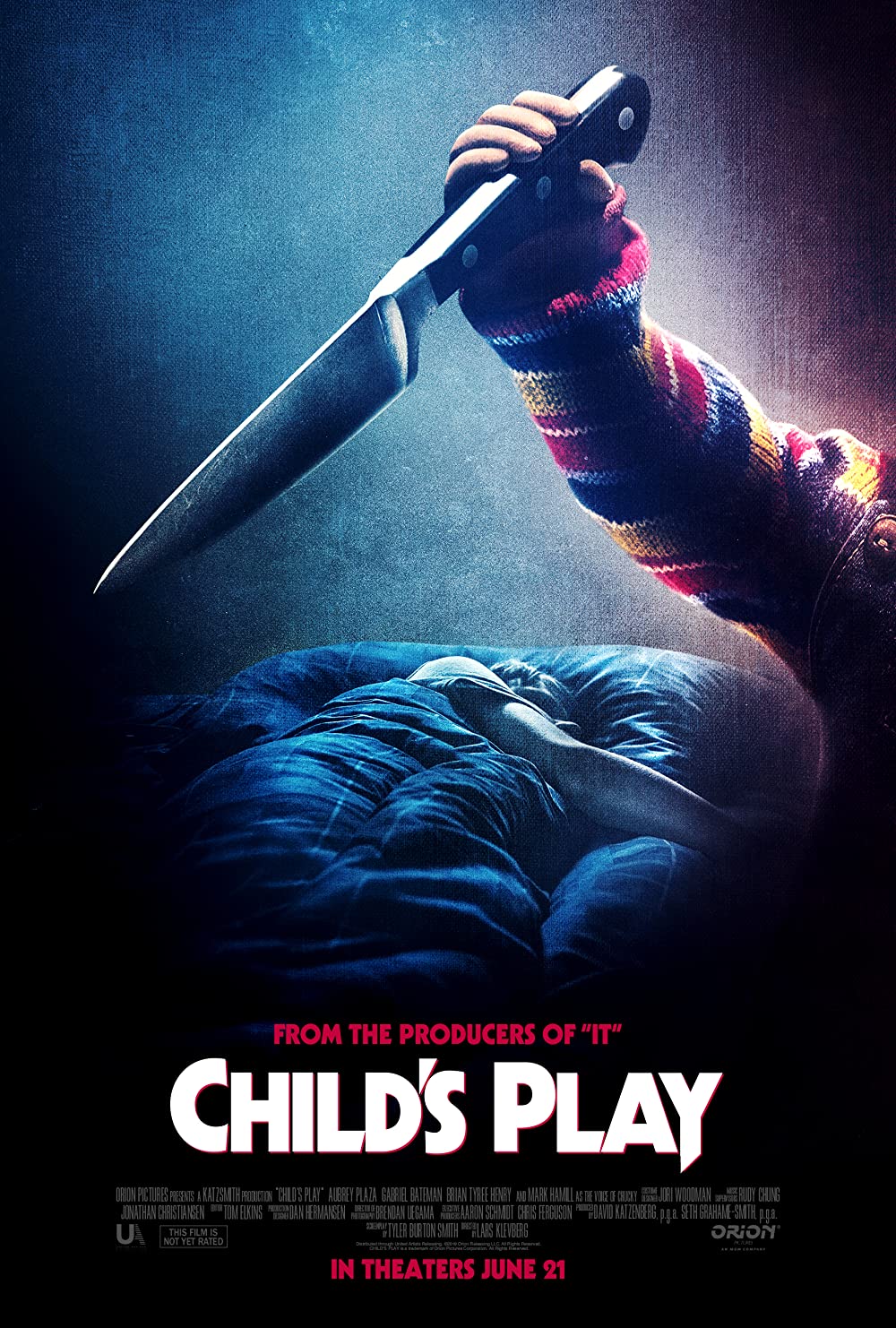
Child's Play (2019)
More of a reimaginging than a reboot, which is fine with me: if the original Child's Play is something of a response to the gross colonization of kids' imaginations by commercial advertising, then this is a pretty canny update of that concept for the fresh hell of surveillance and data collection that capitalism has brought to the act of play. It's also just a lot of silly, mean fun and does a great job of evoking the spirit of a Chucky movie (at least, the original three) without being overly familiar. Grade: B


Behind the Mask: The Rise of Leslie Vernon (2006)
As long as this stays true to its stated premise (a mockumentary about the killer in a slasher film), this is a great time. The mockumentary scenes show the killer, with the goofy enthusiasm of Michael Scott giving a tour of the Scranton branch, walking the documentary crew through his plan to manufacture the tropes of the slasher genre in his own prospective killing spree, and while by 2006, this was hardly ground-breaking commentary, it's fun and funny and charming to no end. Unfortunately, when the movie flips over to the actual movie that results from this plan, it turns out that following slasher tropes to a T doesn't result in a slasher that's notable in any way, and when the movie finally ends its mockumentary conceit entirely to permanently reside in the slasher mode (albeit in a transition that is pretty clever), Behind the Mask grinds to a halt. The good news is that this is a fairly small fraction of the movie, and the rest is so enjoyable that I'm willing to forgive the deflating ending. But still, it's too bad it has to end on its least-engaging note. Grade: B

The Call of Cthulhu (2005)
Pretty fun Lovecraft adaptation. The whole thing is a silent-film pastiche, and it does a better job evoking the feel of an old silent film than a lot of these silent-revival movies do, which is impressive given that this was basically a fan film by enthusiasts in the H. P. Lovecraft Historical Society. Also, the decision to make it a silent film is a good workaround to the obvious problems in adapting Lovecraft's cosmic horror for the screen, as the knowingly silly embrace of limitations actually makes it feel more otherworldly when Cthulhu finally shows up than it might have been otherwise (stop-motion Cthulhu is very cool, too). It's not perfect, and a lot of this feels a little too smooth—both in terms of the framerate as well as the costuming/props—to be completely credible as an expressionist film from the 1920s. But still, this is a lot better than it has any right to be. Grade: B


Shinbone Alley (1970)
It's not a good movie: it's haphazardly paced, its "spurned male lover" ethos is mean and dull, and the songs are terrible. That said, Shinbone Alley is an interesting historical document, not just for that way the its scratchy animation style so fully embodies the aesthetic preoccupations of what is probably the ugliest (not always in a bad way) era of American animation but also for the way it fits into the whole mini-trend of edgy animated animal movies. For example, this movie comes out a couple years before Fritz the Cat, but it's got some of the same bizarre predilections, i.e. the whole "animals, but make them hip and horny urbanites" thing. I mean, even Disney got in on this; 1970 is the same year that saw the release of The Aristocats, which, with its jazz cats and lecherous Thomas O'Malley and alcoholic geese, is definitely an iteration of the trend (albeit cleaned up for the Disney crowd), and while 1973's Robin Hood isn't quite the same, it's still got animals acting like people and being weirdly sexual at times. What was going on in the 1970s with animals and animators? Grade: C

Mildred Pierce (1945)
An incredibly bleak film about the world's abject refusal to allow the titular character to experience prolonged happiness. For as despairing as it ultimately is, the plot is a lot of fun (one turn near the end made me gasp so audibly that my wife called from the next room to check if I was okay), and Joan Crawford's performance is an all-timer—if the latent noir aesthetic were ratcheted up just a few clicks, the movie might be an all-timer, too. Grade: A-

Sunday, November 27, 2022

Mini Reviews for November 21 - 27, 2022

Yes I was without internet for part of this week and had to watch random movies I had on my laptop—why do you ask?

Movies

Bones and All (2022)
It's a lot of things, maybe too many things: a YA romance, a road-trip movie, a cannibal movie, a Badlands / Bonnie and Clyde "one step ahead of our past catching up with us" sort of thing, an '80s nostalgia movie (if what you're nostalgic for in the '80s is heartland rock, wood paneling, and everything smelling like cigarettes), a philosophical inquiry into the most ethical way to eat people if you are biologically compelled to do so, maybe a queer metaphor, maybe an addiction metaphor. I'm not sure if the extremely bummer ending satisfyingly ties up any of these threads or modes, but like a lot of road trips, the interesting part is how you get there, and this movie is certainly a journey: parts of it deeply unsettling with unexpected moments of terror, other parts evoking a profound loneliness, others a deep well of pathos. Whether or not this completely holds together thematically, it's able to make all of these disparate threads feel like a cohesive whole through a confident stylistic hand as well as some terrific performances (the entire principal cast is great). There's a strong emotional throughline, if nothing else, and some of these scenes are going to stay with me for a while. Grade: B+

Rosaline (2022)
A worst of both worlds situation: neither the Rosencrantz and Guildenstern Are Dead by way of Romeo and Juliet that I was hoping for, nor the sugary-sweet rom-com-revival fun that this movie thinks it is. It has the feeling of being written by someone who hasn't touched Romeo and Juliet since they read the SparkNotes summary in 9th grade English class; Tromeo and Juliet has a better literacy of the Shakespeare play than this one does, which is theoretically fine: so what if Paris is now Rosaline's gay best friend and that famous lines are misappropriated by characters in nonsensical contexts? If you're not trying to be deconstructive, there's no point in actually caring about your film's relationship to its source material. But you gotta give us something in the source material's place, and the watery gruel that we receive is a bunch of warmed-over rom-com clichés employed with a flimsy gloss of girl-power and sarcasm, not to mention a completely empty love interest. As uninterested in Romeo and Juliet as this movie is, it seems even less interested in the elements it's added, and I'm not sure why we're supposed to care about anything going on in Rosaline's life. Kaitlyn Dever is pretty good here, at least—a performance in search of a movie that has any idea at all how to use it. Grade: C-

Joshua and the Promised Land (2004)
It's basically unwatchable, but it's also fascinating because it so clearly is a product of evangelical Christianity while also being a work of outsider art, something you can't say about a lot of more visible evangelical media, which usually comes from a fairly large industry with established tropes and modes of discourse, almost none of which this movie even bothers with. For example, it's not uncommon for evangelical media to use the post-parting-the-Red-Sea stories of Moses and Joshua to justify genocide, but there's usually some tact or rhetorical sleight of hand that makes it seem like it's not justifying genocide. Like, Focus on the Family media has definitely said genocide is okay, but you usually have to analyze it a little to understand that that's what it's doing. This movie doesn't have the guile for that kind of decorum and literally just states outright that it's okay to exterminate a people group if God tells you to, and it does so by using some of the most amateur CG animation I've ever seen as well as some of the most head-scratching decisions in character modeling (if they're supposed to be lions, where are their tails??), which is kind of an out-of-body experience. There's such an incredible purity of vision here, a vile, cancerous, eye-melting vision. I'd love to hear what Phil Vischer thinks about this. Grade: C

Song of the Miraculous Hind (Ének a csodaszarvasról) (2002)
I know so little of Hungarian history and folklore that this film's plot (a telling of ancient Hungarian "history" as seen through its mythology) quickly lost me. Basically the only parts I understood were the pieces that had widespread mythological tropes like the "cosmic hunt" that makes up one early section of the movie. So I would probably have a drastically different reaction to this movie if I were Hungarian or even just knew anything at all about Hungarian history—I dunno, I would definitely have some strong opinions about a movie that tried to dramatize the national mythology of the United States, so this seems like the kind of movie that is fraught with political implications that I have no access to. But from where I sit, it doesn't matter that I couldn't follow the plot, because the film is directed by Marcell Jankovics, which means that it has dazzling animation. It's a lot more stylistically experimental than his masterpiece, Son of the White Mare, which makes sense given this movie's episodic format, and not everything is a home-run here; in fact, there are sections with animation that is surprisingly prosaic for Jankovics. However, other pieces of animation here are incredible in ways that aren't exactly superior to White Mare but also are far more intricate and complex than anything that the other movie attempts, sequences that are overtly psychedelic or even strobe-like, playing around with kaleidoscopic color variations and unstable character forms in a way that is as mesmerizing as it is bewildering. The early sequence with the cosmic hunt is pretty great in this regard, as is the final sequence of the film when Jesus Christ appears to a medieval king. There's something about this kind of stylistic kitchen-sink that, when it works, approaches the sublime when paired with mythological storytelling that I don't understand. Again, I'm sure I would have a much different reaction if I actually did understand the mythology. Grade: B+

Rock and Rule (1983)
The kind of movie that is probably best reviewed by listing out its component parts and just basking in the miracle of the existence of something this bizarre: a nuclear war has destroyed the human race and in the human's place grow a society of animals mutated into character designs I can only describe as "edgy Goof Troop," among whom is the rock star Mok, who needs to find the magical voice that can release a demon who will help him rule the world and gain immortality. This story is told as a rock musical with a plot that doesn't make a lot of sense and with compositions and performances from Lou Reed, Debbie Harry, Iggy Pop, Earth, Wind & Fire, and assorted configurations of Cheap Trick, and it's visual style has a blending of the kind of squishy character animation you might see on children's programming with a less-abrasive form of Ralph Baskshi's urban mixed-media approach for the backgrounds, plus another technique I can't quite identify for Mok's demon that reminds me of Yuri Norstein in its earthy textures. Everything in this movie has these smirking comic-book naming conventions, e.g. Mok Swagger, Carnage-y Hall, Nuke York, etc. A real stew, this movie. A complete meal. Grade: B

The Heartbreak Kid (1972)
This is an amazing story about a man's sociopathic drive to destroy his marriage on his honeymoon, and as a depiction of monstrous self-destruction, it's about as hilarious as something like that can get (which is: very). Truly one of the great evocations of masculinity at its most pathetic and loathsome. But also... also... the incredible coup that this movie pulls is that by casting Cybill Shepherd as the object of this man's desire, there's a part of me, not a significant part but a part nonetheless, that watches her in this movie and thinks, "You know, I get it." Audience-implication sometimes feels like a cheap shot, but this one totally got me. Grade: A

Sunday, November 20, 2022

Mini Reviews for November 14 - 20, 2022

This week I was on the Cinematary podcast talking about the 1931 Ernst Lubitch film The Smiling Lieutenant. Here's the link if you're interested!


Movies

Barbarian (2022)
It spends a good portion of its first half pretending to be a much more serious movie than it is (the movie it pretends to be: a slow-burn thriller about two strangers accidentally booked at the same Airbnb), but after a particular point, it drops the mask so quickly that the abruptness in and of itself is hugely entertaining. It does this a couple more times, and by the end, Barbarian is thoroughly goofy, albeit of the grimy, ugly sort that characterizes the work of, say, Wes Craven. This isn't anywhere near as clever as a Craven movie, but that veneer of seriousness barely containing a mean-spirited glee at others' misfortunes definitely feels like it's in the same wheelhouse. I found this thoroughly entertaining, though by the end, as it's become clear that the film is kind of a one-trick pony in terms of how it doles out its reveals, there are diminishing returns to what it's attempting on a thematic level (some muddled ideas about gender and motherhood and morality). But it's a masterclass in executing that one trick, and I had a great time hootin' and hollerin' at the screen with my wife as we watched this. Grade: B+

The Banshees of Inisherin (2022)
Really, shockingly good. I don't hate Martin McDonagh, but it's been a while since he's done anything I particularly cared for, and this far surpasses the distant, pleasant memories I have of In Bruges. Moreover, this is the first McDonagh screenplay (I've never seen one of his stage plays) that doesn't feel like it's bending over backward trying to prove something with its cleverness; the screenplay here simply is clever in this understated yet confident way that bowled me over. If I'm not mistaken, there's some Irish political history metaphor going on with the plot that I am unequipped to unpack, but that's okay, because it's also just a very human story of pain and loss as two former friends drift apart. Whatever the allegory that's happening here, McDonagh does the very graceful and very difficult task of also making it not feel like an allegory, and the entire thing works just as well (perhaps better) if you assume that Colin Ferrell and Brendan Gleeson's characters are real, psychologically complex human beings instead of simply being analogs for the sides of the Irish Civil War or whatever is supposed to be going on there. Career-best work from Ferrell, too. He takes his "affable goofball with hidden complexity" thing and imbues it with a deep well of sadness and vulnerability that ends up pervading the entire film. I can imagine having a good, cathartic cry over this movie if it caught me in the right mood, and I mean that as a compliment. Grade: A-

My Father's Dragon (2022)
The first half of this movie, which is split pretty evenly between the social-realist(ish) beginning involving the struggle of a mother and her son to make it in a new city and the wildly inventive fantasy of the boy's flight from the city to a magic island, is terrific, utilizing a dream logic undergirded by a strong emotional core in a way reminiscent of the Where the Wild Things Are movie. The back half of the movie unfortunately falls apart as it fails to maintain the emotional clarity through the dream logic, and the climax hinges on an emotional epiphany that is almost completely unearned. Narratively, it's the weakest of the Cartoon Saloon features, and it's not even close. Visually, however, this is as stunning as any of the studio's other work, maintaining the rich texturedness of Wolfwalkers as well as the luminous use of color present throughout the studio's work. In the face of that, it's hard to feel grumpy about the film. Grade: B


Cult of Chucky (2017)
My least-favorite, I think, of the "...of Chucky" stage of this franchise, but Mancini continues to have a tight grasp of fundamental horror mechanics as well as the specific idioms that make his Chucky movies special—at this point, watching these characters and tropes return is something akin to watching a soap, and it's great fun just to see, for example, Jennifer Tilly show up again in some new, ridiculous role. Some great practical gore effects here, too. The psychiatric hospital setting isn't nearly as evocative or well-deployed as the old mansion in Curse, and the film relies just a little too much on movie-crazy-people-isms in fleshing out the secondary cast, and as a whole, the movie lacks the verve or the mad-scientist coherence that animates the best in the series. But I guess in the short span of time I've been watching the series, I've become a lifer with these movies, because I still had a good time and can't wait to hop into the TV series. A cult indeed. Grade: B


Dangerous Liaisons (1988)
If I wasn't already familiar with the source material, it would be unbelievable that a movie this smutty and this mean came out of the stuffy '80s costume drama world. The closest thing I can think of to this is The Favourite, which of course arrived from a much different milieu in cinema. But here's this movie, a brutally spiteful satire of 18th-century ruling class with only a few of the edges sanded off from the French novel on which it is based (I'm unfamiliar with Christopher Hampton's 1985 play that is the more direct source for this movie). This is probably the best I've ever seen Glenn Close and John Malkovich, two actors I'm not overly fond of, and the way they slowly reveal the utter despair that they cloak in the abject evil of their actions is kind of masterful. The film's pacing gets a little dicey by the end as the plot turns from being outrageous to being just bleak, and as with basically every other version of the story, I'm not sure how to feel about its treatment of sexual assault. But on the whole, this is pretty good. I want to live in the alternative universe in which all Masterpiece Theatre-ish productions are this cruel and sick. Grade: B+