Monday, June 15, 2015

Revisiting Narna: The Last Battle

Hi, everybody! This summer, I'm rereading C. S. Lewis's Chronicles of Narnia and blogging about each book. For more details on the project, you can read the introductory post here.

You can read the post on The Lion, the Witch and the Wardrobe here.

You can read the post on Prince Caspian here.

You can read the post on The Voyage of the Dawn Treader here.

You can read the post on The Silver Chair here. 

You can read the post on The Horse and His Boy here. 

You can read the post on The Magician's Nephew here.
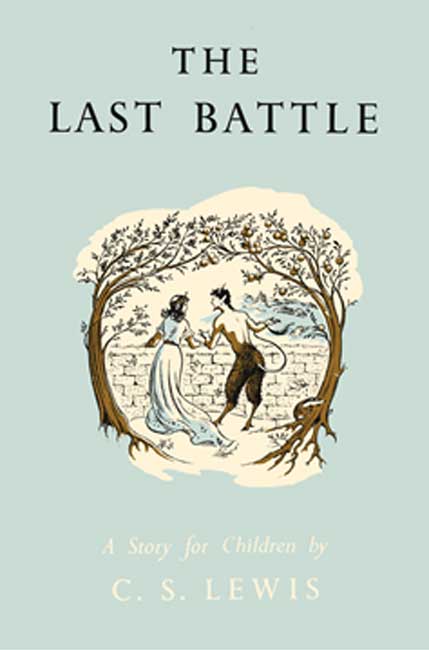


How in the world do you end a long-running fantasy series? If you're J. K. Rowling, you rely on epic confrontations and grand-unification theories; if you're J. R. R. Tolkien[1], you rely on epic confrontations and an extended denouement; if you're Lloyd Alexander, you basically do the Tolkien thing with about 5% of the denouement; if you're George R. R. Martin, you just wait for the sweet sleep of death to free you of the burden of even finishing your series. And if you're C. S. Lewis, you just bring on the end the friggin' world.

Let's be fair here. At the time C. S. Lewis was writing The Last Battle, the seventh and final entry in his Chronicles of Narnia series, there were very few precedents for such a thing, given that fantasy novels of the kind Lewis was writing (youthful heroes, British values, more-or-less cohesive world-building) were not nearly so common then as they are now, and those books that did exist tended to be either standalone novels or never-ending serials, neither of which have to deal with the hassles of multi-book conclusions. We have to remember that in 1956, when The Last Battle hit bookshelves, J. K. Rowling was still eight years away from even being conceived, and the final volume of The Lord of the Rings had only just been released a year earlier (and to only modest success at that), meaning that the world was still about a decade away from the modern conception of a "fantasy series" as heralded by the explosion of fantasy literature influenced by LotR's mid-to-late-'60s boom in popularity. Lewis was pretty much flying blind.

But all that's just history. What about now, in 2015? Is The Last Battle a fitting conclusion for The Chronicles of Narnia? Well, despite the book's initially positive reception (it won the Carnegie Medal, after all), the popular consensus among modern readers is that no, it is not. This book has had a precipitous fall from grace, thanks not only to high-profile voices like Philip Pullman and Neil Gaiman criticizing it but also a generation of readers more attuned to modern fantasy conventions and less to Lewis's never-more-blatant parallels to Christian theology. As for myself, my answer is a bit more complicated than a simple yes/no, though I will say upfront that I do not think Lewis ended on the series's strongest note. In fact, for reasons I'll hopefully explain in more detail as this post continues, I'd call The Last Battle the second-weakest Narnia book, ahead of only Prince Caspian. But even beyond issues of good and bad, one thing I know for sure after reading The Last Battle again for the first time in over a decade is that this book is a weird, weird end for the Narnia books.

Here's the plot in a nutshell: Hundreds of years after the events of The Silver Chair (in Narnian years, at least), an ape named Shift and a donkey named Puzzle find a lion skin out in the Western Waste of Narnia. Shift hatches a plan to dress up Puzzle in the lion's skin and convince other Narnians that he's Aslan, and Puzzle, being kind of a pushover and easily confused, reluctantly goes along with the scheme. Soon, Shift has succeeded in convincing quite a few Narnians that he is Aslan's first in command, and with this newfound power (under what is ostensibly Aslan's orders), he allies himself with the Calormenes and allows Calormene mercenaries into Narnia to chop down the land's trees, enslave the land's animals, and do all sorts of dreadful things. This attracts the attention of Narnia's king, Tirian (who is something like Caspian's great-great-great-great-great grandson), and, enraged, he kills several Calormenes, which gets him captured. Tirian sees that the ape has bullied many of the Narnians into submission to "Aslan's" orders—the Narnians long to see Aslan (who has been long-absent from the land), but they are confused by the brutality of his apparent orders. Tirian is powerless to aide these creatures, and in despair, he calls out to Aslan and the strange children who he has heard have helped Narnia in the past. His cry is answered a moment later when Eustace Scrubb and Jill Pole appear out of nowhere and free him of his bonds. With the help of Scrubb and Pole, Tirian plans to retake Narnia from the Calormenes and Shift; however, things start to look pretty bleak when Shift and the Calormenes start trying to tell the Narnians that Aslan and the demonic Calormene god Tash are, in fact, one and the same god, a declaration which causes Tash himself to appear and take up residence in the stable. Shift begins throwing rebels into the stable for Tash to devour, and this continues until Tirian, Scrubb, and Pole arrive and unite the Narnians against the Calormenes. A huge battle ensues in front of the stable, during which Shift and several others are eaten by Tash. Eventually, though, the Narnians are overwhelmed by Calormene reinforcements and forced into the stable themselves. However, once inside, they find themselves not in a stable but in a sunny field along with the Pevensie children (sans Susan[2]) from the earlier Narnia books and Digory and Polly (now quite elderly) from The Magician's Nephew. Then Aslan appears and, looking out at the nighttime outside the stable, makes all the stars fall out of the sky and puts the sun out and basically ends the world. As it turns out, the field that our heroes find themselves in is heaven (the English characters apparently died in a train crash in their own world), and once they run around for a while, they find pretty much every good character from the other books just chilling in a garden. And that's the end of The Chronicles of Narnia.

That's great, it starts with an earthquake, birds and snakes and airplanes...

I'm in no place to evaluate how shocking the end of this book is, given that I read it first when I was around six years old and had read so few books that I had little conception of what was standard and nonstandard in stories (thus surprises didn't phase me much), but I imagine that any adult reading that plot synopsis might have to do a double take on those last three sentences. Yes, The Chronicles of Narnia end with Narnia itself being plunged into an eternal, cold nothingness, and all of Aslan's friends dead and living happily ever after in heaven. I suppose it's a reasonable assumption that Lewis would follow his Christian parallels in Narnia to their logical conclusion by having the characters eventually make it to the afterlife, but did anyone actually think Lewis would go full-on Revelation with this last book? I don't know for sure, but in hindsight, it seems like a mighty strange, mighty bold move to make.

But "strange" does not necessarily equal "bad"; The Voyage of the Dawn Treader is a very strange book, and it's nowhere close to being a bad one. I'm not even saying that "strange" equals "bad" in this particular instance. So my head-shaking at that ending doesn't get us any closer to answering my original question of whether this book works or not as an ending. What my head-shaking is, though, is an admission that this book is devilishly hard to talk about in any cohesive way, and a big part of that has to do with how Lewis seems to kind of punt in the book's last sixty pages. So maybe it would be easier to begin by answering the much smaller question of whether or not this book is any good on its own, regardless of how it works as a series finale. To break that question into even smaller chunks, I'm going to divide that evaluation into a few sub-topics that have cropped up a lot in the posts for the other books and deal with each of those one at a time. So hang with me; like The Last Battle itself, this post is going to be a strange, disjointed ride.

Plot
Alright, so here's the first sub-topic: plot. Does The Last Battle work on a purely story level? The short answer: yes, until it doesn't. I've made no secret of the fact that I think the plots are often the least compelling, least functional part of the Narnia books. Of all seven books, the only ones I would say contain good plots are The Magician's Nephew and The Silver Chair (and maybe, if you press me, The Horse and His Boy); the rest of the books tend to favor image and anecdote over consistent storytelling. Actually, for a while, The Last Battle does a much better job of plot than most of its brothers, and that's partially to do with the fact that it jettisons most of Lewis's trademark meandering wonder in favor of a relatively mean, lean, propulsive story. The threat of Shift and the Calormenes taking over Narnia by means of a false Aslan is far and away the most dramatically urgent story the entire series tells, and for a good chunk of its pages, The Last Battle is a page-turner like no other Narnia book can claim to be, filled with action and intrigue, suspense and disguises. It's genuinely tense when Tirian is captured, and it's genuinely exciting when Tirian and Pole and Scrubb sneak around Narnia forming their retaliation against the Calormenes. The Last Battle gets closer to being a thriller than any other book in the series.

It helps that The Last Battle also tells the darkest story of all the Narnia books; we've see Narnia under siege before, but it's never been under attack from both within (Shift) and without (Calormen), and that's not even mentioning the violence—seriously, there is so much killing in The Last Battle, both by the enemies (the death of a Dryad early on in the book is particularly chilling) and our heroes (so many dead Calormenes...). I tend to think that this violence is a necessary device for the kind of bleak story Lewis is telling, but it's startling nonetheless—all the more so becuase Lewis is savvy enough to know that whimsy or humor[3] would disrupt the thick dread and elegiac tone that hangs over the novel. With a few exceptions like Digory's mother, the Narnia books tend to be fleet-of-foot in tone and storytelling, but Lewis shows here that he knows how to get heavy when the story calls for it. The first few words, "In the last days of Narnia," open the book with a haunting note of finality and apprehension; the same goes for Tirian, whom the book introduces simply as "the last of the kings of Narnia." This is the end.

And yet, as much as those words seem to be an attempt to prepare us for the novel's apocalyptic climax, they just don't. On a storytelling level, Aslan has always been a problematic device, too often lending himself as a tidy machine to save the day or motivate characters in otherwise unnatural ways, and his appearance at the end of The Last Battle is far and away the most egregious of these instances. Look, I know that a large part of the plot (and the righteous-anger-fueled momentum) hinges on their being a false Aslan, so it makes sense that the real Aslan is going to have to show up in the flesh sooner or later. But the way he shows up makes absolutely no sense on a plot level. Once he appears, he does nothing to directly confront the false Aslan or the battle with the Calormenes or Narnia's political trouble or any of the other issues that have fueled the book's plot engine up to that point; he simply calls for the end of the world, and that's the end of that. It's dramatically unsatisfying because it doesn't resolve the ongoing conflicts; it merely changes the rules. In a sense, it doesn't matter that the world ends, because the prospect of the world ending was not a dramatic question we were invested in for the first three quarters of the novel. As a result, the book's final sixty-ish pages are actually kind of boring. I don't care that our characters can swim up waterfalls or run without stopping in heaven; I wanted a conclusion that somehow connected to the plot of the novel's first one hundred and sixty pages.

Characters
Alright, next topic. Historically, Narnia books have fared a little better with characters than with plot, and there are gleaming examples throughout the series of wonderful gems of characters—Eustace, Uncle Andrew, Edmund, Lucy, Jill, Aravis, etc. But even then, most of the books have struggled to keep interesting character development at the forefront; Edmund's arc in LWW ends well before the book's conclusion, to name one example. I'm afraid that The Last Battle doesn't do much better with characters than the rest of the series, although there are the usual exceptions throughout. On the whole, the problem is that the characters here—at least, the ones we spend the most time with—are just kind of boring. Not really boring (the Peter and Susan still hold the record there), but just boring enough that you never really care for them all that much. Eustace and Jill are back at the center of this novel, which would be a good sign except that they have become, like most people who are on their second trip to Narnia, a little bit too agreeable. The great thing about their relationship in The Silver Chair is the thorniness that surrounds their friendly affection for one another; unfortunately, in The Last Battle, most of their bickering has gone the way of Edmund's petulance: barely there.

King Tirian, looking elegiac as ever

King Tirian, the book's de-facto protagonist (we spend more time with him than anyone else), is slightly better, although he's his own kind of blandness—a sort of mashup of nobility, honor, and self-seriousness that isn't all that interesting either. What makes him better, though, is that there are moments of much more complex character work: by and large, he's the emotional core of all the "This is the end" doom and gloom, and his laments about the downfall of Narnia under his rule have a deep, almost classical-tragedy pathos to them. He also has some moments (though these are few and far between) where he tries to wrestle with some rough theological questions as a result of the false Aslan. The "he's not a tame lion" line from LWW becomes a kind of mantra in this book, and at times, Tirian comes to grips with the terror of that phrase: Aslan is capable of anything, so what if he decides to be cruel and turn his back on Narnia? However, these moments largely fade away once Jill and Eustace show up, and in the end, they don't have much long-term weight.

That's a big problem, actually; you'd think that in a plot that involves a doppelganger for someone as central to Narnian identity as Aslan, you'd have tons of interesting, unique dramatic conflicts between characters pop up as a result of their own feelings toward the lion (and as I said, such moments exist in the novel), but by the end, all the characters fall into two basic camps: those who are for Narnia and those who are against it, and that takes away a lot of the dramatic possibility and interesting character development that could have come out of an idea as volatile as a false Aslan. That's a big part of why our protagonists are so boring: instead of having interesting, personal desires, they are all animated by the same "let's save Narnia" motive, which doesn't provide many dramatic fireworks.

But even with the kind of boring duality that the book eventually settles into, we still get a few interesting character moments. I've already named a few involving Tirian, but I also want to call attention to the story's villain, Shift, who ranks among the best of the Narnian villains. With this ape, Lewis seems to have split the difference between the insecure bullies of previous books (think Edmund, Eustace, Uncle Andrew) and the cruel sadism of the White Witch, and the result is one diabolical, pathetic dude. He's the kind of guy you just love to hate; whenever he opens his mouth, he's guaranteed to say something interesting. In general, though, The Last Battle struggles with the same inconsistencies of character that the rest of the books do.

Fantasy
This is probably the biggest disappointment in The Last Battle. Throughout the Narnia books, one thing you can reliably count on to brighten up the novel is C. S. Lewis's vivid imagination for fantasy. More than anything else (including, arguably, his passion for Christian theology), Lewis seems to have envisioned the Narnia books as joyous excursions into the imagination. It doesn't matter that the books don't always have internal consistency or even compelling characters, provided that they indulge the pure aesthetics of fairy-tale storytelling—just look at my own favorite, Dawn Treader, which, except for Eustace's arc, has almost no meaningful character work or plot but is bursting at the seams with fantasy ideas.

However, The Last Battle is a Narnia book that seems to run a little dry on fantasy ideas. Some of this seems to be by design; with the focus on Shift's political machinations and on the heroes' undercover stealth, magic and vibrant fantasy imagery would have been a distraction. Also, with Aslan's long absence, a lack of magic seems appropriate; it's a lot easier to believe in fake magic (i.e. Puzzle in a lion skin) when the real magic is only a distant memory. "That sort of thing doesn't happen now," Tirian says at one point, and it's poignant and even compelling how right he seems to be. That's good. Still, the presence of more awe-inspiring things in the story is something I missed a lot when reading the book.

This is Tash. Oh yeah.

"But wait!" you might be thinking. "What about Tash? And the end of the world? Isn't that all pretty fantastic?" And yes, on one level, it is. Tash is a pretty cool, even scary creation (made even better by Pauline Baynes's amazing illustrations), and the end of the world lends itself to a few amazing fantasy images: the shower of stars, for example, or my favorite, when Father Time takes the sun and squeezes it out "as you would squeeze an orange." That's all neat. But on the other hand—well, this will be easier to explain in the next section. So without further ado...

Themes
Oh boy, does The Last Battle have some themes. And unlike most of the other books in the series, Lewis doesn't come at his themes obliquely here. Nope, there's a message, and he's going to make sure you get it. Narnia's connections to Lewis's Christianity have never been all that subtle—e.g. Aslan appears as a lamb at the end of Dawn Treader—but nowhere else in the series is Lewis's Christianity so strongly and unambiguously presented as in The Last Battle. A sample line: "In our world too, a stable once had something inside that was bigger than our whole world." Yeah, we're barely in the realm of allegory anymore. This is a book about C. S. Lewis's unabashed conservatism and the solution to everything he, through that conservatism, sees as wrong with the world.

Now, by conservatism, I don't mean to evoke any kind of specifically political or religious meaning. I'm not necessarily saying that Lewis would have voted Republican (or I guess the Conservative Party—isn't that the UK equivalent? Help me, readers; I'm so ignorant) or that he was a biblical literalist or anything like that. I'm talking about the general definition of the word, where "conservatism" means that you are more of a traditionalist who tends to view change with suspicion. And Lewis was most definitely that kind of conservative. That's not necessarily a bad thing to reflect in a book. All of the Narnia books (in fact, most traditional, happy-ending stories) are this kind of conservative: a status quo is disrupted by event or person that takes away an older (better) way of life, and it is the goal of the hero to defeat that changing element and return the land to that older, happier time. The White Witch must be killed so Narnians can live like they used to; the Telmarines must be overthrown so that Old Narnia can return to power; the seven Telmarine lords must return to their old posts in Narnia; Digory's mother must recover from her illness so their family can return to their old life in the country.

That conservative spirit is all over The Last Battle. In Lewis's world, that conservative fear that the world will get worse as time goes by has become a reality: Calormen takes over Narnia, fake Aslans confuse the animals, forests are destroyed. This progress toward oblivion is something that takes a toll on King Tirian. He is constantly longing for how things used to be in Narnia, lamenting his position as the last king, thinking of the "old days" when Caspian or Rilian reigned. And as I said earlier, that's a pretty compelling character dilemma, and it makes for some good, poignant moments. Tirian's character is a graceful integration of that theme, the fear that the world is falling apart.

However, elsewhere in the novel, the theme is not so gracefully integrated. With ideas like the stable and "Tashlan" (the pluralistic amalgam of Tash and Aslan that Shift eventually starts preaching to the Narnians) and the faithless dwarfs[4], it becomes all too obvious that there is a one-to-one correlation between the things we see in Narnia and the things Lewis sees in his own world outside his window, and that's where the novel starts to run aground on its themes. Lewis always had a purpose in mind when writing Narnia, so I won't pretend like the other Narnia books are models of literary ambiguity or anything. Nevertheless, The Last Battle goes way beyond what the other books do, to the point where it sometimes seems to become more rhetoric than artistry. The craft of the novel begins to serve the message instead of that message flowing organically from the art. This is my issue with the fantasy that does appear in the book; it becomes just another way of reinforcing Lewis's ideas about the world, in a way that sucks a lot of the wonder from what has the potential to tap into the fairy tale aesthetics in the other books. Tash, a cool creation on his own, becomes a stand-in for paganism and later, religious pluralism, and that drains some of the vibrancy from his creation. This is the only Narnia book where all the magic feels more like a tool than something wild out of a child's vibrant mind. This is, to paraphrase that famous Aslan line, tame magic.

That's an even bigger problem with the novel's apocalyptic/afterlife ending, which causes the components of the novel's drama to break apart completely. When Aslan ends the world, he brings the novel to a screeching halt artistically. Up until the heroes enter the stable, a certain trajectory for the plot had been playing itself out, with the land of Narnia spinning into darker and darker chaos, sometimes to heavy-handed effect but also sometimes to compelling effect. But with the arrival of Aslan and the end of the world, the constituting parts of that plot are replaced by entirely new dramatic elements (i.e. the afterlife) in a way that neither complements the original artistic motions of the novel nor provides a compelling case for its own existence other than to serve as a theological punctuation to the rest of the story. This is conservative storytelling divorced from craft and continuity—a "return the the status quo" (the afterlife is basically a purer form of the old Narnia) from outside the story logic or even emotional logic, all for the sake of the thematic point that it will take divine intervention to rescue the "good" people from the doomed world on its rapid downward slope.

In the interest of honesty, I should probably note that in general, I am a fan of C. S. Lewis's theology; some of his ideas, including ones raised in this book, I take issue with[5], but on the whole, I tend to like what he has to say. At the very least, I am a Christian, which means that I share some of the same foundations as Lewis, if nothing else. So I am probably a much more receptive to Lewis's raw theology at the end of this book than others might be. I don't hate this ending; I just think it's clumsily placed. But that's the thing: I don't think a work of literature should live and die by how much you agree with the thematic aims of the author. For sure, you can disagree and even hate a work for what the author is trying to say; just ask me about Fight Club. But even within that agreement or disagreement or even hate there should be room for the appreciation of form, of language, of beauty, or else the work is vapid as a piece of art. I'm afraid that as The Last Battle enters its apocalypse, it verges on that vapidity.

I say "verges" because I don't think it quite gets there, and that's largely due to two things. First and foremost, I would be remiss if I didn't mention Lewis's prose and tone in the book's final chapters. He describes the new, afterlife Narnia with such joy and passion that I can't help but share in a little of the emotions. "Further up and further in" is a wonderfully evocative phrase, and it exemplifies well the ecstasy of those final pages and the burst of, if not creative energy[6], emotional energy at least. I may feel that the ending is disingenuous to the rest of the novel, but C. S. Lewis very sincerely does not, and he does about as good a job as can be expected (given the circumstances) of making that sincerity infectious.

Second, there's this phrase. It's a small one, and it's one that probably doesn't carry a lot of weight in the grand scheme of things. But after blogging through all seven of these books and writing so much about Lewis's ideas about fairy tales and storytelling, I couldn't help but find it meaningful—not cheap, coercive meaning like the apocalypse but actual meaning that seems to tie the entire series up beautifully. That phrase is this: in describing the new Narnia in relation to the old one, Lewis's narrator says that it's "deeper, more wonderful, more like places in a story: in a story you have never heard but very much want to know."

Aside from being another great example of the lovely prose often found in this afterlife section, this phrase does something much more interesting, thematically, than any of Lewis's blunt theological parallels in the rest of the book. With this phrase, Lewis makes a connection between stories and this afterlife land. A tension between life in fairy tales (i.e. Narnia) and life in the real world has run throughout the entire series. At the end of each book, the children must return home; the story must end. The real world is separate from the land of stories. Sometimes this separation is stark (as in Prince Caspian, where Peter and Susan learn that they will never return to Narnia) and sometimes it is porous (as in The Magician's Nephew, where Digory and Polly hop from story to story at will), but it is always poignantly true that real life and stories do not exist in the same spaces. What that phrase does is resolve that tension, dissolving the lines that divide life from stories. In the afterlife live not just people from Narnia but people from all different worlds, including the "real" world of England—off in the distance, Peter, Edmund, and Lucy can see their parents waving at them. For the first and only time in the series, the world of stories and the world of life are one and the same place. The two are reconciled. And that's actually pretty beautiful.

***

So there still remains that original question: is The Last Battle a good conclusion to The Chronicles of Narnia? The answer to that question is much too messy to be even a qualified yes; there are, without a doubt, some true missteps here, especially when you consider the connection to the series as a whole, and any Narnia book so short on fairy-tale wonder is bound to be a frustration for me on some level. But then again, there are parts that work well enough that make me hesitant to give a straight no either; it seems perversely appropriate for a series that focuses so much on Aslan to spend so much in its final entry with a villain who interrogates the very concept of Aslan, and for all my misgivings about the ending, that story connection is so lovely that it makes me want to forgive all the heavy-handedness. So my answer to that question lies somewhere in between. As I said before, this is an astonishingly weird book, and like many of Narnia's novels, its unconventional shape defies regular standards for evaluating literature.

Whatever the case, though, I have thoroughly enjoyed my return journey to Narnia over these past several weeks, and I hope you've enjoyed it, too. Thanks so very much to all of you who stuck out the whole ride; I've had way more reader involvement and feedback than I normally get from this blog, and that's been super fun and super encouraging. You guys are the best! I'd love to hear back from y'all one last time, too. I know The Last Battle tends to be a divisive book, and I've barely scratched the surface of some of the issues it raises. So feel free to comment, talk to me, etc.

Otherwise, until next time (when I'll tackle something completely different, I promise)!


1] Well, first of all, if you're Tolkien, you don't have a long-running series anyway, but your publisher makes you break up your monster-sized work into still pretty monster chunks.

2] Controversy Corner: Susan's fate is the second of the two controversies I named in my post on The Horse and His Boy (the first being the arguably racist depiction of the Calormenes, something that is even more a problem in this book than in Horse[7]). The argument is that Lewis is being sexist for keeping Susan out of Narnia/heaven, since the reason given for her absence is that she became "interested in nothing nowadays except nylons and lipstick and invitations," interests that have caused her to reject her belief in Narnia. This issue hinges on the words "nylons and lipstick," which some critics have taken to be Lewis's way of representing femininity or possibly sexuality in general, the idea being that Lewis is saying that interest in femininity and/or sex has made Susan an atheist and therefore not fit for heaven. I don't quite agree with that reading, though I certainly see where people are coming from. It seems inordinately harsh to give Susan such a bleak ending when pretty much every other non-villainous character in the books gets into heaven at the end of The Last Battle. I mean, geez, Jack. However, I do think that this controversy misunderstands the nature of Susan's transgression. It's true that Lewis uses a couple of traditionally feminine objects (nylons and lipstick) as shorthand for Susan's problem in that specific passage, and the associations are unfortunate (especially since Susan is the only major character who is interested in traditionally feminine objects). But I'd argue that that associate is largely accidental and that Lewis actually thinks Susan's sin is fixating on frivolous things like appearance and social standing at the expense of more important things like faith, wonder, and family. The distinction isn't, I think, between faith and femininity or faith and sex, but rather between the childlike capacity for curiosity/awe/honor and what Lewis would call the "silliness" of adulthood—i.e. a lifestyle defined by superficiality and faux maturity. In that same passage in The Last Battle, Polly says of Susan that "her whole idea is to race to the silliest time of one's life as quick as she can and then stop there as long as she can," which, to me, harkens way back to Lewis's dedication in The Lion, the Witch and the Wardrobe, where he talks about being temporarily too old for fairy tales. It seems that Lewis believes that at a certain age, there is a temptation to consider adult thoughts and childlike thoughts mutually exclusive, and that Lewis finds this idea particularly troublesome, especially when your version of "adulthood" is one that prioritizes how you look and how many parties you get invited to. This is a belief of Lewis's that crops up throughout the Narnia series, and it's not always gender coded like it is with Susan. Besides Lewis's dedication to Lucy Barfield, the other most prominent character who personifies it is Uncle Andrew, who, in a particularly telling passage, dresses up in front of a mirror preparing for an afternoon out on the town with Jadis. Lewis writes that "children have one kind of silliness, as you know, and grown-ups have another kind. At this moment, Uncle Andrew was beginning to be silly in a very grown-up way." Lewis isn't saying that it's silly or wrong for Uncle Andrew to have romantic or social desires, just that his application of those desires in this particular circumstance (she's a freakin' witch!) and prioritization of them over the more pressing matters at hand is not great. It seems to me that it's much the same thing with Susan—you don't want to get too hung up on word studies in Narnia (Lewis's style never seems considered enough to justify that sort of close reading), but the use of the word "silly" in both cases seems like a pretty strong link. Of course, it helps that Uncle Andrew is a fantastic character with a rich, conflicted inner life; Susan, on the other hand, has always, always been a bore, even among the generally boring Pevensies. That, in my estimation, is the real "problem of Susan": she's just a crappy character throughout the series, and that makes her eventual absence from heaven seem kind of careless and lazy. It's not sexist; it's just bad writing.

3] This is probably the only Narnia book without a single wry aside or funny line, although I did get a chuckle out of Shift's incredulous response when Puzzle says that he thinks everything's alright in Narnia at the book's beginning: "Everything right?—when there are no oranges or bananas?"

4] I won't list them all out, but the most central one I disagree with in The Last Battle is the idea that the world will get worse and worse until the only solution is for God—erm, Aslan—to end it. If you're interested in talking theology, you can email me or we can chat in person; otherwise, I'm not going to bog this post down in eschatology.

5] Who, when it comes to Lewis's theology, are a pretty interesting case. Just in case you've forgotten, the dwarfs in Narnia decide to stop believing in pretty much all things supernatural ("the dwarfs are for the dwarfs") once they find out that Shift's Aslan is a hoax. I find two things really fascinating about this. First, that it's misappropriated religion that turns them into modern secularists, not any of the old Christian bogeymen like science, reason, or secular education. Second, that these unbelieving dwarfs still make it into heaven. Lewis seems to posit that lost belief is only foolish, not damning.

6] I think the afterlife "superpowers" are pretty lame. Swimming up waterfalls, running without stopping—those would be pretty cool to do, but they don't exactly capture the freedom and beautiful otherworldliness that I imagine Lewis is going for with these actions.

7] For example, we get the only real racial epithet in the series, with the dwarfs calling the Calormenes "darkies" a couple times. Granted, the dwarfs aren't exactly good guys in the book, so it's possible that Lewis meant the word to characterize just how nasty the dwarfs really are. Still, it's a little surprising when it happens. That said, The Last Battle also contains several redeeming factors for Lewis's depiction of the Calormenes. The most prominent grace note is the character of Emeth, a Calormene who makes it into heaven because Aslan basically counts his righteous worship of Tash as worship of Aslan himself. For certain brands of Christians, this is very troubling theologically (enough so that it maybe counts as a third controversy, although it's so localized to these Christian groups that I don't know if it's worthy of its own category), but on the level of basic representation, it's nice to see Lewis extend the afterlife to this otherwise marginalized group, even if it's only one pretty minor character. A second note to consider is a small one, but important: when everyone is in the afterlife Narnia, the narrator describes the landscape of the country and mentions that way off in the distance lies Tashbaan, the Calormene capital. This is significant because it means that Calormen still exists in the afterlife—this nation was not totally irredeemable. Again, it's a minor detail in a series otherwise scornful of Calormen, but it's still good to see Lewis end the series on a note of grace rather than condemnation.

Tuesday, June 9, 2015

Revisiting Narnia: The Magician's Nephew (or, Adventures in Grief)

Hi, everybody! This summer, I'm rereading C. S. Lewis's Chronicles of Narnia and blogging about each book. For more details on the project, you can read the introductory post here.

You can read the post on The Lion, the Witch and the Wardrobe here.

You can read the post on Prince Caspian here.

You can read the post on The Voyage of the Dawn Treader here.

You can read the post on The Silver Chair here. 

You can read the post on The Horse and His Boy here.


Let's not beat around the bush here: The Magician's Nephew, the sixth book published in The Chronicles of Narnia, is almost without a doubt, the most perfectly realized book of the entire series. Now, whether or not "most perfect" means "greatest" is a matter I have not quite sorted out yet[1], but what I do know is that it is the only Narnia book that comes within spitting distance of my perennial favorite, The Voyage of the Dawn Treader. Furthermore, unless I'm grossly misremembering The Last Battle, Magician also makes up the last entry of what we might call a sort of "hot streak" or even "trilogy of greatness" in The Chronicles, with the first two books being the aforementioned Dawn Treader and The Silver Chair. C. S. Lewis was on fire when he wrote these three books back-to-back[2], and as far as I'm concerned, this unofficial trilogy is the primary justification for Narnia's continued legacy in the pantheon of children's lit greats.

So just to clear up any confusion, The Magician's Nephew is definitely great. But I also called it "perfectly realized," and what I mean by that is this: while most of this re-reading project has led me to discover just how bizarre and flawed (albeit powerful) most of the Narnia books are, The Magician's Nephew is a novel that manages to distill the greatness from the series without accumulating the lopsided structure, incomplete character arcs, or any of the rest of chaff that I've mentioned in my reviews thus far. I called The Silver Chair a great novel, and it is, but I think even more than that book, The Magician's Nephew takes the fantasy of Narnia and works it into what most of us would recognize as a finely calibrated story.

And the key to that calibration is our protagonist, Digory Kirk.

Let's summarize for a moment. The Magician's Nephew takes place in London in the early 20th century[3]. A girl named Polly Plummer lives in a row of townhouses, and one day, she's out in her garden when she meets her neighbor, a boy named Digory Kirk who used to live in the country but now resides in London with his aunt, his crazy Uncle Andrew, and his deathly ill mother. The two strike up a friendship centered around the mutual discovery of a crawl space that runs along the entire row of houses where they can have secret meetings. They decide to use the crawl space to break into an abandoned house in the row, but they miscalculate the distance and end up in Uncle Andrew's study instead. It turns out that Uncle Andrew imagines himself a magician and has come into possession of some magic rings. The unpleasant man tricks the children in to touching the rings, which he says will transport them to another world. They find themselves in a wood filled with pools of water. The children realize that these pools represent different universes that they can enter using the rings, and they decide to try out one of the other pools before returning to their own puddle. They find themselves in a ruined civilization called Charn. Digory accidentally awakens an evil queen named Jadis, and against their will, she returns with them to Uncle Andrew's study. The queen promptly wreaks havoc in the London streets, and in a panic, Digory and Polly use their rings to take her (and, without meaning to, Uncle Andrew, a cab driver, and his horse) back to the wood and into the first world they can get to. This world is dark and formless until a lion (Aslan, of course) appears, creates life and landscape before their very eyes, and christens it "Narnia." At the sight of the lion, Jadis runs away into the countryside, and Aslan tells Digory that since he has brought this evil into the new world, he must also protect it by going on a journey to a garden to get the seed of a magic tree that will ward off evil. When Digory finds this garden with the help of Polly, Jadis is already there. She tells him that the fruit of the tree is a life-giving fruit that will cure his mother's illness, but Digory, though terribly conflicted, follows Aslan's instructions and returns the fruit to him. Aslan plants the tree, and when it has grown (which, in the magical new soil of Narnia takes a matter of minutes), he gives Digory fruit from the new tree. When Digory and Polly and Uncle Andrew return to their own world, Digory gives his mother the fruit, and she undergoes a miraculous recovery. The end.

Digory and Polly

So yes, The Magician's Nephew is a prequel to the entire series (even more so than I've described—for example, Digory grows up to be Professor Kirk from The Lion, the Witch and the Wardrobe), but besides that, hopefully something you picked up on from that plot summary is that at the book's beginning, Digory has a tremendously sad life: he has lost his childhood home, his former life, and his friends, and most importantly, he's on the brink of losing his mother, too. In most books, this would not be particularly notable; think Huckleberry Finn, Oliver Twist, or even relatively lightweight fare like The Boxcar Children: literature thrives on the sadness of its protagonists. In most conventional storytelling paradigms, plot and character development stem from conflict, and almost always, that conflict grows out of a tragedy of some sort.

But for an entry in The Chronicles of Narnia, beginning with that kind of tragedy is a big deal, because up to this point, sadness and grief have not been central to the Narnia ethos. In fact, The Magician's Nephew is an anomaly in how desperate and broken it makes Digory's life in the outset. Think about the rest of the books: there's a hint of tragedy in The Lion, the Witch and the Wardrobe in the tossed-off reference to the Pevensies' flight from the bombings[4]; a twinge of sadness as the Pevensies await adulthood at the train station in Prince Caspian; some bullying woes for Pole at the beginning of The Silver Chair. But these are all minor occurrences, both in the books' treatment of them (these troubles are usually swept aside for more interesting, magical things in a page or two) and in their weight to the characters (none of them seem deeply distraught, and besides, none of their problems even approach the horror of the death of a parent). The only protagonist who even approaches beings able to lay claim to the same depths of grief as Digory is Shasta from The Horse and His Boy, but even then, Shasta's prospects improve drastically a few pages into the book, once he encounters the magic of Bree, the talking horse. Anyway, even if Shasta regards Arsheesh's cruel treatment with the same level of grief as Digory does his mother's illness, he doesn't show it.

By contrast, the first thing we see of Digory is his tear-stained face after he's been crying alone in his family's yard, and only a page and a half later, he's choking back tears again. What's more, the cause of this sadness isn't something that fades away after the introductory pages; Digory's mother is ill until the very last chapter, and we see tears come to his eyes at the thought of his mother several times on the way there. Digory's sorrow is deep and sustained in a way unlike anything any other character encounters in the series. Lewis's protagonists, when they aren't glorious little snots in the mold of Eustace or early Edmund, tend to be of the stiff-upper-lip variety, the kind of folks that call things a "bother" and face troubles with a clever, problem-solving resoluteness that protects them from any heartache too profound. They tend to be capable of joy but not grief—even Susan and Lucy, weeping at Aslan's corpse in Wardrobe, seem to be doing so innocently, almost like Pole crying about the bullies, the way people cry at momentary cruelties or a scrape on the knee. Digory is in for the long haul, and he realizes it. His story is sad and affecting, all the more so because the book gives weight to the fact that Digory knows that once death takes your mother, you never get her back. He's a boy that Lewis renders with tenderness and compassion, and as a result, Digory becomes the series's most bleedingly human character.

I include this picture here for the sole reason
that I think it's one of the series's best.

This accomplishes two things. First, on a purely technical level, it gives the book a dramatic drive that even the more propulsive books in the series can't match. I mean, with Digory's grief, The Magician's Nephew has a sustained dramatic conflict affecting a character for the entirety of the book; that's astonishingly rare in The Chronicles of Narnia. But even the books with a similar single conflict don't quite match Magician's heights. The Silver Chair may be a tightly plotted novel with an exciting hook—who doesn't love a missing person plot?—but for all its twists, even I have to admit that it's central premise is a little dry on the emotional front (unless we identify with the largely absent King Caspian, something the book does not encourage us to do). The Magician's Nephew, on the other hand, outdoes it by girding its exciting, world-jumping plot with emotional stakes unparalleled in even that masterful novel: Digory is grieving his mother's imminent passing. Plots with exciting twists are one thing, but plots with exciting twists and emotional stakes are even better. This novel is the series's most effective page turner because it's the book most engineered to make us care about what's happening. Take, for example, the book's climax, where Digory must choose between saving his mother's life by stealing the magic apple for himself or following Aslan's commands by returning it to the lion to protect Narnia. Throughout the Narnia books, we see characters face similar conundrums, where they must either act selfishly or obey Aslan, and honestly, it's never all that interesting because it's always obvious which choice is the right one: of course they should follow Aslan and not side with the White Witch, etc. And honestly, the right decision is pretty obvious here, too—Digory knows he should obey Aslan. However, the cost of obeying Aslan is never as steep as it appears here, and because of that, Digory's choice is one of the most compelling moral actions in the series. Unlike the rest of the "do the right thing" scenarios, there is real weight to the ostensibly wrong choice. And that's all couched in Lewis's depiction of Digory as a character whose world is profoundly broken.

Second, the grieving, compassionate humanity with which Lewis renders Digory forms the thematic core of everything this book does. The Magician's Nephew is a novel about dealing with grief—specificially, Digory's. And I do mean dealing with grief. I don't think it's any accident that Lewis waits until more than half the novel has passed before introducing even a sliver of hope for Mrs. Kirk's recovery[5]. By not giving us the narrative logic necessary to see Digory's mom's recovery as a possibility, Lewis makes us focus not on how Digory saves his mother but on how Digory lives with the fact that he can't do anything for his mother—to put it another, broader way, how Digory manages to cope with a world full of evil and tragedy; how Digory finds beauty in a world he calls "a beastly hole." And that focus leads to some rather profound insights into the series's pet motifs of storytelling and fairy tales (you knew that was going to come up sooner or later, didn't you?).

It might help to look at the novel's opening chapter just a little more in-depthly. I've already mentioned that the novel opens with Polly finding Digory crying, which is, of course, heartbreaking. Besides introducing Digory, though, what's interesting about that scene is what ultimately diverts the story away from just focusing on Digory's grief. Lewis's narrator writes that "to turn Digory's mind to cheerful subjects," Polly asks him if his Uncle Andrew "is really mad." Which, at first blush, seems like one of the absolute worst questions you could ask someone who was already feeling bad about their family problems—"I'm awfully sorry to hear about your dying mother; now why don't you tell me about your insane uncle?" But that question makes a lot more sense once you see where it leads. Once Polly and Digory begin to talk about Uncle Andrew, it becomes clear that they aren't talking about him because he's a crazy uncle; they're talking about him because with him lies the promise of discovering a fantastic story. Uncle Andrew is a mystery, not one of those ugly, unpleasant, real-life mysteries like "When will Digory's mother die?", but a romantic, storybook mystery—he might be a coiner or have a crazy wife shut up in his room, to name two possibilities the children name. "Or," Digory adds eventually, making the storybook connection even clearer, "he might have been a pirate, like the man at the beginning of Treasure Island." This is how Digory finds beauty in life and how he deals with grief: through stories. More specifically, through fantasy[6] stories.

That attraction to storytelling as a means of dealing with grief is there from the book's outset, and it only becomes more apparent as the book progresses and fantasy becomes more and more a part of not just the children's imaginations but the novel's reality. With Uncle Andrew's magic rings and the trip to the Wood Between the Worlds, all the storytelling possibilities Digory and Polly have thrown around become actualities. They can jump from world to world, story to story. They literally immerse themselves in fantasy by jumping into the pools in the wood, and they can bring back into their own world the things they have learned and acquired. Of all the Narnia books, The Magician's Nephew is the one that spends the most time in our world, and it's the only one besides Wardrobe where major plot points happen on Earth, outside of Narnia. This is important. Most of the Narnia books are interested in fairy tales and storytelling in one way or another, but The Magician's Nephew is unique in that it's interested in how fantasy interacts with reality. Nowhere else in the series is the division between "fantasy/Narnia" and "real life/England" more permeable. Let's not forget that the first page of the book also tells us that "in those days Mr. Sherlock Holmes was still living in Baker Street." This is a book in which the fantasies we read about in literature—be they the wicked Queen Jadis[7] or Atlantis or magic rings or cure-all apples—have a life in an other, fantasy realm and in "real-life" London. In The Magician's Nephew, C. S. Lewis argues that these fantasies are vital sources of beauty and hope for us as we live through our own world.

I don't think this is any sort of prosaic statement on Lewis's part. A lot of this "beauty" and "hope" takes the form of less savory things like witches and ruined civilizations, and even the initial storybook mysteries that Digory and Polly suggest at the book's beginning aren't exactly pleasant ones: counterfeiters, pirates, insanity. It's not that Lewis thinks that we should disappear into fantasy in order to buffer ourselves from the pains of the real world. Digory could stay in Narnia or Charn or the Wood Between the Worlds and forget about his mother, but he always returns to his home in London. What I do think Lewis is trying to show is that stories are how we are taught to see truth, and by knowing the truth (be it God Himself, whom Lewis found through his own studies of literature, or just a deeper understanding of the complexities of life[8]), we can better interact with our own world and deal with pain and hurt and brokenness in a more mature way.

Of course, it's true that The Magician's Nephew does end up kind of rectifying every one of Digory's woes through magic, and I suppose this could be considered Lewis's argument for (or maybe even fallacy of) escapism. I'll admit that Lewis lays on the happy ending a little thick, even for the Narnia books: not only does Digory's mother get better but also some random relative dies and bequeaths Digory's family his immense fortune, which allows his father to retire from his job in India and the family to move together to a beautiful country estate. However, I have two things to say about that. Firstly, any ending that allows for the scene in which Digory feeds his mother the apple is a-okay in my book, as that scene is one of the most poignant, tender passages Lewis ever wrote. Secondly, I'd also say that Lewis is totally aware of the escapism of that ending, which is why he drives the prequelness of the book so hard in the end. The final pages of the novel are chock full of allusions to The Lion, the Witch and the Wardrobe—Digory builds the wardrobe, the country estate is the same one the Pevensies live at during the war, the lamp-post in Narnia turns into Lantern Waste—and at least one of the effects of all of these allusions (in addition to the satisfying feeling of watching everything click into place from the other books) is that it calls attention to the fact that The Magician's Nephew is a book itself and not real life and that although Digory got to live his fantasies thanks to the rings, our interactions with the stories in books must be more metaphorical. No, there are no magic silver apples that we can bring from other universes to heal our mothers[9]. But that doesn't mean that there isn't value in talking about a fantasy world in which there are.

This book, y'all.

And... gaaaahh, there's so, so much that I still haven't said about this book! The Magician's Nephew is so rich that I've spent this entire post babbling on about Digory and spent next to no time talking about Uncle Andrew (who ranks with Eustace as one of the great heels of Lewis's creation) or Jadis or the knowledge/power thematic connections or the urban/rural divide or Polly (who isn't as interesting as Digory or Pole but still does alright as a pricklier version of Lucy) or even just the wonderful, wonderful imagination and imagery on display in this novel—seriously, Charn is one of the most haunting, evocative things Lewis put on the page, and the same goes for its eventual fate as a small hollow in the Wood once its puddle has dried. But a post has to end somewhere, and I guess I have to end it here.

But that doesn't mean you readers have to stop! I know I've focused rather narrowly in this post, so let me know what I missed about the novel. I could talk for pages and pages about it, and I'm sure at least a few of you out there share my enthusiasm. Feel free to share in the comments or let me know otherwise about your own thoughts, feelings, likes, dislikes, etc.[10]

Until next time (and the conclusion of the series!)!


1] Dawn Treader, a book much too messy to ever be called "perfect," has an odd, powerful greatness that makes the shagginess of its form a non-issue.

2] The Horse and His Boy, though published between The Silver Chair and The Magician's Nephew, was actually written earlier (hence the references to it in The Silver Chair).

3] To be completely accurate, the narrator says that the story happens "when your grandfather was a child." My grandfather was a child in the 1940s, but if you imagine the "your" being some idealized young reader picking up this book in 1955 (when this book was published and my grandfather wasn't even twenty), we can imagine that it's supposed to be about fifty years prior.

4] Something the 2005 film ran with, to great success (the added emotional weight was definitely one of the film's strengths).

5] And even then, it's the very slimmest of slivers, hinging on a figure of speech about his mother being cured by fruit from "the land of youth."

6] I mean, really. What else would you call Treasure Island? I know there's no magic, but as far as the snooty world of literary studies goes, this level of genre fiction basically resides all in one big clump. Lewis, an academic himself (though far from a snooty one) is aware of that, I'm sure.

7] Whom Wikipedia tells me is basically an Edith Nesbit character come to life in Lewis's world from her novel The Story of the Amulet.

8] As, I think, Uncle Andrew learns from his encounter with that "dem fine woman" Jadis.

9] At least, I don't think there are. If you have evidence to the contrary, let me know pronto.

10] One final note that I didn't quite know where to put in the post: it's almost certain that The Magician's Nephew is the most autobiographical of the Narnia books. Not only is it set during Lewis's own childhood (and colored by quite a bit of nostalgia, as in the opening where he says "the meals were nicer" back then), but Lewis's own mother was also taken ill when Lewis was about Digory's age. Sadly, just a few months before his tenth birthday, C. S. Lewis's mother died, which adds an extra layer of poignancy to Digory's situation and the novel's ending. This is the ending Lewis never got.

Tuesday, June 2, 2015

Revisiting Narnia: The Horse and His Boy (or, Adventures in Controversy)

Hi, everybody! This summer, I'm rereading C. S. Lewis's Chronicles of Narnia and blogging about each book. For more details on the project, you can read the introductory post here.

You can read the post on The Lion, the Witch and the Wardrobe here.

You can read the post on Prince Caspian here.

You can read the post on The Voyage of the Dawn Treader here.

You can read the post on The Silver Chair here.


When it comes to discussing The Chronicles of Narnia nowadays, two controversies tend to dominate the conversation. One, which Neil Gaiman obliquely named "The Problem of Susan," doesn't come up until The Last Battle, but the second one, which, for the sake of consistency, we may as well call "The Problem of Calormen," has already cast its shadow across corners of the first four Narnia books and is darn near unavoidable when talking about Narnia #5, The Horse and His Boy.

I've avoided talking about both of these issues thus far, not because I don't think they're worthwhile to discuss but rather because these are topics that have been written about so extensively that they tend to suck the air out of the room when it comes to analyzing Narnia. As I hope I've already shown, there is so much stuff to talk about when it comes to this series, and I hope I don't sound too much like a white dude when I say that I don't think the beauties and flaws of these books are solely tied to how Lewis treats women and how Lewis treats non-white characters. But there's a time and a place to discuss everything; as it happens, the time and the place to discuss "The Problem of Calormen" is probably alongside The Horse and His Boy.

So here we are.

Just in case you hadn't been paying attention in the first four books where it shows up in maybe ten sentences total, Calormen is a country at the southern reaches of the Narnian continent[1]. The climate there seems alternatingly arid and tropical, and the people of Calormen (called Calormenes) have, compared to the milky-white Narnians, a much darker complexion, grow beards, wear turbans, and worship a god named Tash[2] instead of Aslan. If that description is ringing bells in your head, it should. Calormen is pretty much Narnia's version of the Middle East (with just a touch of India thrown in). And therein lies the controversy. Well, not exactly. Obviously, just as there's nothing wrong with C. S. Lewis making Narnia a fantasy version of England, there's also nothing inherently wrong with having a fantasy version of the Middle East occupying a separate corner of that same world[3]. The controversy is that in execution, Calormen is an unflattering caricature of the Middle East, one that betrays either racism on Lewis's part toward the cultures and peoples of that area.

Just in case you didn't make the Calormen-Middle East
connection, the illustrations are here to help you out.

And I'm inclined to agree, though my stance is less intense than a lot of this issue's most vocal speakers. C. S. Lewis's depiction of Calormen has big problems. But to unpack those problems, I'm going to have to (finally!) talk about what happens in The Horse and His Boy. Here's the basic summary: The book is a prequel of sorts, taking place during the reign of Peter, Susan, Edmund, and Lucy after most of the events of The Lion, the Witch and the Wardrobe. Shasta is a (white) boy living in a poor fishing village in Calormen with his abusive (non-white) fisherman father. One day, a Tarkaan (basically, a Carlomene lord) rides up to the fisherman's hut and demands lodging for the night. Shasta overhears a conversation between the two men that reveals that 1) the fisherman is not Shasta's real father but instead found the boy as an infant, washed up on the shore in a raft, and 2) the fisherman intends to sell Shasta to the Tarkaan as a slave. Understandably upset by this news, Shasta runs to the stable and discovers that the Tarkaan's horse is a talking horse named Bree[4] who, as a foal, was stolen from his home in Narnia and now longs to return. So the two decide to run off together "for Narnia and the North," as they say many times throughout the book. After fleeing the fishing village, they meet another pair of runaways: a talking horse (Hwin) and Aravis, a wealthy Calormene girl escaping an unsavory arranged marriage. They too are riding for Narnia, so they join forces. However, in order to get to Narnia, they must pass through the Calormene capital city of Tashbaan, and while doing so, though a complicated series of adventures, they learn that the Calormene Prince Rabadash is planning on attacking Narnia because Narnian Queen Susan (Susan Pevensie, remember), has spurned his romantic advances. Hearing this, our four heroes race across the desert and warn the king of Archenland (the kingdom directly south of Narnia) of Prince Rabadash's plans. When Rabadash shows up with his army, there is a battle, but thanks to the early warning, the Archenlanders (later joined by Narnian forces) defeat the Calormenes. Then, somewhat randomly (though not too randomly, since this is Narnia we're talking about) Aslan shows up and turns Rabadash into a donkey as punishment for his foolishness. Finally, at the novel's end, Shasta discovers that he is the long-lost twin of Archenland's Prince Corin (whom he met earlier in the novel) and the inheritor to the Archenland throne. The end.

Actually, a lot more happens that I didn't include, and I'll get to some of that later, but for now, discussing "The Problem of Calormen," this is basically what you need to know. It's pretty easy to see where the basic foundation of the controversy comes from: C. S. Lewis took the one non-white nation in his entire world and made them the bad guys. It's of course worth noting that the Calormenes aren't the only bad guys in the Narnia books, nor are all the bad guys of Arabic ethnicity: the White Witch is, well, white, as are the giants in The Silver Chair and the Telmarines in Prince Caspian. But the particular way that Lewis defines the Calormenes' villainy is unique to this situation and looks especially troublesome to many modern readers, myself included. For whereas the White Witch and the Telmarines are villainous for mythical and/or political reasons (we'll ignore the giants for now, since they don't seem to have much relation to real life ethnicities), the Calormenes are villainous for reasons that seem innate to either their culture, their race, or a combination of the two.

The most obvious example is of Prince Rabadash, who starts a war basically because he can't get the woman he wants. Taking his character in isolation, the obvious explanation of this action is that Rabadash is a foolish, petulant individual who is not used to being told, "No." Or, to put it another way, Rabadash is simply a flawed human being, and on the one hand, there's nothing wrong with having a flawed human being as your story's central villain. But on the other hand, Rabadash isn't a character in isolation. He's a member of a rigidly patriarchal society that both subjugates women (e.g. Aravis's arranged marriage at the will of her father) and emphasizes forceful coercion and especially slavery—one of the only appearances of Calormen in the previous four books is in Dawn Treader, where the nation is said to be the major administrator in the slave trade. Rabadash's villainous actions are ones that emphasize these specific flaws in his culture, a culture that is tied heavily to his race (it's telling that the two "European" nations, Narnia and Archenland, seem culturally indistinguishable, while Calormen, a nation of a different race, has an entirely different identity).

Again, there's nothing inherently wrong about having a villain in a story, or even with showing how the villain is a product of his society. What does strike me as at least (to use that grad school term) "problematic" is that the only time when Lewis wants to make the villain the product of his society is when he's dealing with the Calormenes. Heck, the only time Lewis wants to point out flaws in a culture are when he's dealing with the Calormenes. The Telmarines, to bring up the easiest European parallel, fear the woods and are rigidly realist, two things that drive their own villainous acts, but both of these are tied to the political factors of the Telmarine kingdom trying to suppress an uprising from the mystical Old Narnians. The culture flows from a temporary political situation. But with the Calormenes, it's the other way around: a temporary political situation flows from their culture, and the implication is that if the Calormenes didn't have such a flawed culture, they would be on much more peaceful terms with their political neighbors.

Even considering all of these issues, I might not even have much of a problem with the Calormenes if the Narnian culture was viewed with a similarly keen eye for flaws. But here we get to what I think is the most damning thing about the whole situation: throughout the entire series but especially in The Horse and His Boy, the Narnians (and the Archenlanders) are pretty much saints. Think about it: when are we ever shown a Narnian character with more than a merely minor character flaw? Edmund in LWW, probably, and a few dwarfs (poor Nikabrik), but other than that? It's all heroic warriors (Caspian, Reepicheep), kindly women (Lucy, Susan, Mrs. Beaver), and comic-relief-but-well-intentioned sidekicks (Mr. Beaver, the Bulgy Bears). Now, for contrast, let's think about the Calormene characters we meet: there's Rabadash, whom we've already talked about; Arsheesh, the abusive, greedy fisherman-cum-surrogate father to Shasta; Aravis's air-headed and spoiled friend Lasaraleen; the Tisroc[5], who either jails or kills his cook for giving him indigestion; and a whole host of other minor characters who share roughly the same barbaric, small-minded, and generally hostile qualities as the ones I mentioned. Of course, there's also Aravis, a Calormene character who comes off quite well in the book, but having only one "good" Calormene in a book set almost entirely inside Calormen makes her character feel more like a lucky exception than a challenge to a stereotype[6]. To put it another way: it's an exception to the rule when a Narnian is evil; it's just as great an exception when a Calormene is good. And it would be bad enough if that were just subtext, but that's actually something that the book nearly says outright. Repeatedly, characters and even the narrator refer to the North as "noble," such as when the book remarks that Shasta had "no idea how noble and free-born people behave," with the not-so-subtle contrast between "noble" and Shasta's Calormene upbringing.

This illustration has nothing to do with anything I'm
talking about, but I think it's awesome.

It would only be fair at this point for me to point out several things that complicate this reading just a little bit. The first is that there are moments in The Horse and His Boy where Lewis does not hold Calormene culture in contempt and, in fact, seems to admire it quite a bit. For example, the book mentions that Calormenes are exceptionally good storytellers, and if there's one thing Lewis holds dear besides his Christianity, it's the art of storytelling. The book also, in great C. S. Lewis fashion, goes to great lengths to describe just how delicious Calormene food is. The narrator also calls the statues of the Calormene gods and mythic heroes "impressive" (although the compliment is sort of backhanded: "mostly impressive rather than agreeable to look at" is the full quote). In fact, there's something to be said for just how detailed the book's description of Calormene life is overall; Lewis's sympathies clearly lie with Narnia, but even then, we only get sparse sketches of what Narnian culture is like—taking the text literally, Narnia seems to be a sparsely populated land with small pockets of civilization where the inhabitants like to dance in circles and occasionally go hunting. The descriptions of Calormen are positively lush in comparison, and honestly, I've got a way better idea of what it's like to live there than in Narnia. The Calormene culture is probably the best worldbuilding (in the traditional high fantasy sense) that Lewis ever did in these seven books. Finally, it's important to note that Lewis was writing this book as an aging British man in the 1950s; in 2015, it's awfully easy to feel superior to people who lived in past decades, but it's equally easy to forget that most of us (white people) would have probably been subject to the same social conditioning and virulent ideas that shaped many of these depictions of other races. Moreover, the ideas regarding what is and isn't hateful toward other races have changed significantly over time, and it's entirely possible to do something that is progressive in one era (having one sympathetic Middle Eastern character, for example) only to have it backfire into regression in another (having only one sympathetic Middle Eastern character). So I don't want to claim much moral high ground here; I don't consider myself superior to Lewis just because I'm noting some of these issues.

That said, these are still issues, and issues I don't think should be ignored. The Horse and His Boy is kind of racist about Calormenes. That's not good.

I complained earlier about the Narnian controversies sucking all the air out of the analysis of the books, so of course, I've gone and spent almost this entire blog post talking about one of those controversies. Part of that has to do with how captivating and vital it can be to discuss these sorts of hot-button issues, but in another, equally accurate sense, a big reason my analysis of the non-racial parts of the book has been so paltry so far is that The Horse and His Boy is probably the most straightforward book in the entire Chronicles of Narnia, with the possible exception of The Lion, the Witch and the Wardrobe. And by straightforward, I mean that Lewis seems to have had little interest in putting as much subtext and complexity into this book as he did with The Silver Chair and The Voyage of the Dawn Treader, the last two entries before The Horse. By comparison with the adventures of Eustace and Pole, this book feels morally and thematically and artistically direct in a way that recalls not the older, more mythic third and fourth entries in the series but rather the more juvenile Wardrobe and Prince Caspian. Like those earlier books (but even more so), The Horse and His Boy is an often beautiful but also often unevenly plotted adventure story that emphasizes playfulness and discovery over everything but the occasional moral lessons. And that makes sense; Lewis wrote The Horse and His Boy around the same time as he wrote Prince Caspian.

That proximity to Caspian isn't necessarily a bad thing; overall, The Horse is a much stronger novel than Prince Caspian (though it's not quite as good as Wardrobe and way, way not as good as Dawn Treader or The Silver Chair); it's better at being the pure adventure story that Caspian wants to be, with the hurried journey north providing a much stronger backbone for the story than the Pevensies' trek to Aslan's How. It's also not saddled with the awkward flashback structure either, allowing for a much more propulsive, linear narrative that heightens the tension in The Horse despite that the basic plot engine—we've got to get to Narnia in time to help the king!—is essentially the same. Finally, The Horse has the distinct advantage of actually knowing what to do with its characters. Shasta is an amiable and innocent protagonist reminiscent of Lucy, though with a much clearer conflict motivating him, and the rest of the cast is similarly fun and well-defined: Aravis with her escape from her betrothal, Rabadash with his jealousy and petulance, and especially Bree (who pretty much steals the show) with his arrogant idealism about Narnian life. These characters all have actual arcs, too, which is another thing the book has over Prince Caspian; if someone has a flaw or an unresolved conflict, you can bet they'll have to confront it before the book is done.

"I just love a good roll in the hay..."

But being such a close cousin (even a superior one) to Prince Caspian means that The Horse and His Boy also shares some of that earlier book's flaws, the most troublesome one (besides race, of course) being that C. S. Lewis just does not know how to write a climactic battle scene and, what's worse, all that exciting adventure and character stuff I loved in the previous paragraph comes to a screeching halt once the Calormenes attack Archenland. The big issue with the climax is that it's narrated by one of the characters (a magical hermit) through a crystal ball, which makes the battle seem more like a sports match with commentary than a life-or-death situation. The book also has some of the clumsiest uses of Aslan in the entire series. As I discussed when I wrote on The Lion, the Witch and the Wardrobe, Aslan is a character who doesn't make much sense from a literary standpoint, more a blunt instrument for morals than a functional piece of the world, but it doesn't matter when Lewis invests the book with such rich emotions surrounding Aslan. You can out-think his role in the story, but you can't out-feel it. In The Horse and His Boy, however, most of those emotions are absent. None of the characters (save for Bree, who has an interesting mini-arc about his fear of lions) have much emotional connection with Aslan, which means that we as readers don't have much of an emotional connection with him. So all that's left is this big, thudding plot device.

I've talked a lot about how so much of the Narnia books is connected to fairy tales in some way, and what's interesting about The Horse and His Boy is that it's maybe the most fairy-tale-like of all the Narnia books. By that, I don't mean that the book has the most interesting things to say about fairy tales; what I'm saying is that this is the book that most resembles a fairy tale itself. A poor, orphaned boy escapes his past to find out that he has a fantastic destiny as both a prince and a savior of a kingdom—that's right out of Fairy Tales 101. In fact, the story of The Horse and His Boy pretty much is a fairy tale as far as Narnians are concerned; if you flip back to The Silver Chair and read carefully, you'll find a passage in which Puddleglum tells Scrubb and Pole about Shasta in the same way that you or I might tell someone a story about King Arthur or Cinderella. I think that's important to keep in mind: when we read The Horse and His Boy, we're basically reading a Narnian folk tale. So in a way, all of these flaws I've described in this post make a kind of generic sense. Of course a fairy tale is going to deal bluntly with a moralistic magical lion; of course the villains are going to be one-dimensionally awful caricatures of ethnic groups; of course the battle isn't the most exciting part of the story. These are all characteristics that play into the general storytelling mode of fairy tales, a mode that tends toward simplicity and moral straightforwardness instead of ambiguity and ethical quandaries. The Voyage of the Dawn Treader may have been the most active, vibrant distillation of Lewis's fairy tale aesthetic, but The Horse and His Boy—story beats, racism, and all—is Lewis's most focused, single-minded pastiche of the fairy tale not as an aesthetic but as a story framework.

Which I think is kind of interesting. It still doesn't excuse the flaws, racial or otherwise, in the book, but it does put them in a context that I hadn't thought about before now. I dunno. If you can't already tell, this isn't my favorite Narnia book.

But maybe it's yours! Let me know! Or even if it isn't, I'd love to talk with anyone about anything I've discussed here. I'm going to go ahead and wrap this post up, so now it's your turn to say your peace.

Until next time!


1] I say "Narnian continent" and "southern reaches," though neither of these are entirely accurate. For one, we should probably call this land the Calormen continent, since, as we learn in The Horse and His Boy, Calormen is an enormous empire whereas Narnia is a country only a fraction of the size of one of the empire's provinces. For two, it's never clear just how big the continent is—for all we know, it goes on way further south past the borders of the Calormene empire, making the country in the "central reaches" of the continent. But we never learn of anything past Calormen, so I guess we'll just pretend like it's as south as you can go. Such are the ambiguities of Lewis's worldbuilding.

2] Though the Calormenes also mention "gods," meaning that they're probably polytheistic, although Tash is the only one named.

3] In fact, if Lewis had omitted Calormen entirely from his world (effectively turning it into a land of pasty Europeans) the series would probably be encountering the less intense but still dogged criticisms of whitewashing that Tolkien's Lord of the Rings sometimes gets these days.

4] Well, not exactly. His full name is Breehy-hinny-brinny-hoohy-hah, but I'm just going to side with Shasta here and shorten it to Bree. I'm deeply sorry if I offend any horse readers out there.

5] May he live forever.

6] And even if that's not Lewis's intended message, having just one noble Calormene[7] to prove that not all Calormenes are evil feels a little like having just one black friend to prove that you aren't racist. You're going about it the wrong way, buddy.

7] Though to be completely fair, there's also another good Calormene in The Last Battle. Still, two characters out of many isn't a good ratio.