Tuesday, May 12, 2015

Revisiting Narnia: Prince Caspian (or, Adventures in Sequelitis)

Hi, everybody! This summer, I'm rereading C. S. Lewis's Chronicles of Narnia and blogging about each book. For more details on the project, you can read the introductory post here.

You can read my previous post, on The Lion, the Witch and the Wardrobe, here.


It must be hard to write a sequel. I've never done it (I'm going to be doing well if I ever finish my first novel), but, being a regular dissenter of sequels, I can imagine the pressures involved. It's hard enough the write a good novel the first time around, and doing that twice in a row must be even more difficult. You obviously can't write the same novel as the first time around, or your readers are going to get suspicious ("Hey, there was a major character death on p. 133 in the last book, too!"). By the same token, though, you also can't diverge too much from the formula and techniques that were so successful in the original book, or you run the risk of either alienating your established audience or, worse, missing what was good about the first book to begin with. Writing a sequel is, among many other things, a careful balancing act between preservation and change.

I write all this to soften the blow of what I'm about to say: Prince Caspian, C. S. Lewis's sequel to The Lion, the Witch and the Wardrobe, is probably my least favorite book in the whole Chronicles of Narnia saga. Obviously, much of this has to do with arbitrary personal preference, and I'm not discounting that. But a large part of my discontent with the novel also has to do with how it handles its sequeldom. And make no mistake: Prince Caspian is very much a sequel (something that isn't true of every entry in the Narnia books), and the issue is that it's a sequel that takes away many of the most pleasurable aspects of its predecessor.

My feelings on this book will hopefully become clearer as this post goes on, but for now, probably the best way to begin is to summarize the plot. Prince Caspian begins in much the same way that LWW[1] does, with the four Pevensie children—Peter, Susan, Edmund, and Lucy—traveling away from home. This time, though, they have no jovially condescending Professor Kirk to look forward to; instead, they are all headed off to boarding school. It is one year since they returned from Narnia at the end of LWW, and curiously, the four seem more irritated that they have to go to school than by the fact that just a year prior, they were rulers of a small nation. Anyway, they don't have to be irritated for long, because no sooner do they arrive at the train station than a magical force whisks them away to a castle ruin. It doesn't take them long to figure out that they are back in Narnia and that the ruin is the remains of Cair Paravel, the castle where they ruled as kings and queens. Time works differently in Narnia than it does in their own England, and apparently hundreds of years have passed in the one year they spent grousing about boarding school. In the course of those centuries, Narnia has again fallen under evil rule, this time by the brutish Telmarines, humans who have conquered the land and forced the magical creatures of Old Narnia into hiding. Narnia's sole hope lies in Caspian the Tenth, the rightful heir to the Narnian throne who has fled his murderous, usurping Uncle Miraz to join the Old Narnians and lead a revolt against the Telmarine rule. The Pevensies join Caspian in his fight, and together (along with the help of Aslan, who again shows up at the last minute to save the day) they defeat Miraz and restore Narnia to its rightful king.

That's not an inherently bad plot. In fact, it's a quite interesting plot for reasons that I will get to in a minute. However, even among the interesting stuff, it's clear that Lewis is retreading a lot of the same ground from the previous novel. For starters, we have Narnia again enslaved by a cruel, totalitarian force[2]. We have Aslan long-absent from the land, only to return in the final chapters to set everything right. We have Peter, Susan, Edmund, and Lucy summoned from our world to set things right[3]. We have a climactic battle in which the good guys are saved by Aslan bringing extra troops. We're definitely dealing with some of the same story beats here. And that's not necessarily a bad thing. Many a TV show made compelling weekly viewing out of the same essential story structures repeated time after time. Besides, Prince Caspian is a sequel, and none but the most radical of us expects (or wants) a sequel to be completely different from its predecessor.

 To be fair, nothing like this happened in the first book.

But here's the problem with Prince Caspian's repeat elements: in almost every case, they just aren't as interestingly executed as their counterparts in The Lion, the Witch and the Wardrobe. Take the evil dictator, King Miraz. Conceptually, he's an antagonist with almost Shakespearean gravitas: brutal political schemer, murderer, coward. Lewis had a good idea here. But in execution, Miraz is a bit of a non-presence. We hear about him a lot more than we actually see him in action (in fact, he only appears in two scenes in the entire book, and one of those is a flashback), which makes him a bit ephemeral as a villain, despite his brutality in the abstract. Compare this to the White Witch, who not only is conceptually terrifying (always winter and never Christmas!) but also chews up enough scenery that her personality is unmistakable. We hear about how evil Miraz is; we know how evil the White Witch is. This is true of nearly every borrowed element: they just aren't as memorable or compelling. An eternal winter is cooler (ha) than a generic totalitarian rule. A magic wardrobe is a more evocative passage to Narnia than an invisible force snatching kids from a train station. A castle full of petrified creatures is way more striking than a simple medieval-style estate.

Even the Pevensies are less interesting this time around; Edmund, the crown jewel of the first novel, has largely become a just slightly younger version of Peter, a Star Scout to Peter's Eagle Scout, if you will. There's a brief stint where the book recreates the believer-skeptic relationship between Lucy and the rest of her siblings, but without Edmund acting like a heel, it's got none of the liveliness or pain of the original iteration of this dynamic.

I'm being a bit negative so far, and I stand by that negativity. By my reckoning, Prince Caspian is not a great book. But still, my feelings toward the novel are more complicated than a simple pan, and here's why: while Prince Caspian is an overall less enjoyable experience than The Lion, the Witch and the Wardrobe, the sum of its parts generates a much more functional novel than LWW, at least as far as novels are supposed to develop consistent thematic and character arcs. As I spent so much time discussing in my review of LWW, that book doesn't do a great job with its characters outside of Edmund and Lucy (and even those two kind of fade out toward the end), and if the novel is trying to develop a central theme or message outside of general Christian apologia, I sure missed it. Prince Caspian, on the other hand, actually does have a central theme and character arcs revolving around that theme. In a way, Prince Caspian is good at all the stuff that LWW isn't good at, which creates a weird yin-yang relationship between the two books.

See, Prince Caspian is a novel about coming to grips with growing up. It's significant that the novel opens with the Pevensies on their way to school. For children, nothing signifies the passage of time more strongly than the unstoppable tick-tock of school term, then vacation, then school again. To be on their way to school means that Peter, Susan, Edmund, and Lucy are getting older—in fact, the narrator tells us that Lucy is "going to boarding school for the first time," making this moment an even greater milestone. The Pevensies are waiting at a train junction, and at the other end of the tracks lies a realm one step closer to adulthood. The kids are "all rather gloomy," not just because they have to go to school but also because they have to get older. It's a short introduction (the novel takes a scant two pages to get the Pevensies back in Narnia), but it's one that provides the thematic groundwork and even an emotional core for the entire book.

The Narnia that the Pevensies find themselves in is essentially a Narnia that has grown up. Hundreds of years in the future, the familiar landmarks of their time in Narnia have warped and crumpled into something unrecognizable, from their old home at Cair Paravel, now in ruins, to the very landscape of the country itself, which Peter repeated calls unfamiliar. The childlike qualities that made Narnia so charming in the first book have been put away: the magic, the talking animals, Aslan. Last post, I made a big deal about how much of a fairy tale LWW is, and what's fascinating is that now Narnia itself regards its past, aka LWW, as either a fairy tale (in one of his two scenes, Miraz tells Caspian that the history of Old Narnia is a myth), or at least a story that is only fit for children (multiple characters—even Old Narnians—scoff at the idea of a magic lion). The absence of the fairy-tale-esque wonder and strangeness of LWW makes for a sometimes dry experience[4] when reading Prince Caspian (sometimes you just want to see a witch wave her wand around), but it also makes for pretty effective thematic work. By fighting for Old Narnia, the Pevensies are fighting for the preservation of childhood.

The ending of the novel, then, is a moving conclusion to that theme. The Telmarines are defeated and given the opportunity to either leave Narnia forever or learn to live at peace in the land, and Caspian, himself a Telmarine, begins his rule as king. In doing so, Lewis makes an admirably complex statement: growing up is the process of making synthesizing adulthood and childhood, not suppressing one in favor of the other. Old and New Narnia must learn to dwell side-by-side. This harkens back to the dedication to The Lion, the Witch and the Wardrobe, where C. S. Lewis remarks that Lucy Barfield will first grow too old for fairy tales but later grow old enough to embrace them again—maturity as the combination of adult and child. More personally, this theme manifests itself in Peter and Susan learning that they have grown too old for Narnia at the novel's end. They are not children anymore, and as such, they can no longer put off the non-Narnian aspects of themselves. They must instead learn to take what they have learned in Narnia and apply it in their lives in England. That's some heavy stuff for a children's book, and I'll admit that it's subtext that I didn't catch onto until this most recent reading of the book. Still, it's a beautiful, melancholy center that grounds an otherwise dysfunctional book.

Finish him!

And I do mean dysfunctional. For all its thematic elegance, this is one ungainly novel. I've already talked about the problems with the "like LWW but lamer" elements, and that's one issue. Another is the structure itself, which is awkwardly saddled between flashback and forward momentum—Caspian's story is told in a lengthy sequence in the book's middle third, and it completely disrupts the flow of the Pevensies' adventures in the castle ruins. Then there's the pacing, which is all over the place. Sometimes (particularly in the Caspian flashback), the book has the lean drive of a thriller, and it's great, but then you get to a section like the chapter where Caspian goes around and meets all the woodland creatures in hiding and that propulsion sputters to a halt. It's a novel that swings from breakneck adventure to meandering quaintness without much grace. There was an element of this in LWW, but its constant revery in magic and awe made the pacing more of a feature than a bug. In the harder, meaner, less-magical world of Prince Caspian, however, these structural issues become a lot more apparent.

I don't want to rag on Prince Caspian too much, though. As I said, the thematic work and central arc for the Pevensies really is lovely, and undoubtedly, C. S. Lewis had a daunting task in front of him when looking at a sequel. That he went to a darker, more challenging headspace is commendable, too. Even considering all that, though, Prince Caspian remains more of a "problem novel" than anything truly accomplished.

At least, that's my take. Let me know what you guys think! Any Prince Caspian defenders out there? I'd love to hear about it.

Until next time!


1] This is my new acronym for The Lion, the Witch and the Wardrobe. It's much more agile than the TLtWatW one I was using for most of last post, and I hope you agree that it's a lot easier on the eyes, too. Thanks to the helpful reader who suggested the switch!

2] This is the last time that the series plays this card, unless you count The Last Battle, which I'd say is a different case entirely. Given the more fantastical trajectory of the next few Narnia novels, I get the impression that Lewis himself got a little tired of throwing Narnia into political upheaval each time the humans from our world returned.

3] Though this time it's not quite so clear why they are supposed to be such a big help to Narnia—we're talking about four children here, and yeah, I realize that these children used to be powerful leaders, but when you're fighting battles, four extra people isn't exactly a mass that will turn the tides. Though apparently they do.

4] If I'm remembering the rest of the books correctly, Prince Caspian is the closest the series ever got to literary realism, which is kind of funny considering that The Lion, the Witch and the Wardrobe had trouble finding a publisher because it lacked a commitment to realism. At the very least, I get the sense that in Prince Caspian, Lewis is treating Narnia more as a real place with rules and histories (i.e. traditional high fantasy world-building) rather than the often anarchic fairy tale vibes from LWW. That said, Narnian realism is still a far cry from real-world realism; case in point: the Greek god Bacchus shows up.

Monday, May 4, 2015

Revisiting Narnia: The Lion, the Witch and the Wardrobe (or, the Unpleasant Realization That C.S. Lewis Apparently Doesn't Believe in the Oxford Comma)

Hi, everybody! This summer, I'm rereading C. S. Lewis's Chronicles of Narnia and blogging about each book. For more details on the project, you can read the introductory post here.


What exactly do we want out of fairy tales?

This is an important question for a number of reasons, but most relevantly to this blog series, it's important because C. S. Lewis himself identifies the Chronicles of Narnia—or at least The Lion, the Witch and the Wardrobe, the series' first published entry—as a fairy tale. "You are already too old for fairy tales," he writes to Lucy Barfield, his goddaughter, in the dedication to TLtWatW[1], "but some day you will be old enough to start reading fairy tales again. You can then take it down from some upper shelf, dust it, and tell me what you think of it." It's a funny, melancholy, and entirely sweet way to prologue a series that, if memory serves, is itself funny, melancholy, and sweet; moreover, it serves as the most direct statement of purpose for Lewis's ambition contained in the whole seven novels that make up the Chronicles.

So, it stands to reason that any fair assessment of TLtWatW should take into account that Lewis considered the novel first and foremost a fairy tale—not high fantasy, as this series is sometimes mistaken for (sorry, 2005 movie adaptation), or even a psychologically observant character piece, as novels are often expected to be. Nope, this is a fairy tale and a darn good one at that. But I'm getting ahead of myself.

For those who don't know, The Lion, the Witch and the Wardrobe tells the story of four siblings—Peter, Susan, Edmund, and Lucy—who, during World War II, leave their bomb-riddled home in London for the safer countryside manor of Professor Kirk, a elderly friend of their mother's. Lucy, the youngest, discovers a wardrobe in an abandoned corner of the mansion that transports her to Narnia, a magical land ruled by the White Witch, who has (in what seems like a hell specifically crafted for my own torture) plunged the country into a cursed freeze in which it is "always winter and never Christmas." When Lucy returns via the wardrobe, none of her siblings believe her story at first, probably because the wardrobe, in typical furniturial sadism, no longer contains a passage to Narnia when Peter, Susan, and Edmund check. Eventually, however, they all make it into Narnia and, alongside some kindly (and talking) forest creatures, join the forces of Aslan, the lion-king/deity of Narnia, in fighting the White Witch, although Edmund initially aligns himself with the Witch when she gives him some really delicious Turkish Delight (a confection that is disgusting in real life, by the way). Aslan trades himself for Edmund, though, and for this, dies at the hands of the Witch—only to come back to life the next morning to kick butt and take names. He doesn't do much name-taking, actually, and it's not long before he's killed the Witch and placed Peter, Susan, Edmund, and Lucy as kings and queens of Narnia. The end.

So we're definitely in the realm of fantasy—even, yes, fairy tales—here. This novel was published in 1950, and from what I can tell (which, of course, means: "according to Wikipedia"), the vast majority of children's novels of the time tended toward literary realism; in general, the taste-makers of the day considered fantasy to be at best frivolous and at worst harmful. So it was a pretty big deal that C. S. Lewis, who at that time was best known as a theologian and literary critic, wrote a fantasy novel for kids. It may seem counter-intuitive in an era where fantasy seems to be the default genre for most children's literature, but back in the late '40s when Lewis sat down to write this thing, the idea of The Lion, the Witch and the Wardrobe was very much against the grain of culture. And that's really cool, not only because it makes Narnia kind of countercultural (a label I assure you will not be applied to this work elsewhere—you heard it here first, folks!) but also because it means that Wardrobe is one of the most influential pieces of children's literature ever.

 C. S. Lewis: author, apologist, punk

All that is well and good. But historical significance and counter-cultural impetus mean little for anyone but history buffs if the associated work isn't any good. So, is The Lion, the Witch and the Wardrobe any good? Well, the short answer is that it depends on what rubric you're using, but in general: oh yes. Now for the long answer.

For starters, the novel is a fantastic display of efficiency. The book barely cracks 200 pages in my edition (the 1994 HarperCollins, if anyone is curious), and that's with a generous font size and frequent illustrations. He doesn't get nearly enough credit for this, but C. S. Lewis is an extraordinary prose stylist, not in the virtuosic, experimental way of his literary contemporaries like Nabokov or Kerouac but more in line with prose traditionalists like E. B. White, where above all, the priority is to be clear, witty, and quick with your sentences and plotting. Lewis manages with dozens of words what it takes many writers hundreds to sort out. I mean, it only takes the book six pages (counting an illustration!) to get Lucy into Narnia. As another example, let's take what is perhaps the most iconic image from the Narnia series, the the lamp-post in the snowy woods as Lucy enters Narnia for the first time. Do you remember that lamp-post? Of course you do; everyone does. But do you also remember that Lewis introduces that lamp-post with just two sentences of prose? Here's all we get when Lucy first sees it: "It was a lamp-post. As she stood looking at it, wondering why there was a lamp-post in the middle of a wood and wondering what to do next, she heard a pitter patter of feet coming toward her." Not just two sentences, but two sentences that have a lot else on their minds than just the lamp-post and still manage to make that image seem lovely.

Lewis does this constantly throughout the book, where he'll drop in this indelible image or concept or plot detail like the Stone Table or Edmund's struggles in school (or even the entire reason the kids are in the country—"because of the air-raids," is all Lewis's narrator says) and then just move on because, man, this book has places to be! Narnia is mysterious, not J. J. Abrams-style mystery where it's teasing out suspense but in a gently awestruck, thoughtful way not unlike Lucy's own reaction to the lamp-post. In the book, magic isn't belabored with too much explanation or even examination; it simply is. What this ends up meaning is that Wardrobe is a novel that is nimble without feeling airy, fun without feeling trivial, beautiful without feeling ponderous.

This is, in many ways, the primary way that TLtWatW works in the fairy tale mode. Like a lot of fairy tales, the book strives to be evocative, not rigorous. Why does Rumpelstiltskin collect first-born children? I dunno, he just does. It certainly evokes feelings about a whole lot of anxieties floating around in humanity's collective unconscious (the loss of a child; kidnapping, greed), but the story itself doesn't comment on it much. Wardrobe does similar things. Why is there a lamp-post in the woods? There just is [2]. And as far as anxieties go, there are definitely ghosts of WWII and fear of fascism in the depiction of the White Witch's totalitarian rule and brutal police enforcement (even more terrifyingly, a brutal wolf police enforcement), but these aren't connections that the story highlights. In fact, you have to dig for them. This evocation-over-explanation technique is what gives so many fairy tales their strange, non-sequitur quality, and that's in no short supply in Narnia either (who invited Santa Claus, anyway? And what on earth are the "people of the toadstools"??). As much as C. S. Lewis gets touted as a theologian and the Narnia books get labeled as theological (more on that in a second), there's a very real way in which a large part of Narnia is simply just Lewis reveling in the pleasure of imaginative fantasy, allegory be damned, and that's on full display in TLtWatW.

Now, of course, it's entirely reasonable to point out that this story is not truly a fairy tale because it is, in fact, a novel, a genre that, unlike fairy tales, does not live through oral folk tradition but must exist on the printed page in a much more precise manor. Another reason I brought up all that stuff about fairy tales at the beginning of this post is because so many of the "flaws" in TLtWatW as a novel can be explained away by approaching it as a fairy tale, a genre with a whole different set of rules and priorities. And here's where we get to what you might call the "gripes" section: this novel, while a ripping fairy tale, is not always a great novel, at least not in the Austenian/Flaubertian tradition.

To be fair, sometimes it is a great novel on those terms. At various points in the novel, Lucy and Edmund both are fantastic characters with complicated psychologies. This is especially true of Edmund. He's a royal snot (or to borrow Peter's colorful language, a "poisonous little beast"), a character type that Lewis proved to be really good at writing over the course of this series. Whenever there's a sulky, mean child in Narnia, you know that he's going to absolutely come alive on the page, and Edmund's no different. His selfish frustration with his older siblings—particularly Peter—is gloriously rendered, and we get just enough of his relationship with his family to both understand the roots of his frustration and realize his own selfishness that drives it on. As such, his psychological journey from entitled "beast" to broken wretch to wizened survivor is quite affecting. Lucy doesn't have quite the dynamism in her arc, but she's similarly given life through precise rendering of personality. I get the idea that these two characters, the awestruck believer and the sullen bully, are the two most autobiographical elements of Lewis's writing in this book, though that's just a hunch from my familiarity with his non-Narnian works.

But the rest of the characterization—the building block of most novels—is wildly inconsistent. I'm just going to be honest: Peter and Susan are terrible bores, and when you're pretending like your novel has four protagonists (as Wardrobe often seems to want to), it's a problem if fifty percent of those protagonists are dull as paste. Susan is the worst, really, alternatingly a nag and the voice of reason (and once a damsel in distress); very early in the book, Edmund accuses Susan of "trying to talk like Mother," and although I don't know Mrs. Pevensie personally, I'm inclined to agree with him. It could be interesting to see her attempt at surrogate motherhood collide up against the distinctly un-parental logic of Narnia, but nothing much ever comes of it. Peter comes off slightly better; he at least has a discernible arc wherein he starts the book bravely and becomes even braver after slaying a wolf, but even then, he's still just one police chief father away from being the third Hardy boy. The rest of the characters in the novel don't fare too well, either, being either archetypes (poor Mrs. Beaver) or weird non-entities (the Witch's dwarf). These characters are often entertaining in their simplicity, and there's something commendable in that. In fact, if we're reading this novel as a fairy tale, these characters don't need to be complex; fairy tales thrive on simplicity, and that's definitely at play here. But if we're talking about the novel's ability to make me care for them, I'm afraid it's just not there.

And here we come to the elephant (er... lion) in the room: Aslan. Look, guys, I just don't think Aslan works as a character in this novel. On a psychological level, he's aloof and opaque and fluctuates wildly in tone, none of which makes for a compelling character. On a narrative level, he doesn't quite add up either. He's king of Narnia, so how do Peter, Susan, Edmund, and Lucy become royalty at the end? He's also clearly powerful enough to stop the Witch's evil rule at any time, so why doesn't he? Why does he wait 100 years to swoop in and save the day? The novel doesn't spend nearly enough time with him before his death either, not enough the justify the emotional stakes of his execution. And while we're on that, the whole "rising from the dead" thing is pretty much a deus ex machina explained away with a cryptic "deeper magic from before the dawn of time" hand wave, a rule we weren't privy to until it became important for justifying impossibilities. This is what we in creative writing workshops call, "Not earning your ending;" also known as: cheating.

Peter, always the ham, shows off his latest dance moves.

Now, just to be clear: I get that Aslan represents Jesus and that his resurrection is borrowing specifically from the biblical accounts and generally from a whole tradition about resurrected deities. The allegoric (or, as Lewis calls it, "supposal") nature of this story is not lost on me, and I realize that, in fact, by questioning the story like I am, I'm raising some theological questions as well. But here's the thing: even divorced from allegory, I think Aslan does work, just not as a character in a novel normally does. Aslan works as a fairy tale presence. He is evocative, not explained. When we hear "Aslan is on the move," it means nothing much specifically but it evokes, in Lewis's masterful efficiency, a feeling about the kind of entity he is. The same goes for the kids' interactions with Aslan; in a novel, his personality would be unconvincing and aloof (as I've described it before) because of the lack of precision, but in a fairy tale, we believe that lack of precision because it evokes an effect that wins us over. Aslan is a tremendously effective presence even if he is not an entirely convincing character, which is why my reaction to his death on this reading was a curious mix of sadness and unsuspended disbelief. I can out-think this novel, but I can't out-feel it.

The fact of the matter is that while I've been pretending this whole time that the fairy tale and novel elements of this book are somehow separable, they really aren't. You can't have one without the other. Without the brilliance of characterization afforded to Edmund and Lucy by the novel format, Aslan (and the story as a whole) might float away on easy-stakes fantasy. But without the fairy tale roots, there's no real impact to the images, plot, and even characters in this book. It's a fascinating and messy undertaking that C. S. Lewis has here, and I'd say that, warts and all, it's quite an accomplishment. To paraphrase one of the more famous passages from the book: The Lion, the Witch and the Wardrobe isn't flawless, but it's good.

And that's it! Let me know what you think! What are your feelings about this book? Also, tune in next time when I take on this book's sequel, Prince Caspian. I know this post was a long one, and I'm not sure how many subsequent posts I can make this long. I guess we'll see.

Until next time!


1] I'm sorry, folks. Horrible as that acronym is, there's no way on God's green earth that I'm going to make it through this review if I have to type the novel's title in its entirety every time.

2] The Magician's Nephew notwithstanding, that is.

Thursday, April 23, 2015

An Announcement: I'm Rereading The Chronicles of Narnia

Hello, everyone!

As Tennessee shakes off the last drops of winter (it's actually been kind of nippy at night lately! I'm shocked, shocked!), the end of the school year approaches. And you know what that means: I'm going to have oodles and oodles of extra time on my hands for the next few months [1], which in turn means that I'm going to have to find some way to occupy a lot of that free time. And binge-watching Futurama again just ain't gonna cut it.

After all the fun that my AFI project last summer turned out to be, I want to do another multi-part project here to keep me busy this summer. Only this time, I want something that won't be quite as lengthy of an undertaking and also something that deals with a different medium than film. So here's what I'm thinking: I'm going to blog through C.S. Lewis's much-loved, poorly-adapted-into-film book series The Chronicles of Narnia. [Trumpet noise! Fanfare!]

Why Narnia? Why blog through these books? A few reasons, actually:

First: There was a period of about a decade in my life when I would not have hesitated to name The Chronicles of Narnia as my favorite books of all time. During that period, I read these books a lot. They were some of the first "chapter books" I owned—my parents gave me the box set one year, either at Christmas or my birthday (can't remember), and I just took off, first listening to my dad read them out loud to me and then reading them on my own once my reading skills acclimated. I was enthralled. Blogging through the series will give me a good opportunity to articulate what I love about it.

Second: Despite my young fanaticism for the books, I actually haven't read them since sometime in high school. I figure that it will be interesting and illuminating to revisit the series with adult eyes.

Third: Narnia gets used a lot as a theological bludgeon, an appropriation that Lewis sort of invited by including not-so-hidden parallels to Christian scripture and thought. But what often gets lost in all the theological brouhaha is the fact that these books are really, really lovely from a purely artistic standpoint. At least, I think they are—maybe I'll think differently about that now than I did as an eight-year-old. I'm interested in theology, yes, but I'm also interested in how these books are lovely works of art.

Putting these three points together, I guess what I'm trying to say is that my approach to this series is one of an adult cultural critic. You could think of this project as basically one of review: what about Narnia still holds up for 24-year-old me? What doesn't? I'm very much a layman, so don't expect me to dive too deeply down the theology well (though I of course won't shy away from it if its relevant to what I'm discussing). But what you can expect is commentary—well-reasoned or not, I make no guarantees—about what makes Narnia work as literature. Literature is beautiful; what is Narnia's beauty? I'm betting it doesn't just have to do with how Aslan is basically Jesus.

I'm still a little fuzzy on how exactly this is going to take shape, but my overall thought is that I'll write one post for each book—seven in total [2]. If you followed my 100 Years...100 Movies posts last summer, you can expect my Narnia posts to be a bit more in-depth than the reviews I did there, given that I'll be focusing on a single work each time instead of two or three different ones. The posts may be laser-sharp exegesis or just a collection of random thoughts I have; I suppose it will depend on the book itself and my mood in the given week. Also, since reading books (even books as short and breezy as the Narnia novels) takes longer than watching movies, this means that the posts will be less frequent than my AFI ones were last year. I'm going to try to do one at least once every week, though.

And that's about it. I'm about halfway through my reread of The Lion, the Witch and the Wardrobe right now (the Narnia Beautification Committee frowns upon your lion statue graffiti, Edmund), so it shouldn't be too long before I get to writing the first post, provided that end-of-semester grading, etc. doesn't dump all over my plans. I guess we'll see how the next few days go. Whenever it gets kicked off, though, I'm excited to revisit this series, and even if nobody else reads my posts, I'm sure I'll learn a lot and have a lot of fun trekking through this project.

Until next time!

Edit: Read the series now with the Table of Contents for Posts

1. The Lion, the Witch and the Wardrobe
2. Prince Caspian
3. The Voyage of the Dawn Treader 
4. The Silver Chair
5. The Horse and His Boy 
6. The Magician's Nephew 
7. The Last Battle 


1] Well, probably. There's this whole business of trying to get a job and start a career post-grad school, but you know. Details.

2] Also, for those who care, I'm reading through them in publication order (i.e. start with The Lion, the Witch and the Wardrobe). My box set and all modern editions of the series order the books in chronological order, and I've never read them in their originally published sequence. I've heard apologists for both orderings; it should be interesting to see how the two compare.

Sunday, March 29, 2015

Ranking R.E.M.'s Albums

People sometimes ask me who my favorite band or musician is. Have you ever tried to answer that question? It's a tough call. Sometimes I've said Radiohead, other times David Bowie, and Miles Davis is becoming an increasingly common thought of mine. But if I'm being totally honest and not, you know, worried about making myself look smarter than I actually am, I've got to say that R.E.M. is up there. Like, way up there.

Analogies are tricky, but I'm going to try to make one here: R.E.M. are the Beatles of alternative rock. It's not just because R.E.M. has roughly the same number of studio albums (depending on how you count all those US Beatles releases); it's the sheer breadth and quality of their catalog, the trailblazing trajectory of their career, the willingness to push simultaneously challenging and pop-oriented sounds. If nothing else, R.E.M. pretty much birthed the entire alternative rock genre in the early '80s alongside post-punk and new wave in much the same way that The Beatles helped to invent the British brand of the "white man" rock 'n' roll and R&B. This much is also for sure: R.E.M.'s streak of greatness, running (in my book) from 1983's Murmur through 1998's Up, is a feat of consistency almost without peer in rock history, with the closest analog being the career of the Fab Four themselves.

So, wherever R.E.M. ranks among my personal canon, there's no question in my mind that they are among the greats. In honor of that (and the fact that I just recently purchased the last album I needed to have the band's entire discography), I thought I'd rank all of R.E.M.'s studio albums from most-favorite to least-favorite. I've already blathered on for a while, so let's jump right into it. Enjoy!


15. Around the Sun
I realize that part of the secret to making a good list is the ability to make bold choices, ranking in ways that are surprising but well-reasoned. Well, folks, I just couldn't do it with this album. R.E.M.'s thirteenth studio album, per its reputation, truly is the rear end of their discography. The record's biggest sin is just that it's boring. Soooo boring. It's here that the emotional complexity and studio trickery that propped up the previous two post-Bill-Berry albums fall away entirely, and we're left with the form of a late-period R.E.M. album without any of the content. 56 somnolent minutes of it, no less. It's not all bad: "Leaving New York" is pretty, and "Wanderlust" gives a welcome flash of mid-album energy in what's otherwise an apathetic outing. But these highlights are fleeting and wouldn't even rank as highlights at any other point in R.E.M.'s career. Around the Sun is really no good, y'all. So let's move on.


14. Reveal
And now we have Reveal, which still isn't that good. But it's better! At the very least, though, it has some major cracks showing—like its immediate successor, Around the Sun, it's far too long (what was it with R.E.M. and these 50+ minute albums?), and it's sorely lacking the energy that invigorates better R.E.M. albums. But unlike Around the Sun, there's actually some good ideas, both musical and philosophical, within these twelve tracks, which does help keep the air in recordings a bit. The electronics are livelier and often lush, which gives even the more mundane moments (and there are plenty here—Reveal is no masterpiece) some spark. A motif of flight runs throughout the album, too, from the opening "The Lifting" (a plane is lifting off, get it?) through the flying beachball in the closing track, and while that's not the greatest theme to center a record around, it's not bad either, especially when it leads to the disaffection and melancholy of songs like "Disappear" and "Chorus and the Ring." In the face of how horribly human beings sometimes treat each other, even things as magical as flight or interplanetary bodies seem hollow. This idea comes to a head in the gorgeous "Imitation of Life," the album's high point and sole bona fide classic. The rest of Reveal runs the gamut between "meh" and "good enough," but "Imitation of Life" is really something else, proving that even on a minor work, R.E.M. can bring their A game out for a song or two.


13. Accelerate
I don't love Accelerate (obviously—look at that ranking), but it's miles ahead of both Around the Sun and Reveal, if only for two reasons: 1) It rocks, maybe harder than R.E.M. ever did elsewhere, and 2) It's only 35 minutes long. The first reason is mostly self-explanatory, though it's worth pointing out that while a lot of the band's '80s output was played with more vigor, Accelerate is the only of their albums to adopt a modern rock style of production, which gives it considerably more punch. The second reason may sound like I'm damning the album with faint praise, but I'm really not. Upon its release, Accelerate was heralded as a return to form for R.E.M., but something that people don't talk about enough is the pure pleasure of seeing this band (whose first six all clock in at robust 40-ish-minute runtimes) rediscover the art of self-editing. Coming right on the heels of Around the Sun, the album is still haunted by the specter of form-over-content; there's a song about Hurricane Katrina ("Houston") and another one about the exploitation of religious experience ("Supernatural Superserious"), but these have the feel of token nods to a few of the band's pet themes more than any real statement. Basically, this album doesn't have an "Imitation of Life," which is a shame. But what it does have is a sense of fun, almost as if Stipe and company (staunch leftists, all) are shaking off the malaise of the Bush era and roaring out of the gate for an election-year romp (this album came out early 2008). And fun is something that counts for a lot in my book.


12. Collapse Into Now
If Accelerate toys with the idea of R.E.M. as a band playing at its past identity with songs like "Houston" and "Supernatural Superserious," then Collapse Into Now takes that idea and blows it up into full-on concept album levels. On their fifteen and final record, R.E.M. is paying homage to itself, and wrapped up in its 41 minutes (thanks again for learning that a CD doesn't have to be a full hour, guys) are allusions—mostly musical—to the band's diverse history, especially its fat, mainstream radio years of the late '80s and early '90s: "All the Best" is straight out of Document; "Oh My Heart" wouldn't feel out of place among Automatic for the People's dark-night-of-the-soul tracks; "Blue" has the fuzzed-out guitars and ragged mourning of New Adventures in Hi-Fi (and also a Patti Smith guest vocal, not seen since that album's "E-Bow the Letter"); "Überlin" even has the almost-spoken-word "Hey!" hook from "Drive." The band never quite recaptures the greatness of those earlier moments, but we're in solidly "very good" territory here. Collapse Into Now is R.E.M. making their very own tribute album, and on those terms, it's a great success. If nothing else, it's a fitting sendoff to this dearly beloved band, one I'm glad we got.


11. Monster
There's a blog post out there that I can't find right now, but the gist of it is that the author points out how R.E.M.'s Monster is basically guaranteed to be taking up space in any used/bargain CD bin you come across. I've rummaged through a lot of used/bargain CD bins in my time, and that blog post is totally on the money! It's everywhere, and it usually costs no more than $5 (my copy came from Wal-Mart and ran me about $4). Monster is certainly not the R.E.M. album with the best reputation; bargain bin presence notwithstanding, there's a feeling of disappointment surrounding this album among fan circles, the original critical reviews, and even more recent retrospectives. And I guess that's understandable. It's no Automatic for the People, the blockbuster that this album had the misfortune of having to succeed in R.E.M.'s discography. Then again, it's not trying to be a sequel to Automatic for the People—an album that was itself a sort of sequel, the Empire Strikes Back to Out of Time's Star Wars, if you will. That Monster tried something different and isn't simply the Return of the Jedi of this period of R.E.M.'s career is admirable, and in fact (if I'm going to belabor this analogy), it's more like if Return of the Jedi had taken the Jabba's Palace segment and stretched that out into a feature film. From the sexuality of the lyrics to the fuzzy, warbling distortion that warps every track (even prettier balladry like "Strange Currencies"), Monster is a colorful, bizarre album unlike any other in the band's repertoire, and I love that. R.E.M. was never much for Bowie-like shifts in identity, but this album stands as their one experiment in that arena. Michael Stipe (and really, the band as a whole) is playing dress-up, trying on what it feels like to be a grunge band by way of Ziggy Stardust, and it's through that level of distance that the band somehow manages to craft some of its strangest, most intimate songs.


10. Green [1]
There are few albums in R.E.M.'s discography that are more significant than Green. I'm not talking about quality; I mean how much this album provides a road map for the rest of the band's artistic pursuits. Green is a transition album in almost every sense—their major-label debut, having moved from I.R.S. to Warner Bros., whom they would stay with the remainder of the band's existence; their commercial breakthrough, solidifying that the chart presence of Document's singles wasn't a fluke; and, most significantly, their biggest stylistic shift yet at the time, diversifying the college rock sounds of their first five albums by adding mandolin, strings, and accordion to the mix and adopting a decidedly poppier approach to songwriting. Without this album, there is no Out of Time or Automatic for the People, no R.E.M. as world-conquering stars, no Bill Berry leaving, no Up nor any of the somnolent work that followed. So yeah, this is a big 'un for the band, and like a lot of transition albums, it's got a frustrating mix of greatness and not-so-greatness. I am staunchly in the anti-"Stand" camp; it's one of the most inconsequential, irritating songs the group ever made, and I can't stand (ha...) it. I have similar, though less passionate, feelings about "The Wrong Child." But then you've got "Pop Song 89" and "Get Up," which are fantastic and the cream of all R.E.M.'s nakedly pop music. "Orange Crush" is also next-level, of course, and the lovely "Hairshirt" is another highlight, a quiet moment on an album full of loud statements. So I'm splitting the difference here and putting this right at the fringe of the band's top 10.


9. Up
Up is a depressing record for a number of reasons, both textual and meta, but here's the one that sticks in my craw the most as I do this writeup: it's the last R.E.M. album to come within spitting distance of greatness. In fact, scratch that: it is great, the last great R.E.M. album, though by most accounts, its greatness is a small miracle. Bill Berry, the band's longtime drummer, had just left the group, knocking a leg out from under R.E.M.'s equilibrium, and what with the concert fatigue afflicting the remaining members and the spiritual and existential despair present in the album's lyrics, it seems like c. 1998 was a dark time for our heroes. Wikipedia even informs me that the band "came close to breaking up while recording the album." Well, thank goodness they didn't, or we wouldn't have gotten this gem. Up is R.E.M.'s most personal album, eschewing the usual third-person commentary of their lyrics for first-person introspection, creating songs about frustration and alienation with a pathos that rivals Automatic for the People in emotional resonance. With songs like "Hope" and "The Apologist" and "Daysleeper," this is definitely a Doubt record, at once R.E.M.'s Achtung Baby and their Kid A[2], the tortured, weird sibling to the band's more commercial work. It's compelling, complicated stuff that makes the album's few moments of catharsis all the more resonant. "I've found a way to make you smile," Stipe sings on "At My Most Beautiful," the album's crown jewel of a song, the band's very own "Strawberry Fields Forever." Ain't that the truth.


8. Murmur
And now we're into full-blown classics from here on out. Any one of these top 8 albums I wouldn't hesitate to put among my personal top 100 albums, so it's a tough task for me to rank them. Still, I'm afraid I've got to give Murmur the boot, so to speak, and knock it down to the least of R.E.M.'s masterpieces. It's not that I don't like it—I do, very much, and it's a testament to how ridiculously great R.E.M. is that I'd put an album I like this much in the bottom 50% of their discography—but the album does suffer somewhat from its station as the first R.E.M. full-length. The performances here are slightly more mannered here than the band would develop in the following years, for one, and the bass has always struck me as somewhat awkwardly incorporated into the rest of the sound of the album. Honestly, it's probably the production, which is significantly thinner than even Reckoning, the band's 1984 follow-up. But let's not nitpick; Murmur is an astoundingly confident, accomplished work, both as a debut (one of the best in rock history) and as an album, period. It's got a fascinating tension between light and dark going on, where the melodies are bright and inviting (along with the chiming lead guitar) but seem kind of murky and mysterious by the same token. It's rare that music this outwardly effervescent and light can also feel dangerous, but R.E.M. does it somehow. Just look at the second track, "Pilgrimage," where the muttered, ominous verses break into the pop bliss of the chorus on the turn of a dime, and you'll see what I mean. And this is just the beginning.


7. Document [3]
R.E.M. have always been a political band on some level (you don't just name one of your albums Fables of the Reconstruction for a lark), but they really take it to the next level here. Released in 1987, right at the tail end of the Reagan years, Document is sort of R.E.M.'s state of the union address, and, being the lefties they are, the outlook isn't good. "Michael's nervous," Stipe sings here on "Strange," changing the lyrics from Wire's original version to ensure that we know: the world is ending, and R.E.M. isn't really feeling fine. And oh, it's deliciously vicious how they cope with it, comparing '80s America to McCarthy's senatorial tyranny on "Exhuming McCarthy" and proclaiming that "what we want and what we need have been confused" on the blistering opener, "Finest Worksong." Then there's "Welcome to the Occupation," the brutal critique of America's foreign policy: "Listen to the Congress where we propagate confusion, primitive and wild." On a personal note, this album played a pretty big role in the transformation of my own beliefs from thinking of the '80s as "that decade with all the bad hair" to "that decade with all the troubling legislation (and bad hair!)." It's a punk album in everything but musicianship, and even then, it's R.E.M.'s loudest collection of songs until Accelerate, twenty years later. Even if the politics don't match yours, there's still plenty to enjoy, from the bitter good riddance of "The One I Love" to the very early-'80s-R.E.M. "King of Birds" to, yes, "It's the End of the World As We Know It (And I Feel Fine)." Come for the message, stay for the music. Or the other way around, if you want.


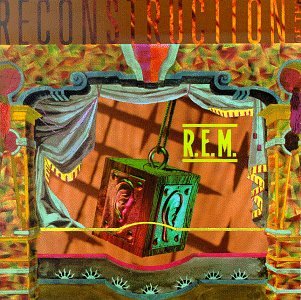
6. Fables of the Reconstruction [4]
This is the album that tends to get lost in the shuffle when R.E.M. conversations pop up. It's not groundbreaking, it's not an auspicious debut, it's not a new direction for the band, it's not a blockbuster; it's simply just another fantastic R.E.M. album in the sea of fantastic albums R.E.M. put out in the '80s. If R.E.M. is the Beatles of indie rock, then this is their For Sale—caught between milestones, its only claim to fame being that it's really great. If it sounds like I'm damning with faint praise, then allow me to redirect: Fables of the Reconstruction is also notable for being the last of R.E.M.'s murky, mysterious albums. Their subsequent records embraced a much cleaner, more arms-wide-open sound, but Fables of the Reconstruction is still very much in the spirit of Murmur, where each song has dark, ominous corners that refuse easy interpretation. For all the sweetness tied up in the Peter Buck's guitar and Michael Stipe's voice, this is a prickly album, as menacing as its title's allegation of institutionalized historical fiction. We're still a few years out from Document and R.E.M.'s most overtly political years, and on the whole, the band here is more interested in existential refraction and sonic haze than political statements, but there's something unmistakably conceptual about Fables, something that I find difficult to put my finger on, but it's there, somewhere, shifting in the brambles. The genius of the album isn't its clarity; it's the shifting, mirage-like qualities that defy fact. It's the fable.


5. Out of Time
After the success of Green, R.E.M. doubled down on the mandolins and mainstream sensibilities and came out with their definitive pop album, Out of Time. The songs are brightly produced, clearly enunciated, and melodic, and for some reason that has always eluded me, this makes for one of the most divisive records in the band's discography. Some people seriously hate this album, and in certain circles, it's a kind of shibboleth for R.E.M. fans. At the center of this vitriol is "Shiny Happy People," the jaunty, chamber-poppy bit that has many times been called (often by the members of R.E.M. themselves) one of the worst R.E.M. songs ever. Well, let's get this out in the open here: I love "Shiny Happy People." It's fun, it's catchy, and it has just the right undercurrent of melancholy (they are putting something/someone in the ground, after all) to ferment the tune into something richer than just simple fluff. The same goes for pretty much the whole album, which, if you hadn't already guessed from its ranking, I also love. It's a fleet record, full of some of R.E.M.'s nimblest, sweetest melodies, and its 45 minutes go down remarkably easy. But at the core of all this sweetness is a dark mass that gives the music an emotional texture that's much more complex than the shiny, happy instrumentation would indicate initially. The darkness only boils to the surface at two tracks—"Losing My Religion" (a serious contender for my favorite R.E.M. song) and "Country Feedback"—but they're both powerhouses that color the rest of the record. There's heartbreak here: "I need this," goes the refrain in "Country Feedback," and the sadness isn't just in the desperation of the words but also in the tension created with those smooth, bright studio sounds. It's not radio pandering (not with that opening "Radio Song"); it's the necessary ligature to keep the emotions from tearing everything else apart.


4. New Adventures in Hi-Fi
Okay, this is the last time I'm going to use the Beatles analogy: New Adventures in Hi-Fi is R.E.M.'s White Album. This is true for a lot of different reasons: it's sprawling (R.E.M.'s longest record, by quite a margin at the time of its release, though that margin shrunk quite a bit during the band's subsequent "hey, we can put a whole hour's worth of songs on a CD" era); it's stylistically diverse, including one-off experiments like the Mexican-folk "Zither" (surely the album's "Wild Honey Pie"); it's also an album that captures a band on the brink of fracture, with drummer Bill Berry preparing to leave soon after the record's completion (though this departure was on considerably better terms than the Beatles' breakup). But enough about the Beatles. New Adventures in Hi-Fi is a phenomenally mature album, both stylistically and lyrically, the kind of album that a band can only make when it's been around for a decade or two and its members are entering their late thirties. When Michael Stipe sings, "Twentieth century, go to sleep," on the radiant closer, "Electrolite," you can hear the years weighing on him. The same goes for Peter Buck's fuzzed-out guitar, which sounds like the rock star posturing of Monster grown older, more grisled. This album is the logical conclusion of everything the band had done up to this point, something no more apparent than in bracing centerpiece, "Leave," where the hurt of Out of Time and Automatic for the People has festered into a pulsing open wound. It's beautiful, bracing stuff and stands as an artistic height that R.E.M. would never reach again.


3. Reckoning
A lot of bands with a debut as fully formed as Murmur have a sophomore slump. R.E.M., on the other hand, has, I dunno, a sophomore... hump? peak? Whatever you call it, Reckoning is the sound of a scrappy young band improbably becoming even better than before, and it's marvelous. Part of my preference for Reckoning over Murmur is (at the expense of my indie cred) due to the hugely improved production values; it's not exactly a mainstream-pristine record (we'd have to wait until Document to have one of those), but it's like a sunny day compared to Murmur's murk and muddle. The result is a much richer sound that teases out melodies in a gently precise way, and it's rapturous. "(Don't Go Back To) Rockville" is the obvious, standout track here, and it's the one that's gotten the most attention over the years, but every single song here is a marvel, from the jaunting movement of "Harborcoat" to the delicate beauty of "Camera." The increased clarity brought on with the crisper production gives us, for the first time in R.E.M.'s career, actual tangible emotions to latch onto in these songs, too: "So. Central Rain" is R.E.M.'s first overtly sad song, and "Pretty Persuasion" practically spews vitriol in a way that anticipates the more acerbic moments on Document and Green. The crazy thing is that these first forays into what would eventually become tried-and-true tropes for the band are also the very best iterations of these styles. R.E.M. didn't need to practice; two albums into their career, they were already masters.


2. Lifes Rich Pageant [5]
There are a lot of things that can be said about Lifes Rich Pageant: its politics, its environmental themes, its commercial success. But focusing on any that runs the risk of eclipsing what's perhaps this album's greatest strength (something I've been guilty of on some of these other writeups), which is that the songs freakin' own. Lifes Rich Pageant is the great showcase of just how much of a songwriting powerhouse the men of R.E.M. were—especially in 1986, the height of what many consider their golden age. Its production, caught between the college-rock sounds of the first three albums and the radio-ready engineering of their next four, is the most optimal delivery system the band ever had for its sheer songwriting prowess, and it pays off wonderfully with a collection of some of the band's best songs. Robert Christgau calls the Rolling Stones' "Brown Sugar" "a rocker so compelling that it discourages exegesis"[6], and that pretty much describes my feelings about the twelve tracks on Lifes Rich Pageant. Take "Fall On Me," one of the album's many, many highlights. I can read the lyrics and think about its thesis about how commercialism destroys the environment, etc., but when the music starts, it sounds so glorious that I don't care at all what it says. This is true not just of the sweeter melodies like "Fall On Me" and "Cuyahoga" but also of the pricklier, deep-impact stuff like "These Days" and "Hyena," where R.E.M. really goes for broke on the rock 'n' roll. They've got smart, important things to say, but in a certain sense, who cares when they make music this awesome? It's not grandiose or conceptual, but song for song, on the level of pure craft, I'll stack this album up against any album in the rock canon. Plus, it takes its title from an Inspector Clouseau quote; that's a recipe for success if there ever was one.


1. Automatic for the People
Man, where to start with this album? How about personally: Automatic for the People is the first R.E.M. album that I ever owned (something that, I'm guessing, goes for many R.E.M. fans of a certain age); my brother had their greatest hits, and I'd heard quite a few of their songs on the radio, but this was the first CD of theirs that I ever got with my own money. When I first listened to it, I was alone, sitting at my parents' wobbly dining room table, my little circular CD player beside me, whirring. The house was empty. To this day, this is an album I find best experienced with nobody else around—preferably late at night, timed so that the final, gorgeous bars of "Find the River" fade at just the moment the evening is at its quietest. With other people (or even just in daylight), songs like "Nightswimming" and "Everybody Hurts" are easy to mock, friends and acquaintances filling up the spaces this album leaves intentionally blank, but alone, there's nothing to distract or buffer you from this album's quiet beauty. It's like the difference between a stage whisper and a real whisper, a secret passed between just two people. If I'm waxing pompous and insufferable about this one, know that it's because Automatic for the People is among my top 20—maybe even top 10—albums of all time. It's not a groundbreaking choice for #1 R.E.M. album (it's one of the band's best-selling records, and you won't find it in all that many bargain bins either), though it's hardly representative of what an R.E.M. album sounds like. The strings and organs recall some of the chamber poppiness on Green and especially Out of Time, and there's the requisite political number with "Ignoreland," but at most, these are just echoes of what R.E.M. had been up to this point and what they would become for the rest of their career. On Automatic for the People, the emotional depth are deeper, the tone is more mournful, the instrumentation is statelier, the left turns are weirder ("Star Me Kitten," anyone?). Gone is the college rock; not yet here are the guitar crunches of Monster and Hi-Fi nor the noodling electronics of the post-Berry era. Automatic for the People is just Automatic for the People. For all of R.E.M.'s masterpieces (and they are many), this is the one album of theirs that has grandeur, and in that sense, it's a sort of one-off for the band. But what a one-off it is.

And there you have it. Thanks for reading, everyone! Fellow R.E.M. fans out there, be sure to let me know your own favorite R.E.M. albums, songs, moments, anecdotes, complaints, thoughts, etc. I'd love to hear what everyone else has gotten out of this marvelous band.

Until next time!


1] For those of you out there who, like me, are fascinated by the quirks of owning physical media, I'd like to point out that the liner notes for the CD release of Green only have the lyrics to "World Leader Pretend." Also, the final song apparently has no title; on the disc, there's an "11." but no track title following, and the back of the CD doesn't even list an eleventh track. iTunes calls this song "Untitled," but Wikipedia says it's called "11." Mysterious. R.E.M.'s '80s releases are full of packaging weirdness like this, though for whatever reason, the trend doesn't continue into the '90s. Also also, my CD copy of this album is a used one, and the previous owner inscribed, in sharpie, the initials H.K.C. on the label side of the disc. H.K.C., whoever you are, thank you for selling your album so I could pick it up years later for $0.79.

2] Fun fact: Thom Yorke once said that Radiohead probably couldn't have made Kid A without the precedent of Up.

3] Packaging weirdness: on the back of my CD copy of Document are printed the words "Number 5 Document," right across from the track listing. I get it; Document is the fifth R.E.M. album. But why? No other R.E.M. album's packaging references its position in the band's discography. I mean, why not, I guess, but you've got to wonder what goes into these sorts of decisions.

4] More packaging weirdness: Fables of the Reconstruction is by far the most bizarre, as far as confounding packaging goes. Get this: the album basically has two covers, both of which are included in the CD edition, and which one is facing out seems to vary from retailer to retailer (those of you who have this on vinyl, let me know what that looks like). One cover is the one I included for the writeup above, while the other looks like this. If you look closely, you'll see that the first cover has the words "Fables of the" written across the top, while the second one has "Reconstruction of the" printed along the bottom. That means that when you put them together, they complete each others' phrases, creating a sort of snake-eating-its-tail situation where the phrases form an infinite loop. This, of course, plays right into the album's generally opacity and its central idea of reality being irrecoverably buried by fables and language, but it's still a little confounding. Also confounding: the spine of the CD copy I own bears not the album's title but "Reconstruction of the Fables." Additionally, the liner notes have a stylized track listing that includes "When I Was Young," an R.E.M. rarity that's only available in demo form, and that appears nowhere on this album. Why did R.E.M. do this? Was it a mistake? An artistic statement? Just trolling? Who knows, but it sure makes for some lengthy footnotes.

5] Even more packaging weirdness: Lifes Rich Pageant has maybe the best evidence for the argument that at least some of R.E.M.'s '80s packaging was just a mistake. Riddle me this: why would the band only include ten of the album's twelve songs on the track listing? And why are they in the wrong order?? Is it a printing error? Is it just to mess with the heads of bloggers writing about it 19 years later? Or is this all part of some elaborate message? Wake up, sheeple!!

6] An idea I think is complete BS for that particular song. No, Rob, it discourages exegesis because you just don't want to admit that actually reading the lyrics means you have to come to grips with the fact that it's a repellant celebration of racism and rape. At least with R.E.M., ignoring the words only means that you're tacitly agreeing to leftist political views.

Thursday, February 19, 2015

Goodbye, Parks and Recreation


Next Tuesday evening, NBC's little-watched but much-loved sitcom Parks and Recreation will air its final episode. And yeah, I get it. Seven season is way more than any of us had any right to hope for back in those dark, early years when it seemed like only three dozen people were watching. It's time to say goodbye. But the show's end still makes me sad. Sadder than I've felt at any other TV show's end. That's because Parks and Recreation is one of the few pieces of pop culture than I can say has really, truly, demonstrably changed my life.

In the final minutes before Conan O'Brien ended his brief stint as the Tonight Show host on January 22, 2010, the comedian gave one final monologue that, if history is fair, should be remembered as one of television's greatest moments. The whole speech is a marvel typical of Conan's warm, off-beat sensibilities, but its crux comes at the very end, when he speaks the following words: "Please do not be cynical. I hate cynicism. For the record, it's my least favorite quality, and it doesn't lead anywhere."

Parks and Recreation debuted more than nine months prior to Conan's last Tonight Show, but it may as well have been in direct conversation with that moment. By most accounts, Parks's first season is a mess, a sitcom stuck between meandering characterization and pale imitation of its older NBC sibling, The Office. But by January of 2010, the fledgling series was midway through its second season and on much firmer footing, having in the intervening ten-ish episodes figured out exactly what kind of show it was and remains today, up to its penultimate episodes. And that is a show that, like Conan (but unlike so many of its so-called "quality TV" peers), hates cynicism.

Take, for example, a moment the occurs in "Galentine's Day," a season-two episode that aired just a few weeks after Conan's NBC farewell. April, the Parks Department's resident millennial, pessimist, and hipster, attends a seniors' Valentine's Day dance with some of her also pessimist, also too-cool friends. The music is cheesy, the geriatrics are doddering, and her friends have a great time cracking jokes about not just the senior citizens but also Andy, April's crush who loves Dave Matthews Band. One suspects that a young Jim Halpert would have been right at home among April's pals. But April will have nothing of it, and she shouts, "Why does everything we do have to be cloaked in like fifteen layers of irony?" It might as well be a thesis statement for the show as a whole.

I know that there's a difference between cynicism and irony, but in the landscape of great TV comedy of the past twenty-ish years, the two come from remarkably similar places, whether its Seinfeld's cool remove from the solipsism of its characters' behavior or, more relevant to Parks, the acidic mockery often present within the mockumentary sitcoms that cropped up in the first few years of the new millennium. The Office is humanist at heart, showing tremendous sympathy for its characters in its most unguarded moments, but in practice, its comedy often hinges on giving the viewer a sharp feeling of superiority over most of its cast—man, isn't Dwight crazy? Man, isn't Andy preppy? At its most schadenfreude-inducing, The Office is funny not because what the characters are doing is funny but because they are inherently pathetic. Its comedy relies on a certain cynicism about humanity; we expect people to be flawed, so its funny when people are even more flawed than we initially imagined. That's what April rages against; that's what Parks and Recreation despises. There is very little superiority invoked by Parks and Rec. For all its jokes, for all its political satire, for all its warmth, Parks's most astounding artistic feat may just be that it manages to make liking people funny.

This is a show that's relentlessly optimistic, and I'm not just talking about how it believes that change is possible, or how it posits that small-town (and occasionally mid-sized city, depending on the narrative needs of the episode) Pawnee, Indiana, could somehow become not just the hub for a thriving tech startup but also the freaking National Parks headquarters. No, I'm talking about how it's optimistic about people. It really, truly believes that staunch libertarian Ron and political progressive Leslie can be best friends. It believes that Neutral-Milk-Hotel-loving April could hook up with Dave-Matthews-goof Andy and form a loving, stable marriage.

I'm not really saying anything new; TV critics have been discussing the miracle of Parks's sincerity and optimism for years. But for me, personally, watching this show as I transitioned from a late-teen to an early-twentysomething, those beliefs made more of an impact on me than all the biting, cynical wit of the most prestigious TV comedies combined. As a teenager, I had found a refuge in cynicism, in distancing myself from people because of the flaws that I expected in them. By the time college rolled around, it had become a default mode, something to fall back on whenever something bad happened. "Well, what did you expect? Things suck." It was the smart, cool thing to think. I mean, I wasn't quite at April-levels of cynicism, but the core was there. And Parks and Recreation's gently stubborn insistence that such thinking isn't the smartest or the coolest blew my mind.

Oftentimes, things do suck. I get that; I'm not that naive. The type of ironic/cynical comedy I discussed above has its merits; I like The Office, and I love Seinfeld, Arrested Development, and a whole slew of other shows that embrace a similarly cynical comedic philosophy (and anyway, this comedy of cynicism isn't the only thing these shows have to offer). But as far as revolutionary, as far as life-changing, I can't say any of those shows helped change my worldview. But Parks and Recreation did. The message that appreciating and connecting with people is often just as (if not more) important as acknowledging the suckage profoundly shook up the way I saw the world. Conan got to me first, but Parks wasn't far behind.

I don't want to overstate this; most catalysts in life don't work dramatically. Parks and Recreation impacted me in the way change normally happens—a nudge, a hair's breadth in a new direction. In true Parks and Rec fashion, it didn't work alone either, but in tandem with a variety of other factors in my life, some even more influential—changing theology, falling in love. But the fact remains that at least some part of me now, even if it is a small part, is different for having watched the show.

So thanks for that, Parks and Recreation.

Until next time.