Showing posts with label progressive rock. Show all posts

Saturday, July 9, 2022

Prog Progress 1985: Kate Bush - Hounds of Love

Hi, everyone! Welcome to Prog Progress, a blog series in which I journey through the history of progressive rock by reviewing one album from every year of the genre's existence. You can read more about the project here. You can learn about what I think are some of the roots of progressive rock here. You can see links for the whole series here.


It's been a while, hasn't it? Looking back, I now realize that it's been over a year since I last published a "Prog Progress" entry (1984's Powerslave), which I believe is the longest gap between posts in this series. I'd like to think that it won't be that long again until I get to 1986, but realistically, it's not unlikely that it will take me that long. Turns out having kids is really time-consuming! Who knew! Regardless, I need to make at least one post per year if I at least want to keep pace with, you know, the march of time, so at the very least, I guess I'll see y'all again sometime around June 2023.

In the year-plus since that Iron Maiden post, a lot has happened, most of it largely depressing. However, most relevant to this post, one somewhat significant, not depressing occurrence is that Netflix released the first half of the fourth season of Stranger Things. I don't watch Stranger Things (watched the first season, decided it wasn't for me). I wouldn't normally be mentioning contemporary television series in a post about progressive rock in the '80s, but if you watch Stranger Things or just follow popular music discourse, you probably know where I'm going with this: one episode has a very prominent use of Kate Bush's "Running Up That Hill (A Deal with God)," the opening track and lead single from her 1985 album Hounds of Love. Since I'm not a Stranger Things viewer, I haven't seen the episode in question, but it's apparently an absolute banger of a moment when the "Running Up That Hill" needle drop hits, so much so that people have been streaming the hell out of this song, which has rocketed "Running Up That Hill" to #1 on the UK Singles Chart (her highest-charting UK single in 44 years) and #4 on the Billboard Hot 100 in the United States (her highest-charting US single ever). Kate Bush has never exactly been an unknown artist, but she's been pretty far outside of mainstream pop music attention for a decade or three in terms of what "the kids these days" are listening to, but now, thanks to this fairly preposterous series of events, Kate Bush generally and Hounds of Love specifically are having something of a popular renaissance.

This makes writing this post feel a little different than writing the other prog entries did. If you've been reading the whole series, you'll know that my tone in these is usually flavored with at least a little bemusement—much as I love progressive rock, it's not lost on me that a lot of it is deeply silly as well as being thoroughly out of fashion, and I like to have fun with that in the posts. But now, an artist who is no less weird than a lot of the prog rock I've already covered here has against all odds become a chart-topping presence again.

It's a wonderful little cosmic accident that I will savor for as long as it lasts, because Kate Bush is definitely weird stuff. In fact, one of the reasons that I'd planned for year to cover Kate Bush in this blog series is, back at her mid-'80s commercial peak, her status as a weirdo interloper among the pop music mainstream. I've talked at some length about how in the post-'70s fracturing of UK progressive rock, the tropes and ideas of progressive music starting finding homes in adjacent genres, most notably arena rock and pop, and Kate Bush is a direct beneficiary of this movement and probably even the torchbearer for the full potential in prog's diversifying from "rock" to "art pop." She's really something special, and that goes right back to her inception as an artist.

As a teenager in the '70s, Bush was something of a prodigy, having taught herself multiple instruments and written a substantial number of songs by the time she was 16. Somehow, David Gilmour of Pink Floyd got a hold of her demo tape that her family had been circulating to record labels, and he apparently liked it enough to finance and help produce another demo, which resulted in her getting signed to Pink Floyd's parent label, EMI[1]. EMI sat on her material for a couple years before allowing her to record and release her first album, The Kick Inside, in 1978. It's a pretty auspicious debut: the record peaked at #3 on the UK albums chart and did even better internationally, reaching #1 in Portugal and the Netherlands as well as #2 in Belgium, Finland, and New Zealand. More importantly, the album's debut single, "Wuthering Heights," went to #1 in the UK, Australia, Portugal, New Zealand, Ireland, and Italy. In terms of pure music-industry crassness, this album moved some units. I don't normally focus on the commercial aspects of the music in this series, but I am here just to emphasize two things: first, that Kate Bush truly was working in the realm of pop (at least in the broad sense of having popular, mainstream success), and second, she did this in spite of the waning influence of pure progressive rock. These two things together are notable because as it arrived (and would continue in her next few releases), Bush's music was distinctly proggy, especially in pedigree. David Gilmour helped produce the album, and a good portion of the Alan Parsons Project were session musicians on a number of the album's tracks. You've also got the typical mythic/literary flourishes often found in prog, no less obvious than in the smash-hit lead single "Wuthering Heights," a song sung from the perspective of Catherine's ghost from the titular Emily Brontë novel[2]. Then you've got the music itself, which has definitely proggy touches like a Hammond organ, a mandolin, synths, and the typical flourishes of unconventional instrumentation (a boobam on one track, literal beer bottles on another).

But at the same time, Kate Bush's music doesn't exactly feel like progressive rock—not in the sense of the genre as it existed in 1978, at least. There's not a lot on The Kick Inside or her subsequent records that sounds especially improvisatory, nor are there the lengthy solos or instrumental passages typical of '70s prog. On a more conceptual level, this isn't particularly band-oriented music; a lot of prog, especially that classic wave in the '70s, takes its cues from jazz in terms of the idea that a given song is about the interplay of people in the room, who trade off time in the spotlight with solos before rejoining the whole group[3]. Progressive rock in its purest form is remarkably collaborative. With Kate Bush, however, everything is clearly subordinate to one person's vision: her own. She wrote all of the songs on The Kick Inside (as well as on her future albums), and for all of the baroque, proggy touches in instrumentation, Bush's vocals and piano take the lead pretty definitively on each song, with the rest of the musicians filling out texture as they follow that lead.

This sort of monolithic realization of a single person's vision would become even clearer on her second album (Lionheart, which came out just a few months after The Kick Inside), when Bush began co-producing the music; by her fourth album (1982's The Dreaming), Bush was the sole producer on her work. By the fifth album (and this post's ostensible focus), The Hounds of Love, Bush had mostly cycled through the label-approved Alan Parsons Project musicians and had formed a stable of studio musicians of her own choosing. This sort of auteurist control over all levels of the production isn't unheard of in the broader realm of pop music (Prince comes to mind), but within the framework of prog, it's pretty singular; the closest analog I can think of is Robert Fripp's famously draconian leadership over King Crimson, but even then, the band's recordings are highly inflected with improvisation and a live interplay of musicians trading the lead that you simply do not see in Bush's work. Taken as it is, this foregrounding of a singular figure backed by studio magicians makes Bush's music a lot closer to the structure of pop, or at least the more pop-oriented rock acts of the era like David Bowie, with Bush being, in her own off-beat way, the star that the whole recording revolves around. This is why I think Bush is such an interesting figure to talk about in the context of prog rock: it is clearly prog on some level, but rearranged into the shape of pop and pop stardom.

Since it's already come up, I guess I'd better actually start talking about the main show, i.e. The Hounds of Love. In the context of this prog-pop duality of Bush's, The Hounds of Love is actually a pretty interesting case study, as it's structured so that the two sides of the LP each focus on bringing out one of those genres. Side one of the album (the first five tracks, if you're not listening on vinyl) is simply labeled "Hounds of Love" on the back cover and is a collection of propulsive songs seemingly designed to appeal to all the Kate Bush fans who fell in love with her as the kind of left-of-center pop artist who did "Wuthering Heights." It's probably the most conventional stretch of music in her entire career up to that point, and each of the songs is broad and approachable in the way you expect of pop music (albeit in that dreamy, cock-eyed way that a lot of UK musicians approached "pop" in the '80s). Here you'll find Bush's most well-known songs (outside of "Wuthering Heights"): the rollicking rock of "The Big Sky," the chamber-pop of "Cloudbursting," the synth-pop of the title track, and yes, the immortal "Running Up That Hill (A Deal With God)." That's not to say that any of these songs involve Kate Bush sanding off the bizarre edges that often make her music interesting (she barks like a dog on the title track, after all), but these songs are certainly foregrounding the side of Bush that knows how to write a track you just want to listen to again and again. They've all got huge hooks and sticky melodies, and taken as a whole, that first side is just irresistible, banger after banger after banger. A lot of the press surrounding the album's release had to do with painting the record as Bush reemerging as a major commercial player after a few albums in the wilderness, and that's absolutely to the credit of the "Hounds of Love" side.

And then you get Side Two, labeled "The Ninth Wave" on the album packaging, which pointedly not a bid to reemerge as a commercial player. "The Ninth Wave" is an ambitious, genre-bending, side-long suite threading together seven tracks to tell an impressionistic story of a woman's mythical journey through birth, life, and death inspired by the poetry of Alfred, Lord Tennyson. In terms of the music itself, it's a radical break with the first half of the record on the level of what David Bowie and Brian Eno did on the Berlin trilogy or what Peter Gabriel was doing on his first few solo records; instead of the pristine, left-of-center pop songs of Side One, "The Ninth Wave" presents melodies that snake along in unpredictable directions among richly textured, open-ended soundscapes occasionally punctuated by string hits and other studio trickery (as well as, in one memorable instance, an Irish jig). An epigraph in the liner notes indicates that the suite was inspired by Tennyson's Idylls of the King, a cycle of poems about King Arthur and Camelot[4], and it seems that not just the lyrics (more on that in a minute) but also the music itself is rooted in a kernel of that Tennyson work: for as abstract and experimental as the record gets in this section (and it is, often flirting with ambient and electronic structures), "The Ninth Wave" is nonetheless organized around traditional and at times even pre-modern European folk music, not just in the musical structures but in the instrumentation as well, which includes a Slovakian shepherd's flute, bagpipes, an Irish drum, and other indigenous European instruments. The way "The Ninth Wave" weaves together '80s studio experimentation with music from the deep past stretches the album back from whatever avant-garde it occupies in its present to connect it to a profound well of myth and history in the same way that Tennyson was linking his Victorian moment with the national and moral tradition of Arthurian legend. Bush is, in a way, insisting on her role in the continuum of the national, continental, and artistic lineage that Tennyson (and any number of other poets and artists) claims. I hope it goes without saying, but this is prog as hell: the sense of myth, the assertion of ostensibly popular music into the realm of high culture, the fusion of traditional European idioms with modern rock/pop shapes, the couching of all of this with a side-long suite of continuous music. If Hounds of Love Side One was the distillation of Bush's commercial pop impulses, then Side Two is certainly the culmination of her pedigree within the world of progressive rock. As a piece, it's stunning.

And yet, at the same time, if you were to listen to a random minute of "The Ninth Wave," you probably wouldn't peg it as prog in the same way that you could of a lot of Yes or Gentle Giant or (to use an example recently[6] covered on this blog) Marillion. It's too outré, too ambient, too folksy. This is also true of Side One as well, though in the other direction: it's simply too pop. And yet, it's hard to describe Hounds of Love in a way that doesn't make it sound like prog, at least on paper. In the context of this blog series, the cool thing about Kate Bush is her ability (especially on Hounds of Love but really, throughout her career) to take the theoretical parameters of prog and make them sound like no prog you've ever heard before—a true embodiment of the "progressive" ethos of prog, not just progressing rock(ish) music but progressing the genre itself into new forms. I've talked about this on the last few entries in this series, so I don't want to beat a dead horse here, but one of the things that I find most interesting about what happens to prog in the '80s is that prog's mainline implosion at the end of the '70s kind of necessitated the blowing up of the expectations of what the classic prog acts established as the expectations for the genre, and what interests me least about prog in the '80s are the acts that try to keep those old expectations alive (i.e. neo-prog, i.e. Marillion and their cohort). Whether it's the flourishing of progressive metal or the cross-breeding of arena rock with proggy instrumental textures[7], the people carrying the torch forward for the genre in my mind were those least likely to be precious about its boundaries as a genre. Kate Bush, with her singular vision and top-to-bottom ownership of the production process, is a bigger part of that vanguard of post-prog artists than anyone else I've yet covered on this blog.

When talking about her ability to move prog into the future, it isn't lost on me that Bush is a woman. Within the world of pop, a female-fronted act isn't all that anomalous[8], but within prog (especially British prog), it's a rarity to the point of near non-existence[9]. For reasons I've never quite been able to figure out, progressive rock is heavily masculine-presenting, and it's hard not to speculate (though also hard to say for certain) that Kate Bush's foregrounding of pop melody and experimental eccentricity (both realms historically more gender-diverse, though prog's abysmal record is a low bar to clear) gives her a backdoor into progressive music that she might not have had otherwise. Whatever the case, Kate Bush seems especially conscious of gender and her place within a masculinized world on Hounds of Love. Side One's songs are full of gendered angst, none more so than "Running Up That Hill (A Deal With God)," in which the titular deal with God involves Bush's speaker hypothetically flipping genders with her significant other so they can understand the pain they inflict upon each other (and, implicitly, the uphill climb women face in a masculine society).

But the part of the album where this idea comes into full fruition is "The Ninth Wave," which is, as previously mentioned, inspired by Tennyson's Arthurian cycle, but what I didn't point out before is that all the Camelot stuff is purely subtextual; the literal lyrical thread of Side Two involves the story of a woman who is adrift at sea and experiences some kind of vision that lays out her whole life in mythical terms as she battles what seem to be near-fatal conditions on the ocean. A lot of this is, like the music, somewhat abstract and hard to parse, but what comes through clearly is the importance of this narrator's identity as a woman, maybe even a kind of ur-woman who has a primordial connection with the feminine experience throughout human history. Significantly, during one sequence in the suite (the song "Waking the Witch"[10]), the woman's vision seems to link her struggles to stay afloat at sea with a witch trial where the accused woman was thrown into water (maybe as execution, maybe as a test of her witchiness). Witch trials are somewhat notorious for using specious evidence to prosecute women who were perceived as having transgressed or abandoned their ordained (usually subservient) role within society, and whatever else Kate Bush is communicating on this album (I'm not sure of everything), it is obsessed with this idea of transgressing and transcending the limitations placed on women by a patriarchal society. And it works on a metatextual level, too; Hounds of Love shows Bush claiming a stake in the Victorian gender morality of Tennyson's Idylls of the King and the by-then nostalgic boys club of progressive rock. She has, in a way, made good on the premise of "Running Up That Hill": she's run up the hill of success in a patriarchal world. But also, by making music that is so fully her own, both in terms of its production and also it's distinctly non-prog sound, she's also improved upon that premise. She's run up that hill, for sure, but she didn't need God to let her switch places with a man; she's done it as a woman.

I still don't exactly know why prog is so dude-heavy, but at times I wonder if it's a problem with how we've tended to define what prog is. If the sound of prog is based on a few influential records made by men[11] (a definition this blog is certainly guilty of perpetrating), it's possible that this just makes prog systemically inclined to drawing its own boundaries around music that primarily men tend to make. I don't want to be too gender-essentialist about this, and obviously women and nonbinary people are capable of making something that sounds like, I dunno, Close to the Edge. But it's also true that different life experiences and different contexts create different perspectives and subcultures and approaches to art, and how many nuances and innovations of prog's sound by people who aren't men have just been left by the wayside because it simply didn't fit the sometimes rigid format occasionally pressed onto the genre. Maybe there's a different definition of prog that skews toward fuller, richer, more gender-inclusive music made under the broad philosophical impulses of progressive rock. Is Joni Mitchell prog? Is Vashti Bunyan? Laurie Anderson? I dunno. But I'm declaring right now that Kate Bush is[12]. Maybe I can get the Stranger Things crowd onboard with me.

See you in 1986!


1] With the money from her signing bonus, Kate Bush paid for classes that allowed her to become trained in interpretive dance and miming, which gives you a pretty good idea of what a top-shelf weirdo she is. Just such pure, beautiful eccentricity.

2] Kate Bush and Emily Brontë share a birthday (July 30), it turns out.

3] There are a few exceptions (most notably Rick Wakeman), and of course everybody had their own solo records.

4] The quote included in the liner notes is this:
    "Wave after wave, each mightier than the last,
    Till last, a ninth one, gathering half the deep
    And full of voices, slowly rose and plunged
    Roaring, and all the wave was in a flame"[5]

5] The notes misattribute the quote to the poem "The Holy Grail," but it's actually from "The Coming of Arthur." Not that it really matters, but I can't in good conscience be an English teacher and not be a pedant about something like that.

6] Relatively

7] Speaking of Asia, Geoff Downes appears on one track of Bush's previous album, The Dreaming.

8] Though even here, Kate Bush is pushing forward with her hands-on approach to everything in her music: "Wuthering Heights" made Kate Bush the first female artist to have a #1 song in the UK that she wrote herself.

9] There's probably an argument that, with the gender-bending trends of '70s British rock, there's a stronger presence of gender-nonconforming or even nonbinary performers (or at least ones who present as-such onstage) than female performers, but I kinda don't know if I want to open that can of worms.

10] Which uses a sample from Pink Floyd's The Wall, by the way. It's far and away the most out-there track on the album, though not because of the sample (which is brief).

11] White, usually British, usually straight men at that, but again, I don't know if I have the bandwidth to open that can of worms on this post.

12] Arguably more so in her 21st-century output, where albums like 50 Words for Snow let her music fully spread out into much longer, more spacious compositions.

Tuesday, June 15, 2021

Prog Progress 1984: Iron Maiden - Powerslave

Hi, everyone! Welcome to Prog Progress, a blog series in which I journey through the history of progressive rock by reviewing one album from every year of the genre's existence. You can read more about the project here. You can learn about what I think are some of the roots of progressive rock here. You can see links for the whole series here.


Since the very early goings of this series, I've been foreshadowing that metal would one day play an important role in the progress of progressive rock, and now, my dear dedicated few readers who have stuck with this series, we're here! The moment when heavy metal and progressive rock truly converge! Can you feel the tingling on the back of neck? The sudden impulse to thrash your head back and forth? The undeniable urge to make edgy allusions to Satan to discomfort your parents? Yeah baby! Here we go! 

I should say first that I am not anything close to a metal expert; metal music communities thrive on hyper-specific knowledge that I simply do not have. I enjoy this music, and I hope I've represented it to the best of my abilities. But there are probably going to be some factual errors and oversimplifications here. If so, please let me know!

But wait; per tradition, here's some history. As you may have guessed, neither 1984 nor Iron Maiden's Powerslave are the first time that progressive rock and heavy metal have overlapped. I talked about their interplay way back on my 1970 post about Black Sabbath's Paranoid, and I still basically stand by the observation that back in the post-'67 explosion of divergent rock music styles and structures, a lot of the people pushing the boundaries of rock music were basically all hobnobbing under the same big tent of rock's vanguard, from the wacked-out avant-gardists like Captain Beefheart to those who would eventually become associated with more commercially viable genres like art rock, hard rock, heavy metal, and progressive rock. I mean, Deep Purple, definitely one of the heavy metal grandaddies, sings about Frank Zappa in "Smoke on the Water"; my impression is that this was all something of a scene, which is kind of wild to think about when you consider how siloed the branches of rock music would become from one another moving forward.

And they did get siloed pretty quickly. As early as 1972 or '73, these definitely felt like completely different wings that may occasionally overlap but generally felt as if they were moving in distinct directions. The avant-garde/experimental folks like Zappa and Henry Cow were off in one corner, doing their thing. Then there was art rock and progressive rock going in their own increasingly florid directions, especially prog, which, as we've discussed, focused on forming complicated, busy compositions that stretched over whole sides of LPs; meanwhile, hard rock and heavy metal traded on one another for the rest of the '70s with bands like Led Zeppelin, Black Sabbath, and Blue Öyster Cult (all of whom tended to trade in both genres), with hard rock forging a faster, bluesier path and heavy metal leaning on slower, crushing riffs and doomy atmospheres—and despite emerging from the same post-'67 primordial pool, neither sounded especially proggy except on obvious genre experiments like Zeppelin's "Achilles Last Stand." This is all waaay simplifying the evolution here, but hopefully it's not too unfamiliar territory for someone who stuck it out this far in the series. Tons of this is still part of the mainstream rock canon; if you still have a radio, '70s heavy metal and hard rock in particular are all over classic rock radio[1].

Predictably, this all gets shaken up with the emergence of punk, which begins mid-'70s in the United States as kind of a convergent evolution between America's experimental rock and hard rock wings but soon hops across the pond to the UK, where it makes an arguably bigger cultural splash as specifically a movement in defiance of the reigning powers that be in the rock world, which in the UK at the time mean prog and heavy metal. I've talked before about how the narrative that "punk killed prog" is a gross oversimplification, and I would say the same thing of this first wave of heavy metal/hard rock in relation to punk. As with prog, heavy metal/hard rock happened to be undergoing some internal shakeups not directly connected to punk, e.g. Ozzy Osbourne's departure from Black Sabbath and Led Zeppelin's increasing trouble with its members' health/behavior, culminating in the death of drummer John Bonham and the group's subsequent dissolution. So as with prog, heavy metal has something of an identity crisis at the end of the '70s[2].

Now unlike prog, which, as we've seen previously in this series, adapted to punk by ultimately just abandoning prog for prog-inflected pop, metal sees punk and its aggression and fleet songwriting and adopts a "if you can't beat 'em, join 'em" approach, and what's known as the New Wave of British Heavy Metal (NWOBHM... catchy) forms around a bunch of artists who fuse the speed and scuzziness of punk with the riffs and doom of heavy metal: Motörhead, Saxon, Def Leppard[3], etc. It makes sense; the sneering thrash of punk is a much more obvious cross-pollination with the aggro-postures of metal than it is with the operatic and symphonic sensibilities of '70s prog, so it seems only natural that metal and punk rub off on one another more so than punk and prog do[4].

The funny thing about all of this is that because of prog and metal's at-this-point distant shared ancestors, prog did end up cross-pollinating with punk by proxy of the NWOBHM, whose bands fused the immediate instrumental ferocity of punk with the more grandiose structures of the legacy of that stew of post-'67 rock experimentation. The groups who especially leaned into the latter half of this equation even became known as "progressive metal."

This is more or less where we get to Iron Maiden, not only one of the headlining bands of the NWOBHM but also a key player in the formation of progressive metal. Iron Maiden were formed by bassist/songwriter Steve Harris in London in 1975, and like a lot of bands, the group kind of bounced around various clubs and underwent a number of lineup changes before finally being able to scrounge up enough funds to get themselves into the studio. In 1978, they recorded their very scrappy, self-produced debut, The Soundhouse Tapes: a lean three-song EP written entirely by Steven Harris. It's a fairly modest listen for being the studio debut of one of the most important metal groups of all time, but it's also an early example of the hallmarks of the NWOBHM: DIY production, punk-flavored guitar and vocals, Judas-Priest-inspired edge. At the time, punk, not metal, was the press darling as far as emergent underground rock music in the UK goes, so Iron Maiden, as with most of the New Wave Metal, mostly gained an audience by word-of-mouth and by circulating tapes of this EP (honestly a very punk move) until they found radio and club DJs who were interested. This eventually snowballed into enough popularity that their public release of The Soundhouse Tapes in 1979 sold out all 5000 copies in a matter of weeks. This was enough to get some major label attention, and the group signed to EMI soon after.

I know that this is technically a post about the band's fifth album, Powerslave, but I say all this about their debut EP just to point out that Iron Maiden is truly a fusion of the legacies of all three major strands of left-of-center British rock music: punk and prog and metal. As I pointed out in the previous post in this series, a lot of post-'70s posture towards prog was anything but progressive, attempting to preserve certain characteristics of the genre as if the sea change of the punk/new wave moment at the end of the '80s had never happened[5]. But with Iron Maiden, there is a genuine spirit of synthesizing the old with the new that feels way more in the spirit of their early-'70s forebears than the people who were out there trying to create '70s revivalist music, which I find delightful. Even more delightful is the fact that Iron Maiden don't seem to have envisioned themselves as progressive rockers at all, based on their early, formational work; The Soundhouse Tapes make it clear that punk and metal are the key building blocks, and the music reflects that, with fast-paced, macabre tunes about urban decay ("Prowler"), Vikings ("Invaders"), and the band's spooky persona itself ("Iron Maiden"). None of these songs are over the four-and-a-half minute mark; none of them are particularly indebted to any of the tropes of prog.

That all starts to change with the group's first full-length LP (self-titled, naturally). In some ways, the album is a continuation of what the band started with The Soundhouse Tapes; "Prowler" and "Iron Maiden"[6] are both present in re-recorded versions, and a lot of the rest of the album has the same sort of punk-metal sound. But nestled at the end of Side One is a track called "Phantom of the Opera," a seven-minute, multi-part epic inspired by the titular gothic mystery novel by Gaston Leroux—pretty much a prog hat trick. And with this single track, Iron Maiden's progressive metal is born. Nearly every album from Iron Maiden's classic era (approximately their self-titled through 1988's Seventh Son of a Seventh Son) has some sort of openly operatic composition in this vein, a long, multi-movement song usually drawing on history or classic literature/mythology or sometimes just fantasy or sci-fi more broadly: "Prodigal Son" on Killers, "Hallowed Be Thy Name" on The Number of the Beast, "To Tame a Land"[7] on Piece of Mind, etc. Even the songs that aren't overt epics begin to take on some of the grandeur of their more ambitious siblings—for example, "Flight of Icarus" on Piece of Mind, a song that's not even four minutes long but that still makes time to re-tell the Greek myth alluded to in the title.

One of the things that sometimes goes unremarked-upon about prog is that it is a genre that relies heavily on storytelling. Country and hip-hop get a lot of attention as the "storytelling" genres, and they certainly have earned those accolades. But prog's penchant for conceptual ideas, unself-consciously grand gestures, and the genre's roots in British prep schools make it a little different from the embellished autobiography and folk realism that imbues the country and hip-hop storytellers. Because outside of Pink Floyd's Wish You Were Here or The Wall, proggers tend to shy away from overt autobiography; instead, befitting the genre's grandiose ambitions, when prog tells a story, it tells an epic one: apocalypses, sci-fi sagas, pseudo-Biblical fantasy parables, Tarkuses, to say nothing of the numerous examples of social/political satire that have peppered the genre with big ideas. As much as progressive music has aspired to the mathematical bombast of classical music, so too has its lyrical content often been bent toward the literary classics in either explicit adaptations or pieces that reach for the same philosophical/cultural high-mindedness as the European storytelling canon[8]. I've been a little snarky about some of these storytelling attempts in the past because they are a little cornball at times, and there's something of a "teenaged boy thinks that the most serious stories have battles and brooding men doing important things" vibe to some of this, and critics of prog have certainly used this to lampoon the genre as a bastion of faux-intellectual dorks. But I also have a great deal of affection for the unabashed nerdiness of this kind of thing, and besides, some of this stuff is really cool and interesting and weird, or at least charmingly bookish in a way that most rock music does not allow itself to be. And Iron Maiden definitely slots right into this category.

The funny thing about Iron Maiden is that, despite being named after an instrument of torture and having either Satan, a zombie, or both on every one of their album covers and being one of the key players in a genre notorious for its edge-lord darkness and alleged ability to corrupt the morals of children, Iron Maiden are kind of dorks. To be fair, this is true of many metal bands once you peel back the macabre facade, but it is especially true of Iron Maiden, a band whose lyrics seem intentionally calibrated to be played by high school English and history teachers desperate to prove to their students that they are one of the Cool Ones[9]. The one most responsible for this impulse seems to be Steve Harris, who was initially the primary songwriting for the band. Though the songwriting duties eventually diversified, Harris is far and away the most prolific of the Iron Maiden crew, and his penchant is definitely for these high-school-class-type epics, being the man responsible for all of the songs I named above except for "Flight of Icarus." Under Harris's pen, the band honed what would be Iron Maiden's signature lyrical posture: a macabre gloss over a classical education. I am throwing no shade here; I unabashedly love this about Iron Maiden, and this impulse in the band that I love arguably comes to a head with their fifth album, Powerslave.

Powerslave finds Iron Maiden at their proggiest point yet, in terms of both their music and their lyrics. Just looking at the track listing, you've got the most obvious harbingers of progginess: long songs. Only two of the eight tracks dip below five minutes, and at the album's long-windiest, you've even got a 7-minute song and a nearly 14-minute song. But this is just surface-level; more important is what's actually in those songs, which are loud, brash, and fast in the NWOBHM style but also intricately composed, with winding instrumental passages and multi-movement structures in a way that distinctly recalls the tendencies of prog.

Most importantly for the theme that I've been building in this post, this album is positively brimming with narrative. The record opens with "Aces High," a Harris-penned recounting of a WWII dogfight, followed just a few tracks later by vocalist Bruce Dickinson's "Flash of the Blade," which tells the story of a young boy who grows into a vengeful swordsman, before ending Side One with another Harris lyric, "The Duellists," about a sword duel to the death and named for the Ridley Scott film of the same title (itself adapted from the Joseph Conrad novella The Duel). The other two Side One songs I didn't already mention are "Losfer Words (Big 'Orra)," an instrumental track, and "Two Minutes to Midnight," an apocalyptic anti-nuclear-war banger that, in the grand Sabbath tradition, associates nihilistic war hawks with the demonic—neither free from prog inflections themselves.

Side Two of the record goes even fuller-bore into this grand narrative posture. The first song on Side Two is "Back in the Village," part two of a pair of Iron Maiden songs (the first being "The Prisoner" on their third album, The Number of the Beast) based on the cult-favorite British TV series The Prisoner. Next is "Powerslave" itself, which opens on a Pink-Floyd-sounding bit of spooky sound collage until it bursts forth into a riff-heavy jam whose lyrics form a dramatic monologue of sorts involving a pharaoh on his deathbed raging against the coming darkness. "Powerslave" in particular whips itself up to a rather impressive progressive frenzy, shifting through three very distinct movements, each with their own tempos and technical flair: the first and third comprising the lyrical sections, a grim memento mori growled over hard-hitting riffage, sandwiching the second movement, a lengthy and escalatingly quick passage of guitar pyrotechnics that at times abandons any metal flourishes entirely and becomes definitively neo-prog its its melodic, winding guitar work. At seven minutes, this kind of structure wouldn't feel out-of-place on, say, Yes's Close to the Edge or Marillion's Script for a Jester's Tear.

But all of this pales in comparison to the album's 13-minute-and-45-seconds grand finale, the monstrous, sprawling "Rime of the Ancient Mariner." The song is more or less structured like "Powerslave" in that there are two conventional metal sections sandwiching a moodier middle, but the runtime allows for the band to stretch each movement out to heretofore unprecedented levels of detail. By the end, the song has this all-encompassing feel, as if Iron Maiden is trying (and succeeding!) to put everything they know how to do in one song: you've got the heavy riff of the beginning, the NWOBHM "chugga-chugga-chugga" faster section after that, a lengthy atmospheric interlude with minimal instrumentation and melody, a crescendo lifting the song out of atmospherics back into full-throttle metal mode, culminating in a shredding guitar solo, and then an ending that returns to the riff from the beginning of the song. It's incredible, almost certainly the greatest Iron Maiden song of all time as well as one of the greatest heavy metal songs ever. And with that structure, it's of course incredibly proggy.

More than just that, this song feels like an essential link in chronicling the connections between metal and prog. Literary nerds (or just students who have suffered through my 12th-grade English class) will recognize that this song is based on based on the 18th-century Samuel Taylor Coleridge poem of the same name. The poem itself is plenty epic and macabre, more than 600 lines of dark Romanticism wherein Nature is presented as this incomprehensibly large and frighteningly capricious force that tortures those human beings with the arrogance to assume they can tame it, a grisly piece of verse that feels like it was practically tailor-made to be turned into a metal song. People talk all the time about how the posture of prog is basically a space-age lens on Classical and Romantic ideas, but it's not nearly as widely noted that the aesthetics and attitudes of a lot of heavy metal themselves date back to that same period, building on the Gothic and dark-Romantic ideas that proliferated in the more troubled fringes of that same literary/musical movement of the 18th/19th centuries, which means that metal and prog don't just share common ancestry in the post-psych-rock boom of the late 1960s but they also share DNA originating over a century previous to that. The cool thing about a lot of the literary foundations of Iron Maiden's output but especially "Rime of the Ancient Mariner" is that they really highlight that shared DNA.

The effect of that shared DNA is that you can get something like Powerslave: definitively metal but in a way that also scratches that prog itch, too. As I've already pointed out, it's not as if there hadn't already been overlap with these two genres before, but the ways that a lot of '80s metal leans into that overlap feels simultaneously in the prog tradition but also genuinely new. In the most literal sense of the genre's title, what '80s metal does is actually "progressing" rock music, and the intertwining of metal and progressive rock would continue to yield fruit for years to come. Powerslave, while hardly the only album to do that, feels like an epitome of that kind of progress. Besides, it's just a great album regardless.

See you in 1985!


1] Though that said, "classic rock radio" is increasingly oriented around the '80s and '90s, which... well, I would say it gives me consternation, except that it doesn't really, because radio stations are just for waiting rooms now, right? (I love radio, but really).

2] Again, I'm simplifying heavily, and as with prog, there are still plenty of examples of commercially and artistically successful heavy metal artists during the late '70s—for example, Judas Priest, who would go on to have great success in the UK on either side of the punk watershed, as well as Rush on the other side of the Atlantic, who continued to thrive at the intersection of heavy metal, hard rock, prog, and (eventually) pop well into the '80s.

3] In their pre-Pyromania days, at least.

4] Though apparently the punks didn't take too kindly to metalheads showing up at their venues and vice-versa, so this mutual influence happened at the somewhat tense distance between their respective clubs and pubs.

5] I should probably also mention disco: not precisely "rock music" (as obnoxious rock fans have reminded us ever since) but certainly a part of that shifting music landscape by the end of the '70s. As far as I can tell, disco has no influence on Iron Maiden or most of the NWOBHM, though.

6] Making this one of the rare (and always satisfying) examples of an artist with a self-titled album with a self-titled song—as luck would have it, the only other metal band I've covered so far in this series, Black Sabbath, is also part of this club.

7] Which is a retelling of the book Dune, incidentally—not the first time a band in this series has found inspiration in Frank Herbert's work.

8] Noticeably missing (at least, I can't find any) from the list of influences of prog storytellers are the parts of the literary canon that have a reputation for being bawdy: Chaucer, Shakespeare, etc. I personally would love to get a 20-minute rock epic about "The Miller's Tale," with guitar solos and Mellotron and the works.

9] No I've never done this, why do you ask

Thursday, October 29, 2020

Prog Progress 1983: Marillion - Script for a Jester's Tear

Hi, everyone! Welcome to Prog Progress, a blog series in which I journey through the history of progressive rock by reviewing one album from every year of the genre's existence. You can read more about the project here. You can learn about what I think are some of the roots of progressive rock here. You can see links for the whole series here.


Over the past few posts, I've made a few passing references to "neo-progressive rock." Neo-prog is basically a prog revival; as a bunch of the bands in the original prog wave pivoted toward pop, new wave, and arena rock, a group of younger musicians who had grown up on the '70s prog canon decided that they actually still liked progressive rock a lot, so they picked up the torch and started making their own music in the style of Genesis and Yes (and a few other bands, but mostly those two), with a shade of modern '80s production. And so here we are, in 1983, at the dawn of that whole movement. And so we have Marillion. Welcome back, my friends, to the show that never ends, indeed.

There are neo-prog records before 1983: Twelfth Night (a major neo-prog band) had released a couple albums by 1983, and IQ (another big deal in the movement) had released a demo the previous year. But in the same way that King Crimson's In the Court of the Crimson King in 1969 signaled a watershed moment for progressive rock's first wave, when O.G. prog truly came into its own, the release of Script for a Jester's Tear is very much a coming out for the neo-prog movement at large, the coalescing of underground momentum into a mainstream (or at least mainstream-adjacent) force.

Even from the beginning, Marillion felt like a prog cliché, which makes them the perfect band to put neo-prog into drive, and the band is honestly kind of charming for that. The group was formed in 1978 by drummer Mick Pointer (who would be fired from the band shortly after the release of Script) and bassist Doug Irvine (who was dismissed from the band before the recording of Script—Marillion clearly wasn't a great band for job security in its early years) on the basis of, as I hope is the case of any self-respecting prog group, the members' common bond over the works of J. R. R. Tolkien. In fact, the band's original name was just "Silmarillion," a straightforward advertisement of nerdom bona-fides that would put even Dün to shame.

With the addition of keyboardist Brian Jelliman (who, naturally, also was replaced before Script, by Mark Kelly, the eventual long-term keyboardist for Marillion) and guitarist Steve Rothery (who—surprise!—not only made it to the recording/touring of Script but is actually still with the band as its longest continuous member), they just kind of puttered around southern England's concert scene as a fairly anonymous but evidently hard-working pub band. My impression is that things were going okay but not spectacularly for Marillion as they worked their way up the local scene ladder, and were it not for one important development, it seemed likely that they would remain one of those townie-type bands that populate a parochial circuit without ever really transcending that setting[1]. That particular development happened in 1981, when Diz Minnitt and Derek William Dick joined the band. Minnitt isn't particularly important; he replaced Doug Irvine as bassist, but, typical of an early Marillion member, was soon replaced himself (by Pete Trewavas, who still plays bass for the band to this day). But he's worth mentioning for the sole reason that he came as a two-for with Derek William Dick. And that guy: in the context of Marillion history, Derek William Dick is huge.

Marillion fans might not recognize the name Derek William Dick, and that's because he went by "Fish" instead, apparently a nickname Dick, not at all fond of his admittedly poindexter-ish given name, embraced after it was given to him by a landlord who was upset at how much time Dick spent bathing[2]. Fish is basically the Peter Gabriel to Marillion's Genesis (if not quite the Robert Fripp to their King Crimson), and an incredible amount of the character of Marillion's first few albums can be attributed directly to Fish. In 1981, though, Fish was just a working-class dude with a deep interest in poetry who had just begun performing as a singer the previous year, and after he and his friend Diz Minnitt were dead broke after having unsuccessfully tried to form a group together, the two came across an advertisement for a band looking for a vocalist/bassist. That band was Marillion, having just parted ways with Irvine, and Minnitt apparently convinced the existing members of the band not to find just a singing bassist but rather two new members: a bassist and a singer[3]. Fish wasn't just a singer-for-hire, though. Along with his reedy voice (the Peter Gabriel comparison was not just an idle parallel[4]), Fish brought with him his love for poetry and actual lyric-writing acumen in tow, which meant that Marillion was not only no longer a solely instrumental band but also a band with actual literary/thematic ambitions: i.e. Fish's. He's the final piece of the puzzle that leads us up to the recording and release of Script for a Jester's Tear. Not to diminish the considerable talents of the rest of Marillion, but from where I'm standing, Fish's contributions to the band really are what were ultimately most responsible for turning Marillion from a band that people listened to in the pub to a band that people wanted to listen to at home, a band that could get a record deal, a band that could sell a pretty sizeable chunk of records. For lack of a better word, the addition of Fish to Marillion gave the band personality.

And what exactly was that personality? Perhaps this is where I should start talking about the record itself. Fitting of neo-prog's ambitions of sounding like regular prog, Script for a Jester's Tear is basically a meat-and-potatoes prog album, with a few technical upgrades (some of these guitar tones don't sound like anything you'd hear outside the '80s). There are six lengthy tracks (the shortest clocks in at 5:07 and most of the others go upwards of 8-9 minutes) full of tempo shifts, winding instrumental passages, guitar and keyboard theatrics, and self-serious tones. The instrumentation will be familiar to prog fans: keyboards and guitars as the main melodic instruments (though a bit heavier on the guitar than a '70s prog album may have been—another concession to the '80s, I'd imagine), bass and drums making up the rhythm section, most of them given a chance to solo at one point or another. None of the tracks are officially divided into separate sections in the liner notes, but several of them are definitely multi-part compositions, with songs changing gears every few minutes: "The Web," for example, is cut in two, a palate-cleansing pair of consecutive solos (first keyboard and then guitar) dividing the ominous, wordy opening from the fist-pumping finale. The record doesn't have anything particularly epic or ambitious in terms of the format-pushing suites and 20+-minute arrangements (Marillion's signature LP-side-filling opus at this point, the 19-minute "Grendel," was left off for reasons I'll get to in a minute), but there are plenty of classic prog records without those compositional flexes, too, and Script is definitely in the spirit of prog even if it doesn't shoot for the genre's biggest flourishes.

The most nonstandard element of the record is Fish's lyrics. They are still overwrought in the grand prog tradition, with wonderfully purple turns of phrase like, "The rain auditions at my window, its sympathy echoes in my womb," from the beginning of "The Web," which is a heck of a mouthful to open a song with. However, for a band as consciously evocative of prog's past and despite the medieval allusions of the title, Script for a Jester's Tear is strikingly free of the fantasy/sci-fi tropes a lot of people associate with prog (and that someone might fairly expect from a band named after a Tolkien book). In fact, Fish goes in the opposite direction, often bending his florid songwriting toward distinctly modern concerns; "The Web" is about an isolated, self-destructive loner trapped in his "rubber plant"-furnished apartment, paralyzed by depression and malaise; "He Knows You Know" is a bleak portrait of drug addiction; "Forgotten Sons" is about homeless veterans struggling with the psychological fallout of their war experiences; the title track itself is just straightforwardly a breakup song. It's a bleak, melodramatic album, but it's also one in which the lyrics don't really feel abstracted from the material reality of the world around it. There's a remarkable lack of pretension about Fish's writing as compared with the kind of metaphysical gobbledygook that prog is famous for. As overcooked as some of the turns of phrase can sound, the simple griminess of lines like the part in "Forgotten Sons" that talks about how "your father drains another beer" or the yearning magazine fantasies of a working-class girl "living in her cellophane world in glitter town" on "Chelsea Monday" have a blunt down-to-earthness about them that feels grounded and stark. The interplay of bog-standard prog instrumentation with grim and gritty (if elaborate) realism is the fundamental personality of the Marillion that I'm familiar with[5], and this texture is Fish's biggest contribution to the group.

Well, that and his voice. So I guess we need to get to that. I've already hinted at this, but there's no point in further beating around the bush: Fish sounds like Peter Gabriel. Not exactly like Peter Gabriel, but enough that it makes you turn your head, and paired with the band's pretty by-the-numbers prog instrumentation, the result is a group that sounds an awful lot like Genesis. And they knew it, too. The whole reason why "Grendel," their 19-minute epic, was left off Script is that the band members were worried that it sounded too much like "Supper's Ready," Genesis's massive opus that fills up most of Side Two on their 1972 album Fotxtrot. I like "Grendel," but the band is right; it sounds a lot like "Supper's Ready," though I'm not so sure why they drew the line at "Grendel," since Script is pretty reminiscent of Gabriel-era Genesis anyway.

There's a delicate balance between tribute/revival and just plain pastiche that Marillion straddles in this album, and while I don't think they ever bend to Greta Van Fleet levels of mimicry, there's no doubt that this album, and neo-prog in general, lean heavily on the tribute aspect of things by design. After all, that's the whole project of neo-prog: to bring back classic prog. For Marillion, that meant bringing back classic Genesis[6].

I'll go ahead and just lay my cards on the table by admitting that I am not a huge fan of neo-progressive rock. People complain about Spotify Core, and I basically feel the same way about a bunch of neo-prog in the sense that it often sounds like a bunch of the most obvious hooks of '70s prog (literary references! Moog synths! long instrumental passages!) stitched together into a facsimile of progressive rock designed to scratch the prog itch but with little of the sense of adventure that defined the '70s heyday. Progressive rock is sometimes derided for its misleading title, with its focus on recreating classical musical motifs (or even whole classical compositions) being much more backwards-facing than "progressive" [7]. But for as much as that retrograde strain manifested itself in, like, Emerson, Lake & Palmer, prog's first decade could also be wildly unpredictable and pretty radical in terms of composition and concept. You flip on a prog record from 1972 or 1974, and while there are some tropes you could reasonably expect, there was no telling what exactly you would be in for: a cha cha breakdown? an improvised, lyric-less vocal track? I guess my point is that '70s prog is, in its own dorky way, pretty visionary. But neo-prog? Neo-prog is the first purely regressive movement in prog history, premised entirely on the idea of recreating a kind of music from ten years ago. You put on a neo-prog record (at least one from neo-prog's mainline, non-metal wing), and the ratio is flipped from their '70s prog antecedents: while there are some moments of surprise, you pretty much always know what you're getting each time. And what you get is a group of people trying very hard to sound like golden-era Yes or Genesis, only with David-Gilmour-inflected guitar work and more straightforward songwriting.I'm of course painting with an overly broad brush, but I stand by the preceding sentences as a general rule-of-thumb when approaching neo-prog.

Marillion is a fine band, and Fish brings some interesting thematic preoccupations to the table[9]. And Script for a Jester's Tear is a solid album that I enjoy when I put it on—there's no denying the melodic swing of the final section of "The Web," for example, and "Forgotten Sons" is a tremendous closing track and certified bop from beginning to end. But I also find it hard not to be distracted by just how self-consciously this album inserts itself within the prog legacy. Everything about the record seems carefully calibrated to be a throwback to the halcyon days of progressive rock: the music itself, of course, but also the LP sleeve[10] itself, whose back cover completes a panoramic look at the "jester's" apartment, on the floor of which there is a record player surrounded by some Marillion singles set next to a Pink Floyd album. It's not really subtle; these guys saw themselves as the progeny of '70s prog. They even were going to get Dave Hitchcock, producer of several classic prog records from Camel, Caravan, and even one from Genesis[11], to produce Script until he was in a serious car accident and the label, EMI, put in Nick Tauber instead, a new wave producer who is probably responsible for the few ways in which Script sounds like an album of the '80s.

I'm okay with people just really being into the old sounds and wanting to revive genres. But I can't help but feel that Marillion, and neo-prog as a whole, hemmed themselves in and made themselves a somewhat kitsch enterprise by being so ostentatious in their connections to old prog and so preservationist in their definition of what prog should sound like. In my opinion, the most interesting attempts at picking up where '70s prog left off are within '80s metal, and I regard Marillion (and neo-prog in general) to be something of an evoluationary dead-end, capable of some good moments (Script is one of them!) but also kind of trapped in amber. I may cover more neo-prog albums in future posts—it is, after all, arguably still kicking in the 21st century—but probably not many. After all, this series is called "Prog Progress." I'm interested in how this progressive rock grows.

Until 1984!


1] A good portion of the band was basically just drawing unemployment this whole time, apparently, so they clearly weren't making a ton of money.

2] The only reason I can imagine that the landlord was upset about this is that he must have pro-rated the water bill, and I applaud every effort of Fish's to not only remain squeaky clean but also stick it to a landlord.

3] He didn't convince them too well, apparently, given that the band gave him the boot after touring a little with him. Apparently Fish himself drew the short straw and had to deliver the news to Diz, which must have been a knife to the back, though in the liner notes to Script for a Jester's Tear, Fish doesn't seem too torn up about it ("The unit had to come first," he writes, which... I mean, I guess nobody was in Marillion to make friends—or keep them).

4] Fish says that Marillion basically sounded like Camel when he first heard them, actually.

5] Which basically consists solely of the Fish era, which would last though the band's fourth album in 1987, after which Fish would leave, citing the physical and mental toll of touring.

6] Genesis themselves, of course, were by this time firmly entrenched in the pop world. I'm curious what they thought about Script.

7] And to be fair, prog rock feels downright conventional compared to jazz fusion and kosmische musik, the other two major "progressive" wings of experimental, rock-adjacent music in the '70s [8]

8] This is, of course, assuming that progressive rock is meaningfully separate from fusion or kosmische musik, an assumption about which I've already expressed some skepticism.

9] Though it's worth pointing out that the class satire of "Garden Party" feels very much the kind of thing that the Genesis of Selling England by the Pound would have written.

10] Or for me, CD case.

11] None other than Foxtrot, home of "Supper's Ready," which you might know by way of Marillion's song "Grendel."

Tuesday, April 7, 2020

Prog Progress 1982: Asia - Asia

Hi, everyone! Welcome to Prog Progress, a blog series in which I journey through the history of progressive rock by reviewing one album from every year of the genre's existence. You can read more about the project here. You can learn about what I think are some of the roots of progressive rock here. You can see links for the whole series here.


As I've said many times already, English progressive rock in the early '80s was in retreat. I'm not sure what it's like to be a musician in a dying movement, but I can't imagine that it's fun. Your specific set of skills and sensibilities, which once felt alive and cutting-edge, are now used as examples of the bloated or out-of-touch old guard; what once was a vibrant community of artists is now a graveyard of shuttered projects. I mean, in the case of prog, we're still talking about artists generating millions in ticket and album sales—Yes's last pre-hiatus album, 1980's Drama, peaked at #2 on the UK charts—and pretending to record an LP as an excuse to go on a beach vacation, so on the one hand, perhaps all these guys deserved was the tiniest violin in the world (with which they undoubtedly created a 15-minute instrumental suite in tribute to Tolkien's Silmarillion or something). But on the other hand, I do kind of understand how this might have been a trying time for prog musicians, at least existentially, to have the world that you've built your entire adult life around begin to turn on your endeavors.

So it makes sense that these musicians would want to shore up their resources and tilt toward the new mainstream. And oh boy, did they. I've already talked in previous posts about how most of the bands that survived the late-'70s had, in the early '80s, transitioned into pop or pop-adjacent projects, be that New Wave (Yes's 1983 reunion record 90125), synth-rock (Rush's Signals in 1982), or just straight-up pop-rock (Genesis's Abacab in 1981). But I haven't talked much about how much the increasingly small world of '70s-turned-'80s prog had become a veritable game of musical chairs. Musicians jumped from band to band, project to project, in search of artistic fulfillment, commercial success, freedom from bandmates who trample their egos, or (ideally) all three. Prog had always been a pretty collaborative genre with shifting personnel, and while even at its early '70s peak, prog still had the battle of egos and competing artistic/commercial impulses, at least the effect of this rotating talent made the golden age feel similar to how jazz communities work, with musicians flitting from project to project because they are too full of ideas for a single band configuration to contain them. But now ten years later, in the '80s, it's clear that there's a real scramble for opportunity within the English prog community motivated by (at least the perception of) scarcity.

Lucky for us listeners, it still yielded some good music! Yes's new lineup on 90125 unequivocally slaps, and while '80s Rush can be a little hit-and-miss, the balance is definitely more toward the hits. I can even get behind nu-Gensis at times. But probably the best example of making a silk purse out of the sow's ear of the trend-chasing and personnel shuffling of the early '80s is Asia.

I'm cheating a little bit to include Asia on this project, since one of my rules is that each band gets only one post, and Asia is comprised almost entirely of musicians from bands I've already covered. It is, in other words, a supergroup. But I've already covered a supergroup in this series (ELP), so since I've already opened that door, might as well let a few more people in. Asia's drummer is Carl Palmer, who of course is the "Palmer" in Emerson, Lake & Palmer; Steve Howe, guitarist and backing vocalist, was Yes's guitarist from 1970 up until the band's 1981 hiatus; John Wetten, lead vocals and bass and one of the primary Asia songwriters, had been in King Crimson (though during the group's legendary mid-'70s trio of albums, not on In the Court of the Crimson King). And then we have Geoff Downes, the keyboardist and (alongside Howe) the other major songwriter in the group as well as being probably the most important member of Asia, at least for the purposes of this post, for reasons I'll get into now.

In one sense, Downes is just another progger that ended up in Asia during the musical chairs of the early '80s, having been a member of Yes immediately before that band temporarily disbanded. But he's not really in the same class as, say, Carl Palmer or Steve Howe. He was, in fact, only in Yes for a year before the hiatus[1], and it was decidedly a lark for Downes. Downes is much better known for his involvement with The Buggles, a New Wave duo consisting of Downes and Trevor Horn that found moderate success with their two studio albums and massive success with their debut single in 1979. In fact, if you know The Buggles at all, it's almost certainly because of that debut single: "Video Killed the Radio Star." Written by Downes, Horn, and their former bandmate, Bruce Woolley[2], "Video Killed the Radio Star" is one of the defining crossover moments for New Wave into commercial pop, a #1 hit in at least 10 countries, and famously the very first music video MTV ever aired—it was, as they say in the business, a big deal, which transitively made Downes and Horn a big deal.

The Buggles acquired Brian Lane as their manager following their smashing success on the back of "Video Killed the Radio Star," and in a bit of fortune, Lane also happened to manage Yes; perhaps seeing the writing on the wall for the aging prog group (especially after vocalist Jon Anderson and keyboardist Rick Wakeman left in early 1980[3]), he asked Downes and Horn to join Yes for the recording and touring of the album that eventually became Drama. The two agreed to do so for reasons I can't quite fathom, essentially dissolving The Buggles in the process[4] and becoming lightning rods for hate from Yes fans irritated at Anderson's replacement and the slightly poppier touches that the pair brought to Drama. Apparently they were booed in concert, which is probably not what Lane had in mind when he was hoping to salvage Yes. The band broke up the following year.

But some important seeds were planted. The infusion of New Wave with prog ended up being a gigantic development in the long run. Prog bands like Genesis who had pivoted to pop had usually done so through a baroque or art pop portal, with members basically brushing off their own pop skills (Phil Collins in Genesis, for example), but The Buggles's involvement in Drama brought musicians who had cut their teeth as pop songwriters into the prog fold, showing that perhaps there was more of a direction forward for prog than people might have guessed and that this direction had to do with the merging of pop talents with prog instrumentalists. Even if Drama in particular didn't quite find the right format, the symbiosis between pop New Wave and prog would prove to be enormously fruitful for both genres, at least commerically. In fact, for all the talk about New Wave and punk killing off prog, there really was a lot of room for overlap between the old and the new, most obviously encapsulated by Yes's 90125 (and, to a weirder extent, King Crimson's early '80s trilogy of Discipline, Beat, and Three of a Perfect Pair) but also just generally with The Buggles's having zero qualms just hopping into Yes when the occasion offered itself. At least at times, New Wave and prog were more or less friends, and New Wave didn't kill prog as much as it absorbed a good portion of it and in doing so brought prog full circle to its early-'70s heyday adjacent to the mainstream, albeit in a much different form.

And it wasn't just New Wave that could benefit from this approach of having pop sensibilities merged with prog instrumentation—which brings us back to Asia. Even before the dissolution of Yes, Steve Howe and John Wetton were writing material for a new project, a project that Carl Palmer (newly displaced from a disbanded Emerson, Lake & Palmer and halfheartedly involved in the band PM with guitarist John Nitzinger) soon joined as well. When Yes broke up, Howe brought over Geoff Downes, and Asia was complete. Within the next year, the group had released their self-titled first album.

The music on Asia is not New Wave by any stretch of the imagination, despite the presence of Downes, nor was it truly a progressive rock album, despite Palmer, Wetton, and Howe being there. The album was produced and engineered by Mike Stone, who was not exactly a stranger to prog (he had worked on Genesis's Nursery Crimes), but who was also much more immersed in the arena rock scene of the '70s, having worked extensively with Queen throughout the first wave of their career, helping that band in the span of a few years to go from the quirky pomp of their first two albums to their arena-rock smash News of the World[5]). He's also the producer behind Escape, the 1981 album that transformed Journey from the barely successful jazz-fusion/prog wannabes they were in the '70s to the belting-to-the-cheap-seats power balladeers they are famous for being[6]. Accordingly, more than anything else, Asia is an arena rock record. It's got punchy singalong choruses; its songs consist of, as Robert Christgau memorably puts it, "two lyrics about why they like their girlfriends, three about 'surviving,' and four about why they don't like their girlfriends"; it's loud; it's brash; it's swaggering; the closing track, "Here Comes the Feeling," features (presumably) Carl Palmer just pounding a cowbell. You could be forgiven for at times confusing some of these songs with, say, a Foreigner track. And that's entirely the point.

Alongside New Wave, arena rock was the lingua franca of mainstream rock in the 1980s, with even ostensibly hard rock bands like Scorpions swinging for the cheap seats with those big chorus hooks in the '80s, not to mention the whole hair/glam metal thing taking off with the likes of Bon Jovi, Def Leppard, and Poison. So Asia's whole conceit seems to be to throw all these old prog dudes together with this hot, young pop guy and a mainstream producer and jump as enthusiastically as possible into that mainstream with a big, anthemic record with monster hooks. And on that rubric, it's entirely successful. If you're into this kind of music, Asia presents nine cheesy, catchy, fun arena rock songs that, frankly, kick ass. I've talked some in my past posts about the general insipidness among the music produced by prog's late-'70s push toward pop and craven commercial motives, and I still stand by my criticism in general. But as this post has already amply alluded to, there were some exceptions that managed to find gold outside of the prog tradition, and I declare without a shred of irony that Asia is one of the best of that lucky group.

Reading the liner notes, it's hard to tell exactly who's responsible for writing which pieces of the songs (they are all collaborative efforts), but it doesn't seem like an accident that the hookiest songs on the album are the ones on which Downes is credited as a songwriter: "Wildest Dreams," "Only Time Will Tell," "Sole Survivor," and especially the opener, "Heat of the Moment," which became Asia's biggest hit, going to #1 on the Billboard Mainstream Rock charts and all the way to #4 on the Billboard Hot 100. The world may have lost The Buggles, but those songwriting chops didn't go anywhere. These songs go hard.

Asia's status as a progressive rock record is a little more fraught. A cursory glance at the album reveals exactly zero songs over six minutes in length and nothing about that cool serpent with the glowing orb on the cover (the lyrics are, as I've already quoted Christgau as having pointed out, a bunch of rock clichés). And then there are those big hooks and the verse-chorus-verse structures. On the surface, this definitely doesn't sound like prog; there are a few moments that feel overtly progressive, like the mostly instrumental last minute of "Cutting It Fine" or the way "Only Time Will Tell" just throws out the word "insincerity" like it's a college seminar, but even then, Asia never sounds any proggier than than something like Styx's "Come Sail Away" does (arena rock's inherent grandiosity always shares a little of prog's pomp). A closer listen unearths something a little more interesting, though, which is that if you listen to just small samples of the music, it becomes clear that these musicians are playing like they're on a prog album: Howe's soaring guitar, Palmer's intricate drum patterns, Downes's atmospheric keyboard—none of these would feel out of place on a more traditional prog album. But the songwriting keeps this instrumentation firmly grounded in recognizable pop structures. The effect is a curious one in which the prog musicians' progginess is kind of treated like session musician skills only to be broken out in service of the songwriting. It's prog put into an arena-rock-shaped container. It's like an answer to the concerned prog fan's conundrum: "What if I like prog, but I also like Foreigner? And cocaine?" Welcome to the '80s, man.

A fair enough question to raise about all this is why any of it deserves its own post in this series[7]. As I've already mentioned, arena rock has always tangoed with progressive rock, from Boston to Styx to even Queen, who got their own post in this series already. But most of those examples involve musicians who were never particularly ensconced in the main prog vein dabbling in prog sounds for flavor; what to me feels different and noteworthy about Asia, at least in the context of arena rock, is that it works the other way around; the band consists almost entirely of people from the hardcore center of progressive rock dabbling in arena rock. This isn't an arena band hopping on the prog trend; it's a prog band hopping on the arena trend, a reversal of roles that feels not just a little symbolic. Moreover, in the context of prog's evolution in general, Asia represents one of the purer encapsulations of the specific ways that nearly all the surviving prog bands were dealing with the changing fortunes of a new decade. Like Genesis, it shows prog musicians shifting toward poppier formats; like what would eventually happen with Yes, this shift was aided by the addition of a relative outsider that would help bend traditional prog instrumentalists toward a more credibly pop sound.

In addition to all this, what's also interesting about Asia is that unlike most of the other prog groups that pivoted toward pop formats, Asia doesn't really brand itself as a reinvention. To go back to the same two horses I've been beating this whole post, if you look at major pop gestures from prog groups like Genesis's Abacab or Yes's 90125, these are meant to be seen as major departures with hip marketing and cool '80s-mod artwork. You hate prog? You like cool, modern music that isn't preoccupied with baroque structures and big ol' concepts? Check out this! Or this! I mean, the lead single off 90125 has breakbeat on it; no confusing that for prog, right? Contrast that with Asia, which fully presents itself as a prog record, from the progressive who's who of the musicians right down to the album art, designed by none other than Roger Dean[8] at his Roger Dean-iest; Asia makes no bones about being a record full of high fantasy and epic suites, and the fact that it isn't actually full of those things is all the more interesting, since it seems basically to argue that prog isn't fantasy yarns and side-long compositions anymore; arena rock, Asia argues, is prog. While 90125 and Abacab might say, "If you hate prog, try this," Asia does the opposite: "If you love prog, this is where it's at now."

And if that's the argument this album is implicitly making, it's not quite wrong. if we only look at the old guard of prog, arena rock was pretty much where prog musicians were allowed to be their proggiest so long as they colored within the lines, and "session musicians in their own band" isn't an inaccurate appraisal of what most of these guys would be doing during the '80s, puttering around in various roles in mainstream rock and pop. Which is kind of bittersweet. On the one hand, the sound you hear in Asia is the sound of prog persisting at the expense of its spirit and ambition, which is sad. On the other hand, it's nice to see it persist at all, and especially in a package as enjoyable as Asia is; prog gets compared a lot to dinosaurs, implying that it's outmoded, but what a lot of people forget is that dinosaurs evolved into birds. Arena rock and mainstream pop aren't the most elegant of birds, but hey, it's better than extinction.

But also, to say that records like Asia were where prog was going in the early '80s isn't quite right either; at the same time as John Wetton was teaming up with a New Wave hot shot to write "Heat of the Moment," the prog spirit was being carried on much more purely by a number of different sources. The original cycle of progressive rock had, with Asia, now completely run its course, but a couple of new waves inspired by classic prog were just getting started. We haven't said goodbye to nonsense lyrics and epic compositions yet. Not by a long shot.

Until 1983!


1] He would later return to Yes in the 21st century, appearing as a keyboardist and backing vocalist on the band's two most recent albums, 2011's Fly From Here and 2014's Heaven & Earth (neither of which I've heard).

2] Who took the song with him when he left and recorded his own version with his own band, Bruce Woolley and the Camera Club. It's not as good.

3] Wakeman had already left the band once before, so it wasn't a big surprise that he'd leave, but Jon Anderson's quitting the band was a pretty big blow, considering how much his vocals were central to the Yes sound. Don't worry, though; he'd be back for 90125. Hilariously, though, is that apparently the event that precipitated Anderson's departure was that drummer Alan White broke his ankle roller skating at a nightclub, delaying the next album's recording by six weeks. I have a lot of questions about this, foremost being: roller skating in nightclubs was a thing?

4] The Buggles would have just one more studio album, 1981's Adventures in Modern Recording, which they recorded after Yes disbanded.

5] Which of course includes the immortal "We Will Rock You" / "We Are the Champions" opening.

6] Readers will remember that Escape opens with—what else?—"Don't Stop Believin'," the arena rock song to end arena rock songs.

7] The boring answer is that 1982 is yet another year in which nothing terribly interesting is going on with prog outside of a few examples like Asia.

8] Just to remind you, this is the guy who made the cover art for pretty much all the classic Yes albums, as well as some Uriah Heep and Gentle Giant covers. He's probably more responsible for the visual aesthetic of '70s progressive rock than any other one individual (though the collective Hipgnosis is probably the most responsible).

Wednesday, January 29, 2020

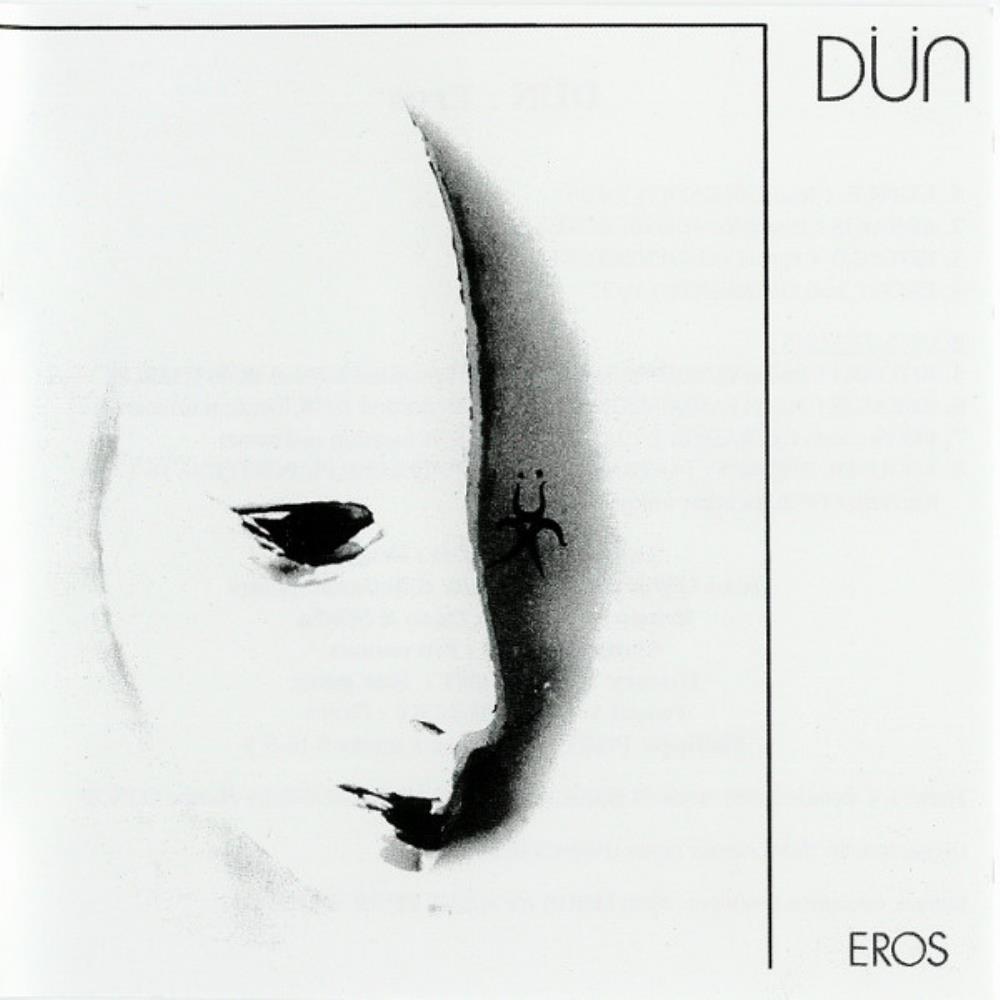
Prog Progress 1981: Dün - Eros

Hi, everyone! Welcome to Prog Progress, a blog series in which I journey through the history of progressive rock by reviewing one album from every year of the genre's existence. You can read more about the project here. You can learn about what I think are some of the roots of progressive rock here. You can see links for the whole series here.


I should probably create a boilerplate for what I'm about to say, given that I've said it to one degree or another in the past three posts of this series: 1981 was not a particularly notable year for progressive rock.

As before, this is partially because a lot of the classic '70s bands had either disbanded (this year, none other than Yes kicks the bucket, albeit temporarily) or moved on to other sounds, like pop (Rush[1] comes out with the all-timer Moving Pictures, for example, and if you've heard one Rush song on mainstream rock radio, it's almost certainly "Tom Sawyer") or some other unclassifiable direction (King Crimson's Discipline isn't really prog in the classical sense so much as it is experimental new wave, while as always, who knows what Frank Zappa is doing on something like You Are What You Is). It's also partially because there just wasn't a ton of young creative energy surrounding the genre in 1981, though by this time, you're starting to see a little bit of the shape of prog to come with some new bands forming—1981 sees the formation of Queensrÿche, for example, who would go on to take the vanguard of progressive metal in the '80s, while Marillion and Twelfth Night, who would both become pivotal to neo-prog, had already been active for a few years. But none of these bands had yet recorded anything close to their definitive work, nor had they caught on in any meaningful way with listeners, which yet again leaves the broader direction of progressive rock meandering.

So as with 1980, I'm using my 1981 post as a way to fill in some of gaps that I left in continental European prog while I mainly focused on British prog in the '70s. Last time, it was Germany's krautrock/kosmische musik. This time: zeuhl!

I imagine that there is a not insubstantial subset of readers[2] whose first reaction to the previous sentence is, "What the hell is zeuhl?", and unless you are French, that would be an understandable response. Unlike krautrock, none of the bands associated with zeuhl have ever really broken out into the broader English-speaking mainstream, which makes it a somewhat obscure corner of the prog world, even today when most of recent music history rests at the fingertips of anyone with a Spotify account. And then I chose to cover Dün in this post, which makes this extra fun, because that means I get to talk about an obscure piece of an already obscure corner of a somewhat niche genre. Blogging is a wonderful thing.

So anyway, what the hell is zeuhl? Hold on. This will take a minute.

So while the UK was busy being the international face of progressive rock, a lot of the rest of Europe was having its own take on the genre: prog had a strong pull in Italy, for example, and I've already talked about Germany's prog last time. Each country's national scene had its own quirks, but France's takes the cake. See, in France there's this band called Magma; other French prog bands exist, but Magma is far and away the most famous and also the one that's relevant to zeuhl. Magma was started by a drummer named Christian Vander. Like a lot of first-wave prog bands, the band started coming together in 1967 (though they wouldn't be fully active until 1969) at the height of the counter-cultural psychedelia movement. Unlike a lot of prog bands of the era, though, the band's genesis wasn't Sgt. Pepper's Lonely Hearts Club Band or an acid trip[3]; rather, it was the sudden death of John Coltrane in July of that year. Vander was apparently so distraught by Coltrane's death that it sent him on a spiral that caused him to quit the band he was in at the time and travel abroad. When he returned to France older and wiser in 1969, he put together what would become Magma in, as Wikipedia puts it, "an attempt to fill the void" left by Coltrane.

The Coltrane influence is pretty apparent on Magma's recordings, which share the spiritual/cosmic fervor of the last few years of Coltrane's output, as well as having obvious compositional similarities in the sense that they are jazzy and unpredictable and built around improvisation. It doesn't really sound like Coltrane, though; being a prog band, Magma had some orchestral ambitions, with a lot of brass and woodwind and even female choirs[4] in their music, and also, being a prog band, Magma also built their discography around this really wild sci-fi concept in which each album was a continuation of a story involving a group of humans who escape a dying Earth to go live on Kobaïa (a planet of Vander's invention). Presumably, at least; I honestly can't understand a word of the lyrics, and it's not because I don't know French. No, it's because most of the time, Magma isn't singing in any human language as we know it but rather in Kobaïan, a language that Vander invented to be the spoken tongue on the planet Kobaïa, so you get song titles like "Rïah Sahïltaahk" and "Kreühn Köhrmahn Ïss Dëh Hündin," and it's anyone's guess what those mean, because they aren't translated into French (or English) in the liner notes. Apparently, Kobaïan is a language "spoken from the heart," without any real semantic meaning, which as far as I can tell means, "made up as we went along [5]," so I guess that makes translation difficult, but we do have at least one word translated for us: zeuhl, which means "celestial."

In case you haven't noticed, this is pretty goofy, even for prog.

Magma, perhaps tongue-in-cheekedly—it's really hard to tell how much of this is meant to be taken seriously—called the music that they made "zeuhl music," and as kooky as a lot of this stuff is on paper, in fairness to them we probably did need a special term for this music, because it is unlike anything else I have ever heard. Philosophically, the expansion of rock instrumentation to orchestral grandeur with the purpose of realizing some big sci-fi concept fits right in with the general prog ethos, but sonically, this is something entirely its own. The mix of jazz improvisation, the guitar wails, the choral chants, the conlang thing—it accumulates into something pretty stunning on an audio level. That contrast between the ludicrously whimsical stuff on the textual level and transcendent, serious stuff on the musical level feels like the key to the particular heady, hair-brained alchemy Magma achieve, like the comedy rock undergirded by virtuosic instrumentation that Frank Zappa traffics in swallowed whole by a group of space aliens and taken to the stars. When I'm listening to it, I find myself often caught up in its sweep while simultaneously being pretty amused that something so goofy not only exists but also has sweep in the first place. It's otherworldly and completely itself, so it's no surprise that they basically ended up defining French prog in the long run and practically inventing a whole subgenre as other French bands started to mimic their sound.

So anyway, that's zeuhl: a bunch of French bands paying tribute to a Coltrane tribute gone wild.

Magma doesn't have any 1981 albums, but their footprint has a strong showing that year, because while 1981 may have been a weak year for prog in general, it's a pretty strong year for zeuhl music. You have Eskaton's 4 Visions, for example, as well as Eider Stellaire's self-titled debut, and that's only a couple from an overall pretty full offering—a nice reminder that the focus on British prog you usually see from English-speaking dorks like me elides some pretty great music from the rest of the world, and just because the British movement was in decline doesn't mean that the rest of the world's prog was.

At any rate, the zeuhl album I've chosen for 1981 is Eros, the only record ever released by the zeuhl band Dün, and in the spirit of zeuhl's often potent mix between great music and ludicrous concepts, I've mostly picked Dün because in addition to making pretty solid music, they are whimsical and amusing to the max.

Dün begin in 1976 as a Mahavishnu Orchestra cover band called Vegetaline Boufiol, and I would just like to begin this by highlighting the sort of ludicrous and surprising fact that a world exists where the demand for a Mahavishnu Orchestra cover band would be high enough for one to actually materialize. Google Translate isn't returning anything for "Vegetaline Boufiol," which kind of crushes my hopes of this band having some ludicrous vegetable-adjacent name in French, but don't worry, we get to more ludicrousness soon enough. By 1978, the band had changed its name from Vegetaline Boufiol to Kan-Daar, and by this time, they had accumulated quite a cadre of musicians playing instruments ranging from the traditional guitar and drums to relatively atypical things like flute[6]. I guess the vaguely orientalist leanings of that name didn't quite sit well with the band, so they soon changed their name again. Apparently guitarist Jean Geeraerts and flutist Pascal Vandenbulcke were big fans of the novel Dune, so they renamed the band... Dune. Then I guess they decided that that was maybe too on-the-nose, so they made the final change and started calling their band Dün, because nothing disguises your sci-fi dorkdom like an umlaut. They must not have been too insecure about their fandom, though, because two of the four tracks on Eros have Dune-inspired titles: "Arrakis" and "L'épice" (French for "spice"). I love the unbridled frivolity of all this; it's so transparently the product of a bunch of nerdy dudes just hanging out and enjoying each other's company—so silly but so pure, and there's something kind of sweet about the fact that the band clearly never wanted to be anything more than that. Dün eventually opened for Magma at a local festival, and, probably as a result of that connection, they were invited to join Henry Cow's Rock in Opposition movement[7], but they never did get around to joining—"due to neglect and laziness," according to the liner notes of the 2012 reissue of Eros[8]. Ah, Dün. Just bros hanging with bros, ya know?

This ethos ran basically throughout everything the band did. Perhaps most notably and entertainingly, Dün was totally down with the bros just straight-up inventing their own instruments and debuting them onstage. To wit: Vandenbulcke, in addition to playing the flute, also was proficient in an instrument called the gruyèrophone, which he had created himself. If the sheer delightfulness of this is not readily apparent, let me add that this instrument was otherwise known as the "swisscheesophone," and involved, as Vandenbulcke himself described it, "a wind instrument belonging to the hunting horn family, with a tube mouthpiece and a square-shaped bell into which small bits of Swiss cheese are introduced. The technique is not unlike that of a bagpipe. When the player is tired of blowing the instrument, the small holes in the Swiss cheese then burst, taking over from the performer and allowing him to catch his breath." It seems uncharacteristically empathetic of Swiss cheese to know when a musician is tired of blowing, and I'm a little foggy on the mechanics of the whole operation, and sadly, as wonderful a place as the internet can be for this kind of delirious absurdity, it is not wonderful enough to have a clip of someone playing a swisscheesophone that I can find[9]. The sweet sounds of the swisscheesophone also never made it onto any of the band's studio recordings, and I don't think any live recordings of the band exist (can you imagine this band having the wherewithal, either financial or motivational, to make a live recording?), which means that the sands of time have tragically robbed the modern world from experiencing the dulcet tones of the swisscheesophone[10].

But at any rate, I guess I should probably get around to talking about the studio recordings themselves. Unlike Magma, the Dün bros seemed more interested in chillaxin' and jammin' with the boys than in writing lyrics, so they don't have any lyrics, Kobaïan or otherwise, which is fine: Eros's four tracks ("L'épice," "Arrakis," "Bitonio," and "Eros") are all hard-nosed experimental prog whose effect would probably have been disrupted by zeuhl's usual silliness, especially since I can only imagine what kinds of lyrics would have formed from the band responsible for the swisshcheesophone. In fact, the music on Eros is shockingly serious and technical, not just for an album that was halfway inspired by Dune but also for a band as seemingly intent on goofing off as Dün was. For as much time as I've spent in this post talking about the goofy context to Eros, you probably wouldn't find much of the actual music goofy at all if you didn't know all the culture surrounding the album. Each track plays with a foreboding, pulsing intensity built from the complex interplay of Vandenbulcke's flute, Geeraerts's guitar, and Bruno Sabathe's piano/synth keyboards. Sometimes this takes the form of these instruments trading solos (as they do in the opener, "L'épice"), and other times they pile on top of one another in a clashing cachophony (as in the climax of the closing title track); always, the music is driven forward relentlessly by the swirling dual percussion of Phillippe Portejoie's drums and Alain Termolle's inventive and entrancing... something—I don't always know what Termolle is banging on (the liner notes cite xylophone, vibraphone, and "percussion"[11]), but his beats in particular are mysterious and exquisite. The whole record just gels in this off-kilter but kind of tremendous way.

Turns out these swiss-cheese-blowing boys had some chops; Eros is a really good prog album.

Sadly, Dün never completed another record. Eros had already been a shoestring effort. Like a lot of essentially hobbyist, local-band scenesters, Dün self-financed Eros[12], which resulted in an extremely limited pressing of 1000 copies of the album that the band would sell themselves at shows[13]. The band continued to play live shows for the next couple years, but after a few lineup changes, they disbanded in 1983. Soon after, Vanenbulcke and Geeraerts created a Latin jazz group called Nevrose Spirituals (which seems like a weird direction for these guys, but okay) that lasted a short time before Geeraerts, apparently the most ambitious of the Dün bunch, left to attend the Berklee College of Music, and the new band fall apart. Then there was a brief Dün reunion in 1992 coinciding with a '70s/'80s revival concert in Dün's hometown of Nantes, but that's the last time that the band has ever played. And that was pretty much that.

The only other thing to note is that in a sort of small-scale Velvet-Underground turn, those 1000 copies of Eros became objects of minor cult fascination for record collectors and prog fans, which eventually led to the 2012 CD reissue/remaster that I bought. Aside from the zeuhl connection, this is basically why I wanted to cover Eros; the world of prog is dominated by your Genesises and King Crimsons and Jethro Tulls (and later by your Dream Theaters and Porcupine Trees), all of which still have significant radio play, some sort of current incarnation still performing, and/or at least a significant enough legacy that they stay at the forefront of the (admittedly niche) discourse surrounding prog. The ethos of progressive rock is one of size and grandeur; these bands wanted to be impossible to forget, and as such, compared to a genre like, for example, indie rock (which thrives off obscure corners and cult followings[14]), it's relatively rare in prog to have these obscure mythologies of The Greatest Band You've Never Heard Of, who played Swiss cheese instruments and whose only album was a self-financed LP with only 1000 copies in existence. So I thought it would be fun to explore one of prog's few examples of this.

Actually, this is kind of the mythology of zeuhl as a whole; at least in the English-speaking world (and certainly in the United States), zeuhl is a hyper-underground phenomenon, the province of record collectors with a penchant for the avant-garde, Prog Archives contributors, and pretty much nobody else. The zeuhl albums I bought for this post were certainly the hardest (and most expensive) to acquire of any of the albums I've gotten in this series, and they all had to be ordered from European sellers, even the albums by Magma (far and away the most popular zeuhl band). It's an interesting thing to see obscurity within progressive rock, but if you want it, zeuhl is for you. Plus, there's some pretty great music at the end of the scavenger hunt.

Not bad for a Mahavishnu Orchestra tribute making a tribute to a Coltrane tribute in the form of a Frank Herbert tribute.

See everyone in 1982!


1] I would be remiss not to mourn Neil Peart passing here. We lost probably the single greatest rock drummer of all time, and from what I've seen, he seemed like a pretty cool guy in general.

2] The two readers who even still read this series, that is.

3] Well, I suppose I can't confirm that acid wasn't involved. But it's not typically the reason given.

4] Making Magma one of the only major prog bands I know of to extensively use female musicians (even though most of the core members were male). All rock music is, to a degree, male-dominated, but I can't figure out why prog is such a sausage fest even within rock music. Theories welcome, readers.

5] As fans of Icelandic post-rock may recognize, this is a similar tactic that Sigur Rós employed when inventing their Hopelandic language, though Magma's music is considerably less self-serious and baroque than Sigur Rós's.

6] Though I suppose that in the scope of prog, this one's not atypical at all, given the shadow of Jethro Tull.

7] Sort of the "We demand to be taken seriously" of progressive rock, in which Henry Cow and a bunch of other under-appreciated but innovative bands in progressive rock's avant-garde wing tried to garner a larger following in opposition to what Henry Cow saw as the increasingly corporatized and bland music occupying a lot of labels in the UK. Their slogan was, "The music the record companies don't want you to hear." The messaging was a little melodramatic and more than a little self-aggrandizing—it turns out that "the music the record companies don't want you to hear" was also "the music most people don't want to hear." They weren't really successful, clearly, which is a shame, because there was a lot of interesting music in that lineup.

8] Which is where most of my knowledge of Dün comes from, admittedly.

9] You can, however, get an image of a swisscheesophone on a necktie for $28.75 (plus shipping).

10] I have no idea if Pascal Vandenbulcke is still alive, but if he is, can the internet please make it its collective priority to find this man and record him playing his swisscheesophone? I am but a humble blogger, and I have only this one request.

11] What are the odds that he's drumming on blocks of Swiss cheese?

12] Typical of Dün's proto-slacker ethos, the liner notes mention that "there was never any time spent looking for a record company."

13] Again, the liner notes specify that the Dün dudes did this "without looking for a national or even regional distribution." Given prog's usual outsized ambitions, there's something so refreshing about a band who clearly had no ambitions at all.

14] And actually, Dün's fame-eschewing slacker attitude and DIY production fit pretty nicely with, say, '90s indie rock.