Showing posts with label Robert Eggers. Show all posts

Sunday, April 24, 2022

Mini Reviews for April 11 - 24, 2022

Sorry for the week delay! At least I got to see a couple of new movies this week!

Movies

The Northman (2022)
Robert Eggers's newest feature is far and away his most conventional, free from most of the archaic linguistics of The Witch and The Lighthouse and pushing to the margins the folk weirdness and scatological impulses that those previous two movies centered. Actors like Willem Dafoe and Björk carry on the mad-scientist torch of the older, less-studio-financed Eggers, and their eccentricities—both tied to the northern-European pagan mysticism that undergirds the film—are welcome. But for the most part, this is a fairly straightforward revenge saga, starring a bunch of vikings. And it absolutely rips. Pure heavy metal cinema of the highest order, as grisly, gory, and as shouty as you would hope for, performed by a cast that is top-to-bottom completely dialed in to the arch intensity that is this movie's wavelength. It perfectly threads the needle between the self-seriousness requisite in the format and the silliness inherent in taking oneself so seriously, and a lot of this is actually pretty funny while still feeling of a piece with the stone-faced brutality that animates the characters. Also, by virtue of being a movie made by someone with the preoccupations of a man like Robert Eggers, even its more conventional elements are made more interesting than might be otherwise. For example, as a revenge story, it has the expected "When you seek vengeance, you gotta dig two graves" themes, but the meticulous historical and mythological detail present here, however sidelined compared to his previous features, deepens that idea to a treatise on the ways that religion and the personal mythology of "protecting my family" are used as justifications for the cult of masculine violence involved in the endless cycle of death and vengeance. Human beings are not naturally creatures of endless bloodshed but rather creatures who are driven to killing by rationalizing violence post-hoc with elaborate narratives of honor and necessity, and there's something simultaneously moving and horrifying about the deep meaning these characters find in the brutality that the movie goes out of its way to show is functionally nihilistic. It's bleak stuff, but it also involves two characters fighting to the death naked inside of a volcano, which is awesome, so you know, in conclusion, The Northman is a movie of contrasts. Grade: A-

Everything Everywhere All at Once (2022)
The agreeable things about this movie are very agreeable to me. The pseudo-improvised absurdity of the multiverses here feels like a more committed-to-the-bit version of those Rick & Morty interdimensional cable episodes, which I enjoyed quite a bit, and while I certainly understand why people find the Daniels' extremely internet-y sense of humor exhausting, I continue to find it charming and usually hilarious (one particular recurring joke, which was halfway spoiled for me but I won't spoil here, had me in stitches every time it was deployed). There's a home-spun genuineness to both the gags and the effects here that reminds me of Terry Gilliam, a filmmaker who has to be as much of an influence on EEAaO as the Wong Kar-wai and Wachowski connections everybody is already talking about, not just for the practical effects and chaotic surrealism but also for the way that the film uses its aesthetic to blow up its goofiness to a sincere treatise on the nature of reality and meaning-making within the human experience, which feels right out of Time Bandits or Brazil to me. It's not an original idea that life is absurd and only valuable in so much as we are able to find meaningful connections through kindness and empathy (again see: Gilliam, Terry), but it's a powerful one nonetheless that I found movingly rendered here. All of that said, the movie's only real liability for me is such a liability that it knocks the movie considerably out of the top-tier category that the component parts deserve, and that's the length. Friends, two hours and twenty minutes is just tooooo looooong for this movie, and not even barely too long either—I'm talking majorly too long, like 30, 40, maybe even 50 minutes too long. The climax of this movie lasts forever as it makes the same point over and over and over and over and over again, and given the heightened freneticism and naked sentimentality of the film (both of which I like quite a bit in isolation), I felt like I was being bludgeoned with the film until I just went kinda numb after a while. A movie this zippy and energetic deserves a zippy, energetic runtime, and the sad thing is that it doesn't even feel like a lot would have had to have been sacrificed to cut the film down to a more functional length, considering how repetitive pieces of the film (especially the climax) are. Part of the charm of this movie is that it gives the impression that the Daniels were given a blank check to follow any and every filmmaking whim of theirs with absolutely no intervention from any studio suits, and I would hate to spoil that feeling. But maybe someone somewhere could have given some helpful pointers about the runtime? Otherwise, a complete delight. Grade: B+

Viva (2007)
Kinda feeling weird about this one, but, like the other Anna Biller movie I've seen (The Love Witch), it's a marvel of craft, and there's really no denying that, so here's that positive rating. But it is weird that this is using a very exacting pastiche of '70s sexploitation cinema to satirize the patriarchal abuses of the sexual revolution, while at the same time being kind of sexy by virtue of being a pastiche of erotic cinema. And like, it's true that a lot of older sexploitation movies also have this queasy mix of eroticism and gross abuse, but Anna Biller has a hardline moral point of view that very few of those earlier films do, making the queasiness the central intended effect, which is fine—I mean, I hope we all feel queasy about sexual assault! But—and maybe I'm being paranoid here because I'm a fragile heterosexual man (not ruling that out)—there's also this quiet but persistent feeling that Biller's themes are meant to bleed out into a broader conception of sex, wherein heterosexual encounters within a patriarchal society aren't just incidentally abusive but unavoidably abusive by virtue of their inescapable cultural framework. I think it's worth exploring the ways in which our broader social systems override and corrupt even well-meaning ideals to the contrary (and I think Viva is very on-point for criticizing the sexual revolution for not having explored this issue thoroughly enough), so kudos for Viva having the gumption to do so. But also, the sex presented in this movie is just so irredeemably corrupt that it feels like sexual nihilism on a certain level, and I don't know what that means for sexual liberation as a whole. I dunno. The fact that I'm thinking about it this much is probably a good sign that something about these themes is resonating with me, and the film is top-to-bottom a triumph of aesthetic anyway, so maybe I'm just talking myself out of liking this movie as much as I actually do. Grade: B

The Lady from Shanghai (1947)
An utterly bizarre, almost found-object of a movie, an already strange vision (e.g. Welles's "Irish" accent) cut to shreds by the studio with little regard for continuity of tone or coherence of plot, and all we're left with are the scraps that survived. To this end, the film has the feeling of something that's disintegrating as we're watching it, beginning with a fairly conventional noir setup, only to take weirder and weirder pivots to match what seems to be the increased studio interference, including a truly deranged courtroom sequence, until we're at the climactic (and justly iconic) hall of mirrors shootout, and the movie becomes almost entirely abstract, each shot cut to ribbons by its own reflections. Wild stuff—feels of a piece with things like Kiss Me Deadly, i.e. film noirs that feel like they leaked in from a parallel universe. Grade: A-
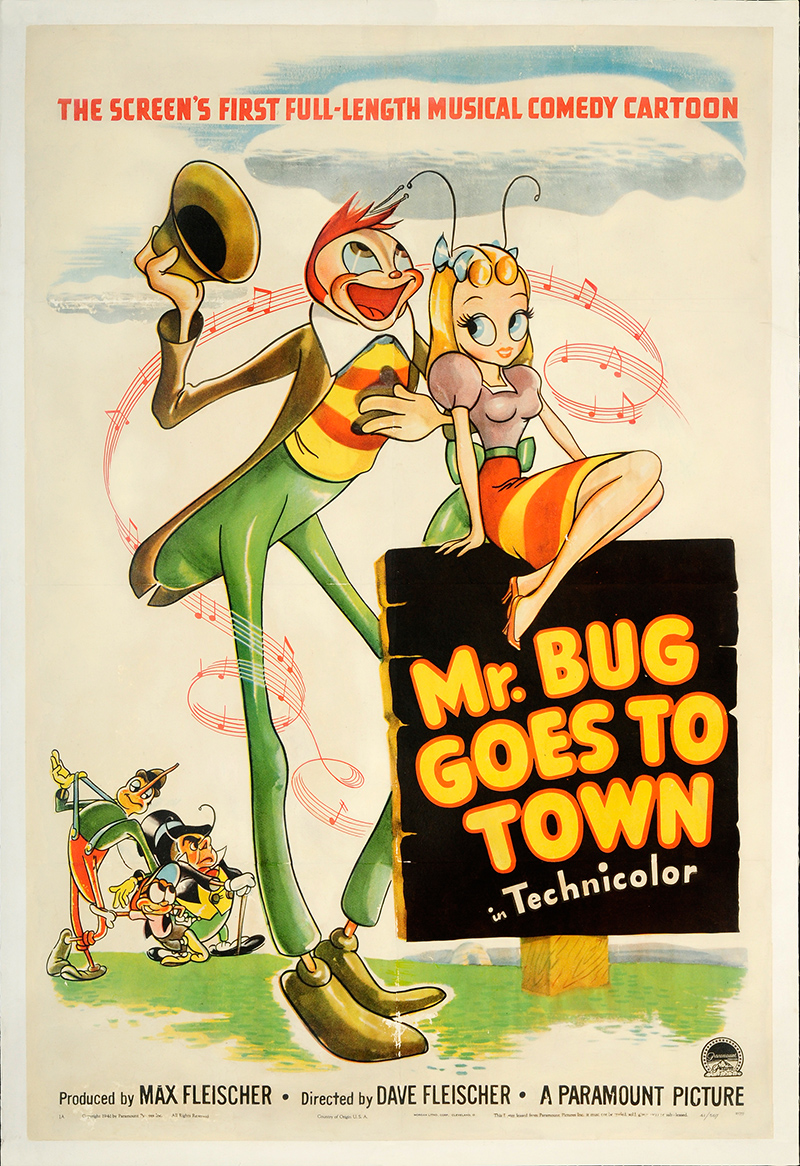
 

Mr. Bug Goes to Town (1941)
I really hate to hand it to the Disney monopoly, but watching the early non-Disney American animated features (of which this is only the second—and only the sixth American feature overall if you do count Disney features!) really makes it completely obvious and understandable why Disney and only Disney came to dominate the animated feature film market in this country. Walt Disney was in masterpiece mode for the entirely of the pre-WWII output, and not just regular masterpieces but things like Fantasia and Pinocchio, medium-defining moments that remain high water marks in American cinema to this day. Meanwhile, the only major competitor, Fleischer Studios, was making dull crap like this. The sad thing is that the Fleischer short films of the preceding decade are far and away superior to the Disney shorts of the same era, but for whatever reason, the transition to feature filmmaking stripped away all the bizarre and inventive instincts of those shorts and resulted in a film that's running on empty, creatively—this is a film in which someone thought it was a good idea to have its protagonist's only major character trait be that he just says "gee weeds" all the time. The animation is fluid and its characters have that irresistible Fleischer design, but the actual choreography of the animation feels perfunctory at best, all that wonderful rubberiness wasted on the stalest cartoon movements. The Disney features also lack the ingenuity of their earlier shorts, but they replace that loss with a visual grandeur and storytelling mythology that makes them absolutely stunning despite being comparatively staid; Mr. Bug Goes to Town has no ambitions of grandeur, which is fine if it were to go for broke with cartoonish mayhem like the Fleischer shorts do. But instead, it just feels like this animation spends the whole movie revving up to something a lot more kinetic and out-there that we never end up seeing. Really kind of depressing that this is something of a last gasp of one of the greats of early American animation (as I understand it, Paramount basically manufactured the dismantling of Fleischer after acquiring it in the early '40s), because this is far from the swan song that Dave and Max's legacy deserved. Grade: C-

The Seven Ravens (Die sieben Raben) (1937)
There's something about European stop-motion films with puppets that is endlessly fascinating to me. Not fascinating enough to help me not be kinda bored with this, but the uncanniness of the animation does feel particularly well-suited to the rhythms and sensibilities of Grimm fairy tales. A lot of early animation is surprisingly intricate, but this film really has a home-spun feel to it, almost like I'm watching a streetside "Punch and Judy" booth or something of that nature, and considering the improvisatory feel of those fairy tales, this works pretty well. I just wish it were a better, more exciting story. Do "Bluebeard" next time. Grade: C


The Black Pirate (1926)
Pretty great sets/costumes, and that two-color Technicolor looks cool. I was completely on-board with this movie in the early-goings when this was about a dude who had pledged bloody revenge against the pirates who murdered his dad, but then he accomplishes this revenge in the first third of the movie and spends the rest of the time tricking the pirates into not doing pirate-y things like sinking ships? Morally, yes, this seems like a good idea, but as a viewer thirsting for pirate content, I feel somewhat let down. Turns out in the end that this guy advocating for moral nobility has been literal nobility the whole time (he's a duke, apparently), so I guess that tracks. Still, nice of him to make sure the pirates didn't rape that one lady; even this pirate-craving viewer can get behind that. Grade: B-

Wednesday, January 1, 2020

Favorite Movies of 2019

2019 sucked. It sucked on a personal level for me and my family, it sucked on a national level, it sucked on a global level.

My son was born, though, which is just such a wonderful ray of positivity in my life while at the same time ushering in a kind of mournfulness for him and the world he will inherit from my generation and the ones prior. I want my son to have a world full of joy and beauty, and while certainly those things will persist, they will do so alongside God only knows what horrible inheritance of the modern age. But in the absence of a material reality that's going to leave a more beautiful world for my son, there is at least art and the legacy it can leave on the human earth for my son to encounter, and readers, you all know that the cinematic arts are near and dear to my heart.

So here are my favorite movies of the year. When my son asks me about this year (if he cares to—and honestly, why would he? I certainly wouldn't want to hear about 2019), I'll have to tell him about children in cages and my brother's death and my grandfather's decline and Jeff Bezos hoarding his billions like a really boring version of a fairy tale dragon. But I also hope to be able to tell him about what made me feel awe and wonder and that rush of being alive, and these movies will undoubtedly be a part of that.

Anyway, enough hand-wringing. Here's the list. As always, it's limited to movie that had either a streaming or theatrical release in the United States during 2019. Also limited to the movies I actually had a chance to see in 2019. So before you ask, no, I didn't get to see Knives Out or Rise of Skywalker.

Also, don't forget about my Favorite Music of 2019 post, in case you missed it and are interested!

Favorite Movies

1. Long Day's Journey Into Night
Filmmakers have long compared cinema to dreaming, but when the protagonist of Bi Gan's towering Long Day's Journey Into Night falls asleep, it results in one of the most thrilling and transporting sequences of film I've ever seen: an hour-long single take that affirms that filmmaking is the nexus between waking and dreaming, heaven and earth. The movie is one half mystery and one half that dream sequence, and honestly, I couldn't describe much more about the opaque plot. But it doesn't matter when it's composed of some of the most dazzling minutes of film ever. The Wizard of Oz for the arthouse. This is why I love movies.

[Read original review]

2. The Lighthouse
Both an unsettling dream of a film and also the funniest comedy of the year. Melville meets Beckett meets whatever strange thought is in director Robert Eggers's head. Willem Dafoe is mesmerizing. The cinematography is lush. The Lighthouse is God. Why'd ya spill yer beans?

[Read original review]


3. Little Women
The kind of movie that makes you glad you were alive to see it. I wouldn't be surprised if after repeat viewings, this became my favorite movie of this year.

[Read original review]


4. The Irishman
Scorsese's death-obsessed swan song for the modern gangster genre is one of the man's best. Like Silence a few years ago, it's about grasping for God and some sense of meaning within a life that has caused immeasurable suffering and resulted in crushing isolation: a bleak rumination on fevered and heartbreaking memories that try desperately (and unsuccessfully) to obscure the wasted life and rotten soul of the protagonist.

[Read original review]


5. Uncut Gems
The most intense movie on this list by far. Adam Sandler's turn as a jeweler who pays his debts with gamble upon gamble is one of the more visceral depictions of the aftershocks of the Great Recession put onscreen (the movie takes place in 2012), Darius Khondji's grainy, nervous cinematography and Daniel Lopatin's relentless, pulsing score highlighting the sweaty desperation of Sandler's character. It's a movie of almost transcendent griminess, and when it reaches its inevitable, heart-stopping conclusion, you'll realize you haven't taken a breath for two hours.

[Read original review]


6. Parasite
Twisty and tense, provocative in its ideas—Gatsby-esque in its critique of capitalism and the pretensions of the upper class, Hitchcock-esque in its propulsive, deadpan drive.

[Read original review]


7. Hustlers
The best mainstream Hollywood release of the year (if we don't count Little Women); the best Goodfellas riff since the OG itself; a rip-roaring heist film by way of a female friendship dramedy. A lot of the movies on my list appeal pretty much to my own niche set of interests, and Hustlers does that, too, but it's also far and away the biggest crowdpleaser of all ten here. I can't say enough good things about it.

[Read original review]


8. Her Smell
Terrible title. Good movie. I can't think of a "rise and fall and rise of a musician" movie that does that arc more effectively than this one. One of Alex Ross Perry's best.

[Read original review]


9. Us
Get Out's messier, more ambitious younger sibling. There's an intensity to the sheer commitment to its host of wild ideas, and the resulting movie is breathtaking in its scope. Jordan Peele's got it, that mad Twilight Zone energy. Lupita Nyong'o's got them, the best performance(s) of the year.

[Read original review]


10. Transit
Transit takes a WWII novel and transplants it into contemporary Europe, provoking questions like: What if there were Nazis in 2019? What if they marched through the streets to round up refugees? What if they didn't wear swastikas and stuff and instead just had on riot gear and police uniforms? Weird, right? Guess we'll never know what that would be like.

[Read original review]


Appendix: Miscellaneous Movies Also Worth Noting

Best Screenplay: High Flying Bird—I'm pretty sure it's Little Women. But if it isn't Little Women, then it's certainly Tarell Alvin McCraney's electric writing on High Flying Bird. And I don't even follow basketball.

Best Florence Pugh in a Flower Crown: Midsommar—Again, this maybe should go to Little Women. But this one gets bonus points for putting Pugh in a flower dress, too. I admire the commitment to the bit.

Best Action: John Wick 3: Parabellum—I mean, it's John Wick. He has a fight on top of a galloping horse.


Animated Corner Award: I Lost My Body—At least among the ones I saw, 2019 was a distressingly weak year for animated movies, hence nothing making my top 10. But animation is also the thing I love most about cinema, so I feel weird leaving it off completely, so here's this movie that was interesting but that I wasn't super enthusiastic about.

Documentary Corner Award: Apollo 11—On the other hand, this was a tremendous year for documentaries (honestly, a great decade for documentaries, which is a relief after the 2000s were a nadir for the form), and Apollo 11, the movie made of mostly previously unseen footage of the original moonshot, is the very best. Its focus on the mundane details of the mission and the spaces around its most famous moments cut through the cultural mythology of the event and emphasis just what a jaw-dropping feat of engineering and physical dexterity landing on the moon was. Stunning.

"Documentary" Corner Award: Rolling Thunder Revue: A Bob Dylan Story—Too good not to include, too fake to call a documentary.

Concert Documentary Award: Homecoming: A Film by Beyoncé—Completely thrillingly assembled footage of the instantly iconic "Beychella" performances. It also probably belongs alongside Rolling Thunder Revue in its work in furthering the mythologizing of its central artist.

Best Outer Space Award: Ad Astra—2019 was a really tremendous year for space movies. If you're looking for "hard sci-fi," you can't get much better than this movie's rigorously thoughtful, realistic depiction of near-future space travel.

Best Philosophical Implications of Outer Space: High Life—I wrote about this at length for Cinematary, if you want to read that.

Best Conspiracy: Under the Silver Lake—A conspiracy film for the internet era. The biggest conspiracy of them all is that you're inventing it all yourself. Facts may not care about your feelings, but what if they also don't care about making any coherent sense?

Best Ghost Story: Atlantics—It's kind of a ghost story. I dunno. See it yourself and find out.

Best UFO Enthusiast: Ash Is Purest White—You'll know him when you see him.

"More People Should See This" Award: Greta—Don't remember too many people talking about this thriller, but it's a good one. Go see it!

"Thank Goodness I Don't Live In Florida" Award: Crawl—Hurricanes? Alligators? No thanks.

"Nope, Florida's Still Not Worth It" Award: Beach Bum—Not even a ridiculously fun Matthew McConaughey performance and some really cool cinematography can make this place somewhere I want to be. Plus: SHARKS??

"You Do You, Man" Award: Glass—M. Night Shyamalan is just doing his thing, and this year "his thing" was making a logically suspect, bizarrely paced mythological elevation of the Avengers. It's very odd, it's not really that good, and it's entirely a Shyamalan joint. Glad our test-grouped-to-death corporate blockbuster age somehow made room for a movie like this.

Least-Favorite Trend of the Year: "Hello, my name is the Walt Disney Company! Remember that thing of ours that you like? We're here to make it worse!"

Worst Disney: Dumbo—A very crowded field; I can't remember a year in which I found so little to like among the corporate titan's film output. And I didn't even get a chance to see The Lion King. But this completely misbegotten live-action adaptation of the bona fide animated classic gets the dubious honor as my least-favorite out of a whole host of rotten.

Worst Movie of the Year: Climax—Gaspar Noé can go sit on a tack. An LSD-laced tack.

Best Non-2019 Movie I Saw for the First Time in 2019: Dusty Stacks of Mom: The Poster Project—Jodie Mack's beautiful, idiosyncratic, personal re-interpretation of Pink Floyd's Dark Side of the Moon, by way of the collapse of her mother's poster business. It's basically perfect, and while it's devilishly hard to track down, if you can do it, DO IT. It's so great.

Sunday, October 27, 2019

Mini Reviews for October 7-27, 2019

It's been several weeks since I've made a blog post, and for those of you who don't know, this is because my brother died two weeks ago. It's been a difficult time for my family, and even though I was still reading books, watching movies, etc., I really didn't feel like writing about them until just a few days ago. I don't know how much my brother read this blog, but my relationship with him casts a long shadow over my reviews. Who I am as a viewer and critic is inextricable from my relationship with him. A lot of our childhood together was spent—as is the case with most siblings, I'd guess—sharing movies, music, and television. We watched Batman: The Animated Series and played "Batman and Robin" together (though neither of us liked being Robin); we rented The Iron Giant from Blockbuster and liked to joke about "coco-lax"; we spent a lot of time doing Toy-Story-inspired surgery on stuffed animals we had. When we were teens, there was a lot of arguing over media, particularly music: he was into blink-182 and Sum 41, whereas I was a budding indie-rock snob. We both liked Dark Side of the Moon, though, and I remember loaning him my CD a lot in high school at night so he could go to sleep to that beating heart. The music fights died down once we were no longer living together and subjecting each other to each other's taste, but I still think about those fights sometimes and the ways in which I've decided he was right and I was wrong (Rage Against the Machine, for example: I of course realize now that they rock).

When somebody close to you dies, the impulse is to try to conceptualize the entire person in your mind, since that's all you have left, but it's hard to the point of impossible to fit a whole human being inside your head because when they're alive, there's no need—what forms in the mind is the organic outgrowth of life and the afterimages of experiences. So when I think about my brother now, it's only pieces of who he is that come to me at a time. Right now, as I'm putting together this blog post, it's these little fragments of shared media that bob to the surface. We are everyone we have ever known, and our relationships with art are part of that, since our experience of art is the collection of these relationships' intersections with the now. To write a review is to remember what fragments you can, as incomplete of a reckoning of a whole life as that is.

Anyway, here are the reviews.

Movies

The Lighthouse (2019)
Man, how do I even describe The Lighthouse? I guess I can now call it a hallmark of writer/director Robert Eggers that his films are heavily steeped in a meticulous recreation of arcane English dialects; in the same way that The Witch had its characters speak in Puritan English, The Lighthouse has its Willem Dafoe character go full-on Captain Ahab/Mr. Krabs seaman English—whatever that's called. The degree to which that sounds goofier than The Witch is a good indication of the difference between the two projects: The Lighthouse is the unhinged-to-the-point-of-hilarity but no less frightening cousin to The Witch's relatively serious drama of isolation. There's a lot to, uhh, behold in The Lighthouse, from its deeply rattling evocation of post-Romanticism "weird" fiction like Melville and Lovecraft to its smotheringly lush late-1800s sea-shanty production to its fevered imagery and unstable reality to its (I kid you not) mermaid genitalia, but the absolute best of it all for me is the complete and total control Eggers and Dafoe have over the effect of this dialect. Long, careening scenes will take hairpin turns of tone bent around ornate speeches and turns of phrase: Dafoe goes from lamenting that Robert Pattinson's character doesn't like his cooking to delivering two minutes of the most elaborate, blistering maritime curse I've ever heard then finally to a small, tender word all in the space of like five minutes, and it's by turns riveting and funny and scary and kind of sad—amazingly, without ever feeling unnatural or out of place. It all just is, spewing forth from this totemic force of a man inside this totemic force of a movie, high and low brows crashing together like waves whipped up by a nor'easter emanating from the deepest well of the masculine psyche. The movie is, among other things, about all the ways in which we humans—but especially we males—cloak our basest urges in all sorts of hierarchies and rituals and how quickly these hierarchies and rituals become indistinguishable from those base urges themselves when we cling to them tight enough. Dafoe's intricate dialect is a vehicle of both his rigid rules for keeping up the lighthouse and also these deeply ancient curses and superstitions that envelope his rules like a force of nature. It's bewildering, terrifying, and very, very funny. Martin Scorsese says that Marvel movies are like amusement park rides, but honestly, none of them ever took me on a ride as wild and thrilling as this. Grade: A

The Raid: Redemption (Serbuan maut) (2011)
I care not a whit for any of the plot or human beings within this movie. But the action is very super good, y'all. I mean, that's the only thing people talk about with this movie, so it's not like I'm blowing any minds. Sometimes consensus is just right. Grade: B


The Happening (2008)
I'm not going to say that people "misunderstood" The Happening upon its release, because so much of what's here defies the typical sort of appraisal: the dialogue has the almost-human surreality of one of those AI-generated scripts ("We ate tiramisu together, that is it"); Mark Wahlberg and Zooey Deschanel give two of the most idiosyncratic and unnatural performances of 21st-century mainstream cinema; the score is ham-fisted to the point of self-parody; Shyamalan's motif of wind blowing through trees feels laughably flimsy. There's nothing here that's conventionally entertaining, that's for sure, and it's no surprise that audiences and critics bristled at this deeply off-beat horror-melodrama-thriller oddity. But I dunno... I kind of liked it. Kind of. I'm not fully with the re-appraisers who want to call this an outsider masterpiece or whatever, but like most of Shyamalan's movies, there's this undeniable energy to the whole thing that's pretty compelling when it isn't just confounding. The way this threads the needle between an evocation of '50s-style B-movie kookiness, an almost arthouse level of seriousness regarding the lived experience of humanity on the brink, and (intentional?) absurdist comedy is just so undeniably its own thing. To be honest, the alchemy of it all feels just a few clicks away from the otherworldly camp that David Lynch taps into, and if people hadn't taken The Sixth Sense so po-facedly seriously and did the whole "Next Spielberg" jig, we might be talking about Shyamalan more in that vein. Maybe. Like Lynch, it's easy to chuckle at the window dressing, like the off-kilter dialogue and weird acting, but its themes (in this case, ecological collapse and the horrifying unpredictability of human self-destruction) are so unrelentingly bleak and unshakeably tethered to my own real-world terrors that it's hard to feel comfortable sitting unambiguously in the "so-bad-its-good" enjoyment mode. Tell me, what on earth are you even supposed to do with First Reformed as filtered through Plan 9 from Outer Space? Grade: B-

The People Under the Stairs (1991)
This movie definitely bites off more than it can chew as far as ideas go. There's so much crammed into this gleefully dark satire that there are a lot of elements that feel half-baked—including the titular people under the stairs themselves, who are never as engaging or interesting or developed as the children protagonists or the maniacal villains. But holy moly, what works here works. I'm all about this movie's hatred of vulture landlords, and I'm especially all about this movie's villains as the Reagans from Hell. Plus, the "'80s family movie, but a Hard R rating" is a very fun vibe. As a movie, it's a LOT, but gloriously so. Grade: B+


Gremlins 2: The New Batch (1990)
Demented and gonzo to an absurdly delightful degree: I almost died of happiness when the gremlins break out into a big musical number to the tune of "New York, New York." The chief pleasure here is just how anarchic it is (very); the movie opens with an animated bit involving the classic Looney Tunes opening, but with Bugs and Daffy fighting for control over the segment, and this is a pretty great microcosm for the level this is working on—quite explicitly a live-action cartoon. As a result, the movie is a little less sharp in its satirical targets than its predecessor's shredding to pieces of Christmas Americana, but '80s NYC yuppies and real estate barons are still worth the chaos that's wreaked on their world here. In a 2019 in which Donald Trump is leading a quasi-fascist regime seemingly bent on destroying everything I like about America, I can see how some people might feel like this movie softballs its depiction of its very Donald-Trump-in-the-'80s-esque villain (he has a semi-sympathetic redemption arc); however, it is a marvelously bitter pill that The New Batch ends with this theoretically reformed villain cashing in his newfound goodwill by deciding to profit from the mass-manufacturing/exploitation of the first movie's small town. It's not just (as the first movie argues) that the concept of "Americana" is flimsy kitsch that can bear none of the weight of reality; it's that this kitsch is a pandering lie cooked up by a craven corporation, and any humanity that once existed within this concept has been wrung out for all the shareholder value it's worth. It's a good thing this movie is an all-time blast, or the cynicism would collapse under its own weight. Grade: A

Halloween III: Season of the Witch (1982)
This movie's reputation as the supreme oddball of the Halloween franchise (taking place in a universe outside the continuity of the Michael Myers entries) led me to believe that it was going to be a lot more meta and self-reflexive in its posture toward the series as a whole. Instead, its relationship with the rest of the series boils down to a few cheeky references, and otherwise, this is a fun little one-off sci-fi horror movie reminiscent of The Stuff and that kind of thing. Most slasher franchises would probably be improved if they eventually just became anthology series like Season of the Witch was apparently trying to make of the Halloween series, so I applaud the attempt here, however unsuccessful. I guess there are already a couple other Halloween continuities we could try this with again, though—get on it, Universal! Grade: B+

Ganja & Hess (1973)
The first Capital-G Great horror movie I saw this October. Spike Lee of course remade Ganja & Hess in 2014, but Lee's somewhat terrestrial preoccupations never manage to hook the deep mysticism of this original. Actually, it's 2012, with Red Hook Summer, that shows ol' Spike most dedicatedly carrying forward this movie's torch—a sprawling, searingly fervent reckoning of Christianity's role in colonialism and slavery, set to wall-to-wall gospel music. Bitter and evocative: eternal life is the price of vampirism, resurrection its perverse horror. But the magic is that oppression never overwhelms the film itself, which blooms into a liberated beauty from the husk of its plot. It is a profoundly spiritual experience—neither the social treatise of Spike's Red Hook Summer nor the neutered eroticism of his remake two years later—but rather inventing its own sublime cinematic language of cross-fades and double-exposures and slow-mo, seemingly from the ground up. Its radical freedom of style and substance forms the perfection of blaxploitation; Curtis Mayfield and stuff form the cultural memory of that movement, a monolith of groovy bass and bottomless cool for semi-ironic appropriation. But at least to me, the elliptical mysticism and self-made mythologizing of this movie (and, to a different degree, Sweet Sweetback) form a much more compelling soul to the whole scene. If you couldn't tell, I loved this. Grade: A

The Blood Spattered Bride (La novia ensangrentada) (1972)
The marketing promises a kind of Spanish giallo, but it plays like a grindhouse take on a Val Lewton picture. Ancient curses and lesbian vampires cooked in a visually rich slow-burn. I'm not always the biggest fan of exploitation cinema, but this is kind of the platonic ideal of it for me: in which it's a trojan horse for the marginalized to wield the lurid tropes of the genre as weapons against its own audience, right up to that final shot, which is probably the most shocked I've been by a movie this whole horror season. It's a pretty nasty movie, and I wish it had made as much space for onscreen queer sexuality as it makes for onscreen sexual violence, but as an indictment of masculine sexual entitlement/aggression, it's damning—not to mention pretty riveting. Grade: B+

Daughters of Darkness (Les lèvres rouges) (1971)
I'm writing this review a couple weeks after I actually saw this movie, and I honestly don't remember the plot hardly at all. But I do remember Delphine Seyrig's wonderful performance—a more sympathetic, vampire iteration of Mrs. Danvers from Rebecca—and I do remember the pretty lush scenery and cinematography, which itself feels like a vampire old-soul version of cinematic styles gone by. Anyway, I remember enjoying this overall. Grade: B


The Velvet Vampire (1971)
A really dope score and some very cool hallucinogenic/dream imagery buoy this movie a bit for me, and there's a deep sadness to the ending that I wasn't expecting. But I guess I'm not really invested enough in vampire stories to begin with to be all that entranced by a revisionist one. Then again, I did love Ganja & Hess, so I dunno why I'm not more excited. Grade: B-


Music

Lover by Taylor Swift (2019)
The first half of this album is fantastic, and things like "Cruel Summer" and "Miss America and the Heartbreak Prince" are some of the best Taylor Swift's ever been at pure pop music: shiny, pristine, hooky, thoughtful. But there's a lot of pretty weak material buried deep in this record, too, material like the lead single "Me!" and the honestly pretty dumb pileup of Britishisms that is "London Boy," and the fact that anything can be buried deep in this album speaks to the biggest issue, which is that it's just too long and, with that, has some really awful track sequencing—the supremely goofy "London Boy" goes right into "Soon You'll Get Better," a song about her mother's battle with breast cancer? Who thought that was a good idea? I'm probably in the minority in thinking that Lover as a whole is a step down from her previous record, Reputation; it lacks that album's thorniness or the arch-villain camp or the thematic complexity. But it's certainly not a weak album, and if we're going just on the basis of high points, Lover has several very high ones. Grade: B

Sunday, March 6, 2016

Whatcha Doing? Mini-Reviews for Feb. 29 - March 6, 2016

Another week, another post of mini-reviews. It's pretty movie-heavy this week, but oh well. Let me know y'all's opinions, too!

Movies

The Witch (2016)
The thing that impressed me most about this movie wasn't the thick atmosphere, the uniformly solid acting, or the fact that it profoundly freaked me out in its final fifteen minutes. No, what I liked best here was the commitment to the period-appropriate Puritan language in the dialogue. Seriously, the whole thing sounds like William Bradford's journal. Which I find awesome. Make of that what you will. Grade: B+


An American Werewolf in London (1981)
Tons and tons of fun. The wolf-transition setpieces are justifiably legendary in their use of practical effects, and the rest is just gravy: the soundtrack and the wise-cracking corpses make sure we don't take things too seriously, and the legitimately moving and sincere characterizations keep things just serious enough. Also, is it just me, or is our intrepid lycanthropic hero struggling to come to grips with his homosexuality? It's a nice twist on the usual wolf-as-virile-heterosexuality metaphor. Grade: A-


After Hours (1985)
So nobody told me that this is like a top-five Scorsese film, huh? Maybe top three. Seriously, it's, what, Goodfellas, King of Comedy, and then this gem of existential hilarity. It's one of those deceptively straightforward movies that you usually get from, say, mid-career Stanley Kubrick or the Coens, where what goes by is so breezy and immensely enjoyable that its dense depths only on you slowlyI'm a particular fan of how the apparent SoHo artistic obsession with horrifying papier-mâché eventually becomes a kind of visualization of our poor protagonist's state of mind. Scorsese's been on a grand, serious streak lately, so how nice would it be if he returned to this sort of lithe, smirking filmmaking? Grade: A


Bridge of Spies (2015)
It's a late-period Spielberg film, which means that you can expect a gorgeously shot, meticulously crafted gem; it's also a current-period Coen Brothers screenplay, which means that you can expect tight, nervously funny repartee. Bridge of Spies isn't quite the miraculous surprise that Lincoln was (nothing's going to beat seeing America's favorite president telling dirty jokes), but it's every bit the earlier film's companion piece, both movies centering on men struggling to perform simple acts of human decency in political climates that require asinine acrobatics to get anything done. If that makes it sound kind of leaden, please hear me when I say that it is emphatically not. Funny, tense, moving: see it. Grade: A-


Books (Plays? I read it in a book, but it's technically a play)

Man and Superman by George Bernard Shaw (1903)
Man and Superman is a weird one in that it has a huge, glaring bit of experimentation (an unconnected and lengthy third act featuring Don Juan in hell) that honestly kind of drags the whole thing down and yet also contains the weight of this play's urgency. I like the frothy romantic comedy that makes up the rest of the play, but it's too lightweight to stand on its own. It's in that long, tedious conversation among Don Juan and Satan where the play actually gets some conceptual drive. Too bad that part's a bore. You know what's not as interesting as philosophy? Taking a break from your real play to have heretofore unintroduced characters discuss philosophy. Oh well. The rest is fun enough that it's not a total wash. Grade: B-