Showing posts with label Disney Animation. Show all posts

Sunday, January 8, 2023

Mini Reviews for December 19, 2022 - January 8, 2023

Between the holidays and a bout of sickness, it's been hard to fit blogging in, so please take this super-sized post as penance for all the missed time!

P.S. My wife and I released another podcast episode, this time about The Tale of Despereaux, which you can listen to here. Enjoy!


Movies

Avatar: The Way of Water (2022)
I haven't seen the original Avatar since I watched it in 2010 on a dorm CRT TV during a floodwatch weekend interrupted by tornado sirens, so there's a pretty good chance I'm wrong about this, but The Way of Water feels superior to the first one. It's basically the same movie: broad, hokey, but achingly earnest anti-imperialist environmentalism filtered through some of the most stunning FX work of all time in the service of some very cool-looking prog-rock-album-cover production design. But as an iteration of that formula, this feels sturdier than my memories of the first, probably because it doesn't do the Pocahontas / Dances with Wolves thing of having the anti-imperialism hinge on a romance and also probably because James Cameron just has a way with water photography in a way that he doesn't with Roger Dean forests and also also probably because the limp context of contemporary Hollywood blockbusters in 2022 just makes it easier to appreciate this film's increasingly rare brand of impeccable technical craft mixed with sincere, archetypal storytelling. I was not entirely sold on this movie for probably the first half mostly because these Avatar movies stubbornly refuse to create interesting characters, and there's a lot of character melodrama in the opening salvo of the film. But once I got to the whaling sequence and felt myself getting palpably upset at the slaughter of the creatures (seriously, one of the most stomach-churning and brutal scenes in a big PG-13 Hollywood release in recent memory), it struck me at how impressive it was that this movie could get me to care about an ecosystem in the way I might care about a character, which is probably the more thematically important thing to do for this movie than to make me care about the actual characters. Anyway, once that scene hits, the rest of the movie is basically nonstop righteous-anger action, executed to perfection—weirdly parallel to the Top Gun sequel in that regard, though of course ideologically polar opposite. Also, I'm struggling to remember the last mainstream Hollywood release that explicitly had the U.S. military as its villain (maybe it was the last Avatar movie?), and as silly and hippy-ish as some of the screenplay's approach to race/imperialism/environmentalism can be, I gotta give it props for not softballing that part. Grade: A-


Glass Onion: A Knives Out Mystery (2022)
I liked this a little bit less than the first one—its structure is a little more ungainly (and the first already had a somewhat ungainly structure), and the knowingly obvious reveal of the killer (punctuated by the "It's so dumb it's brilliant," "No, it's just dumb" interchange) is only really satisfying on a meta level. But it's still a cracking good time because it has all the strengths of the first: the game cast, the pocket-watch-tight technical craft, the almost-camp deployment of mystery tropes, and of course the presence of the delicious, ludicrously fun Benoit Blanc. I wish I could have caught this in a theater (one week only? I truly don't understand this business model, Netflix), but instead, my wife and I watched it on Netflix and still had a ball. Speaking of the internet, though, I'm legitimately perplexed at how apoplectic some people are about the alleged "terminally online" qualities of the movie. Maybe I'm missing some of the nuances because I'm not on Twitter (though make no mistake: I spend too much time online nonetheless), but there's a long tradition in mystery stories of having characters who are broad caricatures of public figures or types, and the satirical easter-egg-ish allusions to contemporary political discourse and celebrities is another thing that doesn't strike me as particularly egregious—just wait until people find out about The Great Gatsby or Citizen Kane! Not saying this is anything on the level as those two, but just because time has obscured the references in them doesn't make them any less allusive. The only thing that felt a little forced to me was the "May 13, 2020" date, which feels less like lockdown commentary (the specter of COVID is hand-waved away with a magic spray mere minutes into the film) and more of a strained attempt to symbolically connect the film's ending with the 2020 BLM protests, since George Floyd's death is just a few days after this film takes place—I appreciate the intent behind the gesture, but also, it's kind of a wish-fulfillment treatment of the outcomes of that political moment, which have had a lot more "pretense for the state to crack down on left-wing organizing" consequences than this movie's ending allows for. But see, the very fact that I can write that sort of thing about this movie is evidence not that this movie is too glib with its politics but that I'm waaaay too extremely online myself. I say this with a note of dismay, since part of my project as a teacher has been to try to get people to understand contemporary resonances and themes in texts, but most people simply do not watch movies that way, even most people clued into politics and literary theory, like my wife. Yeah, sure, I think a lot of people are going to recognize that this movie is dunking on Elon Musk, especially post-Twitter-purchase, but beyond that broad level, I think we're way down the iceberg when it comes to the movie's allusions. I dunno, maybe the fact that I recognized the Lana Del Rey mesh mask thing here is more of an indictment of my spending too much time on the internet than it is of the film itself. Anyway, this is just a long way of saying, "It didn't bother me." This movie is fun! Grade: B+


Strange World (2022)
We're now elbows-deep into a bona fide Walt Disney Animation Studios dark age, so I guess it's time to trot out the daddy-issues sci-fi inspired by 19th-century European lit. This feels about on-par with Treasure Planet in that regard, both for its choice of source material (my childhood Jules Verne phase was basically concurrent with my childhood Treasure Island phase) and in terms of quality (which in both cases is decidedly mediocre). Strange World is mediocre in different but not especially productive ways from Treasure Planet: no Goo Goo Dolls this time around, nor does it have the horrendous CG "virtual sets" mixed with cel animation (Strange World's animation is quite nice as a whole, if a bit auto-pilot for WDAS CG animation at this point—I did love the creature designs and how palpably billowy everything was). But it's also much less enthusiastic in embracing the pulp swashbuckle of its inspiration, and for as much as the characters don't completely work in Treasure Planet, they at least aren't the hopelessly bland mush that comprises the cast of Strange World, who seem to have been conjured whole-cloth from either a mad libs or AI prompt: a son who wants to be different from his father? A father who... doesn't understand??? Gimme a break. A listless shrug of a movie that I hoped would be at least a little bit fun. I'm tempted to suspect that Disney astroturfed the (very dumb) culture war surrounding its racial diversity and gay representation just to give people a reason to care about this movie. Grade: C


Armageddon Time (2022)
A sharp piece of anti-nostalgia—I for one am glad to see the '80s being portrayed as a monumentally bleak time rather than whatever is going on with the seemingly endless '80s revival wave I've been experiencing for most of my adult life. In stretches, this equals its obvious "portrait of the artist as a young man" cinematic companion, The Fabelmans (a few of the family scenes, for example, as well as the scene where the mom chews out her kid for smoking weed), and there's an admirable impulse to make the protagonist just an absolute pain in the specific way that middle schoolers often are, but ultimately this is a lot more prosaic and thinner than Spielberg/Kushner's vision in that film. I don't really understand the distinction people are making between this being a product of white guilt (derogatory) instead of an interrogation of white privilege and the way it interacts with the Jewish assimilation the protagonist's family is aspiring to, and I would say that we need more movies that do the latter. As with everything else in the film, there are stretches where this part of the film is tremendous, but the main problem re: the racial dynamics is simply that Johnny, the black kid, is just not fleshed out whatsoever. There's a kind of logic to that, given the way that the film's point of view is intentionally limited to the white/Jewish half of the friendship, and that limitation could deploy an even more damning exploration of privilege, but if that's the route the film wants to take, it needs to be a little more clever at suggesting depth in Johnny just outside the frame. Instead, he's purely a thematic construct, which is ultimately unsatisfying, especially as that becomes the dramatic fulcrum in the film's climax. When this movie works, though, it really works, and I'd honestly love to see James Gray return to this well rather than going back to the stately period dramas he's been doing (outside of Ad Astra, which feels like an outlier in a few different ways). Grade: B+


White Noise (2022)
A rigidly literal-minded adaptation of a novel that definitely needed some creative liberties taken to be successfully brought to the screen. In general, I found it kind of dull, especially once I realized that Baumbach's screenplay was not interested in doing much beyond visualizing the novel. Kudos to Baumbach for trying something legitimately outside of his wheelhouse, even if it didn't really work—there's an admiral refusal to Baumbach-ize this material, which I appreciate. There are a few signs of life, though: the production design and costuming are terrific, and I dug the LCD Soundsystem dance party in the credits (one of the few places where the movie finds something new to do that nevertheless feels in the spirit of the book). Grade: C


Decision to Leave (헤어질 결심) (2022)
A fun little Vertigo riff, and I'm honestly having a hard time seeing it as anything other than that (there's even a green dress). Which is okay, because—hot take!—Vertigo rocks! That said, credit to Park Chan-wook for doing something genuinely new with depicting digital communication (e.g. SMS) onscreen. Grade: B+


Speak No Evil (Gæsterne) (2022)
For at least an hour of its runtime, this movie is a tense little satire about the discomfort people will undergo in the interest of maintaining a veneer of politeness. The film is great at teasing out its social nightmare scenario: a family agrees to spend the weekend with another family that they only barely know, and once the weekend begins, things immediately feel off but not starkly enough that they can articulate them in a way that would completely justify the impropriety of bailing before the weekend is up. The final thirty minutes of the film take a hard turn into the most absurd and upsetting conclusion possible from the preceding hour, and while I respect in theory the utter nastiness of the film's ending, in practice it just feels like a desperate play at being edgy and dark. Make no mistake: it is pitch dark in a viscerally unpleasant and impressively bleak way, but the extremity of it ruins the sublime tightrope that the film's first 2/3 has managed. For that first 2/3, though, it's one of the best movies of 2022. Grade: B


Watcher (2022)
I don't think I have much interesting to add to what people have already said, re: Maika Monroe being extremely good here, and re: this being basically Rear Window meets Polanski's apartment trilogy. I ended up kind of feeling the same way about it that I did Park Chan-wook's Decision to Leave in that I never really found a way to stop being distracted by this movie's being a riff on older movies and therefore felt a little distanced from it. Maybe I missed what's special about it. Really well-done for what it is, though. Grade: B


Resurrection (2022)
A well-done but not particularly notable psychological thriller—not notable, that is, except for Rebecca Hall's performance, which is an all-timer. She's been slowly building an incredibly impressive résumé of performances in this vein, in which her character's fraying understanding of objective reality begins to unmask a brutal, even feral internalized violence, and this is handily the best of the bunch. Grade: B


Flux Gourmet (2022)
I remain firmly fascinated with Peter Strickland's "thing," despite the fact that this and his previous film were both middling. It's got an incredible hook: a guy in a culinary arts commune is having gastrointestinal issues but has a deep fear of farting in front of others, so he painfully holds his gas in until he learns how to embrace his body and make it art. The resultant movie is intermittently inspired, especially when it focuses on the weirdo stuff that the commune is doing—some bizarre confluence of cooking, performance art, and noise show, which turns out to be super cinematic and visually/aurally interesting. But a lot of the rest of the movie just feels too buttoned-up and mannered to make full use of its setting and premise, and of all of the Strickland features I've watched, this feels the most stylistically inhibited, which is weird given that the whole point of the film is about being less inhibited. Whatever; I'll probably still watch whatever "kink turned textual art film" thing Strickland puts out next. Grade: B-


This Place Rules (2022)
Can't believe I wasted my last movie-watching opportunity of 2022 on this garbage. I haven't watched a ton of Andrew Callaghan's online work, but I've seen enough to know that he has a preternatural, almost Nathan-Fielder-esque ability for using his flat affect to draw incredible comments from the people he interviews, and that's on display here. There are a dozen fascinating documentaries to be made from the raw material captured here (the influencer street fight at the beginning, the heartbreaking QAnon family stuff, the surprisingly lucid Alex Jones interview, any number of the people-on-the-streets rants, etc. etc.), but in maybe one of the most egregious editing hack jobs of all time, this film realizes exactly none of those possibilities, creating instead a flimsy and specious narrative around "wow, people sure were crazy in 2020." Even worse, there's an attempt at political commentary that is so impoverished that it's insultingly obvious (you mean to say that social media and news media have a financial incentive to divide us along cultural and political lines??) when it's not borderline irresponsible, such as the handful of times that the film cuts between footage of left-wing protesters talking about abolition and footage of right-wing protesters talking about Joe Biden being a Chinese communist socialist child molester as if these are equivalent displays of unhinged political fringes. And then after all that, Callaghan didn't even get to attend January 6?? It's not his fault he got COVID, but maybe it would have been a good idea to rethink the whole conceit of "here's how the build-up to Jan. 6 looked from the frontlines!" when you couldn't even make it to the main event. The documentary ends with an almost literal shrug in which Callaghan and a few other people look at the aftermath of Jan. 6 and ask what the point of all of it was, to which Callaghan basically just says, "Money," which is true in perhaps the broadest sense that most things in a capitalist society boil down to being about money, but also it kind of makes me wonder what the point is of making a big, flashy HBO documentary about a major fascist movement in America if you don't seem to understand the point of fascism beyond "money" or the urgency of this moment beyond "huh, people seem upset and misinformed." Andrew, you seem like a good dude, but please give your footage to like Frederick Wiseman or Laura Poitras or someone who actually knows how to assemble the incredible material you clearly have buried here. Grade: C-


Happy Hour (ハッピーアワー) (2015)
Ryusuke Hamaguchi's movies always tip-toe right up to the line of being "too long" before whacking me in the face with emotional catharsis so powerful that I lose track of how long it took to get there. But I think I've decided that five and a half hours is too long even for that approach. Even breaking this up into several sittings, I found myself getting restless as this movie slowly and novelistically wound its way toward its cathartic final hour. I don't really know what I'd cut, though, because the length is totally baked into the whole project here, a warm study of the friendship among four different women and the way that foursome friendship reverberates through their romantic lives, in which the fact that we spend hours with these characters accumulating details and scenes that illuminate their interior lives and connections to each other is a key component of this movie's ability to pay off at the end. More than anything, it reminds me of Rivette, only without the aggressive experimental impulse or the mystical bent. So maybe it's a me problem that I got bored at times, or maybe the best way to watch this is held rapt for hours in a theater rather than watching it over three days on my laptop. Whatever the case, when this gets to the parts where things start happening, it gets really good. Grade: B


The Three Stooges (2012)
Legitimately funny. Reminds me of Altman's Popeye movie in the sense that at least half the fun is its dedication in recreating a thoroughly outdated property with as much fidelity as possible within the then-contemporary studio system. It's impressively committed to the bit, and even though I was only ever a moderate Three Stooges fan at best, I got a lot of joy out of this. The other half of the fun are the bizarre details filling in the corners of this movie. Iggy Pop doing the theme song? Larry David as a nun? "Peter and Bobby Farrelly" appearing before the credits to tell kids not to try this slapstick at home? Delightfully strange. I'm imagining the alternate (superior) universe in which this got Peter Farrelly his Oscar. Grade: B+


A Grin Without a Cat (Le fond de l'air est rouge) (1977)
An incredible piece of analysis of the moment when (in retrospect) the tide turned toward capitalism's eventual "victory" over the 20th century. Given that capitalism is, like, evil and that we really have never returned to anywhere close to the collective revolutionary consciousness in the late-'60s/early-'70s that this film depicts, it's a pretty dispiriting watch, but that said, for as depressing as it is, it's also remarkably fun and funny at times, too, mostly because of the terrific eye for archival footage—Fidel Castro describing how to make lasagna, for example. It also struck me as I watched this how few documentaries are truly like this now, i.e. actively analytical instead of explanatory. Most political documentaries that aren't just vérité are usually busy explaining information, but this documentary barely does any of that, which makes it, in that regard, much more of an "essay" in form than documentaries usually are. I haven't watched much Adam Curtis, but I guess he's the big one carrying on the torch? Otherwise, it's hard to think of many documentaries released in the past couple decades that are formatted like this. Grade: A


The Mortal Storm (1940)
Mostly notable for being 1) an early anti-Nazi Hollywood film, and 2) unrelentingly bleak in its depiction of the Nazis—Chaplin is obviously the better filmmaker in general, but The Great Dictator is kind of embarrassing in its comparatively soft and vague treatment of Nazism when something like this already existed. As with another big 1940 Jimmy Stewart film (The Shop Around the Corner), it's amusing how Stewart's performance here just kind of refuses to pretend to be anything resembling Central European. Grade: B


Books:

Dead End in Norvelt by Jack Gantos (2011)
A really entertaining and surprisingly political Newbery Medal winner. One of my favorites I've read so far, and you can hear more about it in the episode on it my wife and I did on our Newbery Medal podcast! Grade: A-


The Tale of Despereaux by Kate DiCamillo (2003)
A fun, fairy-tale-esque Newbery winner. I really like the bemused narrative voice (shades of Lemony Snicket) and the interlocking story structure. Some of the characters work better than others. You can hear more thoughts on the episode on it my wife and I did on our Newbery Medal podcast! Grade: B+

Sunday, December 5, 2021

Mini Reviews for November 29 - December 5, 2021

For anyone who missed me posting this on social media, here's the really long essay I wrote on 2014's Noah movie that was published this week! I was also on the Cinematary podcast talking about the same movie! Great week for my Noah obsession.

Movies

Encanto (2021)
The animation is fun and colorful, and it contains some of the nicest-designed characters in recent Disney animation—especially the protagonist, Mirabel, who, with her perpetually wobbling eyeglasses, comes as close to approximating the language and ethos of a traditionally hand-drawn cartoon character as any character I can think of in one of these Disney CG features (which of course just raises the obvious question of "then why didn't they just make it a hand-drawn feature to begin with?", though I guess I should just resign myself to losing that battle). So it's not like this is a "bad" movie. But good lord, the writing. There are all sorts of problems with the screenplay, from the fact that nobody but the protagonist has any indication of an internal life until the plot necessitates it to the way that the movie stresses a "you're important because you're you, not because of your abilities" message while at the same time reducing about 75% of its cast to their magical abilities. But probably the single most dysfunctional part of the film is the extreme dissonance between the film's exposition, which depicts a family so toxic that it ostracizes our protagonist for what seems like probably a decade and compels her uncle to go into hiding for the same period of time, and the film's resolution, which acknowledges that toxicity while also presenting its solution as essentially "hug it out." I can't decide if the writers have underestimated just how awful the beginning of the film makes the family look or if they've overestimated the heavy-lifting ability of the ending's symbolism to account for the beginning, but regardless, there's been a major miscalculation somewhere, and the result is a movie that feels at first daringly mean before revealing itself to be disappointingly empty. I ask the people of Walt Disney Animation Studios: is it so hard to find a functional screenplay? This has been a perennial problem since basically the Walt years, but it's felt especially urgent in the past 10-ish years, now that Disney films are intent on being "about" something. I'm begging you: write better. Grade: B-

Real Life (1979)
Utterly scathing satire of the way that film/TV production destroys souls on either side of the camera. The whole thing is amazing, but Albert Brooks in particular is just astounding. Incredibly audacious, especially for a feature debut, to write such an unflattering role for yourself and have that be the point—perhaps the only thing more audacious is having this movie exist and then the first major reality television program of note be named what is essentially a synonym of this movie's title. Maybe I just run in the wrong circles, but why don't people talk about this movie more? Grade: A


Phantom of the Paradise (1974)
Literally felt like I was losing my mind watching this. Sometimes the relentless Too-Muchness of the movie is numbing, but it's also kind of incredible, too. Where did this Brian De Palma go? Because this is like no other Brian De Palma movie I've ever seen. The "Psycho shower scene but the knife is a plunger instead of a knife" has got to be the best De Palma Hitchcock homage, right? Grade: B+


The Abominable Dr. Phibes (1971)
A Vincent Price who uses a turn table to speak kills people in ways inspired by the ten plagues from the Exodus story. It's like the funny, colorful version of Seven, only if that movie had bumbling British cops clicking their tongues every time they came across a victim, like, "Blasted shame the locusts ate that bloke's face off. Blasted shame." Big fun. Grade: A-


Music

Blue Lick - Hold On, Hold Fast (2021)
It's a pretty unassuming release: spoken-word lyrics (by Havadine Stone) droning over an experimental soundscape (by Ben Baker Billington). Apparently Stone did the spoken-word all in one 30-minute take and then sent it to Billington, who creates the sounds to match on a custom modular synthesizer, so even the process of making this itself is unassuming. But I've probably listened to this album more than any other 2021 release; I've been putting it on during my planning block at school almost daily, and it's just the best vibe for that: comfortable sonic textures for when I'm working, with plenty to pay attention to when I want my mind to wander from lesson plans and grades. The scratches and gurgles of Billington's soundscape are great to get lost in, and Stone's lyrics are surreal, dryly hilarious, and occasionally profound (sometimes all three at the same time: there's a whole aside about how the air that keeps us alive was once in someone's bleached asshole, which is as contemporary an update of the "water is dinosaur pee" as I can imagine). Anyway, I imagine this is most definitely not for everyone, but I think it's really cool. Grade: A-

Monday, April 5, 2021

Mini Reviews for March 29 - April 4, 2021

 Sorry for posting a day late! Easter was busy. By the way, Happy Easter to those who celebrate! He is risen!

Movies

Raya and the Last Dragon (2021)
A movie of impeccable craft on a technical level but of barely passable craft on a narrative one. This is a stunning movie to look at, probably the pinnacle of the specific aesthetic Disney CG animation has been chasing since Tangled, with detailed particle effects and landscapes that would seem photorealistic if they weren't obviously impossible fantasies and smooth-skinned, doll-like characters rendered expressive by vibrant (but never too exaggerated) character animation. It very much feels like the coming-of-age for the "house style" of Disney's last decade in the same way that Beauty and the Beast was for the '90s Renaissance. The big difference between Raya and the Last Dragon and Beauty and the Beast is that there is absolutely nothing going on in Raya besides the animation craft. Seemingly assembled entirely from component parts of other movies and sequenced into a video-game-like episodic quest for crystal shards, Raya and the Last Dragon would be frightfully generic if it weren't for the considerable strengths of the visuals, and even with those visuals, this movie left me pretty restless by the end. Unlike other recent animated Disney movies, Raya doesn't have shaggy detours or nagging abandoned plot threads—instead, it's so pristinely "Screenwriting 101" that it sucks all the life out of the story. Every character and scene is fine-tuned to contribute its own special piece of the plot, but in making this such a sleek machine, the filmmakers forgot to make any of this emotionally resonant or make its characters have any complexity. Say what you will about other recent Disney films, but their protagonists at least had recognizable internal conflict and identifiable personalities. Raya, by contrast, just feels like a personified screenwriting tool going through the motions of having an arc and theme, and Sisu (the last dragon herself and the only other possible main character) has a bad case of "Disney comic-relief sidekick." Namaari, the sort-of antagonist, has the potential to be a lot more interesting, given the apparent conflict between her and her mother, but that only gets, like, two scenes, so instead, she's as underdeveloped as the rest. Thank goodness for the animation to hold my attention. Grade: B-

Bloody Nose, Empty Pockets (2020)
I have no real-world emotional attachment to bars—I'm not much of a drinker, personal experiences have given me I exactly zero romanticism for people being drunk, and I also have the incredibly old-man-ish posture of disliking how all barside conversations have to be conducted with raised voices. But the dive (along with social clubs and union halls and neighborhood churches) is yet another cornerstone of "third spaces" crumbling in America, and I care deeply about that erosion, so this hit me pretty squarely in the feels regardless. And this is just such a warm, beautiful depiction (fictional or not—I'm a little fuzzy on the production here) of the kinds of communities that can form in those spaces. It's like Cheers with all the dopey stuff stripped away—people even call regulars' names in unison as they enter the bar, as if they're NOOOOORM or something. I love it. Grade: A-

Bob & Carol & Ted & Alice (1969)
When people talk about Hollywood's new wave, they tend to focus on the ways that people like Scorsese and Coppola took Hollywood genres like the gangster film and roughed them up with shagginess and European cinematic techniques. I like those movies, but I wish people would also talk about movies like this, which also feel European (the long, talky takes and editing feel indebted to Truffaut or maybe a more down-to-earth Fellini) but are a lot less self-consciously grand and mythologized than your Bonnies and Clydes and Mean Streetses. There are a lot of really specific, everyday cultural details in a movie like this that tends to get lost in the revisionist genre impulses of the more famous New Hollywood movies—the Esalen Institute retreat, for example, or the part where Robert Culp's character is unironically wearing something that looks like the Seinfeld Puffy Shirt, or the Tex-Mex restaurant's drive-through speaker, or just generally the unadorned depiction of upper-middle-class So-Cal life at the time. I dunno, I just found that really interesting. Besides that, I think it's a shame the way that this movie's legacy is staked on the supposed "orgy" at the end—not because that isn't an important, tender moment in the movie but because the way I've heard some people talk about it kind of marginalizes what's meaningful about that part and dismisses the movie as a sexual-revolution curiosity rather than as the strikingly honest, lovely treatise on the ways in which people find connection and love that it is. Also, this has maybe my favorite Elliott Gould performance—the whole central cast is great, but he in particular is just so vulnerable and real here in a way that I don't think I've ever seen him before. Grade: A-

The Bellboy and the Playgirls (1962)
Just awful. One of the worst movies I've ever seen. Boring, flimsily made, and deeply, deeply sexist on a level that I'm not sure I've ever seen a movie be on before—the whole movie is either some dude peeping into a hotel room full of women, and a director lecturing an actress about the history of horniness so he can coerce her into doing a sex scene on camera. It's vile. I watched this because I've decided to be a Francis Ford Coppola completionist, but that was a mistake because: 1) this was a tedious waste of my time, and 2) he only directed (co-directed, at that) a small part of the movie; this is one of those "let's do a hilarious dub of a foreign film and put in some nudity so we can run it on the porno circuit" things, which was just the worst trend in American cinema. Coppola's other early, pre-"respectable" feature, Tonight for Sure, had enough of a spark of fun that I was willing to give this a shot, but I regret that now and am actually kind of mad that Tonight for Sure was good enough to seduce me into watching this. Boo. BOOOOOO. Grade: F

Sunday, December 1, 2019

Mini Reviews for November 25 - December 1, 2019

Holiday week = posting this late. Sorry!

Movies

Frozen II (2019)
Frozen II has a lot of the same liabilities that the original Frozen had: messy plot structure, boring throwaway songs aplenty, no idea whatsoever what to do with Kristoff, etc. But all of these liabilities are much worse in Frozen II, and none of the highs are nearly so high as the original's, resulting in a movie that's desperate to please and dysfunctional to the max. The movie is at its best when it is a psychologically weighted dark fantasy quest into an unknown wilderness; all of the best songs in the movie revolve around this, as does Elsa's whole character arc, and it leads to some really arresting imagery and increasingly abstract landscapes that culminate in a nifty and pretty resonant sequence involving Elsa alone in a cave with the literally materialized collective memories of her family. Outside of that, though, the movie is a complete mess. The movie opts to take the Pirates of the Caribbean approach to making a sequel, which means that it takes every single detail from the first movie and invents a byzantine mythology connecting them all (including, I kid you not, the chanting motif that plays over the title card of the original film). It's cumbersome and convoluted, no thanks to the screenplay, which is, frankly, a disaster: characters are yanked from one location to the next with only the barest of connective tissue, subplots are shoved in solely to give all the main cast from the original stuff to do (Kristoff is, to dust off my intimate knowledge of this Disney deep cut, basically doing the Bernard arc from The Rescuers Down Under, and it is extremely out-of-place), and the main plot is tangled in a (to put it charitably) half-baked analogy to the conflicts between indigenous peoples and colonizers. The whole thing operates under the deus-ex-machine-esque logic of Magic Portents and Spirit Energy, which works really well for the Elsa material but renders absolutely everything else here as contrived and silly, not to mention structurally incoherent. It's not irredeemable; there is good material in here. But if 2010s Disney animation was a revival of the '90s Renaissance spirit, then Frozen II (and Ralph Breaks the Internet, let's be honest) put us squarely within the post-Tarzan hinterland. Grade: C

Amazing Grace (2018)
This long-shelved Aretha Franklin footage has a relentless physicality to it—both in terms of the actual film style, shaking and out of focus and smudged by stray hairs and the grime of the film stock itself, and the performances captured by that style, awash in sweat and thunderously alive. It's certainly an effect, oftentimes an evocative one but sometimes unnecessarily distracting in a way that obscures the performances themselves—probably inevitable, given the way this movie was cobbled together. But at its best, Amazing Grace has preserved one of the most striking and vibrant American art forms, the communal gospel experience, with all its verve and beauty, performed to near-perfection by one of America's great artists. Imagine music like this existing and white people still just singing Chris Tomlin at church. Grade: B+

Tuesday, After Christmas (Marți, după Crăciun) (2010)
This movie has two great scenes. The first is the first scene of the entire movie, in which we see an unbroken 7-8 minutes of a couple in post-coital bliss, as playful and intimate a depiction as I've ever seen of the affectionate goofiness that loving couples engage in. The second is about an hour later, when the wife of the man in that first scene finds out about the woman in that scene (who is, of course, not the wife). This scene is excruciatingly long and ranks among the similarly scorched marital fights of Before Midnight and Scenes from a Marriage. But the rest of this movie... ehhh, I dunno. It's really boilerplate Romanian New Wave, which for me means that I struggled to get too excited about the improv-y dialogue and bare-bones, naturalistic camerawork (this is a personal problem, I know, but I've yet to encounter a Romanian New Wave movie I love). It doesn't help that I don't really relate to the central conflict at all—"OH NO, I love two women at the same time, one of whom I am married to! Whoops!" I dunno, it's just not something that I intrinsically connect with, and while there are plenty of movies about anguished infidelity that I find extremely moving (Carol, Brief Encounter, etc.), the cavalier libidinousness of cheating on your wife with your kid's dentist just makes it hard for me to get too invested in the handwringing here. Grade: B-

Alien Autopsy: (Fact or Fiction?) (1995)
I wouldn't normally review a TV special, but this is such a primo example of the sort of '90s conspiracy theory programming I absolutely devoured as a kid that I kind of felt obligated to mark the occasion of a rewatch—because I'm reasonably sure I watched this as a child, though I would have been far too young to have watched it without parental supervision when it first aired (and there's no way my parents would have been watching this stuff—my dad, who was in the Air Force for over twenty years, scoffed when I once asked him about Roswell [but isn't that what they would have trained him to do???]). Perhaps I just gleaned it from the dozens (hundreds?) of conspiracy theory books I read back then, since I remember stills of the autopsy footage featuring prominently in their pages. Even twenty years removed from my obsessed heyday with this stuff, this is still a solidly enjoyable hour of endearingly po-faced dopiness; there's something so pure about this special's approach to its subject matter as opposed to its winky History Channel offspring: this sort of curiosity-shop-style sowing of "reasonable" doubt—"What if? What if?" Also, props to the audacity of the guy who created this hoax for getting one of his talking heads to say that if this is a hoax, it's the greatest hoax of all time. Grade: B-

The Pied Piper (Krysař) (1986)
A flat-out masterpiece and maybe the best animated feature of the '80s (at least, of the ones I've seen). This movie belong to that exceedingly rare genre of movie—the animated horror film—that I am always delighted to come across. "The Pied Piper of Hamelin" is already one of the darker stories we tell our children, and filtered through the notoriously nightmarish Czechoslovak stop-motion style (think Jan Švankmajer, only with woodcut puppets), it becomes a work of primal terror. Cloaked with a deeply macabre atmosphere and an expressionist set design that warps the central town in on itself in an impossibly crooked way, this movie burrows deep into your mind and won't let go until its haunting final minutes—even more so because of the sadness this movie imbues the piper's otherworldly aura with. Horrifying to behold, but impossible to look away. Grade: A

Tuesday, July 31, 2018

Ranking Walt Disney Animation Studios Films


So I thought I'd officially close my Disney animation retrospective with a good ol'-fashioned list post, with a few small comments at the bottom. Hope everyone has enjoyed this series!

Disney Movies, Ranked
It's just my opinion, but search your feelings; you know I'm right.

1. Pinocchio
2. Fantasia
3. Beauty and the Beast
4. Sleeping Beauty
5. The Emperor's New Groove
6. The Many Adventures of Winnie the Pooh
7. The Little Mermaid
8. Lilo & Stitch
9. Alice in Wonderland
10. Dumbo
11. The Three Caballeros
12. Winnie the Pooh
13. Aladdin
14. The Hunchback of Notre Dame
15. One Hundred and One Dalmatians
16. Tangled
17. Moana
18. Mulan
19. The Adventures of Ichabod and Mr. Toad
20. Tarzan
21. Wreck-It Ralph
22. Bambi
23. Frozen
24. The Lion King
25. Snow White and the Seven Dwarfs
26. The Rescuers Down Under
27. Zootopia
28. The Princess and the Frog
29. Melody Time
30. Bolt
31. The Jungle Book
32. Fantasia 2000
33. Big Hero 6
34. Peter Pan
35. Meet the Robinsons
36. The Sword in the Stone
37. Brother Bear
38. The Great Mouse Detective
39. Lady and the Tramp
40. Hercules
41. Cinderella
42. The Fox and the Hound
43. Robin Hood
44. Saludos Amigos
45. Atlantis: The Lost Empire
46. The Black Cauldron
47. Treasure Planet
48. The Rescuers
49. Home on the Range
50. The Aristocats
51. Fun and Fancy Free
52. Dinosaur
53. Make Mine Music
54. Pocahontas
55. Oliver & Company
56. Chicken Little


Disney Movies, Ranked by Quality of Animation
Since I've been so obsessive about the animation during this series.

1. Pinocchio
2. Sleeping Beauty
3. Fantasia
4. The Hunchback of Notre Dame
5. The Lion King
6. Beauty and the Beast
7. Snow White and the Seven Dwarfs
8. Bambi
9. The Princess and the Frog
10. The Little Mermaid
11. Aladdin
12. The Three Caballeros
13. Mulan
14. One Hundred and One Dalmatians
15. Winnie the Pooh
16. The Many Adventures of Winnie the Pooh
17. Tangled
18. Dumbo
19. Alice in Wonderland
20. Brother Bear
21. Lilo & Stitch
22. Tarzan
23. Pocahontas
24. The Rescuers Down Under
25. Moana
26. Wreck-It Ralph
27. The Emperor's New Groove
28. Peter Pan
29. Lady and the Tramp
30. Fantasia 2000
31. Melody Time
32. Atlantis: The Lost Empire
33. The Adventures of Ichabod and Mr. Toad
34. Frozen
35. Fun and Fancy Free
36. Hercules
37. Cinderella
38. The Black Cauldron
39. Zootopia
40. Big Hero 6
41. Bolt
42. Home on the Range
43. Saludos Amigos
44. Treasure Planet
45. The Great Mouse Detective
46. Make Mine Music
47. The Jungle Book
48. The Sword in the Stone
49. The Fox and the Hound
50. The Aristocats
51. Meet the Robinsons
52. Robin Hood
53. The Rescuers
54. Oliver & Company
55. Dinosaur
56. Chicken Little


Top 20 Favorite Disney Songs
Tried to rank these just in terms of how much I like the music, though obviously, it's hard to divorce them from their associated animated sequences.

1. "When You Wish Upon a Star" (Pinocchio)
2. "Gaston" (Beauty and the Beast)
3. "Under the Sea" (The Little Mermaid)
4. "Heaven's Light / Hellfire" (The Hunchback of Notre Dame)
5. "Cruella De Vil" (One Hundred and One Dalmatians)
6. "You Can Fly! You Can Fly! You Can Fly!" (Peter Pan)—yes, that's really the song's title
7. "Kiss the Girl" (The Little Mermaid)
8. "The Bare Necessities" (The Jungle Book)
9. "Part of Your World" (The Little Mermaid)
10. "Circle of Life" (The Lion King)
11. "The Bells of Notre Dame" (The Hunchback of Notre Dame)
12. "Heigh-Ho" (Snow White and the Seven Dwarfs)
13. "Winnie the Pooh" (The Many Adventures of Winnie the Pooh)
14. "The Journey" (The Rescuers)
15. "Belle" (Beauty and the Beast)
16. "How Far I'll Go" (Moana)
17. "The World's Greatest Criminal Mind" (The Great Mouse Detective)
18. "A Whole New World" (Aladdin)
19. "Baby Mine" (Dumbo)
20. "Colors of the Wind" (Pocahontas)

10 Musical Pieces That Should Definitely Be in Fantasia 2060
1. "Shhh / Peaceful" - Miles Davis
2. "Psalm" - John Coltrane
3. "Music in Twelve Parts: Part 2" - Philip Glass
4. "Symphony No. 9 in E Minor: II. Largo" - Antonín Dvořák
5. "The Lark Ascending" - Vaughan Williams
6. "West End Blues" - Louis Armstrong
7. "Larks' Tongues in Aspic, Part One" - King Crimson
8. "Ride of the Valkyries" - Richard Wagner (Disney's apparently considered this before—just... please don't make it racist...)
9. "Eruption" - Van Halen (because this will definitely be "old-fashioned music" in forty years)
10. "Symphony No. 9 in D Minor: IV. Finale" - Ludwig Van Beethoven (why not?)

(I need some women on this list... suggestions?)


Best First-Time Watch: The Three Caballeros. Disney on peyote—can we get more of this kind of stuff? Please?

Worst First-Time Watch: Chicken Little. Obviously.

Biggest Surprise of this Retrospective: The Three Caballeros (again). Thank goodness for this beautiful, insane mess.

Movie that Most Benefited from Rewatch: Lilo & Stitch. This is why I should rewatch movies more often—how had I forgotten how good this movie is?

Movie that Least Benefited from Rewatch: The Rescuers. How had I forgotten just how sloppily plotted and animated this movie is?

Favorite Disney Animation Trend: "What if we hired this Alan Menken dude?"

Least-Favorite Disney Animation Trend: "You know what this movie is missing? An obligatory, unearned romance."

Best Comic Relief Character: Kronk (The Emperor's New Groove)—though maybe this is cheating, since the whole movie is comic relief? Okay, if it is cheating, then my other answer is Joanna (The Rescuers Down Under).

Worst Comic Relief Character: Whatever that lemur's name is in Dinosaur. Does something count as comic relief if it isn't funny?

Monday, July 30, 2018

Disney Review: Zootopia, Moana

I'm blogging through all the feature films released theatrically by Walt Disney Animation Studios! For more information on the project, you can visit my introductory post here. You can see an overview of all the posts in the series here.

This post is unique in that these two movies have come out recently enough that I've already written reviews of them on my normal weekly review feature. You can read the Zootopia review here, and you can read the Moana review here.

Also, it's the LAST REVIEW POST OF THE SERIES! Thanks for sticking it out the whole time and giving some great feedback. I've also had way more readers for this series than I usually do, so if you're new, I hope you'll stick around. Anyway, I'll have one more post wrapping up the series with some goodies in it, so stay tuned for that.

EDIT: Here's the wrap-up post!

You can read the previous entry in the series here.

55. Zootopia (2016)
Disney's track record with race is... uh... dicey, to say the least. So it sure would seem to be a misguided approach to make a movie about contemporary urban race relations, right? And at first, Zootopia seems to be just that. In fact, a lot of people have read a racial message in Zootopia's "predator/prey" dichotomy, and the movie itself seems to bait this reading with lines like "Only a bunny can call another bunny 'cute'" and "You can't touch a sheep's wool," to say nothing of how the central plot involving "predatory" animals going "savage" resembles the War on Drugs in general (paging "superpredators") and the urban crack epidemic specifically, issues that are highly affected by the relationship between white and black Americans. And if you read the movie as "predator=black, prey=white," there are some things that the movie does that are quite radical for a Disney (or even any mainstream American) movie—for example, that a Disney movie would imply that the government caused the crack epidemic on purpose in order to incarcerate black men kind of blows my mind, and even if we don't go there, it's still kind of wild that a Disney movie would make a white-coded character responsible for the villainous oppression of black-coded characters without any kind of equivocation. But reading the movie this way also gets into some very uncomfortable and retrograde territory, too, and you don't even have to go any further than the "predator/prey" premise to get there—I don't think I have to explain why there is a problem with equating murderous, carnivorous insticts with African-Americans. The predator/prey=black/white analogy doesn't really lay itself accurately onto reality, either; why, for example, would it be the prey (white) characters saying things like "don't touch my hair" and "only our species can call itself cute," ideas that are connected to black Americans in modern American society?

If this is a movie about race exclusively, then it's incredibly sloppy with its metaphor, mixing racial codes and even mistaking gender codes for race (in the case of rabbits and their marginalization on the police force). That's why I don't really think Zootopia is a movie about race. At least, not race specifically. The world of the movie only makes thematic sense in relationship to reality if you consider it a generalized metaphor about the interplay of people's various social and personal identities in the formation of social power structures—i.e. "intersectionality." This is most clearly seen with our protagonist, Judy (a rabbit); she faces systematic discrimination as a rabbit in the way that the police force refuses to take her seriously, but she also as a rabbit has privilege in that her government treats prey more fairly than predators. The point isn't specific to racism; it's that based on who she is, there are varying degrees to which she benefits from and is at a disadvantage within the power hierarchies of her society. The movie makes a serious blunder by so openly tagging this generalized commentary about the way societies work with references to the specific power hierarchies of 21st-century American society, since this makes the messy one-to-one mapping of Zootopia's world onto our own; I'd say this is the film's largest flaw outside of some pacing issues within its impressively complex but also maybe convoluted conspiracy/neo-noir plot. But if you sweep aside those references (their kind of annoying anyway), what's left is a pretty thoughtful intersectional parable that I like quite a bit.

Switching gears completely, you'll notice I've been keeping away from my usual commentary on animation style in my last few reviews. That's not because the animation isn't good in Wreck-It Ralph, et al. This period of Disney animation is defined by an admirable ability to make its CGI creations look convincingly alive and emotive by looking realistic in the details while being cartoonish in the design—for example, the multitude of hairy creatures in Zootopia all look convincingly "hairy" in close-up while also looking like exaggerated cartoon animals that avoid the uncanny valley handily when you zoom out to look at the whole character, an approach that gives all the living things in the recent Disney movies (humans included) the appearance of something resembling living dolls, which makes it all the more impressive that it's not uncanny. That said, this same approach also tends to make these movies look somewhat generic and forgettable on a sheer animation metric—I mean, sure, these movies all look "nice" and are capable of some very cool visual moments, but the aesthetic or craft never particularly stands out in any other way that that it looks "good." If a character from Zootopia suddenly wandered into Big Hero 6, it might be kind of weird, but it also wouldn't be some violation of the aesthetic parameters of the film—something it would be much harder to say if, for example, Mulan suddenly found herself in the middle of Tarzan. I guess what I'm saying is that while these recent Disney movies are impeccably designed as far as their designs and characters go (the different climate zones in Zootopia are full of clever choices regarding how the environments function), none of them really have any sort of distinguishing aesthetic personality or identity outside of the same Disney house style that's been dominating their output for the past few years. Which is better than Chicken Little, so I suppose I should count my blessings. But I do long for even, in some regards, the days of the early 2000s, when each movie was its own artistic universe. Ah well. At least the narrative elements of the movies are strong(ish).

56. Moana (2016)
Remember what I said about being sick of Frozen? I'm well on my way there with Moana. Full disclosure: I am currently living with a two-year-old whose life basically revolves around Moana and its related branding (though recently, she's taken to The Boss Baby and Coco and The Magic School Bus—I'll give her this, she at least has good taste in the media she's going to drive into the ground by incessant repetition). She has a Moana doll that will sing the chorus to "How Far I'll Go." She has Moana pajamas she wears nearly every night. She listens to the soundtrack when she takes baths. It's a lot to take in, and the Moana exhaustion has gripped me fiercely (to say nothing of the two-year-old's poor mother). But like I said, this two-year-old has taste, and if you're going to make your life revolve around a single movie, you can do a lot worse than Moana, which is, as I've mentioned before, probably only eclipsed by Tangled as the best CGI-animated Disney feature.

Let me talk about something I haven't really discussed in a while: music. If you look at recent Disney history, you'll notice that the studio has scaled way back on its rate of musical features within its output. The '90s, probably the height of the form, have only one non-musical feature, The Rescuers Down Under (two if you count Tarzan, though even that has a decent musical presence despite the lack of full-on show-stopping numbers), but starting in the 2000s, similar to the parallel Disney Dark Age in the '70s and '80s, music becomes less and less a part of the films the studio is releasing, usually only sticking to one or two original songs to play over a montage and almost never going for having characters themselves perform song-and-dance routines in the typical Broadway style. The 2010s Revival brought back the Broadway-style structure with The Princess and the Frog and especially Tangled and Frozen, and the latter two films' successes can, I think, be chalked up to their music in large part (I have a hard time imagining Frozen as the overpowering cultural force that it was without "Let It Go"); but even these films represent a sort of half measure as far as the musical form goes, since both of them use a heavily musical structure in their first acts that eventually give way to much less music action-adventure second and third acts, giving the impression that each of the movies kind of forgot that it was a musical by the end. This is a very long way of saying that Moana is the first fully committed Disney musical since The Princess and the Frog and, based solely on the strength of its songs and how it incorporates them into its structure, the best Disney musical in a very long time—I'd say probably since The Hunchback of Notre Dame. There isn't a bad song in the entire movie, and there are at least three songs I'd comfortably rank among the very best Disney songs ever ("Where You Are," "How Far I'll Go," and "You're Welcome"—all written by none other than Alexander Hamilton himself, Lin-Manuel Miranda).

Even better is the fact that—aside from "Shiny," which I'll give a pass to because come on, Jemaine Clement is a David Bowie crab—these songs aren't just serving as comic asides or soundtracking montages; they're actually crucial to the narrative advancement and are vital to what the movie is doing thematically. For example, "Where You Are" not only gives exposition on the social structures of Moana's home village but also introduces Moana's role as the village leader and also gives us the foundational characterizations of Moana, her father, and her grandmother as well as introducing the major environmental symbols of the sea and the shore in addition to seeding the conflict of the film's first act by juxtaposing the "and no one leaves" refrain with the increasingly dissonant expressions on Moana's face as she grows older and more entrenched in her island's social conservatism. That's an enormous amount of heavy lifting for one song to perform, but "Where You Are" manages it in an effortless three-and-a-half minutes. And that's just one song. I haven't even mentioned the frankly brilliant way that "How Far I'll Go" does double duty as both a traditional Disney "I Want" song as well as the climactic affirmation of self-actualization. It's a chameleonic song whose impact changes with its context, wistful and dissatisfied at the movie's beginning and triumphantly anthemic as it completes Moana's character arc near the movie's finale. It reminds me, to evoke one of my two-year-old housemate's other favs, of how Coco's "Remember Me" turns on a dime from a puffed-up piece of braggadocio to a heartbreaking goodbye, and in both cases, the results are incredibly moving.

Completely off-topic, but also, because I don't know where to fit it in, can I just say how refreshing it is to have a Disney Princess Movie that is completely uninterested in romantic love at all? Even the most progressive of princess films (e.g. Beauty and the Beast) have operated under the general assumption that a single woman must be paired off by the movie's end, but Moana just doesn't have time for those shenanigans. I don't think that romantic love is even mentioned in the movie outside of the background fact that Moana has parents who, presumably, love each other. No, this is just about Moana discovering herself and doing cool things with a (demi-)guy with whom she has an entirely platonic relationship, which is quietly revolutionary for a Disney film. Magic.

Moana isn't perfect, and as is the case with movies you're forced to watch again and again, the flaws get increasingly obvious to me the more I watch it. Like most recent Disney movies (except for Tangled, which is why I put it ahead of Moana in the CGI ranks), Moana has a frustrating approach to storytelling that prioritizes a moment-to-moment rush forward to the detriment of the big picture; with the exception of one mid-film dream sequence, the movie gets so preoccupied with the individual pieces of the plot's present—whether they be Moana's banter with Maui or my beloved glam crab or incongruously Mad Max: Fury Road-indebted coconut pirate dudes—that it kind of loses track of the central inciting incident of the crisis back on Moana's home island, which gives the movie's events, when you map them out, a kind of scattered, haphazard quality that undermines some of the character work later in the movie and robs the film of that pleasing narrative efficiency of having every incident tie back in to the central conflict. There's also some really egregious dialogue; 2010s Disney has made a habit of leaning into jokey anachronisms in its screenplays, which... ugh, fine I guess, but I don't know if I've ever heard a joke more forced than the "it's called tweeting" line. But like I said, I'm hyper-conscious of these bits because of how often I've seen the movie. In reality, they aren't any worse than the flaws that plague Frozen or Big Hero 6, and what's good about Moana far outshines the good of those movies. It's a very good, borderline-great, movie and a fitting final piece to review for this project.

---

And that's all, folks! We made it! All the way to the end of the Disney canon—at least until Ralph Breaks the Internet comes out in November, at which point this series will become rapidly obsolete. But in the four month interim, I can at least bask in the glow of having reviewed every feature film from Walt Disney Animation Studios, and you can bask in the glow of having endured the whole thing.

Like I said, I'll have one more post wrapping up this series, so stay tuned for that. But this is it for the most part. It's been fun, y'all!

Until next time!

Saturday, July 28, 2018

Disney Review: Wreck-It Ralph, Frozen, Big Hero 6

I'm blogging through all the feature films released theatrically by Walt Disney Animation Studios! For more information on the project, you can visit my introductory post here. You can see an overview of all the posts in the series here.

Almost at the end, folks. Hang in there.

You can read the previous post in this series here.

UPDATE: You can read the next post in this series here.

52. Wreck-It Ralph (2012)
The opening of Disney's 2012 feature, Wreck-It Ralph, throws down a pretty heavy gauntlet. As John C. Reilly's opening expository monologue comes to an end, the camera zooms out to reveal that his character, the titular Wreck-It Ralph, is sitting in a meeting of Bad-Anon, i.e. a support group for video game baddies. And this isn't just a meeting full of anonymous, made-up villains from made-up games, like Wreck-It Ralph is from the fictional Fix-It Felix Jr. cabinet; no, this is a meeting with Super Mario's Bowser, Street Fighter's Zangief, Sonic the Hedgehog's Dr. Robotnik, and Pac-Man's Clyde, among others. These are not, in case you are wondering, Disney properties; Bowser belongs to Nintendo, and Zangrief belongs to Capcom, and so on. Disney just bought the licenses to include all these characters in this movie. With their money. With their millions and millions of dollars. This isn't completely without precedent—1988's Who Framed Roger Rabbit (released by Buena Vista Pictures, aka Disney) is famously populated by a variety of animated characters from other studios, including one scene where Mickey Mouse and Bugs Bunny cross paths. But it was also kind of notoriously hard work for Roger Rabbit to get those characters cleared to appear in the film; Wreck-It Ralph, on the other hand, just feels like it's flexing its muscles; this opening scene is far from the end of the non-Disney references in this movie, which goes on to allude to titles as far afield from one another as Metal Gear Solid and Q*bert and show 188 licensed characters onscreen over the course of the film. By bringing all these characters under one of its canonical animated films, Disney, flush with its own recent successes like Tangled and lucrative acquisitions like Marvel and Pixar, was announcing its dominance over the media landscape. With Wreck-It Ralph, the globe-conquering, IP-gobbling vision of the modern Disney made its theatrical debut.

It would be easy to feel cynical about this (and just wait for my Big Hero 6 review below), but it's hard to feel too curmudgeonly about a movie as good as Wreck-It Ralph. Wreck-It Ralph is quite good. Even beyond the avalanche of characters I mentioned above, the video game allusions are a lot of fun (the Konami Code makes a conspicuous appearance, for example, as well as the , and that's to say nothing about the end credits, which re-imagines the characters of the movie in a surprisingly deep array of famous game aesthetics, from the original DOOM to even the LucasArts point-and-click adventures)—I mean, it's all nostalgic window dressing, for sure, but if you're making a movie that takes place in a video game arcade, of all thirty-year-old places, nostalgia seems like a reasonable aesthetic, especially since it never overshadows the real plot of the movie. Like most of these Revival movies, the plot of Wreck-It Ralph is grounded in brightly rendered characters with specific and moving emotional arcs—in this case, Ralph, who, after thirty years being the villain of his game, is coping with the existential malaise of being viewed by everyone inside and outside the arcade cabinet as the villain, when in reality, he knows he isn't a bad guy, even if he is the Bad Guy; there's also Vanellope von Schweetz, who faces the rejection of her peers because she glitches. And while there isn't anything particularly profound or new about these arcs (children's entertainment has been doing this sort of identity journey for decades—though it bears mentioning that Vanellope's plot makes Wreck-It Ralph one of the more disability-positive Disney movies out there, a kind of representation we don't often talk about when we talk about representation Disney "should" include), the particular timbre of these emotional arcs feels urgent and poignant in a way that feels more akin to what Pixar was doing in the 2000s than anything Disney has ever done. The one part that especially gets me is the way that Sarah Silverman's Vanellope just starts bawling when Ralph destroys her car—and not cartoony quivering lips and boo-hoos or whatever but actually pained sobs; it's an astoundingly sad moment made all the more wistful by Ralph's misplaced feelings of protectiveness toward Vanellope, and this, combined with the levels of violence and alcohol consumption in the movie (which, admittedly, goes with the video game territory) makes this Disney's most adult-skewed film since their experiments of the early 2000s, and it's a far more successful bid for an older audience than any of those misfires.

It's not a perfect movie. For instance, it's disappointing that, after the wild, game-jumping first act, the movie settles into the relatively generic Candyland-esque Sugar Rush setting. And the movie's storytelling mechanics are too indebted to both Toy Story and Monsters, Inc. to quite have the rush of pure invention that those (and some other superior films) give me. The movie also does this thing where it introduces plot mechanics that are clearly just in place to set up a later conflict and otherwise don't serve much of a natural function in the movie—call it Chekhov's plot device (I'm thinking in particular of how glitches can't leave the game for some reason). But even so, Wreck-It Ralph is one of the stronger Disney movies of the past decade. If they keep making them like this, I suppose all my complaints about Disney the Megacorp will kind of stay abstract.

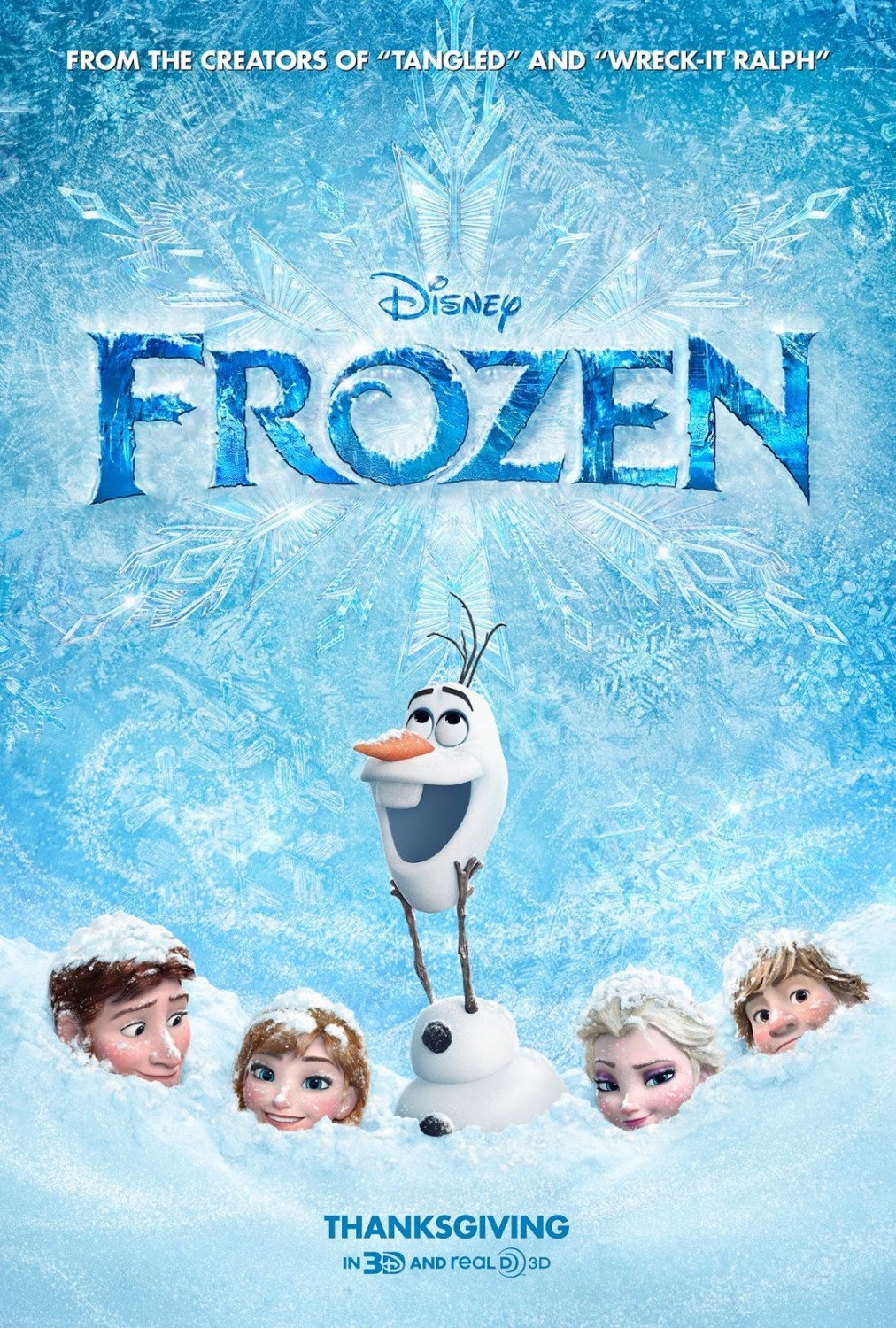
53. Frozen (2013)
Woof. So this is a big one. And like most of the big Disney movies, this movie has saturated the culture to the extent that it's difficult to think about it freshly, so completely exhausted am I of its footprint on the popular imagination. The phrases "let it go" and "do you want to build a snowman"  strike fear into many parents' hearts, and though I am not (yet) in the throes of parenthood, I don't blame them; even without having spent the years of 2013 through 2016 with a preschooler, I would be completely fine not hearing those songs for another decade or so, and the movie itself has similarly worn me raw over repeat, repeat viewings. This has been true of most of the big Disney movies to come out near my lifetime; I went through the same thing with The Little Mermaid when my sister was obsessed with Ariel when she was like five, and I myself wore out Beauty and the Beast and Aladdin when I was a preschooler. But I've had at least a decade's space from my peak exposure to those older films. Frozen hasn't even reached its fifth birthday yet, and as far as overbearing footprints on the cultural landscape, it's only just within the past 18 months that Frozen has been replaced by Moana in sheer ubiquity. I'm not about to put this Disney project on hold for the years it will take for Frozen to fade from my memory, so I'm stuck here doing my best with my Frozen-depleted brain.

But you know, sometimes the cultural zeitgeist gets something right, and when I first saw Frozen, I thought it was one of the very best Disney movies in recent years. Though repeat viewings have made the seams show more than at first blush—for example, how little sense the trolls and Kristoff's relationship with them makes, or how the movie sort of forgets it's a musical after the first half—this movie and its sister-love finale genuinely surprised me back in 2013. That's major; though I think some of the "subversive" stuff the movie does just feels like a more obvious and less interesting version of what earlier Disney movies like Beauty and the Beast were doing decades prior to Frozen (all the romantic stuff in this movie is so weak, and the bait-and-switch of the "oh, I'm your fiancé, oh nevermind, hahaha, I'm the villain!!" combined with Kristoff's existing at all is a bad case of Disney having its cake and eating it, too, re: its approach to romantic love), the idea of familial and specifically sibling love is shockingly under-explored in the Disney canon, which makes it all the more refreshing that sister love is both the central emotional arc of the film as well as the entire conceit of the film's climax.

As for the idea of family in general, Frozen is a fascinating and (I think) moving iteration of some of Disney Animation's pet themes on the subject of parental authority. An interesting discussion formed on Facebook after I posted the previous Disney Review entry regarding the role of parents—and in particular, abusive parents—within the Disney canon. It's definitely a trope of Disney's, most often in the princess movies but also not infrequently in other Disney films, to have parents or adults in parental roles exerting undo control over their children (who then rebel against that overreach); there are the openly abusive and toxic parents of the likes of Tangled (which inspired the Facebook thread) or Cinderella or Madame Medusa in The Rescuers, who all do legitimately traumatic things to our young protagonists, but then there are also the more nurturing (but slightly misguided) parents of The Little Mermaid or Aladdin, who are viewed much more kindly by their movies and usually are granted some measure of reconciliation with their children. Motive matters a lot here. Did the parent act with evil intentions? Then the child will face legitimate danger at their hands and potentially scarring experiences. Did the parent have a legitimate protective and loving impulse toward their children that led to the conflict? Then it's ultimately okay, and they'll get a happy ending with their child. But then enters Frozen, which is a complete disruption of this paradigm. In Frozen, legitimate abuse is done at the hands of well-meaning parents: the king and queen have no malice in their hearts when they isolate Elsa and tell her to control her ice powers—in fact, they are doing so only out of care, since they nearly lost Anna in a magic-related accident—but in doing so, they cause legitimate harm to Elsa, who is somewhat traumatized by the message that she must repress her identity as a magic user and whose relationship with her sister is ruptured. Moreover, no reconciliation is offered to these parents; minutes (in movie time) after they coerce Elsa into locking herself away, the parents die in a storm at sea, leaving the abuse mess with their daughters without a chance to recant their ideas. Whether you want to read this as a coming-out narrative (the visuals and lyrics of both "Do You Want to Build a Snowman?" and especially "Let It Go" certainly give the movie a good nudge in this direction) or some more generalized idea of the conflict between personal identity and parental authority, you're still left with the idea that even the well-meaning impulses of a parent can be abusive and harmful to their child in ways that the parents cannot always mend, which is a complex and really freaking heavy theme for any movie, much less a Disney movie. I know people have a lot of differing ideas about what should and shouldn't be in a movie aimed at preschoolers, but I kind of love that Frozen tackles something so thorny and nuanced, whether or not it's actually audience-appropriate.

It can't be discounted that the Disney movie with some of the freshest and most surprising ideas in at least a decade of Disney movies was also Walt Disney Animation Studio's first (and, at the present, only) feature with a female director: Jennifer Lee, who co-directs with Chris Buck and who has the sole writing credit on the film's screenplay. If we're making arguments for why it's important to get different kinds of people behind the camera (or keyboard or whatever a director does in a CGI-animated film), this is Exhibit A. The easiest way to shake up a complacent formula is to have someone look at them from a different perspective. Frozen, for all its flaws (not that I focused on them, but believe me, there are some flaws), is just that. Disney, give us more new voices is your movies. But don't make them all do Frozen sequels.

54. Big Hero 6 (2014)
Much like Wreck-It Ralph is a decent showcase for the modern conception of Disney, the IP-Gobbling Media Giant, Big Hero 6 is also a conspicuous instance of Disney's ever-growing share of the media landscape intersecting their animated output, though this time, it's a more specific intersection that Wreck-It Ralph's "haha, we can get the rights to ANYTHING" approach. No, in Big Hero 6, Disney is specifically interesting in showing off that it is now the owner of none other than Marvel Entertainment, and there's nothing you can do about it. Mwahahaha...

Okay, this is a tangent, but since I don't have a ton to say about Big Hero 6 (it's fine—I'll talk about it in a sec), lemme rant about Disney's approach to media properties. While I'm not necessarily thrilled about the concept of a single company sucking up every last IP it can get its grubby, Mickey-Mouse-gloved fingers on, I realize that's just a feature of the media landscape we're currently living in and I just have to deal with it, and like... fine. But what especially bugs me about Disney's particular way of gobbling up media properties is that once gobbled, each IP is then molded into Disney's image. On the one hand, this provides a solid quality control over the films, making sure that, I dunno, Star Wars doesn't do another Holiday Special or that if it does, it at least is sufficiently budgeted and fan-servicey that they can get away with it without a PR disaster. But on the other hand, it also means that you don't get nearly as many way-out-of-nowhere weird touches like the Viet Cong reimagined as teddy bears or a second trilogy of films whose whole point is to make the moral and philosophical ideologies of the original beloved trilogy seem corrosive and hollow, which I think puts a definitive cap on how good the media these IPs produce can be. Worse, these properties cease to really be their own thing and just become self-consciously an arm of the ever-growing hydra that is The Walt Disney Company. I mean, say what you will about the old pre-"Acquire Everything!" Disney, but at least there was a unifying aesthetic to the company's products. Now, you go to the Disney store and Mickey Mouse is sitting next to Darth Vader, and Iron Man is shaking hands with Stitch. You can go to Disney World and watch Stormtroopers march down a thoroughfare lined with Goofy and Cinderella mascots. It's like living inside The LEGO Movie, only the kid got a hold of the Kragle and froze everything in a state of chaotic permeability. Can these properties not just exist as their own thing? Does everything Disney owns have to become part of the Disney Media Marketing Universe? Because the sheer post-modernness of these IPs crashing together with thunderous cash register sounds is making me anxious.

Anyway, that's just a long way to say that Big Hero 6 is the first canonical Walt Disney Animation Studios film to be based on Marvel source material, and the sheer corporate synergy of that bugs me. Can't we keep the Marvel parts of Disney separate from the Animation Studios parts of Disney? I guess not. But oh well. All that aside, it's an alright movie, though I'd say it's probably my least-favorite of the Revival films. It has a strong emotional through line with the relationship between Hiro and his brother, and Baymax is just delightful and delightfully animated (he's basically a gigantic balloon, which is a lot of fun to watch). But the plot is messy, and while a lot of Disney Revival plots are messy and fragmented and lose track of their pieces as time goes on (*cough*Frozen*cough*), Big Hero 6 doesn't have nearly the high points the other movies do that help us viewers forget about the chunky, uneven plot rollout and the inconsistent stakes. And since race came up in the Facebook discussion for my last post, I'll also say that this movie does a nice thing most Disney movies don't regarding race, in that Hiro's Asian-American ethnicity isn't lampshaded or the point of his character—it's just a normal detail of the character, which is I think we will hopefully arrive one day regarding racial representation in media. Not that the celebration of distinct ethnicities isn't worthwhile, but it's pretty rare (and valuable, I think) to see a movie so casually normalize an Asian-American protagonist as just not a big deal. Anyway, aside from all the ranty stuff above, I don't really have strong feelings about this movie, so maybe you readers can tell me what you like about it.

Next time: the last post in the series!!