Sunday, March 22, 2020

Mini Reviews for March 16-22, 2020

Quarantine, Week 2: The library is closed. I want to go back to school.

Movies

A Beautiful Day in the Neighborhood (2019)
I'm too late to this party to be surprised that this isn't a paint-by-numbers Mr. Rogers biopic (its reputation long preceded it), but I'm no less delighted by the legitimately complex interplay of cliché and ingenious, thoughtful invention. Like, this actually just goes whole hog into the clichéiest of clichés by giving our protagonist (not Mr. Rogers, I assume most people know by now, but a quasi-fictionalized journalist) certified Daddy Issues, but then it defamiliarizes that trope rigorously by contextualizing it all within this bizarre, Brechtian version of a Mr. Rogers' Neighborhood episode in which Tom Hanks (who looks and sounds nothing like the real Fred Rogers, but he works well in this movie) plays his soft-spoken iteration of a fourth-wall-breaking guide taking us through this story, a la Sam Elliot in The Big Lebowski or even the Leading Player in Pippin. And yet, even this defamiliarizing is refamiliarized by the meticulous fidelity to the aesthetic and set of Mister Rogers' Neighborhood itself, and at least for someone like me who spent a not inconsiderable amount of my early childhood watching the show, it's both intensely nostalgic and a little uncanny to see the show's architecture, right down to the songs and the cardigan choreography, bent just slightly into the particular story this movie is telling. And somehow, through all this, the movie manages to transform its story's on-paper roteness into an unbelievably effective and deeply moving rumination on coming to terms with and ultimately expressing the thorny, twisted emotions that accumulate as a function of being human. Marielle Heller's direction is unbelievably creative, too, and the final shot of this movie is my favorite shot of 2019 from any movie not named Long Day's Journey into Night. An odd, beautiful gem of a film from top to bottom. Grade: A-

Bastards (Les Salauds) (2013)
Probably my favorite Claire Denis movie I've seen after High Life, "favorite" being kind of loosely defined, since this is thoroughly miserable and scary in some pretty awful ways. Which admittedly is also true of High Life. I guess I just like Claire Denis movies to be scary and unpleasant. Grade: B+


Southland Tales (2006)
Came expecting to cheer on a fascinating train wreck, left having experienced a masterpiece. What a bewildering, jaw-dropping rush of apocalyptic sci-fi satirical whatever. Like, I get why people hate it, but man, y'all. Quantum entanglement, time travel, satire of moral-majority conservatism, etc.—100% the movie I would have expected the writer/director of Donnie Darko— to have directed with four times the budget, but also 100% funnier and more vital than I was prepared for. It's a fascinating artifact of the fears of the Bush era (terrorism emboldening a repressive [yet respectable-presenting] right-wing state; the Patriot Act re-shaping privacy and the internet as we know it—honestly, probably the most sincere and insightful reckoning with 9/11 as both a reality and a cultural symbol that this era of filmmaking produced), but there's also something perennially cogent about this movie's wild, wildly hilarious, brutally despairing take on the apocalypse. As someone sitting on the brink of what feels like some kind of low-grade apocalypse myself, I found a lot of this movie echoing pretty resoundingly in 2020 (geez, I already hate typing that number—more meme than calendar year by now), from the way the political battles of this movie condense around the magnetism of ineffectual celebrity (The Rock's performance here is so good, btw—don't ever think he's done anything this out-there before or since) to the way that otherwise noble revolutionary Marxists kind of lose the plot for a minute debating whether or not it is just that nature coerces all living things to defecate whether they want to or not. This movie just understands something constituent both about living in a world teetering on the brink in general and also about specifically the intersection of the American myth (or whatever sausage-mill version of that myth that comes out of the modern capitalist media landscape) with that general lived experience on the brink. I'm rambling (what else can you do about a movie as sprawling as this?), so I'll just close by saying that this is probably the most Pynchonian movie I've ever seen and definitely feels like a bizarro-world dry run for PTA's adaptation of Inherent Vice (Timberlake and Newsom basically play the same roles in their respective movies?)—each one being a borderline incomprehensibly plotted comedic whirlwind through the end of an era and the borderline incomprehensibly byzantine forces engineering that end. Neither movie runs out of ideas. Grade: A

Syndromes and a Century (แสงศตวรรษ) (2006)
A hushed, often beautiful, usually just supremely calming rumination on rural vs. urban Thailand—though I'll admit that more so than any of the ideas in the movie, I just kind of coasted on the vibes, and for me, this movie's basically working in the same vein as ambient music. Probably the most immediately an Apichatpong Weerasethakul movie has worked on me, and an ideal movie to put on at about 1 pm on an overcast afternoon while your son takes a nap—I definitely fell asleep during the last five minutes and had to rewind when I woke up, which normally would sound like a criticism but is absolutely praise here. Very nice to have my constant, low-grade anxiety about the fallout from a global pandemic cease for about 100 minutes, and the burden of consciousness slip away for about 5. Grade: A-

Police Story 2 (警察故事續集) (1988)
Much more of a traditional cop movie than the first one, which is bad because the cop elements were my least-favorite parts of the first one. It also has what strikes me as a very tasteless depiction of a deaf villain, which is also bad. But the good: the fight scenes are still great (the fireworks warehouse at the end rivals the best sequences from the original, and the playground brawl isn't too shabby, either). I also really enjoy that the movie opens with Chan's bosses chewing him out for all the damage he did in the first one, which is a good comedic note in a film that doesn't always seem to know where to put its comedy. Grade: B-


The Fog (1980)
Small town, sprawling cast, metaphorically rich threat, deep sense of history, lighthouses (and generally Maine-ish vibes, despite the California setting)—feels like a Stephen King novel, and at a mere 90 minutes, it more importantly feels like a Stephen King novel in fast-forward, the appeal of which I sometimes wish King's editors would take to heart more often. Anyway, this is tons of fun; on-paper, it's a little standard (the ghosts come every 100 years, ooOOOoo), but the movie's filled with great details that flesh out this world delightfully, from the undead sailors' glowing eyes to Carpenter's score to the fact that the hottest radio station in town is the one that just plays jazz standards. I probably wouldn't live in this town, on account of the ghost sailors, but I would definitely visit. Grade: B+

I Wanna Hold Your Hand (1978)
American Graffiti cross-pollinated with Looney Tunes. It has that same feeling of nostalgia being weaponized against itself that Spielberg (producer here) would take to much zanier, often more cutting heights a year later in 1941 (there's a lot of cast overlap between those two movies, too, which makes me curious how much I Wanna Hold Your Hand influenced that one [Edit: As it turns out, the two movies have the same writers—surprise, surprise]). The results of all this are solidly entertaining, though a little thin at times—blame Robert Zemeckis's first-time jitters, I guess? Still a pretty impressive directorial debut. Surely someone out there somewhere has written something really insightful about Zemeckis's relationship to Boomer nostalgia (the line between this movie, Back to the Future, and then Forrest Gump is fascinating)—I'd love to read it. If this hasn't been written yet, you're welcome, culture writers of the world. I'll collect my finder's fee in Beatles CDs. Grade: B+

Television

Anne with an E, Season 3 (2019)
The third and final season of Anne with an E makes a good case for the show's cancellation. Back when this series began, I was enthusiastic about the ways in which the show revised its source material into interesting new shapes, but after a second season compromised by some silly turns, this third season finds the spark of that first season mostly dead and my enthusiasm entirely waned. The problems here are basically the same as in Season 2: ludicrous plot turns, heavily shoehorned-in 21st century progressive values (there's a whole out-of-nowhere #MeToo plot)—none of which I'm inherently opposed to, but they're handled clumsily here and have basically supplanted what made the show enjoyable in the first place, i.e. the seriousness with which it takes Anne's search for a community that helps her heal from her past (reduced here to a merely semi-recurring thread in which Anne looks for information regarding her parents). New to this season are some pretty deep structural issues, too, which makes the show even more dysfunctional; arcs come and go seemingly without forethought—the aforementioned sexual assault plot gets two episodes of intense attention before disappearing completely, and the same goes for a number of the stories told here—and the show has no idea how to incorporate its newer characters, such as Bash (whom Gilbert met in his improbable swashbuckling adventures last season) and his extended family as well as the people we follow from the Mi'kmaq nation (a real missed opportunity here, since the presence of indigenous peoples is something that could have organically yielded some interesting directions for the show—there are some good individual moments, but none of them help to make the plots feel like they're transmissions from an entirely different series). So this third season ends up just rushing from plot to plot without any structural integrity or even really a sense of how all these elements fit into the same universe. As much as it makes me sad to say this about a show I once had pretty positive feelings about, it's kind of insufferable. Grade: C

Books

Code Name Verity by Elizabeth Wein (2012)
Really solid bit of historical fiction. I was at first irritated by the YA-ness of the narrative voice here; like, the narrator is a prisoner of war in WWII being tortured by Nazis, so why is she talking all snarky and jokey like she's in The Fault in Our Stars? But the novel gets pretty clever with this voice as the story progresses, eventually playing around with narrative personas and unreliable narrators in some really interesting ways before veering into straightforward tragedy that feels appropriate for the weight of the subject matter. On a meta level, this book is kind of bittersweet for me because I was reading it for my school's student book club, and because of the school cancellations, not only will we not be able to discuss this book, it now seems unlikely that the book club will meet again before the end of the school year. It's a minor thing in the scope of everything else happening in the world with the virus, but I'm going to miss book club. Grade: B+

Sunday, March 15, 2020

Mini Reviews for March 9-15, 2020

Quarantine, Week 1: Rations running low. Ran out of milk and Kelly Reichardt DVDs today.

Movies

Wild Nights with Emily (2018)
The cinematic style itself is a little shaky, and this movie made me realize that it's kind of strange that the "letter is read by actor talking directly at the camera" technique has becomes something of a cliché for 18th/19th century period pieces trying to court modern sensibilities. But the screenplay and acting are both really tight, and the revisionist historical angle is enlightening—as an English teacher who has taught Dickinson poems in the past, I am embarrassed to admit that I didn't know half the things I discovered in my post-movie Wikipedia dive. Grade: B


Sacro GRA (2013)
Kind of like a Wiseman film if Wiseman were just a tad more interested in people than institutions. As cross-section of the people living along the biggest highway in Italy, it's a pretty interesting study of contrasts, from dudes bathing in literally golden tubs to people essentially living on the streets, and director Gianfranco Rosi gets some really evocative shots both of people living their lives (often filmed through their apartment windows) and of the highway itself. Gotta say, though, I dunno that it really justifies all of its 90 minutes, and I was restless by the end. Would have loved to spend a little more time with the guy making recordings of grubs than with some of the more anonymous folks here. Grade: B-


*Corpus Callosum (2002)
A playful, fun avant-garde feature that's basically just 90 minutes of goofing around with early digital film and digital effects. It feels historically significant that this came out the same year of Attack of the Clones (another landmark in digital cinema), and it makes me wonder what kind of movies George Lucas would have been making in 2002 if Star Wars hadn't ever taken off. Grade: B 

I talked about this movie (and Wavelength) on the Cinematary podcast, if you're interested in hearing about that. You can listen here.


River of Grass (1994)
It's pretty jarring to think of this movie's Badlands-by-way-of-'90s-indie in the context of Kelly Reichardt's broader career, to which it bears little resemblance. But I think if you can put that aside, it's a solid, occasionally lovely picture. I don't know if it's any more than the sum of its influences (a little bit of Breathless, a little bit Drugstore Cowboy, a lot of bit the aforementioned Badlands), but you could say the same of a lot of auspicious, slightly off-format '90s indie debuts: Hard Eight, Bottle Rocket, etc. There's something about the grimy, pre-Pulp Fiction American indie aesthetic that I just can't get enough of, and River of Grass delivers that in spades while also being Reichardt's funniest feature (the last scene is one of the great moments of black comedy in the '90s, on par with "You shot Marvin in the face"). Plus, it has that really awesome jazz score. Grade: B

Police Story (警察故事) (1985)
There are exactly three parts in this movie where I was more entertained than by any other action movie I've watched in recent memory: the opening sequence in the shanty town, the mid-film bit where Chan has to answer all the phones in the police station at once, and (of course) the legendary mall fight at the film's finale. The rest I thought was mostly tedious (with some pretty iffy gender politics to boot). But those three scenes are A+ territory, and Jackie Chan is a freaking Movie Star, so this shook out pretty great on average for me. Grade: B+


Wavelength (1967)
Really hate to be the guy who doesn't like the greatest avant-garde movie of all time, but I didn't like the greatest avant-garde movie of all time. I didn't get a thing out of it, and while I kind of appreciate some of the choices here (the "Strawberry Fields" part is neat, though for me that's likely just because I enjoy the song; some of the color tints are cool; I like where this ultimately ends up re: letting the waves go out of focus; also, that random dude who drops dead in front of the camera is Hollis Frampton??), I mostly just wish I didn't feel like the sound design had actually damaged my hearing. Was thinking I was going to be a Michael Snow head after digging *Corpus Callosum, so color me disappointed. Grade: C


Television

The Show About the Show, Season 2 (2019)
The first season of The Show About the Show was one of the great gems of the "Peak TV" era, a gonzo, hilarious experiment in self-reflexivity with a legitimate edge to it. I suppose it was only natural that a show as recursive as this one would eventually fold into itself and become not about the show itself but the people who make the show, and that's exactly what happens in this season, which essentially becomes a video diary of how Caveh Zahedi's commitment to the show has more or less destroyed his life. The show still has that same live-wire energy and compellingly playful unpredictability as its first season, but it's also excruciating and legitimately uncomfortable to see Caveh just dive into suffering with the abandon he does here. As this season shows, the central conceit of having real-life people recreate the ways in which they have interacted with the show creates a feedback loop that can end in nothing but chaos—interactions that, under normal circumstances, may have been tense but ultimately have dissipated with time become scabs that the show's recreations pick at and pick at until they become infected and even gangrenous. Added to this is the fact that the show now seems much less self-reflexive of its own limitations than it was in its first season; we are stuck in Caveh's point of view as he narrates his own memories, and while the first season did some work to explore the unreliability of this POV, the second season allows for no windows out of this solipsistic, at times genuinely sociopathic perspective, which renders central figures like Caveh's wife sort of incomprehensible as real people, either because Caveh chooses to portray them in fractured, illogical ways or because he doesn't understand these people himself. It's kind of horrific and monstrously sad. The first season was fun; this one is just kind of miserable, and while it's no less fascinating than its first season, I can't get too enthusiastic about this one. Grade: B

Music

Grimes - Miss Anthropocene (2020)
There's a somewhat muddled concept to Miss Anthropocene that you can explore if you want, but I'll be honest that I really just like the sound of this album. It sounds like what I imagine Visions-era Grimes would sound like if she had the Art Angels-era budget, and the result is a beguiling collection of songs, from the ambitious production of something like the opener, "So Heavy I Fell Through the Earth," to the hazy space-pop of "Delete Forever" or "Violence." It's a really solid record, and sure, it lacks some of the punch of Art Angels, but what doesn't? Grade: B+

Sunday, March 8, 2020

Mini Reviews for March 2-8, 2020

One week until Spring Break. One week until Spring Break. One week until Spring Break.

Movies

Portrait of a Lady on Fire (Portrait de la jeune fille en feu) (2019)
Céline Sciamma has made several good movies, but this is comfortably my favorite of hers, retroactively one of my top five movies of 2019, and likely the French director's masterpiece (I still haven't seen her debut, Water Lilies). A love story whose deep emotional contours mirror its sonic and visual ones in a way that melds form and narrative more thoroughly and organically than in any other 2019 movie I can remember. It's a swooningly lush aesthetic experience—I could have existed in this movie for hours more; in fact, those painting scenes alone could have lasted years, and I wouldn't have complained. The movie's hushed sound design emphasizes the smallest of details—the scratch of charcoal on canvas, the rustle of a dress, a hand brushing across a sprig of rosemary, a caught breath as one character meets the gaze of another—until they take on an otherworldly richness, and this is precisely the movie in a nutshell: capturing that specific magnetism that compels you to study every detail of someone you love. This is, of course, literalized by the plot itself, which involves a painter scrutinizing her subject for a portrait until this scrutiny blossoms into love, but this story wouldn't hold nearly so much weight without the full alignment of the cinematic style behind this philosophical/emotional thesis. As much as the history of cinema insists upon it, love isn't made of grand gestures; it's the accumulation of the smallest of sensory morsels: her eyebrows when she's upset, the water dripping from her nose as she shivers after an ocean swim; the timbre of her voice as she asks you about love. None of this would register without the film's exquisite quietness, nor would the two moments at which music bursts forth loudly be so powerful: once an ethereal folk song around a campfire, another a famous Vivaldi composition in a concert hall. These two moments occur at the emotional climaxes of the film, and after the silence we've become accustomed to, it's literally dizzying to be swept up in the maximalism of these moments, a cinematic out-of-body experience where the distance between viewer and subject functionally disappears in the same way that the space between painter and lady does in this story: to watch someone this closely means to be enveloped as soon as they gesture toward you. Two become one: viewer to characters, lover to lover. This movie is magical. Grade: A

Dark Waters (2019)
Do not understand at all the tepid response to this movie—it's every bit as paranoid and apocalyptic as Todd Haynes's previous "we're all being poisoned" freakout, Safe. This is definitely a mainstream legal thriller, but it's a cracking one, and while the script occasionally gestures toward the generic (poor, poor Anne Hathaway gets saddled with a completely unironic deployment of the "longsuffering wife" trope), the movie's style is covered with such thick layers of sickening despair that it transforms the film into nothing short of a horror movie. The yellow tint of the cinematography alone is grotesque enough to make you ill, and the VHS footage of cow tumors sees the film's reality practically melt under the evil knowingly perpetrated by DuPont. Our world is a hellscape whose contours were intentionally sculpted by capitalism, and I've seen few movies that capture the sheer malaise of knowing that fact like Dark Waters and its parade of reflections of branded billboards and fluorescent logos on car windows and wet pavement. A waking nightmare of a movie masquerading as a potboiler. Grade: A-

I Was at Home, But... (Ich war zuhause, aber) (2019)
I can't say that I understood this movie. It's a very scattered, often abstractly structured collection of incidents with sometimes only tenuous connections between them, and I couldn't summarize this movie if I tried because it's hard to hold all those incidents up together into a coherent whole. That said, I did find myself connecting pretty strongly to individual moments: a lengthy diatribe of a disgruntled theater-goer to the director of a film she watched; a strikingly tender tableau at a swimming pool; a mother with frayed nerves shouting at her children and then feeling quiet remorse as they leave the room. There's a cock-eyed compassion to the humanity of these little moments, and I guess enough of these moments added up to my feeling pretty positive about the movie as a whole. Grade: B

The Return of the King (1980)
In which Rankin/Bass try to cobble together a sequel to both their adaptation of The Hobbit and Bakshi's Lord of the Rings. This movie does a couple of things well. The pre-Ghibli Ghibli folks are still supervising the animation, as they did for The Hobbit, and it leads to some cool character designs (the Witch-King of Angmar looks extremely dope) and of course those water-color backgrounds. I also dig the way this opens with a literal invocation of the muses and then goes on to do a whole bunch of other structural things informed by the tropes of epic poetry, which is interesting and feels in-line with Tolkien's original project. But otherwise, The Return of the King is an extremely dopey adaptation. The music sucks (unless we're going to ironically appreciate the orc-disco, "Where There's a Whip There's a Way") and slows down the pace to a crawl—the first ten minutes of this barely 90-minute movie is just a song recapping the plot of The Hobbit and the first part of Lord of the Rings, and that's not the only time that happens. Even ignoring the pacing issues, the storytelling is extremely haphazard, both as a continuation of the previous movies (if you watched this immediately after Bakshi's Lord of the Rings, you would have no idea how Frodo is suddenly captured inside of Cirith Ungol and Samwise is now the ringbearer, since it skips the whole Shelob thing in favor of starting immediately where Tolkien's book does) as well as a movie unto itself (one character has to very hastily explain who Éowyn is like thirty seconds before she kills the Witch-King because apparently the movie couldn't be bothered to introduce her earlier—like couldn't we have skipped one of the musical sequences to have her show up just once before she becomes crucial to the plot?). And with all respect to my soon-to-be Ghibli bros, outside of the cool bits, the animation is pretty lousy, too, somehow more technically accomplished than the previous two movies while looking several magnitudes dumber. It's not like the other animated Tolkien adaptations of this period were sterling masterpieces or anything, but they both had a kind of striking ambition to them, whereas this is just a muddled mess. Definitely the worst of the loose trilogy. Grade: C-

Snoopy, Come Home (1972)
This is the first Peanuts feature-length movie I've seen, and if this is any indication, the gang probably should have stuck to half-hour TV specials if they were going to venture from the funny pages at all. This movie is clearly padded, which leads to some fun, weird moments that might not have happened otherwise (Snoopy has a trippy dream sequence for no real reason, which is both incongruous for Peanuts but also charming), but it also leads to a lot of boring, overlong sequences without a ton happening—I don't know where my tipping point was, but I definitely got tired of the musical sequences, for example. There are some bright patches of classic Peanuts bleakness (Charlie Brown, after throwing a rock into a pond: "Everything I do makes me feel guilty"), but this is slack enough that I'd much rather be watching one of the specials—or really, just reading the comics. Grade: C

The Front Page (1931)
Took me a loooong time to stop the voice in my head that kept asking, "But why are they talking so slowly??"—my experience with this movie was definitely hurt by this movie not being its remake, His Girl Friday, and this version's marriage plot is definitely hurt by the fact that the lovers aren't working together in the newsroom (compare Peggy, sidelined for long sections of the film, to the constant, blistering back and forth between Hildy and Walter). But not all movies can be the greatest (and fastest) American comedy of all time, and so I finally was able to force myself to watch this movie on its own terms. It's got some pretty interesting editing, and the part where Hildy is walking out of the newsroom and shouts, "See ya later, you wage slaves!" made me laugh pretty hard. But on the whole, it's a much darker and more serious movie than His Girl Friday (as is, presumably, the original play on which this all is based), which is sometimes to its benefit: the pathological compulsion of these journalists stings a bit more than in His Girl Friday, and we're allowed to wallow in the ugliness and collateral damage a bit more, I guess that's a decent-enough substitute for the characters not acting at an amphetamine pace for the duration of the film. Grade: B

Music

Stevie Wonder - Music of My Mind (1972)
This album is more or less the beginning of Stevie Wonder's legendary run of records in the '70s, so it feels a little petty to complain that this isn't as good as something like Innervisions—like, between 1972 and 1976, Stevie made more great albums than most artists make in a lifetime, so who cares if he has one that's not quite great when it is still very good? Music of My Mind is very good. There are bum tracks ("Superwoman" isn't too great, and it makes up 1/6 of the album!), but there's gold, too: "Love Having You Around" is a stomping opener, "Keep on Running" is a terrific little groove, "Evil" is a soulful gospel finale. Plus, the album has some of the hippest use of the Moog synthesizer in pop history. And even if the record only hits a double as opposed to a home run, it's still kind of thrilling to know that this is the beginning of Stevie Wonderful, maestro. Grade: B+

Sunday, March 1, 2020

Mini Reviews for February 24 - March 1, 2020

March is here. Please go away, winter. You've never been welcome, but your lease is up now.

Movies

Knives Out (2019)
Not sure why the movie farts around for half an hour as an Agatha Christie parody when it is, for most of its runtime, more in line with something Alfred Hitchcock might have done. Knives Out is a lumpily structured movie, and there are several moments when you can practically hear the movie's gears grinding as it delivers one of its several left turns. The tremendous cast is also pretty inconsistently utilized, too, especially Jamie Lee Curtis and Don Johnson, who are given such a vibrant showcase in the opening Agatha Christie section before becoming essentially irrelevant for the next 90 minutes as the movie takes its true form as a Craig/Evans/de Armas show. Yet that said—what a show, you know? It's really easy to list off this movie's flaws, but it's just as easy to forgive them, because everything after the movie's first reveal (i.e. the shift from Christie to Hitchcock) is such a delight on a moment-by-moment basis. Sometimes people talk about movies that are fun to watch being "effortless," and that's certainly not the case for Knives Out, which goes out of its way to highlight all the work that went into its cleverness—in the typical mystery/thriller manner, it explains multiple times the motivations and timelines central to its plot, and the loopy dialogue really underlines its sharp turns of phrase. Usually I would dock a movie for this kind of showiness, except that I must invoke the Fun Principle here: I just had a great time, y'all. That Daniel Craig accent? That nasty, nasty Chris Evans character? That Ana de Armas sweetness? That breezy plotting that keeps the movie galloping along unfailingly through 130 minutes and several tonal shifts? *chef kiss* The same goes for its thematic ambitions, which aren't particularly complex but that I found cathartic regardless: as much as I think the movie could have given a lot more complexity to its thoughts on class/immigration, it's hard not to cheer at the final minute. This is just a really great confection. Grade:B+

Joe Versus the Volcano (1990)
Deeply delightful in a way I was not expecting. I was ready for a silly adventure and some fun Hanks/Ryan chemistry; I was NOT ready for a Brazil-esque satire of capitalism, nor an occasionally profound reflection on existentialism, both of which Joe Versus the Volcano also is. I was DEFINITELY NOT ready for Meg Ryan in this movie, who plays her three roles with more vim and careening recklessness than I've ever seen in a Ryan performance—hilarious, wonderfully unhinged, and also strikingly sad at times, too, and I'm prepared to die on the hill that this movie is the best she's ever been. The movie would be a total masterpiece if it didn't lose itself somewhat once it arrives at the titular volcano, but given the trifle I was expecting, I can forgive the shaky landing when the experience is so rich otherwise. Grade: A-

Son of the White Mare (Fehérlófia) (1981)
This was something of a feat to track down, but I'm glad that I did, because it's absolutely incredible. Probably the most consistently visually inventive animated movie I've ever seen—imagine that poster in motion, for the entire movie; there's never a moment where something new or dazzling isn't happening onscreen, and for as much as the aesthetic of this movie is unified, every motion of every character is a wonderful surprise. On a plotting level, it's also the most purely folkloric movie I've ever seen, maintaining the iterative repetition and completely slippery sense of reality that a lot of world mythology has. How cool is this kind of European mythology, too? It's a real shame that Greek/Roman mythology casts such a long shadow over Europe's collective identity, given that Greek/Roman is one of the worst mythologies qua mythology, overcooked and schematic as it is. Gimme that weird, primal Central Europe stuff (but not in a white-supremacist way, pleaseandthankyou). Grade: A

Belladonna of Sadness (哀しみのベラドンナ) (1973)
I found this to be pretty gross, tbh—specifically for the way it constantly conflates scenes of sexual violence with eroticism. The movie gestures toward nominally feminist ideas, but it seems completely unlikely to me that anything but horniness was in the driver's seat here, which is troubling, given the subject matter. The ending connecting the story to the French Revolution is mega-dumb, too. And yet, I would be lying if I said I was into animation for anything other than the art style, and Belladonna of Sadness has that by the ton. Its art nouveau + psychedelia + watercolors aesthetic is frequently stunning, and there are at least two sequences (the introduction of the Black Plague and the village orgy) that rank among the coolest animated scenes I've ever seen. The acid-prog score really works for me, too. I just wish I weren't so repulsed by most of what happens. Grade: C+

Ten Nights in a Barroom (1926)
Decently engaging on a moment-by-moment basis, though like a lot of moral parables of the time, some of the connective tissue between the big setpieces feels a little thin. Also, it's pretty messed up that the movie basically says that God killed a little girl so her father could learn his lesson and become mayor. The Lord works in mysteriously violent ways, I suppose. Grade: C+


Music

Janet Jackson - Janet Jackson's Rhythm Nation 1814 (1989)
If there's a ground zero for the 21st-century conception of a blockbuster pop album, Rhythm Nation 1814 is almost certainly it. A genre-blending style unified by a social consciousness and a deep dancefloor sensibility; a blurred line between producer and artist; there was even a tie-in short film that aired on MTV (surely 1989's YouTube). Sure, pieces of this all existed beforemany pioneered by Janet's brother Michael—but this is where it all came together. It's astonishingly forward-thinking. Oh, and it straight-up rules. Like a lot of modern pop albums, it's too long, and and like pop albums throughout the ages, it peaks early (very early—"Rhythm Nation," the first proper track after the opening interlude, is 100% the best song here. Some of the interludes are a little slight, too. But otherwise, it's a great time. If you somehow still need encouragement to check out Janet Jackson, here's my endorsement. Grade: A-

Sunday, February 23, 2020

Mini Reviews for February 17-23, 2020

I finished a book this week, so I guess you could say I'm an intellectual now.

Movies

Gretel & Hansel (2020)
Very much an Oz Perkins horror movie, meaning that it's a little stilted, a little opaque, a little off-beat, and a lot spooky. Perkins is making a pretty good résumé (if not reputation—go see these movies, people!) for himself of movies that are just left-of-center enough to be interesting, undergirded by a strong visual eye and a refreshing recognition of mood as the primary building block of horror, not scares. As with most of these movies, there are things that don't work: in this case, I think the synth-core/Stranger-Things-y score is a mistake, an odd choice for a movie whose setting's sole concession to the 20th century is a delightfully incongruous playground slide. But on the whole, this is a really solid late-winter release with some awesomely thick atmosphere and tremendous set design. Also, Alice Krige is quite good. Grade: B+

Frankie (2019)
I've enjoyed Ira Sachs's other movies (Love Is Strange a lot, Little Men somewhat), and Frankie does has a little of that infectious wistfulness that I love. But it's a movie with too many protagonists when, in fact, there should be exactly two—Marisa Tomei and Isabelle Huppert—and that spreads out the emotional resonance perilously thin over some unnecessarily convoluted dramatic geography. I just want Huppert and Tomei walking around the Portuguese countryside together! Beautiful final shot, though. Grade: C


Tomboy (2011)
I remember being four or five and wanting to wear a dress to preschool, and my parents wouldn't let me, and I was a little upset about that. There have been a few moments like that in my life. I don't think I'm nonbinary or anything, and I certainly wouldn't want to equate my mild experiences with the much more severe ones the main character experiences here. But I say all this to explain why the beautiful liberty the protagonist of Tomboy experiences in the movie's early stages resonated with me. Sciamma renders with an artful matter-of-factness the unobstructed self-ness of simply being able to exist within the gendered space you feel you belong, and it's gloriously free. This is of course only a temporary freedom within a society so thoroughly bent around an obsession with matching genitalia with gender, which is the completely obvious but no less heartbreaking tragedy at the core of this movie. Gender normativity freaking suck. Cisgendered normativity is a cancer. Burn it down. Grade: B+

Yellow Submarine (1968)
I was significantly undersold how strange this movie is. There's a major character who is a giant glove with an eyeball on its thumb and a big, toothy mouth between its fingers; there are doppelganger Beatles we're told are the real Beatles who meet the real Beatles we're told are the doppelganger Beatles; there's a creature with a vacuum cleaner for a nose who sucks up the whole movie before sucking up itself; there is a sea full of holes in the animation. A lot of people might say that a movie that structures its plot entirely around the prospect of creating cool images to animate is wagging the dog, but no sir, not me; this is delightful, a movie completely drunk on the boundless possibilities of animation, so intoxicated by its own aesthetic that it literally cares about nothing else except the discography of The Beatles. The only other movie I can think of that's so in love with the pure texture and geometry and whimsical play of animation is The Thief and the Cobbler, and Yellow Submarine is considerably less compromised than that movie ended up being. An animation fan's dream. I guess The Beatles are pretty good, too. Grade: B+

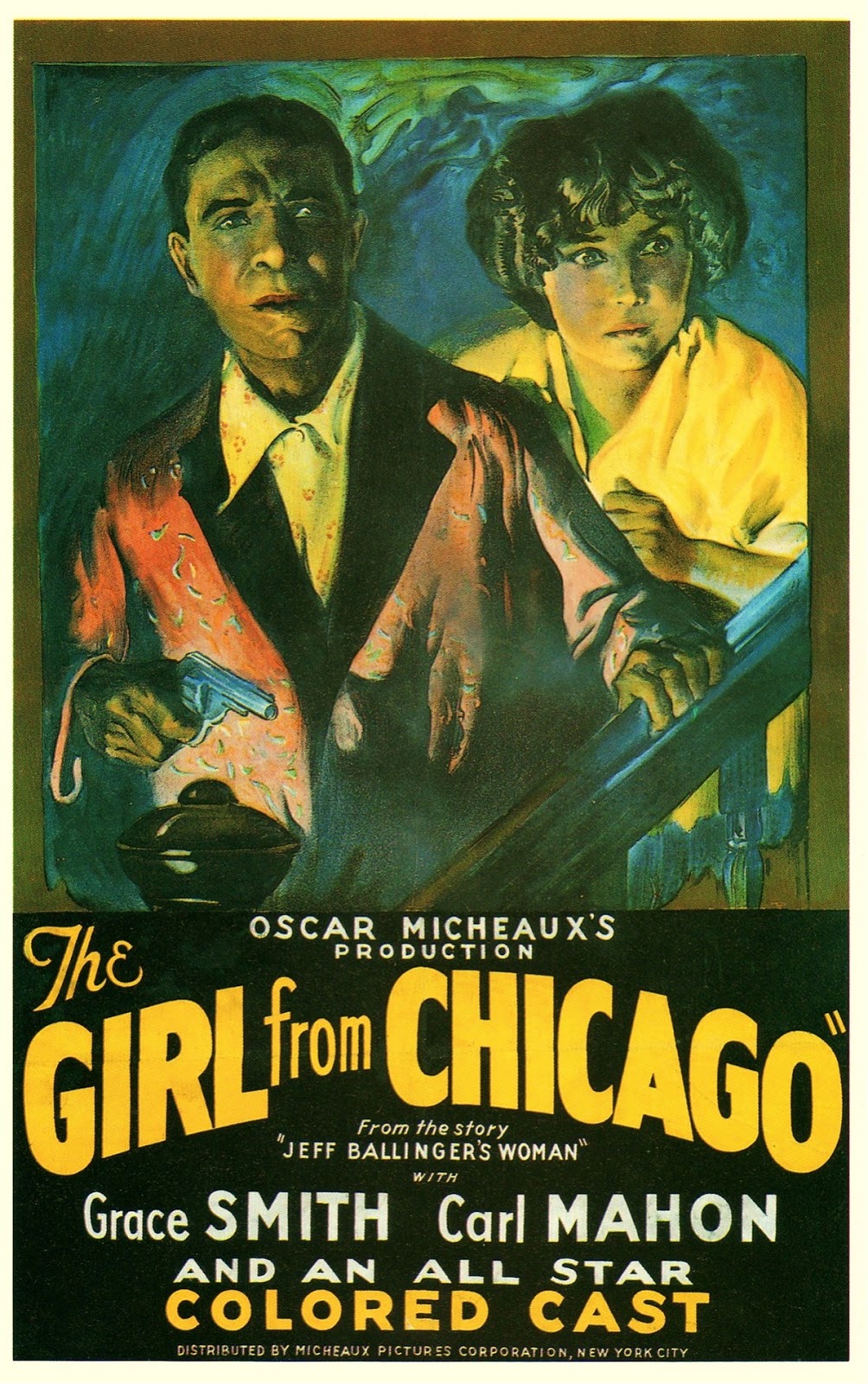
The Girl from Chicago (1932)
I had a really difficult time following this movie—partly because it's a fairly complicated plot created with some very threadbare early-sound equipment and sensibilities (Micheaux never really acclimated to sound cinema, and it's punishingly obvious here), partly because I was so bored that I couldn't keep my mind from wandering. But the musical sequences were fun! Grade: C-


Television

Orange Is the New Black, Season 7 (2019)
It's not that the seventh and final season of Orange Is the New Black doesn't have good moments. It does, and it's overall a much stronger season than the abysmal sixth season. But the scars left by that sixth season remain, and much as the writers try to add ripped-from-the-headlines plots (Litchfield becomes an ICE detainment facility) and return the show to a pre-Season-Six status quo (Badison gets shipped off to another prison, e.g.), Orange never really rights itself. Part of this is because most of these characters are too far gone—there's only so much backpedaling you can do, and it's not enough to make these characters interesting again after all the stupid storylines and wasted time in the past year. Another part of it is that the show's creative team, either through apathy or befuddlement at how to tie all the show's many, many threads together, has all but abandoned any semblance of dramatic coherence: new characters are introduced willy-nilly before being sidelined again for the main cast; flashbacks (long a liability in this show) are thrown in inconsistently and for the thinnest reasons; storylines flare up for an episode or two before being more or less ignored; episodes themselves become structureless blobs of one scene ambling after another until the runtime is up and they can do the credits needle-drop. All of these problems have been issues to some degree since the show began, but they become especially apparent now that the show has to work double-time to clean up its sloppy storytelling into some semblance of a finale. And speaking of the finale: it is, like many series finales, something of a curtain call for all its characters, and this means bringing back a lot of the characters we lost at the end of Season 5 when the cast was halved, and I can think of no greater indictment of how the show managed its last two seasons than the feeling of warmth I felt seeing all these old characters, followed by the feeling of deep frustration that I was watching freakin' Daya do whatever she was doing these past two years instead of spending time with these old friends. Orange Is the New Black skated through its inconsistent storytelling for years by the skin of its teeth and the strength of its character bench, and the parts of this season that work function on the same kind of character-above-all magic: Doggett's arc, Ramos's ICE experience, the chicken farm, Nichols's growth, etc. But these are relatively few and far between moments, and with the diminishing effectiveness of these characters, it becomes pretty clear how thin this show could be. Probably the worst case for a finale: I was glad to see this show go. Grade: C+

Books

The Secret Commonwealth by Philip Pullman (2019)
The second book in Pullman's companion trilogy to His Dark Materials is not only a huge improvement to the first one, La Belle Sauvage, but also retroactively helps some of the creative decisions in that book make sense. After Book One, I was left wondering why this story was being told, and The Secret Commonwealth answers that question thoroughly by pulling this trilogy into focus: Pullman's thesis here is centered on the limits of reason as a guiding principle for a worldview and the ways that reason-obsessed skeptics sometimes excise compassion, beauty, and other intangible but vital human qualities from their experiences. A not inconsequential subplot involves Lyra (this book takes place several years after the end of The Amber Spyglass) becoming infatuated with the ideas of a trendy Ayn-Rand-ish philosopher, and it's not hard to map this plot metaphorically onto our world in the same way that readers did the alternate-history Magisterium and Authority onto our real-world ideas about church authority and God in His Dark Materials. The titular "Secret Commonwealth" (i.e. the world of the spirits) serves as a counterpoint to the obsessively "rational" perspective that tempts our characters, and in this light, it becomes absolutely clear what exactly Pullman was up to in La Belle Sauvage, contrasting the relatively realist espionage with a blown-out fantasy finale full of fairies and magic that serves as a kind of foundational event for The Secret Commonwealth. More than just ideas, though, this book is just a rip-roaring adventure story, probably the closest thing to the scope and tone of The Golden Compass we've gotten; here again, Lyra must travel into an unknown world in search of a dear companion: this time she must journey east to find her own daemon, Pan. But it's a much darker and more complex journey than that told in The Golden Compass, much more interested in politics and in particular colonialism than Lyra's earlier trip into the relatively untouched North was, which makes sense. I do wonder if Pullman leans a little bit too hard into Orientalist tropes when describing places like Syria, but he at least goes out of his way to explain that these regions are as war-torn and corrupt as they are because of the influence of Western commerce and religion. But with that aside, it's a completely thrilling ride in the tradition of the best of His Dark Materials, balancing a sharp fantasy imagination with a deep interest in Big Ideas, and I was legitimately sad when I reached the last page. I've read that Pullman hasn't even started the third book, which makes me inordinately sad, because I have to know what happens next. I can't remember the last time I've felt like this about a series. Grade: A

Music

Don Cherry - Brown Rice (1975)
Most of the time, the "fusion" in jazz fusion is with rock or R&B, and it's not like Don Cherry's music is free of those influences. But what's so mesmerizing and compelling about Brown Rice (and, it bears mentioning, the rest of his '70s output) is that rock and R&B are just drops in the bucket of influences that form a kind of pan-Eurasian folk music with its mix of not just North American and British musical forms but also Indian and African and Near-Eastern. It's an album that pivots from ambient chants and hypnotic grooves to molten free-jazz solos—a truly adventurous listening experience that transportive and deeply spiritual. I've been obsessed for the past few weeks. Grade: A

Sunday, February 16, 2020

Mini Reviews for February 10-16, 2020

As you may remember, I was sick last week, so this week's post is both filling in the stuff I didn't get a chance to cover from last week as well as writing about the new stuff I saw this week. Enjoy!

Movies

How to Train Your Dragon: The Hidden World (2019)
Gorgeous animation—in fact, it's one of the most stunningly rendered "traditional" (i.e. not Spider-Verse) CGI animated features in recent memory. That this is anywhere close to a positive review is entirely on the strength of those visuals. Aside from that, though, I remain completely unable to understand people's connection to the characters and mythology of this franchise; from where I sit, the character models are still ugly, Jay Baruchel's voice acting is still bad, and the larger sweep of the story trends toward convolution rather than gravitas. I'll say this, though: props to this movie for having what is almost certainly the longest sequence devoted to animal mating rituals in an animated movie since Bambi—landmark! Grade: B-


For Sama (2019)
It is pretty tacky to talk about how this movie is shakily edited together from video journals (of a woman in a situation unthinkably more terrifying than anything I've ever experienced), but to watch a movie is to put yourself in a place of privilege over its subject matter, so that's the critical thought that kept flickering through my head. The rest of the time, though, I was pretty deeply moved, and I don't know if I have ever felt a movie scene more viscerally than I did the emergency C-section sequence. Structural issues or not, this is a powerful document. Grade: B+


A Silent Voice (聲の形) (2016)
Meticulous animation that creates a frequently gorgeous effect—it's an oft-made observation, but this is the perfect example of how Japanese animation puts the full power of its technology behind even the most mundane scenarios, and I have nothing but respect for that. As the for the story itself, it felt a little too long and repetitive for my tastes, and the characters' reactions to the two suicide attempts in the movie seem artificial and strange (though perhaps this is just a cultural difference between the US and Japan?). But all that said, the movie finds a good intersection between the sweetness and sourness of its central relationship, and in examining its central ideas of forgiveness, depression, self-loathing, etc., A Silent Voice movingly resists a lot of the pat answers that other movies might lazily reach for. A thorny watch because of that, but not without some fruit. Grade: B


Step Brothers (2008)
Watched this bedridden with a 101 fever, and I honestly don't even know anything about anything. Time is a flat circle, and the "Sweet Child o' Mine" scene is great, but I dunno about the rest. Something else my fevered brain has been thinking about: Bob Dylan's "Isis," on repeat. I don't think that song is in this movie, but it's a good song. Would recommend. Grade: C


Paris Is Burning (1990)
Everything I liked about Climax with none of what I hated. Alternately, a vital and foremostly fun record of late-'80s NYC "ball" culture, and probably the most thorough and complex analysis of the intersection of race, class, gender, and sexuality in film history. Grade: A


Purple Rain (1984)
The narrative portions of this movie range from charmingly amateur to outright bad—not really sure what to do with either the bleeding-wound autobiographical elements or the copious misogyny here, either. But luckily, the movie is about 50% musical performances, and as every being, mortal and immortal alike, can attest, the music of Purple Rain slaps all the way to the moon and back. It may in fact be impossible to tear your eyes from the screen as Prince just tears up number after number up on that stage, and the decision to end the movie with about 20 consecutive minutes of music is the best one this movie makes. It's not hard to see why people flocked to this movie; it's also not hard to see why people don't really talk about the movie when they talk about this movie. It's Prince, y'all. Who cares what else there is? Grade: B-

Television

Joe Pera Talks with You, Season 2 (2019-20)
The second season of the best Adult Swim series of all time not only continues the soft-spoken, sincere nicety of its previous season; it also expands everything about what this show is, and in doing so, it becomes a masterpiece. Often eschewing the essayic digressions of its first season, Season Two increasingly deals directly with the psychological realities of its characters and the small and heartbreaking ways in which the march of time changes even the placidity of the show's Upper Peninsula. It's simple, but never simplistic, and almost always profound. I was openly weeping by the ends of half of these episodes. There's nothing like it on television right now, the unassuming beauty of this series and its quiet but hard-won aphoristic triumphs. Grade: A+

BoJack Horseman, Season 6 (2019-20)
All my shows are ending, y'all. Here's BoJack Horseman, ending its run on a mostly high note. There have been a lot of shows recently that have focused on personal growth and recovery in their final stretch (Crazy Ex-Girlfriend comes to mind), and that's the route that BoJack goes, too, in its closing season; its first half largely centers on the twin poles of BoJack's enrollment in rehab and Diane's struggle with depression that leads her to get psychiatric help, while the second half of the season is largely about the thorny, difficult pieces of life that happen after the formal steps of recovery: after medication, after you get out of rehab. And it's pretty good! Creator/showrunner Raphael Bob-Waksberg has said that he thought Netflix was going to give him more episodes to spread these arcs out over, and that's apparent: secondary characters like Todd get what feels like rushed send-offs that feel like all the show could fit in alongside the main attractions of Diane and BoJack. But allowing for that slightly rushed feel along the edges of the show, it's a mostly compelling conclusion to the series, giving some of the more complex wrestling with "#MeToo" and the idea of problematic protagonists I've seen in a show. It also provides some really stunning individual episodes, most notably the penultimate episode "The View From Halfway Down," which is probably the most frightening and bleak that the show has ever been. And alongside all this, there's of course also the supremely goofy animal puns and wacky humor on clear display, too; I am completely in love with the running gag of the His-Girl-Friday-esque pair of reporters, Paige Sinclair and Maximillian Banks, and there's half a dozen other jokes up to that caliber. This show was special; I'm going to miss it. Grade: B+


The Good Place, Season 4 (2019-20)
The Good Place has always been a show better at exploring ideas than it was developing characters. That doesn't mean that Eleanor, Chidi, etc., didn't have their charms, because they did. But at least for me, if you asked why I came back to the show, it wasn't because I cared particularly strongly for the central cast, winsome as they are. So it's somewhat disappointing that the show's final season leans so heavily on the affection we supposedly have for these characters. Long periods of the final 13 episodes are devoted to giving arcs to the main characters, especially the romance between Eleanor and Chidi, and while I never hated the romance between Eleanor and Chidi, I always appreciated it more as a sideshow to the much more interesting metaphysical ideas this show was batting around. Because when you get right down to it, these characters were not especially complex or interesting; they had an accumulation of traits that worked well for sitcom situations, which was especially helpful in the first season when this show was still halfway a metaphor for the creation of a TV show. But they simply cannot bear the weight of the entire show being put on their shoulders, especially when the characters' emotional arcs are meant also to carry home the ultimate metaphysical ideas the show settles on. About those ideas: I really wish they'd done something more than the whole "eternity is a prison, so the only ethical afterlife is one that eventually leads to annihilation" thing. Look, I know many very smart people have proposed this concept before (including Todd May, a philosopher who makes a cameo in the finale and who argues that life is only meaningful because we are mortal), but I've yet to see anything that convinces me that this whole idea is just unsubstantiated hypothesizing—we don't know anything but mortality, so it seems patently absurd to be so convinced that it is mortality that gives us meaning. Or at any rate, the show is going to have to work a lot harder to convince me that an eternal paradise would eventually become hell. Death is a thief and a bastard, and the ability the choose when it happens only solves half of the problem. As long as we're inventing made-up fantasy heavens, I am willing to risk one without it, thank you. So anyway, it's a final season whose characters can't sustain the weight the show puts on them, nor can the show's ideas stand the scrutiny their placement in the finale engenders. It's not like this last season of The Good Place isn't enjoyable in a lot of the ways the show has been enjoyable since its beginning: it's still funny and goofy and absurd in some pretty fun ways, its zippy plotting keeps things interesting and resists settling into a status quo, etc. But on the deepest levels on which The Good Place has been entertaining in the past, Season 4 falls short, which is too bad. So long to one of network television's quirkiest and most thoughtful delights; I'll remember you for the good times, not the finale. Grade: B-


Silicon Valley, Season 6 (2019)
In its final year, the long-running tech satire finds a few new fresh directions, including some topical ones (Richard begins this season testifying before congress making promises about data privacy that he clearly has no idea the feasibility of), and in general, the final season's focus on tech ethics and data harvesting does give Silicon Valley some of the bite it lost in its mediocre last couple years. It's still not nearly as funny as it once was, and the finale bizarrely lands the show on a note of optimism that feels both weirdly out-of-sync for this show and also pretty disconnected from the inescapable hell that is real-world Silicon Valley (I would be shocked if there was a non-zero number of tech giants who intentionally destroyed a very cool piece of code because it had the possibility of destroying the world). But the journey to that note is a solid one, and I had a fun time taking a ride with this show one more time. So yay. Grade: B

Books

March Series by John Lewis and Andrew Aydin, Illustrated by Nate Powell (2013-16)
I was a little skeptical of these books at first, because my impression of them is that they were part of the whole "let's turn a school subject into a graphic novel so the kids these days will learn it!" movement, which isn't a movement without its merits but sometimes does lead to some prosaic stuff. The first book feels a lot like that, too, but each successive book gets increasingly complex in ways I wasn't expecting, eventually forming a cycle of books that gives a rich and difficult conversation about the push and pull between radicalism and centrism within political movements. A large part of this comes out of the grounding of the books within John Lewis's point of view, which gives the books a lot of personality and momentum that wouldn't be possible in a straight history. These books are as much memoir as history, which is great; that point of view also saves the books from a lot of the sanctimony that we often like to give history—it is fascinating, for example, how Martin Luther King, Jr., is presented not just as an important leader but also as both a distant celebrity and a frustratingly conservative (relatively) alongside Lewis's more radical vision from SNCC. It doesn't all work; there's a pretty hokey framing device involving Obama's first inauguration, hokey enough that I wonder if, by the end, there's a kind of bitter irony being engaged in (the book ends by talking about the end of the Civil Rights Movement in the late '60s, which then gets juxtaposed with Obama in ways that feel at-best ambivalent). But on the whole, I'm pleasantly surprised by how moving and powerful I found these books. Kids who won't read could do a lot worse than to learn about Civil Rights from this series. Grade: A-

Sunday, February 9, 2020

Mini Reviews for February 3-9, 2020

Bare-bones post today because I have the flu and haven't finished reviewing everything I watched this week. Don't be an idiot like me; don't put off getting your flu shot!

Movies

The Wind (2018)
Would have vastly preferred the version of this story in chronological order, but even then, I don't think there's a whole lot to this movie, which makes the nonlinear storytelling feel like an attempt to cloak a lack of ideas. Too bad, too, because "possession movie in the Wild West" feels like a real winner of an idea. Grade: C


Waltz with Bashir (Vals Im Bashir) (2008)
For the majority of the movie, my main thought was that the animation hadn't aged particularly well—it's literally Flash animation, and although it's probably the most technically sophisticated Flash animation I've ever seen, it's still got that uncanny, floaty quality to it that always feels flat in Flash. But then that cut into live-action footage in the movie's final minutes hits, and it's one of the most devastating, damningly anti-war things I've ever seen in a movie, all the more so because the the preceding 85 minutes had established a false normality of this artificially smooth, poorly aged style that just shatters when confronted with the final reality—the literalized mechanism of a brain that refuses to admit culpability in a massacre. Nobody ever thinks they're culpable in a massacre. I'm sure I don't. Grade: A-

The Watermelon Woman (1996)
This movie does a fantastic job of evoking the alternatingly intoxicating and frustrating feeling of digging into a research project and pulling on loose thread after loose thread. I really dig the ingenuity with which this research project is constructed, too—until the credits told me so, I didn't realize that the "Watermelon Woman" that the protagonist researches here is a fictional figure invented by writer/director/star Cheryl Dunye for this movie, which means that all the primary sources the movie shows are invented, too, so mad props for the dedication to do all that. I just wish this movie were better on a character and screenplay level, though—the dialogue is pretty flat, and the central romance that gets so much attention ends off-screen for reasons I don't fully understand. A fascinating, flawed project that feels ripe for a remake. Grade: B

Mutiny on the Bounty (1935)
This movie has a lot of competition within my immediate film-viewing context, and it's losing: I've recently seen a much better Charles Laughton movie (Ruggles of Red Gap), and I've recently seen a much more entertaining movie in which a group of scrappy upstarts overthrow their terrible boss (9 to 5). But it's a lot better than the other Frank-Lloyd-directed movie to win the Academy Award for Best Picture during the 1930s (Cavalcade, bleh), and I did have a pretty good time here, so here's a positive review. Grade: B