Monday, January 22, 2018

Favorite Albums 1-100


Not sure anyone cares/remembers, but back when this blog hit its 100th post, I celebrated by making a list of my 100 favorite movies at the time (which the morbidly curious can read here). Well, now this blog has reached its 200th post (fanfare! fireworks! you get a car! and you get a car!), so I thought I'd celebrate with another 100 list—this time my favorite albums.

As with the movie list, I just want to stress that this is not a list of the best albums; nor is it a list of the albums I have listened to most or have always loved the most. This is simply a catalog of the albums that, at this particular moment in time, I would count as my favorites. This was very difficult to whittle down to an even 100—ask me tomorrow, and you'd get a much different list, the day after and you'd get an even more different list still. Also as with the movie list, this list is alphabetized, not ranked (and even lazily alphabetized at that—if I were being rigorous here, I'd have organized the artists by last name, but instead, I just listed them in the order that they are on my iTunes: Kanye West right before Kendrick Lamar, etc.).

Another organizational note: In order that this list didn't consist entirely of R.E.M., David Bowie, and Miles Davis, I limited any one artist to no more than three albums. Otherwise, this list would have definitely been just R.E.M., David Bowie, and Miles Davis.

Anyway, I hope this inspires people to share their own favorite albums here. I'm a white male music nerd who has counted rock as his musical genre home base for most of his life, and this list definitely reflects that hardcore, so I'd love suggestions that push against my demo. As I've mentioned frequently, the point of lists (as I see it) is to share new or neglected works of art with others, so please view this list as an opportunity to do so! Or maybe you love all the same albums as I do, in which case we can just revel together in the awesomeness of Carly Rae Jepsen or Funkadelic. Or maybe you hate Carly Rae Jepsen and Funkadelic—that's cool, you can call out my taste for being bad, too. Really, when you think about it, all music is bad.

Some stats before we begin:

  • The oldest album on this list is Miles Davis's Kind of Blue (1959).
  • The youngest album on this list is Vijay Iyer & Wadada Leo Smith's A Cosmic Rhythm with Each Stroke (2016)—list is bookended by jazz, woo, I'm a cool cat.
  • The most represented decade is the 1970s, with 24 albums.
  • The least represented decade is the 1950s (just Kind of Blue).
  • The most represented artists are Bob Dylan, David Bowie, Miles Davis, R.E.M., and Radiohead, all of whom hit the three-album ceiling.


The List
Against Me! – Transgender Dysphoria Blues (2014)
Alice in Chains – Jar of Flies (1994)
Arcade Fire – The Suburbs (2010)
The Beatles – A Hard Day’s Night (1964)
The Beatles – Magical Mystery Tour (1967)
Belle and Sebastian – If You’re Feeling Sinister (1996)
Big Star – #1 Record (1972)
Björk – Homogenic (1997)
Bob Dylan – Bringing It All Back Home (1965)
Bob Dylan – Highway 61 Revisited (1965)
Bob Dylan – Modern Times (2006)
Brad Mehldau – Elegiac Cycle (1999)
Bruce Springsteen – Born in the U.S.A. (1985)
Bruce Springsteen – The River (1980)
Can – Tago Mago (1971)
Carly Rae Jepsen – Emotion (2015)
Carol King – Tapestry (1971)
Chance the Rapper – Acid Rap (2013)
The Clash – The Clash (1977)
Coldplay – A Rush of Blood to the Head (2002)
David Bowie – Hunky Dory (1971)
David Bowie – The Rise and Fall of Ziggy Stardust and the Spiders from Mars (1972)
David Bowie – Young Americans (1975)
David Crowder Band – A Collision or (3+4=7) (2005)
Dead Kennedys – Fresh Fruit for Rotting Vegetables (1980)
Deerhunter – Halcyon Digest (2010)
Echo & the Bunnymen – Crocodiles (1980)
Father John Misty – I Love You, Honeybear (2015)
Fiona Apple – The Idler Wheel Is Wiser Than the Driver of the Screw and Whipping Cords Will Serve You More Than Ropes Will Ever Do (2012)
The Flaming Lips – Embryonic (2009)
Fleet Foxes – Helplessness Blues (2011)
Florence + The Machine – Lungs (2009)
Funkadelic – Maggot Brain (1971)
Genesis – Selling England by the Pound (1973)
Grimes – Art Angels (2015)
Iggy & the Stooges – Raw Power (1973)
Janelle Monáe – The ArchAndroid (2010)
Joanna Newsom – Divers (2015)
John Coltrane – A Love Supreme (1965)
Joni Mitchell – Court and Spark (1974)
Kanye West – Late Registration (2005)
Kendrick Lamar – To Pimp a Butterfly (2015)
King Crimson – In the Court of the Crimson King (1969)
King Crimson – Larks’ Tongues in Aspic (1973)
The Knife – Shaking the Habitual (2013)
The La’s – The La’s (1990)
Lauryn Hill – The Miseducation of Lauryn Hill (1998)
LCD Soundsystem – Sound of Silver (2006)
Led Zeppelin – Houses of the Holy (1973)
The Mars Volta – Frances the Mute (2005)
maudlin of the Well – Part the Second (2009)
Miles Davis – In a Silent Way (1969)
Miles Davis – Kind of Blue (1959)
Miles Davis – On the Corner (1972)
My Bloody Valentine – Loveless (1991)
The National – Boxer (2007)
Neil Young & Crazy Horse – Rust Never Sleeps (1979)
Neutral Milk Hotel – In the Aeroplane Over the Sea (1998)
Nirvana – MTV Unplugged in New York (1993)
Oasis – Definitely Maybe (1994)
Patti Smith – Horses (1975)
Pavement – Wowee Zowee (1995)
Pink Floyd – Dark Side of the Moon (1973)
Pink Floyd – Wish You Were Here (1975)
PJ Harvey – Let England Shake (2011)
PJ Harvey – To Bring You My Love (1995)
Queen – A Night at the Opera (1975)
R.E.M. – Automatic for the People (1992)
R.E.M. – Lifes Rich Pageant (1986)
R.E.M. – New Adventures in Hi-Fi (1996)
Radiohead – Amnesiac (2001)
Radiohead – In Rainbows (2007)
Radiohead – OK Computer (1997)
Regina Spektor – Soviet Kitsch (2003)
Robert Glasper – Black Radio (2012)
The Rolling Stones – Sticky Fingers (1971)
The Roots – Things Fall Apart (1999)
The Shins – Chutes Too Narrow (2003)
Simon & Garfunkel – Bridge Over Troubled Water (1970)
Sonic Youth – Daydream Nation (1988)
Spiritualized – Ladies and Gentlemen, We Are Floating in Space (1997)
St. Vincent – Strange Mercy (2011)
Sun Kil Moon – Benji (2014)
Sunn O))) – Monoliths & Dimensions (2009)
Talk Talk – Laughing Stock (1991)
Talking Heads – Remain in Light (1980)
Television – Marquee Moon (1977)
Tindersticks – Tindersticks (1995)
TV on the Radio – Dear Science (2008)
U2 – Achtung Baby (1992)
U2 – Pop (1997)
The Velvet Underground – The Velvet Underground & Nico (1967)
The Verve – A Northern Soul (1995)
Vijay Iyer & Wadada Leo Smith – A Cosmic Rhythm with Each Stroke (2016)
Vince Guaraldi Trio – Jazz Impressions of Black Orpheus (1962)
The White Stripes – White Blood Cells (2001)
The Who – Who’s Next (1971)
Wilco – A Ghost Is Born (2004)
Yeah Yeah Yeahs – Fever to Tell (2003)
Yes – Fragile (1972)

Sunday, January 21, 2018

Mini-Reviews for January 15 - 21, 2018

Lots of snow days today means lots of reading, watching, etc. Woot woot!

Movies

The Post (2017)
A companion piece, of sorts, to Lincoln. If every 4-5 years Spielberg has to drop in and create a tightly scripted historical film stealthily (or not so stealthily, in The Post's case) about the state of the current executive branch, I'm cool with that as long as they're this good—good enough, even, that I'm willing to forgive how both of these movies have ended on final scenes that are entirely too cutesy. I'm also a sucker for movies about journalists doing journalist things, and honestly, I could watch a whole movie that was just shots of the Washington Post typesetting process and people with leather patches on the elbows of their tweed jackets shuffling through paper archives. Luckily for everyone who doesn't have my particular journalistic fetishes, The Post is all that plus electrifying plotting and dynamite actors chewing through some crackerjack dialogue. Grade: A-

Happy Death Day (2017)
"Groundhog Day, but a slasher" is a premise so easy and appealing that it's a wonder that it's taken this long to materialize (and apparently it's not been as long as it seems—this movie has been in production since 2007). Nevertheless, here we are, and the resulting film is consistently entertaining, though certainly not great—the characters, for starters, never really break out of the stock-character mold they're introduced in, and with the exception of one third-act twist that's incredibly fun and subverts the usual trajectory of these Groundhog Day movies perfectly, the movie isn't really doing a ton of new or interesting things with its format. Still, the script is entertaining enough throughout and the acting winsome enough that these quibbles are easy to dismiss in favor of just enjoying a moderately engaging variation on the familiar. Grade: B

Mary and the Witch's Flower (メアリと魔女の花) (2017)
A good—if a bit generic—fantasy coming-of-age from Ghibli-alum Hiromasa Yonebayashi. Imagine Harry Potter, but if McGonagall was Dr. Eggman from Sonic. There are some gorgeous and inventive character designs in the woefully brief magical Endor College tour, and overall, the movie is nicely animated in exactly the way you would assume a film from ex-Ghibli-ers to be. There are some narrative problems—most notably, the way the movie has essentially two first acts and no second act, though I'm not sure which first act I'd cut to add a second, since they're both rather lovely—that make the movie feel slight and a little underdeveloped even within its pretty standard genre fare, but none of them are fatal, and the things that are nice about this movie are quite nice. Grade: B

Basic Instinct (1992)
Gender-flipping Psycho seems like a lateral movie, as far as LGBT sensitivity goes, and I'm honestly not sure of the point of it, thematically, though it does lead to some clever moments. Cleverer still is the way that the movie finds Psycho by way of Vertigo, and I won't lie that I find this kind of experimentation—not just genre experimentation but experimentation with the narrative forms of specific genre hallmarks—pretty fun. The movie might go over much better if Basic Instinct had anything better than a monumentally dumb screenplay, but, well, it's monumentally dumb. As it is, Sharon Stone (in a deliriously hammy villain performance), Michael Douglas (in a perfectly nasty noir-protagonist turn), and score composer Jerry Goldsmith are doing a lot of heavy lifting here, and I'd ultimately guess your enjoyment of this comes down to how you feel about Paul Verhoeven's trademark "This doesn't exactly feel like satire, but that's the only possible explanation for some of these directorial choices" approach. I like Starship Troopers, so that puts me in the positive camp. Grade: B

Duel (1971)
Gotta love a movie that knows exactly what it is—in this case, a movie about a killer truck—and leans way into that. Some really fantastic shot compositions and lighting, too. Be the best you you can be. Grade: A


The Bellboy (1960)
I don't know what I was expecting from my first Jerry Lewis feature, but a 70-minute series of barely related and often surreal sketches is not it. In a brief prologue, the supposed "executive producer" at Paramount Pictures assures us, the audience, that The Bellboy is a movie with "no story and no plot," and the film makes very good on that promise. At one point, Jerry Lewis plays himself, harangued by a crowd of sychophants—he has about two scenes, and then we never see him again. At another point, the protagonist, Stanley (the titular bellboy, also played by Lewis), takes a flash photograph at night, and the flash literally turns the nighttime into day, despite only being 3:30 in the morning. In another scene, Stanley finds himself in the middle of a marital spat and gets beaten by both husband and wife. Elsewhere, Stanley flies a plane. And so on. These bits are tied together only by the tenuous connection that they all take place at or around the same Miami Beach hotel and mostly involve Stanley, and many of them seem to be inspired by the goofy wordplay, physical humor, and flights of fancy of Lewis's vaudeville-performing childhood. The result is something like the intersection of Charlie Chaplin, the Three Stooges, and the dream sequence in Sherlock Jr., though of the three of those, the overall sensibilities lean heavily in the Curly-Larry-Moe direction. It's all very silly, and as with anything as relentlessly episodic as this is, there's a lot of dead air. However, most of the bits are less than a minute long, so it generally skates by on the same principles that float Aaron Sorkin dialogue, moving fast enough that the bad patches are quickly replaced by the good ones before they linger too long in your mind. And beyond that, I don't think I can stress enough just how strange this movie is willing to get, often without any sort of explanation. There's a kitchen-sink approach to the comedy here that makes room for everything from musical interludes to meta humor, and the final package is endearingly bewildering. I can't say if this is representative of Jerry Lewis's output in general (his reputation suggests not), but I'm interested to see more. Grade: B

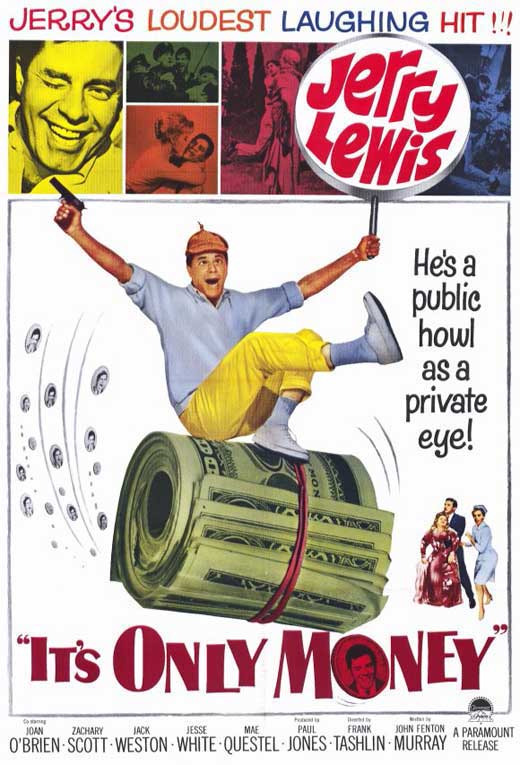
It's Only Money (1962)
Eh, okay. Lacking the go-for-broke absurdity of The Bellboy, all this Jerry-Lewis-starring feature is left with is Lewis's physicality, and that wasn't nearly my favorite thing about The Bellboy, though Lewis is admirably committed to it. I might be a little more admiring of it if Lewis wasn't so shouty and rapid-fire moron here, but I guess that's sort of his thing in his non-Bellboy performances. Honestly, the funnier part of the movie to me is the Ladykillers-style plot involving some no-gooders repeatedly failing in their attempts to murder Lewis's character. The escalating ridiculousness of it is fun, though the movie doesn't ever commit to it enough to make it actually Ladykillers-level enjoyable. Grade: C+


Television

Orange Is the New Black, Season 4 (2016)
Finally a season of Orange Is the New Black without any glaring flaws. Oh, there are little ones, to be sure, most notably in the way it still insists on keeping one foot in sitcom mode when dealing with non-major characters (something that manifests itself most troublingly in the way it depicts the new crop of white supremacist characters, which, with the bitter aftertaste of 2017 still on my tongue, feels far too glib and divorced from the reality of the actual white supremacists who have been running amok in this country). But this sitcomminess isn't nearly the problem it was in previous seasons, and most of the rest of the recurring OitNB issues have been relegated to the periphery (Alex and Piper), gotten rid of entirely (Daya and Bennett—THANK YOU LORD), or incorporated as vital thematic units of the season arc (the racial stereotyping, which the show turns cleverly on its head by ratcheting up the racial tensions—and even intra-racial tensions—within the Litchfield environment and making them a function of the prison context and not the show's storytelling). In lieu of these usual stumbling blocks, we're left instead with the series's most structurally ambitious and thematically cohesive year yet, a deftly (and okay, occasionally clumsily—this is still OitNB, after all) woven narrative about corruption and innocence and idealism and privilege. It's the first season of the show that actually seems to be trying to say something about Society in general, and while after the previous seasons, I would have said that this is a show not nearly well-equipped enough to handle that sort of scope, Season 4 manages it commendably (the aforementioned hiccups aside), building a complex tragedy that argues as well as any TV series has since The Wire that The System is both an unstoppable force and an accumulation of individual actions and prejudices by autonomous people. Grade: A-

Books

The Idiot by Elif Batuman (2017)
A discursive and directionless novel about a Harvard freshman feels directionless and alienated by academic pretensions and undergraduate socializing. It's basically a comedy, but a very dry one, and while there's a ton to like here (the motif of our protagonist, Selin, nodding along as she listens to some self-impressed academic blather on about his pet theory while she internally feels deeply confused or gets distracted by errant thoughts feels deeply accurate to me and is never not hilarious), I do kind of wonder if the novel could have had a bit more direction—or at least something to grab onto among all the detached and wry observations. I kind of feel like a stick-in-the-mud here; maybe I'm getting old. It's an easy novel to walk through, but for all its humor and stylistic precision, it's a hard novel to get any closer to than arm's length. Grade: B-

Music

Margo Price - All American Made (2017)
My favorite new country artist doesn't write anything as immediately Great as "Hands of Time" on her sophomore release, but All American Made, a less showy album than Price's debut by most accounts, finds Margo Price and frequent co-writer Jeremy Ivey pushing their songcraft in exciting new directions this time around. The soul inflections of "Do Right By Me," the tempo shifts and structural strangeness of "Cocaine Cowboys," and pop-country string-based production of "A Little Pain" are all welcome additions to Price's retro vibes. The album stumbles a few times, most significantly on the mariachi-tinged "Pay Gap," which melds a questionable musical idea with bland social commentary, but all is forgiven when we get to the mournful and masterful closing title track, a stealth contender for Price's best song yet and easily one of last year's best songs, period. Grade: B+

Sunday, January 14, 2018

Mini-Reviews for January 8 - 14, 2018

A student told me this week that January is the Monday of months. True words, and this week was probably the Monday of movie weeks—so many B-grade films.

Movies

I, Tonya (2017)
I, Tonya gets its best laughs out of being a sort of flippant farce that recreates the whole Tonya Harding/Nancy Kerrigan drama (Paul Walter Hauser is never not hilarious as mastermind/masterboob Shawn Eckhardt); but I, Tonya gets its best material out of the sardonic tragedy of Harding's life trajectory—I don't know a ton about the real Tonya Harding, but this movie version of her is a fantastic character, the story of someone so entangled in cycles of abuse that it's hard to tell whether she's punching back or just manifesting signs of trauma. It's a shame, then, that that the movie's relentless cutting between these two modes—farce and tragedy—comes off as overly clever and smothers the heart of the film under a blanket of smarmy Scorsese-isms and a cloying soundtrack that gives us the late-1980s/early-1990s by way of the 1970s by way of American Hustle. Grade: B-

Lucky (2017)
There's plenty that's trite and obvious and just kind of mediocre in Lucky—the movie is far too fond of punctuating scenes with lines of dialogue that are ostensibly part of the preceding conversation but are obviously only in the movie to hammer a theme (Pet store lady: "Would you like to give this dog a permanent home?" Lucky, squinting into the wind: "Nothing's permanent"). But there's at least as much in the movie that's flat-out amazing, including a mid-film dream sequence that comes out of nowhere but is absolutely stunning. Then of course there's Harry Dean Stanton, doing what will surely become one of the canonical final artistic statements alongside Bowie's Blackstar and Richard Farnsworth's The Straight Story performance—and with Lynch acting in a (great) supporting role, this may as well be a Straight Story revision with Stanton in the lead instead of the periphery. An imperfect Straight Story, to be sure, but capable of some of the same humbly profound heights. Grade: B

Brawl in Cell Block 99 (2017)
Anyone who saw writer/director/composer S. Craig Zahler's previous film, Bone Tomahawk, and its adaptation of the whole "unseam'd him from the nave to the chaps" Macbeth routine shouldn't be surprised at the level of violence in this movie, but I'm still a little shocked. Some of this is the sound design (which goes out of its way to make sure we hear every bone break), but there's no denying the stomach-churning visual immediacy of seeing a dude's face scraped on on a concrete floor until all that's left is a grinning skull. And it's all done in immaculately staged practical effects. Whether this all makes the movie better or worse depends on your sensibilities, I suppose, and me, I'm inclined to like it, though only barely, and as it is, I do wish this movie were about thirty minutes shorter. As is, it's paced like a B-movie trying to pass as an arthouse flick, and well, when we're dealing with face-flaying, I think it's best to throw off all pretension and cut right to the chase. There's a lotta buildup here. Grade: B

Sworn Virgin (Vergine giurata) (2015)
It's a movie about a Balkan sworn virgin (look it up—I had to), and it's absolutely obsessed with bodies. The camera lingers over the human form in a way that even more obviously objectifying films don't, and this movie, being from the POV of someone who has existed outside the gender continuum of her country's society, presents those bodies with the curiosity and strangeness of someone from the outside looking in. The obvious pitfall here is that this curiosity could have come across as either leering or clinical, but neither is the case. It's a warmly human movie, and even if all the interpersonal relationships don't feel quite as fleshed out as they should, plenty of emotional weight alone comes from the geometry of muscles and bones. Grade: B+

Gone Baby Gone (2007)
The score is boilerplate, and the cinematography is forgettably workmanlike. And thank goodness we've all been saved from the "you know it's a flashback because we've got all this color correction and grainy effects" overload of the mid-2000s. But presuming you're willing to put up with the conventions of mainstream American cinema from last decade (and Casey Affleck), Gone Baby Gone is an engaging enough crime drama. I'm not nearly familiar enough with Boston to know if this is an accurate portrayal of the city, but the movie has a tremendous sense of place—fantastical or not—that lends a specificity to the film's drama, and the plotting follows the trappings of traditional crime thrillers closely enough that it's surprising when it dances onto the razor's edge of moral doubt at the end. Grade: B

Sunday, January 7, 2018

Mini-Reviews for January 1 - 7, 2018

New year, new reviews.

Movies

Beatriz at Dinner (2017)
This movie lays down on the table a corker of a premise pillared by some truly excellent acting—most notably, Salma Hayek as a Mexican-American healer and John Lithgow as basically Donald Trump with complete sentences, though Connie Britton does some quietly excellent work, too, at this movie's periphery. But after maybe an hour of tense dramatics, it becomes clear that the movie has absolutely no clue what to do with these gifts, and the ending just kind of tapers off into a big ol' puff of air. Sad! Grade: B-


V/H/S (2012)
It's been a while since I've seen a movie so openly misogynistic as V/H/S is. Not "the representation of women is problematic within the 2018 political climate" misogynistic; no, I'm talking about an anthology movie in which a theme of pretty much all of its shorts is "women are duplicitous and will probably kill you, but hey, at least they have breasts." That kind of misogyny. Some of this is self-aware, and the multiple allusions to amateur pornography are surely not accidental, although the connection between VHS tapes and homemade, digitally distributed porn is... conceptually muddled, let's say. But whatever intentions about the ethics of ambushing a woman into being in pornography this movie may have do nothing to mitigate the definitely terrible thematic effects of the finished product. The movie is somewhat interesting for a few inventive and interesting uses of digital and analog static in the films (probably one of the better uses of the "found" aspect of found footage that I've seen), and in isolation, any one of these shorts would be "okay"—none great, and they all are about 30% too long, resulting in a movie that feels way more bloated than it should. But as a cumulative feature film, it quickly becomes a slog, made even worse by the gender politics. I want to love a horror anthology, but geez, why do they all have to be so not good? Grade: C-

The Host (괴물) (2006)
This is definitely a Bong Joon-ho film—unsubtle political message, wildly divergent tones, structural insecurities in the plot—but of the ones I've seen, it's definitely the one that exercises the most restraint in terms of those tonal and plotting zig-zags. As a result, it feels slightly more conventional than, say, Snowpiercer. Which is sort of good and bad; on the one hand, you don't have to approach this movie as existing at a different level of cinematic reality the way you have to with his more outlandish features, because there aren't so many bizarre performances, etc., but on the other hand, I do kind of miss the weirdness. Great monster design and solid action setpieces, though, and that covers a multitude of sins. Grade: B+


The Portrait of a Lady (1996)
This certainly looks like a great movie, full of sumptuous costuming, exquisite framing, and artsy stylistic flourishes (such as the mystifying modern-day intro and the silent-movie-esque travel sequences). It's the most lavish Campion movie I've seen, and good on her for that, even if there's the niggling feeling in the back of my mind that maybe Campion went mad with power after the unqualified success of The Piano. But geeeeeez, everything to do with the narrative is awful. It's boring and stilted and devoid of human emotion. While some of this could be attributed to the original Henry James novel (I haven't read it), John Malkovich (whom I'm beginning to suspect is not a good actor) and his lifeless brood certainly cannot be. Grade: B-


Pom Poko (平成狸合戦ぽんぽこ) (1994)
There are "flaws" here—the movie's too long by a comfortable margin, and its environmental messaging feels more nostalgic than actually constructive. But it's beautiful, wistful nostalgia, and that gets at the magic of this movie: none of the flaws really matter when the movie feels this strongly. Pom Poko is about as funny as you'd expect a movie about tanuki (dog-like creatures who, in Japanese culture, are depicted as tricksters with shape-shifting abilities and gigantic testicles [the Disney English dub misidentifies these creatures as "raccoons"]) to be, and it's pretty funny when the tanuki community fights off humans as Tokyo suburban development destroys their native forest. But Pom Poko is also much more somber than its tanuki premise suggests, and the film is as soon a chronicle of a marginalized group and a fable of violent insurgency and a eulogy for pre-WWII Japan as it is a warm comedy with silly animals. It's all so strange and wonderful, one of the most moving animated features of the 1990s. Grade: A

Grease (1978)
People point to Star Wars as the movie that maimed the American New Wave and Heaven's Gate as the one that killed it for good, and maybe that's true, I dunno. But I'd say there are few movies as symbolic of the end of the New Hollywood as Grease, a movie that takes one of the key texts of '70s American cinema, American Graffiti, and fills it full of bad writing, flat cinematography, horrifying gender politics, rape jokes, nonsensical sentimentality, and ugly nostalgia that can't decide if it thinks the '50s were the best or the worst. Ladies and gentlemen, I present to you mainstream American filmmaking of the 1980s! Grade: D


Books

Understanding Comics: The Invisible Art by Scott McCloud (1993)
It's essentially a nonfiction manifesto in comics form, and it's sort of brilliant for being so. While it may seem like an obvious flourish to make your manifesto on comic-book style a comic book itself, the ingenuity and energy with which McCloud executes this idea are consistently impressive and engaging. We can quibble with some of his conclusions—and honestly, in 2018, his defensive tone ("comics aren't for kids, guys, come on!") feels played out, although that's more a function of twenty-five years of academic engagement with the comics art form since this book's publication than any flaw of McCloud's writing here—but on the whole, this is a significant work of criticism that, even several decades later, still has bite and insight. Grade: A-

Music

Adele - 19 (2008)
I'd been putting this one off for a while, and I'm not sure why. While I maintain that 21 is still Adele's best album overall (and maintain even more that Adele isn't really an album artist), 19 has several of her best songs, including "Best for Last," "Right as Rain," and especially "Hometown Glory." In that respect, 19 is similar to Fiona Apple's debut, Tidal—an album that's still searching for an artistic identity (Adele tries on several genres here, but, like Apple, also defaults a little too often to retroisms—in Adele's case, Dusty Springfield-style blue-eyed soul) but has moments of jaw-dropping self-actualization. Shame Adele's career looks to be nothing as interesting as Apple's, but hey, we'll always have those wonderful singles. Grade: B+

Sunday, December 31, 2017

Mini-Reviews for December 25 - 31, 2017

Last post of 2017! Also, in case you missed them, I did my annual year-end lists this year: music and movies. I'd love to hear your feedback on those.

Until next year!

Movies


Lady Bird (2017)
Like last year's The Edge of Seventeen, Lady Bird understands the very specific ways that high schoolers can lie and pretend and be careless toward each other and their families. It's my favorite kind of coming-of-age, one that takes seriously the small joys and heartbreaks of the teen experience without letting those moments swallow the rest of the world but also recognizing the extent to which the teens absolutely let their own moments swallow everything. There are some narrative loose ends that don't really work as loose ends—most notably, a weird go-nowhere subplot involving a teacher crush. But the movie at least never loses sight of its protagonist, a luminous Saoirse Ronan as the titular Lady Bird, and it never strays too far from its central thematic axes of Lady Bird's self-actualization and her recognition that the hardest part of self-actualization is the appreciation of your upbringing at the very moment you're distancing yourself from it. It's a lovely tribute to family and place and friendship (Lady Bird's friend Julie [Beanie Feldstein] is every bit the non-Lady-Bird heart of the film), measured with equal parts poignancy and knowing humor. Basically, it's very good. Grade: A-


Three Billboards Outside Ebbing, Missouri (2017)
Okay, the acting is excellent, and the dialogue has some very nice zingers. But what on earth does this movie mean? It's certainly not about violence toward women; it seems like that's where it's going—Frances McDormand, a survivor of domestic abuse, is upset that the police have not solved her daughter's rape/murder—but Sheriff Willoughby says the case has no leads, and we're never given any reason to doubt him, so that's sort of a dead-end, thematically. It doesn't seem to be about racism. Though plenty of time is spent describing the police force's racist behavior (and I guess here's as good a place as any to say that I think the film's use of the N-word [and for that matter, the word "retard"] is irresponsible and flippant—giving the UK-born writer/director Martin McDonagh the benefit of the doubt, I suppose we could chalk this up to his being ignorant of the full American connotations of those words, but that doesn't change the shocking way the movie refuses to even comment on the use of these epithets beyond an assumed irony that I don't think we can safely assume in an audience), so little of the plot has anything to do with race and so few of the cast members are black that I can't imagine how McDonagh could have been trying to say anything about racism in modern policing. More likely foci are the moral and philosophical questions that the movie poses—ones of redemption, rage, retribution, and, most interesting to me, whether individual members of a group should be held culpable for the actions of every member of that group. But frustratingly, the movie intentionally cuts to credits right before the characters' actions can give any of those questions any concrete meaning, and while ambiguity is all fine and good, this is not a movie that necessitates ambiguity, especially when it throws down those gigantic questions like whole bucketful of gauntlets. Besides, I already experience plenty of ambiguity about those questions in real life—I didn't need to watch two hours of really elaborate profanity and mediocre cinematography to just be reaffirmed of that. It's a cop out. This whole movie is a cop out, and it's lucky that it's funny enough to not make me actively hate it. Grade: C


Captain Underpants: The First Epic Movie (2017)
I mean, you know what you're signing up for with this movie, and just in case the title didn't clue you in, let me stress: there is a character whose name is Professor Poopypants; he rides in a giant toilet; the word "poopageddon" is uttered in sincerity by one character. But allowing that a movie can behave in this way (a dubious assumption for some, I know), this is actually rather delightful. As a longtime fan of the Dav Pilkey novels, I can say that this is an admirable shuffle of the first four books, complete with a Flip-O-Rama! sequence; beyond that, the animation is actually kind of great. Dreamworks has been trying to do this for a while, but I'd say that it's this year, with The Boss Baby and this film, that they've finally succeeded in making CG animation look like an honest-to-goodness cartoon and not some failed attempt at realism. Oh, there's also a sequence animated in sock puppets. The movie's not required viewing or anything, but it's not far from it. Grade: B+


Cemetery of Splendor (Rak Ti Khon Kaen) (2015)
I don't understand this movie. The extent to which this is a consequence of how little I know about Thai political history—upon which this movie is commenting in ways I am very poorly equipped to parse—or an intentional effect by the film itself is unclear to me, though it's definitely some mix of the two. Nevertheless, it's a hypnotic feature that, when it isn't a little boring (and honestly, it is kinda, at least in stretches), is utterly arresting in its dreamy, tactile approach to its narrative—something about soldiers falling asleep and spirits waking up, but that's not all that important; this movie's alchemy of sound and image made me feel a great sense of mystery and awe, and that's valuable. Grade: B+


I'm Still Here (2010)
I think it's pretty well-established now that I'm Still Here is mockumentary and not documentary. On the one hand, this is a relief—I remember watching Joaquin Phoenix's talk show appearances depicted here and being very sad and confused. On the other hand, knowing that this is all staged sucks the life right out of this movie. One of the things that was so weird and live-wire about Phoenix's behavior during the period depicted here was the insecurity about whether to laugh or cry. The lush ambiguity of this performance is gone when you realize that it was all a gag of sorts. The movie works in small doses, particularly near the end, as a parody of the lurid, washed-up-celeb docudramas that lurk in the corners of basic cable. But as a whole, its shtick quickly wears thin. Grade: C


The Queen (2006)
The central conflict of this movie—essentially the tension between the necessity of the traditional British monarchy as a political symbol and the pragmatic realities of modern Western representational democracy—is something I can't relate to; every time some character suggested that it was maybe time for (shock! horror!) the monarchy to be dissolved, I found myself nodding in agreement. However, I'm not from the UK, and this tension is clearly a deeply British one, so it's not really my tension to critique. And besides, the movie is still able to take those themes to effective places; the cinematography is nice (though not jaw-dropping), the acting is good, and the screenplay is pretty smart in how it handles the conflict between the Queen and new Prime Minister Tony Blair in the aftermath of Princess Diana's death. Grade: B


Tenacious D in The Pick of Destiny (2006)
As with most Jack-Black-involved projects, there's an admirable level of enthusiasm here. But the core material just isn't there. A few setpieces are fun—the dream sequence of the duo's rock success is a highlight—but overall, this is just under-baked (ha). Also, I was under the mistaken impression that this movie contained "Tribute." It doesn't—talk about a disappointment. Grade: C


Dressed to Kill (1941)
Is screwball noir a thing? I don't think so, and I'm willing to blame this movie—an unfunny and dull combination of screwball comedy and noir mystery, Dressed to Kill is enough to have discourage anyone else from attempting the format. The only thing that really lands is the final scene, and that's more for how mean-spirited it is than for actually being funny. Grade: C


Young Mr. Lincoln (1939)
The first third of this movie is straight-up myth-making silliness of the sort you might find in one of those children's picture books from the 1950s. Then the movie abruptly left-turns into a court drama (because Lincoln was a lawyer, y'see) before returning to the myth stuff in the final couple minutes. None of this is great Abraham Lincoln biography, I'm sure, but the lawyer section is pretty great. Grade: B


Television


Atlanta, Season 1 (2016)
It's possible this show is too patient, especially in the early-going, when it maybe assumes a bit too strongly that its quiet, slow depiction of Earn's life unadorned is fascinating. Earn (Donald Glover) is the least-interesting character here—though he's able to give a fantastic deadpan look of mixed fear and incredulity, and two of the season's best episodes, "Streets on Lock" and "Juneteenth," rely heavily on this look—so it's a breath of fresh air when the back half of the season begins to stray from relying on his POV alone and instead embraces the other characters are worthy storytelling vessels. Even better, the show develops a low-key surrealism as it progresses, and many of the funniest moments in this decidedly genre-fluid series (it's a half hour, but it's not always a comedy) come from this understated strangeness, e.g. Justin Bieber being played by a black actor without comment. My instinct is that this show is a tad overrated, but oh well. I still enjoyed it. Grade: B+

Books


The House of the Spirits (La casa de los espíritus) by Isabel Allende (1982)
The most incredible thing about Allende's incredible debut (!!??!!) novel is the way it so effortlessly conflates the personal with the historical. The House of the Spirits is basically two stories—the lives of four generations of women in the aristocratic Trueba family and the political development of Chile over the course of the 20th century—but under Allende's confident plotting and beautifully efficient prose, these two threads become one. There's never the feeling that we've spent too long with the historical sweep of the country and we should return to the Truebas or that we've focused too narrowly on the Truebas and need to zoom out to the broader political context, because the novel is brilliantly meticulous in making those two one and the same. It's intimate and epic and exciting and gently funny until it turns bracingly tragic until it's sweetly nostalgic, and I loved it from cover to cover. Grade: A


A Raisin in the Sun by Lorraine Hansberry (1959)
For a little while, it seems like A Raisin in the Sun isn't going much of anywhere, instead just willing to show symbolically freighted but dramatically low-impact slice-of-life events for the duration of its multiple acts. And that would have been fine—plenty of successful drama works in this way. However (and those of you who've read/seen the play know what I'm talking about), all of the sudden everything happens, and in that instant, the play doesn't just become symbolically weighted but also dramatically profound and, in gaining this dramatic heft, symbolically profound, too. This is the 20th-century black experience in microcosm, and it's powerful. I'm not blowing your minds—I'm probably the last person on earth to experience this required-reading staple for the first time, but... *shrug*. It's still great. Grade: A

Music


U2 - Songs of Experience (2017)
Let's not kid ourselves here (*cough*Rolling Stone*cough*): this is U2's worst album since How to Dismantle an Atomic Bomb, and while there's nothing here quite as bad as the worst bits on that album, we're not dealing with much of a margin above it. On Songs of Experience, U2 is determinedly non-experimental (it's looking more and more like No Line on the Horizon was our last chance to see a truly new-sounding U2 record, and they kind of mucked that up), and while that's not inherently a problem (Songs of Innocence, which I like a whole lot, is similarly stylistically staid), it's not doing the album any favors when most of the songwriting is this mediocre. It's not all bad; the two opening tracks ("Love Is All We Have Left" and "Lights of Home") are actually very good, and "13 (There Is a Light)" recontextualizes one of the weaker tracks on Songs of Innocence ("Song for Someone") and turns it into a pretty strong closer. But the ten tracks in between those are full of run-of-the-mill pop/rock and more lyrical Bono-isms than anyone should have to endure. Grade: C+

Saturday, December 30, 2017

Favorite Movies of 2017

Well, here we are again—another one of these lists. I'm not going to do one of those long preambles. As usual, this post is divided between my favorite movies (emphasis on "favorite," not "best," whatever that means) and other movies I thought were notable, either for good or ill. Also as usually, I admit that I (obviously) haven't seen every 2017 movie, and I resent that the elitist and outdated distribution schedules have kept some of my most-anticipated movies away from Knoxville (more importantly, The Post and Phantom Thread).

I hope y'all enjoy it. Please, disagree with me; share your own picks; discuss. I've said it before—I love discussing this list stuff.

Favorite Movies

1. The B-Side: Elsa Dorfman's Portrait Photography
It's all about death, when you get right down to it: our lives, our actions, our thoughts—whether or not we're conscious of it, they're all defined by that firm bookend. Warm and easy-going, The B-Side resembles that other Errol Morris masterpiece, Fast, Cheap & Out of Control, by allowing a mix of editing and unfettered obsession over a craft (here, Polaroid portraitry) to accumulate into a towering treatise. I haven't seen a ton of people love this movie as much as I did, but more so than anything else I saw this year, The B-Side is profound.

[Read original review here]


2. Good Time
A damning character portrait disguised as a feature-length chase sequence, Good Time is fun until it's devastating. It's the sort of movie where you'll spend most of the runtime with your hand over your agape mouth, your eyes dazzled by the gorgeous nocturnal cinematography, your ears ringing from the assaultive score. If you haven't already seen it, the most viscerally exciting movie of the year is well-worth your time.

[Read original review here]


3. The Shape of Water
In the running for Guillermo del Toro's best English-language film, The Shape of Water is by turns swooningly romantic and gory, baroque and grimy, nostalgic and mythic; it's a blender of all of del Toro's best preoccupations, from classic Hollywood to B-movie trash, and it's great. You'll believe a fish-man can dance.

[Read original review here]


4. A Ghost Story
David Lowrey's hypnotic, unpredictable art film about grief is something of a feature-length remake of the "I got a rock" refrain from It's the Great Pumpkin, Charlie Brown, right down to the sheet ghost. The magic of this movie is that it's also heartbreaking, and not in that gentle Charlie-Brown-style way—it's legitimately staring-into-the-void-style sublimity.

[Read original review here]


5. mother!
If Darren Aronofsky wanted to just make provocative, stylistically adventurous Bible movies for the rest of his career, that would be a-okay with me. Whatever you think of the theology here, the sheer daring of this movie's scope is in a league of its own.

[Read original review here]


6. The Beguiled
Sweatiest movie of the year, bar none. This is supposedly set in Virginia, but this is definitely Louisiana, and rarely has humidity been so palpably captured on film. It's Sofia Coppola's best in quite some time, and it's no accident that it's also a tight, mean little thriller, Coppola's usually dreamy atmospherics morphing into something as sinister and phantasmagoric as it is beautiful.

[Read original review here]


7. A Quiet Passion
An exquisite tribute to Emily Dickinson couched in Terence Davies's usual visual splendor—a particularly good match of subject with director, as Davies's understated formalism complements Dickinson's own poetic style wonderfully.

[Read original review here]


8. Logan
The only superhero movie in this superhero-stuffed year I'd call "great," and while we've had plenty of movies with politics on their minds, this, with its apocalyptic squalor, is one of the few that really captures my fears of where we seem to be heading.

[Read original review here]


9. A Cure for Wellness
Something something good taste something bad script something something. I don't care. This movie looks awesome, and it's the best gothic horror we've gotten at the movies since Crimson Peak. Plus, there's no topping the compositions and lighting of the visuals here.

[Read original review here]


10. Your Name
It has all the gorgeous detail of previous Makoto Shinkai features and, a first for me with his work, a story I really bought into. The final half hour or so of the film is some of the most cosmic, beautiful film imagery, animated or not, of the year.

[Read original review here]


Appendix: Miscellaneous Movies Also Worth Noting

Best Zeitgeist-Defining Movie: Get Out—This is the 2017 movie, and I don't see many good arguments to the contrary. It's far from my favorite, but Get Out is still really freaking good, hilarious and frightening in equal measure, bolstered by a diverse cinematic tradition alluded to heavily in Jordan Peele's dense and frequently brilliant screenplay. But this is more than a spot-the-allusion film; it's a film that uses movies like Night of the Living Dead and Invasion of the Body Snatchers to genuinely subversive ends, playing off our familiarity with the beats and images of these movies to shock us. Also, it's about race; more specifically, it's about predatory white people. Let's not pretend like that isn't the most 2017 plot in all of cinema.

Best Drama: The Salesman—And I mean "drama" in the sense that it resembles a play. Asghar Farhadi's The Salesman isn't play-like in the derogatory way that movie critics usually mean when they compare the two media; rather, I'd just like to call attention to and celebrate that way that, like always, Farhadi brings a tense efficiency to the screenplay that recalls the immediacy of the stage. Farhadi's movies are as tight as drums, and while there are some elements in The Salesman that makes it less tight than, say, The Past, it still makes a mighty sound when struck.

Best Coming of Age: Lady Bird—I haven't had a chance to formally review this one yet (it's likely the final 2017 movie I'm going to see in a theater), but I love me some coming-of-age cinema, and this one is very good. Willing to be honest about the specific ways in which high school students can be various shades of pretentious and careless in a way that recalls last year's masterful The Edge of Seventeen, it's a tremendously well-observed film that, for all its plot shagginess (and there is that, sometimes to its detriment), is so sharp and specific in its characterization of Lady Bird herself that she practically jumps off the screen to shake your hand.

Best Cinematography: Blade Runner 2049—I get the thematic and narrative critiques of this movie, but I won't hear anyone dissing Roger Deakins's astounding, beautiful, lay-me-down-to-rest-because-I-have-seen-the-face-of-God visual work. Some kudos probably goes to the production design, too, without which this probably wouldn't have been so stunning. But come on; it's also Deakins we're talking about here.

Best Cry: Coco—Pixar, y'all. "Remember meeeee..."

Best Action: John Wick: Chapter 2—It's like dudes in suits shooting each other in art galleries in highly choreographed ways. What's not to like about that?

Best "Not Quite the Best Action, but Hey Look! Tarkovsky!": Atomic Blonde—Don't get me wrong: the action in Atomic Blonde is very good. It just isn't John Wick: Chapter 2 good. Still, there's a fight scene in front of a projection of Andrei Tarkovsky's Stalker, so major points to this movie for making a cheap retro allusion that I am physically unable to resist. Take that, Ready Player One.

Best Action (Ape Division): War for the Planet of the Apes—Apes on horses! Apes with guns! Apes breaking out of concentration camps! Apes doing all sorts of things! All our movies should have more apes. (But all kidding aside, this really is a good movie)

Best Animation: The Boss Baby—Am I losing my mind? Pixar has the photorealism, Cartoon Saloon has the serious stylization, Illumination Entertainment has all the really crappy-looking stuff, but it's DreamWorks Animation—frikkin' DREAMWORKS—that's actually doing the animation I like best on an aesthetic level these days. This studio has finally done what I'd considered impossible and made CG animation as flexible and convincingly cartoonish as hand-drawn stuff, and for that, they have my sincere gratitude.

Animated Movie I'm Most Thankful For: The Breadwinner—This movie is flawed in significant ways, but, along with the DreamWorks output this year (?!?), it most pushes English-language animation in directions I wish the whole medium would all go: serious-minded, audience-trusting, culturally diverse, stylistically (not realistically) animated.

Best Opening Sequence: Valerian and the City of a Thousand Planets—The first five minutes of this movie, set perfectly to David Bowie's "Space Oddity," are the best five minutes (opening or not) of any movie this year. It's a warm throwback to the optimism of sci-fi's 1940s/50s golden era, only flipped to show interplanetary contact to be an intrinsic element of this future utopia, not its greatest threat. Any other year, it wouldn't be a particularly political statement, but with every inter-species handshake, it's impossible not to feel that cooperative multiculturalism is a necessary piece of humanity's future, and also to feel the chasm between that ideal and our contemporary political discourse.

Best Opening Sequence (Non-David-Bowie Division): Baby Driver—Edgar Wright's crime caper never really delivers on the promise of this scene as an action movie intricately choreographed to pop music, but for its opening scene (and honestly, the decidedly more pedestrian second scene), Baby Driver is the perfect realization of this premise. It's wonderful.

Best Use of "Take Me Home, Country Roads": Logan Lucky—This movie's a lot of fun all around, but it's only a great movie in one moment, and that's at a children's beauty pageant, of all reprehensible things. People sing this song; it's moving.

Best Use of the Word "Poop": Captain Underpants: The First Epic Movie—There's a lot of poop-centric stuff in this movie. It's great.

Worst Use of a True Story: Same Kind of Different as Me—Pure Flix strikes again! This time, they've skimmed over all the legitimately interesting stuff about the kind of amazing true story that informs the plot and instead left us with the most boring, cookie-cutter inspirational trash ever. Hurray!

Most Misunderstood: The Glass Castle—Critics saw a toothless weepy in a tremendously difficult, thorny film about what it means to feel love for a genuinely abusive person. This is not a movie of easily-arrived-at adages; it's a film that languishes on messy, complicated, intentionally problematic questions and doesn't suggest anything cheap about its film-ending catharsis.

Best Quote: The Big Sick—"This is why I don't want to go online, 'cause it's never good. You go online, they hated Forrest Gump." Terry (a great Ray Romano) gets it.

Best Use of Social Media: Personal Shopper—Briefly, the quiet psychological thrills of Personal Shopper get cranked up to sheer horror-movie levels, and it's all thanks to a clever playing off of what we know about texting and social media engagement.

Best Use of Outer Space: Guardians of the Galaxy Vol. 2—There's a lot about these Marvel movies that's getting stale, but I'll give them this: as long as they are making colorful, goofy, imaginatively designed space-opera visuals (see also: Thor: Ragnarok), I'll probably still watch them.

Best Shower: Alien: Covenant—You'll know it when you see it.

Best Kiss: Alien: Covenant—Again, you'll know it when you see it.

Best "Well, We're Going to Be Making These Movies Until Human Extinction, So We Might As Well Make It Interesting": Star Wars: The Last Jedi—This actually probably belongs again to Alien: Covenant again, but I'm not confident that they'll be making Alien movies for that much longer. Star Wars, though... Star Wars is forever. The Last Jedi is likely the most experimental that we're going to see Star Wars get for a while (though judging by some of the fan outrage, they need to get a lot more so—just rip that band-aide off, Kennedy), and even this isn't too dramatic of a departure (I can't be the only one who wanted Rey to join Kylo like he asked). However, it's by far the most interesting engagement with the series mythology since the prequels, and this is the first time since Lucas was at the helm that the Star Wars universe felt like a living, breathing place full of species and planets we haven't seen before. It's enjoyable.

"Good Try, I Guess" Award: Song to Song—Does Terrence Malick actually know what rock music is, or did he just read the Wikipedia page? QUESTIONS TO PONDER.

Worst Application of Corporate Synergy: Beauty and the Beast—We did not need this movie, and we certainly didn't need it to be as bad as it was. Disney's been pretty good at making questionable (and nakedly money-grubbing) decisions at least blandly enjoyable this decade, but NOPE. Not this one.

Best Slow, Monarchical Death: The Death of Louis XIV—The title says it all, and let me repeat: it is sloooooow. But it's also beautifully costumed, and there's something about the languorous, meticulous way that we watch the Sun King pass from this life that feels so profoundly conscious of the realities of death in a way that reminds me of Stan Brakhage's The Act of Seeing with One's Own Eyes.

Best Non-2017 Movie I Saw For the First Time in 2017: Ordet—A dialogue between realist modernity and old-time supernatural religiosity that feels like a genuine expression of both worldviews and, more impressively, a genuine fusion of both. It's a majestic film, one of the best-ever about faith, right up there with Tarkovsky's Nostalghia and Bergman's Winter Light though considerably more optimistic than either of those, and without a doubt the most fully I've been moved by a motion picture this year.