Sunday, June 12, 2022

Mini Reviews for June 6 - 12, 2022

Not much to say here. Read on.

Movies

The Bob's Burgers Movie (2022)
This was nice. A lot of sitcoms struggle when they try to break out of the half-hour format (including Bob's Burgers, whose two-parters have always felt ungainly to me), but I actually thought this did a good job of preserving the rhythms of the show while also still making it feel plotted and paced like a movie. Ditto the animation, which is noticeably more fluid and dynamic than a typical episode of the show without ever really being distractingly different from the show. My one real quibble is that making the Belchers and the Fischoeders allies here feels weird, but there are a dozen great little character beats to outweigh that—I don't know why, but Teddy calling the food cart "Bob Burger" made me chuckle every time I saw it. Anyway, I wasn't going to be hard to please with this movie; Bob's Burgers has been comfort television for me for basically a decade at this point, so all this really had to do is not be terrible, and it's not. It's good, actually, and it made me feel good to see it. Grade: B+

The Voyeurs (2021)
Knowingly ridiculous but also About Stuff (in this case, the lack of privacy in the digital/social media age), which makes it a tad frustrating that it isn't quite what it would be if Paul Verhoeven were actually directing instead of the movie just really, really wanting to pretend he's directing. Just imagine what Sydney Sweeney's kinda forced performance here could have been under the for-real Verhoeven magic? Anyway, regardless, this is still fun, and there's a plot beat that happens about half an hour from the end of the film that's so audacious and bananas that it made me want to stand up and cheer. I'm seeing a lot of people talk about how nice it is to have eroticism back in a mainstream movie, too, though I'm having a hard time figuring out if the movie is sexy or if these actors are just sexy, which is a distinction I want to believe is meaningful? Anyway, something is sexy here. Good time. Grade: B

Wake Wood (2009)
Pretty unremarkable folk horror only remarkable for its cast (Timothy Spall! Aidan Gillen!) and for the fact that it's a Hammer production. There's nothing particularly wrong with the movie—it's basically Pet Sematary but Irish—but it never quite tips over from "vaguely unsettling" to "pit-in-stomach scary," which is what I'm usually waiting for with folk horror. Grade: B


A Boy and His Dog (1975)
Really unpleasant, which I probably should have braced myself for, given that it's based on a novella by the notoriously unpleasant Harlan Ellison—but seriously: what if Lassie, but it's in a post-apocalyptic world and the dog helps his boyish owner by helping him find women to rape? This is just gross, pointlessly edgy nonsense for a good chunk of its runtime. It gets a lot better when the boy enters an underground biosphere run by a fertility cult nostalgic for the rhythms of small-town America, which, credit where credit is due, is actually something with satirical bite (maybe more so now than in 1975). This part actually is close to great, but boy oh boy, I just hated the first 45 minutes or so of this. Grade: C


Le Mans (1971)
Points for the audacity of the concept and the purity of vision, i.e. a nearly dialogue-free movie mostly involving Steve McQueen just zooming around in European race cars as his character participates in the 24 Hours of Le Mans. It's occasionally very striking, especially when this leans into a fractured, almost experimental European New Wave/New Hollywood style to depict the racing (and especially the handful of crashes that happen during the race). But I gotta be honest here: I'm not nearly interested enough in cars to feel very strongly about this film. Remake this movie but about trains instead, please. Grade: B-


Hawks and Sparrows (Uccellacci e uccellini) (1966)
Pasolini isn't, like, an unfunny director, but I was pretty shocked to see something as openly jokey and hilarious as this is from him. This is extremely funny to me. For example, there's this one bit where this talking crow is telling this story about a couple of Franciscan friars who are told by St. Francis to preach to hawks and sparrows, so the two of them go through this years-long process of learning how to speak to birds, and once they have, they preach the gospel to them and are dismayed to see that the hawks are still killing and eating the sparrows, and when they tell St. Francis about it, he's all like, "Oh here's your problem: you didn't put enough Marxism in your gospel," and then the parable ends, and there's this intertitle tells us that just so we know, the crow is a left-wing intellectual. I dunno, writing it out like this, it doesn't actually sound that funny, but trust me: it is! The movie is also a pretty direct satire of Italy's relationship to communism at the time, which is maybe a little more obvious from my summary of this one scene. Oh, and it's also a send-off to the career of an Italian clown named Totò, for whom this was his final role, and honestly, I probably need to learn more about him and rewatch this, because some of this feels like watching Limelight without knowing who Charlie Chaplin is. But I at least know a little about communism, so I'm good on the rest of the movie! Grade: A-

Macbeth (1948)
Orson Welles going ham on some Shakespeare, as he was wont to do. He's apparently (as a cost-cutting measure) repurposing material from his own stage production of the Scottish play, but this feels undeniably cinematic, as informed by German Expressionism and the abstractions of the silent era as Joel Coen's adaptation, only whereas the Coen film feels hermetically sealed, Welles's has a barely contained manic energy born from its limitations. Both films have very cool depictions of the Weird Sisters, though—here, they're these faceless, shadowy figures, which are super unnerving. Grade: A-


Television

Atlanta, Season 3 (2022)
Props to the Atlanta team for just doing whatever the heck it is that they want. I'm not sure it's exactly what I want. On paper, this sounds awesome: Paper Boi is doing a European tour, and the fractured experience of touring in different countries also fractures the show itself, which pivots unpredictably this season from existential vignettes involving the main cast to episodes without any of the characters we know at all, usually centered around speculative concepts or thought experiments. It's the sort of audacious, episode-focused television that should be right up my alley, but it never quite adds up for me. The main-cast episodes feel about right, precise little stories about the intersections of race, class, and fame, this time inflected with ex-pat experiences reminiscent of James Baldwin's writing about Europe. But the standalone episodes without the main cast, which comprise four out of the ten episodes, feel a little thin. It at first feels bewildering and exciting that the show will zag into new directions like this, but eventually, once it becomes clear that each one is going to be basically a fairly obvious parable about the same themes that the regular episodes handle with a lot more subtlety and strangeness, the shine wears off. There's an episode imagining reparations; there's another one about a white family attending the funeral of their son's black nanny; etc. It's not like they're bad, but a lot of them have a kind of Black-Mirror-esque quality of being able to be reduced to its thesis, and after a while, I would have rathered the show process these ideas through its normal storytelling modes, which end up being much more interesting. Any one of these episodes is pretty cool, but collectively, as 40% of the season, they feel like less than the sum of their parts, I guess. Kudos for Atlanta just going for it, though. More shows should do that. Grade: B-

The Marvelous Mrs. Maisel, Season 4 (2022)
I still enjoy some of the ambitious aesthetic and writerly flourishes: the show always looks great, and the dialogue can still be very fun. But I'm mostly just tired of this show, I think. The characters are constantly circling around the same beats and conflicts iterated again and again in ways that promise us that this time, the drama will actually have consequences and matter, only to have it not matter and not have consequences. On top of this, the writers seem to have forgotten how to plot a season of television. Mrs. Maisel has never been a super-plotty show, but it's usually had consistent plot threads throughout. This season, however, picks up and drops plots at random, and it's never clear what is significant and what isn't. I don't mind shows that are purely episodic, but this show isn't structured episodically, either; it treats its plot threads as if they will be significant later on rather than one-and-done episode plots or even just series of incidents for character flavor. As a result, the bottom completely falls out of the drama, and frankly, I'm not sure why I'm supposed to care about anything happening in this show anymore. Grade: C+

Sunday, June 5, 2022

Mini Reviews for May 30 - June 5, 2022

Just vibing at my house after a week of cleaning up children's vomit, 'cause the stomach bug hit our home this week, baby!

Movies

Candyman (2021)
Oddly forgettable on the whole, but it at least has some cool imagery, especially toward the end. It loses completely the folkloric alchemy of the original film by relentlessly explaining any possible metaphor at every turn, which really highlights how gossamer good horror actually is, for all its grotesquery. Grade: C+


Goodbye, Dragon Inn (不散) (2003)
I'll have to watch this again when: 1) I've seen the movie Dragon Inn, and 2) I'm not drifting in and out of sleep the whole time, though on the latter point, this strikes me as the kind of movie where my somnolent reaction is more of a feature than a bug: a nearly dialogue-free exploration of a historic movie house's final screening, with characters floating in and out of each other's lives and in and out of paying attention to the film screening as they wander the crumbling halls of the theater—my being lulled to sleep making me basically a participant in the characters' similarly diffuse attentions. Regardless, pending a rewatch, this has the feeling of a masterpiece, an elegiac ode to cinema that feels all the more poignant in the post-COVID world in which theatrical distribution seems to be in its death throes. I still love going to the movies, but the palpable emptiness of even the suburban multiplexes makes me sad. I worked at a theater for a few years in college, nearly a decade after this movie's release but, importantly, right before the digital-projection takeover that I associate with the end of the theatrical era I have nostalgia for, and it is unnerving to see how pared down the staff has become: no more projectionists, far fewer ushers, box office and concessions combined into one job description—there is literally just blank space where I know some of my coworkers used to be. In one of the few lines of dialogue in this film, one character mentions that the theater has ghosts, and while there's a lot of ways to take this, what strikes me as particularly ghostly when I walk into a theater is that lack of staff. This film absolutely nails what's so haunting and melancholy about that. Grade: A-

The Shooting (1966)
A western so spare and opaque that it almost becomes metaphysical. Like Monte Hellman's similarly ambiguous Two-Lane Blacktop, this feels a lot more akin to existential literature than it does to its genre peers, though there's something about the wide-open emptiness of the western setting and the broadly sketched archetypes of the typical western story that makes the pivot into existentialism feel not so much a disruption as a logical conclusion for the genre. Grade: B


Ride in the Whirlwind (1966)
While The Shooting, Monte Hellman's other anti-western released in 1966, has a really cool, slippery ambiguity that gives it an existential, even spiritual component, Ride in the Whirlwind has none of that. Instead, its approach to being an "anti-western" is to strip a number of western storytelling archetypes to the bone, and the result is a film that is strikingly spare but also strikingly boring. I feel like a doofus saying that, but I must speak my truth. Grade: C


The Cat and the Canary (1927)
Pretty goofy and insubstantial on a plot/character level, which is kind of by design, being a horror-comedy, but also, you gotta make something interesting, even if you're being goofy, right? Anyway, though, the main draw here is the film style, which is very cool. The movie has these terrific haunted house vibes directed with panache by Paul Leni, who was fresh out of the German Expressionist movement. It also does a lot of really fun things with its title cards, which are usually animated or visually punched up in some way, and I gotta say, I can't believe more silent films didn't do this. Title cards are usually a drag, but I actually looked forward to them here. If your characters are boring and the things they say are trite, you can at least make their dialogue look interesting! Grade: B-

P.S. I was on the Cinematary podcast this week talking about this movie. Here's the link, if you're interested in listening!

Sunday, May 29, 2022

Mini Reviews for May 23 - 29, 2022

SCHOOOOOOL'S OUT FOR! SUMMER!

Movies

Top Gun (1986)
This is an impeccable piece of craft, and the dogfights are great. I also understand why people want to reclaim the movie based on its homoeroticism and Dudes Rock ethos, and more power to those people who can, but I kind of had trouble approaching the movie from that angle. The sincerity of the male camraderie in this film is very sweet, but what this movie unintentionally underlines for me are the ways in which this type of open affection among men is only really permitted in certain very specific settings in which you have to perform very aggro-male behaviors to be welcomed, among which is the military. If you try to approach these spaces without being willing (or able) to perform the masculine scripts, they can become very hostile, and this spills out into broader culture in general, where even among fairly nonconforming, progressive spaces, it's hard to have male-to-male interactions without a kind of stand-off-ish-ness that makes affectionate camraderie difficult. While it's certainly not specifically Top Gun's fault that this is the case, I personally found it pretty difficult to embrace the characters with the innocence and openness the story demands of viewers, knowing that the domineering, hyper-male environment depicted here is what gatekeeps the acceptance of close male friendship elsewhere. I had steeled myself for the blindly imperialist, rah-rah military stuff that permeates this movie, but I was caught offguard by the way I struggled with the gender stuff. Still, an incredible piece of filmmaking in terms of basically every technical aspect. This is the movie the '80s were made for. Grade: C+

Top Gun: Maverick (2022)
If it's possible to be even more jingoist than the original, this one does it, with the central conflict orbiting around the question of whether it is better to blow up "the enemy" with drones or with human-piloted planes, and like, I know it's a metaphor for the film industry, but it also isn't, not with the Pentagon actively involved in your production. But anyway, coming to Top Gun expecting a critique of the American military is the most quixotic of quixotic film-viewing postures. More importantly, like a lot of these legacy sequels, this one isn't nearly as dramatically sturdy as the original: the well-defined bros-being-bros camaraderie between Maverick and Goose as well as the frenemy status of Iceman have been traded for a pretty anonymous cast of youngsters with very little chemistry neither as-written nor onscreen—the film is just a whole lot less energetic in building the connections between these characters, and considerably less homoerotic as a result, too, which takes away some of the interesting subtext from the original. The "Maverick has to reconcile with Goose's son" stuff is, though a lot clearer than the rest of the film's relationships, weirdly morose—this movie reminds me a lot of Rocky Balboa, aka "Rocky 6," in the degrees to which it takes a mostly triumphalist movie property and allows it to be thoroughly haunted by mortality, which maybe would play better for me if I had cared at all about the characters in the first Top Gun. I'm not sure how much I miss the bro-camaraderie aspect, though; this film is definitely less-textured without it (and without the evocative Tony Scott/Jeffrey L. Kimball pop-art cinematography), but the absence of that also saves me from the noxious, oppressive masculinity of the original, too, so I guess I can call that a draw. But why am I talking about the characters? All of that is, as it was in the original, immaterial to the real draw of the film, which is when the planes go vroom-vroom and pew-pew, and anytime Top Gun: Maverick puts its characters in a plane, God is my witness this becomes the best tentpole action film in years. There's just not a sophisticated way to explain the ways that the flight scenes tickled my lizard brain—I was enthralled, particularly during the magnificent climax. The whole movie is more or less one long training for the characters to do what basically amounts to the Death Star trench run but with F-18s, and when the movie finally got to the moment when they have to do the mission, I felt giddy. The flying is one of the only ways in which this movie improves on the original, and honestly, it's the only way that really counts, and it so completely blows the first movie out of the water in this regard that it kinda doesn't matter whatever else negative I could say about the film. The vroom-vroom parts freakin' rock, and the movie has the good sense to make the entire final 30 minutes full of vroom-vroom parts. My critical faculties just can't stand up to whatever sorcery this film is doing with planes. It's a good movie, y'all. Grade: B

The Velvet Underground (2021)
Begins as a five-star, A+ experience before ultimately settling into something pleasant but disappointingly conventional—which, to be fair, is basically the trajectory of the VU anyway, and given how meticulous and intentional a filmmaker Todd Haynes is, it's hard to know if this is on purpose or not. But boy, do I wish this had kept with the style of the opening 60-ish minutes, which finds Todd Haynes leaning heavily into his penchant for pastiche as he apes Andy Warhol and a bunch of that '60s avant-garde scene in depicting the cultural context of the Velvet Underground's rise. The film seems curiously incurious about the band itself, whose storied discography it practically sprints through over the course of about 45 minutes, but it makes up for it by having basically nonstop needledrops from the Velvet Underground and associated NYC acts. My music tastes have gone in a lot of different directions since I was a senior in high school falling in love with that scene, but that music remains a comforting home base for me, and you won't hear me complaining about hearing it for two hours. Grade: B+

Mission to Mars (2000)
I remember seeing the trailers for this when it was first coming out and being really intrigued by it. I was very into space mysteries and aliens at the time, and I read a bunch of Isaac Asimov and William Sleator and watched a bunch of The Twilight Zone and stuff like that. I never got to see it back then, and if I had, I probably would have been disappointed by how little it focused on the Mars mystery stuff compared to the relationships between the characters. Seeing it now, as an allegedly mature adult who likes feelings and relationships, I'm struck by how open-hearted and sentimental the relationships are. The big action setpiece in the middle, when they have to connect to that satellite and land it, is at least 50% just the characters crying and saying that they don't want to lose each other, which is kinda sweet. It would be even sweeter if it didn't have the same stilted flatness that you get when the hard sci-fi authors like Asimov tried to write emotional arcs, but that's definitely what this felt like. Still, I appreciate the effort. Also, I thought the Mars mystery stuff was cool, though I guess I'm still ten years old, because I wish there was more of it. Grade: B


Television

Bob's Burgers, Season 12 (2021-2022)
I somehow missed reviewing Season 11 last year, but it doesn't really matter because at this point, all Bob's Burgers's seasons are functionally the same. The show has its formula down to a science by now, to the point where even its off-format episodes have their tropes (an extended pop-culture riff, you say? elaborate musical sequences, you say?). It's been years since we learned something surprising about these characters or that the show did something genuinely unprecedented, but that's fine in my book; this is pure comfort-food viewing for me now, and I'm glad this show has found a stasis and has stuck to it rather than pushing for newer and more questionable beats like its Fox colleague The Simpsons was doing when it was Bob's Burgers's age. In the era of streaming and prestige television, the ability for a show to consistently deliver the same kind of mild entertainment week-in, week-out has become undervalued, but this is why I still love network sitcoms. I'm also stoked for the movie, so I guess we'll see how that turns out. Grade: B

Sunday, May 22, 2022

Mini Reviews for May 16 - 22, 2022

One half week until school let's out. Home stretch, buddy.

Movies

Parallel Mothers (Madres paralelas) (2021)
I've not seen a ton of Pedro Almodóvar's movies, but of the few that I've encountered, this is definitely my favorite. His incredible use of color is back, and the costuming is next-level while never really being the main focus, which is almost always firmly on the twisty plot that intertwines a "switched-at-birth" potboiler with a rumination on the legacy of Franco's Spain. I've seen a lot of people talking about that the connections between the maternal plot and the reckoning with fascism being kind of forced, and I suppose I will ultimately defer to people who know more (read: pretty much anything beyond the equivalent of an opening paragraph of a Wikipedia article) about the Spanish Civil War and the decades that followed. But I found the resonances between those two threads pretty moving, especially in that absolute banger of a final scene. Grade: A-

The Neon Bible (1995)
An incredibly bleak little Southern Gothic, in a way that often feels as cruel as it does cathartic. But it's directed by Terence Davies, so you know every minute of this is incredibly beautiful. I was kind of slaw-jawed at how stunning this movie looks, even with the crappy library DVD I was watching it on, and under Davies's mesmerizing aesthetic, the story takes on a dream-like quality that turns the bleakness into something more primordial than it might otherwise be, as if it bubbled up from a collective nightmare of the Southern United States. I'm told that Davies considers this movie a failure, and I can't believe someone can be so wrong about their own work. Grade: A-


Hansel and Gretel (1954)
In terms of creating the first stop-motion feature film, the USSR had the USA beat by almost 20 years and made the better movie overall, too. So that's a point for communism, I guess. But both movies are a snooze. Some really, really nice sets and backgrounds in this one, but the opera (did you know there was a "Hansel and Gretel" opera?) kinda sucks, and the voice acting is some real early-Sunday-morning-public-access-television-core. I gotta stop watching these early stop-motion movies. Grade: D+


The New Gulliver (Новый Гулливер) (1935)
"Communist revision of Gulliver's Travels" and "possibly the first stop-motion feature ever made" should have yielded a way more interesting movie than this is. The stop-motion craft is very cool and also a little unnerving, too, with how expressive the characters' faces are on top of fairly nondescript bodies. But otherwise, really boring. Sometimes technical innovation arrives with a bang, but other times, it's just something perfunctory like this. Grade: C

Sunday, May 15, 2022

Mini Reviews for May 9 - 15, 2022

One and a half weeks until school lets out.

Movies

Cyrano (2021)
This feels akin to Tom Hooper's Les Misérables in the sense that it is mostly notable as a pileup of idiosyncratic/questionable decisions—and given that I'm at least theoretically (if not in practice) in favor of big-budget musicals built from idiosyncratic/questionable decisions, I had a reasonably good time with Cyrano. In this case, an incomplete list of the notable choices includes: 1) making the juxtaposition of an incredibly elaborate period setting with an anachronistic, self-aware comedic sensibility about the pomposity of the period, 2) relatedly, playing up to grotesque degrees the elaborate fashion of 17th-century France, but only for some characters, 3) giving most of the musical sequences an abstract, impressionistic style more like music videos than traditional choreographed numbers, 4) having all the music written by The National and having half of the actors attempt to sing at Matt Berninger's baritone register, 5) casting a lead, Peter Dinklage, who, despite his best efforts, has no real discernible facility with musical theatre, and this seems to be part of the point of the movie (or at least a part of his character, vis-à-vis Cyrano's awkward physical presence that he must hide behind his writing), 6) having Peter Dinklage do some Hamilton-style raps in the verses of his introductory number just for fun. It's very, very goofy, but it also has moments when it undeniably cooks, especially during some of the songs when Joe Wright and his main guy Seamus McGarvey get grooving with their typically florid camerawork. There are also a lot of places where this pretty much falls flat on its face, but imo, that's the appeal of this kind of mad-scientist musical: the high-wire act of how far these questionable choices can get the film before it falls. It's the kind of movie that's so sincere and heart-on-its-sleeve that it invites mockery but also makes you feel bad for making fun of it because it's having such a good time being itself. Of the two financial flops that tried to bring back big-money musicals in 2021, West Side Story is the obvious winner, but I like the idea of this being the weirdo kid brother to Spielberg's honor-roll, class-president ethos. Grade: B-

White Bird in a Blizzard (2014)
Just kinda okay as a Gregg Araki film—mostly pretty paint-by-numbers in terms of the kind of plot beats and themes he seems fond of including in his 21st-century films. But I remain consistently floored by this dude's ability to conjure incredible film music, whether that's curating a soundtrack or (in the case of this one) commissioning an absolute flex of a score. Robin Guthrie and Harold Budd??? Amazing. Grade: B-


Shampoo (1975)
I thought this was actually terrible for the first half, where the main bit seems to be that Warren Beatty is a hairdresser.......but Not Gay! This comes together a lot better once you get to the election-night scenes and all of Beatty's character's cavalier behaviors blow up in his face, but it's too little, too late for me. The Richard Nixon stuff all feels painfully on-the-nose, and watching it makes me think I've been given a window into how our kids and grandkids are going to feel as they run across all the 2016-2020 #Resistance anti-Trump media. I'm sorry, children and grandchildren. I'm all-for boomer self-critiques, and I get that on some level this is about how the dream of the '60s counterculture was cut off because privileged white folks lacked (or abandoned) the class/race consciousness to understand or care about the revolutionary core under the hedonist surface pleasures of liberation, a point I'm in theory interested in. So maybe it's one of those "you just had to be there" sort of things. But this didn't really connect with me. Grade: C

Essene (1972)
At the periphery of this portrait of a Benedictine monastery, you can see small glimpses of the bureaucratic mechanisms that Wiseman is usually so fascinated by, and of course any organized human community is going to have some feature of that. But what sets Essene apart from the other early Wiseman documentaries is the degree to which the liturgies and structures of a religious commune like this allow the people Wiseman records to be far more open-hearted and sincere than folks out in mainstream society are usually allowed to be. Like all Wiseman subjects, these monks stare into the dehumanizing, alien maw of modernity and feel afraid and lonely, but unlike Wiseman's normal subjects, who because of the constraints and obligations of their lives are often only obliquely referencing that fear and loneliness, the monks here are constantly talking about these things to each other and, stripped of the formalities of a industrialized, disenchanted life, are allowed and even encouraged by their faith to openly seek human connection and understanding, which is kind of incredible to see in the context of Wiseman's broader filmography because it makes you realize that that kind of connection and intimacy with fellow human beings is exactly what's at the heart of so many of the eccentrics, pencil-pushers, and vagrants that Wiseman throws up onscreen. By simply showing the routines of people who have devoted their entire lives to embracing ancient rituals as they slough off our modern, bureaucratized ones, Essene becomes a striking and often transcendent depiction of meaning-making in its rawest form. I know my own religious beliefs make me especially susceptible to this subject matter, so maybe I'm just projecting, but this was, for me, unexpectedly a kind of primordial Wiseman film, as if all the other ones are in answer to the questions raised in this one. Grade: B+

Mamma Roma (1962)
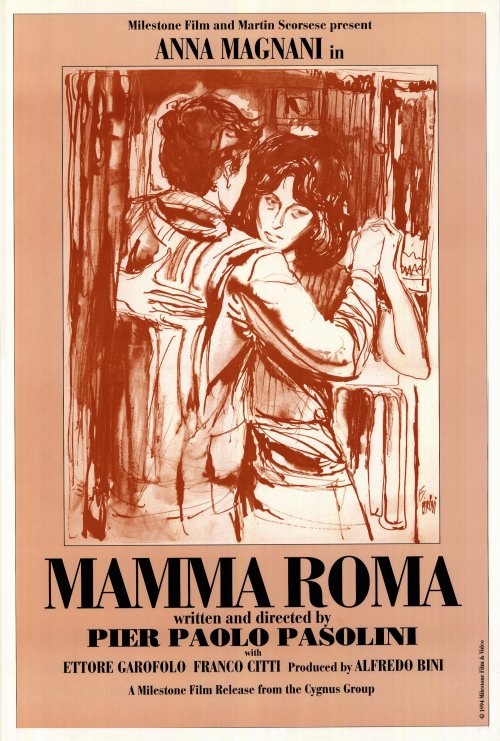
Good Mother's Day watch—a mom trying her best to shield her son from the consequences of her past of poverty and desperation (unsuccessfully, of course, because this is Italian Neorealism). This would probably have more of an impact on me if I cared at all about the concept of Rome as a city, for which this movie's titular mother is very obviously an analogy, but the tragedy of the movie's arc has a baseline gravitas that is unavoidable, and Anna Magnani as the protagonist is electric onscreen. It's funny to me that fascists showed up to protest this movie's premiere, considering how gentle it is compared to what I understand about Pasolini's later work, but I guess opposing anything but sycophantic adoration and positivity toward your homeland is one of fascism's big deals. Grade: B


Television

Nathan For You, Season 4 (2017)
In the end, it's fitting that the final season of Nathan For You is obsessed with authenticity and identity, a theme that has been not only a constant undercurrent of the show but also is an inevitable casualty of the fame-adjacent, growth-minded business "sense" that has permeated the show as well as capitalism as a whole. This season, Nathan seems much more willing to mislead and even openly lie and defraud to enact his absurd schemes, whether that be convincing people (falsely) that Michael Richards left an abnormally large tip at a diner, leading every Maria Garcia in the greater Los Angeles area to believe that a psychic has had a vision about them, or orchestrating a bizarre confluence of events just to tell a funny anecdote on Jimmy Kimmel Live! To pursue a profit is to make all but the most crass of us inauthentic, but nobody can let on that they understand that or the whole illusion of the purity of the entrepreneurial spirit would crash, so we're all just participating in this elaborate charade to imbue business with a meaning beyond pure financial motive. This all comes to a head in the feature-length finale "Finding Frances," which turns these very tensions about authenticity and success inward onto the show itself, and it's honestly brilliant, one of the best TV episodes of all time, not to mention one of the greatest series finales ever. I've seen people compare it to the work of Abbas Kiarostami, and as hyperbolic as that sounds, it's right on the money. I'm going to miss this wild, wonderful show. Grade: A

Sunday, May 8, 2022

Mini Reviews for May 2 - 8, 2022

Two and a half weeks until school lets out.

Movies

C'mon C'mon (2021)
I sure do love 20th Century Women, so I'm super sad that this just didn't add up for me. Some very good component parts: Joaquin Phoenix is in sensitive dude mode, which is a refreshing fit for him, and Woody Norman (imagine being 12 years old and named "Woody") has an amazing ability to portray a precocious kid who isn't immediately grating onscreen, though I'm not sold on his performance being "good" so much as it is just good for what Joaquin is doing, but regardless, those two together are very watchable. But I had a hard time dialing into this movie until it started talking about how the incidents depicted in the movie will just be vague memories for the child, and that got me all verklempt because I started thinking about my own kids, with whom it already seems like I've spent a lifetime with but the oldest of whom is only just getting to the age where he's going to be remembering anything that happened. I think what this movie is short on that 20th Century Women has in spades (and what it turns out I'm most interested in with Mike Mills's feature filmography) are the moments like that, where the movie casually flips from the immediacy of the present into the hindsight at the scale of lifetimes—it's a kind of twee move at times, but when Mills nails it, he freakin' nails it and contextualizes the moments of our lives within these impossibly big timelines in a way that feels like a human-scaled Carl Sagan Pale Blue Dot thing. This movie's okay, but it could have used a lot more of that, because if there's anything that makes the passage of time palpable, it's being around children. Grade: B-

The Doom Generation (1995)
Pretty unpleasant satire about a trio of alleged heterosexuals who blow up their lives in a spate of nihilism and as a result briefly find themselves with enough space to find meaningful connections in the fluidity outside of the hetero-monogamous paradigm before they inevitably get crushed by the hateful hegemony of the United States mainstream. It's intentionally unpleasant, I think, given the completely understandable contempt Araki had as a sexual minority for the United States government and for sexual squares at the time (continues to have?), and I usually dig this kind of abrasive punk ethos—very much in the vein of The Living End, in which the realization that the powers that be are indifferent to and in fact even might be advocating for your annihilation forces you to find a life outside of the state and the family and all the traditional structures that those powers use as crutches, and I really like that movie. But something about the fusion of that with a very manic sensibility that presages Kaboom (my least-favorite Araki I've seen so far) makes this a lot less compelling to me than The Living End. The particular despair at the core of this movie—the kind of horrified reaction to that '90s "End of History" moment where there's an apocalyptic, even cataclysmic sense of looking at the abuses of liberal democracy and capitalism and being told This Is All There Is—feels a lot more vivacious and urgent than whatever Araki is going for in Kaboom, and it funnily enough feels easier to transpose that sense of doom that Araki felt from the AIDS pandemic into a modern framework of desperation birthed from the climate change/late capitalism/fundamentalist religion/fascism stew we've got cooking in the 2020s than it is to connect to the theoretically much more contemporary doom in Kaboom. But nevertheless, something about the way this movie presents itself feels forced and postured in a very Kaboom-ish way that I find irritating. Also, while I don't dislike Diablo Cody, Rose McGowan's character feels like it was written by Diablo Cody, which is both kind of funny to me and also somewhat annoying in this context. Stoner James Duval is very sweet, though, and I genuinely loved him. I dunno, a mixed bag. Grade: B-

Nowhere (1997)
It's hard for me to describe why I found this movie to be so resonant when I somewhat bounced off the previous entry in Gregg Araki's "teen apocalypse" trilogy, The Doom Generation. But I thought this one was kind of beautiful in its chaos. It's no less bleak or filled with arch dialogue than The Doom Generation, but by the end, I had a gigantic lump in my throat. I dunno, maybe it's just the way that the movie frames itself around a single day culminating in a party, which is a structure I absolutely love in movies, or maybe it's the way that it positions its "end of history" despair within a chronological continuum that begins with a wild, liberatory abandon that slowly becomes sadder and more hellish. There's something about those final thirty-ish minutes in this movie that perfectly capture that morose, semi-panicky feeling of being at a party and slowly realizing that you don't want to be there and that you're too sober to even enjoy the people you came for and that it's too late to catch up even if you wanted to. Maybe it's the way that even this is positioned within a broader arc of James Duval's character reaching desperately for human connection of some kind through the haze, looking around at a world where nothing makes sense except the things whose cold logic feels so cruel that you have no chance but to reject it, and when suddenly out of nowhere he actually finds that connection for a fleeting moment despite literally everything else in the movie, it's this unspeakably sublime moment that I can only really connect to the ending of Mysterious Skin in the broader context of Araki's career. This is a lot less overtly political than the other two "apocalypse" movies, but the fluid reality of this film has a texture and an emotional landscape so deeply buried within the subjective experience of knowing you will live through the end of the world that it feels radically empathetic in a way that neither of the other two achieve. I was trepidatious about this one after not being over-the-moon about The Doom Generation, but wow, consider me over-the-moon here. Grade: A-

Poison (1991)
It makes sense that this is Todd Haynes's debut film, as it contains basically all of his interests (pastiche, camp, queerness, the fluidity of identity, the oppressive unlivability of modern society) packaged into a pretty scuzzy, rough-around-the-edges triptych of stories. It's pretty wild and radical and unbuttoned in a way that a lot of Haynes's future work would dial back, but also, I do prefer the pristine polish of his other movies compared to this. An undeniable landmark and the kind of movie you can probably only make once, but also exhausting for being that. Grade: B


To Sleep with Anger (1990)
To Sleep with Anger is folkloric in a way that is rare enough in the literary precedents this is pretty obviously drawing from (Toni Morrison, Gabriel García Márquez, Zora Neale Hurston) and nearly unheard-of within cinema. It's at once fairly straightforward—an old family friend (an unparalleled Danny Glover) comes uninvited for a visit and throws off the equilibrium of the community—while swimming in the mirage-like ambiguity that is the province of myth, a dozen different meanings sprouting from any one line or character. A masterpiece of that uncanny kind that feels as though it's grown from something outside of itself, as if the frames of the film itself are just a flimsy veneer over some ineffable Beyond. Grade: A

Sunday, May 1, 2022

Mini Reviews for April 25 - May 1, 2022

Did you guys know that when Justin Timberlake sings, "It's gonna be me," the "me" sounds like "may" and you can make a meme about that every time it's May 1?

Movies

Blow the Man Down (2019)
I thought this was a great deal of fun: a small-town crime thriller with great textures, in this case Main fishing village with sea shanties as a kind of Greek chorus between acts. Not really breaking the mold of this particularly well-trodden genre, but it's a really solid iteration of those familiar rhythms. I dug it a lot. Grade: A-


Get on the Bus (1996)
As long as this is a "hey, what if we put the entire spectrum of black male politics on a cross-country bus ride?" pressure cooker, it's super good. A top-to-bottom great cast animates what might have otherwise felt like overly abstract political discourse into something that feels human and raw, and the Million Man March as context is a kind of perfect storm for the ideological and dramatic tensions that simmer along. As soon as this has to put its plot into gear, though, this kinda stumbles, and the characters never quite land the transition from "human beings in impassioned dialogue with each other" to "human beings who must make decisions about important things together." It makes sense that this remains semi-forgotten in the context of Spike Lee's career, considering the towering titans of films he made elsewhere in the '90s and that definitely overshadow Get on the Bus. But it's one of those movies that feels particularly interesting for being so direct and small-scale in the context of a career that has rarely been so. Glad to have caught this one. Grade: B

A Man for all Seasons (1966)
I found this movie fine, enjoyable, and otherwise unremarkable, but the performances and costume design are next-level. The "pious man devoted to his principles unto death" plot is an archetype I've had diminishing returns with as I've gotten older, but Paul Scofield sells it pretty hard here. It's very funny to me that thirty years later he'd basically play the exact opposite of this role when he was Danforth in The Crucible. Grade: B


Television

Jane the Virgin, Season 1 (2014-2015)
Lots of fun with its self-referential, winking treatment of the soap/telenovela format, but also able to spin this into some exceptionally sweet and well-observed characters, too. Case in point is the entire premise of the show, wherein a woman who has never had sex get accidentally artificially inseminated—a knowingly goofy contrivance that somehow manages to spin that goofiness into a pretty sophisticated story about family, identity, and religious faith. There are half a dozen things about the show that follow a similar trajectory, taking silly concepts and weaving them into something with serious, thoughtful emotional stakes.  Some of the more arch things I'm asked to take serious emotional stake in, especially the love triangle that develops between Jane and her accidental sperm donor and her fiancé, I found a little tedious at times and wished so much of the dramatic energy of the show weren't so driven by them. But as long as the show focuses on Jane's multi-generational household that she shares with her mother and grandmother, the show is consistently engaging and often very warm. The more outlandish telenovela elements are fun, too, such as the travails of prima donna show-within-the-show lead Rogelio (who eventually gets tied up into the emotional stakes of her primary family, of course) or the ongoing investigation of a drug lord named Sin Rostro, and the show finds a pretty good balance in each episode between more sincere beats and the off-the-wall camp elements. I'm enjoying the show so far, and I've been told that subsequent seasons make the love triangle more interesting, so I'm looking forward to what comes next. Grade: B+