Showing posts with label Pier Paolo Pasolini. Show all posts

Sunday, July 31, 2022

Mini Reviews for July 18 - 31, 2022

Announcement! My wife and I started a podcast! The basic idea is that we're reading through each book that's won a Newbery Medal and then discussing each one. I know I don't review a ton of books on this blog, especially children's books, but if that sounds at all interesting to you, here's the link!

Movies

Nope (2022)
I've seen people complain that this movie has a messy structure and an overcooked screenplay, and while I guess I theoretically understand why they'd say that (it definitely feels like we're seeing either too much or too little of Steven Yeun's character, and this movie is biting off a lot thematically with all of its "society of the spectacle" + limits of anthropomorphism stuff), I was captivated the whole time here. I'm an easy target for UFO thrillers, but even so, the specific ways in which Jordan Peele approaches that topic makes it feel like he was interested in all the same weirdo Americana stuff that I was growing up, and combine that with his Shyamalan-esque "just go for it, dude" conceptual unself-consciousness and his formidable formal command, and you've got a movie that's pretty specifically calibrated to my precise wavelength. I just thought this was a crackjack time at the movies. Also, re: the dense web of metaphors and thematic threads that a lot of people have found overdetermined and overbearing—I guess I have incurable English-teacher brain, but I thought that was fun! Grade: A-

The Bad Guys (2022)
Of all the major studios, DreamWorks is still doing the most interesting things with CG animation. It's a fairly paint-by-numbers heist film with a villain "reveal" that's even got to be obvious to the kids who make up the film's target audience, but at this point, I ain't watching DreamWorks animated movies for the plot: this has an intensely cool style that basically mixes 3D animation with some intentionally flat texturing and broad color work that make it look like computer-assisted cel animation of the kind you might have seen in the late '90s, or maybe even a digitally-inked comic book set in motion. Slick, but in a way that leaves room for play and invention. With any luck, one of these days, DreamWorks is going to get their hands on a front-to-back legitimately great screenplay and make the greatest mainstream animated feature of the decade. Until then, at least they're pushing the medium forward aesthetically. Grade: B

Because of Winn-Dixie (2005)
Softballs everything you would expect a mid-2000s family film set in the small-town South to (e.g. entirely benign Baptists, zero racial tensions), but its sense of place is really terrific—the movie nails the feel of that specific small-town window of the post-industrial, post-NAFTA but pre-"everything is just a fast food franchise or gas station" milieu: crumbling, half-vacant main street full of old-timers desperately clinging onto what remains of the idiosyncratic life their town once had. Some real grit at the margins of each shot. It's also surprisingly melancholy for a movie about a dog curing everyone's malaise. Credit to two strong central performances from Jeff Daniels and AnnaSophia Robb; the movie's deep undercurrent of sadness is simple but never calculated in their hands, which almost never happens with "single-dad reconnects with daughter" movies like this. Similar to its rendering of the setting, the movie's characterization of their relationship (and their shared but at times incompatible grief over the wife/mother who left them) is not particularly difficult, but it's so purely and effectively felt that it doesn't matter if the brush is broad. It's easy to say this a lot because major studios really only make like two or three types of movies nowadays, but they really don't make movies like this anymore, which is normally not something I would mourn (who misses the sappy family film?) but this movie's a great example of what we've lost by removing the possibility of the once-in-a-blue-moon successful product of this little genre. Grade: B

Cartoon Noir (1999)
More of an anthology of previously released animated shorts than it is a fully original movie on its own, and Only one of the shorts in the anthology has anything even resembling film noir ("Tale About the Cat and the Moon"). So anyway, here's a ranking of the shorts, sorted by favorite to least-favorite. "Abductees" is far and away the best here, a real masterpiece and also one of the best pieces of UFO media I've ever seen, but all the films are great. Feature-length adult animation has always had a spotty track record, so shorts are where it's at. There should be more compilations like this: NOW That's What I Call Music!, only for experimental adult animation.
    1. "Abductees" (1995, dir. Paul Vester)
    2. "A Gentle Spirit" ("Lagodna") (1987, dir. Piotr Dumała)
    3. "Joy Street" (1995, dir. Suzan Pitt)
    4. "Ape" (1992, dir. Julie Zammarchi)
    5. "Tale About the Cat and the Moon" ("Estória do Gato e da Lua") (1997, dir. Pedro Serrazina)
    6. "Club of the Laid Off" ("Klub odložených") (1989, dir. Jiří Barta)
Grade: B+

The Hole () (1998)
For as much as this depicts misery and squalor (a crumbling city, endless rain, isolation in a pandemic [yike]), I found this to be deeply beautiful and human and even sweet. I have no idea how this would have played for me before having gone through several years of a pandemic characterizes by intermittent houseboundness and relative isolation (I at least have family at home), but the alienation these two characters feel from the broader world as well as the desperation with which they eventually cling to each other—right up to that transcendent ending in which the distance between the two is recklessly, compassionately pulled away—had me tearing up. I also watched it with my three-year-old, and that kind of drove home how lucky anyone is to have another person in their life who cares about that. I have no idea what he thought about it, he did watch quietly all the way through to the end (it was better than the alternative, I guess, i.e. taking a nap). His lone comment: "That's a lot of rain." Grade: A

Fatal Attraction (1987)
Flagrantly misogynist, which kind of comes with the territory, and for as much fun as Glenn Close has, it sometimes feels like she's hemmed in a bit. Some parts are weirdly slow, too, as if the movie can't make up its mind how artful it wants to be. Still, there's some good, nasty fun to be had once this gets cooking (er... literally in the case of that poor bunny). I think my problem is that I want to find an erotic thriller that is as good as Gone Girl, and maybe there just isn't one. Grade: B-


Faster, Pussycat! Kill! Kill! (1965)
Good fun for the most part, and not nearly as smutty as I'd been led to believe. The opening and closing are great, but it does get somewhat draggy in the middle. Except for the beautiful women, it kinda feels like John Waters took everything I love about this movie—the dialogue, the arch line deliveries, the post-morality ethos, the sheer camp of it all—and nuclear-charged them, making much more front-to-back engaging (not to mention truly smutty) movies in the process, but you've got to respect an original, and compared to Waters's films, this movie is shockingly competent in the technical department. It's also glaringly obvious how much Quentin Tarantino loves this movie, too, though he kinda takes the opposite tact of Waters, making slicker and less weird versions of this movie. Grade: B


I Am Cuba (Soy Cuba) (1964)
As is to be expected with Mikhail Kalatozov directing, this movie is visually stunning, with a camera that's practically taken flight, swooping and panning madly in a seeming attempt to take in every possible bit of scenery and human life in each scene. It's incredible. It's also great at being an anthology film, with only the last segment falling flat (the one with the guy who initially declines to join the revolution, which only really fails because of its leaden didacticism, since the film style is still as vibrant as ever). It's also nice that this movie is actually hopeful; the other two Kalatozov features I've seen, The Cranes Are Flying and Letter Never Sent, are both major bummers, which parallels the anachronistic creep of pessimism that hangs over every Soviet film because I know that that state will eventually fail. Cuba, on the other hand, for all its problems, remains a relative beacon for leftists worldwide as a socialist project that hasn't collapsed on itself or been undone by counterrevolutions (though not for lack of trying, of course), so it feels poetic to me that a film full of such national optimism in the radical then-present remains uplifting to a certain extent to this day. This is probably not exactly the right word for a movie that is pointedly agitprop, but it's almost sweet how much this loves the concept of a revolutionary Cuba. Grade: A-

Accattone (1961)
This mostly just seemed bleak. I was intrigued by the dream(?) sequence at the end, but overall, I'm not 100% sure what I'm supposed to get out of this, which is weird because the subsequent Pier Paolo Pasolini movies have, whatever their faults, crystal-clear intentions. Part of this must, as always, be chalked up to the fact that I simply don't know as much about mid-century Italian history as I need to to get the most out of the Neo-Realist films I've watched. But also, probably the biggest reason I don't know what to do with this movie is that the version I watched had absolutely terrible white subtitles that were illegible 30-40% of the time (they were hard-coded into the film, too). I really owe it to this movie to rewatch on a better transfer. Grade: C


Television

Russian Doll, Season 2 (2022)
Russian Doll, a kind of perfect little one-off jewel, didn't really need a second season, something I'm still confident of even after having watched this crazy-ambitious, wonderfully weird second season. But since we got one, at least it's good. After the first season, there really wasn't a ton left to do with the "Groundhog Day, but with NYC-based mystical stuff," so it makes sense that we'd get a different time problem here: this time, Natasha Lyonn's Nadia discovers that a train that takes her back to 1982, where she inhabits the body of her mother. At least, that's initially what the concept is. What it eventually becomes is an epic that spans generations and continents, leaning even more into the mystical stuff from the first season in order to spin a yarn about fate and the fundamental traumas at the root of family mythologies. It's considerably messier than Season One, and it's clear that the show doesn't have a clue what to do with Charlie Barnett's character here, who gets some tantalizing but underexplored threads that don't end up earning where his story eventually goes. But even so, the show can still be very funny and unexpectedly moving, and Lyonn's performance, which masterfully dances around but never lands on shtick, is still riveting. Honestly, I'm cool just hanging with Nadia while weird stuff happens. It seems that as long as this show lasts (Lyonn has indicated in some interviews that there will be a third season), we're at least always going to get that. Grade: B+


Books

Strawberry Girl by Lois Lenski (1945)
At times really well-observed literary realism, at other times tediously moralized. I read this for the podcast, so keep an eye out for the episode if you're interested in more fleshed-out thoughts. Grade: B-

Sunday, June 12, 2022

Mini Reviews for June 6 - 12, 2022

Not much to say here. Read on.

Movies

The Bob's Burgers Movie (2022)
This was nice. A lot of sitcoms struggle when they try to break out of the half-hour format (including Bob's Burgers, whose two-parters have always felt ungainly to me), but I actually thought this did a good job of preserving the rhythms of the show while also still making it feel plotted and paced like a movie. Ditto the animation, which is noticeably more fluid and dynamic than a typical episode of the show without ever really being distractingly different from the show. My one real quibble is that making the Belchers and the Fischoeders allies here feels weird, but there are a dozen great little character beats to outweigh that—I don't know why, but Teddy calling the food cart "Bob Burger" made me chuckle every time I saw it. Anyway, I wasn't going to be hard to please with this movie; Bob's Burgers has been comfort television for me for basically a decade at this point, so all this really had to do is not be terrible, and it's not. It's good, actually, and it made me feel good to see it. Grade: B+

The Voyeurs (2021)
Knowingly ridiculous but also About Stuff (in this case, the lack of privacy in the digital/social media age), which makes it a tad frustrating that it isn't quite what it would be if Paul Verhoeven were actually directing instead of the movie just really, really wanting to pretend he's directing. Just imagine what Sydney Sweeney's kinda forced performance here could have been under the for-real Verhoeven magic? Anyway, regardless, this is still fun, and there's a plot beat that happens about half an hour from the end of the film that's so audacious and bananas that it made me want to stand up and cheer. I'm seeing a lot of people talk about how nice it is to have eroticism back in a mainstream movie, too, though I'm having a hard time figuring out if the movie is sexy or if these actors are just sexy, which is a distinction I want to believe is meaningful? Anyway, something is sexy here. Good time. Grade: B

Wake Wood (2009)
Pretty unremarkable folk horror only remarkable for its cast (Timothy Spall! Aidan Gillen!) and for the fact that it's a Hammer production. There's nothing particularly wrong with the movie—it's basically Pet Sematary but Irish—but it never quite tips over from "vaguely unsettling" to "pit-in-stomach scary," which is what I'm usually waiting for with folk horror. Grade: B


A Boy and His Dog (1975)
Really unpleasant, which I probably should have braced myself for, given that it's based on a novella by the notoriously unpleasant Harlan Ellison—but seriously: what if Lassie, but it's in a post-apocalyptic world and the dog helps his boyish owner by helping him find women to rape? This is just gross, pointlessly edgy nonsense for a good chunk of its runtime. It gets a lot better when the boy enters an underground biosphere run by a fertility cult nostalgic for the rhythms of small-town America, which, credit where credit is due, is actually something with satirical bite (maybe more so now than in 1975). This part actually is close to great, but boy oh boy, I just hated the first 45 minutes or so of this. Grade: C


Le Mans (1971)
Points for the audacity of the concept and the purity of vision, i.e. a nearly dialogue-free movie mostly involving Steve McQueen just zooming around in European race cars as his character participates in the 24 Hours of Le Mans. It's occasionally very striking, especially when this leans into a fractured, almost experimental European New Wave/New Hollywood style to depict the racing (and especially the handful of crashes that happen during the race). But I gotta be honest here: I'm not nearly interested enough in cars to feel very strongly about this film. Remake this movie but about trains instead, please. Grade: B-


Hawks and Sparrows (Uccellacci e uccellini) (1966)
Pasolini isn't, like, an unfunny director, but I was pretty shocked to see something as openly jokey and hilarious as this is from him. This is extremely funny to me. For example, there's this one bit where this talking crow is telling this story about a couple of Franciscan friars who are told by St. Francis to preach to hawks and sparrows, so the two of them go through this years-long process of learning how to speak to birds, and once they have, they preach the gospel to them and are dismayed to see that the hawks are still killing and eating the sparrows, and when they tell St. Francis about it, he's all like, "Oh here's your problem: you didn't put enough Marxism in your gospel," and then the parable ends, and there's this intertitle tells us that just so we know, the crow is a left-wing intellectual. I dunno, writing it out like this, it doesn't actually sound that funny, but trust me: it is! The movie is also a pretty direct satire of Italy's relationship to communism at the time, which is maybe a little more obvious from my summary of this one scene. Oh, and it's also a send-off to the career of an Italian clown named Totò, for whom this was his final role, and honestly, I probably need to learn more about him and rewatch this, because some of this feels like watching Limelight without knowing who Charlie Chaplin is. But I at least know a little about communism, so I'm good on the rest of the movie! Grade: A-

Macbeth (1948)
Orson Welles going ham on some Shakespeare, as he was wont to do. He's apparently (as a cost-cutting measure) repurposing material from his own stage production of the Scottish play, but this feels undeniably cinematic, as informed by German Expressionism and the abstractions of the silent era as Joel Coen's adaptation, only whereas the Coen film feels hermetically sealed, Welles's has a barely contained manic energy born from its limitations. Both films have very cool depictions of the Weird Sisters, though—here, they're these faceless, shadowy figures, which are super unnerving. Grade: A-


Television

Atlanta, Season 3 (2022)
Props to the Atlanta team for just doing whatever the heck it is that they want. I'm not sure it's exactly what I want. On paper, this sounds awesome: Paper Boi is doing a European tour, and the fractured experience of touring in different countries also fractures the show itself, which pivots unpredictably this season from existential vignettes involving the main cast to episodes without any of the characters we know at all, usually centered around speculative concepts or thought experiments. It's the sort of audacious, episode-focused television that should be right up my alley, but it never quite adds up for me. The main-cast episodes feel about right, precise little stories about the intersections of race, class, and fame, this time inflected with ex-pat experiences reminiscent of James Baldwin's writing about Europe. But the standalone episodes without the main cast, which comprise four out of the ten episodes, feel a little thin. It at first feels bewildering and exciting that the show will zag into new directions like this, but eventually, once it becomes clear that each one is going to be basically a fairly obvious parable about the same themes that the regular episodes handle with a lot more subtlety and strangeness, the shine wears off. There's an episode imagining reparations; there's another one about a white family attending the funeral of their son's black nanny; etc. It's not like they're bad, but a lot of them have a kind of Black-Mirror-esque quality of being able to be reduced to its thesis, and after a while, I would have rathered the show process these ideas through its normal storytelling modes, which end up being much more interesting. Any one of these episodes is pretty cool, but collectively, as 40% of the season, they feel like less than the sum of their parts, I guess. Kudos for Atlanta just going for it, though. More shows should do that. Grade: B-

The Marvelous Mrs. Maisel, Season 4 (2022)
I still enjoy some of the ambitious aesthetic and writerly flourishes: the show always looks great, and the dialogue can still be very fun. But I'm mostly just tired of this show, I think. The characters are constantly circling around the same beats and conflicts iterated again and again in ways that promise us that this time, the drama will actually have consequences and matter, only to have it not matter and not have consequences. On top of this, the writers seem to have forgotten how to plot a season of television. Mrs. Maisel has never been a super-plotty show, but it's usually had consistent plot threads throughout. This season, however, picks up and drops plots at random, and it's never clear what is significant and what isn't. I don't mind shows that are purely episodic, but this show isn't structured episodically, either; it treats its plot threads as if they will be significant later on rather than one-and-done episode plots or even just series of incidents for character flavor. As a result, the bottom completely falls out of the drama, and frankly, I'm not sure why I'm supposed to care about anything happening in this show anymore. Grade: C+

Sunday, May 15, 2022

Mini Reviews for May 9 - 15, 2022

One and a half weeks until school lets out.

Movies

Cyrano (2021)
This feels akin to Tom Hooper's Les Misérables in the sense that it is mostly notable as a pileup of idiosyncratic/questionable decisions—and given that I'm at least theoretically (if not in practice) in favor of big-budget musicals built from idiosyncratic/questionable decisions, I had a reasonably good time with Cyrano. In this case, an incomplete list of the notable choices includes: 1) making the juxtaposition of an incredibly elaborate period setting with an anachronistic, self-aware comedic sensibility about the pomposity of the period, 2) relatedly, playing up to grotesque degrees the elaborate fashion of 17th-century France, but only for some characters, 3) giving most of the musical sequences an abstract, impressionistic style more like music videos than traditional choreographed numbers, 4) having all the music written by The National and having half of the actors attempt to sing at Matt Berninger's baritone register, 5) casting a lead, Peter Dinklage, who, despite his best efforts, has no real discernible facility with musical theatre, and this seems to be part of the point of the movie (or at least a part of his character, vis-à-vis Cyrano's awkward physical presence that he must hide behind his writing), 6) having Peter Dinklage do some Hamilton-style raps in the verses of his introductory number just for fun. It's very, very goofy, but it also has moments when it undeniably cooks, especially during some of the songs when Joe Wright and his main guy Seamus McGarvey get grooving with their typically florid camerawork. There are also a lot of places where this pretty much falls flat on its face, but imo, that's the appeal of this kind of mad-scientist musical: the high-wire act of how far these questionable choices can get the film before it falls. It's the kind of movie that's so sincere and heart-on-its-sleeve that it invites mockery but also makes you feel bad for making fun of it because it's having such a good time being itself. Of the two financial flops that tried to bring back big-money musicals in 2021, West Side Story is the obvious winner, but I like the idea of this being the weirdo kid brother to Spielberg's honor-roll, class-president ethos. Grade: B-

White Bird in a Blizzard (2014)
Just kinda okay as a Gregg Araki film—mostly pretty paint-by-numbers in terms of the kind of plot beats and themes he seems fond of including in his 21st-century films. But I remain consistently floored by this dude's ability to conjure incredible film music, whether that's curating a soundtrack or (in the case of this one) commissioning an absolute flex of a score. Robin Guthrie and Harold Budd??? Amazing. Grade: B-


Shampoo (1975)
I thought this was actually terrible for the first half, where the main bit seems to be that Warren Beatty is a hairdresser.......but Not Gay! This comes together a lot better once you get to the election-night scenes and all of Beatty's character's cavalier behaviors blow up in his face, but it's too little, too late for me. The Richard Nixon stuff all feels painfully on-the-nose, and watching it makes me think I've been given a window into how our kids and grandkids are going to feel as they run across all the 2016-2020 #Resistance anti-Trump media. I'm sorry, children and grandchildren. I'm all-for boomer self-critiques, and I get that on some level this is about how the dream of the '60s counterculture was cut off because privileged white folks lacked (or abandoned) the class/race consciousness to understand or care about the revolutionary core under the hedonist surface pleasures of liberation, a point I'm in theory interested in. So maybe it's one of those "you just had to be there" sort of things. But this didn't really connect with me. Grade: C

Essene (1972)
At the periphery of this portrait of a Benedictine monastery, you can see small glimpses of the bureaucratic mechanisms that Wiseman is usually so fascinated by, and of course any organized human community is going to have some feature of that. But what sets Essene apart from the other early Wiseman documentaries is the degree to which the liturgies and structures of a religious commune like this allow the people Wiseman records to be far more open-hearted and sincere than folks out in mainstream society are usually allowed to be. Like all Wiseman subjects, these monks stare into the dehumanizing, alien maw of modernity and feel afraid and lonely, but unlike Wiseman's normal subjects, who because of the constraints and obligations of their lives are often only obliquely referencing that fear and loneliness, the monks here are constantly talking about these things to each other and, stripped of the formalities of a industrialized, disenchanted life, are allowed and even encouraged by their faith to openly seek human connection and understanding, which is kind of incredible to see in the context of Wiseman's broader filmography because it makes you realize that that kind of connection and intimacy with fellow human beings is exactly what's at the heart of so many of the eccentrics, pencil-pushers, and vagrants that Wiseman throws up onscreen. By simply showing the routines of people who have devoted their entire lives to embracing ancient rituals as they slough off our modern, bureaucratized ones, Essene becomes a striking and often transcendent depiction of meaning-making in its rawest form. I know my own religious beliefs make me especially susceptible to this subject matter, so maybe I'm just projecting, but this was, for me, unexpectedly a kind of primordial Wiseman film, as if all the other ones are in answer to the questions raised in this one. Grade: B+

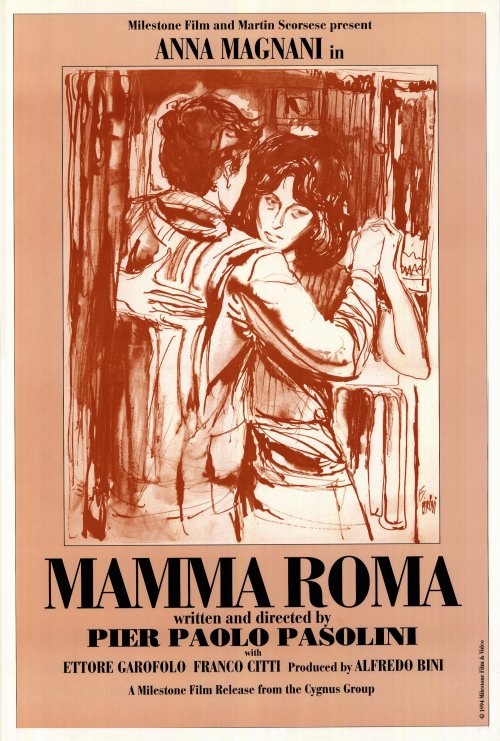
Mamma Roma (1962)
Good Mother's Day watch—a mom trying her best to shield her son from the consequences of her past of poverty and desperation (unsuccessfully, of course, because this is Italian Neorealism). This would probably have more of an impact on me if I cared at all about the concept of Rome as a city, for which this movie's titular mother is very obviously an analogy, but the tragedy of the movie's arc has a baseline gravitas that is unavoidable, and Anna Magnani as the protagonist is electric onscreen. It's funny to me that fascists showed up to protest this movie's premiere, considering how gentle it is compared to what I understand about Pasolini's later work, but I guess opposing anything but sycophantic adoration and positivity toward your homeland is one of fascism's big deals. Grade: B


Television

Nathan For You, Season 4 (2017)
In the end, it's fitting that the final season of Nathan For You is obsessed with authenticity and identity, a theme that has been not only a constant undercurrent of the show but also is an inevitable casualty of the fame-adjacent, growth-minded business "sense" that has permeated the show as well as capitalism as a whole. This season, Nathan seems much more willing to mislead and even openly lie and defraud to enact his absurd schemes, whether that be convincing people (falsely) that Michael Richards left an abnormally large tip at a diner, leading every Maria Garcia in the greater Los Angeles area to believe that a psychic has had a vision about them, or orchestrating a bizarre confluence of events just to tell a funny anecdote on Jimmy Kimmel Live! To pursue a profit is to make all but the most crass of us inauthentic, but nobody can let on that they understand that or the whole illusion of the purity of the entrepreneurial spirit would crash, so we're all just participating in this elaborate charade to imbue business with a meaning beyond pure financial motive. This all comes to a head in the feature-length finale "Finding Frances," which turns these very tensions about authenticity and success inward onto the show itself, and it's honestly brilliant, one of the best TV episodes of all time, not to mention one of the greatest series finales ever. I've seen people compare it to the work of Abbas Kiarostami, and as hyperbolic as that sounds, it's right on the money. I'm going to miss this wild, wonderful show. Grade: A