Showing posts with label Gregg Araki. Show all posts

Sunday, May 15, 2022

Mini Reviews for May 9 - 15, 2022

One and a half weeks until school lets out.

Movies

Cyrano (2021)
This feels akin to Tom Hooper's Les Misérables in the sense that it is mostly notable as a pileup of idiosyncratic/questionable decisions—and given that I'm at least theoretically (if not in practice) in favor of big-budget musicals built from idiosyncratic/questionable decisions, I had a reasonably good time with Cyrano. In this case, an incomplete list of the notable choices includes: 1) making the juxtaposition of an incredibly elaborate period setting with an anachronistic, self-aware comedic sensibility about the pomposity of the period, 2) relatedly, playing up to grotesque degrees the elaborate fashion of 17th-century France, but only for some characters, 3) giving most of the musical sequences an abstract, impressionistic style more like music videos than traditional choreographed numbers, 4) having all the music written by The National and having half of the actors attempt to sing at Matt Berninger's baritone register, 5) casting a lead, Peter Dinklage, who, despite his best efforts, has no real discernible facility with musical theatre, and this seems to be part of the point of the movie (or at least a part of his character, vis-à-vis Cyrano's awkward physical presence that he must hide behind his writing), 6) having Peter Dinklage do some Hamilton-style raps in the verses of his introductory number just for fun. It's very, very goofy, but it also has moments when it undeniably cooks, especially during some of the songs when Joe Wright and his main guy Seamus McGarvey get grooving with their typically florid camerawork. There are also a lot of places where this pretty much falls flat on its face, but imo, that's the appeal of this kind of mad-scientist musical: the high-wire act of how far these questionable choices can get the film before it falls. It's the kind of movie that's so sincere and heart-on-its-sleeve that it invites mockery but also makes you feel bad for making fun of it because it's having such a good time being itself. Of the two financial flops that tried to bring back big-money musicals in 2021, West Side Story is the obvious winner, but I like the idea of this being the weirdo kid brother to Spielberg's honor-roll, class-president ethos. Grade: B-

White Bird in a Blizzard (2014)
Just kinda okay as a Gregg Araki film—mostly pretty paint-by-numbers in terms of the kind of plot beats and themes he seems fond of including in his 21st-century films. But I remain consistently floored by this dude's ability to conjure incredible film music, whether that's curating a soundtrack or (in the case of this one) commissioning an absolute flex of a score. Robin Guthrie and Harold Budd??? Amazing. Grade: B-


Shampoo (1975)
I thought this was actually terrible for the first half, where the main bit seems to be that Warren Beatty is a hairdresser.......but Not Gay! This comes together a lot better once you get to the election-night scenes and all of Beatty's character's cavalier behaviors blow up in his face, but it's too little, too late for me. The Richard Nixon stuff all feels painfully on-the-nose, and watching it makes me think I've been given a window into how our kids and grandkids are going to feel as they run across all the 2016-2020 #Resistance anti-Trump media. I'm sorry, children and grandchildren. I'm all-for boomer self-critiques, and I get that on some level this is about how the dream of the '60s counterculture was cut off because privileged white folks lacked (or abandoned) the class/race consciousness to understand or care about the revolutionary core under the hedonist surface pleasures of liberation, a point I'm in theory interested in. So maybe it's one of those "you just had to be there" sort of things. But this didn't really connect with me. Grade: C

Essene (1972)
At the periphery of this portrait of a Benedictine monastery, you can see small glimpses of the bureaucratic mechanisms that Wiseman is usually so fascinated by, and of course any organized human community is going to have some feature of that. But what sets Essene apart from the other early Wiseman documentaries is the degree to which the liturgies and structures of a religious commune like this allow the people Wiseman records to be far more open-hearted and sincere than folks out in mainstream society are usually allowed to be. Like all Wiseman subjects, these monks stare into the dehumanizing, alien maw of modernity and feel afraid and lonely, but unlike Wiseman's normal subjects, who because of the constraints and obligations of their lives are often only obliquely referencing that fear and loneliness, the monks here are constantly talking about these things to each other and, stripped of the formalities of a industrialized, disenchanted life, are allowed and even encouraged by their faith to openly seek human connection and understanding, which is kind of incredible to see in the context of Wiseman's broader filmography because it makes you realize that that kind of connection and intimacy with fellow human beings is exactly what's at the heart of so many of the eccentrics, pencil-pushers, and vagrants that Wiseman throws up onscreen. By simply showing the routines of people who have devoted their entire lives to embracing ancient rituals as they slough off our modern, bureaucratized ones, Essene becomes a striking and often transcendent depiction of meaning-making in its rawest form. I know my own religious beliefs make me especially susceptible to this subject matter, so maybe I'm just projecting, but this was, for me, unexpectedly a kind of primordial Wiseman film, as if all the other ones are in answer to the questions raised in this one. Grade: B+

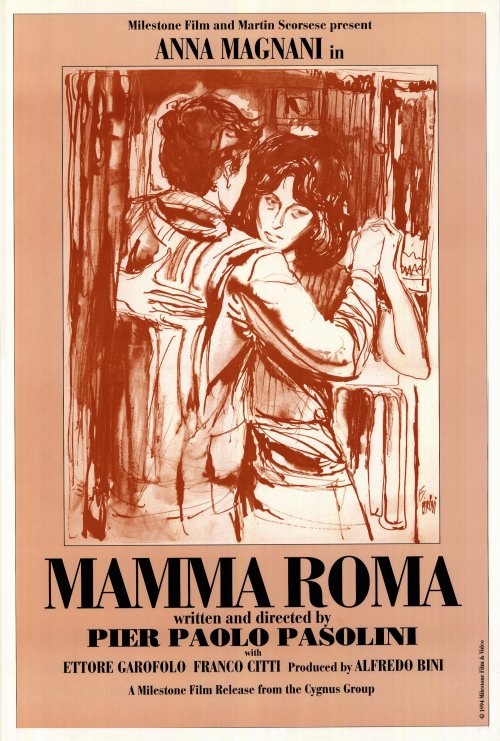
Mamma Roma (1962)
Good Mother's Day watch—a mom trying her best to shield her son from the consequences of her past of poverty and desperation (unsuccessfully, of course, because this is Italian Neorealism). This would probably have more of an impact on me if I cared at all about the concept of Rome as a city, for which this movie's titular mother is very obviously an analogy, but the tragedy of the movie's arc has a baseline gravitas that is unavoidable, and Anna Magnani as the protagonist is electric onscreen. It's funny to me that fascists showed up to protest this movie's premiere, considering how gentle it is compared to what I understand about Pasolini's later work, but I guess opposing anything but sycophantic adoration and positivity toward your homeland is one of fascism's big deals. Grade: B


Television

Nathan For You, Season 4 (2017)
In the end, it's fitting that the final season of Nathan For You is obsessed with authenticity and identity, a theme that has been not only a constant undercurrent of the show but also is an inevitable casualty of the fame-adjacent, growth-minded business "sense" that has permeated the show as well as capitalism as a whole. This season, Nathan seems much more willing to mislead and even openly lie and defraud to enact his absurd schemes, whether that be convincing people (falsely) that Michael Richards left an abnormally large tip at a diner, leading every Maria Garcia in the greater Los Angeles area to believe that a psychic has had a vision about them, or orchestrating a bizarre confluence of events just to tell a funny anecdote on Jimmy Kimmel Live! To pursue a profit is to make all but the most crass of us inauthentic, but nobody can let on that they understand that or the whole illusion of the purity of the entrepreneurial spirit would crash, so we're all just participating in this elaborate charade to imbue business with a meaning beyond pure financial motive. This all comes to a head in the feature-length finale "Finding Frances," which turns these very tensions about authenticity and success inward onto the show itself, and it's honestly brilliant, one of the best TV episodes of all time, not to mention one of the greatest series finales ever. I've seen people compare it to the work of Abbas Kiarostami, and as hyperbolic as that sounds, it's right on the money. I'm going to miss this wild, wonderful show. Grade: A

Sunday, May 8, 2022

Mini Reviews for May 2 - 8, 2022

Two and a half weeks until school lets out.

Movies

C'mon C'mon (2021)
I sure do love 20th Century Women, so I'm super sad that this just didn't add up for me. Some very good component parts: Joaquin Phoenix is in sensitive dude mode, which is a refreshing fit for him, and Woody Norman (imagine being 12 years old and named "Woody") has an amazing ability to portray a precocious kid who isn't immediately grating onscreen, though I'm not sold on his performance being "good" so much as it is just good for what Joaquin is doing, but regardless, those two together are very watchable. But I had a hard time dialing into this movie until it started talking about how the incidents depicted in the movie will just be vague memories for the child, and that got me all verklempt because I started thinking about my own kids, with whom it already seems like I've spent a lifetime with but the oldest of whom is only just getting to the age where he's going to be remembering anything that happened. I think what this movie is short on that 20th Century Women has in spades (and what it turns out I'm most interested in with Mike Mills's feature filmography) are the moments like that, where the movie casually flips from the immediacy of the present into the hindsight at the scale of lifetimes—it's a kind of twee move at times, but when Mills nails it, he freakin' nails it and contextualizes the moments of our lives within these impossibly big timelines in a way that feels like a human-scaled Carl Sagan Pale Blue Dot thing. This movie's okay, but it could have used a lot more of that, because if there's anything that makes the passage of time palpable, it's being around children. Grade: B-

The Doom Generation (1995)
Pretty unpleasant satire about a trio of alleged heterosexuals who blow up their lives in a spate of nihilism and as a result briefly find themselves with enough space to find meaningful connections in the fluidity outside of the hetero-monogamous paradigm before they inevitably get crushed by the hateful hegemony of the United States mainstream. It's intentionally unpleasant, I think, given the completely understandable contempt Araki had as a sexual minority for the United States government and for sexual squares at the time (continues to have?), and I usually dig this kind of abrasive punk ethos—very much in the vein of The Living End, in which the realization that the powers that be are indifferent to and in fact even might be advocating for your annihilation forces you to find a life outside of the state and the family and all the traditional structures that those powers use as crutches, and I really like that movie. But something about the fusion of that with a very manic sensibility that presages Kaboom (my least-favorite Araki I've seen so far) makes this a lot less compelling to me than The Living End. The particular despair at the core of this movie—the kind of horrified reaction to that '90s "End of History" moment where there's an apocalyptic, even cataclysmic sense of looking at the abuses of liberal democracy and capitalism and being told This Is All There Is—feels a lot more vivacious and urgent than whatever Araki is going for in Kaboom, and it funnily enough feels easier to transpose that sense of doom that Araki felt from the AIDS pandemic into a modern framework of desperation birthed from the climate change/late capitalism/fundamentalist religion/fascism stew we've got cooking in the 2020s than it is to connect to the theoretically much more contemporary doom in Kaboom. But nevertheless, something about the way this movie presents itself feels forced and postured in a very Kaboom-ish way that I find irritating. Also, while I don't dislike Diablo Cody, Rose McGowan's character feels like it was written by Diablo Cody, which is both kind of funny to me and also somewhat annoying in this context. Stoner James Duval is very sweet, though, and I genuinely loved him. I dunno, a mixed bag. Grade: B-

Nowhere (1997)
It's hard for me to describe why I found this movie to be so resonant when I somewhat bounced off the previous entry in Gregg Araki's "teen apocalypse" trilogy, The Doom Generation. But I thought this one was kind of beautiful in its chaos. It's no less bleak or filled with arch dialogue than The Doom Generation, but by the end, I had a gigantic lump in my throat. I dunno, maybe it's just the way that the movie frames itself around a single day culminating in a party, which is a structure I absolutely love in movies, or maybe it's the way that it positions its "end of history" despair within a chronological continuum that begins with a wild, liberatory abandon that slowly becomes sadder and more hellish. There's something about those final thirty-ish minutes in this movie that perfectly capture that morose, semi-panicky feeling of being at a party and slowly realizing that you don't want to be there and that you're too sober to even enjoy the people you came for and that it's too late to catch up even if you wanted to. Maybe it's the way that even this is positioned within a broader arc of James Duval's character reaching desperately for human connection of some kind through the haze, looking around at a world where nothing makes sense except the things whose cold logic feels so cruel that you have no chance but to reject it, and when suddenly out of nowhere he actually finds that connection for a fleeting moment despite literally everything else in the movie, it's this unspeakably sublime moment that I can only really connect to the ending of Mysterious Skin in the broader context of Araki's career. This is a lot less overtly political than the other two "apocalypse" movies, but the fluid reality of this film has a texture and an emotional landscape so deeply buried within the subjective experience of knowing you will live through the end of the world that it feels radically empathetic in a way that neither of the other two achieve. I was trepidatious about this one after not being over-the-moon about The Doom Generation, but wow, consider me over-the-moon here. Grade: A-

Poison (1991)
It makes sense that this is Todd Haynes's debut film, as it contains basically all of his interests (pastiche, camp, queerness, the fluidity of identity, the oppressive unlivability of modern society) packaged into a pretty scuzzy, rough-around-the-edges triptych of stories. It's pretty wild and radical and unbuttoned in a way that a lot of Haynes's future work would dial back, but also, I do prefer the pristine polish of his other movies compared to this. An undeniable landmark and the kind of movie you can probably only make once, but also exhausting for being that. Grade: B


To Sleep with Anger (1990)
To Sleep with Anger is folkloric in a way that is rare enough in the literary precedents this is pretty obviously drawing from (Toni Morrison, Gabriel García Márquez, Zora Neale Hurston) and nearly unheard-of within cinema. It's at once fairly straightforward—an old family friend (an unparalleled Danny Glover) comes uninvited for a visit and throws off the equilibrium of the community—while swimming in the mirage-like ambiguity that is the province of myth, a dozen different meanings sprouting from any one line or character. A masterpiece of that uncanny kind that feels as though it's grown from something outside of itself, as if the frames of the film itself are just a flimsy veneer over some ineffable Beyond. Grade: A

Sunday, April 10, 2022

Mini Reviews for April 4 - 10, 2022

If you're interested, I was on a podcast talking about a trio of Lindsay Ellis videos about the Hobbit movies. It was a good time! You can listen to it here (and it's a better use of your time than actually watching those Hobbit movies).

Movies

Turning Red (2022)
I'm a public advocate of Pixar being capable of producing solid movies that don't necessarily "change your life," as well as Pixar diversifying their animation palette, and I'd say the last few features the studio has made have the future looking pretty bright in that regard (though it'd be a lot brighter if Disney would actually release these in theaters). This movie isn't without its flaws, especially on the screenplay/structural level: there are some howlingly bad lines in the film (the clear worst offender: "My panda, my choice," which was practically an out-of-body experience for me), and the battling pandas is one of the most out-of-place invocations of the "Pixar shoehorns an action setpiece into the third act" trope in the studio's history. But on the whole, this is really rather lovely. The generational conflict between mother and daughter so emotionally precise in a way that feels like a less compromised version of what Brave was going for, and for as much as I just complained about the fight finale, when the movie pushes through that into the much gentler emotional climax immediately following it, it's beautiful and resonant in a specific way that Pixar has never really tried before (and, it bears mentioning, does a much more effective and nuanced rendering of Encanto's clumsily broad-brushed treatment of virtually the same thematic territory). I also like the animation here quite a bit, which, like Luca, is doing this interesting experiment in cartoonishly rounded character models and flattened color gradients which suggest but don't overly conform to the conventions of the modern cel animation you might see on a kids show now (the dreaded "CalArts style," I suppose). Also, the fur animation on the pandas is some of the nicest I've ever seen—the extremely tactile way that you can sense the presence of skin and fat and muscle under the fur is very impressive and also very cuddly-looking. There's been a lot of hand-wringing over the past decade about Pixar's difficulty in producing the same kinds of masterpieces that they did in the '90s/2000s, and while I still stand behind my old assertion that there's value in sturdy formula, it's still exciting to me that it seems like 1) Pixar is no longer automatically chasing that formula (like, not everything has to be built around a high-concept world), and 2) in place of formula, Pixar is allowing for more idiosyncratic, personal stories, even when those stories are considerably messier and less polished than classic Pixar. Unless I'm completely misreading this new era of Pixar, and in a few years, we'll all have realized that the new Pixar formula was a reliance on body transformations, which *counts on fingers* has actually been the focus of the last four Pixar movies, soooo... uh oh. Grade: B+

Apollo 10 1/2: A Space Age Childhood (2022)
A really weird, tricky film, maybe especially so for me. It's set in and dedicated to describing the very Houston suburb where my mom grew up and that I have visited countless times, and moreover, this suburb is depicted at the exact time that my mom (who is just four months older than Richard Linklater, I found out) lived there, too. On one level, it's just kinda surreal to see a major motion picture talking about NASA Road 1 and Clear Lake; but on a deeper level, a movie that is already about the kaleidoscopic nature of nostalgia becomes for me filtered through family history and a second-hand nostalgia from the things that my mom, her sisters, and my grandparents have told me. For a while, this was a major liability for my feelings about the movie; the first 30-40 minutes of this film are a minefield of the cringiest, Forrest-Gump-level Boomer clichés ("we were at war in Vietnam for some reason," Jack Black's entirely too precious narration says with little irony), made even worse for me since I'm hearing them echoed through the often insufferable, usually fairly reactionary way my extended family talks about the past, i.e. with a heavy dose of "back when men were men and people weren't so soft" alongside a tinge of "when [black] people knew their place" and "you kids don't know how easy you have it"—not really the ethos of this movie (hard to imagine Linklater ever buying into any of that) but inescapably linked in my mind. But as the film went on, my attitude got better as I started noticing the accumulation of really interesting, off-the-beaten-path details among the iconic stuff: the brief digression about Whipped Cream & Other Delights, for example, or Joni Mitchell dueting with Johnny Cash on The Johnny Cash Show, or a random snippet of Janis Joplin appearing on Dick Cavett—the kinds of media details that almost never make it into this type of "Boomer's greatest hits" piece. Like, sure, the protagonist goes to 2001: A Space Odyssey, and it blows his mind, but he also goes to the drive-in and sees a John Wayne movie called Hellfighters that I don't think anyone but Richard Linklater remembers, and the protagonist seems just as pumped about that movie as the iconic Kubrick one. As the movie went on, what occurred to me is that this isn't so much about the self-aggrandizing mythology that Boomer movies tend to lean into but instead it's about the interplay between the specific, granular, not particularly memorable experiences that comprise most people's lives and the gigantic collective memories like the Kennedy assassination or the moon landing that end up becoming generational myths. There's a line near the end of the movie (maybe the final line of the movie? I'd have to check) about how even though the protagonist had slept through the actual moon landing on television, the nature of memory is such that he'll remember it anyway: from the longview of an entire lifetime, the moonwalk is just as real (even realer) than schoolyard rounds of Red Rover or a trip to AstroWorld, even if you didn't actually experience it. And for as much as I reflexively rolled my eyes at the way the early goings of this movie reminded me of the irritating aspects of, like, my aunt telling me about "the good old days," the film as a whole kind of moved me because I couldn't stop thinking about how easily my mom or my grandfather or whoever could have populated the edges of this movie, which is not something I'm used to feeling in stories about this era. As always, Linklater has a real facility with making his creations feel lived-in and alive, but it's awfully strange how here he arrives at that through something so arch as a '60s Wonder Years-ish space race movie, and it's really strange that it halfway felt like I was watching my family. Grade: B+

Totally F***ed Up (1993)
I was vibing on this just being a Slackers-by-way-of-Godard-style film essay built out of vignettes, but then the last ten minutes came around, and I realized that there was a plot I was supposed to have been following, which made me feel a little dumb. I should probably watch this again. Grade: B


Saint Jack (1979)
If I hadn't seen Peter Bogdanovich's name in the credits, I would have never in a thousand years guessed that he directed and co-wrote this extremely loose hang-out movie: a lot of Altman (specifically The Long Goodbye) in this, and virtually nothing of the melancholic nostalgia of something like Paper Moon or Nickelodeon other than the fact that this is halfway a remake of Casablanca, only with the decision to not cooperate with the CIA replacing the decision to help people escape the Nazis. But for the most part, this is a total change of pace for Bogdanovich, which is fine with me! Spread your wings, Pete! It has a terrific sense of place and an equally terrific central performance from Ben Gazzara, and if it's maybe a little too shaggy for my tastes in parts, those two things make up for that. Grade: B


Television

Nathan For You, Season 3 (2015)
As with the second season, it's more of the same, only scaled up. The sheer number of absurd steps that Nathan Fielder has his schemes go through to get his clients to traditional measures of social and commercial success in our capitalist society is never not hilarious to me, and it's also vaguely profound (and even horrifying). It's not just that there's the whiff of desperation in Fielder's plots (though that's there, too)—it's also the broader context that provides the justification for these absurd scenarios: in a society in which validation and actualization is measured via profits and private ownership, any hustle to get you there becomes valid. Wild stuff. Grade: A-

Sunday, April 3, 2022

Mini Reviews for March 28 - April 3, 2022

Nothing to read here.

Movies

Teacher's Pet (2004)
Such an unfetteredly unhinged little feature film, probably made more so by my having zero knowledge of the TV series upon which it is based. But more than any TV-to-film adaptation I've seen, this preserves the rubbery, anything-goes absurdity of children's animated television of the era without ever losing the energy of an 11-minute short over its 74-minute runtime. It's kind of marvelous, something like John K. crossbred with Bill Plympton, and outside of the early Silly Symphony shorts, I can't think of a single Disney animated theatrical project that feels even remotely like this. But also, it turns out there's a reason that you usually only see this kind of animated freneticism in 11-minute shorts, because by the end of 74 minutes, this has so thoroughly burned through its own sensibilities that you can practically smell the engine overheating, and the credits are a merciful reprieve. I felt legitimately tired after watching this. Grade: B

Trigger Man (2007)
The only Ti West feature I hadn't seen at this point, and a major stylistic departure from his later films. If people complained about House of the Devil being a slow burn, I can't imagine what they'd do with this. Literally just people walking around the woods until eventually an unseen sniper starts picking them off. On the "is this Slow Cinema or just empty cinema?" rubric, I think unfortunately West landed on the latter, but on paper, you've gotta admire the purity of concept here. Grade: C-


Baraka (1992)
The cinematographer for Koyaanisqatsi decided to make a movie, and surprise! It's a beautifully shot, musically minded, non-narrative collage documentary about the dichotomy between humanity's capacity for achievement and destruction. Only this time, it's less about humanity's relationship with nature and more about human communities and the destruction wrought to those communities by capitalism, which should theoretically be more up my alley except that: 1) the New-Age-isms of Michael Stearns's ambient score are no substitute for Philip Glass's towering Koyaanisqatsi score, and 2) this movie leans a little into exoticizing the many indigenous, non-European cultures it depicts here, which is not awesome. Still, the film is frequently stunning, and I'm glad I watched it. Grade: B

The Living End (1992)
This is a lot angrier than the other Gregg Araki movies I've seen, which I wasn't expecting but makes total sense given the subject matter. The way the film flirts with but ultimately eschews the nihilism of the HIV-positive "dead men walking" protagonists is both stunning and also crushingly sad as it becomes apparent that these guys can't die on their own terms even if they set their minds to it—pretty effective at rendering the tragedy of the AIDS pandemic: no amount of cool anger and cavalier self-destruction can nullify the cavernous reality that faced the gay community, as far as I understand it. Brutal, vivacious, beautifully human cinema. Grade: A-

Sunday, March 20, 2022

Mini Reviews for March 14 - 20, 2022

END OF SPRING BREAK

Movies

The Batman (2022)
I feel like I was oversold on the extent to which this is "a detective story [implied: as opposed to a Batman movie]." Sure, Batman follows clues, but that's what Batman does, because he's a detective. There's nothing here that feels out of place within a mainstream concept of Batman-ness within the past couple decades, and in fact, this movie's pretty unapologetic about including some fairly goofy elements of Batman mythos, too, like the Wayne Manor looking like a Gothic castle and the Batmobile having a literal jet flame coming out the back—this movie's pretty indebted to the tone of the Nolan Batman trilogy (especially The Dark Knight), but it's hard to imagine the Nolan films including the visual gag of the Penguin waddling that this one does. The ability to simultaneously have some goofy fun with Batman while also not really compromising on the grimness is impressive, and for a good 2/3 of this, I was enjoying it a ton. The film's climax/ending is an abject disaster, though, both in terms of plot cohesion and themes, and while I guess it's always a dubious prospect to look for trenchant social commentary in a Batman movie, it's kind of wild that the same movie that goes out of its way to show how billionaire philanthropy is a scam that primarily benefits those already in power also ends on a note that regards Gotham under martial law as something vaguely positive (say what you will about Joker's so-called social commentary, but as thin as it is, it at least has the wherewithal to remain cynical of channels of power throughout). That's a Batman movie for you, I guess, but on top of everything else, it's so unbelievably corny how it all plays out, the one place where the movie seriously stumbles in that balancing act between the silly superhero gestures and the serious superhero gestures. It's also way, way too long, and I don't know exactly what to cut to make it something not nearly so ridiculous as 3 hours, but surely that ending should have been first in line for more judicious editing. But anyway, I had a good time for a length of time that would span a normal movie, so that's not nothing. Oh and P.S., speaking of goofy, how about the score being built around Nirvana's "Something in the Way"? After this and Malignant's "Where Is My Mind?" score, I can't wait for Spider-Man 12's score to be based on "Bullet with Butterfly Wings" or "My Name Is Jonas" or whatever. Grade: B

X (2022)
There's been a lot of throwback '70s exploitation pastiches, some of which were already directed by Ti West himself, but I think Ti West nails it here in a way that's uncommon: not just the stylistic proclivities of the genre (which it is admittedly very clever with, e.g. the opening shot, which positions a doorway in just the right way that it looks like we're looking at an academy-ratio 8mm film) but the specific kind of reckless meanness that animates a lot of '70s exploitation, the kind that feels halfway imbued with a kind of social mandate that ultimately gets left by the wayside in search of thrills—think The Hills Have Eyes or something like that. And hoo boy, is this movie mean, mercilessly mutilating these characters in service of queasy kills and uneasy laughs. It's kinda sorta about the forced sexual repression of the young by the religious and the forced sexual repression of the elderly by society and/or their bodies, but the movie can't really carry the pathos those themes engender when it occasionally tries to confront them head-on, so instead we mostly get a full-on assault between the demographics of those themes, played with a smirking proclivity for grotesque spectacle: the old brutalizing the young in the same way that age brutalized them. Ti West still has an uncanny knack when it comes to focusing on meat-and-potatoes horror anyway, and this movie is tight as a drum in that regard. It's very fun to me that although West's The House of the Devil is a foundational text in what would become Elevated Horror, he absolutely refuses to play by the expectations of that, despite the A24 logo at the beginning. Pretty much everything here seems to be a product of West looking at the audience and saying, in the best exploitation tradition, "You want this, don't you, you sickos?" A toast to the perverts indeed. Grade: B

Kaboom (2010)
Honestly, terrible. Brings me no joy to say that, as I've thought all the other Gregg Araki movies I've seen so far are good-to-great. But this one is just a disaster. It's half-baked as a horny-college-students-hooking-up film, and someone forgot to turn on the oven at all with the conspiracy/apocalypse plot. At least Araki's signature bubblegum-shoegaze vibes are here. But everything else about this is dead on arrival. Grade: C-


Reds (1981)
Half of the fun of this movie is marveling that it exists: an epic historical romance released in 1981 about (and sympathetic to!) a bunch of anarchists and socialists involved with the IWW and the Russian Revolution, directed/produced/co-written by Warren Beatty, scored by Stephen Sondheim, shot by Vittorio Storaro, with script doctoring by Elaine May, and starring Beatty himself, Diane Keaton, and Jack Nicholson (as Eugene O'Neill!). Absolute madness. Like a lot of these types of epics (most notably Doctor Zhivago, of which this movie feels like a leftist revision), Reds has a hard time credibly interweaving the historic with the personal, with some of its biggest flourishes that attempt to do so feeling fundamentally misguided (e.g. the montage that intercuts the October Revolution with Keaton and Beatty's characters falling in love), and moreover, as a historical treatise, it largely struggles to ground it within the lives of the workers/ordinary people that these characters purport to fight for. And also like a lot of movies of this kind, that runtime is pretty dang long, though I didn't feel this movie's 195 minutes nearly so as much as I felt the 176 minutes of The Batman, so take that, modern Hollywood mainstream. But also, this movie feels a little smarter than your usual historical epic in the way that it makes itself less about the history itself and more about the writing of history and the tensions between individual subjectivities as power structures begin to coalesce around different understandings of the same events—a large chunk of this movie is devoted to factions of revolutionaries struggling among themselves over conflicting interpretations of World War I, the Russian Civil War, the early Labor Movement, etc. And then the whole movie is sprinkled with cutaways to footage of actual interviews with people who lived through the events depicted in the film and personally knew the "characters" in real life, and not even these people can agree about the specifics. It's maybe more cerebral than stirring, which is probably a big-time flaw for a romantic epic, but wow, is it impressive. Grade: B+

The Set-Up (1949)
Barely an hour long, and it's one of the greatest film noirs I've seen. I had no idea this was going to be so relentlessly bleak, even for a noir: an incredible use of boxing as a way of showing the human cost of labor exploitation. You feel it in every punch. The whole system is a set-up—it sounds corny when I say it here, but the magic of cinema is that when it's 72 minutes of hard-boiled efficiency, it feels profound. Grade: A


Television

jeen-yuhs: A Kanye Trilogy (2022)
Less the comprehensive birds-eye view of Kanye's career that I was expecting and more of an intensely personal and subjective work, which in terms of documentary artistry is probably better in the long run, even if it consciously ducks the big ideas and sweeping social commentary that the career of Kanye West makes so tempting. The first two parts of this series, which focus on Kanye's early career up through the release and widespread acclaim of The College Dropout, are honestly stunning, the most intimate and humanizing footage of Kanye that we're likely to ever get: the series is coming from the fixed perspective of Kanye's role in a larger community of Chicago artist friends, and seeing the warmth and closeness of this community, especially with the tragic tint that our knowledge of the rest of his career gives these sections, is so sweet and had me a little teary-eyed at parts. Seeing him interacting with his mother in particular is just heartbreaking because it's so pure and beautiful. The final part, which jumps over a decade forward, is by-design a lot less intimate, as it involves this community, and particularly Coodie Simmons, who remains the POV grounding this, coming to grips with who Kanye has become and how distant they now feel from their friend who very obviously is spiraling out of control. This is probably a necessary piece to any documentary about Kanye, but it's also the weakest section of the film because of that lost intimacy, since, like all of us, the documentary is forced to experience Kanye through the rush of news scandals and social media tirades that we all see and all know. It's all very sad, as is everything involving Kanye since this documentary's production wrapped, and had the documentary continued filming through this year, it certainly wouldn't have gotten a lot happier. The film ends on a note of ambivalence, with Coodie hoping that Christianity and the end of Kanye's presidential campaign will bring his old friend stability, even while the words of Donda West about the tragedy of the giant haunt that hope. I sure wish I had even the measured hope that Coodie has. Grade: B+

Sunday, February 6, 2022

Mini Reviews for January 17 - February 6, 2022

Sorry I've missed a few weeks! I just had a couple of really busy weekends in a row. But now you have a really, really long post! Enjoy!

Movies

The House (2022)
Does a major faux pas of anthology filmmaking, which is that it puts its segments in descending order of quality, which makes this movie initially very exciting (the first and most sinister segment is flat-out great) only to have that feeling dissipate over the subsequent hour. Put these in reverse order, and this movie would feel a lot more satisfying. But the stop-motion craft on display here is excellent: major Henry Selick vibes, only de-coupled from any Burton-esque cutesiness. It also continues the trend of Netflix being the greatest streaming service for original animated features—in a lot of (arguably most) ways, Netflix has really become kind of a picked-over bargain bin of a streaming service, but it continues to platform really, really striking animation, which I guess gives me a weird note of optimism about streaming. Grade: B

Last Night in Soho (2021)
After reading all the negative reviews a few months ago, I can't say I'm disappointed. But it is sad to see an Edgar Wright movie that's so dysfunctional. Smarter people than me have talked about the problems of the screenplay, which are deep, but I think this movie's issues are even more fundamental than that. Wright was just the wrong guy for the job; his movies thrive on excessive formal precision, whereas the giallo movies he's clearly trying to evoke here have a ramshackle, shoestring quality where they achieve their magnificent visual overdrive as a function of the feeling that the whole enterprise is going to fly to pieces at any minute. Wright is simply too meticulous to make the hallucinogenic dream logic of a giallo story work, and while the film delivers some pretty cool-looking shots (esp. when the film is focused on dance—Edgar Wright musical, when?), the whole thing feels far too tightly controlled to have the impression that it sprung straight from a feverish psyche, which is so key to the kind of story the film is trying to tell. Sad to see the incredible Persona-esque pairing of Thomasin McKenzie and Anya Taylor-Joy squandered in such a compromised movie, so hopefully someone sees this and gives them the co-starring vehicle they deserve. Grade: C

The Last Duel (2021)
The Rashomon angle doesn't do anything for me, and given that this movie is already pretty long in the tooth by the end, it bears mentioning that this exact same story could have been told once, and the only thing lost would have been the literalizing of the extent to which each of the two principal male characters flatter themselves in their heads. But otherwise, this is pretty solid—I remain unconvinced that Ridley Scott is some Great Artist outside of his justifiably legendary Alien / Blade Runner back-to-back, but the dude clearly knows how to evoke a period setting, in this case a terrifically grimy medieval France, and the climactic duel is undeniably exciting. On the screenplay level, I enjoyed the writing here a lot outside of the Rashomon conceit; Matt Damon, Nicole Holofcener, and Ben Affleck have done a pretty good job here of creating a morality play out of the trappings of a historical epic, and I dig the way that this deflates the mythology of chivalry, often in some very darkly comic ways that I have to imagine are Holofcener's touches (I guffawed at the title card immediately after Damon's triumphal exit from the arena that tells us his character died in the crusades soon after). I would be interested in what this movie would look like if it were just Holofcener at the writing desk—probably something I would like a lot better, though of course this isn't bad. I just wish it were shorter and punchier. Grade: B

Halloween Kills (2021)
I'm tempted to play the so-bad-it's-good card here, because I was chuckling at my TV basically the entire time. But it's not good. Not on any metric. It's a movie only notable for its bravery to be a classic train-wreck bad movie in an industry where "bad" usually means soullessly competent IP management nowadays. Amazing that it only took two movies for a franchise reboot premised on classing up the bad sequels to end up producing a sequel as bottom-tier as anything I've seen from the original franchise. Grade: D-


The Killing of Two Lovers (2020)
This movie's reliance on slow-cinema-adjacent long takes that fill its scenes with productive emptiness intrigued me, but ultimately, this fell apart on a screenplay level for me. We're given an interesting dramatic irony at the beginning (we know dude wants to murder his soon-to-be-ex wife and her boyfriend, but nobody else does), and then the movie proceeds to do nothing but hammer that same irony again and again over its runtime, with not a ton of development, just new scenes: oh, now this potential murderer is hanging around his wife, oh now he's around his kids (remember, he's potentially a murderer!), etc. It's tense at first, until it becomes clear that nothing is actually going to develop. Too bad, because the cinematic style really is enticing. Grade: B-

The Dead Don't Die (2019)
I've never been especially into Jim Jarmusch, so I'm not sure why I finally decided to watch a movie that almost everyone seemed to agree was minor Jarmusch at best. But here we are. I wasn't especially into it. The more explicitly comedic bits were things that other horror comedies have already done better, and the meta pivot at the end feels like just a lazier version of things that Jarmusch has done before. Not exactly sure why this movie was made, tbh, because it doesn't feel all that interested in doing anything new or even retreading ground well. Great cast, though, and great Sturgill Simpson song/bit. I also enjoyed Iggy Pop's cameo as a zombie. So the movie isn't entirely without its pleasures, I guess. Grade: C+


Smiley Face (2007)
I've now seen three Gregg Araki movies (this, Splendor, and Mysterious Skin), and none of them feel anything like one another, and yet they all share a kind of spiritual connection just in terms of complete purity of commitment to whatever concept undergirds the movie: in Smiley Face's case, a stoner comedy. I don't think I've ever seen a movie more single-mindedly invested in depicting the mechanics and outcomes of stoner logic—and virtually nothing else. Jane starts the movie high, and literally everything else in the movie follows from there, somehow digressive and yet never straying from its singular concentration on the fact that Jane is high. In one sense, that makes the movie kind of empty: nothing is learned, nothing is "commented on," there's no real character development to speak of. But on the other hand, the distillation of a movie genre to nothing but its most fundamental elements and then putting those elements on full blast for a feature film makes Smiley Face short-circuit the pleasure centers of my brain to a degree that it's impossible to deny how good a time I had here. Credit where credit is due: as talents as Araki obviously is as a director, none of this would have worked in the slightest without a ridiculously committed performance from Anna Faris, who is so completely in-the-pocket here that it makes me sad that (to my knowledge) she's never been given this much free reign before or since. Also, why are stoner comedies so much better when they focus on female characters? Grade: A-

Lovely & Amazing (2001)
I have to respect Nicole Holofcener for writing a movie that looks you dead in the eyes and triple-dog dares you to like any of its characters. To an extent, all of the Holofcener movies I've seen are an experiment in mining pathos from unlikability, but Lovely & Amazing takes that to another level, which is perhaps paralleled in the loathing these women have for themselves. It is very much an unflinching interrogation of the immense damage that beauty standards do to the female psyche, whether those be based on size, shape, age, race, or some intersection of all of the above, and it's honestly excruciatingly tragic to see these characters go through genuine anguish and body dysmorphia and then externalize it in the ways they treat others. Nominally a comedy, but it mostly made me sad. Grade: B+

Dirty Dancing (1987)
Genuinely floored to discover that this movie is set in the early 1960s. I'd seen isolated scenes of this movie on TV when I was growing up, and based on the hair, the clothes, "(I've Had) The Time of My Life," and everything about Patrick Swayze's appearance and demeanor, I'd assumed this was set sometime around the film's production, but then the opening line of this movie is a voiceover telling us how it was the summer of '63, before the JFK assassination and the Beatles, like we're about to watch Happy Days or something, for reasons I can only imagine have to do with justifying the abortion subplot, because otherwise, this movie feels completely uninterested in its period setting beyond only the broadest gestures. Far be it from me to act as if we're living in some comparatively enlightened age, given that we've been stuck in a fairly vapid '80s nostalgia cycle for what feels like my entire adult life, but wow, was that late-'50s/early-'60s nostalgia thing sure could be insipid. The period music absolutely bangs, though, and when it's not butting up against the bland limpness of '80s adult contemporary (what mullet-headed music supervisor thought that the likes of Eric Carmen could go toe-to-toe with The Ronettes and Otis Redding?), it creates a real sense of yearning when mixed with the sweaty, sweaty dance sequences, which are this movie at its absolute best. I found it hard to be very invested in a romance that's trapped inside a screenplay as haphazard as this one, but there is some bona-fide Movie Magic happening anytime the music sets bodies to motion, especially in the justifiably iconic climax. I would have loved it if the rest of the movie had stuck with period-appropriate music and that final scene was this glorious, out-of-nowhere anachronism in which the sheer sweep of the dance's sex energy broke reality itself to bring "(I've Had) The Time of My Life" into 1963, rather than the movie foreshadowing that moment on its soundtrack throughout the preceding 90 minutes. But whew, still a great moment. Grade: B

P.S. I also was part of a Cinematary podcast discussing this episode. You can listen to it here if you're interested!

Hollywood Shuffle (1987)
Conceptually interesting: more or less an anthology of sketches illustrating the systemic discrimination within the Hollywood machine and double conscious required for black actors to navigate it. It's a very angry film, and satirically, it's got good ideas. But the problem is that very few of its jokes actually land. This wouldn't be a problem if it were more of a satiri-tragic blast of righteous fury in the vein of Bamboozled, a movie with which this movie shares a good bit of DNA. But for as angry as it can be, Hollywood Shuffle also seems to find itself funny, and unfortunately, I just don't. As a result, the skits just amble on for far too long without having much to offer beyond their original satiric idea. I did think the There's a Bat in My House thing was pretty funny, but otherwise, this was mostly falling flat for me. Grade: B-

Desperately Seeking Susan (1987)
I was a little perplexed at its diffuse, rambling plot until I read afterwards that the movie was inspired by Céline and Julie Go Boating, and then it all clicked. This is absolutely about two women sharing a mystical connection as they drift through a major city. It's not nearly so strange nor as transcendent as the Rivette movie at its best, but it's also half as long and has "Into the Groove," one of the GOAT Madonna songs, which isn't nothing. I had no idea that it was from this movie until it came on during a gloriously meta moment of Madonna (in her peak "hot Madonna" era, no less) bopping to her own song in a club. So of course this movie is good. Shout out also to Rosanna Arquette—the whole cast, actually, which is unilaterally great, but especially Arquette, who is the soul of this movie and is able to go toe-to-toe with an exceptionally magnetic Madonna. Grade: B+

Nickelodeon (1976)
Not without merit, and the first half in particular is filled with some glorious tribute/pastiche of early silent-era filmmaking, including a bunch of gags and pratfalls that wouldn't feel out-of-place in a Harold Lloyd picture. But boy, does Bogdanovich's fixation on a sentimentalized history cut both ways. On the one hand, the affection for this era of filmmaking is contagious, and it's hard not to be caught up in the period detail and scrappy outsider stories this film depicts. But on the other hand, Bogdanovich's unfettered love for the era completely obliterates any judiciousness in editing, and as this movie's second hour swells with historical anecdote after historical anecdote one after the other, the entire film just deflates until its own shapeless weight. And that's to say nothing of Bogdanovich's uncritical eye toward the movies at the time. I can understand the impulse to only barely comment on the black/brownface and anti-indigenous storytelling prevalent at the time (I'm not sure how a direct condemnation of those things would have fit into this movie, which I guess is probably part of the problem), but to wholly embrace the thoroughly-debunked mythology of The Birth of a Nation and moreover frame your entire climax around a bunch of white people enraptured in what is called, without challenge, "the best movie that will ever be made" feels like willful apathy toward the consequence of that film. There's "maybe this film is a little dated" and then there's "this movie was used at a recruitment tool for the KKK," and Nickelodeon completely doesn't care about the difference between those two. Movies don't have to be historical critiques of course, and there's a place for a movie existing in a fantasized past. But there's something irritating about Bogdanovich's insistence on making a movie self-consciously from the perspective of his being a student of film history while also being fairly cavalier with the history itself. To be honest, though, I probably would have been more forgiving of that ending if the preceding hour hadn't been such a slog, so who am I to judge? Grade: C

The Gospel According to St. Matthew (Il vangelo secondo Matteo) (1964)
I often find Italian neo-realism to be a little dry, and The Gospel According to St. Matthew, Pier Paolo Pasolini's Italian neo-realist Jesus movie, is a little dry, especially for the way that it is basically adapting the titular gospel verbatim (with a few omissions and restructurings). But also, its status as an Italian neo-realist feature is what makes this movie so striking at times, too. Its use of nonprofessional actors and dusty 20th-century Italian landscapes do more to ground the life of Jesus to the universal struggle of common people against oppressors than any other cinematic version of Jesus that I've seen, an effect reinforced by the stunning collection of anachronistic musical choices, which range from Civil Rights hymns to Bach to Congolese liturgy to Southern blues. Taken as a whole, it feels like the movie is arguing that for Jesus to be resurrected means not just a traditional bodily resurrection but also the resurrection from being entombed in the specifics of a particular time period and the text. Pasolini's assertion that this movie is "the history of Christ plus two thousand years of Christian storytelling" foregrounds Christ's democratization, the collective ownership of Christ: Christ is everywhere and belongs to everyone and as such is intrinsic in the work of collective justice, not unlike what Richard Rohr would call the "Universal Christ." On a more personal note, it's also really inspiring to see such great unibrown representation. To everyone who told me to shave it in twain: if the single brow was good enough for the Son of God, the Only Begotten of the Father, Emmanuel, well then by golly it's good enough for me. Grade: B+

Grand Illusion (La Grande Illusion) (1937)
Renoir's WWI POW melodrama is a lovely salute to pan-European (and specifically European, unfortunately) solidarity in contrast to nationalism, and it's got a great roster of characters who are hard not to love. I've always loved The Great Escape, which obviously takes a lot of cues from this movie but also ends up with a far less rosy and idealized depiction of humanity, which maybe makes sense in the context of something like WWII (and implicitly the Holocaust/atomic bomb, whose consequence casts an incredibly long shadow over common human solidarity in the 20th century and beyond). So I think I'm maybe feeling a little distanced from the optimism of this movie, but as an ideal, it's beautiful. Grade: B+


Television

I Think You Should Leave with Tim Robinson, Seasons 1 & 2 (2019-2021)
I'm not really sure how to review a sketch comedy show, or even how to review its seasons individually, but I thought this was a good one. Tim Robinson's characters' tendency to double down on a mistake rather than simply own up to it and move on is very funny, and I'm sure there have been essays written about how this is "about Our Current Moment." Not sure if I could write those essays, but I laughed a lot. Grade: B+


Nathan For You, Season 1 (2013)
I know I'm behind the times watching this, but I've got HBO Max now, so the world is my oyster, baby! So anyway, everything I've ever heard people say about this is on the money: a convergence of prank show with the "let's help a failing business" reality TV that's gut-bustingly hilarious while also being occasionally profound and poignant. You will believe that people will hike a mountain and camp overnight solving riddles and sharing their fringe medical beliefs and forge friendships in the process, just to get an $11.93 rebate on gas! Grade: A-


Eastbound & Down, Season 1 (2009)
This wasn't for me. I'm bummed, because I've been hearing positive things about it since it aired. But I guess in the end, I've seen enough shows involving a washed-up anihero narcissist trying to navigate a life in which they have increasingly less control that I'm going to need them to be a cut above the rest to pique my interest—like, say, BoJack Horseman, which is not only a much funnier show but also in a context that I am much more prepared to understand the inside jokes for (Hollywood, as opposed to professional baseball). One day, I will find a Jodi Hill/Danny McBride project I will connect with! Unfortunately, this one wasn't it. Grade: B-

Sunday, January 2, 2022

Mini Reviews for December 20, 2021 - January 2, 2022

Finally got around to a reviews post. Sorry for the delay! Anyway, in case you missed it, here's the link to my favorite music of 2021 post.

Movies

Red Rocket (2021)
Simon Rex is extremely good at playing someone who is simultaneously charming and bitterly loathsome—like, lots of characters in lots of movies try to walk this tightrope, but Rex's Mikey Saber is one of the most I've ever believed a character could charm his through his insidious behavior. It's a great tension in the film, and the movie is overall a pretty captivating exercise in waiting to see if the other shoe will ever drop, with regards to Saber's dancing around the collateral damage he blithely causes. It's raucous and funny and also kind of horrifying, with Baker's typical affinity with nonprofessional actors particularly shining here in their roles as both caustic counterbalances to Saber as well as some of the best (only?) depictions of coastal Texans I've seen. In fact, the whole movie is a vibrant and ultimately kind of beautiful rendering of one of the ugliest landscapes in the United States (one I have the pleasure[citation needed] of being fairly familiar with)—that brackish swampland punctuated by industrial towers becomes an essential, often otherworldly backdrop to Saber's arc, the reckless exploitation at which industrial petroleum and gas have colonized the wetlands a macrocosm of Saber's story here. I would probably rate this a lot higher except for two things. First, the 2016 election stuff going on in the background is kind of insufferable; "What Mikey Saber Can Tell Us About Donald Trump" is like a bad Slate headline, but this movie insists on making it its explicit thesis, which I could never stop rolling my eyes at. And second, I don't think I've been more uncomfortable in a movie this year than in this movie's sex scenes between Saber and Strawberry, the 17-year-old he's trying to traffic into the porn industry. I know it's The Point that he's a creep using porn's fixation on "barely legal" girls to manipulate her at the same time that he's too self-impressed to understand that she's a fairly self-actualized person staying a step or two ahead of him, but I had a really hard time accepting the sex and nudity in the context of that point. I'm sure this is going to vary from person to person, but for me it just seems really gross to make that point while at the same time depicting nudity and sexual acts that would be considered statutory rape in most of the U.S. (they aren't in Texas, but only barely not). I know that Suzanna Son, who plays Strawberry, is actually in her mid-twenties (and she's really good in this film!), but I just can't get past that we're seeing nudity that the film wants us to believe is of someone who is only 17. I dunno. I'm probably being puritanical here. But it really took me out of the movie, tbh. Grade: B

The Lost Daughter (2021)
Parenting can be incredibly hard; the way kids just completely cage in any sense of independence or control is both profound and often claustrophobic, and in the thick of the difficulty, I think most people end up thinking and wishing (or even doing) some things they may feel guilt about later on. I mean, I've been at home with my two kids full-time for the duration of the school winter break, and I've had some very bleak moments just staring down the barrel of hours and hours of tantrums and tedium and open-ended play, even while in my heart knowing I love these two little creatures deeply. I know most parents go through these same arcs, but I've been struck by how very, very unnerving it is to feel like these children are capable of completely unraveling your curated life or even your mental stability, because in the moment, it feels incontrovertibly like they can, and there's a real guilt in feeling that, too. It's so rare to see any media about parenting deal honestly with this kind of thing, which is a big part of what makes The Lost Daughter such a treat. The other part is the cast, which is uniformly excellent, especially in communicating the unspoken through ambiguous glances or body language. The movie's cross-cutting between present-day and flashbacks feels clumsy at times, and the shades of evoking Clair Denis or Lucrecia Martel (the two filmmakers I thought of constantly watching this) sometimes tempt unfavorable comparisons with obviously better movies. But on the whole, this is a tough subject done very well. Olivia Colman probably deserves another award, and Maggie Gyllenhaal deserves to write/direct a lot more movies. Grade: B+

Passing (2021)
The black and white cinematography would feel a lot more on the nose for a movie about characters navigating the spaces between racial signifiers if it weren't so visually effective. Rebecca Hall has filled her film with some of the most striking compositions of the year, off-kilter and asymmetrical shots that show characters trapped in uneasy spaces that reflect their psychologies. The same goes for Tessa Thompson and Ruth Negga, who play the film's main duo; their performances are stilted and odd, a complement to the stilted performances that racialized America has them play. The story itself feels not-quite-there—it's apparently based on a 1929 novel, which is fascinating in concept, but in execution, it has the kind of elliptical, stuffy feel that sometimes plagues overly reverent literary adaptations. I should probably read the novel; by virtue of its 1920s setting and interest in who is deemed to "belong" in white society, this recalls The Great Gatsby quite a bit, and while the film mostly suffers from that comparison to one of the great American novels, I wonder if the novel Passing, published just a few years after Fitzgerald's, has a more interesting relationship with Gatsby; for a novel whose chief project involves white gatekeeping and racial oppression, Gatsby is remarkably weak in depicting its few explicitly nonwhite characters, and perhaps a biracial author such as Passing's Nella Larsen is just what this story needs. As exciting as it is to see Rebecca Hall pivot from being a great actress to a good director, I don't know if she's quite the person to crack this narrative. Grade: B

All Light, Everywhere (2021)
A really interesting documentary essay on surveillance, including some incredible interview footage with the spokesperson of a manufacturer of police bodycams. I probably couldn't say it better than my buddy Andrew does in his review of the movie, though, so check that out if you're at all interested in the subject. Grade: B+


maɬni – towards the ocean, towards the shore (2021)
A lovely, thoughtful, and often strikingly beautiful experimental documentary about Chinookan identity and the push-and-pull between the radical and assimilationist choices a colonized person must make, all in the backdrop of a natural world that stands in ancient defiance of that colonization. As with a lot of avant-garde filmmakers, I think I prefer Sky Hopinka's short films to this feature, but this is still one of the best 2021 movies I've seen. The soundscape this movie creates is unbeatable. Grade: B+


The Nowhere Inn (2020)
Some terrific St. Vincent concert footage spliced into a faux-documentary that feels like a remix of Persona and Mullholland Drive, to the point where it almost feels like a tribute to those films. Since at least Strange Mercy, Annie Clark's music has been premised on taking a somewhat pastiche-ish reverence for visionary predecessors and slicing it through structural games and pedal effects to turn it into something that feels fresh and compelling, so I guess it makes sense that she'd be drawn to something like that in her movie stardom, too. Given that I never really connected to her Daddy's Home album this year, it's started to feel to me like this approach doesn't have as much gas in the tank as it used to, as her spins on familiar material read as increasingly strained to me. The Nowhere Inn has something of the same problem; I'm just not really sure what this movie has to offer that other, earlier films haven't explored at length. It's not "bad"; Clark remains a fascinating screen presence, and there are some great moments, such as when Carrie Brownstein confides in Annie that she feels like she's in the stage of her career where people are sick of her so everything she does is deemed a misstep. But the film just doesn't ever cross the line from having interesting moments to being interesting as a whole. The concert footage is fantastic, though. This movie clearly isn't interested at all in being a concert film, but I would love a St. Vincent concert film. Grade: B-

The Messiah (بشارت منجی) (2007)
A Jesus movie from the Islamic world (Iran, in this case), which is conceptually interesting enough if only for the fact that this world has been used as a usually voiceless filming location for plenty of Christian Jesus movies; on top of this, there's the ending, which gives you the traditional Christian conclusion (minus the resurrection, interestingly) before cutting to the Muslim version of the crucifixion, thus playing up the tension between this movie and Christian Jesus depictions. Unfortunately, there's not a lot else going for this film. It looks pretty cheap in terms of filmmaking and acting, and the story itself is suffocatingly pious, treating Jesus as an otherworldly figure with zero human psychology (despite the Qu'ran's position that Jesus is not divine). More than a lot of Jesus movies I've seen, most of the narrative's tension here comes from the politics of first-century Judea under Roman occupation, which might make this movie more appealing to me if it weren't couched in such grotesque antisemitism. It's not as if you can't interpret an undercurrent of antisemitism in some of the New Testament gospels, but this movie seems several degrees worse than that. Apparently the director of this movie was inspired by The Passion of the Christ in the making of this movie, which is maybe all the explanation we need. Grade: C-

eXistenZ (1999)
Like pretty much every reviewer ever, I think it's funny that this came out the same year as The Matrix. Whereas The Matrix is, in a way, about the interplay between projected transcendence of the material plane and the squishy materiality itself, Cronenberg never even entertains the idea that you can get away from the gross, gooey meat sacks we're encased in—even in the VR game, the characters still have those nasty little butthole VR sockets in their backs, and even in the game, the characters have to use lube to plug things into those holes. It's just fleshy orifices all the way down, and whether or not you're "in the game," you're going to have to contend with biology. Meat guns, teeth bullets—the idea that technology exists as a separate category from "natural" flesh is a fallacy. Grade: B+

Splendor (1999)
It gets a little too broadly goofy in its wedding-ceremony climax, and the talking-to-the-camera voiceover was aggressively annoying to me. But it's otherwise a sweet, fun lil rom-com. There's also something really special about how Araki takes the flat sheen of the typical late-'90s/early-2000s rom-com aesthetic and makes it something beautiful and textured without losing the specificity of that era/genre. The soundtrack is doing a lot of heavy lifting in that regard; so many good, out-of-left-field cuts here, e.g. that Spiritualized remix. Some mad-scientist soundtracking, for sure. Grade: B


Sylvia Scarlett (1935)
Katharine Hepburn in drag is fun, and it seems for a while that the movie is going to be focused on that. But the movie ends up changing gears into a more traditional kind of rom-com, and it never really recovers what was interesting about its premise to begin with. Grade: C+