Remember that Sheryl Crow line that goes, "I've been living on coffee and nicotine"? Well, this semester, I've basically been living on Adventure Time and Sufjan Stevens.
Movies
Upgrade (2018)
Lots of fun without ever becoming exemplarily so. I love the silly Eagle-Eye-meets-The-Six-Million-Dollar-Man concept, and even if the execution isn't always quite as go-for-broke silly in tandem with what its premise seems to demand, it's at least a handsomely made B picture with the decency to substitute good ol' fashioned energy for my longed-for goofiness. The movie also has one truly inspired technical mechanic: during the fight scenes, the camera tilts and rotates with each punch thrown, which makes each scene a lot more visceral and interesting than I imagine they would be otherwise, given the fight choreography. I probably won't remember much else about the movie, but at least that camera thing is cool. Grade: B
Minding the Gap (2018)
Minding the Gap is a movie that figures out what it is in real time as the film's 93 minutes unfold. The movie's opening sections amount to little more than home video footage of director Bing Liu recording the love he and his two close friends have for skateboarding, and you would be forgiven for finding those early pieces of the movie a little rote and tedious, because they kind of are. But then something happens: these three boys begin to grow up, and as the adult world encroaches on their lives, Liu slowly finds a purpose for this project and begins to interrogate the adults he and his friends are becoming—adults who are coming to grips with the systemic unfairness of the worlds in which they grew up and then participating in those same systems. It's not just the BIG ISSUE that rears its head in the film's harrowing back half—essentially, Liu starts documenting the cycles of domestic abuse in which he and his friends came of age—but the little things, too: the way that the boys' skateboarding landscapes become increasingly bedraggled as the infrastructure of their hometown of Rockford, Illinois, crumbles; the way that the camera catches the slow falling apart of one of the boys' houses over the course of the film; the way the boys still casually assume that each others' lives are the same as they've ever been long after we as viewers recognize that they are not. It all accumulates until the movie ends on profound disquiet, and the once-dull early skateboarding footage that plays over the credits is both a bitter nostalgia and a eulogy for the previously unquestioned mythology that shaped the boys' adolescence. It's a film about time and heritage in both their affirming and destructive modes, and, by the end, as moving a coming of age as I've seen in a long while. Grade: A-
Before the Devil Knows You're Dead (2007)
It's about the intersection of incompetence and Murphy's Law, and it should be a lot funnier than it is—though there's a moment near the end of the movie where P.S. Hoffman's character asks, at a very NOT GOOD time, "We good?" and Ethan Hawke's character gives a reaction shot worthy of an Academy Award all its own, and it's comedy gold. Apart from that, though, the movie is punishingly bleak, a mode that's not always a bad fit for the movie, especially when it's exploring the interlocking layers of dysfunction within the central family, and there's an almost sadistic glee that the movie takes in revealing even greater depths of dysfunction each time it switches POVs. But it's also not always a great fit, especially because, as I said, it takes just a tad too seriously a premise and plot that's begging for just a taste of black comedy. Anyway, Hoffman and Hawke are great, though, and the movie is quite a ride, even if it's a bumpy one at times. Grade: B
The King of Kong: A Fistful of Quarters (2007)
This documentary saga of the fight for the highest Donkey Kong score of all time is so very obviously constructed—amazing how the documentary crew was filming on both ends of Billy Mitchell's villainous phone calls, huh? But it doesn't really matter; Mitchell is a terrific heel, and to watch this doc is to experience the intersection of a mid-2000s indie documentary with, like, The Real Housewives. It's a lot of fun. Plus, this movie's a sort of unintentional artifact of the early speedrunning/competitive play community, which I'm low-key obsessed with. Grade: B+
Foreign Correspondent (1940)
If I'm going to be watching one of Hitchcock's WWII propaganda films, I prefer the high-concept high-wire of Lifeboat, and to be honest, neither film handles its propaganda elements particularly gracefully (though perhaps it's unfair to wish elegance on propaganda, and perhaps I'm not being grateful enough for the ways that these movies are so totally and shamelessly anti-fascist and anti-Nazi—TAKE NOTES, modern blockbuster media!). Still, Foreign Correspondent has two tremendously entertaining sequences, one set in a mill and one involving one of the most frightening plane crash sequences I've ever seen. It's hard to complain too much about a movie with those pieces. Grade: B
Television
Adventure Time, Season 9 (2017)
(note: I wrote this before watching the final season)
The series's commitment to surrealism, both in its use of imagery and in its use of pseudo-hip lingo, remains a delight, and the characters remain tons of fun. But at this point, it's clear that Adventure Time is winding down and, moreover, needs to be winding down. I'll miss the show, and it's not quite spinning its wheels, but there's nothing about this season that suggests that there's enough gas in the tank to continue on past its next (and final) season. There are no new characters, few surprises, and nothing about the series's penchant for strange non-sequitur that feels especially non-sequitur-ish in the context of what came before; even the miniseries that kicks off the season, "Elements," feels just like a shuffling of the pieces we've already been given, not anything entirely fresh. If it sounds like I'm being critical, please don't take it that way; I'm still enjoying these Land of Ooo hijinks a great deal. It's just that every show has its life cycle, and Adventure Time's is definitely coming to its logical expiration date. Grade: B
Adventure Time, Season 10 (2017-18)
There are a few ways to end a long-running series. One is to expand upon and subvert what has come before—you can see this in Lost and The X-Files, as well as some more beloved ending like Mad Men and Breaking Bad. Another way is to make the ending a reunion of sorts, throwing in as many references and cameos to past plots and characters as possible—Cheers did this, as well as, uh, The X-Files again. As it turns out, Adventure Time elects to go out X-Files-style, adopting both approaches for its final episodes. Fortunately for all of us, Season 10 of Adventure Time is a lot better than The X-Files's original final season (its 9th). Its mythology expansions are both interesting and poignant—there's a cycle of episodes that reveal some pretty surprising stuff about Jake's past that somehow doesn't feel like the gigantic retcon that it is—and its reunions/payoffs are a beautiful salute to itself, one of the best TV series of the past decade, culminating in a finale that's both a climactic showdown and a moving tribute to everything that made Adventure Time so special. It's a little overstuffed and busy, and some of the plots feel like they probably should have been developed over the course of an old-school-Adventure-Time-style 20-40 episode season rather than the truncated 16 here. But on the whole, it's as thoughtful and sweet and inventive as I could have wanted the ending of this show to be, and there's one particular moment in the finale involving a song that I'd rank alongside the closing scene of "I Remember You" as one of the show's most emotionally effective minutes. It's fitting, I suppose, that a show with the word "Time" in its title would be, in the end, so preoccupied with the way that life changes over long eras and that it would recognize that the run of a TV show itself from pilot to finale is as much of an era as the eons that span this series's actual plot; but to have Adventure Time conclude with a rumination on the passage of time and the temporal nature of all things really caught me off guard in the best way possible. "Time is an illusion that helps things make sense, so we are always living in the present tense. It seems unforgiving when a good thing ends, but you and I will always be back then." So long, Adventure Time. Grade: B+
Music
Sufjan Stevens - All Delighted People EP (2010)
Aw yeah, here we go. I was worried for a second after my measured feelings about Illinois that I wasn't going to get too excited about any future Sufjan released, but this is entirely my cup of tea. Something of a concept album (or EP, I guess, though it's an hour long, which I know is the point, he's playing around with our format definitions, but come on) involving the theological problem of evil/pain and the main melody of Simon & Garfunkel's "The Sound of Silence," a description that is not even scratching the surface of how bonkers and grandiose and effective this record is. Sufjan is using an orchestra again, but this time, he's turning the collective sound of the instruments into a veritable cacophony swirling around a dissonant electric guitar, against which a typical Sufjan chorus of voices must shout—as fitting a musical metaphor for the album's central ideas as any. It's a record that whips between the cosmic and the personal; on one end of the album are the grand abstractions of the title track, and at the other end, a direct address to Sufjan's own sister, Djoharia, and all the pain she has experienced, and the juxtaposition is as striking and beautiful as the music itself. I love every second of it, and while I suppose there are people who are going to look at the pomp of the album's instrumentation and the sprawl of its track length (we're dealing with an 11-minute title track and a 17-minute closer here), let me remind everyone that I have a long-running series on this very blog about my undying love for progressive rock. Grade: A
Sufjan Stevens - The Age of Adz (2010)
And to imagine that Sufjan would release something even better that very year. The Age of Adz is a masterpiece, full stop, a revisiting of the themes of All Delighted People (released just two months prior to Adz) but filtered through a confessional interiority; it's an album about Sufjan himself (his name is explicitly invoked at numerous times during the record), his sexuality, his own selfishness and sophomoric tendencies, and the imperfections of his belief in the power of language itself to reconcile these issues. This is an album whose first track ends with the line, "Words are futile devices," a searing self-critique by an artist who has often positioned his own words in a place of power over the world, using them to subjugate whole states at a time, to say nothing of his authoritative naming of his sister just a few months prior. It's blisteringly sad, a man chronicling the crumbling of his faith in the aesthetic institutions of his past at the same time he's using those aesthetics to interrogate the psychological trauma in his past that made him use that aesthetic philosophy as a refuse to begin with. "Stupid man in the window," Sufjan cries (presumably at himself) near the album's end, his voice fractured and masked by a vocoder, his own words mangled by the technology he's embraced. But in the end, the album argues, all this is solipsism, and solipsism is its own kind of trauma—a self-flagellation that only drives one further inward and further isolated. The real solution, not just to the interior problems of this album but also to the thorny theological ones in Adz's companion, All Delighted People, is not self-hate or isolation but collectivism—"Boy, we can do much more together," goes the album's extended, triumphant, singalong outro, and the message is clear: humanity, not words, is the true useful device. It's heaven, not hell, that's other people; the true potential of creation is in a radical embrace of togetherness, of community. It's an unlikely mirror image to Kanye West's My Beautiful Dark Twisted Fantasy, another 2010 album about the prison of one's own self-obsessed psychology; the difference is, Sufjan actually found a way out. Grade: A+
At this point, nothing more than the musings of a restless English teacher on the pop culture he experiences.
Showing posts with label Adventure Time. Show all posts
Sunday, September 16, 2018
Sunday, February 25, 2018
Mini-Reviews for February 19 - 25, 2018
A very documentary-heavy week. The truth is out there!
Movies
Annihilation (2018)
About halfway through Annihilation, I found myself wishing the movie were a bit weirder—up to that point, it had been a solid but unremarkable take on the "expedition into an unknown territory that turns into a slow-moving disaster" genre that includes previous torchbearers like Aguirre, the Wrath of God and the first act of Alien (and Prometheus, for that matter, which is probably a more precise precedent for the first 2/3 of this film). Thankfully, by the end of the movie I had gotten my wish, and judging from the discussion I've been seeing online, that seems to be a sticking point for a lot of viewers. Not for me, though. With its ending, Annihilation finally becomes more than just a familiar sci-fi slow-burn with a good cast, terrible dialogue, and a dazzling visual scheme (more rainbows in serious sci-fi, please). It transforms into an intoxicating headtrip that evokes (I won't say "mimics," but it gets close) the metaphysical awe of films like Tarkovsky's Stalker and Soderbergh's Solaris, filtered through an acute sense of existential terror. It's not nearly as good (or as meticulous) as either of those films, but the vibes are there, along with an alien presence that's horrifically otherworldly and nonhuman in a way I've very, very seldom seen cinematic sci-fi attempt, and that' includes the aforementioned influences. Grade: B+
Ex Libris: The New York Public Library (2017)
Libraries are THE great modern social institution, so yes please to a documentary that captures the ins and outs of the New York Public Library's events, patronage, and management. I had a great time with all three-plus hours of it (you heard that right—I love libraries, okay?). That said, the only other Wiseman I've seen is At Berkeley, and while this seems basically in the same mode, it's also a much less philosophically interrogative film; a major thread in At Berkeley is the questioning of the institution's image of itself and how much it's coasting on/undermining that image. In Ex Libris, on the other hand, the NYPL is portrayed as an absolute good, and while I generally agree that libraries (and this library in particular) are great, this movie maybe could have complicated the narrative a bit more; instead, we're treated to a lot of interesting characters and tensions about how to allocate resources, but the question of whether or not the library (or those working for the library) actually is this purely good is never raised. Also, the NYPL is one of the most resource-rich library systems in America, and that lends itself to a movie with a huge diversity of environments and activities we can observe. However, most library systems in the country can't book Patti Smith or tape their own personal audiobook recordings or give out wi-fi hot spots to patrons to keep for a year. This is all very cool and exciting, but I do wonder what this movie would have looked like if it had depicted a more beleaguered system that was more representative of what the average American library is like. Grade: B+
Housebound (2014)
It begins promisingly enough as a gently comedic haunted-house horror—Kylie, a young woman caught robbing an ATM, is placed under house arrest with her estranged mother, and it seems like the family house is haunted and has been so for quite some time. Easy enough, right? Unfortunately, the movie shifts gears about thirty minutes in, along with, apparently, the skill of the screenwriter, and it devolves into a pretty tepid exercise in sleuthing and murder-mystery-solving. I'm not sure why the film takes something that's working and then turns it into something that it's clearly not nearly so adept at staging. This seems like preventable suffering. Grade: C+
Margot at the Wedding (2007)
If Noah Baumbach is, as I've often thought, the second coming of Woody Allen, then this is certainly his take on Allen's occasional attempts to create an Ingmar Bergman feature, a la September or Interiors. Importantly, though, Baumbach (unlike Allen) remembers that, for all of the psychological turmoil and claustrophobic settings, Bergman films could often be very funny, too, and such is the case with Margot, a black comedy in the blackest mode it can get without literal death being included here (though you know Bergman would've made sure at least one of these characters wouldn't make it through the film alive). Nicole Kidman and Jennifer Jason Leigh are great as the two chaotic poles of the film, and Zane Pais does fantastic work as an amalgam of Jesse Eisenberg and Owen Kline's characters from The Squid and the Whale, and Baumbach's writing is as caustic and precise as always. Grade: B+
Enron: The Smartest Guys in the Room (2005)
I watched this because I wanted to be informed, and Alex Gibney's "Long New Yorker article, only a documentary" style of info doc is the best of its kind, even if I don't think there's a lot of artistry to this style. But it's hard to begrudge the film for doing what I approached it for and nothing more. Plus, there's a lot compelling dramatic irony to be reaped from the way that, three years prior to 2008, the doc's talking heads are all warning us that the Enron scandal is a wake-up call for the financial sector and that this could happen again, and a lot of fear to be gleamed from the way that the film discusses how Enron was able to convince the public it was an innovative, ethical company through a savvy PR campaign (*coughcoughApplecough*). It's almost as if corporate institutions don't have our best interests at heart or something. Grade: B
High School (1968)
The Wiseman touch to the public high school. As a high school teacher myself, I was fascinated at the time capsule this is. On a tangible level, there are the hallway alcoves full of phones for students to use and the typewriters in the classrooms that feel completely alien to my own high school experience, and on a philosophical level, you have the brusque, authoritarian temperament of a lot of the teachers, which, while not completely gone from modern secondary education, is certainly not nearly so much the norm. Most striking, though, (and this hasn't changed one bit in the intervening decades) is the way that the school as an institution is so bent toward instilling conformity and unthinking allegiance to certain social institutions. The final scene, where a principal reads a letter from a former student who has gone off to Vietnam, is a real punch to the gut; the student is clearly scared out of his mind and talks about how he wants to donate his life insurance to create a student scholarship if he is killed in Vietnam, which is just horrifying, crushing stuff, but all the principal does is smile with pride and say something to the effect of, "When you get letters like this, you know our school is working." Cut to black, credits roll. I try not to be someone who teaches my students blind allegiance to ideals or authorities, but even so, there's a certain amount of authoritarianism to my teaching on a logistical level (as I'd imagine is true of most teachers). This documentary really makes me wonder how much I should even be doing that. The connection between schools and the military has always made me uncomfortable (there's something exploitative about how recruiters come to the schools directly), but I hadn't even thought about how the philosophy of public education itself might compel students toward their possible deaths. Grade: A-
Television
Adventure Time, Season 8 (2016-17)
While I'm still sensing a little bit of the complacency with the standalone episodes as I felt in Season 7, Season 8 sees Adventure Time also stretching its wings into a more straightforwardly sci-fi realm. It's a season preoccupied with the past, with standalone episodes calling back to previous seasons (James Baxter, that beautiful horsey, makes a return) and the ongoing serialized plots obsessing over the planet's tumultuous backstory—in clearer terms than we've ever been given before, Season 8 explores what exactly happened to the planet following the Great Mushroom War, answering questions you may have been wondering for quite some time (if Finn the Human is human, what happened to all the other humans?) and others that may never have crossed your mind (was Princess Bubblegum a person before she was bubblegum?). Somewhat surprisingly, this commitment to filling in gaps in the show's mythology doesn't take the air out of the series; as I said, it's presented in a mostly straightforwardly sci-fi way, free from a lot of the absurdity and elliptical goofiness that's defined the show's storytelling up to this point, and while in theory this sounds like a bad idea (the absurdity and goofiness are some of AT's greatest strengths!), in practice this ends up being mostly satisfying because the show always grounds it in its typically wistful character work—this is particularly true of the Islands miniseries that ends the season, which explores deeply personal material for both Finn and Susan. I'm not sure if they'd announced the Season 10 endgame at this point in the run, but it's clear that in Season 8, the show is winding down; if this is the direction in which it chooses to send itself out, I'm alright with that. Grade: B+
Music
Chicago/London Underground - A Night Walking Through Mirrors (2017)
As recursive, eerie, and confounding as its title implies, A Night Walking Through Mirrors is an album of mood and ethereality, one entirely transportive but also maddeningly intangible. Motifs turn to mist when you turn your ear toward them; the quartet has that cicada quality where you can hear each member clearly without ever being able to pin down any of their locations, and from time to time, one or two or three of them will wink out of existence to leave you alone with the others (usually Chad Taylor's drums or Rob Mazurek's cornet). In fact, forget cicadas: you're on an empty city street at night, and you hear the urban sounds from blocks away—car horns and subway rumblings and wind and indistinct voices and cracklings you can't quite place. This sort of avant-garde jazz isn't for everyone (80 minutes of it, no less—four compositions, each at least 15 minutes a piece), but for me, it's transfixing. Grade: A-
Sunday, August 20, 2017
Mini-Reviews for August 14 - 20, 2017
Maybe it's just the impending eclipse, but it sure seems like I watched more mediocre/bad movies than I usually do this week—not to mention that long-coveted F review.
Movies
God's Not Dead (2014)
From a distance, God's Not Dead is great fun—my wife and I enjoyed immensely our time heckling this movie's relentless strawmanning and sanctimony, not to mention its laughable grasp of philosophy and opportunistic celebrity cameos (Duck Dynasty's Willie Robertson makes a particularly shameless cameo, while there's enough buildup to the baffling Newsboys concert climax that it wouldn't be far off-base to call the film a gigantic advertisement for everyone's favorite trend-chasing Aussie CCM-ers). But that fun dies the precise moment you remember just how sincerely the Evangelical Christian world regards this movie's worldview, how this is the most lucrative ($62.6 million at the box office??) iteration yet of the memefied misinformation campaign that's plagued Evangelicals for decades, and how this is a particularly vengeful—even hateful—iteration at that. The sheer sadism through which the movie doles out its inevitable conversion scenes (one via a fatal hit-and-run, the other via cancer [because we wouldn't want to be too tasteful]) is condescending and vile to the max, betraying a startling, ugly antipathy toward every character who is not Christian and showing that, at least for the Christian filmmakers behind this movie, the core of the modern American Christian is that winning an argument trumps any semblance of compassion for other human beings. There's something to be said for viewing this movie as a The-Room-esque pile-up of the sheer surreality of every possible mistake being made on the craft and screenwriting level, but unlike the mind of Tommy Wiseau, the world of God's Not Dead is too firmly rooted in a toxic social reality that I, as a fellow Christian, loath to retain any of that so-bad-it's-good charm. Grade: F
Casting JonBenet (2017)
This documentary's clever concept—having actors audition for roles in a film adaptation of the notorious JonBenét Ramsey murder speculate on the truth behind the real-life players in that mystery—is blessed to have an equally clever follow-through. This is a movie that's ostensibly about the sensational death of a young girl, but by the end, it's become a meditation on how the public at large responds to such tragedies, with its cast of aspiring actors forming a chorus of the mortified solipsism with which we approach them. So it's all very clever and interesting, but it's perhaps a little too conceptual to be anything but that. Grade: B+
Get Me Roger Stone (2017)
At its best, this documentary recalls Errol Morris's political duology of The Fog of War and The Unknown Known, wherein powerful political players are essentially allowed to monologue on their strategies and thus reveal far more about the political process and their own character than a more traditional doc would have been able to. Get Me Roger Stone does something similar, and the most engaging parts of the movie by far are the ones in which the titular political strategist and bona fide sleazeball just talks, betraying the rotten core of everything he's ever touched. Unfortunately, those talky segments are nested within the structure of a far less interesting documentary that feels something like a TV special about Roger Stone's history, regurgitating familiar soundbites from famous campaigns in the past and leaning far too heavily on the 2016 Trump campaign. But those Roger Stone talking heads are to die for. Grade: B
The Girl with all the Gifts (2016)
An intriguing twist on zombie tropes, The Girl with All the Gifts is the first zombie movie I can think of that's really embraced the post-human implications of most zombie stories—it's not just that the zombies here are destroying human society; they are creating things to replace human society, culminating in a ballsy finale that rivals The Night of the Living Dead in its despairing grandeur. In this world, a second generation of zombies has been born that is fully sentient, which ends up being a cool exploration of the question of what to do with deadly flesh-eaters when they are able to develop their own moral compass, feel pain, etc. The craft of the movie isn't quite up to making this a great movie, and the child-actor lead is unfortunately way out of her league here (thankfully offset by a fantastic Glenn Close villain). But there are enough interesting ideas at play here that it's worth a watch regardless. Grade: B+
Colossal (2016)
There are a couple of metaphors going on in the situation Anne Hathaway encounters (i.e. realizing that returning to the confines of her childhood playground triggers the appearance of a monster in Seoul that mirrors her every move, wreaking havoc on poor South Korea). The first is one of childhood memory and the cycles of childhood trauma; the second is the idea of the actions of clueless Westerners destroying Asia. Neither one is particularly interesting, but I'll at least give Colossal credit for trying to make them so—it's just such a bizarre concept for a movie that it's hard not to admire it in concept, if not in practice. There really isn't a lot going on here, though, so... oh well. The best-laid plans, etc. Grade: B-
Seeking a Friend for the End of the World (2012)
The movie's vision of a world facing certain and imminent destruction is observant enough and funny enough that the movie's never not pleasant (at least, as pleasant as the end of the world can be). But I'm not buying the central relationship one iota; both Carell's and Knightley's characters are well-formed enough, but the film manages to do that almost entirely irrespective of anything that might connect these two in an actual meaningful bond. I mean, I get it: it's the end of the world, people are desperate for human companionship, etc. But this is triggering my major pet peeve against the depiction of new romances as somehow world-conquering and transcendent-to-the-end-of-time. Grade: B-
Snowtown (2011)
This movie is pornographic—not in a sexual sense (although there is a rape) but in the sense that it seems to be about nothing but the sensual experience of witnessing serial killers do their serial killing. Based on the true story (of course) of a group of guys who decided to torture and kill first pedophiles and then homosexuals, this film points its camera directly at the actions of these men and rarely looks away. What I'm supposed to be getting out of this, I'm not sure, except now I know what it looks like to see a toenail pulled off a big toe. Grade: C-
Television
Adventure Time, Season 7 (2015-16)
After the increasingly serialized and high-minded fourth, fifth, and sixth seasons of Adventure Time, Season 7 feels like a stripped-down, back-to-basics sort of outing, resulting in what's probably the show's least-exciting season since its first. That's not exactly a criticism, as there are some delightful one-offs and silly-for-silliness's-sake episodes like "Cherry Cream Soda" and "The Hall of Egress," not to mention the strangely compelling horror experiment, "Blank-Eyed Girl," all of which make great use of the deep roster of minor and major characters developed over the series's run. The season also gives us at least a few new explorations of the series lore, one of which, "Stakes," is a whole eight-part miniseries devoted to Marceline, and I'll never complain about giving her more screen time. So it's not as if this season is joyless or bad; in fact, it's probably a necessary step for the series, re-establishing its fundamentals after pushing its boundaries to the max. But I'd also be lying if I said that there wasn't something missing here, the way a balloon feels all floppy and wrinkled when you deflate it. There's good stuff here, for sure, but it kind of feel like Adventure Time is no longer aiming for greatness, which is a little bit of a letdown. Grade: B
Music
Grimes - Visions (2012)
I'm sort of backing my way into Grimes's discography, starting first with Art Angels and now going to her next-to-last, 2012's Visions, and doing so, it's fascinating to see all the pieces of Art Angels's greatness intact, just slightly submerged, as if Grimes is slowly excavating them. On Visions, it's the ambient electronica textures that take the foreground, slightly swallowing the '90s-pop/Euro-club melodies that would come roaring to life on the next record. As a result, Visions is, despite it's crazy-awesome cover art, a somewhat more ethereal presence than Grimes's subsequent work, and as such, it's frequently a work of delicate beauty—never more so than on the late-night-driving all-timer, "Oblivion," which ranks as not just Grimes's best-ever composition but one of the finest pop music creations of recent years. I'm looking forward to seeing what she did before this. Grade: A-
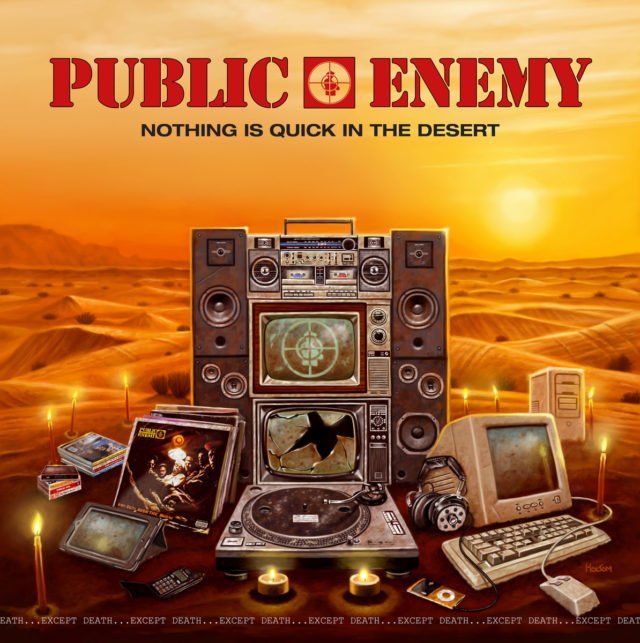
Public Enemy - Nothing Is Quick in the Desert (2017)
Thirty years into their career, Public Enemy's music is throwing punches with as much force as ever, although its targets are maybe a bit more questionable. There are the typical rabble-rousing, truth-to-power shout-alongs—"sPEak," "Beat Them All," "Toxic"—and it's here that the album's at its best. However, other sections of the album also betray the ages of the band members, and it's not uncommon for Chuck and Flav's lyrics to come off as the musical equivalent of that Grandpa Simpson "Old Man Yells at Cloud" moment; this hits its nadir in "Yesterday Man," which rants at all sorts of petty and distasteful grievances with modern culture, including Kanye West/Kim Kardashian and Caitlyn Jenner (whom they insist on calling "Bruce"). I guess it wouldn't be a Public Enemy album without a little bit of regressive sexual politics. It's not that there isn't good stuff here; you'll just have to sift through the bad and the tedious to get to it. Grade: C+
Sunday, June 18, 2017
Mini-Reviews for June 12 - 18, 2017
Summer. How I love thee.
Movies
Guardians of the Galaxy Vol. 2 (2017)
While it lacks the light touch of its 2014 predecessor (the script here is distressingly belabored, from the emotional beats to even a lot of the comedy—the film tries way harder to make a joke out of "Taserface" than it's worth), and overall, it's just not as fun. But Vol. 2 is superior to the original (and, in fact, the large majority of the MCU in general) in two important qualities. First, it has probably the best Marvel-movie villain in ages (though I'm afraid revealing who it is would spoil a certain part of the film)—clearly motivated, charismatically acted, and, moreover, integrated into the emotional stakes of the plot. But even more welcome than that is the film's visuals, which are some of the best in recent blockbuster history and certainly the best of any Marvel film to date; a rainbow-blasted cornucopia of cosmic pulp, it's the closest any movie in recent memory has come to looking like a comic book come to life. It's glorious and as big-screen-worthy as any movie this year. Grade: B+
The Salesman (فروشنده) (2016)
One of the lesser Farhadi films I've seen (it's certainly no A Separation or The Past, but really, what is?), but it's still tensely watchable. It takes a while to get going, but once we get toward the end, especially a final setpiece with an old man cornered by our increasingly adamant protagonist, it is thrilling and excruciating in equal measure. I'm continually amazed at just how much tension Farhadi is able to wring from low-key domestic situations. Grade: B+
Lee Daniels' The Butler (2013)
If you're expecting the broad treatment of history that renders events as simplified dramatic beats (as I was going into The Butler), you'll get it; this is basically the civil rights version of Forrest Gump, in which two characters are present for all the major events in the latter half of the 20th century, and naturally, in covering so much time, things get a little simplistic—worst is the parade of presidential impressions, which range from absurd (John Cusack's Nixon, James Marsden's JFK) to distractingly parodic (Liev Schreiber's LBJ). It doesn't help that the screenplay is frequently clumsy, stumbling over some very clunky dialogue and transitions. When we're dealing with the three principle actors (Forest Whitaker, David Oyelowo, and Oprah Winfrey), though, the acting is fantastic, especially Winfrey, who absolutely disappears into her role here and goes toe-to-toe with Whitaker in giving the best performance in the film. Between all three of them, they manage to breathe life into the script's programmatic sweep. And speaking of the sweep, the most notable difference from Forrest Gump (aside from race, of course) is an actual awareness of politics. As broadly as this movie casts history, it's still realizes that the way it renders history is implicitly political (as opposed to Gump, which I assert is not intentionally conservative, just merely thoughtless of how its framing of historical events communicates a political stance). This is most notable in how it treats African-American radical politics. Oyelowo's character isn't some ham-fisted tragedy/morality tale a la Jenny in Forrest Gump; he's a major player in the film's movement, and as the movie progresses, uses him as a fascinating foil to Whitaker's butler, shaping a narrative of the history of civil rights as the reconciling of radicalism with "respectable" integration. Nobody who's a student of this era of history is going to find that especially mind-blowing, but it's a narrative that the movie successfully imbues with a deep pathos that makes it work. And even besides that, how crazy is it for a mainstream American film to regard African-American progressive politics with so much sympathy and dignity? Grade: B+
The Straight Story (1999)
Nearly twenty years later, you'd think it would have sunk in that one of David Lynch's best (maybe even the best) is a Disney-studios family movie dedicated to the power of sincere human decency. But let's just marvel at this for a moment, okay? Because while many David Lynch films are similarly preoccupied with human goodness, they're generally showing how often the apparent presence of wholesomeness is a thin veneer over abject depravity, cruelty, and—if he's feeling frisky—an otherworldly abyss. But this is beautifully inverted in The Straight Story. The morality of Richard Farnsworth's Alvin and the spectrum of Midwest humanity that he meets while driving hundreds of miles on a lawnmower isn't uncomplicated—two of the film's aching conversational setpieces (one with a fellow WWII veteran, the other with a priest) make this abundantly clear—but the film insists that such complications don't offset the fundamental goodness at these characters' cores. Rarely has such a resolute testament to simple goodwill graced our movie screens. Grade: A
The Sure Thing (1985)
It says something about the state of teen comedies in 1985 that The Sure Thing could be heralded as a mature and smart take on the genre. "I didn't sleep with her" is such an insanely low bar of masculine gentility to clear, especially when "her" is someone you've only just met, that it's genuinely insulting that the film seems to regard John Cusack's character's first tepid step toward maturity as this world-conquering act of love (particularly when he's spent most of the rest of the film being a lousy student, shotgunning beers, and generally being an insufferable cad). And that's to say nothing of Daphne Zuniga's character, who leaves a doting boyfriend (admittedly, one who is presented as sort of a stick in the mud, but... I dunno, he does play a mean game of gin rummy) to hook up with this guy. And yet, it's a testament to the magic of a well-made film that I not only wasn't insulted by all this stuff (or even the suggestion that the only sensible alternative to being a stick in the mud is being a beer-shotgunning tool bag) but actually kind of got caught up in the whole thing. As far as Rob Reiner rom-coms go, this is no When Harry Met Sally. But the same principles are at play, and you know what? It's pretty good! Grade: B
Voyage in Time (Tempo di Viaggio) (1983)
Relative to classic making-of documentaries like Hearts of Darkness, there's not really a lot going on in Voyage of Time, a film in which Andrei Tarkovsky and script writer Tonino Guerra pal around Italy in search of good locations for the shooting of Nostalghia. But it has its low-key charms. Tarkovsky and Guerra spend most of the time shooting the breeze, and, being intellectuals who are about to produce a tour de force of cinematic philosophy, their shooting the breeze is pretty interesting as they discuss the nature of cinema and architecture. There's also a brief shot of Tarkovky in short shorts, which is its own sort of thrill. Grade: B
Television
Bob's Burgers, Season 7 (2016-17)
The second law of thermodynamics says that given enough time, everything turns to crap (I'm paraphrasing here). This seems accelerated on TV, where good shows usually have four or five good seasons before they are no longer good shows. Bob's Burgers seems determined to defy this law, though; in its seventh season, it's no less its fine self than in its fourth, and those who love the show will know exactly what to expect: sweetly maniacal family dynamics, silly wordplay, off-the-wall pop-culture parodies, tongue-in-cheek-but-actually-super-good musical interludes, H. Jon Benjamin's panicked intonation of "oh god." There isn't a bad episode in the bunch, and if it's slightly less exciting than earlier seasons, that's only because we've grown so accustomed to Bob's Burgers' perennial pleasures. Grade: B+
Adventure Time, Season 6 (2014-15)
Season 6 is the first time in Adventure Time's decorated run that you can feel a real step down in quality without any discernible reward. Season 5 had its downs, but it also represented such a thrilling step forward in terms of structure and theme for the show that it really didn't matter. But Season 6 doesn't have that—it arguably continues the show's increased devotion to continuity and serial plots (the final 6-ish episodes are all basically pieces of a single story that the show had been developing for the latter half of the season), but by this time, its mix of silliness, epic sci-fi/fantasy, and emotional arcs is nothing new. That's not to say that it's bad (except for, I'd argue, the stuff with Finn's dad, which is Daddy Issues boilerplate and doesn't really pay off in the otherwise excellent season climax); there are, in fact, quite a few excellent episodes throughout the season, and the end of the season continues the show's tradition of finales in sending the series in exciting new directions. But let's put it this way: this is the first season of the show that doesn't feature any episodes that I'd put in the Top 20 Adventure Time episodes. But I shouldn't be too negative—this is still a show of astounding energy and imagination, and we're lucky to have it. We've just been a tad bit luckier in the past. Grade: B+
Music
The Men - New Moon (2013)
The Men must have realized that "Candy" was the best song on their 2012 breakout, Open Your Heart, so the songs on New Moon are all countrified, to mixed-to-positive results. The opener, "Open the Door" welcomes us to the record with an honest-to-goodness piano, and it's actually lovely. But it's hard not to miss that punk energy from their first two records, which is absent on all but a few of the songs here. The rest are an intriguing whirlwind of genres, ranging from country ("High and Lonesome") to Americana ("Bird Song") to riff-stomping sludge ("I Saw Her Face") to jammy noise rock ("Supermoon"). It's fun to see the band try on so many different hats, and the effect is more or less engaging. But one gets the sense that The Men are drifting afield here. Grade: B+
Sunday, March 5, 2017
Mini-Reviews for February 27 - March 5, 2017
Reviews. Y'all know the drill.
Movies
Get Out (2017)
Jordan Peele's debut writer/director outing (yes, Key & Peele Jordan Peele) is a work of horror love: the shots are lovely and allusive (both Rear Window and, if I'm not mistaken, Night of the Living Dead get shout outs), the tension is smart and earned, the core mechanics are frightening and emotive. But let's also take some time to appreciate that it's also basically a feature-length Key & Peele sketch, its first 2/3s playing out the various permutations of its clever, socially conscious premise (basically, The Stepford Wives, but about the black experience rather than the female one) before veering into a crazy, borderline absurd finale. It's all great fun, and I adored every minute of it. Grade: A-
London Road (2015)
I guess I shouldn't be surprised when a head-scratching premise leads to head-scratching results, but here we are: a murder mystery musical that culminates with a large flower sale and features a slew of actors, both recognizable and anonymous, and singers, both tone-deaf and talented. The results, I'm afraid, are just kind of pasty and dry in their weirdness, and while I'm all for nontraditional singing styles in musicals, so many of the singers here struggle to hit the already kind of iffy notes (the songs are dinner-theater-caliber) that the effect is kinda numbing. Grade: C
Our Vinyl Weighs a Ton: This Is Stones Throw Records (2013)
I'm not as familiar with the output of experimental hip-hop label Stones Throw as I probably should be for this film to have its full impact, but even so, it's cool to have the history of MF Doom, etc., laid out like this. The structure is a bit scattershot at times—there's not really much of a narrative besides "And then this happened"—but it's got a busily engaging visual style that sets it apart from your standard talking heads/stock footage doc. Also, some great music (from Stones Throw's catalog, of course) underlines everything. Grade: B
The Ghost Writer (2010)
A super tight political thriller in the vein of The Parallax View, complete with a haunting, evocative ending. Ewan McGregor, playing the ghost writer for the memoir of a former Prime Minister who has been accused of war crimes, does great work as a guy who's in way over his head but doesn't know he's in over his head, so he's kind of foolishly confident, and Pierce Brosnan makes for a surprisingly compelling slimy politician as the Prime Minister. The sense of dread ratchets up consistently over the film's two hours until it reaches an almost unbearable climax by its end, which is both colossally depressing and too aesthetically marvelous to dismiss as mere nihilism. Good stuff. Grade: A-
Hard Candy (2005)
A tremendously mean little thriller that, in flipping the script by having a teen psychologically torture a presumed pedophile, maybe encourages too much sympathy in a man who may in fact be a monster. But that implications are just details. Hard Candy is breathless and tense throughout, culminating in a moment that's not exactly unexpected but shocking nonetheless. And thus the career of Ellen Page was born. Grade: B+
Point Break (1991)
Very stupid, but deliciously so. Faced with the revelation that a notorious band of bank robbers are, in their less criminal personas, surfers, new rookie Keanu Reeves must himself become a surfer in order to bag the baddies, and oh yes, you'd better believe he's the "methods are unconventional but dammit, you get results" kind of rookie (shoutout to John C. McGinley as a particularly fine specimen of the disgruntled superior). In a way that seems specific to the late '80s/early '90s era of big-budget action heroics, Point Break manages to leverage its mountain of silliness into something almost sublime through the sheer power of its sincerity and gonzo disregard for reality. So naturally the final product is both eye-rolling and a great time. Grade: B+
Battle for the Planet of the Apes (1973)
The worst thing about the worst of the original Planet of the Apes series isn't its tepid, interminable battle scenes (although they are interminable and woefully tepid). It's that it all but abandons the myriad of thoughtful questions it poses. Can the future be altered? Is violence justified if it results in good? Is the subjugation of the human race by the apes a result of the violence inherent in the ape society? If you're interested in knowing the film's take on any of these questions, too bad! It manages to sidestep each and every one of them on its way to its clumsy anticlimax. A disappointingly safe (and entirely unsatisfying) ending to one of the most recklessly ambitious sci-fi series of all time. Grade: C
Television
Adventure Time, Season 5 (2012-14)
The show has had better—much better—seasons, but its bizarre, sprawling (52 episodes!), heartbreaking, ruminative, uneven, intermittently brilliant fifth season is, I think, what establishes Adventure Time as an all-time great TV series, no longer the type of show that people will say, "Oh yeah, I remember that one," but will instead interrupt people rhapsodizing on the merits of The Simpsons and The Wire to say, "But have you seen this??" With Season 5, Adventure Time proves that the structural gamble of sections of its fourth season—unannounced plot arcs and symbolic character studies intermingled with the normal standalone adventures and outright technical experiments—can work stellarly as a conceit for an entire season, not just intermittent sections. I've expressed unease at the increasing serialization of the show before, and while Season 5 is easily the most serialized yet, it also does what I was afraid the show wouldn't, which is to effectively recontextualize its playful absurdity within a more logically consistent world required of more series continuity. What's more, it's able to find great poignancy within that recontextualized, serialized absurdity, probably best exhibited by the out-of-nowhere epic quest two-parter "Lemonhope," but more conventionally presented in the now-standard Ice King weepfests "Betty" and "Simon & Marcy," the swashbuckling-cum-coming-of-age of "Mystery Dungeon," and the art criticism of "James Baxter the Horse." And that's not even accounting for the weird, stylistic experiments that the show's expanded episode count allows for, like the intentionally buggy 3D animation in "A Glitch Is a Glitch" or the one-off noir "Root Beer Guy." And of course we've got a handful of the best episodes the show has ever produced, most notably the Lump Space Princess-centric "Bad Timing," a time-travel episode that easily fits among the stylistic innovators of "A Glitch Is a Glitch," with its Don Hertzfeldt-inspired visuals while also doing some of the most inventive storytelling and poignant character work in the show's history. The season doesn't always work, and at times it really doesn't—far too much time is spent on Finn's romance/breakup with Fire Princess, to the point that our once protagonist is easily the weakest link in the show. But make no mistake: this is greatness. This is legend. This is one of the greatest shows of all time. Grade: A-
Music
The Men - Open Your Heart (2012)
It's easy enough to see Open Your Heart, The Men's sophomore LP, as a mere sum of its influences. The opening one-two punch of "Turn It Around" and "Animal" wouldn't have sounded out of place on an album from The Jam or even early Foo Fighters, and later tracks sound very much like, for example, country-rock Rolling Stones ("Candy") or Oasis ("Open Your Heart") or Sonic Youth ("Presence"). And I know bands who wear their influences this flamboyantly can be kind of hit-and-miss with people looking for new sounds, which... fine. But I dare you to listen to this album and not marvel at least at the sheer colorfulness on display, the reckless abandon with which the band jumps from one genre to the next, the tireless energy with which they derive their chord changes and sonic textures, the overall excellence in the songwriting, regardless of precedent. It's hard. Originality is overrated anyway. Grade: A-
Sunday, December 18, 2016
Mini-Reviews for December 12 - 18, 2016
Second-to-last reviews post of the year! Excitement!
Movies
Moonlight (2016)
The first narrative section of this movie's three isn't much different from what you've seen from other inner-city-set indies (or even TV's The Wire). No, where Moonlight's brilliance is to be found is in its two subsequent parts, which explore how human beings both change and remain static over time with a nuance and piercing insight that I've seldom seen (and of all things, Mad Men seems the closest corollary as far as how it handles human relationships over long periods of time—and honestly, the same goes for the dialogue, which walks a wonderful line between literary and achingly human). This is the story of Chiron: gay, African-American, projects-raised—the movie smartly doesn't make any of those characteristics a central premise for the character (although he would be greatly changed were any of those things to be different), and what we're left to grapple with instead is the titanic beauty and pain of the human experience in general, and the way that those two (beauty and pain) can occur within the space of the same moment or drawn out over years. Don't miss this one. Grade: A
Into the Inferno (2016)
We've been lucky enough to have two Werner Herzog documentaries in 2016, and I don't want to spit on that. Both are good, engaging films, but I've got to give the edge to Lo and Behold over this one. Although both films are scattered, Lo and Behold makes this a feature of its structure, employing intentionally episodic section breaks, Into the Inferno just meanders forward without any clear structure to hang its scenes on. This movie feels fitfully too long and pointless, and that's unfortunate, considering that there are some tremendous, classic Herzog humans to be found here (a late-film fossil hunter that feels like a Jeff Goldblum character come to life is a particular highlight). And the footage of the magma flows is never less than awe-inspiring. That's less true of a detour into North Korea. Grade: B
Nostalgia for the Light (Nostalgia de la Luz) (2010)
A documentary that finds thematic connections between astronomy and the horrors within the Pinochet dictatorship should be a bit too far-reachingly literary for its own good. And Nostalgia for the Light probably is, honestly. That doesn't stop it from being an engaging watch, though, and its depiction of human grief and obsession is pretty great. Grade: B+
Lost Highway (1997)
The basic critical breakdown on Lost Highway seems to be that Lynch diehards regard it as a masterpiece, while everyone else just sort of dislikes it. I'm feeling in the middle—this is nowhere near Lynch's magnum opus, and while the filmmaking on display is certainly no slack, the overall effect is way more muddled than it should be (the soundtrack [usually a Lynch highlight] does the movie no favors, either, what with the abundance of mid-'90s hard rock screamers that, given my age, I'm in no position to decide whether have aged poorly or were simply no good to begin with). Also, let the record show that this is the first Lynch movie I've seen that I found genuinely troubling in its depiction of women, particularly one woman: Patricia Arquette, who, for the movie's primary female avatar, spends entirely too much time engaged in twisted coital scenarios and general femme fatalery. That said, Lynch movies are unparalleled in their ability to unsettle and bend standard noir plots toward the metaphysical, and this one does not disappoint on either of those counts. In fact, through a certain lens, Lost Highway feels like an early draft of Lynch's later actual masterpiece, Mulholland Drive, and the intertextual ideas between those two films are rich. They might be richer if this movie's execution were just a little tighter, though. Grade: B
Television
Adventure Time, Season 4 (2012)
Season 4's major innovation is the weaving of the previous season's loose collection of threads into a coherent (and even intermittently serialized) world. I'm mostly ambivalent on this forward momentum as a whole, because while it pays off wonderfully in this season, there's no denying that it also tames the show a bit, or at least has the potential to—once you give characters consistent motivations and ongoing arcs, the opportunities for the free-wheeling, adventurous absurdity that have been the show's bread-and-butter grow smaller, and the pieces available to sacrifice for whimsical shock diminish. Basically, we probably aren't going to be getting another episode like the one where Tree Trunks disappears with a *poof*/cut to credits. But as I said, the intensified focus on character development and mythology growth works like gangbusters in this season, and as a result, we're gifted with some mighty fine television indeed. The Princess Bubblegum-Finn-Fire Princess love triangle is sweetly mature; the season-ending multiverse cliffhanger is appropriately nail-biting; and the Ice King/Marceline-focused "I Remember You" is simply one of the most beautiful episodes of TV I've ever seen. In fact, don't mind my griping; this season's great. Grade: A-
Music
Maps Need Reading - Mapsynapse (2016)
Knoxville's burgeoning progressive rock scene is at the exciting phase where the groups who first expanded the scene with promising debut singles, EPs, and live shows are beginning to release full-lengths. White Stag had their long-ish EP Eos Crux earlier in 2016 (and, given their FB activity, looks to be on the brink of releasing something else in the near future), and now we have Maps Need Reading with their own LP. While White Stag seems to be carving out their sound in the prog metal tradition and Lines Taking Shape are doing their math-y King Crimson thing, Mapsynapse seems to position Maps Need Reading more along the lines of Steven Wilson's prog-revival sound: a mix of soft rock, folk, Pink Floyd atmospherics, and full-on laser-light-show guitar jams. The album is clearly a step forward for the band, and as a collection of proggy setpieces, it's accomplished and ambitious. That said, there's still quite a bit to tighten up as far as production and songwriting goes (Steven Wilson, let's not forget, is an absolute master mixer, and these guys are not Steven Wilson). So what this feels like is less a definitive statement than it is another stepping stone toward some later, greater work. And that's okay; historically, prog bands have taken several albums to fully bloom. Maps Need Reading is getting there. Grade: B
Subscribe to:
Posts (Atom)