Wednesday, May 7, 2014

100 Years...100 Movies 4-6: Raging Bull, Singin' in the Rain, Gone with the Wind

Hello all! I'm working my way through AFI's 100 Years...100 Movies list, giving thoughts, analyses, and generally scattered musings on each one. For more details on the project, you can read the introductory post here.

So, last time I was writing about movies I pretty much love unconditionally. This time, not so much. Nevertheless, I hope you enjoy the reflections. Remember, I'm putting an asterisk next to the titles of movies I'm watching for the first time for this project.

4. *Raging Bull (1980, Martin Scorsese)
Ah, here it is: the first movie of the list that I haven't seen previously. And... I like it. Not love, but like. Here's the thing: Raging Bull is one of those films that New Hollywood was so fond of making back in the '70s—let's call it a stylistic character study, where the movie's interests lie almost entirely in the twin peaks of cinematic craft and the titanic personality of its lead character, to the exclusion of all else. And while I can't deny the considerable strengths of any of those films, I also can't help but admire them from a distance rather than truly embrace them. Such is the case with Raging Bull. It's a beautifully shot movie with plenty of cool cinematic tricks (more on that in a second), and De Niro is mesmerizing to watch, but aside from that, I had a hard time getting into it. Maybe the blame is the slack plotting, which kind of lumbers from one year to the next without much more driving it than the self-destructive urges of De Niro's Jake LaMotta. Which is fine—a movie doesn't have to be a narrative powerhouse to be good. However, it's not just the narrative that makes the movie feel a little slack; almost every scene not centered around a boxing match felt kind of meandering to me. I know I might be losing some film geek street cred here, so now that I've mentioned the fights, let me go out on a positive note: those fight scenes are incredible. And not because they're violent, although oh boy, are they ever. The cinematography and editing surrounding the boxing just feels so electric, using slow-motion, framing, negative space, and lighting in a way that makes each fighter's movements seem simultaneously ferocious and poetic. A fantastic example of this poetry comes early in the movie in what is maybe my favorite shot in the whole thing: when a chair is thrown into the ring, the camera follows its arc through the air, and at the apex of its flight, the chair is high enough for the boxing action to fall below the frame of the shot, making the chair seem suspended, surrounded only by the blackness of the arena ceiling. It's a strikingly gorgeous moment of abstract imagery, and I've never seen anything like it. Seriously, scenes like that one make the whole movie worth watching. As for the rest, though, maybe I need to give the film some time to sink in, because I'm missing something. 


5. Singin' in the Rain (1952, Gene Kelly)
After my kinda-sorta critique of Raging Bull, I'm a little worried about going after another sacred cow, but in the interest of journalistic (bloggeristic?) integrity, here it goes: I don't care for Singin' in the Rain. I know, I know, I'm the worst. It's not the movie's fault—not exactly, anyway. In fact, if I'm trying to be objective (whatever that means), I have to admit that it's actually a pretty good movie. The problem is that I'm just not a big fan of movie musicals. If I see musicals live on a stage, I love them, but there's just something lost for me once they're filmed. Whereas stage musicals feel real and close and engaging, I feel sort of distanced from movie versions; they feel flat and fake, even when (as is the case with Singin' in the Rain) it's obvious there there are real, impressive performances unfolding right in front of my eyes without any cinematic trickery. I honestly think it's the lack of environmental noises in movies—the total curation of sound design that edits out the incidental stomps, clicks, rustles, and creaks that characterize live performances. You can't hear Gene Kelly's feet slam on the ground unless the sound engineer wants you to hear it. I watch Singin' in the Rain, and all I can think is how much better this would be if I were seeing it in person. Don't get me wrong: there are movie musicals I like (and at least one of those is coming up in the next few entries on the list), but Singin' in the Rain is not one of them. 


6. *Gone with the Wind (1939, Victor Fleming)
I don't know if I've ever seen a movie more in evidence of the phrase "They don't make 'em like they used to" than Gone with the Wind. And I mean that in both the positive and negative senses of the expression. First of all, for all my griping about the bloated length of modern blockbusters, they certainly don't make mainstream movies 230 minutes long anymore. And thank goodness. Let me say this once and for all: if your movie is 230 minutes long, it's probably too long [1]. That said, Gone with the Wind is definitely an epic in the grand tradition of Old Hollywood that, for all its excesses, has a breathtaking scope and majesty to it that most modern movies can't hold a candle to. It helps that it's gorgeously shot; the visual motif of silhouettes against a clouded red backdrop is fittingly iconic, as are the scenes of the sack of Atlanta. For all the advances in movie possibilities that modern special effects have brought us, there's still a grandeur to these "cast of thousands" scenes that feels irreplaceable by any sort of technology. Another thing "they" don't do anymore: make movies with this level of casual racism. It's such a common criticism nowadays that I almost didn't mention it, but seriously, Gone with the Wind's depiction of slavery as idyllic is horrifying and toxic. The problem isn't necessarily that all the slaves in the film are happy—I'm not saying that black slaves never showed happiness in real life [2]—but that this movies doesn't seem to have any sort of understanding that slavery was a very bad thing is a huge, huge issue. Heck, the film (in addition to the characters) feels nostalgic toward slavery. Thanks, revisionist history. Make no mistake, this movie is a revisionist fantasy of the old South in the same way that depictions of the Middle Ages as some golden age of high chivalry are of medieval England. Gone with the Wind's glasses are practically opaque with all the rose-coloredness. Still, accepting all those significant flaws (and don't get me wrong: those are super significant flaws), I found the film at least a little rousing. The movie works in two modes (the battle-torn loss of innocence in sections before and immediately after the intermission, and the Mad Men-esque domestic drama of cruel people sniping each others' marriages to pieces that fills out the movie's final 100-ish minutes), and I'm not convinced that those two modes actually cohere into a thematic whole, but there's a lot of great, rich stuff in those two parts. Not that any of that makes the horrible racism okay. But Gone with the Wind's merits are also considerable. They don't make 'em like they used to indeed.

I got a little rambly this time, so sorry for that. Not sure how long it will be until I post again (Lawrence of Arabia is coming up, which is another four-freaking-hour epic—not sure how many of these I can take in quick succession), but it should be sometime next week. Until then!

You can read #1-3 in the series here.
Update: you can read the next three, #7-9, here.

1] I say "probably" because I don't want to rule out the possibility that I'll see a movie that length that justifies its runtime. It's unlikely, given my preference for movies under two hours, but I guess I shouldn't make blanket statements like that. Not yet at least.

2] Though who are we kidding: there's no way slaves were that happy, ever, and there's no way that slavery (i.e. the owning of another human being) is ever anything but awful, even at its most genteel.

Monday, May 5, 2014

100 Years...100 Movies 1-3: Citizen Kane, The Godfather, Casablanca

Hello, all! I'm working my way through AFI's 2007 list, 100 Years...100 Movies. For more details on the project, feel free to look back at the original announcement. Otherwise, I hope you enjoy my commentary. These first three movies are old favorites of mine, so let's hope I have at least a few interesting things to say about them.

1. Citizen Kane (1941, Orson Welles)
Is there a worse thing you can do to a movie than declare it the best movie ever made? Yeah, I suppose I can think of a few things (burning all existing copies, for instance, or crayoning all over the negatives), but really, once any sort of consensus builds up around a work of art that it's the best of its medium, it's doomed to an eternity of "Yeah, it was good and all, but the best ever?" Such is the case with ol' Citizen Kane, which has topped not only this list (and the original '98 list) but also the Sight and Sound & Sound critics polls for decades (until Vertigo took the prize in 2012—watch out, Hitchcock! Here come the inflated expectations!). The effect is paradoxically that people become so concerned with how Citizen Kane is or is not the best movie ever that the fact that it's a really flipping good movie sort of gets lost in the shuffle. Which is a shame, because it really is a flipping good movie, regardless of whether it's the greatest ever or not. There are many, many great things to single out in the movie (and gallons of ink has already been spilled doing so), but one thing I've always enjoyed about Citizen Kane is how deftly it privileges both its technical and human aspects. A whole lot has been said about what a technical masterpiece the film is, and you won't hear me disagreeing; it's incredible that cinematic techniques the film basically invented in '41 still feel cutting edge seventy-three years later. Just take a gander at that opening sequence and marvel at how fresh everything feels. But all technical mastery would be just whizz-bang showmanship if it weren't for the intensely tragic story of the eponymous Charles Foster Kane, in the same way that that story would feel ham-fisted and moralizing if it weren't for the beautiful technicalities of the film's craft. Put together, though, the narrative and cinematic complexity form a film of real philosophical, aesthetic, and humanist depth. That's something I think is pretty rare in cinema, so let's cherish it, regardless of its status in the film canon.


2. The Godfather (1972, Francis Ford Coppola)
Here's something that I've always been a little bit surprised at: a whole lot of people like The Godfather. And by a whole lot of people, I don't just mean that a lot of movie buffs and critics like it (something that's true about many, if not all, of the films on the AFI list). What I'm talking about is that The Godfather is one of the highest grossing movies of all time in North America (#23, if you can believe this Wikipedia article). That's more ticket sales than The Avengers. More than any Pixar movie. More than any of the Lord of the Rings films. It even sold more tickets than most of the Star Wars movies! That's some serious cultural cachet, folks. None of that would surprise me if The Godfather were a movie as accessible and friendly as, say, Finding Nemo or Star Wars. But Finding Nemo The Godfather ain't. It's a distinctly prickly movie with a dense plot built on the subtext of coded conversations and camera angles, a movie with a slow, methodical pacing to even the most explosive events. That's not to say that I don't like The Godfather (I think it's fantastic), but slow, dark, subtle movies with lots of ambition and little exposition don't usually end up appealing to more people than the latest Marvel film. I know that the early '70s were a different time for the movie industry than, well, most other times; I'm having a hard time wrapping my mind around that, though. I guess that's just me being cynical about the movie-going public, and I'm sorry if this whole rant is coming off as a little arrogant (as if I'm somehow better than people who see fewer movies than I do!). But still... it's surprising. And that's all I'll say about that, I suppose.


3. Casablanca (1942, Michael Curtiz)
You know, it's harder than you might think to say something interesting about some of the most beloved, analyzed movies ever, which is why I've spent a good portion of the last two entries talking about the cultures surrounding the films rather than the contents of the films themselves. But I can't shirk that task forever, and after all, isn't talking about movies the whole point of this project? So, here's something I really admire about Casablanca: its economy. I'm sure it's been said before, but I find it remarkable how huge this film feels despite that its runtime doesn't even clock two hours and its action is mostly relegated to a single location. Part of that, I'm sure, is the historical context of the plot (and, for that matter, the movie's production in general), which plops the characters right down in the middle of World War II, and how do you make anything to do with Nazis feel anything less than epic? However, I think the bulk of the credit has to go to what is probably the film's greatest strength: the screenplay. I know there's nothing revolutionary in praising it, but seriously, Casablanca earns the heck out of that praise. The screenplay—which is one of the all-time great English-language screenplays (if not the all-time great) in the history of the medium—does such a wonderful job of imbuing every bit of dialogue with an immense sense of history that each moment of the movie's final act feels like it's predicated by years of narrative rather than just the preceding eighty-ish minutes. There's a reason why the lines from this movie stick in people's minds; "Play it, Sam" (I'll admit I almost added "again"), "Here's looking at you, kid," "We'll always have Paris," et al.—those bits of dialogue have the feel of a larger life lived behind them, the sort of shorthand that couples develop after being intimate, showing so much about Rick and Ilsa by saying so little. It's storytelling economy at its best. And living in 2014, when at least half of the movies that come out seem half an hour too long, I find that economy refreshing and exhilarating.

That's all for now. Be sure to let me know what you think. Obviously, I believe all three of these movies are stone-cold classics, but I'm sure some of you out there disagree. Or maybe you just want to add something to what I've said. Either way, I wanna hear about it! I've said it before, but one of the valuable things about lists like these is the discussion they encourage. So, discuss.

Three movies down, ninety-seven to go! Until next time.

Update: Read #4-6 in the series here.

Wednesday, April 30, 2014

An Announcement: I'm Watching the AFI 100 Movies

There are currently two assignments and seven days between me and summer break, and what a feeling it is (and what a better feeling it will be once those assignments and days are behind me). The relevant takeaway from that fact is this: I'm about to have a whole lot of free time on my hands. The even more relevant takeaway: I plan on spending some of that free time watching and blogging through the American Film Institute's 100 Years...100 Movies list.

Ever since I started this blog, I've wanted to do a long series working through some major body of work, but I never thought of any work that I really wanted to work through. Until the other day, that is, when I decided to scan through AFI's ranking of what the institute considers the 100 greatest American films ever made. I've known about the existence of this ranking for about as long as I can remember, and I've read through it several times because I'm a pedantic slave to pop culture lists. From these read-throughs, I've always had the general sense that I've seen most of these movies at least once, but upon revisiting the list, I was struck by how many of these movies I haven't seen (roughly one third of them!). So this summer I'm going to remedy that.

Listen, you can say what you want about the biases, illogicalities, and predictability of the AFI ranking. These certainly wouldn't be my choices for the best American films either, although I do enjoy (and even love) quite a few of them. But whether or not you actually like the movies on the list, one thing you have to admit about is that AFI does about as good a job as any at identifying the canon of American film, or at least at ensuring that every one of its 100 movies is a bona fide classic. I don't mean "classic" in the "best movie evahhh!" sense but rather that each one of these movies has significant cultural prominence and/or importance to the medium of film. For someone looking to experience the major works of American cinema, you could do a lot worse than to start with the AFI 100 Years...100 Movies list. So, my not having seen about thirty of these suckers means that I have pretty significant gaps in my knowledge of American film, and it's my intention to fix that this summer.

A few ground rules:

1. AFI has made two ...100 Movies lists, one in 1998 and a 10th Anniversary list in 2007 (even though that's the 9th anniversary?). The two lists aren't hugely different, but for the sake of some of the more recent movies added, I'll be working through the '07 list.
2. I'm not rewatching movies I've already seen. I've got other things to do this summer, people! What that means is that I'll be working off my memory for my responses to a lot of these movies, and some of those memories might be a little hazy—to put it another way, it's been a long time since family movie night introduced me to Sullivan's Travels.
3. I'll put an asterisk next to the titles of the movies I'm seeing for the first time.
4. I'm not sure how many posts it's going to take me to finish this series, but it won't be one hundred. I'm planning on covering anywhere from two to five movies in each post. Maybe I'll say insightful things about those two-to-five movies, maybe I'll just be a rambling windbag. But each one will have at least a couple sentences written about it.
5. I'm going to stay away from list quibbling (e.g. "I can't believe they ranked Taxi Driver over Toy Story!"—which, by the way, is a real shame), since that can become tedious really quickly.

Other than those points, I'm leaving this project wide open for myself.

Honestly, I'm not sure how many people out there will really be that interested in this project. It's entirely possible that no one will end up reading these posts. And I'm cool with that. The real goal of this blog post series is that I want to deepen my understanding of film history and craft. I have this tendency to watch a lot of movies in such rapid succession that I don't take any time to reflect over what I've seen, and hopefully, making myself blog about these movies will help me to be more thoughtful in my viewing. Worst case scenario here: no one cares about these posts, and I've watched a ton of great movies. Best case scenario: my blog goes viral, I become king of the world, and I've still watched a ton of great movies. It's a win-win.

I should be posting the first entry in the series within the next week or so, depending on how long that schoolwork takes me, so if you're interested in this project, be one the lookout.

Until next time!

Update: You can read the first entry in the series here.

P.S. I linked to the AFI list a few paragraphs up, but in case you missed it, you can just follow this link.

Sunday, April 13, 2014

I'm Not Worried About Mad Men


I should be working on one of several end-of-semester projects right now, but the new season of Mad Men starts tonight, so screw it. I'm writing a post!

Last August, I wrote that I wasn't worried about Breaking Bad's final spate of episodes because I was reasonably positive that the show would stick the landing. And now that we're in pretty much in the same position with Mad Men [1], I thought about writing the same sort of post about the impending finale of Don Draper and company's story. But as I started thinking more about the post, I realized that I had basically nothing to say about the likelihood of Mad Men's future artistic success.

This, I realized, is because I honestly do not care one bit whether Mad Men's ending is good or bad.

That doesn't mean I'm disinterested in Mad Men's final season. I'm actually super stoked to see it. I am practically on the edge of my seat waiting to see what Matthew Weiner and the rest of the Mad Men creative staff will deliver as their ultimate statement on Don, Peggy, Pete, Sally, Roger, Joan, advertizing, capitalism, family, gender, privilege, history, identity, race [2], love, art, death, and any number of the other fascinating thematic and character territories the show has covered up to this point. I'm just not really interested in where any of the remaining episodes will fall on an A+—F scale, whether or not the finale will be a four-star, two-thumbs-up triumph or an embarrassment that somehow retroactively makes the whole show awful [3]. I just want to experience the show, whatever ends up happening.

And you know what? That's a pretty enjoyable place to be. Sometimes it seems like I spend so much time evaluating the art I consume that I forget to do what that art was actually created to do, which is to give me an experience that conveys something meaningful and/or entertaining about the human experience. I'm so busy discussing whether or not a given movie, series, book, painting, etc. was good or bad that I forget to engage in the experience beyond that binary evaluative system.

A few weeks ago, Sam Adams at Criticwire wrote a great piece about watching movies in which he argues that "when you watch a movie...you agree to submit to its vision." You aren't passive, but by watching the movie, you enter a sort of contract with the film that should make you engage with the work's ideas. You as the viewer are subservient to the demands of the film in that your discussion of it happens on the terms supplied by the work's art.

Those assertions get into a whole lot of thorny theoretical issues about the relationship of author, art, and audience, but one thing about the argument I can definitely get behind is the idea that a given work of art brings to its audience certain premises, and if we audience members ignore those premises, we're doing at least a little disservice to that art's vision.

I can't help but feel that when I try to decide if a work is good or bad and leave it at that, I'm not submitting to that work's vision. That's not to say that evaluation is an inherently bad thing—if nothing else, the work of the late Roger Ebert, whose career's meat and potatoes were basically made of evaluations, is a great example of the vitality of a good review. But when the bulk of the discussion surrounding a movie or TV episode consists of people trying to figure out if that film or episode is good or bad to the abandon of everything else (as the Internet is so wont to do with its myriad of grades, scores, and upvotes), isn't that missing the point? At least a tiny bit?

I'm sure plenty of us will have feelings about the worth of Mad Men's final season in good time (and it's okay to have them!), but for now, I'm really enjoying the respite from evaluation.

Until next time.


1] Well, sort of. I guess to be in the exact same position, I'd have to have written that post back in 2012 when the first half of Breaking Bad's fifth season was about to air, given that Mad Men is pulling the same pointless, greedy, AMC-realizing-with-desperation-that-it-has-basically-only-The-Walking-Dead-and-nothing-else episodic scheme. But let's not get into that.

2] Here's hoping Mad Men's pulling a long-con on this one and will pull the rug out from under us sometime this season, given how underplayed any real insight into American racial politics has been on this show so far.

3] A response to finales I've never really understood. I didn't like True Detective's ending either, folks, but dang it all, how does an ill-fitted ending make the awesomeness of episodes four and five any less awesome?

Tuesday, March 11, 2014

Reappreciating Dark Side of the Moon: "On the Run" and "Any Colour You Like"


I listened to Pink Floyd's The Dark Side of the Moon the other day. On its own, that's not such an notable occurrence. There was a time in my life (and not too long ago at that) when listening to that album was an almost daily ritual.

Actually, it's kind of amazing that I haven't written about DSotM yet on this blog, considering that Pink Floyd's 1973 opus holds a significant place in my development as a music listener. Like, really significant. Not only is it the first album I ever bought (I had been mooching off my brother's CD collection beforehand), but its psychedelic, existential ways are also responsible for the broadening of my horizons beyond the classic-rock-and-Green-Day listening habits I stuck to in my early teens. I haven't taken a census of my current music library or anything, but I bet that at least 82 percent of the artists I listen to now I listen to because of some taste-related chain reaction started by my falling in love with The Dark Side of the Moon. For example: Pink Floyd got me listening to Radiohead, which got me listening to prog and indie rock and eventually jazz, all of which got me listening to like a trillion other bands, which turned me into an insufferable music snob. I've tried to cut back on the snobbery bit, but however you slice it, The Dark Side of the Moon is pretty dear to my heart.

So no, it's not at all surprising that I was listening to it. What was surprising, though, is how little my feelings on the album have changed since I first heard it when I was sixteen. That's not the case with a lot of music I listened to in my teens. I mean, sure, I still like most of the music I listened to back then, but my relationship with a lot of that music is kind of like returning to a favorite camping spot at some state park—I still enjoy the sights, but the location has lost some of the mystery and grandeur it held for me at first. To put it another way, I still like Coldplay, but "The Scientist" no longer seems like the soul-shaking powerhouse I once thought it was.

But The Dark Side of the Moon? Man, that's still one friggin' great album. And returning to it now, I realize that one of the great things about this album is that it's grown with me. At each stage of life I listen to it, I find something new to love about it.

When I was sixteen (and the most pretentious, insufferable teenager you've ever met), I was drawn to the way the songs faded into one another to form one big song, the psychedelic flourishes, and the philosophical lyrics (all of which were novel to me—hey, all I was really listening to at the time was Aerosmith and Journey). Also, that guitar solo in "Money" was pretty cool, too. As I've gotten older, I've had phases when I was more interested in the existentialism in the album's lyrics or with the cool pathos of the jazz touches or that weird, almost inaudible string music at the very end of "Eclipse." Always something new.

So when I listened to the album again the other day, it wasn't the jazz or the guitar solos or existentialism that stood out to me but rather how awesome "On the Run" and "Any Colour You Like" sound now. Until recently, I had considered these two tracks (the only instrumental songs on the album, by the way, depending on how you classify "The Great Gig in the Sky") to be minor pieces, the necessary connective tissue to get from "Breath in the Air" to "Time," or "Us and Them" to "Brain Damage," to make the album cohesive. But I'm a different listener now than I was at sixteen, and something about those intervening years has brought me to a place where I now not only appreciate those two instrumentals but think they're two of the best songs on the album.

With "On the Run," I now see this song as, among other things, Pink Floyd's take on krautrock. That driving synthesizer pulse, the chaotic percussion, the disembodied human voices—that's all stuff right out of Kraftwerk and Can's respective songbooks, mixed with some of the freakier elements of Pink Floyd's psychedelic past (e.g. the penultimate movement of "Echoes" from their previous album, Meddle). It's also a killer sonic experience to enjoy with a good pair of headphones. My melody-driven listening habits as a sixteen-year-old didn't have much to do with the non-melodic sonic experimentation of "On the Run," but now that I care more about ambient textures and mood in music, it's absolutely riveting. A lot of songs seem less fresh once I become acquainted with other genres of music. "On the Run," though, has only become more interesting.

The cover from the 2003 re-release of the album (which is the one I own).
Not as fond of it as the original cover, but part of me wishes this had kicked off a
trend of iconic album art being rendered in stained glass.

And then "Any Colour You Like"—oh man, what to say about this gem? There are points of comparison to be made with the song, but honestly, I can't think of any other piece in Pink Floyd's discography (heck, in pop music in general) that sounds like the jubilant synth-funk symphony that is "Any Colour You Like." On the one hand, there's the playful main melody that's especially prominent toward the end, a plucky tune that seems prescient of a certain strain of disco that would arise later in the '70s. David Gilmour's funky guitar noodlings in the background give the track a jammy flavor that interplays nicely with the melody in this regard. But then there are those synthesizers! Synths get a lot of flack in certain circles for their role in the rise of corporate rock, but holy cow, if "Any Colour You Like" doesn't have the best classic-rock-era use of synthesizers, it's pretty dang close. The way they run up and down those jazzy arpeggios early in the song is beautiful and more evocative of the album's famous prism cover than any other moment on the disc. Even better is the climax of the song, when these two movements—jazz-synths and disco-funk—converge in a glorious pileup of sound that is at once pop-music catchy and classical-music complex.

New knowledge, expanded listening habits, and a differing ethos opened up a whole new level of appreciation of this album for me. I guess that's how it is with favorite albums (and just in case I wasn't clear earlier, this is one of my favorite albums). It's not just the familiarity that makes you return, but also that the music keeps blossoming into new experiences.

Of course, not everyone feels this way about The Dark Side of the Moon. I've heard many great people call this album slow and boring. And it's okay that they feel that way (even if they're dead wrong[1]). That's another thing about favorite albums: they're personal. So yeah, I'm sure many of y'all out there don't share my enthusiasm for The Dark Side of the Moon. But I bet a lot of you have experienced something similar with your own favorite album or song, that feeling of having that music grow with you.

And that's about all I have to say about that. Feel free to share your own favorite music experiences in the comments—that's what that box down there is there for. Until next time.


1] Kidding, kidding. You like what you like, and there's no quantifying or disproving taste[2]. One of my least favorite things about my sixteen-year-old self post-DSotM is that I held the seriously misguided belief that a person's aesthetic tastes were a reliable indicator of that person's worth or that person's intelligence. I can't tell you how many conversations surrounding that idea I now regret.

2] Which isn't to suggest some sort of all-encompassing relativism here. I think it's totally possible to argue for some kind of non-subjective worth in a piece of art while still acknowledging that everyone enjoys different things and that everybody enjoying different things is okay. Those of you who don't care for The Dark Side of the Moon, I'll try to convince you that it really is a great album, but if you still don't agree, that isn't some character flaw of yours or anything. We can respectfully disagree, right? [steps off soapbox]

Monday, February 17, 2014

Fawlty Towers: Sybil, Sybil, Sybil, Sybil, Sybil


I recently did myself the favor of watching Fawlty Towers for the first time, and boy, what a favor it was.

Like any self-respecting geek, I've been a fan of the Monty Python troop's work since I was in middle school (you did not want to mention "not expecting" something around me when I was in ninth grade or so, trust me). However, until recently, my fandom was pretty much restricted to the immediate Monty Python canon of the Flying Circus and its movie relations, so I didn't venture out into the wild world of the Pythons' solo ventures. Which meant I never watched Fawlty Towers, the British sitcom in which John Cleese (aka Sir Lancelot; aka the guy with the dead parrot; aka the Argument Clinic dude) is Basil Fawlty, the worst hotel manager ever. Which meant I was seriously missing out. And you are too if you haven't watched the series. 

But now I've watched the whole series (or two series, rather... British TV terminology is confusing) and enjoyed the heck out of it. There are many great things about Fawlty Towers, and I could give a really thorough review outlining a lot of them. But I won't do that. Instead, I want to call attention to one minor detail in the show that has some great payoffs throughout the show's run.

That detail is that Basil's wife's name is Sybil.

And here's why that's so great: Sybil is a name that is really, really easy to say quickly. Seriously, try it. Say it loud; say it proud: Sybil Sybil Sybil Sybil Sybil Sybil. Just rolls off the tongue, doesn't it? Now try doing the same thing with another name. Changes are, it didn't roll quite so well. Marge Marge Marge Marge. Becky Becky Becky Becky.

Sybil works like this, I think, for two reasons. The first is that Sybil is composed of very short syllables, especially that second one: "il" (/əl/, for all you phonetics nerds out there). It's very clipped and quick to say, which allows for very fast repetition. Compare the two syllables of "Sybil" to the one syllable of "Marge," for example. "Marge" may have fewer syllables, but it feels much longer to say. The sounds, especially that vowel, are long, and it's really difficult to say it quickly.

The second reason is another phonetic one, so forgive me for the technicality of it all (and for those of you with more expertise on this subject than I have, feel free to correct me!). Here it is, though: "Sybil" is a word that begins and ends at the same place of articulation. /s/ and /l/ are both alveolar consonants, meaning that your tongue forms the sound by touching the alveolar ridge in your mouth (i.e. that bumpy part of the roof of your mouth just behind your front teeth). That means that once you say the name Sybil, you don't have to move any part of your mouth before saying it again. Again, compare that to Marge, in which you have to move your lips closed to form the bilabial articulation point of the /m/. With Sybil, you don't have to take that split-second pause to put all your articulation organs back into the right position, making rapid repetition of the name all the easier.

Mmmm... alveolar ridge...

Okay, yes, but why is it so important to be able to say Sybil's name over and over in rapid succession? Wouldn't Fawlty Towers be just as great if Sybil (played impeccably by Prunella Scales, by the way) had indeed been named Marge? Well, not quite. I mean, don't get me wrong; Fawlty Towers is very funny independent of the characters' names. But I'd argue that it would not be quite so funny if Sybil were named something else.

Here's why: almost every episode of the show involves John Cleese's Basil becoming increasingly flustered at some situation in the hotel, a flustering that usually requires him to interact with his wife. And when Basil gets flustered, he begins to speak very, very quickly—which is why it's super important for him to be able to repeat his wife's name very quickly. When I think of Fawlty Towers, there is perhaps no trope in the series more iconic to me than Basil's impassioned cries of "Sybil, Sybil, Sybil," sometimes in exasperation as he tries to talk her out of spoiling one of his intricately constructed lies, sometimes desperately as he tries to explain some mishap he has caused, but always in rapid succession, uttered so quickly and so often that the repetition veers into some sort of comically surreal sound effect. Really, next time you watch the show, listen to how Cleese says Sybil. The name comes fast and clipped, and Cleese always piles up multiple repetitions on top of one another. It's the show's own version of a rimshot, only instead of signaling a punchline of a joke it cues the beginning of one of Basil's futile attempts to restore his version of order to the hotel's chaos. And it sounds hilarious.

Without Sybil being named Sybil, John Cleese couldn't have pulled off that sound effect, and the show would have been just a bit poorer in the sound's absence.

And that's about all I have to say about that. Until next time!

Wednesday, January 29, 2014

"No Longer Any Such Thing As a McDonald’s Hamburger": On the Near Demise of Beowulf

Note: As I'm rereading this post, I'm noticing that it's a bit of a fevered ramble that doesn't go anywhere very constructive. I definitely dabble in some hyperbole here. Honestly, some of it is a little reminiscent of "The Wanderer," only in a more hysterical, less insightful, less beautiful way. Some of it's even a little silly, in fact. But it's also a pretty accurate transcript of my state of mind about an hour prior to the publishing of this piece, so I'm posting it anyway. Cheers!


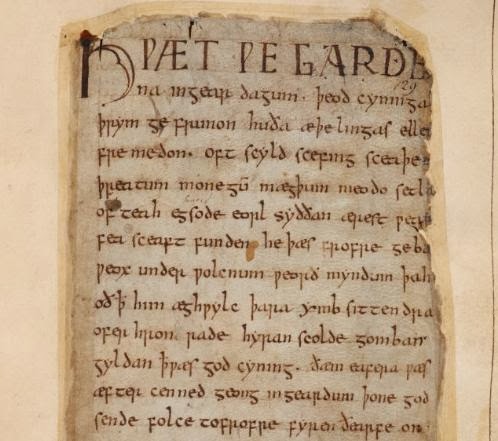
On October 23, 1731, a fire blazed through the library of Ashburnham House in Westminster, London. This library was a repository for a whole host of valuable manuscripts that the British government had decided to store in there to keep safe, although I get the feeling that they may have come to regret that decision. All told, the fire completely devoured dozens of manuscripts, and hundreds more were damaged. It wasn't a good day for the preservation of human knowledge.

You know what almost made it an even worse day for knowledge preservation? A codex in that library held the world's only existing copy of Beowulf, and that codex only barely escaped the flames [1]. That's right: Beowulf, the great English-language epic, tent-pole of high school English curricula, a (if not the) foundational work in English literature, reckoned by most post-Tolkien scholars as a masterpiece, was almost destroyed in a fire and lost. Forever. We were very nearly born into a Beowulf-less world.

Now, I don't know about you, but I find that idea utterly horrifying. Like, keep-me-up-at-night horrifying. It's not that I love Beowulf so much that the very thought of not having it to read puts me in a cold sweat (although, I'm in a Beowulf class right now and loving every minute of it[2], so I wouldn't put it past myself to feel that way come May). I do really, really like Beowulf, but I think my terror goes a little deeper than that.

What's truly disturbing for me about this whole story is that it illustrates the sad, humbling fact that no matter how hard we try to preserve it, humanity and its work are in a constant state of disappearing. Think mortality, but on a grand scale. Yes, I will die, and you will die, and everyone on Earth will one day die, and I think about that a lot; but something I only think of every once in a while (and maybe that's why it's so strikingly scary for me) is that all human art will die, too. It's like that part in The Hitchhiker's Guide to the Galaxy: Arthur Dent can cope with the idea that everyone in the world has died, but when he realizes that there is no longer McDonald's, he passes out cold. Film, literature, painting, music, and all that—a big part of the reason they exist is for posterity, that ability they have to outlast their creators and communicate with people far in the future. But what if a piece of art just doesn't last? Well, that's it, I guess. *passes out cold*

Just like everything else, art lives in this precarious state that is always just on the brink of dissolution. I think maybe the ubiquity of Beowulf in bookstores and textbooks gave me this false impression that the poem had and will always be around forever, so it's really jarring for me to think about how it very nearly never got to that point of ubiquity in the first place. In fact, at the time of the fire, Beowulf was languishing in relative obscurity—no one was really studying it at the time or thought very much of it. It would have died a quiet, unlamented death. Thinking about that, man, it's like staring into a maw of mortality.

Now, I do believe some things last forever[3], but as far as human-created things go, there's really no counting on anything existing for any length of time, even in this modern age of hyper-documentation. It's possible that in a couple generations' time, we'll have some crazy worldwide EMP/nuclear hybrid blast and Adventures of Huckleberry Finn will no longer exist. "The Weary Blues" will no longer exist. Peanuts will no longer exist. Citizen Kane[4] will no longer exist. Seinfeld will no longer exist. Kind of Blue will no longer exist. Spirited Away will no longer exist. Holy crap, Star Wars will no longer exist. Granted, with all our digital technology and the millions of copies of each of these that exist, it's not particularly likely that any of these works will disappear any time soon. But it's possible. Art's grasp on the physical world is only slightly less tenuous than the artist's. And that's freaky.

I guess what I'm saying is, don't play with matches in a library.

Until next time.


1] As it is, the manuscript was considerably singed, and several words of the poem are unreadable as a consequence. You can actually look at a digital copy of the manuscript here and see some of the damage around the edges of the pages.

2] It's this class that informed me of the Ashburnham House fire and the near death of Beowulf, by the way. Also, thanks to this class, I now only halfway stand by some of the comments I made about the poem in the very first entry of this blog. Not that any of you guys really care about my reneging on some half-baked ideas I penned over six months ago, but I have a weird panic that my professor will find this blog and make scoff at the ideas in that post. Best, I figure, to cover all my interpretive bases.

3] God, for one, and souls. Mostly metaphysical things, actually. But that's another topic for another day.

4] Speaking of Orson Welles, a full hour of his second movie, The Magnificent Ambersons, is lost forever thanks to some studio tampering—Welles's own personal Ashburnham House fire.