Showing posts with label Michael Curtiz. Show all posts

Sunday, December 4, 2022

Mini Reviews for November 28 - December 4, 2022

My wife and I finally released another episode of The Newbery Chronicles! It's on Louis Sachar's Holes, and you can listen to it here if you're interested.

ALSO: If you're one of the 10 people who subscribe to this via Letterdrop email, I'm going to have to discontinue that because Letterdrop eliminated their free tier. I might switch over to Substack, but I may just not email these out anymore. I dunno. If you have strong feelings about that, let me know.

Movies

The Fabelmans (2022)
As I watched this, my gut was telling me that this was enjoyable but slight, a handsomely filmed and extravagantly performed feature (Paul Dano and Michelle Williams are both incredible) whose most prominent characteristic is the cute allusions to Spielberg's own filmography, e.g. the scorpion box from Hook, the monkey from Raiders, etc. But then a late-film scene—for those who have seen it, the one in the school hallway with the jock upset at how he's portrayed in the skip day film—came and hit me like a freight train, surely one of the best scenes in any movie this year and one of the best scenes in Spielberg's career as a whole, and it cracked this movie wide open for me, and the more time I've spent rolling this movie over in my mind, the more it's opened up (to the point where I started this review with one grade in mind and ended it with another, higher one). I don't think there's been a Spielberg film since A.I. that places this much tension between its thorny ideas and the facade of Spielbergian classicism and sentimentalism, and that earlier film's ersatz family dynamics by way of semiotics is the core allusion that informs everything else in this movie; yes, the movie seems like a wistful semiautobiography about the magic of movies, and the movie works perfectly well when taken as that, but The Fabelmans, with that school hallway scene, tips its hand: "movie magic" is just another way of saying "control," and Spielberg, long accused of being a "manipulative" filmmaker, completely leans into this accusation, laying bare the manipulation baked into the very premise of filmmaking, which this movie pretty explicitly depicts as a person's attempt to recreate life in his own image. What we've been watching—what we watch with every movie, but especially with this movie—is a mere simulation that creates the illusion of authenticity by sleight of hand and trickery. There's a fun, whimsical element to this idea that runs through the film, most notably how the movie shows the ingenuity of its not-Spielberg protagonist as he makes home movies recreating his favorite moments at the cinema, but there's also a deeply sad, even disturbing undercurrent to this: the longer I've sat with this movie, the more the film's depiction of the parents' divorce and particularly the mother's side of things feels like the achingly bleak ending of A.I. when aliens grant the mechanical boy a day of bliss with an artificial mother before allowing him to die. Only in this film, Spielberg is cast as both sides of that scenario, both the boy desperate for the childhood he was denied and also the magic aliens comforting this boy with a constructed image, an automaton. The way I'm describing it sounds dire and depressing, but the incredible thing about the movie is its nuance in depicting it: there are moments in which the film's drive to show filmmaking as a form of control and coercion is profoundly unsettling, most notably the scene with Michelle Williams dancing in front of the car headlights (or a later scene in which a film-within-a-film quotes from the work of Leni Riefenstahl—a truly wild allusion for a Spielberg movie to make but also probably the purest possible example of the insidiousness of film's ability to subjugate reality), but elsewhere in the movie, the results are just delightful, which is kind of the ultimate wrinkle in the movie's thesis on film (described breathlessly by Paul Dano in the opening scene), which is that the illusion of film is able to create real movement in our reality because we are able to be tricked—movies are fake, but the tears, the joy, the anger we feel as we watch them: those are real. Which brings me back to that scene in the school hallway, where an anguished school bully has realized that the illusion of himself depicted in the skip day film will have tangible effects on his real life, and the ambivalence The Fabelmans has about this epiphany is profound: there's something maniacal or even devious about the protagonist's realization of the kind of control he has sought for the previous two hours, but there's also a gobsmacked wonder about it, too. The people who hate Spielberg films (and boy oh boy, do some people haaate them) seem more conscious of this duality in his work than most fans, but it's amusing and even gratifying to know that Spielberg (or at least, Spielberg working with Tony Kushner) understands the haters enough to give them a scene like this. He's also not above making the hater a raging antisemite in the film, which is the sort of self-aggrandizing "manipulative" thing that I'm sure will drive people nuts even more. But I dunno, to me, a lifelong Spielberg fanboy whose first real concept of the "art" of film came from realizing when I was ten years old that Raiders of the Lost Ark and E.T. were directed by the same person, there is something wonderful and magical about all of this, made even more so by Spielberg's alternating aggrandizement and villanizing of his own profession. Maybe I'm just one of the chumps who wants to be sold a magic trick, but I'm ultimately okay with that. I can't deny the reality of what this made me feel. Grade: A
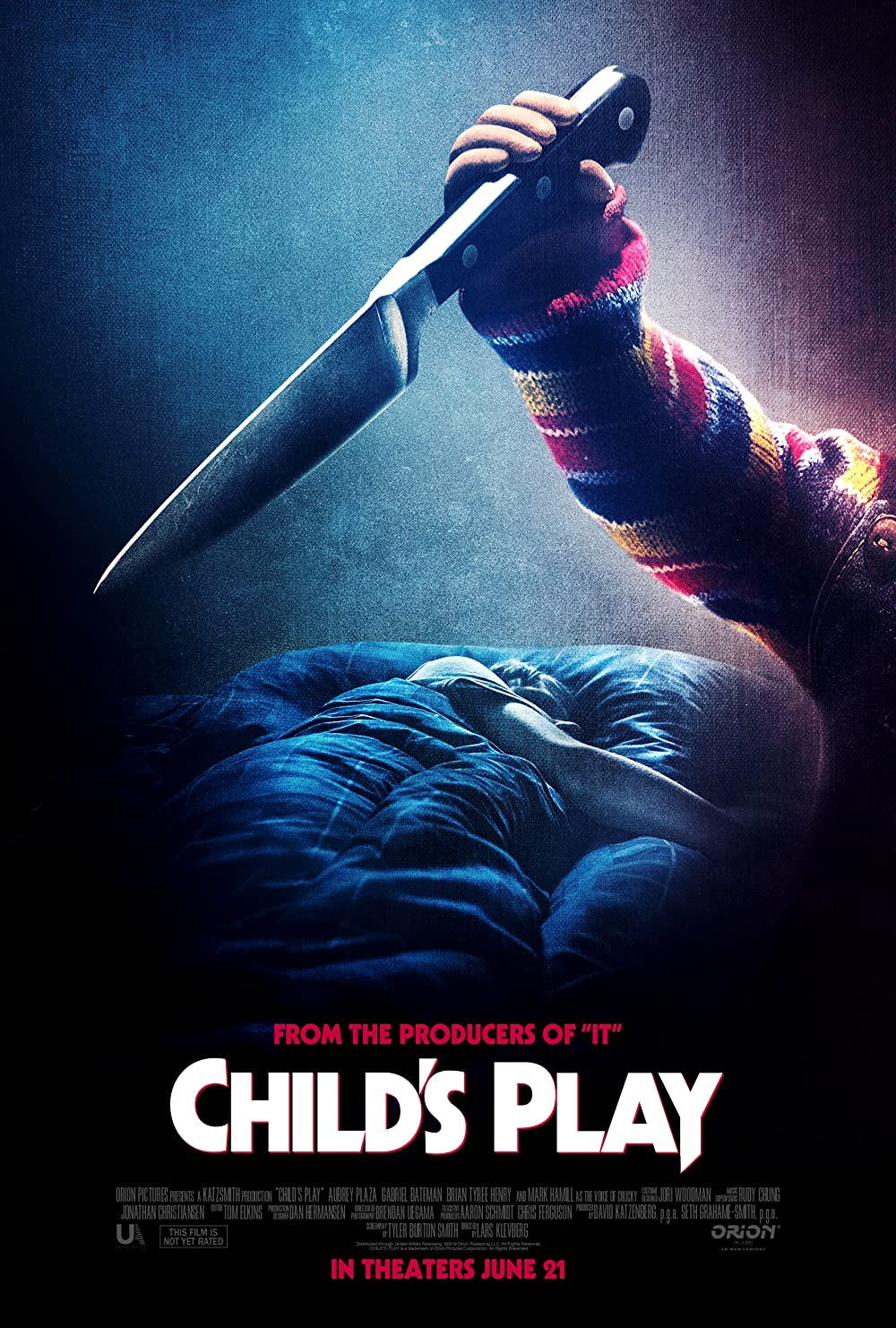
Child's Play (2019)
More of a reimaginging than a reboot, which is fine with me: if the original Child's Play is something of a response to the gross colonization of kids' imaginations by commercial advertising, then this is a pretty canny update of that concept for the fresh hell of surveillance and data collection that capitalism has brought to the act of play. It's also just a lot of silly, mean fun and does a great job of evoking the spirit of a Chucky movie (at least, the original three) without being overly familiar. Grade: B


Behind the Mask: The Rise of Leslie Vernon (2006)
As long as this stays true to its stated premise (a mockumentary about the killer in a slasher film), this is a great time. The mockumentary scenes show the killer, with the goofy enthusiasm of Michael Scott giving a tour of the Scranton branch, walking the documentary crew through his plan to manufacture the tropes of the slasher genre in his own prospective killing spree, and while by 2006, this was hardly ground-breaking commentary, it's fun and funny and charming to no end. Unfortunately, when the movie flips over to the actual movie that results from this plan, it turns out that following slasher tropes to a T doesn't result in a slasher that's notable in any way, and when the movie finally ends its mockumentary conceit entirely to permanently reside in the slasher mode (albeit in a transition that is pretty clever), Behind the Mask grinds to a halt. The good news is that this is a fairly small fraction of the movie, and the rest is so enjoyable that I'm willing to forgive the deflating ending. But still, it's too bad it has to end on its least-engaging note. Grade: B

The Call of Cthulhu (2005)
Pretty fun Lovecraft adaptation. The whole thing is a silent-film pastiche, and it does a better job evoking the feel of an old silent film than a lot of these silent-revival movies do, which is impressive given that this was basically a fan film by enthusiasts in the H. P. Lovecraft Historical Society. Also, the decision to make it a silent film is a good workaround to the obvious problems in adapting Lovecraft's cosmic horror for the screen, as the knowingly silly embrace of limitations actually makes it feel more otherworldly when Cthulhu finally shows up than it might have been otherwise (stop-motion Cthulhu is very cool, too). It's not perfect, and a lot of this feels a little too smooth—both in terms of the framerate as well as the costuming/props—to be completely credible as an expressionist film from the 1920s. But still, this is a lot better than it has any right to be. Grade: B


Shinbone Alley (1970)
It's not a good movie: it's haphazardly paced, its "spurned male lover" ethos is mean and dull, and the songs are terrible. That said, Shinbone Alley is an interesting historical document, not just for that way the its scratchy animation style so fully embodies the aesthetic preoccupations of what is probably the ugliest (not always in a bad way) era of American animation but also for the way it fits into the whole mini-trend of edgy animated animal movies. For example, this movie comes out a couple years before Fritz the Cat, but it's got some of the same bizarre predilections, i.e. the whole "animals, but make them hip and horny urbanites" thing. I mean, even Disney got in on this; 1970 is the same year that saw the release of The Aristocats, which, with its jazz cats and lecherous Thomas O'Malley and alcoholic geese, is definitely an iteration of the trend (albeit cleaned up for the Disney crowd), and while 1973's Robin Hood isn't quite the same, it's still got animals acting like people and being weirdly sexual at times. What was going on in the 1970s with animals and animators? Grade: C

Mildred Pierce (1945)
An incredibly bleak film about the world's abject refusal to allow the titular character to experience prolonged happiness. For as despairing as it ultimately is, the plot is a lot of fun (one turn near the end made me gasp so audibly that my wife called from the next room to check if I was okay), and Joan Crawford's performance is an all-timer—if the latent noir aesthetic were ratcheted up just a few clicks, the movie might be an all-timer, too. Grade: A-

Sunday, August 24, 2014

100 Years...100 Movies 97-98: Blade Runner, Yankee Doodle Dandy

Hello all! I'm working my way through AFI's 100 Years...100 Movies list, giving thoughts, analyses, and generally scattered musings on each one. For more details on the project, you can read the introductory post here.

Counting the movies in this post, I have exactly four movies left on the AFI list, which means that I can't continue at my normal clip of three movies per post. So instead, you'll notice that I'll cover these last four movies over two posts of two movies each. Cool? Cool. Also, this post includes the very last movie I have to watch for the first time for this series. Woot woot! The excitement! The bittersweetness!

97. Blade Runner (1982, Ridley Scott)
Okay, so I'll be honest here: I think it's a royal pain in the hindquarters when movies have more than one version. I realize that all sorts of reasons go into the existence of multiple cuts/editions, including studio interference, directorial hubris, and MPAA ratings-board compliance. But you know what? It's still a major inconvenience that there are two different versions of, say, Apocalypse Now out there because it inevitably leads to the feeling that I haven't really seen this movie until you've seen x cut, and dang it, I shouldn't have to see two versions of the same movie to have really seen the movie. Most of that is just laziness on my part combined with my sometimes unhealthy prioritization of breadth over depth (e.g. I'd almost always rather see a movie I've never seen before than rewatch something), and I do feel a little bad about that. But seriously, seven[1] different versions of Blade Runner? All this tiresome rant is to say that no, I haven't seen every cut of Blade Runner, and yes, it does sort of bug me that I haven't, but no, I'm not making any real attempt to seek out the versions I haven't seen. I couldn't even really tell you which versions I've seen besides The Final Cut. So maybe this means that I haven't really seen Blade Runner. I don't know. What I do know is that in the end, it doesn't really matter, because the versions of the movie I have seen are amazing. The film is one of the best intersections of hard sci-fi, philosophic artistry, and special effects ever. The acting is uniformly phenomenal, too, and it's a real treat seeing Harrison Ford give a career highlight in one of the only roles ever to allow him to explore real existential depth in a character. Oh, and then there's the cinematography's unparalleled eye for catching incredible imagery out of the already evocative setting. It's great stuff, and one of my personal favorites, multiple versions be darned.


98. *Yankee Doodle Dandy (1942, Michael Curtiz)
So, here's the last movie I'm watching for the first time for this series. It's... ehhh... Well, okay, I'll put it this way: on a technical level, it's fine—nothing too fancy, but also nothing totally embarrassing, either. Yankee Doodle Dandy is a mostly well-made movie, which is not a surprise if you remember that Michael Curtiz also directed none other than Casablanca[2], though I could quibble with the use of flashback and voiceover to build the film's story and with the cuts during the musical segments. The acting, too, is fine, with James "Made It, Ma" Cagney throwing himself into his role as famed Broadway mogul George M. Cohan with admirable enthusiasm. That level of technical proficiency in the production is nothing to sneeze at, so don't hear me calling this movie a complete failure or anything. But good night, folks, there's also the content of the film. Just how much unironic nationalism can one movie cram into a two-hour runtime? Quite a lot, as it turns out. Look, I realize that Cohan is a real-life figure and that these songs would have to be included in a film adaptation of his life. I also realize that this movie was made in the middle of World War II, which would have made any sort of critique of America's blind patriotism difficult to pull off. But man, the U.S.A!-U.S.A.!-ness of the movie really does rub my 21st-century perspective the wrong way, especially when it comes to the rah-rah-hang-'em-high nature of the movie's treatment of war. I'll give the movie this much: songs like "Over There" are way more fun, musically at least, than modern equivalents like "Courtesy of the Red, White, and Blue" (legitimate question: is mainstream country the only genre that still writes patriotic anthems?), and as such, the lavish spectacle of the musical segments do have an engaging gaudiness to them. Still, that's not enough to rescue the film from the sort of unselfconscious grossness of its unexamined Americanism. All this would definitely be forgivable, though, if the movie were at least dramatically interesting, but alas, that's not the case. I'm sure Cohan, like all human beings, was a complicated individual with all sorts of interesting facets to explore. Watching this movie, though, you would be forgiven for thinking that his life was an inert series of successes, punctuated by only the most fleeting conflicts with those around him. So yeah, I'm not exactly thrilled with this one. It's a bummer that the last new movie on this list ended up being one I'm so unenthused with. But oh well. There have been plenty of other great ones I've seen along the way.

One more post, folks. This is getting real. If you want to add something, go ahead and jump right into the conversation. I love hearing from you dedicated readers, especially you lovely people who stuck it out this whole project. Until next time!

Feel free to read the previous post in the series, #s 93-96, here.
Update: You can read the final(!) post in the series, #s 99-100, here.

1] Admittedly, there are only four versions that ever saw significant releases on home media, but still. That's a lot of Blade Runners.

2] There's a cool symmetry to this list in that both the third and third-from-the-last movies were directed by Curtiz. Well, I think it's cool. Easily amused, I guess.

Monday, May 5, 2014

100 Years...100 Movies 1-3: Citizen Kane, The Godfather, Casablanca

Hello, all! I'm working my way through AFI's 2007 list, 100 Years...100 Movies. For more details on the project, feel free to look back at the original announcement. Otherwise, I hope you enjoy my commentary. These first three movies are old favorites of mine, so let's hope I have at least a few interesting things to say about them.

1. Citizen Kane (1941, Orson Welles)
Is there a worse thing you can do to a movie than declare it the best movie ever made? Yeah, I suppose I can think of a few things (burning all existing copies, for instance, or crayoning all over the negatives), but really, once any sort of consensus builds up around a work of art that it's the best of its medium, it's doomed to an eternity of "Yeah, it was good and all, but the best ever?" Such is the case with ol' Citizen Kane, which has topped not only this list (and the original '98 list) but also the Sight and Sound & Sound critics polls for decades (until Vertigo took the prize in 2012—watch out, Hitchcock! Here come the inflated expectations!). The effect is paradoxically that people become so concerned with how Citizen Kane is or is not the best movie ever that the fact that it's a really flipping good movie sort of gets lost in the shuffle. Which is a shame, because it really is a flipping good movie, regardless of whether it's the greatest ever or not. There are many, many great things to single out in the movie (and gallons of ink has already been spilled doing so), but one thing I've always enjoyed about Citizen Kane is how deftly it privileges both its technical and human aspects. A whole lot has been said about what a technical masterpiece the film is, and you won't hear me disagreeing; it's incredible that cinematic techniques the film basically invented in '41 still feel cutting edge seventy-three years later. Just take a gander at that opening sequence and marvel at how fresh everything feels. But all technical mastery would be just whizz-bang showmanship if it weren't for the intensely tragic story of the eponymous Charles Foster Kane, in the same way that that story would feel ham-fisted and moralizing if it weren't for the beautiful technicalities of the film's craft. Put together, though, the narrative and cinematic complexity form a film of real philosophical, aesthetic, and humanist depth. That's something I think is pretty rare in cinema, so let's cherish it, regardless of its status in the film canon.


2. The Godfather (1972, Francis Ford Coppola)
Here's something that I've always been a little bit surprised at: a whole lot of people like The Godfather. And by a whole lot of people, I don't just mean that a lot of movie buffs and critics like it (something that's true about many, if not all, of the films on the AFI list). What I'm talking about is that The Godfather is one of the highest grossing movies of all time in North America (#23, if you can believe this Wikipedia article). That's more ticket sales than The Avengers. More than any Pixar movie. More than any of the Lord of the Rings films. It even sold more tickets than most of the Star Wars movies! That's some serious cultural cachet, folks. None of that would surprise me if The Godfather were a movie as accessible and friendly as, say, Finding Nemo or Star Wars. But Finding Nemo The Godfather ain't. It's a distinctly prickly movie with a dense plot built on the subtext of coded conversations and camera angles, a movie with a slow, methodical pacing to even the most explosive events. That's not to say that I don't like The Godfather (I think it's fantastic), but slow, dark, subtle movies with lots of ambition and little exposition don't usually end up appealing to more people than the latest Marvel film. I know that the early '70s were a different time for the movie industry than, well, most other times; I'm having a hard time wrapping my mind around that, though. I guess that's just me being cynical about the movie-going public, and I'm sorry if this whole rant is coming off as a little arrogant (as if I'm somehow better than people who see fewer movies than I do!). But still... it's surprising. And that's all I'll say about that, I suppose.


3. Casablanca (1942, Michael Curtiz)
You know, it's harder than you might think to say something interesting about some of the most beloved, analyzed movies ever, which is why I've spent a good portion of the last two entries talking about the cultures surrounding the films rather than the contents of the films themselves. But I can't shirk that task forever, and after all, isn't talking about movies the whole point of this project? So, here's something I really admire about Casablanca: its economy. I'm sure it's been said before, but I find it remarkable how huge this film feels despite that its runtime doesn't even clock two hours and its action is mostly relegated to a single location. Part of that, I'm sure, is the historical context of the plot (and, for that matter, the movie's production in general), which plops the characters right down in the middle of World War II, and how do you make anything to do with Nazis feel anything less than epic? However, I think the bulk of the credit has to go to what is probably the film's greatest strength: the screenplay. I know there's nothing revolutionary in praising it, but seriously, Casablanca earns the heck out of that praise. The screenplay—which is one of the all-time great English-language screenplays (if not the all-time great) in the history of the medium—does such a wonderful job of imbuing every bit of dialogue with an immense sense of history that each moment of the movie's final act feels like it's predicated by years of narrative rather than just the preceding eighty-ish minutes. There's a reason why the lines from this movie stick in people's minds; "Play it, Sam" (I'll admit I almost added "again"), "Here's looking at you, kid," "We'll always have Paris," et al.—those bits of dialogue have the feel of a larger life lived behind them, the sort of shorthand that couples develop after being intimate, showing so much about Rick and Ilsa by saying so little. It's storytelling economy at its best. And living in 2014, when at least half of the movies that come out seem half an hour too long, I find that economy refreshing and exhilarating.

That's all for now. Be sure to let me know what you think. Obviously, I believe all three of these movies are stone-cold classics, but I'm sure some of you out there disagree. Or maybe you just want to add something to what I've said. Either way, I wanna hear about it! I've said it before, but one of the valuable things about lists like these is the discussion they encourage. So, discuss.

Three movies down, ninety-seven to go! Until next time.

Update: Read #4-6 in the series here.