Rvws.
Movies
Missing Link (2019)
Small and slight, but I feel like a healthy diversity of American animated output should make room for these sorts of low-stakes projects. Besides, it's charming, and the craft is exquisite (unsurprising of a Laika feature). Then again, I was saying the same thing about Pixar circa The Good Dinosaur, and now 2019 has the fourth Pixar prequel/sequel in four years, so I guess we'll see if this really is a harbinger for Laika's future. Grade: B
Charlie Says (2018)
I'm seemingly the only person on the planet who does not find the Manson family innately fascinating, despite the case intersecting a lot of my own personal interests ('60s counterculture, the Beatles, film history). I don't really know what it is, except that the idea of a misogynist, white-supremacist madman exploiting vulnerable women and misconstruing the White Album as an apocalyptic prophecy just feels too airy and unhinged to have the sort profound tragic arc of other countercultural movements grounded in actual social realities (Jonestown, the Black Panthers). On the one hand, it's nice that Charlie Says tries to freshen up some of the ossified framework of the Manson saga by grounding it in a very particular and sometimes-ignored perspective of the "Manson girls" themselves (specifically Leslie Van Houten); to the credit of this focus, the movie doesn't get lost in the Manson mythology or get star-struck by Manson's magnetic toxicity, like a lot of depictions of this story do. Director Mary Harron has a strong control of tone and gets some great performances out of everyone involved here without ever letting the charisma of the players overwhelm the larger context of the basic smallness and sadness that the whole Manson situation radiates. I also like the decision to focus part of the film on the de-radicalizing/de-brainwashing process the girls went through during their imprisonment after the murders. But on the other hand, it's kind of disappointing to me that Charlie Says deals most with the details I'm least interested in—the lurid and abusive environment Manson fostered at Spahn Ranch commune, leading up to the notorious murders themselves. What this movie brings new to the table is the most interesting piece of the whole thing to me: the conflict the graduate student visiting the girls in prison feels over the realization that helping the girls shake Manson's delusional ideology from their heads will cause them an enormous amount of suffering, since it will require them to confront their own actions in service of that ideology. The ways that putrid/nonsensical ideas like Manson's become their own shields against the consequences born from the application of those ideas—that's really thorny and compelling territory that's rarely explored in the context of the Manson family, but unfortunately, the movie doesn't give it nearly the obsessive scrutiny that it reserves for the Spahn Ranch flashbacks (which are less flashbacks than they are just 75 percent of the movie), and the prison scenes involving the girls' re-education are disappointingly programmatic: e.g. there's a flashback to Manson laying out his wildly racist delusions, followed by a prison scene where the girls repeat it to the graduate student educating them, followed by another scene where the graduate student brings in a black colleague, who basically just tells the girls, "Uh, that's racist"; lather-rinse-repeat for any number of ideas. There's no real wrestling with what it actually takes to de-program a true believer who believed enough to murder in cold blood, nor of the psychological toll of what it means to, in essence, lose one's faith and sense of moral justification at the same time; instead, it's just a handful of scenes featuring basic refutations of Manson's ideas. I get the impulse to spend more energy at the ranch, since on paper the ability of Manson to brainwash a whole bunch of people into believing his nonsense is one of the more incredulous parts of the whole story. But I dunno, maybe I've just spend too much time around fanatically religious people who believe some bonkers things, but that's never been the part that I had a hard time imagining. It makes total sense how a combination of affection, authority, cosmological vision, and abuse can create a completely dissociative, sheltered, nominally voluntary congregation. Escaping that, though, and coming to terms with what you've done in the name of belief—that's relatively unexplored territory. I know I'm kind of critiquing this movie for not being the movie I wanted it to be, which is bad form. But there's enough here of what I did want to make me pine for more. Grade: B-
Fast Color (2018)
Fast Color has arrived way too late: too late for either the dystopia boom of the early 2010s or the lo-fi indi sci-fi of the same period. I'm not sure if I would have liked it any better back then—genre context does nothing to help thin characters or tedious pacing—but it might at least have had a distinctness and novelty to its execution. As it is right now, it's just heavily evocative of Midnight Special, and in a diminishing way: a throwback of a throwback. Grade: C
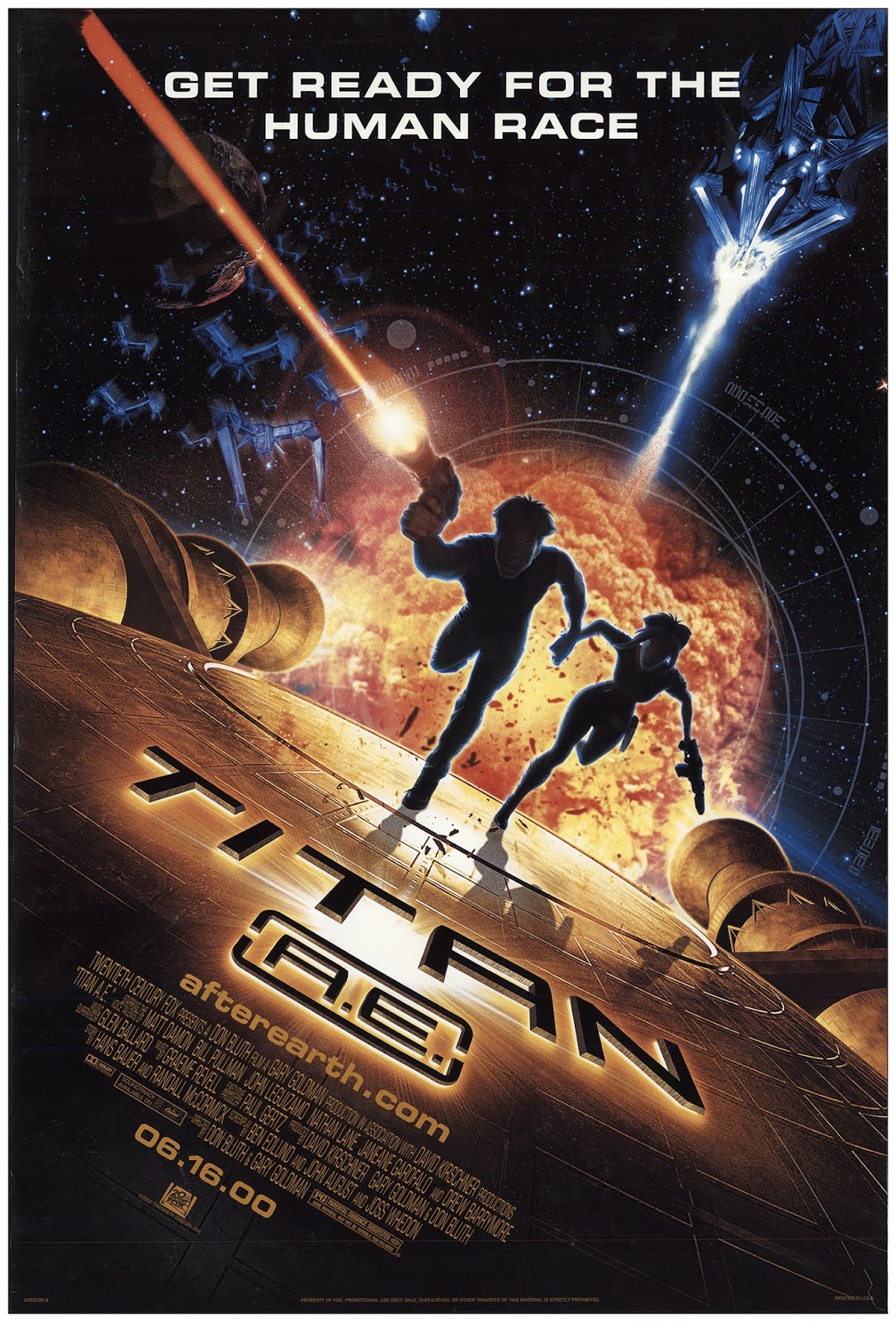
Titan A.E. (2000)
It's weird that Disney saw this movie and decided that they would still make Treasure Planet with both the butt-grunge soundtrack and cel-animation-over-flatly-textured-3D-polygon-backgrounds aesthetic—both huge liabilities in this movie. It doesn't help that this movie's screenplay is bland beyond belief. The bones of this movie are very weak. But the movie's saving graces are saving enough that they keep the movie upright: credit where credit is due, the visual design of this world is very cool, and the cel animation looks tremendous, if you can mentally isolate it from the PS2-level 3D it's interacting with. It's honestly a shame that the exact moment everyone else caught up with the technical possibilities of Renaissance-era Disney animation, they all decided to pivot to CG. Grade: C
Television
King of the Hill, Season 2 (1997-98)
There's a reactionary streak to this show that I'd forgotten about (or maybe it had worked its way out by the time I was watching it), and the episodes that lean into that are pretty cringey—the worst case being "Junkie Business," which involves a complete misunderstanding of the Americans with Disabilities Act. But at the same time, the show is still as sweet and warm as it would ever be, and by this second season, it has a firm grasp on the nuances of its increasingly sprawling cast. Episodes have arcs, but they allow time for bizarre little character moments that make these people feel humanly idiosyncratic even outside their stock characteristics; my favorite example of this is in the second episode, "Texas City Twister," which spends like thirty seconds developing a C plot in which Bobby tries to test out what he's heard about a tornado being able to fling an egg through a brick wall—it's such a small little arc that pays off in a hilarious anticlimax, but the fact that the show makes room for it in an otherwise high-stakes episode just gives the episode so much vitality. When adult animation (I hate that term) on television so often goes for absurd jokes and metacommentary, it's nice to see a show built off of warm, character-based humor, even if it occasionally dips its toe into some eye-roll-worthy politics. Grade: B
Scenes from a Marriage (Scener ur ett äktenskap) (1973)
I've never actually seen the film version of this, but I've had the TV miniseries that the movie was cut from on Blu-ray for ages, and given that behind The Seventh Seal and maybe Persona, this is one of Ingmar Bergman's most influential works on subsequent generations of filmmakers, I figured I needed to watch it. Big surprise, it's great. Each episode is built around one of six "scenes" (though they are occasionally 2-3 scenes apiece), and each of these scenes are constructed from lengthy and claustrophobic conversations; these conversations are allowed to stew for dozens and dozens of minutes at a time until they become almost abstract versions of themselves, the blank walls of the bedchamber becoming a void against which this couple has nothing but themselves, almost as if they are onstage, which was maybe Bergman's intention, given his background in theatre. Bergman's permissive hand allows these conversations to wind in bizarre, digressive shapes that veer from affectionate mundanities to searing arguments, giving these episodes a live-wire feel, as if both everything and nothing about this relationship is contained with every word spoken. The execution here is highly artificial to points that occasionally strain credulity—the way this couple is able to frame everything about their relationship coolly and logically is a superhuman feat of articulation in the face of life-shattering events, and the eventual moment when cooler heads cease to prevail later in the series feels like a similarly calculated and "written" moment—but the great paradox of this film is that from that artificiality pours a messy deluge of bleeding human emotions, right up until the final moments of the series contemplate mortality and existence itself. No matter what rigor with which you impose order onto life, it all becomes subject to our quivering humanity. Grade: A-
At this point, nothing more than the musings of a restless English teacher on the pop culture he experiences.
Showing posts with label Laika. Show all posts
Sunday, August 11, 2019
Sunday, August 28, 2016
Mini-Reviews for August 22 - 28, 2016
Reviews. Read up.
Movies
Kubo and the Two Strings (2016)
There are good discussions to be had about the extent to which this movie appropriates Eastern culture to mostly Western ends, whether or not the characters are too trope-ish or one-joke, whether the plot is too video-game-ish (I'm far from the first to suggest that this may be the best Legend of Zelda movie we ever get). But when you get right down to it, one two things end up mattering to me in any gut-level way here, and both of them are towering and beautiful: the animation and the ending—the animation because this is hands-down the most intricate and gorgeous stop-motion that I've seen in my life, and the ending because it imbues the whole movie with such fantastic and thematically rich meaning about the nature of just what's going on in this movie that it snaps the preceding hour into sharp focus: a focus that turns the film into one of the most well-observed, provocative, and emotionally resonant commentaries on the power of storytelling in recent memory. I cried. Grade: A
High-Rise (2015)
This weird little dystopian satire involving an apartment building so self-contained that its increasingly Dionysian residents never need venture outside its walls proves something I already knew, which is that director Ben Wheatley makes technically fascinating movies that are a little hard to follow and a lot hard to love. This one's a little less aggressively off-putting than his last, the unapologetically surreal A Field in England, by virtue of having big-name stars (hey there, Mr. Hiddleston) and a satirical message so blunt (we live in a society that causes deep, dysfunctional class divides, y'all) that even when the plot gets a little hazy, there's always that frame to hang the scenes on. It's also his prettiest, most technically stunning movie to date: every single frame could be a groovy poster in your dorm. I'm not in love. But I liked it very much indeed. Grade: A-
Maggie's Plan (2015)
Throughout Maggie's Plan, Maggie (Greta Gerwig) has several plans, few of which are all that collected or grounded in much besides short-sighted impulse. I guess the same could be said about the movie as a whole, which flits through its oddly twisty (for this brand of indie dramedy) plot with as much breezy effervescence as Gerwig herself (who is typically fantastic). The result is a movie that is consistently entertaining all the way through without ever really cohering into anything that makes a lot of sense on a macro level. There's a sneaky sort of absurdity that's able to slip the phrase "ficto-critical anthropologist" alongside goofy sperm-donor hi-jinks and whatever on earth Julianne Moore is doing with that accent. Grade: B
Mind Game (マインド・ゲーム) (2004)
Imagine an animated movie that uses an early, metaphysical premise to eventually rope its protagonist into a slapstick middle half-hour set entirely in the belly of a whale, and you've only just begun to plumb the depths of unadulterated crazy that is Mind Game. Now imagine a movie animated in over a dozen styles that it rapidly switches between, often mid-scene: you're getting closer. The sensibilities of Mind Game are totally juvenile (the defining trait of the film's most prominent female character is that she has very large breasts, which have apparently kept her from realizing her childhood dream of being an Olympic swimmer [how could I make this stuff up?]), but those sensibilities, coupled with the completely gonzo animation, are piled up in such magnitude and intensity that the results toe the line between numbing and sublime. Grade: B+
Two Friends (1986)
Sort of like Memento, but with a friendship instead of murderous revenge. I'm being flippant—Jane Campion's debut feature (which aired on TV, her theatrical review still being three years away) is in turns sweet, poignant, and unapologetically harrowing in the emotional territory it mines. Maybe I'm just a softy, but the backwards-chronological sequencing of the sections makes this film's narrative of a friendship crumbling in reverse have the interesting and crushing effect of having each successively happier moment feel sadder and sadder. As it turns out, a friendship crumbling in reverse is even more painful than seeing one in the regular forward rush. Grade: B+
Music
Beyoncé - Lemonade (2016)
Lemonade is the sort of album we get every once in a while that seems to justify the pop music machine: an intensely collaborative, blockbuster record, the likes of which could never have been made without the piles of dollars and producers Columbia has at its disposal to throw behind its biggest stars, but one that nevertheless feels visionary and personal. This is every bit a commercial, big-label production while still being every bit Beyoncé's album: not just in the sense that she completely owns almost every minute of the record's 45 (I'm still on the fence about how well "Daddy Lessons" works) but also in that this is THE Beyoncé album, the one that's distilled the most potent parts of her identity into an adventurous, definitive statement. The album itself pales in comparison to the "visual album" feature film released alongside the music, and in fact, the record plays a lot like a soundtrack to the movie rather than a distinct work of its own, but as a soundtrack, it's killer. Grade: A-
Movies
Kubo and the Two Strings (2016)
There are good discussions to be had about the extent to which this movie appropriates Eastern culture to mostly Western ends, whether or not the characters are too trope-ish or one-joke, whether the plot is too video-game-ish (I'm far from the first to suggest that this may be the best Legend of Zelda movie we ever get). But when you get right down to it, one two things end up mattering to me in any gut-level way here, and both of them are towering and beautiful: the animation and the ending—the animation because this is hands-down the most intricate and gorgeous stop-motion that I've seen in my life, and the ending because it imbues the whole movie with such fantastic and thematically rich meaning about the nature of just what's going on in this movie that it snaps the preceding hour into sharp focus: a focus that turns the film into one of the most well-observed, provocative, and emotionally resonant commentaries on the power of storytelling in recent memory. I cried. Grade: A
High-Rise (2015)
This weird little dystopian satire involving an apartment building so self-contained that its increasingly Dionysian residents never need venture outside its walls proves something I already knew, which is that director Ben Wheatley makes technically fascinating movies that are a little hard to follow and a lot hard to love. This one's a little less aggressively off-putting than his last, the unapologetically surreal A Field in England, by virtue of having big-name stars (hey there, Mr. Hiddleston) and a satirical message so blunt (we live in a society that causes deep, dysfunctional class divides, y'all) that even when the plot gets a little hazy, there's always that frame to hang the scenes on. It's also his prettiest, most technically stunning movie to date: every single frame could be a groovy poster in your dorm. I'm not in love. But I liked it very much indeed. Grade: A-
Maggie's Plan (2015)
Throughout Maggie's Plan, Maggie (Greta Gerwig) has several plans, few of which are all that collected or grounded in much besides short-sighted impulse. I guess the same could be said about the movie as a whole, which flits through its oddly twisty (for this brand of indie dramedy) plot with as much breezy effervescence as Gerwig herself (who is typically fantastic). The result is a movie that is consistently entertaining all the way through without ever really cohering into anything that makes a lot of sense on a macro level. There's a sneaky sort of absurdity that's able to slip the phrase "ficto-critical anthropologist" alongside goofy sperm-donor hi-jinks and whatever on earth Julianne Moore is doing with that accent. Grade: B
Mind Game (マインド・ゲーム) (2004)
Imagine an animated movie that uses an early, metaphysical premise to eventually rope its protagonist into a slapstick middle half-hour set entirely in the belly of a whale, and you've only just begun to plumb the depths of unadulterated crazy that is Mind Game. Now imagine a movie animated in over a dozen styles that it rapidly switches between, often mid-scene: you're getting closer. The sensibilities of Mind Game are totally juvenile (the defining trait of the film's most prominent female character is that she has very large breasts, which have apparently kept her from realizing her childhood dream of being an Olympic swimmer [how could I make this stuff up?]), but those sensibilities, coupled with the completely gonzo animation, are piled up in such magnitude and intensity that the results toe the line between numbing and sublime. Grade: B+
Two Friends (1986)
Sort of like Memento, but with a friendship instead of murderous revenge. I'm being flippant—Jane Campion's debut feature (which aired on TV, her theatrical review still being three years away) is in turns sweet, poignant, and unapologetically harrowing in the emotional territory it mines. Maybe I'm just a softy, but the backwards-chronological sequencing of the sections makes this film's narrative of a friendship crumbling in reverse have the interesting and crushing effect of having each successively happier moment feel sadder and sadder. As it turns out, a friendship crumbling in reverse is even more painful than seeing one in the regular forward rush. Grade: B+
Music
Beyoncé - Lemonade (2016)
Lemonade is the sort of album we get every once in a while that seems to justify the pop music machine: an intensely collaborative, blockbuster record, the likes of which could never have been made without the piles of dollars and producers Columbia has at its disposal to throw behind its biggest stars, but one that nevertheless feels visionary and personal. This is every bit a commercial, big-label production while still being every bit Beyoncé's album: not just in the sense that she completely owns almost every minute of the record's 45 (I'm still on the fence about how well "Daddy Lessons" works) but also in that this is THE Beyoncé album, the one that's distilled the most potent parts of her identity into an adventurous, definitive statement. The album itself pales in comparison to the "visual album" feature film released alongside the music, and in fact, the record plays a lot like a soundtrack to the movie rather than a distinct work of its own, but as a soundtrack, it's killer. Grade: A-
Subscribe to:
Posts (Atom)


