Showing posts with label King of the Hill. Show all posts

Sunday, December 12, 2021

Mini Reviews for December 6 - 12, 2021

In addition to this stuff, I also rewatched The Prince of Egypt and chatted about it on this podcast, if you're interested!

Movies

Pig (2021)
A very sweet, low-key revenge thriller (what a combo of adjectives, huh?) about a man who just really loves his truffle-hunting pig, but what's haunting me about the movie is the mid-film scene inside a trendy Portland restaurant in which retired, off-the-grid ex-chef Nicolas Cage interrogates one of his former employees, who is now the chef at said restaurant, about abandoning his culinary ambitions in order to cave to the tastes of vapid gentrifiers. The rest of the movie is good, but that one scene in particular cuts deep. Grade: B+


The Power of the Dog (2021)
It's not as oblique and mysterious as Jane Campion's best (e.g. The Piano), but it's every bit as feral an interrogation of power and human sexuality. Besides, it's best not to look a gift horse in the mouth, because it might cause us to lose sight of the celebratory fact that at long last we have a new Jane Campion movie! And a really excellent one, too—a tensely written psycho-sexual western sturdily supported by a terrific batch of performances, none greater than Benedict Cumberbatch's seething, animalistic turn as a brooding bully turned sociopathic by his desperate clawing at the mustiest of masculine tropes for protection. I am hit-and-miss on Cumberbatch, so I'm extremely impressed here. He's so good that his character is still manacing even after calling a piano a "pinano" the whole movie. I wonder what it would have been like if this character had shown up in The Piano. Grade: A-

The Apostle (1997)
A great Robert Duvall performance (and several great supporting performances) in search of a great movie. But if the movie it found isn't great by any stretch of the imagination (it's meandering and overlong to a significant fault), it's at least a fascinating one for me nonetheless. The Baptist-inflected evangelicalism of suburban comfort that I grew up with is a far cry to the charismatic revival style of Christianity depicted here, so I don't know if I'm any less of an outsider viewing this as your garden-variety nonbeliever, but it's often riveting to see a completely unvarnished depiction of rural Pentecostalism, free from judgement or condescension. I grew up fairly skeptical of charismatic Christianity, both because of theological prejudices picked up from the churches I attended (and, it must be said, prejudices grounded in my own whiteness, since as this movie shows, charismatic traditions tend to be much more multi-racial than the white enclaves of the less spirit-filled evangelical traditions) and also because the most visible examples I had of these strains of Christianity were of megachurch pastors on TV who obviously were peddling something. But this movie does a pretty good job of showing just what is so meaningful about this sort of tradition, while also not sugar-coating the reality of it or trying to assimilate it to more mainstream tastes—I would say it's a "warts and all" depiction, but the movie seems completely uninterested in leveraging any judgement here that might identify warts at all, including of the iffy atonement theory and afterlife obsession that the churches in the film share with my own upbringing. It's not at all the approach I would have had given the subject matter, but I respect the commitment to the ethos. I wish the narrative of this movie had more going for it. The transformation Duvall's character goes through from ousted pastor to "apostle" is theoretically interesting, but the movie is just so episodic that it's hard to get into it as an arc; meanwhile, the movie seems a lot more impressed with the implications of the character's maniacal possibilities (the film's inciting incident is him more or less killing a man) juxtaposed with his ecstatic piety than feels earned; it kind of just presents these warring impulses in Duvall's character without comment, with little development or interplay (he more or less leaves behind his violent tendencies the moment he's re-baptized, except for the scene in which he beats up a racist dude), which leaves the irony of his character and the catharsis of his redemption arc as more of a conceptual dare than anything truly felt. Which is a shame. The concepts of forgiveness and redemption are some of the thorniest and least-convenient and frankly offensive in Christianity, ones that enrich the faith as much as they scandalize it, and this movie treats them with the same sociological neutrality as it does every other bit of faith here. Duvall's performance is clearly up to the task of that complexity, too, and any life his character has is entirely from the way that he plays the central figure as someone whose fanatical proselytizing and seething fury are drawn from the same ambiguous energy. But without more in the text itself (text which Duvall himself wrote!), that tremendous performance is left twisting in the wind. Too bad, because even with its shortcomings, this movie feels important, at least on a ecumenical level; 1997 is probably the latest moment when this story could be told without being forced into a period setting, and even in '97, it was clear that the totalizing force of the Hillsongs and the Purpose-Driven Churches and that whole white-middle-class homogeneous evangelical mainstream machine were sucking these kinds of regional faith traditions dry, in a mirror to the free trade and globalization at the same time destroying the economies of the communities in which these traditions lived—hell, Steven Curtis Chapman even makes an appearance on the soundtrack, an acknowledgement of the inevitable terminus of this Christian moment. But this movie just feels dry outside of its obviously valuable depiction of a particular milieu. I desperately wish it weren't the case. Grade: B

Repo Man (1984)
An utterly deranged movie. Starts unassumingly enough (punk sells out, starts repossessing cars) only to then stack bizarre detail upon bizarre detail until the sheer accumulation of it all turns it into something that's primal and intuitive while also being heady and complex. Or maybe it's just convoluted and this doesn't really add up to anything, and if that's the case, it only helps the movie's jaded cause of depicting the world as corrupt systems run by jerks on top of corrupt systems run by even bigger jerks... on top of aliens? I dunno. A wild time. Grade: A-


Television

King of the Hill, Season 5 (2000-2001)
I don't know how much there is to say about this show five seasons in. Bobby remains great, as are the episodes that focus on his adolescent trials, the episodes that unironically present Hank's worldview as noble are still pretty eye-roll-y, as are the episodes where the show tries to Say Something, but overall the show remains pretty consistently gently funny with the occasional hilarious gag/episode. At this point, the show seems like it was getting some clout, as it features some notable celebrity guest stars (Brendan Fraser, Snoop Dogg, Paul Giamatti) as well as some Texas royalty in the form of former Texas governor Ann Richards (a limp-wristed George W. Bush also makes an appearance as a character, though the read Dub apparently declined an invite to dub his own voice work); as with its Fox lineup mate The Simpsons, these guests tend to be hit-and-miss in terms of how well they fit into the universe of the series (the governor especially feels inorganic—not the least because she's not a great voice actor). But even so, these don't feel like seismic shifts for the series. It's basically what you'd expect from the series at its height, which is mostly a good thing in my book. Grade: B


Music

Sufjan Stevens & Angelo De Augustine - A Beginner's Mind (2021)
Sufjan Stevens and some dude named Angelo make a single-songwriter record inspired by a bunch of different movies, so obviously this is very specifically catered to my tastes. This is going to appeal to people who like Sufjan's earlier folk work like Seven Swans, and while I do wish this were a little more aesthetically ambitious, there's no denying the songcraft here. A few feel a little shoehorned into the broader film concept, but the range of influences is impressive (Hellraiser III?), and most of the songs here are extremely solid, clever, even emotionally resonant at times, no more so than in the opener, "Reach Out," easily my favorite track here (inspired by Wings of Desire, which I haven't seen). Grade: B+

Sunday, October 11, 2020

Mini Reviews for October 5 - 11, 2020

I don't know why I write these blurbs up here every week. Sometimes I actually just don't have anything to say.

Movies

Bad Education (2020)
I knew nothing about the true story on which this is based, and I recommend that approach if possible, because then the movie plays as a remarkably twisty thriller wherein each turn of the plot reveals new depths of just how badly the central characters have behaved in their participation in the central scandal. Within fifteen minutes of the movie's beginning, you're thinking, "Huh, as advertised, this education does seem somewhat bad," but then by the end, it's "hooooooly cow, please stop, this education can't possibly get any worse!" A really great little parable of how the road to hell is paved not quite with good intentions but with the ability to delude yourself into believing that you have good intentions. This is communicated most starkly with Hugh Jackman's performance—probably the best performance I've seen in a new movie this year and almost certainly the best performance the guy has had in his career (I'd have to rewatch The Prestige to get rid of that "almost"). If nothing else, come for the Jackman, folks. Grade: A-

The Lords of Salem (2012)
I'm still not 100% on Rob Zombie's wavelength, and this movie is no exception—I really wasn't grooving with it until about 30 minutes before the end, when it twists from a mostly generic horror movie slightly elevated by some Attitude into a really affecting, psychedelic rumination on addiction/relapse. The latter stages of this movie ring deeply true, from the sobriety that suddenly morphs into a downward spiral to the complete isolation of using. The last real shot of this film before the credits roll is heartbreaking. On a different note, it's a real experience to watch this the same week as Witchfinder General, two movies which have about the most polar opposite feelings toward witches that I can imagine. Grade: B


Fat City (1972)
A solid, claustrophobic boxing movie that's like the bummed out cousin of Rocky—all its underdog, working-class sympathies and more broken heroes on a last chance power drive than you can shake a Bruce Springsteen song at, only without any of the optimism that often comes with the territory, and certainly no "Gonna Fly Now." On a production level, it's fascinating to think of this as a John Huston feature. He's a director so steeped in the old Hollywood studio system, but here he's doing really admirable work embodying the grime and looseness of the New Hollywood film-school generation: an impressive pivot for a guy who was over 40 years into his career at that point. I should watch more of his later output. Grade: B


Witchfinder General (aka The Conqueror Worm) (1968)
Brutal in a way that I was not at all expecting. Vincent Price usually brings a sly (or sometimes overt) camp to his roles, and his playing the eponymous Matthew Hopkins in this movie is the only of his performances that I've seen completely stripped of those winks and theatrics—just pure, vile, craven sadism in this man here. It's not a movie that's scary in the traditionally spooky sense, but watching Price play this man literally hellbent on torturing men and (especially) women accused of witchcraft is very, very scary. Grade: B+


Titicut Follies (1967)
Frederick Wiseman's first feature documentary is a lot more explicitly constructed and didactic than I was expecting, which is probably just a product of his not having yet fully formed his fly-on-the-wall documentary style yet. But part of me would like to imagine that the subject matter of this film made it impossible for Wiseman to assume his usually withdrawn stance. Taking place in an asylum for "the criminally insane," Titicut Follies chronicles an incredible amount of suffering as the authoritarian vice of the institution turns the humanity of the patients into an abstraction to be manipulated. I can't help but feel that the movie would be improved by a modern Wiseman 3+ hour sprawl that would allow us more of a sense of the bureaucratic banalities giving rise to the tactile horrors seen here, but as the furiously angry, viscerally sad document that this was intended to be, it works well, too. Grade: A-

Television

King of the Hill, Season 4 (1999-2000)
Now that the show is basically at the peak of its powers in my watch-through, some of its tendencies are starting to wear a little thin as the show settles into a more familiar groove. For example, I definitely think Hank is a more interesting character when he's a principled man whose principles put him just slightly behind the times and just slightly less compassionate than he should be, but the show's default mode is definitely to side with Hank's principles, which definitely saps the show of some of its energy by veering a little too closely to making Hank a hero at times. And the show's attempts at showing grace to the Souphanousinphone parents are a lot thinner than I remembered them being and don't really mitigate the kinda-sorta racist depiction of them. Connie remains one of the best secondary characters on the show, though, and her relationship with Bobby (the best primary character on the show, bar none) is a consistent highlight, sweet and funny and unforcedly complex, and forms the backbone of what I think is the best episode this season ("Naked Ambition"). There's a lot of other good material here, too (seeing Dale rekindle his relationship with Nancy is great, for example), so I'm not exactly complaining about this solid season of television. But it does feel like the strikingly complex, ambitious third season was walked a little back this time around for a slightly more straightforward, slightly less rewarding follow-up. I enjoyed myself, but nothing here surprised me. Grade: B+

Sunday, May 3, 2020

Mini Reviews for April 27 - May 3, 2020

Quarantine, Week 8: I need a haircut.

Movies

John Carter (2012)
I was really into this for the first ten minutes, when I thought it was going to be some kooky meta-pulp thing with stuff like Edgar Rice Burroughs appearing as a character. I was still into it, if lessly so, when it becomes a less kooky but still fun pulp western thing—Stanton feels at his most playful here, and there are some great laugh-out-loud moments built from the editing. Unfortunately, the stage of this movie I was least into, and the one that takes up the bulk of the runtime, is the actual premise of the movie, i.e. when John Carter actually goes to Mars, as the movie quickly devolves into some really tedious Martian sociopolitical action epic. The effects and world/creature design are excellent, which is a saving grace, but the movie loses almost all of its sense of fun. Which is too bad, because if the Mars material had had some Valerian-like invention, I would be proclaiming this an unjustly maligned gem. Instead, I'm stuck with a movie that I only like in pieces, and small pieces at that. Grade: B-

God's Own Country (2017)
On the one hand, the aesthetic of this movie is a snooze, basically the driest kind of cinematic realism you can imagine. On that same hand, this movie doesn't do a ton with its characters who aren't the protagonist—the Romanian love interest is basically just a magically perfect immigrant, and the rest of the cast is even less filled in than that. On the other hand, this movie does an affecting (if a little broad) job of rendering the cage of traditional masculinity, and the final scene is great. So I dunno, I guess I sort of liked the movie as a whole. Grade: B-


Harold & Kumar Go to White Castle (2004)
A thoroughly mixed bag with the usual noxious mix of homophobia and misogyny that was the default garnish to the mainstream American comedy in the 2000s. But I also laughed really hard at the "battle shits" part and at Kumar's daydream where he marries a bag of marijuana, and the scene in the police station is top-to-bottom great, so... what can you do, you know? Grade: B-


Trouble Every Day (2001)
There's a lot to process here. Which do I process first? The cannibalistic sex acts? The (needlessly?) opaque plotting? The fact that I kept confusing the housekeeper with the other female characters in the film? Anyway, I'm on the record as saying that I like Claire Denis when she's at her most brutal and miserable, and I remain on that record now, so I guess I reap what I sow. This feels like every bit the thematic antecedent to High Life in the sense of treating sex in its juicy, bodily materiality and suffering as a sort of embodied existentialism. Kind of wish this movie were set in space, too, though I guess I can't have everything. Grade: B


Sling Blade (1996)
This movie's relative chronological proximity to Forrest Gump doesn't do it any favors, as it highlights that Billy Bob Thorton's protagonist really isn't any less of a hollow symbol than that other emblem of spiritual purity by way of mental disability. Which is too bad, because otherwise, Sling Blade is a haunting, even chilling evocation of existentialism via the American South. I'm particularly impressed with (and surprised by) Thorton's direction here, which is as patient as I've seen in an American mainstream release: shots just linger in a way that reminds me of some intersection between Bergman and Ozu—I wouldn't say that Thorton has a remarkable eye for imagery, but he has a tremendous sense of tone and pace, which renders this philosophical fable with striking clarity. I wish it worked better on the character level, but otherwise, there are some real aces up this movie's sleeve. Grade: B

Tromeo & Juliet (1996)
I'm not super familiar with the Troma world (outside Surf Nazis Must Die, which I saw years ago and hated), but this was as much a delight as an abomination. It's supremely gross, and the incest angle and occasional transphobic flavors (including a very unfunny [what other kind is there?] Ace Ventura riff) are transgressive bridges too far for me. The softcore veneer over everything is also kind of a buzzkill for me, though I think that people who are saying that it's some wild innovation on Shakespeare are forgetting just how sexually lurid the original text of Romeo and Juliet is. But I adore the general ethos of this thing; I've been waiting my whole adult life for a Romeo and Juliet adaptation that treats the Bard's worst major play with the contempt that it deserves, and Tromeo and Juliet gets closest to that ideal. The movie has the bones of a very good farce, and for as much as a lot of the moment-by-moment jokes don't land, a lot of them do land, provided you're willing to go to the juvenile, continuously extra place the film's tone demands—there's just something so funny to me about arbitrarily renaming the character Paris "London" here; sue me. I also appreciate that the juvenile and extra elements are grounded in, like, an actual literacy of the original play—anyone can make a face cheek / butt cheek pun, but only someone who is reasonably familiar with the play can craft a joke as terrific and terrifically dumb as the moment when Romeo swoons, "See how she leans her cheek upon her hand," and the movie cuts to a shot of Juliet's hand resting on her bare posterior. Grade: B

Matewan (1987)
The best thing here is the gorgeously dusky cinematography. The movie's depiction of the 1920 coal miner strike in the town of the same name is otherwise told excitingly enough, and it ticks its ideological boxes: an intersectional coalition of workers united against some truly nasty coal barons. There are some basic foundational things that are pretty shaky, though; the cast is uniformly excellent (including a lil baby Will Oldham!), but the screenplay is pretty indecisive on how to employ them. The striking miners themselves are mostly anonymous outside their respective big scenes, none of the female characters are given much to do, and James Earl Jones comes swaggering in as just about the coolest part of the movie for the first half hour before more or less disappearing for the rest of the film. None of this stops the movie from being a rousing depiction of labor solidarity, but it could have been a lot more effective for me if the character work came together better. Grade: B

Television

Barry, Season 2 (2019)
This is a pretty messy season, and it loses a lot of the considered, Shakespearean arc of its first year. This isn't all bad: the freedom from that structure allows for some interesting arcs for, for example, Sally, who struggles with the intersection (or lack of intersection) of emotional honesty with acting success. At other times, though, the season is tonally all over the place, and while that was also true of the first season, this season struggles to tie it all together in the way that the first season did. I enjoy NoHo Hank as a screen presence, but his sort of cheery self-help-obsessed mob guy feels like forced shtick this time around, as disconnected from the main plots as he becomes. And with this season's ending, it's glaring how much the show is contorting itself to preserve its central cast, even when the plotting would seem to demand, for example, the death of Fuches. I'm complaining a lot because this is such a step down from the first season, but there are still a lot of engaging elements being juggled here: Henry Winkler's performance, the light satire of the aspiring acting community, a completely bonkers fifth episode that's nothing like anything the show has done before. But that juggling is a lot less elegant this time around. Grade: B

Brooklyn Nine-Nine, Season 7 (2020)
It's fine, just like every other season of Brooklyn Nine-Nine. The show is walking through the motions of an aging sitcom (characters getting pregnant!), but the remarkable thing about this show is that it seems incapable of showing age, and its quality has remained absolutely constant throughout its run. It began as a mildly funny workplace sitcom with a great cast and an iffy premise, and it remains precisely that—no more, no less. Grade: B


King of the Hill, Season 3 (1998-99)
The show dips its toe a little less frequently into issues commentary this time around, which is good, because that still feels as awkward a gesture as ever (and I'm not always sure whether it's a joke or serious—e.g. the episode "Love Hurts... and So Does Art," which resolves with Hank bringing in a sheriff to an art exhibit to enforce Texas's [fictional?] law against modern art). But on the whole, this season feels like a total maturation into King of the Hill as I remembered it, the sweet show about the light absurdities of its characters' small-town Texas psychologies, and even some things I didn't remember: there are full multi-episode arcs here, which are often very sweet (the best being Hank and Peggy's ongoing struggle with infertility, which culminates in a poignant finale). More so than most animated shows of its era, this season has a sense of continuity to it that caught me by surprise. The structure of this season is unexpectedly complex for the kind of series that it is, and everything and everyone just feels so much richer this time around, fully realizing the promise of those first two seasons. But it achieves this without ever losing touch with its core episodic structure, which you know I love. Very funny, very sweet television. Yup. Grade: A-

Music

Fiona Apple - Fetch the Bolt Cutters (2020)
If Fiona Apple is going to only release albums once a decade, they might as well keep being among the best of the decade. Fetch the Bolt Cutters is dazzling, a percussive, bewildering torrent of acid poetry. It's whimsical in the best ways (several dogs are credited as performers on the album) while also being a brutally serious engagement with the very texture of existence and what that existence means when overlapping with other people's existences. And the lyrics. Fetch the Bolt Cutters lacks the surrealism of The Idler Wheel's tumultuous words, but Fiona's no less considered of a wordsmith here; in fact, she's better than she ever has been in that regard. Simultaneously blunt and so razor-edged that they'll cut your fingers clean off without you even feeling the pressure of the blade if you aren't careful—I love these lyrics; I want to put them in a book; I want to put them on posters and paper my house walls with them. I would quote some of the standout lyrics, but every single word sung is its own universe. Anyway, this album is great. Believe the hype. Grade: A

Sunday, August 11, 2019

Mini Reviews for August 5-11, 2019

Rvws.

Movies

Missing Link (2019)
Small and slight, but I feel like a healthy diversity of American animated output should make room for these sorts of low-stakes projects. Besides, it's charming, and the craft is exquisite (unsurprising of a Laika feature). Then again, I was saying the same thing about Pixar circa The Good Dinosaur, and now 2019 has the fourth Pixar prequel/sequel in four years, so I guess we'll see if this really is a harbinger for Laika's future. Grade: B


Charlie Says (2018)
I'm seemingly the only person on the planet who does not find the Manson family innately fascinating, despite the case intersecting a lot of my own personal interests ('60s counterculture, the Beatles, film history). I don't really know what it is, except that the idea of a misogynist, white-supremacist madman exploiting vulnerable women and misconstruing the White Album as an apocalyptic prophecy just feels too airy and unhinged to have the sort profound tragic arc of other countercultural movements grounded in actual social realities (Jonestown, the Black Panthers). On the one hand, it's nice that Charlie Says tries to freshen up some of the ossified framework of the Manson saga by grounding it in a very particular and sometimes-ignored perspective of the "Manson girls" themselves (specifically Leslie Van Houten); to the credit of this focus, the movie doesn't get lost in the Manson mythology or get star-struck by Manson's magnetic toxicity, like a lot of depictions of this story do. Director Mary Harron has a strong control of tone and gets some great performances out of everyone involved here without ever letting the charisma of the players overwhelm the larger context of the basic smallness and sadness that the whole Manson situation radiates. I also like the decision to focus part of the film on the de-radicalizing/de-brainwashing process the girls went through during their imprisonment after the murders. But on the other hand, it's kind of disappointing to me that Charlie Says deals most with the details I'm least interested in—the lurid and abusive environment Manson fostered at Spahn Ranch commune, leading up to the notorious murders themselves. What this movie brings new to the table is the most interesting piece of the whole thing to me: the conflict the graduate student visiting the girls in prison feels over the realization that helping the girls shake Manson's delusional ideology from their heads will cause them an enormous amount of suffering, since it will require them to confront their own actions in service of that ideology. The ways that putrid/nonsensical ideas like Manson's become their own shields against the consequences born from the application of those ideas—that's really thorny and compelling territory that's rarely explored in the context of the Manson family, but unfortunately, the movie doesn't give it nearly the obsessive scrutiny that it reserves for the Spahn Ranch flashbacks (which are less flashbacks than they are just 75 percent of the movie), and the prison scenes involving the girls' re-education are disappointingly programmatic: e.g. there's a flashback to Manson laying out his wildly racist delusions, followed by a prison scene where the girls repeat it to the graduate student educating them, followed by another scene where the graduate student brings in a black colleague, who basically just tells the girls, "Uh, that's racist"; lather-rinse-repeat for any number of ideas. There's no real wrestling with what it actually takes to de-program a true believer who believed enough to murder in cold blood, nor of the psychological toll of what it means to, in essence, lose one's faith and sense of moral justification at the same time; instead, it's just a handful of scenes featuring basic refutations of Manson's ideas. I get the impulse to spend more energy at the ranch, since on paper the ability of Manson to brainwash a whole bunch of people into believing his nonsense is one of the more incredulous parts of the whole story. But I dunno, maybe I've just spend too much time around fanatically religious people who believe some bonkers things, but that's never been the part that I had a hard time imagining. It makes total sense how a combination of affection, authority, cosmological vision, and abuse can create a completely dissociative, sheltered, nominally voluntary congregation. Escaping that, though, and coming to terms with what you've done in the name of belief—that's relatively unexplored territory. I know I'm kind of critiquing this movie for not being the movie I wanted it to be, which is bad form. But there's enough here of what I did want to make me pine for more. Grade: B-

Fast Color (2018)
Fast Color has arrived way too late: too late for either the dystopia boom of the early 2010s or the lo-fi indi sci-fi of the same period. I'm not sure if I would have liked it any better back then—genre context does nothing to help thin characters or tedious pacing—but it might at least have had a distinctness and novelty to its execution. As it is right now, it's just heavily evocative of Midnight Special, and in a diminishing way: a throwback of a throwback. Grade: C


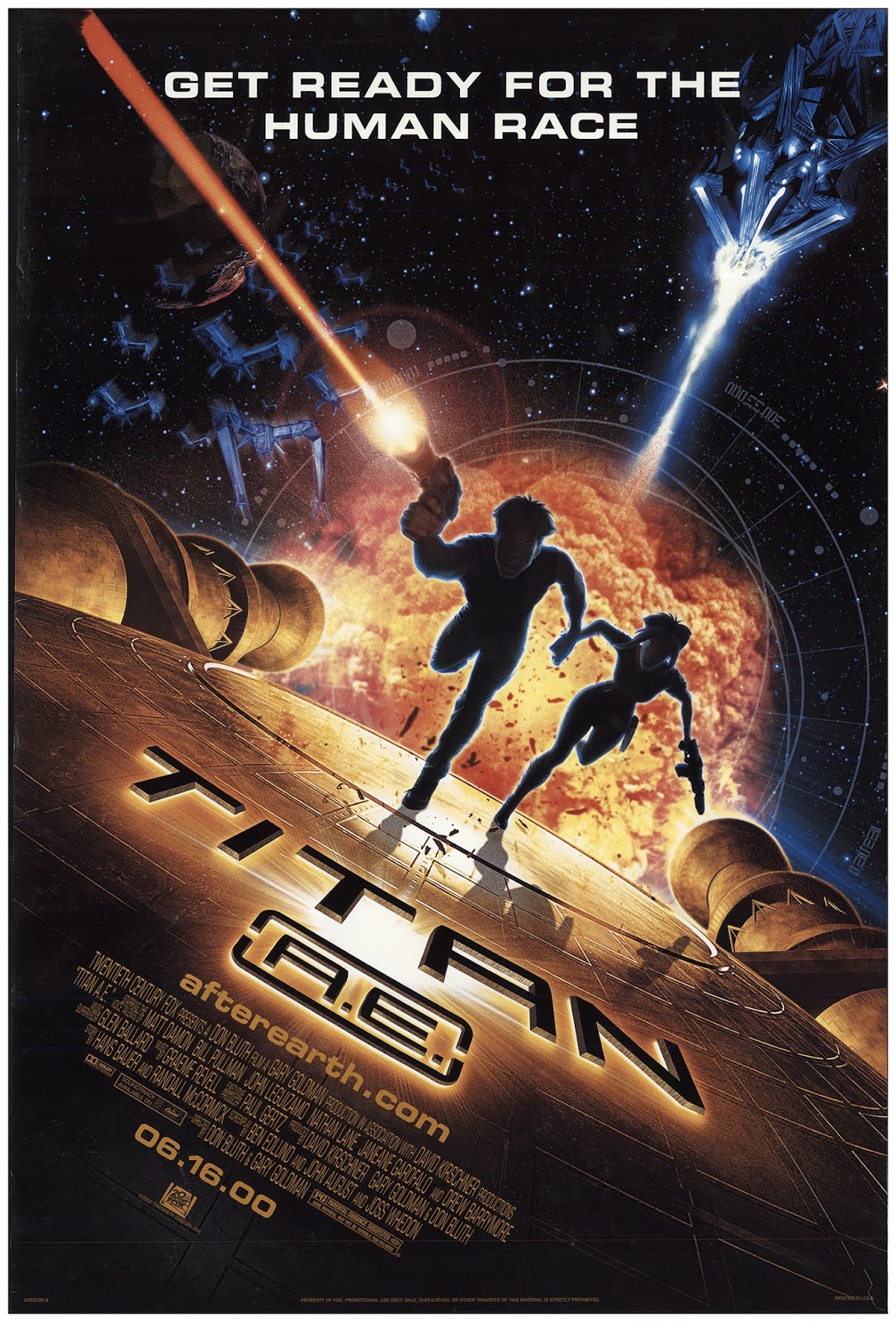
Titan A.E. (2000)
It's weird that Disney saw this movie and decided that they would still make Treasure Planet with both the butt-grunge soundtrack and cel-animation-over-flatly-textured-3D-polygon-backgrounds aesthetic—both huge liabilities in this movie. It doesn't help that this movie's screenplay is bland beyond belief. The bones of this movie are very weak. But the movie's saving graces are saving enough that they keep the movie upright: credit where credit is due, the visual design of this world is very cool, and the cel animation looks tremendous, if you can mentally isolate it from the PS2-level 3D it's interacting with. It's honestly a shame that the exact moment everyone else caught up with the technical possibilities of Renaissance-era Disney animation, they all decided to pivot to CG. Grade: C

Television

King of the Hill, Season 2 (1997-98)
There's a reactionary streak to this show that I'd forgotten about (or maybe it had worked its way out by the time I was watching it), and the episodes that lean into that are pretty cringey—the worst case being "Junkie Business," which involves a complete misunderstanding of the Americans with Disabilities Act. But at the same time, the show is still as sweet and warm as it would ever be, and by this second season, it has a firm grasp on the nuances of its increasingly sprawling cast. Episodes have arcs, but they allow time for bizarre little character moments that make these people feel humanly idiosyncratic even outside their stock characteristics; my favorite example of this is in the second episode, "Texas City Twister," which spends like thirty seconds developing a C plot in which Bobby tries to test out what he's heard about a tornado being able to fling an egg through a brick wall—it's such a small little arc that pays off in a hilarious anticlimax, but the fact that the show makes room for it in an otherwise high-stakes episode just gives the episode so much vitality. When adult animation (I hate that term) on television so often goes for absurd jokes and metacommentary, it's nice to see a show built off of warm, character-based humor, even if it occasionally dips its toe into some eye-roll-worthy politics. Grade: B

Scenes from a Marriage (Scener ur ett äktenskap) (1973)
I've never actually seen the film version of this, but I've had the TV miniseries that the movie was cut from on Blu-ray for ages, and given that behind The Seventh Seal and maybe Persona, this is one of Ingmar Bergman's most influential works on subsequent generations of filmmakers, I figured I needed to watch it. Big surprise, it's great. Each episode is built around one of six "scenes" (though they are occasionally 2-3 scenes apiece), and each of these scenes are constructed from lengthy and claustrophobic conversations; these conversations are allowed to stew for dozens and dozens of minutes at a time until they become almost abstract versions of themselves, the blank walls of the bedchamber becoming a void against which this couple has nothing but themselves, almost as if they are onstage, which was maybe Bergman's intention, given his background in theatre. Bergman's permissive hand allows these conversations to wind in bizarre, digressive shapes that veer from affectionate mundanities to searing arguments, giving these episodes a live-wire feel, as if both everything and nothing about this relationship is contained with every word spoken. The execution here is highly artificial to points that occasionally strain credulity—the way this couple is able to frame everything about their relationship coolly and logically is a superhuman feat of articulation in the face of life-shattering events, and the eventual moment when cooler heads cease to prevail later in the series feels like a similarly calculated and "written" moment—but the great paradox of this film is that from that artificiality pours a messy deluge of bleeding human emotions, right up until the final moments of the series contemplate mortality and existence itself. No matter what rigor with which you impose order onto life, it all becomes subject to our quivering humanity. Grade: A-

Sunday, March 10, 2019

Mini Reviews for March 4-10, 2019

Rerverws.

Movies

Free Solo (2018)
This movie exists to justify the climactic, 15-ish minute climbing segment, and don't get me wrong: that is riveting cinema and a technical marvel to boot. But I kinda wish this had been a short film of just that piece, because the rest of the movie is majorly Just Fine. There's really nothing revelatory about the exploration of Alex Honhold's death wish that occupies roughly 75% of the runtime, and the fact that the movie never quite figures out with just what ratio of badass and psychopath we are supposed to regard Honhold feels less like thematic tension and more like the documentary wants to have its cake and eat it too re: the emotional/physical toll of the rawly impressive, extremely dangerous, and fundamentally stupid hobby of free solo climbing. As such, it's (crucially) a major disservice to Honhold's long-suffering girlfriend that she's basically every significant other in every Great Man biopic—i.e. holding our intrepid hero back with Emotions and Domesticity. The documentary walks right up to actually validating her point of view, but ending as it does with the truly thrilling climb, the documentary sort of completes its thought by pointing out that she's wrong, which seems, to me, an irritating structure to take. I, for one, would have loved to see what happened in the months after Honhold had managed such a Herculean feat, and I feel like that's where the truly interesting relationship drama would occur: in interrogating the extent to which his ability to succeed at these ridiculous feats of strength actually underwrites his position in opposition to his girlfriend. But whatever, that climbing sequence was really great. Grade: B-

Let the Corpses Tan (Laissez bronzer les cadavres) (2017)
I think this is basically the movie I was hoping Mandy would be, which is to say: I was left nearly giddy by some of the imagery but couldn't even begin to tell you what "happened" in the film. This also feels about halfway like the movie that The Holy Mountain already is, which is to say: it's suffused with the same sort of "baby's first sacrilegious imagery" as Jodorowski's film and a kind of leering male gaze that I grew quickly bored of. When you lose the thread of a movie about halfway through, though, it's pretty easy to compartmentalize the pieces you like, so here's a positive rating for this movie. Grade: B


Field Niggas (2015)
In documenting his mostly black, mostly homeless subjects, director Khalik Allah shows not synced video with the numerous, vibrant interview audios that comprise the film but instead footage slowed to a rich, molasses crawl. It's a simple but profound technique, and it transforms these Harlem humans into something almost akin to religious icons, inviting viewers to find transcendence simply in the presence of another human being, the image of God. The movie is bursting at the seams with ecstatic, mundane life, but it's also a deeply spiritual experience, too—and honestly, one is no different from the other. Grade: B+


Magic Mike XXL (2015)
So... this is amazing? I enjoyed the first movie quite a bit, but truth be told, it's a pretty dry, dour affair once you get past the uproarious dance sequences—and justifiably so, given that it's ground zero for Great Recession Cinema. But it also makes a kind of logic to jettison all the depressing stuff altogether and just focus exclusively on the dancing, and that's exactly what Magic Mike XXL does, becoming essentially a musical revolving around some of the most ridiculously fun, intricately choreographed movie sequences I've seen in years. There's also something fairly formally (if not ideologically) radical about the movie's final thirty minutes, which basically amount to nothing more than one long, elaborate dance party over which a woman monologues about female sexual agency. The movie itself comments on the low bar it has to clear in order to be "progressive"—"all we have to do is ask women what they want," one character says at one point, somewhat incredulously. And that is a mighty low bar, similarly low to the one cleared by 2015's other pop-progressive masterpiece, Mad Max: Fury Road ("All we have to do is call the patriarchy... bad"). But in a landscape where so few movies actually do that bare minimum, why not celebrate those that do? And if you're going to hop over so low a bar, you might as well do it as exuberantly as possible, and Magic Mike XXL is possibly the most exuberant movie I have ever seen. Grade: A

Cavalcade (1933)
It sure didn't take the Best Picture Oscar long to find its penchant for nostalgic period pieces, and this one gets extra points for being one of those "generational collage" pictures that's even bigger Oscar catnip. I am not kidding at all when I say that it's pretty much Forrest Gump, only a lot less fun and for aging Victorians instead of Boomers. It's the usual tedious tripe typical of this kind of film, with all the regressive and reactionary tendencies of the genre to boot. A movie that ends with an old British couple at the tail end of the 1920s staring off into the distance wondering if their country will ever return to its former "dignity," pausing for a montage of jazz singers and flappers and all sorts of modern "atrocities," and then nobly fading out as "God Save the Queen" plays over the credits—well, this movie certainly knows where it's bread is buttered. It's handsomely filmed and has a pretty cool, almost Expressionist montage for WWI, but otherwise, Cavalcade is relentlessly mediocre. The fact that seemingly every generation falls for one of these movies should make all us Millennials quiver in dread of the 110th Academy Awards or whatever, when there will inevitably be some film that regards the invention of the iPhone and the release of Space Jam with the same hushed, "birth of a generation" piety. Grade: C

Television

King of the Hill, Season 1 (1997)
The gentlest of Fox's adult animation begins as a decent approximation of what it always will be. The completely unassuming nature of the show always belies the level of difficulty in achieving that result, so of course the first season is a deceptively mundane achievement—and in fairness, there's nothing particularly great about this first season. But it's no small feat for a show to find its bearings as quickly as King of the Hill does, which is pretty much from the get-go. The dead air between the pieces of dialogue feels a little more dead than an important part of the easy-going naturalism the show would perfect later on, and some of the characters and plotting feel just a tad off from what the show would do in its prime. But the basic pieces are here (at least, as far as I can remember from my only occasional viewing of the show when it was actually airing), and the show's central conflict of the conservative Hank Hill learning, bit by bit, not to be so reactionary in his conservatism as the world changes around him is already astoundingly sharp. Not all of it works; the pilot, for example, in which a misunderstanding leads to Hank being suspected of abusing Bobby, is both a pretty unfunny episode of television and also a really dark, bitter piece of work to begin a show that was rarely dark and never bitter—to say nothing of its complete loss as to how to use Luanne (an issue the first season never quite figures out, actually). And then there are the little bits that have not aged as well as we would have hoped: for example, the Laotian neighbors, the Souphanousinphones, are depicted in a way that's decent for 1997 television, developed beyond stereotypes with nuanced relationships with the other characters, but watching in 2019, there's an unmistakable Apu-like quality to their role in the show—i.e. these are definitely characters measured by their differences in relation to their white counterparts. Part of that's an intentional limitation (and subversion) of the show's white, Southern, middlebrow point of view, but other parts of it just feel like an indulgence in microaggressions. So there's a groundwork laid here: a groundwork both for the great little observational comedy that the series would excel at later, and also the groundwork to either fix or let fester some of these early problems. I never watched enough of the show to know which of the latter I'm in for as I head through the rest of this series. But here's hoping... Grade: B

Books

The Haunting of Hill House (1959)
It's always interesting to read horror fiction from decades ago, given how frequently the mode has changed over the years. The Haunting of Hill House is, by modern metrics, not "scary," and in fact, it's actually mostly just funny—I was not expecting a comic novel when I picked it up, but I'd argue that about 70% of it is, built around the bickering eccentricities of its central characters as they try to figure out the weird happenings at Hill House. Especially once Dr. Montague's wife shows up and begins to systematically critique everything the cast has done thus far as hokey baloney, there are some pretty deep guffaws to be had. But there's also this creeping thread throughout the novel of our point-of-view character, Eleanor, becoming less and less of a reliable point of view, which distorts the comedy further and further into something darker. The effect is much more akin to the light touch of something like The Turn of the Screw than, I dunno, Stephen King, the horror being built not on blunt force trauma but on the unseen, the ambiguous spaces between the words on the page. Still, it's also not hard to draw the line between this novel and something like The Shining, which similarly twists initially comic(ish) dynamics like Jack Torrance's withering interior anger into something much more horrific. If I were writing this, I probably wouldn't have taken quite so long with the comedic portions, but in the end, it's a decently affecting read. Grade: B