Showing posts with label Adam Sandler. Show all posts

Sunday, July 28, 2019

Mini Reviews for July 22-28, 2019

Well, you jokers got one last Adam Sandler movie in before the summer's end. This week's reader pick is The Wedding Singer. I have to go back to school tomorrow, so this marks the end of the summer suggestions project. I'll keep a list of all the other movies submitted to the poll and try to work through them in the next few months, but I probably won't be doing one a week like I have this summer.

Thank you to everyone who submitted picks! It's been a wild, Sandler-heavy summer, movie-viewing-wise.

Movies


The Wedding Singer (1998) Reader Suggestion!
Being a mostly traditional rom-com in the '90s/2000s model, The Wedding Singer lacks a lot of the usual abrasiveness of Adam Sandler's tendencies. Both a blessing and a curse, actually, since it means we do escape some of the uglier habits of his vehicles (though the movie does make time for a Boy George riff that's both unfunny and more than a little transphobic), but in the process of excising that material, the movie becomes somewhat forgettable and generic, save for the '80s nostalgia (pretty irritating and obvious nostalgia from my perch, but I guess in 1998, the tropes of '80s revivalism hadn't quite become as ubiquitous as they are in 2019) and Sandler's performance himself in the titular role. This actually brings up something I really didn't think about until this movie, which is that it's a little strange that so few of his movies trade on Sandler's musical talents, given that music is a cornerstone of his stage legacy ("The Thanksgiving Song," "The Chanuka Song," etc.). It's legitimately enjoyable to see Sandler ham up some '80s ballads here, and I have no idea why his movies don't go to this well more often. Grade: B-

Ash Is Purest White (江湖儿女) (2018)
I haven't seen a ton of Jia Zhangke's movies, but I have seen enough to have a sort of nagging feeling that Ash Is Purest White is double-dipping on some of his previous work, most notably Mountains May Depart. The triptych structure, the isolating push of a plot that omits years in a single edit, a somewhat out-of-nowhere sci-fi flourish connecting the second and third parts of the movie—that's all there (and better) in Mountains May Depart. Actually, I like the sci-fi flourish better in this movie, and that particular moment is truly lovely. And it's not as if this movie's familiarity ruins it; far from it in fact, and it's honestly a nicely done character study of a woman whose life is thrown into complete turmoil and must rebuild on the other side and how her particular vulnerabilities on either side of that turmoil lend her to be exploited. It's just not all that surprising, and surprise was, though hardly the only thing Mountains May Depart had going for it, certain a big thing it had going for it, something this movie feels just a bit poorer for missing. Grade: B

Contagion (2011)
My standard line with Soderbergh movies is that they are super easy to like but usually kind of hard to love, but, uhhh.... I love this? It kind of feels like a Tom Clancy novel in fast-forward, but somehow without ever feeling rushed: a world-spanning epic about a global threat told via a large handful of POV characters that flesh out the unfolding catastrophe from a variety of angles, including the political, the scientific, the journalistic, and the personal. It's a deliriously big film that somehow manages to convincingly evoke global politics and scenes of expository medical charts and then make time for a purely personal moment like one girl's private prom with her boyfriend and miraculously have that micro-personal moment hit with a ton of bricks' worth of emotional heft that rivals the geo-thriller stuff—and Contagion does all this while coming in easily under two hours in runtime, breaking nary a droplet of sweat. It's incredible. Also, it's a pretty wicked meta-joke to have a movie depicpt Gwyneth Paltrow contracting a fatal disease while also that same movie prominently features a quack profiting off the pandemic by peddling homeopathic treatments. Grade: A

Logan's Run (1976)
Pretty much peak pre-Star Wars '70s American sci-fi in the sense that it has some very neat (if charmingly chintzy) production design that slightly buoys an interesting premise that otherwise doesn't quite give the movie enough gas in its tank to make it to the end. Here, we're shown a world in which people live in perfect pleasure but only until they turn 30, at which point they have to undergo a "rebirth" process in this big stadium known as the Carrousel. It doesn't take a genius to guess that this rebirth process is really just a ruse for mass-killing, which raises some questions regarding just how good a purely hedonist lifestyle is for one's intellect; it also means that the movie's biggest shock moment (the first "rebirth" sequence—very trippy, very cool sequence) hits relatively early in the film and leaves the rest of the movie somewhat adrift as to what to do with a story that's already hit its climax within its first thirty minutes. But like I said, the design of everything is baller, and that offsets the back half considerably. We need more real-life holograms used in movies. Grade: B-

Late Spring (晩春) (1949)
It's Ozu, so it's a wonderfully observed portrait of domestic Japan with a deeply melancholy strain. Late Spring in particular, more so than other Ozu movies I've seen, seems to regard societal expectations of that domesticity as not just an obligation but also a kind of cage—the issue in this movie revolving around the "necessary" marriage of a daughter, the pursuit of which neither the father nor his daughter want but they move toward regardless. It's so heartbreaking, and as affecting a portrayal as I've ever seen of the self-fulfilling prophecies that are societal norms. Grade: A-

P.S. I (and a bunch of other people) talk about this movie in a lot more depth in Episode 257 of the Cinematary podcast, which you can listen to here.

Music

U.K. Subs - Brand New Age (1981)
U.K. Subs often play second-fiddle to the bigger bands of the first wave of British punk, like the Sex Pistols and The Clash, but their sophomore album, Brand New Age, can absolutely go toe-to-toe with Give 'Em Enough Rope. And the Sex Pistols couldn't even cobble together a second album, so I guess we know who won the battle there. Brand New Age is also an early step forward toward hardcore punk—as in their debut, the songwriting is still a little inelegant, but in moving toward a more muscular, aggressive sound, the band makes their material work through sheer brute force. Grade: A-

Sunday, July 14, 2019

Mini Reviews for July 8-14, 2019

HELLO! The randomly selected reader suggestion for this week is.... *long, beleaguered sigh* another Adam Sandler movie: The Longest Yard. Just because I'm dedicated, I also watched the original 1974 version of The Longest Yard. I'll keep the rest of the suggestions in the pool, and if you want to put in a suggestion for next week (or put in another one), here's the link:

Just click here to submit a suggestion for next week's review post!

Movies

The Longest Yard (1974)
For what is nominally a comedy, The Longest Yard is impressively mean—the blood and broken necks aren't jokes as much as a really grimy middle finger toward the criminal justice establishment by way of depicting its most viceral excesses. This is textbook "1970s Hollywood filmmaking," vivacious and shaggy and raw, and there's a real "blood on the turf" feel to this movie that I really wasn't expecting. It was a nice surprise. Not nice and not surprising: I didn't like Burt Reynolds here, and his character never worked for me, especially not his longer arc from roughing up his girlfriend in the first scene to becoming a hero of the common man by the film's end. The movie is also more shambling and hang-out-y than I'd like it to be, and the first half of the movie in particular is kind of a drag in stretches. Again, textbook "1970s Hollywood filmmaking," but you know, the bad parts this time. Grade: B-

The Longest Yard (2005) Reader Suggestion!
It lacks the grit or the subversive spirit of the 1974 original while also maintaining one of the original's chief downsides: the casting Burt Reynolds. Mostly gone are the critiques of the criminal justice system, replaced by a kind of egregious "southern gents on the plantation" version of the snobs vs. slobs film that emerges from the bones of the older film, and then you have to deal with the whole litany of unfunny scatological humor, homophobia, transphobia, and light misogyny that's apparently de rigueur of a Sandler vehicle, to say nothing of the completely broken, rambling structure of the movie—somehow even flabbier than that of the original film. Billy Madison being so eccentric and watchable made me think I might have a few secret Sandler affinities rattling around inside of me, but I think by now I can pretty safely call my reaction there a one-time fluke. Grade: C- 

The Lego Movie 2: The Second Part (2019)
I was honestly bored for stretches of this movie, which is not something I thought I'd say about the sequel to The Lego Movie. It has all the ingenious worldbuilding and low-key philosophy with barely half of the sense of humor that made that all fun in the first movie. Like, this movie doesn't even try to be funny for long sequences, which is fine I guess, except "action-adventure" isn't nearly this style's forte compared to "comedy-adventure," so it's all just a little flatter than the original. That's not to say this is bad, necessarily, and there are good parts—the animation is still stellar, the character designs are inventive, and the ultimate message of "The world sucks, but that doesn't mean that happiness has no place" is a good one. It just pales in comparison to the original, which I think we all knew was going to be the case, though I was holding out hope that it would be just a tad better than this. Grade: B-

Isn't It Romantic (2019)
The movie's subversion of old rom-com tropes is really just a way for the film to back its way into being a rom com itself, which is fine. Parody that doesn't come from a place of love can be overly bitter, and Isn't It Romantic's vibes are winsome and fun, particularly on the strength of Rebel Wilson's sweetly sardonic performance. That's all well and good. But as a subversion of the rom com, I wish this movie were doing more than just lampshading unrealistic tropes, and as a rom com itself, I wish the movie were, you know, more romantic and more comedic. Grade: B-


This Is the End (2013)
I wish this were funnier and had more than two jokes (1. "This star is playing himself and referencing his own career!" 2. "Masturbation!"). Because there's something fitting about one of the last true Apatow-stable comedies being the literal apotheosis of the form: a who's who of the previous decade of comedy judged by none other than God Almighty. As the Bible says, "Many will come and say, 'Lord, Lord, have we not improvised in thy name and in thy name crafted dick jokes?' Then the Lord will profess unto them, 'I never knew you: depart from me, ye that work iniquity.'" Grade: C


Saved! (2004)
Like a lot of 2000s teen comedies (including some of the greats, like Mean Girls), the structure is kind of lumpy, and some of the beats haven't aged super well—that bit where they find the old fat pictures of Mandy Moore and plaster them everywhere? Yikes (though possibly a snide reference to A Walk to Remember?). The movie is also not particularly funny, which places it behind its 2004 sister, Mean Girls (despite the presence of a few delectable quotables: e.g. "I'm saving myself for marriage, and I'll use force if necessary"). But as someone who grew up in the Evangelical Christian world myself, I enjoyed seeing that world skewered. Parts of it felt a little foreign to me, maybe accounting for the differences between Evangelicalism in Baltimore, MD, compared to Memphis, TN—e.g. the significance attached to the religious jewelry, the lack of scriptural proof-texting in their discussions of morality, the lack of modesty culture and shaming in the sex "education" (sex was deadly serious in my church growing up, and there's no way they wouldn't have spent days hammering in how sinful extramarital activity is/how important "biblical" marriage is) etc. And I'm not sure about transplanting the "mean girl/queen bee" archetype into an Evangelical setting; there was plenty of leveraging morality and spiritual practice for gaming social power dynamics where I grew up, but that particular trope feels like an ungainly carryover from teen movie conventions rather than an authentic expression of how church kids leverage morality and theology to their own ends. But there's a lot that's spot-on, too, from the picture of George W. Bush framed at the front of the classroom to the kind of ecstatic response to worship music (hands in the air, e.g.) to the hokey co-opting of secular culture for theological purposes. Jena Malone is a fantastic lead, too, and the moment where she realizes that Jesus isn't listening to her (after she finds out she's pregnant) is probably the realest moment in this movie. Like I said, it's not a very funny movie for a comedy, but it has a beating heart not typical of the teen comedy genre—probably a more appropriate tenor at which to engage religion anyway. Grade: B

Books

Trust Exercise by Susan Choi (2019)
Susan Choi's previous novel, My Education (a novel I wasn't a huge fan of), chronicles in uncomfortable personal detail a toxic sexual affair. In some ways, Trust Exercise is entirely different, focusing on teens at a performing arts school rather than a grad student at a university. In another way, though, there are a lot of similarities between the two novels, with Trust Exercise leveraging intense psychological imprints and unflinching descriptions of emotionally and sensorily searing experiences in a way reminiscent of My Education (though, I'd wager, much more interestingly). But just what affair lies at the novel's center is something that's hard to grasp. Each successive section of the novel's three parts calls into question the reliability and the point-of-view of the prior section, pulling further and further out from the novel's original pages toward something that approximates the "truth," though in a novel whose reality folds in on itself accordion-style to such an extent, the idea of "truth" somewhat collapses. To a degree, this is a mystery to be solved (though the parameters of the mystery don't reveal themselves until the second section begins), parsing clues in the later sections to cut through the fictions of the earlier ones, but to another degree, the mystery is an end to itself irrespective of whatever answers you find. Trust Exercise is a novel about the process of fictionalizing—the way that the telling of a story warps reality around the storyteller's psyche. It's all very meta and clever, which I suppose will be a turn-off for some, but I found it thrilling. Grade: A-

Music

Bruce Springsteen - Western Stars (2019)
The output of Bruce Springsteen in the 21st century has been, to one degree or another, corny. This isn't to say that it hasn't been good, but even his best albums this century—The Rising, Wrecking Ball—have had a loud, modern-rock production and occasionally broad songwriting that, admittedly, warrant an eye roll or two. Western Stars isn't exactly corn-free, but its introspective lyrics and subdued production choices bring it closer to the po-faced rock troubadourism of Springsteen's '80s than anything this side of Y2K has. Songs like "Hello Sunshine" and the title track are somber, ruminative compositions built on subtle instrumental flourishes and a low Springsteen croon—you could fairly complain that his albums over the past twenty years have been short on the personal storytelling that the man built his career upon, but Western Stars leans heavily into that mode, engaging the Boss's depression more directly than ever before. And even the moments that do scan as corny here ("There Goes My Miracle," "Sleepy Joe's Café") are corny in new ways. Springsteen is trying new song structures and modes here, and even if that's not always 100% successful, it's still exciting to see an artist more than 40 years into his career still pushing himself to create a sincere piece of craft. Grade: B+

Sunday, June 16, 2019

Mini Reviews for June 10-16, 2019

HELLO! The randomly selected reader suggestion for this week is Big Daddy! I'll keep the rest of the suggestions in the pool, and if you want to put in a suggestion for next week (or put in a second one), here's the link:

Just click here to submit a suggestion for next week's review post!

Please, if you have good cheer for your fellow man in your hearts, don't put any more Adam Sandler movies in there.

Movies

Big Daddy (1999) Reader Suggestion!

This movie is so bereft of good ideas. Like, I can't think of a single one here. The plot, in which Adam Sandler has to take care of an unaccompanied minor, is full of the stalest "haha, clueless parent does inappropriate things" tropes until it veers into some deep sentimentality, and neither mode works at all. The humor isn't funny, and it's disappointingly short on the madcap energy of something like Billy Madison; Sandler's typical '90s man-child performance is dialed down to a sleepy lull here, which is weird, given that he's playing opposite an actual child, and the few jokes that aren't hinged on this dynamic are bizarrely hung up on shaming Leslie Mann's character for having worked at Hooters. Then the sentiment feels cloying and unearned, not to mention wanting to have its cake and it eat regarding the level of knowing ironic distance from said sentiment. Also, it's a cheap shot because most kid actors are bad, but man alive are Dylan and Cole Sprouse bad here—this is, like, sub-Olsen-Twins-in-Full-House bad. I hope they let both of the Sprouse twins pee on the side of a building with Sandler, though, because that was probably a good time. A better time than I had watching this movie, to be sure. Grade: D+

The Son of Joseph (Le Fils de Joseph) (2016)
You would think this would be exactly up my alley: a satirical domestic drama based on recurring motifs from the Bible and the visual arts in a completely audacious way that flirts with sacrilege before landing at deep piety. And when the movie gets to that moment in its final few minutes, it's pretty breathtaking. But the movie is just so suffocatingly affected in its style that I feel a thousand yards away from anything happening in this movie. I enjoyed La Sapienza, writer-director Eugène Green's 2015 feature, but that movie's self-conscious emphasis on architecture made a lot more sense with the static shots and direct camera addresses than the considerably more human subject matter does here. Grade: B-


Mother (마더) (2009)
A somewhat standard crime procedural—a mother must sleuth around to prove her accused son's innocence—until the final fifteen minutes make it something much bleaker and more heartbreaking, as unflinching a stare into the void as I've seen in a while. The movie probably hangs too much on the standard genre tropes being completely shattered by the existential and ethical terror of the movie's end as its hook, and for pretty decent stretches, it's only engaging in an autopiloted kind of way. But whew, when you get to the end, boy, that's rough. Grade: B+


Barking Dogs Never Bite (플란다스의 개) (2000)
Huh. So Bong Joon-ho's debut is this utterly bizarre dark comedy about a man who murders dogs and fights with his wife about whether it is 50 or 100 meters to the corner store. Didn't see that coming. Parts of it are very good (I really like the whole pissing match about the distance to the corner store, which culminates in a very weird toilet-paper-themed setpiece), but the pieces come together into such an ungainly whole that I can't say I enjoyed the experience overall. Also, there's certainly something satirical going on here, but I lack the context to understand what specifically. Grade: C+


Boxcar Bertha (1972)
Scorsese has always had a streak of economic populism, but it's stronger here than I've ever seen it. There are some absolutely all-timer bits here to that end—I'm a big fan of the scene where the big railroad capitalist gets robbed during a meeting in which he boasts about all the money he's made, and then he starts quoting the Bible to the robbers about how they should store up their treasures in heaven instead. Stuff like that is great. Less great: the characters, the pacing, and the whole "Bertha is a magic sex hobo woman" thing that takes up a pretty sizable chunk of the movie. I guess if you're getting money from Corman, ya gotta pay the piper, but still. Grade: B-


Television


Fleabag, Series 1 (2016)
So Phoebe Waller-Bridges created, wrote, and starred in a BBC television adaptation of her own stage play of the same name, and it's fantastic. The premise—in which a thirtysomething Londoner uses sex and unending snark to cope with the death of her mother, the death of her best friend, a toxic immediate family, and some crushing secrets related to all those things—sounds like a miserable experience, and if I tell you, accurately, that Waller-Bridges's protagonist (credited only as "Fleabag") is constantly breaking the fourth wall to smirk at the camera or give a cheeky aside to us viewers, I wouldn't blame you if you took a pass entirely. And the first episode or two definitely gesture toward the sort of painfully edgy series the premise suggests. But in the same way that the early episodes of BoJack Horseman's first season only do justice to the series's rich emotional landscape, to bail on Fleabag after its first episode or to never watch it at all is to miss an indelible work of tragicomedy of the likes I have never seen. It zigs where most shows would zag, its writing cuts effortlessly deep, the cast is tremendous, Waller-Bridges in particular is effervescent, and the finale made me feel in the best way possible like I could not breath. Like I said, the early goings are a little rocky until you can view them in retrospect, but by the end, it's become something magnificent and essential. Grade: A-

Books


Oblivion: Stories by David Foster Wallace (2004)
David Foster Wallace's final short story collection is something of a résumé of Wallace's fiction-writing talents and aspirations. The byzantine corporate structures juxtaposed with drolly satirical speculative elements and bizarre characters of intense obsessions in "Mr. Squishy" recalls Infinite Jest in microcosm; "Incarnations of Burned Children" is a short, intense piece of the sort DFW occasionally rolled out to show off his virtuosic command of the structures of the English language; the confessional masculinity of "Good Old Neon" feels of a piece with the kinds of stories you might find in Brief Interviews with Hideous Men; "The Suffering Channel," the novella that closes the collection, is yet another treatise on the intersection of irony, art, and mass media. Short fiction has never been my favorite mode for DFW, but nevertheless, some of these stories are great ("Mr. Squishy," "Good Old Neon"), only a couple are hard to get into beyond the audacity of the premise ("Another Pioneer," "Incarnations of Burned Children"), and most of them are good and worth reading. At least one story involves suicide, which gives the collection an (unintentionally?) morbid biographical appeal, which I'm not a huge fan of, but there's probably not a single piece of DFW's life work that isn't haunted by the fact that he eventually took his own life, so here we are. If we have to view it as the semi-prophetic last look into the living mind of one of the late 20th century's most fascinating writers, it could be a lot worse. Grade: B+

Music

Deerhunter - Why Hasn't Everything Already Disappeared? (2019)
It's not like there's nothing to recommend about this album. "Element" is a cock-eyed take on a fun rocker with a singalong chorus; "No One's Sleeping" feels like a lost jangle-pop song from the '80s with a jammy coda; "Greenpoint Gothic" is a moderately interesting instrumental detour. But even those positive moments are ones I ones recommend only half-heartedly, and honestly, y'all, I'm just finding it really hard to muster up any sort of enthusiasm here. It's just a sleepy, mid-tempo indie record from a band that I know as anything but sleepy. Or at least when they are sleepy, they usually have the good sense to give me evocative dreams when I drift off. Here, I'm getting nothing. Grade: C+

Carly Rae Jepsen - Dedicated (2019)
It's hard following up one of the greatest pop albums of the millennium, and Carly Rae Jepsen doesn't try to one-up herself. Dedicated lacks the swing-for-the-fences mega-pop moments like, for example, the exuberant saxophone that opened "Run Away With Me" as if Queen CRJ were entering the city gates riding a unicorn. It even pointedly leaves off some of the poppier singles Jepsen's released in the interim between these two albums, like "Party for One" or "Cut to the Feeling." In place of all that is a slightly dancier, groovier record that's no less full of hooks than Emotion but maybe positions those hooks just a little more cleverly and less immediately: the warbly synth breakdown that greets the final minute of "Julien," the way the melody in "Real Love" pivots from being reminiscent of the "Hush Little Baby" lullaby into the maturely ecstatic mirror image, etc. If Emotion didn't give Jepsen the superstar, headlining status that she deserves, Dedicated is, frustratingly, not going to do that for her either. But it's also a record replete with the kind of sincere, wholesome pop that only Carly Rae is making and for which she absolutely should be given renown on the level of Taylor Swift or Ariana Grande. The fact that that won't happen is pretty much the only disappointment here. Grade: B+

Sunday, June 9, 2019

Mini Reviews for June 3-9, 2019

HELLO! The randomly selected reader suggestion for this week is Spanglish! I'll keep the rest of the suggestions in the pool, and if you want to put in a suggestion for next week (or put in a second one), here's the link:

Just click here to submit a suggestion for next week's review post!

Movies

Spanglish (2004) Reader Suggestion!
There are a lot of well-observed dynamics and moments in Spanglish of the sort that only a smart writer like James L. Brooks could pen. The central relationship between Flor (the Mexican single mother who is ostensibly the movie's protagonist) and her daughter Cristina is the best in show, built on a complex web of tensions regarding class and race and identity and personal psychology specific both to these characters and their larger social milieu of undocumented immigrants, but even smaller-scale bits like how Adam Sandler's character and his daughter share moments of understated, elliptical conversations that communicate a lot more than what is actually said have a great deal of heart and nuance. Unfortunately, the movie has just as many dysfunctional pieces, pieces so ill-conceived that only a writer as comfortable and privileged as James L. Brooks in the mid-2000s could have allowed them past his inner critic, and these begin to crowd out and undermine what should otherwise work well. Téa Leoni works thanklessly and unsuccessfully in a bizarrely and erratically written role as the wife of Sandler's character, John, a role so harpy-ish and shamelessly "hysterical" in the Victorian sense of the word that it flirts with open misogyny, and while Sandler himself gives a pretty strong dramatic performance, John's relationship with Leoni's character—easily the least-interesting and actively bad part of the movie—gets so much screentime that it upstages the much more engaging relationship between Flor and Cristina, to agonizing effect. And I don't think I need to spell out just what is so uncomfortable on a macro-social level about a movie that purports to be the story of an undocumented family but gets distracted and sidelines that family in favor of airing the petty problems of the rich, white family who employs them. And this is all before the romantic tension between John and Flor develops, a would-be affair between employer and employee that is Woody-Allen levels of ick without Woody-Allen levels of wit. These are the worst of the bunch but far from the only things that turn this movie into a gnarled, frustrating mess—a real shame, because the pieces of the movie that are good hint at a much richer, more compelling movie than the movie I found on this library DVD. Grade: C

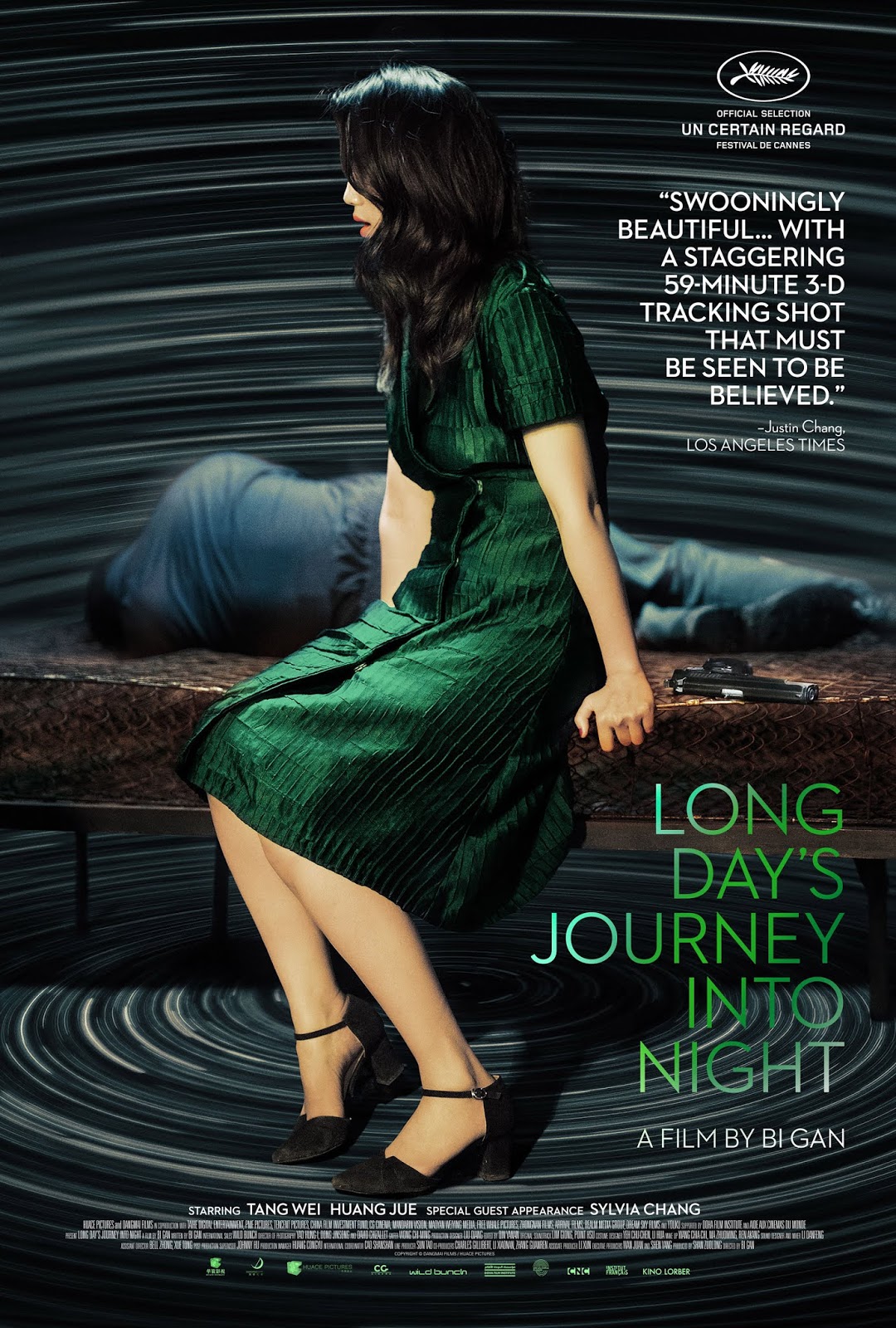
Long Day's Journey into Night (地球最后的夜晚) (2018)
I recently complained that Kaili Blues, director Bi Gan's previous feature, loses some magic when it transitions into its 40-minute single-take shot in its back half. So by all means, I should be leveling the same complaint against Long Day's Journey into Night, a movie with almost the exact same structure as Kaili Blues, only about forty minutes longer: an opening sixty-ish percent of the movie involving a man's personal search is transformed both thematically and formally by a ridiculously long take that occupies the rest of the movie and that blows the movie's plot up to mythic proportions that accentuate a dream-like geography. And yet here I am, left completely stunned by Long Day's long take (as well as with pretty much everything else here). It's not just that this movie's long take is a much more technically virtuosic feat than Kaili Blues's, though it most certainly is; it's nearly a full hour long and involves the camera following characters into increasingly tricky spaces like a zipline and even the sky itself, to say nothing of the incredibly risky bits of choreography like a character having to make difficult billiard play that show up late in the shot. There are some parts of the shot that actually seem logistically impossible to me, and I have no idea how some of this was filmed. But there's also the substance of the shot itself. Extraordinarily long takes like the one in Kaili Blues or the entirety of Victoria, the single-take German heist film from a few years ago, tend to have a lot of emptiness as characters move in transit from location to location, which results in these takes often becoming about the spaces in between the shots of a conventionally edited scene. The characters in Long Day's shot spend a lot of time in transit as well, but part of the magic of what Gan accomplishes is that every moment of this shot feels like a piece of a real scene with form and function, without any of the dead air that often accompanies intense shot length. All this comes together to make the magic of Gan's camera movement merge with the literal magic we see onscreen to make the single most mystical and transcendent hour of cinema I've experienced all year. And that's not even bringing up the first 80 minutes of the movie, which, while consisting of more conventional shot lengths, is its own kind of magical cinematic experience, its editing cutting across time and space in a way that's mesmerizing. Like Andrei Tarkovsky before him, Gan takes the central plot of this movie (straight out of a classic Hollywood film, a man searching for his lost love) and builds it from time sculpted into striking shapes and images molded into psychologically and spiritually profound frames. In a manner not unlike Nostalghia or Mirror, Long Day languishes on those thin places where the boundaries between our own material world and the world of transcendent spirituality become porous; it's very much an Art Film, but like the films of Tarkovsky, there's a gut-feeling immediacy to this movie entrancingly sensual style that both rewards intellect and also makes that sort of chin-stroking entirely unnecessary in the face of such a majestic audio-visual experience. I was swept away. My favorite film of the year so far by a considerable margin. Grade: A

Greta (2018)
A fun thriller with a tremendous central performance by Isabelle Hupert. A lot of Neil Jordan's normal florid directorial flourishes have been honed down to simple, mean neo-noir edges, which suits this movie just fine—a simple, mean neo-noir itself, about which there isn't a lot surprising other than just how solidly executed everything is. It's a little distracting how it justifies Chloë Grace Moretz's character's naivety by acting like Boston is some down-home backwater where people are good and kind and trusting ("Where I'm from, we return lost purses," is a real line that she says, and when it's finally revealed that it's Boston and not, like, Sweetwater, Tennessee, I almost fell out of my chair), and the movie walks a razor's edge of being tropey enough to be comfortable and too tropey to be engaging, but in the end, its feet are planted pretty firmly in the right places. Grade: B

Climax (2018)
I don't hate this like I hated Enter the Void, mostly because 1) it is an hour shorter than Enter the Void, and 2) the early dance scenes are some of the most hypnotic filmmaking I've seen all year. But I still don't like the movie as a whole. It shares that same faux-profound cinematic flexing that made Enter the Void noxious at 161 minutes (*bong hit* "What if the last ten minutes of the movie were, like, upside-down, maaaaan"), as well as the same dead-end, performative nihilism and provocateurism. I realize that the dissonance between the sensory euphoria of the first half of the movie and the hellish cinematic assault of the back half of the movie is kind of The Point (ominous title cards tell us, alternatingly, that "Birth is an interesting opportunity" and "Death is an interesting opportunity"), but I resent that being The Point, especially when it's in service of such a doggedly myopic and unimaginative philosophy of birth and death. And especially when I have to watch *spoilers* a pregnant woman kicked in the stomach until she miscarries, solely for the shock value. Wow, what a brilliant subversion of the dichotomy of birth and death Gaspar you've really done it this time mind blown this might be your masterpiece oh my gawd so deep bro why can't all filmmakers be deep auteurs like you. Grade: C

24 Frames (2017)
The last film by the late, great Iranian director Abbas Kiarostami is one of his most experimental. Consisting of just 24 shots, each a mostly static image with a few (often digitally superimposed) moving pieces, it's an obvious play on the fundamental building blocks of cinema itself, and a strikingly beautiful one at that, with the starkness of each image contrasting wonderfully with the life communicated by the movement and immersive sound design. It's oddly engaging, too, given its component parts; the premise makes this movie sound non-narrative, but Kiarostami slyly curates small stories within each shot, presenting wordless conflicts among its mostly animal cast that develop and then resolve in the space of each shot's 4.5 minutes. Even without these conflicts, though, I think I would have still found this mesmerizing. With its often obvious digital superimposition and ambient natural sound, 24 Frames strongly recalls '90s PC CD-ROM point-and-click games/edutainment in a way that I found deeply relaxing. I don't think it's too much of a stretch to call this movie a naturalistic adaptation of, say, Myst, or at least the vibes of a game like that, and watching this unearthed some very dear memories of sitting on the floor just staring at screensavers or the looping FMV of game waiting for a click input. This is a completely subjective reaction to this movie, I know, but whatever. Objectivity in art is an illusion, even with something as "objective" as a static image. Grade: B+

35 Shots of Rum (35 rhums) (2008)
This film's characters are so gloriously full of life that I'm disappointed that they aren't contextualized within a story that I found more engaging. The elliptical nature of the film's storytelling is definitely an intentional choice on the part of Claire Denis, and I understand why that choice was made, but it routinely did not work for me. People are going to tell me I'm wrong, and I probably am, because this is the most pedestrian critique ever to make of a movie, but I do think I would have been more engaged if the plot were just a hair more propulsive and cohesive. The reason I know I am probably wrong is that my favorite pieces of the movie—and, to be clear, these pieces are resplendent—are the least-plotty ones: the late-night party set to the Commodores' "Nightshift," the strike/protest bits, the shots of the pressure cooker. Part of me wishes that the movie committed to a complete lack of forward narrative, though that would probably break the movie entirely. Anyway, I feel really weird about High Life now being my highest-rated of the four Denis pictures I've seen, since in some ways, it's the least-interesting. But I dunno. Taste is a fickle friend, and it's the only one of her movies I've seen where I've not been periodically restless. Maybe I just like spaceships. Grade: B

Birthright (1939)
Oscar Micheaux's talkie remake of his (now lost) silent film of the same name is stilted and ham-fisted, and its plot is bonkers in the sense that it just careens from point to point without much regard for structure. In most regards, this is pretty tedious, though at times, it's kind of wild and delightful in its blunt-force craft. There are, in particular, a few line readings by some evil white dudes that are all-timers, my favorite being the way one chortles, "Let's have a Coca-Cola!" in celebration of a black man being swindled (honorable mention to the other evil white guy who convinces a black man to "let [his] seed wither" rather than marry a black woman). The movie has a real "no-B.S." policy when it comes to the racist South, and this is particularly refreshing when it comes to cutting through all the pretense of the stock phrases of Southern politeness to reveal the racism often masked underneath—even if it takes turning characters into mustache-twirling villains to do it! Grade: B-

Television

SpongeBob SquarePants, Season 3 (2001-2004)
It's SpongeBob; whaddya need, a road map? Its production being interrupted by the development of the 2004 theatrical film, the third season feels a little more reliant on the time-wasting Patchy the Pirate segments and gimmick episodes like "The Lost Episode" than previous seasons. But the average quality here is still insanely high, and there are some absolutely classic episodes in the season, including "Chocolate with Nuts" and "Ugh" (i.e. SpongeBob B.C.). This season (and the feature film that followed it) represent the end of that fevered first era of SpongeBob (and in fact, it was initially the planned ending of the show), after which the tone of the show changed somewhat, and as such, it feels like a finale of sorts. And it's a fitting finale, if only a temporary one. Grade: A-

Sunday, March 31, 2019

Mini Reviews for March 25-31, 2019

It's the end of the month, so you know what that means: a hodgepodge of all the stuff expiring from Netflix!

Movies

Us (2019)
Us is bigger and much weirder than Get Out, which is both a blessing and a curse; Get Out felt, to me anyway, like a pretty conventional movie, just done extremely well and helmed by a writer/director with an extremely sharp thematic eye. Which is great—I love conventional movies done well. But it also meant that Get Out could only take us so far and surprise us so much; its convention placed something of a cap to where the movie could go. For better or for worse (mostly better), Us is much less beholden to convention than its predecessor. Parts of it flirt with established norms: for example, the middle (and best) section of the film is something like a home-invasion thriller; but even then, the genre conventions are filtered through the sensibilities of, like, a Borges short story, or at least the very weirdest, most inscrutable episodes of The Twilight Zone, and taken as a whole, the way the movie houses under one roof all these various individually familiar setpieces just makes Us feel all the more alien for the mix-and-match juxtaposition of genre modes. Which is to say, after a certain point, I had no clue where this movie was going, and that was exhilarating. Sure, the social commentary is a lot more opaque (or convoluted, depending on how charitable we're willing to be—that's the curse part) than Get Out's clean precision, if you want to engage with anything besides the most obvious class-based interpretation the plot offers, and without a doubt the film bites off way more than it can chew. But I dunno, there's this mad-scientist energy to this movie that reminds me of M. Night Shyamalan's output immediately following his first trio of conventionally successful films that I find very compelling; this is definitely from the same place of breathlessly inventive intellectual and artistic hubris that gave us The Village and Lady in the Water, which is sure to make Us divisive. However, the movie technically and dramatically holds together far more effectively than Lady (I wouldn't be surprised if Us is the best-looking film of 2019—this is a huge aesthetic step forward for Peele), and its core ideas are far stranger and more nightmarish and interesting than either of those Shyamalan films. Plus, Shyamalan never found a performance nearly so titanic and riveting as Lupita Nyong'o's here—I worry that Nyong'o faces the same fate as Toni Collette last year, where a career-best, Oscar-worthy performance gets forgotten because of its centrality to a messy, divisive mid-year genre flick. But make no mistake: she's amazing. Come to think of it, Shyamalan never really got a performance quite as good as Tim Heidecker's here either, a deeply douchey comedic role that recalls what Joaquin Phoenix was going for in Signs until Heidecker's leaves that all behind with a transcendently funny physical performance in the film's back half—probably the hardest I laughed in the whole movie. Anyway, your mileage may vary on the film as a whole, but hopefully we can all agree that this is a Movie To Contend With. Grade: A-

The Grand Bizarre (2018)
Though Jodie Mack's exquisitely tactile, stop-motion approach to filmmaking remains after Dusty Stacks of Mom (the other feature of hers I've seen), there are times when The Grand Bizarre feels almost like a video essay on the role of textiles as a sort of skeleton key to modern life. Mack's rapid montage finds lots of visual and conceptual analogies to fabric—modern agriculture, binary computer code, circuitry, shipping yards, alphabets—implying that the same key idea lies behind them all and thus describes the progress of human technology writ large. It's a fascinating little bit of implied anthropology, but also, this movie's just a lot of fun on a sensual level. Music and images collide in that typically playful Mack fashion; little visual jokes imbue the experience with a levity uncommon at this level of avant-garde abstraction. I can't say I'm an expert on experimental film, but based on what I've seen, Jodie Mack is definitely the most fun corner of that world. Grade: B+

The Birth of Saké (2015)
The text of this movie is a pretty standard documentary, chronicling the process and struggles of the workers at the legacy Tedorigawa Brewery. But the form—my goodness, the form. The Birth of Saké is organized around the pure texture of saké brewing at least as much as it is the typical talking heads, and long sections of the film consist only of a saké recipe being read over loving, languishing shots of the brewing process in action. The experience of these sections is hushed, tactile, and mesmerizing. The director, Erik Shirai, is a cinematographer by trade, so the obsession with aestheticized process isn't surprising. But it is beautiful. Grade: B+


Billy Madison (1995)
There's a lot of "yikes" in this movie, from the persistent fat-shaming to the undercurrent of ableism. It's probably worst when some kid tells Billy to touch his teacher's chest, and Billy says, "That would be assault!" before being convinced by a double-dog dare to do it anyway—and then this somehow leads to a cute romantic interest. So yeah. There's all that. And it's bad. But hand to God, this would probably be a four-star movie for me without that. It's all just so dementedly weird and inventive, from the strange runners like the banana peel and the clown and Norm Macdonald/Mark Beltzman's absurdly clueless characters to the one-off things like the musical sequence and to the personified shampoo/conditioner argument. I could actually take or leave Sandler's central performance, to be honest (it never quite figures out what it intends to be, shifting incongruously from mode to mode, like a gas filling whatever container it finds itself in), but the rest of the movie is stuffed with indelible comedic acting, too—my favorite being Bradley Whitford, who takes the typical '90s-family-movie-villain tics and dials them up into something transcendently dickish. I'm really caught off-guard by it all, the life and personality that suffuses this movie. I remember hating this stuff when I was younger. Is this what it means to grow up? Measuredly enjoying an Adam Sandler movie? Grade: B-

Lessons of Darkness (Lektionen in Finsternis) (1992)
In the wake of the Gulf War, Werner Herzog recontextualizes Kuwait's devastated oil fields as a literally biblical apocalypse. This film's images—consisting almost entirely of impossibly large pools of oil stretching from horizon to horizon and impossibly tall geysers of oil rocketing up into the sky (often aflame)—makes it hard to argue with Herzog's mythic scale. Even today, there's not a lot of media contending with the legacy of Desert Storm, which means that Herzog's take on it remains somewhat definitive. I'm not sure how I feel about that. There's a sort of terrifying admiration of the sheer magnitude of the destruction caused, terrifying both that destruction on such a cataclysmic scale could happen and that human nature is such that admiration is the involuntary response to such titanic acts of catastrophe when human beings are responsible. Lessons of Darkness finds the bleak intersection between the typical Herzogian "outsider" protagonist and war hawks, which is its own sort of terror in and of itself. Grade: A-

Stripes (1981)
There was a really promising twenty minutes or so there at the beginning of the movie where Bill Murray and Harold Ramis are just these loser dudes palling around NYC, and it felt like a proto-Apatow thing, only with tightly scripted jokes, so, you know, better than Apatow. But then they join the army, and the movie fulfills its Apatow promise by promptly turning into an aimless, overlong, slackly improvised mess—only Apatow movies usually have, like, ideas, man. This has absolutely nothing. It's not really mocking the pieties of the U.S. military (what I was expecting) or even telling jokes in the traditional sense. It's just Bill Murray doing his old weird, camera-mugging shtick, just this time in boot camp. Plus all the requisite sexism and ridiculous, leering female nudity of your typical '80s comedy, of course—foolishly, I'd hoped to avoid that by being so early in the '80s, but alas, male chauvinism is the flavor of all corners of American cinema's worst decade. I dunno why I even watched this except for my perverse adult impulse to seek out all the movies I saw glimpses of on cable or box art of in some video rental store when I was a kid and my parents were all like "Nooooo" and changed the channel or redirected me back toward The Pagemaster at Blockbuster. My parents were right an astounding number of times, I have to admit. Grade: C-

Flaming Creatures (1963)
A mid-century free-associative wet dream by way of a nightmare. Some of this is pretty tedious in its abstraction and poor image quality, made all the more tedious by the sometimes incomprehensible YouTube rip I watched this on. Nevertheless, the way that the sexual imagery mixes with weird cultural flotsam makes for occasionally transcendent moments (like the lipstick commercial parody, or the exuberant intrusion of "Be-Bop-A-Lula" near the movie's end), and that juxtaposition goes a long way toward evoking pretty viscerally the ways in which normative mainstream culture can feel so suffocating—all the more so, I'd imagine, for queer Americans in the early '60s. Grade: C+


Music

RAP - Export (2019)
Thoughtful, mildly experimental electronica that occasionally bursts into other genres like chamber music or, in its final track, New-Order-style dance-pop. I like it. The beats sound interesting, and I wouldn't be surprised if the samples had been recorded in some pretty unconventional ways. But I should probably learn all the subgenres of electronic music so I can more precisely describe this music. Grade: B