Longtime readers of this blog will know that I used to have a big blog project each summer. There were the (now embarrassingly untrained) watch through AFI's top 100 movies, my Narnia and His Dark Materials summers, and the Disney rewatch (probably the single most popular thing I've ever done on the blog in terms of page views and social media engagement). Those same readers will probably have noticed that I haven't done one of these summer projects in a while—the last thing even approaching a project was the summer of 2019, when I let people suggest movies to me to review. I mean, what can I say—it turns out that it's just incredibly difficult to do big writing projects when I have kids to take care of over the summer.
That's not to say that I haven't done any projects at all, though. I usually have personal projects I work on myself that don't get chronicled on the blog: fiction writing, book reading, video game playing, bus riding, etc. I haven't let my children steal these projects from me, and I truly relish that the summer allows me the time to do them. It's one of the most rewarding things about being a teacher, to be honest: the things I can do when I'm not teaching. This summer was no different. I had a lot of childcare in my life (not to mention the birth of a new child!), but I also was able to find time for a couple of big projects. I obviously didn't have time to do a big blog fanfare for either project, but the two projects did end up becoming interesting foils for one another, and both of them ended up preoccupying a huge section of my brain (still do, in fact). So I thought I'd do a post about them.
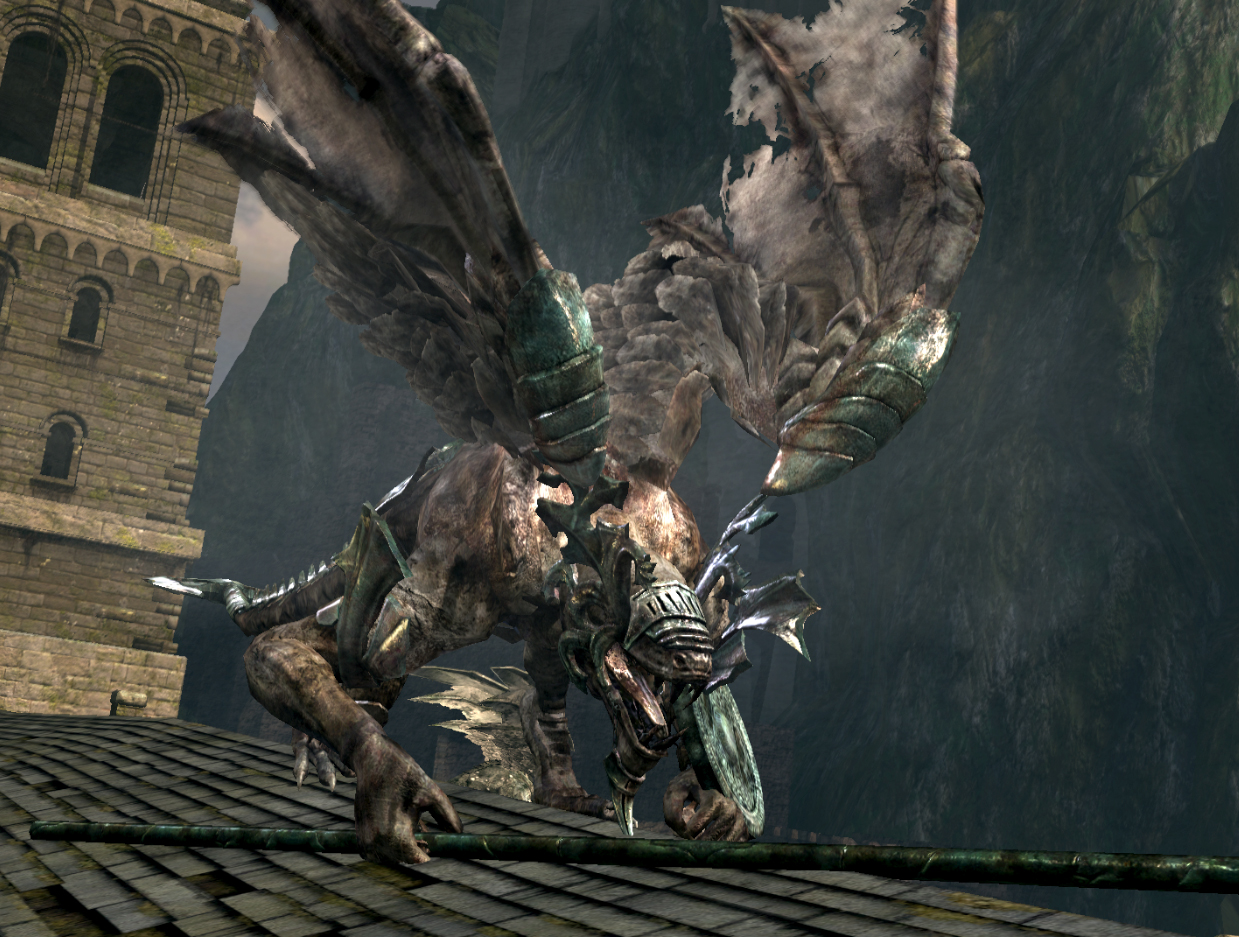
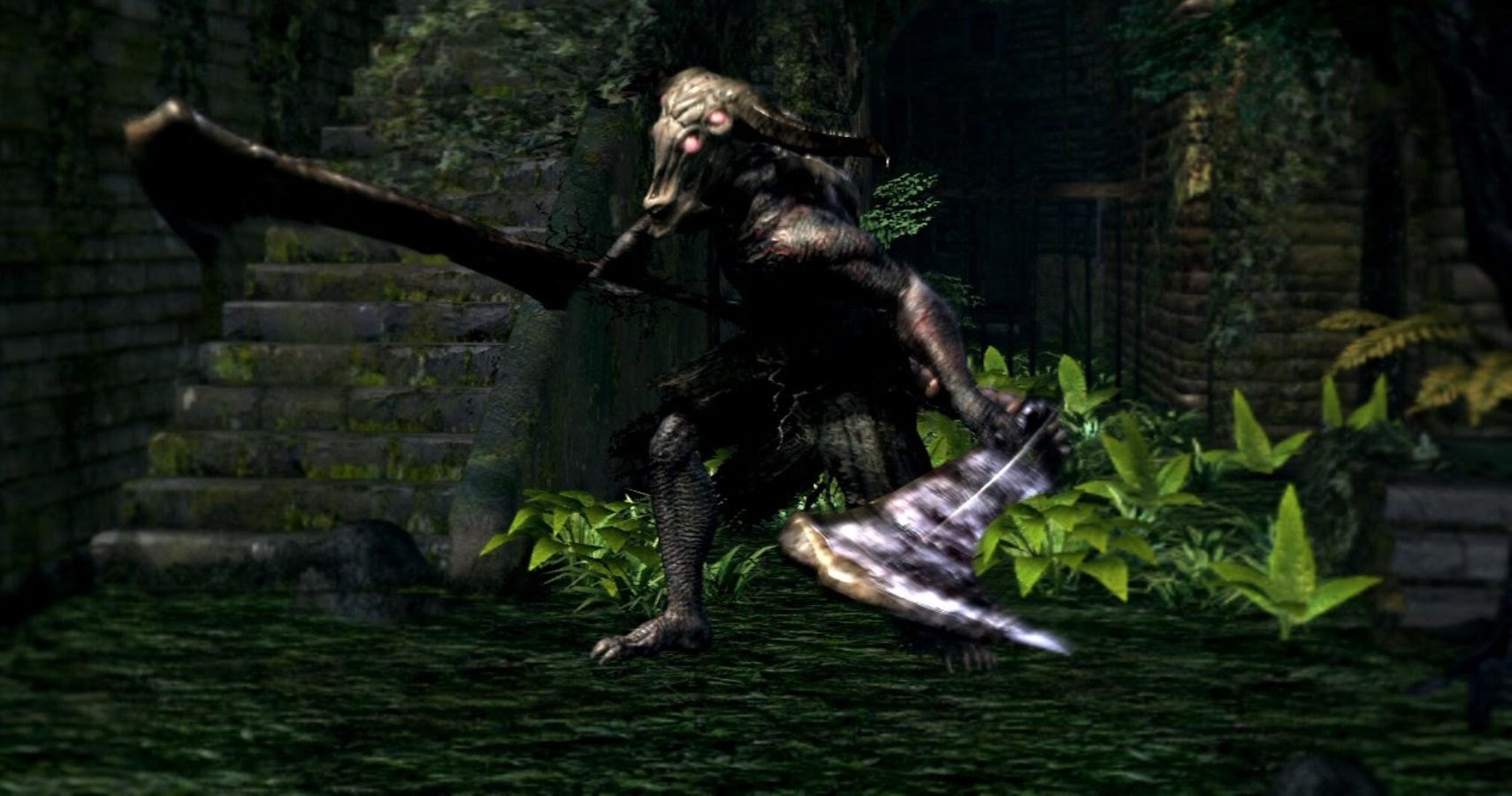
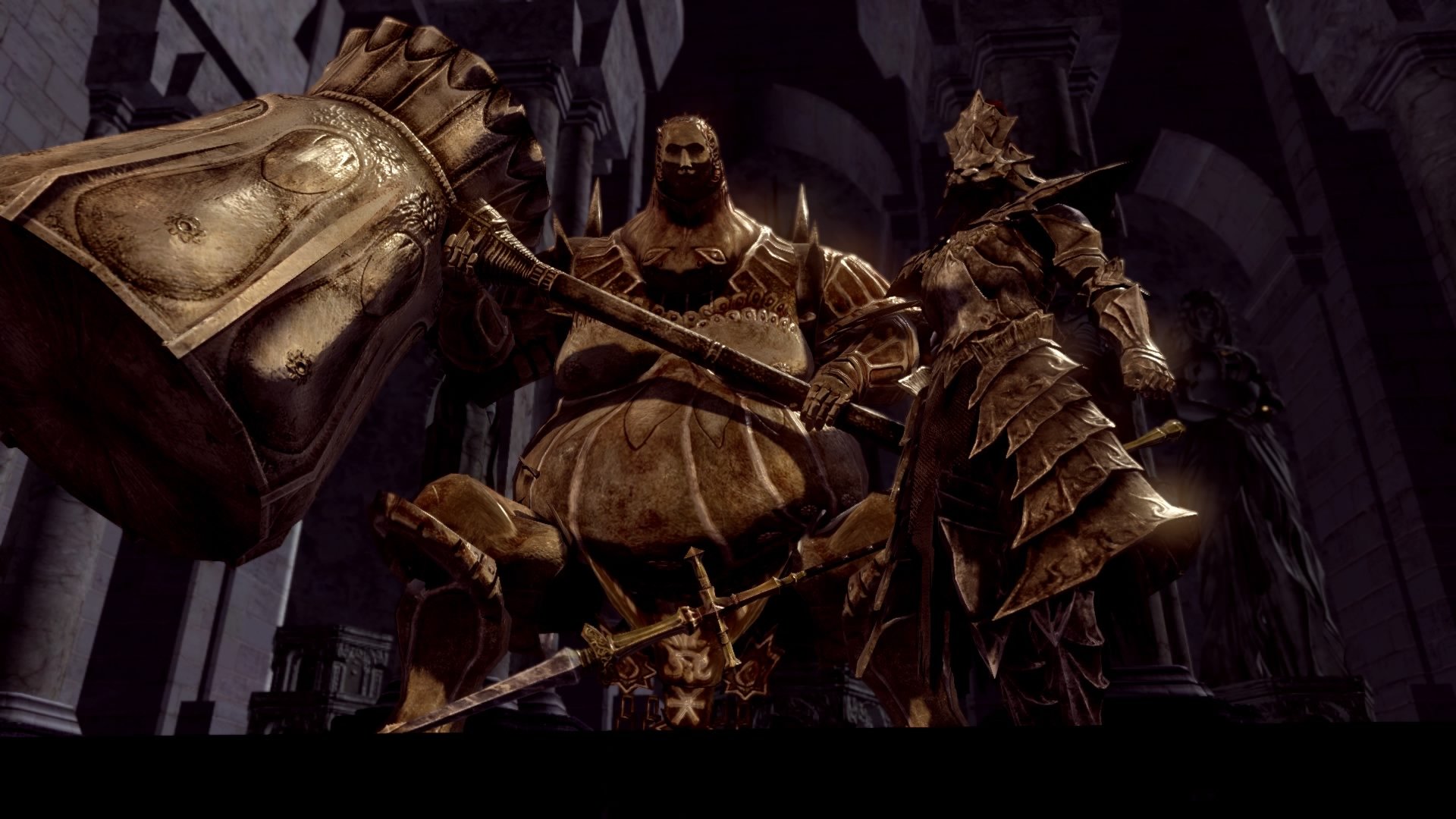
In case you couldn't tell from the header image, my two projects were playing Dark Souls and reading Gravity's Rainbow, firsts for me. Both are somewhat legendary within their own subcultures: From Software's Dark Souls being one of the definitive action-RPG video games (probably one of the definitive video games, period) of the past decade, and Thomas Pynchon's Gravity's Rainbow being the postmodern novel and probably the most critically acclaimed American novel of the past fifty years. Each is a masterpiece of its kind, these ambitious, sprawling works built around big ideas that redefined their respective media, and I enjoyed my time with both of them a lot. Believe the hype.
But both of these works have another kind of legendary status beyond sheer acclaim: they're also infamous for being extraordinarily difficult to get through. Dark Souls is an exacting game requiring players to master a precise combat system wherein success is dependent on carefully timed actions and mistakes are usually punishable by enemies hacking away large chunks of your player character's precious HP; it is simply a function of the Dark Souls experience that you will die over and over and over, to the point where a re-release of the game was titled the "Prepare to Die Edition" with only a smidge of irony. Gravity's Rainbow is a bewildering novel that takes Thomas Pynchon's already dense prose and uses it to tell a mind-bogglingly complex, unconventional narrative spanning continents, genres, and nearly 800 pages. If that weren't enough, Pynchon's sense of whimsy is often as confounding as it is delightful, making it sometimes hard to keep track of just where the prose is taking you: discussions of biochemistry are peppered with dick jokes, meticulously researched history suddenly veers into theology or science fiction, and there are over 400 named characters, one of whom is a lemming, another of whom is a lightbulb. Unless you are a much more clear-headed reader than I am, you will get confused, many times.
As a result, Dark Souls and Gravity's Rainbow have both acquired a reputation as works that are hostile to their audiences and whose audiences often don't finish them. In fact, a big part of why Darks Souls and Gravity's Rainbow are as interesting as they are is because of their difficulty, and the whole reason I ended up deciding to blog about them here is that the particular ways in which they are difficult made for a fascinating juxtaposition throughout my summer. It's not just that these are incidentally challenging—the challenge of navigating both ended up being central to how I ended up thinking about what these two works mean. So I wanted to dig into that.
It's probably going to be helpful to look a little closer at what makes each work difficult, so let's get a little more into the weeds.
Dark Souls is difficult because of how it presents players with clear, specific challenges to overcome. In the game, you control an undead knight who has escaped from the purgatorial "Undead Asylum" into Lordran, a once-mighty kingdom crumbling into squalor, and while navigating the complex, interlocking environments that form Lordran can be tricky, the game's true challenge comes when that navigation is brought to a halt by a combat encounter with one of Lordran's many hostile guardians, which players can only progress past by mastering the intricacies of the aforementioned precise battle mechanics and applying them cleverly to these enemies' weaknesses. Sometimes these exploration-halting encounters are with particularly tough regular enemies, such as an infamous section involving the traversal of a narrow rooftop while having to strike down powerful armored archers or another infamous section involving killing gigantic skeletons in a pitch-dark tomb with nothing to guide your sword but the pinpoint glowing eyes of the skulls. But the encounters most players really remember (and the ones people tend to talk about when talking about Dark Souls) are the epic boss-fight set pieces featuring enormous, intimidating foes with huge health bars and attacks often capable of destroying player-characters in a single hit: the likes of the Bell Gargoyles, Capra Demon, Orstein and Smough. Every once in a while, you'll come across someone who will tell you, "Dark Souls isn't actually that hard; all you have to do is learn to dodge," which is kind of like saying, "Running a marathon isn't that hard; you just have to learn to jog for 26.2 miles without stopping." I found many of these encounters incredibly tough, precisely because of the difficulty in learning to dodge these bosses' attacks and then get hits in of your own. But if by "not actually that hard" people mean that it's never very challenging to figure out what to do next, I agree. Dark Souls is a game with a lot of mysterious components (most significantly its story, which is told via impressively subtle implications), but in terms of communicating how to get from Point A to Points B, C, D, and so on until the end, the game is never too coy. It's an action-RPG with a heavy emphasis on the action, meaning that the game and its environments are built[1] around funneling players toward these larger-than-life boss encounters that players must defeat in order to progress, and the way to defeat these bosses is almost invariably some combination of "dodge, then hit." You're taught pretty clearly what you need to do; you just have to do it, which, simple as it is to explain, can be the damnedest thing. As I said earlier, you will die. A lot. But you always know why you're dying.
Gravity's Rainbow is a little different. Instead of presenting specific challenges to its audience, Pynchon's labyrinthine novel seeks to befuddle readers. At its core, the novel's story is of Tyrone Slothrop, a U.S. Army lieutenant stationed in London during the tail end of World War II who begins to notice that unlikely events keep happening to him. When Slothrop prods at these events, he discovers that he has been the subject of years of covert study and experimentation by a cabal of government scientists who are trying to condition and control his behavior; in an attempt to get to the bottom of just what these scientists have subjected him to and why, he deserts the army to pull at the loose threads of what he knows, an investigation that sends him deeper and deeper into the anarchic limbo of the war-devastated European continent while at the same time deeper and deeper into a vast conspiracy involving an enormous web of people that links Slothrop's experiments to Axis and Ally powers, war profiteers, and even perhaps a mystical connection to the prototype of the V-2 rocket itself. I say this is what the novel is "about," but it's hardly even as straightforward as the somewhat convoluted explanation I just gave. The tough thing about unraveling a conspiracy is that a conspiracy by definition defies explanation, structuring itself on wheels within wheels of secrecy and spreading its true intentions across so many points of contact that it's hard (if not impossible) for a layperson without inner-circle access to gather all the information, much less put all the pieces together once they get them, and much like the conspiracy controlling Slothrop's life, the novel's plot is difficult to get to the root of because of how intimidatingly dense it is with information. Like, so dense; so much information. As I've already mentioned, there are over 400 characters who flit in and out of the novel's narration, most of whom are significant to the plot in some way, if only briefly, and these characters are sprawled out over the whole European continent and beyond, sometimes bringing with them decades of backstory that readers have to keep in their head. That's not even mentioning the countless organizations, acronyms, technical specs, shadow governments, militia groups, research projects, etc., that also play a part. And all this info comes at you fast. Pynchon prose, already elaborate in a shorter, less complex novel like The Crying of Lot 49, becomes kaleidoscopic under the sheer fire hose of information it communicates. Slothrop quickly finds himself over his head, swimming in the myriad fragments of the truth that he learns in his quest across Europe, and the novel puts the reader in essentially the same headspace. You will be confused; it's just a feature of diving into the book's maze. The challenge is knowing which direction to even go.
So here we have two works with very different challenges: one that shows you the way but makes it hard to get there, the other that makes it hard to know the way at all.
What I found so interesting about that difference was how much that affected my relationships with the game versus the novel. With its emphasis on laying out clear obstacles to be overcome, Dark Souls became for me a game about empowerment. It's one of the most fundamental building blocks of a video game experience, especially RPGs: a challenge is presented with the understanding that the player will train until they have become powerful enough (by either skill or stat-building) to triumph over it. The sheer difficulty of Dark Souls's encounters compared to its gaming peers at the dawn of the 2010s[2] heightens this effect to a level reminiscent of the uber-tough games of the 8-bit and 16-bit eras, to the point where it virtually consumes a new player's experience with the game. "How do I beat..." and "How do I get past..." questions abound on Dark Souls forums in the same way that the same questions proliferated at the playgrounds in the '80s and '90s about Ghosts 'n Goblins, and I definitely had this same feeling playing the game; I obsessed over how to triumph against the bosses and tough regular-game sequences, looked up strategy videos, discussed challenges with other people who had played the game, etc. The game is, of course, about other things: the exploration, the character-building, the environmental storytelling. But as far as the feature that foregrounded itself in my mind? Definitely the combat challenges and, consequently, the head rush of finally being able to beat them. It feels good to be powerful, especially after being so weak for so much of the game—case in point, an area near the end of the game has you encountering some bosses from the beginning of the game, and cutting through these creatures like a hot knife through butter now that you have hours and hours of leveling up and skill-building from your initial encounters with them is one of the more satisfying feelings in the game. The story of Dark Souls (particularly the ending) shows a lot of ambivalence about the effects of power (it is, basically, about the lengths to which those at the top of a corrupt hierarchy go to maintain their authority), but the effect of playing the game speaks a lot louder: the core of enjoying the game is in victory.
On the other hand, the particular kind of difficulty found in Gravity's Rainbow makes the novel about disempowerment. This is quite literally what it is about on a plot level: the conspiracy at the heart of the novel is too large for Tyrone Slothrop to ever get to the bottom of, something that becomes even more apparent in the book's back third as he falls in with a group called "The Counterforce," more or less a confederacy of left-wing anarchists whose goal is to preserve the stateless freedom embodied by a Europe liberated from Nazi occupation but not yet divided up into spoils of war by the Yalta Conference. Of course, even the most novice student of history knows that this campaign is bound to fail, and the later sequences of the novel show the Counterforce coming to grips with their world hardening into the East/West boundaries controlled by megalomaniacal nations that would rule the planet for the next half century—engineered by, it turns out, the very same forces that have been pulling strings in Slothrop's life: the war mongers, the arms manufacturers, and the psychotic men who work to institutionalize a capitalist warrior-class military industrial complex. Whatever sense of empowerment the characters have been able to grasp in the twilight of the world war crumbles under the weight of these impossibly huge international forces. And the novel instills this same sense of failure in the reader: the further you get into the book, the more and more opaque the story becomes as its threads interweave in increasingly complex ways that jolt the book out of time and often out of reality, entangling itself in bizarre and opaque obsessions that seem tangential to its main characters, like occultism and Soviet politics. Like a video game, the book gets harder as you progress further into it, but unlike Dark Souls, there is no feeling of empowerment to emotionally buoy that progress, no sense of becoming stronger in the face of this increased difficulty. In fact, the opposite: the book's structure as a conspiracy mystery means that as the plot becomes harder to track, your ability to solve that central mystery feels further and further out of reach. Perhaps those super-smart, gatekeeping English graduate students have it all figured out, but my experience with the back half of Gravity's Rainbow was defined by a growing sensation of my confidence in my ability to "solve" the novel slowly slipping through my fingers. I'd guess this is by design; it is, after all, not a book about people who solve things but rather fail to do so. Appropriately, I, too, failed.
I imagine that the way I've just described my experiences with these two works makes Dark Souls sound like a great time and Gravity's Rainbow sound like a dreadful, demoralizing slog. But if I had to name the one that I enjoyed most and got the most out of, it would be Gravity's Rainbow by a mile. To be clear, as I said before, I enjoyed both, so don't take that to mean that Dark Souls is worthless or that I hated it. Both works were meaningful to me. But Gravity's Rainbow ended up being the truly transformative and fulfilling experience, one of the best books I've read in years. Dark Souls, on the other hand, was an absorbing experience but hardly life-altering.
So what gives?
A big part of it is just my immediate emotional reaction toward each. When you have a difficulty like Dark Souls's built around the idea that you have to be this good to progress, then the obvious corollary is that if you aren't progressing, then you aren't good enough, which is not a fun feeling to have. In the best of cases, this kind of challenge creates a perseverance and a drive toward self-improvement—not to mention collaboration with other players, which the game allows through a pretty fun co-op feature (one I definitely used and found rewarding in some of the tougher sections of the game, thanks to a much more seasoned Dark-Souls-playing friend of mine). However, in the worst of cases, the game's difficulty can be deeply frustrating and even demoralizing, an emotional state the game literalizes with its concept of characters going "hollow," i.e. the idea that when characters in Lordran lose all sense of hope, they basically becoming soulless zombies. The point is not to let yourself go hollow, but I will confess to feeling pretty listless after seeing my twentieth "Game Over" screen from a single boss. When the goal is to overcome and conquer, difficulty becomes an obstacle, and my inability to progress past that obstacle became a reflection of my own worth as a player (at least in terms of my value toward completing the game's objectives). More power to the people who find the game's challenges inspiring and motivational, and it's not like I never felt that sense of drive. But I also at certain points felt a sense of frustration that there was seemingly something "wrong" with my ability to rise to a particular challenge. Counterintuitively, the game's objective of empowerment made me feel weak.
But what if there is never any expectation to overcome and conquer? What if "losing" is a foregone conclusion? That's the experience that Gravity's Rainbow offers, especially on its first read-through. Once I came to grips with the fact that I was probably not going to be able to sort through all of the novel's intricacies, my time with the book became much richer. Without any pressure to completely understand everything that was going on in the book's plot, I felt a sense of ease in wandering through this maze of a novel, content simply to experience the book as it came to me rather than to wrestle it into submission. There's something liberating about the realization that you can't win. I could enjoy a turn of phrase or a tangential vignette without fretting about whether or not I would be able to tie it into a solution to the conspiracy; I could make emotional connections to characters and subplots on more immediate terms than their their larger significance. Gravity's Rainbow is too sad a book to call "pleasant," but it's also not a book without rewards, many of which are the thousand little micro-nuances and flourishes to appreciate at any given section, beautiful moments that I would lose sight of whenever I approached the book with a mind toward "solving" it. Maybe this is just me, and other readers have had different experiences, but at least in my experience, it's a book where it's easy to (to flip the cliché) miss the trees for the forest. Freed of any obligation to map the forest, I found myself enjoying the exploration and the sights I met along the way.
This cuts deeper, too. Both works are, in a sense, about creating a framework for adversity—what it means to face struggle, whether personal or sociopolitical (both of which Dark Souls and Gravity's Rainbow engage with). If the fundamental condition of life really is, as Albert Camus said, like Sisyphus pushing the boulder up the mountain over and over, Dark Souls says that the response should be to train and power up until Sisyphus can finally overcome the fundamental difficulty of his situation and roll that boulder over the peak. It's not as if this isn't a valid response to some difficulties; a lot of situations really do require perseverance and self-improvement to resolve, and one kind of hope is the belief in your ability to overcome.But frankly, a lot of the things that keep me up at night these days are things that I simply have no ability to meaningfully overcome through personal actions of my own: climate change, the creep of overt fascism into American life, the wide-ranging harm wrought by so much of American Christianity, the ways my vindictively reactionary state legislature continues to target teachers, COVID, etc. The Dark Souls approach is simply incompatible with problems at this kind of political scale; it's too focused on individual actions, too reliant on the assumption that there is a fundamental fairness at play that matches hard work with corresponding success.
It's Gravity's Rainbow that's about living in that condition of being powerless to stop the boulder from rolling back. If you can't "win," how should you then exist? It's a profoundly depressing novel, where the creep of capitalist, death-cult modernism is inevitable, and its human cost is tangible, but paradoxically, I found a kind of relief in simply acknowledging this. Sometimes there really is nothing that any one person can do to stop the advancement of evil, and in fact, like the impenetrability of the book's plot, that's by design; the world has been broken and then the game rigged by madmen such that individuals have no hope of ever triumphing a la a Dark Souls-style leveling up into empowerment. To admit as such is to free us from the expectation of carrying the dysfunction of entire systems on our solitary backs.
I want to be clear in distinguishing this from "doomerism," which looks at seemingly insurmountable problems (often the same ones I have named above) and chooses despair. I actually felt inspired by Gravity's Rainbow, and I don't think it's a book meant to inspire despair so much as it is trying to jog loose from our minds the idea of individual heroism, this solipsistic sense that great individuals can turn the tides of history toward justice—an idea that the book implies rather effectively is a tool of the powerful to preserve existing hierarchies. It's not that there are no solutions for the world's pain; it's just that those solutions do no reside within typical rugged individualism and conquest. Within the book's pages, I found an inspiring kind of camaraderie; the book's insurmountable difficulty puts us readers in a kind of community with the similarly befuddled characters wandering the world of the novel, seeking to survive but only half-understanding the insidious forces that have wrought such destruction and suffering on the planet. Sure, the book has its share of villains, people who play hair-raising roles in the machinations of that suffering: people like SS Officer Blicero and extreme racist Major Marvy remain detestable throughout. But others—Roger Mexico, Katje Borgesius, even Slothrop himself—I found myself caring deeply for after having been through so much with them. After hundreds and hundreds of pages of increasingly abstract and confusing world-building, these characters begin to feel like signs of life in a bleak landscape; they bob out of sight, sometimes for hundreds of pages, but they always return, and when they do, it feels like being reunited with old friends. By the end of the novel, we may have been "beaten," but also, by virtue of having found each other, there was hope: if for nothing else, for the continuation of the human spirit for just those moments in which our union formed a collective whole.
When the goal is not to overcome but just to exist, difficulty is merely part of the experience of existing in its world, not necessarily a failure state. Meaning comes not in conquering but in finding human connection, and that connection is itself a potent resistance against the dehumanization of modernity. In this way, Gravity's Rainbow has a great well of empathy for the "hollow" that I simply don't see in Dark Souls. In the book, you're put in solidarity with characters who also struggle to understand and survive their world, which I found powerful. It's not like this is entirely absent from Dark Souls (in addition to the aforementioned co-op mode, the game also has several NPCs you can meet and summon throughout), but ultimately, I found the fundamental structure of the game as an individual quest for empowerment to override any of the communal features—it's still ultimately an individual experience, premised on individual ability and accomplishment. Gravity's Rainbow's structure makes that sort of experience impossible. In the end, it's either annihilation or collectivism; the fabric of the book allows for no other outcomes.
I don't know if this even makes sense. I'm also not sure what the Venn diagram looks like of blog readers who have read Gravity's Rainbow and blog readers who have played Dark Souls, but hopefully at least somebody out there knows what I'm talking about.
Maybe next summer I'll actually blog a project.
1] At least, if you play like I did, without selecting the Master Key gift at the beginning of the game, which is how I imagine many first-time players choose to play the game. But if you have the Master Key, the game's objectives become incredibly diffuse.
2] A period during which mainstream games were unusually unfocused on difficulty.