At this point, nothing more than the musings of a restless English teacher on the pop culture he experiences.
Showing posts with label Shows You Should Watch. Show all posts
Monday, December 22, 2014
Rev., Christianity, and the Best TV of 2014
This time of year, you hear a lot about the best of the past twelve months' culture—the best movies, books, new species (?), etc. I've even gotten into the fray myself with my previous post on my favorite music of the year. 'Tis the season for list-making, after all.
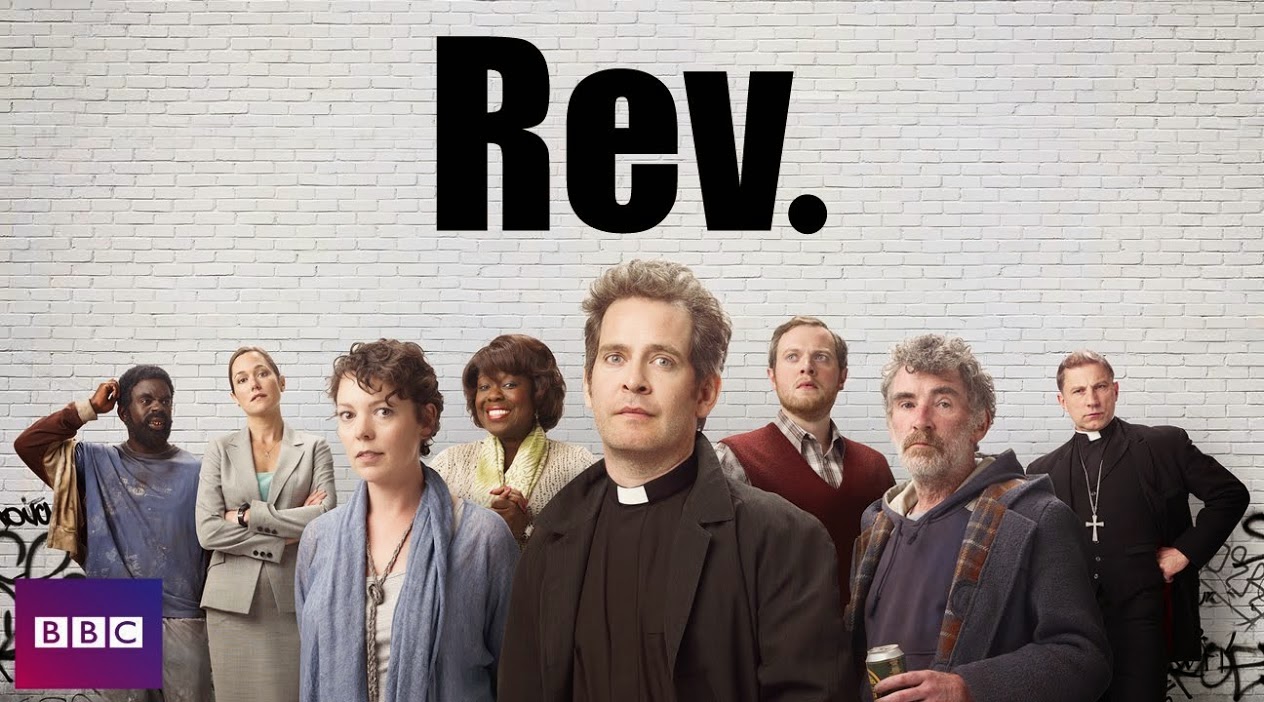
Because I'm a helpless dork for that kind of arbitrary coding of pop culture, I've been reading a lot of these lists. In particular, I've been interested in seeing what the various culture makers are putting on their Best TV of 2014 lists. And as good and interesting as the selections on those lists have been[1], I've noticed that one of my favorite shows of the year has been absent from most of them, so I just wanted to take a moment to give it some much-deserved praise on this blog. That show is Rev.
Rev. is a British show that aired its third (and probably final) series this past summer. It's about Adam Smallbone, an Anglican vicar (Tom Hollander, who also co-created the series) who is put in charge of a small inner-city London church after spending several years in a rural parish. That's a premise that might as well be the setup for a typical fish-out-of-water sitcom, and nominally, Rev. is a sitcom, with its half-hour format, goofily framed secondary characters (of which my favorite is Archdeacon Robert [Simon McBurney], Adam's wry and antagonistic supervisor), and comedy-of-errors plots. The show is often very funny, especially in its first series, where it leans most heavily on its sitcom proclivities.
It's also a show that, for all its humor, has considerable dramatic gravitas, which is part of the series' greatness—we have plenty of funny sitcoms, British and otherwise, but the list of those that are also interested in serious dramatic stakes for their characters is much shorter. St. Saviour in the Marshes (the London church Adam works at, and yes, I'm jealous I don't go to a church with that name) is a parish struggling to maintain attendance and financial stability, problems that affect in serious ways not just Adam and his wife but also the few steady church members, many of whom (being in the inner city) live in poverty and homelessness. Though its examination of these problems are often told through jokes, the show treats them and the characters with dignity and compassion. There's a real sorrow for a broken world at the heart of the series.
But even more than that sorrow, what I think makes Rev. truly great is its handling of the Christianity at the center of its characters' lives. When most contemporary Western pop culture deals with Christianity (or really, any religion, but, being Western, it's most often Christianity that's dealt with), it does one of two things that I consider problematic.
The first is that it starts from the premise that belief in the religious supernatural is inherently foolish and/or destructive. See: the works of Woody Allen, for example (though much of that deals with Judaism), Stephen King, and mid-though-late-career Ingmar Bergman. Works that start with this premise are often excellent at analyzing the types of crises that can lead people away from faith or can cause organized religions to hurt people, but they often stumble in depicting with compassion and nuance sincerely faithful individuals[2]. When your story grows from a belief that a religious reality is false, it's difficult to have insight into religious belief without condescending from that premise.
On the other hand, there's also the second problem that pop culture tends to run into, which is that it assumes that the existence of the religious supernatural (and often a very particular brand of religious supernatural, too[3]) is self-evident. Admittedly, this problem is almost exclusively the property of the Evangelical stable with the likes of Courageous, Facing the Giants, and God's Not Dead, but it's the loudest counterpoint to the first problem and therefore worth discussing. Only cynical blindmen and villains can possibly doubt the existence of God/the power of prayer/the holiness of the Church once the right theology has been explained thoroughly enough, these works often say[4]. As a result, Christianity tends to be seen through rose-colored glasses, with the redemptive elements of faith and church community emphasized (often to the point of accidental self-parody) and the possibility that living according to religious beliefs can sometimes be a really, really hard thing to do downplayed. With these artistic endeavors, it's difficult to have insights into religious belief because that belief is assumed to be stable from the start.
Rev. belongs to an exceedingly rare class of art that not only avoids those two issues but also presents a meaningful and compassionate view of humanity through its depiction of Christianity. Its characters are devoutly religious people who pray, believe in miracles, and serve in church, and the show's depiction of that is neither condescending (there is never the suggestion, for example, that it's anything less than intelligent for Adam to pray to God when he needs guidance) nor self-satisfied in that faithfulness. Adam wrestles with doubts about the nature of his faith, God, and his church duties, but that wrestling is shown as a natural part of his existence, not a catastrophe (as it surely would have been in Evangelical art) or a step toward secular enlightenment. Neither is Adam (or any other character) perfect; he bumbles and makes mistakes, sometimes grave ones. He's a human being, after all, and his existence is peppered with the same moral struggles (deception, infidelity, anger, selfishness) that all humans encounter. The Church of England, being made of humans, isn't perfect either here. It's corrupt, it's petty, it's greedy, it's complicated by bureaucracy, but it's also never dismissed outright. Adam's parishioners gather, worship, experience joy and beauty and hope through the mechanism of that Church, and that's something the series never forgets.
Beautifully, Rev. posits that even though the Church is imperfect, it is worth caring for. Much the same goes for the show's view of the human race. I said above that it was more the treatment of Christianity than the sorrow for brokenness that makes Rev. great, but perhaps what I should have said is that its greatness lies in the way its sorrow for brokenness informs its depiction of Christianity. More than almost any piece of pop art I can think of, Rev. recognizes that the problems in organized religion are rooted in the same problems that inform human nature. The show's view of Christianity is something that grows out of its larger humanist spirit, the one that sees worth in showing compassion to even the lowest characters. The characters and their church aren't all good, but there's something at their core that absolutely is. Deep inside the human experience, whether it's the experience of day-to-day life or of Sunday worship, is something that can be redeemed.
And that's why it's my favorite TV show of 2014[5]. I totally recommend seeking it out if you get a chance; as of the writing of this post, all three series are streaming for free on Hulu, so there's really no excuse, right?
Until next time.
1] We're at an interesting point in television history where, following the endings of several elder statesmen of TV's "Golden Age" (Breaking Bad and 30 Rock, to name two, not to mention the impending end of Mad Men in the next few months), there's no longer as much monolithic critical consensus surrounding "elite" shows as there used to be during the high-classical era of Tony Soprano and HBO's mid-2000s output. Television is more fractured than ever, and that means there's equal room for everything from Over the Garden Wall to Louie.
2] This is less true of Ingmar Bergman's films, which are nothing if not nuanced and compassionate toward every single human being ever. But I don't think there's any doubt that his later films are also very much within a post-Christian mindset which restricts its depiction of faith to misery and wishful thinking.
3] Hint: it rarely includes transubstantiation.
4] I'm exaggerating a bit for effect, but the core idea is there.
5] Tied with Mad Men, Louie, and Over the Garden Wall, that is, but hey, those are already getting plenty of love elsewhere.
Friday, August 2, 2013
Shows You Should Watch: Slings and Arrows
Welcome to Shows You Should Watch, the first post in what I hope to be a recurring feature of this blog! The basic premise here is that I talk about a random TV show I like that doesn't seem to get as much recognition as some other famously great series. I actually have a whole long introduction to this piece, but it got to be so long that I just annexed it to the end of the post rather than making all of you trudge through it at the beginning. So, if you're interesting in reading my inspiration for making this feature, scroll on down to the end and read the would-be prologue. If you don't feel like slogging through all that ponderousness, though, just continue right on to the main event.
Show: Slings and Arrows (2003-2006)
Slings and Arrows is a Canadian show, and to be honest, I have never watched another Canadian television series in my life, nor have I ever asked a Canadian about his or her television viewing. So I can't really give any insight into this show's place in Canadian TV history or even if this show is more well-known there than here in the States (the wealth of awards it gathered seems to indicate it was a hit on some level, if only critically). What I do know is that Slings and Arrows is wonderful.
A large part of that wonderfulness comes from just how out-of-place the show feels in the television landscape. A lot of that has to do with the premise. Slings and Arrows is about the struggles of the various employees of a modern Shakespearean theater festival as they try to finish the theater season after the untimely death of their artistic director, Oliver. An old colleague of Oliver's, Geoffrey Tennant (played impeccably by Paul Gross), takes up the role of artistic director after Oliver's passing, and each of the show's three seasons focuses on Geoffrey's challenges in staging a different Shakespearean tragedy in Oliver's absence—Hamlet in Season One, Macbeth in Season Two, and King Lear in the final season.
So yeah, there's a lot of Shakespeare. Television has had its share of showbiz series, but I can't think of a single one that is so focused on the production of a work as wholly non-contemporary (let alone challenging for modern audiences) as Shakespeare's output. I mean, the word "Shakespearean" has been used to describe a handful of shows from time to time, but to have Shakespeare's plays themselves as the central thematic device feels completely fresh and unprecedented to me. And I do mean central thematic device. Extended periods of each episode are devoted to Geoffrey conversing with Ghost Oliver (did I mention that Geoffrey might be mentally unstable and is visited by the ghost/hallucination of his old director?) about how each play's themes translate onto the stage. As a former English major (even one who does not particularly care for a lot of Shakespeare), I found all the literary analysis fun, and even if Lit Crit isn't your cup of tea, the analysis is always grounded in the various crises of the show's characters, so it's both intellectually and dramatically rewarding.
If that sounds dry and academic, that's just my awful prose. For all its Shakespearean settings, Slings and Arrows is first and foremost about living, breathing people and the laughs and heartbreaks that come from spending time around them. It's is a very lively, funny show with a penchant for black humor and light satire. The show gets a lot of comedic mileage, for example, out of the pratfalls of the festival's manager in his attempts to scrounge up money for the company, and there are a lot of nice jabs at the whole "commerce vs. art" tension. And then there's Geoffrey's hilariously smug rival, Darren Nichols, a director whose high-concept ideas (the picture above is his vision for Romeo and Juliet) poke all sorts of holes in self-serious theater.
But it's also an achingly sad show. The main characters are all funny and likeable, but they are also lonely, miserable people, broken by narcissism, hurtful relationships, and unhealthy obsessions. I've already mentioned Geoffrey's mental instability and Oliver's death, and these two main tragedies set the tone for much of the other character work as well, with mortality and isolation oppressing all the characters throughout the series. Aside from Oliver's death (which happens in the pilot), this isn't really a show life-or-death stakes [1], but the the conflicts in each season nudge every character toward the realization that their lives and those of the people around them will not last forever. And in these moments of realization, the show becomes desperate and beautiful in its humanity.
A lot of TV dramas use patches of humor to relieve the sense of tragedy, but what's remarkable about Slings and Arrows's combination of tragedy and comedy is that the two aren't at odds with one another. In Slings and Arrows, there is no "comic relief" like there is in Mad Men, for instance, or Lost. The comedy is not an aside to distract from the tragedy but it is instead intrinsically woven into it. Slings and Arrows depicts its drama and humor as different expressions of the same broken humanness that drives its plot. In doing so, it links comedy and tragedy in a way that's rare on TV (outside of Freaks and Geeks, that is, and maybe the U.K. version of The Office). It's actually quite appropriate, then, that Slings and Arrows is so concerned with the works of William Shakespeare. Like the most interesting of Shakespeare's plays, it finds that comedy and tragedy lie on the same emotional spectrum. And in making that discovery, it becomes occasionally profound.
So yeah. If you can find it, I strongly recommend Slings and Arrows. It's not without its flaws (for instance, it has a penchant for stringing along irrelevant romantic subplots in its second and third seasons as a way of filling the void created by Rachel McAdams leaving the show—yeah, she's in this show, too!). But at only eighteen episodes, the series goes by fast enough not to let those flaws boil into genuine irritants. The whole show used to be available to stream on Netflix, but unfortunately it expired earlier this year. You can still get the seasons by disc delivery, though. However, Amazon Prime still has it up for streaming, so if you're interested in just sampling it, that might be the place to go.
Until next time.
----
And now the intro.
Back in June, Entertainment Weekly threw down the gauntlet that all entertainment-covering publications throw down at one point or another: they declared their "all-time greats." Specifically, they made lists of their choices for the 100 all-time greatest movies, TV shows, books, and albums.
Now, I love lists. As much as it can be reductive to quantify works of art as "good, better, best," I can't deny the debt I owe to such rankings, and without them I would have missed out on some truly great stuff. Lists are nice because they're such a fantastic tool for introducing folks to works that they wouldn't normally approach and to spark discussion of said works (even if those discussions sometimes boil down to, "Nuh uh, man, It's A Wonderful Life is totally better than The Seventh Seal![2]").
But here's something else lists do: they create canons, and that's something to be a little more careful about. At their worst, artistic canons can be exclusive and focus critical attention on certain "elite" works while marginalizing all sorts of less-canonized groups and movements[3]. You get a little of this with the Entertainment Weekly lists. Sure, I think EW is right on the money by calling Revolver a great album and Citizen Kane a great movie, but almost everyone thinks they're great; look at previously published lists for any of the categories, and you'll see the same entries crop up over and over again until list-making begins to look like an exercise in rearranging preexisting pieces. There's something blandly patriarchal about putting these guys at the top again[4], especially when there are so many other interesting works to discuss that didn't even make these lists. And yeah, I realize that exclusion is a basic function of a list. That's part of what makes them interesting. And no, I'm not saying that frequent high-ranking on lists makes a work somehow inferior. But sometimes it would be nice to see more discussion of supposedly second-string works.
Which brings me (finally) to the main point of this ramble: Shows You Should Watch. Looking at EW's list for the greatest TV shows (the top ten of which you can view here), I was struck by how quickly the television canon has calcified. Out of all the media EW considered for their lists, TV is by far the youngest, barely pushing 60 years in age. Yet already the selections they made feel old-hat. The Wire, The Simpsons, The Sopranos, The Twilight Zone, Cheers, I Love Lucy—these are all shows that have featured in so many best-of lists by other critics that calling any of them the best show ever is about as easy and obvious as naming Citizen Kane or Star Wars the all-time greatest movie. Ladies and gentlemen, that's a canon if I ever saw one.
And I got to thinking that yeah, these shows are great, but there are so many other TV shows that don't get as much attention from critics and/or American audiences, especially not when most of the spots on best-of lists like EW's are taken up by all the Seinfelds and Twilight Zones [5]. So that's exactly what I'm planning on doing with Shows You Should Watch. In each post, I'll write about a different TV show that doesn't often seem to be considered among TV's all-time greats, but that I like just the same. I'm not promising that I'll be digging around the TV archives for the most obscure shows ever; this isn't an attempt to out-hip the TV canon. I'm not some TV guru that knows exclusively of "all the good shows," either. These are just random series that I've come across, not entries from some comprehensive knowledge of all things TV.
You may have heard of these shows before or even watched some of them. And that's great! What I want to do is stir up discussion about some less-talked-about series[6], so if you've watched any of these shows before, join in the discourse. The more the merrier! And if you haven't heard about one of these, well, that's great, too! Glad to introduce you.
I've already said that discovery of new works and discussion of those works are the chief delights of pop-culture lists for me. Well, it's my hope that this feature will serve the same function as a list in that regard and that those two qualities will be the chief delights here, too. Happy reading!
1] In his first-episode review of the show over at The A.V. Club, Todd VanDerWerff has an excellent analysis of how this lack of life-and-death stakes makes Slings and Arrows an "outlier" in the context of modern TV.
2] To anyone out there who shares this opinion, I'm right there with you!
3] For a great (and obvious) example of this, just look at how long it took English literature curricula in public schools to diversify out of the "19th-century white male" canon. Or, for a less politically charged example, look at how the rise of album-oriented rock criticism has all-but banished any artists performing prior the the mid-1950s from modern best-of lists.
4] Then again, kudos to Entertainment Weekly for putting some newer, less proven works in the list, too; I may be pretty ambivalent about Kanye West's My Beautiful Dark Twisted Fantasy, but it was nice to see a three-year-old hip-hop album crack the top ten albums, if only to shake up the status quo of obviously-great Clashes, Dylans, and Princes.
5] And just to be open here: I would have named many of these same shows myself if I were making the list. So I'm definitely not saying that most of these shows are not great. They are (at least, the ones I've seen, which make up six of the top ten, and a good deal of the rest). The point I want to make is not that these shows don't deserve the attention they get; it's that there are plenty of other shows off the beaten path in need of attention, too.
6] The Internet has made TV criticism and discussion so abundant that I'm positive that most of these shows have been discussed somewhere out there; heck, the reason I know about some of these shows is that I read about them on the Internet. So I'm not trying to out-hip TV criticism either. Chances are, I won't contribute a single new idea to the discussion of any of these shows, so forgive me if this all just seems redundant. But honestly, the probability that I will repeat someone's ideas on one of these shows is much smaller than if I were going to write on The Wire or something.
Subscribe to:
Posts (Atom)


