Showing posts with label A. S. King. Show all posts

Sunday, June 4, 2017

Mini-Reviews for May 29 - June 4, 2017

Out-of-towning is making this post late, but I hope y'all enjoy it anyway. Peace!

Movies

My Life as a Zucchini (Ma vie de Courgette) (2016)
Everything about this movie works, but none of it works greatly—the Playdough-looking visuals, the warm characterizations, the lightly optimistic upturn to what should otherwise be a crushingly sad plot. In fact, this last one is the film's most impressive achievement, given that it deals with an orphan who has accidentally killed his mother, a mean and alcoholic woman whom he remembers with a revisionist kindness. This movie should, by rights, feel oppressively cruel, but instead, it simply feels rather melancholy; the way I've worded it makes it sound like it doesn't take its tragedy seriously, but that's not what I mean: it's just that the world of the movie is one where kindness exists alongside its unspeakable meanness, such that it's much less a wallow than it might be. Another example: Simon, another orphan in the orphanage who seems, based on his picking on our protagonist, to be set up to be a bully is given a wonderful humanity, too, that transforms him into something far richer than his presumed archetype. Simon is, by far, the best thing here outside the protagonist, and a big part of the movie never being more than "pretty good" is that none of the other characters or situations transcend their archetypes: we have the kindly cop, the inspirational teacher, etc. Perhaps if the movie were a bit longer (it's barely an hour now), the additional time with these characters would have granted them more life. But as it is, there are merely flashes of inspiration that make this any better than a run-of-the-mill inspirational picture. Grade: B
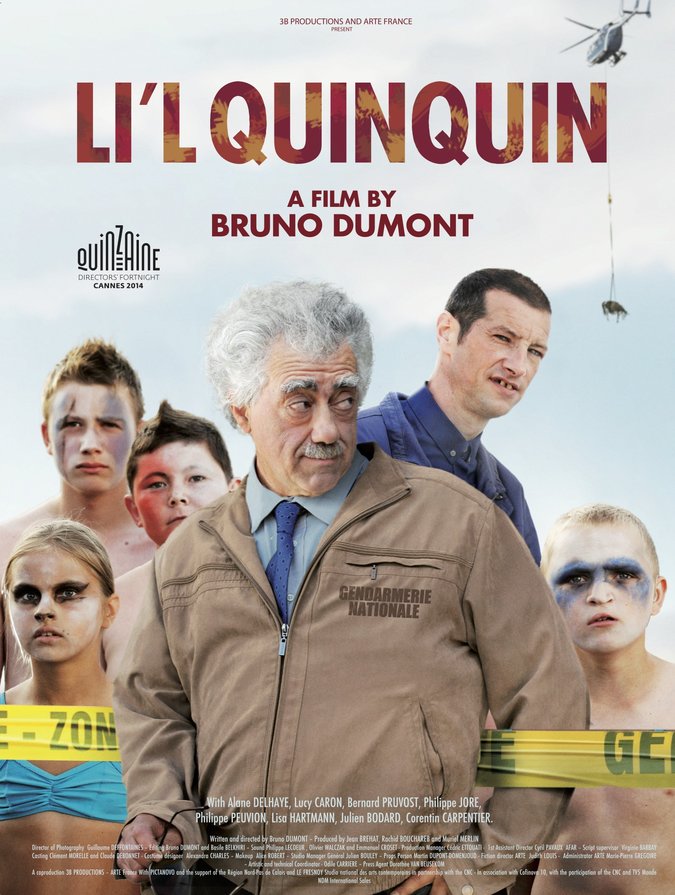
Li'l Quinquin (P'tit Quinquin) (2014)
Something of a murder mystery crossed with a philosophical treatise crossed with a very off-beat comedy, Li'l Quinquin is a strange duck. Probably the closest analogue here is Twin Peaks, for the way that it explores the dual absurdity and darkness hiding within small-town life through the eyes of an unconventional-but-wise detective. But even that doesn't really capture the bizarre, mesmerizing energy of the film—we are, after all, dealing with a mystery involving corpses found inside the digestive tracks of cows, not beautiful dead girls wrapped in plastic. It's utterly confounding, but there's a magnetic power to it as well, one that feels like it's tapping into something both goofy and elemental. Grade: B+


Billy Elliot (2000)
A very sweet coming of age film that strikes me in the same way that I think last year's Sing Street struck a lot of people (not me) last year, only with dance instead of song. The T. Rex-filled soundtrack makes it even sweeter, and the backdrop of working-class strife and a coal miner strike to all the ballet makes for some interesting social textures. There are some potentially worthwhile ideas left to wither on the vine—virtually every side character gets short shrift, but the worst is Billy's gay friend, Michael, who gets about two scenes of any weight; his other friend, Debbie (who gets what is probably the best image in the entire film as she drags her stick across a fence that then turns into police riot shields), receives even less screen time. But everything with Billy and his family is great, particularly the time spent between Billy and his father. Seeing the father's sympathies slowly turn toward Billy and his ballet ambitions is beautiful to behold and is the best this film has to offer. Grade: B+

Fire in the Sky (1993)
There are two very interesting premises embedded in Fire in the Sky. The first is a crime mystery involving a group of men who cite a flying saucer as the explanation for the disappearance of their friend and a highly dubious town and law enforcement cohort. This is a story about truth and the limitations of eye-witness reports, and it's fascinating. The second is a horror movie involving a man's abduction by aliens and the psychological fallout from that abduction as he attempts to reintegrate back into his former life after his return. This is a story about trauma and body autonomy and the terrifying smallness of humanity within the larger context of an uncaring universe, and it's also fascinating. But taking both of these stories and mashing them both into a 109-minute film does a disservice to both, and we're left with a muddled, confused movie that's never quite sure how to fit all its various lumps into its '90s middlebrow box. Grade: B-

Wild at Heart (1990)
David Lynch's follow-up to his indie smash Blue Velvet is, like Lost Highway, a transitional work between two career monuments: this time, between Blue Velvet's off-kilter crime thriller and the full-on affectation and absurdity of Twin Peaks. And it's nuts. It's a movie with Wizard of Oz obsessions (often to an absurd degree, mimicking specific iconic shots from the classic) and Nicolas Cage playing a character who has all the style and mannerisms of an alternate-universe Elvis who was born and raised in L.A., and those two things don't even begin to describe the frantic energy that animates every single shot—this is, without a doubt, Lynch's more frenetic film. It's goofy and grotesque in equal measure (I'm astonished that the film only had to alter one shot to avoid the X rating), but it's beautifully realized and, for all its proclivities for idiosyncratic parody and irony, also ends up being a sincere treatise on love and commitment that's quite moving. Laura Dern's character's wounded infatuation with Cage's aloof Elvis-impersonating makes for a truly great screen romance that only gets sweeter as the movie progresses. The film isn't perfect—a late-film subplot with Willem Dafoe is a misstep, for sure—but for any flaws, it hits eloquently the immaculate emotional range that only David Lynch can deliver. Grade: A-

Books

Still Life with Tornado by A. S. King (2016)
Last year's release from the prolific and frequently excellent A. S. King may be her best. To say that this novel is a painfully sharp depiction of domestic abuse makes it sound like a miserable experience that it absolutely is not (though its depiction of its subject matter is very sharp), so I'll instead frame it this way: given how crushing being a teenager can actually be, YA lit is a genre that is almost laughably in love with self-actualization for brooding, existentially adrift adolescents, but Still Life with Tornado is one of the few that actually manages to build its protagonist's self-actualization with weight and meaning. Yes, she's an artsy teen wandering through urban landscapes (Philadelphia, in this case), but way she finds her way out of that headspace is earned and real. This is a book in which victories are not a foregone conclusion but an actual extension of who these characters are. I dig it. Grade: A-

Sunday, May 22, 2016

Mini-Reviews for May 2 - May 22, 2016 (aka "Sorry for the delay!")

Due to a lot of end-of-semester craziness and some personal stuff, it's been two weeks since I've been able to write one of these review posts. I don't know if anyone hangs on these posts or waits up at night for them or anything, but if someone does, I'm sorry! Hopefully this extra-long post makes up for the delay.

Movies

Looney Tunes: Back in Action (2003)
The title leads you to believe that this is a Looney Tunes movie, and it's certainly anarchic and self-referential enough to earn that moniker. But what this movie really is is a salute to Warner Bros. history in general, which makes it way more fun than a Chuck-Jones-less Looney Tunes movie was ever going to be. It's sometimes trying too hard, and not all the jokes land. But it's got an Animaniacs-esque love of movie history, and it's hard to begrudge that. Grade: B+


Kiss Kiss Bang Bang (2005)
It's one of the funniest American movies of the past few decades. It's also got that irritating, show-stopping meta-commentary by Robert Downey Jr.'s character, which doesn't stop it from being one of the funniest American movies of recent years. But it is something extra that just kind of drives me up the wallwe get it, movies are artificial. The core of this movie is just aces, though; bonus points to Michelle Monaghan for breathing life into her wafer-thin girl friday. Grade: A-


The Descent (2005)
Why aren't more horror movies set in caves? Caves are terrifying! Especially when, as is the subtext in this movie, the cave leads to Hell itself. It's a spooky, unsettling undercurrent that's made all the more spooky and unsettling by the masterful control of lighting. The lighting really is the MVP here; if I had to guess, I'd say that a full 25 percent of the film is entirely dark, while a not inconsiderable fraction of the movie's remainder is composed of shots with only a corner of the frame lit. It's wonderfully effective and creates the neat effect of making the audience as blind as the unfortunate cavers who star in the film, but what sets the lighting into truly incredible territory is the scenes lit by the cavers' various flares and glowsticks, casting the cave walls in fire-red and sickly green monochrome. It's without question one of the best-directed horror movies of the new millennium, and were it not for the relatively forgettable cast of characters (my one strike against the movie), we'd be dealing with an all-time classic here. Grade: A-

American Ultra (2015)
This movie thinks it's a lot more entertaining than it is, obsessed with its own presumed cleverness and ironic juxtaposition of tones. There are actually two really fantastic performances in here, one from Jesse Eisenberg and the other from Kristen Stewart, and the ending credits are, improbably, cool. All of which makes it even more of a shame that the movie surrounding those bright spots is such a bore. Grade: C


Steve Jobs (2015)
The cracker-jack Sorkin dialogue and inventive, stage-like structure (each of the three "acts" center around a long scene that focuses on a single product launch in Jobs' career) make this one of the best biopics in yearsprobably since Spielberg's Lincoln. That is, until it completely and catastrophically flubs the landing on one of the most astoundingly ill-conceived endings I've ever seen in a movie. There's a moment (I won't spoil it, but you'll know it once the final ten minutes slap you in the face) when the movie jumps from being a razor-sharp study of the compromises of genius to a weirdly beatific, tender mushfest, and it's awful. That said, 95 percent of the best biopic in years is still 95 percent of the best biopic in years. Cut your losses, I suppose. Grade: B

The Nice Guys (2016)
This will likely be the funniest movie of 2016funny enough that it pretty much doesn't matter that the trailer revealed most of the best jokes. Of course, if you've been paying attention to the career of Shane Black, this should come as no surprise; unfortunately for me, I haven't been paying attention to Shane Black until just earlier this week when I saw Kiss Kiss Bang Bang, so I'm in the kind of dopey-eyed position of being surprised that The Nice Guys is every bit as funnynay, funnierthan its trailer promised. I can't overstate how much the winning cast plays a hand in this success: Ryan Gosling in particular displays a proficiency with timing and physical comedy that makes this probably my favorite performance of his career. There's a lot of Robert Downey Jr.'s Kiss Kiss Bang Bang performance in him here, which is good. In fact, there's a lot of Kiss Kiss Bang Bang in general here, which is mostly good but also comes with its own baggage: as in the earlier film, there's a troubling glibness surrounding the mistreatment of women, and the plot and writing in general hews closely enough to Black's wheelhouse that there's a definitely been-there-done-thatness to the whole movie that makes it just a tad less fresh than it might be in a vacuum. But still. This is great fun. Grade: A-

Television

Better Call Saul, Season 2 (2016) 
It's a slight step down from the first season, if only because the debut's sickening feeling of discovery made the tragedy of Jimmy's world all the deeper, but a slight step down from one of the best seasons of television in recent years still makes for very, very good television. This season is all about teasing out more complex varieties of the same basic conflicts from the first season, though in more heightened situationsas Jimmy works his way up the legal-world ladder, he faces again and again those same questions: the tension between what's right and what's right for his career, the gulf between what people deserve and what people get, all of which culminates in a riveting, tense showdown between Jimmy and his brother that reveals, yet again, that the great tragedy of the show is Jimmy's love for his brother. Also (and slightly unrelated): Kim Wexler is probably my favorite character on TV right now. Grade: A-


Books

Please Ignore Vera Dietz by A. S. King (2010)
I liked Reality Boy, the other A. S. King I've read, alright, but Please Ignore Vera Dietz is head and shoulders above that novel. It's got the same stellar command of voice and humor that gave Reality Boy its readability, but the dysfunction is dialed down just a bit, which makes room for a bit more tender (though still not exactly cuddly) character interplay, especially between Vera and her father. There are also the surreal touches, like the from-the-grave narration of "the dead kid," which serve alternatingly as flashback devices and little tone poems, and it adds tons of texture to the story. A broken heart lives at the center of this book—torn apart by lost friendships and deathand it's genuinely moving to see it pieced back together. Grade: A-

The Girl Who Loved Tom Gordon by Stephen King (1999)
It's not absolutely top-notch Stephen King, but it does present King in a very readable mode. The '90s were a decade of experimentation for King, where he starts moving toward new storytelling structures and types, and while Tom Gordon isn't as experimental as something like Hearts in Atlantis, the wilderness survival genre is relatively fresh ground for King, and he tills it well, serving up something not unlike Hatchet crossed with Lovecraft. Not everything works: I'm not sure the narrative voice is sufficiently different from the average King protagonist to justify it being that of an 8-year-old. But as a whole package, it's good. Grade: B


Music

David Bowie - The Man Who Sold the World (1970)
I'd heard this album already, but it wasn't until I bought it that I really listened to it in-depth. The Man Who Sold the World finds Bowie at this fascinating crossroads in his career, stuck between his space-oddity progginess and his fun-house-mirror pop star sensibilities. There's at least one alternate universe where Bowie went on become the fifth member of Van der Graaf Generator, and arguably, the reason why Hunky Dory is so important is that it established that Bowie wouldn't do that. This is fantastic stuff, both as this sort of fascinating "what if" and also, with classics like "All the Madmen" and the title track, as the beginning of Bowie's golden years. Grade: A-

Vijay Iyer and Wadada Leo Smith - A Cosmic Rhythm With Each Stroke (2016)

I bought this album because I like Iyer (his 2015 record was one of my favorite of last year), but this is much more Wadada Smith's show. Iyer's piano lays down minimalist soundscapes for Wadada's trumpet to swoop and shriek over, and the results are spacious and thoughtful. A few songs are a little skeletal, which sometimes works for atmospherics but elsewhere just feels kind of underbaked. But on the whole, Cosmic Rhythm is an immersive, moody jazz record, the kind best played late at night. Grade: B+

Sunday, April 24, 2016

Mini-Reviews for April 18 - 24, 2016

Hey! This week I actually have media besides movies!

Movies

Ed Wood (1994)
That Ed Wood is the best Tim Burton movie by such a wide margin (beating my other favorite, Big Fish, by a country mile) leads me to the uncomfortable idea that Burton is way better without the things that we normally associate with Good Burton: showily Expressionist scenery, Gothic fantasy, S&M, Danny Elfman. To be sure, the first couple of those tropes exist in Ed Wood, but they are pared waaaay down when compared to other Golden-Age-Burton outputit's by no means a subtle movie, but Ed Wood is perhaps the closest we've ever gotten to subtlety in this famously flamboyant director's filmography. So, maybe Burton is better when he's just a little less obviously himself than usual? It's a disheartening revelation in a movie that features such an unapologetic affection for the supposed worst director of all time; there's an easy possible version of this movie that depicts Ed Wood with all sorts of condescension: he's a fool, ignorant of his own shortcomings, filled with pretension and myopia. But Burton's version (and Depp's, who plays Wood with tenderness and empathyrarely has Tim's favorite actor been so vital to the impact of Tim's film) says something different: that maybe it doesn't matter how good something is, just that it's done sincerely, with the kind of dorky passion that only a true outcast can muster. So maybe I've just missed the big fat point with my Burton critique? Grade: A

Fast, Cheap & Out of Control (1997)
This one snuck up on me. Leave it to Errol Morris, ever the docu-philosopher, to turn an ordinary documentary (well, "ordinary") about a robot scientist, a naked-mole-rat expert, a topiary trimmer, and a lion tamer into a treatise on consciousness and individuality. It's talking-head documentary-making taking to the abstract expressionist edge, and it's riveting. I had to take a walk afterwardit's not necessarily heavy viewing, but the ideas slowly envelope your mind like creeping vines until you can't shake them. Grade: A


Beau Travail (1999)
A loose, artsy adaptation of Melville's Billy Budd, apparently, which might mean more to me if I had read Billy Budd. As it is, we've got a movie that's hard-to-follow and kind of boring (in a meditative, considered way that's boring nonetheless) but also mercifully beautiful, albeit in that "handheld, accidentally beautiful" way that I don't particularly enjoy all that much. I demand for film compositions to be stable and intentional-looking, dang it! Grade: B-


Buffalo '66 (1998)
A great example of how style, not plot, is cinema's most valuable commodity. Because honestly, the plot here kind of sucks, particularly when it comes to Christina Ricci's woefully underdeveloped and possibly fetishized Layla, the kidnappee/love interest (I know, right?) for Vince Gallo's infinitely more interesting and alternatingly scary and hilarious Billy. But on a style level, we've got a nearly masterful combination of film grain, editing, music, lighting, and framing that pretty much single-handedly rescues the film from its male-centric tropes and turns it into one of the most distinctive-looking indies of the past couple decades. I mean, it's still not great, but it's hard to hate a movie with both Yes and King Crimson so skillfully deployed on its soundtrack. Grade: B+

Books

Reality Boy by A. S. King (2013)
Now that I'm teaching high school, I've decided to make a more diligent effort to keep up with YA lit outside the blockbuster Hunger Games/Harry Potter field, as most of my experience with that genre comes from at least a decade back (and most often begins and ends with Robert Cormier). This was my first stop on that journey. It's pretty goodA. S. King evokes a fantastic voice in her protagonist/narrator, and the basic premise, examining the psychological fallout of a child from one of those "Emergency Nanny"-type reality shows appeals a lot to my general loathing of that kind of show. The ending doesn't work at all: it stares right into the abyss so compellingly in its middle hundred pages that the sudden shift toward positivity and self-actualization at the conclusion feels under-cooked. But the journey there is funny, scary, and all kinds of readable. Grade: B

Television

Crazy Ex-Girlfriend, Season 1 (2015-2016)
Anyone paying attention to Rachel Bloom's fantastic video work prior to last fall (I wasn't) would have had no problem anticipating the Bloom-starring/co-created/co-written CW musical comedy, Crazy Ex-Girlfriend, as the sharp, gutsy, laugh-out-loud hilarious show it turned out to be, not to mention just how hummable the songs are. But I think what caught everyone off-guard was the depths of the emotional stakes here. Bloom deserves pretty much all the awards for imbuing what even the theme song acknowledges is a sexist term with wonderful, aching human life. It's sharp, laugh-out-loud, etc., yes, but it's also a moving, messy examination of what it means to be happy in modern life. Which is, like, amazing considering the really kooky premise of the show. The first few episodes are kind of duds, but once you get to the one with the "Sex With a Stranger" song and the Astaire-Rogers homage (that both of those can exist in the same series should give you an idea of just how wonderful this show is), it's pretty much gold through the end. If you're only going to catch up with one new show from the past TV season, make it this one. Grade: A-

Music

Black Mountain - IV (2016)
Black Mountain and their signature Pink Floyd/Black Sabbath revival sound with an album that is particularly Floydian and Sabbath-ish, in equal measures. The long, atmospheric passages and guitar solos (and heck, that cover art) is vintage Wish You Were Here, while the punchier, crunchier songs are straight Master of Reality. Plus, there's the gloriously unironic use of sci-fi imagery and proggy synths throughout, which, come on, we need more sci-fi songs these days. Like most revival-type albums, some of the stuff here ventures a little too close to pastiche at times, and the music can seem a little thinner than the legends it's trying to evoke. But when you get right down to it, this is either going to be your thing or not, and your love of Pink Floyd and Black Sabbath is pretty much going to determine that thingness. Grade: B+