Showing posts with label Stanley Kubrick. Show all posts

Tuesday, December 5, 2017

Ranking Stanley Kubrick's Films

Every once in a while, you've just got to get a good list of your chest, you know? I've done a couple of these before, once for R.E.M. and once for the Coen brothers, and while I'm reasonably pleased with the former, that Coen brothers post has remained a thorn in my side that gets a little thornier every time a Coen brothers film hits theaters—it's a pain to revise the list every time one of their movies comes out, and it's darned unsatisfying to leave it without their complete filmography, so I've decided that, as with the R.E.M. list, I'll wait until an artist is retired or dead to rank their works (to be continued, Coen bros. post). Lucky for me, Stanley Kubrick is both.

Well, only lucky for the purposes of this post, because in every other way, the world is a poorer place without Kubrick's presence as America's finest European auteur. My first memory of Stanley Kubrick is watching Paths of Glory with my grandfather when I was in elementary school and the movie happened to be on TCM. Of course I had no clue at the time that this was a Stanley Kubrick movie or even that the fact of it being a Stanley Kubrick movie was significant, but that didn't matter; as I watched, I was transfixed and distressed in a way I had never been by a film before. Rarely has a movie seared itself into my brain like that movie did.

Then, a few years later, my dad showed me Kubrick's other great b&w war film, Dr. Strangelove, which went over like gangbusters, because what self-respecting middle-school nerd doesn't love the "precious bodily fluids" and "you'll have to answer to the Coca-Cola company" lines?

A few years after that, as a senior in high school, I went to Blockbuster (obligatory nostalgic "you kids these days don't know" note) and rented 2001: A Space Odyssey after having read and loved Arthur C. Clarke's companion novel. This is the first time I connected Kubrick's name to a movie, since the introduction to the book mentioned his collaboration with Clarke in the adaptation of Clarke's story "The Sentinel." And as I watched this film, for the first time consciously registering the fact of a Stanley Kubrick movie, I was bored to tears. I decided then and there that Kubrick was a pretentious snob.

The funny thing was, I continued to watch Kubrick movies, watching them in a slow, drip-feed succession of one every year or so, sometimes realizing they were directed by the man of the hour as I went in, other times only realizing so on the other side of the movie. I didn't always love them—you can read my original ambivalence at A Clockwork Orange from when I covered it for my AFI project here (and for fun, you can see me kind of regretting my early dislike of 2001 here in that same project). But I kept watching. And watching. And watching, until sometime in the middle of grad school, I suddenly realized that I'd watched every single Stanley Kubrick feature there was and that he'd sneakily become one of my favorite filmmakers of all time. So here we have this list. I still don't love all of his movies, but each and every one of them has something interesting to offer and displays a self-possessed vision rarely seen in American filmmakers, even among the more independent scenes.

I mean, does the world need another film geek guy ranking Kubrick's movies? No. And as rankings/analyses go, this is far from essential. But I had fun with it. And hopefully you will, too, reading and discussing it.

So here we go. Enjoy. Disagree. Etc.


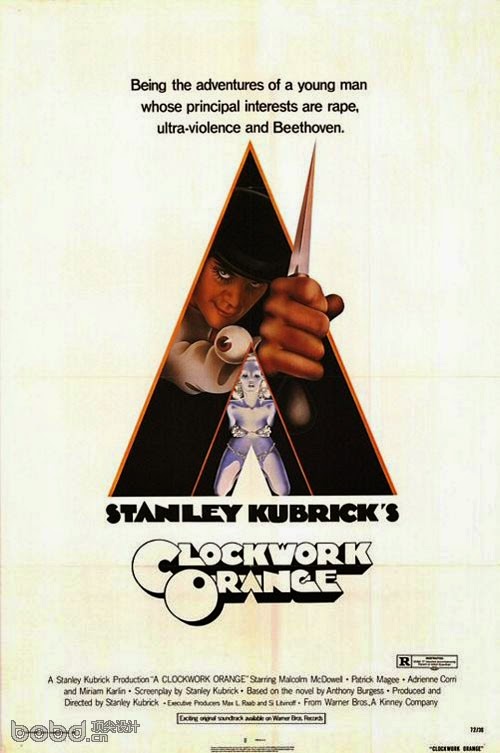
13. A Clockwork Orange
Coming a few years on the heels of 2001: A Space Odyssey, A Clockwork Orange finds Kubrick again in sci-fi mode, and the overriding philosophy behind both these pictures are the same: a complete indifference to the human experience as we know it. Kubrick's reputation as an icy-hearted robot who used film to observe people in the same way that a scientist observes and dissects a bug under a magnifying glass is, I think, overblown, a consequence of people viewing a lack of Hollywood-style sentiment as a lack of emotional engagement. But taking only 2001 and A Clockwork Orange into account, it's not hard to tell where this reputation came from. And while this philosophical preoccupation leads to the profound framing of humanity against the vastness of the universe in 2001, the results of that approach in A Clockwork Orange are perhaps less profound and decidedly less tasteful. Absent the moralizing (but essential) final chapter in Burgess's original novel, Kubrick's film is an exercise in detached observation of human suffering, something the movie brings us back to time and time again but maybe no more quintessentially than in the first rape scene, in which a woman is stripped and raped in extreme long shot, no one to help or pity her, not even the camera itself. There's no question that Kubrick absolutely achieves what he sets out to do, and with stylish aplomb; whether or not you think this is worthwhile has to do with whether or not you think objectified misery and sadism is a valuable use of one's cinematic time. I do not.

12. Lolita
Let's just set aside how this compares to the Nabokov novel (it pales, reader). The bigger issue is that this just isn't great. It's good, sure, but not that good. It's overlong and tedious in stretches, never mind the way that the movie never quite figures out Lolita herself, which is a capital offense in a story like this, turning the titular character into a kind of set piece shuffled around among the male characters instead of a living, breathing human victim of male exploitation. Lolita just doesn't seem up to the challenge (whether from the censorship pressures of the early '60s MPAA or the film's own myopia) of engaging fully with the questions raised by its premise, and that's ultimately its downfall. Thankfully, it's plenty stylish, both from a camera and especially a costuming point of view—images from this movie are justly iconic. But as powerful as style is, it can only elevate a movie so far.

11. Fear and Desire
Kubrick famously disowned his debut feature, and I guess it's not hard to see why. It lacks a lot of the formal precision of the rest of his work, and, worse, it features plenty of moments that clearly reach for formal precision but don't quite get there. It's one of the few Kubrick movies with mistakes, in the sense that you can tell that Kubrick wanted to accomplish something he didn't have the chops to pull off without stumbling. The screenplay is also largely gobbledygook. But there's so much energy here; Fear and Desire is the most avant-garde Kubrick would be until 2001: A Space Odyssey—he still has one foot in the world of his previous career, photography, and the most arresting moments in the movie are essentially photographic, oftentimes edited into more conventional shots. That kind of go-for-broke experimentalism is admirable and, for all its flaws, ultimately successful. Plus, I'm a sucker for "war movie as existential freakout" flicks, and this is nothing if not that.

10. The Shining
Character-wise, I guess I'm with Stephen King here: Jack Nicholson's performance is boring and obvious, and none of the changes (mostly dehumanizing ones) the film makes to King's original cast of characters improves the movie substantially. But The Shining has never been my favorite King novel anyway, so I've got no loyalty to its form in general, which means that unlike King, I'm positioned pretty handily to admit that it improves on the book in a number of ways (or at least goes in interesting directions)—specifically, the way it transforms the humanist horror of the book (i.e. the terror of losing one's mind, either to ghosts or alcohol) into something much more elemental. It's the sublime, horrifying feeling of coming face-to-face with incomprehensible and otherworldly forces and realizing that human significance is an illusion born from those forces, bound to be consumed by them, the malevolent corollary to 2001's "Jupiter and Beyond the Infinite" sequence. It also stars Shelley Duvall, who is the absolute best in general and is without a doubt best-in-show here, too. King talks about the sexism inspired by some of the narrative changes made to his story in the movie, and maybe rightly so. But the real sexism is Duvall's "Worst Actress" Razzie. Boo.

9. The Killing
Like so many Kubrick features, The Killing is perfect in the sense that it accomplishes exactly what it sets out to do—in this case, to create a modest heist flick. I've heard people call this movie one of Kubrick's best, and, well, I obviously don't agree. It lacks the totemic power of Kubrick's "mature" features and the piercing dramatic thrust of his earlier films. But there's something kind of brilliant about a film that's content to be as thoroughly straightforward and unambitious as this one is, and it's got a mean ending that cuts to "The End" with brutal efficiency. Plus, you've got that stunning B&W cinematography, which is aces.


8. Killer's Kiss
You know, honestly, it's probably sheer contrarianism motivating me to rank this one over The Killing. That, and the jaw-dropping mannequin factory finale, which is one of the most memorable images in Kubrick's oeuvre, a filmography with no shortage of memorable images to compete with. But really, I don't think there's any way to separate these two, his pair of mid-'50s noir-ish crime features. It's also a significant step in Kubrick's career (and especially the development of his notorious control-freakishness), being the first of his narrative features to have him direct, write, and produce, a combination that would become commonplace for him but that he wouldn't be able to replicate until Dr. Strangelove, nearly a decade later. I dig it.


7. Barry Lyndon
This movie is, by most traditional metrics, boring. But this movie doesn't care, and there's something weirdly compelling about that—i.e. I believe we call this "slow cinema." What's even more compelling is how it all looks: a kind of 18th-century companion piece to A Clockwork Orange's elaborately designed mise en scène, each shot a meticulous and sumptuous window into a world so fully realized in its 1700s fuffery that the screen basically disappears. It also extends Orange's proclivity for using slow zoom-out shots as painterly tableaus set to striking music, and as such, it represents the maturation of the final major technical piece of Kubrick's repertoire. Each successive Kubrick film (and there were only three more) would use this shot, making Barry Lyndon, if for nothing else, one of the more important entries in Kubrick's filmography. I'm talking about this really academically, and I suppose that's appropriate, given the movie. But make no mistake: as "boring" as this can sometimes be, there's something magnetic and hypnotic about the movie that I kind of love. So it's not all head over heart here.

6. Spartacus
Stanley Kubrick famously disliked this movie, and of all his movies, this is the one over which he had the least control, being that Kubrick was brought in mid-production after the firing—or resignation, depending on who you're asking—of Anthony Mann (the first choice for director was David Lean [who declined], and, well, we can dream, can't we?). But anyway, even transcendent prodigies of the medium are wrong every once in a while, and folks, Kubrick is wrong about Spartacus. It's not a great Kubrick movie in the sense that it fits in well as an iteration of themes and devices developed throughout his career, but it is a great movie movie and without a doubt, the best ancient-history epic of the era (and were it not for one Lawrence of Arabia, the best historical epic of the era, period). The battle scenes are exciting, the romances are sweeping, and the scenery is grand. I also find the "I'm Spartacus" moment tremendously moving, which I suppose makes me a sap but oh well. Sap has its place, even in a Kubric movie. This movie's awesome.

5. 2001: A Space Odyssey
There are some movies whose grip on pop culture is so tight and all-encompassing that, often through overexposure, normalization, and/or relentless parody, it's easy to lose track of the fact of how audacious they were when they first rattled audience bones upon first release. Star Wars is just such a movie, and 2001: A Space Odyssey, the chillier older cousin to Star Wars as far as Baby Boomer sci-fi goes, is yet another. I alluded to as such in a footnote to this blog's original treatise on 2001, but as a rationale for why I disliked the movie. Well, times have changed, and my old boredom at the dancing space ships has been replaced by flat-out awe. Blame my pretentious hunger for esoteric, patience-testing cinema, I guess. Many movies attempt to grapple with the transcendent unknowability of our world; precious few attempt to do so through a cosmic lens, framing the vastness of non-terrestrial space against the minuscule human experience we all live; and of even that rarefied bunch, only Terrence Malick's The Tree of Life has managed to evoke that equally frightening and humbling feeling of encountering the inhuman, inscrutable Great Beyond at the fabric of our universe as effectively as 2001 does. Yes, its prominent position in film culture has robbed this movie's surprises of their shock (and maybe made some of the classical music cues a bit self-parodic), but they've lost none of their power. "A Space Odyssey"—I don't think we recognize enough just how hilariously understated this title is. This movie is nothing short of an epiphany set to film.

4. Full Metal Jacket
I have never been in a war, so I can't comment on the experience (or how closely this movie adheres to it). But the idea of war—not the self-defense kind but war as an act of retaliation or of politicking—is horrifying. Which is what is so terrifying about the Vietnam War in general, the idea that rational Americans thought the conflict was a valid extension of foreign policy for over a decade, and why it is so appropriate that Full Metal Jacket, Kubrick's final treatise on the absurdity of war, is essentially a horror movie. More specifically, it is a horror movie that, in each of its bifurcated halves, deconstructs two of the biggest cinema narratives about the value of war: the camaraderie of soldier peers and the honor of combat. It's not that such things don't exist, but the movie makes it sickeningly clear that their existence is bought through tremendous sadism and agony inextricable from whatever hollow "good" comes out of it. This is one of the very few war movies that professes an anti-war bent and backs it up stylistically. It's a terrible, miserable experience that baits you into thinking it isn't so until, all at once, you're reminded that of course it is. War is hell, and not the metaphorical kind—actual Hell, the eternal torment of souls.

3. Eyes Wide Shut
I suppose that it's eye-rolling for some to spend two and a half hours experiencing a man's existential freak-out at discovering that fact that his wife is, in fact, a sexual being. And I respect that position. But as a man married to a woman, I find that two and a half hours immensely powerful—not, I'd like to think, because I am nearly so condescending as Tom Cruise's character (please, Rebecca, punch me hard if I am), but because it's compelling to imagine how easily I could become so and because it's humbling to recognize lighter shades of Cruise's behavior in myself and to be roundly chastised for it. This all makes the movie sound like some moral scold, but the amazing thing is that it isn't, even with Kidman's tour-de-force monologue scene (and is there any actor who has been more suited to a Kubrick film than Kidman? If so, only barely). In fact, for all its reputation for being a chilly puzzle film with an orgy in the middle, Eyes Wide Shut is one of Kubrick's warmest, most human features, from the fuzzy Christmas vibes everywhere to the pitch-perfect final scene, a moment of such culminating beauty and shock that it makes me laugh and cry at the same time. Barring his unfinished contributions to A.I., it's the last thing the director did in his lifetime, and I couldn't have asked for a better curtain call.

2. Paths of Glory
There has been no other film—not in the English language, at least—that has provided so efficient and despairing a critique of Reason as the ultimate foundation of one's worldview. These are rational actors, the men in charge of the court that eventually decides to execute three soldiers for deserting their posts in the face of a suicide mission. These are rational actors, the commanders who order the raid on the Anthill, a raid whose cost is in the rapid extinction of human lives. These are rational actors, the European leaders who have ushered in the entire engine of the Great War to begin with. It all makes sense when your mind is breadcrumbed along through the cleanly demarcated path of statistics and Enlightenment logic that informs the Modern view of things. And of course we see it as absurd. We can see it in the writing bodies of the condemned soldiers just before the firing squad pulls their triggers, hear it in their whimpers just moments before the gun smoke. Absent empathy, compassion, the arbitrary but critical value for human life—qualities not incompatible but certainly not necessitated by "pure" Reason—we are a squalid empire of metal and bone. The fact that the film—Kubrick's most propulsive and viscerally exciting work, even if one of his bleakest—is also anti-war feels almost redundant in the face of this.

1. Dr. Strangelove or: How I Learned to Stop Worrying and Love the Bomb
But at least the leaders in Paths of Glory are competent, eh? Dr. Strangelove shows us the terrifying, hilarious flip side of this, a situation that essentially posits Paths of Glory as a twisted kind of best-case scenario, if only by the sheer idiocy of the players in Strangelove's story. It's the Cold War, baby, and though everyone in the film aspires to rationality, each and every one of them is undone by their own machismo, fears, dick-measuring, insanities, and miscommunications. I guess another way you can look at it is that at least Paths of Glory doesn't end with the extinction (or near extinction, depending on the virility of the world leaders looking to copulate their respective countries' ways out of a post-apocalyptic "mineshaft gap"—we know for a fact that one character in the film is impotent, and I'm betting that at least General Buck Turgidson is a second). Meticulous pursuit of Reason led us to the Nuclear Age, Dr. Strangelove argues, but mankind (and specifically mankind) lacks the capacity to actually enact the already fatally flawed (but essentially stabilizing) mechanisms of Modernity. It's dark and misanthropic and hopeless, and as far as nuclear war is concerned, that seems exactly right to me. The tone also seems exactly right: a stone face Buster Keaton would be proud of, resulting in the greatest work of English-language cinematic satire, and very nearly the greatest work of English-language comedy. Easily my favorite Kubrick. Pray to God that this movie remains a cosmically frightening what-if, so we don't all die from laughter.

Sunday, April 9, 2017

Mini-Reviews for April 3 - 9, 2017

I actually have a few non-movie reviews this week! How about that!

Movies


20th Century Women (2016)
When movies go to depict the tensions between generations, they typically approach it loudly, often through the device of ultra-conservative parents who hate their progressive children's freedom. So it is just one of 20th Century Women's multitude of lovely touches that it couches the changing mores of generations through the gentler (but no less piercing) dynamic of a son and his already open-minded mother who, for all her open-mindedness, still feels left behind. It's beautiful and nuanced and textured with arresting moments of self-reflection. What is ostensibly (and, I suppose, is still) a coming-of-age tale set in the late '70s becomes, under this relationship and the myriad other equally gentle, equally textured human bonds (among whom are perfectly cast Greta Gerwig and Elle Fanning [who, between this and The Neon Demon, had quite the 2016]), becomes this lived-in collage of what it means to find community from within the larger noise of the culture of a given historical moment. And speaking of culture: a mix of post-rock-ish ambient motifs and period-specific punk and post-punk tunes (Talking Heads feature prominently, as does Black Flag), the film's soundtrack is absolute catnip for me. So of course that affects the grade here (as if this weren't A-grade to begin with). Grade: A


Elle (2016)
If, after the film's open thirty minutes, you're left wondering about the proprietary of having a movie about a rape survivor then reveal said survivor to be a raging sociopath, that's exactly the trap that director Paul Verhoeven, legendary confounder of good taste, means for us bourgeois simpletons to fall into. It's not so much that the movie is outrightly trash; it's that the movie plays its cards so close to its chest regarding what exactly it's trying to say about sexual assault that it's tough to tell if Elle is some smart satire or just an exercise in lurid shock. The film gestures toward both readings without committing strongly enough to either to make its endgame clear even after seeing the entire film once (who knows what repeat viewings will offer). Verhoeven's film's tend to make a lot more sense with a little distance from their specific cultural moment (e.g. Starship Troopers), so maybe it'll take a few years for this one to sink in. As for now... ? Grade: B


Stanley Kubrick: A Life in Pictures (2001)
Very much coasting on the vibes of your average PBS TV doc, it's nevertheless a good—if a bit hagiographic (understandably; the man was barely cold in the grave when the film was made)—source of info on one of cinema's greats. There's some cool footage here (child Kubrick is adorable, btw), and the talking heads—a diverse cross-section of his collaborators and admirers--have smart things to say. None of it is particularly groundbreaking, particularly if you're at all familiar with the critical discourse surrounding Kubrick's work, but it's a solid watch with an infectious enthusiasm for the work of a filmmaker whose work I'm already pretty enthusiastic about. Grade: B


The Big Kahuna (1999)
Three businessmen contemplate life and death in the lead-up and aftermath of a pivotal social mixer. This is the kind of movie where you don't need to look at the production credits to know that it's based on a play (Hospitality Suite, Roger Reuff [the film's screenwriter, in fact])—single-location setting, dialogue that takes the most winding path to get to its destination and loves repeating itself ("Are you mad?" "Am I mad?"), cinematography that mostly sticks to the point-and-shoot variety. As play adaptations go, it's a particularly play-like one, and were it not for a few sequences of ambient interludes, we'd be in the territory of Richard Linklater's Tape. Luckily for The Big Kahuna, though, is that its play is much, much better than Tape's, and its depiction of white male ennui (evoked marvelously by Danny Devito with probably the best performance I've seen from him) has, if not something new to say about that well-trod subject, a uniquely dark and complicated pathos in communicating it. Grade: B+


Hurlyburly (1998)
A meandering, aimless movie about how its characters are meandering and aimless has a hard time justifying its meandering aimlessness beyond the straightforward thematic concerns. There are perks to the ride, though: the acting is generally excellent, both for those playing type (Sean Penn, Kevin Spacey) and those playing very against it (Gary Shandling and a frankly shocking Meg Ryan), and the cinematography does a good job of transcending the film's stage roots (based on a 1984 play of the same title). There are, too, a few moving moments within the mostly tropey treatment of hedonistic aimlessness, notably a tortured Chazz Palminteri navigating a life that is clearly crumbling into some kind of abyss. Nothing spectacular, but nothing altogether awful either. Grade: B-


The Cranes Are Flying (Летят журавли) (1957)
A Soviet film about a woman whose fiance must leave to fight in WWII while she stays behind and deals with the crushing destruction of her home through the German blitzkrieg. So of course it's an exercise in heartbreak. More surprising, though, is the way that director Mikhail Kalatozov is able to sneak some startling abstract imagery into what initially seems to be a straightforwardly naturalistic style—during action scenes, the camera moves with a rapidity that smears out each frame into a kind of Impressionism that's as gorgeous as it is unsettling in its transformation of the warm, domestic landscapes. Did I mention this is super sad, though? Because really, it's going to break your heart. Grade: A-


Books


The Ocean at the End of the Lane by Neil Gaiman (2013)
I sometimes find Neil Gaiman's approach to fantasy to run a bit abstract. This cuts both ways: it can make his stories feel at times frustratingly oblique and sometimes hard to follow, but at its best, it can also lend his work a fantastic sense of the sublime that's virtually unparalleled among authors playing the same game. The Ocean at the End of the Lane has a bit of the former, occasionally exhibiting that frustrating immateriality that makes the story and characters hard to grasp on a tangible level. But at its best—and it is, more often than not—Ocean is wonderfully otherworldly and inventive. Like Coraline (my favorite Gaiman novel and one that Ocean parallels in quite a few ways, right down to its fixation on ominous/demonic female caregivers), the more abstract pieces of Gaiman's prose latch onto tangible details in the story's world in a way that grounds the supernatural in a way that is both frightening and fantastic, obliterating the usual dichotomy between magic and mundane. Grade: B+

Music


Radiohead - Pablo Honey (1993)
People like to critique this album on the basis that it's derivative and straightforward, which is unfair on two counts: 1) Radiohead is always derivative, only now it's modern classical and Aphex Twin, not the Pixies and the Smiths (their ability to synthesize is, in fact, a crucial part of their genius), and 2) of course it's straightforward—clearly these guys were, at this point, more interested in making an alternative rock album than a work of murky dance grooves and pristine art rock. I don't want to overstate this; Pablo Honey is only barely not mediocre, and there are quite a few tracks that are undercooked—"Vegetable," "I Can't," and a couple others. But people pile on this record in a way that ignores that "Creep" is a classic of its angsty kind, "You" is an opener every bit as good as "Planet Telex," and "Blow Out" is the birth of the Jonny Greenwood, guitar experimenter extraordinaire, that we all know and love today. Grade: B-

Sunday, August 3, 2014

100 Years...100 Movies 79-81: The Wild Bunch, The Apartment, Spartacus

Hello all! I'm working my way through AFI's 100 Years...100 Movies list, giving thoughts, analyses, and generally scattered musings on each one. For more details on the project, you can read the introductory post here.

More movies. Carry on, my wayward blog.

79. *The Wild Bunch (1969, Sam Peckinpah)
Now here's an interesting movie, though part of that interest just has to do with plain old luck, I'd wager. The (probably) lucky part: The Wild Bunch arrived at the movies at precisely the right time to make its grand thematic gestures, particularly those regarding the death of an era, serve as a sort of metacommentary for the American movie industry as a whole as it transitioned out of the clean, occasionally immoral Studio era into the purportedly more morally and artistically conscious (though perhaps more anarchic) New Hollywood era. I say "lucky" because I'm pretty sure Peckinpah didn't intend to make such a statement and that such a corollary is just the accidental effect of Peckinpah being an active participant in the New American Cinema movement. Don't get me wrong: there's definitely a media critique going on in this film, but judging from what Peckinpah's said and from the content of the film itself, the targets of this critique seem to be the news coverage of Vietnam[1] and the Western genre (not the studio system as a whole). I'll confess to being a little torn as to whether the film pulls off those critiques, though. Don't get me wrong; there's a ton of rich material in the film, particularly in how the violence obliterates all semblance of the "values" that the characters claim to have. Even in the non-violent portions, I love the amiable looseness of the film (for a good stretch, it's pretty much "just hangin' with the guys"[2]) and how that looseness is often undercut with a current of sadness and regret in the older characters that comes into full bloom once the shooting starts. But then there's the problem that, to me at least, the very violence that this movie is trying to critique often looks (is it just me?) kind of beautifulnot in an elegiac, cathartic way but an actual aesthetic way where the blood splatters look like flower blossoms and falling bodies take on operatic poses in slow motion. The film includes plenty of moments when the violence is very, very ugly (e.g. Pike blowing away that woman when her bullet grazes him[3]), but I don't know that its enough to counteract the formal glamor[4] of those slow motion shots. Maybe that's my fault as a viewer, maybe that's Raimi's fault or Tarantino's fault for teaching me to view violence that way, or maybe it's The Wild Bunch's fault after all. I don't know. Sorry... I'm making it sound like The Wild Bunch is a failure of a movie. It's not. In fact, I think it's pretty good. But when what's separating "good" from "great" is so in-my-face, I guess it's just easier to dwell on that instead of the numerous positives. So, in conclusion, here are four things I love about the movie: the screenplay, the editing, the acting, and the unusually unpatronizing depiction of rural Mexican culture.


80. *The Apartment (1960, Billy Wilder)
Well, I've got no complaints about this one. I tell you, these last two posts have been absolutely gangbusters for new movies for me, what with All the President's Men last time and now The Apartment. And boy, I'm about ready to declare The Apartment a future all-time favorite, too. Maybe it's just the weariness that comes from being this deep into blogging about an AFI list, but The Apartment feels like one of the greatest romantic comedies of all time, which is kind of funny considering that, on paper, this is exactly the kind of movie that gets the rom-com genre mocked. The Apartment is practically a slave to the technicalities of the romantic comedy formula. You've got a silly high-concept premise (man lets his coworkers use his apartment for their affairsI mean, come one, dude!), misunderstandings that escalate into an end-of-second-act conflict, a happily-ever-after ending involving one lovebird running toward the other ("I hate you, Harry, I really hate you"... what's that? Wrong movie? Apologies)heck, you've even got the climactic, epiphanic use of "Auld Lang Syne," which isn't just a rom-com convention but a convention of pretty much every movie genre ever. So shouldn't The Apartment suck? These are the reasons we're supposed to hate romantic comedies, right? They're formulaic? They're sentimental? They're contrived? Yeah well, with all due respect, screw that. The Apartment is top-to-bottom amazing, and it's made no less awesome by its formulaic elements, further proving something one of my English teachers told me in high school: it's the execution, not the bucking of convention, that makes a movie good. The detestable high school me of course didn't believe him, but it's seeming more and more like the truth as I get older. Rom coms (heck, let's just say movies in general) suck when the humor is tepid, when the leads don't have chemistry or charisma, when the cinematography is bland, when the pathos is passionless, and (especially) when the screenplay is dull. The Apartment is hilarious, magnificently acted, stylishly shot, alternately heartbreaking and rousing, and always whip-smart, screenplay-wise. So no, The Apartment doesn't suck. Not at all.


81. Spartacus (1960, Stanley Kubrick)
Well, dang, I forgot about this one. Back when I reviewed A Clockwork Orange, I lamented that AFI hadn't chosen any Stanley Kubrick movies that I like. I was wrong (also, I completely forgot that the peerless Dr. Strangelove is on this list, so... wrong on two counts). I really, really like Spartacus, though to be fair, it's not exactly a Stanley Kubrick movie in the sense that films like A Clockwork Orange and The Shining would go on to define Stanley Kubrick movies. Most obviously, Spartacus is sentimental as all get out, and if there's one thing that Stanley Kubrick Movies(TM) aren't, by golly, it's sentimental. And to be sentimental about human characters, you've got to have empathy for those characters and, you know, care about the human race in general, which, again, is right out for a Kubrick film. Spartacus is a great humanist film, and not only that, but one of the most powerful war epics ever. The closest Kubrick film to Spartacus (both chronologically and thematically) is Paths of Glory (another winner, in my book, and probably Spartacus's superior), both depicting the crucifixionliteral and figurativeof individuals who attempt to buck the cruel machinations of their superiors, both other than that, you'll have a hard time finding analogues to Spartacus in the Kubrick filmography. Of course, that's largely because Kubrick was much, much less involved with the filming process of Spartacus than he was with his other movies; he wasn't even the original director for the film, being brought in as an option after the first director fell through. Honestly, I think Kubrick is entirely the wrong choice for this film (Wikipedia tells me that David Lean declined an opportunity to direct it, which is a crushing disappointment on so many levels). His icier, more controlling tendencies are totally at odds with the sort of pure-blooded Hollywood epic this movie is, and while he never had enough control to make those tendencies prominent enough to be problematic, his choice to film a good portion of the movie's "outdoor" scenes in a studio (to, in a typical Kubrick move, be better able to control the filming) has not aged well, especially juxtaposed with the grandeur of the actual outdoor footage. But enough complaining; Spartacus is a majestic tragedy totally worthy of its classic reputation, regardless of its place in the Kubrick canon. Plus, even if everything else had been crap, there's that scene. You know the one. "I'm Spartacus!" *sniff*

Let me know what you guys think! As always, I love hearing feedback from you lovely readers, even (especially) when it's people telling me I'm dead wrong about films. Until next time!

You can read the previous post in the series, #s 76-78, here.
Update: Read the next post, #s 82-84, here.

1] This interpretation is something I totally got from excerpts from interviews with Peckinpah on the film's Wikipedia page. Honestly, it's a pretty obscure critique. Once you know that the movie's supposed to be about Vietnam, I guess it makes sense, but nothing in the film itself would have led me to interpret the film that way if I hadn't read his statements. The critiques of the Western are much more obvious, though.

2] Emphasis on "guys"The Wild Bunch is a very dude-heavy movie. Which, unfortunately, leads to the film's sometimes troubling portrayal of women. Sure, the movie gets a few digs at misogyny (the scene where the men underpay the prostitutes is striking), but they're pretty shallow digs, not nearly the cutting interrogation I might have liked to see, especially considering how the women are often just pretty faces for the rest of the movie (when they're present at all).

3] The ugliness of the situation really driven home by his scream of "Bitch!" before he pulls the trigger.

4] For the record, I do think there are legitimate artistic and moral reasons to stylize (and even beautify) violence in art. But when one of the main purposes of a film is to make the audience realize the horror and ugliness of commonplace "movie" violence, it's hard to pull that stylization off well. One man's opinion.

Wednesday, July 23, 2014

100 Years...100 Movies 70-72: A Clockwork Orange, Saving Private Ryan, The Shawshank Redemption

Hello all! I'm working my way through AFI's 100 Years...100 Movies list, giving thoughts, analyses, and generally scattered musings on each one. For more details on the project, you can read the introductory post here.

So, this post includes the second (and last) of the Stanley Kubrick movies on this list, and as with 2001, I'm less than thrilled with it, although I do like it better than that original film. Why oh why couldn't AFI actually pick the Kubrick films that I actually like? Anyway, all that is to say that I'm sorry for the overlong writeup of A Clockwork Orange. Hope the mostly reasonable length of the other two entries makes it okay.

70. *A Clockwork Orange (1971, Stanley Kubrick)
This movie is such a mess that I'm struggling to find a good starting point for this discussion. It's not so much "bad" as poorly calculated, so I guess I might as well begin there, especially considering that Stanley Kubrick is one of the most calculating movie directors of all time. And that's not a bad thing! This being a Kubrick film, of course, A Clockwork Orange is a technical masterpiece, full of inventive camerawork, striking imagery, and some of the coolest frame compositions out there. The thing is, as I see it, that technical mastery is also what causes one of the film's biggest problems: it's intentionally filmed as a comedy [1], which of course begs the question of whether or not such a plot as this one (one, in case this work's reputation has eluded you, that is chock full of beatings, rape, torture, and grotequery) should be filmed as a comedy. That question gets into the whole issue of whether there are any subjects off-limits to humor, an issue I don't feel equipped to weigh in on, but I will say this: the jauntiness of the proceedings makes it terrifically difficult for me to figure out what to do with the film's violence. I have no doubt that Kubrick intends for this film to be against rape and gang violence, but it's also possible for there to be miles between authorial intent and actual effect. To be sure, Alex's leering gaze in the first shot makes it clear that our protagonist is as much villain as audience surrogate (though, troublingly, he's also that in the prison and rehabilitation sequences); that being said, there's also something undeniably seductive about the way the violence is situated from Alex's (often joking) perspective, a calculated choice that Kubrick has made to no doubt show the depravity of the character, but a calculation that also hinges so much of its impact on assumptions about the psyche of his viewers that I really think the power of those scenes has fumbled from the filmmakers' control. There's also the problem that many of Kubrick's choices in those scenes, even the more effective ones, often involve objectifying the (mostly female) victims [2]. I do recognize that this film is a satire and that this objectification often serves the satirical points of the film quite well (esp. in reflecting the effects of the hypersexualized society in which Alex lives), but objectification for a purpose is objectification nonetheless, and by gum, when you're dealing with victims of rape, I'm not sure if objectification should be on the table at all. I'm getting rambly, so let me close out by saying that I might be more charitable toward the unintended consequences of the satire if I had a feeling that the satire were serving a larger social point beyond pure nihilism, but I just don't think that's the case. The film, for all its unintended effects, does not want to be on Alex's side, but neither does it want to be on any other side or take any position at all, it seems, given the horrific (and often parodic) nature of the government's penal system. It's a movie that wants to be somehow against both criminal behavior and criminal rehabilitation. At its most constructive, it seems to say that individual autonomy is more important than morality [3], but even then, I'm hesitant to assign that interpretation for all the contradictions it makes in the movie as a whole. So again, it's not a bad movie (it's far too technically accomplished and smart for that), just one that seems horribly (dangerously?) messy to me.


71. Saving Private Ryan (1998, Steven Spielberg)
After the overlong response for A Clockwork Orange (sorrynotsorry, folks), I'll be brief here. The common critical narrative on Saving Private Ryan has become that it's a great movie in its opening Beaches of Normandy sequence and merely an okay movie for the other two hours of its duration. And, boringly, my opinion is basically just a variation on that idea. The first thirty minutes of the film are some of the most visceral, terrifying, and effectively anti-war war movie minutes ever put to film. It turns World War II (our "righteous" war, let's not forget) into the chaotic horror film that I feel most cinematic battle scenes should be. War is hell, goes the banality, and Saving Private Ryan's storming of the beaches is one of cinema's most hellish, with imagery right out of Dante's Inferno (or, you know, real life, which war movies are all too good at letting us forget). The rest of the movie, I have to agree with the critics, is pretty by-the-numbers, as far as war movies go, and it leans a little too hard on the stop-being-a-coward-and-be-a-man-and-kill-people ethic that rubs me wrong about some other war movies. That being said, I do think that in the final fifteen-or-so minutes, the film becomes near-great again, building to a powerful climax with the (spoilers) sacrifice of Tom Hanks's character [4]. So there's that. Yeah, overall, a movie I like with a few essential scenes, but so many other films in just Spielberg's filmography alone deserve this spot, so whatever.


72. The Shawshank Redemption (1994, Frank Darabont)
Well, what a nice surprise. I've spent a good deal of time poring over this AFI list, even before beginning this project (because, you know, I'm a horrible nerd for these sorts of things, which I realize is a bad habit and I should feel bad), but until preparing for this post, I had completely forgotten that The Shawshank Redemption was on this list. What's wonderful about that for me is that the movie is such a non-AFI movie, by which I mean that there is next to nothing Important about it. It's not the work of a so-called "auteur" like Kubrick or even that of generally well-regarded director like Spielberg; Darabont is, in fact, primarily known for directing inoffensive adaptations of Stephen King's work, which is about as glorious a populist legacy as I can envision. There's nothing particularly innovative about its cinematography, either. It's not a movie driven by Big Important Actors like Marlon Brando or Orson Welles playing self-important roles; the acting in Shawshank is top-notch, of course, but it's of the smaller, warmer variety that tends not to get lots of attention from the codifiers of Hollywood history. It's also not a movie with Big Social Themes; although it's set in a prison, the film (along with the Stephen King novella it's based on) has almost zero interest in saying anything socially relevant about the state of incarceration in the United States in the mid-20th century or in contemporary times or ever (compare that, for example, to A Clockwork Orange's hyper social awareness). No, more than anything, The Shawshank Redemption just wants to give its audience a fun, feel-good time. That's a mission statement sorely lacking from so many of the dramas on this list. Now, as I'm sure you can tell from some of the other posts in this project, I love me some self-important dramas, but the idea that films with weighty themes and historical significance are the only films worth honoring is so toxic to cinema culture that it's a genuine relief to me that something like The Shawshank Redemption (an antidote to that toxicity if there ever was one) has gathered enough critical inertia over the years and years of cable reruns to emerge on this list.

Agree with my takes on these movies? Disagree? I'd in particular love to hear someone call me out on my ideas about A Clockwork Orange, as I'm still very conflicted about the film. Or you could call me out on what I have to say about these other movies, too. It's all good.

Until next time!

If you want, you can go back and read the previous post, #s 67-69, here.
Update: The next post, #s 73-75, is right here.

1] There are a lot of indications that A Clockwork Orange is a formally comedic work, but the two main elements that I would cite are the abundance of wide-angle distortions (a technique often used to frame silliness) and the carnivalesque direction of the acting, both of which exaggerate the onscreen images to a somewhat humorous effect.

2] The first rape (the one Alex and his droods walk in on at the beginning) is a good example of what I'm talking about. The film is definitely indicting Alex's callous attitude toward the woman, but it's also a scene in which the depiction of the violence is bloodless enough to sort of emphasize the nakedness of the woman more than the violence itself, which again is keeping with Alex's perspective, but that's a mighty irresponsible stance for a film to take, even for the purpose of satire.

3] Which, again, I think is sort of an irresponsible and sloppy message to ground satire in, especially when the film adaptation lacks the (admittedly clumsy) final chapter of the original novel, in which Alex discovers that the purpose of that autonomy is to develop a moral awareness.

4] You know what bugs the heck out of me, though? That the death of Tom Hanks's character totally messes of the POV of the movie! Like, the whole film leads you on to believe that it's an elderly Tom Hanks in the graveyard at the beginning remembering all this stuff, and as a result, the whole movie is set in Hanks's perspectiveonly then it turns out that this isn't Hanks's memory at all because he's dead, so how on earth did we just remember everything from his POV?? It drives me nuts.

Thursday, June 12, 2014

100 Years...100 Movies 37-39: The Best Years of Our Lives, The Treasure of the Sierra Madre, Dr. Strangelove

Hello all! I'm working my way through AFI's 100 Years...100 Movies list, giving thoughts, analyses, and generally scattered musings on each one. For more details on the project, you can read the introductory post here.

Judging by the number of pageviews my last post got, it seems that people really like reading about Disney princesses. Regrettably, there's nary a princess in any of these movies, and two of them don't even feature significant female characters at all. Welcome to the AFI, folks.

37. *The Best Years of Our Lives (1946, William Wyler)
This movie bored me. I'm sorry. I hate that word, "boring," because it's a critique that never really goes anywhere productive. But boredom was the overriding feeling I got while watching The Best Years of Our Lives. The cinematography is flat, much of the acting feels phoned-in, and the plot lacks a clear structure and compelling stories. It's not for lack of trying on the plot's part, though, as I gather (from the largely didactic and tiresome score that plays throughout most of the film) that the movie at least intends to make me feel very deep emotions throughout. And it seems to have managed to swell those emotions in other people, given its placement on this list and the fact that it pretty much swept the Academy Awards back in '46. Heck, Roger Ebert even liked it. It just didn't click for me, though. Part of me wonders if this is just one of those "you just had to be there" movies (though, unless he's a time traveler, Roger Ebert wasn't "there" either). There's no question that the concept of soldiers returning home after WWII was a lot more immediate in 1946 than it is today. Its thematic territory might have felt a little fresher back in the '40s, too; by 2014, we've had dozens of movies, documentaries, TV shows, and books, chronicling the challenges soldiers face when trying to reenter domestic life after being in combat, and conditions like PTSD and some of the other emotional and psychological trauma experienced by those men and women have reached a decent level of mainstream awareness. Looking back almost seven decades to The Best Years of Our Lives, I can't help but find the whole thing a little uninspired and uncompelling, not because of the subject matter (that will always be important) but because of the relatively trite way in which it engages that subject matter. This movie seems content to say, "Yeah, it's hard for soldiers to return home after war," and leave it at that, whereas so many other movies since then have dug deeply into the specific whys and hows of the soldiers' difficulties. It isn't all bad; the early sequence depicting the soldiers' first night back with their families is engaging, and there's some spectacular framing of shots in the final wedding scene. But overall, The Best Years of Our Lives was not the best three hours of my life (ha. ha.. ha... *rimshot*).


38. The Treasure of the Sierra Madre (1948, John Huston)
I don't have a whole lot to say about this movie except that it's a ton of fun. It's funny that my write-up of the last John Huston-directed movie on this list (The Maltese Falcon) spent so much time trying to parse out if the movie had a moral or not, because in The Treasure of the Sierra Madre, there is most definitely a moral: don't be greedy. And that's a fine moral and all, but it has absolutely no bearing on why I like this movie so much. Whereas The Maltese Falcon sometimes feels like it's trying its hand at profundity (hence making the moral, or lack thereof, kind of important), The Treasure of the Sierra Madre is pretty much cool with just being the most entertaining, thrilling picture it can be. Whether or not it has a moral "point" isn't all that important. And as far as entertaining and thrilling pictures go, this one works like gangbusters. It's one of the great adventure movies of all time, and Humphrey Bogart gives a fantastic turn as the film's villain. It also has one of the more useful of famous movie quotes in the "We don't need no stinkin' badges" line. Really, you can use that quote anywhere. Observe: We don't need no stinkin' barges. We don't need no stinkin' vegetables. We don't need no stinkin' bicycles. We don't need no stinkin' Transformers sequels. We don't need no stinkin' long write-ups of The Treasure of the Sierra Madre. Wish granted.


39. Dr. Strangelove or: How I Learned to Stop Worrying and Love the Bomb (1964, Stanley Kubrick)
I like Dr. Strangelove a whole lot. It's a wonderful mix of the dry and absurd flavors that I usually prefer my comedies to come in, and it's also the rare comedy that is beautifully shot, which should surprise nobody once the Stanley Kubrick name flashes on the screen. The screenplay is tight and fun and greatly accessible for the kind of brainy comedy that this is; even as a kid, I loved the "precious bodily fluids" bits and some of the more slapsticky moments, even though most the sociopolitical satire flew way over my head. It's a movie filled with so many instances of comedic ridiculousness of such a wide range of types that I imagine most people will find at least one joke that lands for them. There are the big "you can't fight in here, it's the war room" moments that are of course huge laughs, but my favorite jokes come at the film's margins, those little details of uncommented-on silliness, like the way the flight commander dons an enormous cowboy hat when he gets word to drop the bomb. Great stuff. And yet... I can't help but wonder if, like The Best Years of Our Lives, I haven't missed the boat on this movie. Don't get me wrong; it's great. But how much greater must it have been back when the Cold War was actually happening? How much more would the fear of a real-life nuclear apocalypse have galvanized the humor? How much sharper must the satire have been when it was picking apart versions of actual possibilities? How much more bite must that final montage of nuclear blasts have had? With the world no longer a sneeze away from H-bomb oblivion, Dr. Strangelove must have lost a little of the terrifying edge that it once had. It's no longer a movie speaking directly to our society. Sure, there are plenty of ways that this movie's themes are still in conversation with contemporary culture (heck, the world is still a violent place rules by raging military powers), but you have to generalize the film a bit to make that work, forming metaphors and fables out of things that were once quite literal. That's the thing about great satire, I guess; there's always the chance that it'll become slightly obsolete.

That's all for now, folks! Thanks so much for reading. It's always great hearing from y'all, so if you have any insights or grievances or humorous anecdotes or whatever, feel free to share. Until next time, be sure to protect your precious fluids from the dirty Reds.

If you feel so moved, you're welcome to go back to the previous post, #s 34-36, here.
Update: Also, you can go on to the next post, #s 40-42, here.

Friday, May 16, 2014

100 Years...100 Movies 13-15: Star Wars, Psycho, 2001: A Space Odyssey

Hello all! I'm working my way through AFI's 100 Years...100 Movies list, giving thoughts, analyses, and generally scattered musings on each one. For more details on the project, you can read the introductory post here.

Lots of sci-fi this post. And a horror movie. Good to see AFI giving attention to some less-critically respected genres, even if they did pick the safest, most obvious works in each genre. Still, sci-fi and horror are sci-fi and horror, and their presence is a rare treat on this list. Let's savor that for a minute.

13. Star Wars (1977, George Lucas)
Ah, Star Wars. Holy cow, Star Wars. If The Wizard of Oz was the first movie on this list to hold a significant nostalgia-factor for me, Star Wars is the movie that holds the biggest nostalgia factor on the list, give or take Toy Story way back at the end. Whole swatches of my life are defined by the original Star Wars trilogy and the accompanying novelizations (plus all those Extended Universe worksThrawn Trilogy all the way!), and I'm sure there are at least a couple other generations of kids who could say the same. I could write volumes in response to this movie. But I won't. Instead, I just want to point out the significance of AFI's preservation of the film's original title. Nowadays, this movie goes by Star Wars Episode IV: A New Hope, but the episode number and subtitle weren't added until after The Empire Strikes Back came out in 1980. That's important to note because it emphasizes how in 1977 Star Wars hadn't yet acquired a lot of the self-serious, mythological elements that came to define the series, like the nature of the Force, the specifics of Jedi philosophy, and the broader socio-political sweep of the titular Wars. Sure, there are hints of all that in Star Wars, but I get the feeling that a lot of those hints gained retroactive significance only after George Lucas and the sequels culled them into the scope of a larger series by adding Episode IV: A New Hope to the title [1]. What sometimes gets lost within the larger context of the sequels and prequels is just how childlike everything is in the original Star Wars. Not childish, mind you, but childlike, in the sense that the whole movie seems constructed with the sincere, innocent excitement of a child at play. With Star Wars, George Lucas has a singular vision of trying to recreate his childhood experience of watching sci-fi serials like Flash Gordon, so of course the movie plays out with wide-eyed attention to thrills and swashbuckling. People talk a lot about the heavy nostalgia of Lucas's other major early work, American Graffiti, but Star Wars is just as nostalgic an enterprise, if not more so; it's a movie about going to the movies as a kid, awed at the darkness of the theater and the striking light of the projected image. Fittingly, the film opens with the words "A long time ago," as if it's not just the plot but also the viewing of onscreen space battles that happened so many years in the past.


14. Psycho (1960, Alfred Hitchcock)
Psycho is still terrifying. It's not a shock-a-minute thrill ride or anything like that (in fact, there are really just three "scares" in the entire film), but when Hitchcock does decide to let rip with the horror, oh man, does he. And for a fifty-four-year-old horror movie in a genre whose scare factor doesn't tend to age that well (The Wolf Man, for example, is a fine movie, but not one likely to frighten modern audiences), that's saying something. Critics have done tons of analysis on how the cinematography and editing and sound design make moments like the infamous shower scene so viscerally frightening, and I agree with them wholeheartedly; the rapid cuts and screeching score in particular are scary in a way that I can't shake, even when I know to expect them. But I also have another, more subjective theory on why this movie continues to scare to add to all that fancy film school analysis: Psycho is still scary because it operates outside the cinematic conventions of its own subgenre. Here's what I mean by that: Psycho basically invented a whole new kind of horror movie, the slasher (in which pretty young people are murdered one-by-one by some menace; see also: Friday the 13th, Halloween, etc.), that ended up dominating the genre for a few decades. During all this domination, the slasher movie developed its own visual shorthand to scare audiences: killer POV camera, slow-building score that cuts silent right before the actual scare moment, and a whole host of other techniques that became so common that they became more of a signifier of fear than any sort of real scare. "Something scary is about the happen," they say. But Psycho, being the foundational text in the subgenre, doesn't have that convention to inform its cinematic style, so the frightening events happen in a way that feels completely alienand therefore more startlingto modern audiences. Or maybe that's just me, and I'm a wimp. Either way, this movie rocks.


15. 2001: A Space Odyssey (1968, Stanley Kubrick)
Out of all the films on this list, 2001: A Space Odyssey is probably the one most hurt by my decision to not rewatch any movies I've already seen. Here's the deal: as of my most recent viewing, I did not like this movie; I found it tedious and needlessly glacial in its pacing, and the use of classical music in the score seemed overblown and portentous [2]. And then there was the "Jupiter and Beyond the Infinite" sequence, which felt horribly aged to me, a relic of psychedelia rather than the (what I then considered) superior, majestic sweep of the book's ending. I was a big fan of the book. And don't get me wrong, I respected things about the movie. I recognized that the camerawork was generally excellent, the special effects somehow still looked amazing (save for those awful color filters in the "...Beyond the Infinite" sequence), and I totally got behind the film's general philosophicaleven religiousambition of depicting mankind's encounter with the sublime transcendence of a power totally beyond human reckoning [3]. But that's all it was: respect. In the end, I reservedly respected the movie a whole lot more than I enjoyed it, and the parts I disliked, I disliked more than the parts I liked. And that's been my general feeling on the movie ever since. The thing is, though, I saw the movie as a senior in high school. A lot of things have changed about me since then, most relevantly to this discussion that I'm now much more likely to enjoy a movie based on its technical artistry and imagery than I was then. In fact, I have a sneaking suspicion that I would kind of love it if I saw it again. I probably will revisit the film soon. But I also think it's a valuable exercise in honesty to write down my long-held opinions on a film without altering them last-minute to something more in-line with the critical climate. Hence this post sans rewatch.

Next post, we'll finally hit a movie I haven't seen yet (The General, if you're curious). Until then, feel free to chastise me for my opinions about any of the movies here. Or you could agree with me; that's cool, too. Either way, I'm looking forward to hearing y'all's opinions. Until next time!

Read the previous entry in the series, #s 10-12 on the list, here.
Update: Read the next entry, #s 16-18, here.

1] Look no further than the novelization of each of the original movies for proof of this retroactive culling. Since the novels were written immediately following the release of each movie, each book is a fascinating time capsule of what the Star Wars series envisioned itself as at different times in its development. There's some weird, noncanonical stuff in those books, enough that it's clear that Lucas didn't exactly have a grand unification theory for the series until maybe Return of the Jedi. Throw in the totally bizarre (at least, in the context of what Star Wars would become) direct-to-paperback sequel, 1978's Splinter of the Mind's Eye, and you've got one head-scratching series identity.

2] Honestly, I think a big part of my problem with the classical pieces was my familiarity with them before seeing 2001. Pieces like "Also sprach Zarathustra" and "The Blue Danube" have been used in so many different cultural contexts (not the least of which is this cartoon, which I watched early and often in my childhood) that it was hard for me to separate those associations with the music. It's a weird and slightly parodic experience to picture cartoon ducks when I'm supposed to be in awe of waltzing spaceships. Now that I think about it, that may have been a large part of my problem with the film as a whole. It's such a famous, iconic movie that long before actually seeing it, I was already familiar with much of its imagery and signature moments through pop culture referentiality and parody. You can only see so many spoofs of that bone-to-spaceship cut, only so many Simpsons jokes, only so many tongue-in-cheek "I'm sorry, Dave, I'm afraid I can't do that" appropriations, before the whole movie starts to feel a little laughable itself.

3] Say what you will about Arthur C. Clarke, but this recurring theme is his work knocks me flat every time. It's an incredibly powerful idea to me, and one that rings true not only with my Christian beliefs but also with my day-to-day experiences with creation. Humanity is so freaking tiny, man.