Sunday, February 27, 2022

Mini Reviews for February 21 - 27, 2022

Two more weeks until Spring Break.

Movies

Spencer (2021)
I don't know how much this Princess Diana biopic has going for it other than Kristen Stewart's performance as Diana and Jonny Greenwood's performance as one of the best composer of film scores of our time, but wow, both of them are knock-outs. Especially Greenwood's score. Easily the best film score of 2021. Grade: B


The Cotton Club: Encore (1984, released in 2017)
Watched the "Encore" director's cut (which Coppola found on an old Betamax, which... lol). No idea what the original movie was like, but this one is, like most Coppola pictures, an absolute marvel on a formal level, just flex after cinematic flex playing out onscreen for the entire 139 minutes. It's something of a backdoor musical, and a great one at that, with large portions of the film being set to some absolutely stunning dance sequences in the old Cotton Club—probably the best post-Jazz-Age media I've ever seen at depicting the raw magnetism of jazz as bringing-down-the-house party music, and I felt like hootin' and hollerin' along with the in-movie crowd when, for example, Cab Calloway shows up. The immense surface pleasures of all this kind of overwhelm what is ostensibly the movie's point, which is the contrast between the absolutely banging club atmosphere and the mechanisms of racism, abuse, exploitation, and outright violence that make the club possible in the first place. Coppola rarely met a bad screenplay he couldn't will into competence by sheer force of cinematic razzle-dazzle, and this one is certainly nowhere close to the worst screenplay in his filmography. But it's also not nearly good enough to pull off the downer thematic coup on that beautiful movie magic that it wants to. I would honestly have preferred a plotless movie that just had random characters hanging around the club, which is basically what this movie is for the first half hour at least. Grade: B

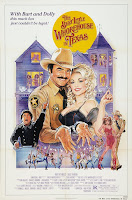
The Best Little Whorehouse in Texas (1982)
It's not hard to see this film as a political parable for the ways that the encroaching right-wing moral crusade across the United States in the early 1980s destroyed the measure of gender and sexual liberation won in the throes of the 1960s/1970s, particularly the queer liberation that was already marginalized even within second-wave feminism. It's not hard to see it because it's basically the explicit text of the film—though the heterosexual pleasures of the titular house are centered, there's a persistent vein of queer activity, from the high camp of the costumes and musical sequences like the nude all-male locker room dance, to the off-handed comment that lesbians were welcomed at the Chicken Ranch, to the casting of Jim Nabors as a knowing narrator. I've never seen the stage musical this is based on, so maybe this is just baked into the source material, but it's hard not to see the movie's attempts to twist a heterosexual exterior into a queer-affirming ethos as personally meaningful for co-writer and director Colin Higgins, an openly gay man who would die from AIDS six years after this film's debut. The film is deeply imperfect both as a political text and as a movie, but there's a strain of exhilarating freedom and also tragic loss working alongside the queer reading of the film that gives this a heft I was not expecting. Also, this is maybe the most I've ever enjoyed Burt Reynolds, which I attribute solely to the magic of Dolly Parton—the two have a certifiably electric onscreen chemistry that makes the sequences in which they're hanging out with each other (a not insignificant part of this probably too-long runtime) inordinately charming. Grade: B+

Coffy (1973)
As an exploitation film, juxtaposing erotic imagery with violence is part of the project, and I dunno how I feel about that, even if it's situated within a nominal empowerment narrative (an empowerment narrative that situates "empowerment" within a world animated by a fundamentally nihilist will to power, which is pretty interesting). Regardless, Pam Grier is incredible, as is Roy Ayers's score (from where I sit, every bit the equal of Isaac Hayes's more iconic work in Shaft), and overall, this is at least plotted fairly tightly and scripted fairly rigorously compared to other blaxsploitation films I've seen. I'm still waiting for a blaxploitation movie to really knock my socks off. This got close at times, though. Big bonus points for the scene where the dude is explaining that the world is so corrupt that you can't kill all of the bad guys, and Grier's just like "Why not?" More bonus points for Grier having the guts to field that absolutely terrible Jamaican accent. Grade: B+

Shaft (1971)
It remains astounding to me how many movies that were incredibly popular in the 1970s are basically just shaggily plotted and edited stories of characters meandering through textured environments as cool soundtracks play. Big portions of movie-going audiences were truly okay with just vibing at the movies, which is charming to me. Kind of wish we had more of that now. Maybe my brain has been poisoned by 21st century cinema, and maybe if I were back in the 1970s, I would have been a little more into this, but despite being charmed by the idea of people regarding this as an exciting action blockbuster, I just couldn't muster up much excitement myself for it as a whole. The Isaac Hayes soundtrack is extremely dope, and Richard Roundtree is justifiably iconic in the title role. But also, this movie feels awkwardly positioned between being more purely a neo-realist urban mood piece and a film noir, either of which could yield a very good movie if it committed to one but right now feels like half measures of both. If I'm going with foundational blaxploitation films from 1971, I would much rather watch the more politically and stylistically radical Sweet Sweetback's Baadasssss Song over this any day. Grade: C

Television

Nathan for You, Season 2 (2014)
Basically more of the same from Season 1, which is an unalloyed good in my mind. The schemes presented to the businesses get a little more elaborate in this season (perhaps most notably in the souvenir shop episode, where Nathan creates an entire film festival to justify the fake movie he's set up, as well as the "Dumb Starbucks" episode, which got national media attention as it unfolded), and Nathan as a character is a little more of a sad sack than he was before. But for the most part, this is taking everything that made the first season good and leaning into that. So of course it's still good. Grade: A-


Books

Stories of Your Life and Others by Ted Chiang (2002)
This story collection is of course most famous for "Story of Your Life," which won a whole bunch of awards and was eventually adapted into the movie Arrival. But the stories I connected to most were "Tower of Babylon," which is basically a story that assumes that ancient near-east cosmology is literally true, and "Hell Is the Absence of God," a story in which God, angels, heaven, and hell are all physically manifested in our material world. Chiang has a great knack for giving his stories one fairly simple idea and then burrowing deeper and deeper into the implications of that idea until you end up somewhere surprising. This of course makes him a good fit for sci-fi, but it's also great for these more religious stories. A lot of religious literature is either invested in doing apologia for a certain hermeneutic of scripture or making elaborate metaphors out of scripture, but Chiang's approach takes religious concepts at face value without a lot of the underlying assumptions that often go into purportedly literal readings of scripture, and the result is an often beautiful, often frightening defamiliarization of ideas that I grew up with. Fascinating stuff. Grade: A-

Sunday, February 20, 2022

Mini Reviews for February 14 - 20, 2022

Ready for spring.

Movies

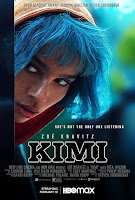
Kimi (2022)
A front-to-back great time. Zoë Kravitz is terrific as the agoraphobic protagonist, and the Rear Window/The Conversation/Blow Out influences feel razor-sharply updated into our pandemic world. I imagine it could have been kind of cringe how it employs these very zeitgeist-y talking points (COVID lockdowns, surveillance capitalism, urban protests, etc.), but in practice, the way the movie has these elements inform the conventions of the paranoid thriller feels very smart and never distracting: a natural result of making a movie in 2021/2022 rather than a self-congratulatory conceptual flourish of having made a movie about 2021/2022. Great stuff. Grade: A-


Drive My Car (ドライブ・マイ・カー) (2021)
Exceptionally patient (3 hours long???) and capital-L Literary (a Murakami adaptation), but ultimately in ways that I ended up really connecting to. The symmetries of the plots and characters scratched the English major part of my brain for the first half of the movie and moved me to tears in the second half, ultimately creating one of the better depictions in recent memory of people grappling with the frayed ends of memories left when someone close to you dies prematurely, and the fear of the profound self-reflection that the engagement with those frayed ends necessitates. It had me thinking a lot about my brother, who died very suddenly of an opiate overdose two and a half years ago, and like the characters in this film, the ambiguities and unresolved nooks of our relationship are haunting, not just for the ways that they represent the loss of my brother but for what they represent about myself. What did he think about what I said in that one conversation ten years ago? What should I have done in that one instance five years ago? With him gone, all that's left is my own interiority in relation to those questions, which can be a cavernously mysterious place. Not sure this needed to be as quite long as it is, but the generous space this movie gives itself with its story is definitely productive, and I wouldn't have connected at all with whatever cool 90-minute version of this might otherwise exists—reminds me a lot of Margaret in that regard. Anyway, cool that a movie this oblique and textured and pointedly international got nominated for the Best Picture Oscar—in a weird way, it fits right alongside my other two favs for the BP (Power of the Dog and Licorice Pizza) in its meandering unpredictability. Grade: A-

Bad Luck Banging or Loony Porn (Babardeala cu bucluc sau porno balamuc) (2021)
What begins as a farce about a teacher whose private sex tape gets uploaded to the internet eventually transforms into a pretty didactic but nonetheless effective treatise of how the moral panics that frequently grip the public perception of education are really proxy wars for broader tensions over the reinforcement/defense of imperialist, racist, capitalist norms. As an educator, it is existentially terrifying to watch this, but then again, watching 60% of school board meetings now is existentially terrifying as an educator, too. At the very least, it's nice to know that this isn't a uniquely American problem, though I can only imagine the looks of befuddlement I would get from some members of the Knox County Board of Education if I started quoting Hannah Arendt to them. Grade: B+

Poetic Justice (1993)
Kind of does the When Harry Met Sally gambit of introducing the male half of the romantic duo by having him spew some blindingly misogynist garbage at the beginning of a road trip (e.g. all women are the same because they all get their periods, ya see) and then daring us to like him on the grounds of his becoming friends with the female half of the romantic duo, despite the fact that he never really changes in this regard. It doesn't work for me nearly as much as it does in When Harry Met Sally because the relationship between Tupac Shakur and Janet Jackson never really comes alive like it does for Harry and Sally; this movie is way too picaresque and easily distracted by interesting environmental/cultural textures like a black family reunion or an African heritage festival or a terrifically lived-in South Central LA beauty parlor for the romance ever to get enough center stage to fill its characters with the sufficient amount of nuance to land the ending. And I guess I don't blame John Singleton for getting distracted, because his facility with those textural details is excellent—I would have actually probably preferred a Before Sunrise-esque walk-and-talk through these cultural landscapes than the more conventional romance we have here. It's easy to see what the movie wants to happen for this pair: Tupac and Janet's shared trauma from gun violence helps them find a deep connection for each other in the end, which helps their love transcend Janet's grief and Tupac's misogynist anger at being functionally a single father; but there just aren't enough dots to connect satisfactorily. That said, whenever this movie spaces itself out and allows itself to meander, it gets really good, and for as much as I feel like the central romance is thin on paper, Pac and Janet having a fair amount of onscreen chemistry on the virtues of them just both being very attractive human beings. Tupac is also a great actor, and even in the scenes that don't completely work in concert with the rest of the film (his discovery of his cousin's murder), he sells his character's emotional journey 100%, which helps a lot to transcend the shortcomings of the writing.

I was part of a conversation about this movie on the Cinematary podcast. Here's the link, if you're interested!


Music

Spoon - Lucifer on the Sofa (2022)
Another Spoon album, another good Spoon album. The band has been making a lot in the press about the way that this album was meant to be more live and spontaneous than their last couple of releases, and Lucifer on the Sofa does share a scruffiness with their notoriously rough-around-the-edges 2010 release, Transference. But also, that press does seem to be underplaying the ways in which this has echoes of the sonic experimentation of 2017's Hot Thoughts, most notably in the title track's use of pensive saxophone but also elsewhere in subtle flourishes. There's something so satisfying about a band who is so reliable in their sound and songcraft but also willing to accumulate subtle new flavors along the way. Grade: B+

Sunday, February 13, 2022

Mini Reviews for February 7 - 13, 2022

Busy week for me this week, hence a small post.

Movies

Jason X (2001)
At long last: The Space One. It didn't disappoint, to the extent that I can even be disappointed by a Friday the 13th movie at this point. It's definitely a significant step up from its immediate predecessors by virtue of its ability to completely let itself go. So many sublimely stupid little tidbits: the fact that it's in space; the part where a person gets turned into ground meat by being sucked through a grate; the part where a guy who got stabbed by Jason twice wakes up from unconsciousness and is all like "What's going on here?" and someone has to remind him that Jason Voorhees is running amok; the part where two characters make out and then say how much their survival chances have increased; the sadly unresolved Pinocchio-esque subplot in which a femme-presenting android wants real boobs; the "we love premarital sex" line, and the part almost immediately after when Jason is just swinging sleeping bags against one another; the fact that Earth 2 apparently has a Crystal Lake, too. I kinda wish the movie had the wherewithal to recognize how golden these moments are and just leaned into them, jettisoning some of the more tedious direct-to-video-esque parts, but maybe that level of self-awareness would make this one lose its ingenue charm as a accidentally awesome cash grab. Also, I love that this movie premiered in Spain a solid six months before its American release, like it's some kind of prestigious festival film or something. Incredible. Grade: B

The Ninth Configuration (1980)
Sure, some people have mental health struggles, but what if the real insanity is... American Imperialism?? I'm not sure how much I'm actually behind the premise of this movie, which is kind of One Flew Over the Cuckoo's Nest by way of Vonnegut, Pynchon, and Catch-22, wherein men in the throes of psychosis are actually just victims of the unspeakable evils of the 20th century and, moreover, prophets capable of both hilarious incongruity and profound insight into metaphysics and religion—a premise that seems at least a little bit dismissive of the conditions of neurodivergence and especially mental illness, which is kind of true of any work of art that uses "insanity" as a metaphor for Society, Man. That said, the singular vision of this movie is truly something to behold, and the way that literally all the characters speak in often very funny, mind-bending stream-of-consciousness non sequitur that, for all its absurdity, builds to a fairly serious interrogation of the existence of God in the face of American Imperialism is impressive and utterly unlike anything I've seen before. Plus, for as potentially ableist as its premise can be, there's something to the mythic undercurrents of it: the Bible talks about how Moses couldn't see the face of God and live, and there's a perverted version of that here, wherein these men, through their experiences in Vietnam, Korea, NASA, and beyond, see the true face of their god (i.e. America) and come away with their brains fried. There is no rational solution to the Problem of Evil that maintains a benevolent, omniscient, interventionist God; there is no rational way to comprehend the abject evil of the American machine and remain devoted to your identity as a subject of that empire. Grade: B

Multiple Maniacs (1970)
Kinda dull and meandering for stretches in a way that I've never felt in other John Waters movies, but also, the scene in the church was maybe the best thing I've ever seen in a John Waters movie (give or take "Surfin' Bird" in Pink Flamingos)—I don't know if this would make John Waters sad or happy to hear this, but watching a passion play cross-cut with Divine being anally pleasured with a rosary was so sacrilegious that it wrapped way back around to being sacred again. Good, unlikely thematic pairing with Benedetta. Grade: B

Sunday, February 6, 2022

Mini Reviews for January 17 - February 6, 2022

Sorry I've missed a few weeks! I just had a couple of really busy weekends in a row. But now you have a really, really long post! Enjoy!

Movies

The House (2022)
Does a major faux pas of anthology filmmaking, which is that it puts its segments in descending order of quality, which makes this movie initially very exciting (the first and most sinister segment is flat-out great) only to have that feeling dissipate over the subsequent hour. Put these in reverse order, and this movie would feel a lot more satisfying. But the stop-motion craft on display here is excellent: major Henry Selick vibes, only de-coupled from any Burton-esque cutesiness. It also continues the trend of Netflix being the greatest streaming service for original animated features—in a lot of (arguably most) ways, Netflix has really become kind of a picked-over bargain bin of a streaming service, but it continues to platform really, really striking animation, which I guess gives me a weird note of optimism about streaming. Grade: B

Last Night in Soho (2021)
After reading all the negative reviews a few months ago, I can't say I'm disappointed. But it is sad to see an Edgar Wright movie that's so dysfunctional. Smarter people than me have talked about the problems of the screenplay, which are deep, but I think this movie's issues are even more fundamental than that. Wright was just the wrong guy for the job; his movies thrive on excessive formal precision, whereas the giallo movies he's clearly trying to evoke here have a ramshackle, shoestring quality where they achieve their magnificent visual overdrive as a function of the feeling that the whole enterprise is going to fly to pieces at any minute. Wright is simply too meticulous to make the hallucinogenic dream logic of a giallo story work, and while the film delivers some pretty cool-looking shots (esp. when the film is focused on dance—Edgar Wright musical, when?), the whole thing feels far too tightly controlled to have the impression that it sprung straight from a feverish psyche, which is so key to the kind of story the film is trying to tell. Sad to see the incredible Persona-esque pairing of Thomasin McKenzie and Anya Taylor-Joy squandered in such a compromised movie, so hopefully someone sees this and gives them the co-starring vehicle they deserve. Grade: C

The Last Duel (2021)
The Rashomon angle doesn't do anything for me, and given that this movie is already pretty long in the tooth by the end, it bears mentioning that this exact same story could have been told once, and the only thing lost would have been the literalizing of the extent to which each of the two principal male characters flatter themselves in their heads. But otherwise, this is pretty solid—I remain unconvinced that Ridley Scott is some Great Artist outside of his justifiably legendary Alien / Blade Runner back-to-back, but the dude clearly knows how to evoke a period setting, in this case a terrifically grimy medieval France, and the climactic duel is undeniably exciting. On the screenplay level, I enjoyed the writing here a lot outside of the Rashomon conceit; Matt Damon, Nicole Holofcener, and Ben Affleck have done a pretty good job here of creating a morality play out of the trappings of a historical epic, and I dig the way that this deflates the mythology of chivalry, often in some very darkly comic ways that I have to imagine are Holofcener's touches (I guffawed at the title card immediately after Damon's triumphal exit from the arena that tells us his character died in the crusades soon after). I would be interested in what this movie would look like if it were just Holofcener at the writing desk—probably something I would like a lot better, though of course this isn't bad. I just wish it were shorter and punchier. Grade: B

Halloween Kills (2021)
I'm tempted to play the so-bad-it's-good card here, because I was chuckling at my TV basically the entire time. But it's not good. Not on any metric. It's a movie only notable for its bravery to be a classic train-wreck bad movie in an industry where "bad" usually means soullessly competent IP management nowadays. Amazing that it only took two movies for a franchise reboot premised on classing up the bad sequels to end up producing a sequel as bottom-tier as anything I've seen from the original franchise. Grade: D-


The Killing of Two Lovers (2020)
This movie's reliance on slow-cinema-adjacent long takes that fill its scenes with productive emptiness intrigued me, but ultimately, this fell apart on a screenplay level for me. We're given an interesting dramatic irony at the beginning (we know dude wants to murder his soon-to-be-ex wife and her boyfriend, but nobody else does), and then the movie proceeds to do nothing but hammer that same irony again and again over its runtime, with not a ton of development, just new scenes: oh, now this potential murderer is hanging around his wife, oh now he's around his kids (remember, he's potentially a murderer!), etc. It's tense at first, until it becomes clear that nothing is actually going to develop. Too bad, because the cinematic style really is enticing. Grade: B-

The Dead Don't Die (2019)
I've never been especially into Jim Jarmusch, so I'm not sure why I finally decided to watch a movie that almost everyone seemed to agree was minor Jarmusch at best. But here we are. I wasn't especially into it. The more explicitly comedic bits were things that other horror comedies have already done better, and the meta pivot at the end feels like just a lazier version of things that Jarmusch has done before. Not exactly sure why this movie was made, tbh, because it doesn't feel all that interested in doing anything new or even retreading ground well. Great cast, though, and great Sturgill Simpson song/bit. I also enjoyed Iggy Pop's cameo as a zombie. So the movie isn't entirely without its pleasures, I guess. Grade: C+


Smiley Face (2007)
I've now seen three Gregg Araki movies (this, Splendor, and Mysterious Skin), and none of them feel anything like one another, and yet they all share a kind of spiritual connection just in terms of complete purity of commitment to whatever concept undergirds the movie: in Smiley Face's case, a stoner comedy. I don't think I've ever seen a movie more single-mindedly invested in depicting the mechanics and outcomes of stoner logic—and virtually nothing else. Jane starts the movie high, and literally everything else in the movie follows from there, somehow digressive and yet never straying from its singular concentration on the fact that Jane is high. In one sense, that makes the movie kind of empty: nothing is learned, nothing is "commented on," there's no real character development to speak of. But on the other hand, the distillation of a movie genre to nothing but its most fundamental elements and then putting those elements on full blast for a feature film makes Smiley Face short-circuit the pleasure centers of my brain to a degree that it's impossible to deny how good a time I had here. Credit where credit is due: as talents as Araki obviously is as a director, none of this would have worked in the slightest without a ridiculously committed performance from Anna Faris, who is so completely in-the-pocket here that it makes me sad that (to my knowledge) she's never been given this much free reign before or since. Also, why are stoner comedies so much better when they focus on female characters? Grade: A-

Lovely & Amazing (2001)
I have to respect Nicole Holofcener for writing a movie that looks you dead in the eyes and triple-dog dares you to like any of its characters. To an extent, all of the Holofcener movies I've seen are an experiment in mining pathos from unlikability, but Lovely & Amazing takes that to another level, which is perhaps paralleled in the loathing these women have for themselves. It is very much an unflinching interrogation of the immense damage that beauty standards do to the female psyche, whether those be based on size, shape, age, race, or some intersection of all of the above, and it's honestly excruciatingly tragic to see these characters go through genuine anguish and body dysmorphia and then externalize it in the ways they treat others. Nominally a comedy, but it mostly made me sad. Grade: B+

Dirty Dancing (1987)
Genuinely floored to discover that this movie is set in the early 1960s. I'd seen isolated scenes of this movie on TV when I was growing up, and based on the hair, the clothes, "(I've Had) The Time of My Life," and everything about Patrick Swayze's appearance and demeanor, I'd assumed this was set sometime around the film's production, but then the opening line of this movie is a voiceover telling us how it was the summer of '63, before the JFK assassination and the Beatles, like we're about to watch Happy Days or something, for reasons I can only imagine have to do with justifying the abortion subplot, because otherwise, this movie feels completely uninterested in its period setting beyond only the broadest gestures. Far be it from me to act as if we're living in some comparatively enlightened age, given that we've been stuck in a fairly vapid '80s nostalgia cycle for what feels like my entire adult life, but wow, was that late-'50s/early-'60s nostalgia thing sure could be insipid. The period music absolutely bangs, though, and when it's not butting up against the bland limpness of '80s adult contemporary (what mullet-headed music supervisor thought that the likes of Eric Carmen could go toe-to-toe with The Ronettes and Otis Redding?), it creates a real sense of yearning when mixed with the sweaty, sweaty dance sequences, which are this movie at its absolute best. I found it hard to be very invested in a romance that's trapped inside a screenplay as haphazard as this one, but there is some bona-fide Movie Magic happening anytime the music sets bodies to motion, especially in the justifiably iconic climax. I would have loved it if the rest of the movie had stuck with period-appropriate music and that final scene was this glorious, out-of-nowhere anachronism in which the sheer sweep of the dance's sex energy broke reality itself to bring "(I've Had) The Time of My Life" into 1963, rather than the movie foreshadowing that moment on its soundtrack throughout the preceding 90 minutes. But whew, still a great moment. Grade: B

P.S. I also was part of a Cinematary podcast discussing this episode. You can listen to it here if you're interested!

Hollywood Shuffle (1987)
Conceptually interesting: more or less an anthology of sketches illustrating the systemic discrimination within the Hollywood machine and double conscious required for black actors to navigate it. It's a very angry film, and satirically, it's got good ideas. But the problem is that very few of its jokes actually land. This wouldn't be a problem if it were more of a satiri-tragic blast of righteous fury in the vein of Bamboozled, a movie with which this movie shares a good bit of DNA. But for as angry as it can be, Hollywood Shuffle also seems to find itself funny, and unfortunately, I just don't. As a result, the skits just amble on for far too long without having much to offer beyond their original satiric idea. I did think the There's a Bat in My House thing was pretty funny, but otherwise, this was mostly falling flat for me. Grade: B-

Desperately Seeking Susan (1987)
I was a little perplexed at its diffuse, rambling plot until I read afterwards that the movie was inspired by Céline and Julie Go Boating, and then it all clicked. This is absolutely about two women sharing a mystical connection as they drift through a major city. It's not nearly so strange nor as transcendent as the Rivette movie at its best, but it's also half as long and has "Into the Groove," one of the GOAT Madonna songs, which isn't nothing. I had no idea that it was from this movie until it came on during a gloriously meta moment of Madonna (in her peak "hot Madonna" era, no less) bopping to her own song in a club. So of course this movie is good. Shout out also to Rosanna Arquette—the whole cast, actually, which is unilaterally great, but especially Arquette, who is the soul of this movie and is able to go toe-to-toe with an exceptionally magnetic Madonna. Grade: B+

Nickelodeon (1976)
Not without merit, and the first half in particular is filled with some glorious tribute/pastiche of early silent-era filmmaking, including a bunch of gags and pratfalls that wouldn't feel out-of-place in a Harold Lloyd picture. But boy, does Bogdanovich's fixation on a sentimentalized history cut both ways. On the one hand, the affection for this era of filmmaking is contagious, and it's hard not to be caught up in the period detail and scrappy outsider stories this film depicts. But on the other hand, Bogdanovich's unfettered love for the era completely obliterates any judiciousness in editing, and as this movie's second hour swells with historical anecdote after historical anecdote one after the other, the entire film just deflates until its own shapeless weight. And that's to say nothing of Bogdanovich's uncritical eye toward the movies at the time. I can understand the impulse to only barely comment on the black/brownface and anti-indigenous storytelling prevalent at the time (I'm not sure how a direct condemnation of those things would have fit into this movie, which I guess is probably part of the problem), but to wholly embrace the thoroughly-debunked mythology of The Birth of a Nation and moreover frame your entire climax around a bunch of white people enraptured in what is called, without challenge, "the best movie that will ever be made" feels like willful apathy toward the consequence of that film. There's "maybe this film is a little dated" and then there's "this movie was used at a recruitment tool for the KKK," and Nickelodeon completely doesn't care about the difference between those two. Movies don't have to be historical critiques of course, and there's a place for a movie existing in a fantasized past. But there's something irritating about Bogdanovich's insistence on making a movie self-consciously from the perspective of his being a student of film history while also being fairly cavalier with the history itself. To be honest, though, I probably would have been more forgiving of that ending if the preceding hour hadn't been such a slog, so who am I to judge? Grade: C

The Gospel According to St. Matthew (Il vangelo secondo Matteo) (1964)
I often find Italian neo-realism to be a little dry, and The Gospel According to St. Matthew, Pier Paolo Pasolini's Italian neo-realist Jesus movie, is a little dry, especially for the way that it is basically adapting the titular gospel verbatim (with a few omissions and restructurings). But also, its status as an Italian neo-realist feature is what makes this movie so striking at times, too. Its use of nonprofessional actors and dusty 20th-century Italian landscapes do more to ground the life of Jesus to the universal struggle of common people against oppressors than any other cinematic version of Jesus that I've seen, an effect reinforced by the stunning collection of anachronistic musical choices, which range from Civil Rights hymns to Bach to Congolese liturgy to Southern blues. Taken as a whole, it feels like the movie is arguing that for Jesus to be resurrected means not just a traditional bodily resurrection but also the resurrection from being entombed in the specifics of a particular time period and the text. Pasolini's assertion that this movie is "the history of Christ plus two thousand years of Christian storytelling" foregrounds Christ's democratization, the collective ownership of Christ: Christ is everywhere and belongs to everyone and as such is intrinsic in the work of collective justice, not unlike what Richard Rohr would call the "Universal Christ." On a more personal note, it's also really inspiring to see such great unibrown representation. To everyone who told me to shave it in twain: if the single brow was good enough for the Son of God, the Only Begotten of the Father, Emmanuel, well then by golly it's good enough for me. Grade: B+

Grand Illusion (La Grande Illusion) (1937)
Renoir's WWI POW melodrama is a lovely salute to pan-European (and specifically European, unfortunately) solidarity in contrast to nationalism, and it's got a great roster of characters who are hard not to love. I've always loved The Great Escape, which obviously takes a lot of cues from this movie but also ends up with a far less rosy and idealized depiction of humanity, which maybe makes sense in the context of something like WWII (and implicitly the Holocaust/atomic bomb, whose consequence casts an incredibly long shadow over common human solidarity in the 20th century and beyond). So I think I'm maybe feeling a little distanced from the optimism of this movie, but as an ideal, it's beautiful. Grade: B+


Television

I Think You Should Leave with Tim Robinson, Seasons 1 & 2 (2019-2021)
I'm not really sure how to review a sketch comedy show, or even how to review its seasons individually, but I thought this was a good one. Tim Robinson's characters' tendency to double down on a mistake rather than simply own up to it and move on is very funny, and I'm sure there have been essays written about how this is "about Our Current Moment." Not sure if I could write those essays, but I laughed a lot. Grade: B+


Nathan For You, Season 1 (2013)
I know I'm behind the times watching this, but I've got HBO Max now, so the world is my oyster, baby! So anyway, everything I've ever heard people say about this is on the money: a convergence of prank show with the "let's help a failing business" reality TV that's gut-bustingly hilarious while also being occasionally profound and poignant. You will believe that people will hike a mountain and camp overnight solving riddles and sharing their fringe medical beliefs and forge friendships in the process, just to get an $11.93 rebate on gas! Grade: A-


Eastbound & Down, Season 1 (2009)
This wasn't for me. I'm bummed, because I've been hearing positive things about it since it aired. But I guess in the end, I've seen enough shows involving a washed-up anihero narcissist trying to navigate a life in which they have increasingly less control that I'm going to need them to be a cut above the rest to pique my interest—like, say, BoJack Horseman, which is not only a much funnier show but also in a context that I am much more prepared to understand the inside jokes for (Hollywood, as opposed to professional baseball). One day, I will find a Jodi Hill/Danny McBride project I will connect with! Unfortunately, this one wasn't it. Grade: B-

Monday, January 17, 2022

Favorite Movies of 2021

As with music, I don't have a lot to say about movies this year. I'm just exhausted by discourse of most kinds at the moment, and I don't really feel like adding to it in this little preamble. It was nice to be able to see movies in theaters again, but also, having a second child now (a good thing!) made going to the theater harder than ever, which made me sad: I would have loved to have seen Malignant or All Light, Everywhere or Pig in a big dark room with strangers. And then there are the theatrical experiences that streaming stole from us: The Power of the Dog, Luca, etc. As much as it deeply grieves me to say so, theatrical distribution seems to be on the way out, an outcome specifically engineered by studios and streaming platforms more so than by audience consent. But as long as theaters are there showing non-MCU movies, I'll be there. Here's to 2022, which will hopefully at least be a better year for movies, if not anything else in this world.

My usual disclaimer that I didn't get a chance to see all movies, including some movies I really wanted to, still applies, of course. Licorice Pizza [ed: since writing this but prior to publishing it, I saw Licorice Pizza, and it definitely would have made my top 5 if I'd felt up to changing my list last-minute], Drive My Car, A Hero, Titane, and many others I simply didn't get to, either because of the usual distribution wankery (why, in this era of digital distribution, we still have to go through the "exclusive to NYC and LA" dog and pony show rollout is beyond me) or because I couldn't get out to the theater in time.

As always, I would love to hear what movies other people enjoyed this year. Movies are best when shared, so share them!

Anyway, on to the list.


Favorite Movies

1. The Power of the Dog
This movie has only grown on me in the weeks since I first saw it. Truly top-tier work from everyone involved. We need more psychological thrillers that are westerns; we need more Benedict Cumberbatch performances that are this good. We need more Jane Campion movies in general.

[Read original review]


2. The Green Knight
Probably the movie I have thought most about this year. It's proven to be a divisive movie among audiences for reasons I can understand (and for some reasons I cannot—the anti-A24 brigade baffles me), but this revisionist take on a required-reading classic is catnip for overthinking English teachers such as yours truly. I yam what I yam.

[Read original review]


3. Benedetta
A fairly rigorous interrogation of church power dynamics and body theology, disguised as nunsploitation. Paul Verhoeven, you sly dog.

[Read original review]


4. The French Dispatch
Wes Anderson going completely ham on his fussy diorama sets and mid-century nostalgia. Maybe not his absolute best (the Frances McDormand character is a weak link, for sure), but it's certainly his absolute most, which is an unqualified good in my mind.

[Read original review]


5. West Side Story
I'm a little sad that this didn't end up finding much of an audience, becoming a pretty resounding flop; makes me wonder what the future is for movies like this. But whatever. At least Spielberg got his musical, and we got a great revival of the classical craft of the form.

[Read original review]


6. Dune
Just an impeccably designed, written, and acted space opera adaptation of a source material I never would have expected to be reproduced so coherently. I've grown increasingly cantankerous about franchise filmmaking as time has gone on, but I'm happy to sit back and enjoy this new franchise.

[Read original review]


7. Old
Silly and profound in equal measures. Mostly I'm just impressed at how much control Shyamalan has over His Thing these days. Dude is making the movies he wants to make, and he's making them well, daring you to like them in spite of (or because of) their idiosyncrasies. Where else in any media would you find a rapper named Midsized Sedan?

[Read original review]


8. Barb and Star Go to Vista Del Mar
Longtime (or probably even shorttime) readers will know that I don't go for modern comedies very often. My sense of humor is just too square/out-of-step with current trends to find a lot of film comedy that funny, and I've made my peace with that. But this, now this is a modern comedy I can get behind. Austin Powers if he were a pair of wholesome midwestern biddies. This movie has occupied more space in my head than any other movie this year.

[Read original review]


9. Malignant
This movie is completely bonkers in all the right ways. Three left turns make a right, and this movie has at least three left turns. James Wan making his career-best film by completely committing to this magnificently absurd little horror gem after having helmed Aquaman is my favorite flex of the year.

[Read original review]


10. maɬni – towards the ocean, towards the shore
A complex rumination on indigenous identity intertwined with an achingly beautiful mood piece about the natural world. If you're scared of the avant-garde, this is a great way to dip your toe in.

[Read original review]


Appendix: Miscellaneous Movies Also Worth Noting

Experimental Documentary Runner-Up: All Light, Everywhere—This was actually my #10 until Malignant bumped it, and it has a certain spiritual kinship with my current #10 in terms of style and status as an unconventional documentary. Like maɬni, this splits the difference between some exquisitely beautiful footage set to a terrific ambient score and a more high-minded essayic treatment of the topic. In All Light, Everywhere's case, it's mass surveillance. It wanders less than maɬni and therefore has less of a capacity for unexpected wonder (hence it not making the top-10 cut), but it's nonetheless stunning and 100% worth your time.

Animation Corner: The Mitchells vs. The Machines—In a strikingly weak year for English-language feature-film animation, it's sort of a backhanded compliment for me to call The Mitchells vs. The Machines my favorite animated film of the year, because truth be told (as it was in my original review), I wasn't in love with the movie. But the animation is tremendous, a genuine step forward for the medium, so I have to give it props for that.

Underrated Animation Corner: Luca—Pixar has gotten itself into a strange kind of bind where if it isn't some swing-for-the-fences ambitious, emotionally fraught film, it's a sign of the studio's retreat into mediocrity. But I thought this was really good, and really good in a solid, modest way that a lot of American animated films struggle to be. Normalize the value of making well-made, low-stakes movies.

Biggest Surprise: Bad Trip—It's well-documented how much I dislike Jackass/Punk'd-style hijinks, so I shouldn't have enjoyed this movie, a gonzo blitz of Jackass/Punk'd-style stunts taped together into a feature-film narrative. But I did enjoy it; a whole lot.

"Stressed Out, But in a Good Way" Award: Shiva Baby—A sublime pileup of dramatic tensions. It would be one of the year's funniest, too, if my heart rate weren't so high.

"Ya Gotta Hand It to Them" Award: Annette—This didn't end up being my cup of tea, but it so completely commits to being the bizarre object that it is that I have nothing but respect for everyone involved.

"Soderbergh's Still Soderberghing" Award: No Sudden Move—After a while, I run out of things to say about Steven Soderbergh, who so consistently delivers films that I enjoy a whole lot but never quite love enough to commemorate in my top 10. His most recent, a pitch-black crime caper starring a murderer's row of performers, is the latest in that line of "great but not quite top 10" material.

"Schrader's Still Schradering" Award: The Card Counter—Not his best by any measure, but Paul Schrader has definitely nailed his "God's lonely man" formula in the sense that he knows how to recycle the tropes over and over again while making little tweaks that help each one feel fresh in its own way. Also, I got an essay on this film published at Fare Forward, so I have a soft spot for this one.

"Making Me Squirm" Award: Red Rocket—I watched a lot of edgy stuff in 2021, but nothing made me more uncomfortable than watching the Simon Rex's character try to prey on Suzanna Son's character. The discomfort is entirely The Point, so I guess good job, Red Rocket.

Best Scene from a Movie Not in the Top 10: Pig—The scene where Cage's character meets a former employee, who has opened a trendy restaurant. It builds from what initially seems like a sad juxtaposition of Cage's isolated, lowly existence with the opulent world he left, only to then pivot to Cage's character gives the most withering dressing down possible of that poor guy, all while implicitly commenting on the devaluing of art and meaning within a capitalist system. Incredible.

Best Kill: Fear Street: 1994—Without a doubt my favorite part of all three Fear Street movies was when that poor girl's head goes through the bread slicer. I know I am a sick man.

Worst Movie of the Year: Fear Street: 1666—Looking back through my reviews for this year, 2021 had a fairly high floor in terms of how much I liked the movies I saw, hence this movie, which I thought was merely "meh" (along with all of the Fear Street movies) being my least-favorite.

Best Non-2021 Movie I Saw for the First Time in 2021: The Rapture—This bizarre, frightening treatise on faith and God basically hasn't left my mind since I saw it back in October, and I probably haven't thought about a single movie this year more than this one, except maybe Noah (because I wrote that gigantic essay on it), which occupies some of the same thematic territory. What can I say: I love movies about spiritual anguish and movies that are weird adaptations of biblical material.

Sunday, January 16, 2022

Mini Reviews for January 10 - 16, 2022

Should *finally* be publishing my post about my favorite movies of 2021, so be on the lookout for that if you're interested. Unfortunately, I wrote most of it before I made this post, and I'm too lazy to update it, so it will be sans Licorice Pizza and Macbeth, both of which would have had a good shot at being in my top 10.

Movies

Licorice Pizza (2021)
I was completely captivated by Paul Thomas Anderson's rambling, completely unpredictable nostalgia ode to a '70s Southern-Californian, showbiz-adjacent adolescence. A lot of people have compared this to Altman, and that's probably what's immediately in PTA's head here, but what this actually reminded me of is the fiction of Beverly Cleary and the other mid-century children's lit in that mode (I'm thinking also of Robert McCloskey's Homer Price and Keith Robertson's Henry Reed): mildly precocious children going through a series of episodic, idiosyncratic misadventures that over the course of a novel build to an emotionally nuanced character arc. Obviously Licorice Pizza is the aged-up, swearing version of that and is willing to go to far weirder places than the books I just mentioned (the incredible gas shortage/Bradley Cooper sequence being perhaps foremost among them—probably my favorite 15 minutes of any 2021 movie), but it has the same lackadaisical structure, sense of semi-improvised whimsy, and psychological precision that grounds those books (especially Cleary's), as well as being preoccupied with the same specific coming-of-age dynamic: that feeling of being out-of-place in your current age bracket but also struggling to adapt to the stage of life beyond it. Lots of people have already written about the pleasures of the top-tier cast and hyper-specific period details, and they're right, but I'm guessing I'm the first to make the Ramona Quimby connection. Regardless, I had a great time with this movie. Grade: A-

The Tragedy of Macbeth (2021)
As a direct adaptation of the play itself, this one's just fine; with the exception of an incredibly lively Stephen Root as the porter, all the other actors rise precisely to what is asked of them, but no higher—Denzel's performance, for example, is exactly what I would have expected from a "Denzel Washington is Macbeth" pitch, which is only disappointing in so far as I would have liked to have been surprised. Textually, it's a fairly standard interpretation of the Shakespeare material, with just enough twists to hold attention: McDormand and Washington are basically playing their respective roles with the exhaustion of middle age, and there's also the way the screenplay intentionally foregrounds the loose ends and ambiguities of the original play, e.g. Fleance's survival and Lady Macbeth's off-stage death. But as a cinematic object, this movie is absolutely superb. The academy-ratio B&W cinematography is exquisite, as is the penchant for directly evoking German Expressionism with its lighting. And the sets are magnificent; perpetually cloaked in fog (a Kurosawa reference?), the architecture of the soundstages this was filmed on flits in and out of view, Ozymandias-eque monuments to human ego that slip into the abyss as easily as a human life. And what architecture! These imposing slabs of what looks like concrete and stone give Castle Inverness the sense of a haunted Brutalism: empty, monumental, a mausoleum for those already living. I loved every single frame of this movie, and if the actual Shakespearean elements don't blow me away, the look of it more than makes up for that. Grade: B+

Cryptozoo (2021)
Accepting the animation style (basically, somewhat talented doodles of the sort Napoleon Dynamite may have put in his high school notebooks, animated in an extremely limited framerate plus psychedelic effects) is a huge ask for audiences, but I thought it was cool—it's obviously stilted at times, but it's also capable of some moments of striking beauty in a way that definitely makes it feel like a step up from Dash Shaw's previous feature, My Entire High School Sinking Into the Sea. It's got a better screenplay than that other one, too: a metaphorically freighted action-adventure involving the way an oppressed class (in this case, the mythical creatures, aka "cryptids"—kind of an iffy allegorical stand-in for oppressed peoples/animals, but you're going to have to roll with it alongside the animation if you want to enjoy this movie) ping-pongs between the ways that the U.S. government wants to use the creatures' powers to crush leftist movements and the ways bleeding-heart folks condescend to and commodify these creatures in the titular zoo in the name of "inclusion" and "representation." The movie bites off way more than it can chew, but it's reasonably thoughtful in doing so and also looks like absolutely no other movie you've seen (except for Dash Shaw's other work). Grade: B

MLK/FBI (2020)
This is right at the intersection of "a basic primer on information I already knew" and "I would rather have read a book on this," neither of which are my favorite genres of documentaries. But this is well-made on a subject that more people should always know about, and it's impressively unflinching (not a given in this type of documentary) about the connection between anti-communism and anti-racial equality, both institutionally in America and in the general white population more broadly. So completely predictable to see all the good white Christians who ostensibly idolize King turn frothing at the mouth with racialized anti-left hatred whenever Black Lives Matter or Critical Race Theory comes up, and I suppose there's value in anything that connects (if only implicitly, as this movie does) that sort of behavior to its truly unsettling historical parallels. Wish this movie would have done more to talk about the ways that the state still surveils dissidents, too, as if that all ended with COINTELPRO—get out of here with your "dark moment in FBI history" justifications, Comey. Grade: B

Finally Got the News (1970)
A memorable, if a bit basic document of the League of Revolutionary Black Workers in Detroit. What strikes me as I look back at these activist documentaries from the '60s and '70s is just how much was lost over the neoliberal 1980s onward (and especially the post-Cold War '90s/2000s) in terms of anticapitalist organizing in the United States. I'm under no delusions that groups like the League of Revolutionary Black Workers were mainstream in the United States, but they were active and helped bring about effective change through a clear-eyed critique of capitalism that was basically nuked to hell by the unfettered power of capital during the eras of Reagan, Clinton, etc. It's taken decades for labor to build back a vocabulary of anticapitalism as precise as is articulated in this documentary, and even now, it's hard to imagine too many people walking around a workplace organizing by explicitly talking to people about surplus value or whatever. Maybe I'm just out of touch and people have more radical class consciousness than I'm giving them credit for, but I certainly don't have that, and there's something tragic about looking back at that astoundingly articulate vanguard '60s/'70s moment and knowing that it would go into retreat for so long—but also inspiring to know that even in the U.S., such a vanguard was possible (and maybe could be possible again). Grade: B


Television

A Series of Unfortunate Events, Season 2 (2018)
I'm not sure I have much more to say on this show now than I did for its first season. All of the same strengths apply (great cast, terrific fidelity to the wit and thematic arc of the books, etc.) as well as some of the same misgivings (particularly the foregrounding of the conspiracy elements rather than keeping them as intriguing breadcrumbs at the story's margins, though this is slightly less of an issue as the series get to adapting the books where the conspiracy began to take a more prominent role). What strikes me this time is that this series is much, much more focused on the adults of this universe than the books are, which is either an effect of centering the conspiracy or the cause of centering the conspiracy—either way, doing so kind of wrests large portions of this story from the Baudelaires; the realization that you aren't the main characters in the world but merely pieces of a larger whole is something the books eventually include, too, but it's interesting that the show's fixation on the adults forces this realization much earlier in the series than in the books, where it was a slowly dawning revelation over the course of the series's back half. I guess as with the conspiracy, I prefer the slow reveal rather than the all-at-once thing the show does, but these are mild complaints. On the whole, I enjoy this series, despite whatever Snicket says. Grade: B

Sunday, January 9, 2022

Mini Reviews for January 3 - 9, 2022

Hey, I got HBO! I'm cool now.

Movies

Malignant (2021)
A deranged, no-holds-barred throw-down against any sense of "respectability" that horror as a genre has tried to gain for itself in the past decade. James Wan goes absolutely bonkers with his camera, whipping that thing around in wild, virtuosic spins, and everything else in the movie follows suit. The plot kind of resembles one of those toothpick-and-marchmallow towers you had to build in middle school science class, where the facts at how ludicrously this thing is assembled and how shakily it reaches its heights aren't problems but the entire premise of the appeal, and if you aren't going to cackle gleefully as the movie pulls rug after rug out from under you, you're not going to like this movie. I was on-board as soon as it starts getting silly after its admittedly tepid warm-up half hour, though, so I had a great time. Really wish I could have caught this in a theater. Grade: A-


No Sudden Move (2021)
A quirk in my phone plan got me HBO Max*, so now I finally get to check out Soderbergh's two movies he did for them (and that HBO probably wouldn't have put out on physical media for years). This one's good! A really, really terrific film noir screenplay from Ed Solomon, who wrote things like the Super Mario Bros. movie, the Bill & Ted movies, etc.—surprise of the century that he has a movie this grimy and menacing and tightly written in him. It's no surprise that this material attracted Soderbergh; he's been directing crime thrillers about the perils of capitalism since I was in elementary school, so it probably would have been more of a shock if it hadn't turned out good. People don't seem to like the fish-eye lens used throughout, but I thought it looked cool. Grade: A-

*Also, I've been out of the HBO ecosystem for most of my life, so I'm open to suggestions on what series to watch. Assume I've already seen the big ones like The Sopranos, because I have!

Cry Macho (2021)
Too cute by half and doesn't have anything real to say about the US-Mexico border, despite that figuring prominently into the plot. But it is nice to see Clint palling around rural Mexico and making friends, and this movie has its low-key charms as long as it sticks to that. Grade: B-


Let Them All Talk (2020)
Second HBO Soderbergh I've seen! This one is also very good. It's basically a distillation of Soderbergh's proclivity with talented ensembles, and almost nothing else. Allegedly, most of the scenes in this movie were improvised, and you can kind of tell because of all the stammering, but also, it's an incredible exhibition of just how magnetic a great actor can be with a character given the right framing. Dialogue wanders with inventively circuity around the characters' relational dynamics, but always lands exactly where it needs to to advance to the next scene or plot beat; I've seen a lot of people compare it to jazz, and that sounds exactly right to me, capturing that same live-wire energy and virtuosity that can make a jazz performance so riveting. It's a spacious, generous movie, but also a tight one in its own way, and I was never bored. This is pretty near top-tier Soderbergh for me, though given that almost all his movies are hovering in the B+/A- range for me, it's not a super high ceiling to clear. Grade: A-

S He (女他) (2018)
An incredibly inventive stop-motion film using shoes and other found objects as stand-ins for oppression under the modern state; given its cycle of revolution-->oppressive new normal, I don't know that it would be accurate to classify it as anti-capitalist, as I've seen some people do—maybe anti-industrial and anti-hierarchical, but it seems to be going broader than a specific political system. Whatever; it's still cool. I wish I could be as over-the-moon about this as some people are, but I think the version I watched (tried both Amazon and Tubi) is broken. I can't be sure that this isn't intentional, given the already experimental nature of this thing, but it looked like the film's frames got slightly jumbled in the conversion to whatever file these streaming services are using, and as a result, the whole thing has this jittery, almost strobe-like look that was kind of hard to watch. Would love to know if other people had this experience and if this is the intended effect. If it is, then I don't like that effect.

EDIT: Okay, I rewatched this on Plex (never heard of that streaming service? Me neither!) and confirmed that the Amazon and Tubi versions were broken. Plex is the way to go! Seeing this with a lot more clarity now. On the one hand, I'm even more in awe of the technical prowess on display here; truly jaw-dropping craft, so much so that I'm bumping this up from what I had originally rated it. On the other hand, now being able to follow the story a lot better, I think I am going to have to change my take and agree with the consensus that this is anti-capitalist—though of a kind of Animal Farm variety that's ultimately not so much concerned with the theory of deconstructing capitalism as much as it is with the ways that the oppressions and hierarchies present within capitalism can manifest themselves in other systems, too, so long as they are reliant on the same kind of industrialism that subjugates bodies and the planet. So far so good, except that this movie frames it in gendered terms, which is kind of cool for the way that it shows the limitations of the "more female CEOs" line of thinking and how the enforcement of gender roles is a way of upholding modes of production but also feels pretty iffy in the ways that it evokes trans identity (especially given the English title and tagline). I genuinely don't know what to do with this movie's relationship with transness, and the film is opaque enough that I couldn't say for sure that it's transphobic, but I can't say for sure that it isn't transphobic either. For that reason, I'm hedging my bets by not rating this even higher, but know that this is absolutely amazing in most other aspects—heavily reminiscent of The Wolf House and 1986's The Pied Piper in terms of its grotesque, mind-melting animation, so if you were at all into those movies, SEEK IT OUT (but on Plex, though). Grade: B

The Adventures of Mark Twain (1985)
It's more or less a Twain anthology, and the decision to focus on Twain's later, less-read works like The Mysterious Stranger (which provides the film's lone top-to-bottom great segment) is extremely cool. But given that, it's pretty disappointing how aggressively dopey the execution of so much of it is. This is a fairly niche reference, but the writing and voice acting (esp. for the vapid children—character from The Adventures of Tom Sawyer for some reason) reminded me of those episodes of Adventures in Odyssey where the kids would jump in the Imagination Station to live through some edges-sanded-off depiction of American history or The Bible or whatever, and while it's impossible to turn Twain (and especially his unrelentingly cynical late career) into something as leadenly wholesome and whitewashed as Focus on the Family's radio-drama versions of beloved white Christian myths, there's an aw-shucks folksiness to this movie's relationship with Twain that overlaps a little bit with that, mixed with those "Read" library posters and an anachronistic dash of The Pagemaster. Even so, the general thematic arc of the film is kind of wild in its obsession with mortality (if I'm still on my Odyssey analogy, it's basically "The Mortal Coil" with a secular-humanist gloss—why do I remember so much about Adventures in Odyssey?), and the claymation yields some genuinely incredible imagery, especially near the end with the Halley's Comet sequence. It's kind of sad that outside of the extreme polish of Aardman, clay-based stop-motion has basically gone extinct, because in its heyday, the medium's capacity for rough-edged phantasmagoric worlds was something special. Grade: C+

The Wiz (1978)
The pacing and some of the creative decisions early on (why is Munchkinland so dimly lit?) make it pretty clear why short-sighted audiences and critics didn't respond well to this upon release. But holy cow, this movie is magnificent for long stretches, including the entire last 45 minutes. Michael Jackson is a revelation to me as the Scarecrow, the colors, set design, and choreography are jaw-dropping, and the cinematography does the thing that a lot of '70s musicals did, where it mixes scuzzy '70s grime with the aesthetic maximalism of the musical genre's 1950s heyday. I wasn't initially sold on Diana Ross as Dorothy, but good lord does she sell it by the end, especially in the final song, "Home." It's incredible that in a movie as ostentatious in its style makes its most ostentatious stylistic flourish in its final minutes with that one-take medium close-up of Ross decontextualized from any scenery, just absolutely belting "Home" at the top of her lungs as tears pour down her face—maximalist minimalism of the highest order. This is kind of a tangent, but I'd also be shocked if the "Home" sequence wasn't a direct inspiration for the "Fools Who Dream" sequence in La La Land, and I'm also shocked that for as much as The Discourse surrounding La La Land involved people excavating its influences and pointing and sneering at how La La Land was allegedly a weaker/less pure pastiche of its predecessors (unfair, but whatever), nobody mentioned The Wiz and how much "Home" and Ross completely and totally eclipse anything "The Fools Who Dream" and Stone are capable of. Not sure if it's fair to say that The Wiz needs to be reclaimed, given as I understand it that it was never really lost on the black audiences it was made for. But it certainly surprised me. Grade: A-


Television

Dear White People, Volume 4 (2021)
Conceptually, one of the most baffling final seasons of a show I've ever seen. There are a couple of things here that defy explanation. Firstly, the season is given a framing device where the characters are sitting around sometime in the future (I think it's supposed to be the late 2020s/early 2030s, though I don't remember it ever being clarified) reminiscing about the events of Volume 4 as we see them unfold—I suppose we get to see where these characters ended up in their careers, but none of that proves to be particularly illuminating, and anyway, the framing mostly is an outlet for tired jokes about Zoom and "oh no, the pandemic never ended." The second and far harder bizarre creative decision to swallow is that as the characters flash back to the events of the season, they remember them as a '90s R&B jukebox musical, complete with reality-breaking choreography. And, like..... what?? Dear White People has always been a stylistically arch series, but having characters suddenly break into song (and not just any song but distractingly famous songs) is such a radical break from the show's normal that I have to ask: why? We get a few clever recontextualizations of lyrics, some nice dances, but that's about it. It's an extremely tall request for an audience to go along with the series blowing up its format like this, and in return, there's no immediate thematic payoff or urgency to it, much less a suitable explanation. I do kind of admire the sheer audacity of the concept, but the concept itself is just never justified enough to warrant the dissonance of its inclusion. People joke about Community's "gas leak year," but this genuinely feels like the writers were in a chemical-induced fugue state. I might be more charitable about this stuff if the season didn't also feel like a major step down in terms of writing. There's a thematic throughline about the tensions between working within the system vs. tearing the system down, and the season does a reasonable job of showing why someone would choose the former despite believing in the latter. However, the moment-to-moment dialogue and character development feels strained and thin, diluted by the musical sequences and the constant flashing back and forth between the framing device. Plus, the catalyst for this tension is a new character named Iesha Vital, a freshman activist who attacks the cast (especially Sam) from the left. It's not a theoretically bad catalyst, and like most of the characters on the show, Iesha is premised on a contemporary political archetype. But Iesha never feels like she's given the life and messy humanity that the rest of the show's cast is afforded, and on a political level, the show seems unduly skeptical of her political motivations. In fact, the series makes the questionable decision to have her be somewhat disingenuous in her critiques of the older cast, being propelled by what the series explicitly labels as "immaturity" and emotional confusion. In the past, Dear White People has done a great job having imperfect people in ideological dialogue with one another, and oftentimes the show uses interpersonal psychology to inform its characters' politics. But Iesha's characterization feels strikingly slim on generosity, and even at the end of the season, when she's made more sympathetic, she's still a fairly flat character. I dunno, it's just a weird look for a show that's usually so sharp in terms of evoking current extremely online political discourse that it fails to believably render this dynamic. Just another miscalculation in a season full of them. An exceptionally disappointing end to what has perennially been one of Netflix's freshest shows. Grade: C


Books

Appleseed by Matt Bell (2021)
Wildly ambitious climate change fiction (a real genre now, it seems). The novel tells three parallel stories: one of a mythical faun and his human brother in late-1700s Ohio, another of ecologically collapsing late-21st century when the world's resources are owned by a tech giant run by a Jeff Bezos/Elon Musk analog, and the third thousands of years in the future as a 3D-printed cyborg searches for the last remnants of human civilization—all three tales riffing on Johnny Appleseed, the Orpheus myth, and biblical echoes to form an arc of North America under human industrialism. It's clear that Bell knows exactly what he's doing; the novel's plausibility is extremely stressful (as are all clear-eyed looks at the titanic realities and frightening possibilities of climate change), and its mythological preoccupations are inventive and often profound. I was sure that a novel with so many threads and sweeping ideas would spin out of control by the end, finishing on an unsatisfactorily tangled attempt to tie everything together, but astoundingly, Bell lands this incredible machine with the most elegant series of pages in the entire novel as he dovetails all three stories in the book's finale. The novel isn't perfect (it has a habit of over-explaining itself in the late-21st century story), but it's compelling nonetheless, not to mention impressive: a fully realized treatise on the fatal incompatibility of our planet's health with humanity's compulsion to subjugate, which reads not like a treatise but like a myth. Grade: A-